Itineraries
Thailand itinerary: 3 weeks from Bangkok to Koh Lanta
Three weeks is the length at which Thailand stops being a highlights reel. There is room for the old capitals as well as Bangkok, for Chiang Rai as well as Chiang Mai, and for three different Andaman bases instead of one compromise beach. This route moves six times in 21 days, never asks you to sleep somewhere for a single night, and keeps two of the long journeys on scheduled trains that you can watch the country from. It ends with four slow nights on Koh Lanta, which is the right way round: the hardest travelling happens while you still have the energy for it.
In this guide
Find the location ↗ — opens in a new tabThe short answer
Book 20 nights in seven bases—Bangkok 3, old Sukhothai 2, Chiang Mai 4, Chiang Rai 2, Phuket 3, Phi Phi Don 2 and Koh Lanta 4—and fly from Krabi (KBV) to Bangkok on day 21 for the flight home. Reserve the international arrival and departure, the Chiang Rai–Phuket flight, the Phi Phi room and the two Bundhaya speedboats first, then the rooms, then the mountain and island outings. Two prices set the tone: foreign admission to the Grand Palace was 500 baht and Wat Pho 300 baht when checked on 26 October 2026, and Bundhaya listed the Phuket–Phi Phi speedboat from 800 baht per person and the Phi Phi–Koh Lanta boat from 700 baht, both labelled all year. All in, the 21 days cost about THB 76,500 per person, THB 153,000 for two sharing a room, before international flights; that includes the day-21 Krabi–Bangkok flight.
- Suggested time
- 21 days (20 nights)
- Route
- Bangkok 3 nights
- Sukhothai 2 nights
- Chiang Mai 4 nights
- Chiang Rai 2 nights
- Phuket (Kata) 3 nights
- Koh Phi Phi 2 nights
- Koh Lanta 4 nights
- All-in budget on the ground
- About THB 76,500 per person, THB 153,000 for two Full breakdown ↓
- Season and timing
- November to February is the easiest window: the Andaman sea is calmest, and the northern days are cool enough for a mountain and a long cycle. TAT places the Andaman south-west monsoon from May to October, so from May onwards keep the north and Bangkok and swap the Andaman finish for the Gulf version in the Thailand islands guide. The Pollution Control Department identifies January to May as the northern smoke-haze risk period, which is the one argument for travelling in November or December rather than March.
- Day by day
- The 21 days at a glance ↓
The 21 days at a glance
One line per day, with where you sleep each night. Times, prices and bookings are in the day sections below.
- Day 1
Arrive in Bangkok
a riverside or Phra Nakhon room and an evening within walking distance. Night: Bangkok.
- Day 2
The royal city
the Grand Palace, Wat Pho and the Chao Phraya. Night: Bangkok.
- Day 3
Ayutthaya
Wat Phra Si Sanphet and Wat Chaiwatthanaram. Night: Bangkok.
- Day 4
North to Sukhothai
by train to Phitsanulok and a car to the old city. Night: Sukhothai.
- Day 5
Sukhothai by bicycle
Wat Mahathat, Wat Si Sawai, Wat Sa Si, the Ramkhamhaeng National Museum and Wat Si Chum. Night: Sukhothai.
- Day 6
Train to Chiang Mai
a travel day. Night: Chiang Mai.
- Day 7
Lanna temples
Wat Chedi Luang, Wat Phra Singh, Wat Phra That Doi Suthep and Wat Pha Lat. Night: Chiang Mai.
- Day 8
Doi Inthanon
Night: Chiang Mai.
- Day 9
Royal Park Rajapruek
and a slower Chiang Mai day. Night: Chiang Mai.
- Day 10
Bus to Chiang Rai
and the Clock Tower in the evening. Night: Chiang Rai.
- Day 11
Chiang Rai's temples
Wat Rong Khun, Wat Rong Suea Ten and Baan Dam. Night: Chiang Rai.
- Day 12
Fly to Phuket
and on to Kata or Karon. Night: Phuket.
- Day 13
A southern loop
Wat Chai Thararam, the Big Buddha, Karon Viewpoint and Promthep Cape. Night: Phuket.
- Day 14
Phuket Old Town
the Moh Seng Historic House and mi Hokkien. Night: Phuket.
- Day 15
To Phi Phi
the speedboat from Rassada Pier to Tonsai. Night: Phi Phi Don.
- Day 16
The boat day
Maya Bay and Phi Phi Leh. Night: Phi Phi Don.
- Day 17
To Koh Lanta
the speedboat to Sala Dan. Night: Koh Lanta.
- Day 18
The four-island day
Night: Koh Lanta.
- Day 19
Inland and east
the Thung Yee Peng mangroves and Lanta Old Town. Night: Koh Lanta.
- Day 20
A free day on Lanta
Night: Koh Lanta.
- Day 21
Leave
the road to Krabi.
Twenty nights, seven bases and the order to book them in
The night count is the plan: Bangkok on nights 1–3, old Sukhothai on 4–5, Chiang Mai on 6–9, Chiang Rai on 10–11, Phuket on 12–14, Phi Phi Don on 15–16 and Koh Lanta on 17–20, with departure on day 21. Nothing is a one-night stop, and each base has a job: Bangkok for the royal city, the river and Ayutthaya; Sukhothai for the first Thai capital at cycling pace; Chiang Mai for Lanna temples and two very different mountains; Chiang Rai for the contemporary temples and a town evening; Phuket for a southern sightseeing loop and a Sino-Portuguese old quarter; Phi Phi for the limestone bays; Lanta for the part of the holiday where nothing is booked.
Book from the outside in. Fix the international arrival into Bangkok and the departure from Krabi first, then the Chiang Rai–Phuket flight, the Phi Phi room and the two dated Bundhaya speedboats, because those are the smallest-capacity links in the chain. The seven rooms follow, then the day-10 Greenbus seats and the Chiang Mai mountain days, and last the weather-sensitive boat day on Phi Phi. Keep the Ayutthaya, Doi Inthanon and Phi Phi boat days movable within their stays; city admissions, bicycles and ordinary meals need no advance booking.
Two of the long journeys are trains, and that is deliberate: the State Railway's northern line links Bangkok, Ayutthaya, Phitsanulok and Chiang Mai, so days 3, 4 and 6 need no domestic flight. The transport guide covers the sleeper option and SRT's D-Ticket booking site; the only flight between bases is the day-12 hop from Chiang Rai to Phuket, which crosses the whole country in about 2 hours 15 minutes.
If you would rather move five times than six, drop Phi Phi and give Koh Lanta six nights: the Rassada–Sala Dan corridor still works, and the four-island outing from Lanta covers the same kind of scenery. Do not use the spare days to add Pai or the Gulf islands as well; each would mean a one-night stop or another flight across the country.
Advisories. On 26 October 2026 the UK FCDO advised against all but essential travel within 20 km of the land border with Cambodia, where the land crossings are suspended, and to Pattani, Yala and Narathiwat provinces, four districts of southern Songkhla and the Hat Yai to Padang Besar train line. This route goes to neither. Other governments draw their own, sometimes wider, lines.
Days 1–3: the royal city, the river and a day in Ayutthaya
On day 1, go from Suvarnabhumi to one riverside or Phra Nakhon room and keep the evening to walking distance. Public taxis queue on Level 1 of the main terminal between Gates 4 and 7, with the meter plus a 50-baht airport surcharge paid to the driver. The Airport Rail Link station is on Level B1 and runs from 05:30 to 24:00. The arrival card and the visa-exemption rules for your passport are in the entry guide.
Give day 2 to one connected old-city story rather than a list of temples. Start at the Grand Palace, where the ticket desks sell only from 08:30 to 15:30: foreign admission was 500 baht on 26 October 2026, covering Wat Phra Kaew and the Queen Sirikit Museum of Textiles, and the dress code excludes sleeveless shirts along with the other items the palace lists. Inside, Wat Phra Kaew holds the Emerald Buddha, carved from a single block of jade, among Ramayana murals, guardian giants and a model of Angkor Wat. Walk on to Wat Pho, open 08:00–19:30 at 300 baht, home of the 46-metre reclining Buddha and still a centre of traditional medicine and Thai massage. Finish on the Chao Phraya: the orange-flag express boat calls at Tha Chang (N9) beside the palace. Spend the evening in Yaowarat, Bangkok's Chinatown, for a bowl of noodles.
Make day 3 the Ayutthaya day and keep the Bangkok room. The historical park is spread across an island town ringed by rivers, which is why a half-day never works: the brick prang and monastery platforms are scattered among streets, not gathered in one compound. Train 7 leaves Krung Thep Aphiwat at 07:30 and reaches Ayutthaya at 08:23, a scheduled 53 minutes; ordinary train 201 leaves Hua Lamphong at 10:15 and arrives at 12:15. Express seats are sold on SRT's D-Ticket site and ordinary tickets at the station. Admission for foreign visitors is 80 baht per ruin or 300 baht for the flat-rate ticket.
Start at Wat Phra Si Sanphet, the former royal chapel inside the palace grounds, a temple without resident monks whose three aligned chedis are the image of Ayutthaya; allow about 45 minutes for the chedis and the surviving hall and bell-tower remains. Break for lunch in the town, then take a tuk-tuk or hired car out to Wat Chaiwatthanaram on the west bank, built by King Prasat Thong in 1630, where a central prang and eight surrounding towers catch the late light; stand back far enough to see how the towers frame one another. Come back for night 3 and eat near the hotel: the next morning is an early train north, and you will want the bags packed before dinner.
If you arrive late on day 1 or lose a day to weather, the Ayutthaya guide sets out which temples to keep when the day is short. Do not solve a lost day by moving Ayutthaya to day 4; that train is the one that gets you to Sukhothai in daylight. The FCDO reported severe flooding around Bangkok in October 2026, which is one more reason to keep the Ayutthaya day movable.
Days 4–5: Sukhothai, the first capital at cycling pace
Day 4 is the move north by rail. Train 7 leaves Krung Thep Aphiwat at 07:30 and reaches Phitsanulok at 11:58, a scheduled 4 hours 28 minutes through the central rice plain; later northbound departures are 18:40, 20:05 and 22:30, all arriving overnight. From the station it is a booked car west to Mueang Kao, old Sukhothai, where the historical park sits 12 kilometres from the modern town; the Fine Arts Department names Phitsanulok as the park's railway station. The drive is about 80 km and the car about 1,600 baht, based on Legendha's private-van fare. Arrive, eat near the park and sleep in Mueang Kao.
The air alternative is Sukhothai Airport (THS), about 40 kilometres north of the town. Legendha Sukhothai, the room priced for these two nights, lists its own airport transfer at 300 baht per person in a joined van or 1,600 baht per private van each way. The flight saves the afternoon; the train costs less and leaves you in Phitsanulok, which is also the railway station for Sukhothai if you prefer a sleeper on the way back.
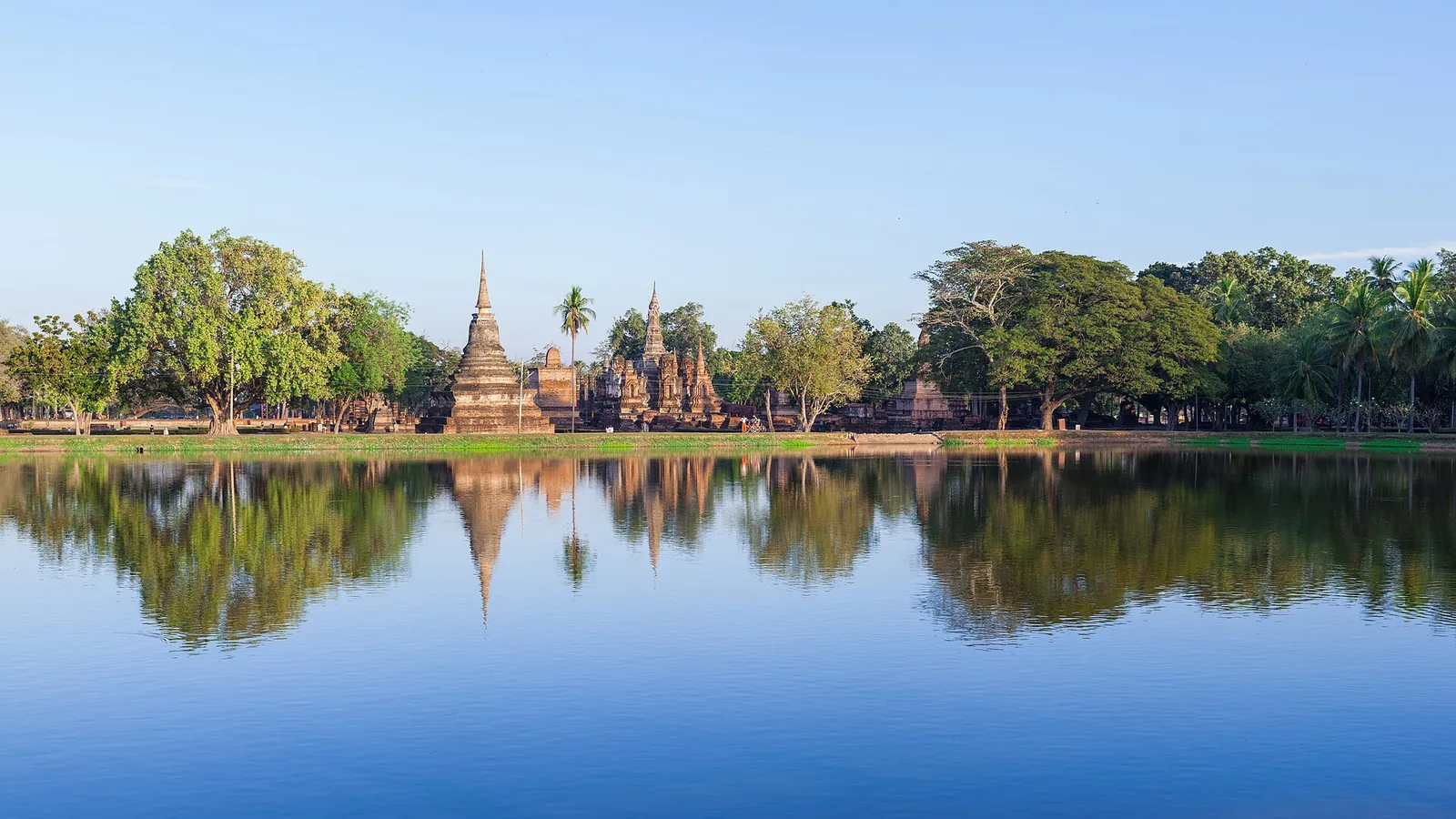
Day 5 is the whole Sukhothai day, and a bicycle is the way to spend it. The old city is a walled rectangle with the main temples inside and more outside the gates, flat enough to ride all day. Start early at Wat Mahathat, whose lotus-bud chedi and surrounding platform explain the Sukhothai temple form better than any label, then ride 350 metres south to Wat Si Sawai and its three Khmer-style prangs, and finish the morning at Wat Sa Si, on its island in the pond. Hire bicycles in front of the park at about 30 baht a day; bicycle entry to each zone is a separate 10 baht.
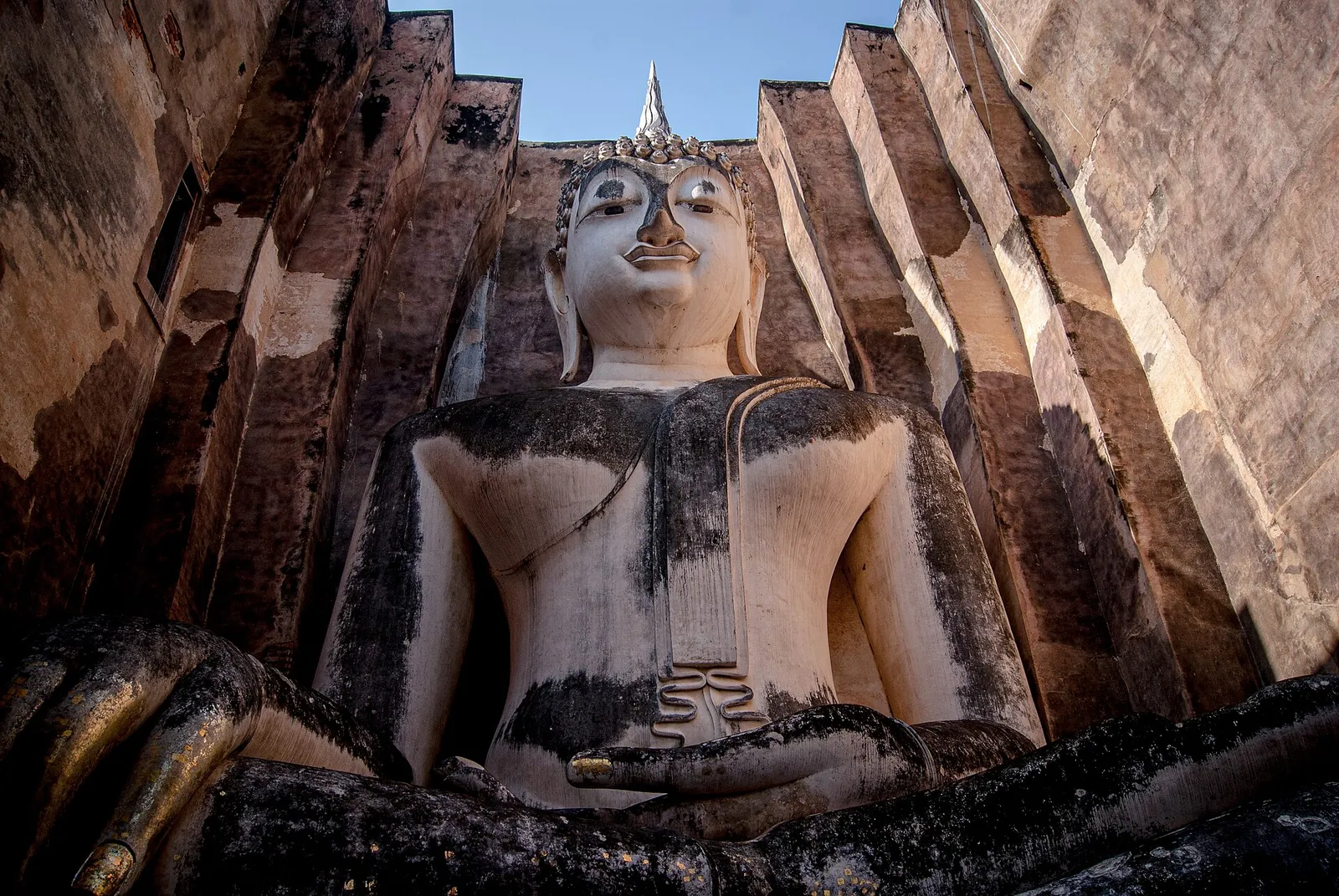
Break the heat with Ramkhamhaeng National Museum, worth a slow two hours for its Buddha images, inscriptions and ceramics. Then ride north through the gate to the pair outside the walls, Wat Si Chum, where the vast seated Phra Achana fills the opening of its mondop, and Wat Phra Phai Luang, whose laterite prangs belong to an older Khmer tradition. Both close at 17:30, so leave the museum by about 15:00.
Admission and hours, checked on 26 October 2026: the central park opens 06:30–19:30 from Monday to Friday and on Sunday, and 06:30–21:00 on Saturday with the monuments lit; the western Aranyik zone opens 08:00–16:30; Wat Si Chum and Wat Phra Phai Luang open 07:30–17:30. Under the national fee schedule effective 28 May 2025, non-Thai admission is 200 baht for the central zone, 120 baht each for the northern and western zones and 400 baht for the three combined, and 200 baht for the museum. The combined ticket pays for itself only if you add the western zone and its hill temple, which this two-night version leaves out.
Eat Sukhothai's own cooking while you are here. Sriwilai Sukhothai, 1.8 kilometres from the park, serves pla hed, the local fish cake, and pad mee chomphu moo dang, vermicelli with red pork in an egg net; the province is also where the thinner, sweeter Sukhothai pad thai comes from. Then pack for the train: Si Satchanalai, Kamphaeng Phet and the Ban Ko Noi kilns need two or three more nights, which the Sukhothai guide lays out as its own trip.
Days 6–9: Chiang Mai, Lanna temples and two different mountains
Day 6 travels by car and train, and nothing else. Take the morning car back to Phitsanulok, about 1,600 baht again, and board train 7, which leaves Phitsanulok at 11:58 and reaches Chiang Mai at 17:50, a scheduled 5 hours 52 minutes up through Lampang and the Khun Tan hills. Train 407 covers the same line earlier, leaving at 07:27 and arriving at 14:45, if you would rather have the afternoon in the city than the morning in Sukhothai. A car from Chiang Mai station to an Old City room takes minutes; keep that one room for all four nights.
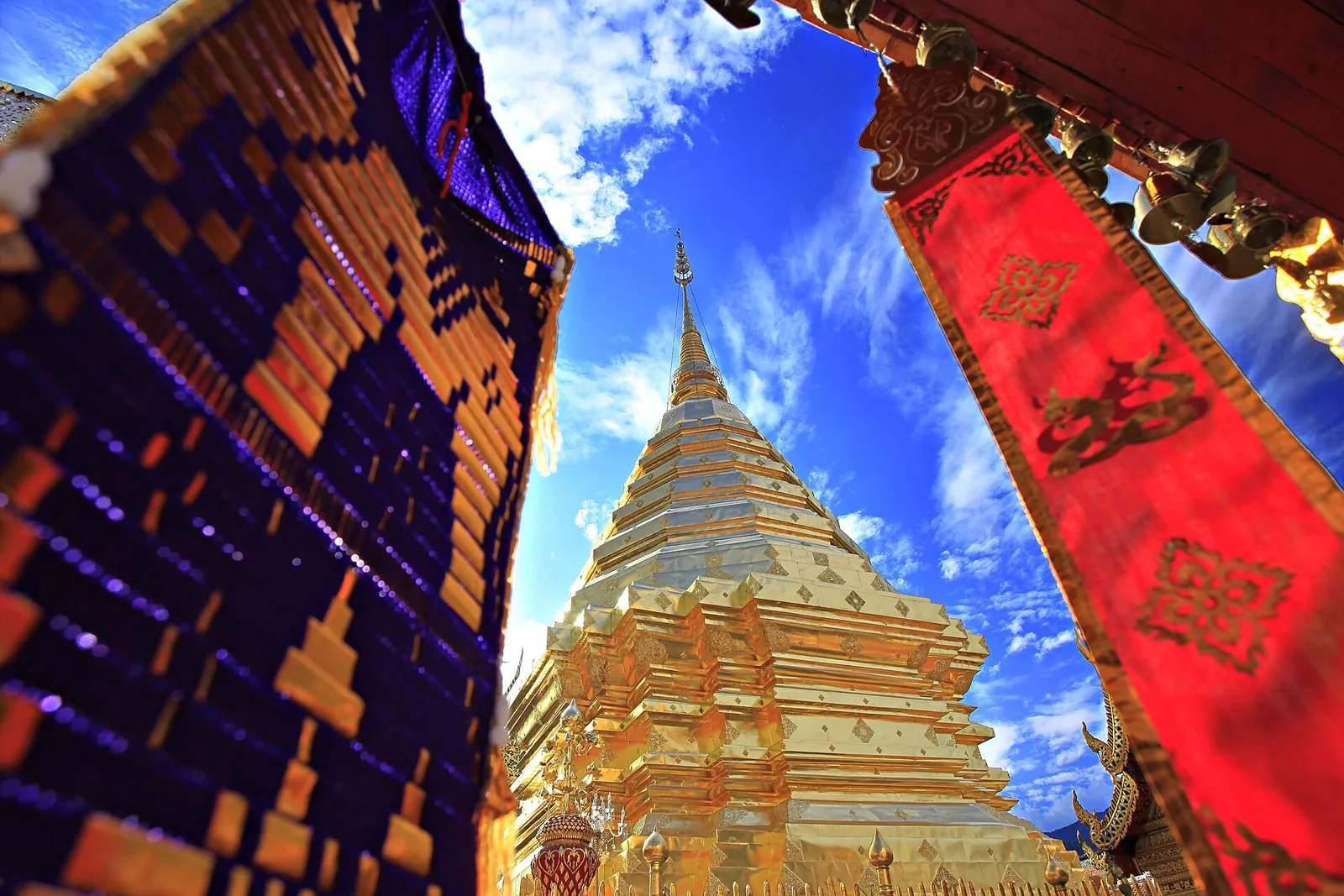
Walk a small circuit on the evening of day 6 or the morning of day 7: Wat Chedi Luang, the great damaged brick chedi in the centre of the walled town, and Wat Phra Singh towards the western moat, with its gilded Lanna interiors and the revered Phra Singh image. Then go up the mountain. TAT puts Wat Phra That Doi Suthep at 1,056 metres, dates it to the late fourteenth century and describes a staircase of over 300 steps, or a funicular, leading to a 24-metre golden chedi, murals of the Buddha's life and the long view over the city; it calls the drive an easy half hour from downtown. Sightseeinggroup's City & Temples + Doi Suthep programme runs 08:30–12:30 at 2,300 baht per person for two people, with hotel pickup and the admissions named in the programme, and a vehicle that pauses at Wat Pha Lat on the way turns the morning into a proper mountain half-day. Keep the afternoon free; this is an active temple, so cover shoulders and knees.
Day 8 belongs to Doi Inthanon, and it needs the whole day. Thailand's highest summit stands at 2,565 metres, around 90 minutes' drive from the city, and the reason to go is the forest, the waterfalls, the Royal Project valleys and the high viewpoints rather than the summit marker itself. Enjoy Life by MJ's joined trip lists 1,500 baht per person including transport, guide, entrance tickets, insurance and lunch; going independently, the Department of National Parks' fee regulation sets admission at 300 baht per foreign adult and 150 baht per foreign child. The DNP closure sheet, with data as of 7 January 2026, closes the Kew Mae Pan nature trail and Namtok Lan Sadet every year from 1 June to 31 October, so in those months build the day around the summit, the pagodas and the waterfalls instead. Take a warm layer: the high ground is much colder than the streets.
Use day 9 for the other side of the north. Royal Park Rajapruek is open 08:00–18:00 at 200 baht for a foreign adult, with Thai and international gardens, the royal pavilion and a tropical plant dome; it is outside the Old City, so it needs its own car. The city alternative is a morning in the temple lanes and at Warorot Market, where the northern food counters are. Either way, end the day in a kitchen: Asia Scenic's Old City courses cost 1,000 baht per person morning or evening, and the farm course 1,200 baht. The evening class becomes dinner, so book nothing else.
Northern haze can decide which of days 8 and 9 is the mountain day: the Pollution Control Department's regional guidance names January to May as the northern PM2.5 risk period and Air4Thai publishes the current readings. Night 9 stays in the same Chiang Mai room, with the bags ready for a morning bus.
Days 10–11: Chiang Rai, where the temples are the work of living artists
Day 10 is the bus, and the bus is enough. Greenbus links Chiang Mai Bus Terminal 3 (Arcade) with Chiang Rai Bus Terminal 1, a road distance of 180 to 185 kilometres that the operator puts at generally 3 to 4 hours, depending on traffic, stops and the service you choose. Greenbus says tickets can be booked up to 30 days ahead; the fare, which can include booking or seat fees, shows on FairFair once you pick a date. Take a taxi or hotel car to the Arcade terminal, add waiting time at both ends, and plan no timed attraction at the far end.
Stay near the Clock Tower, the central market or the Night Bazaar, all within walking distance of Terminal 1. The tower is Chalermchai Kositpipat's work too, so the ornamented imagination you will meet at the White Temple tomorrow is already in the middle of an ordinary street, lit up in the evening. Eat nearby and walk between the tower and the food streets. Two nights here, rather than a day trip from Chiang Mai, is what turns the temples from a photograph into a day.
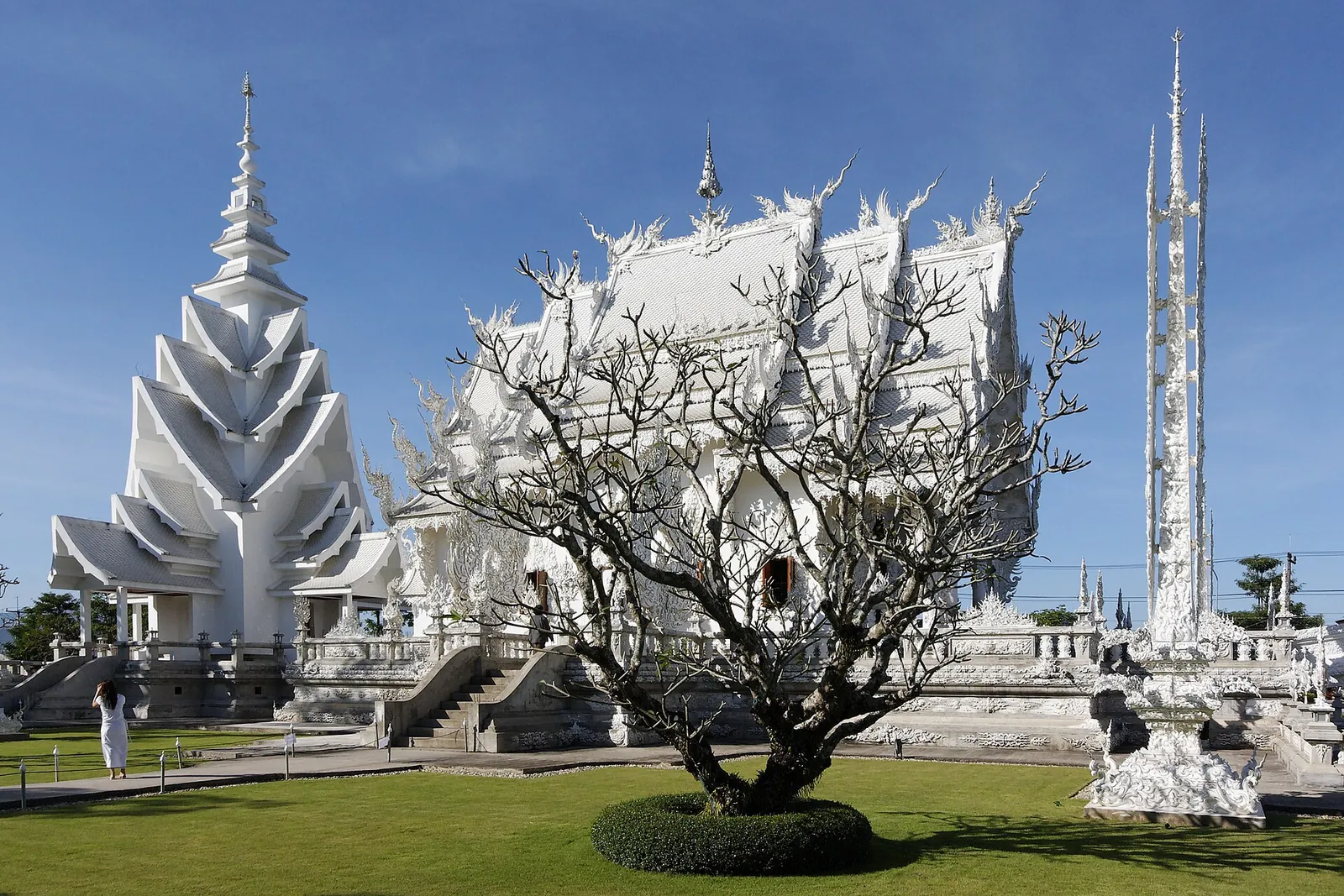
Day 11 starts at Wat Rong Khun, the White Temple, Chalermchai's own temple, where the bridge, the reaching hands and the white mirrored surfaces are as much of the work as the main hall. Admission is 200 baht. Go early, look at the murals inside rather than only the facade, then have lunch before moving on.
The afternoon is Wat Rong Suea Ten, the Blue Temple, open daily 07:00–20:00 with no admission charge, where sapphire blue and gold carry the same contemporary Buddhist imagery in a completely different key. The two temples are not a walking circuit: Booking Taxi Chiang Rai Airport lists a five-hour car at 1,500 baht per sedan for one to three passengers, or 1,800 baht for an SUV, covering the White Temple, Wat Huay Pla Kang, the Blue Temple and the Clock Tower. For a third stop, Baan Dam swaps art for the temples; the Chiang Rai guide compares them.
Day 12 leaves from Mae Fah Luang–Chiang Rai International Airport (CEI), so keep the morning for breakfast and the drive. The Golden Triangle is off this route.
Days 12–14: Phuket, a southern loop and a Sino-Portuguese town
Day 12 crosses the country by air. Thai AirAsia flies Chiang Rai–Phuket direct in about 2 hours 15 minutes, from 2,590 baht on most November and December 2026 dates, with checked bags and seats extra. From the airport the Phuket Smart Bus runs to Rawai through Cherngtalay, Surin, Kamala, Patong, Karon and Kata for a flat 100 baht, with children under 6 free beside a paying adult.
Stay at Kata or Karon for the three nights. Both are west-coast beaches on the Smart Bus line, both put the southern viewpoints within one loop, and both leave an easy road to Rassada Pier on day 15. Kata is the more compact; Karon is the longer, more spread-out strip. Patong suits several late nights, Kamala and Bang Tao a quieter resort stay, and the Old Town is a food-and-architecture base rather than a swimming beach; the Phuket guide sets out the trade-offs. Take the arrival evening at the beach and eat near the room.
Day 13 is one southern loop in one car, not four app rides: about 2,500 baht for the whole car, based on Phuket's published whole-car airport fares. Start at Wat Chai Thararam, usually called Wat Chalong, 8 km from Phuket Town and open daily 07:00–18:00: an active temple with a statue of Luang Por Cham and a holy-water pond, so dress for worship. Then climb to the Big Buddha on the Nakkerd hills above Karon, open 08:00–19:30, a seated figure 45 metres high and 25.45 metres wide covered in white Burmese jade marble and visible from much of the island. Carry on to Karon Viewpoint for the three-beach panorama and finish at Promthep Cape, the island's southernmost point, for sunset. Eat afterwards at Rawai, where the waterfront seafood is.
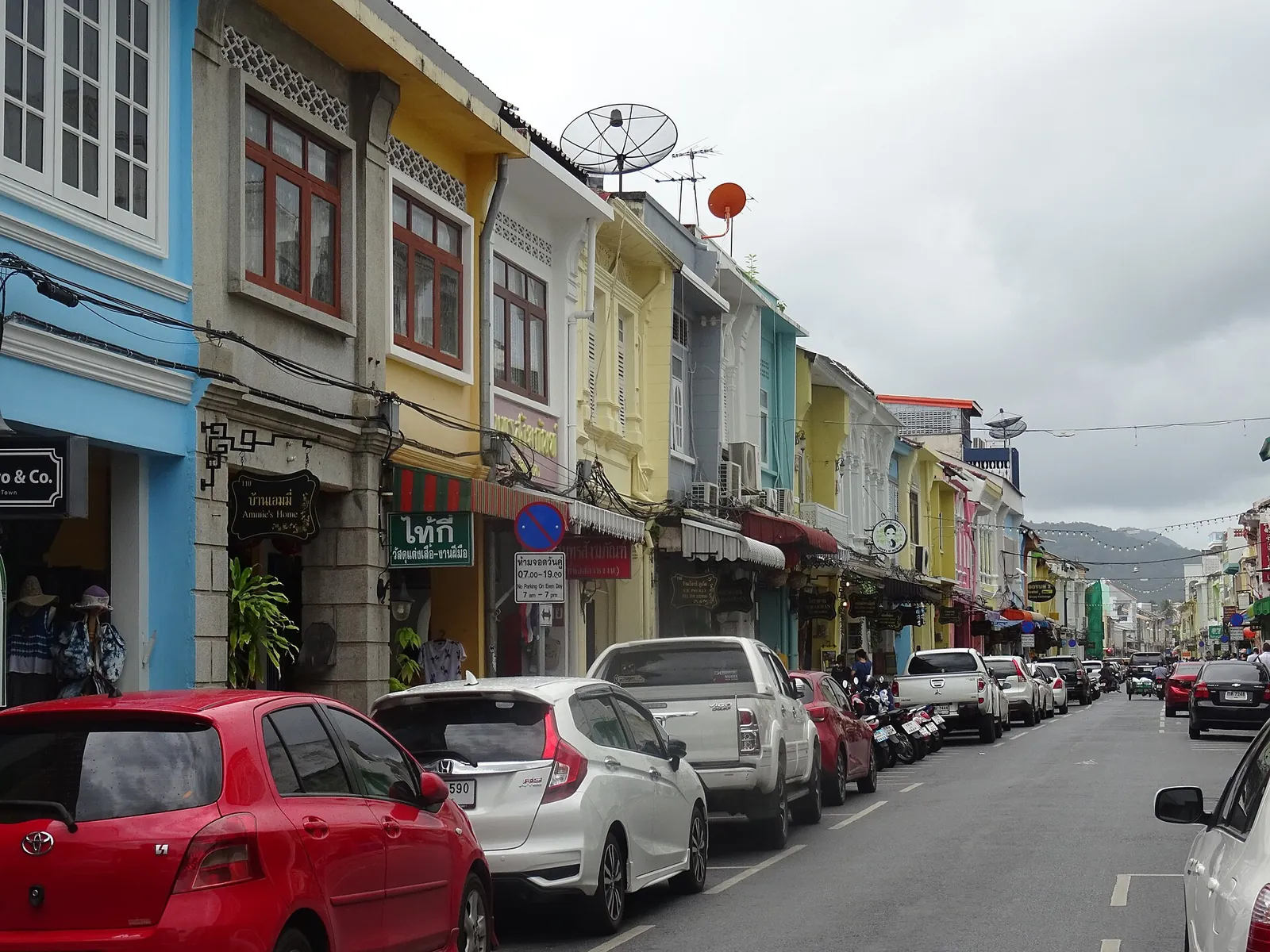
Give day 14 to Phuket Old Town, timed for the late afternoon and dinner. The quarter grew out of the tin trade, and its shophouse grid is still a working town rather than a fenced site. Walk Thalang, Dibuk and Soi Rommanee, and step into the Moh Seng Historic House on Thalang Road, open Tuesday to Sunday 10:00–17:00 at 150 baht.
Lunch is mi Hokkien, the island's Chinese-Malay noodle plate; BAAN 92, the Old Phuket Town Community house, is where TAT's walking tour includes a cooking demonstration by a local chef. Keep day 14's evening unhurried and the bags light for the morning boat.
Days 15–16: Phi Phi Don, and the one boat day worth buying
Day 15 is a short sea crossing. From Kata it is about 19 km by road to Rassada Pier, Phuket's main ferry terminal beside Phuket Town, about 1,000 baht by car, based on Thailand Taxis' airport–Kata fare. Bundhaya's speedboat to Tonsai Pier takes 1 hour from 800 baht per person. The slower choice is Andaman Wave Master's standard-class ferry, which runs daily at 08:30–10:30 and 13:45–15:45, a scheduled 2 hours, at 700 baht for an adult and 600 baht for a child. Andaman Wave Master's own day-tour page lists a Tonsai Pier fee of 20 baht per person.
Walk to the room rather than arranging another island boat. Tonsai village occupies the narrow waist of Phi Phi Don between Tonsai Bay and Loh Dalum Bay, so the afternoon's pleasure is crossing from one waterfront to the other on foot, with a swim and a drink in between. Phi Phi Banyan Villa, the room priced here, is in the village a short walk from the pier. Northern Laem Tong is a separate arrival that would add hotel boats to both the tour and the Lanta departure, so keep the stay beside the pier; our Koh Phi Phi guide covers the bays and the viewpoint climb.
Day 16 is the boat day. Phi Phi Leh's walls, the sheltered bays and the pale sand at Maya Bay are a different landscape from the inhabited bay you slept beside, and the day's pleasure is the sequence of water, rock and short stops rather than a checklist of landings. Maya Bay sits inside Hat Noppharat Thara–Mu Ko Phi Phi National Park: swimming at Maya Bay is prohibited while the reef recovers, so treat it as a beach-and-scenery stop.
Shared-boat price, checked on 3 November 2026: Phi Phi Pirate Boat runs daily from 11:30 to sunset from the Phi Phi Relax Bar on Phi Phi Don at 2,200 baht per person, which it says includes all taxes and fees and the 400-baht national-park entry when you book direct, split as a 300-baht deposit and 1,900 baht paid on the boat. Its page names Maya Bay and Monkey Beach among five or more stops that change with the season, includes snorkelling, kayaking, paddleboarding and a cooked Thai dinner on board, and lists Maya Bay as closed in August and September. Carry baht for the on-board balance: the deposit is the only part you pay online.
The park fee is 400 baht per foreign adult whoever takes you; booked direct, the Pirate Boat price already includes it. The DNP closure sheet, data as of 7 January 2026, also closes Maya Bay, Loh Samah and Lo Ko from 1 August to 30 September, which is one more reason this is a November-to-April route. Sea conditions can cancel any sailing, and that is why the boat day sits on day 16 with the Lanta crossing, not a flight, after it.
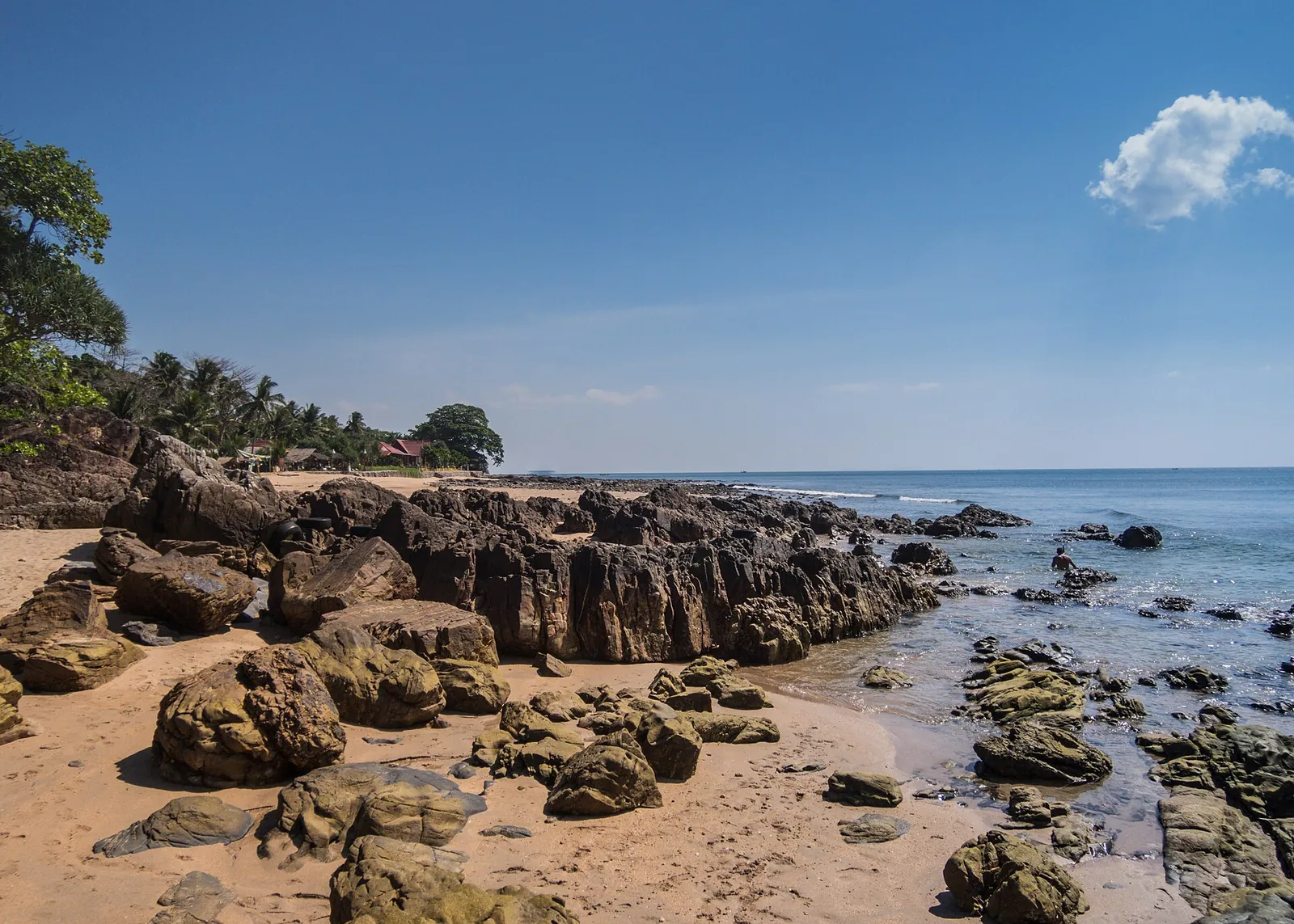
Days 17–21: four slow nights on Koh Lanta, then the road to Krabi
Day 17 is the last crossing. Bundhaya lists the Tonsai–Sala Dan speedboat at 30 minutes from 700 baht per person. At Sala Dan, Lanta's northern gateway, taxis wait for the boats, and the ride of about 10 km down the west coast to Klong Khong is about 400 baht a car, based on the island's airport-car fares. Unpack once and keep the room through night 20.
Choose Klong Khong or Long Beach and stay put. Klong Khong is a long west-coast beach at its best at sunset and low tide; Long Beach gives a broader swimmable frontage closer to Sala Dan. The budget uses Matcha Lanta Resort, a three-minute walk from Klong Khong Beach; Baan Thai Lanta, a villa resort on the same beach at 163 Moo 2, costs more and quotes net rates that include the 10% service charge, the 7% government tax and breakfast for two. A hotel farther south is quieter but adds road time to the pier and to the airport run on day 21.
Day 18 is the four-island day. Baan Thai Lanta's own outing costs 1,500 baht per adult, national park fees included, with lunch on Kradan beach between 11:30 and 13:00; a typical run takes in Koh Mook's Emerald Cave, Koh Kradan, Koh Chueak and Koh Ngai, and the order changes with the tide and the sea state. The DNP closure sheet closes Koh Mook and Koh Kradan from 1 August to 30 September and the Emerald Cave from 1 to 30 September.
Day 19 goes inland and east. Lanta Old Town, on the island's east coast, is a street of timber houses on stilts over the bay, with craft shops and waterside kitchens. Pair it with the Thung Yee Peng mangroves: Koh Lanta Tours runs a half-day Old Town and mangrove outing at 1,095 baht per person with hotel pickup at 09:00 or 13:00 and a return transfer, and the village charges 40 baht per adult and 20 baht per child separately. Paddling a shaded channel explains the island's coast better than another beach.
Make day 20 empty on purpose. Swim between the flags, eat near the room, walk the sand at low tide and watch the sunset from the same stretch twice. If you want one more structured morning, Mu Ko Lanta National Park's land section at Laem Tanot, at the island's southern tip, costs 200 baht per foreign adult.
Day 21 is the road to Krabi Airport, not a boat. Baan Thai Lanta lists a private car to KBV at 2,700 baht for about 88 kilometres, including the inter-island vehicle ferry. Never put an international departure behind a same-day sea crossing; the road and its short vehicle ferry are far less exposed to the weather, although the ferry does not run overnight. If your homeward ticket starts in Bangkok, buy the domestic sector with enough separation for bags and, if you land at Don Mueang, the change of airport to Suvarnabhumi, or add a mainland night to this 21-day plan rather than relying on day 21.
What three weeks in Thailand cost, all in
About THB 76,500 per person, THB 153,000 for two, for all 21 days and 20 nights, before international flights. The seven rooms, every meal and ordinary drink, both trains, the Greenbus, the Chiang Rai–Phuket and Krabi–Bangkok flights with checked bags, every airport, pier and sightseeing car, the two speedboats, the named tours and admissions, two SIMs and a 10% buffer are all in.
| Stay | Per person | For two |
|---|---|---|
| 21 days / 20 nights | THB 76,500 | THB 153,000 |
The budget covers two adults sharing one private air-conditioned room at each base—three nights at Lamphu Tree House in Bangkok, two at Legendha Sukhothai, four at De Lanna in Chiang Mai, two at HOP INN Chiang Rai Clock Tower, three at Kata Palm Resort on Kata Road, two in Phi Phi Banyan Villa's Banyan Wing and four in a double at Matcha Lanta Resort near Klong Khong Beach—on ordinary November-to-February dates outside major holidays, from the arrival dinner to breakfast on day 21. Prices were checked on 13–26 October 2026. Eleven of the twenty breakfasts come with the room; the Chiang Rai, Phuket and Lanta breakfasts are bought. This assumes one short visa-free tourist visit on eligible ordinary passports.
Rooms use the published rates where a hotel states one: 1,450 baht a night in Bangkok with breakfast for two and tax, 5,100 baht for the two Sukhothai nights, 3,600 a night in Chiang Mai with breakfast, tax and service, and 4,600 a room-night on Phi Phi with breakfast and 7% tax. The Chiang Rai night is about 910 baht. The Phuket room is Kata Palm Resort, listed on KAYAK from 1,355 baht a night with VAT when read on 2 November 2026. The Lanta room is Matcha Lanta Resort, listed on Booking.com’s Ko Lanta page from USD 91.33 a night for two adults, about 3,070 baht, when read on 26 October 2026; check the price for your dates.
Food uses about THB 700 a person for a full day—80 for breakfast, 150 for lunch, 370 for dinner and 100 for ordinary drinks and snacks—an estimate for ordinary restaurants. Lanta breakfasts use 150 baht, the breakfast-set price at Baan Thai Lanta’s restaurant on Klong Khong. Eleven hotel breakfasts, the Doi Inthanon lunch, the cooking-course dinner, the Pirate Boat dinner and the four-island buffet are each counted once rather than bought twice.
Getting around covers both long train legs, the two Phitsanulok road transfers, the Greenbus seats, the Chiang Rai sightseeing car, the airport cars at both ends of the flight, the Smart Bus, the Phuket southern loop and Old Town cars, the ride to Rassada, both speedboats, the Sala Dan taxis the 2,700-baht Lanta–Krabi car with its ferry fee, and the day-21 Krabi–Bangkok (Don Mueang) flight at about 4,000 baht for two with checked bags, based on Thai AirAsia's fares from 1,480 baht on many December–February dates, plus a car of about 600 baht between Don Mueang and Suvarnabhumi. The two Phitsanulok cars, the short station and pier rides and the rail seats are estimates, and the two Greenbus seats are about 600 baht together, from the Chiang Mai–Chiang Rai fare of 295 baht a seat that BusAndVan's Greenbus page listed as its lowest when read on 2 November 2026.
Sights and tours keep the Grand Palace, Wat Pho and Ayutthaya tickets, the Sukhothai zones and museum with bicycles, the Doi Suthep half-day, the Doi Inthanon day, Royal Park, the cooking course, the White Temple, the Phuket Old Town museums, the Pirate Boat with its park fee and pier entries, the four-island day and the Lanta Old Town and mangrove outing. Their included meals, admissions and transfers are counted once. Two AIS 30-day tourist plans at 1,199 baht each, plus 7% VAT, cover the three weeks on one SIM per adult.
Flights: about GBP 850–1,000 per person for a London–Bangkok economy return, based on Thai Airways' fares from GBP 849 and GBP 969 on selected dates, seen on 23 October 2026. The Krabi–Bangkok flight on day 21 is already in the total above. With the London return, about THB 114,600–121,300 per person.
If the total is more than you want to spend, cut the paid outings before the night structure. Sukhothai works entirely on a hired bicycle, Chiang Mai can have a market-and-temple day instead of a class, Phi Phi's bays can be seen on a cheaper shared longtail, and Lanta's beach day is free. What does not pay off is shortening the stays: this route is affordable per day precisely because you are not buying a transfer every morning.
- Rooms: THB 57,600 for twenty nights in seven rooms for two.
- Food and drinks: THB 26,100 for two over 21 days.
- Getting around: THB 34,600 for two, including both trains, the two domestic flights and the two speedboats.
- Sights and tours: THB 23,700 for two.
- SIMs: THB 2,600 for two 30-day plans.
- 10% buffer: THB 14,500.
What to eat and where to look
Pla hed, Sukhothai fish cake
A fish cake bound with fresh fish and herbs, named locally as pla hed and served as a Sukhothai speciality rather than a national dish.
- Where to look
- Sriwilai Sukhothai's restaurant, 1.8 kilometres from the historical park, and kitchens around Mueang Kao.
- Fit it into your day
- Dinner on day 4 or 5, with the thinner, sweeter Sukhothai pad thai alongside.
A fish dish; the egg-net noodles on the same menu contain pork.
Khao soi
Chiang Mai's bowl of soft egg noodles in a creamy coconut curry broth with slow-cooked chicken, topped with crisp fried noodles, and lime, shallots and pickled vegetables on the side.
- Where to look
- The Old City Inn, 141 Rachadamnoen Road, inside Chiang Mai's Old City.
- Fit it into your day
- Lunch after the Doi Suthep morning on day 7.
The noodles contain wheat and egg, and the broth is coconut-based with a mixed curry paste.
Sai ua
Northern curried sausage, served as a starter with chilli dips, crispy pork rind and lightly boiled vegetables.
- Where to look
- Chivit Thamma Da on the Kok River in Chiang Rai, whose menu lists a Northern Thai Sausage Platter at 240 baht.
- Fit it into your day
- Dinner on day 10, shared alongside rice and another dish.
Pork, with lemongrass, chilli and curry paste in the filling.
Mi Hokkien
Phuket's Chinese-Malay noodle plate of homemade wheat noodles with seafood and choy sum, the island's lunch noodle.
- Where to look
- BAAN 92, the Old Phuket Town Community house, where TAT's walking tour includes a cooking demonstration by a local chef.
- Fit it into your day
- Lunch on day 14, before the shophouse walk.
The noodles are wheat-based and usually cooked with pork or seafood.
Tom yum kung
Hot and sour Thai soup with prawns and herbs, listed at 210 baht.
- Where to look
- Baan Thai Lanta's restaurant on Klong Khong Beach, lunch 10:30–14:30 and dinner 16:30–21:30.
- Fit it into your day
- Lunch on day 20, the empty beach day.
Prawns and fish sauce; ask for it less hot if needed.
Practical questions
How should I split 20 nights across three weeks in Thailand?
Three nights in Bangkok, two in old Sukhothai, four in Chiang Mai, two in Chiang Rai, three on Phuket, two on Phi Phi Don and four on Koh Lanta, leaving day 21 for the flight home. Every base keeps at least two nights, so no morning is spent packing for a one-night stop.
Is three weeks enough for both the old capitals and the islands?
Yes, if Ayutthaya stays a day trip from Bangkok and Sukhothai gets its own two nights. That gives one full day in each historical park without a third checkout, and still leaves nine nights on the Andaman coast.
Do I need domestic flights for this route?
Only one between bases. Days 3, 4 and 6 use the State Railway's northern line and day 10 uses the Greenbus, so the single flight is Chiang Rai to Phuket on day 12, about 2 hours 15 minutes direct; on day 21 a Krabi–Bangkok flight connects with the flight home.
What if I would rather move five times than six?
Drop Phi Phi and give Koh Lanta six nights. You then take one speedboat instead of two, and the four-island outing from Lanta covers comparable limestone scenery. Do not use the saved day to add Pai or a Gulf island, which would need another flight across the country.
What does three weeks in Thailand cost for two people?
About THB 76,500 per person and THB 153,000 for two sharing one room, before international flights, with all twenty nights, every meal and ordinary drink, both trains, both domestic flights, the boats and cars, the named tours and admissions, two SIMs and a 10% buffer included. With a London–Bangkok return of about GBP 850–1,000 per person, about THB 114,600–121,300 each.
Which month suits this route best?
November to February. The Andaman sea is calmest, Maya Bay and the Lanta island groups are open, and the northern mountains are cool; in November and December the January-to-May smoke-haze period has not yet started. From May to October swap the Andaman finish for the Gulf version in the Thailand islands guide.
Keep planning your trip
Bangkok
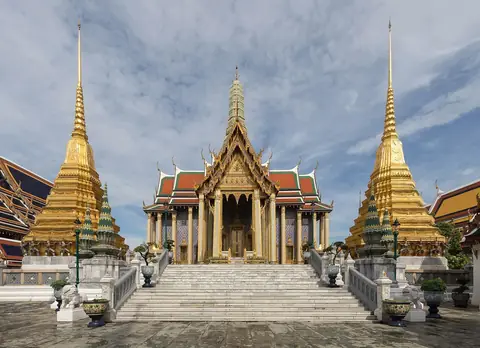
Book three nights in Bangkok: choose a rail or riverside base, arrive from BKK or DMK, visit the palace and Wat Pho, and leave time for Chinatown.
Read the guide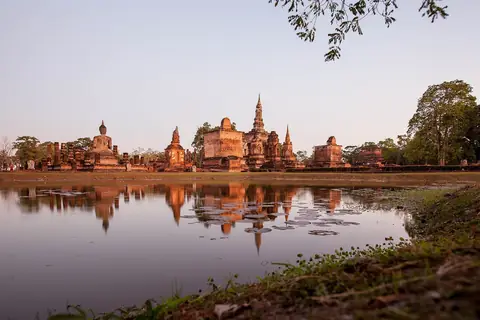
Sukhothai
Plan four nights through Sukhothai, Si Satchanalai and Kamphaeng Phet, with a temple circuit, museum, ceramic kilns and local food.
Read the guide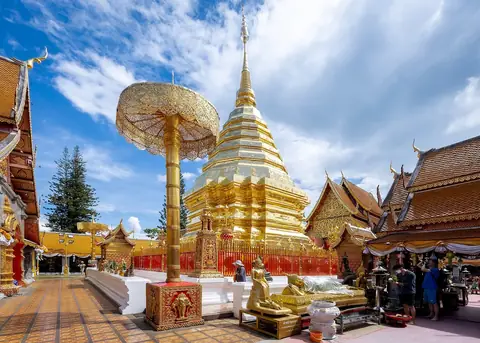
Chiang Mai
Plan five nights in Chiang Mai’s Old City, with Doi Suthep, a cooking class, Doi Inthanon and a guided Lampang–Lamphun day.
Read the guide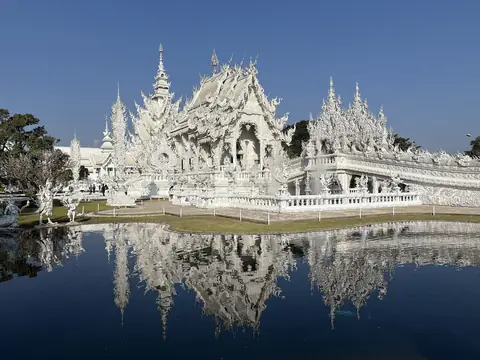
Chiang Rai and Phayao
Plan three nights in Chiang Rai for the White and Blue Temples, Lanna art and Singha Park, with a fourth-night choice of Phu Chi Fa or Phayao.
Read the guide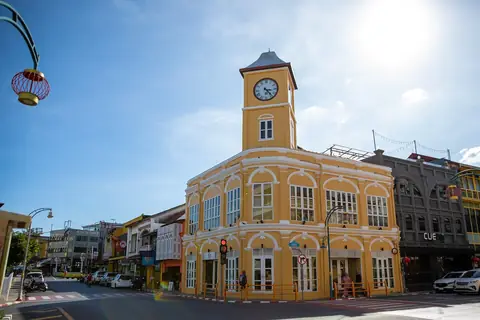
Phuket
Choose the right Phuket base, plan five nights, use the airport bus and budget a Phi Phi or Phang Nga Bay boat day with its park fees.
Read the guide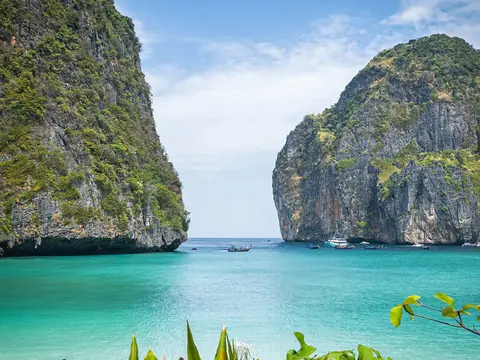
Koh Phi Phi and Maya Bay
Book three nights on Phi Phi Don, choose Ton Sai or a quieter beach, use the right ferry pier and plan Maya Bay around its annual closure.
Read the guideSources and checks before you travel
(61)
- Airports of Thailand: Suvarnabhumi transportation guide ↗ — opens in a new tab
- The Grand Palace: practical information ↗ — opens in a new tab
- Wat Pho: plan a visit ↗ — opens in a new tab
- State Railway of Thailand: northern-line timetable ↗ — opens in a new tab
- Fine Arts Department: Ayutthaya visitor information ↗ — opens in a new tab
- Fine Arts Department: Sukhothai visitor services ↗ — opens in a new tab
- Fine Arts Department: Sukhothai location and access ↗ — opens in a new tab
- Royal Gazette: 2025 national museum and historic-site fees ↗ — opens in a new tab
- Legendha Sukhothai: getting here and its own transfers ↗ — opens in a new tab
- Sriwilai Sukhothai: dining ↗ — opens in a new tab
- TAT Newsroom: Chiang Mai's natural and man-made wonders ↗ — opens in a new tab
- Sightseeinggroup: City, Temples and Doi Suthep half day ↗ — opens in a new tab
- TAT Newsroom: Doi Inthanon ↗ — opens in a new tab
- Enjoy Life by MJ: Doi Inthanon joined trip ↗ — opens in a new tab
- DNP fee regulation (Government Gazette, 9 December 2021) ↗ — opens in a new tab
- Department of National Parks: attraction status sheet ↗ — opens in a new tab
- Royal Park Rajapruek: admission ↗ — opens in a new tab
- Asia Scenic Thai Cooking School: courses ↗ — opens in a new tab
- Pollution Control Department: seasonal PM2.5 risk ↗ — opens in a new tab
- De Lanna: Standard room ↗ — opens in a new tab
- Greenbus: Chiang Mai to Chiang Rai ↗ — opens in a new tab
- TAT Japan: White Temple admission ↗ — opens in a new tab
- Thailand Tourism Directory: Wat Rong Suea Ten ↗ — opens in a new tab
- Booking Taxi Chiang Rai Airport: private sightseeing hire ↗ — opens in a new tab
- AirAsia: Chiang Rai to Phuket ↗ — opens in a new tab
- AirAsia: Krabi to Bangkok (Don Mueang) ↗ — opens in a new tab
- Phuket Smart Bus: payment and fares ↗ — opens in a new tab
- Bundhaya Speed Boat: route table ↗ — opens in a new tab
- Phi Phi Banyan Villa: rooms ↗ — opens in a new tab
- Phi Phi Pirate Boat: shared programme ↗ — opens in a new tab
- TAT Newsroom: Maya Bay regeneration ↗ — opens in a new tab
- Baan Thai Lanta: resort and rate inclusions ↗ — opens in a new tab
- Baan Thai Lanta: own four-island outing ↗ — opens in a new tab
- Baan Thai Lanta: getting here ↗ — opens in a new tab
- Koh Lanta Tours: Lanta Old Town and mangroves ↗ — opens in a new tab
- TAT Newsroom: monsoon patterns by coast ↗ — opens in a new tab
- UK FCDO: Thailand warnings and insurance ↗ — opens in a new tab
- Lamphu Tree House: rates ↗ — opens in a new tab
- AIS: tourist SIM plans and VAT ↗ — opens in a new tab
- Thai Airways: London–Bangkok economy returns ↗ — opens in a new tab
- Bank of Thailand: dated exchange-rate comparison ↗ — opens in a new tab
- Legendha Sukhothai: official site and booking ↗ — opens in a new tab
- HOP INN Chiang Rai Clock Tower: hotel page ↗ — opens in a new tab
- Phi Phi Banyan Villa: contact ↗ — opens in a new tab
- TAT Newsroom: Old City and Yaowarat by MRT Blue Line ↗ — opens in a new tab
- Ministry of Tourism and Sports directory: Wat Phra Si Sanphet ↗ — opens in a new tab
- Ministry of Tourism and Sports directory: Wat Chaiwatthanaram ↗ — opens in a new tab
- Thailand Tourism Directory: Wat Chai Thararam ↗ — opens in a new tab
- Thailand Tourism Directory: Big Buddha Temple ↗ — opens in a new tab
- Tourism Thailand: Old Phuket Town walking tour ↗ — opens in a new tab
- Thailand Taxis — Phuket private-car comparison ↗ — opens in a new tab
- Andaman Wave Master: Phuket to Phi Phi ferry ↗ — opens in a new tab
- Andaman Wave Master: Phi Phi Island day tour (Standard Class) ↗ — opens in a new tab
- The Old City Inn: menu and location ↗ — opens in a new tab
- Chivit Thamma Da: food menu ↗ — opens in a new tab
- Baan Thai Lanta: own restaurant menu ↗ — opens in a new tab
- BusAndVan: Greenbus timetable and fares ↗ — opens in a new tab
- Baan Thai Lanta: 2026–27 villa rates ↗ — opens in a new tab
- Booking.com: hotels in Ko Lanta ↗ — opens in a new tab
- Kata Palm Resort: official site ↗ — opens in a new tab
- KAYAK Thailand: Kata Palm Resort ↗ — opens in a new tab
Reference sources for the version dated 9 November 2026. Confirm opening times, access, transport and conditions for your travel dates.
Photo credits
(6)
Wat Mahathat stands inside Sukhothai's walled central zone, ringed by water and crossed on foot.
Photograph: This Photo was taken by Supanut Arunoprayote . Feel free to use any of my images, but please mention me as the author and may send me a message. (สามารถใช้ภาพได้อิสระ แต่กรุณาใส่เครดิตผู้ถ่ายและอาจส่ง ข้อความบอกกล่าวด้วย ) Please do not upload an updated image here without consultation with the Author. The author would like to make corrections only at his own source. This ensures that the changes are preserved. Please if you think that any changes should be required, please inform the author. Otherwise you can upload a new image with a new name. Please use one of the templates derivative or extract . — opens in a new tab · CC BY 4.0 — opens in a new tab
Changes: Resized and converted to WebP; displayed with responsive crops. · Original photograph and licence details ↗ — opens in a new tab
Wat Si Chum's Phra Achana fills its brick mandapa in the northern zone, a short ride from the walls.
Photograph: Philip Nalangan — opens in a new tab · CC BY 4.0 — opens in a new tab
Changes: Resized and converted to WebP; displayed with responsive crops. · Original photograph and licence details ↗ — opens in a new tab
Wat Rong Khun, the White Temple, opens the Chiang Rai day 13 kilometres south of town.
Photograph: Ddalbiez — opens in a new tab · CC BY-SA 3.0 — opens in a new tab
Changes: Resized and converted to WebP; displayed with responsive crops. · Original photograph and licence details ↗ — opens in a new tab
Doi Suthep's chedi stands above Chiang Mai at about 1,056 metres, up the steps or the funicular.
Photograph: KOSIN SUKHUM — opens in a new tab · CC BY-SA 4.0 — opens in a new tab
Changes: Resized and converted to WebP; displayed with responsive crops. · Original photograph and licence details ↗ — opens in a new tab
Between Lanta's sand beaches the shore turns to rock, which is where the island stays quiet.
Photograph: Dronepicr — opens in a new tab · CC BY 3.0 — opens in a new tab
Changes: Resized and converted to WebP; displayed with responsive crops. · Original photograph and licence details ↗ — opens in a new tab
Thalang Road's shophouses are the centre of the Phuket Old Town afternoon.
Photograph: Christophe95 — opens in a new tab · CC BY-SA 4.0 — opens in a new tab
Changes: Resized and converted to WebP; displayed with responsive crops. · Original photograph and licence details ↗ — opens in a new tab