Sukhothai, Si Satchanalai and Kamphaeng Phet
Sukhothai rewards more than a quick circuit of the famous ruins. Follow the three cities inscribed together by UNESCO and the setting changes from the ponds and lotus-bud chedis of the old capital to Si Satchanalai's ceramic landscape and Kamphaeng Phet's laterite forest monasteries. Four nights give the journey room to breathe: two beside Sukhothai Historical Park, one near Si Satchanalai and a final night in Kamphaeng Phet. The essential decision is transport between the towns; bicycles are for exploring the monuments once you arrive.
In this guide
Find the location ↗ — opens in a new tabThe short answer
Plan four nights: two in old Sukhothai (Mueang Kao), one near Si Satchanalai Historical Park and one in central Kamphaeng Phet. Settle the intercity cars and final departure before paying for the rooms. Under the national fee schedule effective 28 May 2025, non-Thai admission is THB200 for Sukhothai's central zone and THB300 for both Kamphaeng Phet park zones. The primary circuit below adds Sukhothai's northern temples and museum, then Si Satchanalai's walled-city temples and Ban Ko Noi kilns; the western climb and Chaliang are alternatives. Arrive through Sukhothai Airport (THS), with Phitsanulok's airport (PHS) or railway station as alternatives for a booked road pickup.
- Suggested time
- Four nights for all three historic towns; two nights for Sukhothai alone.
- Where to stay
- Mueang Kao for the first two nights; near Si Satchanalai Historical Park for the third; central Kamphaeng Phet for the fourth.
- Season and timing
- Our choice is November to early February for a cycling-heavy visit, with early starts and a midday break.
Follow one five-day circuit, with room for the road
The World Heritage property links Sukhothai, Si Satchanalai and Kamphaeng Phet across 11,852 hectares. Sukhothai was the political and administrative capital, Si Satchanalai a spiritual centre with a ceramic export industry, and Kamphaeng Phet a southern frontier town protecting trade. Follow them in that order to move from the capital's temple forms to the workshops and the forest monasteries.
Choose Mueang Kao, or old Sukhothai, for the first two nights. The historical park is 12 kilometres from modern Sukhothai town. An old-town room makes a midday rest easier; new Sukhothai suits a town-based stay but adds a road journey to each park visit. Put the third night near Si Satchanalai Historical Park, about 80 kilometres from Sukhothai, rather than adding a Sawankhalok hotel transfer to this trip.
For the fourth night, stay in central Kamphaeng Phet, on the town-centre side of the Ping River. The ancient walled city is on the river's east bank, with the Aranyik forest area outside its northern rampart. Leave the last morning for the park and plan a midday or later departure.
Day 1: arrive and settle in Mueang Kao. Use the arrival afternoon for the road pickup, check-in and a meal near the hotel. Keep sightseeing optional so a late flight or train does not displace a paid visit. Sleep in old Sukhothai.
Day 2: central temples, museum and the northern pair. Start early with Wat Mahathat, Wat Si Sawai, Wat Traphang Ngoen and Wat Sa Si, then break for lunch. Give Ramkhamhaeng National Museum the two-hour visit block suggested for the visit, followed by Wat Phra Phai Luang and Wat Si Chum in the late afternoon. Return to the same old-town hotel for dinner; the western zone is not part of this primary day.
Day 3: travel north, then explore the walled city. Keep the morning for the car journey from Mueang Kao, lunch and leaving luggage at the northern hotel. Use the afternoon for Wat Chang Lom, Wat Chedi Chet Thaeo and Wat Nang Phaya, then stay near Si Satchanalai Historical Park. Skip a village detour on this transfer day rather than compressing the temple circuit.
Day 4: ceramic kilns, then the road south. Visit Ban Ko Noi in the morning, collect the luggage and leave the rest of the day for lunch, the car to central Kamphaeng Phet and check-in. Make the evening a town meal and rest, without buying a park ticket for a rushed late visit. Chaliang or Ban Na Ton Chan can replace the kiln morning, not be added to it.
Day 5: Kamphaeng Phet, then departure. Start at 08:30 with Wat Phra Kaeo in the walled city, then visit Wat Phra Non, Wat Phra Si Iriyabot and Wat Chang Rop in the forest zone. Plan the onward leg before you book the rooms: no bus or songthaew timetable from Kamphaeng Phet to Sukhothai is published, so book a car through the Kamphaeng Phet hotel when you reserve. In Sukhothai, continue by coach or by car to Sukhothai Airport (THS) or Phitsanulok. Legendha's page lists Bangkok Mo Chit 2–Sukhothai coaches taking about 7 hours, with Win Tour (0 5561 1039) among the private operators; that page gives the Bangkok-to-Sukhothai direction only, so ask Win Tour for its Sukhothai-to-Bangkok departures. The car's journey time and fare from Kamphaeng Phet to the airport or Phitsanulok are not published either; the hotel can quote them.
Use private cars for the two long hops, Mueang Kao to Si Satchanalai (about 80 kilometres from Sukhothai city) and Si Satchanalai to Kamphaeng Phet. The drive time, distance and fare for either leg are not published, and no company is listed that sells them as one-way hotel-to-hotel journeys, so ask each hotel for a quoted car with luggage collection when you book the room. Times and fares for public buses from Sukhothai bus terminal are not published. With two nights, keep the same old-town base and spend the full day on Sukhothai's central temples, museum and northern pair.
Read the central city through its different temples
Begin inside Sukhothai's rectangular ramparts, formed by three layers of walls and ditches, approximately 1,300 metres wide and 1,800 metres long. Explore the core on foot or by bicycle, stopping inside each compound rather than trying to understand it from the road. The reservoirs, ponds, canals and flood-control system are part of the kingdom's engineering achievement recognised by UNESCO.
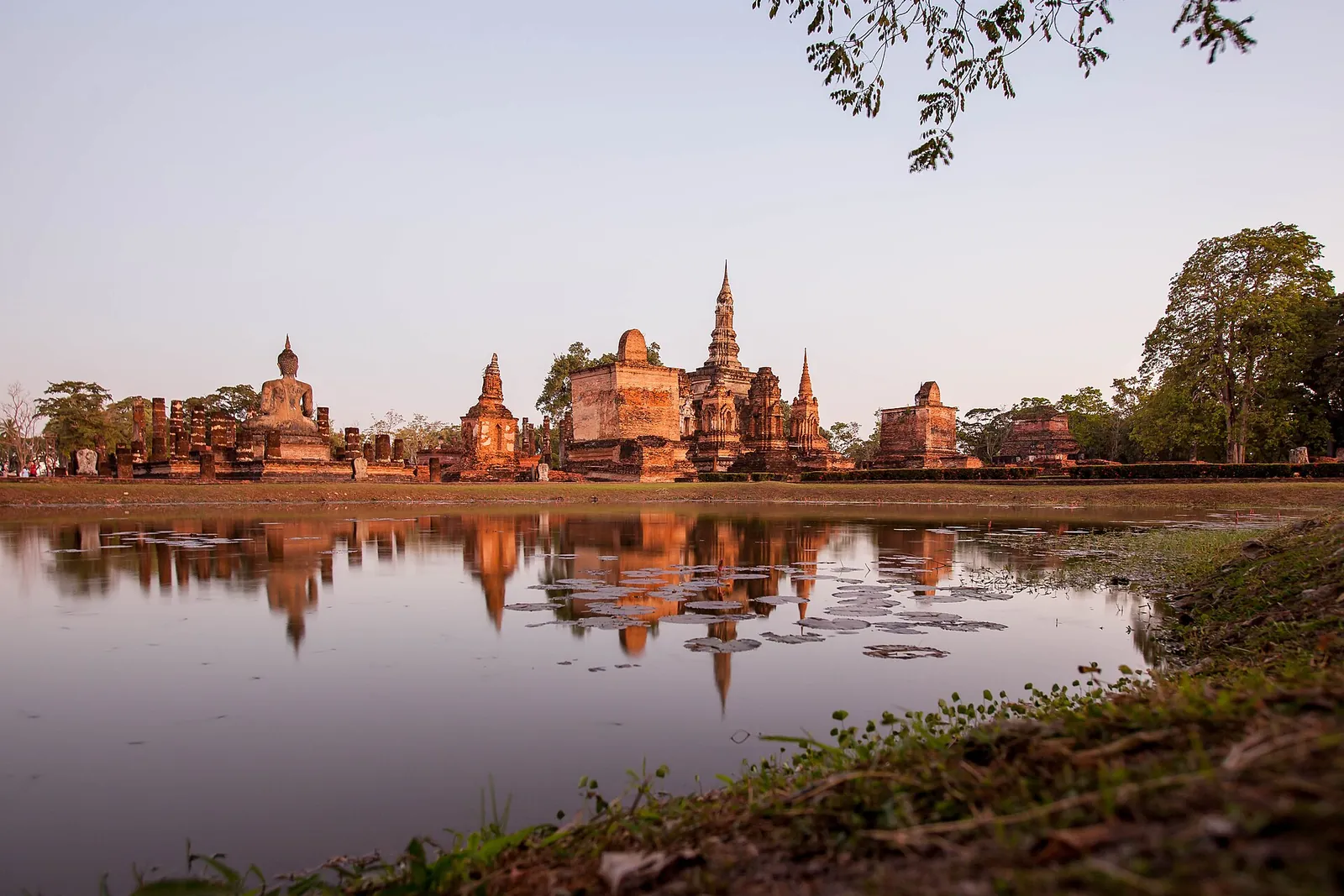
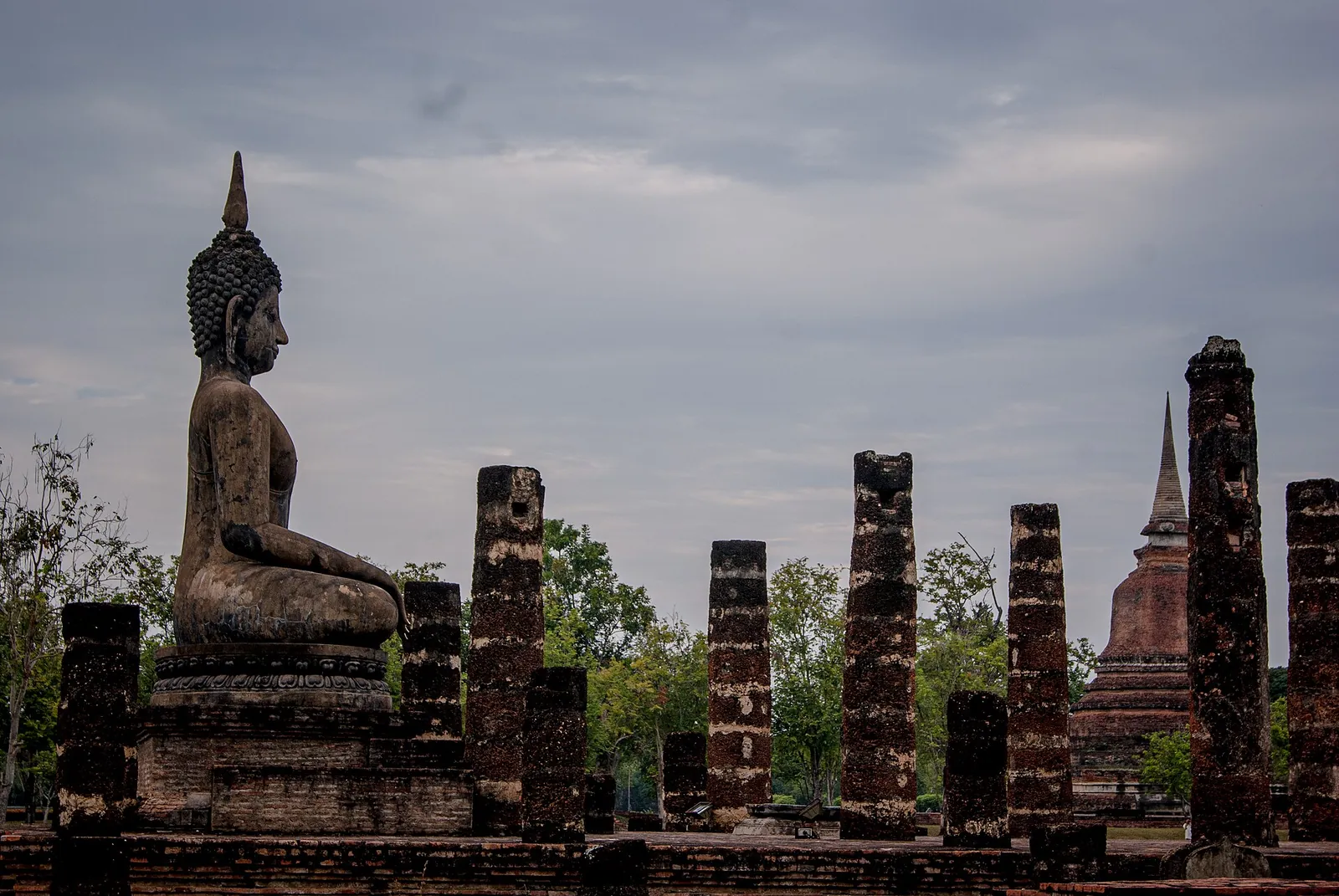
Start at Wat Mahathat, with its lotus-bud principal chedi and standing Buddha images in niches on the northern and southern sides. Walk around the main group before moving on: the central tower and the tall figures are different ways of giving the religious centre its scale.
Continue 350 metres south to Wat Si Sawai. Its three prangs are in the Lop Buri style; evidence of Hindu worship preceded its conversion to a Buddhist temple and the addition of a wihan. Compare those towers with Mahathat's lotus-bud chedi rather than treating all the ruins as variations on one design.
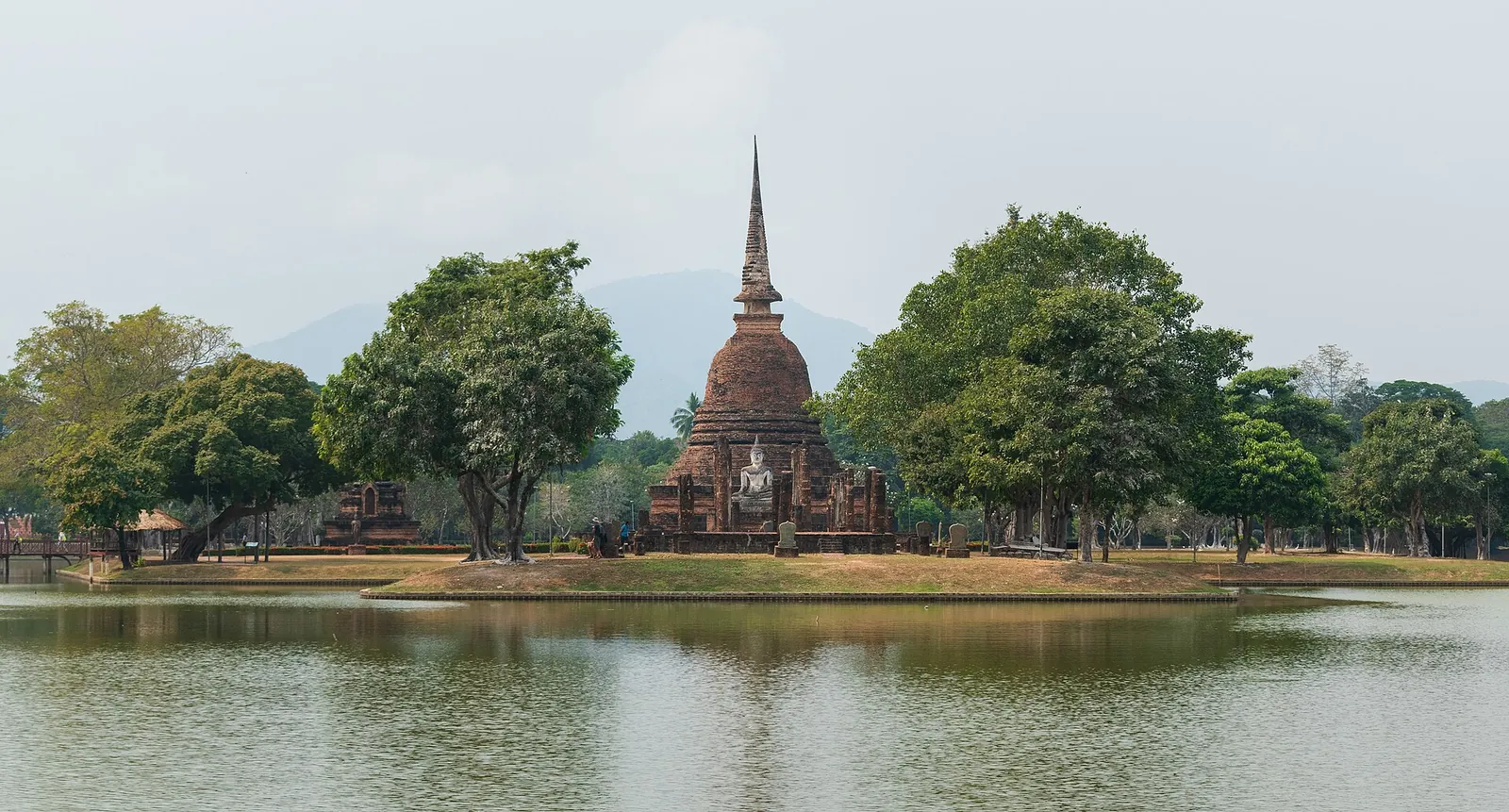
At Wat Traphang Ngoen, look for the lotus-bud chedi, Buddha images in niches and a temple building on an island. Finish at Wat Sa Si, on an island in Traphang Trakuan pond northwest of Wat Mahathat, with a Lanka-style principal chedi and a seated stucco Buddha before the wihan. Leave the bicycle outside each compound and walk in slowly, looking back across the water as well as towards the monuments.
A guided ride helps connect the architectural layers. Sukhothai Bicycle Tour runs a half-day route of 20–25 kilometres (hotel pickup around 08:15, back around 13:00–13:30) and a full-day route of 30–35 kilometres with five kilometres of dirt track (pickup around 08:15–08:30, back around 15:30–16:00), both for 2–12 people. Each lists a mountain bike, helmet, English-speaking guide, local accident insurance, lunch, drinks and Sukhothai hotel transfers; the operator's pages show no price, so ask for a quote before you plan around it. These are the operator's outings, not the distance an independent visitor must cycle. No bicycle-hire price is published; hotels can tell you the day rate.
Admission, checked on 14 October 2026: the national schedule effective 28 May 2025 sets non-Thai prices at THB200 for the central zone, THB120 each for the northern and western zones, or THB400 combined for those three zones. Thai-national prices are THB20 per zone or THB40 combined. Bicycle entry is charged separately at THB10 per zone; that is an admission charge for the bicycle, not its hire price.
Opening hours, checked on 14 October 2026: the central park is listed at 06:30–19:30 on Monday–Friday and Sunday, and 06:30–21:00 on Saturday; the western Aranyik zone at 08:00–16:30 daily; and Wat Si Chum and Wat Phra Phai Luang at 07:30–17:30 daily. The primary day uses the central zone in the morning and the northern pair before their closing time. An evening central-zone visit does not extend the outer zones' hours.
Pair the northern Buddhas with the museum
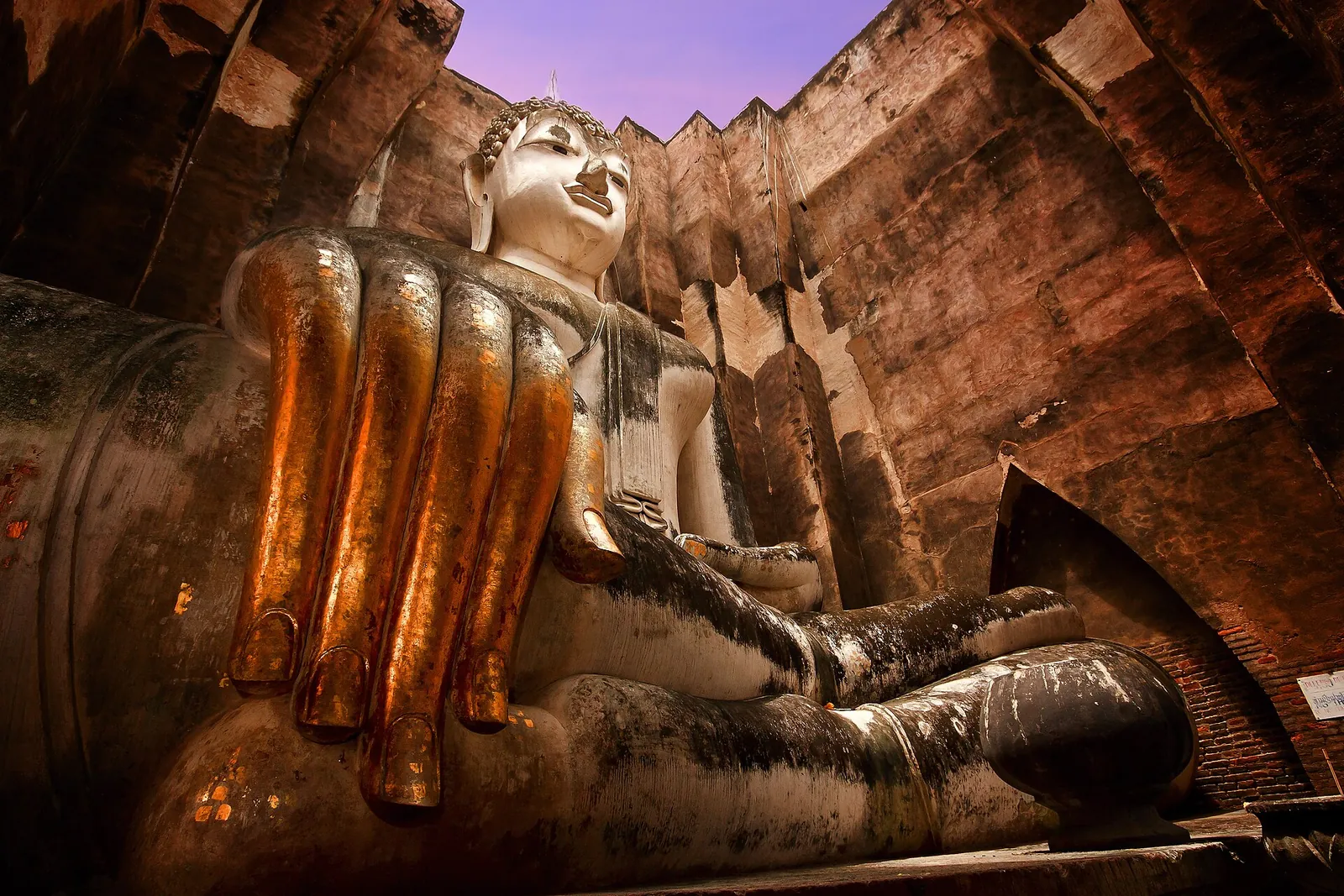
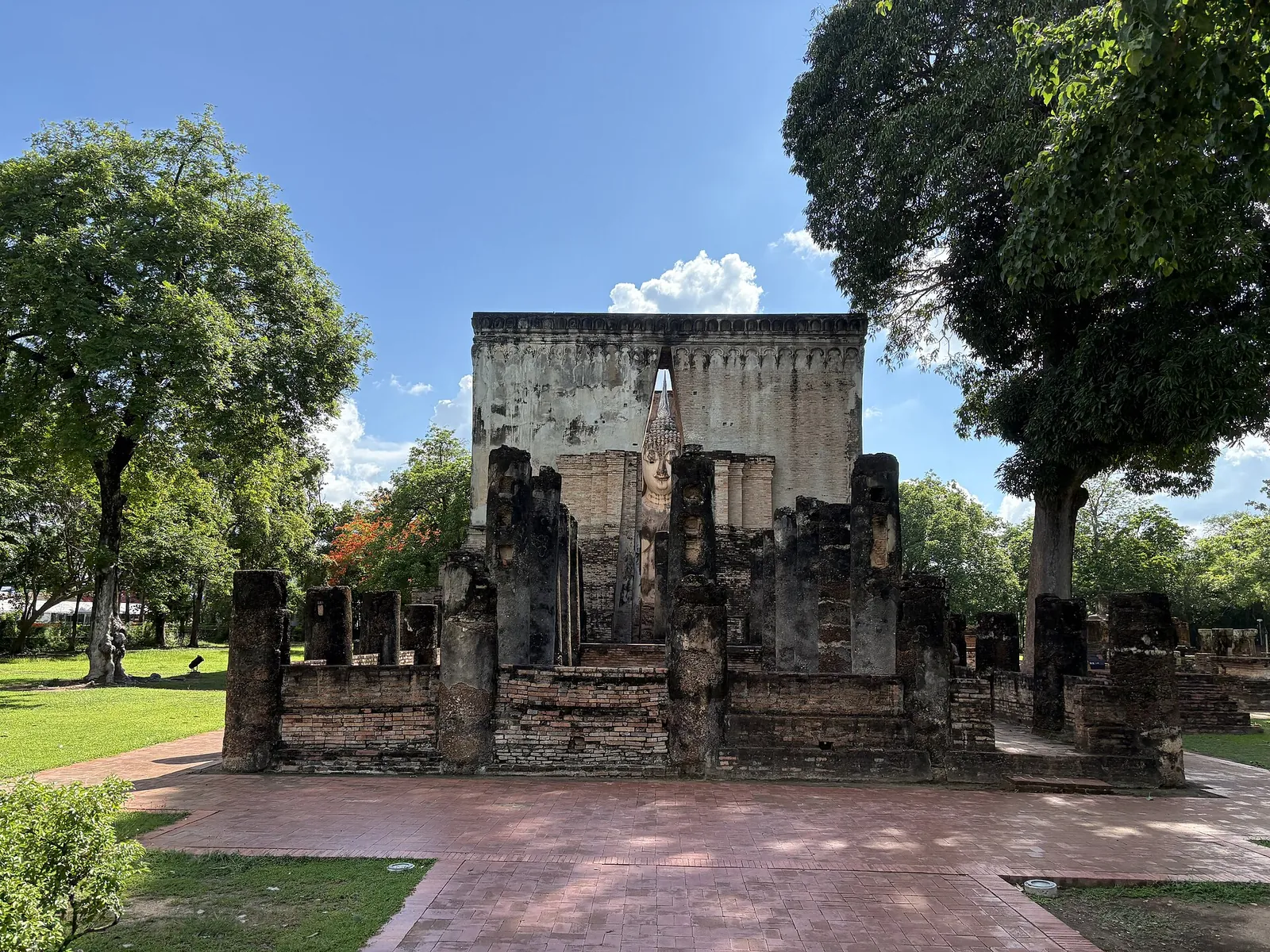
At Wat Si Chum, Phra Achana fills the opening of a massive mondop northwest of the old city. The stucco-covered brick-and-laterite Buddha measures 11.30 metres across the lap and 15 metres high. Pause at the entrance before stepping farther into the compound to take in the scale of the figure.
Pair it with Wat Phra Phai Luang, whose laterite prangs follow the Khmer Bayon tradition. A building there is associated with seated, reclining, standing and walking Buddha images. The remains give you a different architectural reference from the mature lotus-bud forms inside the walls. Wat Si Chum is 800 metres west of Wat Phra Phai Luang, so visit these northern sites together.
For a western-zone alternative, choose Wat Saphan Hin. Its 300-metre slate-paved approach climbs a 200-metre-high hill to a 12.50-metre standing Buddha. This forest-monastery landscape is connected with King Ramkhamhaeng's Buddhist observance. Replace the northern pair with this climb if the foothill setting appeals more, keeping it within the western zone's afternoon closing time. Northern and western single tickets each cost THB120 per non-Thai adult, so that swap leaves the personal admission basket unchanged; visiting all three zones instead makes the THB400 combined Sukhothai ticket the better choice.
Use Ramkhamhaeng National Museum, in front of the historical park, for the middle of the full Sukhothai day. Its finds come from Sukhothai, Si Satchanalai, Kamphaeng Phet and nearby provinces: Buddha images, inscriptions, stucco, weapons and Sangkhalok ceramics. Look at the pottery here before visiting the kilns farther north, connecting finished objects with the places that made them. Keep the full two-hour block in the plan instead of fitting the museum between hurried outdoor stops. For more ceramics, the private Sangkhalok Museum on the Sukhothai bypass road lists more than 2,000 objects, including antique chinaware, and is open 08:00–17:00 daily.
Museum access, checked on 14 October 2026: opening hours are 09:00–16:00 daily, with advance contact requested for groups. The national schedule effective 28 May 2025 sets admission at THB200 for non-Thai visitors and THB30 for Thai nationals. The primary sequence places the museum after lunch and leaves the later afternoon for the northern temples.
For a cycling alternative, Sukhothai Bicycle Tour's sunset ride is listed at 2.5 hours and 18–22 kilometres, including five dirt kilometres, for 2–12 people, with hotel pickup around 15:30–15:45 and return around 18:30–19:00. Choose it instead of another afternoon circuit, especially if you have already covered the main temples.
Give Si Satchanalai an afternoon and a kiln morning
Si Satchanalai sits on a plain beside the Yom River, enclosed by Khao Phra Si, Khao Phra Bat and Khao Yai. An inner laterite rampart and an outer moat-and-mound defence define the old city. This was both a spiritual centre and the centre of an important ceramic export industry. The split visit puts the walled-city temples on the arrival afternoon and the pottery story on the following morning.
Begin at Wat Chang Lom inside the walls. Its Lanka-style principal chedi stands on a square base surrounded by 39 stucco elephants. Walk around the base before looking up at the bell-shaped structure.
Continue to Wat Chedi Chet Thaeo, opposite Wat Chang Lom, where the principal lotus-bud chedi is accompanied by 33 other chedis and forms influenced by Lanka and Bagan. At Wat Nang Phaya, surviving stucco on the wihan walls includes floral patterns beside a circular principal chedi. Give the wall detail as much attention as the large silhouette.
Make the Ban Ko Noi Thuriang kilns the main extension on the next morning. The Turiang kiln sites of Ban Ko Noi and Ban Pa Yang are among the park's important sites, and the link between the kiln landscape and the exported Sangkhalok wares is what makes this a different stop from another temple. Opening hours and displays at the Ban Ko Noi kilns are not published, so ask the park office on 055-679211 what is open before you commit the morning, and keep the afternoon free for the drive south.
For an alternative, visit Wat Phra Si Rattana Mahathat at Chaliang, about 3 kilometres southeast of the old city walls. Its principal prang is a useful comparison with the lotus-bud chedis inside the walls. Nearby Wat Chom Chuen is on the Yom River about 400 metres east of Wat Phra Si Rattana Mahathat, with a laterite chedi, wihan and excavated burials. Choose this archaeology morning instead of Ban Ko Noi; a Ban Na Ton Chan food-and-village morning is another substitute.
Tickets and local movement, checked on 14 October 2026: non-Thai admission is THB200 for Si Satchanalai Historical Park, THB120 for Wat Chom Chuen and THB120 for the Ban Ko Noi Thuriang kilns, or THB400 combined for those three sites. Thai-national tickets are THB20 for each site or THB40 combined. The primary selection, park plus kilns, costs THB320 per non-Thai adult on separate tickets for the two days. The combined ticket pays only if you visit all three sites and its validity fits your dates; it does not cover Sukhothai or Kamphaeng Phet. The Ministry of Tourism and Sports' directory lists the park tram tour at THB40 per foreign visitor and THB10 per Thai visitor, separately from admission. The Fine Arts Department lists bicycle and tram services inside the walls; the tram route and the bicycle-hire price are not published, so check them at the park.
Si Satchanalai Historical Park is open daily 08:30–16:30, so the arrival afternoon on Day 3 has a firm stop; the kiln morning follows on Day 4. The protected area covers 45.1472 square kilometres and 281 historical sites, far more than one visit needs.
Finish with Kamphaeng Phet’s laterite and forest
Kamphaeng Phet adds a different kind of city to the route: a fortified southern frontier settlement protecting movement and trade. Its old city lies on the Ping River's east bank, with successive moats and mounds and a later internal wall of laterite. Compare those dark laterite masses with the brick and stucco forms at Sukhothai.
Use the final morning for the walled city and the Aranyik forest area together. The park covers 3.34 square kilometres, including 0.8048 square kilometres inside the ramparts, with Aranyik outside the northern wall. Aranyik lies about 2 kilometres northwest of Kamphaeng Phet town. Begin at Wat Phra Kaeo, whose principal chedi is decorated with lions. Walk around the surrounding remains before heading to the woodland, so the forest monasteries become a contrast with the civic and religious centre.
In the forest, continue through Wat Phra Non, Wat Phra Si Iriyabot and Wat Chang Rop. The Aranyik area covers about 2.5776 square kilometres on a gravel hill outside the northern rampart. About 40 archaeological sites stand on gravel hills here, built mainly of laterite, in dense forest that keeps the atmosphere of a forest monastery. Besides the three above, the named sites include Wat Kong Chai, Wat Nak Chet Head, Wat Singh and Wat Awat Yai. For what is open to walk through at Wat Phra Non and Wat Chang Rop, ask the park's information centre (055-854736, 08:30–16:30). At Wat Phra Si Iriyabot, a laterite mondop shelters a large Buddha shown in four postures, standing, walking, sitting and reclining, with evidence that the whole figure was lacquered and gilded, and a well and shower in front of the temple. Use a bicycle or car to connect the compounds, then walk around each one.
Across the Ping, Nakhon Chum was an important centre before political and artistic activity moved to the east bank. Its smaller brick monuments contrast with the larger laterite buildings opposite, and the Nakhon Chum retro market is another provincial highlight. Keep this as an alternative to the departure-day forest circuit, rather than a compulsory extra crossing of the river.
Access, checked on 14 October 2026: non-Thai admission is THB200 for either park zone or THB300 for both, with Thai-national prices of THB20 per zone or THB30 combined. Visiting hours are 08:30–16:30. Vehicle admission is additional at THB10 per bicycle, THB20 per motorbike and THB50 per car. Buy the two-zone personal ticket for the final-day circuit and use the same morning for both areas.
After the forest temples, return to town for lunch and collect the luggage before the onward car journey. Keep this as the last sightseeing day: an early departure would need either an extra night or a shorter park visit.
Put local meals into the journey
Use a lunch stop in Si Samrong for Ta Phut's Sukhothai noodles, with homemade egg noodles, pork, peanuts, palm sugar and lime. Choose this stop only when the northern car booking leaves enough time for the afternoon temples. Order the version that appeals and let the shop's recipe be the example; Sukhothai noodles are not one standard bowl that every kitchen makes identically.
For khao poep, head to Pa Khrueang, also rendered Yai Khrueang, in Ban Na Ton Chan, Si Satchanalai district. A steamed rice sheet is folded around vegetables, then served with pork-bone broth and an egg. Choose this food-and-community outing instead of the kiln morning, with the village detour included in the car booking and lunch before the journey south.
Look for mi phan, made with khao khaep rice sheets, among the village's traditional foods; some sheets contain black sesame or crushed chilli. It is a small snack to try while visiting Pa Khrueang, rather than a replacement for lunch. Back in old Sukhothai, Sriwilai Restaurant offers pad mee chomphu moo dang, vermicelli with red pork wrapped in an egg net, and pla hed, its Sukhothai-style fish cake.
In Kamphaeng Phet, finish with Chakungrao grass jelly, a provincial speciality. Make it dessert after a town meal near your final hotel.
What to eat and where to look
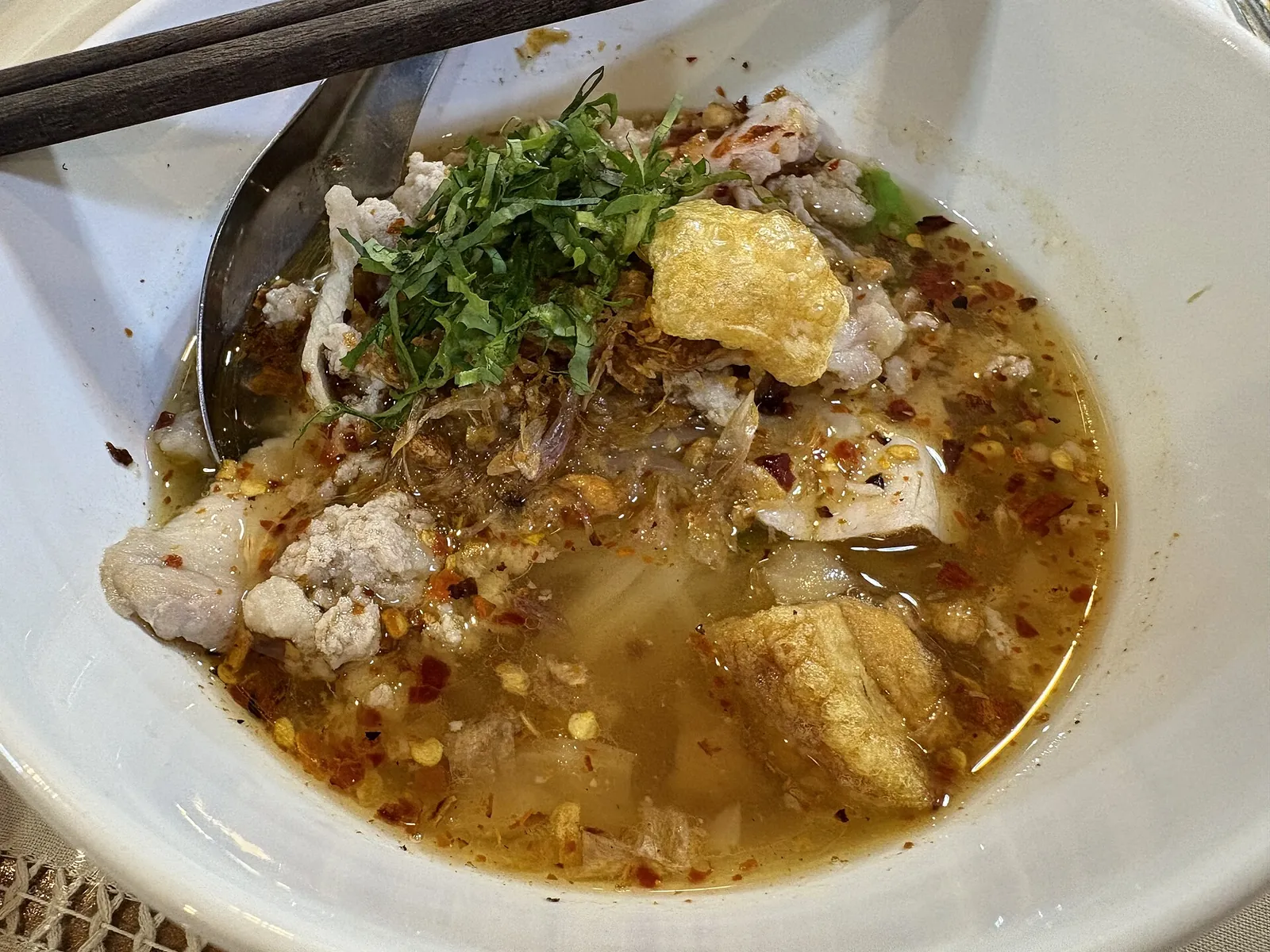
Sukhothai noodles
At Ta Phut, homemade egg noodles meet pork, peanuts, palm sugar and lime; thin rice noodles are another choice.
- Where to look
- Ta Phut noodle shop in Si Samrong, a named stop on TAT's Sukhothai food route.
- Fit it into your day
- Choose it for lunch while heading north towards the Si Satchanalai stay.
Mention allergies and dietary restrictions before ordering; the dishes here can include pork, peanuts, sesame, fish or egg.
Khao poep
A steamed rice sheet folded around vegetables, served with pork-bone broth and an egg.
- Where to look
- Pa Khrueang (Yai Khrueang) in Ban Na Ton Chan, Si Satchanalai district.
- Fit it into your day
- Replace the kiln morning with the village lunch, including the detour in the car booking before travelling south.
Pad mee chomphu moo dang
Sriwilai Restaurant serves this vermicelli dish with red pork inside an egg net.
- Where to look
- Sriwilai Restaurant at Sriwilai Sukhothai Resort, near the historical park.
- Fit it into your day
- An old-town lunch or dinner on the Sukhothai nights.
Pla hed
The Sukhothai-style fish cake on Sriwilai Restaurant's regional menu.
- Where to look
- Sriwilai Restaurant at Sriwilai Sukhothai Resort.
- Fit it into your day
- Share as part of a proper meal rather than making every meal another bowl of noodles.
Arrange the arrival and price the selected visits
Sukhothai Airport (THS) is in Sawankhalok district and is operated by Bangkok Airways, so the road journey to Mueang Kao is part of the booking. Legendha's own page puts the airport about 40 kilometres north of Sukhothai town and the airport transfer to its property at about 40 minutes, with a transfer desk at the airport entrance. It offers a joined van at THB300 per person or a private van at THB1,600 per van each way for up to six people, booked in advance. Other hotels set their own transfer terms; ask for the fare and journey time in writing.
Phitsanulok Airport (PHS) is the other air gateway, followed by a road transfer to Mueang Kao; its time, distance and fare are not published, so ask your hotel. AirAsia's route page lists direct Don Mueang–Phitsanulok flights; for example, Thai AirAsia on 25 October 2026 left at 07:00 and arrived at 08:00. Sukhothai Bicycle Tour lists private transfers from THS, PHS and Phitsanulok railway station, with no fare shown; enquire through its transfer page and name your Mueang Kao hotel rather than ‘Sukhothai’.
For rail, the Fine Arts Department names Phitsanulok as the station from which to continue by road to Sukhothai Historical Park, and the Bangkok–Uttaradit line to Sawankhalok station, then a bus, for Si Satchanalai. The road time from Phitsanulok station to Mueang Kao, and from Sawankhalok station to the park, is not published; ask your hotel. Book trains through the State Railway of Thailand's D-Ticket, which allows advance reservations from three hours to 180 days ahead on the express, special-express, rapid and tourist services.
Old Sukhothai to new Sukhothai: the historical park is about 12 kilometres from the modern town. Fares and hours for public transport between the two are not published; hotels can arrange the trip, and agree any tuk-tuk fare before you set off.
Sukhothai bus terminal to Si Satchanalai Historical Park: times, fares and stops for this bus are not published, so check the current departures and the return stop at the terminal before planning around it. The route above uses private cars and does not depend on it.
Sukhothai and Kamphaeng Phet by bus: times and fares for buses or songthaews between the two towns are not published either. No direct public service between Si Satchanalai and Kamphaeng Phet is listed, so that leg needs a car, as does the final departure from Kamphaeng Phet.
Primary admission basket for two non-Thai adults, checked on 14 October 2026: THB2,280. That is THB640 for Sukhothai central and northern single tickets, THB400 for Ramkhamhaeng Museum, THB640 for Si Satchanalai park and Ban Ko Noi kiln tickets, and THB600 for both Kamphaeng Phet zones. The western Sukhothai zone and Wat Chom Chuen are outside this basket, and it assumes one entry to each area.
Choose the season and leave space for living crafts
Thailand's seasons run approximately mid-February–mid-May for hot weather, mid-May–mid-October for rain, and mid-October–mid-February for the cool season, according to the Thai Meteorological Department. Our choice for this cycling-heavy trip is November to early February. Use the museum and lunch as the midday break, rather than filling every daylight hour outdoors.
Wear shoes that grip wet paving, carry a light rain layer and protect electronics. Skip the western climb when heat or wet paving makes it uncomfortable; it is an optional swap, so the main circuit does not depend on it.
For Loi Krathong, reserve the old-town room once the official programme is announced, because event formats can change; the 2025 Sukhothai festival went ahead with moderated lighting and décor during the national mourning period.
Sukhothai joined UNESCO's Creative Cities Network for Crafts and Folk Art in 2019. Try Sangkhalok Art for ceramic-pattern painting or Ban Phra Phim Learning Center for traditional amulet-making. Replace a Sukhothai temple block with one workshop, rather than adding it after the full museum-and-northern-zone day. Making or buying a modern piece is an optional way to connect the older ceramic story with people working now.
Book the road journeys before committing to the northern overnight and final departure, then choose the rooms and arrival ticket. Keep the primary temple-and-kiln selection together; the village lunch, western climb, Chaliang and workshops are substitutions for travellers with different interests.
What the historic-town circuit costs, all in
About THB 20,000 per person, THB 40,000 for two, for the five-day historic-town route and its four nights, before international flights. All four room nights, every meal and ordinary drinks, domestic flights, private cars, the chosen admissions, bicycles, two SIMs and a 10% buffer are in.
| Stay | Per person | For two |
|---|---|---|
| Four nights in the historic towns | THB 20,000 | THB 40,000 |
This budget is for two adults sharing a Superior twin or double at Legendha for two nights, one private double near Si Satchanalai and one private Standard Double at HOP INN Kamphaeng Phet, Wednesday to Sunday on ordinary November 2026 dates outside holidays. Choose an early London arrival at BKK and a Sukhothai Airport connection; after the day-5 park visit and lunch, return by car to THS and fly to BKK for dinner and a late London departure. Book actual flights with enough time for the road journey and the same-airport connection; this budget adds no Bangkok hotel night. Prices were checked between 14 October and 2 November 2026.
For two: rooms THB 6,500; food and drinks 6,700; getting around 19,800; sights and bicycles 2,400; SIMs 1,100; 10% buffer 3,600.
Legendha’s dated two-night THB 5,100 quote includes tax and breakfast; its non-refundable Flexi Deal allows changes within six months with 14 days’ notice and excludes 20 December–10 January. The Si Satchanalai room is about THB 630 at Sisatchanalai Heritage Resort, about 800 metres from the historical park, from its Booking.com price from USD 18.68 for one night for two adults, read on 26 October 2026 and converted at USD 1 = THB 33.598; the listing has no dates. Kamphaeng Phet is about THB 750 gross, using HOP INN’s listed THB 700 price plus a 7% tax comparison, not a published hotel tax. Confirm two-person room types and gross prices; these comparisons do not guarantee rooms for your dates.
Meals without a published menu price use about THB 80 for breakfast, 150 for lunch and 370 for dinner per adult, based on northern noodle prices and Gaj’s curry-and-rice menu comparison. Ordinary drinks and snacks use about THB 100 per adult per calendar day: Cafe Thammada, on the corner opposite the Sukhothai Historical Park entrance in Mueang Kao, sits in Wongnai’s under-THB-100-per-person band. Each adult has five breakfasts, five lunches and five dinners, from the first BKK breakfast to day-5 airport dinner. Two Legendha breakfasts are counted once; the other three breakfasts are bought separately.
Transport includes Legendha’s THB 1,600 arrival van, three long private-car legs at about THB 3,500 each using a northern full-day-car comparison, five short local car journeys at about THB 300 using half a Bangkok city-car fare. Domestic BKK–THS returns for two are about THB 6,200, from Bangkok Airways one-way economy fares for 12 November 2026 shown on Monde du Voyage’s route pages, read on 26 October 2026: USD 44 Bangkok–Sukhothai and USD 48 Sukhothai–Bangkok per adult, converted at USD 1 = THB 33.598. Confirm the actual gross fare, date and checked baggage before paying. Cars stop outside the paid park zones; day 2 uses bicycles, and other meals stay near the hotels on foot.
Sights keep the THB 2,280 primary admission basket and THB 100 bicycle hire and vehicle fees. No bicycle-hire price is published, so the hire part of that figure is an allowance. The western zone, Chaliang and the tram are alternative choices. The two eight-day AIS plans include 7% VAT; this assumes one short visa-free tourist visit on eligible ordinary passports.
Flights: about GBP 850–1,000 per person for London–Bangkok return economy with Thai Airways, from selected-date advertised examples checked on 23 October 2026; fares include taxes and surcharges, and availability changes. The domestic returns are already in the ground total. With flights, about THB 58,100–64,800 per person.
Practical questions
How many nights do I need for all three historic towns?
Plan four nights: two in old Sukhothai, one near Si Satchanalai Historical Park and one in central Kamphaeng Phet. That gives five days, with the last park visit before departure. With two nights, concentrate on Sukhothai alone.
Should I stay in old or new Sukhothai?
Choose old Sukhothai, or Mueang Kao, for the monuments. The historical park is 12 kilometres from modern Sukhothai town, so a new-town room needs a separate park journey.
Does one World Heritage ticket cover the whole route?
No. For the primary circuit, Sukhothai central and northern tickets cost THB320 per non-Thai adult, the museum THB200, Si Satchanalai park plus Ban Ko Noi THB320, and Kamphaeng Phet's two zones THB300. That is THB1,140 per person or THB2,280 for two adults, before vehicle admission, hire and transport. The THB400 combined Sukhothai ticket pays off when you add the western zone; Si Satchanalai's THB400 combined ticket adds Wat Chom Chuen to the park and kilns.
Do I have to join a cycling tour?
No. Choose independent walking or cycling if you prefer your own pace. For a guided option, Sukhothai Bicycle Tour lists a 20–25-kilometre half-day route. Its full-day route covers 30–35 kilometres, including five dirt kilometres. These are substantial outings, so choose by your comfort on a bicycle rather than the product's name alone.
Which gateway should I use?
Compare Sukhothai Airport (THS) with Phitsanulok Airport (PHS) or Phitsanulok railway station, then arrange the road transfer to your hotel. Sukhothai Bicycle Tour lists transfers from all three. Choose the arrival that fits your first night and the rest of the trip.
When should I book for Loi Krathong?
Reserve the old-town room once the year’s official dates and programme are announced. Use that programme to choose the nights, since event formats can change.
Keep planning your trip
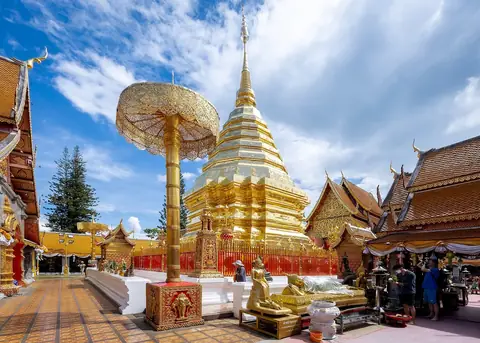
Chiang Mai
Plan five nights in Chiang Mai’s Old City, with Doi Suthep, a cooking class, Doi Inthanon and a guided Lampang–Lamphun day.
Read the guide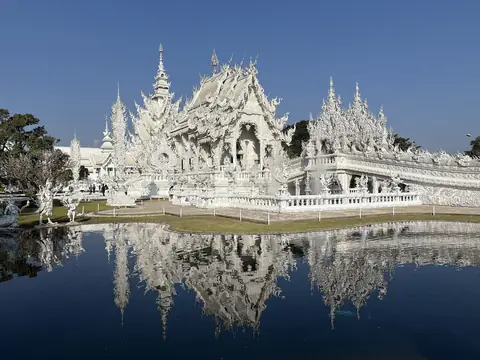
Chiang Rai and Phayao
Plan three nights in Chiang Rai for the White and Blue Temples, Lanna art and Singha Park, with a fourth-night choice of Phu Chi Fa or Phayao.
Read the guide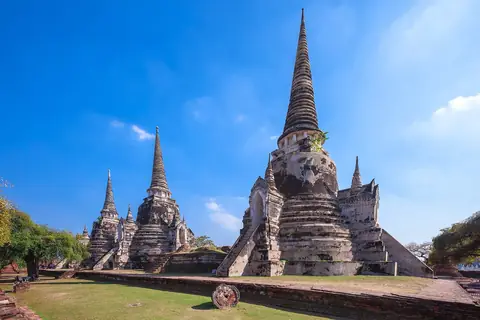
Ayutthaya, with Lopburi
Plan a two-day, one-night Ayutthaya visit for the UNESCO ruins, gold museum and Bang Pa-In, with a complete guided-trip budget and optional Lopburi extension.
Read the guide
Getting around Thailand
Choose trains or flights between regions, the right Bangkok airport and station, and named ferry piers, with published fares and room for connections.
Read the guide
Best time to visit Thailand
Choose Thailand dates by northern weather, Andaman and Gulf monsoons, park closures and festivals, with a nine-night route and dated budget.
Read the guide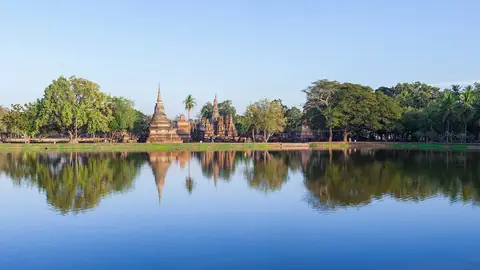
Thailand in 3 weeks
A 21-day Thailand route with 20 nights: Bangkok, Ayutthaya, Sukhothai, Chiang Mai, Chiang Rai, Phuket, Phi Phi and Koh Lanta, with trains, boats and costs.
Read the guideSources and checks before you travel
(50)
- UNESCO World Heritage Centre: Historic Town of Sukhothai and Associated Historic Towns ↗ — opens in a new tab
- Fine Arts Department Virtual Historical Park: Sukhothai ↗ — opens in a new tab
- Fine Arts Department Virtual Historical Park: history of Sukhothai ↗ — opens in a new tab
- Fine Arts Department Virtual Historical Park: Si Satchanalai ↗ — opens in a new tab
- Fine Arts Department Virtual Historical Park: history of Si Satchanalai ↗ — opens in a new tab
- Fine Arts Department Virtual Historical Park: Kamphaeng Phet ↗ — opens in a new tab
- Fine Arts Department Virtual Historical Park: history of Kamphaeng Phet ↗ — opens in a new tab
- TAT Newsroom: Sukhothai joins the UNESCO Creative Cities Network ↗ — opens in a new tab
- Thailand Tourism Directory: Wat Si Chum ↗ — opens in a new tab
- Thailand Tourism Directory: Ramkhamhaeng National Museum ↗ — opens in a new tab
- Thailand Tourism Directory: Si Satchanalai Historical Park ↗ — opens in a new tab
- Thailand Tourism Directory: Kamphaeng Phet Historical Park ↗ — opens in a new tab
- Sukhothai Bicycle Tour: half-day historical-park ride ↗ — opens in a new tab
- Sukhothai Bicycle Tour: full-day historical-park ride ↗ — opens in a new tab
- Sukhothai Bicycle Tour: sunset ride ↗ — opens in a new tab
- Sukhothai Bicycle Tour: gateway transfers ↗ — opens in a new tab
- AirAsia: Bangkok Don Mueang to Phitsanulok route ↗ — opens in a new tab
- State Railway of Thailand: D-Ticket ↗ — opens in a new tab
- Royal Gazette: 2025 national museum and historic-site fees ↗ — opens in a new tab
- Tourism Authority of Thailand: Sukhothai provincial brochure ↗ — opens in a new tab
- Thai Meteorological Department: seasons of Thailand ↗ — opens in a new tab
- Fine Arts Department: Sukhothai visitor services ↗ — opens in a new tab
- Fine Arts Department: Sukhothai location and access ↗ — opens in a new tab
- Fine Arts Department: Si Satchanalai visitor services ↗ — opens in a new tab
- Fine Arts Department: Si Satchanalai location and access ↗ — opens in a new tab
- Thailand Tourism Directory: Wat Phra Si Iriyabot ↗ — opens in a new tab
- Thailand Tourism Directory: Sangkhalok Museum ↗ — opens in a new tab
- Sukhothai provincial local-government office: Pa Khrueang foods ↗ — opens in a new tab
- Tourism Authority of Thailand: Amazing Journey Go Local Sukhothai ↗ — opens in a new tab
- Sriwilai Sukhothai: dining ↗ — opens in a new tab
- Tourism Authority of Thailand: Kamphaeng Phet Historical Park ↗ — opens in a new tab
- Tourism Authority of Thailand: Kamphaeng Phet province ↗ — opens in a new tab
- Bangkok Airways: Sukhothai Airport ↗ — opens in a new tab
- Legendha Sukhothai: its own airport transfer ↗ — opens in a new tab
- Legendha Sukhothai: Superior room example for Wednesday to Friday ↗ — opens in a new tab
- TAT Newsroom: event format changes, October–November 2025 ↗ — opens in a new tab
- Tourism Authority of Thailand: Ride, Relax, and Reconnect in Sukhothai ↗ — opens in a new tab
- HOP INN Kamphaeng Phet: hotel page ↗ — opens in a new tab
- Gaj: dinner-price comparison ↗ — opens in a new tab
- TAT Japan: noodle-price comparison ↗ — opens in a new tab
- Wongnai: Cafe Thammada, old Sukhothai ↗ — opens in a new tab
- AIS: tourist SIM and VAT ↗ — opens in a new tab
- Bank of Thailand: dated currency comparison ↗ — opens in a new tab
- Thai Airways: London–Bangkok full-return examples ↗ — opens in a new tab
- Samsen Street: pasta-price comparison ↗ — opens in a new tab
- Lamphu Tree: Bangkok room and breakfast ↗ — opens in a new tab
- Thailand Taxi: whole-car price comparison ↗ — opens in a new tab
- Booking.com: hotels in Si Satchanalai ↗ — opens in a new tab
- Monde du Voyage: Bangkok–Sukhothai flights ↗ — opens in a new tab
- Monde du Voyage: Sukhothai–Bangkok flights ↗ — opens in a new tab
Reference sources for the version dated 2 November 2026. Confirm opening times, access, transport and conditions for your travel dates.
Photo credits
(6)
Wat Mahathat at sunset, Sukhothai Historical Park.
Photograph: Supanut Arunoprayote — opens in a new tab · CC BY 4.0 — opens in a new tab
Changes: Resized and converted to WebP; displayed with responsive crops. · Original photograph and licence details ↗ — opens in a new tab
Pillars of the former great hall at Wat Mahathat.
Photograph: Philip Nalangan — opens in a new tab · CC BY 4.0 — opens in a new tab
Changes: Resized and converted to WebP; displayed with responsive crops. · Original photograph and licence details ↗ — opens in a new tab
Phra Achana inside the mondop of Wat Si Chum.
Photograph: Khunkay — opens in a new tab · CC BY-SA 4.0 — opens in a new tab
Changes: Resized and converted to WebP; displayed with responsive crops. · Original photograph and licence details ↗ — opens in a new tab
The mondop of Wat Si Chum, outside the city walls.
Photograph: Chainwit. — opens in a new tab · CC BY 4.0 — opens in a new tab
Changes: Resized and converted to WebP; displayed with responsive crops. · Original photograph and licence details ↗ — opens in a new tab
Wat Sa Si across its pond.
Photograph: Dominic Nelson — opens in a new tab · CC BY-SA 4.0 — opens in a new tab
Changes: Resized and converted to WebP; displayed with responsive crops. · Original photograph and licence details ↗ — opens in a new tab
Kuay tiew Sukhothai, the town's noodle dish.
Photograph: Chainwit. — opens in a new tab · CC BY 4.0 — opens in a new tab
Changes: Resized and converted to WebP; displayed with responsive crops. · Original photograph and licence details ↗ — opens in a new tab