Plan your trip
What to eat in India: regional kitchens, thalis and prices
A rough map helps: breads and curries in the north, rice, banana leaves and filter coffee in the south, street food, Parsi cafés and Goan curries in the west, and fish and sweets in the east. This guide takes the four kitchens in turn and says where each is at home on our routes, then explains how a thali and a gurdwara langar work, what the green and brown marks on a menu mean, how to eat with your hand, what a plate costs from a free langar to a hotel buffet, and how to eat vegetarian, Jain or without beef.
In this guide
Find the location ↗ — opens in a new tabThe short answer
Eat each kitchen where it is at home: breads, dals and Mughlai curries in Delhi and the north, idli, dosa and meals on a banana leaf in the south, Mumbai's street food, Parsi cafés and Goa's fish curry rice in the west, and Bengali fish and sweets in Kolkata, or at Delhi's regional canteens if the east is not on your route. Order a thali or point at a counter's board, look for the green (vegetarian) or brown (non-vegetarian) square beside each dish, and if you go without cutlery, eat with your right hand, as Indians usually do. Prices checked on 27 October 2026: pav bhaji at Swati Snacks in Mumbai INR 410 plus 5% GST, and a cup of Irani chai at Jimmy Boy in Mumbai's Fort INR 50; the langar at Gurudwara Bangla Sahib in Delhi is free. Our trip-cost guide budgets about INR 800 a day each for street food and simple restaurants.
- Key point
- One kitchen per region: two or three days in each stop of the route is enough for its breakfast, its lunchtime thali and its evening street food
- Where it applies
- Wherever the route already sleeps: Delhi for the north, with Varanasi and Jaipur; Mumbai and Goa for the west; Kochi and the backwaters for Kerala; Kolkata, outside our routes, for the east
- Timing
- Good all year. Some dishes are seasonal: Varanasi makes malaiyyo only in the winter months, and Mumbai's Mohammed Ali Road fills with food stalls during Ramadan, whose dates move each year.
Four kitchens on one map
The quickest way into Indian food is to stop thinking of it as one cuisine. Delhi's Dilli Haat food court, opposite INA Market, has 25 stalls of regional cooking, and each of the four kitchens below contains several smaller ones: Tamil Nadu alone has Chettinad, Kongunadu, Mudaliar and Thanjavur cooking under one umbrella, besides its temple food.
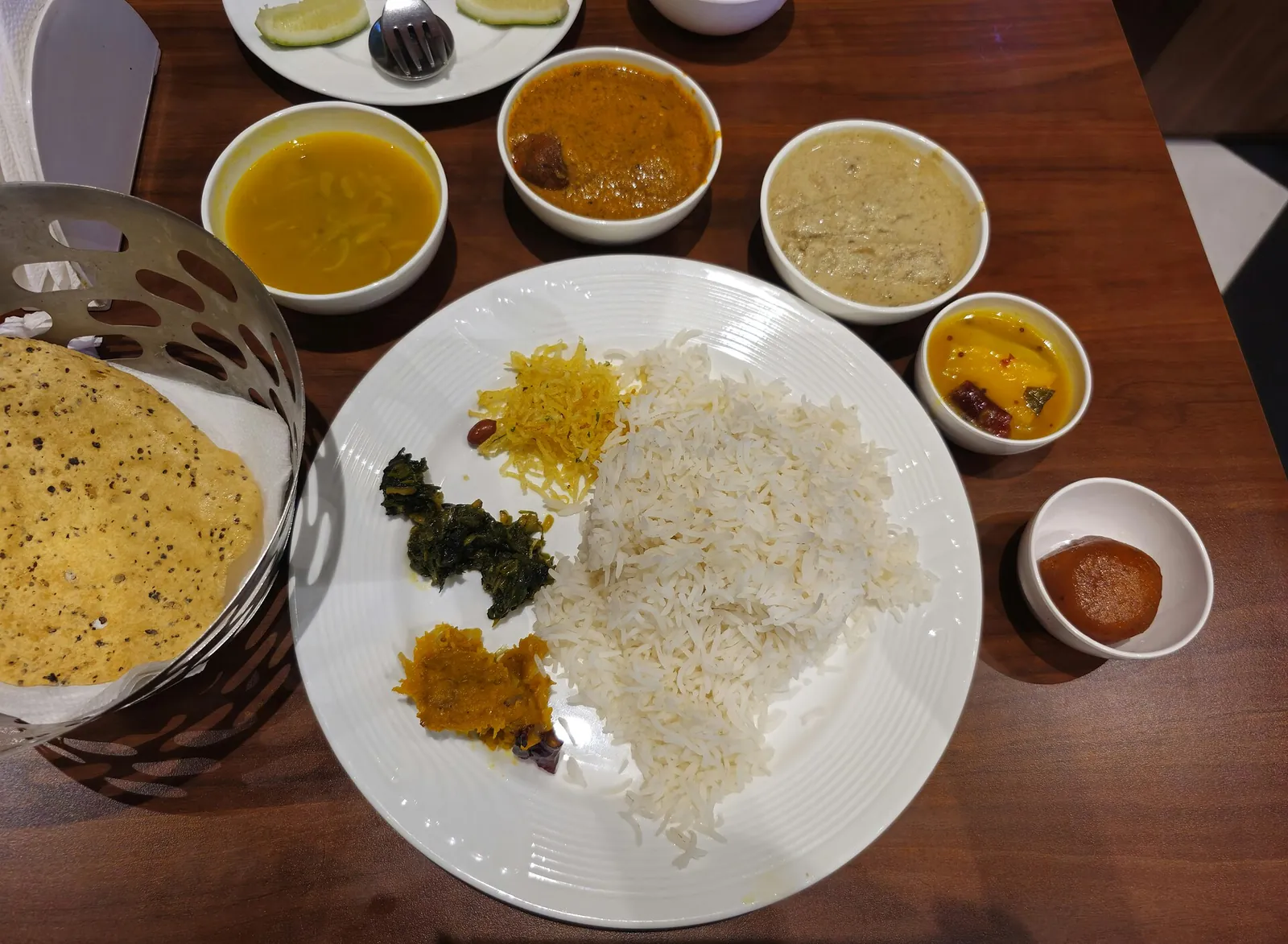
What unites them at the table is the thali, a round metal plate with small bowls of dal, vegetables, curd and pickle around rice or bread, and in the south the banana leaf that does the same job. It is the easiest way to taste a region in one sitting, and on a first trip it saves you from ordering four dishes of the same kind.
That makes planning simple. Our first-trip guide sets out the routes and their nights; each route already passes through at least one of the kitchens below, so eat each where it is at home.
- North: wheat breads, dals, Mughlai and Punjabi curries, chaat, and the Rajasthani table of dal-baati and laal maas.
- South: rice, idli, dosa and sambar, coconut and curry leaves, and full meals served on a banana leaf.
- West: Mumbai's street food, Gujarati vegetarian cooking, the Parsi café and Goa's Portuguese-influenced curries.
- East: Bengal's fish and sweets, Bihar's litti chokha and the Chinese-Indian cooking of Kolkata.
The north: Delhi's breads and curries, Rajasthan and Varanasi
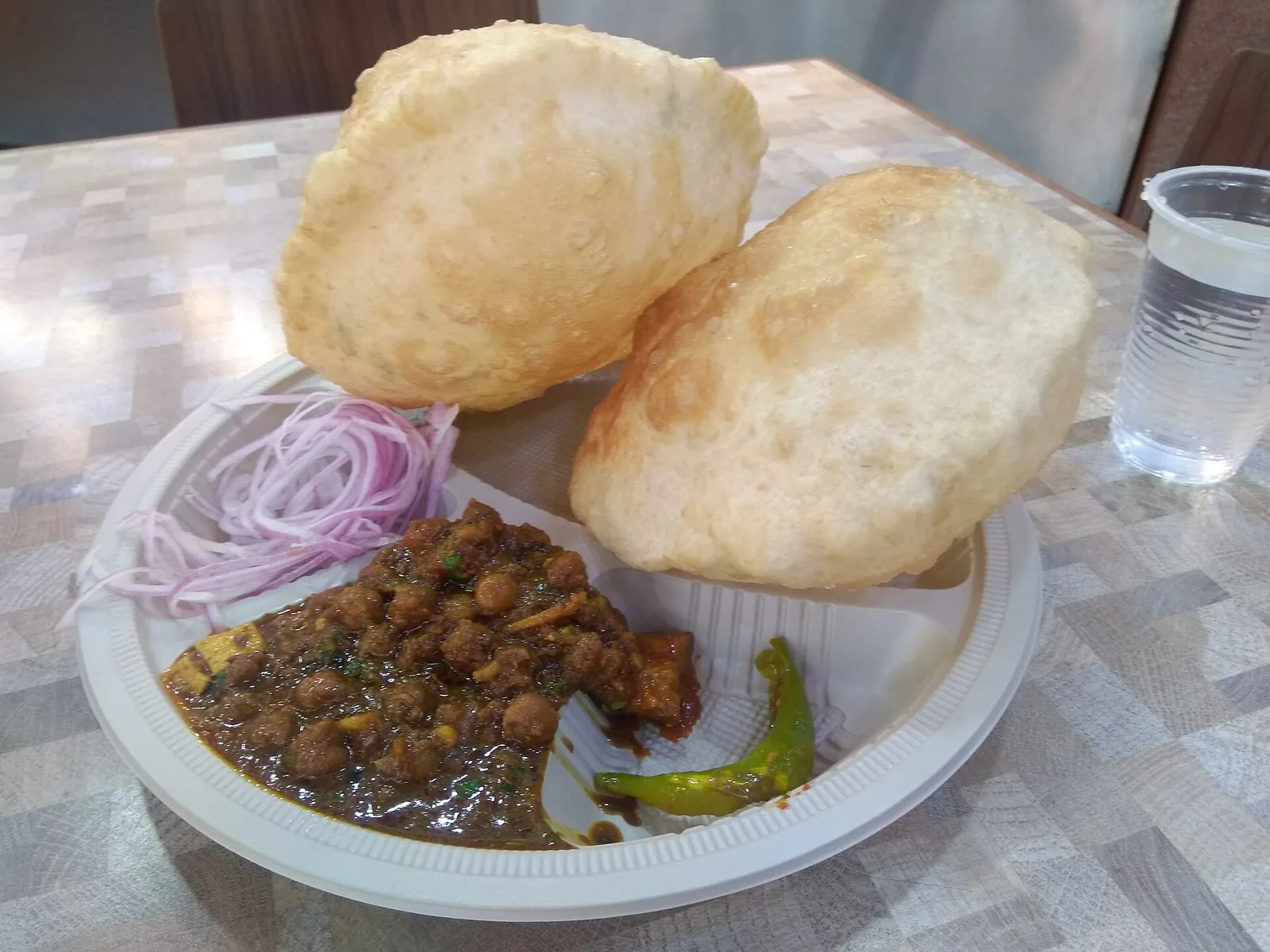
In Delhi, the Ministry of Tourism's food page names the classics and their addresses: chole bhature, fried bread puffed like a balloon beside a spiced chickpea curry, at Sita Ram Diwan Chand in Paharganj or Kake Di Hatti in Chandni Chowk, or at Bhogal in Connaught Place; stuffed parathas in Paranthe Wali Gali; kulche with chole at Lotan in Old Delhi; butter chicken at Moti Mahal in Daryaganj; dum biryani at Al Jawahar by Jama Masjid; and Karim's for kebabs. In Connaught Place, Kake-Da-Hotel, which reopened in Connaught Circus in 1948, cooks its butter chicken Dilli style, tandoori chicken in a buttery tomato gravy, and a dal makhani slow-cooked for 12 hours. Our Delhi guide has the Old Delhi lanes, the metro stations and the hours.
The capital also lets you taste the rest of the country without leaving it. Saravana Bhavan on Janpath serves South Indian food. The canteens of the bhavans, the state governments' offices in the capital, are the other classic way: Andhra Bhavan serves a set breakfast of idli, vada, dosa and filter coffee, vegetarian thalis at lunch, and chicken biryani on Sundays; The Potbelly, at Bihar Niwas in Chanakyapuri, cooks Bihari dishes such as litti chokha. Dilli Haat's regional stalls complete the tour.
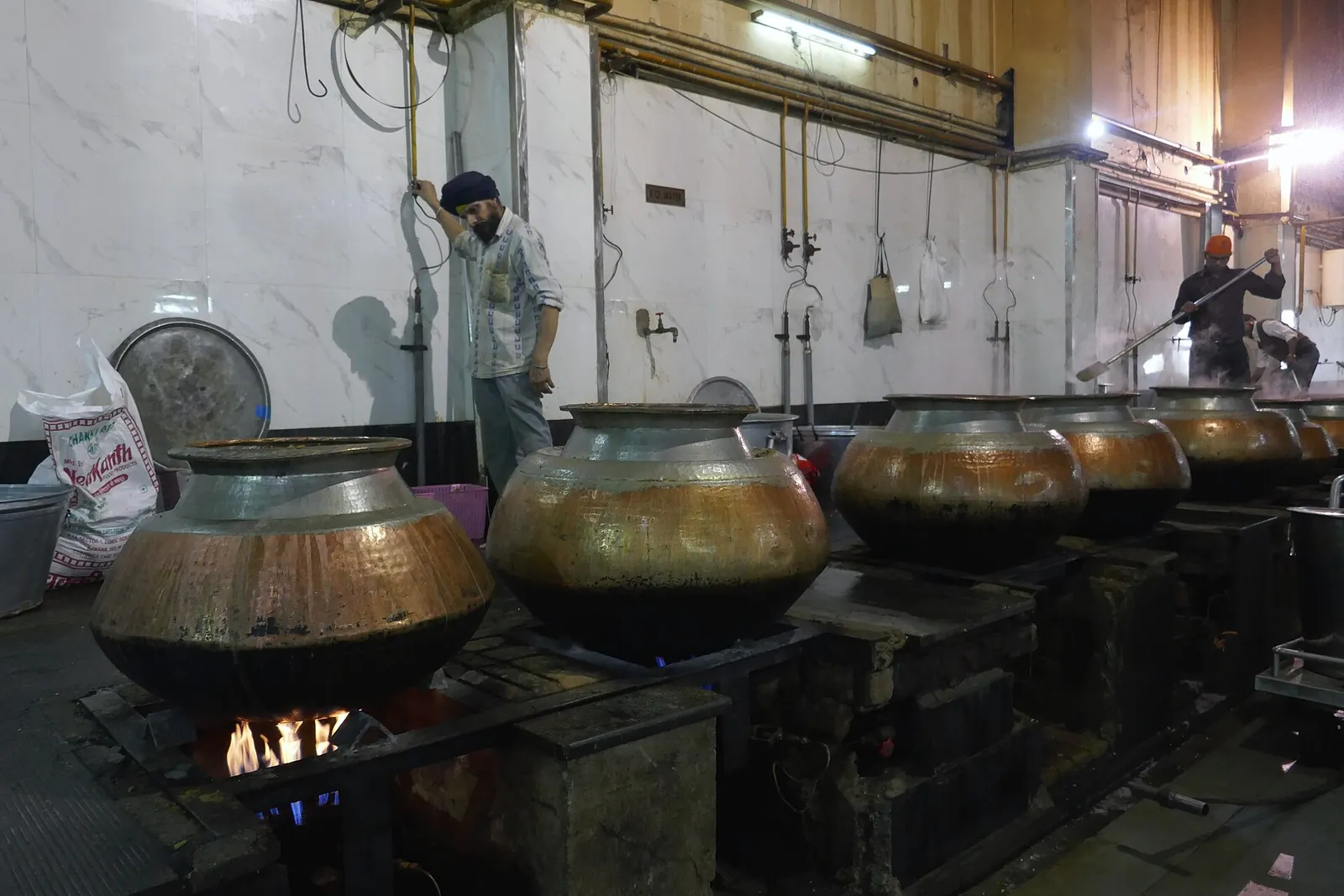
One Delhi meal costs nothing. At Gurudwara Bangla Sahib, near Connaught Place, volunteers cook and serve free meals to thousands of people every day in the langar hall, regardless of caste or creed; you sit cross-legged on the floor and eat what is brought, and on the way out you are given kada prasad, the sweet offering. The gurdwara is open around the clock; cover your head and shoulders and take off your shoes before you go in.
Rajasthan has its own table: laal maas, the red mutton curry; mirchi bada, a stuffed fried chilli that is the state's everyday snack; and heeng kachori. In Udaipur, the ground floor of Natraj Dining Hall serves only Rajasthani and Gujarati food, its Rajasthani thali included; our Udaipur guide covers the city's other tables.
Further east, on the Ganges, Varanasi starts the day with kachori-sabzi served in a leaf bowl, eats tamatar chaat in the evening and makes malaiyyo, perhaps its most famous sweet, only in the winter months.
- Delhi first: chole bhature or butter chicken for lunch, parathas or a Jama Masjid biryani in Old Delhi in the evening.
- Free: the langar at Bangla Sahib.
- Rajasthan: a Rajasthani thali at lunch, laal maas for dinner, mirchi bada at any hour.
- Varanasi: kachori-sabzi for breakfast, tamatar chaat at dusk, malaiyyo on a winter morning.
The south: rice, banana leaves and filter coffee
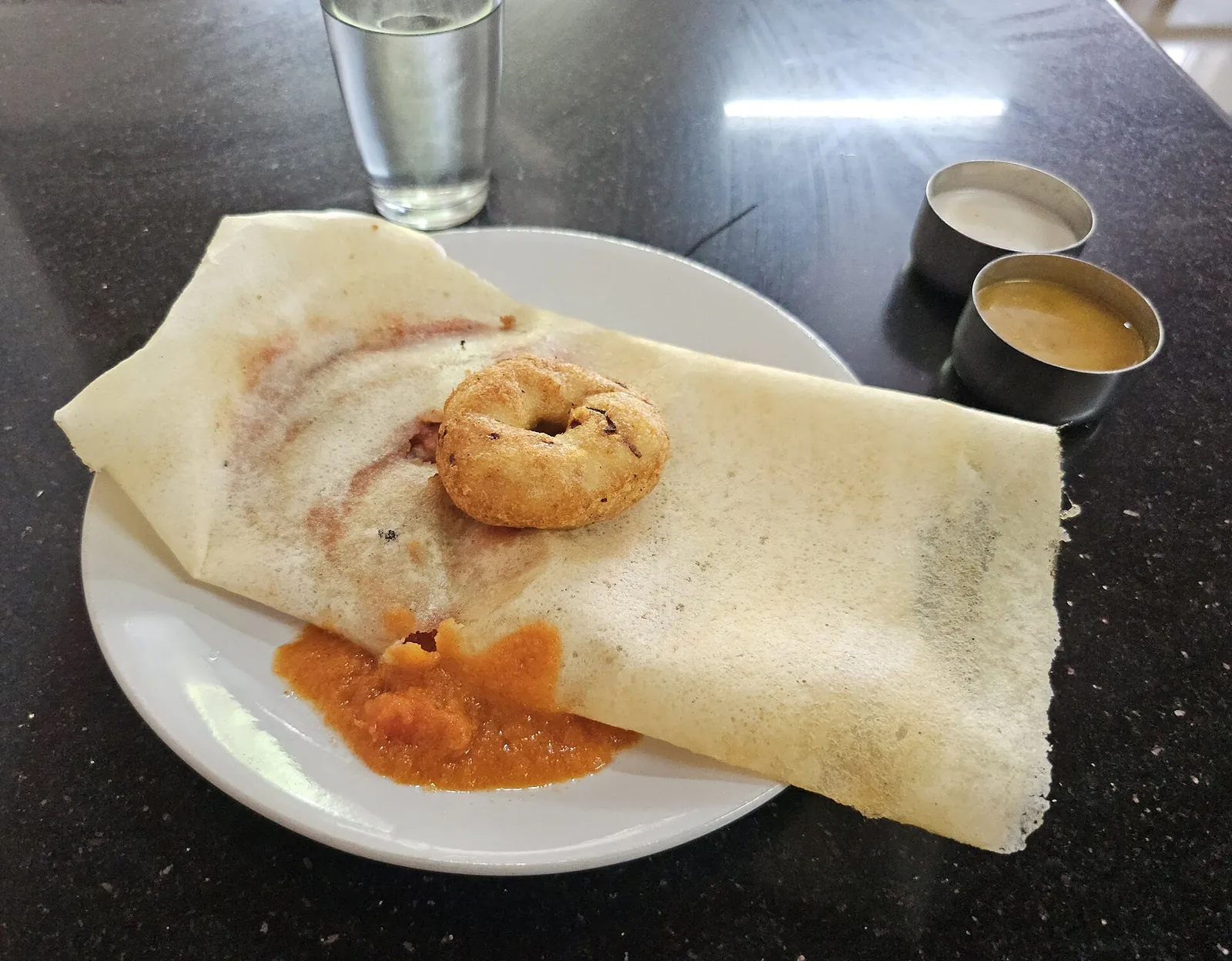
Tamil Nadu is more than the idli-sambar-rasam combination most visitors know: Chettinad cooking grinds fresh fennel, star anise, pepper and cinnamon for its spice-heavy dishes, and temple food includes tamarind rice and pongal. North Karnataka, where Hampi lies, cooks with jowar, according to Karnataka Tourism: jolada rotti, a thin sorghum flatbread, is eaten with stuffed brinjal, and meals are typically served on a banana leaf. In Hampi Bazaar itself, the stalls serve idlis, vadas and sambar in the morning and curries on a thali at lunch and dinner; our Hampi guide names where to eat them.
Kerala has its own long list, from fish curry with coconut milk and appam with stew to puttu with chickpea curry, payasam, prawn curry and beef fry, and above all the sadya, a vegetarian feast of rice, sambar, rasam, pickles and desserts on a banana leaf. Our Kochi guide names the kitchens for karimeen and puttu, and our Kerala backwaters guide covers the houseboat sadya and the toddy-shop duck of Kumarakom.
- Breakfast: idli, vada and dosa with sambar and chutney, and a filter coffee; in Delhi, a South Indian breakfast at Saravana Bhavan on Janpath.
- Lunch: a meal on a banana leaf or a thali of small curries with rice.
- In Kerala: the sadya, appam with stew and a fish curry, at the places our Kerala guides name.
The west: Mumbai's street food, Parsi cafés and Goan curries
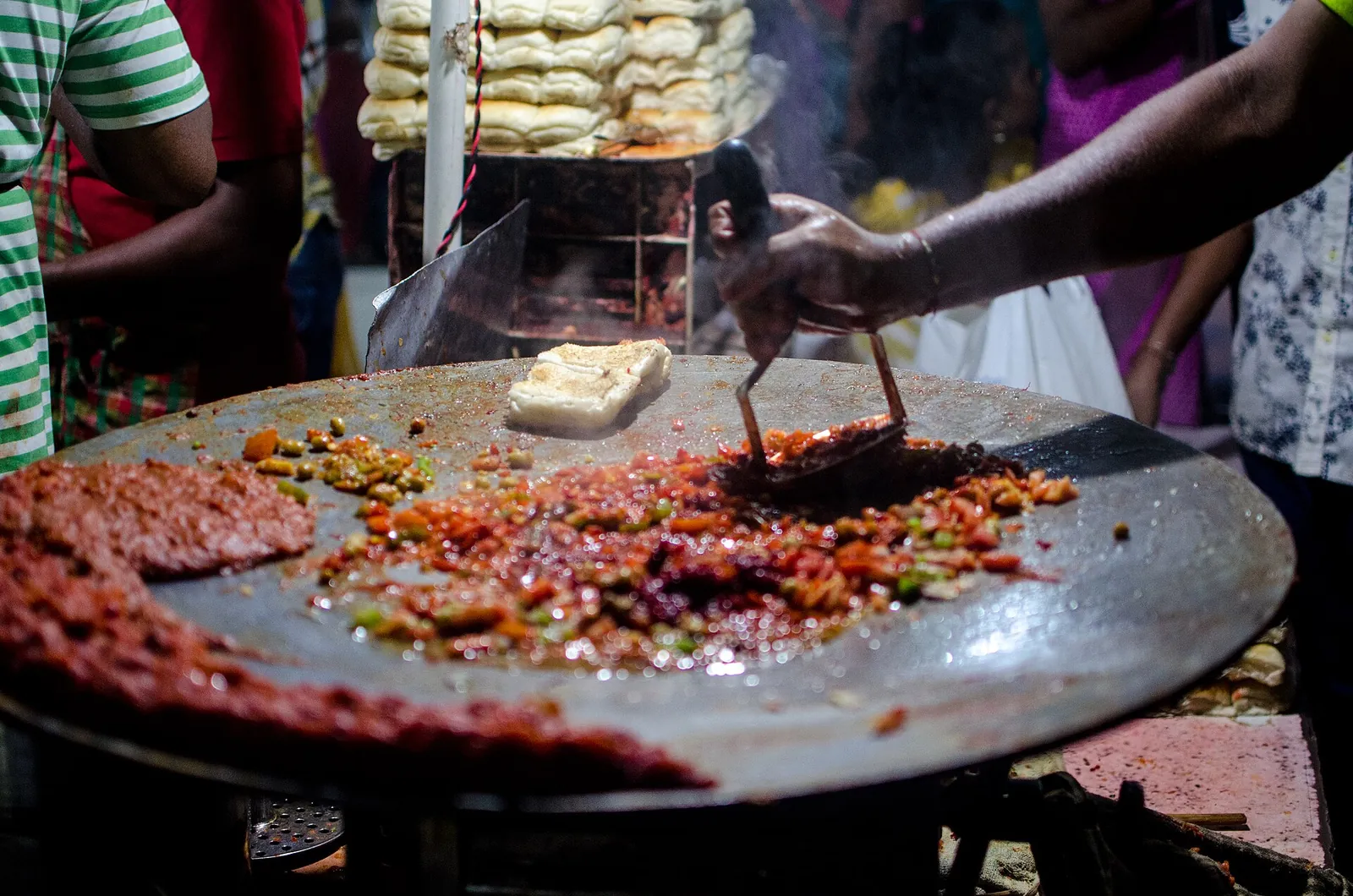
Mumbai eats on the move. The street classics are vada pav, a spiced potato fritter in a soft bun with chutneys; pav bhaji, a buttery vegetable mash with toasted rolls; bhel puri and sev puri; misal pav, a spicy lentil curry topped with crunchy farsan, the Maharashtrian breakfast; and kanda poha, flattened rice with onions and mustard seeds. Girgaum Chowpatty and Juhu are the beaches for pav bhaji, Dadar the district for Maharashtrian cooking, and Mohammed Ali Road turns into a food street during Ramadan, according to the Ministry of Tourism; our festivals guide has the dates.
Two Mumbai restaurants show the city's Gujarati and Parsi tables. Swati Snacks, opened in Tardeo in 1963, cooks Gujarati vegetarian food: panki, rice pancakes steamed in banana leaf, khichdi with kadhi, dal dhokli and puran poli, besides pav bhaji and the chaat, and it offers a Jain version of many dishes. Jimmy Boy, run by the same Irani family since 1925 in a heritage building in Fort, serves the Parsi café breakfast of bun maska, a buttered bun, with Irani chai, and Parsi favourites such as patra ni macchi and dhansak. Our Mumbai guide adds the Koli seafood of Khar Danda.
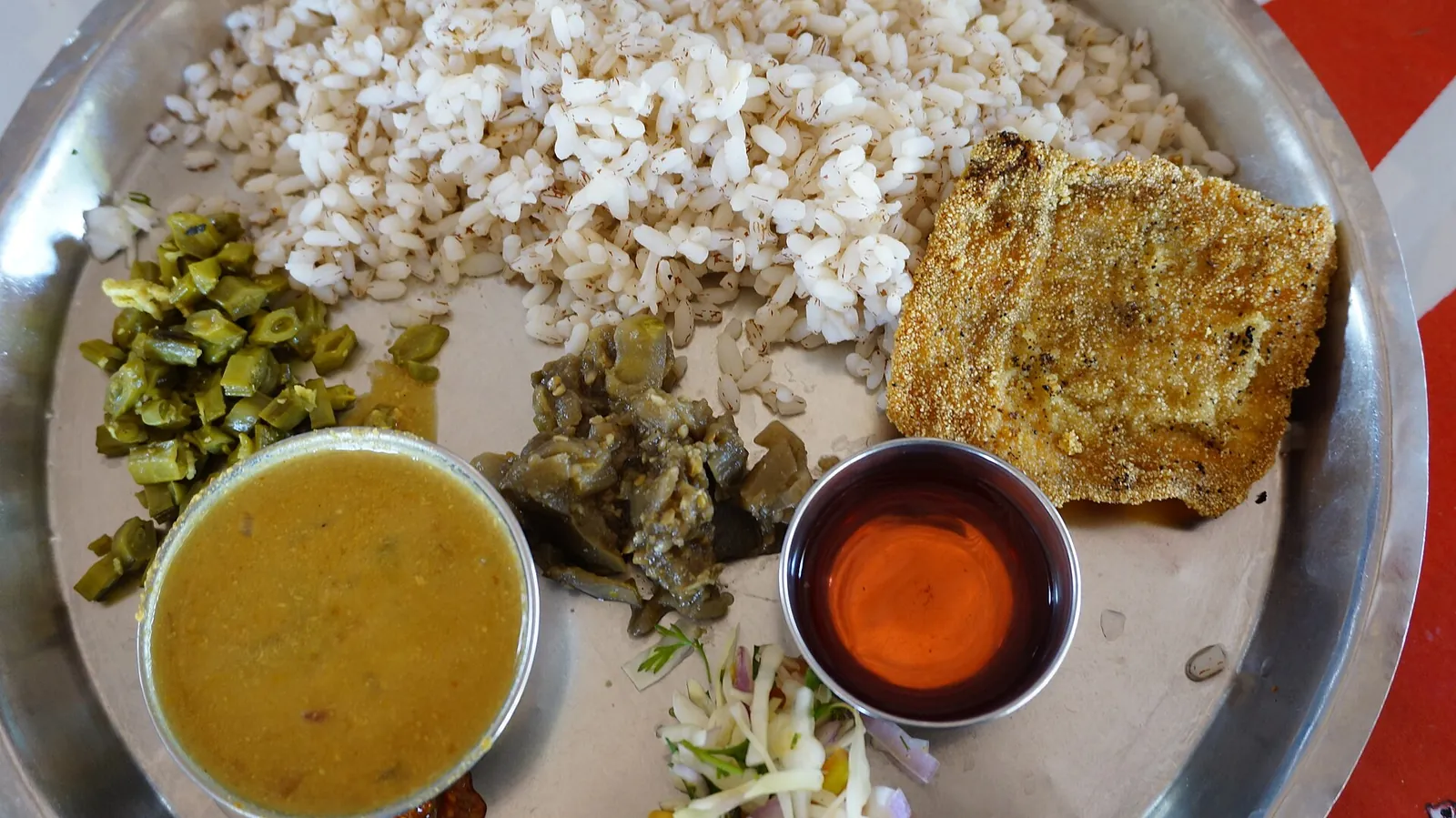
Goa's food carries the mark of its Portuguese past. Vindalho takes its name from the Portuguese for garlic and wine; xacuti blends 16 to 18 spices with roasted coconut; cafreal is chicken in a green masala of coriander, lime and chilli; sorpotel is a pork dish adapted by Goan Christians with vinegar; and bebinca, a layered coconut cake, is Goa's own dessert. The everyday meal is fish curry rice: a reddish-hot curry of spices and coconut, usually with mackerel, kingfish or prawns, over rice. Viva Panjim, a family restaurant in a heritage house in the Fontainhas quarter of Panaji, cooks family recipes for vindalho, xacuti, sorpotel and cafreal besides fish curry rice; our Goa guide covers the beach shacks and markets.
- Mumbai breakfast: bun maska and Irani chai at a Parsi café, or misal pav in Dadar.
- Mumbai lunch or dinner: a Gujarati plate or pav bhaji at Swati Snacks; bhel puri on the beach at sunset.
- Goa: fish curry rice at lunch, xacuti or cafreal for dinner, bebinca to take home.
The east: Bengal's fish and sweets, Bihar's litti chokha
Kolkata is outside this edition's routes, so here is only the short list. The Ministry of Tourism's Kolkata food guide points to bhetki paturi, fish steamed in a banana leaf, and chingri malaikari, prawns in coconut curry; Bengali thalis at Kewpie's on Elgin Lane; kathi rolls at Nizam's on Hogg Street; Kolkata biryani at Arsalan, Aminia or the Royal Indian Hotel; and sandesh and mishti doi, sweetened set curd, at sweet shops such as Girish Chandra Dey & Nakur Chandra Nandy. Without Kolkata, eat litti chokha at The Potbelly in Delhi's Bihar Niwas, or baati chokha, roasted wheat-dough balls with a vegetable mash, which Varanasi serves almost everywhere.
How to order: thalis, langars, the veg mark and eating by hand
The thali. A thali is ordered as one plate rather than dish by dish: Natraj in Udaipur serves its Rajasthani thali this way, and Delhi's Andhra Bhavan its vegetarian thali at lunch. In north Karnataka the same kind of meal is typically served on a banana leaf.
The green and brown marks. Under the Food Safety and Standards (Labelling and Display) Regulations, 2020, vegetarian food carries a green filled circle inside a square with a green outline, and non-vegetarian food a brown filled triangle inside a square with a brown outline. The same rules require food service establishments, with some exemptions, to show the logo and allergen information against the dishes on their menus. Two definitions matter: eggs count as non-vegetarian, so an egg dish takes the brown mark; milk, milk products and honey do not.
Eating with your hand. Indians usually eat with the right hand, according to Rough Guides; the left is usually not used to eat, pass food or wipe your mouth, though it may hold a cup or help tear a chapati. Letting your lips touch food that others will eat, known as jhutha, is generally avoided, so pour from a shared bottle rather than drinking from it. Wash your hands before and after the meal.
Bills. Mumbai's Swati Snacks, for example, adds 5% GST to its menu prices and lists an optional 8% service charge, so read the foot of the menu before you add up the bill. Carry cash for markets and stalls, as our first-trip guide advises.
- Green circle: vegetarian, which in Indian law includes milk and honey but not eggs.
- Brown triangle: non-vegetarian, including dishes whose only animal ingredient is egg.
- Right hand for eating, and nothing passed with the left.
Breakfast, sweets and drinks
Breakfast tells you where you are. Kachori-sabzi in a leaf bowl in Varanasi; idli, vada and dosa with filter coffee in the south and at Delhi's Andhra Bhavan; misal pav or kanda poha in Maharashtra; puttu with chickpea curry in Kerala; and at Jimmy Boy in Mumbai, bun maska with a cup of Irani chai, or akuri, Parsi spiced scrambled eggs, with bread.
Sweets are regional too: malaiyyo in a Varanasi winter, sandesh and mishti doi in Kolkata, bebinca in Goa, puran poli, a flatbread stuffed with sweet lentils, at Swati Snacks' Gujarati table, and payasam at the end of a Kerala sadya. In Varanasi, a Banarasi paan is made fresh in front of you, and lassi, the curd drink, is for any time of day.
Drinks. Filter coffee in the south, Irani chai in Mumbai's cafés, lassi in the north. Alcohol sales are often banned during major religious festivals, national holidays and elections; for water, see the last section.
- Parsi breakfast: bun maska and Irani chai at Jimmy Boy.
- Winter only: malaiyyo in Varanasi.
- After dinner: a Banarasi paan in Varanasi.
What a meal costs
Prices below were checked on 27 October 2026 on the places' own menus. The range is wide: a langar costs nothing, a Parsi café breakfast less than INR 200, a Goan fish curry rice from INR 210, and a hotel breakfast buffet several times that.
| Where you eat | What it costs | Published examples |
|---|---|---|
| Gurdwara langar | Free | Gurudwara Bangla Sahib, Delhi |
| Café or snack counter | INR 50–165 | Jimmy Boy, Mumbai: tea INR 50, bun maska INR 65, masala akuri pav INR 165 |
| Local restaurant | INR 160–410 a dish | Viva Panjim, Goa: mackerel curry rice INR 210, kingfish curry rice INR 320; Swati Snacks, Mumbai: vada pav INR 160, pav bhaji INR 410, both plus 5% GST |
| Hotel restaurant | INR 2,500 plus taxes | Tamra at the Shangri-La Eros, New Delhi: breakfast buffet (checked on 21 October 2026) |
At street stalls, ask the price as you order and pay in small notes. For a day, not a dish, our trip-cost guide works with about INR 800 a day each with street food and simple restaurants, INR 1,500 with sit-down meals and INR 6,000 at hotel restaurants. It also prices the rooms, trains and tickets of a Golden Triangle week.
Two model days from the prices above. In Mumbai: bun maska and tea at Jimmy Boy (INR 115), pav bhaji at Swati Snacks for lunch (INR 431 with GST) and a vada pav there later (INR 168 with GST) come to about INR 700 for breakfast, lunch and a snack, before Swati's optional service charge and your drinks; with dinner, the day passes the INR 800 level unless dinner costs under INR 100. In Delhi, the langar at Bangla Sahib costs nothing; the Delhi restaurants named here do not publish their prices online, so plan the rest of a Delhi day on the trip-cost levels.
- Free: the langar at Bangla Sahib.
- Cheapest breakfast: bun maska and a tea at Jimmy Boy, INR 115 together.
- Tax: sit-down restaurants may add GST and an optional service charge to menu prices.
Meal by meal on the first-trip routes
This plan follows the routes in our first-trip guide: the Golden Triangle week first, then the add-ons. Our Delhi guide plans Bhogal for any day but Sunday.
- Delhi, first day: breakfast at Saravana Bhavan on Janpath; lunch at the Bangla Sahib langar; in the evening, the Old Delhi lanes for parathas, Karim's or a Jama Masjid biryani.
- Delhi, second day: chole bhature at Bhogal in Connaught Place, not on a Sunday (see our Delhi guide); a regional plate at Dilli Haat; butter chicken at Kake-Da-Hotel in Connaught Place or Moti Mahal in Daryaganj for dinner.
- Agra and Jaipur: our Agra guide and Jaipur guide name the bedai breakfast, the bhalla chaat and the kachori stalls; take a Rajasthani thali at lunch.
- Varanasi: kachori-sabzi after the dawn boat, tamatar chaat after the evening aarti, and a paan to finish.
- Mumbai: bun maska and Irani chai at Jimmy Boy before 11:00, when its morning tea ends; a Gujarati lunch or pav bhaji at Swati Snacks (from 11:45); bhel puri at Girgaum Chowpatty at sunset.
- Goa: fish curry rice at Viva Panjim at lunch (11:30–15:30), xacuti or cafreal at dinner (19:00–23:00), then bebinca.
- Kerala: a sadya on the houseboat and karimeen in Kochi, at the places our Kerala guides name.
What to eat and where to look
Langar at Gurudwara Bangla Sahib
A free meal cooked and served by volunteers to thousands of people a day, eaten sitting cross-legged on the floor, with the sweet kada prasad offered as you leave.
- Where to look
- Gurudwara Bangla Sahib, near Connaught Place, New Delhi; the gurdwara is open 24 hours and the langar is free.
- Fit it into your day
- Lunch on the first Delhi day.
Cover your head and shoulders and take off your shoes before you enter.
Pav bhaji
A buttery, spiced vegetable mash cooked on a griddle and eaten with toasted, buttered rolls: the Mumbai street dish, here in a Gujarati vegetarian restaurant.
- Where to look
- Swati Snacks, 248 Karai Estate, opposite Bhatia Hospital, Tardeo, Mumbai; open 11:45–22:30, last order 22:15; pav bhaji INR 410 plus 5% GST.
- Fit it into your day
- Lunch on a Mumbai day, with a Gujarati panki or khichdi to share.
The menu marks the dishes available in a Jain version; for allergens, see the last section.
Bun maska, akuri and Irani chai
The Parsi café breakfast: a buttered bun, spiced scrambled eggs and a cup of Irani chai, served in a Fort restaurant the same Irani family has run since 1925.
- Where to look
- Jimmy Boy, Vikas Building, 11 Bank Street, off Horniman Circle, Fort, Mumbai; tea is served 08:00–11:00 and 16:00–19:00; tea INR 50, bun maska INR 65, masala akuri pav INR 165.
- Fit it into your day
- Breakfast on a Mumbai day, before the walk round Fort and CSMT.
Goan fish curry rice
The everyday Goan meal: a reddish-hot curry of spices and coconut with mackerel, kingfish or prawns, served with rice.
- Where to look
- Viva Panjim, H.No. 178, Rua 31 de Janeiro, Fontainhas, Panaji; lunch 11:30–15:30, dinner 19:00–23:00; mackerel curry rice INR 210, kingfish curry rice INR 320.
- Fit it into your day
- Lunch on the Panaji day, after the walk through Fontainhas.
The curry is made with coconut.
Vegetarian, Jain, beef and allergies
Vegetarian food is easy to check, thanks to the green mark, and some places go further. Swati Snacks marks the dishes it can make in a Jain version; the Prasadam Restaurant of the Ganga Darshanam guest house, at Dashashwamedh Ghat in Varanasi, lists a veg thali with no onion and no garlic; the Ministry of Tourism describes Rishikesh as a vegetarian-only and alcohol-free city; and at Parmarth Niketan, the ashram on the Ganges, eggs and non-vegetarian food are not allowed. If you eat eggs but no meat, look for the brown mark as well: egg dishes carry it.
Beef is a matter for each state. PRS Legislative Research counted, in 2021, more than 20 states with laws that restrict the slaughter of cattle and buffaloes to various degrees, from Chhattisgarh, which prohibits it completely, to Tamil Nadu, which allows it for animals above 10 years old that are unfit for breeding or work; Maharashtra prohibited the slaughter of bulls and bullocks of all ages in 2015. In Kerala, Kerala Tourism lists beef fry among the dishes to try. Order from what the menu lists rather than asking for a dish it does not show.
Street food and water. Drink treated or sealed bottled water, eat food served hot, peel your own fruit and wash your hands often. Treat tap water as unsafe. Food and drink offered by strangers on trains has been laced with strong sleeping drugs, after which passengers wake up robbed, so accept none. Our health and safety guide has the full advice, including what to do if your stomach objects.
Allergies. Restaurants covered by the national rules must show allergen information on the menu. Swati Snacks, for one, warns that its food may contain nuts, dairy, cereals, gluten, seeds, vegetable oils, soy and coconut, asks guests to tell the staff about allergies before ordering, and warns that cross-contamination is possible.
- Vegetarian: look for the green circle; ask for a Jain version or no onion and garlic if you need it.
- Beef: depends on the state; Kerala Tourism lists beef fry.
- Trains: accept no food or drink from strangers.
Practical questions
What do the green and brown symbols on Indian menus and food packs mean?
A green filled circle inside a green square marks vegetarian food; a brown filled triangle inside a brown square marks non-vegetarian food. Under India's labelling rules, eggs make a dish non-vegetarian, while milk, milk products and honey do not, and restaurants covered by the rules are required to show the mark against each dish on the menu.
Is street food safe to eat in India?
Drink treated or sealed bottled water, eat food served hot, peel your own fruit and wash your hands often, and treat tap water as unsafe. Our health and safety guide has the full advice.
How do I eat with my hands in India?
With the fingers of the right hand: Rough Guides says Indian meals are usually eaten this way, and that the left hand is not used to eat, pass food or wipe your mouth, though it may hold a cup or help tear a chapati. Letting your lips touch food or a bottle others will share is generally avoided. Wash your hands before and after.
Can I eat beef in India?
It depends on the state. More than 20 states restrict the slaughter of cattle and buffaloes to various degrees, according to PRS Legislative Research, while in Kerala, Kerala Tourism lists beef fry among the dishes to try. Order from what the menu shows rather than asking for beef where it is not listed.
How much should I budget for food per day?
About INR 800 a day each with street food and simple restaurants, INR 1,500 with sit-down meals and INR 6,000 at hotel restaurants, the levels our trip-cost guide uses. A langar is free, an Irani chai is INR 50, a Goan fish curry rice from INR 210 (checked on 27 October 2026).
Keep planning your trip
First trip to India
How long a first India trip needs, which route fits one, two or three weeks, the month for each region, arrival airports, money, SIM cards and temple manners.
Read the guide
India trip cost 2027
A week in Delhi, Agra and Jaipur in February 2027, all in: about INR 49,000 per person on a budget, 74,000 mid-range or 160,300 in comfort.
Read the guide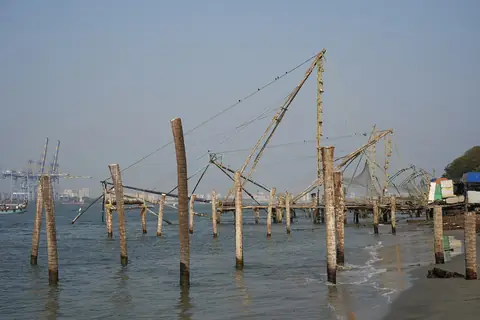
Kochi
Three nights in Kochi: the Chinese fishing nets, Mattancherry Palace and the synagogue with their closing days, Kathakali, the Water Metro and a budget.
Read the guide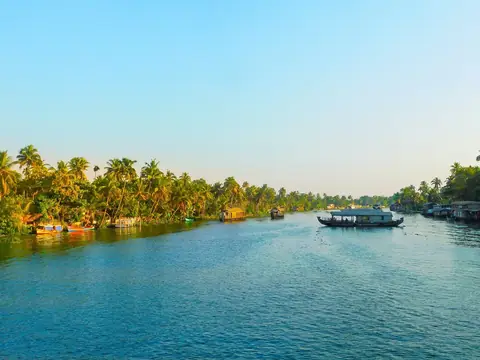
Kerala backwaters
Two nights on Kerala's backwaters: choosing an approved houseboat in Alappuzha, the public boats, Kuttanad, Kumarakom's birds, the Nehru Trophy and a budget.
Read the guideSources and checks before you travel
(32)
- Incredible India (Ministry of Tourism): Dilli Haat, Delhi ↗ — opens in a new tab
- Incredible India (Ministry of Tourism): a captivating journey of flavours (Delhi) ↗ — opens in a new tab
- Incredible India (Ministry of Tourism): Delhi's pan-Indian restaurants ↗ — opens in a new tab
- Incredible India (Ministry of Tourism): Gurudwara Bangla Sahib ↗ — opens in a new tab
- Incredible India (Ministry of Tourism): Rajasthani food in Udaipur ↗ — opens in a new tab
- Kashi official portal: Varanasi cuisine ↗ — opens in a new tab
- Ganga Darshanam guest house, Varanasi ↗ — opens in a new tab
- Incredible India (Ministry of Tourism): local cuisine in Chennai and Tamil Nadu ↗ — opens in a new tab
- Karnataka Tourism: North Karnataka food trail ↗ — opens in a new tab
- Incredible India (Ministry of Tourism): Hampi Bazaar ↗ — opens in a new tab
- Kerala Tourism: Kerala gustatory experience ↗ — opens in a new tab
- Incredible India (Ministry of Tourism): Mumbai's gastronomic odyssey ↗ — opens in a new tab
- Swati Snacks: Tardeo restaurant ↗ — opens in a new tab
- Swati Snacks: Mumbai menu ↗ — opens in a new tab
- Jimmy Boy, Fort, Mumbai ↗ — opens in a new tab
- Jimmy Boy: breakfast menu ↗ — opens in a new tab
- Incredible India (Ministry of Tourism): top foods to try in Panjim, Goa ↗ — opens in a new tab
- Viva Panjim, Fontainhas, Panaji ↗ — opens in a new tab
- Viva Panjim: about ↗ — opens in a new tab
- Kake Da Hotel: menu ↗ — opens in a new tab
- Kake Da Hotel: our story ↗ — opens in a new tab
- Viva Panjim: Goan menu ↗ — opens in a new tab
- Incredible India (Ministry of Tourism): Kolkata food guide ↗ — opens in a new tab
- FSSAI: Food Safety and Standards (Labelling and Display) Regulations, 2020 (compendium) ↗ — opens in a new tab
- Rough Guides: India culture and etiquette ↗ — opens in a new tab
- PRS Legislative Research: the Assam Cattle Preservation Bill, 2021 ↗ — opens in a new tab
- Incredible India (Ministry of Tourism): Rishikesh ↗ — opens in a new tab
- Parmarth Niketan: ashram guidelines ↗ — opens in a new tab
- Germany's Foreign Office (Auswärtiges Amt): India travel and safety advice ↗ — opens in a new tab
- US CDC Travelers' Health: India ↗ — opens in a new tab
- UK FCDO: India travel advice, safety and security ↗ — opens in a new tab
- Shangri-La Eros New Delhi: Tamra ↗ — opens in a new tab
Reference sources for the version dated 27 October 2026. Confirm opening times, access, transport and conditions for your travel dates.
Photo credits
(6)
A vegetarian thali in Kolkata, with rice, papad, dal and small bowls of vegetable curries
Photograph: Ganesh Mohan T — opens in a new tab · CC BY-SA 4.0 — opens in a new tab
Changes: Resized and converted to WebP; displayed with responsive crops. · Original photograph and licence details ↗ — opens in a new tab
Pav bhaji cooking on a street griddle in Mumbai
Photograph: Ashwin Kumar from Bangalore, India — opens in a new tab · CC BY-SA 2.0 — opens in a new tab
Changes: Resized and converted to WebP; displayed with responsive crops. · Original photograph and licence details ↗ — opens in a new tab
The langar kitchen of Gurudwara Bangla Sahib in Delhi, where the free meals are cooked
Photograph: Ji-Elle — opens in a new tab · CC BY-SA 4.0 — opens in a new tab
Changes: Resized and converted to WebP; displayed with responsive crops. · Original photograph and licence details ↗ — opens in a new tab
A Goan fish, curry and rice meal
Photograph: Fredericknoronha — opens in a new tab · CC BY-SA 4.0 — opens in a new tab
Changes: Resized and converted to WebP; displayed with responsive crops. · Original photograph and licence details ↗ — opens in a new tab
Masala dosa and vada from Kerala, with sambar and chutney
Photograph: Gannu03 — opens in a new tab · CC BY-SA 4.0 — opens in a new tab
Changes: Resized and converted to WebP; displayed with responsive crops. · Original photograph and licence details ↗ — opens in a new tab
Chole bhature at a restaurant on Bangla Sahib Road, New Delhi
Photograph: Siva301in — opens in a new tab · CC BY-SA 4.0 — opens in a new tab
Changes: Resized and converted to WebP; displayed with responsive crops. · Original photograph and licence details ↗ — opens in a new tab