Delhi and the north · Uttar Pradesh
Agra travel guide: two nights for the Taj Mahal and Fatehpur Sikri
Agra was the capital of the Mughal emperors Akbar, Jahangir and Shah Jahan, and it kept the buildings to prove it: a red sandstone fort on a bend of the Yamuna, a marble tomb on each bank of the river and, upstream from the fort, the Taj Mahal. Agra often gets one rushed day from Delhi. Two nights let you walk into the Taj gardens as the gates open before sunrise, watch the mausoleum turn gold from Mehtab Bagh across the river, and spend half a day in Akbar's abandoned capital at Fatehpur Sikri, 37 km away.
- Suggested time
- 2 nights (3 days)
- Where to stay
- Taj Ganj and Taj East Gate Road, within walking distance of the Taj Mahal's east gate; Fatehabad Road for larger hotels a short ride away
- Season and timing
- UP Tourism gives October to March as the best season for Agra. From April to June the heat builds: IMD's Delhi climate table puts the mean daily maximum at 39.9°C in May. The monsoon follows, with 195.8 mm of rain over 9.7 rainy days in July and 226.8 mm over 10.2 days in August in the same table. In those months, be at the Taj when it opens and finish Fatehpur Sikri before midday. In winter the table counts an average of 19.2 days with fog in December and 21.6 in January, so leave slack around a morning train or drive in those months. Northern India's winter also brings its worst air pollution, covered in our health and safety guide. Taj Mahotsav, UP Tourism's crafts and culture festival, usually runs for ten days in February.
The short answer
Book two nights in Taj Ganj, near the Taj Mahal's east gate: one night is the minimum for a sunrise visit, and the second makes room for Fatehpur Sikri. Book the room first, then the Taj tickets online on ASI's booking site, asi.paygov.org.in, and the train from Delhi on IRCTC, and keep the Taj off a Friday, the one day it is closed. Two key prices, checked on 17 October 2026: the Taj Mahal costs a foreign visitor INR 1,100, plus INR 200 to enter the main mausoleum, and Agra Fort costs INR 600 (INR 550 online). The model stay below comes to INR 16,105.50 for two, before trains and most meals.
Where to sleep: Taj Ganj by the east gate, or Fatehabad Road
Sleep close to the Taj. UP Tourism's site says no polluting vehicles are allowed within 500 m of the monument, and battery buses and golf carts run from the parking areas at Shilpgram, for the east gate, and Amrood ka Teela, for the west gate. A room in Taj Ganj or on Taj East Gate Road, the old quarter and the road that run up to the walls, puts you a walk from the gate in the dark before sunrise, and lets you come back for breakfast and a rest before the afternoon sights.
Hotel Taj Resorts, on Taj East Gate Road near Shilpgram, lists its Executive Room on its own site at INR 4,555 a night plus taxes, with a buffet breakfast included (checked 17 October 2026); check-in and check-out are at 12 noon. The hotel puts itself 500 m from the Taj Mahal and has a rooftop restaurant facing it. Hotel rooms priced at INR 7,500 or less a night have carried 5% GST since 22 September 2025.
Fatehabad Road, south of Taj Ganj, is where Agra's larger hotels and many of its restaurants are, a short auto-rickshaw or taxi ride from the gates. For how Agra compares with Delhi and Jaipur as a base, see our where-to-stay guide for India.
The Taj Mahal: the tomb, the garden and the river terrace
Shah Jahan built the Taj Mahal for his queen Arjumand Bano Begum, Mumtaz Mahal, who died in 1631 at Burhanpur during the birth of her fourteenth child. UP Tourism's history page says work began about 1631, the mausoleum was finished in 1648 and the outer buildings and gardens five years later, in 1653, by a workforce of about 20,000 recruited across northern India. It has been a World Heritage Site since 1983.
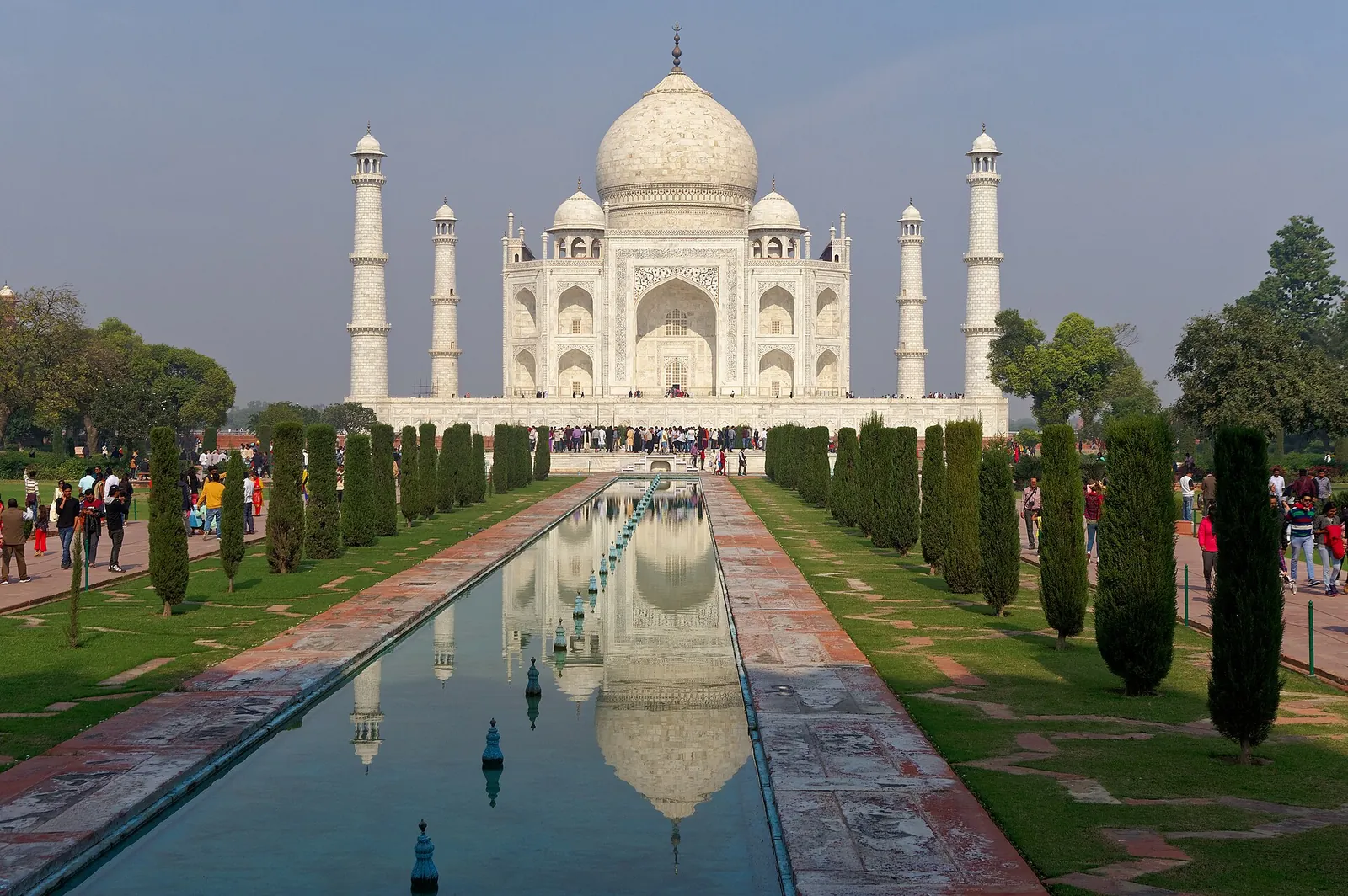
You enter through a red sandstone gateway inlaid with Quranic calligraphy, and the tomb appears at the end of a long garden. The Archaeological Survey of India (ASI) describes a perfect char-bagh, four quarters divided by broad water channels and walkways, with fountains in the channels and cypress avenues beside the walkways. The mausoleum stands at the far end, on a terrace above the Yamuna, framed by four minarets each more than 130 feet tall, with a red sandstone mosque to the west and its mirror image, the Mehman Khana, to the east.
Go up close. The white marble comes from Makrana in Rajasthan, and the flowers on the walls are inlaid stone, yellow marble, jasper and jade cut and set flush with the surface. Inside, under an outer dome that rises to 44.4 m, an octagonal marble screen of 1643 surrounds the cenotaphs of Mumtaz Mahal and Shah Jahan; the real graves lie in a lower chamber that visitors do not enter. UP Tourism's site describes the marble as pinkish in the morning, milky white in the evening and golden by moonlight, and its FAQ adds that an early visit avoids both the summer heat and the crowds.
Visiting the Taj: tickets, gates, Fridays and what you may carry
Hours and the Friday closure. UP Tourism's Taj Mahal site, which publishes the ticket table, says: "Taj Mahal remains closed only on Fridays". "Visiting hours: 30 Minutes before Sunrise upto 30 Minutes before Sunset." On Fridays the mosque inside opens only for prayers between 12 noon and 2 pm, as ASI states. The other Agra monuments are open every day from sunrise to sunset, so a Friday in Agra is the day for Agra Fort, the river tombs and Fatehpur Sikri.
Tickets. UP Tourism's table, checked on 17 October 2026, lists the Taj Mahal at INR 1,100 for a foreign visitor or NRI, INR 540 for SAARC and BIMSTEC citizens and INR 50 for Indians, and the main mausoleum needs an additional ticket of INR 200. There is no entry fee for children below 15 years, Indian or foreign. You can buy at the ticket windows at the west and east gates, which UP Tourism lists as open from one hour before sunrise to 45 minutes before sunset. You can also buy online in advance on ASI's booking site, asi.paygov.org.in, and UP Tourism says each foreigner's ticket bought online costs INR 50 less. Carry your passport: visitors must show a government-issued identity document.
One toll for the day. A foreign visitor's Taj ticket includes the Agra Development Authority's INR 500 toll. ASI says a foreign visitor who buys that toll ticket with the Taj Mahal "need not to purchase any other" toll ticket for Agra Fort, Fatehpur Sikri, Akbar's Tomb or Itimad-ud-Daulah's tomb on the same day, and "On Friday ADA does not levy any Toll Tax". At the Agra Fort gate, for example, ASI's INR 600 price is INR 550 for ASI plus an INR 50 toll; ASI publishes no such split for its INR 550 online price. So the Taj morning is also the day for Fatehpur Sikri.
Gates. Enter by the east or west gate; the south gate is for leaving only. UP Tourism recommends the east gate, which faces the Taj Nature Walk, to avoid the crowd, and there are separate queues for foreign and Indian visitors. Ticket windows and cloakrooms are at both gates. UP Tourism advises hiring only approved guides and photographers who show their identity cards.
What you may carry. A water bottle is allowed, and the foreigner's ticket includes shoe covers, a half-litre bottle of water, a map of Agra and the battery bus and golf cart from the parking areas. Eatables, tobacco, tripods, headphones, mobile chargers, knives and electrical goods other than cameras are prohibited, drones are banned in and around the monument, and photography is not allowed inside the main mausoleum. Leave big bags at the hotel or the cloakroom; they slow the security check. Keep your phone off or on silent. The Taj Museum inside the complex opens from 10:00 to 17:00 and is free.
Night viewing. ASI opens the Taj at night on the full moon and two nights either side of it, except on Fridays and during Ramzan. UP Tourism's site gives eight batches of at most 50 people, 30 minutes each, between 20:00 and 23:59, while ASI's Agra Circle lists the slots from 20:30 to 00:30; either way, security checks are at Shilpgram half an hour before your slot. Phones, video cameras and spare batteries are not allowed at night; a still camera is. UP Tourism lists the night ticket at INR 750 for a foreign adult, booked on ASI's booking site, asi.paygov.org.in, from seven days before the date.
Agra Fort, the Baby Taj and the view from Mehtab Bagh
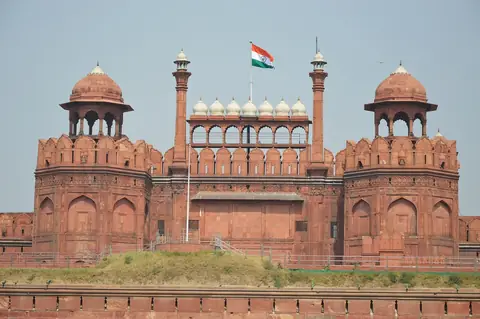
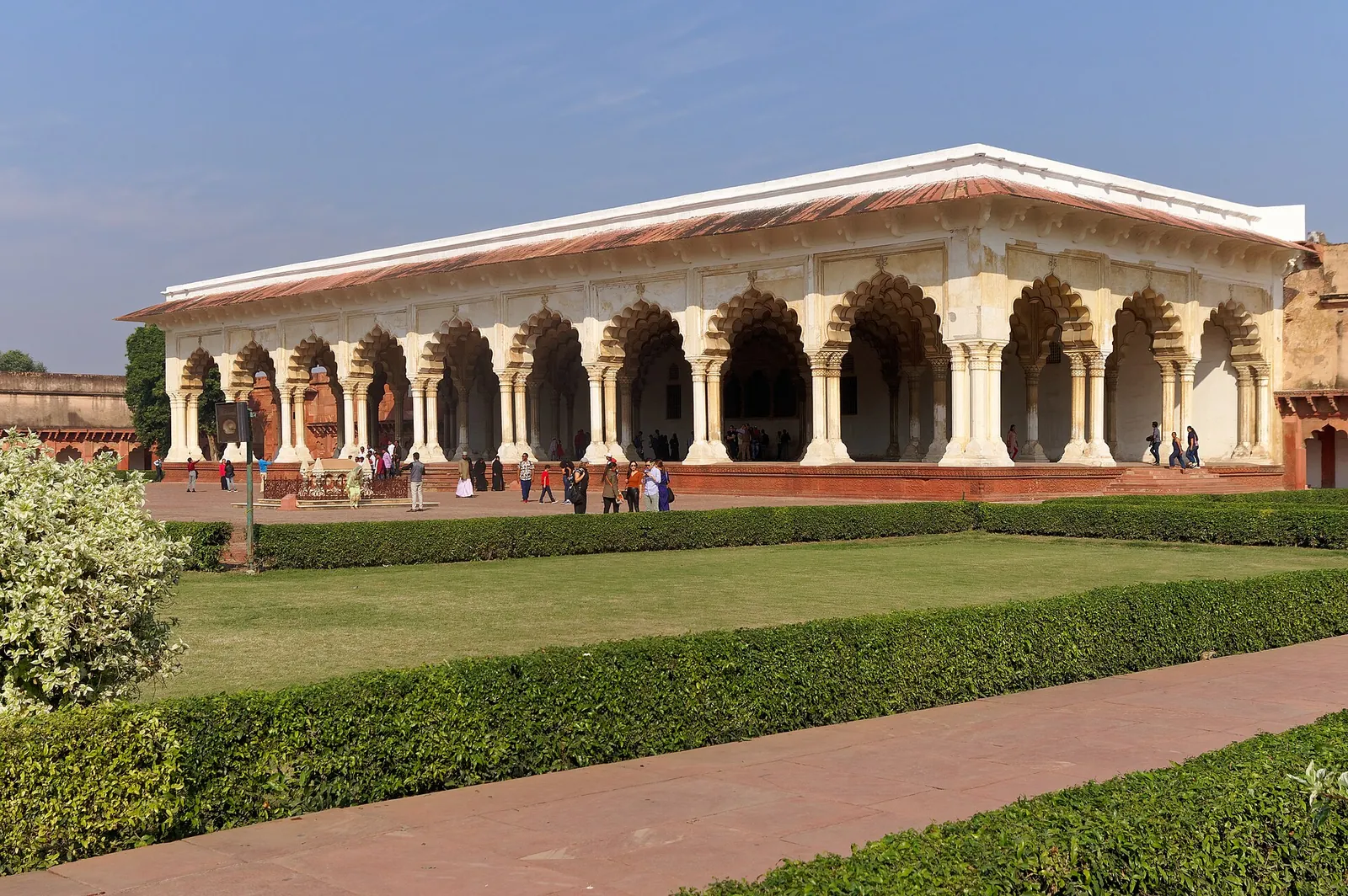
Agra Fort is the city Akbar built to rule from. ASI says he rebuilt an older fort in red sandstone between 1565 and 1573, with some 4,000 builders working daily; the walls are 21.4 m high and enclose about 94 acres. Shah Jahan replaced many of Akbar's buildings with white marble palaces and the Moti, Nagina and Mina mosques, and in the end lived here as a prisoner: his son Aurangzeb held him in the fort for eight years until he died in 1666. ASI counts the Delhi Gate, the Akbari Gate and the Bengali Mahal among the roughly thirty Mughal buildings that survive on the south-eastern side, representative of Akbar's reign. UP Tourism's walk leads to the many-pillared Diwan-i-Am, the hall of public audience, then to the royal pavilions: the Nagina and Mina mosques, the Macchi Bhavan, the Khas Mahal, the Shish Mahal and the Shah Jahani Mahal, with the Zenana Mina Bazaar. In the south of the fort stands the red sandstone Jahangiri Mahal, Jahangir's Palace, which UP Tourism says Akbar probably built for his son. In the Diwan-i-Khas, ASI notes, Shivaji met Aurangzeb in 1666. From the balconies of the riverside pavilions, among them the Musamman Burj, you look along the Yamuna to the Taj. Entry is by the Amar Singh Gate only; part of the fort is used by the Indian Army and closed to visitors. It opens from sunrise to sunset. ASI lists the foreign visitor's ticket at INR 600 at the gate or INR 550 online; UP Tourism's table lists the fort at INR 650 for a foreigner on a weekday other than Friday and INR 600 on a Friday or after visiting the Taj, so the price at the gate may differ from ASI's. Audio guides in English, French, Spanish, German, Italian, Hindi and Bangla are available near the ticket counter.
In the evening the fort hosts UP Tourism's sound and light show, Rang-e-Agra, a 45-minute projection on the walls. UP Tourism lists the English show daily from 19:30 to 20:15, at INR 800 for an international adult and INR 400 for visitors aged 8-17, with 300 seats sold first come, first served, online or at the fort.
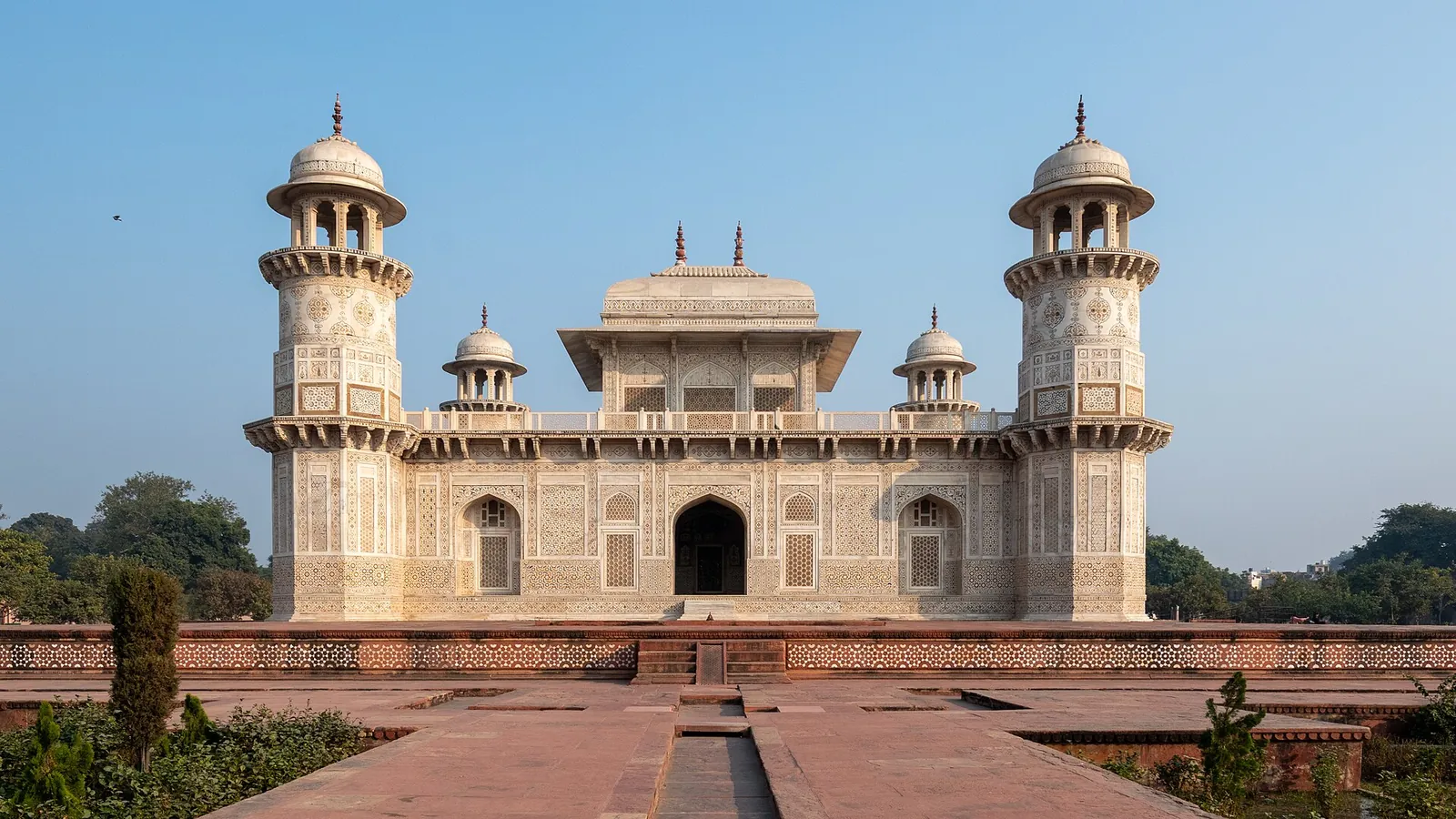
Itimad-ud-Daulah's tomb, on the left bank across the river, is smaller and quieter than the Taj and often called the Baby Taj. ASI says Nur Jahan, Jahangir's empress, completed it in 1628 for her father, Mirza Ghiyath Beg, Jahangir's chief minister; UP Tourism points to its inlay of yellow, black and white marble. It stands in a char-bagh garden next to Chini ka Rauza, a tomb known for its blue glazed tiles. UP Tourism's table lists the foreign visitor's ticket at INR 310, or INR 300 on a Friday or after the Taj.
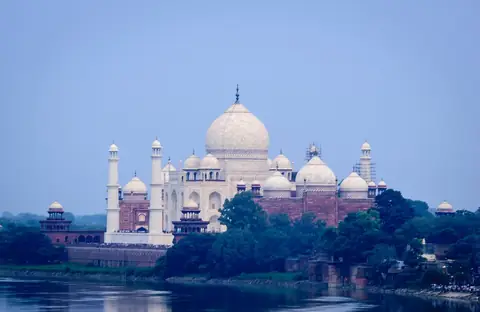
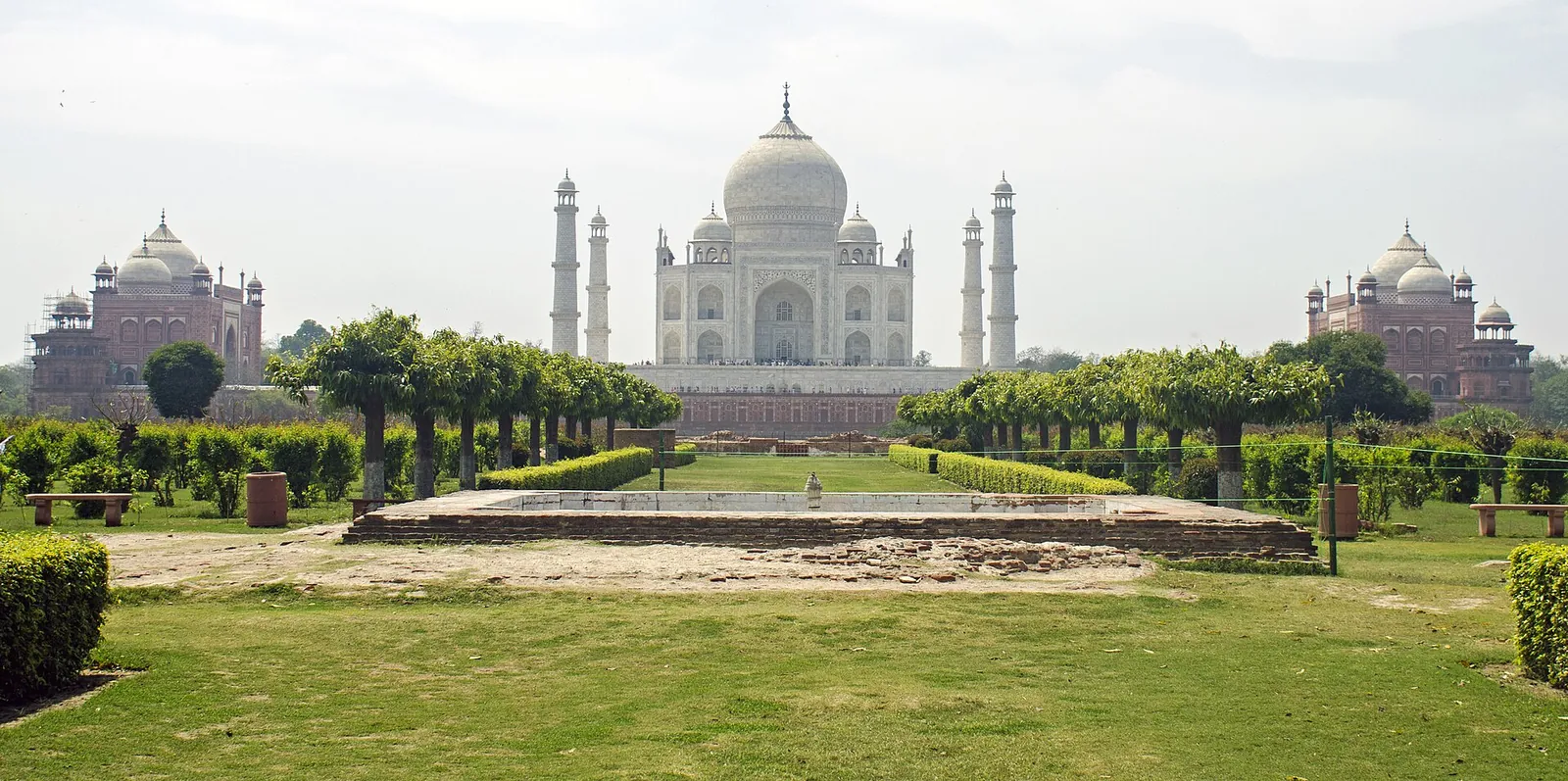
Mehtab Bagh, the Moonlight Garden, lies on the left bank exactly opposite the Taj. ASI's excavations found a huge octagonal tank with 25 fountains, and UP Tourism says the garden, about 300 by 300 m, is aligned with the mausoleum across the water, which makes it one of the best places to view the mausoleum. It opens from sunrise to sunset; UP Tourism's table lists INR 300 for a foreign visitor.
Fatehpur Sikri and Akbar's Tomb at Sikandra
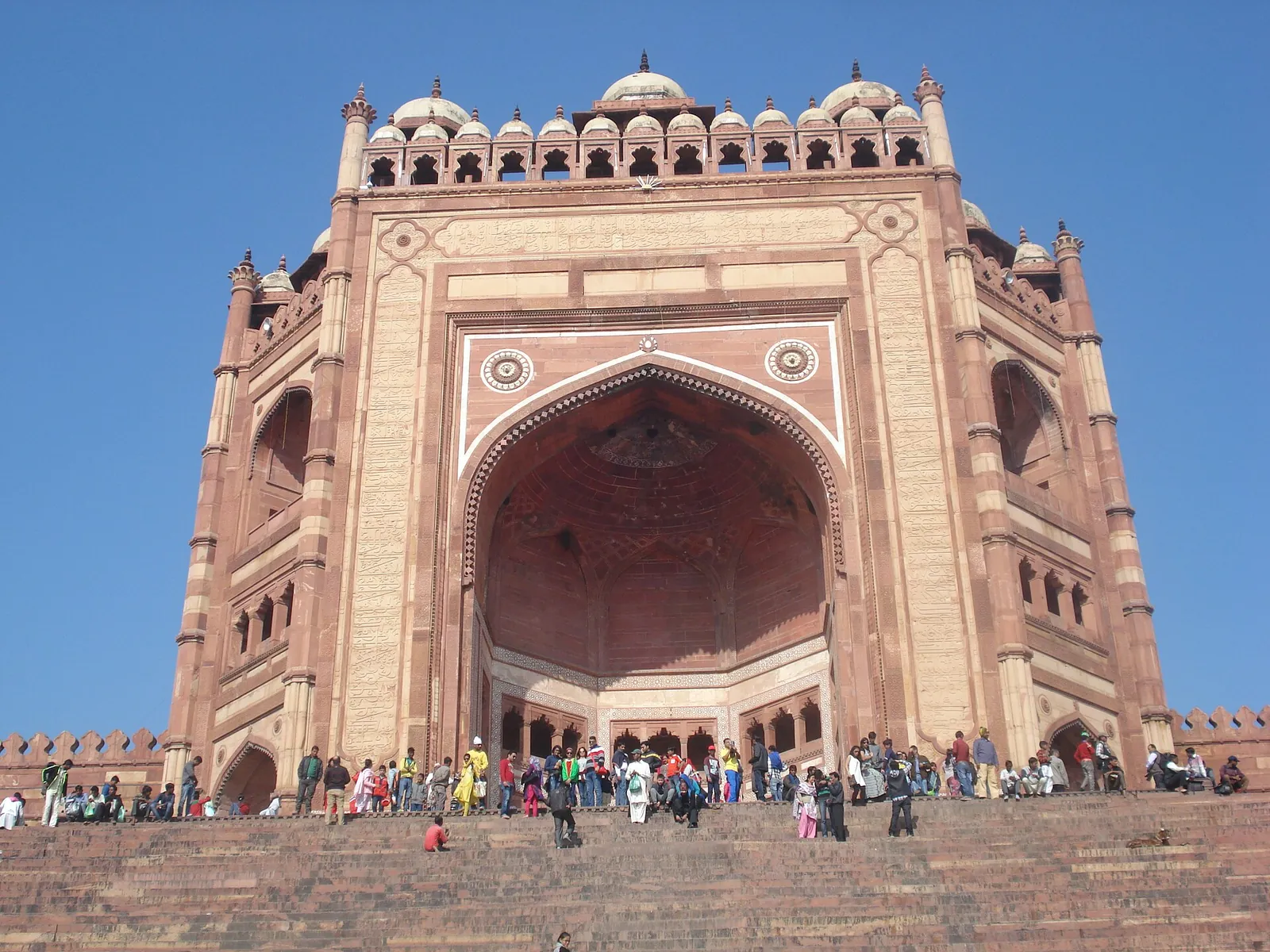
Fatehpur Sikri, 37 km from Agra, is the red sandstone capital that Akbar used and then left. ASI says he moved his court here for 13 years, from 1572 to 1585, to honour the Sufi saint Sheikh Salim Chishti, who had blessed him with a son, Salim, in 1569. It was the first planned Mughal city, laid out in terraces down a ridge, and it has been a World Heritage Site since 1986. There are two halves. The palace complex holds the Diwan-i-Am, the hall of public audience; the Diwan-i-Khas, whose single carved pillar is believed to have carried Akbar's throne; the Panch Mahal; the Anup Talao pool; and the palace named after Jodha Bai. Across the ridge, the Jami Masjid of 1571 encloses the white marble tomb of Sheikh Salim Chishti and is entered through the Buland Darwaza, a gateway at the top of a 13 m flight of steps that UP Tourism dates to 1602.
It opens from sunrise to sunset, and ASI lists the foreign visitor's ticket at INR 600, or INR 550 online. The archaeological site museum near the Diwan-i-Am booking counter opens from 09:00 to 17:00, is free and is closed on Fridays. UP Tourism says the usual way there is by taxi, 37 km each way, that the visit needs at least half a day, and that buses run from Agra's Idgah bus stand. No official taxi or bus fare is published, so agree the taxi price, including the waiting time, before you set off. Licensed guides wait near the ticket counters. UP Tourism warns about unlicensed guides who approach visitors as they get off the bus: if you hire one, make clear you want only the monuments, not shopping.
Akbar's Tomb at Sikandra, on the western edge of Agra on the Delhi road, is an easy stop if you leave Agra by road for Delhi. Akbar began it and his son Jahangir finished it: a five-storey tomb of red sandstone with a white marble top floor, open to the sky, set in a char-bagh garden. UP Tourism's table lists INR 310 for a foreign visitor, or INR 300 on a Friday or after the Taj, and like the other monuments it opens from sunrise to sunset.
Getting to Agra and around: trains from Delhi, the road and the airport
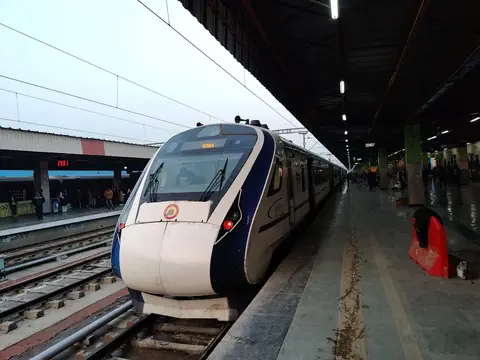
By train. Agra Cantonment (Agra Cantt) is the main station; Raja ki Mandi and Agra Fort are the city's other two. UP Tourism names the Shatabdi, Rajdhani, Gatimaan and Taj Express among the main trains between Delhi and Agra; PIB called the Gatimaan, at its launch in 2016, India's first semi-high speed train, with a maximum speed of 160 km/h. The timetable the Gatimaan Express published at its launch in 2016 gave 08:10 from Hazrat Nizamuddin and 09:50 at Agra Cantt; its launch release said it would run six days a week except Friday. Friday is also the day the Taj Mahal is closed. Indian Railways publishes current departure times and fares only in its journey search, so check IRCTC for your date. The railway enquiry number is 139. Foreign visitors can book under the Foreign Tourist quota with an IRCTC account; our transport guide explains the classes, the quota and the payment rules.
By road. UP Tourism gives the road distance from Delhi as 204 km and from Jaipur as 232 km; no official driving time is published. Between Delhi and Agra, the Yamuna Expressway is a six-lane, 165.5 km road from Pari Chowk in Greater Noida to Kuberpur near Agra. Buses for Delhi, Jaipur, Mathura and Fatehpur Sikri leave from the Idgah bus stand.
By air. Agra's own airport is about 7 km from the centre, and UP Tourism says flights run there in season. Delhi is the usual gateway. The Airport Express Line (Orange Line) runs from Terminal 3 to New Delhi Railway Station in around 25 minutes; first trains leave at 04:45, last trains at 23:15 (Dwarka Sector 21) and 23:30 (New Delhi), and ticket machines are in the Terminal 3 and Terminal 2 arrival halls. Our Delhi guide covers the city before or after Agra.
In town. Auto-rickshaws, cycle rickshaws, taxis and prepaid taxis are easy to find, and radio taxis run 24 hours, as UP Tourism lists. Near the Taj, only the battery buses and golf carts from the parking areas go to the gates.
Two nights in Agra, day by day
This plan keeps the Taj on the second morning, so the first afternoon can absorb a late train. If the second day falls on a Friday, swap: do the Taj on day 3 and Fatehpur Sikri on day 2. With only one night, keep day 1 and the Taj morning and skip Fatehpur Sikri; a day trip from Delhi gets you to the Taj but not at sunrise. To continue the classic route to Jaipur, see our Golden Triangle itinerary.
- Day 1: arrive at Agra Cantt by a morning train from Delhi and leave your bags in Taj Ganj. Agra Fort in the early afternoon, then across the river to Itimad-ud-Daulah's tomb and Chini ka Rauza, and Mehtab Bagh for the Taj at sunset. Dinner on Fatehabad Road, or the English sound and light show at Agra Fort at 19:30.
- Day 2: at the Taj Mahal's east gate before it opens, 30 minutes before sunrise; plan two or three hours in the garden and the mausoleum, staying inside as the directions on your ticket or from ASI staff say, then go back for breakfast. Late morning, a taxi to Fatehpur Sikri for the palace complex, the Jami Masjid and the Buland Darwaza. Back in Agra for chaat in Sadar Bazaar.
- Day 3: check out by noon. Leaving by road for Delhi, stop at Akbar's Tomb at Sikandra on the way out of town; leaving by train, see it in the morning by auto-rickshaw from Taj Ganj and come back for your bags before the train to Delhi or on to Jaipur.
Make time for the local food
What to eat and where to look
Bedai and jalebi
Agra's street breakfast: bedai, a fried puffy bread like a kachori, with a spicy potato curry and a spoon of curd, followed by jalebi, spirals of fermented batter fried and soaked in syrup.
- Where to look
- GMB and Shree Ji Sweets on Fatehabad Road, the two places UP Tourism names for it.
- Fit it into your day
- Breakfast on day 3, before Sikandra; on day 2 the hotel breakfast follows the Taj.
Fried and sweet; the curry is hot.
Bhalla chaat
A fried potato and chickpea patty, smashed open and topped with grated ginger and a sweet-and-spicy tamarind sauce; UP Tourism says Agra makes its bhallas bigger and crispier than elsewhere.
- Where to look
- The chaat lane (chaat wali gali) in Sadar Bazaar, as UP Tourism names it.
- Fit it into your day
- An evening snack after Fatehpur Sikri on day 2.
Choose a busy stall where the food is fried to order.
Mughlai curries
The cooking of the Mughal court: meat in rich, creamy curries with dried fruit and whole spices, which UP Tourism traces to the years when Agra was the Mughal capital.
- Where to look
- Pinch of Spice on Fatehabad Road, or the Nai ki Mandi area on MG Road, both named by UP Tourism.
- Fit it into your day
- Dinner on day 1, after Mehtab Bagh.
Rich and often cooked with cream and nuts; ask if you have an allergy.
Stuffed paratha
Pan-fried wheat flatbread stuffed with potato, cauliflower, carrot or cheese, mostly vegetarian, served with curd, pickle and chutney.
- Where to look
- Rambabu Parathe Wale on the old Delhi-Agra highway, which UP Tourism names.
- Fit it into your day
- Lunch on day 3 if you leave by road for Delhi.
Filling; one or two make a meal.
Agra petha
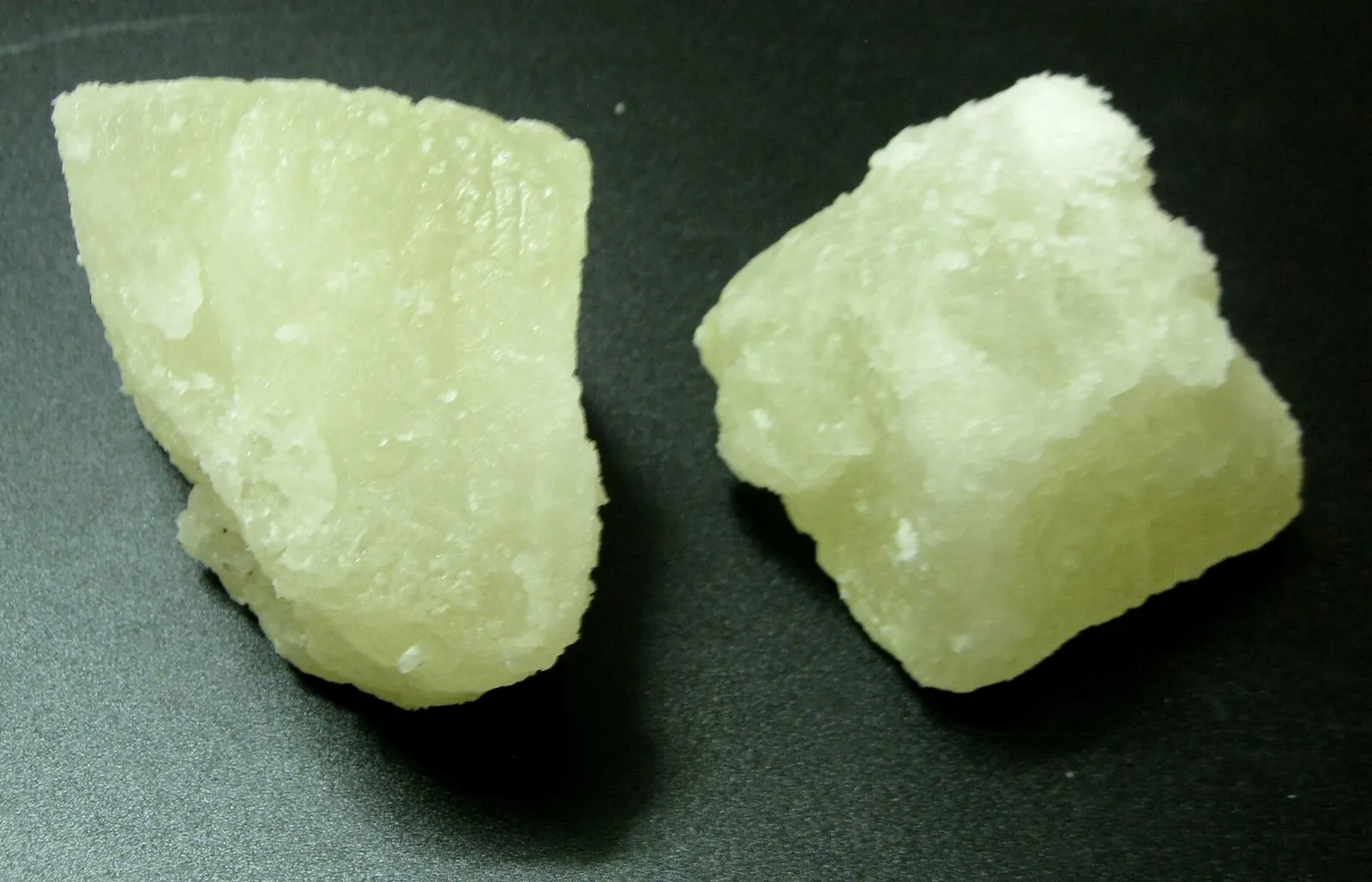
Agra's best-known sweet, made from white pumpkin (ash gourd): dry and chewy or soft and syrupy, plain, with saffron (kesar), as small angoori pieces or flavoured with paan.
- Where to look
- Panchhi Petha at Hari Parvat Crossing, the shop UP Tourism names.
- Fit it into your day
- Buy a box to take on the train.
Very sweet; the dry kind travels best.
A priced two-night stay for two
This model follows the plan above for two adults sharing a room, with prices checked on 17 October 2026 on the hotel's site, UP Tourism's ticket table and ASI's monument pages. The Taj Mahal, Agra Fort and Fatehpur Sikri are priced online, as the guide suggests buying them; the three smaller tombs are at UP Tourism's table prices.
- Room: Hotel Taj Resorts, Executive Room with buffet breakfast, 2 nights at INR 4,555 (INR 9,110), plus 5% GST (INR 455.50): INR 9,565.50.
- Taj Mahal (day 2): UP Tourism's INR 1,100, less the INR 50 it takes off a foreigner's ticket bought online, is INR 1,050, which includes the ADA toll; plus INR 200 for the main mausoleum, for two: INR 2,500.
- Agra Fort (day 1) for two, ASI's online price of INR 550 each: INR 1,100.
- Fatehpur Sikri (day 2) for two, ASI's online price of INR 550 each; the Taj ticket's toll covers the same day, so no second toll is due: INR 1,100.
- Itimad-ud-Daulah and Mehtab Bagh (day 1) and Akbar's Tomb (day 3) for two (INR 310, INR 300 and INR 310 each on UP Tourism's table): INR 1,840.
- Total: INR 16,105.50 for two.
- Not included: the trains to and from Agra, booked on IRCTC; the taxi to Fatehpur Sikri and back and auto-rickshaws in town, which have no published fares; lunches and dinners; guides and audio guides; the Agra Fort sound and light show (INR 800 an international adult); night viewing.
Practical questions
Is the Taj Mahal closed on Fridays?
Yes. UP Tourism's site says the Taj Mahal remains closed only on Fridays; ASI adds that the mosque inside opens only for prayers between 12 noon and 2 pm. Agra Fort, Itimad-ud-Daulah, Mehtab Bagh, Akbar's Tomb and Fatehpur Sikri stay open from sunrise to sunset, and the Agra Development Authority levies no toll at the monuments on Fridays.
How much is the Taj Mahal ticket for foreigners?
UP Tourism's table, checked on 17 October 2026, lists INR 1,100 for a foreign visitor or NRI, plus INR 200 for the main mausoleum; the ticket includes the Agra Development Authority's toll, which also covers the other Agra monuments that day. Children below 15 enter free. Tickets are sold at the east and west gates, and online on ASI's booking site, asi.paygov.org.in, where UP Tourism says a foreigner's ticket costs INR 50 less.
Can I visit Agra as a day trip from Delhi?
Yes, by an early train or by road (UP Tourism gives 204 km by road), but you will reach the Taj after sunrise and have time for little more than Agra Fort. One night lets you see the Taj at the opening, 30 minutes before sunrise; two nights add Fatehpur Sikri.
What can I take into the Taj Mahal?
A water bottle and a camera. Eatables, tobacco, tripods, headphones, mobile chargers, knives and other electrical goods are prohibited, drones are banned, and photography is not allowed inside the main mausoleum. Keep bags small; the foreigner's ticket includes shoe covers and half a litre of water.
Which gate of the Taj Mahal should I use?
The east gate, which UP Tourism recommends to avoid the crowd; battery buses run there from the Shilpgram parking. The west gate is the main entrance, and the south gate is for leaving only.
Is Fatehpur Sikri worth the trip from Agra?
Yes, if you have a second day. It is 37 km away, needs at least half a day, and holds Akbar's palace complex, the Jami Masjid with Sheikh Salim Chishti's tomb, and the Buland Darwaza. ASI lists the foreign visitor's ticket at INR 600 at the gate (INR 550 online), and on the day of your Taj visit no second toll is due; the usual way there is by taxi.
Sources and checks before you travel
Reference sources for the version dated 17 October 2026. Confirm opening times, access, transport and conditions for your travel dates.
- UP Tourism, Taj Mahal site: home page ↗ — opens in a new tab
- UP Tourism, Taj Mahal site: entry fees of Agra monuments ↗ — opens in a new tab
- Archaeological Survey of India: online ticket booking ↗ — opens in a new tab
- UP Tourism, Taj Mahal site: timing and ticket price ↗ — opens in a new tab
- UP Tourism, Taj Mahal site: do's and don'ts ↗ — opens in a new tab
- UP Tourism, Taj Mahal site: entry to the Taj Mahal ↗ — opens in a new tab
- UP Tourism, Taj Mahal site: creation and history ↗ — opens in a new tab
- UP Tourism, Taj Mahal site: overview ↗ — opens in a new tab
- UP Tourism, Taj Mahal site: the Taj exteriors ↗ — opens in a new tab
- UP Tourism, Taj Mahal site: the Taj interiors ↗ — opens in a new tab
- UP Tourism, Taj Mahal site: night viewing ↗ — opens in a new tab
- UP Tourism, Taj Mahal site: FAQs ↗ — opens in a new tab
- UP Tourism, Taj Mahal site: how to reach the Taj Mahal ↗ — opens in a new tab
- YEIDA: Yamuna Expressway ↗ — opens in a new tab
- UP Tourism, Taj Mahal site: Agra Fort ↗ — opens in a new tab
- UP Tourism, Taj Mahal site: Agra Fort sound and light show ↗ — opens in a new tab
- UP Tourism, Taj Mahal site: Fatehpur Sikri ↗ — opens in a new tab
- UP Tourism, Taj Mahal site: nearby attractions ↗ — opens in a new tab
- UP Tourism, Taj Mahal site: about Agra and its food ↗ — opens in a new tab
- Archaeological Survey of India, Agra Circle: Taj Mahal ↗ — opens in a new tab
- Archaeological Survey of India: Agra Fort ↗ — opens in a new tab
- Archaeological Survey of India: Fatehpur Sikri ↗ — opens in a new tab
- Archaeological Survey of India, Agra Circle: Fatehpur Sikri ↗ — opens in a new tab
- Archaeological Survey of India, Agra Circle: Itimad-ud-Daulah's tomb ↗ — opens in a new tab
- Archaeological Survey of India, Agra Circle: Mehtab Bagh ↗ — opens in a new tab
- Archaeological Survey of India, Agra Circle: Akbar's Tomb, Sikandra ↗ — opens in a new tab
- Delhi Airport: to and from the airport by metro ↗ — opens in a new tab
- UK FCDO: India health ↗ — opens in a new tab
- IRCTC: Foreign Tourist quota booking ↗ — opens in a new tab
- Hotel Taj Resorts: Executive Room ↗ — opens in a new tab
- Hotel Taj Resorts: home page ↗ — opens in a new tab
- GST Council: recommendations of the 56th meeting (PIB release of 3 September 2025) ↗ — opens in a new tab
- PIB (Ministry of Railways): Gatimaan Express to be flagged off, 4 April 2016 ↗ — opens in a new tab
- India Meteorological Department, New Delhi: Safdarjung climatological table 1991-2020 ↗ — opens in a new tab
- Archaeological Survey of India, Agra Circle: visitor information ↗ — opens in a new tab
Does this experience fit your route?
Book a room near the Taj's east gate first, then your Taj tickets on ASI's booking site, asi.paygov.org.in; add a guided sunrise visit if you want the history told on the spot.
Check dates and details on Viator ↗ — opens in a new tabAffiliate link · Book with ViatorPhoto credits
The Taj Mahal from the garden, with the central water channel leading to the mausoleum
Photograph: Jakub Hałun — opens in a new tab · CC BY-SA 4.0 — opens in a new tab
Changes: Resized and converted to WebP; displayed with responsive crops. · Original photograph and licence details ↗ — opens in a new tab
The Diwan-i-Am, the hall of public audience, at Agra Fort
Photograph: Jakub Hałun — opens in a new tab · CC BY-SA 4.0 — opens in a new tab
Changes: Resized and converted to WebP; displayed with responsive crops. · Original photograph and licence details ↗ — opens in a new tab
Itimad-ud-Daulah's tomb, the Baby Taj, on the left bank of the Yamuna
Photograph: Rohit Sharma — opens in a new tab · CC BY-SA 4.0 — opens in a new tab
Changes: Resized and converted to WebP; displayed with responsive crops. · Original photograph and licence details ↗ — opens in a new tab
The Buland Darwaza at Fatehpur Sikri, at the top of its flight of steps
Photograph: Kanishk2811 — opens in a new tab · CC BY-SA 4.0 — opens in a new tab
Changes: Resized and converted to WebP; displayed with responsive crops. · Original photograph and licence details ↗ — opens in a new tab
The Taj Mahal from Mehtab Bagh, the Moonlight Garden on the opposite bank
Photograph: Rangan Datta Wiki — opens in a new tab · CC BY-SA 4.0 — opens in a new tab
Changes: Resized and converted to WebP; displayed with responsive crops. · Original photograph and licence details ↗ — opens in a new tab
Agra petha, a sweet made from white pumpkin (ash gourd)
Photograph: Rsrikanth05 — opens in a new tab · CC BY-SA 4.0 — opens in a new tab
Changes: Resized and converted to WebP; displayed with responsive crops. · Original photograph and licence details ↗ — opens in a new tab