Plan your trip · India
Getting around India: trains, the IRCTC quota, flights and airports
India's classic first routes are made for the train. Delhi, Agra and Jaipur sit a few hours apart, Varanasi is one long day train from Delhi, and the Konkan Railway runs down the coast from Mumbai to Goa between the hills and the sea. The jumps between the north and the south are another matter: there a domestic flight saves a day. This guide explains how a foreign visitor books trains on IRCTC under the Foreign Tourist quota, what the classes and luggage rules are, which trains serve each leg of the usual routes, and how the airports, taxis and roads fit in.
- Suggested time
- One day train for each leg of the main routes; a flight for each jump between north and south
- Where to stay
- Connaught Place and Janpath in Delhi, a short taxi ride from New Delhi Railway Station; near CSMT in Mumbai for the 05:25 Vande Bharat to Goa; Ernakulam in Kochi
- Season and timing
- Konkan Railway switches to a slower monsoon timetable every year (its 2026 monsoon timetable runs from 15 June to 20 October); monsoon rain can also close roads and disrupt transport links
The short answer
Transport needs no extra nights of its own. In Delhi, stay around Connaught Place and Janpath, a short taxi ride from New Delhi Railway Station, where the Airport Express Line ends; the Gatimaan to Agra leaves from Hazrat Nizamuddin, so allow for that ride too. In Mumbai, sleep near Chhatrapati Shivaji Maharaj Terminus (CSMT), because the Vande Bharat to Goa was timetabled at its launch to leave CSMT at 05:25 outside the monsoon. Book in this order: open an IRCTC account with your foreign mobile number, then book the train legs under the Foreign Tourist quota (up to 365 days ahead), then the domestic flights. Two key prices, checked on 17 October 2026: IRCTC charges users resident outside India a registration fee of INR 100 plus GST, and a service charge of INR 200 plus GST on each Foreign Tourist quota ticket, which costs 1.5 times the normal fare. Carry your original passport and visa on every train.
Train or plane: how India's distances divide the trip
Within each of the usual routes, take the train. Trains run from Delhi to Agra and from Jaipur back to Delhi, with a car for the Agra-Jaipur leg in our plan, so you can stop at Fatehpur Sikri; Varanasi and Khajuraho have Vande Bharat services, the Konkan Railway carries you from Mumbai to Goa in daylight, and Kerala's main line runs through Ernakulam. Between the regions, say from Delhi or Varanasi to Goa or Kochi, book a domestic flight instead and keep the train for the shorter legs. Our Golden Triangle itinerary sets out the nights for Delhi, Agra and Jaipur; this guide covers how each leg works.
Book the train legs as soon as your dates are fixed. Vande Bharat trains ran above 100 percent occupancy in 2024-25 and in the first quarter of 2025-26, so the fast day trains fill early. Flights can follow once the rail days are settled.
Indian Railways publishes current departure times and fares only in its journey search, so check IRCTC for your date. The railway enquiry number is 139.
Booking as a foreign visitor: the IRCTC account and the Foreign Tourist quota
The account. Register on www.irctc.co.in with an international mobile number (the country code must be other than 91) and an email address. IRCTC sends a one-time code to your email, charges users resident outside India a registration fee of INR 100 plus GST, and then sends a second code to your mobile. After that you add your date of birth, address and gender to complete the profile.
The quota. Foreign tourists, including NRIs, with a valid passport can book under the Foreign Tourist (FT) quota up to 365 days in advance: log in and choose "Foreign Tourist Ticket Booking" under "Services". The quota covers Executive Class (EC), 1st AC (1A), 2nd AC (2A), 3rd AC (3A), AC Chair Car (CC), Sleeper (SL) and Second Sitting (2S) on all trains, including the Shatabdi, Rajdhani, Duronto and Gatimaan, but not Suvidha trains. IRCTC's foreign-tourist terms charge 1.5 times the normal fare and a service charge of INR 200 plus GST per ticket, accept payment only by international debit or credit card, and need each passenger's passport number and nationality. Agents cannot book FT tickets, and names cannot be changed afterwards.
When berths are given. For Indian travellers, bookings open 60 days ahead, not counting the day of travel; Indian Railways cut the period from 120 days on 1 November 2024 and kept the 365-day limit for foreign tourists. If you book an FT ticket more than 60 days ahead, the berth is allotted only when that 60-day window opens, and IRCTC tells you by international SMS. If the railway system allots no berth, the ticket is cancelled automatically and IRCTC sends an SMS and an email. Some daytime trains, the Taj Express among them, keep a shorter booking period.
Cancelling and waiting lists. For a confirmed FT ticket, 50% of the fare is deducted on top of the cancellation charges, and that refund is available up to 4 hours before the train's scheduled departure, through the website only. When a train is full, you may be offered a waitlisted (WL) ticket, which has no berth yet, or an RAC ticket: Reservation Against Cancellation is Indian Railways' provision for splitting a berth into two or more seats. Under the FT quota both follow the general-quota cancellation rules; if your ticket is still waitlisted shortly before the day, keep another train or a flight in reserve.
Tatkal. Indian Railways' last-minute Tatkal tickets on the IRCTC website and app have been open only to users authenticated with Aadhaar, India's resident identity number, since 1 July 2025. A visitor without Aadhaar books ahead under the FT quota instead.
Help at the station. Indian Railways runs International Tourist Bureaus for foreign tourists and NRIs in cities including New Delhi, Agra Cantt, Jaipur, Jodhpur, Varanasi and Mumbai, for enquiries, bookings and reservations. The New Delhi bureau, on the first floor of the New Delhi Railway Station building (+91 11 4262 5156), has worked round the clock since December 2014, and it is the place to go if the IRCTC registration fails.
Classes, berths and luggage on board
Indian Railways' luggage rules label AC 2-tier and AC 3-tier as sleeper classes, alongside the Sleeper class, and its International Tourist page groups Sleeper Class with Second Class as the non-air-conditioned classes; the Ministry of Railways' Vande Bharat sleeper trainset, designed for overnight travel, is made up of AC First Class, AC 2-tier and AC 3-tier coaches. So for an overnight train, book a berth in AC First Class, AC 2-tier, AC 3-tier or Sleeper (1A, 2A, 3A and SL in IRCTC's class codes); by day, the chair cars give you a seat: the Gatimaan Express to Agra, for example, was launched with Executive and AC Chair Car coaches. This guide does not describe the berths or the bedding in each class; put that question to an International Tourist Bureau (see above), which handles enquiries for foreign tourists.
Indian Railways sets a free luggage allowance and a maximum per passenger in the compartment: 70 kg and 150 kg in AC First Class, 50 kg and 100 kg in AC 2-tier, 40 kg and 80 kg in Sleeper class, and 40 kg (with no more allowed) in AC 3-tier and AC Chair Car. Luggage above the free allowance, up to the maximum, is booked and paid for at 1.5 times the luggage rate. The largest case carried in AC 3-tier and AC Chair Car is 55 x 45 x 22.5 cm; in the other classes trunks of up to 100 x 60 x 25 cm go in the compartment.
On board, carry the original passport with a valid visa for every passenger on an FT ticket: IRCTC's terms treat anyone who cannot show them as travelling without a ticket and charge a penalty of three times the fare. Train travel in India is generally safe; do not accept food or drinks from strangers, keep your passport and valuables close, and ignore people at stations who offer tickets and tours.
From Delhi: Agra, Jaipur, Rajasthan and Rishikesh
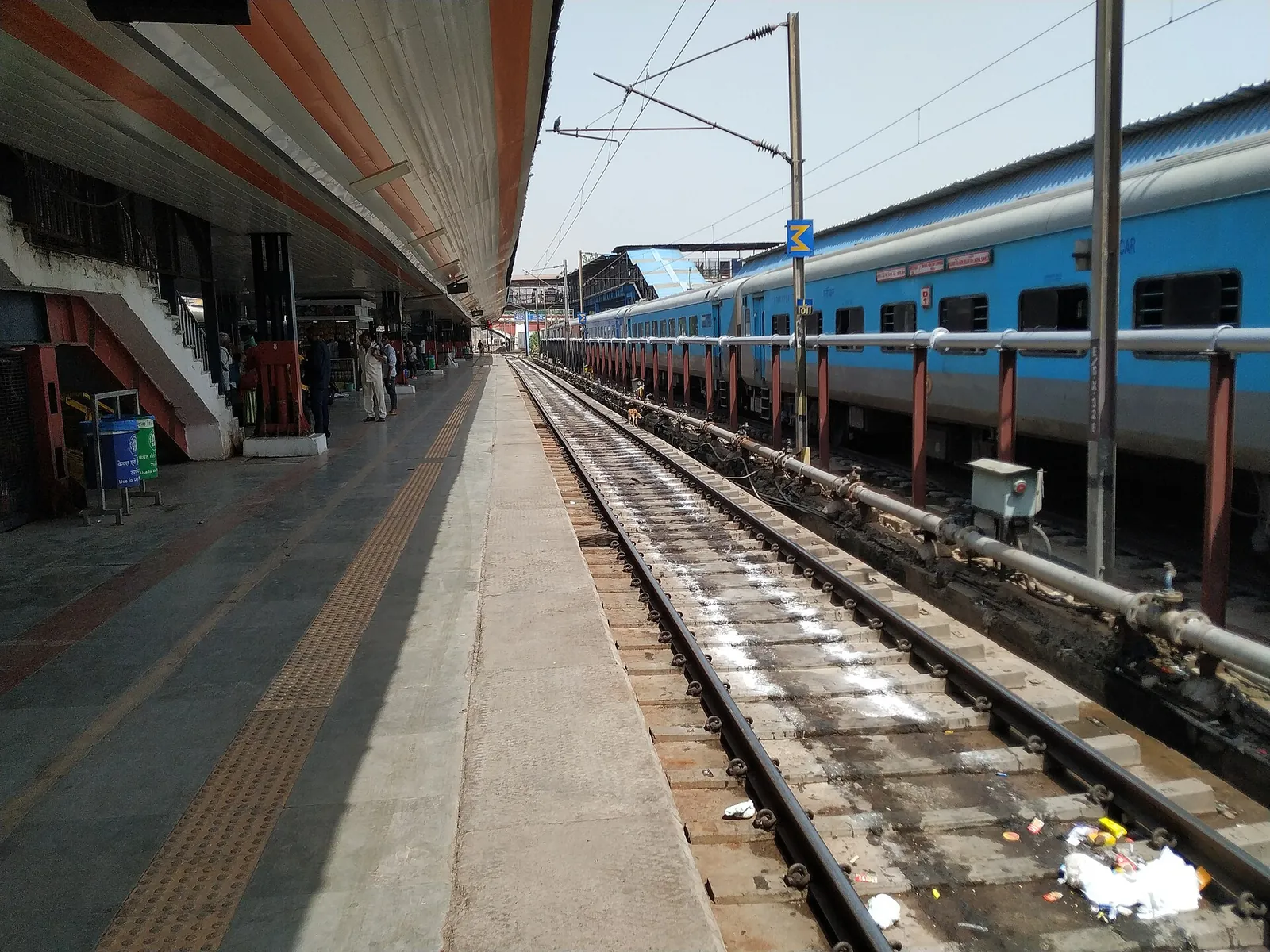
Delhi has several long-distance stations, and each route's fast trains leave from a different one. New Delhi Railway Station is the end of the Airport Express Line from Terminal 3; the Gatimaan Express to Agra leaves from Hazrat Nizamuddin, and Rajasthan's first Vande Bharat, to Jaipur and Ajmer, was announced to run from Delhi Cantt.
Delhi to Agra. The Shatabdi, Rajdhani, Gatimaan and Taj Express are among the main trains between Delhi and Agra; Agra Cantonment (Agra Cantt) is the main station, and the road distance is 204 km. The Gatimaan is India's first semi-high-speed train, built for 160 km/h. The Gatimaan Express was timetabled at 08:10 from Hazrat Nizamuddin, reaching Agra Cantt at 09:50, when it launched in 2016; it does not run on Fridays. Friday is also the day the Taj Mahal is closed.
Delhi to Jaipur. Rajasthan's first Vande Bharat Express was announced for regular service from 13 April 2023 between Ajmer and Delhi Cantt, with stops at Jaipur, Alwar and Gurgaon; the Prime Minister's Office gave 5 hours 15 minutes for the whole run between Delhi Cantt and Ajmer, an hour faster than the Shatabdi Express on the same route, so the Jaipur-Delhi part is shorter. The train's route and terminus may have changed since that release.
Agra to Jaipur. The two cities are 232 km apart by road and are linked by rail. A car with a driver lets you stop at Fatehpur Sikri on the way, which makes it most of a day; by train, Fatehpur Sikri drops out.
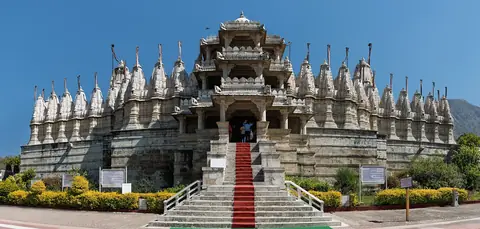
Jaipur, Jodhpur and Udaipur. Jaipur is connected by rail with Jodhpur and Udaipur, and Jaipur International Airport has domestic flights to both. Between Jodhpur and Udaipur, a car with driver lets you stop at the Ranakpur Jain temple, almost 90 km from Udaipur; Udaipur is 257 km from Jodhpur, so the drive with the temple stop fills the day. The Rajasthan itinerary sets out these legs from Jaipur.
Delhi to Haridwar and Rishikesh. Haridwar Junction (HW) is the main railhead for Rishikesh, with trains from Delhi and further afield. From Haridwar station, buses and taxis run on to Rishikesh. Uttarakhand Tourism lists ordinary and luxury buses to Rishikesh from Delhi's ISBT Kashmiri Gate and places Rishikesh on the national highway to Badrinath, but gives no road distance or drive time from Delhi, so this guide quotes none.
East to Varanasi and Khajuraho
India's first Vande Bharat Express started on 15 February 2019 on the New Delhi-Kanpur-Prayagraj-Varanasi line, and the scheduled journey between New Delhi and Varanasi is approximately eight hours. That makes Delhi to Varanasi one day on the train.
From Varanasi to Khajuraho, the Khajuraho-Banaras Vande Bharat Express (26505/26506) has run directly since 11 November 2025 through Prayagraj and Chitrakoot. Khajuraho also has a Vande Bharat to Delhi, the Khajuraho-Hazrat Nizamuddin Vande Bharat Express (22469/22470). The Ministry of Railways lists both as running six days a week; treat each of these legs as a travel day and plan around the arrival time on your ticket.
Khajuraho railway station is 5 km from the town and the domestic airport 2 km from the temples, with flights to Delhi, Mumbai, Bhopal and Varanasi. Our Varanasi and Khajuraho itinerary joins the two to the Golden Triangle.
Mumbai to Goa on the Konkan Railway, and on to Hampi
The Konkan Railway is the scenic way to Goa. The Chhatrapati Shivaji Maharaj Terminus-Madgaon Vande Bharat Express (22229/22230) stops at Dadar, Thane, Panvel, Khed, Ratnagiri, Kankavali and Thivim. Outside the monsoon it is timetabled to leave CSMT at 05:25 and reach Madgaon at 13:10, every day except Friday, and to return from Madgaon at 14:40, reaching CSMT at 22:25; these are the timings published at its launch.
Konkan Railway runs a monsoon timetable with sectional speed restrictions along the route; its 2026 monsoon timetable runs from 15 June to 20 October; after that date the non-monsoon timings above should apply. Running status is on konkanrailway.com and on the railway helpline 139.
In Goa, Madgaon Junction serves the south and Thivim the north. The state has two airports, Dabolim and Mopa, a long way apart, so check which one your flight uses. Kadamba Transport Corporation's air-conditioned airport shuttles charge, per passenger and under its citizen charter of 28 January 2026, from Mopa INR 150 to Mapusa, INR 200 to Panaji or Calangute and INR 400 to Margao, and from Dabolim INR 150 to Panaji and INR 200 to Calangute.
On to Hampi. The nearest station is Hosapete Junction, about 13 km from Hampi, and the nearest airport Jindal Vijaynagar Airport, about 40 km away; taxis, buses and rental bikes run from Hosapete to the ruins. By road, Kadamba's interstate bus leaves Panaji at 09:30 for Hosapete, 379 km by its count via Hubballi, so the ride takes most of the day; Kadamba sells interstate seats on its own website, goakadamba.com, one month in advance. The Mumbai, Goa and Hampi itinerary puts these legs in order.
Kerala: Kochi, the backwaters and Munnar
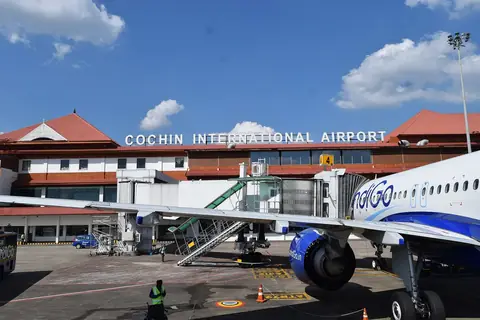
Cochin International Airport (COK) is the gateway for Kochi, the backwaters and Munnar. Ernakulam Junction is the main railway station for Kochi and the nearest railhead for Munnar.
Alappuzha, the backwater town, has its own railway station, about 85 km from Cochin International Airport. Munnar is reached by road, about 119 km from the airport and about 120 km from Ernakulam Junction; Ernakulam town is the usual starting point, and public buses run to Munnar from almost all the major bus stations in the state; this guide quotes no bus timetable or fare. The State Water Transport Department's public boats across the backwaters, the cheap alternative to a houseboat, publish no timetable or fares online.
Inside Kochi, the Kochi Water Metro's battery-powered electric boats link terminals including Fort Kochi, the High Court and Vypin on 15 routes. On the Water Metro's schedule of 17 October 2026, boats run from High Court to Fort Kochi from 08:00 to 20:30, taking 20 to 23 minutes, at INR 40. Our South India itinerary puts Kochi, the backwaters and Munnar together.
Flights, airports, taxis, buses and the road
Domestic flights. Flights cover the long jumps between regions. IndiGo, Air India, SpiceJet and Akasa Air are among the airlines in the Ministry of Civil Aviation's daily airline table, and each sets its own fares on its own booking page. This guide gives no flight time or example fare for the north-south routes; the airline's booking page shows both for your date. Akasa Air's own tariff sheet, updated on 14 October 2026, prices flights between stations that include New Delhi, Mumbai, Navi Mumbai, Goa (Mopa), Kochi and Varanasi, gives each route 15 base-fare levels and a fuel charge, and adds airport fees and GST. Akasa adds a convenience fee of INR 350 for bookings on its website or app, and its free allowance is 15 kg of checked baggage and 7 kg of hand baggage; read IndiGo's, Air India's and SpiceJet's fees and baggage allowance on their own sites before you pay.
At the airport. Delhi Airport asks passengers to arrive 2 hours before a domestic flight and 3 hours before an international one; it requires a valid passport for international flights and lists Aadhaar, driving licence, PAN or voter ID cards for domestic ones, so ask your airline which ID a foreign visitor shows on a domestic flight. Mumbai is served by Chhatrapati Shivaji Maharaj International Airport (BOM) and Navi Mumbai International Airport (NMI), inaugurated in October 2025; Goa by Dabolim and Mopa. Check the airport on every ticket, and allow time for the move from the international to the domestic terminal, even on the airport shuttle.
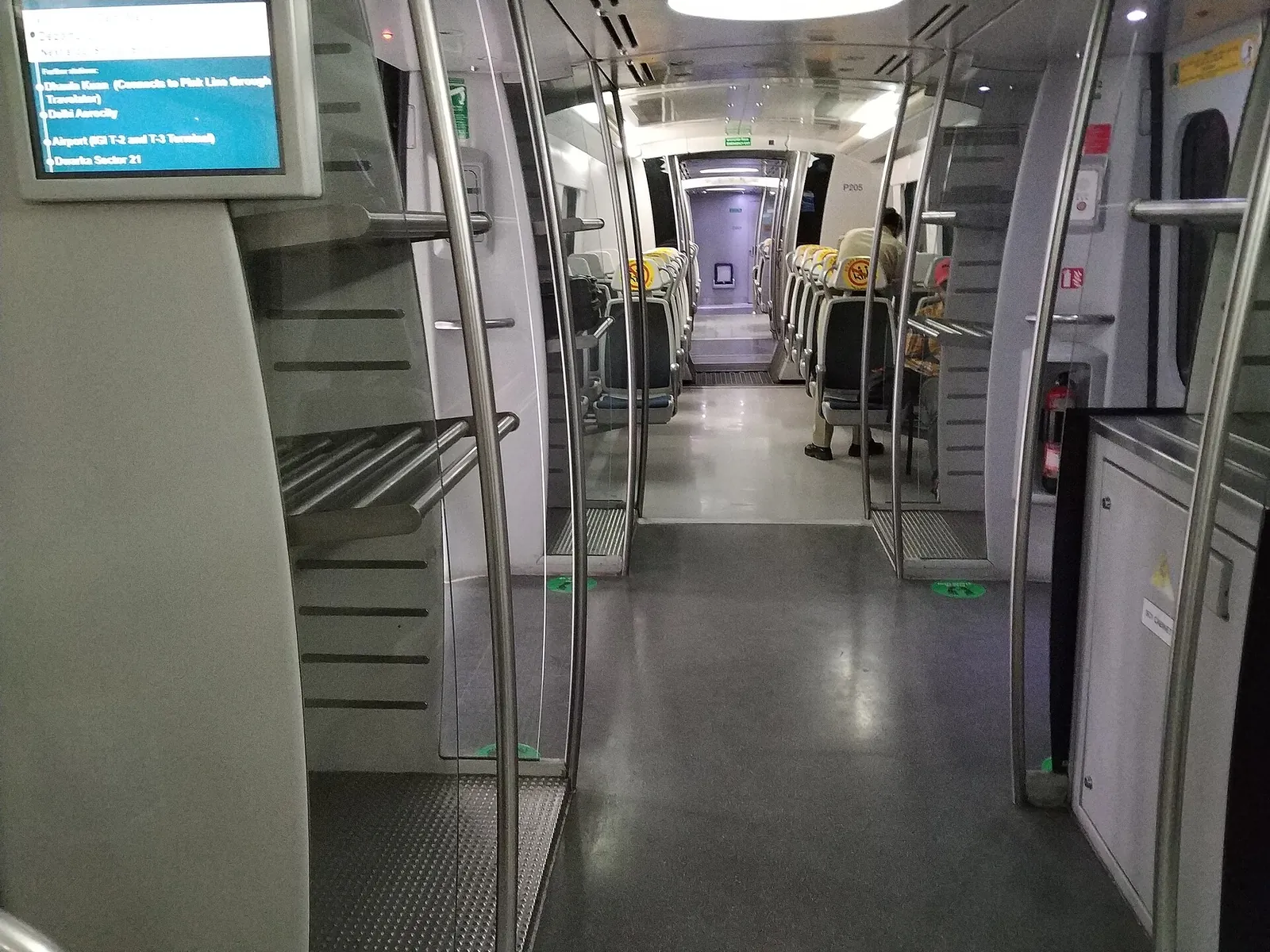
Delhi airport by metro. The Airport Express Line (Orange Line) runs from Terminal 3 to New Delhi Railway Station in around 25 minutes; first trains leave at 04:45, last trains at 23:15 (Dwarka Sector 21) and 23:30 (New Delhi), and ticket machines are in the Terminal 3 and Terminal 2 arrival halls. Terminal 1 has its own Magenta Line station, Terminal 1-IGI Airport, a 5-7 minute walk through a covered subway, with trains from about 05:30 to 23:30.
Metros in the cities. In Mumbai, Metro Line 3 (the Aqua Line), the city's first fully underground metro, runs 33.5 km from Cuffe Parade to Aarey JVLR with 27 stations, and the Mumbai One app sells a single ticket across Metro Line 3, the other metro lines and monorail, the Mumbai Suburban Railway and BEST buses. In Kochi, the Water Metro above is the useful line for visitors.
Taxis and auto-rickshaws. Prepaid and fixed-rate taxis and app cabs (Uber and Ola at every terminal, Rapido at Terminal 1) wait outside arrivals at Delhi Airport around the clock; at Terminal 3 they leave from Level 0 of the multi-level car park. Delhi Airport lists prepaid and fixed-rate taxis but publishes no fare table; ask for the fare before you get in. This guide quotes no station or street fares either: at the big railway stations and in town, agree the price for the whole journey before you get into an auto-rickshaw or a taxi, avoid hailing taxis in the street, especially alone at night, and choose taxis with seatbelts.
Buses and a car with driver. State transport corporations run the intercity buses; the Rajasthan State Road Transport Corporation, for example, sells its seats online. For a car with driver, as between Agra and Jaipur by way of Fatehpur Sikri, no official rate is published: agree the total for the whole trip before you set off, including tolls and the driver's overnight stops. The UK Foreign Office tells British visitors who drive to carry the 1949 international driving permit with their UK licence; with a car and driver you need neither.
The road. The UK Foreign Office warns that India has a high death rate from road accidents, that accidents are common at night and in fog, and that buses are often driven fast and recklessly, so keep long drives for daylight; it calls train travel in India generally safe. Our health and safety guide covers the road and the rest in full.
Practical questions
Can foreigners book Indian train tickets online?
Yes. Register on www.irctc.co.in with an international mobile number and pay the foreign-user fee of INR 100 plus GST, then book under the Foreign Tourist quota with an international debit or credit card. IRCTC's terms charge 1.5 times the normal fare plus INR 200 plus GST per ticket, and you need your passport number at booking and the original passport and visa on board.
How far ahead can I book Indian trains?
Foreign tourists can book under the Foreign Tourist quota up to 365 days ahead. The normal booking window is 60 days, not counting the day of travel, so a ticket bought earlier gets its berth only when that window opens; if no berth is allotted, the ticket is cancelled automatically.
What is the fast train from Delhi to Agra?
The Gatimaan Express, India's first semi-high-speed train, built for 160 km/h, runs from Hazrat Nizamuddin to Agra Cantt; its launch timetable and its Friday gap are under "Delhi to Agra" above. The Shatabdi, Rajdhani and Taj Express also run between Delhi and Agra.
How long is the train from Mumbai to Goa?
The Chhatrapati Shivaji Maharaj Terminus-Madgaon Vande Bharat Express on the Konkan Railway leaves Mumbai early in the morning outside the monsoon; its launch timetable and the 2026 monsoon dates are in the Mumbai to Goa section above.
Should I take the train or fly from Delhi to Varanasi?
The New Delhi-Varanasi Vande Bharat Express takes approximately eight hours, which fills a day but takes you from station to station without airport transfers. A flight is quicker if you are short of time.
What do WL and RAC mean on an Indian train ticket?
A waitlisted (WL) ticket has no berth yet; an RAC (Reservation Against Cancellation) ticket gives you a seat on a berth split into two or more seats. Under the Foreign Tourist quota both follow the general-quota cancellation rules. Online Tatkal tickets have been open only to Aadhaar-authenticated users since 1 July 2025, so visitors book ahead under the FT quota instead.
Sources and checks before you travel
Reference sources for the version dated 17 October 2026. Confirm opening times, access, transport and conditions for your travel dates.
- IRCTC: Foreign Tourist Quota booking (PDF) ↗ — opens in a new tab
- IRCTC: Foreign Tourist quota general terms and conditions (PDF) ↗ — opens in a new tab
- IRCTC: foreign user registration guide (PDF) ↗ — opens in a new tab
- Indian Railways: luggage rules ↗ — opens in a new tab
- PIB (Ministry of Railways): Advance Reservation Period cut to 60 days, 17 October 2024 ↗ — opens in a new tab
- PIB (Ministry of Railways): Aadhaar authentication for Tatkal, 11 June 2025 ↗ — opens in a new tab
- PIB (Ministry of Railways): Vande Bharat Express backgrounder, 16 January 2026 ↗ — opens in a new tab
- PIB (Ministry of Railways): Vande Bharat trains in Maharashtra and Madhya Pradesh, 11 February 2026 ↗ — opens in a new tab
- PIB: four new Vande Bharat trains, 6 November 2025 ↗ — opens in a new tab
- PIB (Prime Minister's Office): Rajasthan's first Vande Bharat, launch announcement of 10 April 2023 ↗ — opens in a new tab
- PIB (Ministry of Railways): Gatimaan Express to be flagged off, 4 April 2016 ↗ — opens in a new tab
- PIB (Ministry of Railways): Gatimaan Express flagged off, 5 April 2016 ↗ — opens in a new tab
- PIB Goa: Madgaon-Mumbai Vande Bharat flagged off, 27 June 2023 ↗ — opens in a new tab
- Konkan Railway: Konkan Railway gears up for monsoon 2026, 12 June 2026 ↗ — opens in a new tab
- UP Tourism, Taj Mahal site: how to reach the Taj Mahal ↗ — opens in a new tab
- Madhya Pradesh Tourism: Khajuraho ↗ — opens in a new tab
- Karnataka Tourism: Hampi ↗ — opens in a new tab
- Kerala Tourism: Munnar ↗ — opens in a new tab
- Kerala Tourism: Kuttanad (Alappuzha) ↗ — opens in a new tab
- Kochi Water Metro: home page ↗ — opens in a new tab
- PIB: Navi Mumbai International Airport inaugurated, 8 October 2025 ↗ — opens in a new tab
- Delhi Airport (DIAL): metro to and from the airport ↗ — opens in a new tab
- Official e-Visa site: e-Tourist visa and entry points ↗ — opens in a new tab
- UK Foreign Office (FCDO): India safety and security ↗ — opens in a new tab
- Indian Railways: facilities for international tourists ↗ — opens in a new tab
- Indian Railways: quota codes ↗ — opens in a new tab
- Delhi Airport: first-time flyer guide ↗ — opens in a new tab
- Delhi Airport: cabs and taxis ↗ — opens in a new tab
- Akasa Air: tariff sheet, updated 14 October 2026 (PDF) ↗ — opens in a new tab
- Akasa Air: excess baggage ↗ — opens in a new tab
- Kadamba Transport Corporation (Government of Goa): citizen charter, updated 28 January 2026 (PDF) ↗ — opens in a new tab
- Kochi Water Metro: boat schedule and route planner ↗ — opens in a new tab
- Rajasthan State Road Transport Corporation: online booking ↗ — opens in a new tab
- Rajasthan Tourism: Jaipur ↗ — opens in a new tab
- Rajasthan Tourism: Ranakpur Temple ↗ — opens in a new tab
- Rajasthan Tourism: Jodhpur ↗ — opens in a new tab
- Uttarakhand Tourism: Rishikesh ↗ — opens in a new tab
- Uttarakhand Tourism: Haridwar ↗ — opens in a new tab
- Ministry of Tourism (Incredible India): Haridwar ↗ — opens in a new tab
- Ministry of Civil Aviation: home page, airline performance table of 15 October 2026 ↗ — opens in a new tab
Photo credits
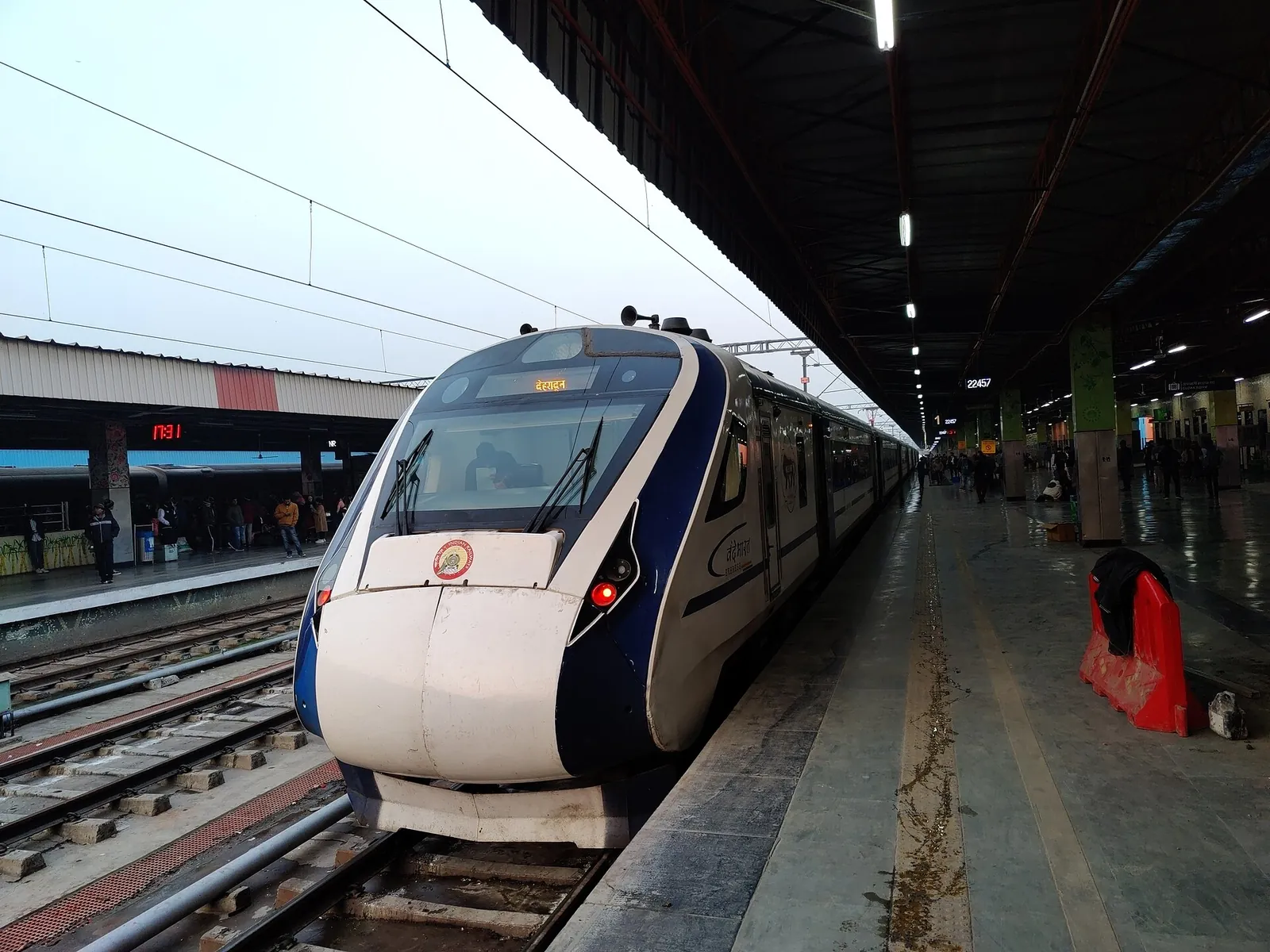
A Vande Bharat Express at Anand Vihar Terminal, Delhi: the fast day trains on most of this guide's routes are Vande Bharat sets
Photograph: Ravi Dwivedi — opens in a new tab · CC BY-SA 4.0 — opens in a new tab
Changes: Resized and converted to WebP; displayed with responsive crops. · Original photograph and licence details ↗ — opens in a new tab
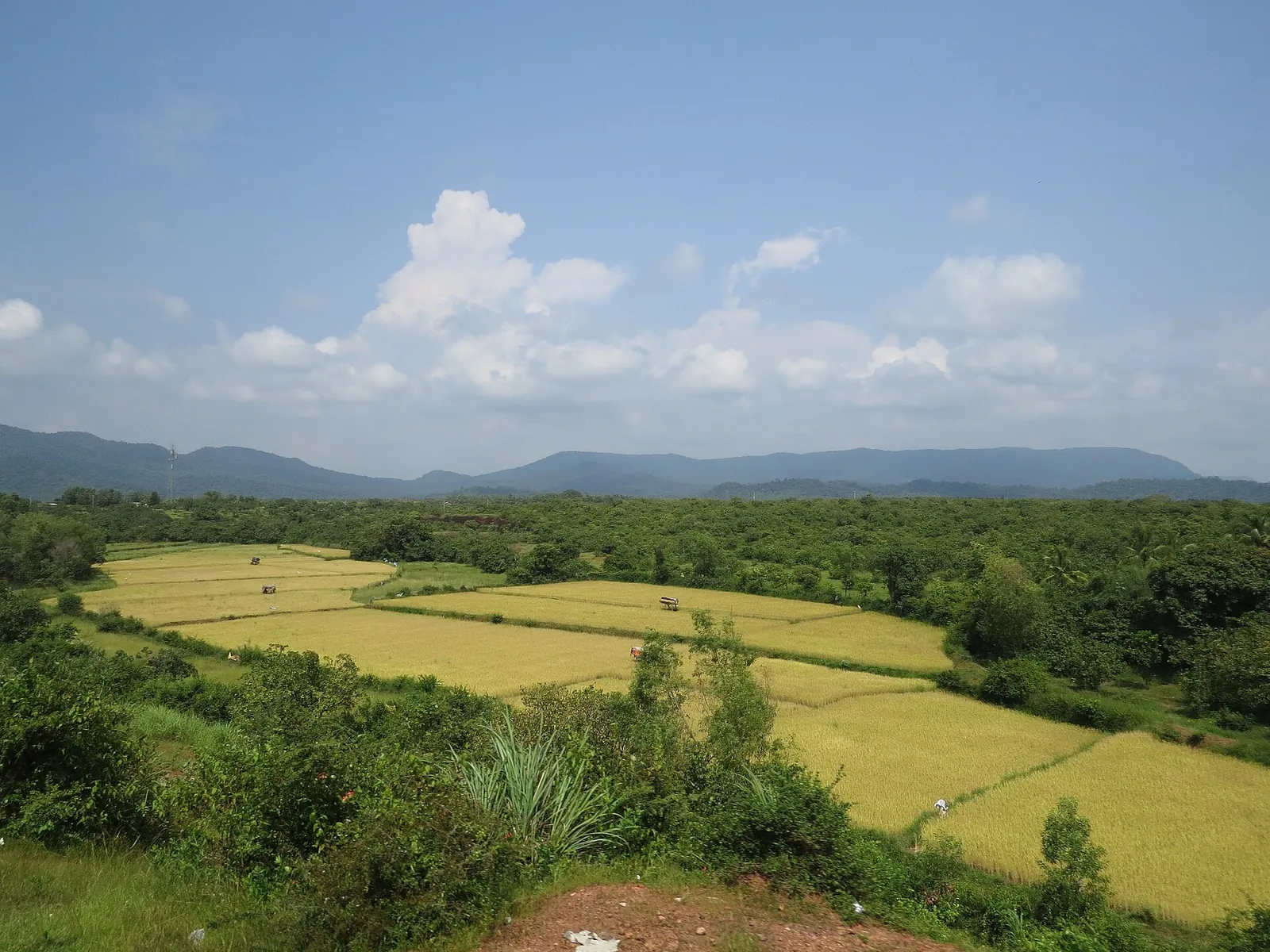
Fields and wooded hills seen from a train on the Konkan Railway, the coastal line that carries the Mumbai-Goa trains
Photograph: Vinayaraj — opens in a new tab · CC BY-SA 4.0 — opens in a new tab
Changes: Resized and converted to WebP; displayed with responsive crops. · Original photograph and licence details ↗ — opens in a new tab
The Gomti Express at New Delhi Railway Station, where the Airport Express Line from Terminal 3 ends
Photograph: Ravi Dwivedi — opens in a new tab · CC BY-SA 4.0 — opens in a new tab
Changes: Resized and converted to WebP; displayed with responsive crops. · Original photograph and licence details ↗ — opens in a new tab
Inside a train on Delhi's Airport Express Line, which links Terminal 3 with New Delhi Railway Station
Photograph: Ravi Dwivedi — opens in a new tab · CC BY-SA 4.0 — opens in a new tab
Changes: Resized and converted to WebP; displayed with responsive crops. · Original photograph and licence details ↗ — opens in a new tab