Rajasthan · Rajasthan
Jaipur travel guide: 3 nights, Amber Fort, City Palace and tickets
Jaipur was laid out in 1727 as a planned city of straight streets and walled blocks, and its old centre is still painted the pink that gave it its nickname. Inside the walls stand the City Palace, where the former royal family still lives in one wing, the stone instruments of the Jantar Mantar observatory and the latticed front of Hawa Mahal; in the hills to the north, Amber Fort rises above Maota Lake and Nahargarh looks down over the whole city at sunset. Three nights give one day to the walled city, one to Amber and the hill forts, and one to the museum and the bazaars.
- Suggested time
- 3 nights (4 days)
- Where to stay
- The walled Pink City for walking to the palace, the observatory and the bazaars; MI Road or C-Scheme just outside the walls for larger hotels and quieter streets
- Season and timing
- Come between October and March, and best of all from November to February, when the days are dry and mild: in IMD's 1991-2020 averages, those months have mean daily maximums of 22.5-29.6°C. May is the hottest month, at a mean daily maximum of 41.1°C, and July and August are the wettest. Jaipur's festivals follow the Hindu calendar, so their dates change each year: Gangaur falls in Chaitra (March-April) and Teej in the monsoon, and both end in processions from the City Palace through Tripolia Bazaar.
The short answer
Book three nights (four days) in or near the walled Pink City, so the City Palace, Jantar Mantar, Hawa Mahal and the bazaars are a walk or a short auto-rickshaw ride away. Book the room first, then the train or flight, and plan your days around the opening hours: Amber Fort opens at 08:00 on Rajasthan Tourism's page and 09:00 on Incredible India's, the City Palace at 09:30. Two key prices, checked on 17 October 2026: the City Palace Museum charges a foreign adult INR 1,200, and its composite ticket, which adds Jaigarh Fort and the royal cenotaphs, INR 1,700. Amber, Hawa Mahal, Jantar Mantar and Nahargarh are state monuments with their own tickets and a composite ticket; check the price on the state's e-ticketing portal, obms-tourist.rajasthan.gov.in.
Where to sleep: inside the walls or just outside them
Jaipur was planned by the architect Vidyadhar Bhattacharya along the rules of Vastu Shastra, with the old city divided into nine blocks behind fortified walls and gates. Sleep inside those walls, in the Pink City, if you want to walk to the City Palace, Jantar Mantar, Hawa Mahal and the bazaars; some of the hotels there are converted havelis, the courtyard mansions of the old nobility, built around an inner courtyard.
MI Road, the main road along the southern edge of the walled city, has larger hotels and Rajasthali, the Rajasthan government's craft showroom; C-Scheme, south of MI Road, is a residential district outside the walls with a few heritage hotels in former mansions. From either, the City Palace is a short auto-rickshaw or taxi ride, and the Metro's Pink Line stops at Badi Chaupar, the closest station to the palace.
The walled city: the City Palace, Jantar Mantar and Hawa Mahal
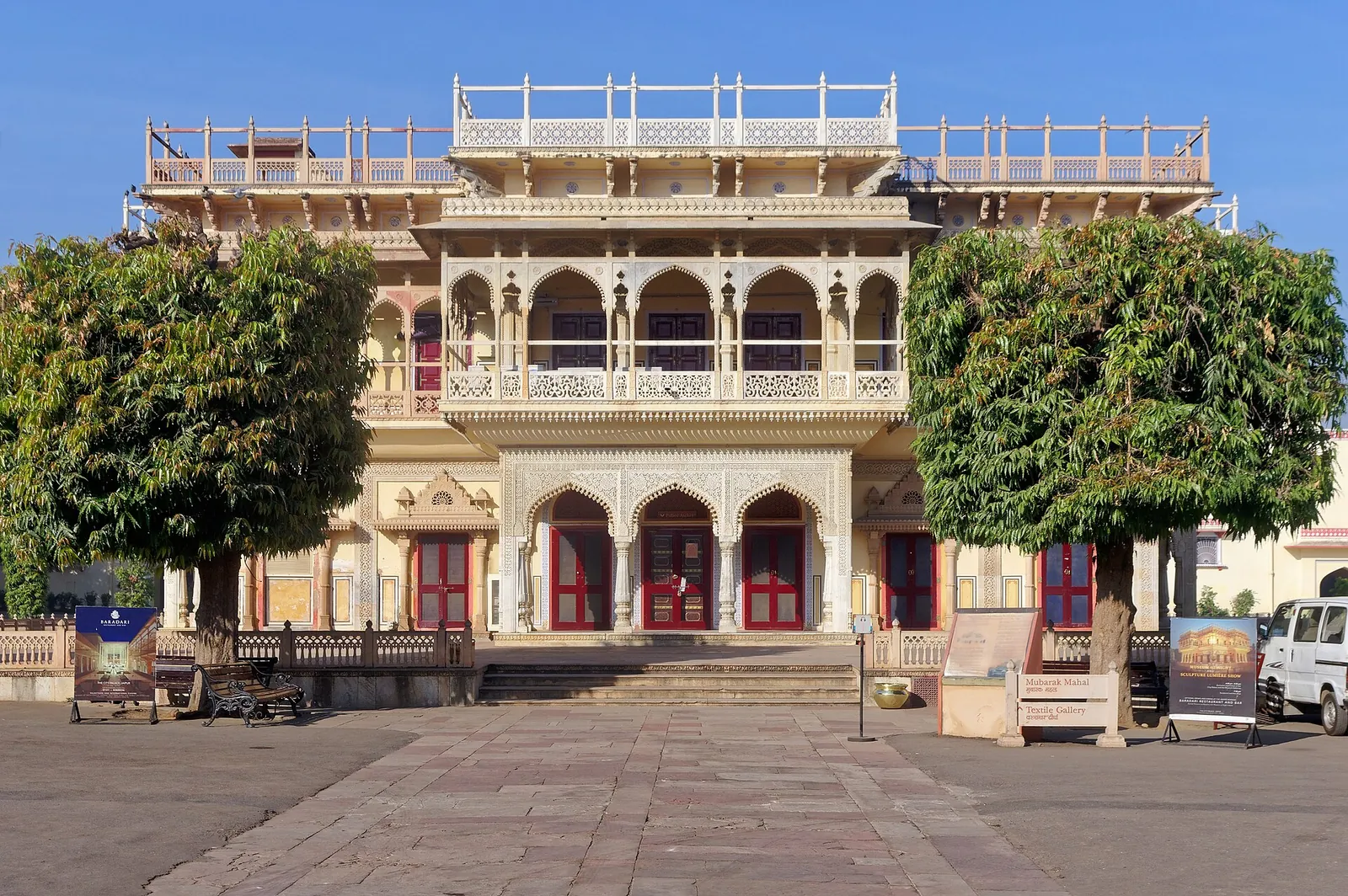
The City Palace is still the home of Jaipur's former royal family, who live in a private part of it. Maharaja Sawai Jai Singh II founded it in 1727 as part of his plan for the city, and the City Palace Museum says additions continued until the mid-20th century, so it reads as a sequence of courtyards and gateways: beyond the Virendra Pol, the cream-coloured Mubarak Mahal, once the reception hall, stands in the first courtyard, and the seven-level Chandra Mahal rises above it all. The City Palace Museum, established in 1959, shows arms, paintings and photographs in galleries such as the Sileh Khana and the Sabha Niwas.
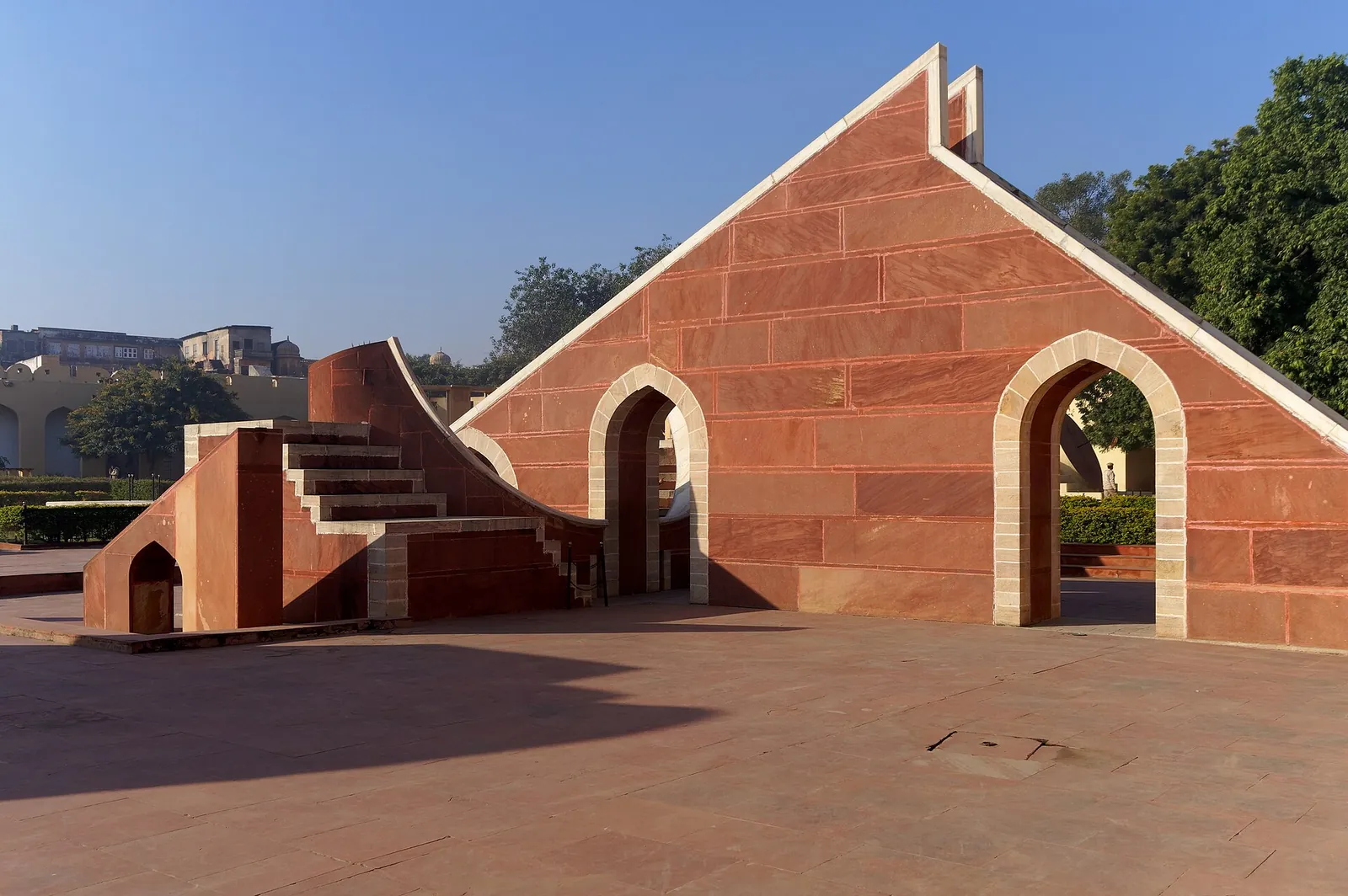
Jantar Mantar, beside the palace's Gate 1, is a UNESCO World Heritage Site: an open-air observatory that Sawai Jai Singh II built between 1728 and 1734, the largest of the five he built across India. Its 19 instruments, in stone and marble, measure time and track the sun, stars and planets. The Samrat Yantra, the giant sundial at its centre, is 27 m long and calculates time to an accuracy of two seconds. Rajasthan Tourism lists its hours as 09:00 to 19:00, with the last ticket at 18:30, but Incredible India gives 09:00 to 17:00, so arrive before 17:00; a guide or an audio guide makes the instruments far easier to understand.
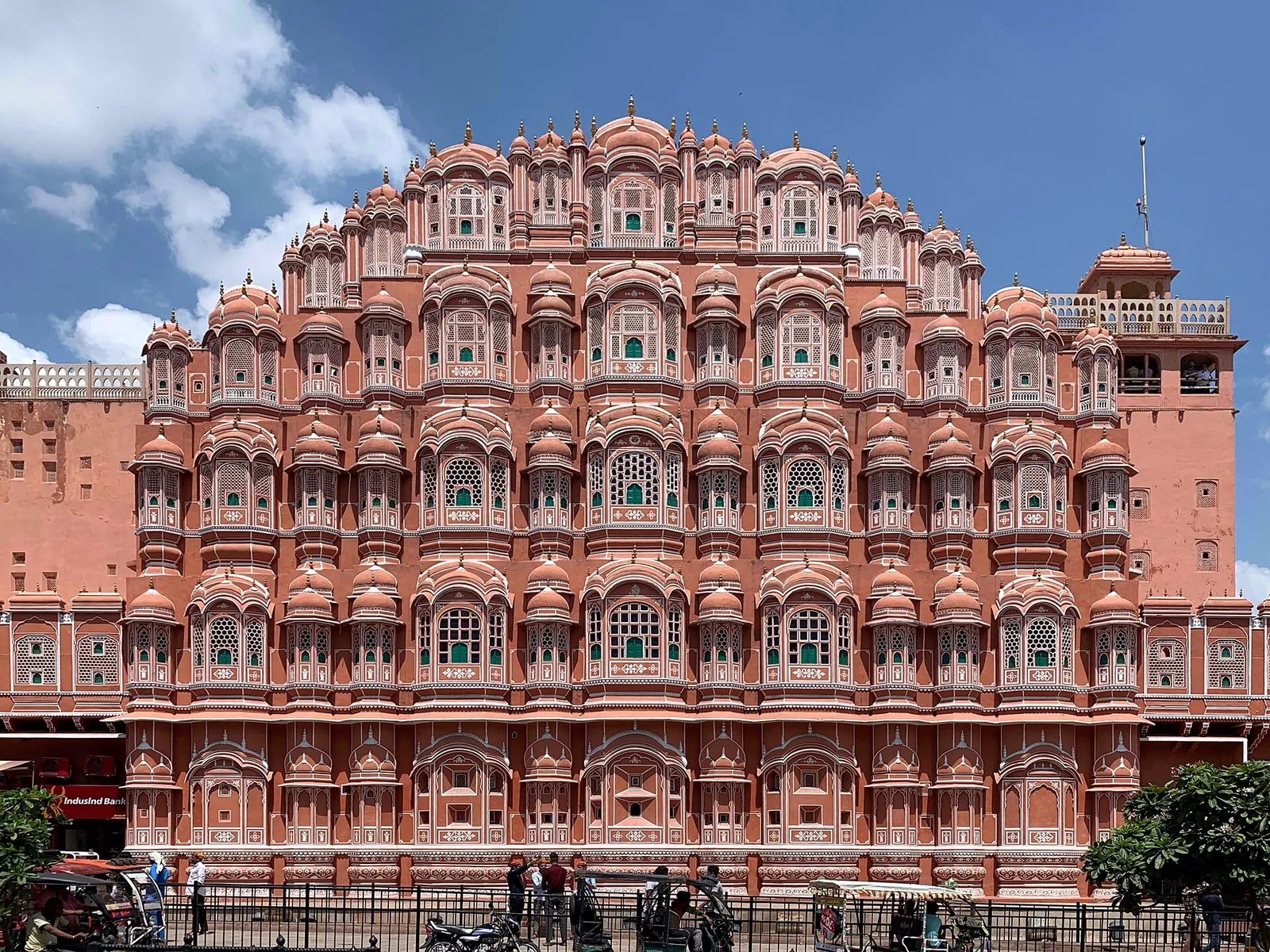
Hawa Mahal, the Palace of Winds, is the five-storey pink sandstone screen that Maharaja Sawai Pratap Singh built in 1799 to a design by Lal Chand Ustad. Its 953 small latticed windows let the women of the court watch the processions and the traffic of Johari Bazaar without being seen. The famous view is the front, from the street; the entrance is at the back, and ramps rather than stairs lead up through its storeys, with a small museum of Rajasthani miniature painting inside. Incredible India lists it as open from 09:00 to 16:30.
From Hawa Mahal it is a short walk along the bazaar to the palace and the observatory, so these three fit one morning; start at the City Palace when it opens at 09:30, before the tour groups.
Amber Fort, Jaigarh and the Jal Mahal
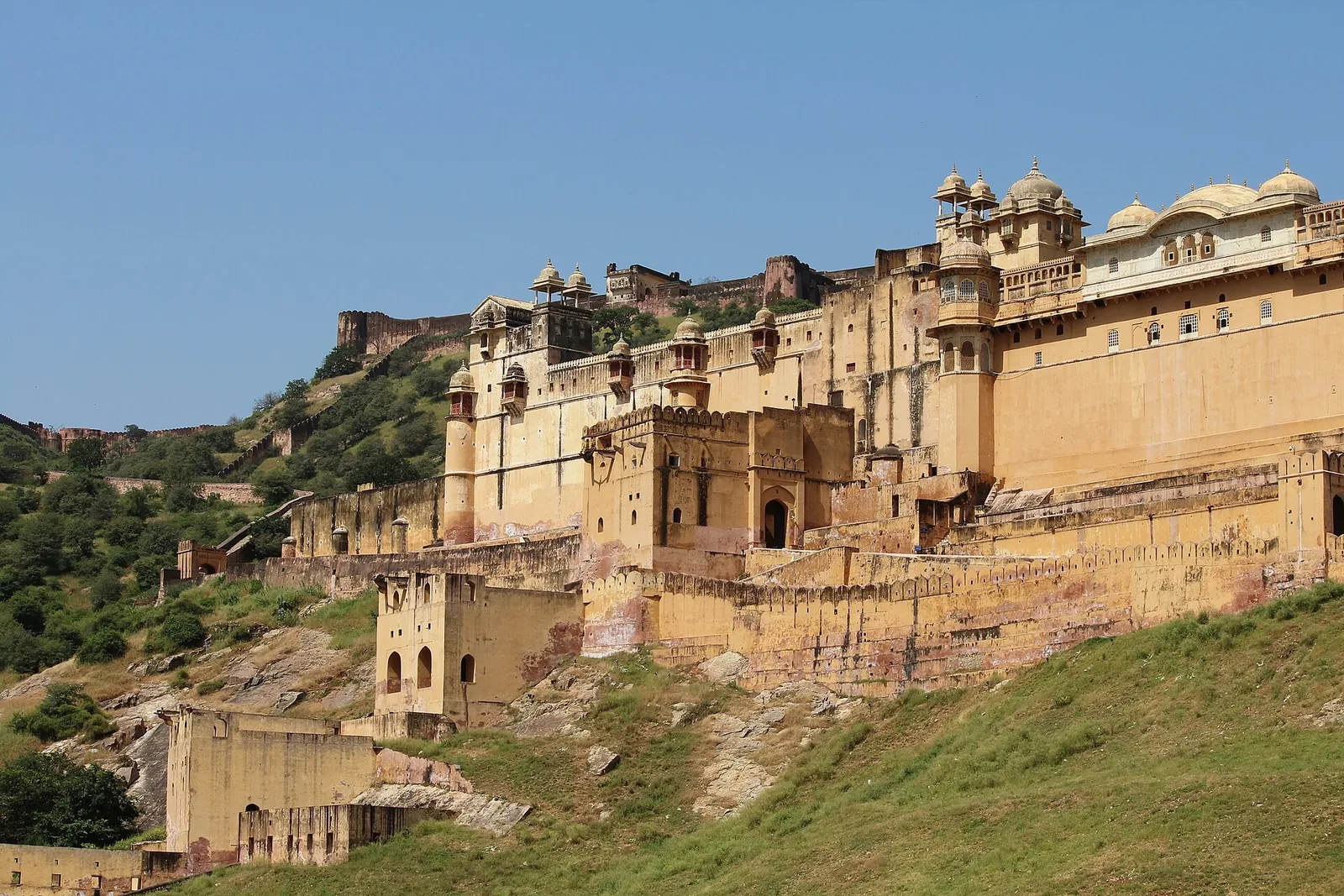
Amber (Amer) Fort, about 11 km from the city, was the seat of the Kachhwaha rulers before they moved to Jaipur, and it is now a UNESCO World Heritage Site. Raja Man Singh I began it in 1592, in sandstone and white marble, on a ridge above Maota Lake. You enter through the Suraj Pol into Jaleb Chowk, the old parade ground, then climb to the Diwan-e-Aam, the hall of public audience, the Sukh Niwas with its sandalwood door and water-cooled rooms, and the Sheesh Mahal, whose walls and ceilings are covered in thousands of small mirrors.
The climb from the road to Suraj Pol and Jaleb Chowk is steep: walk up the ramp, come up by jeep, or ride up on an elephant, which Rajasthan Tourism prices at INR 1,100 for two visitors one way, from the bottom of the hill to the courtyard. The elephants carry a limited number of visitors a day, and in the tourist season most have finished by about 11:00. Rajasthan Tourism gives Amber's hours as 08:00 to 17:30, but Incredible India gives 09:00 to 18:00, so plan for 09:00 to 17:30, the hours both cover, and go early, before the heat and the crowds. In the evening, a sound and light show tells the fort's history from below: Rajasthan Tourism lists it at 18:30 in English and 19:30 in Hindi from October to February, 19:00 and 20:00 in March and April, and 19:30 and 20:30 from May to September. Incredible India lists the English show at 19:30 and the Hindi show at 20:00, so confirm the time at the fort. Rajasthan Tourism does not publish the show's ticket price.
Close to the fort, Panna Meena ka Kund is a centuries-old stepwell named after Panna Meena, the architect credited with building it. Its steps lead down past carved walls to the water, and for generations it was the neighbourhood's main source of water, where people came to fetch it, talk and escape the desert sun. Incredible India lists it among Amber's nearby sights and as open from sunrise to sunset.
Jaigarh Fort, on the hill above Amber, was built by Sawai Jai Singh II in the early 18th century to guard it, and holds Jaivana, said to be the world's largest cannon. It is included in the City Palace Museum's composite ticket, and Incredible India lists it as open from 09:30 to 17:00. On the way back to town, stop on the lakeside road for the Jal Mahal, a palace that seems to float in Man Sagar Lake; only one of its five storeys is above the water, and it is not open to visitors, so the view from the shore is all there is.
Just off the Jaipur-Amber road, Gaitore is the narrow valley where the Kachhwaha kings were cremated. Sawai Jai Singh II chose it as the royal cremation ground, and from 1733 each ruler was given a cenotaph (chhatri) there: open-domed pavilions of marble and sandstone on raised platforms, mixing Rajput, Islamic and Hindu temple forms. The finest is Jai Singh II's own, in white marble carved with peacock motifs. Incredible India lists Gaitore as open from 09:30 to 17:00.
Nahargarh, the Albert Hall Museum and Galta Ji
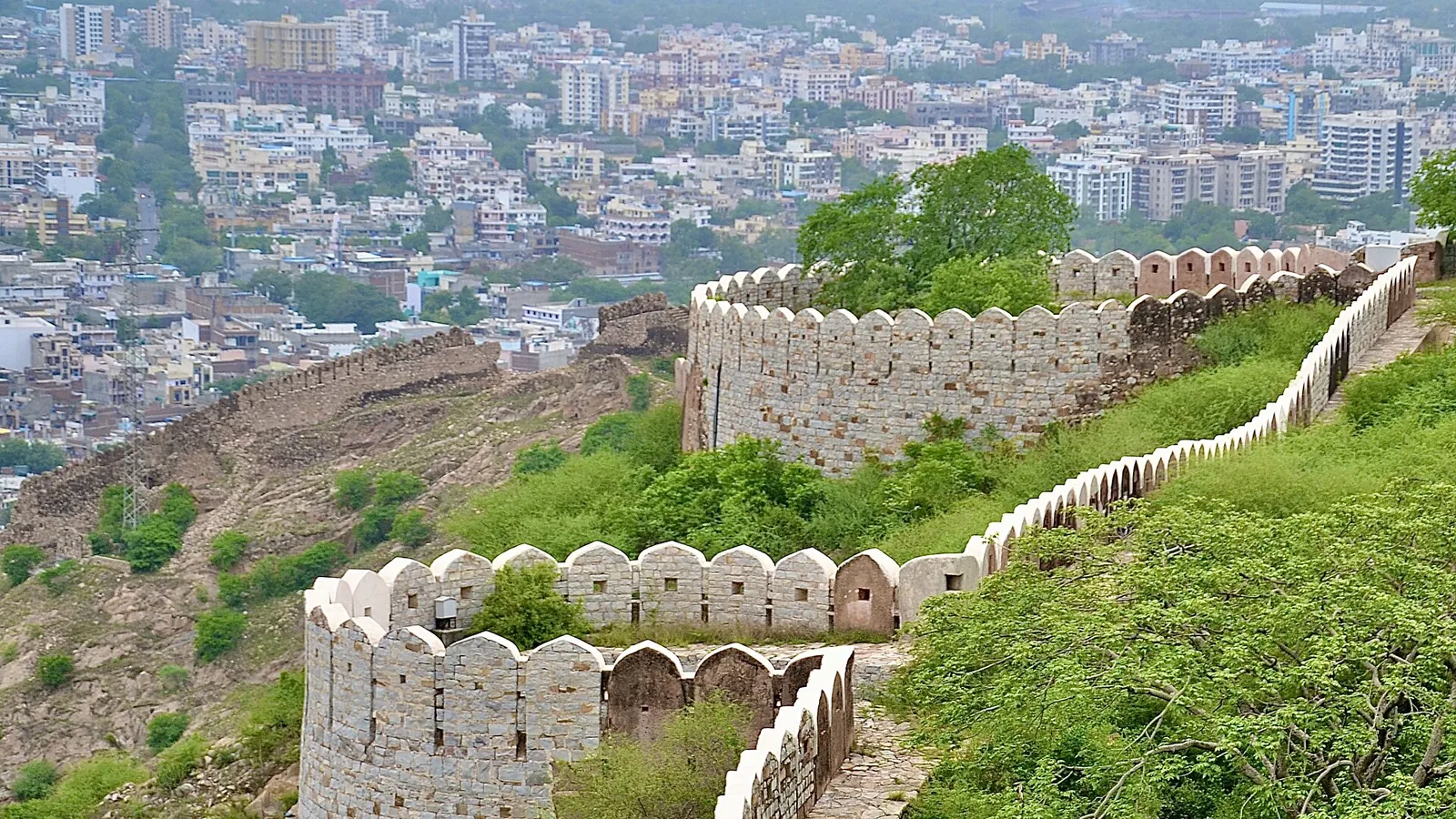
Nahargarh Fort, on the ridge of the Aravalli Hills that closes the north of the city, was completed in 1734 under Sawai Jai Singh II and expanded in 1868. Its name means 'abode of tigers'. Inside, Madhavendra Bhawan, built by Sawai Madho Singh as a summer palace, is a set of matching apartments for the queens linked by corridors painted with murals, and it now also houses a contemporary sculpture park. The ramparts look straight down over the Pink City, which is why people come here late in the day; Incredible India lists the fort as open from 10:00 to 17:30, so take a taxi up by mid-afternoon in winter, when the sun sets early.
The Albert Hall Museum (Central Museum) stands in the middle of Ram Niwas Garden. The Prince of Wales laid its foundation stone in 1876, and Sir Samuel Swinton Jacob designed it in the Indo-Saracenic style. Its collection runs from carpets, metalwork, arms and sculpture to miniature paintings of the Bundi, Kota, Kishangarh, Udaipur and Jaipur schools. Incredible India lists it as open from 09:00 to 17:00 and again from 19:00 to 21:30, when the building is lit. Masala Chowk, an open-air court of street-food stalls, is beside it in the same garden.
Galta Ji, set among low hills, is an ancient pilgrimage centre of temples, pavilions and holy kunds, its natural springs and water tanks. Its Ramgopalji temple is known locally as the Monkey Temple for the large troop of monkeys that live around it, and on the hilltop above stands the small Surya Mandir, the temple of the sun god built by Diwan Kriparam, which can be seen from all over the city.
Tickets and opening hours: the state composite and the City Palace
Jaipur has two separate ticket systems, and neither covers the other. Amber, Hawa Mahal, Jantar Mantar and Nahargarh belong to the Rajasthan Department of Archaeology and Museums. Rajasthan Tourism says Jantar Mantar tickets can be bought at the entrance or online, and its site links the state's e-ticketing portal, obms-tourist.rajasthan.gov.in. The department's About Us page lists the Jaipur monuments in its composite ticketing scheme as Amber Palace, Hawa Mahal, Jantar Mantar, Albert Hall, Sisodia Rani Garden, Vidhyadhar Garden, Isarlat and Nahargarh Fort. The composite lists Albert Hall, so if you buy it, it covers the museum too and you need no separate Albert Hall ticket. Check the composite ticket's price and how many days it is valid on the portal or at the first gate. On the plan below, Albert Hall falls on day 1, Hawa Mahal and Jantar Mantar on day 2 and Amber and Nahargarh on day 3; if the composite does not cover all three days, buy single tickets at each gate.
The City Palace is run by the City Palace Museum, which sets its own prices. On 17 October 2026, its ticket page listed, at the international rate: the museum (courtyards and galleries) at INR 1,200 for an adult and INR 600 for a student or a child under 12; the composite (the museum plus Jaigarh Fort and the royal cenotaphs) at INR 1,700 and INR 850; and the Chandra Mahal Royal Tour, a guided visit to the private floors with refreshments, at INR 5,000 and INR 3,000, sold only at the ticket counter. Indian nationals and residents pay INR 400 for the museum. Guides can be hired at the desk, and golf carts cost INR 150 a person.
The museum is open daily from 09:30 to 18:30, with the last tickets sold at 18:00, and closes only on Dhulandi, the second day of Holi. Its evening Museum at Night programme is temporarily closed, and the Textile Gallery in Mubarak Mahal has been closed for restoration since 27 March 2026. Tickets are sold at both gates: Gate 1 near the Jantar Mantar ticket counter, and Gate 2 at Jaleb Chowk, the only gate with parking.
The bazaars, the festivals and the gem warning
The old city's main streets are its bazaars, each with its own trade. Johari Bazaar is the jewellers' street, with Rajasthani jewellery, clothes and textiles; Bapu Bazaar sells mojari slippers and Rajasthani textiles; Tripolia Bazaar has bangles, fabrics, carpets and rugs; and Chandpole Bazaar is known for carved marble figures. Jaipur is also famous for its block-printed textiles in the Sanganeri, Bagru and Dabu styles. Rajasthan Tourism says the markets are generally closed on Sundays, so keep a weekday for shopping.
Jaipur is renowned for its coloured gems, and that trade has its own scam. The French foreign ministry warns of dishonest sellers, mainly in Rajasthan, Goa and Dharamsala, who offer to ship jewellery and precious stones home for you and then make fraudulent charges on your card or raise the price without your consent; it also reports cases in which visitors were held and forced to buy stones or jewellery. Buy only what you can carry away with you.
Two festivals fill the old city with processions. At Gangaur, in the month of Chaitra (March-April), women worship clay figures of Gan and Gauri, and on the festival day a procession of palanquins, chariots and folk performers leaves the Zanani Deodhi of the City Palace and passes through Tripolia Bazaar and Chhoti Chaupar. At Teej, the monsoon festival of the goddess Parvati, a royal procession leaves the City Palace and winds through Tripolia Bazaar and Chhoti Chaupar on both days, and ghewar is the sweet of the season. Dates change each year with the Hindu calendar; Rajasthan Tourism announces them.
Getting there and around: trains, the airport and the Metro
By train, Jaipur railway station has direct services to Delhi, including Shatabdi, Rajdhani, Duronto and Mandor Express trains, and to Agra and other cities. At its launch in April 2023 the Prime Minister's Office announced the Ajmer-Delhi Cantt Vande Bharat Express with stops at Jaipur, Alwar and Gurgaon, and gave 5 hours 15 minutes for its whole run between Delhi Cantt and Ajmer, so the Jaipur-Delhi part is shorter. The train's route and terminus may have changed since that release, so check IRCTC for the Delhi station on your ticket; Delhi Cantt is not New Delhi Railway Station, where the Airport Express Line starts. Indian Railways publishes current departure times and fares only in its journey search, so check IRCTC for your date. The railway enquiry number is 139.
Indian Railways runs International Tourist Bureaus for foreign tourists and NRIs in cities including New Delhi, Agra Cantt, Jaipur, Jodhpur, Varanasi and Mumbai, for enquiries, bookings and reservations. Foreign visitors can book on IRCTC with an international mobile number and a foreign card, and the Foreign Tourist quota opens up to 365 days ahead; our India transport guide explains the account, the quota and the classes.
By road, the Ministry of Tourism puts Delhi about five hours away, with private and state buses. Between Agra and Jaipur, 232 km by road, a car lets you stop at Fatehpur Sikri on the way. By air, Jaipur International Airport (JAI), at Sanganer, has domestic flights to Delhi, Mumbai and other cities, and is one of the airports where the e-Visa is accepted; see our India entry guide. At the airport, prepaid taxis wait at the domestic terminal, private taxi companies have counters in both arrival halls, and app-based cabs, metered auto-rickshaws and JCTSL city buses run into town.
In town, auto-rickshaws, taxis and app-based cabs are the usual way between the walled city, Amber and Nahargarh, and local buses also run. The Metro's Pink Line runs into the walled city, with Badi Chaupar the station for the City Palace. Jaipur is the third corner of the Golden Triangle with Delhi and Agra, and the start of the route west to Jodhpur and Udaipur.
A three-night plan and what the sights cost for two
This plan keeps Amber for an early morning and the bazaars for a weekday, because the forts are hot by midday and the markets are generally closed on Sundays.
- Day 1: arrive and check in. Late afternoon at the Albert Hall Museum, then dinner at Masala Chowk in Ram Niwas Garden.
- Day 2: the City Palace at 09:30, Jantar Mantar next door and Hawa Mahal from the bazaar; lunch, a rest in the heat of the day, then Johari and Bapu bazaars until evening, and dinner at Chokhi Dhani, a taxi ride out on Tonk Road.
- Day 3: Amber Fort at 09:00, when both official pages have it open, and Panna Meena ka Kund close by, then Jaigarh on the hill above with the City Palace composite ticket. On the way back to town, see the Jal Mahal from the lakeside road and the royal cenotaphs at Gaitore, then stop for lunch and a rest. Take a taxi up to Nahargarh by mid-afternoon for the view over the city before it closes at 17:30. If you would rather see Amber's sound and light show, keep the evening for that and go up to Nahargarh on the morning of day 4 instead of Galta Ji.
- Day 4: Galta Ji early in the morning, then Tripolia and Chandpole bazaars, then the train or flight onward.
- City Palace composite, two adults at INR 1,700 each (museum, Jaigarh Fort and the royal cenotaphs): INR 3,400, checked on 17 October 2026.
- Masala Chowk, entry for two at INR 10 each on day 1: INR 20.
- State monuments (Amber, Hawa Mahal, Jantar Mantar, Nahargarh): the department's tickets or composite ticket for two, at the price shown on its e-ticketing portal; the composite lists Albert Hall, so with it you need no separate Albert Hall Museum ticket.
- Options: the elephant ride up to Amber at INR 1,100 for two one way, and the Chandra Mahal Royal Tour at INR 5,000 a person at the international rate (INR 10,000 for two).
- Not included: rooms, meals and the Chokhi Dhani dinner, the Albert Hall Museum ticket on day 1 if you do not buy the state composite, the train or flight, taxis and auto-rickshaws, guides, and golf carts at the City Palace (INR 150 a person).
Make time for the local food
What to eat and where to look
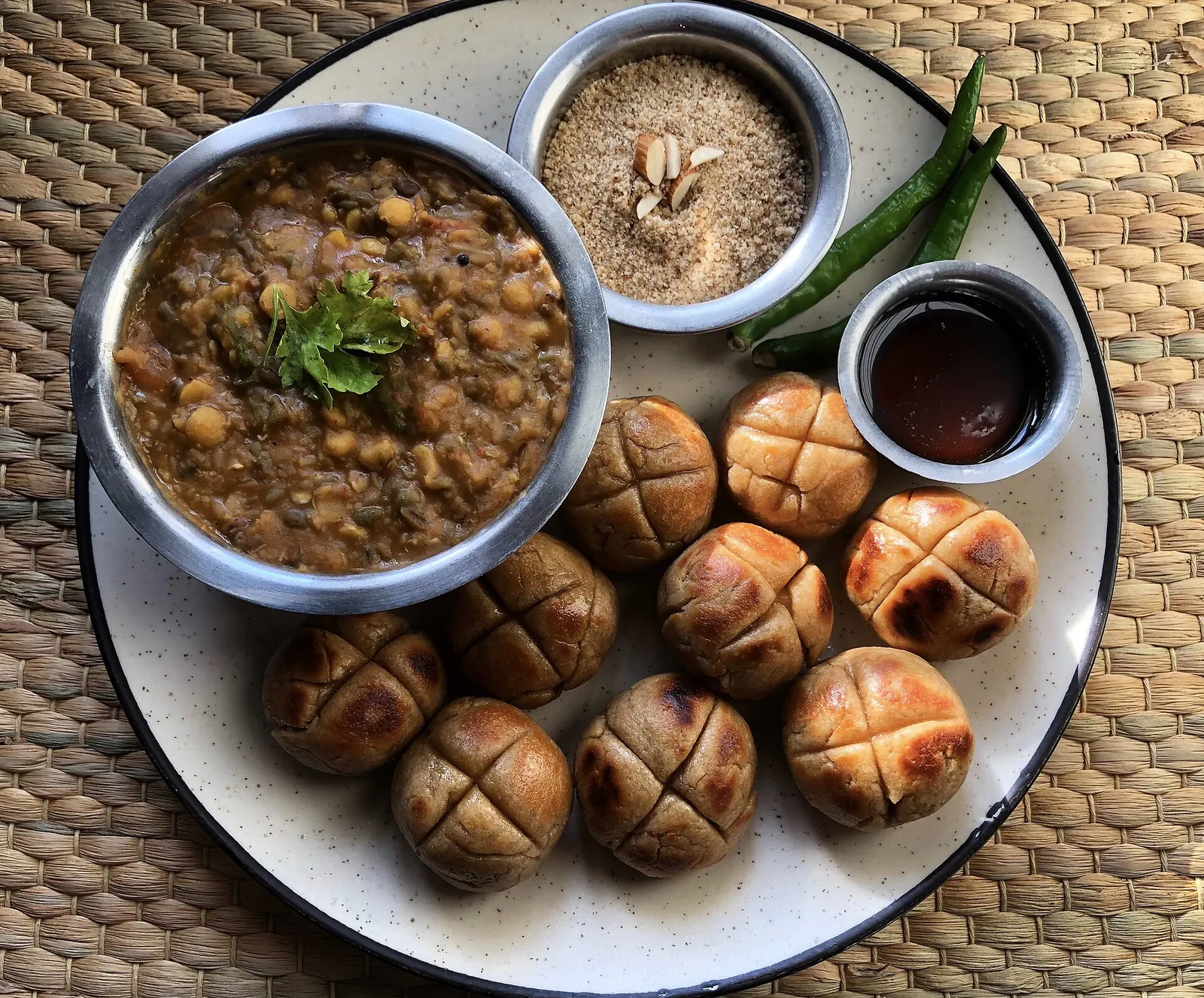
Dal baati churma
Rajasthan's signature meal: ghee-soaked wheat dumplings (baati) with a lentil curry (dal) and churma, a sweet crumble eaten as dessert.
- Where to look
- Chokhi Dhani, a recreated Rajasthani village with folk dance and puppet shows, out of town on Tonk Road (its address is 12 Miles, Tonk Road); its own site describes its food only as Rajasthani cuisine, so ask which dishes are served that evening.
- Fit it into your day
- Dinner on the evening of day 2, with a taxi there and back.
Rich in ghee; the meal is vegetarian.
Ker sangri with bajra roti
Dried desert berries (ker) and beans (sangri) cooked with spices, eaten with flatbread of pearl millet (bajra) and a garlic chutney (lehsun chutney).
- Where to look
- Ask for it at Chokhi Dhani on Tonk Road, whose own site describes its food only as Rajasthani cuisine.
- Fit it into your day
- The same evening as the dal baati churma.
Kachori and mirchi bada
Jaipur's street snacks: kachori, a flaky fried pastry stuffed with spiced lentils or onion, and mirchi bada, a large green chilli stuffed with spiced potato and fried in batter.
- Where to look
- Masala Chowk in Ram Niwas Garden, beside the Albert Hall Museum, an open-air court of 21 street-food stalls; entry costs INR 10.
- Fit it into your day
- An evening snack after the Albert Hall Museum on the first day.
Mirchi bada is hot; ask for a milder one if you need it.
Ghewar
A crisp, honeycombed disc made with flour and ghee and soaked in syrup, the sweet of festivals; Rajasthan Tourism ties it to Teej.
- Where to look
- The sweet shops of Johari Bazaar, on the way between Hawa Mahal and the jewellers' stalls.
- Fit it into your day
- An afternoon sweet on the bazaar day.
Practical questions
How many nights do I need in Jaipur?
Three nights: one day for the City Palace, Jantar Mantar and Hawa Mahal, one for Amber Fort, Jaigarh, Gaitore and Nahargarh, and a third for the Albert Hall Museum, Galta Ji and the bazaars. Two nights are enough if you skip the museum and the shopping.
How much is the City Palace ticket for foreigners?
The City Palace Museum charges INR 1,200 for a foreign adult and INR 600 for a student or a child under 12. Its composite ticket, which adds Jaigarh Fort and the royal cenotaphs, costs INR 1,700 and INR 850. The museum is open daily from 09:30 to 18:30 and closes only on Dhulandi.
Does one ticket cover all of Jaipur's monuments?
No. The Rajasthan Department of Archaeology and Museums has a composite ticketing scheme for its own monuments, including Amber, Hawa Mahal, Jantar Mantar and Nahargarh; check the price and validity on its e-ticketing portal, obms-tourist.rajasthan.gov.in. The City Palace is run separately by the City Palace Museum and has its own tickets.
What time does Amber Fort open?
Rajasthan Tourism gives Amber's hours as 08:00 to 17:30, but Incredible India gives 09:00 to 18:00, so plan for 09:00 to 17:30.
How do I get from Agra to Jaipur?
Between Agra and Jaipur, 232 km by road, a car lets you stop at Fatehpur Sikri on the way. Jaipur railway station also has direct trains from Agra, which you book on IRCTC.
How do I get from Delhi to Jaipur?
Take a Shatabdi, Rajdhani, Duronto or Mandor Express train to Jaipur railway station (the Ajmer-Delhi Cantt Vande Bharat Express was announced at its launch in April 2023 with a stop at Jaipur, but its route and terminus may have changed, so check IRCTC), or fly to Jaipur International Airport; by road the Ministry of Tourism puts it at about five hours.
Sources and checks before you travel
Reference sources for the version dated 17 October 2026. Confirm opening times, access, transport and conditions for your travel dates.
- Incredible India (Ministry of Tourism): Jaipur ↗ — opens in a new tab
- Incredible India: Amber Fort ↗ — opens in a new tab
- Incredible India: Hawa Mahal ↗ — opens in a new tab
- Incredible India: Jantar Mantar ↗ — opens in a new tab
- Incredible India: City Palace ↗ — opens in a new tab
- Incredible India: Nahargarh Fort ↗ — opens in a new tab
- Incredible India: Jaigarh Fort ↗ — opens in a new tab
- Rajasthan Tourism: Jaipur ↗ — opens in a new tab
- Rajasthan Tourism: Jantar Mantar ↗ — opens in a new tab
- Rajasthan Tourism: Hawa Mahal ↗ — opens in a new tab
- City Palace Museum, Jaipur: home ↗ — opens in a new tab
- City Palace Museum, Jaipur: visit and tickets ↗ — opens in a new tab
- Jaipur International Airport: to and from the airport ↗ — opens in a new tab
- Chokhi Dhani: Village Fair restaurant, Jaipur ↗ — opens in a new tab
- France Diplomatie: Inde, conseils aux voyageurs (sécurité) ↗ — opens in a new tab
- Official e-Visa site (Bureau of Immigration): e-Visa information ↗ — opens in a new tab
- IRCTC: Foreign Tourist Quota booking ↗ — opens in a new tab
- IRCTC: Foreign Tourist terms and conditions ↗ — opens in a new tab
- India Meteorological Department: Jaipur climatological information ↗ — opens in a new tab
- Incredible India: Albert Hall Museum ↗ — opens in a new tab
- Incredible India: Panna Meena ka Kund ↗ — opens in a new tab
- Incredible India: Gaitore ↗ — opens in a new tab
- PIB (Prime Minister's Office): Rajasthan's first Vande Bharat, 10 April 2023 ↗ — opens in a new tab
- Uttar Pradesh Tourism (Taj Mahal site): getting around ↗ — opens in a new tab
- Indian Railways: facilities for international tourists ↗ — opens in a new tab
- Rajasthan Department of Archaeology and Museums: About Us ↗ — opens in a new tab
Photo credits
Hawa Mahal's street front, the side most visitors photograph from the bazaar
Photograph: Chainwit. — opens in a new tab · CC BY-SA 4.0 — opens in a new tab
Changes: Resized and converted to WebP; displayed with responsive crops. · Original photograph and licence details ↗ — opens in a new tab
Amber Fort on its ridge above the road from Jaipur
Photograph: This photograph was taken by Rijin S and released under the license stated below. You are free to use it for any purpose as long as you credit the author ( Rijin S ), the Source (Wikimedia Commons), the license (CC-BY-SA 4.0) in close relation to the image and send me a message This image is not public domain . Please respect the copyright protection. It may only be used according to the rules mentioned here. This specifically excludes use in social media , if applicable terms of the licenses listed here not appropriate. Please do not upload an updated image here without consultation with the Author. The author would like to make corrections only at his own source RAW. This ensures that the changes are preserved. If you think that any changes should be required, please inform the author. Otherwise you can upload a new image with a new name. Please use one of the templates derivative or extract . Attribution ( required by the license ) InfoField © Rijin S/ Wikimedia Commons / CC BY-SA 4.0 InfoField © Rijin S/ Wikimedia Commons — opens in a new tab · CC BY-SA 4.0 — opens in a new tab
Changes: Resized and converted to WebP; displayed with responsive crops. · Original photograph and licence details ↗ — opens in a new tab
One of the stone instruments of the Jantar Mantar observatory
Photograph: Jakub Hałun — opens in a new tab · CC BY-SA 4.0 — opens in a new tab
Changes: Resized and converted to WebP; displayed with responsive crops. · Original photograph and licence details ↗ — opens in a new tab
Mubarak Mahal, the former reception hall in the City Palace's first courtyard
Photograph: Jakub Hałun — opens in a new tab · CC BY-SA 4.0 — opens in a new tab
Changes: Resized and converted to WebP; displayed with responsive crops. · Original photograph and licence details ↗ — opens in a new tab
The city seen from the walls of Nahargarh Fort
Photograph: Harshil s mehta — opens in a new tab · CC BY 4.0 — opens in a new tab
Changes: Resized and converted to WebP; displayed with responsive crops. · Original photograph and licence details ↗ — opens in a new tab
Dal baati churma, Rajasthan's signature meal of baked dumplings, lentils and sweet churma
Photograph: Mahi Tatavarty — opens in a new tab · CC BY-SA 4.0 — opens in a new tab
Changes: Resized and converted to WebP; displayed with responsive crops. · Original photograph and licence details ↗ — opens in a new tab