Delhi and the north · Uttar Pradesh
Varanasi travel guide: 2 nights on the ghats, the aarti and Sarnath
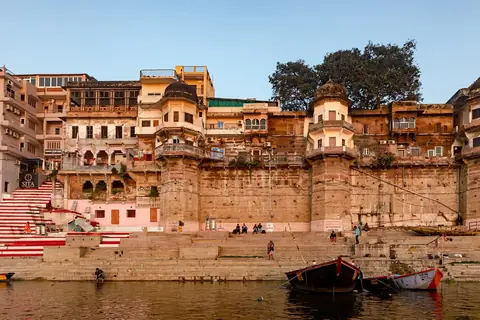
Varanasi is a city you see from its river steps. Its ghats line the west bank of the Ganges, from Assi in the south past Dashashwamedh, where the evening aarti fills the steps with lamps, to Manikarnika, where cremations go on day and night. Behind them, a maze of lanes leads to Kashi Vishwanath, the city's great Shiva temple, and about ten kilometres away lies Sarnath, where the Buddha gave his first sermon and which became a UNESCO World Heritage Site in 2026. Two nights cover the ghats, a dawn boat, the temple lanes and a half day at Sarnath.
- Suggested time
- 2 nights (3 days)
- Where to stay
- The old city around Dashashwamedh Ghat and the Kashi Vishwanath corridor, for the aarti and the lanes; Assi Ghat for calmer mornings and cafés; the Cantonment only if you arrive late by train
- Season and timing
- Incredible India calls October to March the most pleasant time for the ghats, the lanes and the boats, and winter mornings often bring fog over the river. IMD says heat waves come mainly from March to June and peak in May, and the southwest monsoon brings the main rains from June to September, the months when high water can halt the boats. Dev Deepawali, when lamps line every ghat, falls fifteen days after Diwali; dates change each year, and the city announces them.
The short answer
Book two nights (three days) in the old city near Dashashwamedh Ghat, or at Assi Ghat if you want quieter mornings. Book your train or flight first, because Vande Bharat trains ran above 100 percent occupancy in 2024-25 and in the first quarter of 2025-26, then the room, and do not plan Sarnath for a Friday, when its museum is closed. Two key prices, checked on 17 October 2026: Southern Grand Kashi, the guest house inside the Kashi Vishwanath corridor, sells a two-night package for two people sharing a room at INR 14,742 plus 12% GST, and the temple trust sells foreign visitors a darshan ticket for INR 600 at its head-office help desk. The model stay below comes to about INR 17,711 for two foreign visitors, with their darshan tickets, before trains, boats, Sarnath and meals.
Where to sleep: the old city by Dashashwamedh, Assi Ghat or the Cantonment
Sleep near the river. The old city behind Dashashwamedh Ghat puts the evening aarti, the dawn boats and Kashi Vishwanath within a walk, and its lanes are the reason to come. Southern Grand Kashi (Bhimashankar Guest House), owned by the Shri Kashi Vishwanath Temple Trust, is inside the temple corridor and has a route down to Lalita Ghat; it has Super Deluxe rooms of 270 sq ft for up to three adults, plus dormitories of 16 beds. The trust's second guest house, Ganga Darshan (Gangadarshanam), is near Dashashwamedh Ghat in Bengali Tola.
Assi Ghat, at the southern end of the ghats where the Assi river meets the Ganges, is calmer. The city's Kashi portal describes it as lined with cafés, ashrams and guesthouses, close to Banaras Hindu University, with the Subah-e-Banaras ceremony at sunrise and a quieter evening aarti. It is the better base for a longer stay or for early starts on the river.
The Cantonment, around Varanasi Junction station, suits a late train arrival, but every visit to the ghats then begins with a ride across the city, so most visitors are better off by the river. Wherever you stay, the old city is a maze of narrow lanes, so ask your guest house where a taxi can drop you.
The river: from Assi to Dashashwamedh, the evening aarti and a dawn boat
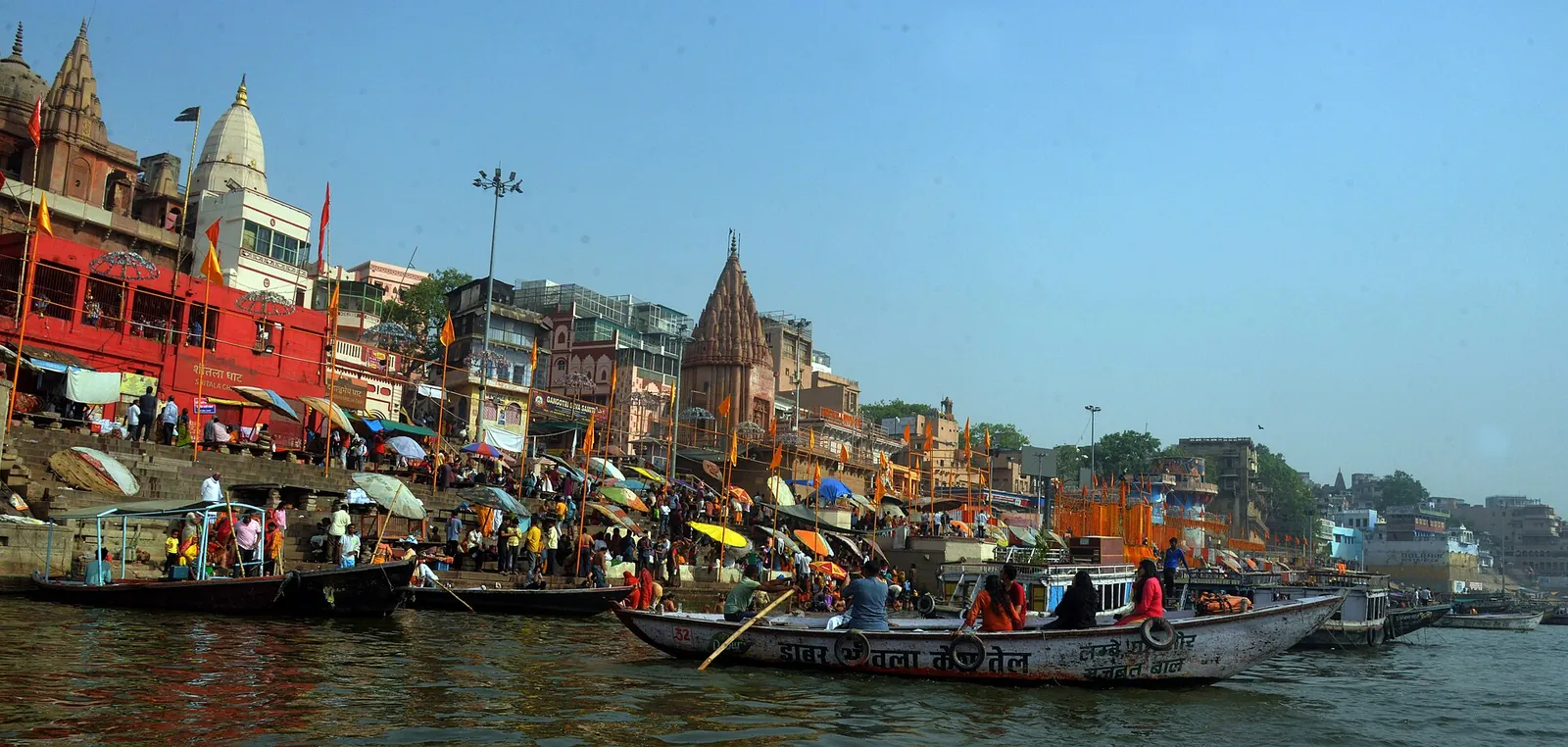
The riverfront is Varanasi's defining image. At Assi Ghat, Incredible India describes a lingam beneath a sacred peepal tree, the small marble Assi-sangameshwar temple just off the ghat and Lolarka Kund, a tank fifteen metres below ground reached by steep steps. Each morning the Subah-e-Banaras programme brings Vedic chants, classical music and yoga to the steps at sunrise.
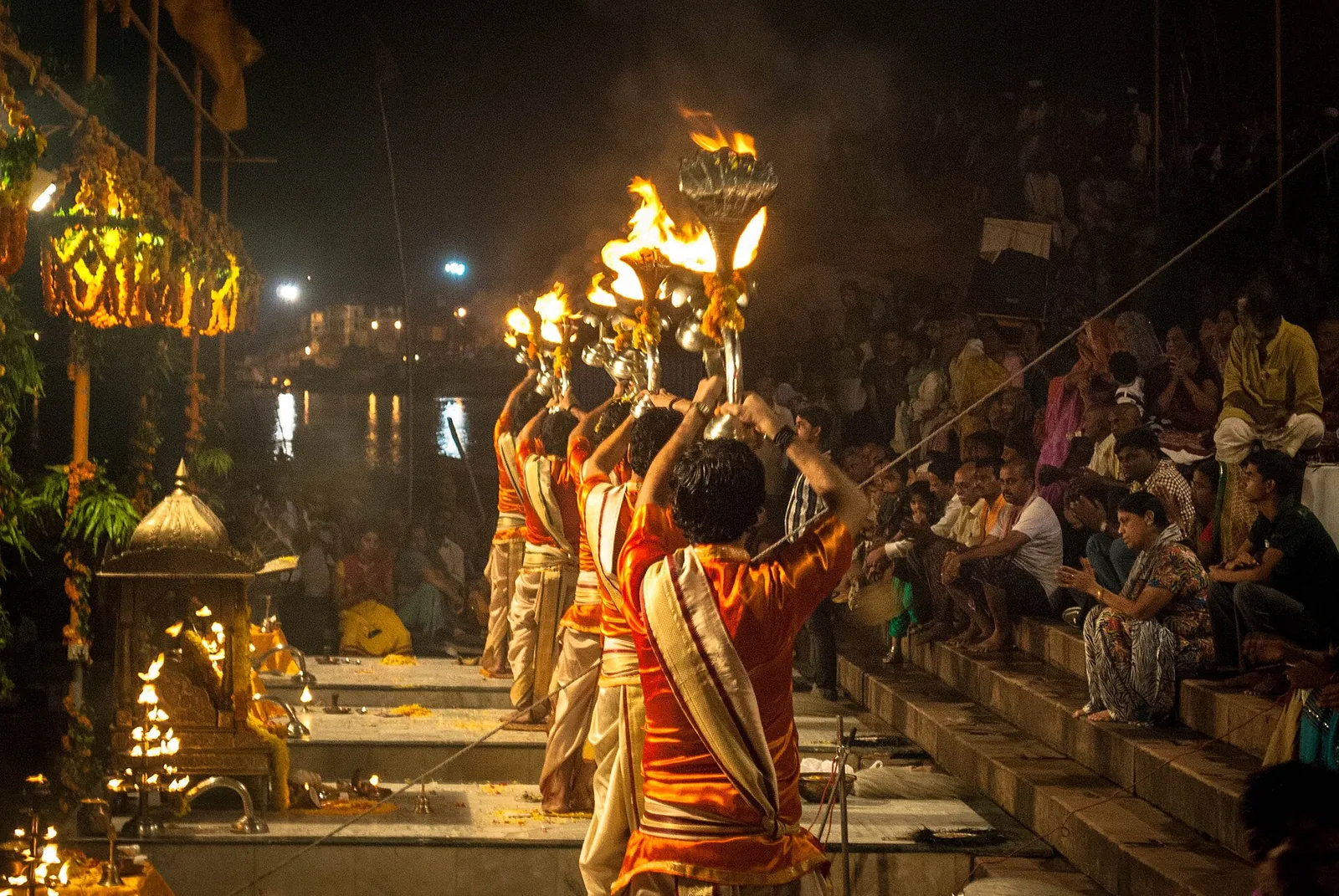
Dashashwamedh Ghat is the busiest of the river steps. Its name recalls the legend that Brahma performed ten ashwamedha sacrifices here, and it is the stage for the main Ganga aarti. According to the city's Kashi portal, the organised evening aarti seen today began in the 1990s; young priests in saffron and cream robes move in unison with conches, bells and tall multi-tiered brass lamps. Incredible India says the rite is led by the head priest of the Gangotri Seva Samiti, is performed on five raised platforms and lasts forty-five minutes.
The aarti begins just after sunset and lasts about 45 minutes, so its clock time moves with the season; people take their places on the steps well before sunset, and many watch from boats moored off the ghat. Smaller aartis are held at Assi, Rajendra Prasad, Raj and Kedar ghats for a closer view away from the crush.
Come back at dawn for a boat on the river, when priests make their offerings, pilgrims take their ritual dip and the ghats turn gold in the first light. Rowing and motor boats wait at Dashashwamedh and Assi. No official boat fare is published; agree the price, the route and whether it is per boat or per person before you set off. In the monsoon the river can rise high enough to halt the boats. DD News, the public broadcaster's news site, reported one such event, dated 20 August 2026, when the administration suspended boat operations as the Ganga approached its danger mark, and said the decision on resuming would wait until the water level and the flow returned to normal. Ask your hotel before you plan a dawn trip whether the boats are running.
Manikarnika and Harishchandra: the cremation ghats
Manikarnika Ghat, between Dashashwamedh and Scindia ghats, is one of the holiest cremation grounds in Hinduism, and cremations take place there around the clock. Its northern part is used for bathing and prayer and the southern part for cremations; Manikarnika Kund, the pool of the legend in which Parvati lost an earring, is beside the steps. Harishchandra Ghat is named after the king of Ayodhya who, in the legend, served as a cremation worker here; besides wood pyres it has an electric crematorium.
These are working cremation grounds where families say goodbye to their dead, not sights. If you pass them, on foot or by boat, keep your distance from the pyres and the mourners, stay quiet, dress modestly and do not take photographs or video. You owe no one a fee to watch from the steps; hand any donation to a temple or charity of your own choosing rather than to someone who approaches you there. When the river runs high in the monsoon, cremations can move up to the higher steps and rooftops.
Kashi Vishwanath and the old-city lanes
Kashi Vishwanath Temple enshrines the jyotirlinga of Shiva known as Vishweshwara or Vishwanath and is the spiritual centre of the city. The present temple was built in 1780 by Maharani Ahilyabai Holkar of Indore, and in 1839 Maharaja Ranjit Singh had two of its domes covered in gold. Since 1983 the temple has been run by the Shri Kashi Vishwanath Temple Trust under the Government of Uttar Pradesh.
The trust lists the temple as open from 03:00 to 23:00, with darshan from 04:00 to 11:00, 12:20 to 19:00 and 20:30 to 21:00. The Mangala Aarti runs from 03:00 to 04:00, with reporting at 02:30 at Gate 1. Phones, other electronic or non-electronic gadgets and even pens are not allowed inside, and free lockers are provided; there is no dress code, but devotees are asked to wear decent clothes. From the river, Gate 1 is open to visitors from Ganga ghat from 06:00 to 21:00.
Foreign visitors with a valid passport book their darshan only at the trust's head-office help desk, CK 37/40-42 near Shapuri Mall, Bansphatak. Show your original passport, hand over photocopies of your passport and visa, and pay INR 600 for a ticket that includes a Shastri escort and prasad (checked on 17 October 2026). Ask at the desk for its opening hours and whether the ticket covers the Mangala Aarti; the trust's support line, +91 7080292930, answers from 09:00 to 18:00.
The temple sits in the middle of the galis, the old city's lanes, which reveal small shrines, old houses, markets and sweet shops at every turn. Incredible India names Vishwanath Gali, Kachauri Gali and Thatheri Bazaar as the lanes to walk. Banaras is also a weaving town: the Banarasi silk sari with its zari work has GI status, and Incredible India notes that Varanasi belongs to UNESCO's Creative Cities Network as a City of Music, the city of Ustad Bismillah Khan's shehnai. Across the river, opposite Tulsi Ghat, the 18th-century red sandstone Ramnagar Fort of the Maharaja of Banaras is, Incredible India says, a 30-minute boat ride away, with a museum of royal palanquins, vintage cars, arms and a 19th-century astronomical clock; the Kashi portal lists the fort museum as open from 09:30 to 17:30, while Incredible India gives the fort's opening time as 10:00 to 17:00, so plan within the shorter window.
In the south of the city, near Assi Ghat, the campus of Banaras Hindu University holds Bharat Kala Bhavan, founded in 1920, which the Kashi portal calls the best university museum in India. Its more than 100,000 objects run from archaeological finds and paintings to textiles, costumes, ornamental art and stamps, and it is open from 10:00 to 17:30.
Sarnath: the deer park of the first sermon
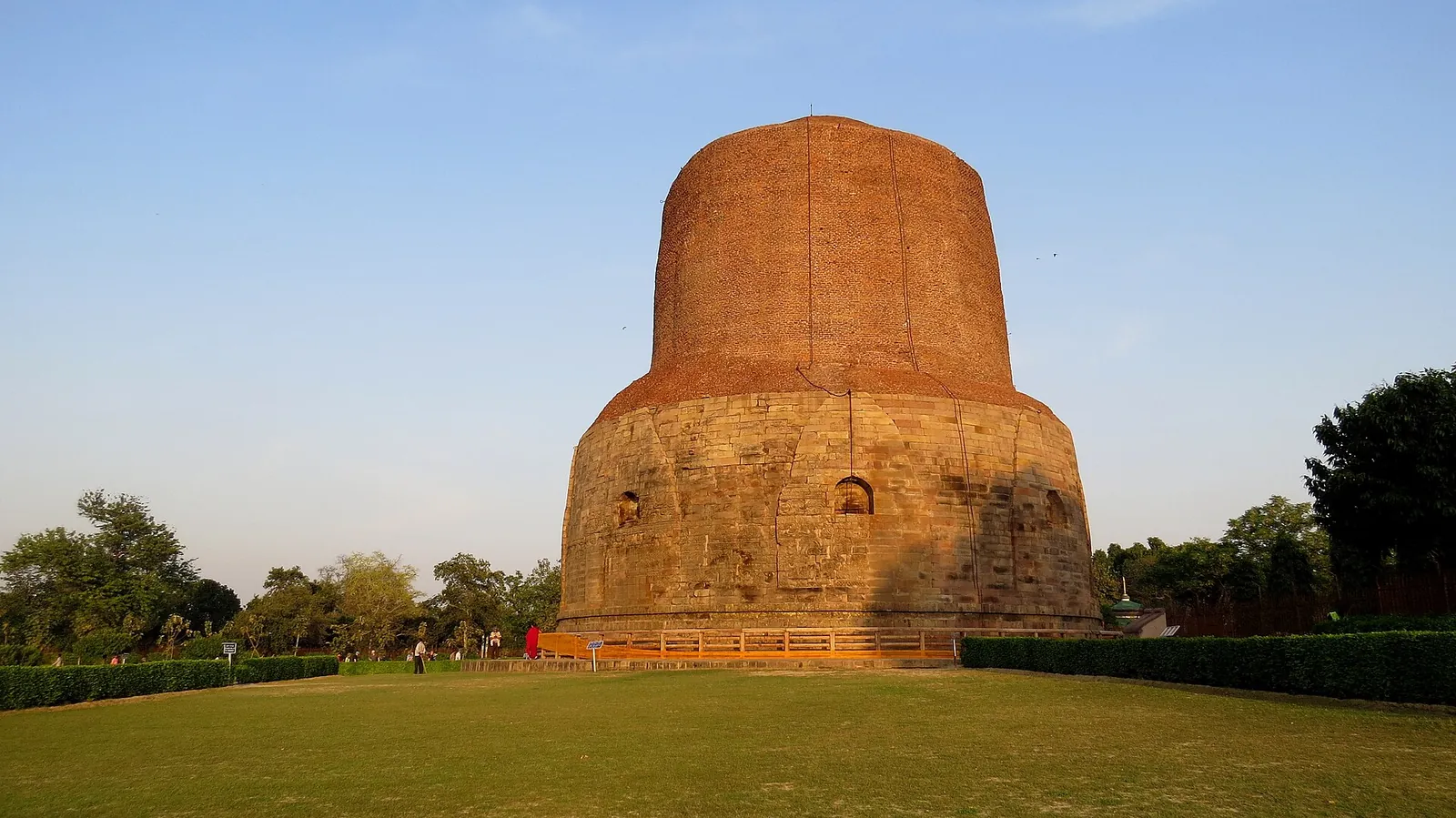
Sarnath, about 10 km from Varanasi, is where the Buddha gave his first sermon, the Turning of the Wheel of the Law, and met his first disciples. On 25 July 2026, the World Heritage Committee inscribed the Ancient Buddhist Site of Sarnath on the UNESCO World Heritage List, India's 45th property, according to the Ministry of Culture's release. It has two parts: the archaeological remains, with the Dhamekh and Dharmarajika stupas, the Mulagandhakuti Vihara and the Ashokan pillar, and the Chaukhandi Stupa.
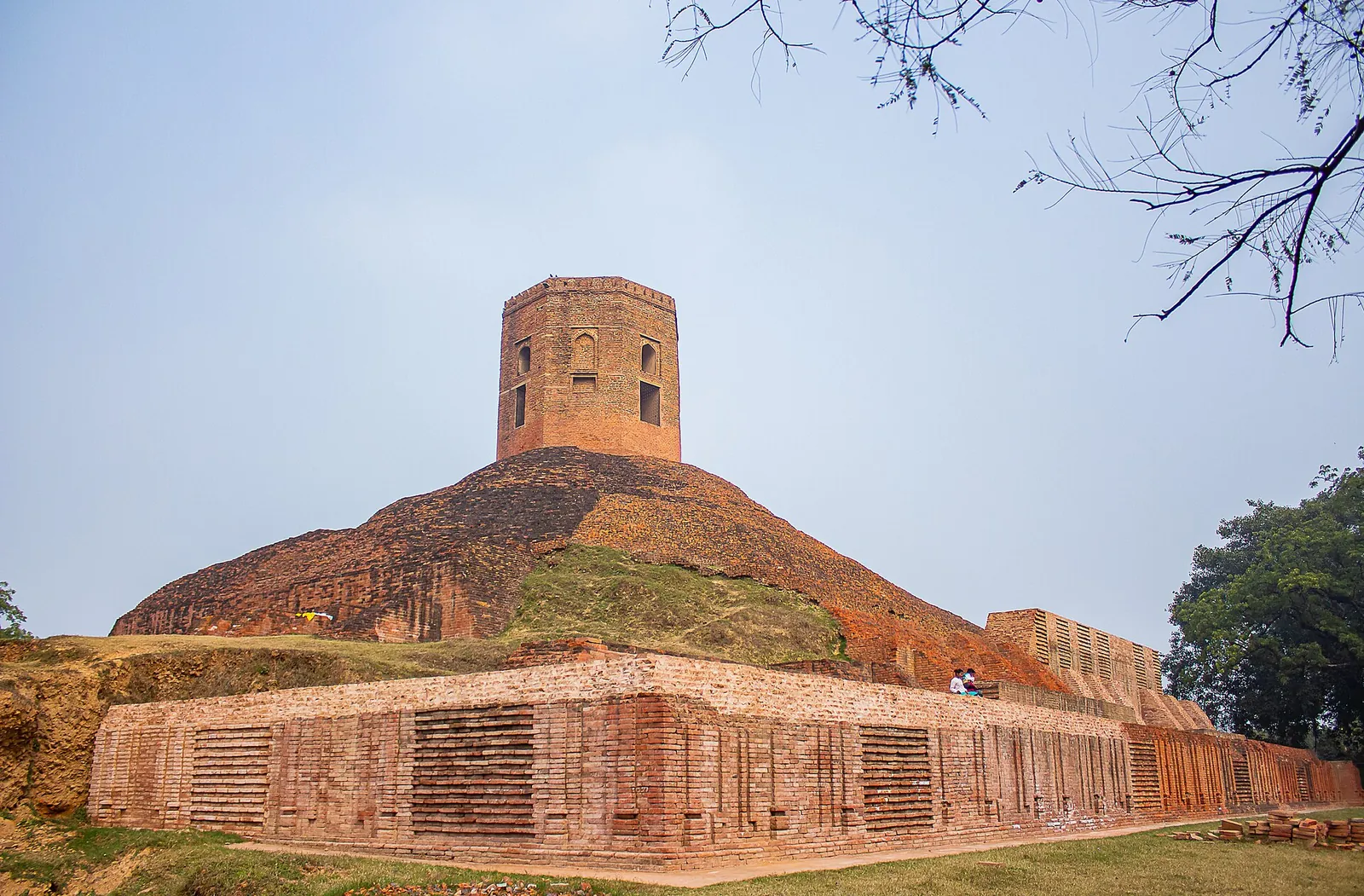
In the main complex, the Dhamekh Stupa is the great cylinder over 40 metres tall that marks the place of the sermon; the city's Kashi portal dates the present structure to the Gupta period, around the 5th century CE, and points out its floral and geometric carving. The broken shaft of the Ashokan pillar stands among the ruins of monasteries and votive stupas. The city's Kashi portal says the Chaukhandi Stupa, a little apart from the main complex, was given its octagonal tower in 1588 by the Mughal emperor Akbar to commemorate his father Humayun's visit.
Leave time for the Sarnath Museum, founded in 1904 as ASI's oldest site museum. Its Shakyasimha gallery holds the Lion Capital of Ashoka, India's national emblem, found in the excavations of 1904-06, and the collection runs from the 3rd century BC to the 12th century AD, including the seated Buddha preaching the first sermon. The city's Kashi portal gives its hours as about 10:00 to 17:00 and says it is closed on Fridays. The Kashi portal says visitors typically pay a fee at the main complex of ruins and a separate one at the museum but gives no amounts, so carry cash for both.
Getting there and around: trains, the airport and the road to Sarnath
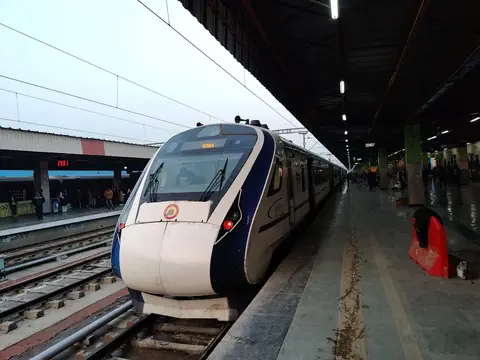
By train. Varanasi has four main stations: Varanasi Junction (BSB), Banaras (BSBS) and Kashi (KEI) in the city, and Pt. Deen Dayal Upadhyaya Junction (DDU), which lies outside it in neighbouring Chandauli district. The Ministry of Railways puts the scheduled time of the Vande Bharat Express between New Delhi and Varanasi, via Kanpur and Prayagraj, at approximately eight hours. Since 11 November 2025, the Khajuraho-Banaras Vande Bharat Express (26505/26506) has run directly between Banaras and Khajuraho via Prayagraj and Chitrakoot. It runs six days a week. Indian Railways publishes current departure times and fares only in its journey search, so check IRCTC for your date. Foreign visitors can book through the Foreign Tourist quota on IRCTC, as our guide to transport in India explains.
By air. Lal Bahadur Shastri International Airport (VNS) at Babatpur is about 25 km from the city centre, and Incredible India says it has regular domestic and international connections. Varanasi is one of the designated international airports through which e-Visa holders may enter India; our India entry guide has the visa rules. Flight times and fares are in each airline's own booking search for your date.
In town and to Sarnath. The last stretch to most riverside guest houses is on foot through the lanes. Auto-rickshaws and app cabs cover the longer rides, including the 25 km from the airport; there is no official fare table, so agree the fare before you start. For Sarnath, about 10 km away, take an auto-rickshaw or taxi for a half day. The main bus station is the Chaudhary Charan Singh bus stand.
Varanasi pairs naturally with the temples of Khajuraho, now a direct Vande Bharat ride away, and with the Taj Mahal: our Agra guide covers the other end of a classic northern loop that begins in Delhi.
Two nights in Varanasi, day by day
This plan suits a train or flight that arrives by early afternoon on day 1 and leaves in the afternoon of day 3.
- Day 1, afternoon: check in near Dashashwamedh, walk the ghats south towards Assi in the late-afternoon light, then come back to Dashashwamedh in good time for the evening aarti, from the steps or a boat.
- Day 2, dawn: take a boat along the ghats at sunrise, then walk up through the lanes for breakfast in Kachauri Gali. Visit Kashi Vishwanath by 10:00 or after 12:20, when darshan resumes, with your passport at the trust's help desk first if you are a foreign visitor.
- Day 2, afternoon: take an auto-rickshaw or taxi to Sarnath for the Dhamekh Stupa, the ruins, the museum and the Chaukhandi Stupa, and return for a quieter evening aarti at Assi Ghat.
- Day 3, morning: go to Subah-e-Banaras at Assi Ghat at sunrise, or walk Vishwanath Gali and Thatheri Bazaar, before your train or flight.
Make time for the local food
What to eat and where to look
Kachori sabzi
Fried kachoris with a spiced vegetable curry, served in a bowl made of leaves. The city's Kashi portal says this is how breakfast begins in Varanasi, and the hing (asafoetida) kachori with chickpea curry is a second version.
- Where to look
- Kachauri Gali, the old-city lane named after it, a short walk from Dashashwamedh Ghat and the temple corridor.
- Fit it into your day
- Breakfast on day 2, after the dawn boat.
Fried and often hot with chilli.
Malaiyyo
Perhaps the most famous sweet of Banaras, according to the Kashi portal: a light, frothy milk sweet that is made only in the winter months.
- Where to look
- The sweet shops of the old-city lanes, early in the morning.
- Fit it into your day
- With morning tea on a winter visit.
Only in winter; outside the season you will not find it.
Banarasi lassi
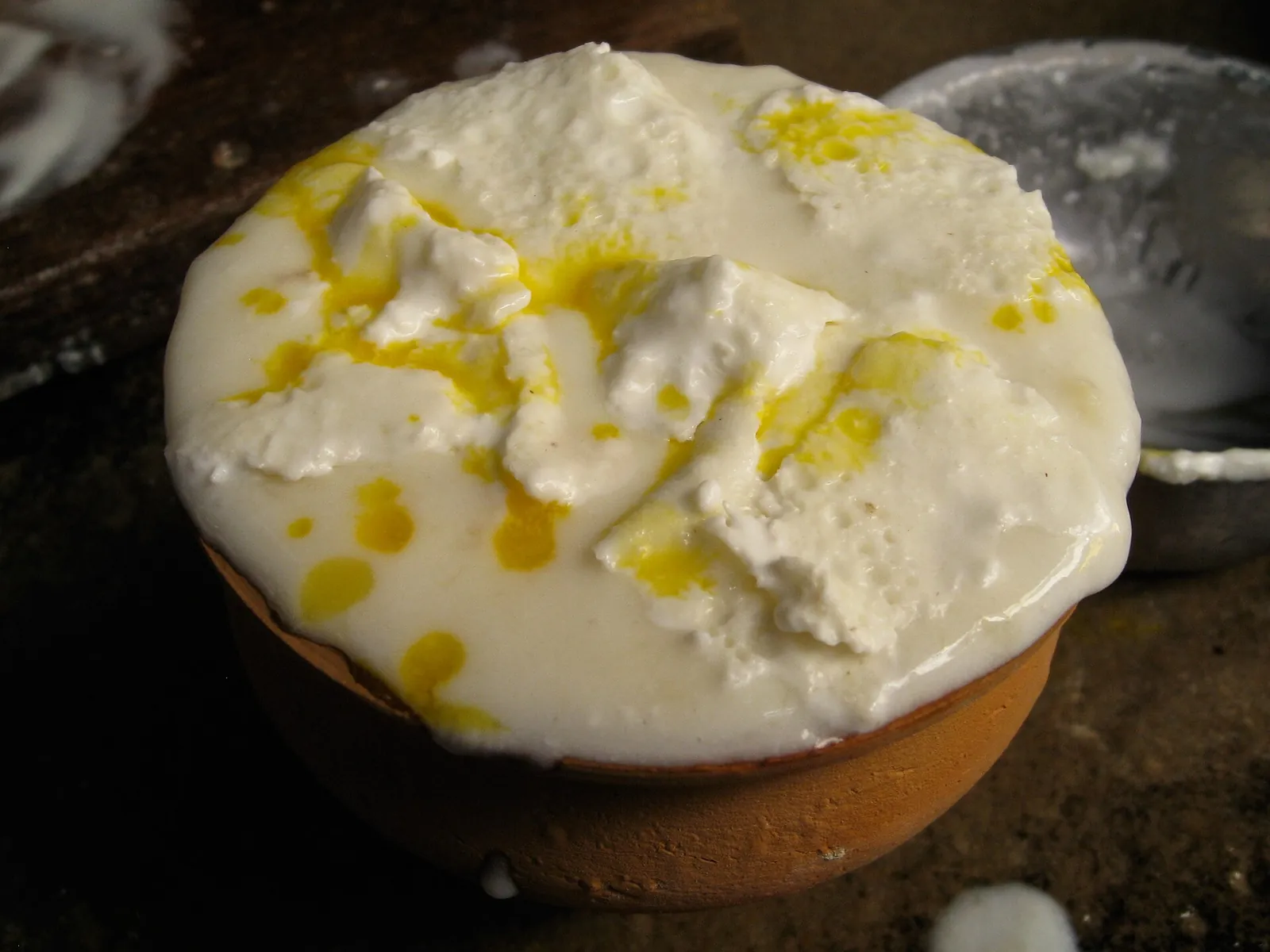
A sweet drink made traditionally with yoghurt and milk; the Kashi portal lists it among the city's classic tastes and says you can drink it at any time of day to refresh yourself.
- Where to look
- The lassi and sweet shops of Vishwanath Gali and the lanes behind Dashashwamedh Ghat.
- Fit it into your day
- Mid-afternoon on day 2, before the drive to Sarnath.
Often served with ice; skip it while your stomach is settling in.
Banarasi paan
A betel leaf folded around aromatic fillings and made fresh in front of you; the Kashi portal calls it a symbol of hospitality, and Incredible India notes its GI recognition.
- Where to look
- The paan stalls of Thatheri Bazaar and the other old-city lanes.
- Fit it into your day
- After dinner; ask for a sweet paan without tobacco.
Most paan contains areca nut (supari), and some contains tobacco; say what you want left out.
Tamatar chaat
Varanasi's own chaat: tomato cooked down with boiled potato, then topped with a sweet-and-sour chutney and yoghurt and finished with coriander, as the city's Kashi portal describes it.
- Where to look
- The chaat stalls in the old-city lanes behind Dashashwamedh Ghat, in the evening.
- Fit it into your day
- A snack after the evening aarti on day 1.
Spicy, and the yoghurt and chutney are served cold; choose a stall that cooks the tomato in front of you.
A priced two-night stay for two
This model uses Southern Grand Kashi's own two-night package for two people sharing one room. The guest house lists its website-only 2 Nights/3 Days package at INR 14,742 for double occupancy, plus 12% GST (checked 17 October 2026). It includes two nights in a Super Deluxe room, airport pickup and drop by air-conditioned car, one temple tour by car (BHU, Sankat Mochan, Durga Temple, Manas Temple and Kala Bhairava Temple) and one Sugam Darshan. The day-by-day plan above does not use the car temple tour, nor the airport transfers if you arrive and leave by train. The 12% GST is the rate the guest house states for that package. Its terms deduct 10% for cancellations made more than 48 hours before check-in, one night's charge between 24 and 48 hours, and give no refund within 24 hours.
- Package, two nights for two sharing a room, with airport transfers: INR 14,742 plus 12% GST, about INR 16,511.
- Kashi Vishwanath: foreign visitors buy their own darshan ticket at the trust's help desk, so add INR 600 each: INR 1,200.
- Total for two foreign visitors: about INR 17,711.
- Not included, because none has a published price: the dawn boat, a boat for the evening aarti, the Sarnath tickets and the auto-rickshaw or taxi to Sarnath. Also not included: trains or flights to Varanasi, and meals.
Practical questions
How many nights do I need in Varanasi?
Two nights: an afternoon on the ghats and the evening aarti on arrival, a dawn boat, Kashi Vishwanath and Sarnath on the full day, and a last sunrise at Assi Ghat. Add a third night for a slower pace or a festival.
What time is the Ganga aarti at Dashashwamedh Ghat?
It begins just after sunset every evening and lasts about forty-five minutes, so the clock time moves with the season. Take your place on the steps well before sunset, or watch from a boat.
Can foreigners enter Kashi Vishwanath Temple?
Yes. Foreign visitors with a valid passport buy their darshan ticket only at the trust's head-office help desk near Shapuri Mall, Bansphatak: show the original passport, give photocopies of the passport and visa and pay INR 600. Phones, gadgets and pens must go into the free lockers before you enter.
Is Sarnath worth a visit from Varanasi?
Yes, for a half day. Sarnath is about 10 km away, it is where the Buddha gave his first sermon, and since 2026 it has been a UNESCO World Heritage Site. See the Dhamekh Stupa, the ruins, the Chaukhandi Stupa and the museum with the Lion Capital of Ashoka, which is closed on Fridays.
How do I get from Delhi to Varanasi?
By train or by air. The Ministry of Railways gives the Vande Bharat Express a scheduled time of approximately eight hours between New Delhi and Varanasi. Flights land at Lal Bahadur Shastri International Airport, about 25 km from the city centre.
When is the best time to visit Varanasi?
October to March, when it is pleasant to walk the ghats and take the boats; northern India's winter air can be poor, so check the air quality before a December or January visit. Dev Deepawali, fifteen days after Diwali, is the most spectacular night, with lamps along every ghat; its date changes each year. In the monsoon, boats can be suspended when the river runs high, as DD News reported once, on 20 August 2026; ask your hotel whether the boats are running.
Sources and checks before you travel
Reference sources for the version dated 17 October 2026. Confirm opening times, access, transport and conditions for your travel dates.
- Ministry of Tourism, Incredible India: Varanasi ↗ — opens in a new tab
- Ministry of Tourism, Incredible India: Dashashwamedh Ghat ↗ — opens in a new tab
- Ministry of Tourism, Incredible India: Manikarnika Ghat ↗ — opens in a new tab
- Ministry of Tourism, Incredible India: Assi Ghat ↗ — opens in a new tab
- Ministry of Tourism, Incredible India: Sarnath Museum ↗ — opens in a new tab
- Kashi portal (Varanasi Smart City): Ganga Aarti ↗ — opens in a new tab
- Kashi portal (Varanasi Smart City): Assi Ghat ↗ — opens in a new tab
- Kashi portal (Varanasi Smart City): Manikarnika Ghat ↗ — opens in a new tab
- Kashi portal (Varanasi Smart City): Harishchand Ghat ↗ — opens in a new tab
- Kashi portal (Varanasi Smart City): Shri Kashi Vishwanath ↗ — opens in a new tab
- Kashi portal (Varanasi Smart City): Sarnath ↗ — opens in a new tab
- Kashi portal (Varanasi Smart City): Varanasi cuisine ↗ — opens in a new tab
- Shri Kashi Vishwanath Temple Trust: Foreign tourist ticket booking process ↗ — opens in a new tab
- Shri Kashi Vishwanath Temple Trust: FAQ (PDF) ↗ — opens in a new tab
- Shri Kashi Vishwanath Temple Trust: home page ↗ — opens in a new tab
- Ministry of Culture via PIB: Ancient Buddhist Site of Sarnath inscribed on the World Heritage List (25 July 2026) ↗ — opens in a new tab
- Kashi Official Web Portal: Chaukhandi Stupa ↗ — opens in a new tab
- Archaeological Survey of India: About museums ↗ — opens in a new tab
- Ganga Darshan (Gangadarshanam) guest house ↗ — opens in a new tab
- Southern Grand Kashi: home page ↗ — opens in a new tab
- Southern Grand Kashi: rooms ↗ — opens in a new tab
- Southern Grand Kashi: 2 Nights/3 Days package ↗ — opens in a new tab
- Southern Grand Kashi: terms and conditions ↗ — opens in a new tab
- PIB (Ministry of Railways): Vande Bharat Express backgrounder, 16 January 2026 ↗ — opens in a new tab
- PIB (Ministry of Railways): Vande Bharat trains in Maharashtra and Madhya Pradesh, 11 February 2026 ↗ — opens in a new tab
- PIB: four new Vande Bharat trains, 6 November 2025 ↗ — opens in a new tab
- DD News: boat operations suspended as the Ganga nears the danger mark ↗ — opens in a new tab
- Bureau of Immigration: e-Visa (designated airports) ↗ — opens in a new tab
- IRCTC: Foreign Tourist quota booking (PDF) ↗ — opens in a new tab
- Ministry of Tourism, Incredible India: Ramnagar Fort ↗ — opens in a new tab
- Kashi portal (Varanasi Smart City): Bharat Kala Bhawan ↗ — opens in a new tab
- Kashi portal (Varanasi Smart City): Ramnagar Fort Museum ↗ — opens in a new tab
- Chandauli district administration: how to reach ↗ — opens in a new tab
- India Meteorological Department: FAQ on Heat Wave ↗ — opens in a new tab
- India Meteorological Department: Monsoon FAQ ↗ — opens in a new tab
- Archaeological Survey of India: online ticket booking ↗ — opens in a new tab
Does this experience fit your route?
Book the train or flight first, then a room by the ghats; add a guided boat for the aarti if you would rather be shown the river on your first evening.
Check dates and details on Viator ↗ — opens in a new tabAffiliate link · Book with ViatorPhoto credits
Dashashwamedh Ghat, the main ghat of Varanasi, seen from the Ganges in daylight
Photograph: Prashant Kharote — opens in a new tab · CC BY 4.0 — opens in a new tab
Changes: Resized and converted to WebP; displayed with responsive crops. · Original photograph and licence details ↗ — opens in a new tab
The evening Ganga aarti at Dashashwamedh Ghat
Photograph: Sujay25 — opens in a new tab · CC BY-SA 4.0 — opens in a new tab
Changes: Resized and converted to WebP; displayed with responsive crops. · Original photograph and licence details ↗ — opens in a new tab
The Dhamekh Stupa at Sarnath, near Varanasi
Photograph: Preeti Prajapati — opens in a new tab · CC BY-SA 4.0 — opens in a new tab
Changes: Resized and converted to WebP; displayed with responsive crops. · Original photograph and licence details ↗ — opens in a new tab
The Chaukhandi Stupa at Sarnath, crowned by the octagonal tower of 1588
Photograph: MaximusPrasad — opens in a new tab · CC0 — opens in a new tab
Changes: Resized and converted to WebP; displayed with responsive crops. · Original photograph and licence details ↗ — opens in a new tab
A Banarasi lassi in its clay cup, Varanasi
Photograph: Patrick Barry from san francisco, ca, usa — opens in a new tab · CC BY-SA 2.0 — opens in a new tab
Changes: Resized and converted to WebP; displayed with responsive crops. · Original photograph and licence details ↗ — opens in a new tab