Kerala and the south · Karnataka
Hampi travel guide: 2 nights for Vittala, Virupaksha and the ruins
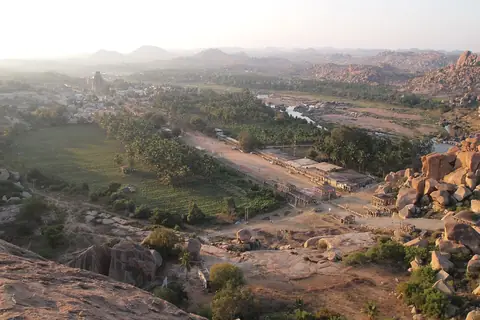
Hampi was the capital of the Vijayanagara empire, and in the 15th and early 16th centuries one of the largest and wealthiest cities in the world. Its temples, bazaars and palace platforms lie scattered over about 26 sq km of granite boulders on the south bank of the Tungabhadra, where the Virupaksha Temple is still in worship and the stone chariot of the Vittala Temple stands in a courtyard of carved halls. After a day on the road from Goa, two nights near the ruins give you a full day for the Vittala Temple and the Royal Centre, and a sunrise from Matanga Hill and a morning in the Sacred Centre before you leave.
- Suggested time
- 2 nights (3 days)
- Where to stay
- Kamalapura, beside the ruins, for early starts at the monuments; Hosapete for the station and more hotels; Hampi village by the Virupaksha Temple for the bazaar and the river
- Season and timing
- Karnataka Tourism calls winter, October to February, the best season, with temperatures between 15°C and 30°C. The hot months are March to May, the India Meteorological Department's pre-monsoon season, when Karnataka Tourism warns that Ballari district can get extremely hot; the southwest monsoon follows from June to September.
The short answer
Book two nights (three days) at Kamalapura, a village beside the ruins, or in Hosapete, the rail gateway 13 km away; book three nights if you return to Goa on Kadamba's bus, which leaves Hosapete at 05:45. KSTDC, the state tourism corporation, runs Hotel Mayura Bhuvaneshwari in Kamalapura, where an A/C Deluxe Double costs INR 3,119 a weekday night, GST extra. Book the room first, then Kadamba's bus from Panaji to Hosapete, and Kadamba's citizen charter says its online booking opens one month in advance. Two key prices, checked on 17 October 2026: the Archaeological Survey of India (ASI) charges foreign visitors INR 600 for the Group of Monuments at Hampi, and KSTDC's sedan with driver costs INR 2,600 for 8 hours or 80 km, plus 5% GST. The model stay below comes to INR 10,480 for two, taxes included.
Where to sleep: Kamalapura, Hosapete or Hampi village
Sleep close to the ruins if you can; the monuments open at sunrise, and the best light on the boulders comes early and late. In Kamalapura, a village beside the ruins, KSTDC describes its Hotel Mayura Bhuvaneshwari as the only hotel located within the World Heritage Site area, with 36 air-conditioned rooms and a restaurant serving local dishes. Its site lists an A/C Semi Deluxe room at INR 2,399 a weekday night (INR 2,599 at weekends) and an A/C Deluxe Double at INR 3,119 (INR 3,379), basic rates with GST extra and a seasonal increase; check-in is at 13:00 and check-out at 11:00. The Deluxe Double is the room priced in this guide's budget.
Hosapete (Hospet), the town 13 km away, has the railway station and rooms for every budget; it suits a late train or an early departure. Hampi village, around the Virupaksha Temple and the bazaar, puts the river ghat and Hemakuta Hill at the door. During Hampi Utsav, hotels in Hosapete and Hampi fill up months in advance. The where-to-stay guide for India explains how foreign guests are registered at check-in.
The Sacred Centre: Virupaksha, the bazaar and Hemakuta Hill
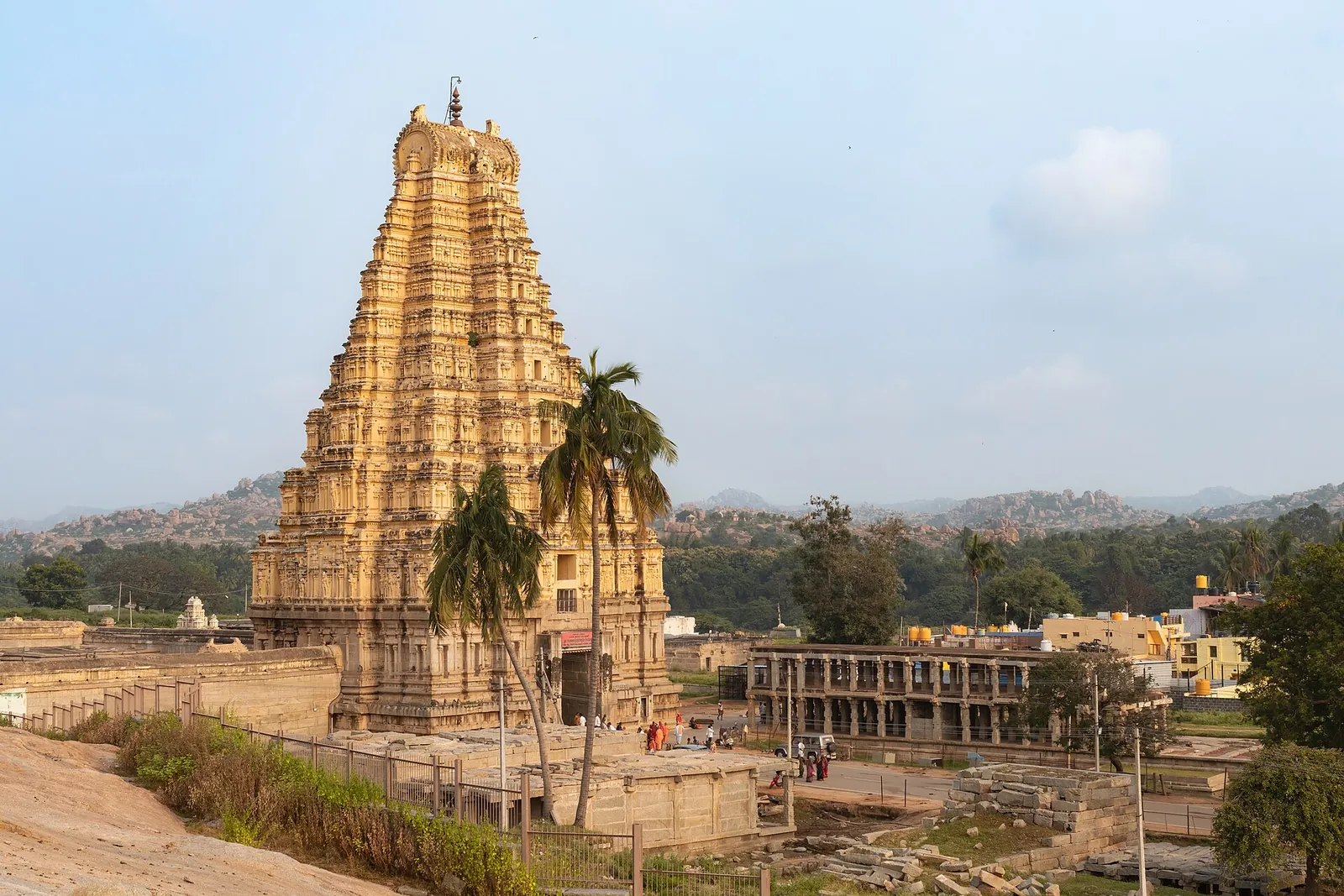
The Virupaksha Temple, dedicated to Shiva as Virupaksha or Pampapati, is the one temple in Hampi still in daily worship. Karnataka Tourism dates it to the 7th century, with the great eastern gopuram, nine storeys and 50 m tall, raised in the 15th century; inside, the complex holds shrines to Bhuvaneshwari and Vidyaranya, and an inverted shadow of the main tower falls on a wall within. The Ministry of Tourism (Incredible India) lists it as open from 06:00 to 12:00 and from 16:30 to 21:00. Remove your shoes inside the temple precincts, here and at the other temples.
From its gate, Hampi Bazaar, the old Virupaksha Bazaar, runs east for more than a kilometre between the ruins of two-storeyed pavilions where traders once sold silk, spices, horses and precious stones; a monolithic Nandi bull sits at its eastern end, below Matanga Hill. Motor vehicles stop at the gate by the bus stand, though two-wheelers may pass.
Hemakuta Hill is a granite slope of small temples from before the Vijayanagara empire, most of them to Shiva; after about a 15-minute climb it flattens out into a small plateau, and the hill is the place for sunrise and sunset over the ruins. On its slopes sit two great monolithic Ganeshas: Sasivekalu Ganesha, about 2.4 m tall in an open pavilion, and Kadalekalu Ganesha, 4.5 m tall inside a temple hall of tall pillars.
The Krishna Temple, also called the Balakrishna Temple, was built by Krishnadevaraya in 1513 to mark his victory over the eastern kingdom of Udayagiri. Its idol of the child Krishna is now in the State Museum in Chennai, but yalis still guard the pillars, elephants are carved at the entrances of the hall, and the eastern tower is under restoration. Opposite the temple, a wide clearing with covered pathways is believed to have been its bazaar, with a water tank that served the traders.
Matanga Hill, rising east of the bazaar street, is the highest point in Hampi; the climb over rock paths and old steps is the classic sunrise walk. Between Matanga and the Gandhamadana hill stands the Achyutaraya Temple of 1534, dedicated to Tiruvengalanatha, a form of Vishnu, with two gopurams, pillared halls carved with yalis beside the ruined Courtesan Street (Soolai Bazaar); Incredible India lists it as open from 06:00 to 13:00 and 16:00 to 20:00.
The Vittala Temple and its stone chariot
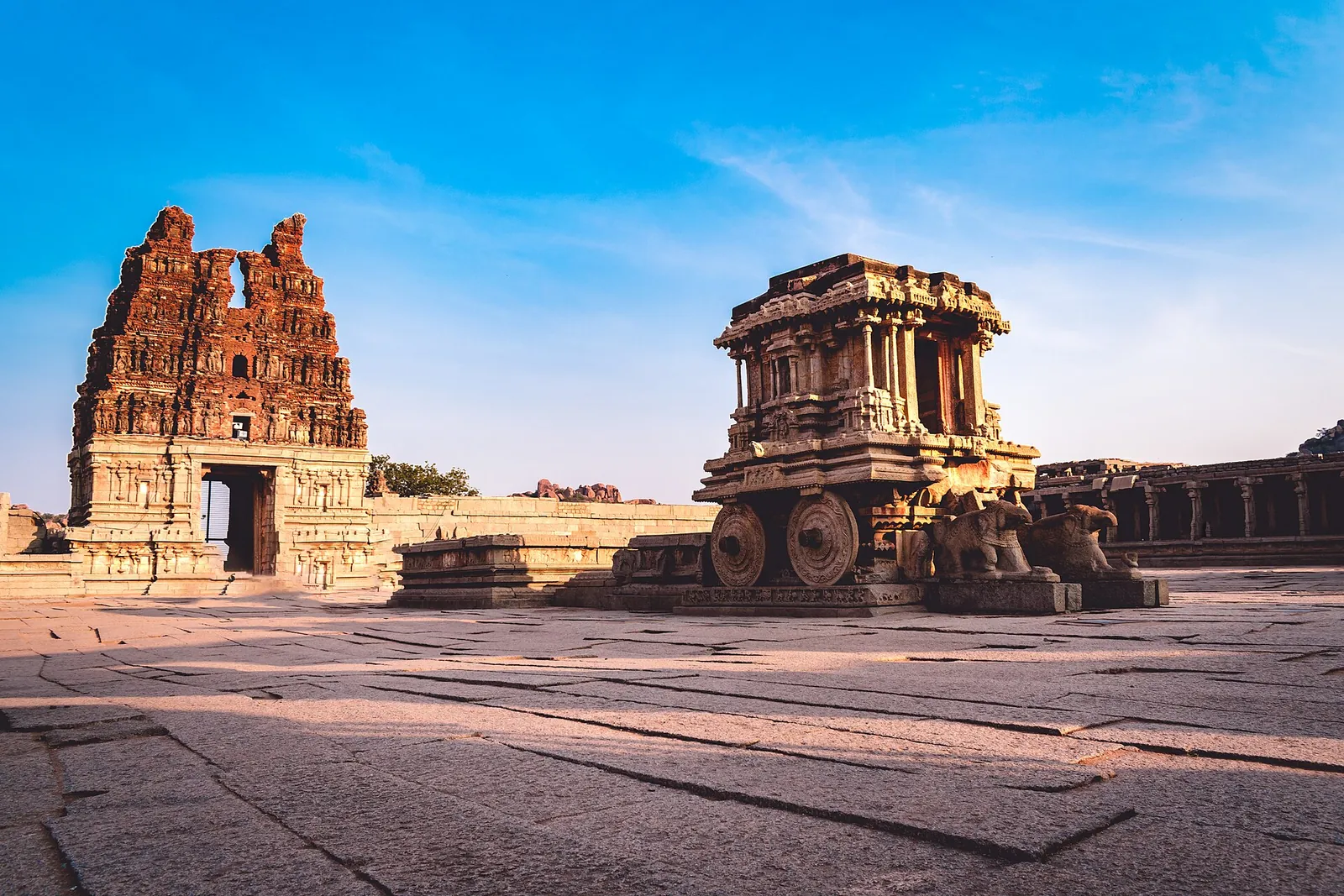
The Vijaya Vittala Temple, dedicated to Vittala, a form of Vishnu, is the masterpiece of the Vijayanagara style, and the ASI singles it out as such. In its courtyard stands the Stone Chariot, a granite shrine to Garuda, Vishnu's eagle mount, built to look like a temple car, with stone elephants in front as if pulling it; it appears on India's 50-rupee note. Around it, the halls are carved with scenes from the epics, and some of the pillars are the so-called musical pillars, which give different notes when gently tapped.
The temple stands near the banks of the Tungabhadra. Electric carts run at selected attractions, and the Hampi Buggy Train links several of the main monuments. A taxi, a bicycle or a hired scooter are the other ways to reach the temple, and Karnataka Tourism also suggests seeing the site on foot. The riverside route from the Virupaksha Temple past the Kodandarama Temple to the Vittala Temple, and the sunken Underground Shiva Temple (Prasanna Virupaksha), have no official map, distance or hours; if you walk instead of taking the car, start at sunrise with water and a hat. Go early, before the heat; Karnataka Tourism also suggests photographing the chariot in the golden hour light.
The Royal Centre: palace platforms, the Lotus Mahal and the elephant stables
South of the Sacred Centre, the Royal Centre was the seat of power. The ASI describes its throne platform, the Mahanavami Dibba, carved with sculptured panels, from which the kings watched the festivals, and a square stepped tank excavated to its south-west; the ASI also lists the king's balance and the treasurer's enclosure among the remains of the city. The Hazara Rama Temple, the kings' private shrine from the early 15th century, is wrapped in panels telling the Ramayana and processions of horses, elephants and dancers.
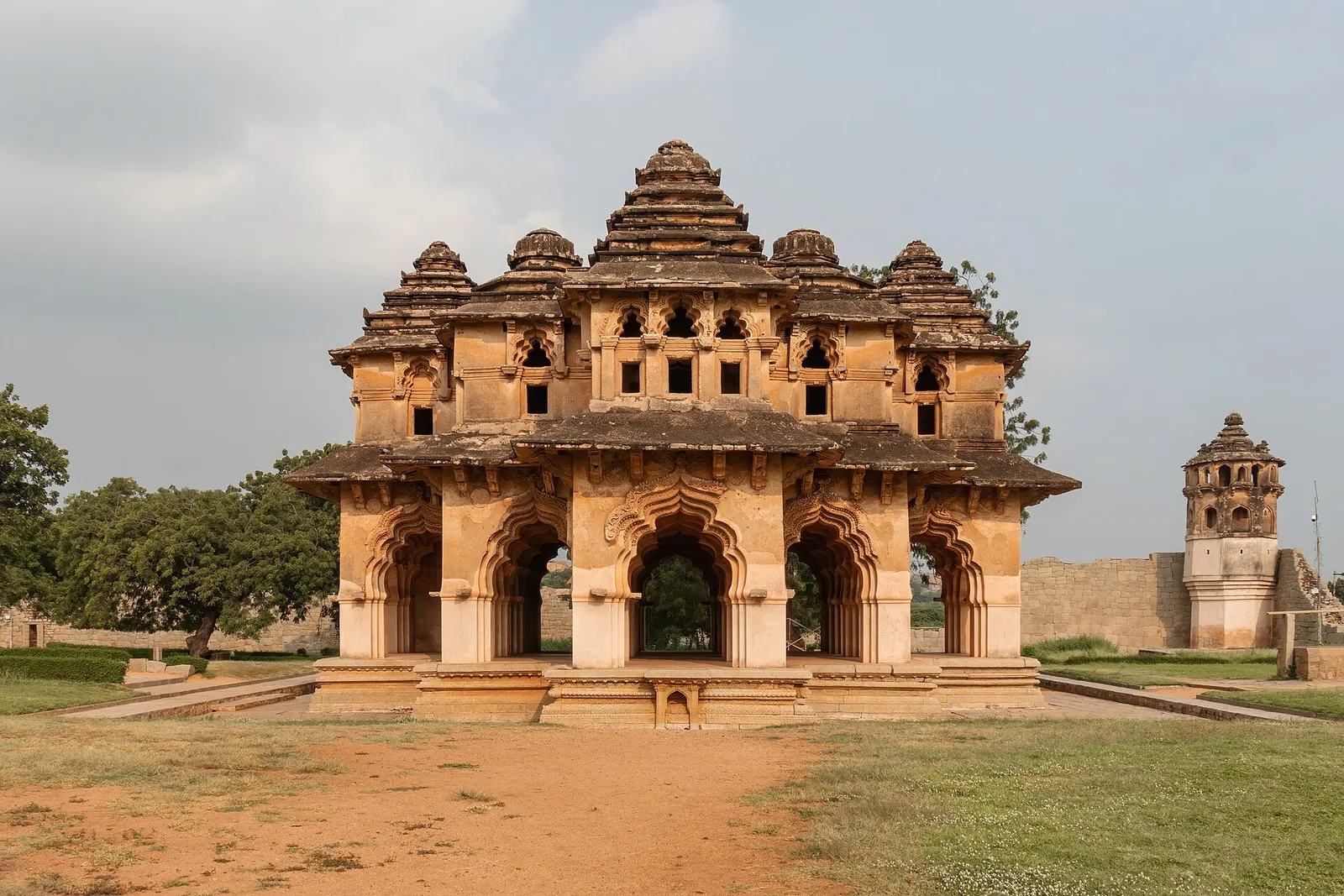
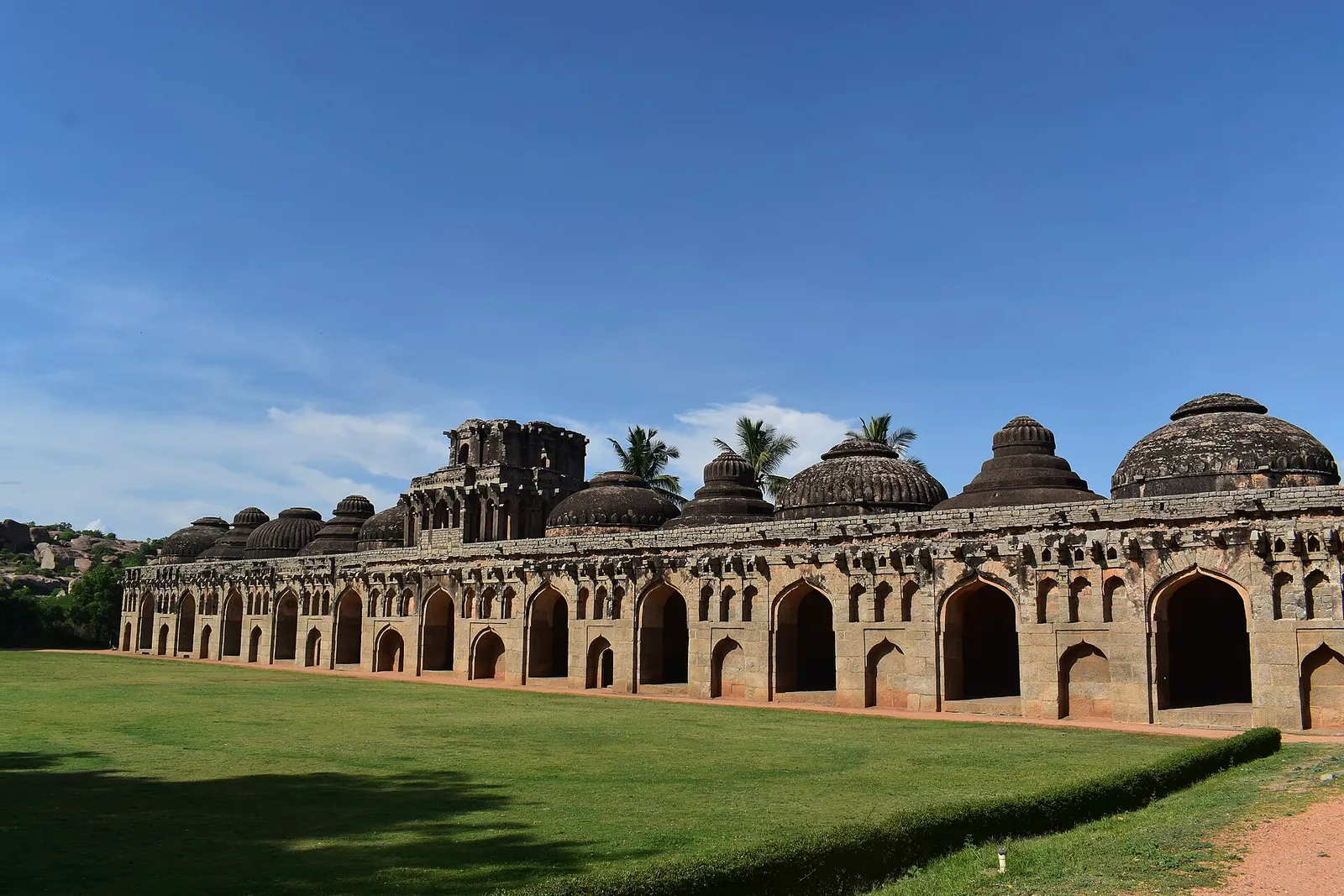
Inside the walled Zenana Enclosure, the Lotus Mahal (Chitrangi Mahal) is a three-storeyed pavilion of 24 pillars and no walls, with arches that mix Hindu and Indo-Islamic design; Karnataka Tourism lists it as open from 8 AM to 6 PM. A short walk away, the Elephant Stables are a long row of 11 domed chambers built for the royal elephants in the 16th century, each dome of a slightly different design. Near the royal enclosure, the Queen's Bath hides a square pool surrounded by ornate balconies behind a plain exterior.
The Ugra Narasimha, Vishnu's man-lion form, is carved from a single boulder 6.7 m high and seated on a seven-hooded serpent; beside it stands the Badavilinga Temple, whose 3 m Shiva lingam is the largest in Hampi. In Kamalapura, the ASI's Archaeological Museum, set up in 1972, has a large model of the whole site in its courtyard and galleries of Vijayanagara sculpture, arms, copper-plate grants and gold and copper coins.
Tickets, hours and getting around the ruins
The ASI lists the Group of Monuments at Hampi as open from sunrise to sunset. Foreign visitors pay INR 600, visitors from the SAARC and BIMSTEC countries INR 40, and children below 15 enter free. It is one ticket, 'Hampi, Group Of Monuments' in ASI's list, which links it to ASI's online booking site, asi.paygov.org.in; you can buy it there before you go, and keep it with you as you move between the monuments. The Virupaksha Temple, still in worship, keeps its own hours, given above.
The site covers about 26 sq km, so plan one area per half-day. Auto-rickshaws and bicycles are the usual way around the ruins, and motorbikes can be rented. The taxi from Hosapete, autos, bike hire, coracles and the buggy have no published fares; agree the price before you set off. The KSTDC hotel hires out a sedan with driver at INR 2,600 for 8 hours or 80 km, including the driver's allowance, plus 5% GST. The boulders themselves are a draw: Hemakuta Hill and Matanga Hill are bouldering spots that bring climbers from around the world. Hampi is a strict plastic-free zone, so carry a reusable water bottle, a hat and walking shoes.
Across the Tungabhadra: coracles, Virupapur Gadde and Anegundi
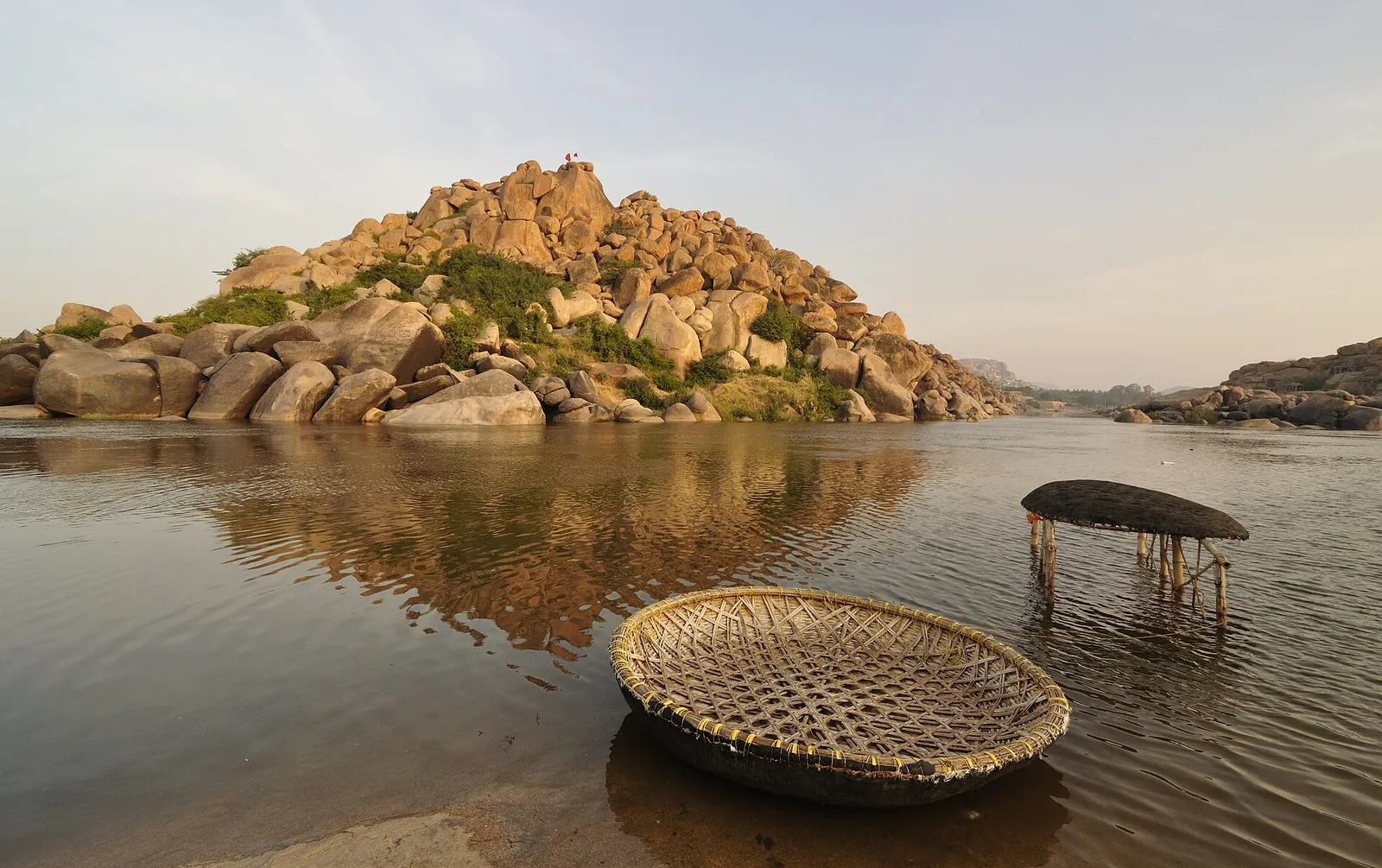
The river is part of the visit. The coracle crossings use round boats like big bamboo baskets, now waterproofed with plastic and bitumen sheets, that carry up to eight people and even bicycles and motorcycles. There are three crossing points: the ghat by the Virupaksha Temple, in front of the Kodandarama Temple, and, the most used, near the Vittala Temple.
From the ghat by the Virupaksha Temple, a coracle crosses in about 5 minutes to Virupapur Gadde, the village called Hippie Island, known for its relaxed atmosphere and cafés; by road it is about 40 minutes. In the monsoon the river can rise, so cross only when the river is low and ask at the ghat or your hotel.
Across the river in Koppal district, Anegundi, a village older than Hampi and the dynasty's first capital, keeps the Gagan Mahal palace, a fort with the Durga Temple, and Pampa Sarovara. Nearby, 570 steps climb Anjanadri Hill, believed to be the birthplace of Hanuman, for views over the fields and the river. Back on the Hampi side, the Karnataka Forest Department's Daroji Sloth Bear Sanctuary, about 25 km away and set up in 1994, has a watchtower over the rocky scrub. The Tungabhadra Dam near Hosapete, about 15 km away, has gardens and is lit after sunset.
Arriving: Hosapete station, the road from Bengaluru and Jindal Vijaynagar Airport
For Hampi, Karnataka Tourism names Hosapete Junction, about 13 km away, as the nearest station, and Jindal Vijaynagar Airport, about 40 km away, as the nearest airport; taxis, buses and rental bikes run from Hosapete to the ruins. Indian Railways publishes Goa-Hosapete departure times and fares only in its journey search, so check IRCTC for your date. By road from Goa, Kadamba Transport Corporation's interstate bus leaves Panaji at 09:30 for Hosapete, 379 km by its count via Hubballi, and the return bus leaves Hosapete at 05:45. The transport guide explains how foreign visitors book under the foreign tourist quota.
The Vijayanagara district administration says trains link the district with Bengaluru, Hubballi, Guntakal and Tirupati. By road, Karnataka Tourism puts Hampi about 340 km from Bengaluru, a drive of around 6-7 hours by car or bus.
The district administration lists daily flights from Jindal Vijaynagar Airport (VDY) to Bengaluru and Hyderabad under the UDAAN regional scheme. Star Air lists VDY among its destinations, with its schedule in the airline's booking search. Coming from the coast, the Goa guide covers the stations at Madgaon and Thivim, and the Mumbai, Goa and Hampi itinerary puts the legs in order.
A two-night plan with prices
This plan gives the car day to the far-flung monuments and leaves the Sacred Centre for walking. The model is for two adults sharing a room, with prices checked on 17 October 2026.
- Day 1: Kadamba's bus leaves Panaji at 09:30 and covers the 379 km to Hosapete, and the charter gives no arrival time, so plan for a long day; take a taxi for the last stretch to Kamalapura, which KSTDC puts 13 km from Hosapete station and keep the evening for dinner at the hotel.
- Day 2: the car day. The Vittala Temple at opening time, then the Royal Centre: the Mahanavami Dibba and stepped tank, the Hazara Rama Temple, the Lotus Mahal and Elephant Stables, and the Queen's Bath. On the way back, stop at the Ugra Narasimha and the Krishna Temple, and end on Hemakuta Hill, past the two Ganeshas, for the sunset. From the Vittala opening to the Hemakuta sunset is longer than the sedan's 8 hours, so settle the rate for extra time with the hotel when you book the car.
- Day 3: Matanga Hill for the sunrise and the Achyutaraya Temple below it, then along Hampi Bazaar to the Virupaksha Temple; outside the monsoon, a coracle across to Virupapur Gadde. Leave in the afternoon by train from Hosapete or by road to Bengaluru. Kadamba's return bus leaves Hosapete at 05:45, so if you go back to Goa by bus, add a third night: the drive from Kamalapura to Hosapete starts in the dark, so book the car through the hotel's front desk when you check in, or sleep the third night in Hosapete.
- Room, Hotel Mayura Bhuvaneshwari, Kamalapura, A/C Deluxe Double, 2 weekday nights at INR 3,119 (INR 6,238), plus the 5% GST that applies to rooms priced at INR 7,500 or less a night: INR 6,550.
- Monuments, the ASI ticket for two foreign adults at INR 600 each: INR 1,200.
- Car day, KSTDC sedan for 8 hours or 80 km, INR 2,600 plus 5% GST: INR 2,730.
- Total: INR 10,480 for two, taxes included.
- Not included: meals; the Kadamba bus, whose fare appears when you book, or the train or flight to Hosapete or Jindal Vijaynagar Airport; the taxi between Hosapete and Kamalapura; coracle fares and the Daroji entry fee; a third night if you return by bus.
Make time for the local food
What to eat and where to look
Jolada rotti with yennegai
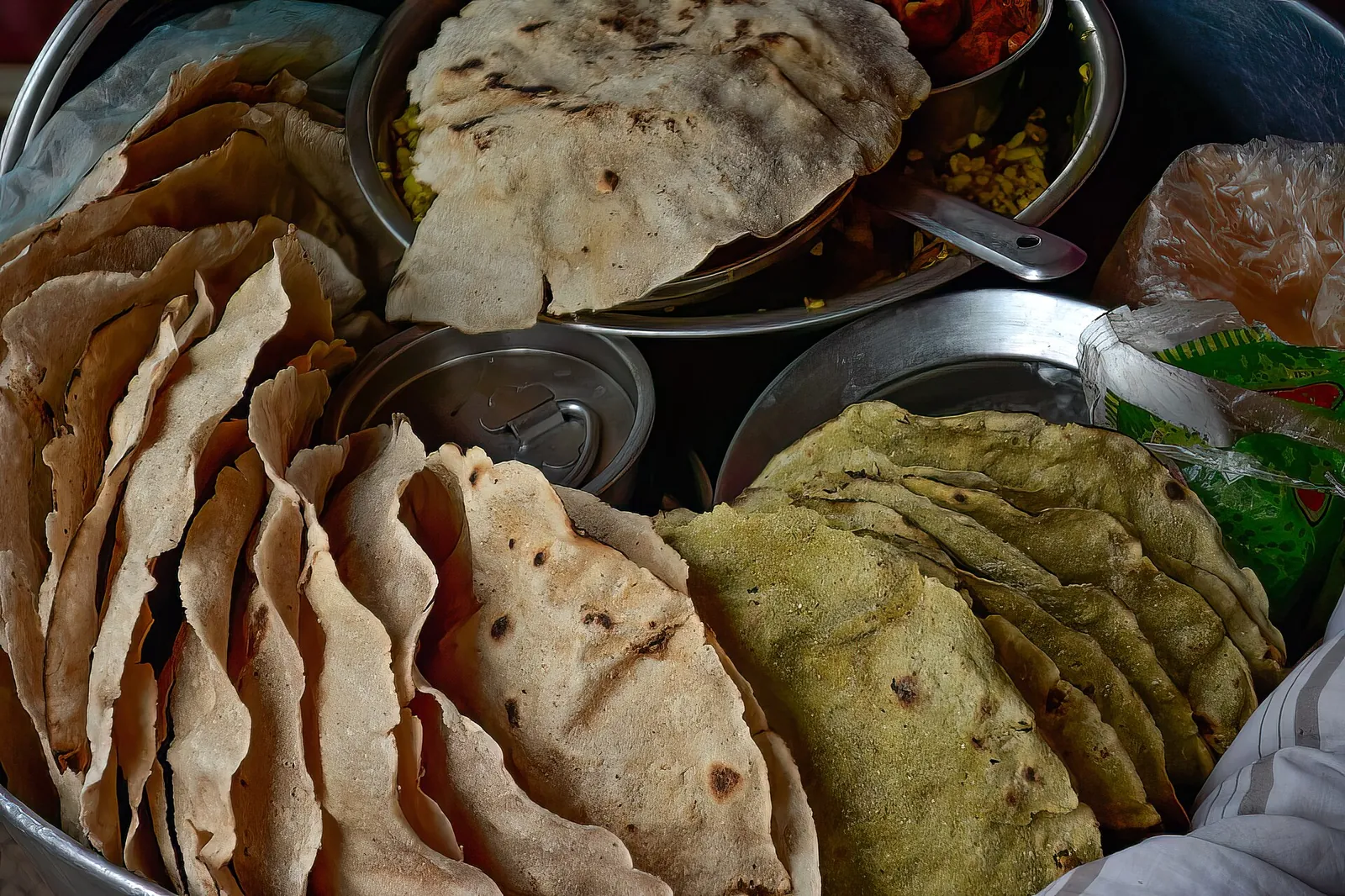
Thin, unleavened flatbread of jowar (sorghum), eaten warm with yennegai, small brinjals stuffed with a spicy masala: the everyday meal of North Karnataka, as Karnataka Tourism describes it.
- Where to look
- The restaurant at Hotel Mayura Bhuvaneshwari in Kamalapura, which KSTDC says serves local dishes, or the North Karnataka meals places of Hosapete.
- Fit it into your day
- Dinner after the car day.
North Karnataka meals are generous with spice and chutney powders; say so if you avoid strong chilli.
Khara mandakki and mirchi bajji
Spiced puffed rice with fried chilli fritters, the snack that Karnataka Tourism says is sold in the region's local markets and at street-side stalls.
- Where to look
- The street-side snack stalls and markets of Hosapete town, where the bus from Goa arrives and leaves.
- Fit it into your day
- A late-afternoon snack on the day you arrive or leave.
Idli, vada and sambar
Steamed rice cakes and crisp lentil doughnuts with lentil and vegetable sambar, the breakfast Incredible India names for Hampi.
- Where to look
- The small eateries along Hampi Bazaar near the Virupaksha Temple.
- Fit it into your day
- Breakfast after the sunrise on Matanga Hill or Hemakuta Hill.
A thali of curries and rice
Rice, chapati or rotti with several vegetable curries, sambar and curd, served on a plate or a banana leaf; Incredible India points to thalis for lunch and dinner in Hampi.
- Where to look
- The restaurant at Hotel Mayura Bhuvaneshwari in Kamalapura, or the eateries of Hampi Bazaar.
- Fit it into your day
- Lunch in Kamalapura on the car day, between the Royal Centre and the Ugra Narasimha.
Shenga holige
A sweet flatbread filled with a paste of peanuts and jaggery, which Karnataka Tourism lists among the region's signature dishes.
- Where to look
- The sweet shops and market stalls of Hosapete, on your way to the bus or the train.
- Fit it into your day
- A sweet for the bus or the train.
The filling is made of peanuts; avoid it if you have a peanut allergy.
Practical questions
How many nights do I need in Hampi?
Two nights: arrive on the first day, give the second to the Vittala Temple and the Royal Centre, and spend the third morning on Matanga Hill, in the bazaar and at the Virupaksha Temple. Add a third night for Anegundi or Daroji, or to catch Kadamba's early bus back to Goa.
How much is the ticket for the Hampi monuments?
The ASI charges foreign visitors INR 600 for the Group of Monuments at Hampi, SAARC and BIMSTEC visitors INR 40, and children below 15 nothing. The site is open from sunrise to sunset; the Virupaksha Temple, still in worship, keeps its own hours.
What is the nearest railway station to Hampi?
Hosapete Junction (Hospet), about 13 km from Hampi; taxis, buses and rental bikes cover the last stretch. Kadamba's interstate bus from Panaji also ends in Hosapete.
Can I go to Hippie Island (Virupapur Gadde)?
Yes, by coracle from the ghat by the Virupaksha Temple, a crossing of about 5 minutes, or about 40 minutes by road.
When is the best time to visit Hampi?
Karnataka Tourism recommends October to February, when temperatures run between 15°C and 30°C. Hampi Utsav, the state's festival in the ruins, was held on 13-15 February 2026; dates change each year, and Karnataka Tourism announces them. Hotels in Hosapete and Hampi fill up months ahead for it.
Can I visit Hampi as a day trip from Goa?
Not comfortably: the ruins are spread over about 26 sq km, and Hosapete, the nearest station, is still 13 km from them. Give Hampi at least two nights; the Mumbai, Goa and Hampi itinerary shows how it fits after Goa.
Sources and checks before you travel
Reference sources for the version dated 17 October 2026. Confirm opening times, access, transport and conditions for your travel dates.
- Archaeological Survey of India: Group of Monuments at Hampi ↗ — opens in a new tab
- Archaeological Survey of India: ticketed monuments ↗ — opens in a new tab
- Karnataka Tourism: Hampi ↗ — opens in a new tab
- Karnataka Tourism: Virupaksha Temple ↗ — opens in a new tab
- Karnataka Tourism: Stone Chariot ↗ — opens in a new tab
- Karnataka Tourism: Lotus Mahal ↗ — opens in a new tab
- Karnataka Tourism: Hampi Bazaar and Royal Enclosure ↗ — opens in a new tab
- Karnataka Tourism: Hampi Utsava 2026 ↗ — opens in a new tab
- Karnataka Tourism: Northern Karnataka food trail ↗ — opens in a new tab
- Ministry of Tourism (Incredible India): Virupaksha Temple ↗ — opens in a new tab
- Ministry of Tourism (Incredible India): Hampi Bazaar ↗ — opens in a new tab
- Ministry of Tourism (Incredible India): Hemakuta Hill Temple Complex ↗ — opens in a new tab
- Ministry of Tourism (Incredible India): Kadalekalu Ganesha ↗ — opens in a new tab
- Ministry of Tourism (Incredible India): Achyutaraya Temple ↗ — opens in a new tab
- Ministry of Tourism (Incredible India): Hazara Rama Temple ↗ — opens in a new tab
- Ministry of Tourism (Incredible India): Elephant Stables ↗ — opens in a new tab
- Ministry of Tourism (Incredible India): Lakshmi Narasimha Temple ↗ — opens in a new tab
- Ministry of Tourism (Incredible India): Archaeological Museum, Hampi ↗ — opens in a new tab
- Ministry of Tourism (Incredible India): Coracle Crossings ↗ — opens in a new tab
- Ministry of Tourism (Incredible India): 8 best things to do in Hampi ↗ — opens in a new tab
- Ministry of Tourism (Incredible India): Anegundi ↗ — opens in a new tab
- Ministry of Tourism (Incredible India): Daroji Sloth Bear Sanctuary ↗ — opens in a new tab
- KSTDC: Hotel Mayura Bhuvaneshwari, Hampi ↗ — opens in a new tab
- Vijayanagara district administration: How to reach ↗ — opens in a new tab
- Vijayanagara district administration: Tourist places ↗ — opens in a new tab
- Star Air: flight schedule ↗ — opens in a new tab
- Indian Railways (IRCTC): train search ↗ — opens in a new tab
- India Meteorological Department: Monsoon FAQ ↗ — opens in a new tab
- Kadamba Transport Corporation: citizen charter, last updated 28 January 2026 ↗ — opens in a new tab
- India Meteorological Department: Statement on the climate of India during 2025 (1 January 2026) ↗ — opens in a new tab
- Archaeological Survey of India: online ticket booking ↗ — opens in a new tab
- Ministry of Tourism (Incredible India): Krishna Temple, Hampi ↗ — opens in a new tab
- Ministry of Tourism (Incredible India): A journey through the sacred sites of Hampi ↗ — opens in a new tab
- GST Council: press release on GST rate changes (September 2025) ↗ — opens in a new tab
- Karnataka Tourism: Hampi ↗ — opens in a new tab
Does this experience fit your route?
Book a room near the ruins first, then Kadamba's bus to Hosapete; add a guided day if you want the Vittala Temple and the Royal Centre explained.
Check dates and details on Viator ↗ — opens in a new tabAffiliate link · Book with ViatorPhoto credits
The Stone Chariot, a granite shrine to Garuda, in the courtyard of the Vittala Temple, with the temple's ruined gateway tower behind
Photograph: Suraj S Rao — opens in a new tab · CC BY-SA 4.0 — opens in a new tab
Changes: Resized and converted to WebP; displayed with responsive crops. · Original photograph and licence details ↗ — opens in a new tab
The eastern gopuram of the Virupaksha Temple, the one temple in Hampi still in worship, above the village and the boulder hills
Photograph: iMahesh — opens in a new tab · CC BY-SA 4.0 — opens in a new tab
Changes: Resized and converted to WebP; displayed with responsive crops. · Original photograph and licence details ↗ — opens in a new tab
The Lotus Mahal inside the Zenana Enclosure, a pavilion of arches and tiered roofs that mixes Hindu and Indo-Islamic design
Photograph: iMahesh — opens in a new tab · CC BY-SA 4.0 — opens in a new tab
Changes: Resized and converted to WebP; displayed with responsive crops. · Original photograph and licence details ↗ — opens in a new tab
The Elephant Stables in Hampi's Royal Centre: eleven domed chambers built for the royal elephants
Photograph: Nrr1729 — opens in a new tab · CC BY-SA 4.0 — opens in a new tab
Changes: Resized and converted to WebP; displayed with responsive crops. · Original photograph and licence details ↗ — opens in a new tab
Coracles, the round boats used for the river crossings, on the Tungabhadra near Hampi
Photograph: Dey.sandip — opens in a new tab · CC BY-SA 3.0 — opens in a new tab
Changes: Resized and converted to WebP; displayed with responsive crops. · Original photograph and licence details ↗ — opens in a new tab
Jowar and millet rotis with curries for sale at Badami, in northern Karnataka: jolada rotti is the everyday bread of the region around Hampi
Photograph: Basavaraj M — opens in a new tab · CC BY-SA 4.0 — opens in a new tab
Changes: Resized and converted to WebP; displayed with responsive crops. · Original photograph and licence details ↗ — opens in a new tab