Delhi and the north · Delhi
Delhi travel guide: 3 nights for the Red Fort, Old Delhi and the Qutb
Delhi is two capitals side by side. In the north, the walled city Shah Jahan founded in 1638 still has its fort, its great mosque and the bazaars of Chandni Chowk, where parathas have been fried in the same lanes for more than a century. To the south, the garden tomb of Humayun, the Lodi tombs and the Qutb Minar, begun in 1199, mark older cities, and Lutyens' New Delhi sets India Gate at the end of a ceremonial avenue. Three nights let you give Old Delhi a full day, the tombs and New Delhi another, and the Qutb a morning before you take the train on to Agra or Jaipur.
- Suggested time
- 3 nights (4 days)
- Where to stay
- Connaught Place and Janpath for both halves of the city; Old Delhi only if the bazaars are the point of the trip
- Season and timing
- Delhi Tourism gives October to March as the best time to visit. IMD's Delhi climate table puts the mean daily maximum at 39.9°C in May and counts an average of 19.2 days with fog in December and 21.6 in January. The UK government warns that air pollution is worst in the winter months from October to February and that north Indian cities are among the most affected.
The short answer
Book three nights (four days) around Connaught Place and Janpath, the centre of New Delhi; the New Delhi YMCA Tourist Hostel on Jai Singh Road lists an executive double room with breakfast at INR 6,245 a night, taxes included, in its tariff effective 1 October 2026 (checked 17 October 2026). Book the room first, then the Red Fort, Humayun's Tomb and Qutb Minar tickets on ASI's booking site, asi.paygov.org.in, where foreign visitors pay INR 550 each instead of INR 600 in cash, and plan around Monday, when the Red Fort is closed. Delhi Tourism lists entry to Jama Masjid at INR 400 for foreign tourists. From Terminal 3 the Airport Express Line reaches New Delhi Railway Station in around 25 minutes. The model stay below comes to about INR 22,835 for two, before meals, the metro, taxis and the onward train.
Where to sleep: Connaught Place, the old city or Aerocity
Connaught Place and Janpath are the centre of New Delhi: Connaught Place, the ring of colonnaded blocks at its heart, is packed with restaurants serving food from across India and the world, and the Ministry of Tourism points to Khan Market and Hauz Khas Village for newer Indian cooking. India Gate and the Bangla Sahib gurdwara are close, and New Delhi Railway Station, where the Airport Express Line from the airport ends, is a short taxi ride away. On Jai Singh Road, the New Delhi YMCA Tourist Hostel lists an executive double room with breakfast at INR 6,245 a night, taxes included, in its tariff effective 1 October 2026; it is the room priced in this guide's budget.
France Diplomatie advises against booking rooms in the small hotels of Paharganj and Nabi Karim, two central New Delhi districts, because of crime; the health and safety guide covers this and other risks.
Old Delhi, around Chandni Chowk and Jama Masjid, puts you inside the bazaars, with Chandni Chowk and Chawri Bazaar metro stations for the rest of the city. The lanes are narrow and loud from morning to late evening, so choose it for atmosphere rather than for a quick start. Aerocity, the hotel district beside the airport, suits a late arrival or an early flight: Delhi Tourism's hotel listings describe it as the place to stay closer to the airport, with Delhi Aerocity station on the Orange Line, the Airport Express. The where-to-stay guide for India explains how foreign guests are registered at check-in and compares bases across the country.
Old Delhi: the Red Fort, Jama Masjid and the lanes of Chandni Chowk
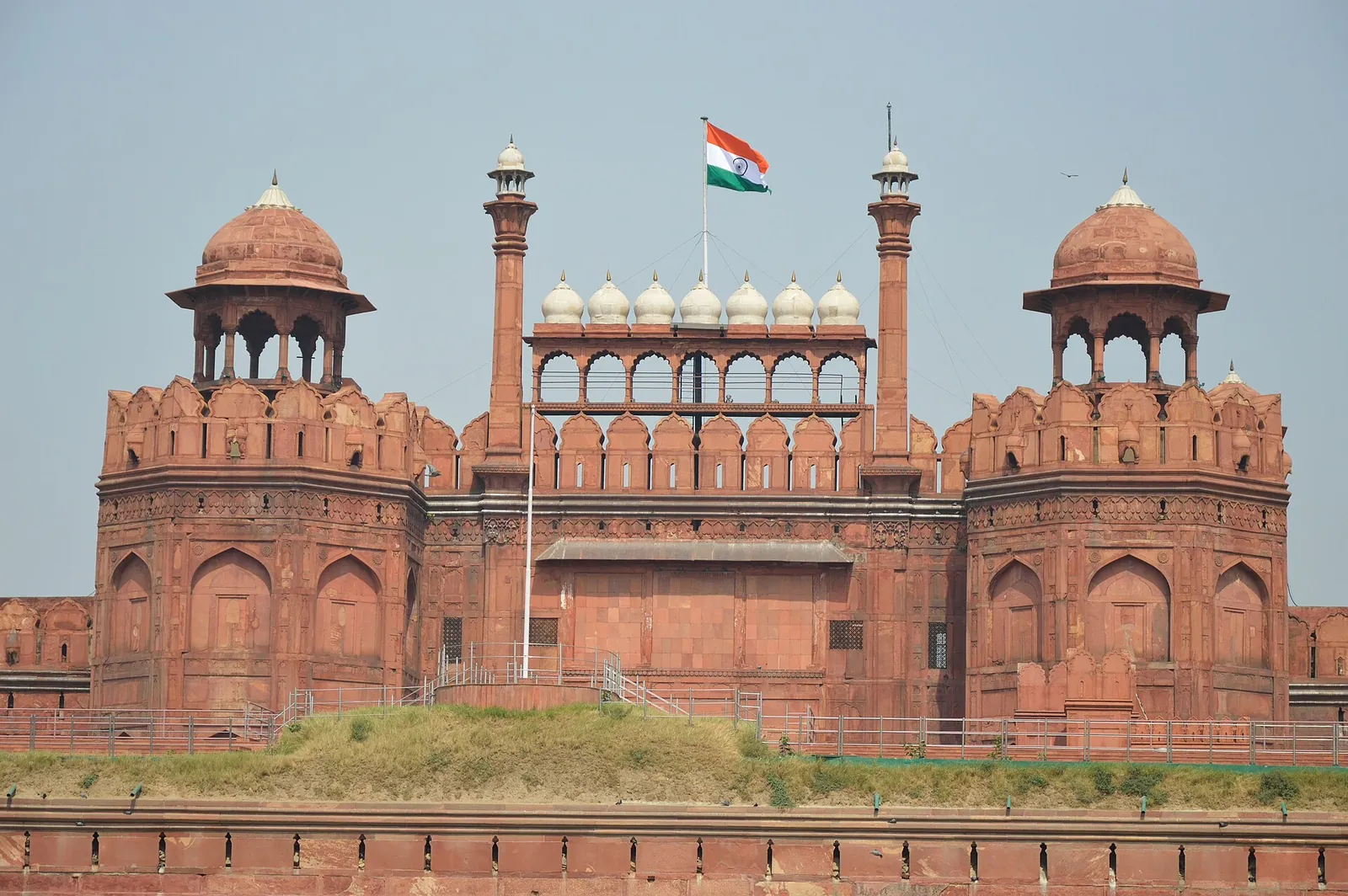
The Red Fort (Lal Qila) was begun in 1639 and completed after nine years, in the new city of Shahjahanabad to which Shah Jahan had transferred his capital from Agra in 1638; the Archaeological Survey of India (ASI) describes an irregular octagon of red sandstone with marble palaces inside. You enter by the Lahori Gate and the vaulted Chhatta Chowk, a covered bazaar, then pass the Naubat Khana, the drum house whose upper floor holds the Indian War Memorial Museum. Beyond are the Diwan-i-Am, the hall of public audience, with a pietra dura panel of Orpheus behind the throne; the Rang Mahal; the Diwan-i-Khas, where the Peacock Throne once stood; the marble Hammam; and Aurangzeb's small Moti Masjid. The Mumtaz Mahal now houses the Red Fort Archaeological Museum, which Delhi Tourism lists as open from 09:15 to 16:30.
ASI lists the fort as open from sunrise to 9:00 pm, but the Ministry of Tourism's Incredible India page gives its opening time as 09:30 to 16:30, so plan on the shorter hours; ASI's price is INR 600 in cash or INR 550 online for foreign visitors (online tickets are sold on ASI's booking site, asi.paygov.org.in, and the same two prices apply at Humayun's Tomb and Qutb Minar), INR 50 (INR 35 online) for SAARC and BIMSTEC visitors, and free for children below 15. The same Incredible India page says the fort is closed on Mondays and that the Jai Hind sound and light show runs every evening except Monday, but no start time is published, so ask at the fort's ticket counter during your visit. Every 15 August, Independence Day, the Prime Minister raises the national flag here and addresses the nation. Delhi Tourism gives Chandni Chowk on the Yellow Line as the nearest metro station to the fort's museum.
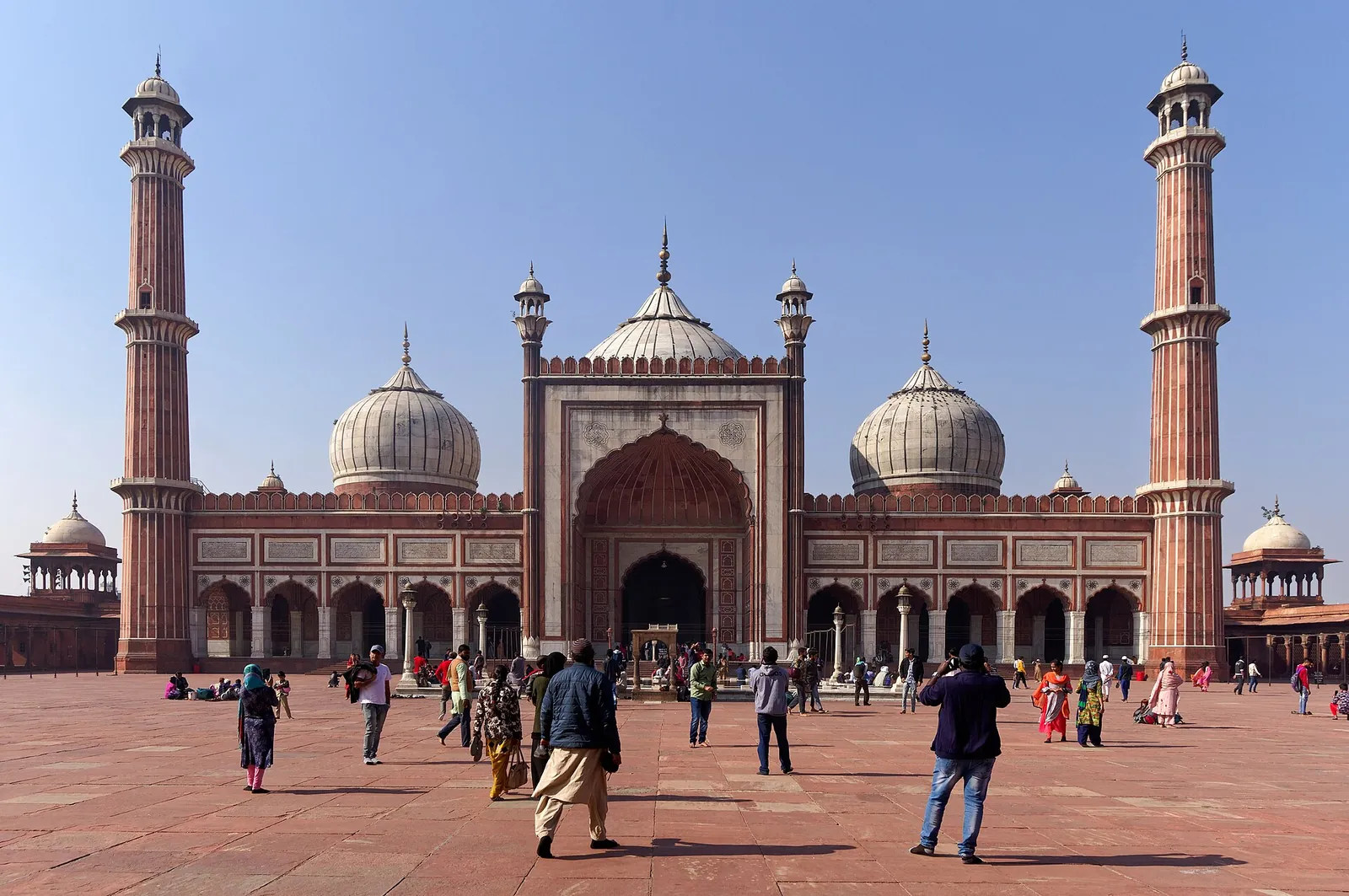
Jama Masjid, a short walk west, was begun by Shah Jahan in 1644; ASI calls it the largest mosque in India. Long flights of steps lead up to three gateways and a courtyard 100 m wide that, as Delhi Tourism notes, holds 25,000 worshippers, facing a prayer hall of eleven arches under three striped marble domes. The Ministry of Tourism's page suggests climbing the southern minaret for the view over Old Delhi. Jama Masjid, the great mosque Shah Jahan finished in 1650, is open every day: Delhi Tourism lists foreign tourists' hours from 08:00 until sunset and says only worshippers enter after sunset, with an entry fee of INR 400 for foreign tourists, free entry for Indian visitors and free photography. Incredible India lists the mosque as open 07:00 to 12:00 and 13:30 to 18:30, so expect a midday break. Robes can be hired at the northern gate. Delhi Tourism names Chawri Bazaar as the mosque's metro station, and Jama Masjid station, on the Violet Line, for Karim's near it.
Chandni Chowk was laid out in 1650 by Shah Jahan's daughter Jahanara Begum as the city's main market street. The Ministry of Tourism describes Khari Baoli, the wholesale spice market, Dariba Kalan for silver and ittar perfumes, Kinari Bazaar for trimmings and sequins, and Nai Sarak for books. Around it stand the Gurudwara Sis Ganj Sahib, the Sri Digambar Jain Lal Mandir, the Gauri Shankar Temple and Fatehpuri Mosque. Give it a morning and eat as you go.
Humayun's Tomb, the Nizamuddin Dargah and Lodhi Garden
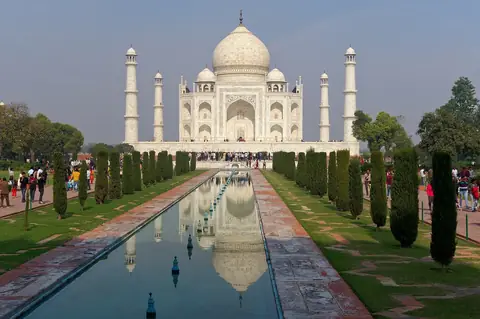
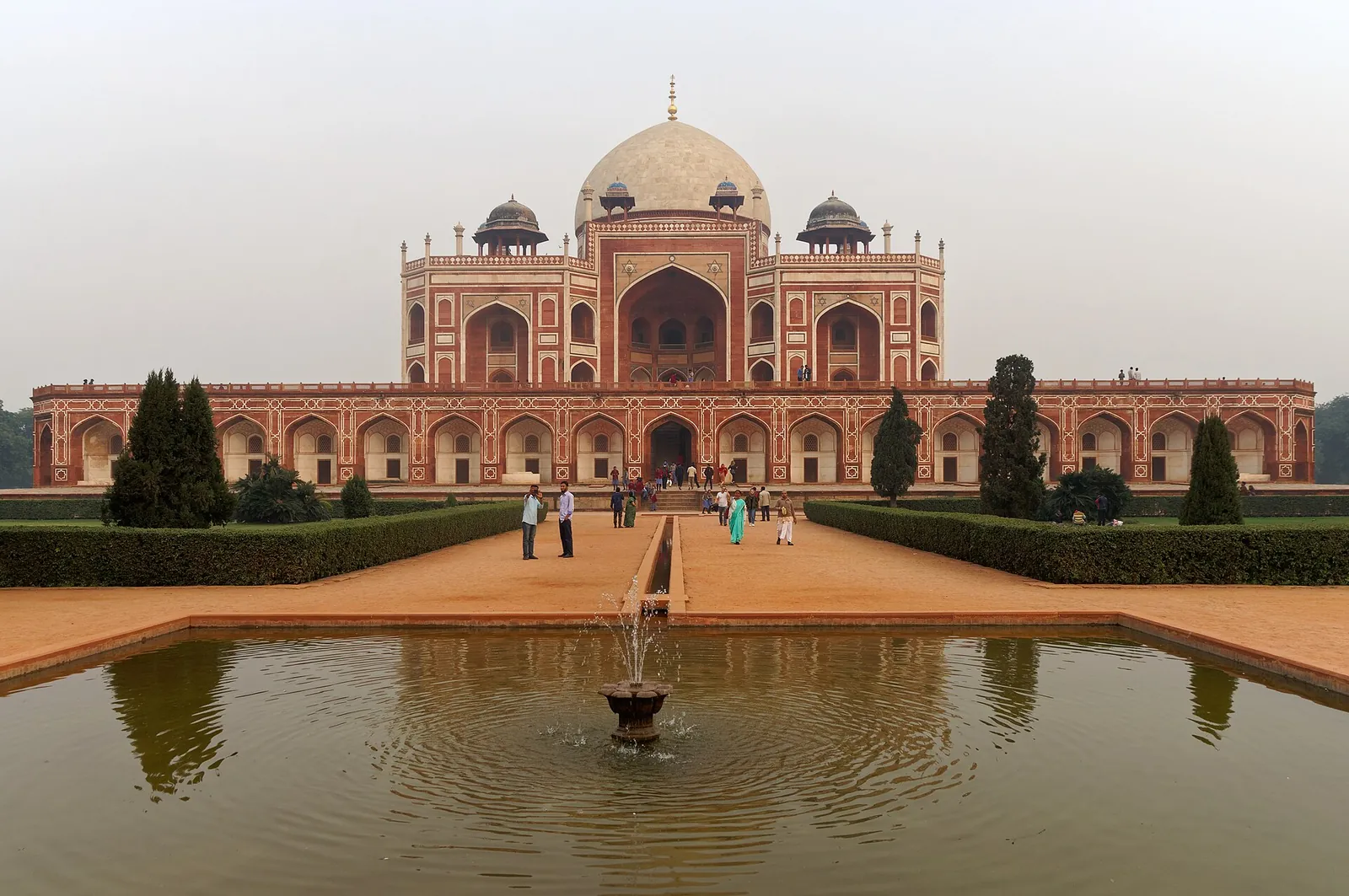
Humayun's Tomb is the building that led to the Taj Mahal. The emperor's widow, Hamida Banu Begum, began it in 1569, fourteen years after his death, with the Persian architect Mirak Mirza Ghiyath; ASI calls it the first distinct example of the Mughal style and the garden tomb that set the fashion the Taj crowned. The red sandstone mausoleum, framed in marble, rises from a terrace 7 m high in the middle of a charbagh, a garden quartered by water channels, under a double dome 42.5 m high. Several Mughal rulers are buried inside, and in 1857 the last emperor, Bahadur Shah Zafar, took refuge here before his capture. Do not miss the small Barber's Tomb (Nai-ka-Gumbad) in the south-west corner.
ASI lists the tomb as open from sunrise to 9:00 pm, but Delhi Tourism gives sunrise to 7:30 pm, so plan to leave by 7:30 pm; ASI's price is INR 600 in cash or INR 550 online for foreign visitors and free for children below 15. Delhi Tourism gives Jangpura on the Violet Line as the nearest metro station.
The Nizamuddin Dargah, near Humayun's Tomb, is the shrine of the Sufi saint Hazrat Nizamuddin Auliya, where pilgrims gather and, as the Ministry of Tourism describes it, qawwali brings Sufi music and poetry alive. Delhi Tourism notes that the shrine, set around a tank among older tombs, also holds the tomb of Amir Khusrau and the grave of Jahanara, Shah Jahan's daughter, and that a fair fills the area twice a year, on the death anniversaries of the saint and of Amir Khusrau.
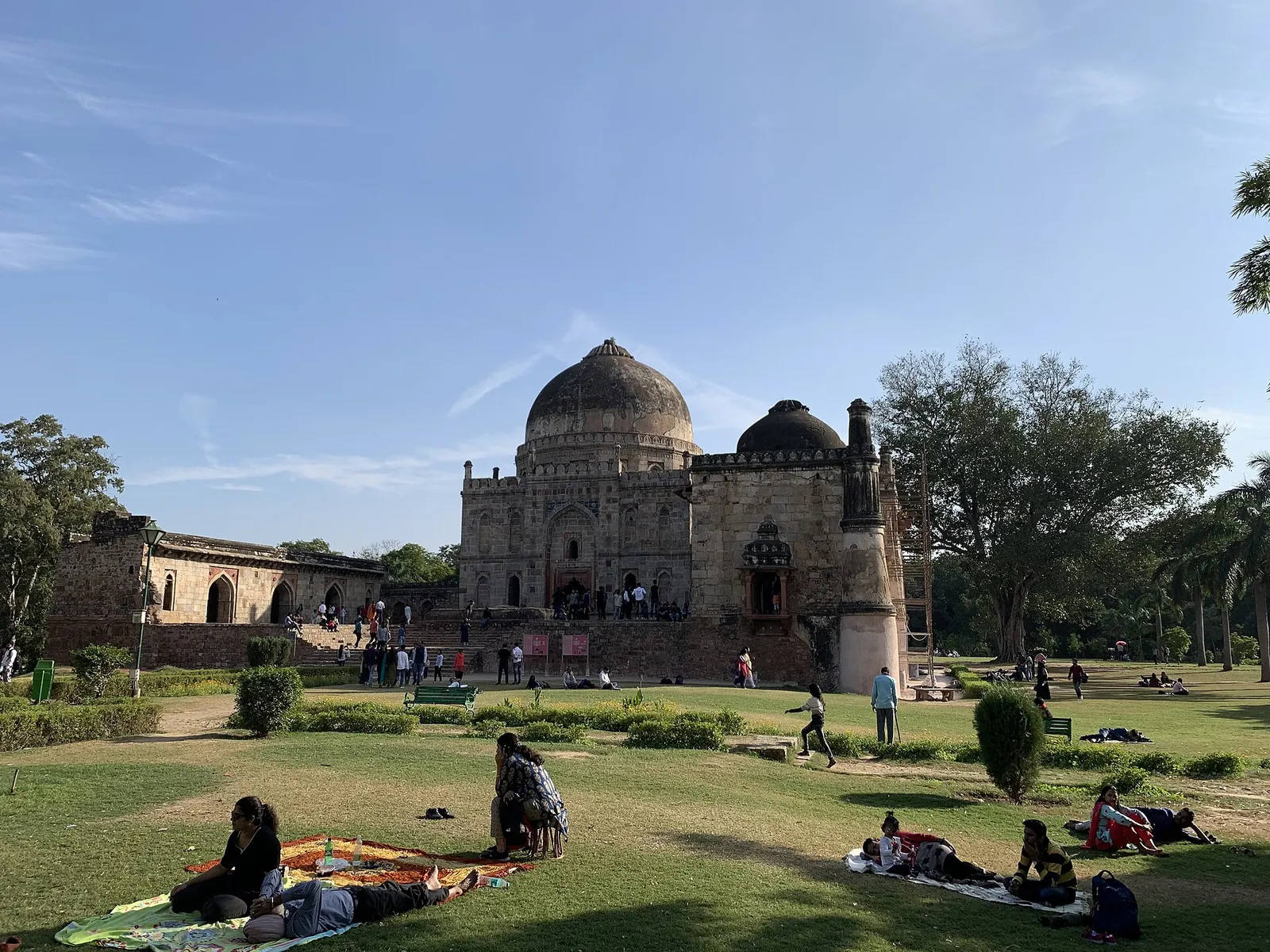
Lodhi Garden, on Lodi Road, is a park built around the tombs of two earlier dynasties. The Ministry of Tourism describes the tomb of Muhammad Shah Sayyid of 1444, the Bara Gumbad and Sheesh Gumbad from the reign of Sikandar Lodi (1489-1517), and Sikandar Lodi's own tomb; Lady Willingdon landscaped the area in 1936, and the glass house, lake and bonsai and rose gardens were added in 1968. Entry is free. Delhi Tourism lists the garden lake as open from 05:00 to 20:00 from April to September and from 06:00 to 20:00 from October to March, with Jor Bagh on the Yellow Line as the nearest metro station; Khan Market, with its shops and restaurants, is a short distance away.
New Delhi and the temples: India Gate, Bangla Sahib, Lotus Temple, Akshardham
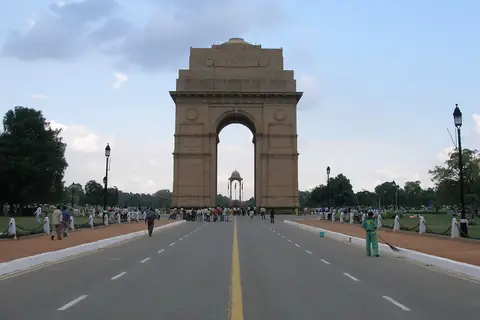
India Gate is the 42 m sandstone arch Edwin Lutyens designed as a memorial to the 70,000 Indian soldiers who died in the First World War and the Third Anglo-Afghan War; the Duke of Connaught laid the foundation stone in 1921 and the Viceroy, Lord Irwin, dedicated it in 1931. The Republic Day parade passes along Kartavya Path (earlier known as Rajpath) every 26 January, and the arch is floodlit after dark. The Ministry of Tourism lists it as open throughout the day, with some areas closed to visitors after dark. Central Secretariat, on the Yellow and Violet Lines, is the nearest metro station.
The National War Memorial, beside India Gate, now holds the Amar Jawan Jyoti, the eternal flame that burned under the arch from 1972 until it moved here in January 2022. Its concentric circles carry the names of fallen soldiers on granite tablets, and the Param Yodha Sthal has bronze statues of the 21 recipients of the Param Vir Chakra. Entry is free. The Ministry of Tourism lists hours from 09:00 to 19:30 from November to March and from 09:00 to 20:30 from April to October, with a retreat ceremony every evening and a change of guard before it on Sundays.
Gurudwara Bangla Sahib, near Connaught Place, stands on the site of the palace where the eighth Sikh Guru, Guru Har Krishan, stayed in 1664 and gave water from its well to the sick during an epidemic. Under its golden domes, Sikh hymns fill the prayer hall, volunteers serve free meals to all comers in the langar hall, and the sarovar, the holy pool, reflects the dome. The Ministry of Tourism lists it as open 24 hours and asks visitors to dress modestly and cover their head and shoulders.
The Lotus Temple, east of Nehru Place, is the Bahá'í House of Worship completed in 1986: a flower of white marble petals set among nine pools and gardens, open to people of every faith for silent prayer or meditation and floodlit at dusk. Delhi Tourism lists it as open from 09:00 to 17:30 and closed on Mondays, with Kalkaji as the nearest metro station.
Swaminarayan Akshardham is a Hindu temple complex of the BAPS Swaminarayan Sanstha, with a mandir that BAPS calls a humble tribute to Bhagwan Swaminarayan and to the avatars, devas and great sages of Hinduism. BAPS's visitor page lists it as open Tuesday to Sunday, with first entry at 10:00 and last entry at 18:30, and closed every Monday. Entry to the complex and darshan at the mandir are free. One ticket covers the three exhibitions (a hall of values, a large-format film and a cultural boat ride) and costs INR 260 for an adult aged 12 or over, from a ticket window open 11:00 to 18:00; the water show after sunset costs INR 110 for an adult. Mobile phones, cameras and other electronic items are not allowed inside and go into a free cloakroom, the dress code asks you to cover your shoulders and wear clothing below the knee, and BAPS puts Akshardham metro station 350 m away on foot.
Qutb Minar and the first city of the sultans
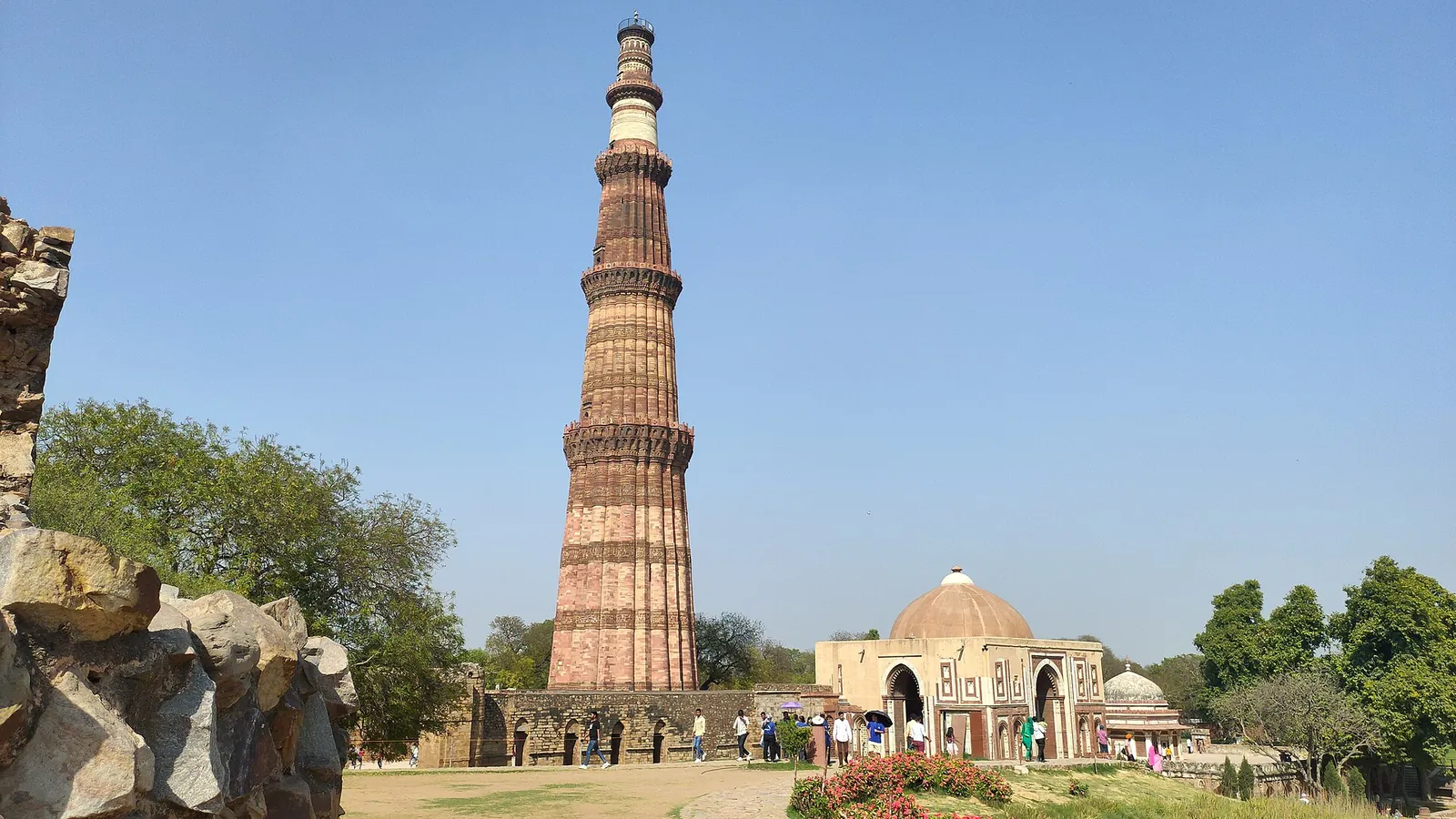
Qutb Minar is the tallest masonry tower in India: 72.5 m of red and buff sandstone, 14.32 m across at the base, ringed by balconies on carved brackets. ASI says Qutb-ud-Din Aibak laid its foundation in 1199 as a minaret for the call to prayer and built the first storey, and his successor Iltutmish added three more. Around it lie the Quwwat-ul-Islam Mosque of 1198, the earliest surviving mosque of the Delhi Sultans, built from the columns of 27 demolished Hindu and Jain temples; the Iron Pillar in its courtyard, with a Sanskrit inscription in Brahmi script of the 4th century; the Alai Darwaza gateway of 1311; Iltutmish's carved tomb of 1235; and the Alai Minar, which Alauddin Khalji meant to be twice the size of the Qutb but left at a single storey 25 m high.
ASI lists the complex as open from sunrise to 8:00 pm, at INR 600 in cash or INR 550 online for foreign visitors and free for children below 15. Give it a morning of its own, at opening time, before the heat and the crowds, and take an afternoon train if you leave Delhi the same day. Delhi Tourism names no metro station for the complex, so an app cab from Connaught Place is the direct way there.
Arriving and getting around: the airport metro, taxis and onward trains
From Indira Gandhi International Airport (DEL). The Airport Express Line (Orange Line) runs from Terminal 3 to New Delhi Railway Station in around 25 minutes; first trains leave at 04:45, last trains at 23:15 (Dwarka Sector 21) and 23:30 (New Delhi), and ticket machines are in the Terminal 3 and Terminal 2 arrival halls. Terminal 2 is a short walk or shuttle ride from Terminal 3. Terminal 1, for domestic flights only, has its own Magenta Line station, Terminal 1-IGI Airport, 5-7 minutes' walk away through a covered subway; its trains run from about 05:30 to 23:30.
Prepaid and fixed-rate taxis and app cabs (Uber and Ola at every terminal, Rapido at Terminal 1) wait outside arrivals around the clock; at Terminal 3 they leave from Level 0 of the multi-level car park. DTC buses run 24 hours a day from Terminal 3 arrivals to New Delhi Railway Station, Old Delhi Railway Station and the interstate bus terminal (ISBT).
In town, the metro is the quickest way between the sights: Chandni Chowk and Chawri Bazaar for Old Delhi, Central Secretariat for India Gate, Jangpura for Humayun's Tomb, Jor Bagh for Lodhi Garden, Kalkaji for the Lotus Temple and Akshardham for the temple of that name. Metro fares are not priced in this guide, so check the fare at the station, and app cabs fill the gaps.
Onward by train. Delhi has several long-distance stations, so check the one on your ticket. New Delhi Railway Station is the end of the Airport Express Line from Terminal 3; the Gatimaan Express to Agra leaves from Hazrat Nizamuddin. The Ajmer-Delhi Cantt Vande Bharat, with stops at Jaipur, Alwar and Gurgaon, was announced at its launch in April 2023 to run to Delhi Cantt; its route and terminus may have changed since, so check IRCTC for the station on your ticket. The timetable the Gatimaan Express published at its launch in 2016 gave 08:10 from Hazrat Nizamuddin and 09:50 at Agra Cantt; its launch release said it would run six days a week except Friday. By road, UP Tourism puts Agra 204 km from Delhi. By road, the Ministry of Tourism puts Jaipur about five hours from Delhi. The Agra guide has the trains and stations for the Taj Mahal, and the Golden Triangle itinerary joins Delhi, Agra and Jaipur with nights and fares.
Indian Railways publishes current departure times and fares only in its journey search, so check IRCTC for your date. Foreign visitors can book Indian Railways tickets on IRCTC under the foreign tourist quota; the transport guide explains registration, classes and when bookings open.
A three-night plan
The plan puts the open-air sights in the cooler early morning and late afternoon. Akshardham and the Lotus Temple, both closed on Mondays, fit a free afternoon or a fourth day. If you travel between October and February, check the air quality before the outdoor days; the health and safety guide explains the winter smog and where to find the readings.
- Day 1: arrive, take the Airport Express Line or a prepaid taxi into town and check in around Connaught Place. In the late afternoon walk to India Gate and the National War Memorial for the evening retreat ceremony, then butter chicken at Kake-Da-Hotel in Connaught Place.
- Day 2 (not a Monday): metro to Chandni Chowk for a breakfast of parathas, the spice market at Khari Baoli and the bazaars of Dariba Kalan and Kinari Bazaar; Jama Masjid in the morning; lunch near the mosque; the Red Fort in the afternoon and the Jai Hind sound and light show in the evening.
- Day 3: Gurudwara Bangla Sahib in the morning and chole bhature at Bhogal in Connaught Place for lunch (not on a Sunday), then the metro to Jor Bagh for Lodhi Garden and Khan Market; Humayun's Tomb in the late-afternoon light and the Nizamuddin Dargah nearby at dusk.
- Day 4: Qutb Minar at opening time, then back to the hotel to collect your bags for the airport metro or an afternoon train to Agra or Jaipur.
Make time for the local food
What to eat and where to look
Parathas
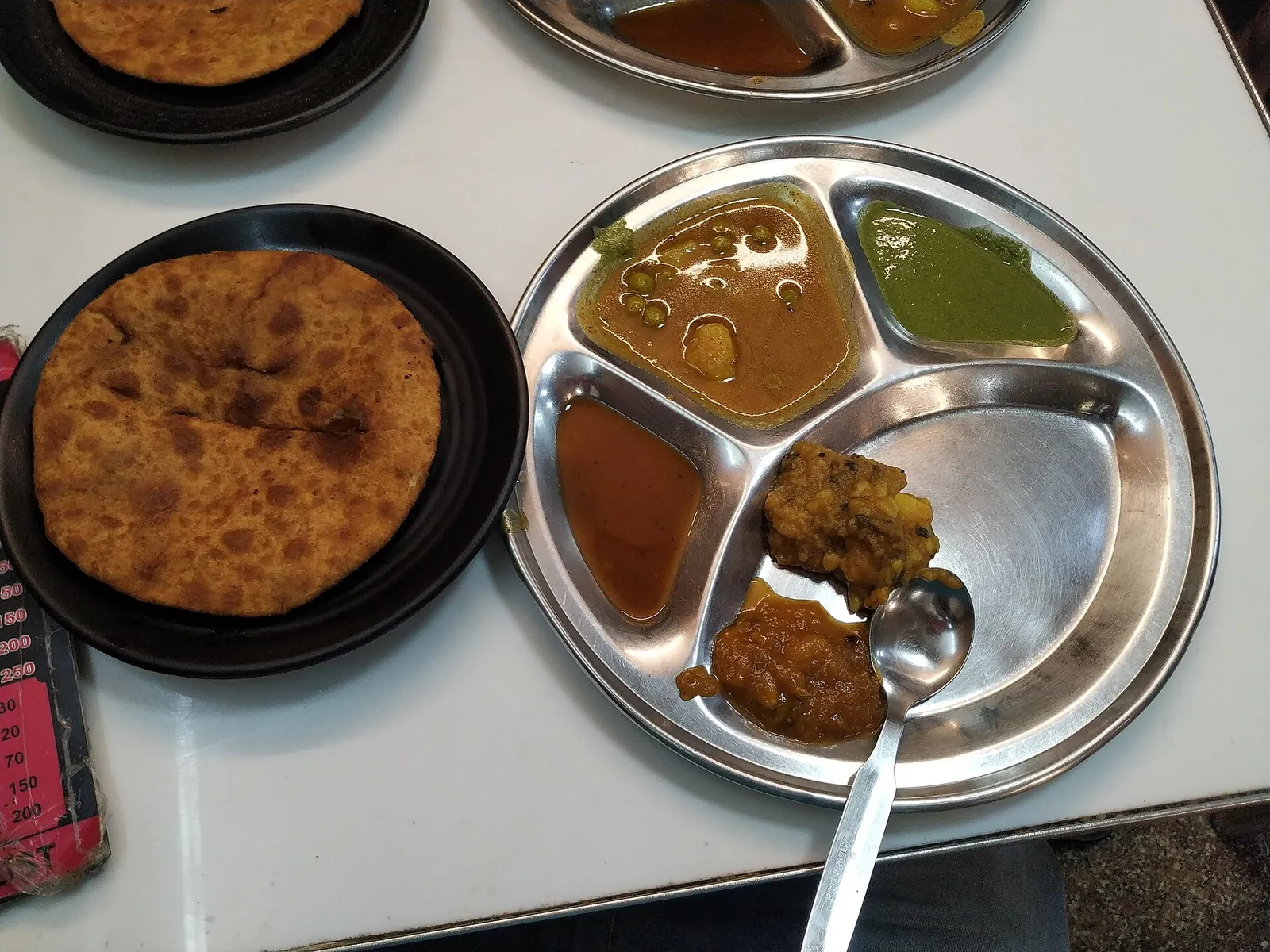
Layered flatbreads fried in a pan, stuffed with anything from potato to lemon, papad or sweet rabri. Delhi Tourism counts Pt. Babu Ram Devi Dayal Parathe Wale, run by the same family since 1889, among the oldest shops in Chandni Chowk.
- Where to look
- Pt. Babu Ram Devi Dayal Parathe Wale, Chandni Chowk (09:00-23:00 daily), near Chandni Chowk metro station.
- Fit it into your day
- Breakfast on the Old Delhi day, before the spice market.
Butter chicken
Chicken in a rich, buttery tomato gravy. Kake-Da-Hotel, a small, no-frills Connaught Place eatery that Delhi Tourism counts among the area's long-running places, is known for it and for its saag meat and keema matar.
- Where to look
- Kake-Da-Hotel, Connaught Place (12:00-00:00 daily), near Rajiv Chowk metro station.
- Fit it into your day
- Dinner on arrival day, after India Gate.
Dahi bhalla and aloo tikki
Soft lentil dumplings under cool yoghurt and tamarind chutney, and crisp fried potato cakes with sauces; Natraj Dahi Bhalla sells only these two chaat dishes.
- Where to look
- Natraj Dahi Bhalla, Chandni Chowk (10:30-21:30).
- Fit it into your day
- A light lunch on the Old Delhi day.
Old Delhi's street food is fried, rich and often hot with chilli; eat where the turnover is high and food is cooked in front of you, and say so if you avoid dairy, gluten or nuts.
Chole bhature
Spicy chickpeas with puffed, fried bread, which Delhi Tourism calls the most celebrated street food of Delhi; Bhogal Chole Bhature in Connaught Place also serves chole chawal and matar kulcha.
- Where to look
- Bhogal Chole Bhature, Connaught Place (11:00-15:00, closed on Sundays), near Rajiv Chowk metro station.
- Fit it into your day
- Lunch on the New Delhi day, after Bangla Sahib.
Mughlai mutton and khamiri roti
The meat dishes of the Mughal kitchen: qormas, karahi gosht and tikkas with a soft leavened khamiri roti, served by Karim's, founded near Jama Masjid in 1913 and now run by the founder's fourth generation.
- Where to look
- Karim's, near Jama Masjid (09:00-00:30 daily), near Jama Masjid metro station.
- Fit it into your day
- Dinner after the Red Fort and the sound and light show.
A priced three-night stay for two
This model follows the plan above for two adults sharing a room, with prices checked on 17 October 2026.
- Room, New Delhi YMCA Tourist Hostel, executive double with breakfast, 3 nights at INR 6,245 a night, taxes included (tariff effective 1 October 2026): INR 18,735.
- Sights, bought online by two foreign adults: Red Fort INR 1,100, Humayun's Tomb INR 1,100 and Qutb Minar INR 1,100 (INR 550 each a person), plus Jama Masjid INR 800 (INR 400 each); India Gate, the National War Memorial, Lodhi Garden and Bangla Sahib are free: INR 4,100.
- Total: about INR 22,835 for two.
- Not included: lunches, dinners and drinks; the Airport Express, metro and DTC bus fares; taxis and app cabs; the Jai Hind sound and light show; the onward train. This guide quotes no metro or taxi fare, and the Incredible India page for the fort gives no show price or start time.
Practical questions
How many nights do I need in Delhi?
Three nights: one full day for Old Delhi, the Red Fort and Jama Masjid, one for Humayun's Tomb, Lodhi Garden and New Delhi, and a last morning at Qutb Minar before you leave. With only two nights, keep Old Delhi and Humayun's Tomb.
Is the Red Fort open on Mondays?
No. The Ministry of Tourism's Incredible India page says the Red Fort is closed on Mondays, and the Jai Hind sound and light show also runs every evening except Monday. Humayun's Tomb and Qutb Minar make a good Monday instead.
How much are the Red Fort, Humayun's Tomb and Qutb Minar tickets?
ASI charges foreign visitors INR 600 in cash or INR 550 online at each of the three, SAARC and BIMSTEC visitors INR 50 (INR 35 online), and nothing for children below 15. ASI lists the Red Fort and Humayun's Tomb as open from sunrise to 9:00 pm and Qutb Minar from sunrise to 8:00 pm, but the Ministry of Tourism gives the Red Fort's opening time as 09:30 to 16:30, so plan on the shorter hours there.
Can I visit Jama Masjid as a tourist?
Yes. Jama Masjid, the great mosque Shah Jahan finished in 1650, is open every day: Delhi Tourism lists foreign tourists' hours from 08:00 until sunset, and only worshippers enter after sunset; Incredible India lists 07:00 to 12:00 and 13:30 to 18:30, so expect a midday break. Foreign tourists pay an entry fee of INR 400, Indian visitors enter free, and photography is free. Robes can be hired at the northern gate.
How do I get from Delhi airport to the city centre?
The Airport Express Line (Orange Line) runs from Terminal 3 to New Delhi Railway Station in around 25 minutes; first trains leave at 04:45, last trains at 23:15 (Dwarka Sector 21) and 23:30 (New Delhi), and ticket machines are in the Terminal 3 and Terminal 2 arrival halls. Terminal 1 has its own Magenta Line station. Prepaid taxis and app cabs wait outside every terminal, and DTC buses run around the clock from Terminal 3 to the railway stations.
Should I go to Agra as a day trip from Delhi?
Only if you have no night to spare: the Taj Mahal is closed on Fridays, opens 30 minutes before sunrise and is best seen early, so a night in Agra makes the visit easier. The Agra guide compares the day trip with a stay.
Sources and checks before you travel
Reference sources for the version dated 17 October 2026. Confirm opening times, access, transport and conditions for your travel dates.
- Archaeological Survey of India: Red Fort ↗ — opens in a new tab
- Archaeological Survey of India: Qutb Minar and its Monuments ↗ — opens in a new tab
- Archaeological Survey of India: Humayun's Tomb ↗ — opens in a new tab
- Ministry of Tourism (Incredible India): Red Fort ↗ — opens in a new tab
- Ministry of Tourism (Incredible India): Chandni Chowk ↗ — opens in a new tab
- Ministry of Tourism (Incredible India): Jama Masjid ↗ — opens in a new tab
- Ministry of Tourism (Incredible India): Lodhi Garden ↗ — opens in a new tab
- Ministry of Tourism (Incredible India): India Gate ↗ — opens in a new tab
- Ministry of Tourism (Incredible India): National War Memorial ↗ — opens in a new tab
- Ministry of Tourism (Incredible India): Gurudwara Bangla Sahib ↗ — opens in a new tab
- Ministry of Tourism (Incredible India): Delhi ↗ — opens in a new tab
- Delhi Tourism: Jama Masjid ↗ — opens in a new tab
- Delhi Tourism: Humayun's Tomb ↗ — opens in a new tab
- Delhi Tourism: India Gate ↗ — opens in a new tab
- Delhi Tourism: Lodi Gardens Lake ↗ — opens in a new tab
- Delhi Tourism: Lodi Tomb ↗ — opens in a new tab
- Delhi Tourism: Red Fort Archaeological Museum ↗ — opens in a new tab
- Delhi Tourism: Pt. Babu Ram Devi Dayal Parathe Wale ↗ — opens in a new tab
- Delhi Tourism: Natraj Dahi Bhalla ↗ — opens in a new tab
- Delhi Tourism: Karim Hotels ↗ — opens in a new tab
- Delhi Airport (DIAL): metro to and from the airport ↗ — opens in a new tab
- Delhi Airport (DIAL): taxis and app-based cabs ↗ — opens in a new tab
- Delhi Airport (DIAL): bus ↗ — opens in a new tab
- UK FCDO: India health ↗ — opens in a new tab
- IRCTC: Foreign Tourist Quota booking ↗ — opens in a new tab
- New Delhi YMCA Tourist Hostel: accommodation and room tariff ↗ — opens in a new tab
- New Delhi YMCA Tourist Hostel: tariff ↗ — opens in a new tab
- France Diplomatie: Inde, conseils aux voyageurs (sécurité) ↗ — opens in a new tab
- Uttar Pradesh Tourism: Taj Mahal ↗ — opens in a new tab
- Delhi Tourism: Lotus Temple ↗ — opens in a new tab
- Delhi Tourism: best time to visit ↗ — opens in a new tab
- India Meteorological Department, New Delhi: Safdarjung climatological table 1991-2020 ↗ — opens in a new tab
- PIB (Ministry of Railways): Gatimaan Express to be flagged off, 4 April 2016 ↗ — opens in a new tab
- PIB (Prime Minister's Office): Rajasthan's first Vande Bharat, 10 April 2023 ↗ — opens in a new tab
- Swaminarayan Akshardham New Delhi (BAPS): visitor information ↗ — opens in a new tab
- Delhi Tourism: Spiritual Delhi ↗ — opens in a new tab
- Delhi Tourism: Bhogal Chole Bhature ↗ — opens in a new tab
- Delhi Tourism: Kake-Da-Hotel ↗ — opens in a new tab
- Delhi Tourism: hotel listing in Aerocity ↗ — opens in a new tab
- UP Tourism: getting around the Taj Mahal ↗ — opens in a new tab
- Incredible India: Jaipur ↗ — opens in a new tab
- Archaeological Survey of India: online ticket booking ↗ — opens in a new tab
Does this experience fit your route?
Book a room around Connaught Place first, buy the three ASI tickets online, and add an Old Delhi food walk if you want a guide for the bazaars.
Check dates and details on Viator ↗ — opens in a new tabAffiliate link · Book with ViatorPhoto credits
The Lahori Gate, the main entrance to the Red Fort
Photograph: Biswarup Ganguly — opens in a new tab · CC BY 3.0 — opens in a new tab
Changes: Resized and converted to WebP; displayed with responsive crops. · Original photograph and licence details ↗ — opens in a new tab
Humayun's Tomb across the charbagh garden
Photograph: Jakub Hałun — opens in a new tab · CC BY-SA 4.0 — opens in a new tab
Changes: Resized and converted to WebP; displayed with responsive crops. · Original photograph and licence details ↗ — opens in a new tab
Qutb Minar and the Alai Darwaza in the Qutb complex
Photograph: Athulvis — opens in a new tab · CC BY-SA 4.0 — opens in a new tab
Changes: Resized and converted to WebP; displayed with responsive crops. · Original photograph and licence details ↗ — opens in a new tab
The prayer hall of Jama Masjid from the courtyard
Photograph: Jakub Hałun — opens in a new tab · CC BY-SA 4.0 — opens in a new tab
Changes: Resized and converted to WebP; displayed with responsive crops. · Original photograph and licence details ↗ — opens in a new tab
Bara Gumbad in Lodhi Garden
Photograph: Slyronit — opens in a new tab · CC BY-SA 4.0 — opens in a new tab
Changes: Resized and converted to WebP; displayed with responsive crops. · Original photograph and licence details ↗ — opens in a new tab
A paratha with sabzi and chutneys in Old Delhi
Photograph: Ravi Dwivedi — opens in a new tab · CC BY-SA 4.0 — opens in a new tab
Changes: Resized and converted to WebP; displayed with responsive crops. · Original photograph and licence details ↗ — opens in a new tab