Mumbai and Goa · Goa
Goa travel guide: 4 nights for Old Goa, Fontainhas and the beaches
Goa is two holidays in one small state. On the coast, shacks open on the sand from mid-September and close before the June rains, and the beaches run from the busy strip at Calangute and Baga to the quiet coves of Palolem and Agonda in the far south. Inland, up the Mandovi river, the churches of Old Goa stand where the Portuguese capital stood until the 18th century, with the Basilica of Bom Jesus keeping the tomb of St Francis Xavier, and in Panaji the painted, tile-roofed houses of Fontainhas climb the slope of Altinho Hill. Four nights in Panaji or Porvorim, on the Mandovi, give you a day for Old Goa and Fontainhas, two for the forts, markets and beaches of the north, and a last morning on the sand; two more nights in Palolem add the quiet south.
- Suggested time
- 4 nights (5 days)
- Where to stay
- Panaji or Porvorim, between Old Goa and the northern beaches; Candolim and Calangute for the beach strip; Palolem for the quiet south
- Season and timing
- Goa Tourism gives year-round temperatures of 24°C to 29°C, with noon heat above 33°C in May and the monsoon from June to September; beach shacks may open from 15 September to 31 May, and no water sports run in the monsoon.
The short answer
Book four nights (five days) in Panaji or Porvorim, on the Mandovi, between the churches and the northern beaches. Hotel Gautam, a vegetarian hotel in Porvorim, north of Panaji, charges INR 3,750 a night for a standard room for two, room only and taxes included, and for stays of three nights or more includes a free pick-up and drop at either airport. Book the flight first (to Mopa or Dabolim, which are far apart) or the Vande Bharat train from Mumbai, then the room; for Christmas and the New Year, book the room months ahead, because accommodation is at a premium across Goa that week. Two key prices, checked on 17 October 2026: the Kadamba air-conditioned shuttle from Mopa airport to Panaji costs INR 200 per passenger, and a town bus from Panaji to Candolim, about 18 km, costs at most INR 25 under Goa's bus fare table. The model stay below comes to about INR 16,080 for two.
Where to base yourself: Panaji side, the beach strip or the far south
Goa is small enough to see from one base, but the coast changes character from north to south, so choose the base for the days you will spend most. Panaji and Porvorim, on either bank of the Mandovi, put Old Goa, Fontainhas and the northern beaches each within a short drive, and suit a first visit with sightseeing. Hotel Gautam in Porvorim, a pure vegetarian hotel, lists its standard room for two at INR 3,750 a night without meals, or INR 5,750 with meals, taxes included, in a tariff valid from 22 September 2025; for stays of three nights or more it includes a free pick-up and drop, between 8 AM and 7 PM, at Thivim or Karmali station or at either airport, which it describes as on a group basis. It is the room priced in this guide's budget.
Candolim, Calangute and Baga form one long beach north of the Aguada headland, with shacks, water sports and the busiest nightlife; stay here if the sea is the point of the trip. Further north, Anjuna, Vagator, Morjim and Arambol are quieter and more bohemian.
Palolem, in Canacona at the far south, is a crescent bay of calm water and beach huts that goes to bed early; it lies about 38 km from Margao. Add two nights there if you want a slower end to the trip. Our where-to-stay guide for India explains how foreign guests are registered at check-in.
Old Goa: Bom Jesus, the Se Cathedral and the churches of the old capital
Up the Mandovi from Panaji, a 1.5 km stretch of cathedrals, churches and monasteries marks Old Goa, the Portuguese capital until the mid-18th century and now the UNESCO World Heritage Site of the Churches and Convents of Goa. The Archaeological Survey of India (ASI), which looks after the site, names the Se Cathedral, the Church and Convent of St Francis of Assisi, the Chapel of St Catherine, the Basilica of Bom Jesus, the Church of Our Lady of the Rosary and the Church of St Augustine among them; the Church of St Cajetan, it adds, is modelled on the original design of St Peter's in Rome.
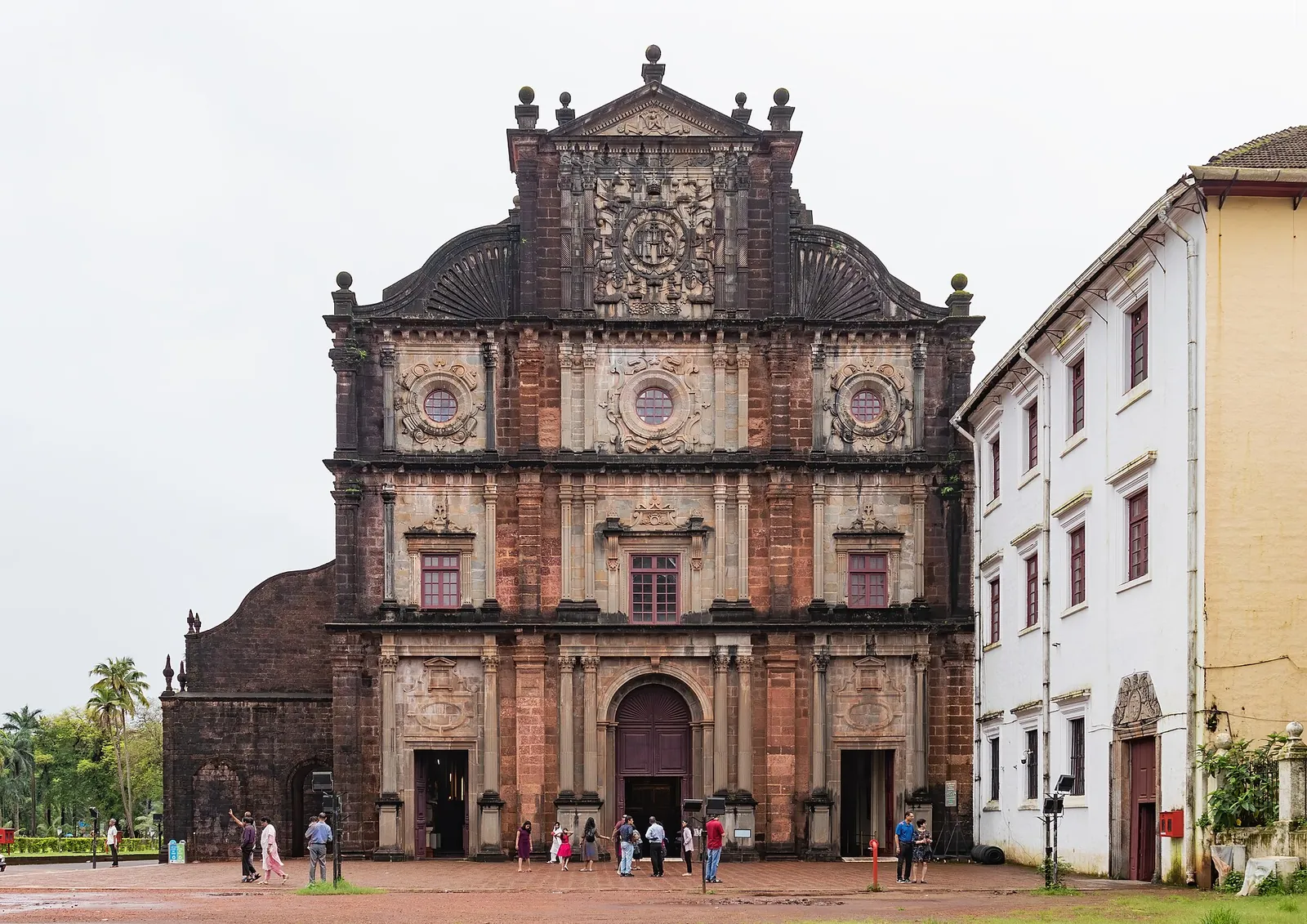
The Basilica of Bom Jesus, built by the Jesuits in 1594, houses the remains of St Francis Xavier, Goa's patron saint, in a silver casket in a side chapel. Its façade of black granite mixes Doric, Ionic and Corinthian orders, and the tomb was a gift from Cosimo III, Grand Duke of Tuscany, made by the Florentine sculptor Giovanni Foggini and assembled in 1698. In 1946 Pope Pius XII made it India's first minor basilica. It is open from 09:00 to 18:30 on weekdays and from 10:30 to 18:30 on Sundays, as the Ministry of Tourism's Incredible India site lists it; every ten years the saint's remains are lowered for a public exposition.
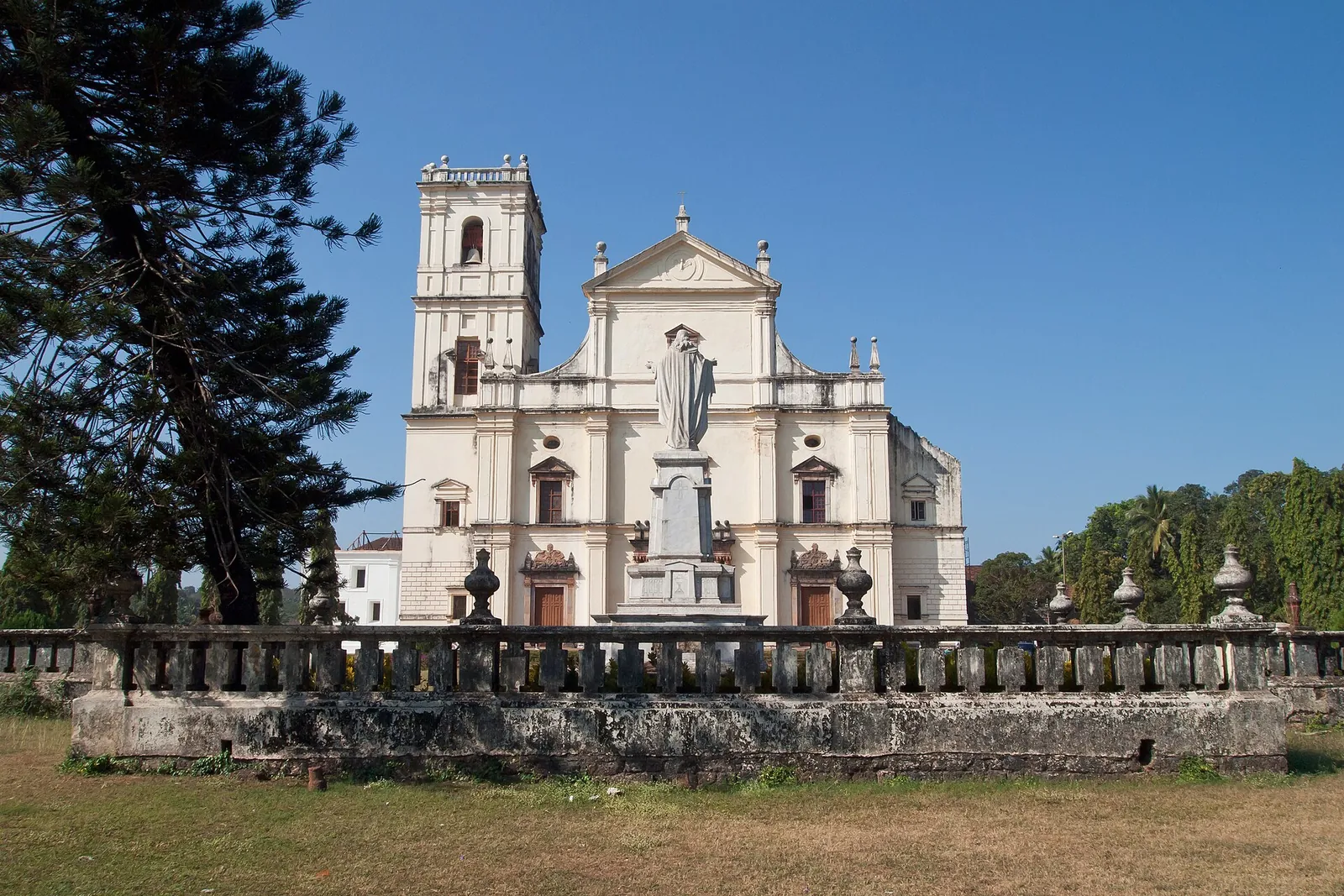
The Se Cathedral, dedicated to St Catherine because the Portuguese took Goa on her feast day in 1510, was begun in 1562 and finished in 1619; Incredible India calls it the largest church in Asia, 250 feet long with a façade 115 feet high, and its Golden Bell the biggest in Goa. One of its two towers collapsed in 1776 and was never rebuilt. The Church and Convent of St Francis of Assisi is in ASI's care and no longer holds services; its nave is painted with scenes from the saint's life. The cathedral is open from 07:30 to 18:00 and St Francis of Assisi from 07:30 to 18:30.
The ASI's Archaeological Museum traces Goa's history from fragments of Hindu temples and sati stones to portraits of the Portuguese viceroys, with a bronze statue of Afonso de Albuquerque in the lobby. It is open from 09:00 to 17:00, closed on Fridays, at INR 10 for adults and free for children up to 15. Cover shoulders and knees in the churches, as Goa Tourism asks visitors to dress with decency at religious places. Allow a full morning, and go early, before the heat. Buses on the Panaji-Ponda road run through Ribandar and past the church complex, and Karmali, a Konkan Railway station, is about 3 km away. From the Old Goa jetty, the River Navigation Department's free ferry crosses to Piedade on Divar Island, an island without a bridge about 11 km from Panaji; the department's route table lists two boats on this route, running from 06:00 to 02:15 as it prints the hours.
Panaji: Fontainhas, Church Square and the Mandovi
Panaji (Panjim) sits at the mouth of the Mandovi and still feels like a provincial Mediterranean town. The viceroy moved here in 1759 after epidemics emptied Old Goa, and it became the capital of Portuguese India in 1843. Above Largo da Igreja, the main square, the white Church of Our Lady of the Immaculate Conception rises at the top of a double flight of stairs added in 1871; the present church dates from 1619, on the site of a chapel where sailors gave thanks after the voyage from Lisbon. The 19th-century Institute Menezes Braganza, now Goa's Central Library, has a lobby mural of blue painted tiles from 1935 showing scenes from the Portuguese epic Os Lusíadas.
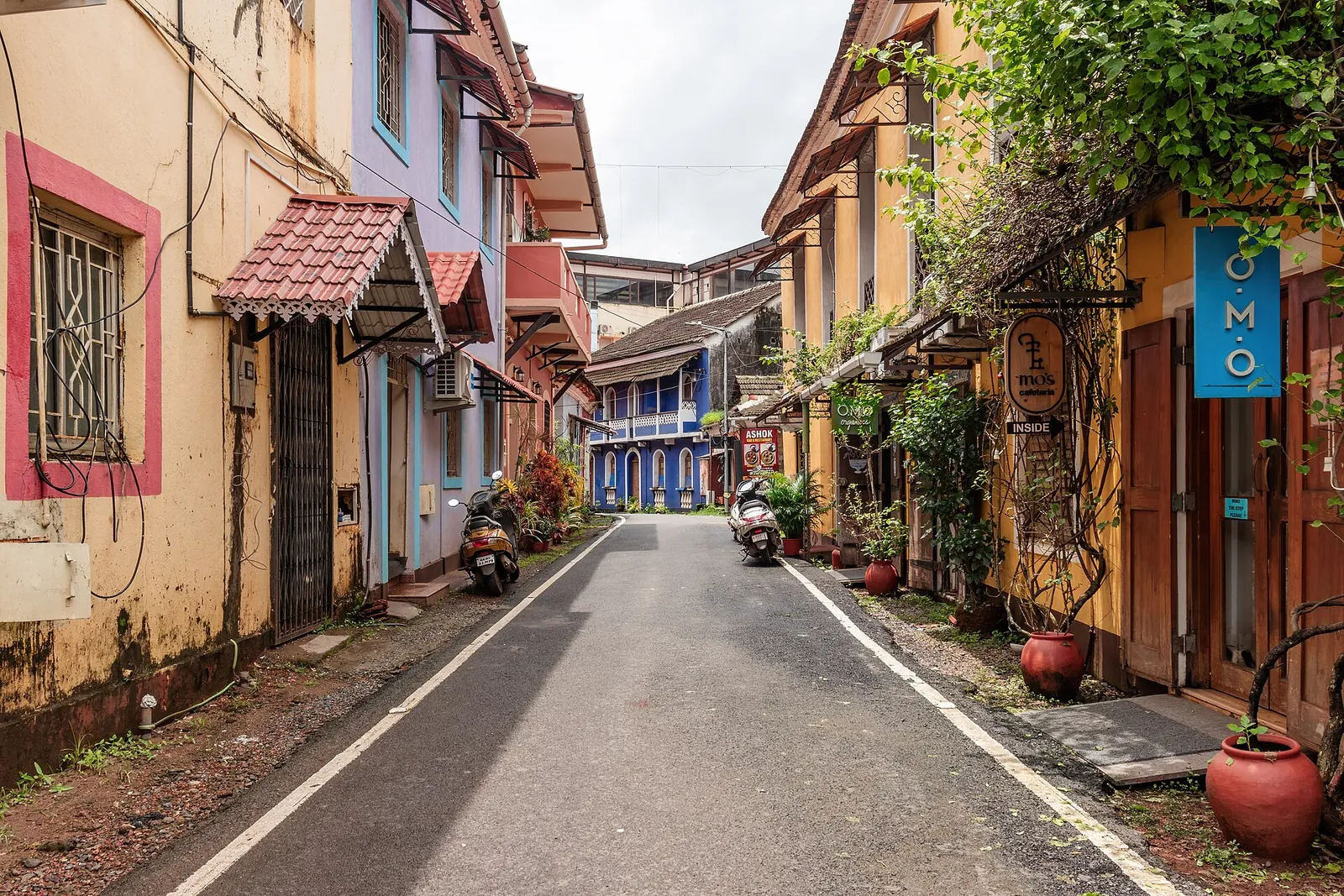
Fontainhas and its neighbour São Tomé, between Ourem Creek and Altinho Hill, are the old residential quarters, built on reclaimed land in the 19th century: lanes of painted, tile-roofed houses, small taverns and bakeries, where some residents still speak Portuguese. The quarter is named after the Fountain of Phoenix, a spring that was once its only water supply. Walk it in the early morning or late afternoon, when the light is soft on the coloured walls, and finish with dinner in one of its Goan restaurants.
Miramar is Panaji's town beach, 3 km west at the river mouth, with views across to Fort Aguada; Dona Paula, 7 km south-west, is the headland between the Mandovi and Zuari estuaries. The River Navigation Department's free ferry crosses the Mandovi from Panaji to Betim between 06:00 and 22:00.
Make time for the local food
What to eat and where to look
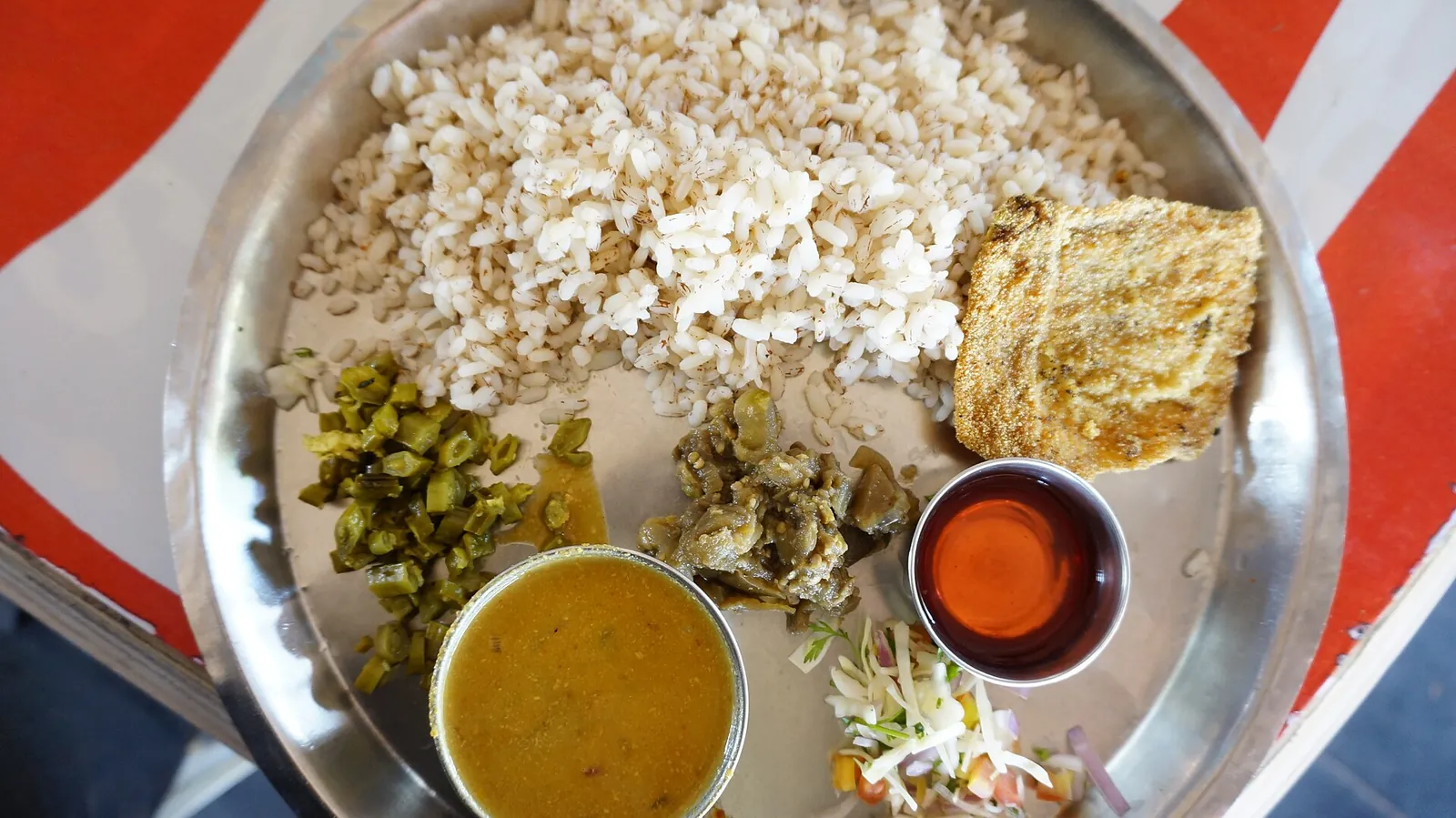
Fish curry rice
The meal on every Goan table: a red, coconut-rich curry soured with kokum, poured over rice, with mackerel, kingfish or prawns.
- Where to look
- The shacks on Calangute beach, which Incredible India names for it.
- Fit it into your day
- Lunch on the beach day, after the forts.
Pork vindalho
Goa's sharp, fiery pork curry, named from the Portuguese words for wine and garlic. Viva Panjim, a family restaurant in a heritage house in Fontainhas that cooks from family recipes, lists it at INR 300.
- Where to look
- Viva Panjim, Rua 31 de Janeiro, Fontainhas (lunch 11:30-15:30, dinner 19:00-23:00, the restaurant lists).
- Fit it into your day
- Dinner on the evening you walk Fontainhas.
Goan curries are hot with chilli and many use pork or shellfish; say so if you avoid pork, nuts, dairy or seafood.
Xacuti
A festive curry of 16 to 18 spices and roasted coconut, made with chicken, crab, mutton or vegetables; Viva Panjim lists a vegetable xacuti at INR 240 and a pork xacuti at INR 300.
- Where to look
- Viva Panjim, Fontainhas.
- Fit it into your day
- To share with the vindalho at the same dinner.
Chicken cafreal
Chicken in a tangy, green masala of coriander, lime juice, vinegar, chillies, garlic and ginger, a dish that came to Goa from the Portuguese colonies in Africa.
- Where to look
- The Goan restaurants of Panaji, where Incredible India lists it among the foods to try in Panjim.
- Fit it into your day
- Lunch in Panaji on the Fontainhas day.
Bebinca
The Goan layered cake of egg yolk, coconut milk and sugar, baked one layer at a time, from seven to 17 layers or more.
- Where to look
- Simonia's bakery in Porvorim, which Incredible India names for it, at around INR 150 a block.
- Fit it into your day
- A sweet to take back to the room, or home.
The north coast: Aguada, Calangute, Anjuna and Chapora
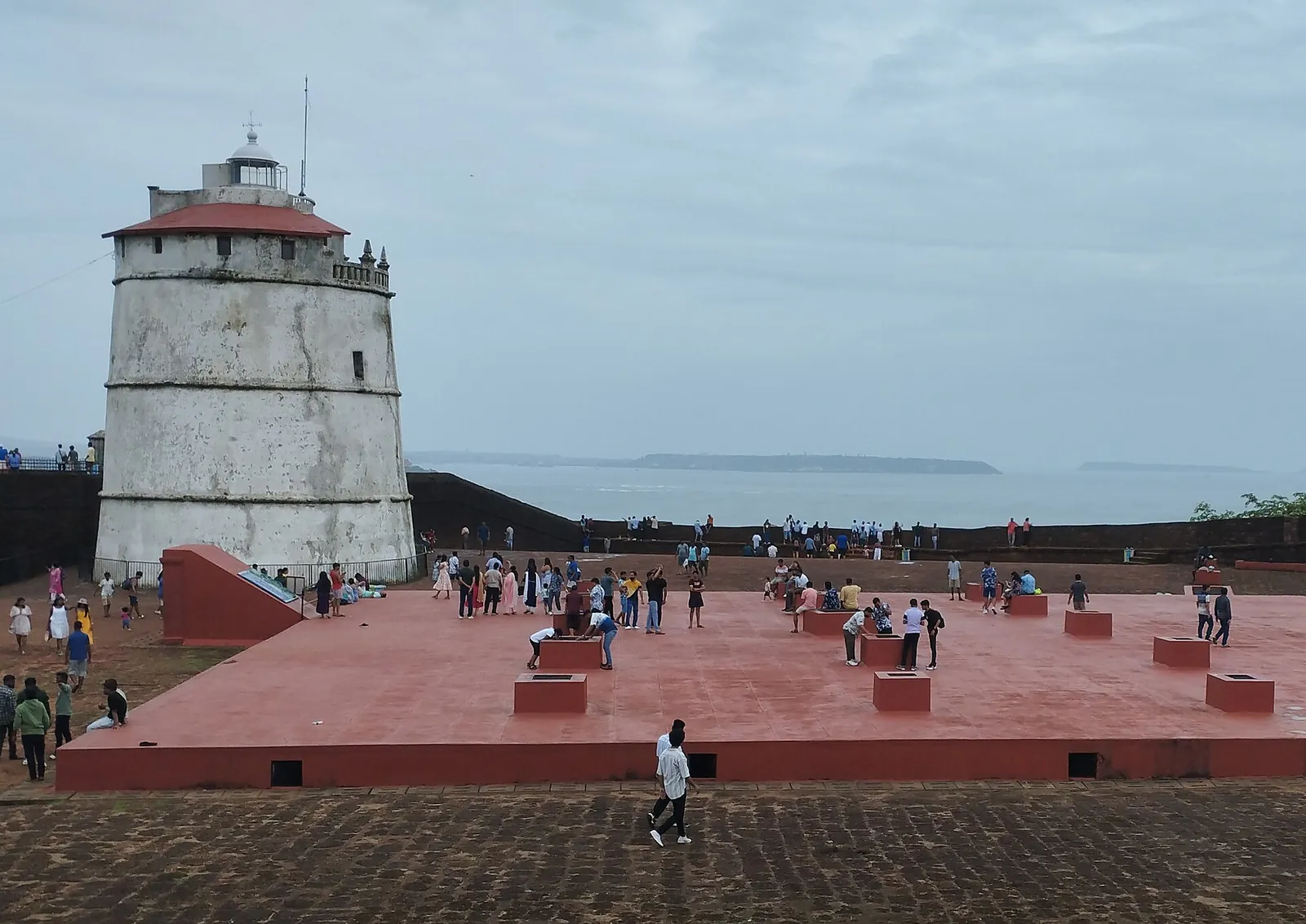
Fort Aguada, on the headland north of the Mandovi mouth, was built in 1612 against the Dutch and the Marathas; its name comes from a spring inside where passing ships took on fresh water, and its lighthouse of 1864 is one of the oldest in Asia. The old Aguada Central Jail beside it now houses a museum of Goa's freedom struggle. The fort, about 18 km from Panaji, is open from 09:00 to 17:00. Four kilometres east, the smaller Reis Magos Fort, rebuilt in laterite and restored from 2008, is open from 11:00 to 17:30, Tuesday to Sunday, next to the Reis Magos Church of 1555.
From Sinquerim below the fort, firm sand runs north without a break through Candolim, about 18 km from Panaji, and Calangute, the 7 km 'Queen of Beaches', to Baga, about 25 km from Panaji, with parasailing, jet skis and banana boats, shacks serving fish curry rice, and Baga's lively nightlife. Anjuna, about 26 km from Panaji, is rockier, with small coves and the flea market held on Wednesdays; Vagator, beyond it, is dominated by the ruined Chapora Fort, which the Portuguese built in 1717 on a hill at the beach's northern tip. Mapusa, inland, holds a colourful Friday market, with spices, cashews, vinegar and the spicy Goan sausage, chouriço.
Further north, Morjim is a nesting beach for Olive Ridley turtles, and Arambol, about 50 km from Panaji, has yoga schools and a sweet-water lagoon behind Kalacha Beach. If you go out at night in the beach villages, watch your glass: France Diplomatie warns that foreign women in Goa are often offered drinks in night bars by new acquaintances, and that these can contain a substance that causes loss of consciousness. Goa Tourism adds that drug offences carry a penalty of 10 years' rigorous imprisonment and a fine; our health and safety guide has the full advice.
South Goa: Colva, Benaulim, Palolem and Agonda
The southern coast is longer, flatter and much quieter. Colva, about 8 km from Margao, the main town of the south, is one of the most popular beaches, on a sandy shore about 20 km long, with water sports, shacks and souvenir stalls; Benaulim, 2 km south, is calmer, a fishing beach with makeshift shacks serving the catch. Inland, the road between the two passes Portuguese-era mansions and whitewashed churches, and in Chandor, 15 km east of Margao, Braganza House is one of the grandest of Goa's old family houses.
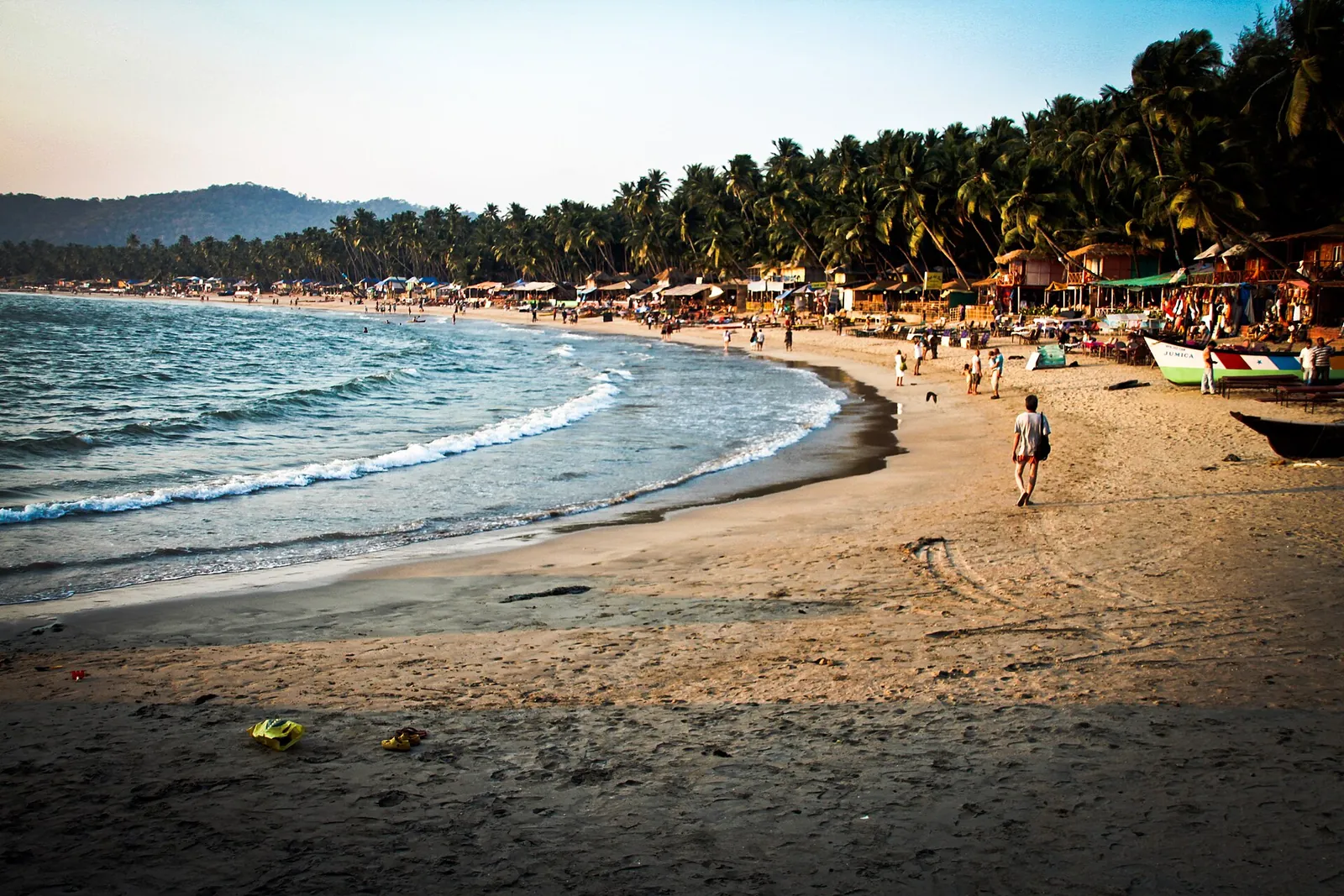
Palolem, at the far end of the state in Canacona, is a crescent bay with Konko Island at its northern end and calm, sheltered water, lined in the season with bamboo and timber huts and palm-thatch restaurants; boats from the beach take visitors to look for dolphins and to Butterfly Beach, a cove reached only by sea. Patnem, just south, is quieter still. Agonda, between Palolem and Margao, is a 3 km cove of white sand and a turtle nesting beach, but Incredible India does not recommend it for swimming. Palolem lies about 38 km from Madgaon (Margao), where the Vande Bharat from Mumbai ends, and Kadamba runs a bus stand at Canacona; check on IRCTC whether a nearer Konkan Railway stop suits your train; under the state's bus fare table, a 38 km ride costs at most INR 35. From Panaji, the Mopa airport buses to Margao run through the city, and the Vande Bharat from Mumbai ends at Madgaon. South Goa makes a long day trip from Panaji; it is better as two nights of its own at the end of the trip, in one of the seasonal huts on the bay.
When to go, and the rules on the beach
Goa's season is set by the monsoon, and its peak by Christmas: from Christmas to the New Year accommodation is at a premium everywhere, and in December and January rooms are hard to find unless booked well in advance. Goa Tourism gives temperatures of 24°C to 29°C for most of the year, noon heat above 33°C in May, and the monsoon from June to September, when the coast turns green and hotels lower their prices. Under Goa's 2024 shack law, the beach shacks may run from 15 September to 31 May, and must be dismantled by 10 June. Goa's water sports policy allows no water sports in the monsoon or in storms, and limits them to 08:00 to 18:30, or sunset if earlier, the rest of the year. The best-time guide compares Goa's months with the rest of India.
Swim only where lifeguards watch. Goa Tourism's rules for the beach ask you to swim only between the red-and-yellow flags, to stay out of the water at red flags, after drinking and in the monsoon, and to keep between the black-and-white chequered flags for water sports. Beaches are open from 7 AM until sunset: all beaches are closed from sunset to 7 AM, and Goa Tourism asks you not to enter the water after sunset, so keep the evenings for town. Drinking alcohol, taking drugs, smoking and driving on the beach are offences. Miramar, at the mouth of the Mandovi, is particularly dangerous in the monsoon, France Diplomatie warns.
Goa's best-known festivals are the Carnival and Shigmo; dates change each year, and Goa Tourism announces them.
Arriving and getting around: two airports, the Konkan Railway and buses
Two airports in Goa. Goa is served by Manohar International Airport (GOX) at Mopa, in the far north, which the Indian aeronautical publication places 16.5 km north-east of Mapusa, and by Dabolim (GOI), a civil enclave in the naval air base INS Hansa, 30 km south of Panaji, whose nearest station is Vasco da Gama. Both accept the e-Visa. The UK Foreign Office warns that the two are a considerable distance apart, so check which one your ticket names.
From Mopa, the airport's timetable lists buses to Panaji at 09:00, 11:30 and 13:30, and buses to Margao through Mapusa and Panaji at 10:30, 12:30, 16:00, 19:15 and 21:30, besides departures for Calangute and Thivim station. The airport publishes no road distance or journey time to Panaji, so ask at the shuttle desk, or your hotel, how long the ride takes before you plan the day around it. Its taxi page names the state's Goa Taxi app, with a counter selling fixed-rate rides, and GoaMiles, an app of the Goa Tourism Development Corporation. The Kadamba Transport Corporation's citizen charter, last updated on 28 January 2026, gives its air-conditioned airport shuttle fares per passenger: Mopa to Mapusa INR 150, to Panaji or Calangute INR 200, and to Margao INR 400; Dabolim to Panaji INR 150, and to Calangute INR 200.
By train from Mumbai. The Konkan Railway is the scenic way to Goa. The Chhatrapati Shivaji Maharaj Terminus-Madgaon Vande Bharat Express (22229/22230) stops at Dadar, Thane, Panvel, Khed, Ratnagiri, Kankavali and Thivim. Outside the monsoon it is timetabled to leave CSMT at 05:25 and reach Madgaon at 13:10, every day except Friday, and to return from Madgaon at 14:40, reaching CSMT at 22:25; these are the timings published at its launch. Konkan Railway runs a monsoon timetable with sectional speed restrictions along the route; its 2026 monsoon timetable runs from 15 June to 20 October; after that date the non-monsoon timings above should apply, but check IRCTC for your date. In Goa the train stops at Thivim before it ends at Madgaon Junction. The transport guide explains how foreign visitors book on IRCTC, and our Mumbai guide covers the start of the line.
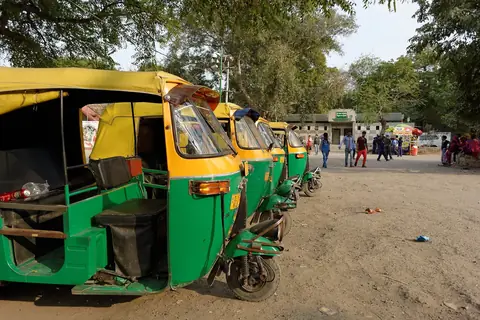
Getting around. Kadamba and private buses link the towns. The maximum bus fares, in force since 1 June 2019 and printed in the same Kadamba charter, are INR 10 for the first 3 km, INR 5 more up to 8 km and INR 5 more for every further 8 km: at most INR 25 from Panaji to Candolim or Fort Aguada, both about 18 km, and INR 30 to Anjuna, about 26 km. White tourist taxis wait at the stations, airports and big hotels, and many visitors rent a scooter. Agree the price of a taxi or a scooter before you set off, and ask at a fort's gate whether there is an entry fee. Goa Tourism asks drivers to follow the traffic rules, to carry their licence and passport, and reminds them that traffic keeps to the left; the UK Foreign Office tells British drivers to carry the 1949 International Driving Permit with their licence, and to wear a helmet on a motorbike.
On to Hampi. Karnataka Tourism names Hosapete Junction, about 13 km from Hampi, as the nearest station. Indian Railways publishes Goa-Hosapete departure times and fares only in its journey search, so check IRCTC for your date. By road, Kadamba's interstate bus leaves Panaji at 09:30 for Hosapete, 379 km by its count via Hubballi, and the charter gives no arrival time, so plan for a long day. The Mumbai, Goa and Hampi itinerary puts these legs in order.
A four-night plan and its cost for two
This plan keeps the Archaeological Museum off a Friday, puts the churches in the cool of the morning and the beaches in the afternoon, and fits the Anjuna and Mapusa markets if your days fall right. The model below is for two adults sharing a room, with prices checked on 17 October 2026.
- Day 1: arrive at Mopa or Dabolim, or at Thivim by the morning Vande Bharat, and check in; in the late afternoon walk through Fontainhas to Church Square, and have dinner in the old quarter.
- Day 2 (not a Friday): a Panaji-Ponda bus to Old Goa for opening time: Bom Jesus, the Se Cathedral, St Francis of Assisi and the Archaeological Museum, then St Cajetan; in the afternoon take the free ferry to Divar Island, or spend it at Miramar, 3 km from Panaji.
- Day 3: by bus to Reis Magos Fort (not a Monday) and Fort Aguada in the morning, then the beach from Candolim to Calangute, with fish curry rice at a shack, and back to Panaji for the evening.
- Day 4: by bus north to Anjuna (the flea market on a Wednesday) or Mapusa (the market on a Friday), then Vagator and Chapora Fort for the late-afternoon view.
- Day 5: a morning swim between the flags, then the airport or the train; or take the bus south to Palolem for two more nights.
- With a spare day: Dudhsagar Falls, which Incredible India calls India's second-highest waterfall, on the Goa-Karnataka border, about two hours from Panaji; a spice farm, where Incredible India says a tour ends with a meal on site; or the Saturday Night Market at Arpora. The road access to the falls, the jeep fare and the monsoon closing dates are not published officially.
- Room, Hotel Gautam, Porvorim, standard room for two, 4 nights at INR 3,750 a night, room only, taxes included: INR 15,000.
- Airport transfers, Hotel Gautam's free pick-up and drop for a stay of three nights or more, between 8 AM and 7 PM on a group basis: INR 0. A flight outside those hours needs the Kadamba shuttle instead, at INR 200 per passenger between Mopa and Panaji.
- Buses, Days 2 to 4, for two from Panaji at the maximum fares: Old Goa (INR 20 each way, as Goa Tourism puts it 10 km from Panaji), Candolim (INR 25 each way) and Anjuna (INR 30 each way); the Divar ferry is free: INR 300.
- Sights, Old Goa's Archaeological Museum for two adults at INR 10 each; Incredible India lists no ticket for the churches, and Fontainhas and the beaches are free to walk: INR 20.
- One dinner, at Viva Panjim in Fontainhas: pork vindalho (INR 300), vegetable xacuti (INR 240) and two Goan rice (INR 110 each): INR 760.
- Total: about INR 16,080 for two.
- Not included: the other meals; any fort entry fee; the short hop between Porvorim and Panaji; taxis and scooter hire; water sports and boat trips; flights and trains to and from Goa.
Practical questions
How many nights do I need in Goa?
Four nights: one day for Old Goa and Fontainhas, two for the forts, markets and beaches of the north, and a last morning on the sand. Add two nights in Palolem if you want the quiet south as well.
Is North or South Goa better for a first visit?
North Goa, if you want the forts, markets and nightlife within a short drive of Panaji and Old Goa; Calangute and Baga are the busiest beaches. South Goa, if you want quiet bays such as Palolem and Patnem and are happy to see less.
Which Goa airport should I fly to?
The one your airline flies to, as the two are far apart: Goa has Manohar International Airport (GOX) at Mopa in the north and Dabolim (GOI) near Vasco da Gama, 30 km south of Panaji. Kadamba's airport shuttles run from both, at INR 200 per passenger from Mopa to Panaji and INR 150 from Dabolim.
When are the beach shacks open?
Goa's shack law allows them from 15 September to 31 May; they must be taken down by 10 June, before the monsoon. Water sports stop in the monsoon, from June to September.
When is the Basilica of Bom Jesus open?
Incredible India lists it from 09:00 to 18:30 on weekdays and from 10:30 to 18:30 on Sundays. The Archaeological Museum nearby is closed on Fridays.
Can I rent a scooter in Goa?
Yes, rentals are common. Goa Tourism asks drivers to carry their licence and passport and to follow the traffic rules, with traffic on the left; the UK Foreign Office advises an International Driving Permit and a helmet. Driving on the beach is an offence.
Sources and checks before you travel
Reference sources for the version dated 17 October 2026. Confirm opening times, access, transport and conditions for your travel dates.
- Archaeological Survey of India: Churches and Convents of Goa ↗ — opens in a new tab
- Ministry of Tourism (Incredible India): Goa ↗ — opens in a new tab
- Ministry of Tourism (Incredible India): Basilica of Bom Jesus ↗ — opens in a new tab
- Ministry of Tourism (Incredible India): Se Cathedral ↗ — opens in a new tab
- Ministry of Tourism (Incredible India): Church of St Francis of Assisi ↗ — opens in a new tab
- Ministry of Tourism (Incredible India): The Archaeological Museum, Old Goa ↗ — opens in a new tab
- Ministry of Tourism (Incredible India): Fort Aguada ↗ — opens in a new tab
- Ministry of Tourism (Incredible India): Reis Magos Fort ↗ — opens in a new tab
- Ministry of Tourism (Incredible India): Calangute Beach ↗ — opens in a new tab
- Ministry of Tourism (Incredible India): Baga Beach ↗ — opens in a new tab
- Ministry of Tourism (Incredible India): Anjuna Beach ↗ — opens in a new tab
- Ministry of Tourism (Incredible India): Goa's coastline ↗ — opens in a new tab
- Ministry of Tourism (Incredible India): Palolem Beach ↗ — opens in a new tab
- Ministry of Tourism (Incredible India): Top 14 foods to try in Panjim ↗ — opens in a new tab
- Ministry of Tourism (Incredible India): 12 food souvenirs from Panaji ↗ — opens in a new tab
- Goa Tourism (Department of Tourism, Government of Goa): Do's and Don'ts advice to tourists ↗ — opens in a new tab
- Goa Tourism (Department of Tourism, Government of Goa): within Goa ↗ — opens in a new tab
- River Navigation Department, Government of Goa: ferry services ↗ — opens in a new tab
- Department of Information and Publicity, Goa: traffic diversion for the St Francis Xavier feast, 19 November 2025 ↗ — opens in a new tab
- Goa Tourism (Department of Tourism, Government of Goa): weather ↗ — opens in a new tab
- Goa Tourism (Department of Tourism, Government of Goa): policy for the regulation of water sports in Goa ↗ — opens in a new tab
- Official Gazette of Goa: Goa Erection of Shacks on Public Beaches (Regulation and Control) Act, 2024 (text hosted by PRS Legislative Research) ↗ — opens in a new tab
- France Diplomatie: India security advice ↗ — opens in a new tab
- UK Foreign Office (FCDO): India safety and security ↗ — opens in a new tab
- Airports Authority of India: Goa (Dabolim) Airport ↗ — opens in a new tab
- AAI eAIP: VOGO Goa (Dabolim) aerodrome data ↗ — opens in a new tab
- AAI eAIP: VOGA Manohar International Airport, Mopa ↗ — opens in a new tab
- Manohar International Airport (GOX): bus routes ↗ — opens in a new tab
- Manohar International Airport (GOX): taxi service ↗ — opens in a new tab
- Kadamba Transport Corporation: citizen charter, last updated 28 January 2026 ↗ — opens in a new tab
- Official e-Visa site: e-Tourist visa and entry points ↗ — opens in a new tab
- PIB Goa: Madgaon-Mumbai Vande Bharat flagged off, 27 June 2023 ↗ — opens in a new tab
- Konkan Railway: Konkan Railway gears up for monsoon 2026, 12 June 2026 ↗ — opens in a new tab
- Karnataka Tourism: Hampi ↗ — opens in a new tab
- Hotel Gautam: Goa tariff ↗ — opens in a new tab
- Viva Panjim: menu ↗ — opens in a new tab
- Viva Panjim: home ↗ — opens in a new tab
- Goa Tourism (Department of Tourism, Government of Goa): staying in Goa ↗ — opens in a new tab
- Ministry of Tourism (Incredible India): 20 unique things to do in Goa ↗ — opens in a new tab
- Goa Tourism: Tourist Directory 2019 (PDF) ↗ — opens in a new tab
Does this experience fit your route?
Book the flight or the Konkan Railway first, then a room in Panaji or Porvorim, and keep Old Goa's museum off a Friday.
Check dates and details on Viator ↗ — opens in a new tabAffiliate link · Book with ViatorPhoto credits
The Se Cathedral in Old Goa, with the one tower that still stands
Photograph: Vyacheslav Argenberg — opens in a new tab · CC BY 4.0 — opens in a new tab
Changes: Resized and converted to WebP; displayed with responsive crops. · Original photograph and licence details ↗ — opens in a new tab
Palolem's crescent beach in Canacona, South Goa, with its shacks under the palms
Photograph: Nico Crisafulli from USA — opens in a new tab · CC BY 2.0 — opens in a new tab
Changes: Resized and converted to WebP; displayed with responsive crops. · Original photograph and licence details ↗ — opens in a new tab
The Basilica of Bom Jesus, Old Goa, which keeps the tomb of St Francis Xavier
Photograph: iMahesh — opens in a new tab · CC BY-SA 4.0 — opens in a new tab
Changes: Resized and converted to WebP; displayed with responsive crops. · Original photograph and licence details ↗ — opens in a new tab
A street of painted houses in Fontainhas, Panaji's old Latin quarter
Photograph: iMahesh — opens in a new tab · CC BY-SA 4.0 — opens in a new tab
Changes: Resized and converted to WebP; displayed with responsive crops. · Original photograph and licence details ↗ — opens in a new tab
The 19th-century lighthouse at Fort Aguada, looking out over the Arabian Sea
Photograph: 0kumr — opens in a new tab · CC0 — opens in a new tab
Changes: Resized and converted to WebP; displayed with responsive crops. · Original photograph and licence details ↗ — opens in a new tab
A Goan fish curry rice plate: rice, curry, fried fish and vegetable sides
Photograph: Fredericknoronha — opens in a new tab · CC BY-SA 4.0 — opens in a new tab
Changes: Resized and converted to WebP; displayed with responsive crops. · Original photograph and licence details ↗ — opens in a new tab