Rajasthan · Rajasthan
Udaipur travel guide: 3 nights for the City Palace and Lake Pichola
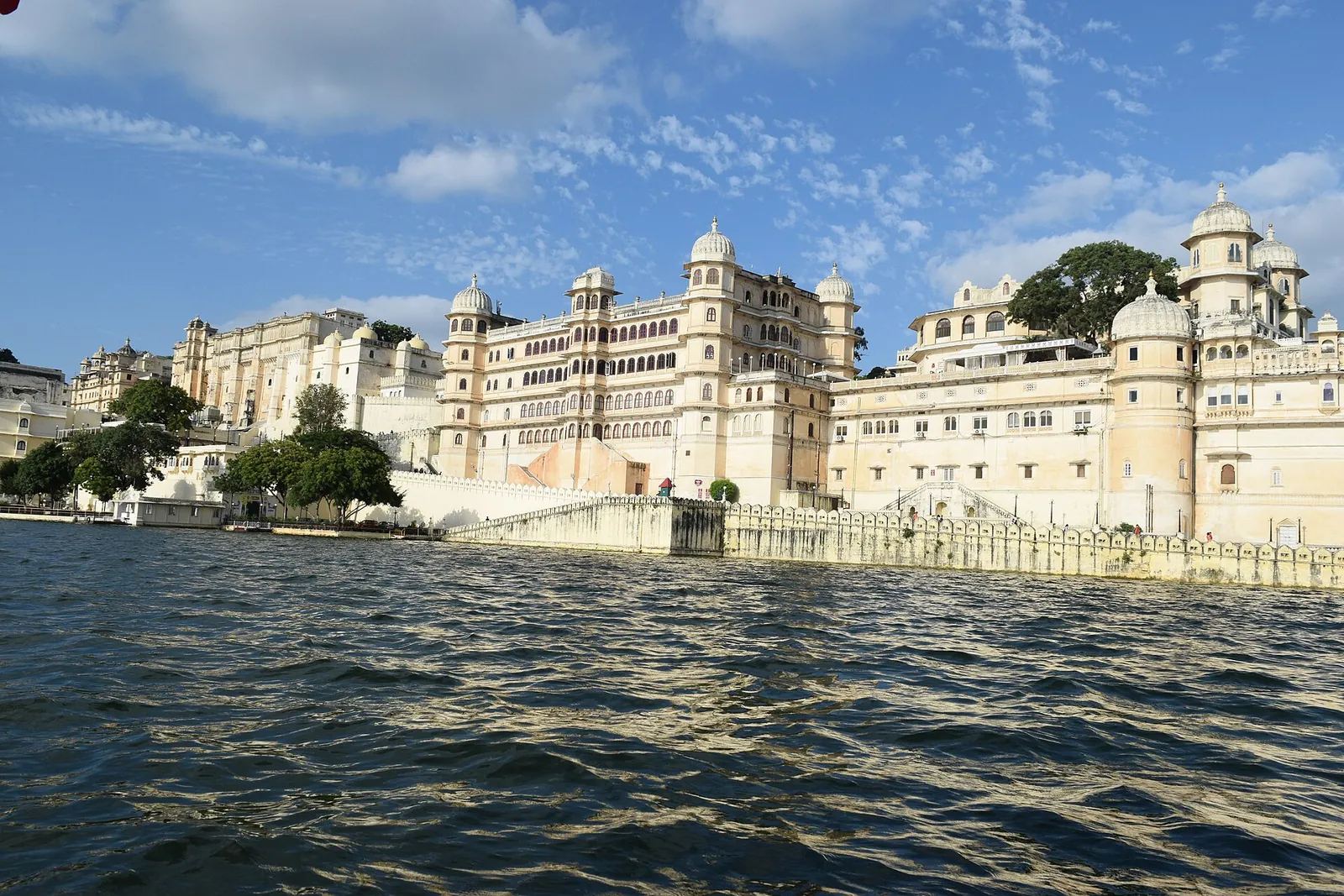
Udaipur is built around water. The City Palace rises from the shore of Lake Pichola, a lake first dammed in 1362 and enlarged when Maharana Udai Singh II made the city his capital; out on the water float Jag Mandir and Jag Niwas, the island palace that is now a hotel. Behind the palace, the old city climbs to the Jagdish Temple of 1651 and down again to Gangaur Ghat and Bagore ki Haveli, while the white Monsoon Palace watches over everything from its hilltop. Three nights give you a day for the palace and the lake, a day for the old city and the gardens to the north, and a late afternoon at the Monsoon Palace; a fourth night adds a day out to the hill fort of Kumbhalgarh and the Jain temple at Ranakpur.
- Suggested time
- 3 nights (4 days)
- Where to stay
- The old city around Jagdish Temple and Gangaur Ghat for walking to the palace and the ghats; Ambrai Ghat for the view of the palace; Gulab Bagh Road for a quieter heritage hotel
- Season and timing
- October to March is the comfortable time for the lake, the rooftops and the walk up to the palace: Incredible India's climate table for Udaipur gives daily temperatures of 13.4-35.8 °C in October and 3.2-30 °C in January. April to June is hot, with highs of 41.5-43.4 °C, so sightsee early and late. June to September is the southwest monsoon, IMD's principal rainy season, when the Monsoon Palace is often shrouded in mist.
The short answer
Book three nights (four days) in the old city around Jagdish Temple, Lal Ghat and Gangaur Ghat, or by Ambrai Ghat for the view of the palace; add a fourth night for Kumbhalgarh and Ranakpur. Book the room first, then buy the City Palace Museum ticket online and plan the afternoon boat to Jag Mandir. Two key prices, checked on 17 October 2026: the City Palace Museum charges every adult INR 400, Indian or foreign, and the regular boat to Jag Mandir costs INR 600 an adult on HRH's latest fares. The model stay below, at the Garden Hotel on Gulab Bagh Road, comes to about INR 43,540 for two, including GST on the room but not most meals.
Where to sleep: the old city, Ambrai Ghat or Gulab Bagh
The old city around Jagdish Temple and Gangaur Ghat puts the City Palace, the temple and Bagore ki Haveli within a short walk. Jagdish Temple stands in the bustling heart of the old city, so expect narrow lanes, temple bells and traffic from morning to late evening; the lanes of Lal Ghat run down to the water nearby.
Ambrai Ghat, also called Manjhi Ghat, is where you go for the view: quiet mornings, lively evenings, six aartis a day and marble seats looking across the water to the Lake Palace and Jag Mandir.
Gulab Bagh Road is a calmer choice outside the busiest lanes. HRH Group of Hotels, which also runs the boats to Jag Mandir, has its Garden Hotel here, opposite Sajjan Niwas Garden; its tariff for 1 October 2026 to 31 March 2027 lists standard rooms at INR 11,000 and superior rooms at INR 13,000 a night for one or two guests, room only, with government taxes extra. It is the room priced in this guide's budget. The where-to-stay guide for India explains how foreign guests are registered at check-in.
The City Palace: courtyards, mirror rooms and a lake view
The City Palace is a city within a city. It spreads over 4 acres of courtyards, pavilions, gardens and halls, commissioned by Maharana Udai Singh II and expanded by his successors over four centuries. The City Palace Museum names Rai Angan as the oldest part, a 16th-century courtyard where the palace's foundations were laid and several Maharanas were crowned. Beyond it come Mor Chowk, the Peacock Courtyard with its glass-inlay peacocks; Kanch ki Burj, a winter bedroom of glass inlay in the Mewar colours of red, yellow and white, with mirrors in its dome and floor; the Zenana Mahal, the queens' palace whose rooms are now galleries; and Baadi Mahal, a garden with a marble colonnade at the very top of the palace. Look out too for the Sheesh Mahal and the Haathi Pol, the elephant gate.
The museum, administered by the Maharana of Mewar Charitable Foundation, was set up in 1969, and part of the complex is still the royal family's home. Its FAQ gives one ticket for everyone, Indian or foreign: INR 400 for adults, INR 150 for children aged 5 to 18 and for students with ID, INR 250 for seniors over 60, and free entry for children under 5. It is open from 09:00 to 21:00 every day, and ticket sales close at 20:00. Tickets are sold at the two palace gates, Badi Pol and Shitla Mata, or in advance on the museum's website, and the ticket includes the camera.
The Crystal Gallery, upstairs in the Durbar Hall of the Fateh Prakash Palace, has its own ticket: HRH, which runs it, charges INR 500 for an adult and INR 300 for a child and opens it from 09:00 to 18:30. Maharana Sajjan Singh ordered the collection from F. & C. Osler of Birmingham: dinner sets, decanters, perfume bottles, furniture and even a crystal bed, all etched with the crest of Mewar. Photography is not allowed in the gallery.
Allow at least an hour; the museum suggests that as a minimum. Audio guides in English, French, German and Spanish are handed out at the information desk in Moti Chowk, flash photography is not allowed in the galleries, the cloakroom is by the Badi Pol counter, and electric cars carry visitors from the gates to the museum for a small fee. HRH's Mewar Sound and Light Show in the palace's Manak Chowk, given in English as The Legacy of Honour and in Hindi as Yash ki Dharohar, is suspended until further notice (still so on 17 October 2026).
Lake Pichola by boat: Jag Mandir and the island palaces
Lake Pichola began in 1362, when a tribesman named Pichhu Banjara dammed the Ayad River; Maharana Udai Singh II later raised a 15.24 m stone dam at Badipol to enlarge it. From a boat you see the long lakeside front of the City Palace, the ghats with their steps, Bagore ki Haveli and the triple-arched gate of Gangaur Ghat, and two small island pavilions: Mohan Mandir, from which the Maharana watched the Gangaur festival, and Arsi Vilas, now a haunt of tufted ducks, coots and kingfishers. Jag Niwas, the ivory-white palace Maharana Jagat Singh II built in the 18th century, is now the Taj Lake Palace hotel.
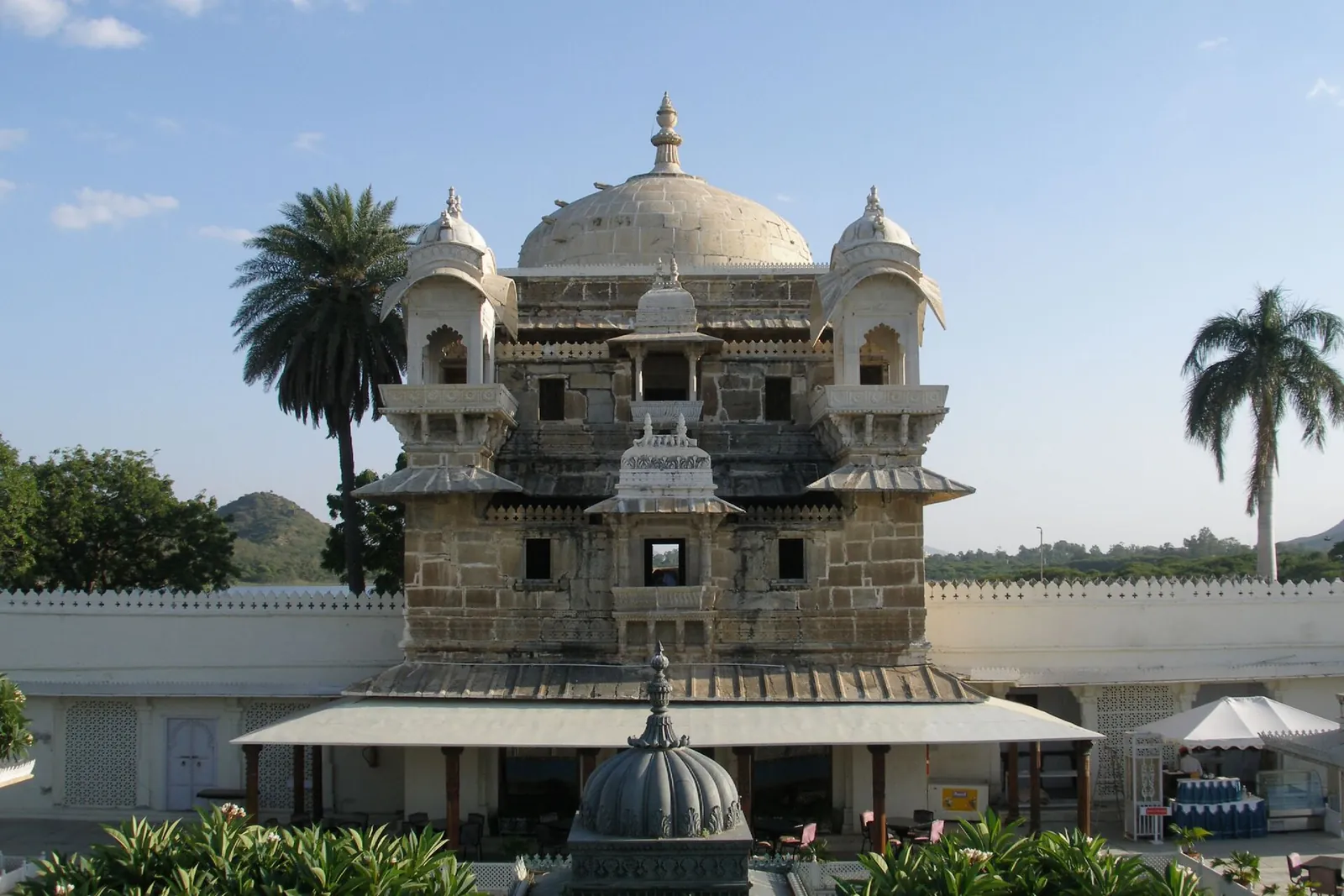
Jag Mandir, on the lake's southern island, is the stop. This 17th-century palace was the refuge of Prince Khurram, later the emperor Shah Jahan; look for its life-sized marble elephants, the Gul Mahal and the Zenana Mahal, its gardens, a Rajasthani restaurant and a museum. Jagriti, HRH's exhibition in the Gol Mahal, traces how the island palace grew.
HRH runs the boats to Jag Mandir from its jetty at Rameshwar Ghat. Its timetable gives regular departures from 10 am until 3 pm in summer and until 2 pm in winter, and sunset trips until 6 pm in summer and 5 pm in winter. HRH's latest published fare table, for 1 April 2025 to 31 March 2026, lists INR 600 for an adult on a regular trip and INR 800 on a sunset trip (INR 300 and INR 450 for a child); HRH had not published its 2026-27 boat fares by 17 October 2026. A private boat for up to seven people from Rameshwar Ghat was listed at INR 6,500 for a regular trip and INR 7,500 at sunset.
The old city: Jagdish Temple, Bagore ki Haveli and the bazaars
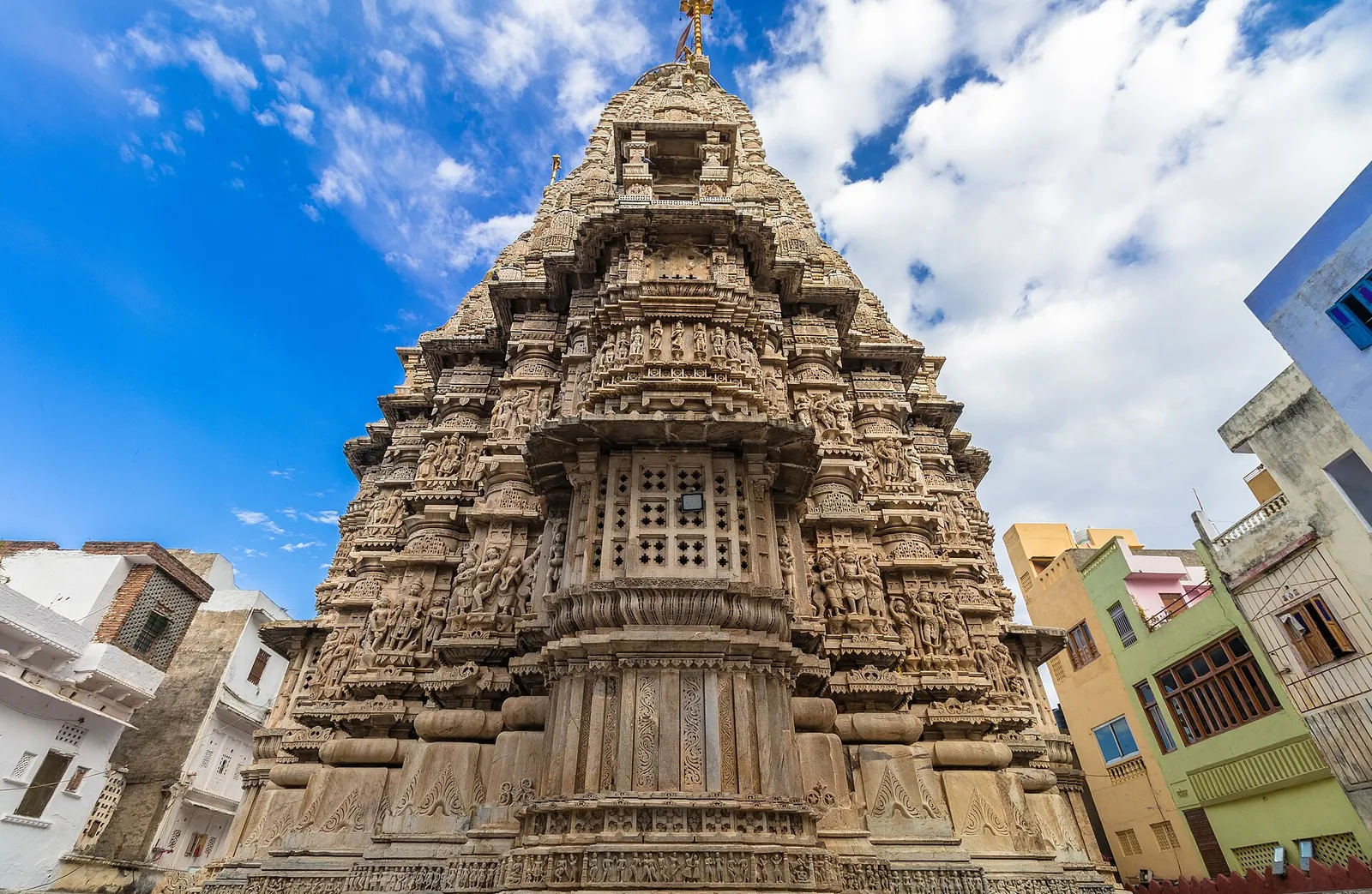
Jagdish Temple has stood since 1651, when Maharana Jagat Singh I built it for Vishnu, worshipped here as Jagannath, Lord of the Universe. A flight of 32 marble steps guarded by two stone elephants leads up to a three-storey temple of carved pillars, painted walls and tall spires, with a black stone image of Vishnu in the sanctum and smaller shrines to Shiva, Ganesha, the Sun God and Shakti. Come for the morning or evening aarti, and look back from the top of the steps over the market and the City Palace.
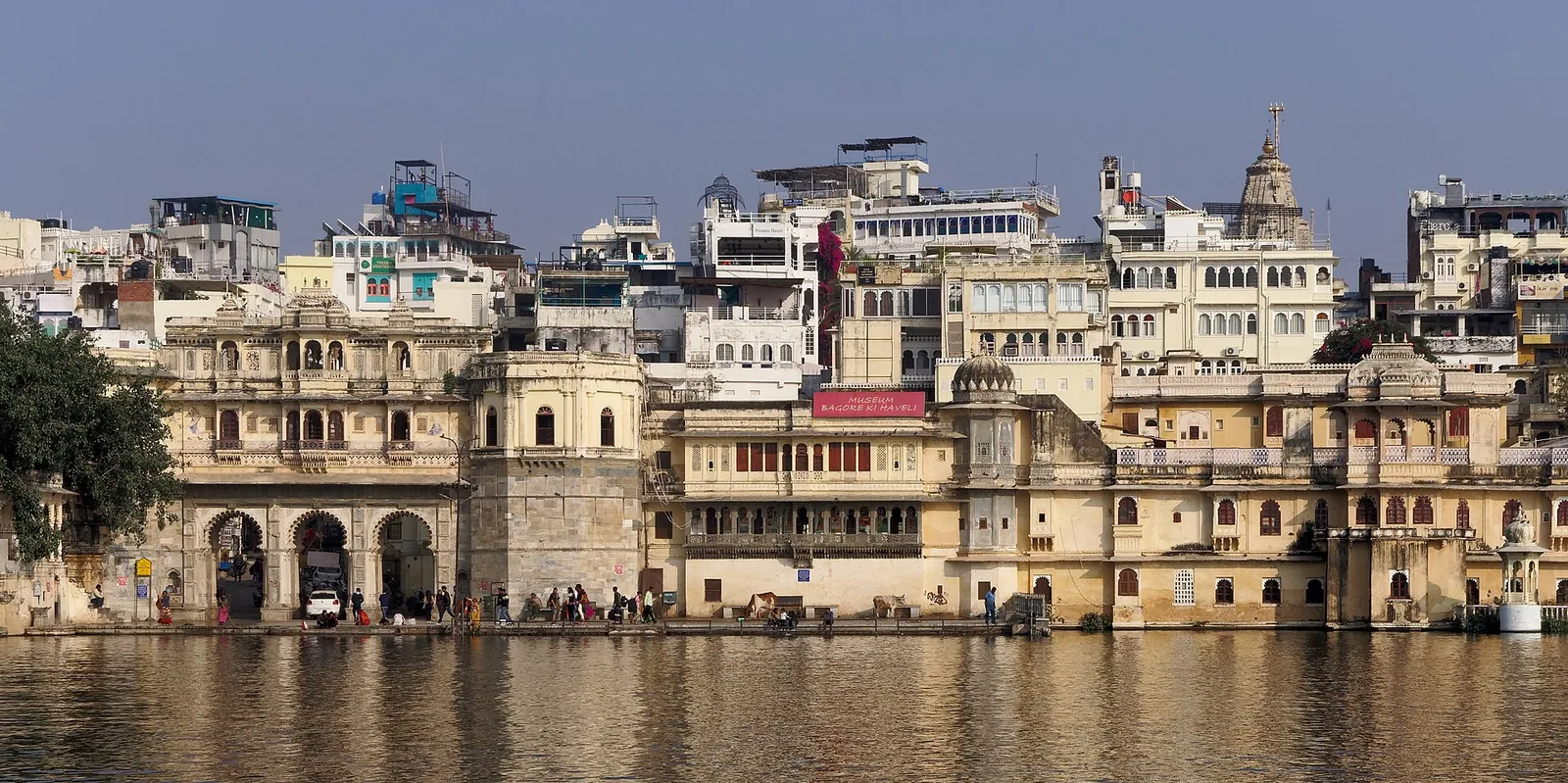
Bagore ki Haveli, on Gangaur Ghat, was built by Amar Chand Badwa, prime minister of Mewar from 1751 to 1778. The West Zone Cultural Centre (WZCC), which has made it its headquarters since 1986, restored its 138 rooms, balconies, courtyards and terraces over five years; above the triple-arched gate of Gangaur Ghat stands the glass-inlay palace that Maharaj Shakti Singh built in 1878. The museum costs foreign visitors INR 150 (Indian adults INR 60), plus INR 60 for a camera. Come back in the evening for the Dharohar dance show, with Rajasthani dances such as Ghoomar. WZCC does not publish its time or price.
The bazaars fill the lanes around the temple. Hathi Pol Bazaar is the place for Rajasthani handicrafts, miniature paintings and phad scrolls, Bada Bazar for clothing, silver jewellery and textiles, and Bapu Bazar for cheaper textiles, pottery and brassware. Gangaur Ghat is also the stage of the Gangaur festival, which WZCC places in the month of Chaitra (March or April), so its dates change each year.
North of the old city: Fateh Sagar, Saheliyon ki Bari, Shilpgram and the Monsoon Palace
Fateh Sagar Lake, north-west of the centre, was first built in 1678 under Maharana Jai Singh and later enlarged by Maharana Fateh Singh. It has three islands: Nehru Park, reached by boat; a second park with water-jet fountains; and the Udaipur Solar Observatory. Walk the embankment, lined with snack kiosks, in the late afternoon. Just below it, Saheliyon ki Bari, the Garden of the Maidens, was laid out in the 18th century by Maharana Sangram Singh for the queen and her companions; its fountains still run by gravity from the lake, and a small museum shows royal household objects. Incredible India gives the garden's hours as 09:00 to 19:00.
Shilpgram, 3 km west of Udaipur, is WZCC's crafts village: 31 traditional huts from Rajasthan, Gujarat, Maharashtra and Goa, built by the communities that live in such houses and filled with their tools, pots and textiles. Entry costs foreign visitors INR 150, and the same INR 60 camera fee applies. WZCC holds the Shilpgram Utsav, a 10-day festival of crafts, music and dance, every year in the last week of December. For a view over the city from above, a ropeway runs from Deen Dayal Upadhyay Park up the hill to the Karni Mata Temple, Rajasthan Tourism says. The entry fee for Saheliyon ki Bari, the boat fare to Nehru Park and the ropeway fare are not published.
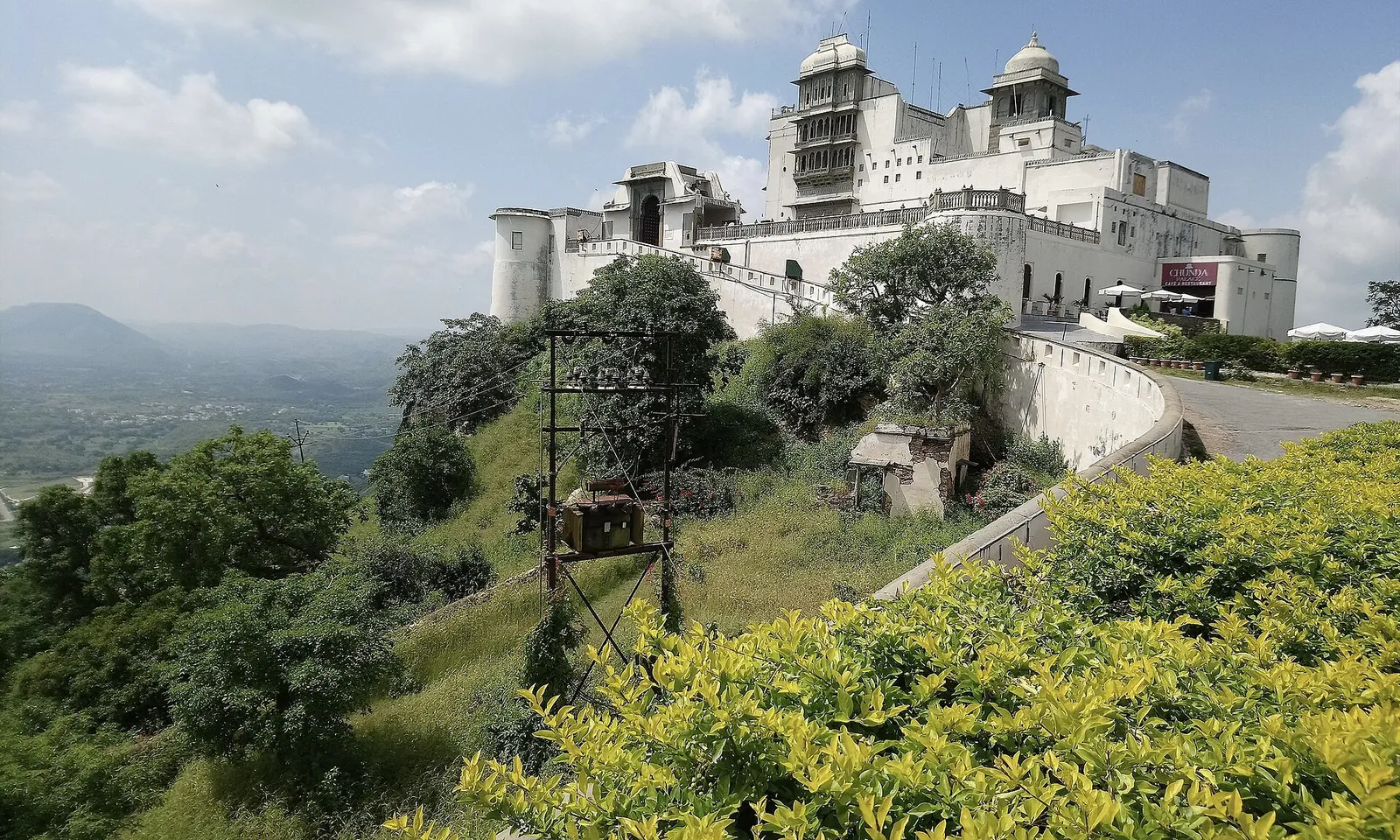
The Monsoon Palace (Sajjangarh), on the Bansdara hills, is the white palace on the hilltop skyline. Maharana Sajjan Singh, the 72nd ruler of Mewar, began it in the 19th century as a nine-storey astronomical centre to watch the monsoon clouds; he died young and it was never finished. It has marble turrets, a central courtyard, a small museum, a rainwater cistern holding 195,500 litres, and a wildlife sanctuary around it; in the late afternoon the light falls over Fateh Sagar below. Incredible India gives its hours as 09:00 to 17:00, so go up by taxi or auto-rickshaw in the afternoon; the sanctuary's entry fee is not published.
A day out: Kumbhalgarh and the Jain temple at Ranakpur
Kumbhalgarh. Mewar's great hill fort was built in the 15th century by Rana Kumbha and is a UNESCO World Heritage site; Incredible India calls it the highest fort in Rajasthan and the birthplace of Maharana Pratap. Its walls run for 36 km around the hills, wide enough for eight horses abreast, behind seven fortified gates. The fort is 84 km north of Udaipur and open from 09:00 to 18:00, Incredible India says, so a car with driver for the day is the way to go, leaving after breakfast. Walk the ramparts in the morning light and come back to Udaipur for dinner; leave out the fort's nightly sound and light show, which would mean driving back after dark, and the UK Foreign Office advises avoiding travel at night. The Archaeological Survey of India lists Kumbhalgarh among its ticketed monuments but prints no fee there, so check the price at the gate before you go.
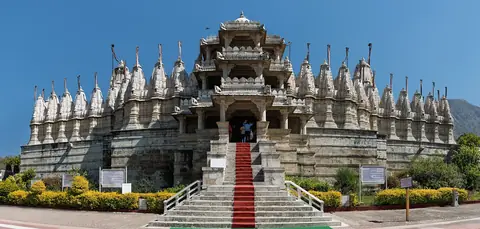
Ranakpur. The Ranakpur Jain temple, which Rajasthan Tourism places almost 90 km from Udaipur, was built in the 15th century by Dhanna Shah, a merchant and minister at the court of Rana Kumbha, under the king's patronage; Rajasthan Tourism says the work took about 50 years. The three-storey temple of white marble is dedicated to Adinath, the first tirthankar, whose image faces the four directions, hence its other name, Chaturmukh. Inside, 80 domes rest on 1,444 carved pillars, no two of them alike, and the light from outside keeps it airy and cool even at midday. Dress modestly; tickets, and any camera charge, are paid at the counter. Ranakpur's visiting hours and fee for sightseers are not published.
Incredible India's account puts Kumbhalgarh about 60 km from Ranakpur, so the loop from Udaipur to Kumbhalgarh, on to Ranakpur and back is about 230 km by car. See Kumbhalgarh first, from its 09:00 opening, and Ranakpur after lunch; that leaves the almost 90 km back to Udaipur for the late afternoon, before dark. Incredible India's account says you will find only one or two places to eat on the way from Kumbhalgarh to Ranakpur, so take water and a packed lunch. No car fare is published; the price is agreed with the driver. If you are going on to Jodhpur, see Ranakpur on the way instead and give Kumbhalgarh its own day.
Arriving and moving on: the airport, the railway station and Jodhpur
By air: Maharana Pratap Airport (UDR) lies east-north-east of the city; the Airports Authority of India places it 20 km from Udaipur City Railway Station, on a bearing of 075 degrees, and lists taxis and car hire at the airport. The taxi fare into town is not published.
By train: trains arrive at Udaipur City Railway Station. Indian Railways publishes current departure times and fares only in its journey search, so check IRCTC for your date. The taxi or auto-rickshaw fare from the station to the old city is not published. Foreign visitors can book on IRCTC under the foreign tourist quota; the transport guide explains registration, classes and when bookings open.
Onward: for Jodhpur, most travellers hire a car with driver for a full day and stop at Ranakpur on the way; the Rajasthan itinerary describes that drive and joins Udaipur with Jaipur and Jodhpur, and the Jodhpur guide covers Mehrangarh and the blue city. Rajasthan Tourism puts Udaipur 257 km from Jodhpur, and the Ranakpur Jain temple almost 90 km from Udaipur, in the forested Aravalli hills, so the drive with the temple stop fills the day. No car fare is published; the price is agreed with the driver, together with the stop at Ranakpur and the drop-off at your Jodhpur address. In town, auto-rickshaws and taxis cover the distances between the old city, Fateh Sagar and the Monsoon Palace; the old city itself is best on foot.
Make time for the local food
What to eat and where to look
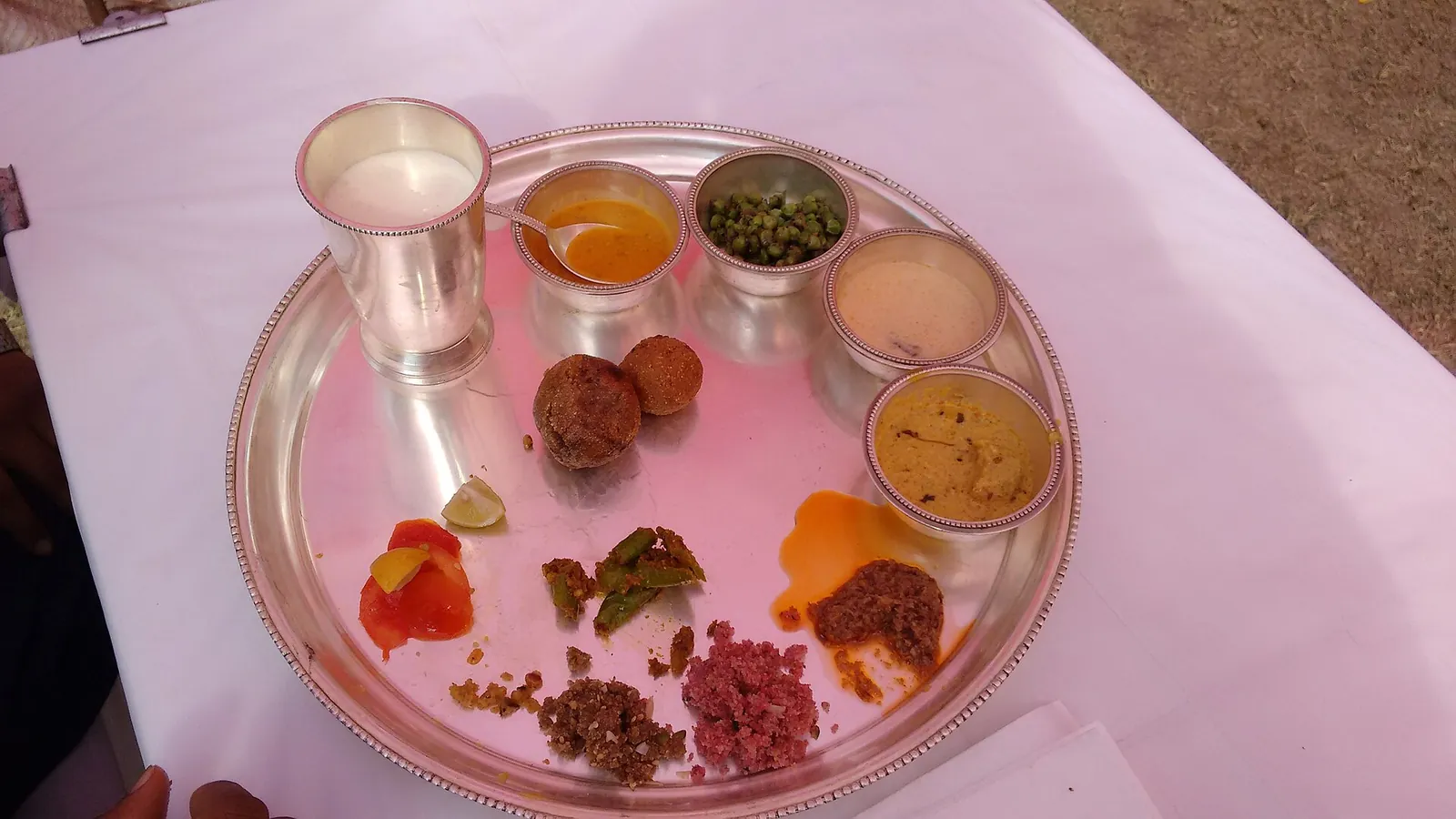
Dal baati churma
A Mewar classic: a hearty combination of lentils, pan-fried wheat balls (baati) and churma, a crumbled sweet-fried bread.
- Where to look
- Rajasthani restaurants on Lake Palace Road, one of the two food streets the Ministry of Tourism names in Udaipur. No restaurant is named for these dishes; each is placed by its food street.
- Fit it into your day
- Lunch on the City Palace day, before the afternoon boat.
A Mewari thali with gatte ki sabzi
A thali is a set meal of several dishes on one tray. Two Mewar dishes to look for are gatte ki sabzi, savoury chickpea-flour dumplings in gravy, and ker sangri, a tangy dish of dried berries and beans.
- Where to look
- Rajasthani restaurants on Lake Palace Road and in the lanes around Jagdish Temple, most of which serve a thali at lunch.
- Fit it into your day
- A long lunch on the old-city day.
Laal maas
A fiery red meat curry, the meat dish of the Mewar kitchen, coloured and heated by dried red chillies.
- Where to look
- Rajasthani restaurants on Lake Palace Road and along the ghats.
- Fit it into your day
- Dinner by the lake after the sunset boat.
Pyaaz kachori and mawa kachori
Kachoris are crisp fried pastries: pyaaz kachori is flaky and filled with onion, and mawa kachori is the sweet version.
- Where to look
- The snack stalls of Hathi Pol Bazaar, which the Ministry of Tourism names as one of Udaipur's food streets.
- Fit it into your day
- A mid-morning snack while you walk the bazaars.
Rajasthani food is rich in ghee, dairy and chilli; say so if you avoid dairy, gluten or nuts, and eat street snacks where they are fried in front of you.
Ghevar
A honeycombed sweet of flour and clarified butter soaked in sugar syrup, a festival delicacy, Incredible India says, and one of the sweets of Holi.
- Where to look
- Sweet shops around Hathi Pol Bazaar and Bada Bazar.
- Fit it into your day
- An afternoon sweet with tea after Bagore ki Haveli.
A three-night plan
This plan gives the City Palace and the boat one day, the old city and the lakes to the north another, and keeps the hilltop palace for the end.
- Day 1: arrive and check in. Walk up to Jagdish Temple for the evening aarti, then down to Gangaur Ghat and Ambrai Ghat for dinner by the water.
- Day 2: the City Palace Museum when it opens at 09:00, with time for Mor Chowk and Baadi Mahal; lunch; then the afternoon boat from Rameshwar Ghat to Jag Mandir, choosing a sunset trip if you can.
- Day 3: Bagore ki Haveli in the morning, the bazaars of Hathi Pol and Bada Bazar, and lunch in the old city; in the afternoon, Saheliyon ki Bari and a walk along Fateh Sagar; back to Gangaur Ghat in the evening for the Dharohar dance show.
- Day 4: Shilpgram in the morning, then the Monsoon Palace in the afternoon, before it closes at 17:00, if your train or flight leaves late; otherwise give it the afternoon of day 3 instead of Saheliyon ki Bari. With a fourth night, give day 4 to Kumbhalgarh and Ranakpur and move Shilpgram and the Monsoon Palace to day 5.
A priced three-night stay for two
This model follows the three-night plan above for two adults sharing a room, with prices checked on 17 October 2026.
- Room, Garden Hotel, standard room for one or two, 3 nights at INR 11,000 a night on HRH's tariff for 1 October 2026 to 31 March 2027 (INR 33,000), plus GST at 18%, the rate for rooms above INR 7,500 a night (INR 5,940): INR 38,940.
- Sights for two foreign adults: the City Palace Museum INR 800 (INR 400 each), Bagore ki Haveli INR 300 and Shilpgram INR 300 (INR 150 each): INR 1,400.
- Boat, the sunset trip to Jag Mandir at HRH's latest adult fare of INR 800 each: INR 1,600.
- Two lunches for two, the Garden Hotel's thali at INR 400 a person including taxes on HRH's tariff: INR 1,600.
- Total: about INR 43,540 for two.
- Not included: breakfasts, dinners and drinks; camera fees at Bagore ki Haveli and Shilpgram; the Crystal Gallery; the Monsoon Palace entry; the Dharohar show; taxis and auto-rickshaws; the car for Kumbhalgarh and Ranakpur; the airport transfer and onward trains or flights.
Practical questions
How many nights do I need in Udaipur?
Three nights: one day for the City Palace and the boat to Jag Mandir, one for Jagdish Temple, Bagore ki Haveli, the bazaars and Fateh Sagar, and a last morning for Shilpgram or the Monsoon Palace. With two nights, keep the City Palace, the boat and the old city.
How much is the City Palace ticket, and when is it open?
The City Palace Museum charges every adult INR 400, Indian or foreign; children aged 5 to 18 and students pay INR 150, and children under 5 enter free. It is open from 09:00 to 21:00 every day, with ticket sales closing at 20:00. Buy at the Badi Pol or Shitla Mata gate, or online in advance.
Which Lake Pichola boat should I take?
HRH's boats from Rameshwar Ghat stop at Jag Mandir, the island palace, and pass the City Palace, the ghats and the Lake Palace. Its latest fares are INR 600 for a regular trip and INR 800 for a sunset trip per adult.
Is the Monsoon Palace worth the trip?
Yes, for the view: the palace stands on the Bansdara hills above Fateh Sagar, and the late-afternoon light over the lake is the reason to go. It is open from 09:00 to 17:00; go up by taxi or auto-rickshaw.
How do I get to Udaipur?
Fly to Maharana Pratap Airport (UDR), 20 km from Udaipur City Railway Station, and take a taxi into town, or arrive by train at Udaipur City; from Jodhpur, most travellers come by car by way of Ranakpur.
When is the best time to visit Udaipur?
October to March, when days are warm and nights cool. April to June is hot, and June to September is the monsoon, when the Monsoon Palace lives up to its name, often in mist.
Sources and checks before you travel
Reference sources for the version dated 17 October 2026. Confirm opening times, access, transport and conditions for your travel dates.
- The City Palace Museum, Udaipur: FAQ (PDF) ↗ — opens in a new tab
- The City Palace Museum, Udaipur: plan your visit ↗ — opens in a new tab
- Ministry of Tourism (Incredible India): City Palace, Udaipur ↗ — opens in a new tab
- Ministry of Tourism (Incredible India): Lake Pichola ↗ — opens in a new tab
- Ministry of Tourism (Incredible India): Udaipur ↗ — opens in a new tab
- Ministry of Tourism (Incredible India): Jagdish Temple ↗ — opens in a new tab
- Ministry of Tourism (Incredible India): Monsoon Palace ↗ — opens in a new tab
- Ministry of Tourism (Incredible India): Fateh Sagar Lake ↗ — opens in a new tab
- Ministry of Tourism (Incredible India): Saheliyon ki Bari ↗ — opens in a new tab
- Ministry of Tourism (Incredible India): Bagore ki Haveli ↗ — opens in a new tab
- West Zone Cultural Centre: Bagore ki Haveli Museum ↗ — opens in a new tab
- West Zone Cultural Centre: about the centre, Shilpgram and the Shilpgram Utsav ↗ — opens in a new tab
- West Zone Cultural Centre: Shilpgram ↗ — opens in a new tab
- HRH Group of Hotels: Jagmandir Island Palace excursion and boat rides ↗ — opens in a new tab
- HRH Group of Hotels: The Mewar sound and light show ↗ — opens in a new tab
- HRH Group of Hotels: tariff 1 October 2026 to 31 March 2027 (PDF) ↗ — opens in a new tab
- Airports Authority of India: eAIP, Udaipur aerodrome data (VAUD) ↗ — opens in a new tab
- India Meteorological Department: Monsoon FAQ ↗ — opens in a new tab
- India Meteorological Department: Statement on the climate of India during 2025 (1 January 2026) ↗ — opens in a new tab
- IRCTC: Foreign Tourist Quota booking (PDF) ↗ — opens in a new tab
- Incredible India: Kumbhalgarh Fort ↗ — opens in a new tab
- Incredible India: must-visit Ranakpur Jain temple (travel account) ↗ — opens in a new tab
- UK Foreign Office: India safety and security ↗ — opens in a new tab
- Rajasthan Tourism: Ranakpur Temple ↗ — opens in a new tab
- Rajasthan Tourism: Jodhpur ↗ — opens in a new tab
- Rajasthan Tourism: Udaipur ↗ — opens in a new tab
- Archaeological Survey of India: ticketed monuments ↗ — opens in a new tab
- HRH Group of Hotels: The City Palace Museum ↗ — opens in a new tab
- HRH Group of Hotels: Crystal Gallery ↗ — opens in a new tab
- Press Information Bureau: GST rates on services recommended by the 37th GST Council ↗ — opens in a new tab
- GST Council: recommendations of the 56th meeting (PIB release of 3 September 2025) ↗ — opens in a new tab
- Incredible India: Jaipur ↗ — opens in a new tab
- Ministry of Tourism, Incredible India: Holi ↗ — opens in a new tab
- Incredible India (Ministry of Tourism): Jaipur ↗ — opens in a new tab
Does this experience fit your route?
Book a room in the old city, by Ambrai Ghat or on Gulab Bagh Road first, buy the City Palace Museum ticket online, and keep an afternoon for the boat to Jag Mandir.
Check dates and details on Viator ↗ — opens in a new tabAffiliate link · Book with ViatorPhoto credits
The City Palace rises above Lake Pichola, seen from the water
Photograph: Kshitiz Sikka — opens in a new tab · CC BY-SA 4.0 — opens in a new tab
Changes: Resized and converted to WebP; displayed with responsive crops. · Original photograph and licence details ↗ — opens in a new tab
The carved spire of Jagdish Temple, built in 1651, above the old city
Photograph: Jmadhu — opens in a new tab · CC BY-SA 4.0 — opens in a new tab
Changes: Resized and converted to WebP; displayed with responsive crops. · Original photograph and licence details ↗ — opens in a new tab
Gangaur Ghat and Bagore ki Haveli on the shore of Lake Pichola
Photograph: Jakub Hałun — opens in a new tab · CC BY-SA 4.0 — opens in a new tab
Changes: Resized and converted to WebP; displayed with responsive crops. · Original photograph and licence details ↗ — opens in a new tab
The Monsoon Palace (Sajjangarh) on its hilltop above Udaipur
Photograph: Roshan Kumar ( Photomylife ) — opens in a new tab · CC BY-SA 4.0 — opens in a new tab
Changes: Resized and converted to WebP; displayed with responsive crops. · Original photograph and licence details ↗ — opens in a new tab
The Gul Mahal on Jag Mandir, the island palace in Lake Pichola
Photograph: Vyacheslav Argenberg from Rostov-on-Don, Russian Federation — opens in a new tab · CC BY 2.0 — opens in a new tab
Changes: Resized and converted to WebP; displayed with responsive crops. · Original photograph and licence details ↗ — opens in a new tab
Dal baati churma served on a thali with buttermilk
Photograph: Rishabhbenganijain — opens in a new tab · CC BY-SA 4.0 — opens in a new tab
Changes: Resized and converted to WebP; displayed with responsive crops. · Original photograph and licence details ↗ — opens in a new tab