Zhejiang and Jiangsu
Hangzhou and Suzhou in three days: West Lake and Suzhou gardens
Hangzhou is a lake with a city around it: willows on the causeways, hills on the far shore and, in the north-west corner, a temple that was founded more than 1,700 years ago. Suzhou is a walled old town of canals and small classical gardens, where the best of them is laid out like a scroll you walk through. Both are a short high-speed train ride from Shanghai Hongqiao, and close enough to each other for one night in each.
In this guide
Find the location ↗ — opens in a new tabThe short answer
Book one night in Hangzhou, on Beishan Street or at Hubin by West Lake, and one in Suzhou around Pingjiang Road. Lingyin Temple has been free since 1 December 2025 but needs a passport booking at least a day ahead in its Alipay or Weixin mini-programme, and the Humble Administrator’s Garden costs CNY 80 (CNY 70 in June and from November to March), booked 1 to 7 days ahead. A second-class train is about CNY 80 to Hangzhou East and CNY 130 on to Suzhou. Two adults at mid-range prices spend about CNY 4,240 on the ground for three days, CNY 2,120 each, before flights.
- Suggested time
- 3 days / 2 nights
- Where to stay
- One night on the northern or eastern shore of West Lake in Hangzhou, one night in Suzhou’s old town around Pingjiang Road
- Season and timing
- In Hangzhou and Suzhou, spring (March to May) is the best season and autumn (September to November) the other good one for walking the lake and the gardens. Mid-June to early July is the plum-rain season. The British government says floods and storms are common from May to November, and typhoons hit southern and eastern coasts in the same season; transport can be disrupted.
Where to sleep in Hangzhou and Suzhou
Take the train out of Shanghai Hongqiao on the first morning, sleep the first night in Hangzhou and the second in Suzhou. The two cities are different in kind. Hangzhou is about open water and walking: the lake shore, a famous temple and the Longjing tea hills behind. Suzhou is about small, enclosed spaces: courtyards, rockeries, white walls and canal-side lanes. If you only have two days, give both to one city: Hangzhou for scenery and a temple, Suzhou for gardens.
Beishan Street, on the northern shore of West Lake, is the quieter choice in Hangzhou. It runs west from Baochu Road by the Broken Bridge, with the lake on one side and Baoshi Hill on the other, and from it you can be out on the Bai Causeway on foot before the crowds. A mid-range double costs about CNY 500 a night. What you give up is the easy arrival: metro line 1 from Hangzhou East stops at Longxiangqiao, so the last stretch is a walk or a taxi with your bags.
Hubin, on the eastern shore, is the easiest arrival. Metro line 1 runs straight from Hangzhou East to Longxiangqiao, the station beside the lake at the Hubin shopping streets, the boats to the island leave from the Hubin piers, and Hubin runs into Beishan Street by the Broken Bridge. The rate is about the same, CNY 500. What you give up is quiet: on busy days Longxiangqiao is so crowded that the trains tell lake-bound passengers to get off at Fengqi Road or Ding’an Road instead.
In Suzhou, sleep in the old town around Pingjiang Road and Guanqian Street. The Humble Administrator’s Garden, the Suzhou Museum and Lion Grove Garden are all close to Pingjiang Road, metro line 6 stops at Xuanqiaoxiang for the street and at Zhuozhengyuan Subo for the garden, and Songhelou’s Guanqian Street branch is in the same part of town, so the evening and the garden morning need no transport. Allow about CNY 550 a night. The cost is a metro or taxi ride from Suzhou station on arrival. A hotel by Suzhou station makes sense only if you arrive late or leave on an early train: the trains in this plan use the main station and the rate is much the same, but you give up the evening in the lanes, and the garden becomes a ride away.
Hotels register foreign guests with the police for you. Chinese policy says hotels should not turn foreign guests away for lacking a licence, but not every property can register foreigners; confirm with the hotel before you book.
West Lake and the Bai Causeway
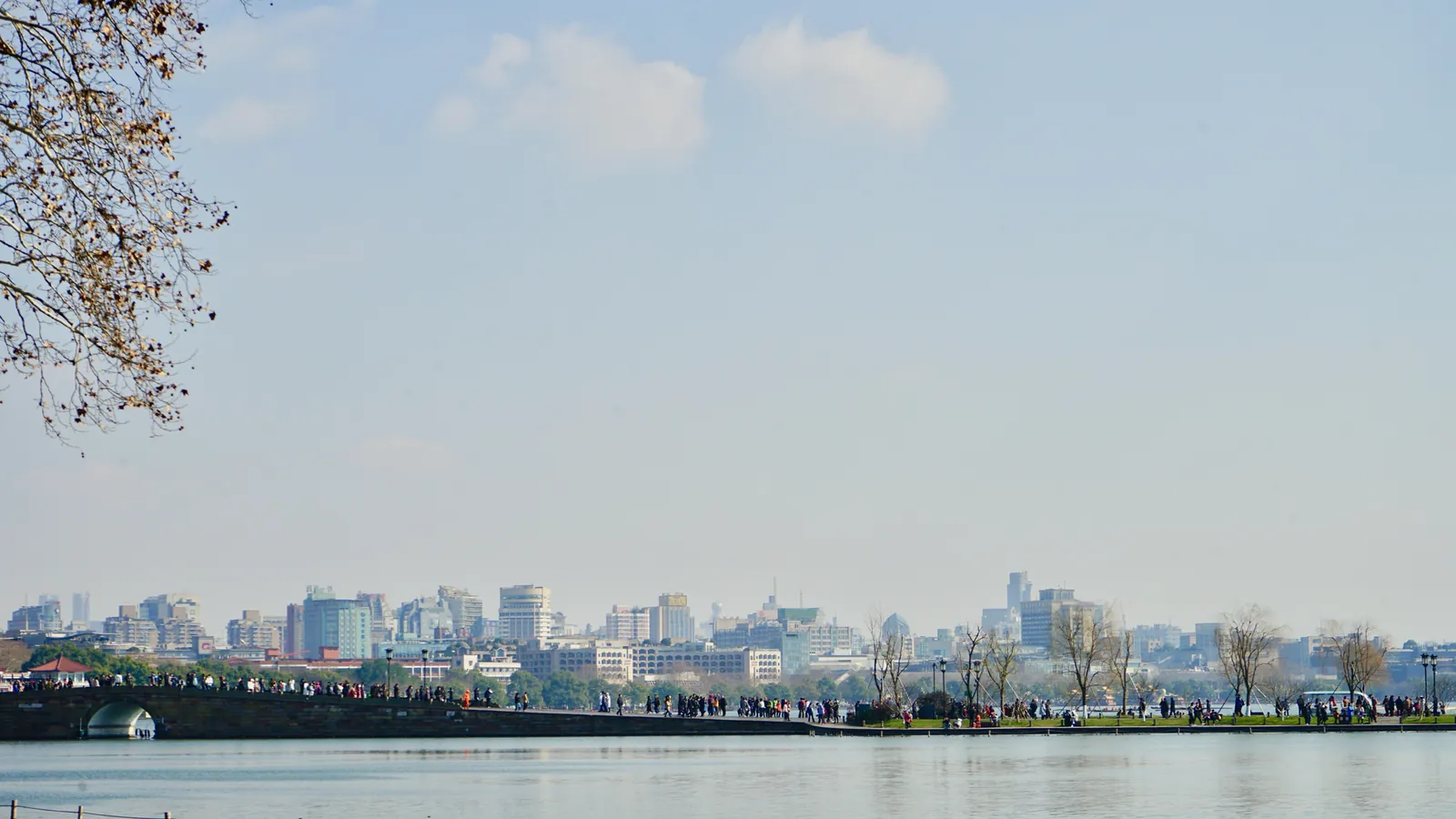
West Lake is the reason to come to Hangzhou, and it has been free to walk around since 2002, when the city removed the fences and cancelled the entrance fee under the slogan “Return West Lake to the People”. The shore is a long loop of paths, willows and causeways, with hills on the western side and the city’s towers on the east. Start on the northern shore near the Broken Bridge, an old stone arch where the Bai Causeway begins, and walk out along the causeway; the view back across the water to the skyline is the one most people photograph.
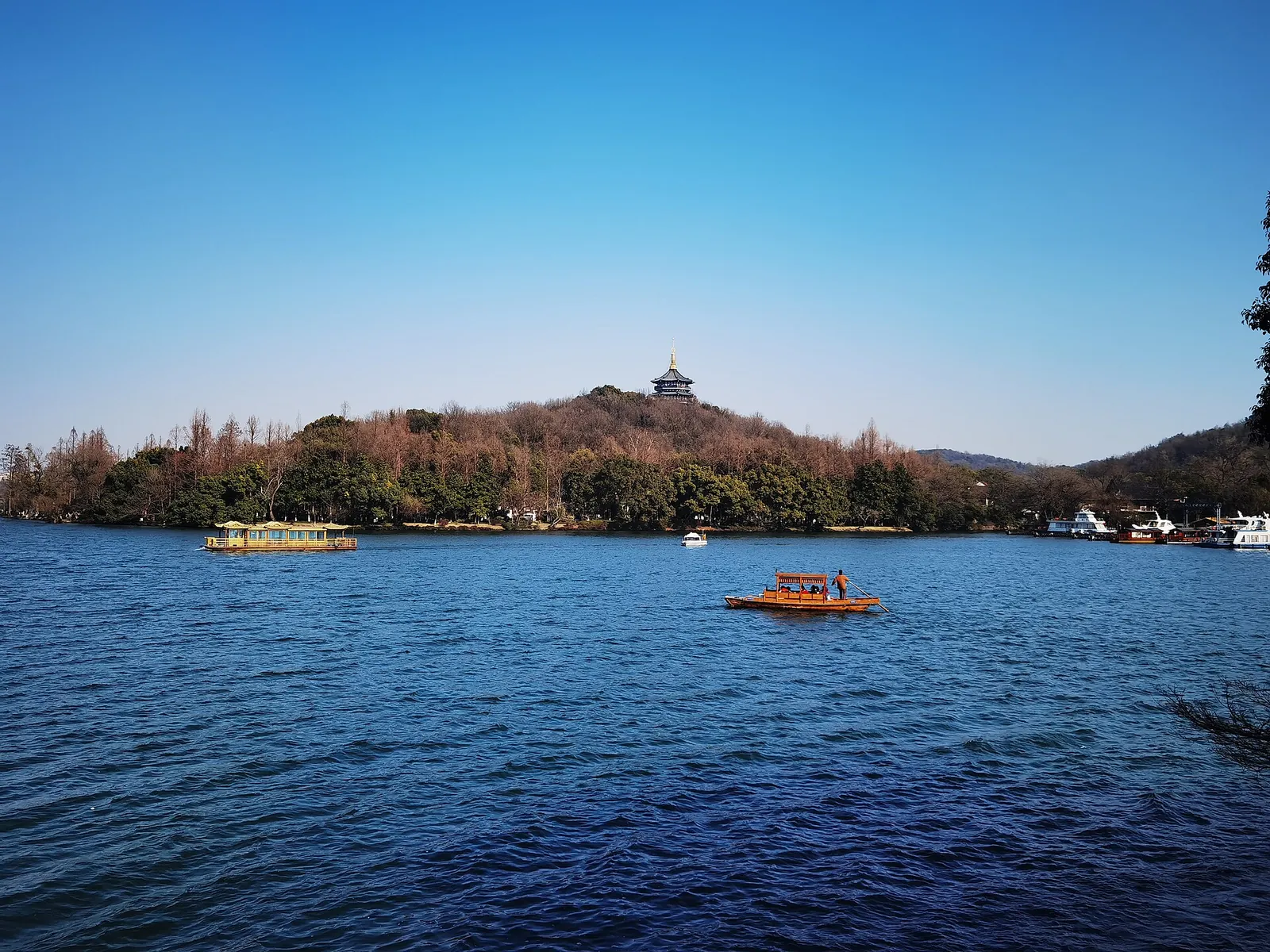
Right behind the Broken Bridge, on the northern shore, Baoshi Hill carries the slim Baochu Pagoda; you see it best from the causeways and from the eastern and southern shores. The Su Causeway stretches nearly three kilometres across the lake: the poet-official Su Shi (1037 to 1101) had the lake dredged during the Northern Song, nearly 1,000 years ago, and the causeway was built from the mud. On the southern shore, Leifeng Pagoda was first built in the Five Dynasties (907 to 960) by Qian Hongchu, a king of that period. Japanese pirates burned it in the Ming dynasty and it collapsed in the 1920s after thieves took bricks from its foundations; the present five-sided, eight-storey pagoda dates from 2002 and looks its best at sunset. A ticket costs CNY 40, booked on official platforms up to 7 days ahead or bought on site by scanning a QR code. Walking the shore and the causeways needs no ticket, and half a day of it, with a stop for tea, is enough for a first visit.
For Longjing, the green tea that gives Longjing shrimp its name, go to Meijiawu, a tea village in south-west Hangzhou about two kilometres north-west of the bamboo-lined path at Yunqi. It lies in the protected original Longjing growing area, with 133 hectares of tea and many teahouses, and makes an unhurried afternoon if you have one to spare.
To see the lake from the water, take the boat to Xiaoyingzhou, the island of Three Pools Mirroring the Moon. Hangzhou West Lake Cruise Company (西湖游船) runs the island boats from nine piers round the shore, among them the Hubin piers at parks 1, 2 and 5, Shaoniangong (the Children’s Palace) and Zhongshan Park. The ticket covers the crossing, as long as you like on the island and the return. It costs CNY 55 a person on an ordinary boat and CNY 70 on the larger painted and new-energy boats, both including the CNY 20 island ticket (fares from the city’s March 2025 list, still the latest official list we could find when we checked on 26 October 2026). Ticket sales run from 08:00 to 16:30 from 16 February to 31 March and 1 September to 15 November, from 08:00 to 17:00 from 1 April to 31 August, and from 08:00 to 16:00 from 16 November to 15 February. Weather can suspend boats. A hand-rowed boat for up to six costs CNY 150 an hour.
Lingyin Temple and Feilaifeng
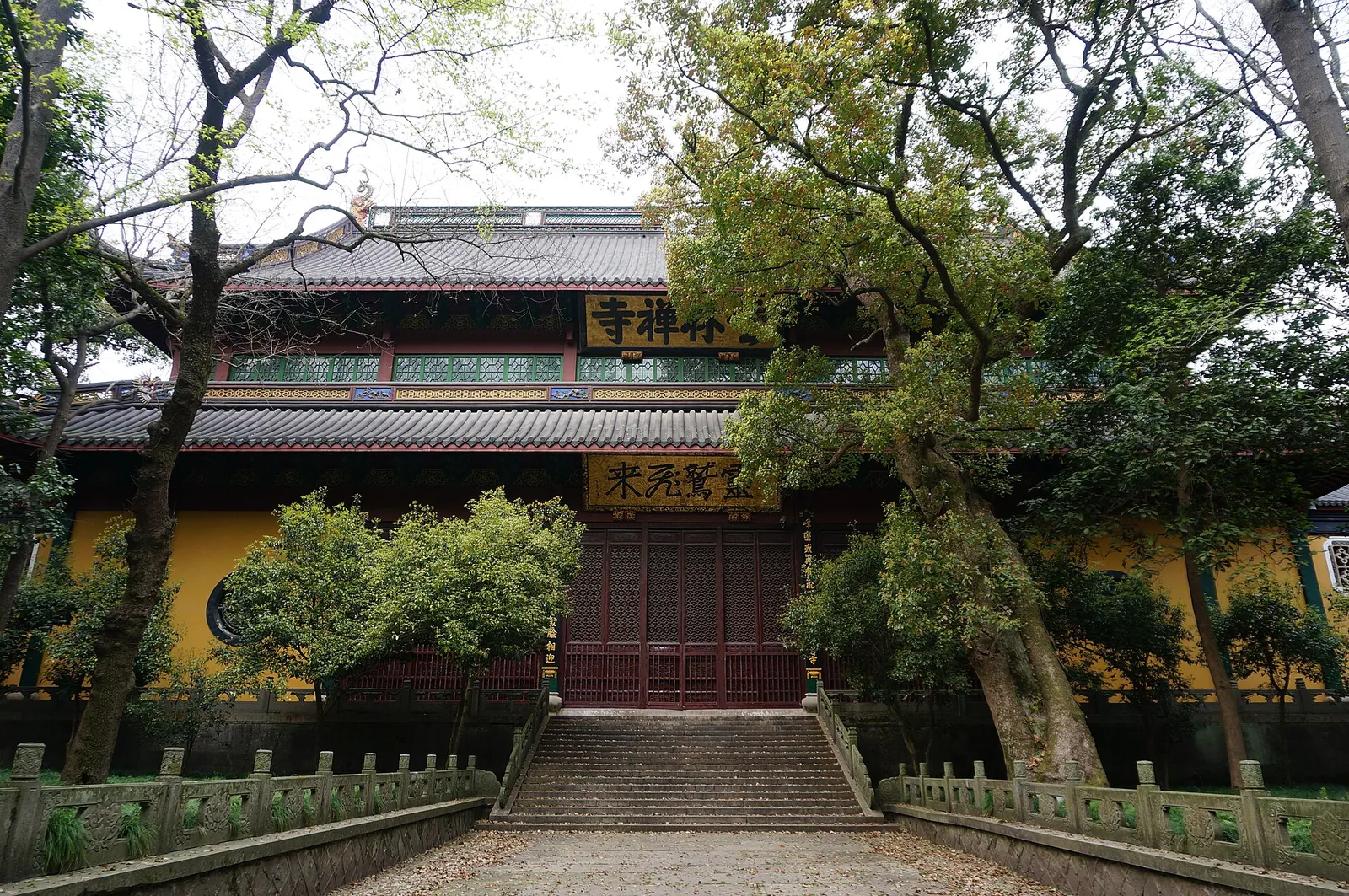
Lingyin Temple lies in the hills north-west of the lake. It was founded in the Eastern Jin dynasty (317 to 420), more than 1,700 years ago. It is also busy: the scenic area received 10.88 million visitors in 2024. The halls climb the slope one behind another. Behind the Hall of Heavenly Kings, the 33.6-metre Grand Hall of the Great Sage (Mahavira Hall) holds a seated Sakyamuni Buddha made from 24 pieces of camphor wood for the rebuilding of 1953, which the temple calls China’s largest camphor-wood statue. On the wall behind it, more than 150 clay figures in a group 20 metres high tell the pilgrimage of the boy Sudhana, with Guanyin standing on a sea turtle.
Across the Lengquan stream from the temple, Feilaifeng (Feilai Peak) is carved with Buddhist figures in its cliffs and caves: about 115 niches holding more than 390 figures, begun in the Five Dynasties and continued through the Song and Yuan into the Ming. The oldest dated group, the Three Sages of the West, was carved in 951. The Yuan carvings are the largest and finest group, many of them in Tibetan Buddhist style, which makes the hillside one of the biggest sites of Tibetan Buddhist art in China.
Since 1 December 2025 the whole scenic area, which includes Lingyin, Yongfu and Taoguang temples as well as Feilaifeng, is free; the former CNY 45 scenic-area ticket and CNY 30 incense voucher are gone. Instead, book in the “杭州灵隐飞来峰” (Hangzhou Lingyin Feilaifeng) mini-programme, found by searching inside Alipay or Weixin (WeChat). Visitors from outside mainland China book with their passport and show the original at the gate. Bookings for each day open at 08:00 seven days ahead and close the day before; same-day bookings are not taken. Choose a morning slot, which lets you in from 07:30 until 13:00, or an afternoon slot, which lets you in from 11:00 until last entry at 17:00. The scenic area is open daily from 07:30 to 17:30, with last entry at 17:00.
If plans change, cancel in the mini-programme by midnight on the day of the visit: three no-shows within 30 days block new bookings for the next 30 days. Bus 7, Hangzhou’s oldest line, runs from Hubin to Lingyin; a taxi is quicker on the day you leave for Suzhou.
Trains between Shanghai, Hangzhou and Suzhou
For this route, choose Hangzhou East as your arrival station from Shanghai Hongqiao; Hangzhou station is a separate station. The 12306 inventory checked on 25 October 2026 for 5 November listed 109 direct G and D trains, taking 45 minutes to 1 hour 27 minutes, with second class at CNY 57 to 87. Those are dated comparisons; use 12306 for your travel date.
The 12306 searches checked on 25 October 2026 for 2 and 3 November listed direct trains from Hangzhou East to Suzhou, the main station, from morning to evening, that call at Shanghai Hongqiao on the way. They take 1 hour 15 minutes to 2 hours 4 minutes, with second class at CNY 92 to 133, and you stay in your seat for the whole run. Book the main station and not Suzhou North, which is a different station where some trains from Hangzhou East stop instead. If the direct trains are full, buy two tickets and change at Shanghai Hongqiao.
In those same dated searches, trains for the way back from Suzhou to Shanghai Hongqiao take 32 to 44 minutes, at CNY 28 to 41 in second class. Book all three legs in the 12306 app with the passport you will travel on; our transport guide explains tickets, the booking window and the station routine.
The Humble Administrator’s Garden
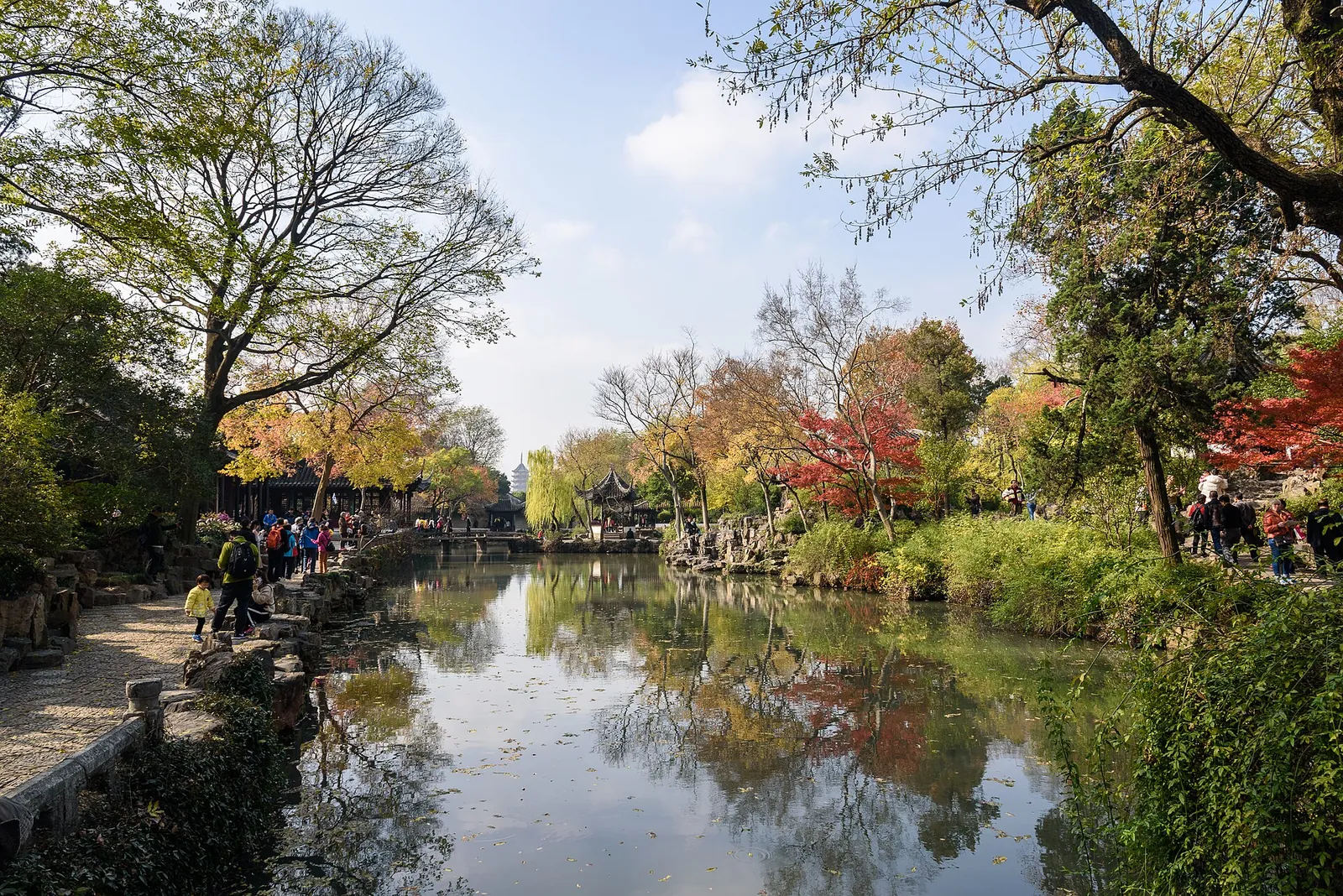
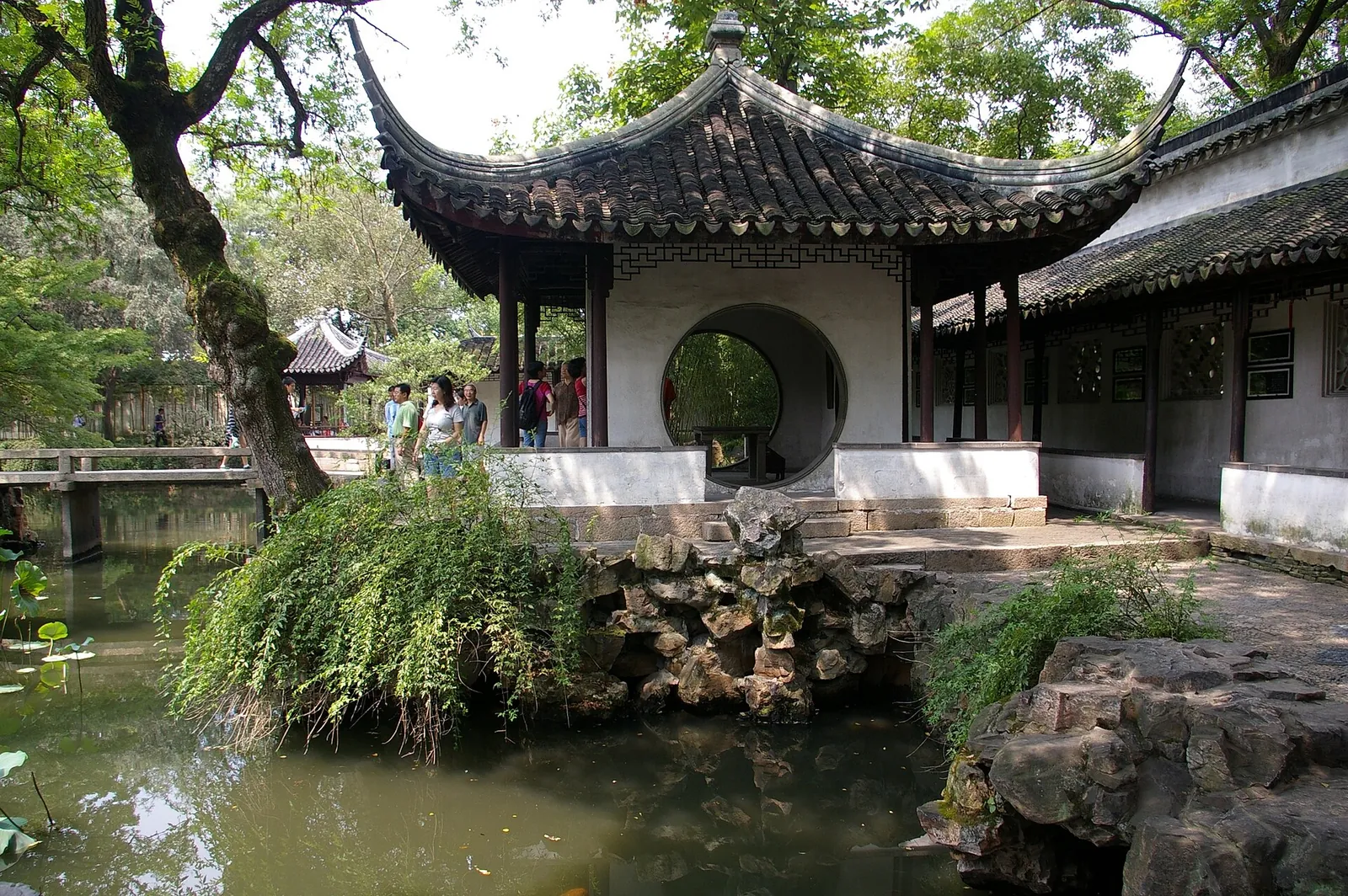
The Humble Administrator’s Garden is the largest surviving classical garden in Suzhou and on the World Heritage list. Water is its centre: a broad pond with islands, pavilions and covered bridges, with rockeries and trees arranged so that every turn opens a different view. The eastern garden is open and spare, the central garden is the one to linger in, and the western part has the finer buildings. The house and its courtyards sit at the southern edge. It is at 178 Dongbei Street, in the north-east of the old town.
There are no ticket sales at the gate. Book a real-name, timed entry 1 to 7 days ahead on the Suzhou Gardens Tourism (苏州园林旅游) account in Weixin, which accepts passports. A ticket costs CNY 80 a person in April, May and July to October, and CNY 70 in the low-season months (January to March, June, November and December). Opening hours follow the season: from March to October the garden is open from 07:30 to 17:30 and stops admitting visitors at 17:00; from November to February it is open from 07:30 to 17:00 with last admission at 16:30. Around Qingming, 1 May, Mid-Autumn and National Day it stays open half an hour later, to 18:00. Metro line 6 to Zhuozhengyuan Subo station, exit 2, leaves a walk of 5 to 10 minutes.
Next door, at 204 Dongbei Street, the Suzhou Museum opened its main building by I. M. Pei in 2006, set among courtyards and water in the manner of a Suzhou garden; the museum’s original home, Prince Zhong’s Mansion, is the most complete surviving group of Taiping Heavenly Kingdom buildings. Entry has been free since 2008, but it needs a real-name, timed booking with each visitor’s name and ID number: book up to seven days ahead, counting the day itself, on the museum’s website, its Weixin account or the “苏州博物馆全预约” mini-programme; if tickets are left, same-day bookings close at 15:40. It is open from 09:00 to 17:00, with last entry at 16:00, and closed on Mondays except national public holidays. Cancel before your slot ends if you cannot go: two no-shows in a row, or four in 90 days, block bookings for 90 days.
A single garden takes two to three hours. Spend the rest of the day on Pingjiang Road, close by: a canal-side street of old lanes, arched bridges over narrow waterways, whitewashed walls and black-tiled roofs. It is free and needs no booking; a ride in a yuloh, the oared canal boat, costs CNY 40 a person, and metro line 6 to Xuanqiaoxiang, exit 2, leaves a walk of about 100 metres to the middle of the street. Early morning is the quietest time, and towards evening the lanterns come on.
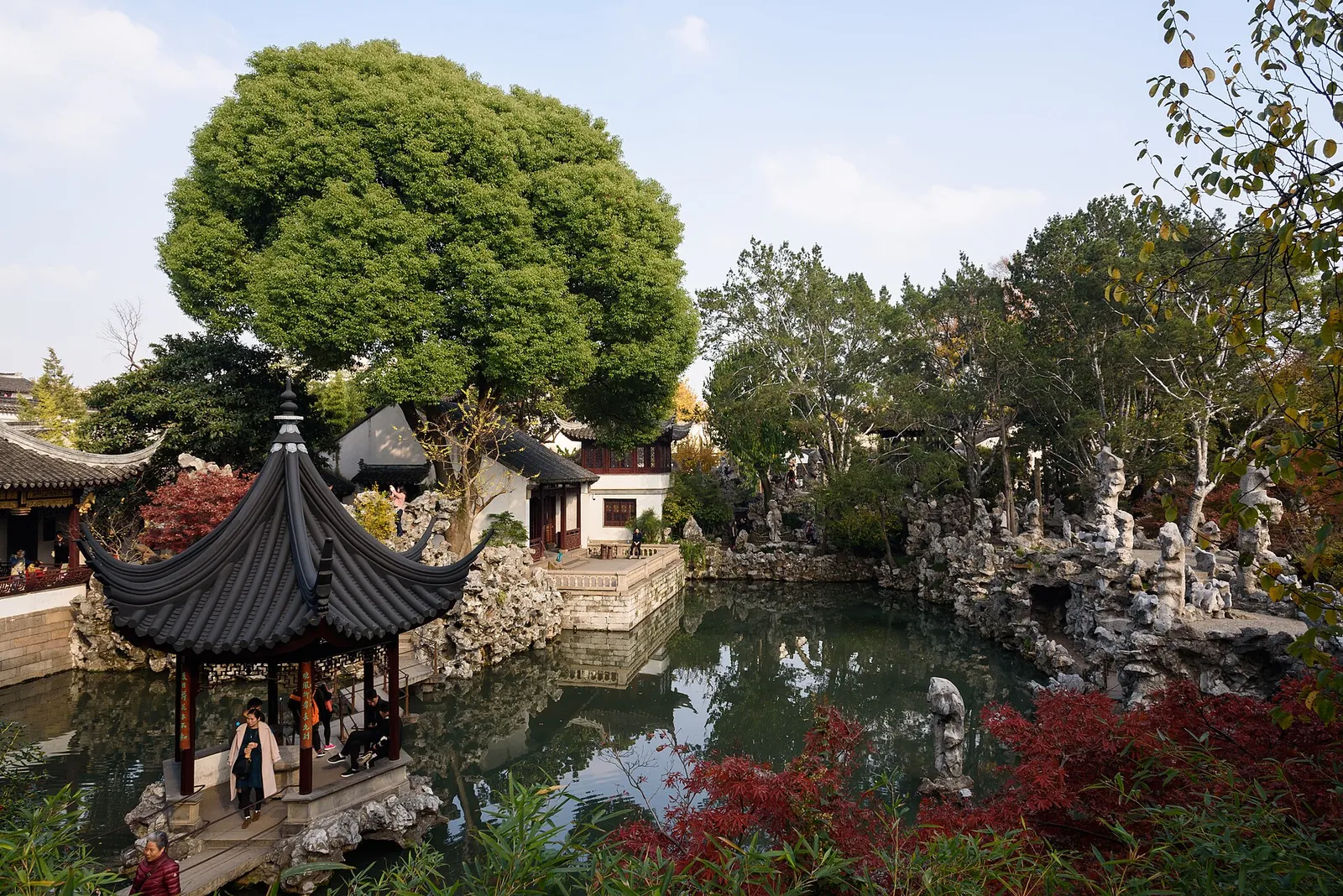
Lion Grove Garden, also close to Pingjiang Road, is built around a pond and pavilion framed by heaped rockeries. It keeps the same hours as the Humble Administrator’s Garden, including the later closing at the four holidays, and costs CNY 40 (CNY 30 in the low-season months).
The Lingering Garden (Liuyuan), at 338 Liuyuan Road and a taxi ride from Pingjiang Road, was laid out as a private garden in 1593 and joined the Humble Administrator’s Garden on the World Heritage list in 1997. Its eastern part is a run of courtyards linked by lattice windows, doorways and covered walks, which the Suzhou garden bureau calls the most varied courtyard spaces of any Suzhou garden, and more than 700 metres of winding corridors join its four parts. There too stands Guanyun Peak, a Taihu rock 6.5 metres high, said to date from the Song dynasty and the largest lake rock in any garden south of the Yangtze. Tickets cost CNY 55 (CNY 45 in the low-season months), and the garden keeps the same hours as the Humble Administrator’s Garden, including the later closing at the four holidays.
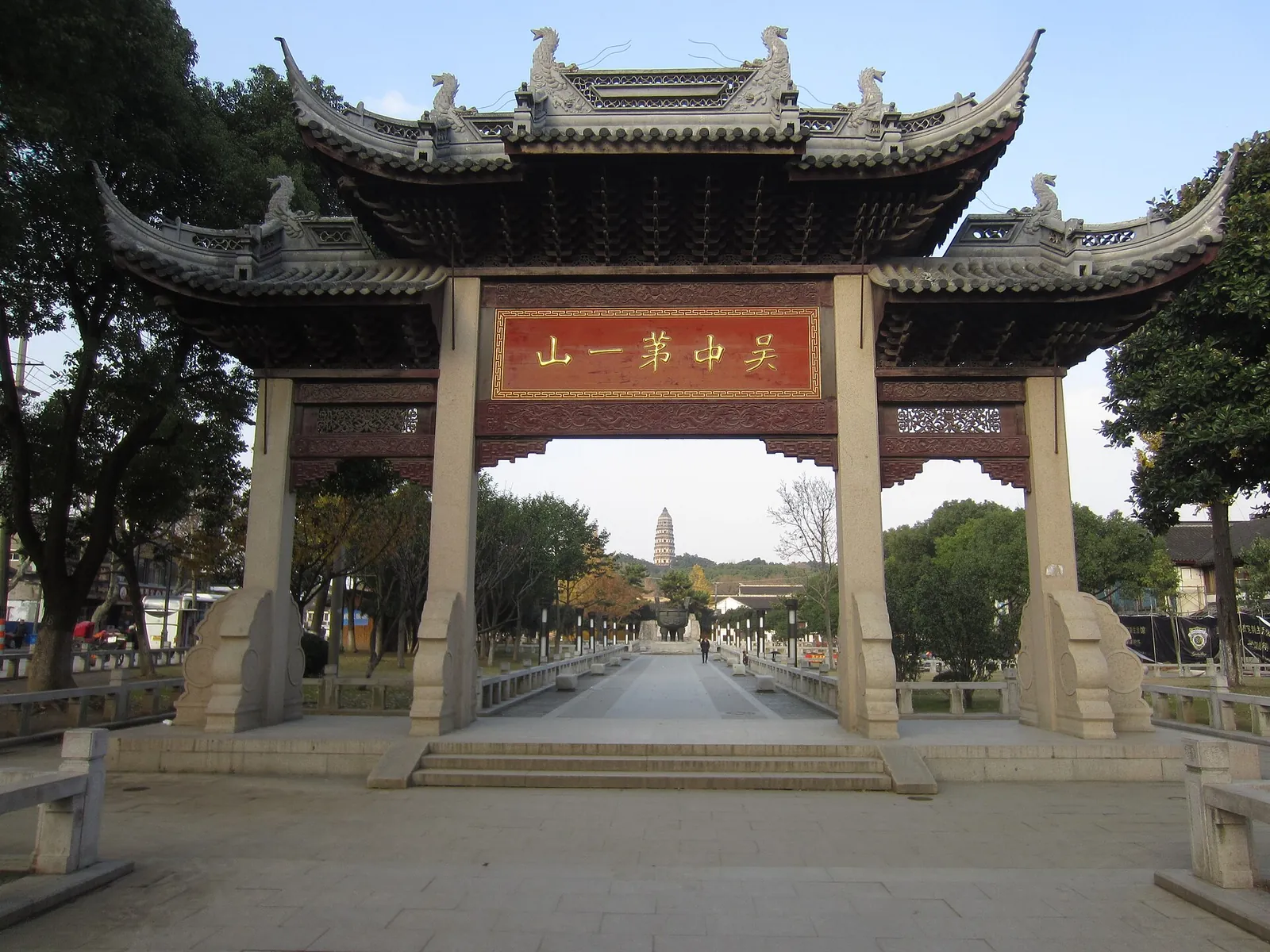
Tiger Hill, the third option, is a hill only 34 metres high crowned by the Yunyan Temple Pagoda, which leans and has stood for more than 1,000 years. On the way up from the south gate you pass the Yuan-dynasty Broken Beam Hall, the flat Thousand People Rock and Sword Pond, said to be the tomb of King Helü of Wu (reigned 514 to 496 BC); the full loop takes two and a half to three hours. Tickets cost CNY 70 (CNY 60 in the low-season months); booking 1 to 7 days ahead is recommended and passports are accepted. The hill is open from 07:30 to 18:00 from May to October, with last entry at 17:30, and from 07:30 to 17:30 from November to April, with last entry at 17:00; the garden bureau lists an 18:00 closing during Qingming. Metro line 6 to Tiger Hill station, exit 3, leaves a walk of about 500 metres to the south gate.
Three days in order
The plan puts each reservation in a morning slot and leaves the afternoons for the lake, the train and one optional extra.
- Day 1, Shanghai to Hangzhou. Take a morning train from Hongqiao to Hangzhou East, leave your bags at the hotel and have lunch at Hangzhou Jiujia. In the afternoon walk from the Broken Bridge along the Bai Causeway to Gushan, then down the Su Causeway to the southern shore, and end at Leifeng Pagoda (CNY 40 a person) for the sunset; the boat to Xiaoyingzhou from the Hubin piers (CNY 55 or 70 a person) is the alternative if you would rather sit. Take a taxi back to Lou Wai Lou on Gushan Road for dinner.
- Day 2, Lingyin and the train to Suzhou. Check out, leave your bags at the hotel and visit Lingyin Temple and Feilaifeng in your morning slot. After lunch, pick up the bags by taxi on the way to Hangzhou East and take an early-afternoon direct train to Suzhou. Evening walk on Pingjiang Road and dinner at Songhelou.
- Day 3, the garden, the museum and home. Pan-fried buns at Yaba Shengjian, then the Humble Administrator’s Garden in your reserved slot and the Suzhou Museum next door (booked too; closed on Mondays). Choose one extra instead of the museum: Lion Grove Garden, a short walk away; the Lingering Garden, a taxi ride away; or Tiger Hill by metro line 6, which needs two and a half to three hours. Then take the train from Suzhou to Hongqiao. For a flight from Pudong, allow the station transfer, the roughly 40-minute Airport Link Line journey and your airline’s check-in time; choose a late departure, or spend a night in Shanghai before an early flight.
What to eat and where to look
West Lake vinegar fish
A lake fish poached whole and glazed with a sweet-sour vinegar sauce, in the style of the Southern Song court, which made Hangzhou its capital.
- Where to look
- Lou Wai Lou, founded in 1848 at 30 Gushan Road on the lake shore, made its name with this dish.
- Fit it into your day
- Dinner on the first evening, one fish shared between two.
Longjing shrimp
Shrimp cooked with Longjing (Dragon Well) green tea, which gives the dish the flavour of the local tea. With Dongpo pork, named after Su Shi, and West Lake vinegar fish, it is one of the classic dishes of Hangzhou cuisine.
- Where to look
- Lou Wai Lou, where Longjing shrimp and Dongpo pork are signature dishes alongside the vinegar fish.
- Fit it into your day
- A plate to share with the fish at the Lou Wai Lou dinner.
Aubergine with minced pork (rou mo qie zi)
A Hangzhou home-style dish: tender aubergine stir-fried in a rich fermented sauce with a scattering of minced pork, soft and savoury.
- Where to look
- Hangzhou Jiujia (Hangzhou Restaurant) on Yan’an Road, where the food writer Fuchsia Dunlop ate it. It opened in 1921 as a tavern known for aged Shaoxing wine and is known today for traditional Hangzhou cooking.
- Fit it into your day
- Lunch on arrival day, one plate with rice to share.
Squirrel-shaped mandarin fish
A boned, scored and deep-fried fish that is cut so that it fans out like a squirrel’s tail, then covered with a hot sweet-and-sour sauce that sizzles at the table. It was named one of Jiangsu’s Top Ten Classic Signature Dishes in September 2018.
- Where to look
- Songhelou, the century-old Suzhou restaurant tied to the dish; its Guanqian Street branch is at 72 Taijian Lane, at about CNY 140 to 180 a person.
- Fit it into your day
- Dinner on the Suzhou evening.
Suzhou pan-fried buns (shengjian)
Pork buns fried until the bottoms are crisp, with thin skins and a juicy filling that is savoury with a little sweetness; a breakfast or afternoon snack.
- Where to look
- Yaba Shengjian, at 12 Wenjia’an off Lindun Road in Gusu, the district that holds the old town, at about CNY 20 to 30 a person.
- Fit it into your day
- Breakfast on the garden morning, before your slot.
What three days in Hangzhou and Suzhou cost
| Level | Per person, about CNY | For two, about CNY |
|---|---|---|
| Mid-range | 2,120 | 4,240 |
This budget is for two adults sharing one private double room for two nights, one in Hangzhou and one in Suzhou, in an ordinary week in November outside the national holidays, with prices checked on 25 and 26 October 2026. It covers rooms, three meals a day with water and snacks (including the two restaurant dinners in the plan), three intercity train legs, local rides and the return Pudong–Hongqiao Airport Link journeys, the garden and Leifeng Pagoda tickets, two SIMs and a 10% buffer. Room estimates include estimated taxes and service charges and are based on late-November rate cards of international hotel chains; check the property’s total and foreign-passport registration before a non-refundable booking.
A London return flying into and out of Shanghai costs about GBP 650 to 850 a person (GBP 1,300 to 1,700 for two), an estimate based on Etihad’s displayed return economy fares from GBP 563, read on 26 October 2026. With it the three days come to about GBP 890 to 1,090 a person (GBP 1,770 to 2,170 for two), converted at the official central parity rate of 23 October 2026 (GBP 1 = CNY 8.9749).
- Rooms, about CNY 1,050 for two. One night at about CNY 500 in Hangzhou and one at about CNY 550 in Suzhou; these are full double-room estimates for two including estimated taxes and service charges; the food line covers every meal.
- Food, about CNY 1,440 for two. About CNY 30 a person for breakfast, 60 for lunch and 20 for water and snacks each day; about CNY 160 a person for each of the two dinners at Lou Wai Lou and Songhelou, the middle of Songhelou’s listed CNY 140 to 180, used for both because Lou Wai Lou publishes no prices; and about CNY 70 a person for the third dinner.
- Getting around, about CNY 840 for two. Three second-class train legs at about CNY 80, 130 and 40 a person (CNY 500 for two); about CNY 30 a person (CNY 60 for two) for metro and bus rides; and about CNY 180 a vehicle in all for four or five taxi rides, mainly to and from Lingyin and to the stations with bags, at Hangzhou’s meter rate of CNY 13 for the first 3 km and CNY 2.50 a km after that. The return Pudong–Hongqiao Airport Link journeys add CNY 104 for two at CNY 26 a person each way.
- Sights, about CNY 220 for two. Two Humble Administrator’s Garden tickets at the November price of CNY 70 (CNY 80 in the peak months) and two Leifeng Pagoda tickets at CNY 40; West Lake, Lingyin Temple and the Suzhou Museum are free.
- SIM and extras, about CNY 300 for two. About CNY 150 a person is an estimate based on China Telecom’s published 15-day visitor card at CNY 125 (30 GB, on sale until 30 November 2026). The tariff does not guarantee the same offer at either base; take your passport.
- Buffer, about CNY 390 for two. Ten per cent of the subtotal of CNY 3,854.
Entry, safety and getting online
Ordinary-passport holders from the United Kingdom, Germany, France, Italy, Spain, the Netherlands and the other listed nationalities can stay up to 30 days without a visa, counted from the day after entry. The waiver is published until 31 December 2026. For a 2027 trip, check that a published extension covers your arrival date or obtain a visa. US and Czech passports are not on this visa-free list. US and Czech citizens need a visa unless they qualify for the 240-hour transit rule, which needs an ordinary passport, a confirmed onward ticket with a date and seat to a third country or region, entry through one of 65 designated ports, and travel only within the permitted area; a return to where you started does not count. Shanghai, Zhejiang and Jiangsu are all permitted areas; our entry guide has the full list and the rest of the rules.
Carry your original passport at all times; a printed copy is not accepted. The British government warns of a risk of arbitrary detention, and British and German advice both warn that exit bans can affect visitors, and the British government says they can last months or years. Avoid demonstrations, large gatherings and any political or activist activity; the French government warns of prison, expulsion and a ban on returning. The French government advises against photographing military or official sites, or any place where photography is banned; some sites are not signposted, and places of worship can have their own rules. German advice is to refrain from using VPN services; plan on limited access to some overseas apps and keep offline maps and notes. Air pollution in big cities is often high to very high, especially in winter; check live readings. Check your own government’s current travel advice before you book.
The two bookings that matter are made on your phone: Lingyin Temple in an Alipay or Weixin (WeChat) mini-programme, the Humble Administrator’s Garden on a Weixin account. Set up Weixin Pay (WeChat Pay) and Alipay and test them before you leave, keep a second card and some cash, and save your hotel addresses in Chinese. Our payments and apps guide explains how.
Practical questions
How many nights should I spend in Hangzhou and Suzhou?
Two nights, one in each, give three days: West Lake and Lingyin Temple in Hangzhou, then the Humble Administrator’s Garden and the old town in Suzhou. If you only have two days, give both to one city.
Is Lingyin Temple free, and do I need to book?
It has been free since 1 December 2025; the former CNY 45 ticket and CNY 30 incense voucher were abolished. You still need a booking: a morning or afternoon slot, made with your passport in the Hangzhou Lingyin Feilaifeng mini-programme in Alipay or Weixin.
How do I book the Humble Administrator’s Garden?
Book a real-name, timed entry 1 to 7 days ahead on the Suzhou Gardens Tourism account in Weixin, which accepts passports; there are no ticket sales at the gate. The ticket is CNY 80 in April, May and July to October and CNY 70 in the other months.
Which train station do I use in each city?
Hangzhou East for Hangzhou and Suzhou, the main station, for Suzhou. Suzhou North is a different station. Direct trains run between Hangzhou East and Suzhou, and both stations connect to Shanghai Hongqiao.
Can I do Hangzhou and Suzhou as day trips from Shanghai?
Either one can be a long day by train, but the Lingyin reservation and the garden’s timed entry fit better with a night in each city. Our transport guide explains booking the trains.
Is West Lake free?
Yes. The city removed the fences and cancelled the entrance fee in 2002, and walking the shore and the causeways needs no ticket.
Do I need a visa?
Not for up to 30 days on an ordinary British, German, French, Italian, Spanish or Dutch passport, or another on the list in our entry guide, while the waiver runs to 31 December 2026. US and Czech citizens need a visa or must qualify for 240-hour transit; the entry section above sets out the conditions.
Keep planning your trip
Shanghai
Three nights in Shanghai: the Bund and a river cruise, Yu Garden, the French Concession, Pudong, Shanghai Museum East, Zhujiajiao, airports and costs.
Read the guide
Xi’an
Two nights in Xi’an: booking the Terracotta Army and the Shaanxi History Museum with a passport, the City Wall, where to stay and what it costs.
Read the guide
China in ten days
A ten-day China itinerary with nine nights in Beijing, Xi’an, Chengdu and Shanghai, a Hangzhou day trip, timed-ticket booking, rail and flight legs and an all-in budget.
Read the guide
First trip to China
How long a first China trip should be, then a week in Beijing, Xi’an and Shanghai: what to book first, the trains, entry, paying and the cost per day.
Read the guide
Getting around China
Book China's high-speed trains on 12306 with a foreign passport, decide when to fly, and get from the airports and stations into town.
Read the guide
Best time to visit China
When to go to China by region and month: spring and autumn for Beijing, Xi’an and Shanghai, rain and typhoon seasons, and the expected 2027 holiday peaks.
Read the guideSources and checks before you travel
(47)
- Hangzhou government: Lingyin free admission and West Lake ↗ — opens in a new tab
- Suzhou water bureau: Humble Administrator’s Garden ↗ — opens in a new tab
- Suzhou government: Humble Administrator’s Garden booking notice ↗ — opens in a new tab
- Suzhou garden bureau: opening hours ↗ — opens in a new tab
- Hangzhou government: Hangzhou cuisine ↗ — opens in a new tab
- Hangzhou government: Lou Wai Lou Restaurant ↗ — opens in a new tab
- China Travel: Suzhou Squirrel Fish ↗ — opens in a new tab
- Chinese Embassy in Timor-Leste: visa-free FAQ ↗ — opens in a new tab
- National Immigration Administration: accommodation registration ↗ — opens in a new tab
- UK government: China safety and security ↗ — opens in a new tab
- German Foreign Office: China safety ↗ — opens in a new tab
- French diplomacy: practical information for China ↗ — opens in a new tab
- State Administration of Foreign Exchange: renminbi central parity table ↗ — opens in a new tab
- Hangzhou government portal (eHangzhou, CGTN): the Su Causeway ↗ — opens in a new tab
- Hangzhou government portal (eHangzhou): Leifeng Pagoda ↗ — opens in a new tab
- Hangzhou government portal (eHangzhou): Meijiawu Tea Culture Village ↗ — opens in a new tab
- China News Service: interview with the Lingyin management office on the Feilaifeng carvings (August 2024) ↗ — opens in a new tab
- Hangzhou news portal: Longxiangqiao metro station crowding (April 2025) ↗ — opens in a new tab
- Hangzhou news portal: Longxiangqiao station (August 2026) ↗ — opens in a new tab
- Shanghai government: Shanghai's four seasons ↗ — opens in a new tab
- China Bound (China Daily): getting to Suzhou ↗ — opens in a new tab
- China Bound (China Daily): a foodie's map of Suzhou (May 2026) ↗ — opens in a new tab
- China Bound (China Daily): street eats in Suzhou (May 2026) ↗ — opens in a new tab
- Hangzhou news portal: Lingyin Feilaifeng free entry, questions answered (November 2025) ↗ — opens in a new tab
- Tide News: Lingyin Feilaifeng scenic area notice and booking rules (November 2025) ↗ — opens in a new tab
- Lingyin Temple: the Grand Hall of the Great Sage ↗ — opens in a new tab
- Hangzhou news portal: why Hangzhou’s first bus line is number 7 (April 2022) ↗ — opens in a new tab
- China Bound (China Daily): the Humble Administrator’s Garden (April 2026) ↗ — opens in a new tab
- China Railway 12306: timetable and fare search ↗ — opens in a new tab
- China Bound (China Daily): exploring Pingjiang Road (April 2026) ↗ — opens in a new tab
- Chinese Consulate General in Toronto: visa-free transit (240-hour) ports and permitted areas ↗ — opens in a new tab
- Shanghai government: circular on accommodation for foreign guests (July 2024) ↗ — opens in a new tab
- Suzhou garden bureau: ticket prices ↗ — opens in a new tab
- China Bound (China Daily): the ultimate way to experience Tiger Hill (April 2026) ↗ — opens in a new tab
- Hangzhou news portal: why Lou Wai Lou’s West Lake vinegar fish is famous (July 2018) ↗ — opens in a new tab
- Hangzhou government portal (eHangzhou): Hangzhou-style dish featured on the Guardian website (August 2021) ↗ — opens in a new tab
- Hangzhou government portal (eHangzhou): Hangzhou Restaurant ↗ — opens in a new tab
- Hangzhou news portal (Hangzhou Daily): Beishan Street (October 2020) ↗ — opens in a new tab
- Hangzhou news portal (Hangzhou Release): West Lake boats, routes and fares (March 2025) ↗ — opens in a new tab
- Hangzhou news portal: Hangzhou taxi fares from 1 December 2019 ↗ — opens in a new tab
- Suzhou Museum: opening and visitor guide (main building) ↗ — opens in a new tab
- Suzhou Museum: director’s introduction ↗ — opens in a new tab
- Ministry of Culture and Tourism (Travel China): West Lake in Hangzhou ↗ — opens in a new tab
- Shanghai government: Airport Link Line ↗ — opens in a new tab
- Suzhou garden bureau: the Lingering Garden ↗ — opens in a new tab
- China Telecom: foreign-visitor card tariff ↗ — opens in a new tab
- Etihad Airways: London to Shanghai economy returns ↗ — opens in a new tab
Reference sources for the version dated 26 October 2026. Confirm opening times, access, transport and conditions for your travel dates.
Photo credits
(7)
The pond of the Humble Administrator's Garden in Suzhou in autumn.
Photograph: King of Hearts — opens in a new tab · CC BY-SA 4.0 — opens in a new tab
Changes: Resized and converted to WebP; displayed with responsive crops. · Original photograph and licence details ↗ — opens in a new tab
West Lake from the Beishan Street shore, with the Broken Bridge and the Bai Causeway.
Photograph: Y Chen — opens in a new tab · CC BY-SA 4.0 — opens in a new tab
Changes: Resized and converted to WebP; displayed with responsive crops. · Original photograph and licence details ↗ — opens in a new tab
The Hall of Heavenly Kings at Lingyin Temple, Hangzhou.
Photograph: 猫猫的日记本 — opens in a new tab · CC BY-SA 4.0 — opens in a new tab
Changes: Resized and converted to WebP; displayed with responsive crops. · Original photograph and licence details ↗ — opens in a new tab
A pavilion with a moon gate over the water in the Humble Administrator's Garden.
Photograph: Jakub Hałun — opens in a new tab · CC BY-SA 4.0 — opens in a new tab
Changes: Resized and converted to WebP; displayed with responsive crops. · Original photograph and licence details ↗ — opens in a new tab
The pond, pavilion and rockery of Lion Grove Garden, Suzhou.
Photograph: King of Hearts — opens in a new tab · CC BY-SA 4.0 — opens in a new tab
Changes: Resized and converted to WebP; displayed with responsive crops. · Original photograph and licence details ↗ — opens in a new tab
Leifeng Pagoda above the southern shore of West Lake, with a hand-rowed boat and a lake cruise boat, Hangzhou.
Photograph: User:CatOnMars — opens in a new tab · CC BY-SA 4.0 — opens in a new tab
Changes: Resized and converted to WebP; displayed with responsive crops. · Original photograph and licence details ↗ — opens in a new tab
The gateway to Tiger Hill in Suzhou, with the pagoda in the distance.
Photograph: Another Believer — opens in a new tab · CC BY-SA 4.0 — opens in a new tab
Changes: Resized and converted to WebP; displayed with responsive crops. · Original photograph and licence details ↗ — opens in a new tab