Ninh Binh
Ninh Binh guide: Trang An, Tam Coc, Hoa Lu and where to sleep
Ninh Binh is the part of the Red River plain where limestone towers stand straight out of rice fields and slow rivers, and where rowing boats slip through caves that run from a few dozen metres to more than a kilometre. The Trang An Scenic Landscape Complex, which UNESCO listed as Vietnam's first mixed natural and cultural World Heritage site in 2014, groups the boat routes of Trang An, the river at Tam Coc, the temples of Hoa Lu, where Vietnam's first lasting capital stood from 968 to 1010, and the forest around them. The choice that matters is which of these separately ticketed places you give your time to, and whether you sleep here at all.
In this guide
Find the location ↗ — opens in a new tabThe short answer
Book two nights if you can, based in Tam Coc for the rice fields or in Ninh Binh city by the station; one night or a long day trip from Hanoi also works, with one boat ride and Hoa Lu. Book your train seat on dsvn.vn and your room first; tickets for the sights are bought on the spot. When we checked on 17 October 2026, the management board listed Trang An at VND 300,000 for adults and Tam Coc and Bich Dong at VND 250,000 without the electric shuttle (VND 350,000 with it).
- Suggested time
- 1 or 2 nights, or a long day trip from Hanoi
- Where to stay
- Tam Coc for rice fields and cycling; Ninh Binh city for the railway station, with a taxi to the boats
- Season and timing
- April to June suits Tam Coc, with the rice fields turning gold in late May; October and November are cool and clear, though the storm season runs to November, and September can be either wet or clear. June to August is hot, humid and wet.
Day trip, one night or two: choosing how long to stay
Ninh Binh is about two hours from Hanoi by train or road, according to Vietnam's national tourism authority, and that is why so many visitors treat it as a day trip. A day works if you ask for little: one boat ride, one temple site and, if the light is good, the climb to Hang Mua. The Trang An boat takes two to four hours, by route, and the sights are scattered, so a day that tries to include Trang An, Tam Coc, Bai Dinh and Hoa Lu is mostly a day in a vehicle. Our day trips from Hanoi guide sets a one-day plan beside the other trips from the capital.
One night gives you an early boat and a late climb either side of a proper lunch. Two nights add the second boat area and Hoa Lu at an easy pace, and are the plan the day-by-day list and the budget below follow. The two boat areas are different experiences. Trang An is a longer trip through caves and past temples. Tam Coc is a river through the rice fields, best when the crop is gold in late May.
Day 1, Hoa Lu and Tam Coc: SE7 leaves Hanoi at 06:00 and reaches Ninh Binh at 08:16; take a taxi or your hotel's pick-up to your hotel, spend the late morning at the Dinh and Le temples in Hoa Lu, then go to Tam Coc for the afternoon boat and Bich Dong. Cover your shoulders and knees at the temples and pagodas; the national tourism authority gives this rule for Bich Dong.
Day 2, Trang An and Hang Mua: take a taxi from the city to the Trang An boat centre, 7 km west of Ninh Binh city, for the first boat of the morning, eat goat and burnt rice for lunch, and climb Hang Mua in the late afternoon for the view over the valley.
Day 3, a free morning and the train home: Bai Dinh takes half a day, or sleep in; SE8 calls at Ninh Binh at 13:59 and reaches Hanoi at 16:20, and SE6 calls at 16:55 and reaches Hanoi at 19:14. If you would rather arrive in the evening, SE3 leaves Hanoi at 19:20 and reaches Ninh Binh at 21:36.
If you also want a night on the water, see our Ha Long Bay guide.
Trang An by boat: caves, temples and the boat station
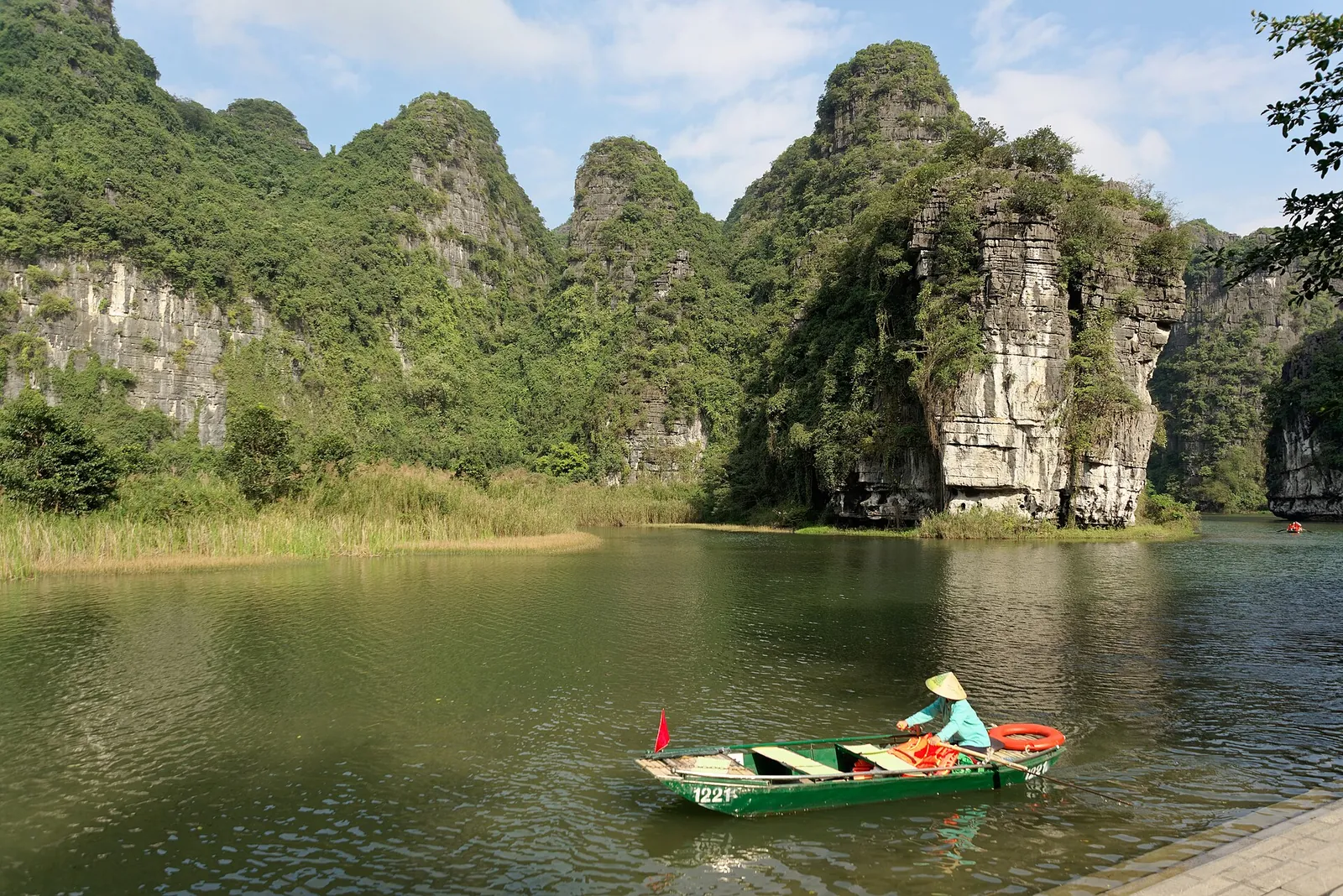
Trang An is a maze of valleys and flooded caves between steep limestone hills, crossed in small boats rowed by local boat people. There are three routes. Route 1 is a closed loop through nine caves and three temples, which the national tourism authority puts at 3 to 4 hours, with a stop to climb nearly 500 stone steps to Tran temple. Route 2, open since 2015, runs from the boat station past the Cao Son temple, through the caves of Lam, Vang and Thanh Truot, past Suoi Tien temple and through the 150-metre Dai cave to the Vu Lam palace, the base of the Tran kings in the 13th century in their wars against the Mongols. The management board gives about 10 km on the water, with a different outward and return path, in about 2 to 2.5 hours. Route 3, open since February 2018, starts at Trinh temple and passes through Dot cave, which the board puts at more than 1,000 metres, and Van cave, nearly 900 metres, before joining the same stops from Suoi Tien onwards; the national tourism authority gives 3 hours. All three are loops back to the boat station. Take route 2 for the Kong: Skull Island location and the Vu Lam palace in the shortest time, route 3 for the two longest caves, and route 1 for the most caves and the climb to Tran temple if you have three to four hours.
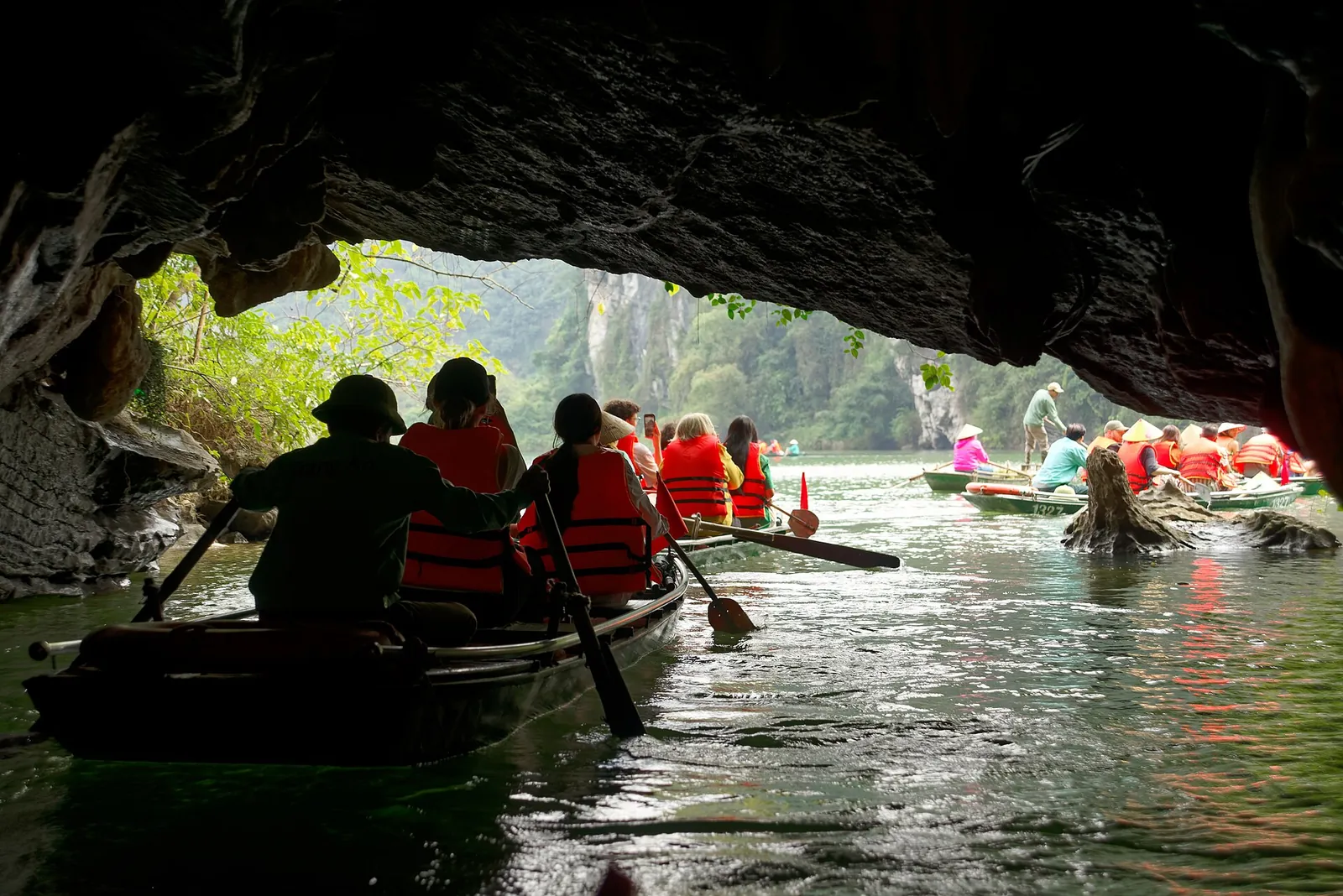
Some caves are low enough that you bend forward in the boat. Boat people at Trang An and Tam Coc row with their feet, a technique the national tourism authority says they developed to lessen the strain on their hands, arms and backs, and routes 2 and 3 are the two that pass filming locations for Kong: Skull Island.
The board lists one Trang An ticket per person and shows a separate boat fare only for Thach Bich and Thung Nang. Go to the boat station in the morning, and ask at the ticket office how many people share a boat. The board advises avoiding the rainy season and high water, which can flood the cave entrances.
Book only with an established, licensed operator, ask for a safety briefing, and check for yourself that there are enough life jackets and escape routes. Each spring the Trang An festival is held at the temples on the route, on the 18th day of the third lunar month according to the board; the solar date changes each year, and the board announces it.
Tam Coc, Bich Dong and the climb to Hang Mua
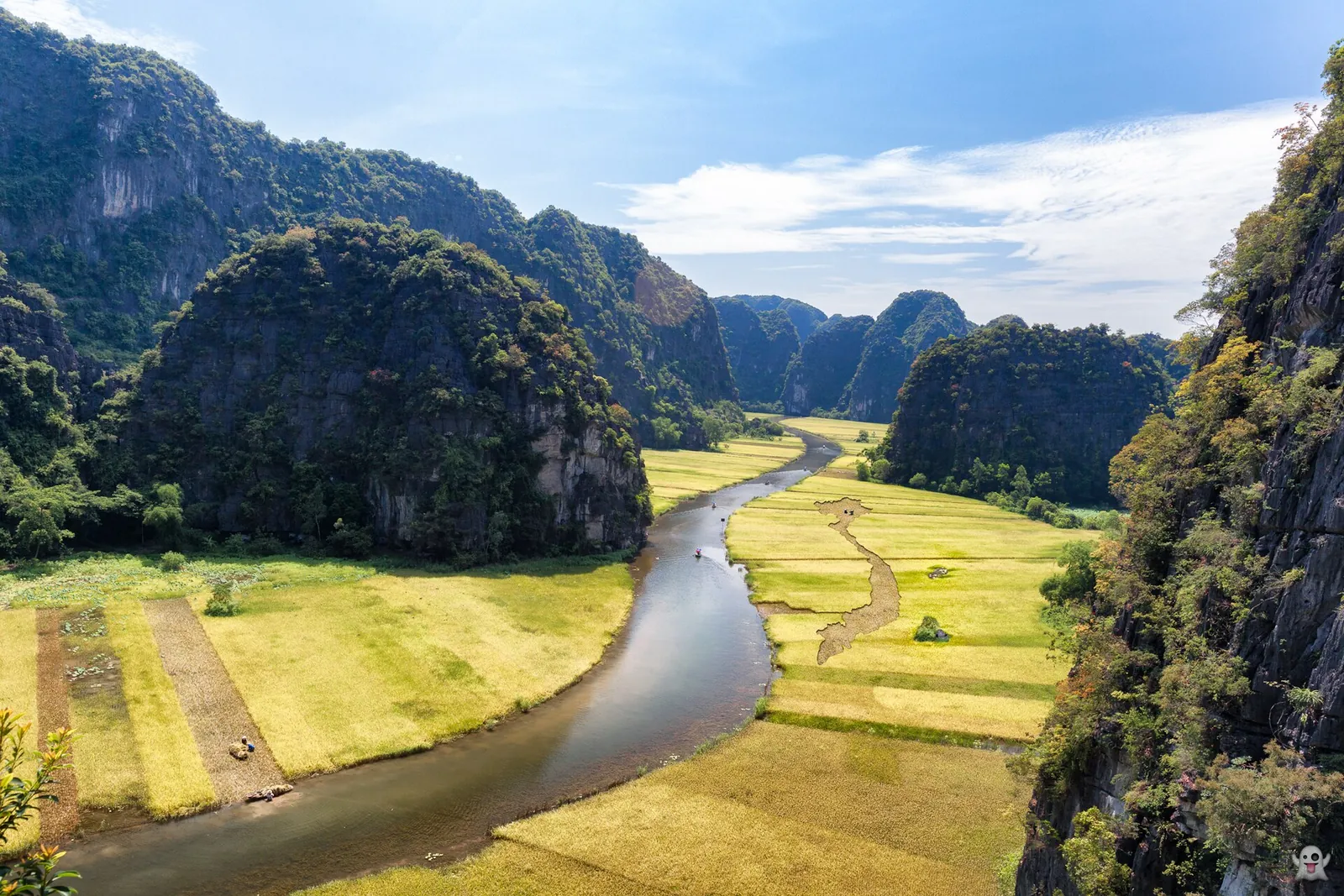
Tam Coc is the river trip people photograph: the Ngo Dong winds between rice fields and karst towers, with boats leaving the Van Lam pier, where you buy the ticket. The name means three grottoes, and the boat usually stops at the three caves of Ca, Hai and Ba; your boat person tells you whether two or four people share the boat, and the national tourism authority gives the round trip as two hours. Green rice fields and lotus ponds line both banks, and rapids have formed in the river where fallen rock has gathered. The management board describes three boat routes in the Tam Coc and Bich Dong area, the Van Lam to Ngo Dong to Tam Coc route, one passing under Bich Dong and the Thach Bich to Thung Nang route, and says the area also has walking and cycling routes linking nearly 20 sights. Tam Coc is 7 km from the centre of Hoa Lu ward and 2 km from National Route 1.
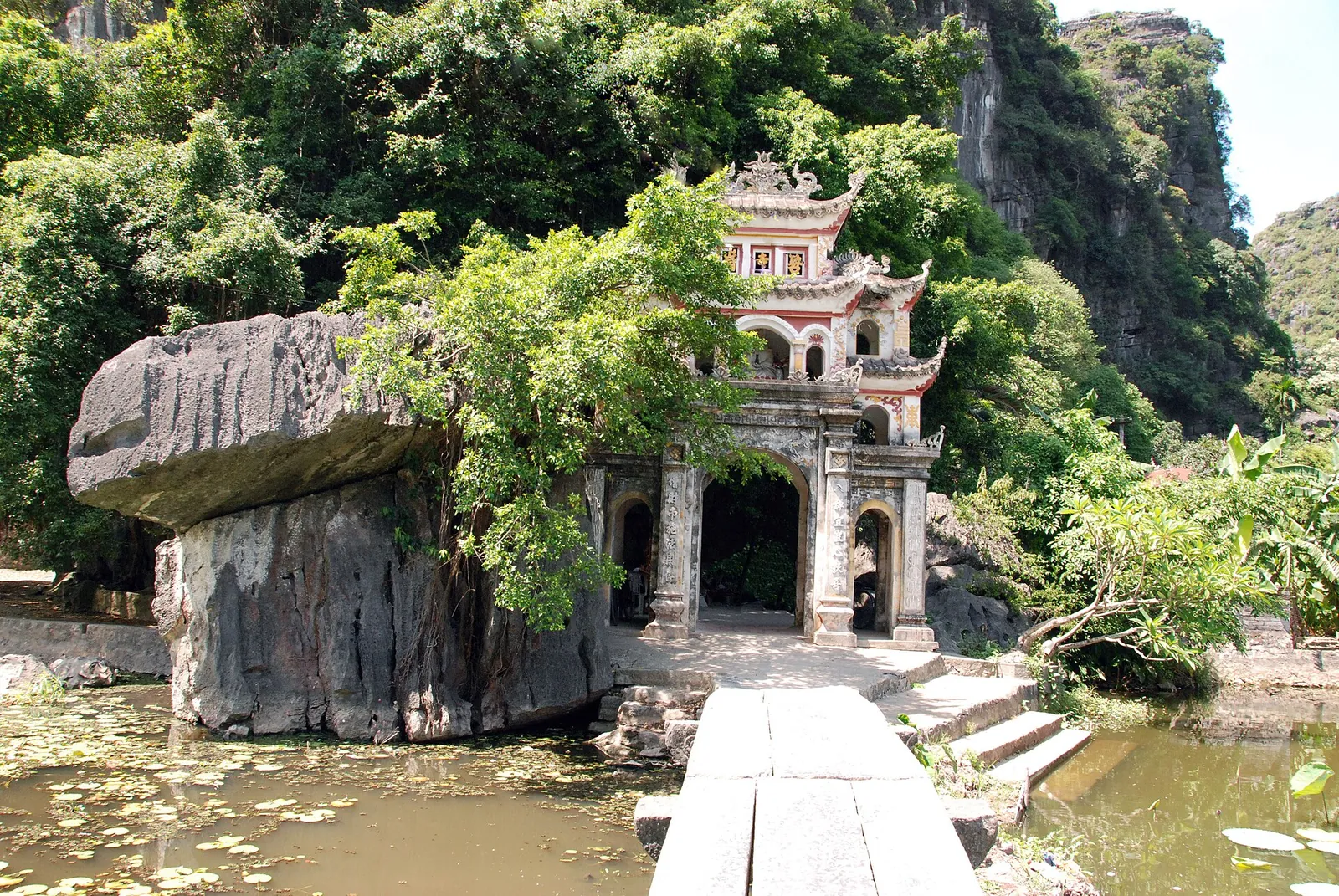
Bich Dong Pagoda stands at the foot of a mountain, reached over a stone bridge across a lotus pond. It has three pagodas on three levels: the middle one is 120 steps above the lower, and the upper one a further 40 steps up, close to the top of the mountain. Thai Vi temple and Tien cave are on the same ticket area. The Thach Bich and Thung Nang boat is a shorter, quieter alternative on the board's list.
Hang Mua is the viewpoint over the valley, 500 stone steps up the mountain, with a 360-degree view of the river among the paddies and limestone outcrops; at the top you find statues of Vietnam's four sacred animals. Wait for the mist to clear if it is covered. Go early or in the late afternoon rather than at midday, and take water.
When we checked on 17 October 2026, the management board listed Tam Coc and Bich Dong at VND 250,000 for adults without the electric shuttle and VND 350,000 with it, for travel between Tam Coc, Thai Vi temple, Tien cave and Bich Dong pagoda; children from 1 m to 1.3 m paid VND 120,000 or VND 190,000, and children under 1 m were free. The list shows one ticket per person for Tam Coc and no separate boat fare. Hang Mua was VND 150,000 a person. The Thach Bich and Thung Nang route was a VND 20,000 sightseeing ticket for adults plus VND 160,000 for the boat, which carries two foreign visitors.
Hoa Lu, Bai Dinh and the quieter edges
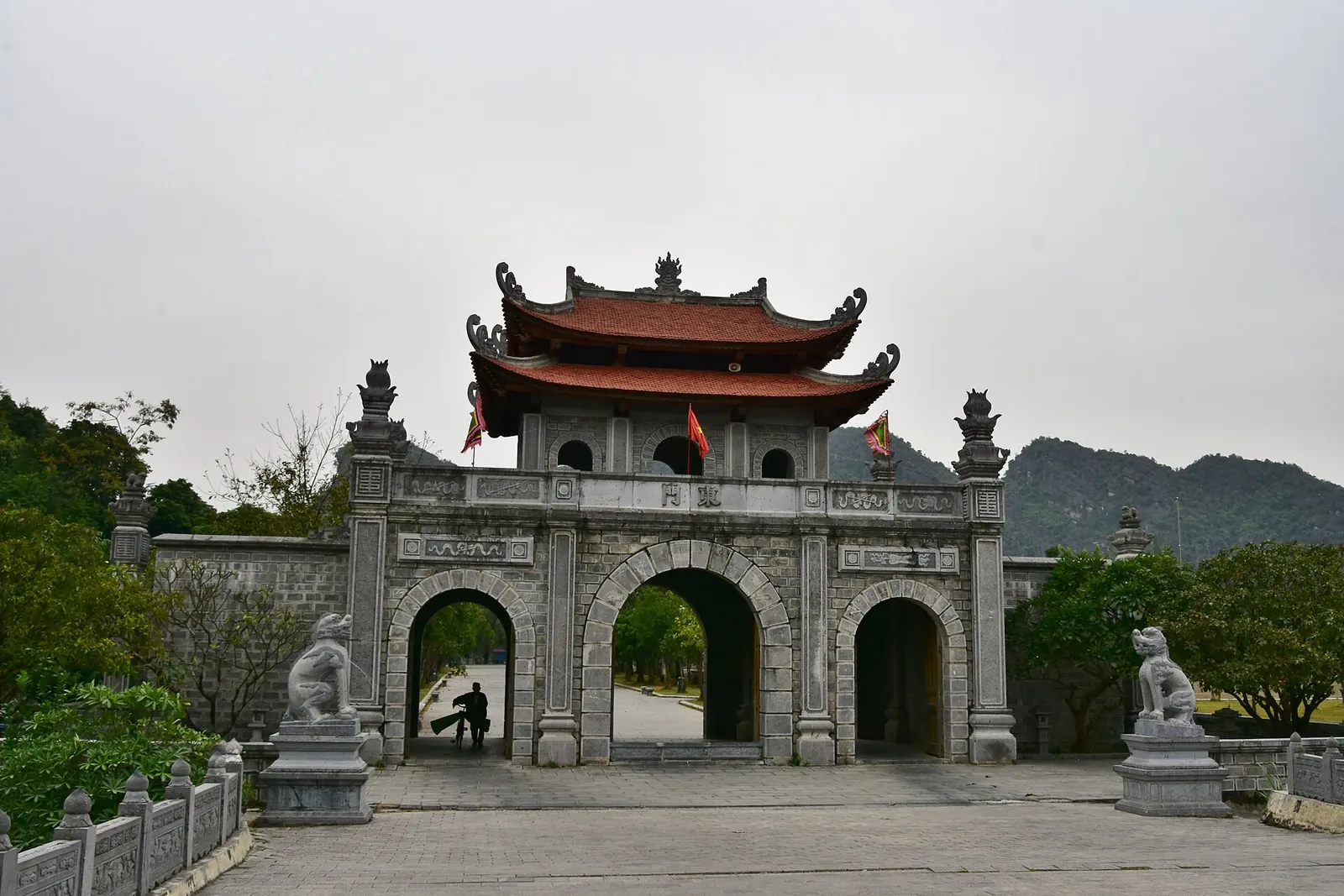
Hoa Lu was the capital of Dai Co Viet for 42 years, from 968 to 1010, under the Dinh, Early Le and Ly dynasties, until Ly Thai To moved the court to Thang Long, now Hanoi. The citadel was about 300 hectares inside a ring of limestone hills. Today the visit is to two temples built on the old palace ground, about 500 metres apart: the Dinh Tien Hoang temple, with a dragon bed carved from a single block of blue stone that is a national treasure, and the smaller Le Dai Hanh temple. The tomb of King Dinh stands on top of Ma Yen mountain, up 265 steps. Hoa Lu is easy to add to a boat morning. Entry to the relic site was VND 20,000 for adults and VND 10,000 for children from 6 to 15 and for visitors over 60 when we checked on 17 October 2026. The relic site lies in the core zone of the Trang An World Heritage complex, whose caves and rivers the Dinh king used as the southern stronghold guarding his capital.
Hoa Lu's festival is held on the 8th to 10th day of the third lunar month; dates change each year, and the board announces them. The board's list also shows the Hoa Lu old street as free to enter, with lantern boats on Ky Lan lake at VND 100,000 for adults, and Am Tien cave, the Tuyet Tinh valley, 400 metres from the east gate of the Dinh temple, with 205 stone steps to its pagoda and a ticket of VND 100,000.
Bai Dinh is the largest Buddhist complex in Vietnam: the board lists it for the largest gilded bronze Buddha in Asia, the longest arhat corridor in Asia and the largest bronze Maitreya in Southeast Asia, and the national tourism authority adds ancient temples in caves up 300 steps, a new temple area of 500 hectares and a 13-storey tower. It lies on Route 38B, 15 km from the provincial centre and 95 km from Hanoi, and fills up on Buddhist holidays. Give it half a day; the electric car there and back is VND 150,000 for adults, and a VND 300,000 package adds the shuttle between sites, the stupa ticket and a foot soak.
Further out, Van Long is a wetland reserve under a limestone mountain, toured by rowing boat, where the national tourism authority names the black-faced spoonbill and the Delacour's langur, one of the world's most endangered primates. Cuc Phuong National Park, about an hour from Ninh Binh city, has primate and turtle conservation programmes and forest trails to very old trees. Thung Nham is a bird park of forest, orchards and flowers, where the national tourism authority names fire warblers, starlings and storks. Prices below were checked on 17 October 2026 on the management board's list: Van Long VND 100,000 for adults and VND 50,000 for children; Cuc Phuong VND 60,000 for adults, with the primate programme at VND 80,000 and the turtle programme at VND 60,000; Thung Nham VND 150,000.
Phat Diem Cathedral is a side trip in the south of the province, 120 km south of Hanoi. It is a complex of the Grand Cathedral and four adjacent churches, begun in 1875 and finished in 1898, built mostly of stone in the style of communal houses, pagodas and temples, and a national relic since 1987, according to the provincial tourism department.

Getting to Ninh Binh and around Tam Coc
The train is the simplest way. Ninh Binh station is on the North-South line, 2 h 16 min to 2 h 22 min from Hanoi on the timetable for departures from 17 August to 30 December 2026; SE10 does not stop there. Southbound from Hanoi Station by day, SE7 leaves at 06:00, SE5 at 08:00 and SE9 at 13:00, and SE3 leaves at 19:20 in the evening. Northbound, SE8 and SE6 call at Ninh Binh in the afternoon, at 13:59 and 16:55. A day trip could therefore leave Hanoi at 06:00 and return at 16:55, arriving at 19:14. Night trains also stop at Ninh Binh, but the day trains suit a stay here better.
Vietnam Railways sells tickets on its official booking site, dsvn.vn, at station ticket offices and through authorised agents and payment apps; the buyer and the passenger must give identity papers with full personal details when buying and when travelling, so carry your passport. For a departure on 18 November 2026, looked up on 18 October 2026, the railway's fare tool priced a soft seat at VND 120,000 on SE7 from Hanoi to Ninh Binh and on SE6 back, and at VND 97,000 on the evening SE3. These are sample fares for one date, and other trains can differ.
The limousine van is the other main way. Trang An Limousine publishes its own fares: when we checked on 18 October 2026, its price page listed VND 155,000 a seat from Hanoi to Ninh Binh city and VND 170,000 to Hang Mua, Tam Coc and Trang An, in 11-seat vans that leave Hanoi every hour from 06:00 to 20:00 and take about 1 h 30 min for about 100 km. Its Hanoi pick-up points are the Central Circus, 56 Pho Vong, 23 Tu Mo, the main gate of Cau Giay park and a kiosk in block N5 of the Dong Tau urban area, with an Old Quarter pick-up for VND 40,000 more per person for two or more passengers. By road, Bai Dinh is 95 km from Hanoi. For the airport link, see our Hanoi guide.
Tam Coc is 7 km from the centre of Hoa Lu ward, and the Trang An boat centre is 7 km west of Ninh Binh city, according to the board; the national tourism authority puts Trang An about 20 minutes from Tam Coc, and Hoa Lu about 20 minutes by car from the Trang An area. From the station take a taxi or a hotel pick-up. Between the sights, a car with a driver suits Bai Dinh, Van Long and Cuc Phuong, and a bicycle suits the lanes around Tam Coc. The licence and insurance rules for two-wheelers are in our transport guide.
The flat lanes between the fields at Tam Coc are the best place to cycle, and the management board describes cycling and walking routes joining nearly 20 sights in the Tam Coc and Bich Dong area. Violent crime against foreigners is rare, but bag-snatching, often from passing motorbikes, pickpocketing and scams occur regularly in tourist areas. The UK Foreign Office advises you to hold bags in front of you or on the side away from the traffic, and not to hand your passport to anyone as a deposit, including when you hire a bicycle.
Ninh Binh combines well with Ha Long Bay, but the way between them runs through Hanoi. After a cruise, the usual route is the limousine back to Hanoi and an evening train: SE3 leaves Hanoi Station at 19:20 and reaches Ninh Binh at 21:36. To go on south by day, SE7 and SE5 call at Ninh Binh at 08:16 and 10:16 and reach Hue at 19:43 and 21:40, which would cost you the Trang An boat that morning.
When to go: rice fields, storms and holidays
The national tourism authority says the rice fields around Tam Coc turn golden in late May, and that autumn is also cool and clear; the board's Thung Nang page names May and June for ripe, golden rice. Northern Vietnam has a cool, misty winter from December to March, a hot, wet summer from June to August, and clear, cooler weather from September to November, so September can go either way. The UK Foreign Office says the tropical storm season normally runs from May to November and that tropical storms can cause serious travel disruption. The rainy season runs from June to September in the north and south and from October to December in central Vietnam; heavy rain causes floods and landslides that can block roads and, France Diplomatie adds, rail lines, and the German Foreign Office notes that roads in mountain areas can become impassable at short notice. Check the warnings of the National Centre for Hydro-Meteorological Forecasting before you travel and be ready to change your plans. France Diplomatie puts the monsoon rains in the Red River basin in the north from the summer onwards. Bai Dinh fills up on Buddhist holidays, and the public-sector Tet holiday runs from 4 to 10 February 2027 according to the Ministry of Home Affairs, so book trains and rooms early for those dates. Our best time guide has the full picture.
Where to sleep: Tam Coc or Ninh Binh city
Tam Coc is the village base: quiet lanes, rice fields at the door, and the Tam Coc pier close by; Bich Dong and Hang Mua are in the same tourist area, which the board describes as linked by cycling and walking routes. The national tourism authority recommends the homestays of Trang An and Tam Coc for sweeping views of the paddies.
Ninh Binh city suits you if you arrive and leave by train: the station and the restaurants are there, which the national tourism authority calls great for beer corners and local restaurants. Since the 2025 provincial merger the city centre is Hoa Lu ward, which shares its name with the ancient capital, and Tam Coc lies in Nam Hoa Lu ward. Hoang Son Peace Hotel, at 98 Trinh Tu in the central area of Hoa Lu ward, faces Dinh Tien Hoang Square and stands 1 km from the Hoa Lu old street, according to its own page. The Trang An boat centre is 7 km west of Ninh Binh city and Tam Coc 7 km from the centre of Hoa Lu ward, so plan a taxi to the boats. When we checked on 17 October 2026, the hotel listed its Superior room (36 square metres) at VND 1,450,000 a night, with a daily buffet breakfast, 10 percent VAT and a 5 percent service charge included. For rooms across Vietnam, see our where-to-stay guide.
What three days in Ninh Binh cost, all in
About VND 6,400,000 per person, VND 12,800,000 for two, excluding international flights. The two Ninh Binh nights and Hanoi arrival night, every meal and ordinary drinks, airport and local travel, the chosen sights, data and a 10% buffer are in.
| Stay | Per person | Two adults |
|---|---|---|
| Two Ninh Binh nights + Hanoi arrival night | VND 6,400,000 | VND 12,800,000 |
These costs are for two adults sharing one Hanoi Garden double on arrival and Hoang Son Peace’s Superior for two Ninh Binh nights, on ordinary November 2026 weekdays. Arrive in Hanoi for dinner the day before the 06:00 train and leave after dinner in Hanoi on day 3; choose a flight with enough time after the return train. Prices were checked on 17–23 October 2026; they are not booking quotes for your dates.
Room estimates include tax and service. Hanoi Garden’s comparison uses Hoang Son Peace’s published amounts where the Hanoi rate does not state them; Hoang Son’s own breakfast, tax and service are already included.
Food uses about VND 50,000 for breakfast, 75,000 for lunch, 125,000 for dinner and 50,000 for drinks and snacks per person on a normal day, based on the tourism authority’s street-food and coffee prices; only meals outside documented inclusions are added.
For two: rooms VND 4,500,000; food 2,100,000; getting around 3,400,000; sights and trips 1,400,000; data 200,000; 10% buffer 1,200,000.
Hoang Son’s two breakfasts are counted once; the early Hanoi breakfast is bought separately. The goat-and-crisp-rice lunch uses the dinner price as a comparison. Getting around covers both airport cars, four soft-seat rail tickets using the 18 November 2026 sample fares, the station links and two whole sightseeing-car days based on local taxi comparisons. The chosen tickets are Trang An, Tam Coc and Bich Dong without the shuttle, Hang Mua and Hoa Lu. The plan keeps a quiet last morning; Bai Dinh, Van Long and Cuc Phuong are alternative outings.
Data buys two seven-day MobiFone HVN7 eSIM plans for compatible phones after passport registration. Visas are not in the total, which assumes passports that enter Vietnam visa-free, such as British, German or French ones. Travellers from Ireland, Austria, Portugal, the United States, Canada and Australia need an e-visa at USD 25 each, about VND 640,000; see Vietnam entry requirements.
Flights: about GBP 800–850 per person for London–Hanoi return economy, using Vietnam Airlines’ lowest advertised examples for selected dates, read on 23 October 2026. With flights, about VND 33,500,000–35,200,000 per person; fares and availability vary.
What to eat and where to look
Goat with lime (de tai chanh)
Goat meat lightly cured in lime juice and tossed with chilli, lime leaves and sesame seeds; Vietnam's national tourism authority calls goat Ninh Binh's most popular meat and de tai chanh one of its signature dishes. The management board's restaurant list names it among the three goat dishes of Pho Nui restaurant, which stands near Trang An.
- Where to look
- Pho Nui restaurant, near the Trang An area.
- Fit it into your day
- Lunch after the Trang An boat.
The meat is only partly cooked; ask for grilled goat if you prefer it cooked through.
Burnt rice (com chay)
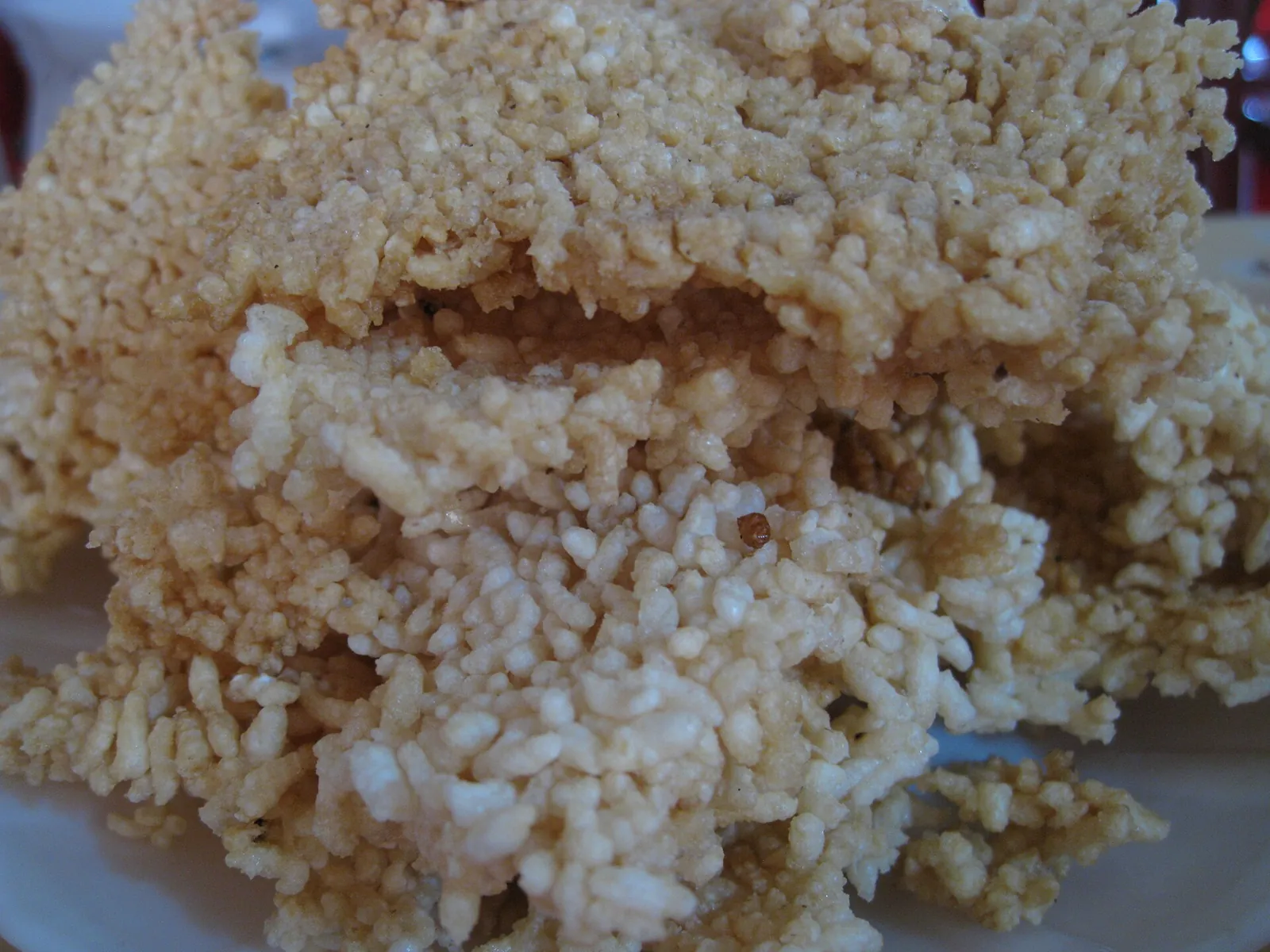
A crust of rice dried and fried until it is crisp, eaten as a snack or dipped into a warm stew. The management board's restaurant page says the burnt rice at Thanh Long restaurant is made in Trang An, and the province's burnt rice was listed among the Top 100 gift specialities of Vietnam for 2020 to 2021.
- Where to look
- Thanh Long restaurant, Ngo Quyen street, Hoa Lu ward.
- Fit it into your day
- A plate to share at lunch with the goat.
Toppings often contain meat or seafood; ask if you do not eat them.
Fish salad (goi ca nhech)
Thin slices of nhech, a fish of the estuaries, squeezed with fresh lime juice and mixed with roasted glutinous rice flour, rolled in leaves and herbs and dipped in a thick sauce made from the fried, pounded fish bones with pork belly; the management board's page calls it a country dish of the Kim Son coast and a leading speciality for visitors to Hoa Lu.
- Where to look
- The Kim Son coast, in the south of the province, where the dish comes from; it fits a Phat Diem side trip.
- Fit it into your day
- A lunch on the Phat Diem side trip.
The fish is cured in lime juice, not cooked; skip it if you avoid raw fish.
Mountain snails (oc nui)
Mountain snails, listed with burnt rice and shrimp paste among the Ninh Binh specialities on the management board's page for Duc De restaurant, which serves goat as its main dish.
- Where to look
- Duc De restaurant, 29 lane 458 Nguyen Hue street, Nam Hoa Lu ward.
- Fit it into your day
- A starter in Ninh Binh city.
Shellfish; skip if you have an allergy.
Practical questions
Should I choose Trang An or Tam Coc?
Choose Trang An for caves, temple stops and a boat trip of two to four hours, by route. Choose Tam Coc for the river through the rice fields, best when the crop is gold in late May, and for Bich Dong and the climb to Hang Mua. With two nights you can do both.
How much is the Trang An ticket?
When we checked on 17 October 2026, the management board listed VND 300,000 for adults over 1.3 m, VND 150,000 for children from 1 m to 1.3 m, and free entry under 1 m. Tam Coc and Bich Dong has its own ticket, at VND 250,000 without the electric shuttle.
How do I get from Hanoi to Ninh Binh, and how long does it take?
Vietnam Railways' timetable for departures from 17 August to 30 December 2026 gives 2 h 16 min to 2 h 22 min by train, depending on the train and direction; book on dsvn.vn or at a station, and note that SE10 does not stop at Ninh Binh. Trang An Limousine's 11-seat vans take about 1 h 30 min and drop at Tam Coc and Trang An hotels.
Is Ninh Binh worth a day trip from Hanoi?
Yes, if you keep it to one boat ride plus Hoa Lu or Hang Mua. The train leaves Hanoi at 06:00 on SE7 and reaches Ninh Binh at 08:16, and the 16:55 train back from Ninh Binh reaches Hanoi at 19:14. One night lets you take the boats early, before the tour groups.
How many steps are there at Hang Mua?
About 500. The management board lists the ticket at VND 150,000 a person. Go early or in the late afternoon and take water.
Where should I stay in Ninh Binh?
Tam Coc for rice fields and cycling, and Ninh Binh city for the station and the restaurants, with a taxi to the boats.
Keep planning your trip

Pu Luong
Thai villages, rice terraces and bamboo water wheels four and a half hours from Hanoi: the road via Mai Chau, the two rice seasons, homestays and what it costs.
Read the guide
Hanoi
Three nights in Hanoi: where to sleep, the Old Quarter and Hoan Kiem Lake, the Temple of Literature, Citadel and Mausoleum, Noi Bai airport links and tickets.
Read the guide
Ha Long Bay
How to book a Ha Long Bay cruise: one night or a day trip, routes VHL1 to VHL8, the board's fees, licensed operators, ports and the road from Hanoi.
Read the guide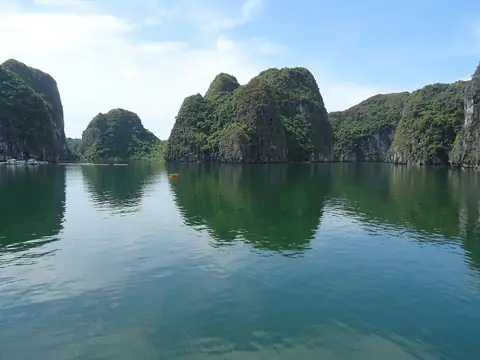
Cat Ba Island and Lan Ha Bay
Two nights on Cat Ba: Lan Ha Bay day boats and fees, park tickets, the ferry, cable car and Hanoi buses, with times and prices checked on 17 October 2026.
Read the guide
Phong Nha-Ke Bang
Phong Nha Cave by boat, Paradise Cave, Dark Cave and the Chay River, with park tickets, Dong Hoi flights and trains, the Hue train and a budget for two.
Read the guide
Vietnam in 7 days
Six nights in Hanoi, on a Ha Long Bay cruise and in Ninh Binh, with every train and transfer, the day plan and a priced week for two adults.
Read the guideSources and checks before you travel
(46)
- Trang An Management Board: ticket prices ↗ — opens in a new tab
- Trang An Management Board: route 2 ↗ — opens in a new tab
- Trang An Management Board: route 3 ↗ — opens in a new tab
- Trang An Management Board: Tam Coc and Bich Dong ↗ — opens in a new tab
- Trang An Management Board: Thung Nang ↗ — opens in a new tab
- Trang An Management Board: Hoa Lu ancient capital ↗ — opens in a new tab
- Trang An Management Board: Hoa Lu in brief ↗ — opens in a new tab
- Trang An Management Board: tomb of King Dinh Tien Hoang ↗ — opens in a new tab
- Trang An Management Board: Am Tien cave ↗ — opens in a new tab
- Trang An Management Board: Bai Dinh pagoda ↗ — opens in a new tab
- Trang An Management Board: restaurants ↗ — opens in a new tab
- Trang An Management Board: Thanh Long restaurant ↗ — opens in a new tab
- Trang An Management Board: Duc De restaurant ↗ — opens in a new tab
- Trang An Management Board: Pho Nui restaurant ↗ — opens in a new tab
- Trang An Management Board: Top 100 specialities ↗ — opens in a new tab
- Trang An Management Board: Trang An complex and its UNESCO listing ↗ — opens in a new tab
- Viet Nam National Authority of Tourism: Ninh Binh ↗ — opens in a new tab
- Viet Nam National Authority of Tourism: 10 must-do activities ↗ — opens in a new tab
- Viet Nam National Authority of Tourism: a perfect day in Ninh Binh ↗ — opens in a new tab
- Viet Nam National Authority of Tourism: weather and climate ↗ — opens in a new tab
- Vietnam Railways: timetable ↗ — opens in a new tab
- Vietnam Railways: fare tool ↗ — opens in a new tab
- Vietnam Railways: ticket booking ↗ — opens in a new tab
- Government portal: provincial mergers ↗ — opens in a new tab
- Noi Bai International Airport: transport ↗ — opens in a new tab
- Hoang Son Peace Hotel: rooms ↗ — opens in a new tab
- Hoang Son Peace Hotel: Superior room ↗ — opens in a new tab
- UK Foreign Office: safety and security, Vietnam ↗ — opens in a new tab
- Trang An Limousine: price page ↗ — opens in a new tab
- Trang An Limousine: routes ↗ — opens in a new tab
- Ninh Binh Tourism Department: Trang An eco-tourism site ↗ — opens in a new tab
- Ninh Binh Tourism Department: Tam Coc and Bich Dong ↗ — opens in a new tab
- Ninh Binh Tourism Department: Phat Diem Cathedral ↗ — opens in a new tab
- Viet Nam National Authority of Tourism: boat tours of Ninh Binh ↗ — opens in a new tab
- Trang An Management Board: Trang An and Hanoi distances ↗ — opens in a new tab
- France Diplomatie: Vietnam, safety ↗ — opens in a new tab
- German Foreign Office: safety, Vietnam ↗ — opens in a new tab
- Government portal: Tet 2027 holiday ↗ — opens in a new tab
- Trang An Management Board: fish salad of Kim Son ↗ — opens in a new tab
- MobiFone: Hi Vietnam visitor eSIM plans ↗ — opens in a new tab
- NCB: exchange rates on 20 October 2026 ↗ — opens in a new tab
- Vietnam National Authority of Tourism: typical food and taxi prices ↗ — opens in a new tab
- Vietnam Immigration Department: single-entry e-visa fee ↗ — opens in a new tab
- Hanoi Garden: Superior Double room-price comparison ↗ — opens in a new tab
- Vietnam Airlines: London to Hanoi return economy fares ↗ — opens in a new tab
- Vietnam National Authority of Tourism: airport taxi comparisons ↗ — opens in a new tab
Reference sources for the version dated 26 October 2026. Confirm opening times, access, transport and conditions for your travel dates.
Photo credits
(7)
The Ngo Dong River at Tam Coc, with the rice ripening between the karst hills.
Photograph: Tuan Mai — opens in a new tab · CC BY 2.0 — opens in a new tab
Changes: Resized and converted to WebP; displayed with responsive crops. · Original photograph and licence details ↗ — opens in a new tab
A rowing boat on one of the lakes of the Trang An landscape.
Photograph: Jakub Hałun — opens in a new tab · CC BY 4.0 — opens in a new tab
Changes: Resized and converted to WebP; displayed with responsive crops. · Original photograph and licence details ↗ — opens in a new tab
Boats come out of one of the water caves on a Trang An route; expect to duck.
Photograph: Jakub Hałun — opens in a new tab · CC BY 4.0 — opens in a new tab
Changes: Resized and converted to WebP; displayed with responsive crops. · Original photograph and licence details ↗ — opens in a new tab
The view from the top of Hang Mua over the Tam Coc valley.
Photograph: Eila Lifflander 3ilaliff — opens in a new tab · CC0 — opens in a new tab
Changes: Resized and converted to WebP; displayed with responsive crops. · Original photograph and licence details ↗ — opens in a new tab
A gateway at the temple grounds of the ancient capital, Hoa Lu.
Photograph: Richard Mortel from Riyadh, Saudi Arabia — opens in a new tab · CC BY 2.0 — opens in a new tab
Changes: Resized and converted to WebP; displayed with responsive crops. · Original photograph and licence details ↗ — opens in a new tab
The approach to Bich Dong Pagoda across its lotus pond, near Tam Coc.
Photograph: Tupham — opens in a new tab · Public domain — opens in a new tab
Changes: Resized and converted to WebP; displayed with responsive crops. · Original photograph and licence details ↗ — opens in a new tab
Com chay, the crisp rice crust Ninh Binh is known for.
Photograph: Nguyễn Thanh Quang — opens in a new tab · CC BY-SA 3.0 — opens in a new tab
Changes: Resized and converted to WebP; displayed with responsive crops. · Original photograph and licence details ↗ — opens in a new tab