Plan your trip · Vietnam
Money in Vietnam: dong notes, cards, ATMs, QR payments and tipping
Vietnam runs on the dong, and the first surprise is the number of zeros: a bowl of noodles, a taxi ride and a hotel night are all priced in thousands or millions. Cards cover hotels, tours and most sit-down restaurants, while street stalls, markets and small shops still run largely on cash. QR codes are common at counters too, but they are built for Vietnamese banking apps and only a few foreign apps can use them. A good money plan for Vietnam is simply knowing which of the three to reach for, and keeping the right notes in the right pocket.
- Suggested time
- Applies to any trip; plan cash for each day spent outside the big cities
- Where to stay
- Hanoi, Hoi An or Ho Chi Minh City, where ATMs, exchange counters and card acceptance are easiest
- Season and timing
- All year; take out extra cash before Tet (late January or early February), when many businesses close.
The short answer
Bring one or two debit or credit cards (ideally on different networks) and withdraw dong from an ATM at the airport instead of exchanging cash at home. Use the card for hotels, tours, spas and larger restaurant bills, and keep small notes for street food, markets, coffee and tips. Withdraw before heading to remote areas or into the Tet holiday. Tipping is optional: a little extra for a private guide or a spa therapist is appreciated, but nobody expects it in a noodle shop. If you carry more than 15 million dong or 5,000 US dollars in cash across the border, declare it at customs.
Dong notes: what you will actually handle
The currency is the Vietnamese đồng (VND, written ₫). The official tourism board lists notes from 200₫ up to 500,000₫, and its payments guide describes a mix of small paper notes and larger polymer ones, with no coins in use. In daily life you will mostly handle 10,000₫, 20,000₫, 50,000₫, 100,000₫, 200,000₫ and 500,000₫ notes.
The tourism board's own trick for the zeros is to drop the last three: 50,000₫ becomes "50". Do the conversion to your home currency once, at the start of the trip, with your card provider's current rate, then think in thousands of dong rather than converting every coffee.
The notes most often confused are 20,000₫ and 500,000₫, which the tourism board warns come in similar shades of blue. Check the number before you hand over a blue note, especially at night or in a hurry, and keep 500,000₫ notes in a separate compartment from your small change. Large notes can also be hard to break at a street stall, so break them at a supermarket, hotel or restaurant with a card terminal and keep a stock of 10,000₫ to 50,000₫ notes for the day.
Cash, cards or QR: what works where
The tourism board's payments guide describes the split clearly: cash for small purchases and street vendors, cards for most established businesses. Hotels, tour operators, boutiques, restaurants, grocery stores and spas generally take international debit and credit cards, and many larger costs can be paid by card in advance online. It also notes that many businesses and taxi services accept contactless card payments. Your card provider sets the exchange rate and any fees, so check them before you leave and pick the card that charges least abroad.
QR codes run on VietQR, the national standard operated by NAPAS, Vietnam's payment network; State Bank of Vietnam figures quoted by NAPAS say card and QR acceptance now reaches most localities. A VietQR code is normally paid from a Vietnamese bank account, but NAPAS also runs a cross-border service, VietQRGlobal: according to its announcements, when we checked on 2026-10-03, visitors could pay with participating home apps from Thailand, Laos, Cambodia, China (via UnionPay, Alipay and, since August 2026, Weixin Pay), South Korea (for Korean visitors paying in Vietnam) and, since July 2026, Singapore. If your app is from one of those countries, ask your provider whether it is a participating app before you rely on it. If not, treat a QR-only counter as a cash counter.
Ride-hailing apps such as Grab need a local SIM card, according to the tourism board, and the UK government's travel advice recommends booking the whole journey in an official app such as Grab or XanhSM. With a metered taxi, the tourism board advises sticking with reputable companies such as Vinasun and Mai Linh and always asking for the meter.
- Usually by card: hotels, tours and cruises booked through an operator, spas, supermarkets, department stores and most sit-down restaurants in the cities.
- Usually cash: street food, market stalls, small cafés, local buses, tips and purchases from artisans in villages.
- QR: convenient only if your home app is part of the VietQRGlobal network; otherwise pay the same counter in cash.
Make time for the local food
What to eat and where to look
Phở (rice noodle soup)
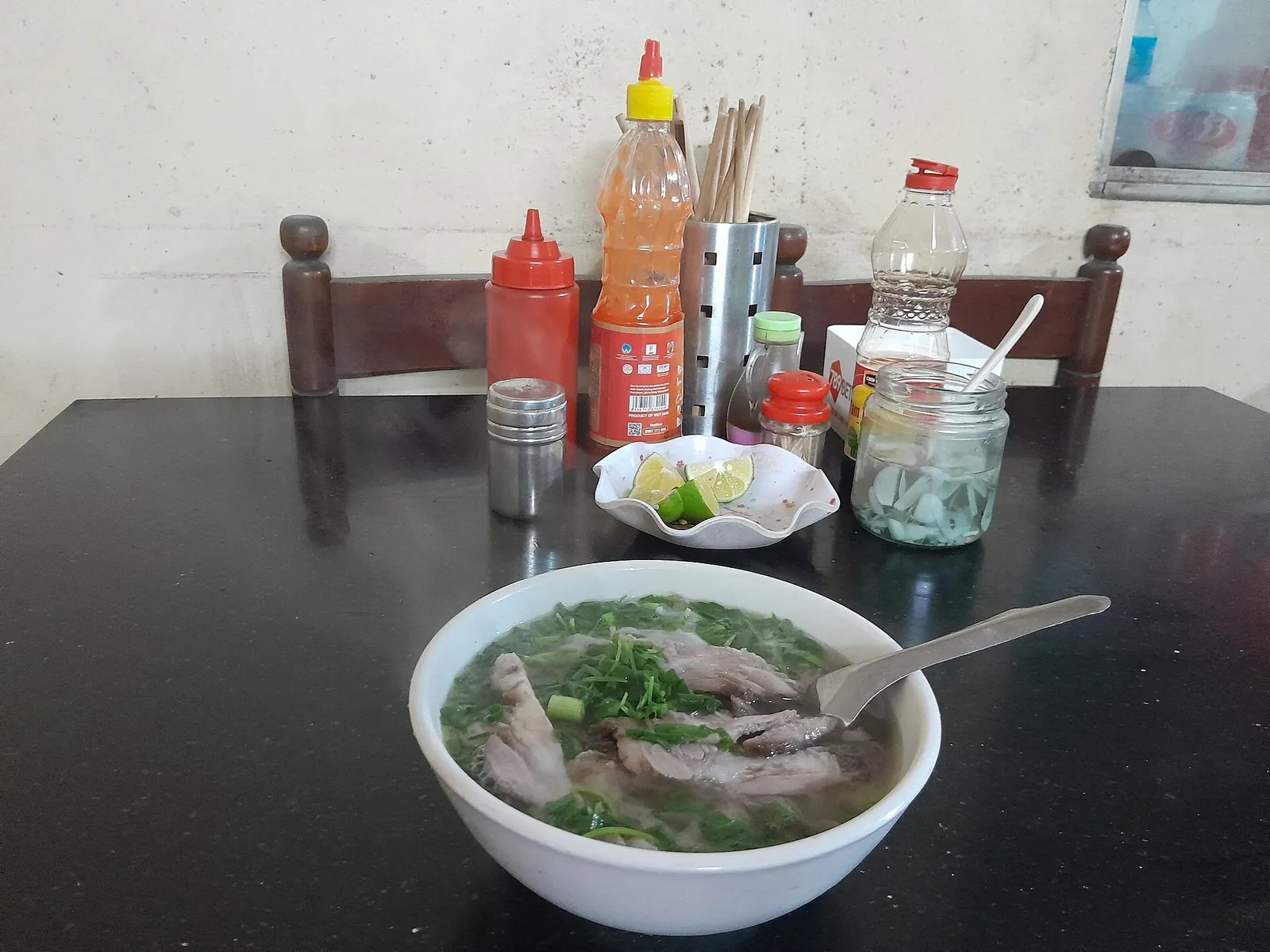
Flat rice noodles in a clear beef or chicken broth, served with herbs, lime and chilli on the side. It is the classic breakfast in Hanoi and a meal you will buy over and over again, usually at a specialist shop that serves little else.
- Where to look
- Small phở shops in Hanoi's Old Quarter and residential streets, busiest in the early morning.
- Fit it into your day
- Breakfast before a day of sightseeing; pay at the counter or to the cook when you leave, with small notes.
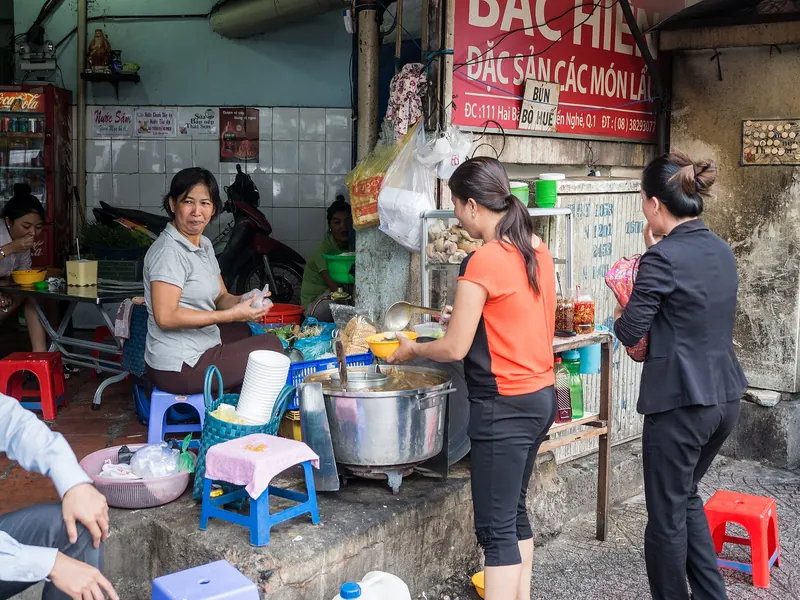
Expect to pay cash at small shops like these. Beef is often served rare and cooks in the broth; ask for chín (well-done) if you prefer.
Bánh mì
A crisp baguette filled with pâté, cold cuts or grilled meat, pickled vegetables, herbs and chilli: the quickest street meal in the country and the easiest to buy on the move.
- Where to look
- Street carts and small bakeries in Ho Chi Minh City and Hoi An, and on most busy corners elsewhere.
- Fit it into your day
- A takeaway breakfast or lunch on a travel day; keep a 20,000₫ or 50,000₫ note ready rather than a 500,000₫ note the vendor cannot change.
Contains pork and pâté in most versions; ask for a chicken, egg or vegetarian filling where offered.
Bún chả
Grilled pork patties and slices in a sweet-sour dipping broth, eaten with rice vermicelli and a basket of herbs. It is Hanoi's lunch dish, cooked over charcoal at the shop front.
- Where to look
- Lunch shops with a smoking grill at the door in Hanoi's Old Quarter and surrounding districts.
- Fit it into your day
- Lunch in Hanoi; ask for the total before you pay if you add spring rolls or drinks.
Contains pork and fish sauce; the fried spring rolls often served alongside usually contain pork or seafood.
Cà phê sữa đá (iced coffee with condensed milk)
Strong drip coffee poured over ice and sweetened condensed milk, drunk on low plastic stools on the pavement or in modern cafés.
- Where to look
- Pavement coffee stalls everywhere for cash, and café chains in the cities where card and contactless payment is more common.
- Fit it into your day
- A mid-morning or afternoon break; a good moment to break larger notes in a café that takes cards.
Very sweet and strong; ask for ít ngọt (less sweet) or cà phê đen (black coffee) if you prefer.
ATMs and exchanging money
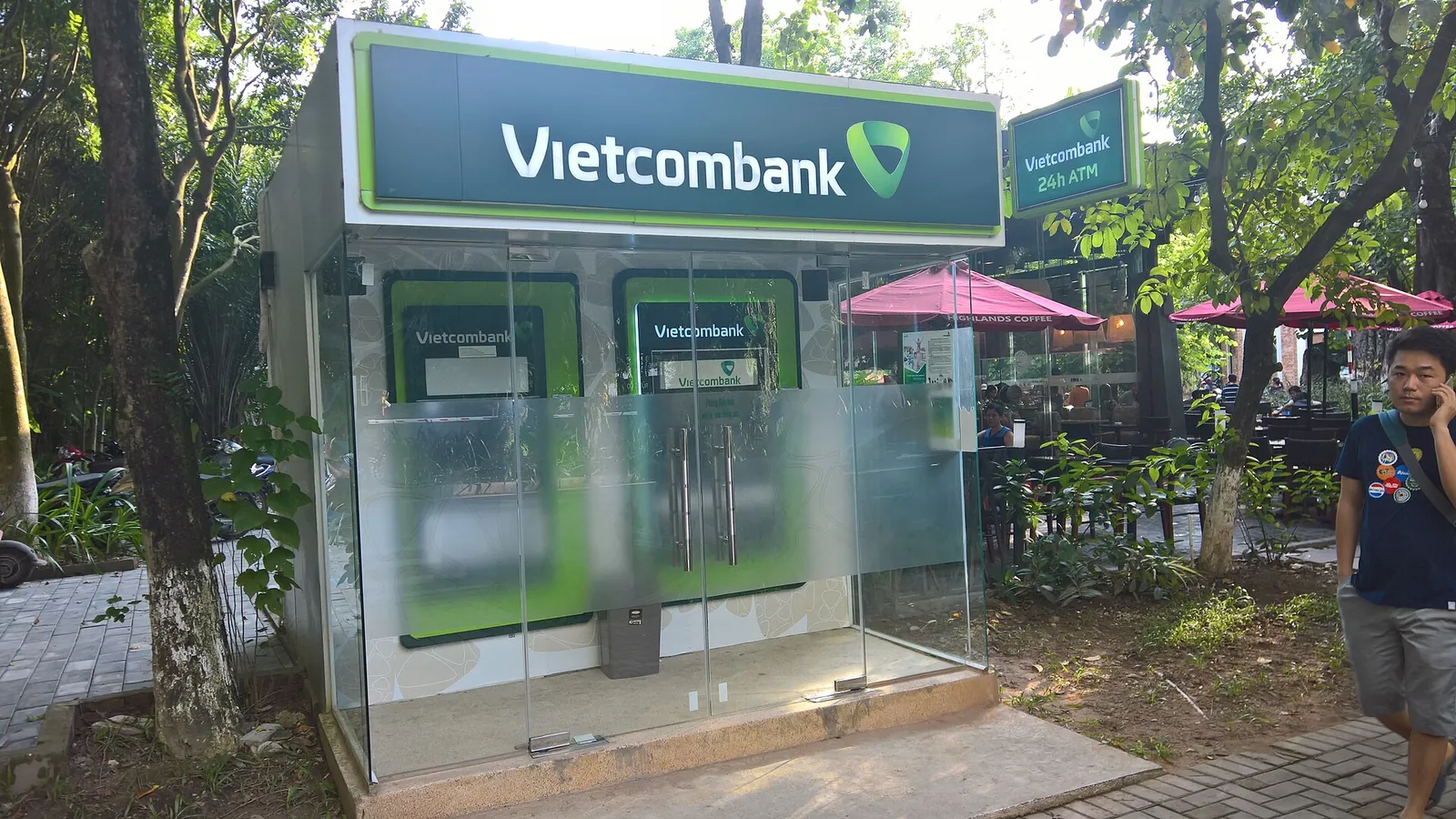
For most travellers, the tourism board recommends ATMs over exchange counters. Its payments guide says ATMs that accept international cards stand just outside the arrival gates at all major airports, and that Visa cards work at more than 20,000 ATMs nationwide. When we checked on 2026-10-03, the same guide gave per-withdrawal limits of 2 to 3 million dong at local bank ATMs and 5 to 10 million dong at international bank ATMs. Check what your own bank charges per foreign withdrawal before you travel; if it charges a fixed fee, a few larger withdrawals cost less than many small ones.
Exchange counters are at the international airports, banks and official exchange centres, and hotels in tourist areas often exchange too. The UK government's advice is blunt: only change money at official exchange counters with a clear sign showing that status, because changing money elsewhere is illegal and you risk losing your money. The tourism board also warns that buying US dollars once you are in Vietnam can be very difficult, so do not plan to change dong back into dollars at the end.
Banks themselves keep office hours. The tourism board lists most banks as opening from 7:30 or 8am to 4:30pm with a lunch break, and some on Saturday mornings, so do counter business (exchanging a lot of cash or sorting out a card problem) on a weekday morning.
Tipping and bargaining
The tourism board says there is no set rule about tipping, because it is not a normal part of Vietnamese culture. It is increasingly common in some situations, such as beauty salons, spas and with private tour guides, while in restaurants and cafés it is not expected but appreciated. Its etiquette guide adds that you are under no obligation to tip at all.
To size a tip, the tourism board suggests keeping local prices in mind: when we checked on 2026-10-03, it put the cost of a local meal at about 30,000 to 40,000 dong. Use that as your yardstick rather than a percentage from home, and give more to someone who has looked after you for a whole day, such as a private guide. Hand it over in cash, directly to the person, and keep small notes aside for it.
Bargaining is normal in markets and casual shopping streets, and the tourism board says you can usually get a lower price in tourist areas with gentle negotiation. Ask at a few stalls first to get a feel for the price, settle the amount before the item is wrapped, and pay with notes close to the agreed sum. Fixed-price shops, supermarkets and restaurants with printed menus are not places to haggle.
Arriving and leaving: airport cash, customs and VAT refunds
Get some dong at the airport for the first taxi, a SIM card and dinner. When we checked on 2026-10-03, Noi Bai International Airport in Hanoi listed currency exchange counters (BIDV, Maritime Bank, Vietinbank and Techcombank) and ATMs (Vietinbank, Techcombank and Agribank) in its international terminal, T2.
Cash limits: the UK government's advice and Noi Bai airport both state that cash above 15 million dong or 5,000 US dollars (or the equivalent in other currencies) must be declared at customs. The UK advice adds that if you leave with more than these amounts, you must show either a confirmation for carrying cash abroad from an authorised credit institution or written approval from the State Bank of Vietnam. Most travellers never get close; it matters if you arrive with a large sum in cash for a long trip.
VAT refunds: foreign visitors can reclaim VAT on goods bought at shops that operate the refund scheme and carried out on the plane. When we checked on 2026-10-03, Noi Bai's page set a minimum of 2,000,000 dong on the invoice from one shop in one day, required the invoice with a refund declaration form issued by the shop on presentation of your passport, and told passengers to have the goods, forms and passport inspected and stamped by customs before check-in. The refund counter deducts a service fee of up to 15% and pays in dong. Ask for the form at the till: the airport page warns that any missing document means the refund is refused.
Keeping money safe, and planning around remote areas and Tet
The tourism board calls Vietnam generally very safe but recommends using the room safe for cash, cards and valuables, keeping wallets close and taking extra care in crowds. Split your money: a day's cash and one card on you, a second card and the larger notes in the safe. Cards with extra online security such as 3D Secure, which the tourism board mentions, protect online bookings.
Outside the cities, plan ahead. The tourism board advises withdrawing extra cash before travelling to remote destinations, especially if you want to buy crafts or textiles directly from artisans; that applies to mountain loops such as Ha Giang, village homestays and island stays. Count the days you will be away from a town with a bank and take enough for meals, transport and purchases.
Tet, the Lunar New Year in late January or early February, is the one period when cash planning really matters. The tourism board warns that most businesses and restaurants shut down during the holiday and transport hubs are overflowing in the days before. Withdraw what you need for the holiday days in advance, and expect fewer stalls and shops to be open while it lasts.
Practical questions
Is Vietnam a cash or card country?
Both. The tourism board says most established businesses, including hotels, tour operators, restaurants, grocery stores and spas, accept international cards, while cash is used for small purchases and street vendors. Carry a card for the big costs and small dong notes for food stalls, markets, coffee and tips.
Should I bring US dollars or exchange money before I go?
You do not need to. The tourism board recommends using ATMs rather than exchange counters, and airports have ATMs just outside arrivals. If you do bring cash, change it only at banks or official exchange counters with a clear sign, as the UK government advises, and remember that buying dollars back in Vietnam can be very difficult.
How much can I withdraw from an ATM in Vietnam?
When we checked on 2026-10-03, the tourism board gave per-transaction limits of 2 to 3 million dong at local bank ATMs and 5 to 10 million dong at international bank ATMs. Your own bank may set a lower daily limit and charge a fee per withdrawal.
Can tourists pay with QR codes in Vietnam?
Only with a participating app from a connected country. When we checked on 2026-10-03, NAPAS listed cross-border QR payments for visitors from Thailand, Laos, Cambodia, China, South Korea and Singapore. Otherwise, a QR code at a stall is for Vietnamese banking apps, so pay in cash.
Do you tip in Vietnam?
It is optional. The tourism board says tipping is not a normal part of Vietnamese culture, is increasingly common for private guides and in spas and salons, and is not expected but appreciated in restaurants and cafés.
How do I tell the 20,000 and 500,000 dong notes apart?
Read the number. The tourism board warns that the two notes are a similar blue, and mixing them up is the most expensive mistake a new visitor can make. Keep 500,000₫ notes in a separate compartment from your change.
Do I have to declare cash when entering Vietnam?
Yes, above certain amounts. The UK government's advice and Noi Bai airport both say cash over 15 million dong or 5,000 US dollars (or the equivalent) must be declared at customs, on arrival and on departure.
Sources and checks before you travel
Reference sources for the version dated 3 October 2026. Confirm opening times, access, transport and conditions for your travel dates.
- Vietnam National Authority of Tourism: Currency and payments in Vietnam ↗ — opens in a new tab
- Vietnam National Authority of Tourism: Plan your trip (currency, taxis, public holidays) ↗ — opens in a new tab
- Vietnam National Authority of Tourism: Vietnamese etiquette for travellers ↗ — opens in a new tab
- UK FCDO travel advice: Vietnam entry requirements ↗ — opens in a new tab
- UK FCDO travel advice: Vietnam safety and security ↗ — opens in a new tab
- NAPAS: Seminar on cross-border QR payments for retail and tourism (25 September 2026, Vietnamese) ↗ — opens in a new tab
- NAPAS: Vietnam–Singapore cross-border QR launch (2 July 2026, Vietnamese) ↗ — opens in a new tab
- NAPAS: Weixin Pay cross-border QR with Vietnam (6 August 2026, Vietnamese) ↗ — opens in a new tab
- Noi Bai International Airport: Banks and ATM ↗ — opens in a new tab
- Noi Bai International Airport: Tax refund ↗ — opens in a new tab
- Noi Bai International Airport: Transportation ↗ — opens in a new tab
Does this experience fit your route?
Paying by card in advance for tours and cruises keeps the cash you carry small. Compare what each listing includes, and keep small notes for tips and street food.
Check dates and details on Viator ↗ — opens in a new tabAffiliate link · Book with ViatorPhoto credits
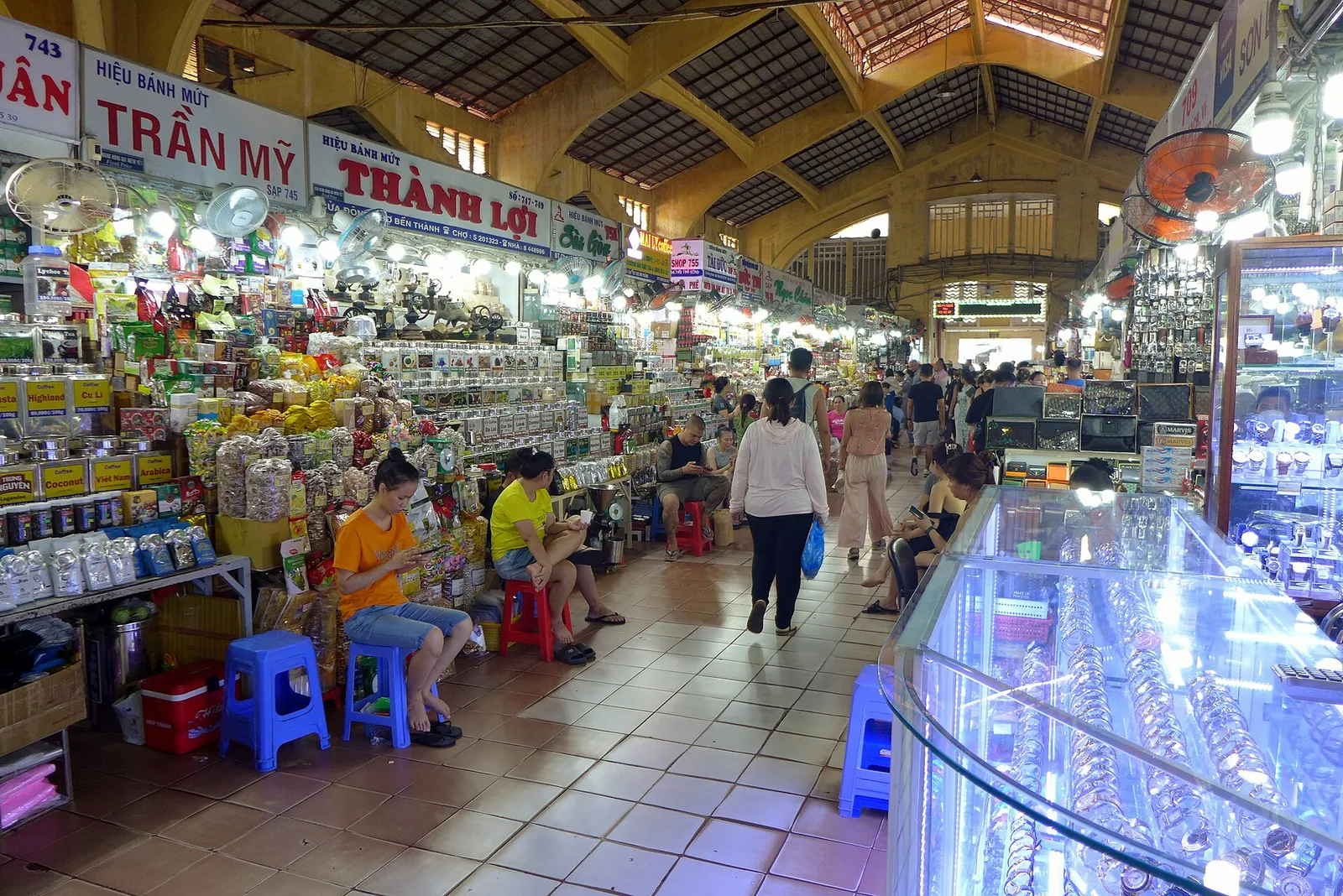
Sweet and snack stalls and a watch counter inside Ben Thanh Market, Ho Chi Minh City, where bargaining and cash are part of shopping
Photograph: Bahnfrend — opens in a new tab · CC BY-SA 4.0 — opens in a new tab
Changes: Resized and converted to WebP; displayed with responsive crops. · Original photograph and licence details ↗ — opens in a new tab
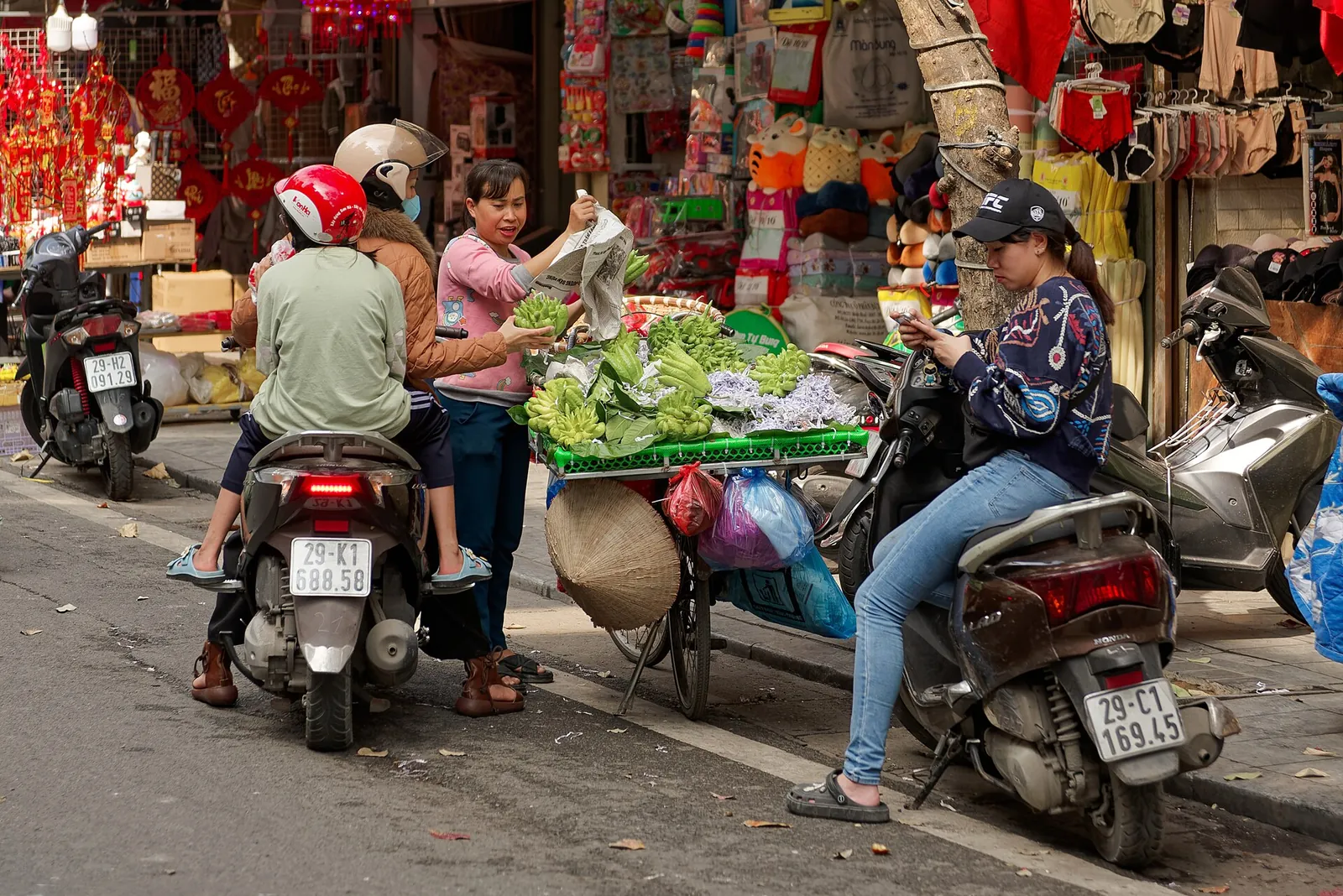
A street seller of fingered citrons in Hanoi's Old Quarter: small purchases like these are paid in cash
Photograph: Jakub Hałun — opens in a new tab · CC BY 4.0 — opens in a new tab
Changes: Resized and converted to WebP; displayed with responsive crops. · Original photograph and licence details ↗ — opens in a new tab
A Vietcombank ATM booth in the Ecopark township near Hanoi; ATMs are the easiest way to get dong
Photograph: Donald Trung — opens in a new tab · CC BY-SA 4.0 — opens in a new tab
Changes: Resized and converted to WebP; displayed with responsive crops. · Original photograph and licence details ↗ — opens in a new tab
Nam Dinh-style beef phở at the Phở Cồ stall in Trung Kính Hạ village, the kind of meal usually paid for in cash
Photograph: Bohdan Phúc Đan — opens in a new tab · CC BY-SA 4.0 — opens in a new tab
Changes: Resized and converted to WebP; displayed with responsive crops. · Original photograph and licence details ↗ — opens in a new tab
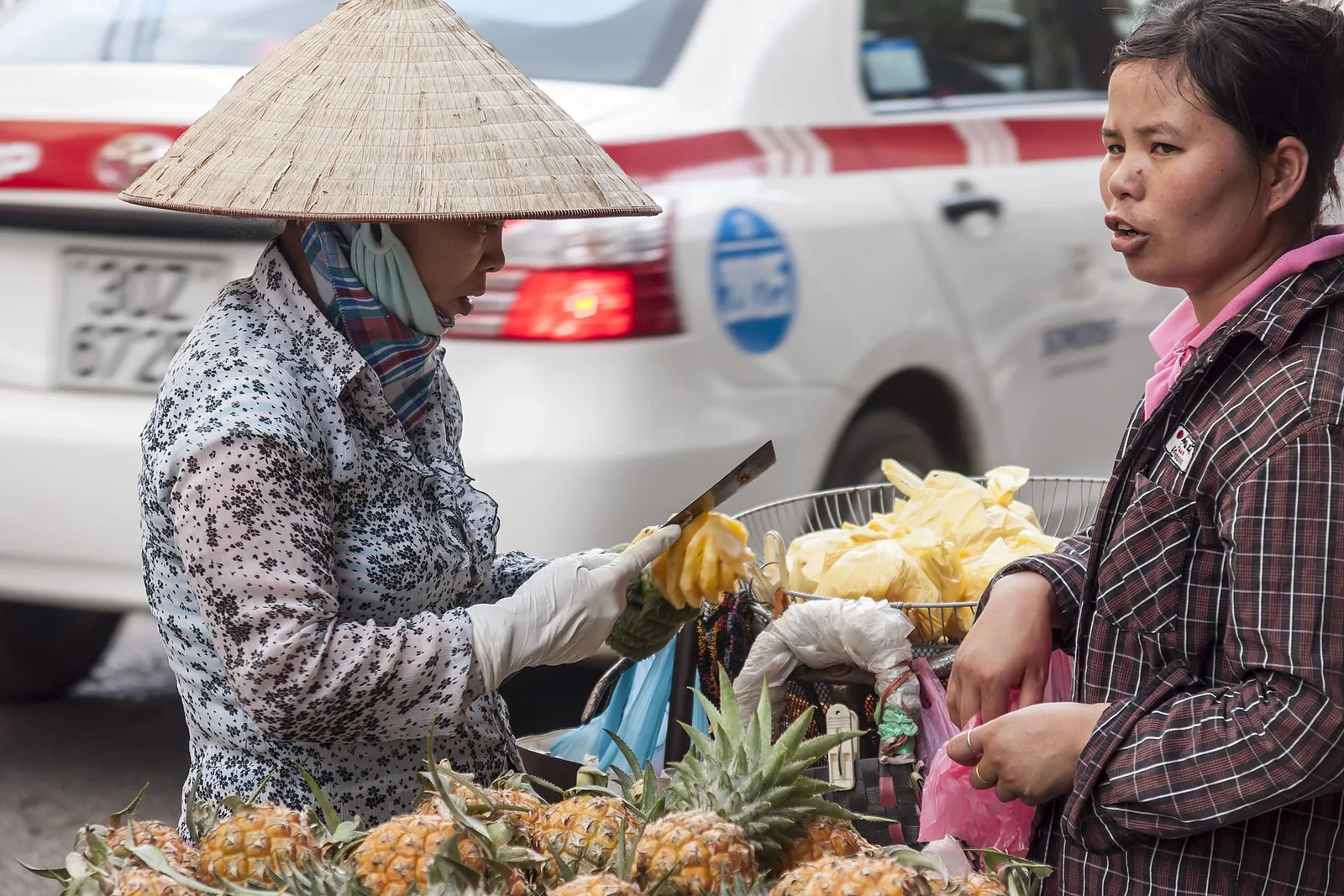
A pineapple seller in Hanoi; keep small notes for street snacks like this
Photograph: CEphoto, Uwe Aranas — opens in a new tab · CC BY-SA 3.0 — opens in a new tab
Changes: Resized and converted to WebP; displayed with responsive crops. · Original photograph and licence details ↗ — opens in a new tab