Plan your trip
Uzbekistan transport: Afrosiyob, Khiva trains, flights and transfers
Uzbekistan’s Silk Road cities lie along one railway line, so most of this guide is about trains: the Afrosiyob between Tashkent, Samarkand and Bukhara, and the electric services to Khiva that began in 2026. The harder questions are how to reach Khiva, when a flight earns its fare and how to cover the last stretch from an airport or station into town. Book the rail legs first, then add a plane only where the train is slow.
In this guide
Find the location ↗ — opens in a new tabThe short answer
Seven days (two nights each in Tashkent, Samarkand and Bukhara) end with the Afrosiyob back to Tashkent; ten days (Tashkent 2, Samarkand 3, Bukhara 2, Khiva 2) add Khiva by train No. 706, which leaves Bukhara-1 at 15:45. Book the Bukhara–Khiva seat and the Khiva return first, then the Afrosiyob seats. The Afrosiyob from Tashkent to Samarkand costs UZS 311,000 in economy on the fares in force since 1 February 2026, and Uzbekistan Airways flights from Tashkent to Urgench start from UZS 442,336 one way (about £28, checked on 25 October 2026).
- Key point
- Rail, flights and transfers for a 7 to 10 day Tashkent–Samarkand–Bukhara–Khiva route
- Where it applies
- Tashkent for arrival and the metro; Samarkand, Bukhara and Khiva along the railway
- Timing
- Spring and autumn are the main walking seasons; Navruz falls on 21 March.
Afrosiyob, conventional trains and the overnight option
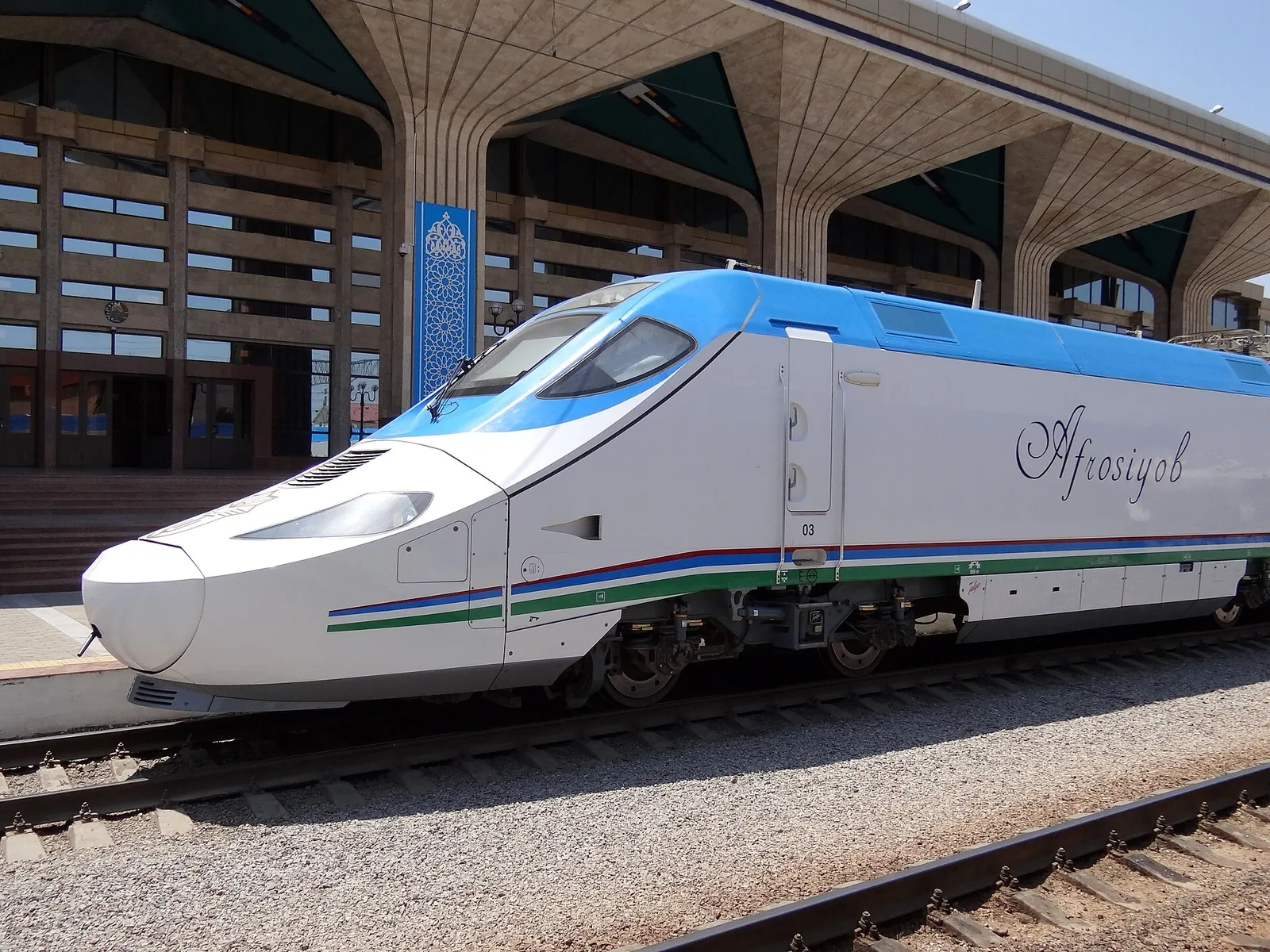
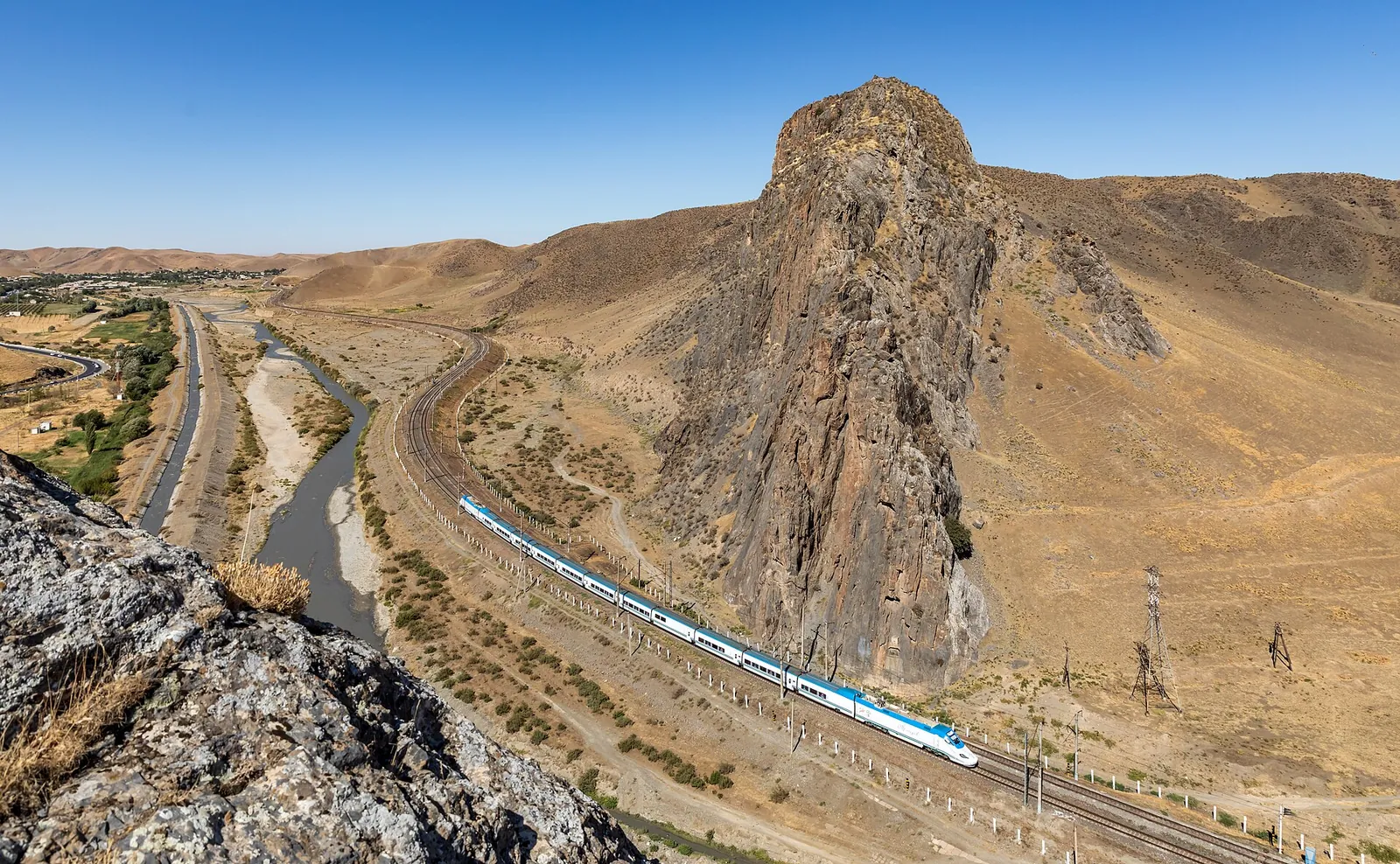
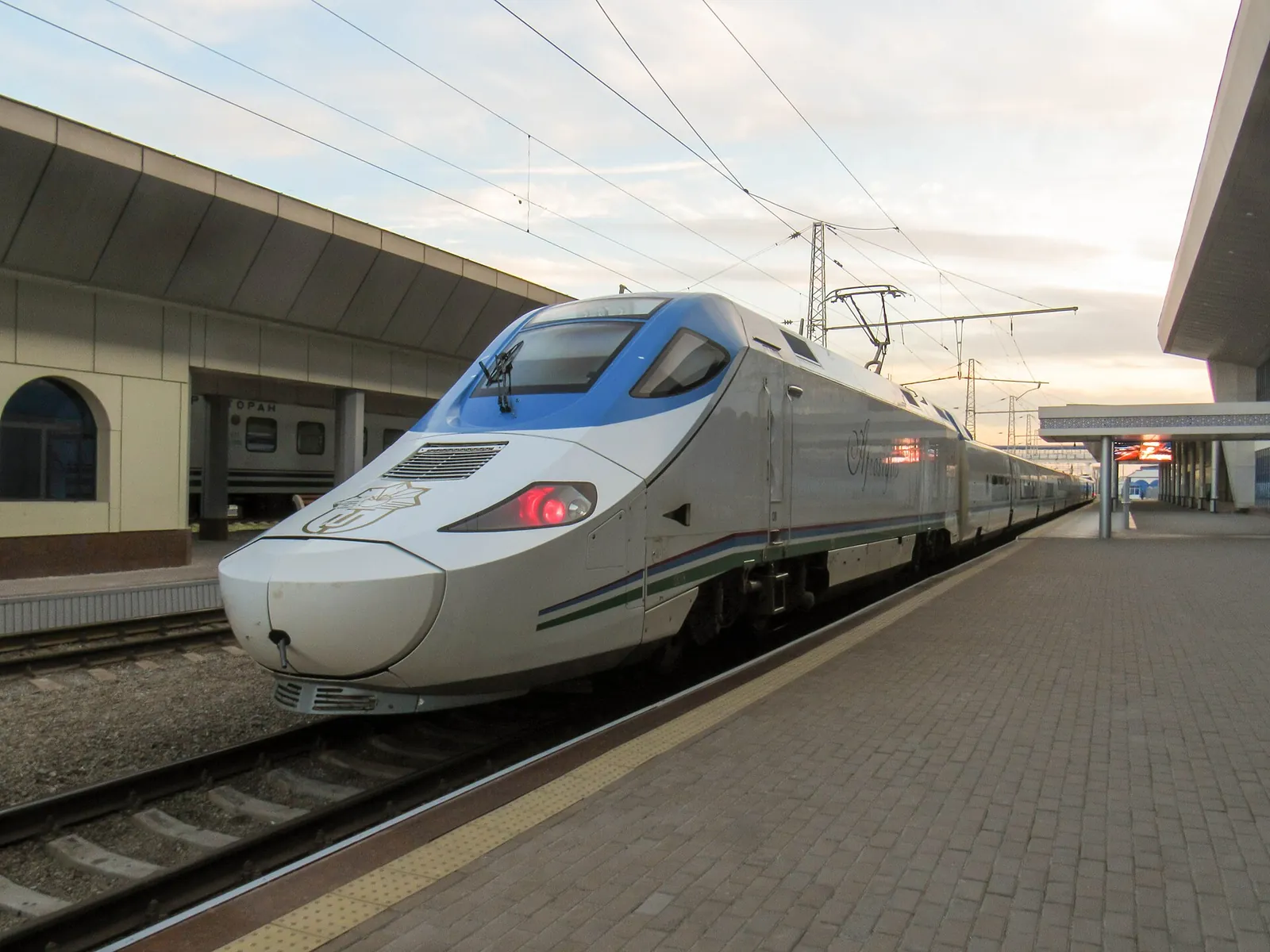
The Afrosiyob is the train that makes a Silk Road week workable. It takes 2 h 30 from Tashkent to Samarkand (2 h 33 back), 4 h 11 to 4 h 22 from Tashkent to Bukhara-1 and 4 h 11 to 4 h 20 back, with three departures a day each way and a fourth from Friday to Sunday. A weekly pair also links Tashkent and Bukhara: No. 702 from Tashkent on Tuesdays (10:05 to 15:17, 5 h 12) and No. 701 from Bukhara on Mondays (15:17 to 21:22, 6 h 05), both since mid-September 2026. The Afrosiyob sells economy, business and VIP seats, and every passenger may carry 36 kg of hand luggage free. Plan the stops with our Samarkand and Bukhara guides.
The operator’s timetable lists these Afrosiyob services end to end. Its change notices move some of them by up to half an hour (No. 766 to 06:51–09:21, for example), so take the time printed on your e-ticket.
| Train | From | To | Departs | Arrives | Days |
|---|---|---|---|---|---|
| 766 | Tashkent | Samarkand | 07:21 | 09:51 | Every day |
| 765 | Samarkand | Tashkent | 17:35 | 20:08 | Every day |
| 778 | Tashkent | Bukhara-1 | 06:03 | 10:14 | Fri, Sat, Sun |
| 768 | Tashkent | Bukhara-1 | 07:27 | 11:38 | Every day |
| 770 | Tashkent | Bukhara-1 | 08:29 | 12:46 | Every day |
| 772 | Tashkent | Bukhara-1 | 19:41 | 00:03 | Every day |
| 771 | Bukhara-1 | Tashkent | 03:15 | 07:35 | Every day |
| 769 | Bukhara-1 | Tashkent | 14:58 | 19:17 | Every day |
| 767 | Bukhara-1 | Tashkent | 16:17 | 20:31 | Every day |
| 777 | Bukhara-1 | Tashkent | 17:55 | 22:06 | Fri, Sat, Sun |
The timetable gives no Samarkand times for the Bukhara Afrosiyobs, so search Samarkand to Bukhara-1 on eticket.railway.uz to see which of them you can board in Samarkand. The conventional Sharq 710 is the dependable choice: it leaves Samarkand at 11:55 and reaches Bukhara-1 at 14:10 (2 h 15), and the other conventional trains take up to 2 h 32.
Slower conventional trains run the same line at other hours: 3 h 05 to 3 h 49 from Tashkent to Samarkand and 5 h 30 to 6 h 39 from Tashkent to Bukhara on the timetable effective 9 September 2025, leaving Tashkent Central at 08:40 and 20:20 and Bukhara at 05:15 and 16:55.
The slow way to Khiva is an overnight conventional train. No. 056 leaves Tashkent on Tuesday, Wednesday, Friday and Saturday (21:24 to 12:02, 14 h 38) and No. 076 on Monday (22:48 to 13:38, 14 h 50). In the other direction 056 leaves Khiva on Wednesday, Thursday, Saturday and Sunday (16:20 to 07:19, 14 h 59) and 076 on Tuesday (14:23 to 05:10, 14 h 47). Long-distance cars are two-berth SV compartments, four-berth TsMK compartments and open TsMO couchette cars with 54 berths, and the booking search names the coach type for each train. Tickets are sold per place, so two travellers in a four-berth compartment may share it with others unless they take all four places.
Bukhara to Khiva: the trains that started in 2026
Two new services changed the way to Khiva. Since 5 May 2026 the Hyundai Rotem train Jaloliddin Manguberdi runs from Tashkent Central to Khiva, stopping at Samarkand, Bukhara and Urgench. It leaves Tashkent at 07:00 and reaches Khiva at 14:31 (7 h 31) on Tuesday, Thursday and Saturday; the return leaves Khiva at 07:20 and reaches Tashkent at 14:51 (7 h 31) on Wednesday, Friday and Sunday. It beats changing at Bukhara, where the Afrosiyob (4 h 11 to 4 h 22) and No. 706 (4 h 40) already add up to about 9 hours before any wait, because it is one through train. It is a different train from the Afrosiyob, so search for it by route and date rather than by name. The return leaves Khiva only on Wednesday, Friday and Sunday, so with two nights in Khiva you arrive on a Wednesday (leave Friday) or a Friday (leave Sunday); a Monday arrival would fit the return but No. 706 does not leave Bukhara on Mondays. The 07:20 departure means a car or hotel transfer before dawn. The ten-day route still goes out by No. 706 because it runs on six days a week, while the through train runs only on Tuesday, Thursday and Saturday from Tashkent and stops at Bukhara on the way.
Since 9 September 2026 a CRRC-Dalian electric train with 415 economy seats also links Bukhara and Khiva. No. 706 leaves Bukhara-1 at 15:45 and reaches Khiva at 20:25 (4 h 40), every day except Monday; No. 707 leaves Khiva at 09:55 and reaches Bukhara-1 at 14:32 (4 h 37), every day except Tuesday. Because 706 arrives at 20:25, arrange your hotel pickup in Khiva before you leave Bukhara.
Book rail seats on the railway’s own site or app
Tickets are sold at eticket.railway.uz and in the Uzrailway tickets app. The results for your stations and date list each train’s name and number (for example Afrosiyob 768Ф or Sharq 710Ф), its departure and arrival times, journey time and free seats, and a seat plan opens once you choose a coach. If a date has no trains, the search shows the timetable for other dates. Seats are scarcest on No. 706 and on the Khiva fast train, which runs three days each way.
Foreign visitors buy on the document they will travel with, so enter passport details exactly as printed, and use Latin letters where the passport shows both Cyrillic and Latin. After you confirm, you have 15 minutes to pay or the order is cancelled. The railway accepts cards of national and international payment systems and sends a one-time SMS code to the phone linked to the card. The e-ticket has a 14-digit number and can be downloaded, and the price already includes a UZS 40,000 issuing fee per seat on domestic trains.
Domestic tickets go on sale 60 days ahead.
Refunds depend on timing. For an unused e-ticket the fee is UZS 15,000 per seat when you return it more than 24 hours before departure; between 24 and 6 hours before, the fee plus 50% of the reserved-seat charge; from 6 hours before to one hour after departure, the fee plus 100% of it; after that nothing is returned.
What the legs cost, per person
One-way fares per person. Uzbekistan Railways raised its fares by 15% from 1 February 2026 and announced the new Afrosiyob fares below; it gave no figures for the other trains, so the booking site shows their fare for your date, and where no fare is published the figure below is an estimate with its basis.
- Afrosiyob, Tashkent–Samarkand: UZS 311,000 economy, UZS 455,000 business and UZS 709,000 VIP from 1 February 2026. Tashkent–Bukhara: UZS 509,000, UZS 760,000 and UZS 1,138,000; Tashkent–Karshi is UZS 429,000, UZS 642,000 and UZS 976,000. The same 15% rise applies to the Sharq, Nasaf and Uzbekistan trains.
- Flights from Tashkent, one way, lowest fare: UZS 201,062 to Samarkand, Fergana, Namangan and Andijan, UZS 241,274 to Bukhara and UZS 442,336 to Urgench (for Khiva) and Nukus, on Uzbekistan Airways from 16 October 2026. At the central-bank reference rate of 23 October 2026 shown on Ipoteka Bank’s page (GBP 1 = UZS 15,916.89) that is about £13, £15 and £28. Silk Avia lists from 1 February 2026 UZS 313,089 to Samarkand, UZS 344,399 to Bukhara, UZS 469,635 to Urgench and UZS 297,435 to Fergana, Namangan and Kokand, and Nukus–Moynaq (the airline writes Muynak) from UZS 125,236.
- Urgench Airport–Khiva train: UZS 25,000 for adults (about £1.60) and UZS 14,000 for children.
- Tashkent metro and buses: a ride costs UZS 3,000 in cash, which buys a single-use QR ticket from an info kiosk, or UZS 2,500 from 1 October 2026 with an ATTO transport card, a bank card or a mobile app, as ATTO, which runs the fare system, announced. ATTO cards are sold at metro ticket offices and UzPost post offices.
- Samarkand–Bukhara train: about UZS 200,000 in economy, an estimate: no fare is published, and this is roughly the difference between the Tashkent–Bukhara and Tashkent–Samarkand Afrosiyob economy fares.
- Bukhara–Khiva train: about UZS 510,000 in economy, an estimate close to the Tashkent–Bukhara Afrosiyob economy fare for a similar journey time (No. 706 sells economy seats only).
- Urgench–Tashkent flight: about UZS 500,000, an estimate a little above the lowest fare listed in the other direction.
- Taxis: about UZS 50,000 from Tashkent airport into town and roughly UZS 20,000–30,000 each way between Bukhara-1 and the old town at Yandex’s published Bukhara tariff (estimates; no fixed fare is published). Over the whole route, taxis between stations, airports and hotels come to about UZS 600,000 for two if you take one only where a transfer needs it, 1.0 million for most transfers and 2.0 million with private cars. Our trip-cost guide adds rooms, food and tickets for the seven- and ten-day routes.
Flights: where the plane earns its fare
Between Tashkent and Samarkand there is little reason to fly: the Afrosiyob takes 2 h 30. The plane pays off on the long legs to the west, to Urgench for Khiva and to Nukus. Since 1 April 2026 Uzbekistan Airways sells domestic tickets in fare brands, with the lowest levels under the Lite brand, and the brands differ in baggage allowance, exchange and refund rules. Buy on booking.uzairways.com, in the airline’s app, at Uzbekistan Airways Sales branches or through official agents.
Silk Avia, a second domestic carrier, sells on silk-avia.com, at airports across the country and at the Uzbekistan Airways Sales office. Its Nukus–Moynaq flight is the quick way to the Aral Sea end of our Nukus and Moynaq guide.
The Fergana Valley is the other place a flight can save a day: the Fergana Valley Community Tourism Network describes it as a one-hour flight from Tashkent to Fergana, Namangan, Andijan or Kokand. The fastest Tashkent–Andijan train, the electric 730, leaves Tashkent at 07:20 and reaches Andijan at 11:42, calling at Kokand and Margilan; the return, 729, reaches Tashkent at 19:55, and from 26 October 2026 neither runs on Mondays. The other Tashkent–Andijan trains in the railway's October 2026 notice take 5 h 47 to 7 h 04, with Namangan on some of them; our Fergana Valley guide covers the stops.
Check-in on Uzbekistan Airways opens three hours before departure and closes 30 minutes before domestic flights; at Tashkent it closes one hour before international departures. The safest plan before a long-haul flight is a night in Tashkent. The itineraries show a same-day connection on separate tickets, with a margin of at least about four hours, as the riskier alternative: the carrier is not responsible for a missed connecting flight when you were carried to the connection point on a separate ticket.
From the station or airport into town
Urgench Airport has a rail link to Khiva. No. 7055 leaves the airport at 08:40 and reaches Khiva at 09:22, calling at Urgench between 08:59 and 09:02; No. 7058 leaves Khiva at 21:00 and reaches the airport at 21:42, 42 minutes each way. Tickets are sold at eticket.railway.uz. The notice lists one train each way, so for a flight outside those times, and for a morning departure from Khiva, book a car.
Tashkent has more than one station: the Khiva train and the conventional trains of the 2025 timetable leave from Tashkent Central, where the operator’s notice also has Afrosiyob 771 arriving. For Afrosiyob 766, 770 and 772, check the departure station on your e-ticket; some Fergana-valley trains leave from Tashkent South. In Bukhara the trains use Bukhara-1, in Kagan, about 12 km in a straight line from Lyabi-Hauz, so take a taxi, roughly UZS 20,000–30,000 each way at Yandex’s published Bukhara tariff, an estimate, or have your hotel arrange the ride. In Samarkand the trains use Samarkand station, about 5 km north-west of the Registan in a straight line; a Yandex ride to the old town costs roughly UZS 15,000–25,000 at its published Samarkand tariff.
In Tashkent and Samarkand the tourism board names Yandex Taxi and MyTaxi as the apps for ordering a car; from Tashkent airport plan on about UZS 50,000 into town (an estimate). At Samarkand airport, buses M1 and 256 run to the central railway station daily from 06:00 to 21:00, about every 15 minutes, for UZS 3,000 in cash. In Bukhara and Khiva, ask your hotel to arrange the car.
Tashkent metro
The Tashkent metro is a small network that is easy to navigate, and the tourism board calls its stations an art gallery for visitors. It runs daily from 06:00 to 00:00; the fare is on the price list above. UK advice says photography restrictions have been relaxed, but to check before taking photos near airports, border checkpoints, military barracks, bridges, police stations and metro stations, Tashkent’s decorated metro included.
By road: Shahrisabz, Bukhara–Khiva and the Fergana Valley
Germany’s advice is to avoid overland drives at night, so ask for road transfers that end in daylight. Intercity buses and minibus taxis exist too, and the tourism board’s travel tips still suggest a bus from Bukhara to Khiva, but the routes below are the ones worth knowing.
Samarkand–Shahrisabz: the pass road is 85–90 km and normally takes around two hours without long stops, through the Aman-Kutan gorge and over the Takhta-Karacha pass. Larger vehicles always take the bypass, which adds time, and heavy snow closed the pass temporarily in December 2021 and January 2024. STANTOURS lists a private day tour, Samarkand → Shahrisabz → Samarkand, at EUR 75 per sedan for one to three people, about UZS 1,000,000; the Shahrisabz guide prices the whole day.
Bukhara–Khiva: overland it is 455 km and 7–8 hours by car, and Advantour’s sedan transfer costs USD 240 (about UZS 2,860,000). It is the way to go on a Monday, when No. 706 does not run.
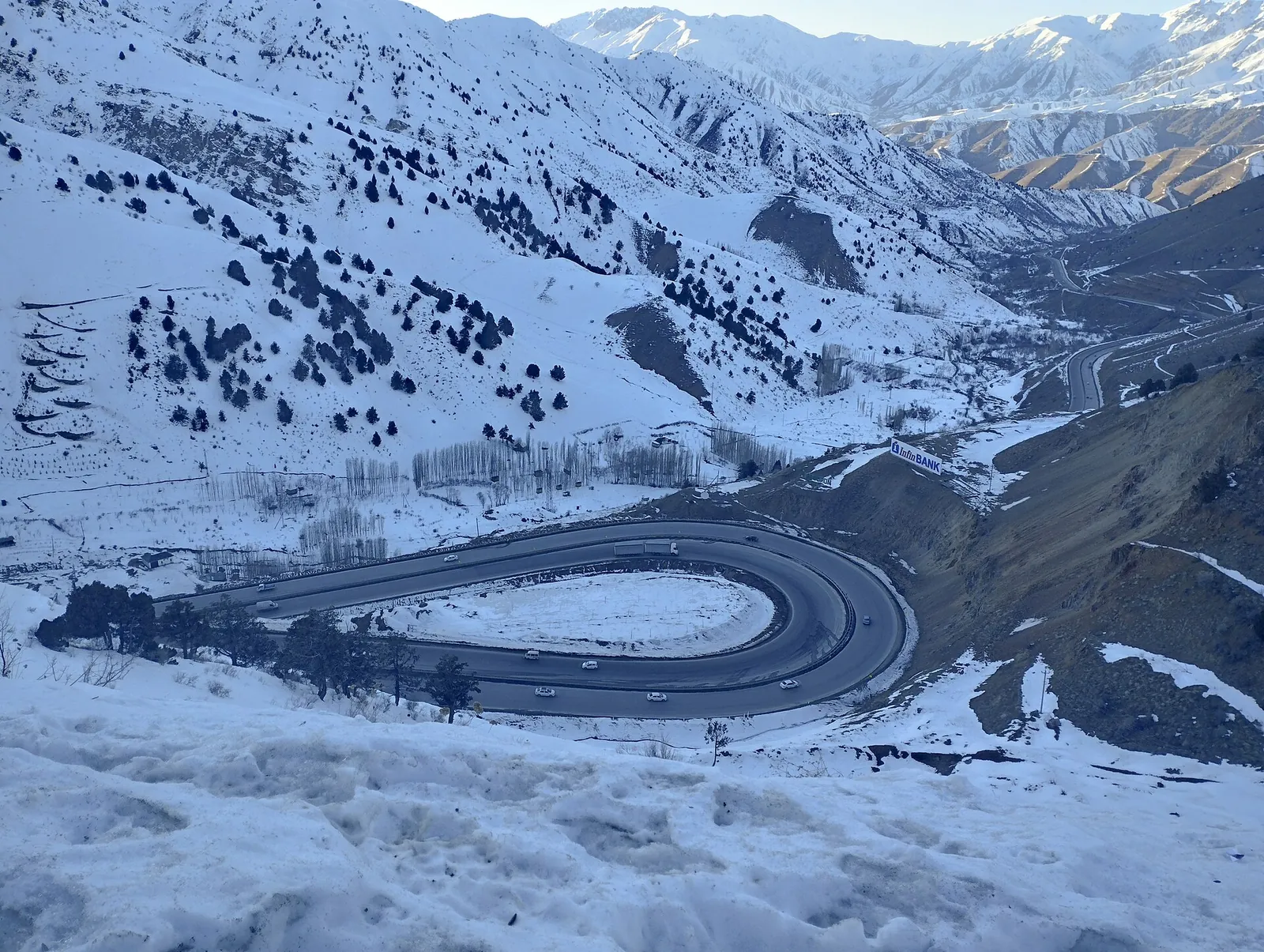
Tashkent–Fergana Valley: a shared taxi takes four to six hours over the Kamchik Pass, depending on the destination and on snow, and usually costs UZS 150,000–200,000 a person; shared taxis leave from a parking area in Tashkent’s Qo’yliq district.
Carry your passport on every journey; the UK says it is a legal requirement and police check it. Registration and the advice on border areas are in our entry guide.
Booking order for the classic route
The ten-day itinerary includes Khiva (Tashkent 2 nights, Samarkand 3, Bukhara 2, Khiva 2); the seven-day route returns from Bukhara to Tashkent (2, 2 and 2 nights). Secure the rail seats before fixing rooms to a day.
- Arrive at Tashkent (TAS): take a taxi-app ride into town, about UZS 50,000.
- Tashkent → Samarkand: Afrosiyob, 2 h 30.
- Samarkand → Bukhara: conventional Sharq 710, 11:55 to 14:10 (2 h 15), or a Bukhara Afrosiyob from the booking search; then a taxi from Bukhara-1 in Kagan.
- Bukhara → Khiva (ten-day route): No. 706 at 15:45, 4 h 40, every day except Monday.
- Khiva → Tashkent (ten-day route): the Jaloliddin Manguberdi on Wednesday, Friday or Sunday (7 h 31), or a flight from Urgench Airport, with a car or the airport train (from Khiva only at 21:00) to the airport.
- Bukhara → Tashkent (seven-day route): Afrosiyob 769, 14:58 to 19:17 (4 h 19), or another from the table above.
Practical questions
Which train should I take from Tashkent to Samarkand?
The Afrosiyob: No. 766 leaves Tashkent at 07:21 and reaches Samarkand at 09:51 (2 h 30), and No. 765 leaves Samarkand at 17:35 and reaches Tashkent at 20:08, both every day. Conventional trains on the same line take 3 h 05 to 3 h 49.
How far ahead can I book trains in Uzbekistan?
Domestic tickets go on sale 60 days ahead. Book at eticket.railway.uz or in the Uzrailway tickets app with your passport.
How do I get from Bukhara to Khiva?
By train No. 706, which leaves Bukhara-1 at 15:45 and reaches Khiva at 20:25 (4 h 40) every day except Monday. The return, No. 707, leaves Khiva at 09:55 and reaches Bukhara-1 at 14:32 (4 h 37) every day except Tuesday.
Where is Bukhara’s railway station?
Bukhara-1 is in Kagan, about 12 km in a straight line from Lyabi-Hauz in the old town, so take a taxi: an app ride costs roughly UZS 20,000–30,000 each way at Yandex’s published Bukhara tariff.
Is it better to fly or take the train from Khiva back to Tashkent?
The Jaloliddin Manguberdi takes 7 h 31 but leaves Khiva on Wednesday, Friday and Sunday only. A flight from Urgench saves the day; Tashkent–Urgench flights start from UZS 442,336 one way.
How do I get from Urgench Airport to Khiva?
Train No. 7055 leaves the airport at 08:40 and reaches Khiva at 09:22; No. 7058 leaves Khiva at 21:00 and reaches the airport at 21:42. The adult fare is UZS 25,000 and children pay UZS 14,000. These are the only two trains listed, so for any other flight book a car.
How much does the Tashkent metro cost?
A ride costs UZS 3,000 in cash (a single-use QR ticket from an info kiosk) or UZS 2,500 from 1 October 2026 with an ATTO transport card, a bank card or a mobile app, according to ATTO, which runs the fare system. ATTO does not say whether foreign bank cards work at the turnstile, so an ATTO card from a metro ticket office is the safe choice.
Keep planning your trip
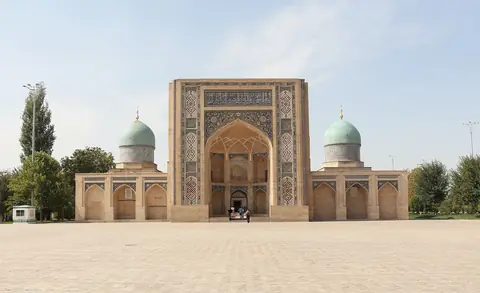
First trip to Uzbekistan
Choose seven days or ten for Tashkent, Samarkand, Bukhara and Khiva: nights, trains, season, registration, money, a SIM and an all-in budget.
Read the guide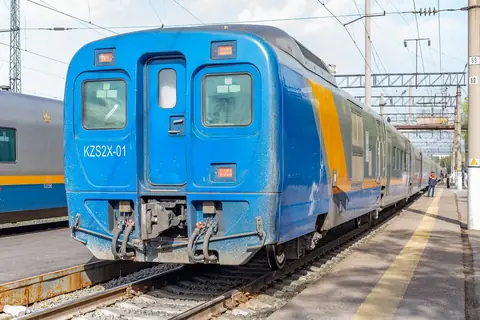
Getting around Kazakhstan
How to get from Almaty and Astana airports into town, ride the Talgo to Astana or Tashkent, use the Almaty metro and taxi apps, and reach Bishkek, Charyn and Kolsai.
Read the guide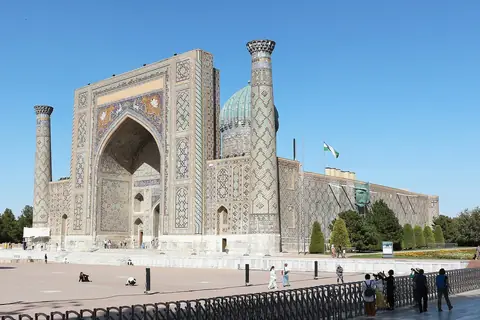
Uzbekistan in seven days
A seven-day Uzbekistan route with two nights each in Tashkent, Samarkand and Bukhara by train, real sights and an all-in cost for two.
Read the guide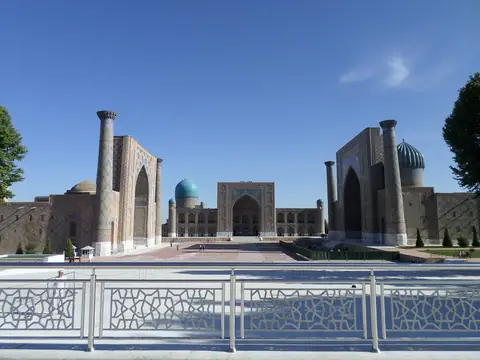
Uzbekistan in ten days
Ten days and nine nights through Tashkent, Samarkand, Bukhara and Khiva, with a Shahrisabz day trip, named hotels, trains, the flight home and an all-in budget.
Read the guide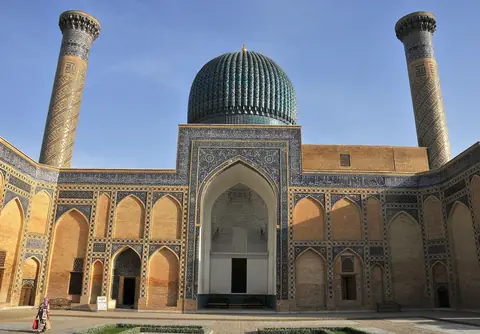
Samarkand
Plan two nights in Samarkand: the Registan, Gur-e-Amir, Bibi-Khanym, Shah-i-Zinda and Afrasiab, with tickets, hours, trains in and on to Bukhara, and costs.
Read the guide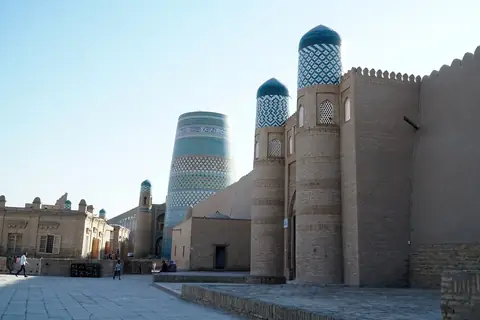
Khiva
Plan two nights inside Khiva’s walled Itchan Kala: where to sleep, the combined ticket, the main monuments, trains from Bukhara and Urgench, and what it costs.
Read the guideSources and checks before you travel
(34)
- O’zbekiston temir yo’llari: e-ticket FAQ ↗ — opens in a new tab
- O’zbekiston temir yo’llari: 60-day ticket sales, 22 November 2019 ↗ — opens in a new tab
- O’zbekiston temir yo’llari: home page ↗ — opens in a new tab
- O’zbekiston temir yo’llari: Jaloliddin Manguberdi launch, 5 May 2026 ↗ — opens in a new tab
- Tourism Committee: Bukhara–Khiva electric trains, September 2026 ↗ — opens in a new tab
- Khiva city government: Urgench Airport–Khiva train ↗ — opens in a new tab
- O’ztemiryo’lyo’lovchi: train timetable ↗ — opens in a new tab
- O’ztemiryo’lyo’lovchi: notice of train time changes from 9 September ↗ — opens in a new tab
- O’ztemiryo’lyo’lovchi: news list ↗ — opens in a new tab
- O’zbekiston temir yo’llari: long-distance coach types ↗ — opens in a new tab
- Uzbekistan Airways: domestic tariffs from 16 October 2026 ↗ — opens in a new tab
- Uzbekistan Airways: fare policy update, 17 March 2026 ↗ — opens in a new tab
- Uzbekistan Airways: flight check-in ↗ — opens in a new tab
- Uzbekistan Airways: passengers carrier contract ↗ — opens in a new tab
- Silk Avia: domestic fare levels from 1 February 2026 ↗ — opens in a new tab
- Uzbekistan Tourism Committee: travel tips ↗ — opens in a new tab
- Tashkent Transport Directorate: bus and metro tariff from 1 January 2025 ↗ — opens in a new tab
- Ipoteka Bank: exchange rates ↗ — opens in a new tab
- UK FCDO: Uzbekistan safety and security ↗ — opens in a new tab
- Auswärtiges Amt: Uzbekistan security ↗ — opens in a new tab
- O’ztemiryo’lyo’lovchi: Afrosiyob schedule changes from 8 October ↗ — opens in a new tab
- Samarkand International Airport: how to get there ↗ — opens in a new tab
- OpenStreetMap: Bukhara-1 station ↗ — opens in a new tab
- STANTOURS: private day tour to Shakhrisabz ↗ — opens in a new tab
- Advantour: Bukhara–Khiva transfer ↗ — opens in a new tab
- Fergana Valley Community Tourism Network: transportation ↗ — opens in a new tab
- ATTO: fares from 1 October 2026 ↗ — opens in a new tab
- Yandex Taxi: Start tariff, Samarkand ↗ — opens in a new tab
- Anhor.uz: train fares raised by 15% (Russian) ↗ — opens in a new tab
- Kursiv: Afrosiyob ticket prices to rise 15% from February 2026 ↗ — opens in a new tab
- O’zbekiston temir yo’llari: Afrosiyob tariff notice, 16 January 2026 ↗ — opens in a new tab
- Yandex Taxi: Start tariff, Bukhara ↗ — opens in a new tab
- Uzbekistan Railways (Telegram): Tashkent–Fergana Valley timetable from October 2026 ↗ — opens in a new tab
- Uzbekistan Railways (Telegram): trains 730/729 cancelled on Mondays ↗ — opens in a new tab
Reference sources for the version dated 5 November 2026. Confirm opening times, access, transport and conditions for your travel dates.
Photo credits
(4)
An Afrosiyob train at Samarkand railway station.
Photograph: Adam Jones from Kelowna, BC, Canada — opens in a new tab · CC BY-SA 2.0 — opens in a new tab
Changes: Resized and converted to WebP; displayed with responsive crops. · Original photograph and licence details ↗ — opens in a new tab
An Afrosiyob train on the Tashkent–Bukhara line between Jizzax and Gallaorol.
Photograph: Kabelleger — opens in a new tab · CC BY-SA 4.0 — opens in a new tab
Changes: Resized and converted to WebP; displayed with responsive crops. · Original photograph and licence details ↗ — opens in a new tab
An Afrosiyob train at Tashkent’s central railway station.
Photograph: Nikolai Bulykin — opens in a new tab · CC BY-SA 4.0 — opens in a new tab
Changes: Resized and converted to WebP; displayed with responsive crops. · Original photograph and licence details ↗ — opens in a new tab
The road over the Kamchik Pass in snow, between the Tashkent region and the Fergana Valley.
Photograph: Mirzoulugʻbek — opens in a new tab · CC0 — opens in a new tab
Changes: Resized and converted to WebP; displayed with responsive crops. · Original photograph and licence details ↗ — opens in a new tab