Fergana
Fergana Valley: three days for silk, pottery and Kokand
The Fergana Valley suits the traveller who would rather watch a loom or a potter’s wheel than visit one more madrasa. Kokand has a khan’s tiled palace, Rishtan the red-clay pottery that decorated it, and Margilan a silk factory where ikat cloth is still woven by hand. Fergana, a green town of shady streets, is the base. Three days is enough for those four towns, though not for Andijan or Namangan, and the road from Tashkent takes most of a day each way.
In this guide
Find the location ↗ — opens in a new tabThe short answer
Give the Fergana Valley three days and two nights, sleeping in Fergana and driving out to Kokand, Margilan and Rishtan. A shared taxi from Tashkent costs about UZS 150,000–200,000 a person, and Uzbekistan Airways flights to Fergana start from UZS 201,062 one way. With a private car, rooms, food, sights and a SIM, the loop comes to about UZS 4,800,000 a person, UZS 9,600,000 for two, without the international flight. Book the car first (OrexCA charges USD 160 for Tashkent–Fergana), then the room; ask a Fergana Valley network operator such as Holiday Tour and Travel in Fergana to book the Rishtan workshop or class when you book the car.
- Suggested time
- 3 days / 2 nights
- Where to stay
- Two nights in Fergana, with road trips to Kokand, Rishtan and Margilan
- Season and timing
- Spring and autumn are the easy seasons; the national tourism portal calls them the velvet season. The summer chillya, the hottest stretch, starts after 20 June and ends in early August, so plan outdoor sights for the morning then. In winter, snow on the Kamchik pass can slow the road from Tashkent, and the UK’s FCDO says outdoor air quality is often poor from November to February in the major cities, the Fergana Valley among them.
Fergana: a quiet base within reach of the craft towns
Fergana is the place to sleep, not the reason to come. It is one of Uzbekistan’s youngest cities, founded in 1876 about 12 km from Margilan and first called New Margilan, and it has almost no ancient sights. What it has is shady streets with old trees, a central park with a monument to Al-Fergani, a regional history museum and a puppet theatre. Its value is position: Rishtan is about 50 km away and Margilan is a short drive.
Fergana Hotel stands at 30B Maturidi Street, in a quiet neighbourhood a short distance from the centre, with a restaurant, a pool and buffet breakfast. Asia Fergana, at 26 Alisher Navoi Street, sits in the centre and sells rooms with and without breakfast. Neither shows a nightly rate outside its booking form.
To sleep beside the looms instead, Yodgorlik runs its own hotel in Margilan with seven rooms for 14 guests, booked through a callback form on its site. This guide plans on Fergana for both nights because it leaves the car in one place.
Three days, in the order the roads allow
The loop drives out through Kokand, the town nearest Tashkent, sleeps in Fergana and gives Margilan and Rishtan the second day, so every road leg ends in daylight, even in December. Germany’s Foreign Office advises against overland drives at night, and the Kamchik Pass is the last road to meet after dark. Tashkent–Fergana is about 315 km by road. Three days covers four towns and nothing else; the valley’s tourism network says three to four days is the minimum if Andijan and Namangan are included, so treat this as the shorter version.
With more days, add Andijan for its old-town bazaar, Craftsmen Alley and plov of red devzira rice, with Marhamat’s giant somsa and the Mingtepa site, which dates back to the 6th century BC, nearby; Namangan for its Chorsu Bazaar; and Chust for plov and handmade knives. The network’s culinary route gives each one or two nights, by train or taxi from Margilan.
- Day 1 — Tashkent to Fergana by Kokand: leave Tashkent at 08:00. Kokand is 250 km away, about four hours over the Kamchik Pass, so you arrive around 12:00. Give the palace and the Jami Mosque an hour and three-quarters and have lunch in town, then leave by 14:00: Kokand to Rishtan is 50 km (about an hour) and Rishtan to Fergana another 50 km, an hour to an hour and a half, so you check in by about 16:00–16:30, before dusk all year. If snow slows the pass, shorten the Kokand stop rather than drive on in the dark. Night: Fergana.
- Day 2 — Margilan and Rishtan: Margilan is 20 km, about 30 minutes, from Fergana. Be at Yodgorlik for the morning, add Gold Silk or the Margilan Crafts Development Center and, on a Sunday or Thursday, the Kumtepa bazaar just outside town. After lunch drive 50 km (about an hour) to Rishtan for one or two workshops, booked ahead, and return 50 km to Fergana by about 17:00. Night: Fergana.
- Day 3 — Back to Tashkent: leave Fergana at about 08:00 and keep the day for the 315 km. A private car needs about five hours, since the operator gives four hours for the 250 km from Kokand; a shared taxi takes four to six hours, and snow in the Kamchik mountains slows both. The road passes Kokand again, which suits the khans’ tomb or the Norbut-biy Madrasah if you missed them. Book no international departure for that evening. From Tashkent the onward choice is usually Samarkand.
Kokand: the khan’s palace and the cathedral mosque
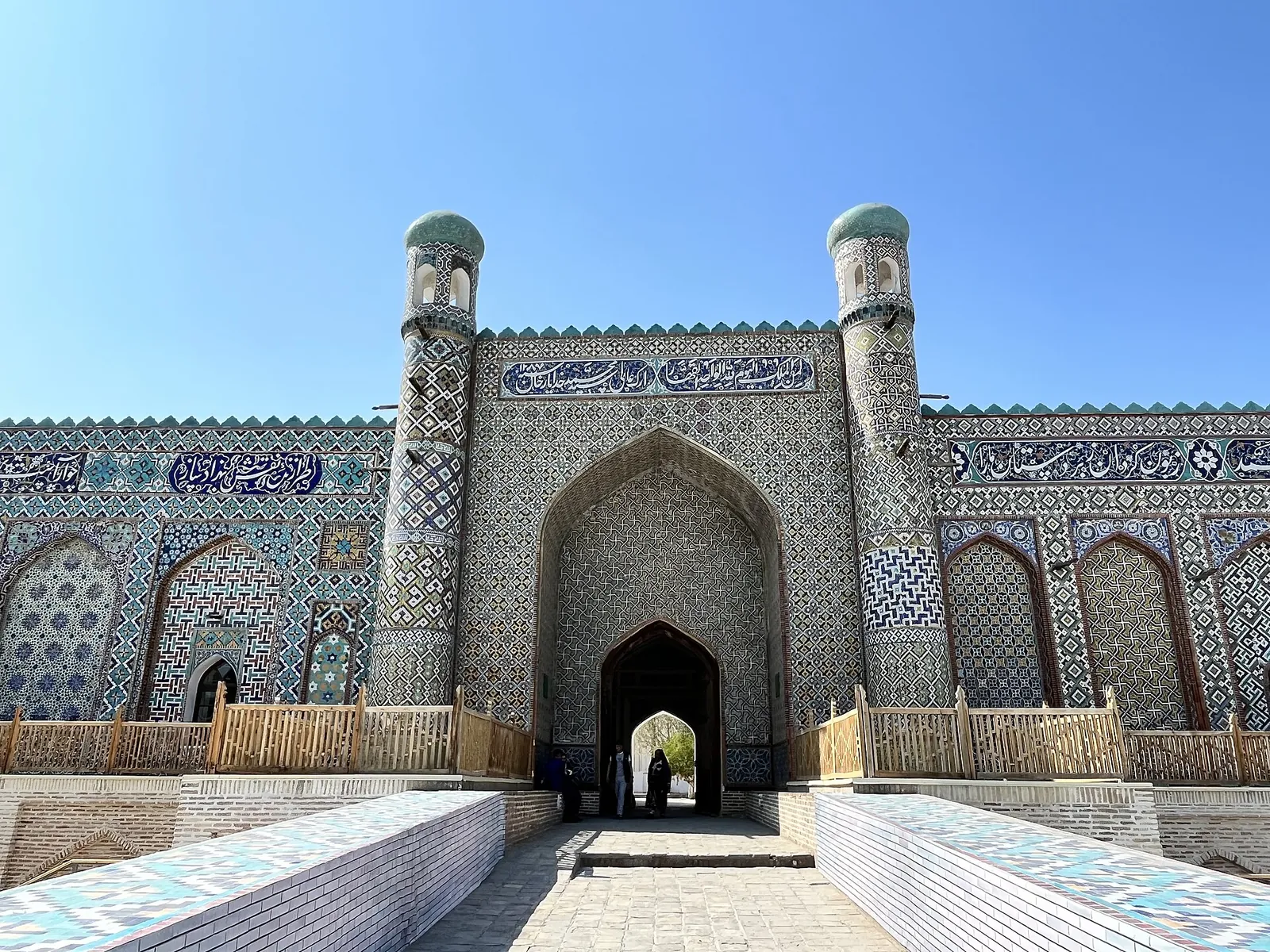
Khudoyar Khan took the throne in 1845 at the age of 12 and built his palace in 1871 to outdo the palaces before it. It was 138 metres long and 65 metres wide with 119 rooms; two courtyards and 19 rooms survive, and they hold the local history museum. The tiled façade is the reason to come: an Arabic inscription over the carved doors and a faceted minaret lined with ceramics in a pattern that recalls Fergana silks. The finishing work was done by the best craftsmen of Rishtan, which is why the next stop belongs on the same day.
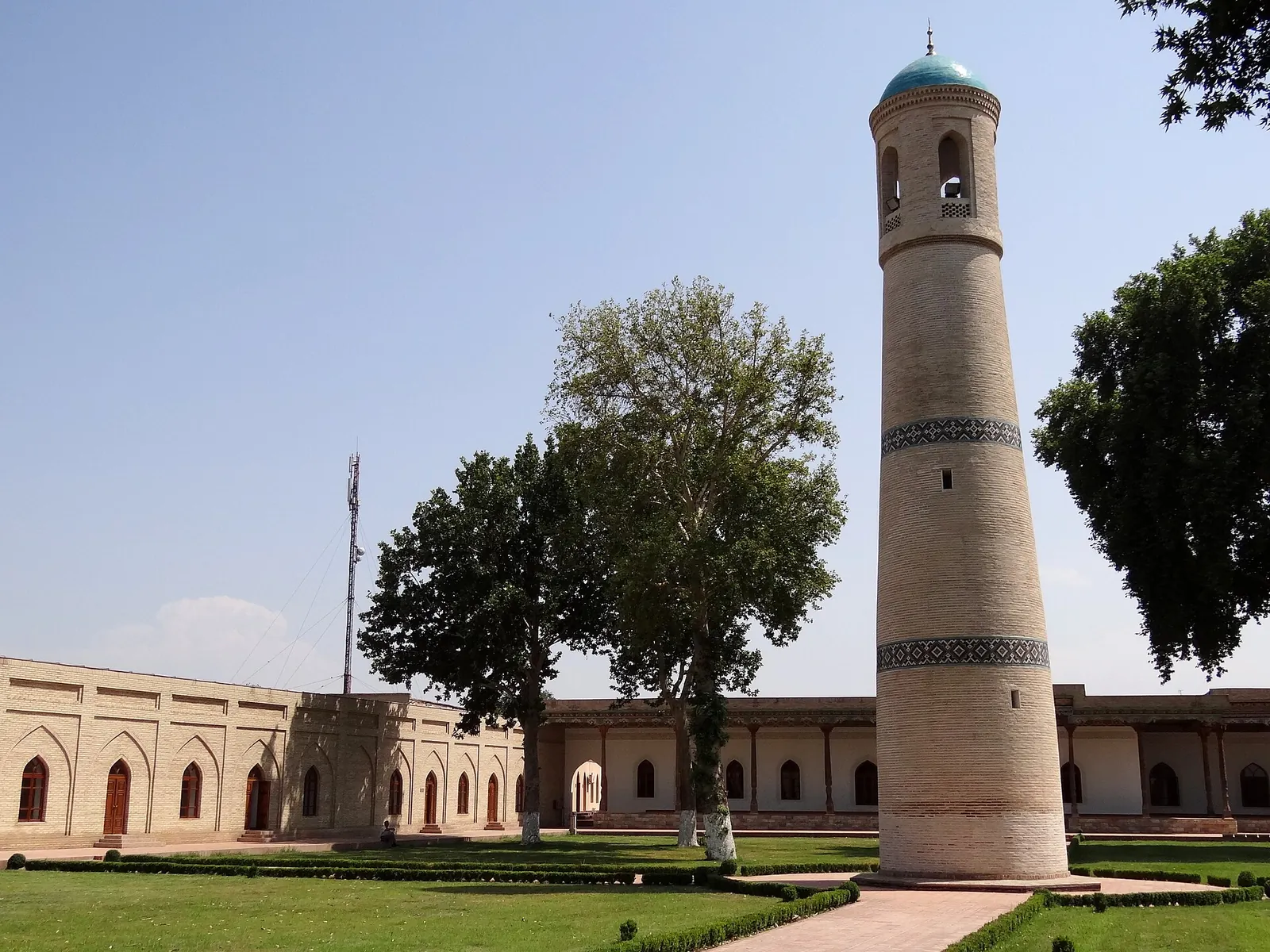
The Jami Mosque, built in 1819–1822 under Umar Khan, is Kokand’s main cathedral mosque. It has a large khanaka, or hall, and a porch of 98 carved wooden columns on three sides, ceiling beams decorated in the girih style, and a minaret 22.5 metres high with a winding staircase to the top. Women should cover shoulders, back and legs here and at the valley’s other religious sights.
Dakhma-i-Shahan is the family tomb of the khans, built after 1822 on the poet Nodira’s initiative, with a tiled portal that repeats the patterns of Fergana fabrics; the Madari Khan mausoleum and the Norbut-biy Madrasah are close by in the town. Kokand calls itself the handicraft capital of Uzbekistan and holds an international applied-arts festival every two years.
The palace museum publishes no opening hours or ticket price; plan on about UZS 100,000 a person, what Tashkent’s State Museum of History charges foreign visitors, and carry cash. Kokand’s railway station is 3 km from the centre and the palace.
Rishtan: red clay, blue glaze and the palace tiles
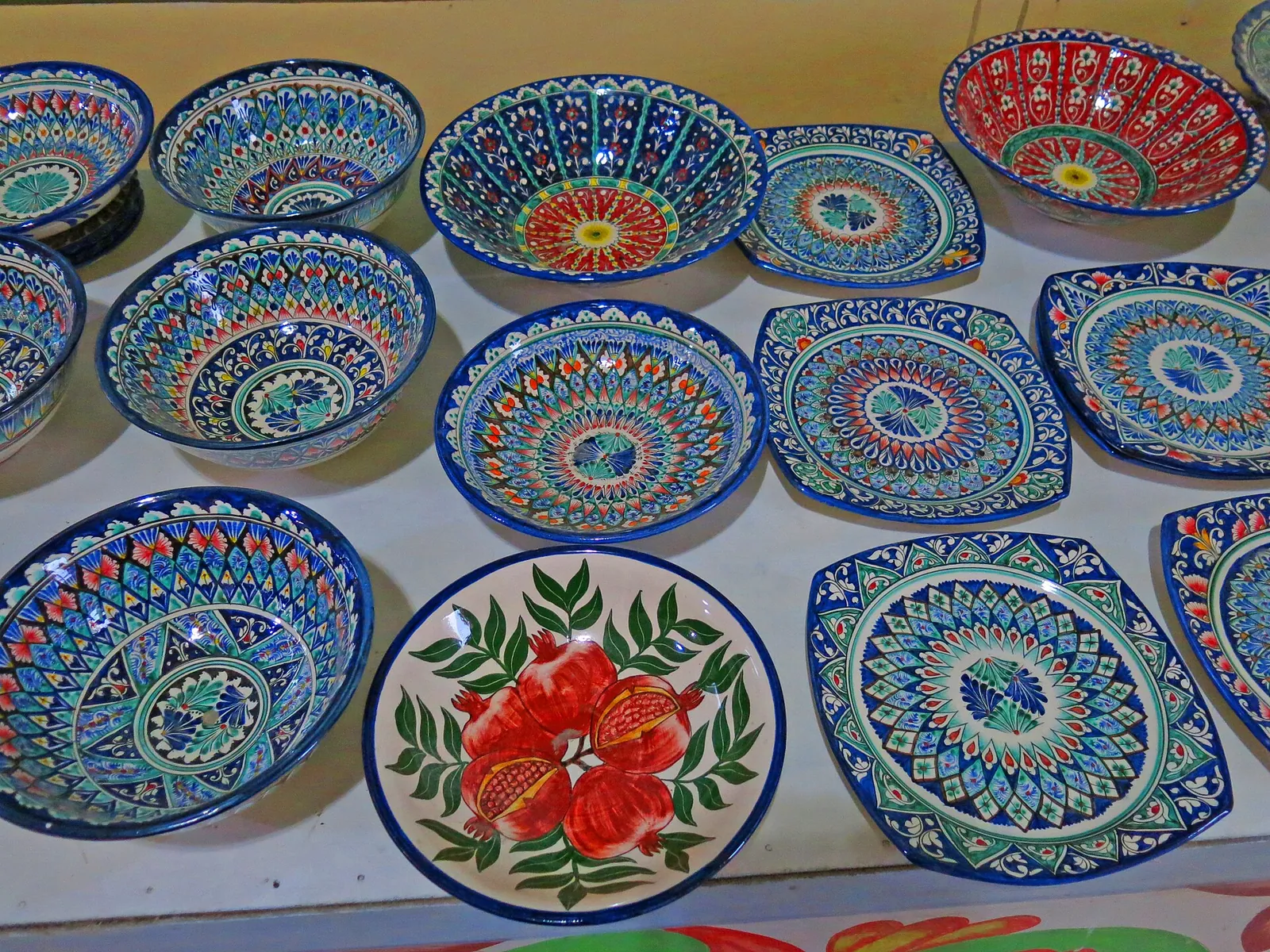
Rishtan, about 50 km from Fergana, is known for skilled potters and its red clay; by local legend the craft began here more than a thousand years ago. The clay is covered in ishkor, a glaze made from plant ash, and painted in cobalt blue, copper-oxide green and iron brown, which gives the blue-and-turquoise finish with floral and geometric patterns. Every colour and design carries a meaning.
Start at the ceramics centre. A Craftsmen’s Centre in Rishtan district works on the master-and-apprentice model, with over 20 workshops and a Museum of the History of Traditional Rishtan Ceramics, and an International Ceramics Center has 15–20 master potters with studio and showroom on the first floor; Diyorbek Nazirov gives master classes there. Single studios, among them Alisher Nazirov’s and Rustam Usmanov’s, let you watch a pot being thrown, painted and fired.
Book studio visits and classes before you travel. The Fergana Valley Community Tourism Network (ferganavalley-ctn.uz) recommends arranging artisan visits and master classes in advance through one of its member operators or guides, and its Fergana-based operators include Holiday Tour and Travel in Fergana city and Dilrabo Travel; ask them when you book the car, so the workshop fits the afternoon of day 2. No studio publishes a visit or class price; the sights budget below includes a workshop visit, and a hands-on class costs extra. The CAJ.UZ packages described below include a workshop visit in their price.
Margilan: silk from cocoon to ikat
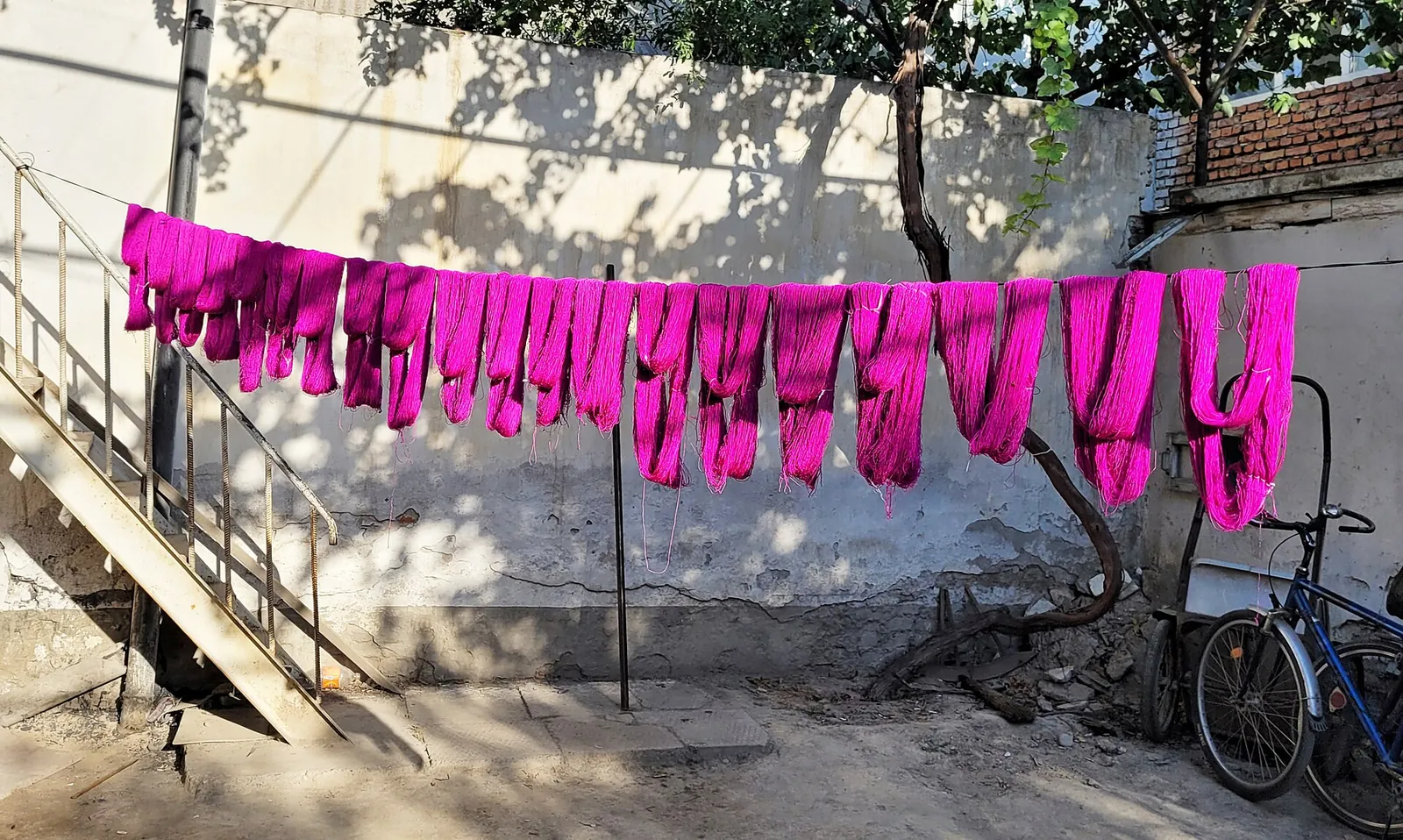
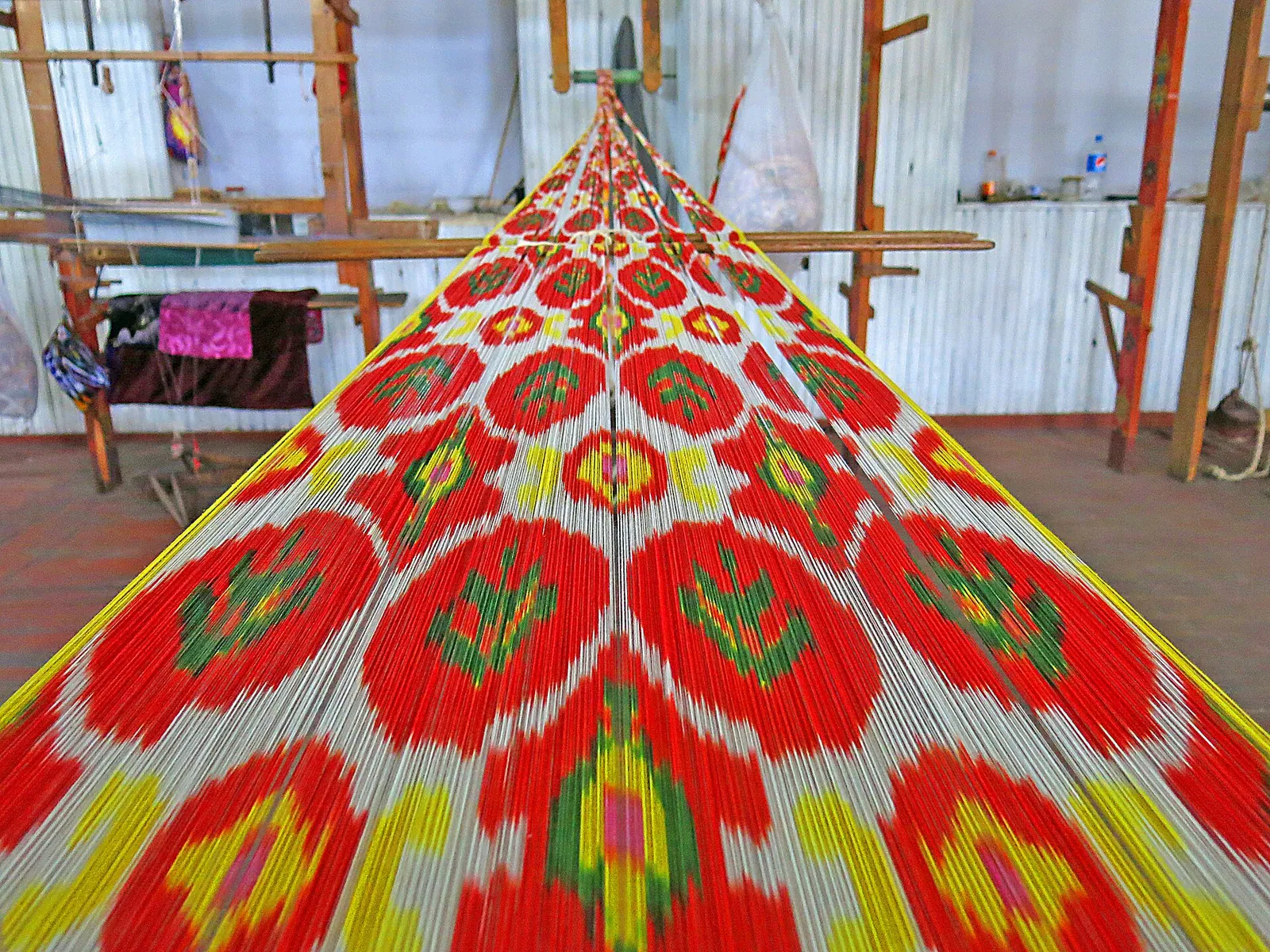
Margilan has been a silk town since the 10th century, and Yodgorlik is the factory to visit. Opened in 1972, it is billed as the only factory in Uzbekistan where the whole silk cycle is done by hand. A metre of atlas, the glossy silk cloth, takes two and a half months and 22 operations, 70% of it manual, with dyes from pomegranate peel, madder and onion husk. Yodgorlik has a museum, gardens, a shop and themed tours, and is open 08:00–17:00 seven days a week at 138 Zahiriddin Street; its shop sells a cotton scarf from $5 and an atlas silk-satin bathrobe for $65.
Two other places are worth the stop: the Margilan Crafts Development Center, in the renovated 19th-century Said Akhmad-Khoja Madrasa, and Gold Silk, a large crafts centre with a showroom and, on separate floors, weaving and carpet-making. Atlas is pure silk with a glossy finish; adras is a silk-cotton blend. UNESCO recorded Margilan’s atlas and adras methods in its register of best practices in 2017.
On Sundays and Thursdays the Kumtepa bazaar just outside town sells fruit, spices, vegetables and fabrics; fruit is cheap and plentiful across the valley, with roadside stalls at the entrance to Fergana. Margilan also hosts an international silk festival, Atlas Bayrami, every year.
What to eat and where to look
Devzira plov
The valley cooks its plov with devzira, a red-brown rice, and whole garlic; Kokand’s version also takes hot pepper and no sweet additions.
- Where to look
- Tea houses and plov centres in Kokand and Fergana; ingredients can be bought at Fergana’s central farmers’ market and cooked with a local family or in a tea house.
- Fit it into your day
- Lunch in Kokand on day 1, or a plov class in Fergana arranged through a local guide on the evening of day 2.
Tell the cook or guide about allergies or a vegetarian diet beforehand; plov is cooked with meat.
Kokand halva
A dessert made to an old recipe that has not changed for centuries; Kokand’s is described as the most tender halva in Uzbekistan.
- Where to look
- Sweet stalls and bazaars in Kokand.
- Fit it into your day
- Buy it in Kokand on day 1 or when the road brings you back through town on day 3.
Patyr bread
Patyr is a distinctive feature of Kokand cooking, and people in Kokand claim that all the valley’s bread is baked by men from their city.
- Where to look
- Bakeries and bazaar stalls in Kokand.
- Fit it into your day
- Take a loaf for the drive to Rishtan after the palace and mosque.
Fergana wine
The only winery in the Fergana Valley stands in Fergana city. It runs a winery tour and tasting, and its restaurant serves a hearty meal afterwards.
- Where to look
- Wine Garden, the winery in Fergana city.
- Fit it into your day
- Dinner on the first night in Fergana, after the long drive.
Valley fruit
Fruit is cheap and plentiful across the valley. Pomegranates, a national symbol, grow on plantations around Fergana, and melons are kept through the winter the traditional way, andarkhan, tied with string and hung from the ceiling.
- Where to look
- The Kumtepa bazaar outside Margilan on Sundays and Thursdays, or the roadside stalls at the entrance to Fergana.
- Fit it into your day
- Buy some at the bazaar on the morning of day 2 for the afternoon drive to Rishtan.
Getting to the valley and around it
By road: Tashkent–Kokand is 250 km (about four hours over the Kamchik Pass) and Tashkent–Fergana 315 km; a shared taxi takes four to six hours, depending on the destination, the weather and traffic, and costs UZS 150,000–200,000 a person; a whole car costs the equivalent of four seats, UZS 600,000–800,000. Shared taxis leave from a parking area in Tashkent’s Qo’yliq district and, in the valley, from bazaars and bus stations when they are full. For this loop a private car is the better choice, since the workshops lie off the shared-taxi routes. The operator OrexCA charges USD 160 for a sedan from Tashkent to Fergana and USD 160 from Kokand to Tashkent, and USD 110 for a day at your disposal within 70 km, 09:00–18:00, with driver, fuel, taxes and parking included. In town, a taxi app such as Yandex Go or MyTaxi shows the fare first.
By train: The fastest Tashkent–Andijan train is the electric train 730: from 1 October 2026 it leaves Tashkent Central at 07:20, calls at Pop, Kokand (10:26) and Margilan (11:02), the station for Fergana, and reaches Andijan at 11:42. The return, 729, leaves Andijan at 15:33, Margilan at 16:10 and Kokand at 16:48 and reaches Tashkent at 19:55. From 26 October 2026 neither train runs on Mondays, the day of its weekly technical inspection. The other Tashkent–Andijan trains in the railway's October 2026 notice take 5 h 47 to 7 h 04, Namangan is on some of them, and some use Tashkent South rather than Tashkent Central, so check the station on your ticket. The booking search shows the times and fares for your date, since the railway publishes no fare table. Tickets usually go on sale two months ahead. Our transport guide covers stations and booking.
By air: Uzbekistan Airways flies Tashkent–Fergana from UZS 201,062 one way, fares valid from 16 October, and Silk Avia flies Tashkent to Fergana or Kokand from UZS 297,435 one way, fares valid from 1 February. The flight takes 50 to 60 minutes and can be delayed or cancelled by fog or bad weather, especially in autumn and winter. Fergana Airport is 5 km from the city centre, and OrexCA’s sedan transfer costs USD 25. Silk Avia does not accept international cards.
As a package: CAJ.UZ sells a three-day, two-night tour by train from Tashkent at USD 605 a person for two sharing (about UZS 7,200,000), with guiding, both train legs, entry tickets, a workshop visit, two breakfasts and two dinners; its route runs through Andijan, Rishtan, Margilan and Kokand, with nights in Andijan and Kokand rather than Fergana. Its two-day tour, with a night in Fergana, costs USD 383 a person for two (about UZS 4,600,000). Lunches are extra, and both tours run on request.
Cards are not widely accepted outside Tashkent and the main cities, and very few ATMs outside them take international cards, so bring cash for the whole loop: smaller restaurants, bazaars, guesthouses and transport expect it.
Borders, photography and what to carry
The valley is shared with Kyrgyzstan and Tajikistan, and Kokand and Rishtan lie close to the frontier. Germany’s Foreign Office advises avoiding non-essential travel near any of Uzbekistan’s borders except at the official crossings. France advises against leaving towns, main roads and marked paths in the border zones, because mines have been reported in the mountains along the Kyrgyz and Tajik frontiers, and lists Kokand among the secured tourist sites. This loop stays in Kokand, Rishtan, Fergana and Margilan and on the main roads between them; keep it that way, and do not accept a shortcut towards a frontier or a mountain track. Check your own government’s advice before booking.
Carry your passport and the registration slips your hotel gives you; our entry guide gives the three-day rule. Ask before photographing bridges, tunnels, railway installations and checkpoints on the Kamchik road, because Germany notes that bans on them are not always signposted.
What three days cost, all in
About UZS 4,800,000 a person, UZS 9,600,000 for two, for three days and two nights in Fergana without the international flight. A double room with taxes, every meal and drink, a private car and driver, entry fees, a visitor SIM and a 10% buffer are in. At the central-bank reference rate of 23 October 2026 as shown on Ipoteka Bank’s page (GBP 1 = UZS 15,916.89), that is about GBP 300 a person and GBP 600 for two.
| Level | Per person | For two |
|---|---|---|
| Mid-range, 3 days / 2 nights, private car | UZS 4,800,000 | UZS 9,600,000 |
The budget assumes two adults sharing a double room for two nights in Fergana, with a private car for the transfers and the day around Margilan, on ordinary spring or autumn dates. Prices were checked on 25 October 2026, with USD 1 = UZS 11,903.15 and EUR 1 = UZS 13,329.15 from the same rate. As a cross-check, CAJ.UZ’s two-day guided tour with a night in Fergana costs USD 383 a person, about UZS 4,600,000, with the train, guide, entry tickets and two meals included.
For two: rooms UZS 1,700,000; food 1,400,000; getting around 5,100,000; sights and tours 400,000; SIM and extras 100,000; 10% buffer 900,000. The valley’s hotels and sights publish no prices, so rooms and sights are estimates from rates elsewhere in Uzbekistan; the car is the operator’s published tariff.
- Rooms: about UZS 850,000 a night for a mid-range double with taxes, based on mid-range doubles at about USD 55 elsewhere in Uzbekistan plus VAT and tourist tax.
- Food: UZS 225,000 a person a day for all meals and drinks.
- Getting around: USD 430 for the party, which is three driver-days: a sedan Tashkent–Fergana at USD 160, a day-use car at USD 110 for Margilan and Rishtan, and the return at USD 160, the Tashkent–Fergana fare taken in reverse. OrexCA’s transfer fares are one-way drives with a 15-minute wait, so ask it to quote the Kokand stop on day 1 before you book.
- Sights and tours: about UZS 400,000 for two, or UZS 100,000 a person a day: the palace museum and the Jami Mosque in Kokand on day 1, the Yodgorlik tour and a Rishtan workshop visit on day 2.
- SIM and extras: two Beeline Hello 1 eSIMs at UZS 60,000 for the month with no activation fee, bought at Beeline’s Tashkent office; the buffer covers tips and small extras.
- Flights, not in the total: London–Tashkent return in economy is about GBP 550–1,200 a person on sample fares from Turkish Airlines. Added to the valley loop, that makes about GBP 850–1,500 a person; fares vary by date. Count the flight once if you join this loop to other cities.
Practical questions
How many days does the Fergana Valley need?
Three days and two nights cover Kokand, Rishtan and Margilan from a Fergana base. Andijan and Namangan need more time; three to four days is a minimum for the highlights including them, and five to seven days is more relaxed.
Can I visit the Fergana Valley as a day trip from Tashkent?
Not sensibly by road. A shared taxi takes four to six hours each way, which leaves almost no time at the sights, and the shortest tour CAJ.UZ sells takes two days and one night. A flight takes 50 to 60 minutes and starts from UZS 201,062 one way.
Do I need to book craft visits in advance?
Yes for studios and classes: the valley’s tourism network asks visitors to book artisan visits and master classes ahead through one of its member operators or guides, such as Holiday Tour and Travel in Fergana. Yodgorlik’s own site gives opening hours of 08:00–17:00 seven days a week.
When is the best time to go?
Spring and autumn, at about 15–25°C. Summer is extremely hot, often above 40°C in the daytime; winter runs from −5 to 10°C with more frequent power cuts.
What does the three-day loop cost for two?
About UZS 9,600,000 for two, UZS 4,800,000 a person, without the international flight: two nights in a double room, every meal, a private car and driver, entry fees, a visitor SIM and a 10% buffer. The car is USD 430 of that, OrexCA’s fares for three driver-days.
Keep planning your trip
First trip to Uzbekistan
Choose seven days or ten for Tashkent, Samarkand, Bukhara and Khiva: nights, trains, season, registration, money, a SIM and an all-in budget.
Read the guide
Transport in Uzbekistan
Book Uzbekistan’s trains and flights: the Afrosiyob to Samarkand and Bukhara, the 2026 Khiva trains, domestic fares, airport links and the Tashkent metro.
Read the guide
Tashkent
Plan two nights in Tashkent: Khast Imam, Chorsu Bazaar, the metro, the squares and museums, an opera evening, rooms, the airport, the train to Samarkand and costs.
Read the guide
Samarkand
Plan two nights in Samarkand: the Registan, Gur-e-Amir, Bibi-Khanym, Shah-i-Zinda and Afrasiab, with tickets, hours, trains in and on to Bukhara, and costs.
Read the guide
Uzbekistan food
Where to try plov, samsa, lagman, shashlik and non in Uzbekistan, with named places in Tashkent, Samarkand, Bukhara and Khiva and what a day of meals costs.
Read the guide
First trip to Kyrgyzstan
Plan eight days from Bishkek along Issyk-Kul to Karakol, with a day on the south shore: nights, buses and drivers, season, money, a SIM, etiquette and a daily budget.
Read the guideSources and checks before you travel
(38)
- Uzbekistan Travel: Khudoyar Khan Palace ↗ — opens in a new tab
- Uzbekistan Travel: Jameh Mosque in Kokand ↗ — opens in a new tab
- Uzbekistan Travel: Kokand ↗ — opens in a new tab
- Uzbekistan Travel: Tomb of the Kings, Dakhma-i-Shahan ↗ — opens in a new tab
- Uzbekistan Travel: Rishtan ceramics ↗ — opens in a new tab
- Uzbekistan Travel: Fergana ↗ — opens in a new tab
- Uzbekistan Travel: Margilan craft centres ↗ — opens in a new tab
- Uzbekistan Travel: The colours of the Khan-atlas ↗ — opens in a new tab
- Uzbekistan Travel: travel tips ↗ — opens in a new tab
- Yodgorlik silk factory: official site ↗ — opens in a new tab
- Fergana Valley Community Tourism Network: plan your trip ↗ — opens in a new tab
- Fergana Valley Community Tourism Network: transportation ↗ — opens in a new tab
- Fergana Valley Community Tourism Network: handicrafts ↗ — opens in a new tab
- Fergana Valley Community Tourism Network: culinary route ↗ — opens in a new tab
- Uzbekistan Airways: domestic fares ↗ — opens in a new tab
- Silk Avia: domestic fare levels ↗ — opens in a new tab
- CAJ.UZ: 2-day Fergana Valley tour ↗ — opens in a new tab
- CAJ.UZ: 3-day Fergana Valley tour ↗ — opens in a new tab
- Fergana Hotel: official site ↗ — opens in a new tab
- Asia Fergana: official site ↗ — opens in a new tab
- Beshqozon: online menu ↗ — opens in a new tab
- Beeline: Hello 1 price notice ↗ — opens in a new tab
- Beeline: eSIM ↗ — opens in a new tab
- Ipoteka Bank: exchange rates ↗ — opens in a new tab
- Turkish Airlines: London to Tashkent fares ↗ — opens in a new tab
- UK government: Uzbekistan safety and security ↗ — opens in a new tab
- UK government: Uzbekistan entry requirements ↗ — opens in a new tab
- Germany’s Foreign Office: Uzbekistan travel advice ↗ — opens in a new tab
- France Diplomatie: Uzbekistan travel advice ↗ — opens in a new tab
- Uzbekistan Railways (Telegram): Tashkent–Fergana Valley timetable from October 2026 ↗ — opens in a new tab
- OrexCA: Fergana Valley city transfers ↗ — opens in a new tab
- OrexCA: distances between cities ↗ — opens in a new tab
- Fergana Valley Community Tourism Network: artisans ↗ — opens in a new tab
- Fergana Valley Community Tourism Network: tour operators ↗ — opens in a new tab
- OrexCA: Fergana Valley airport and station transfers ↗ — opens in a new tab
- State Museum of History of Uzbekistan: about the museum ↗ — opens in a new tab
- UK FCDO: Uzbekistan health ↗ — opens in a new tab
- Uzbekistan Railways (Telegram): trains 730/729 cancelled on Mondays ↗ — opens in a new tab
Reference sources for the version dated 5 November 2026. Confirm opening times, access, transport and conditions for your travel dates.
Photo credits
(6)
The tiled portal of Khudayar Khan Palace in Kokand
Photograph: Dmitriy Tashkent — opens in a new tab · CC BY-SA 4.0 — opens in a new tab
Changes: Resized and converted to WebP; displayed with responsive crops. · Original photograph and licence details ↗ — opens in a new tab
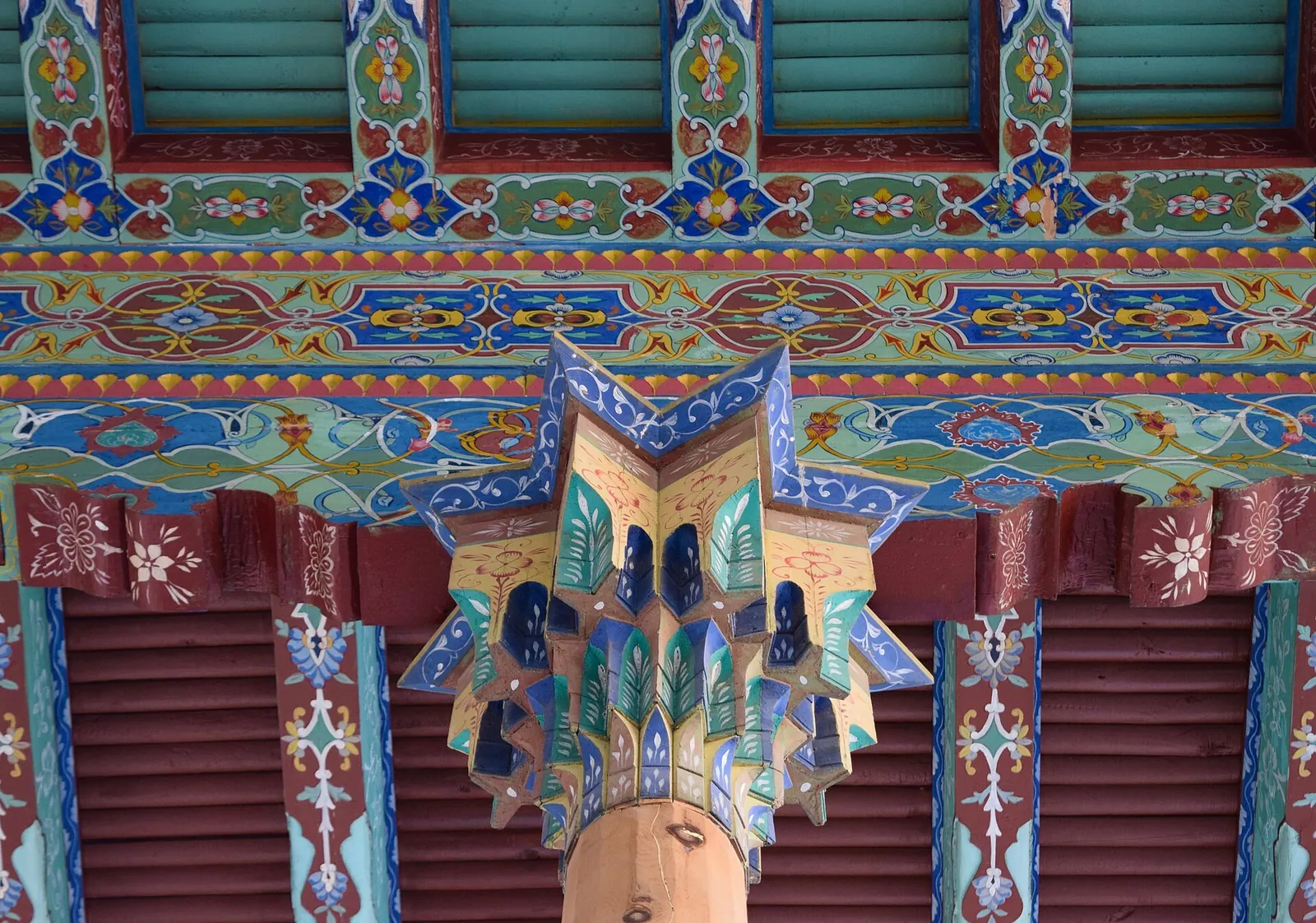
A painted ceiling inside Khudayar Khan Palace
Photograph: Stephanieadams99 — opens in a new tab · CC BY-SA 4.0 — opens in a new tab
Changes: Resized and converted to WebP; displayed with responsive crops. · Original photograph and licence details ↗ — opens in a new tab
The minaret and courtyard of the Jami Mosque, Kokand
Photograph: Adam Jones from Kelowna, BC, Canada — opens in a new tab · CC BY-SA 2.0 — opens in a new tab
Changes: Resized and converted to WebP; displayed with responsive crops. · Original photograph and licence details ↗ — opens in a new tab
Dyed silk skeins drying in Margilan
Photograph: Bgag — opens in a new tab · CC0 — opens in a new tab
Changes: Resized and converted to WebP; displayed with responsive crops. · Original photograph and licence details ↗ — opens in a new tab
Ikat warp threads stretched out at the Yodgorlik silk factory
Photograph: Enric — opens in a new tab · CC BY-SA 4.0 — opens in a new tab
Changes: Resized and converted to WebP; displayed with responsive crops. · Original photograph and licence details ↗ — opens in a new tab
Hand-painted ceramics on display in a Rishtan workshop
Photograph: Enric — opens in a new tab · CC BY-SA 4.0 — opens in a new tab
Changes: Resized and converted to WebP; displayed with responsive crops. · Original photograph and licence details ↗ — opens in a new tab