Bukhara Region
Bukhara: two nights in the old city, its domes and museums
Bukhara is the Silk Road city that still works at walking pace: a pond-side square, covered trading domes, one of the great minaret-and-madrasa ensembles of Central Asia and an old citadel, all close enough to cover on foot. The historic centre has been on the UNESCO World Heritage List since 1993, and the national tourism portal counts more than 140 monuments in the city. Two nights give you the main sights without a rushed morning, and the small museums set inside the madrasas, mosques and mausoleums give each building a reason to step through its door.
In this guide
Find the location ↗ — opens in a new tabThe short answer
Book two nights in Bukhara, in a room within walking distance of Lyabi-Hauz, and reserve the onward train first: train 706 to Khiva leaves Bukhara-1 at 15:45 every day except Monday. Two nights give you an arrival afternoon, one full day and a departure morning for the domes, madrasas and the Ark. A standard double at Komil costs $80 a night in season, and the Ark ticket UZS 60,000 for foreign visitors. All in, two nights for two come to about UZS 4.6 million at mid-range.
- Suggested time
- 2 nights in Bukhara
- Where to stay
- Lyabi-Hauz and the old town, within walking distance of the trading domes and Poi-Kalon
- Season and timing
- The national tourism portal describes Bukhara’s summers as hot and arid and its winters as rather mild. Walking between the sights is easiest outside midsummer, and the museum reserve gives longer hours in season.
A base within walking distance of Lyabi-Hauz
Choose a room a short walk from Lyabi-Hauz, the pond-side square at the centre of the old town, and almost everything in this guide is on foot: the trading domes, Magoki Attori, the madrasas, Poi-Kalon and the Ark. Bukhara-1 station is in Kagan, about 12 km in a straight line from Lyabi-Hauz, so arrive by taxi: an app taxi costs roughly UZS 20,000–30,000 each way at Yandex’s published Bukhara tariff, and your hotel can arrange the ride back.
The budget prices three old-town rooms. Hotel Kamelot, a 3-star hotel at 6 Aini Street in the centre of the old city, lists a double for non-residents at $60 with breakfast included. Komil Boutique Bukhara Hotel, a 19th-century house at 40 Barakiyon Street, lists a standard double at $80 from 15 March to 15 November and $70 in winter, with breakfast and official registration in the rate. Minorai Kalon Boutique Hotel, at 11 H. Ibodova Street, lists a Luxe twin from $100.
Lyabi-Hauz, the trading domes and Magoki Attori
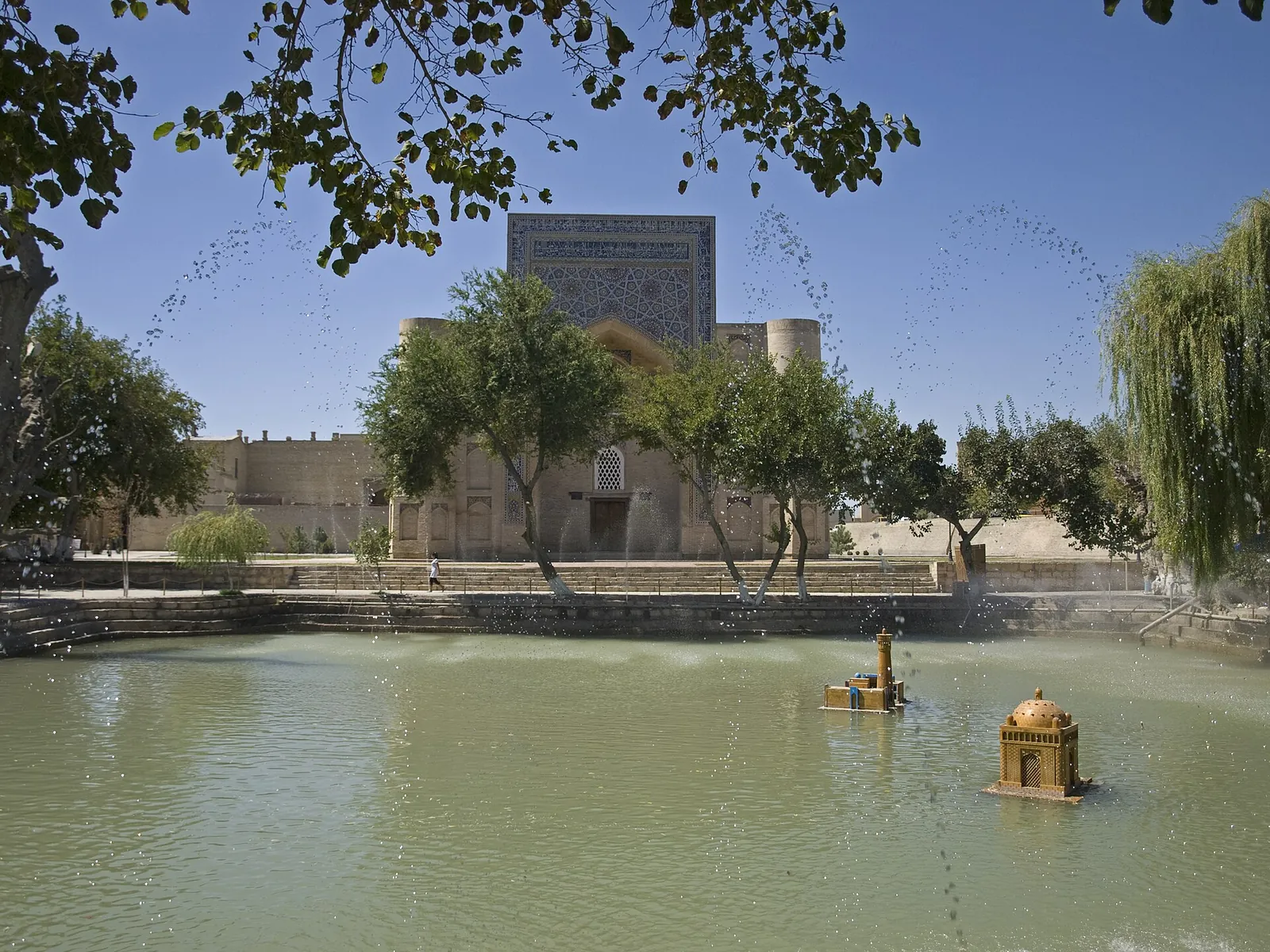
Spend the arrival afternoon here. Lyabi-Hauz means ‘by the pond’, and the pool is why the square works. The 16th-century Kukeldash madrasa, with 160 rooms and majolica façades, and the Nadir Divan-Begi madrasa and khanaka make up the square, and a bronze Khoja Nasriddin on his donkey stands near the Nadir Divan-Begi madrasa. There is a café by the pool. Inside, the Kukeldash madrasa holds a literature museum and the Nadir Divan-Begi khanaka a museum of Varakhsha and Bukhara ceramics, each UZS 20,000 for foreign visitors.
The Tim Abdullah Khan trading dome, built in the 16th century, is completely closed apart from a gate on the west side, and sunlight reaches the stalls only through holes in the dome, so it stays cool in any weather. Carpets, handicrafts, paintings and musical instruments are sold here; Bukhara is also known for ikat fabric, and most shops line the Lyabi-Hauz square and the domes beside Poi-Kalon.
Magoki Attori is the oldest mosque in Bukhara. Its building is dated to 714 and linked to the Arab governor Qutayba ibn Muslim, on the site of a bazaar that sold spices, which is where the name comes from. A lower arch decorated with stalactites survives from the façade, with carved ganch panels beside it; inside, the building is now the carpet museum (UZS 20,000).
Poi-Kalon, the Kalon minaret and the madrasa museums
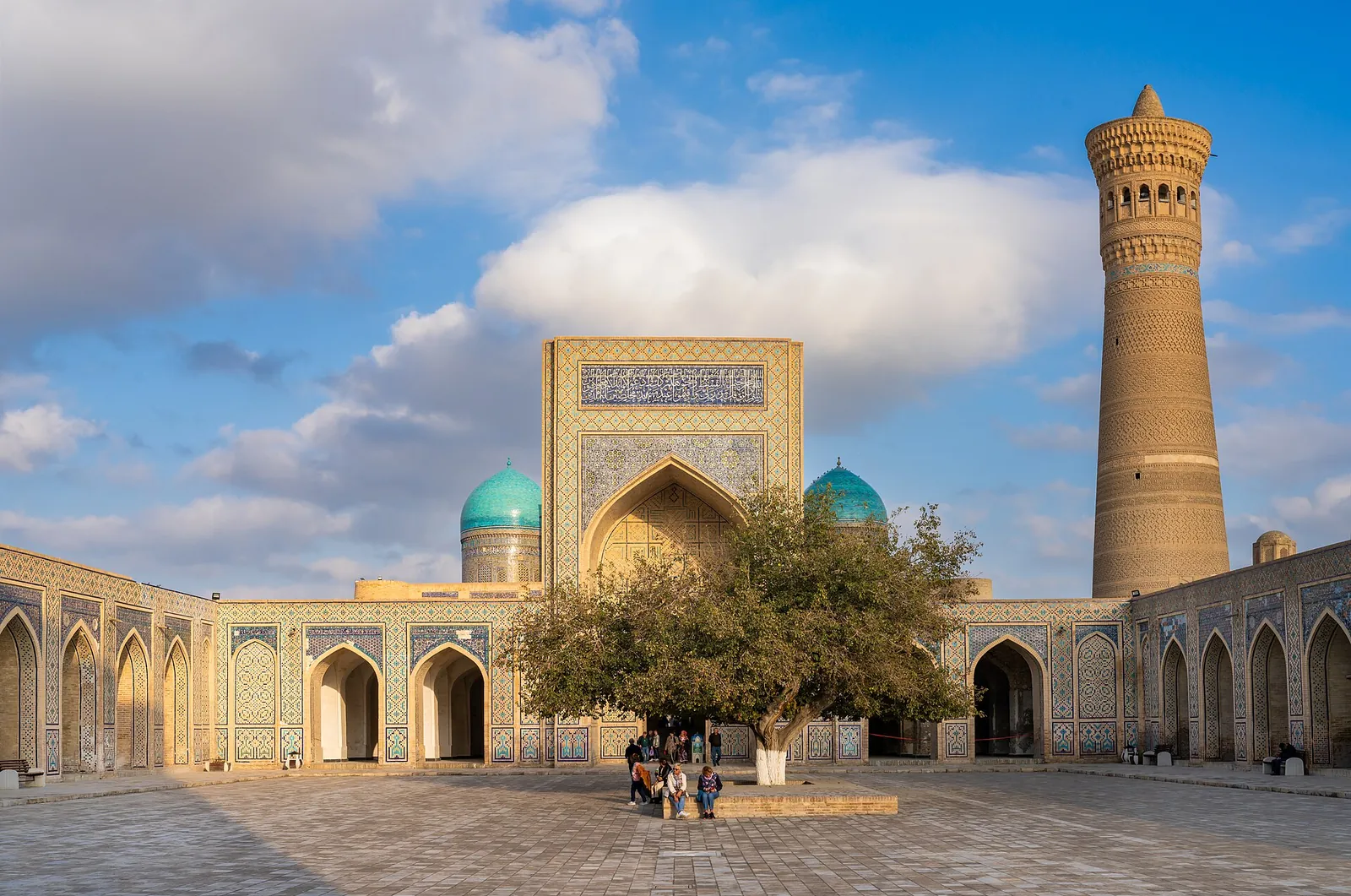
Take the morning of the full day for Poi-Kalon, the ensemble built between the 12th and 16th centuries around the Kalon minaret: the Kalon Mosque, the Miri Arab madrasa and the Amir-Alimkhan madrasa. A cathedral mosque and minaret stood here from the 8th century, and the present ensemble took its shape in the 16th, when the new mosque and the Miri Arab madrasa were built. The Miri Arab, begun in 1530, was larger than Ulugbek’s madrasa in Samarkand. It was reopened in 1945 as a place of religious education, so plan to admire its façade from the square rather than to walk in.
The Kalon minaret was built in 1127 by the Karakhanid ruler Arslan Khan, and its architect, Bako, is named on a ledge near the top. One story says many builders failed before Bako found the right materials; another says Genghis Khan, entering the city after its capture, bowed his head to the tower and ordered it spared. Besides calling the faithful to prayer, the minaret served as a lookout and a beacon for travellers lost in the desert, and it was once used for executions, which earned it the name ‘Tower of Death’. The minaret and the Kalon Mosque are described here from the outside.
Two smaller madrasas make a good pair of museum stops. The Ulugbek madrasa, dating from 1417, houses the calligraphy museum, and the Abdulaziz Khan madrasa, from 1652, houses the woodcarving museum; each costs UZS 20,000. A local story says the masters hid a tiny portrait of the khan in a bouquet of flowers on the mihrab, which is worth looking for. At religious sites women are advised to cover shoulders, back and legs.
The Ark, Zindan and Bolo-Hauz
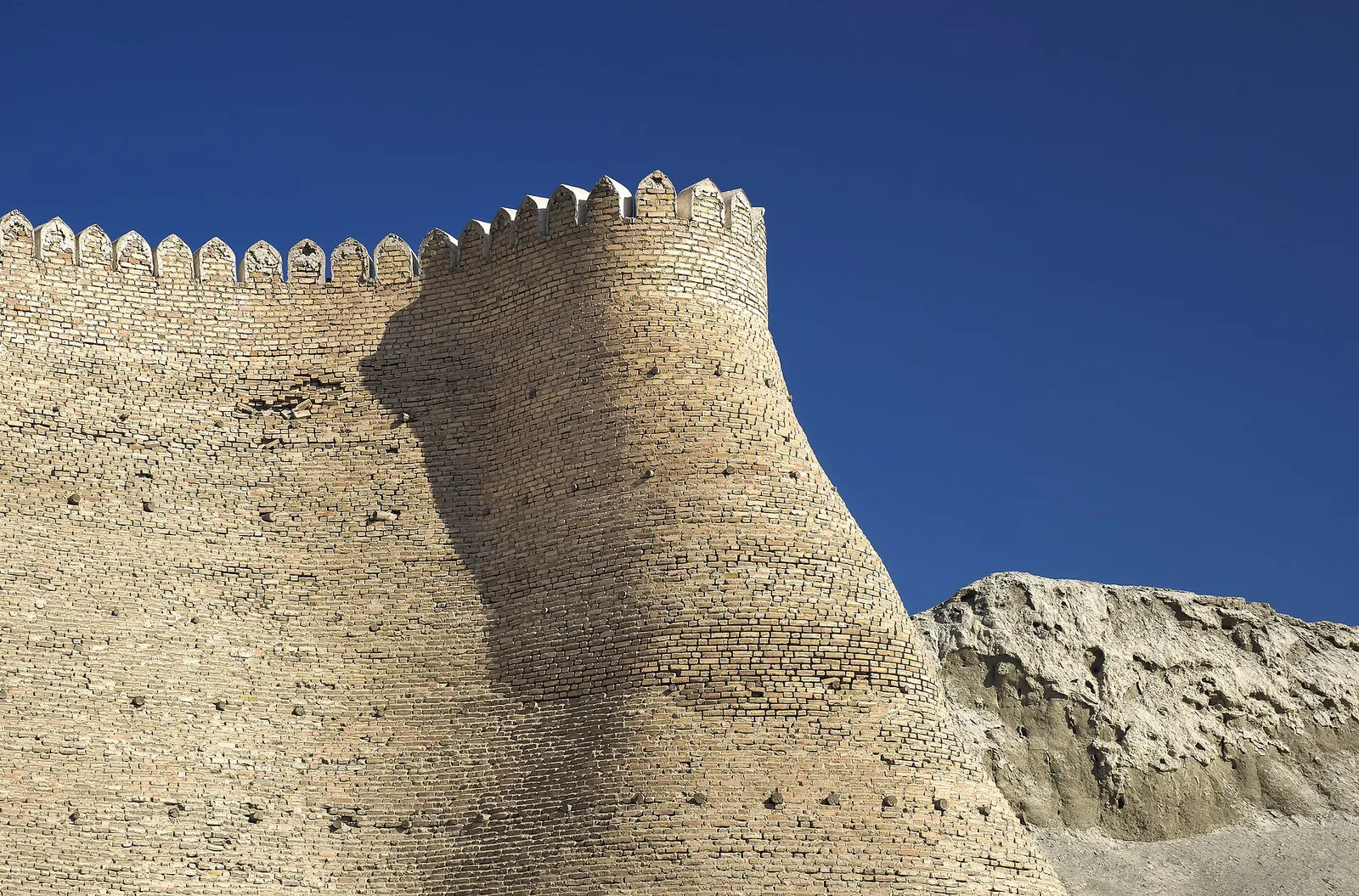
In the afternoon walk to the Ark, the citadel that was the palace of Bukhara’s rulers until 1920 and the oldest monument in the city: excavations date its foundation to the 4th to 3rd century BC, and its walls still stand 16 to 20 m high. Avicenna and Omar Khayyam are named among the scholars who lived there. Inside, the surviving buildings are the 17th-century throne hall, the 18th-century Juma mosque and a reception courtyard, and by the early 20th century the citadel was a small town of about 3,000 people, with workshops, a treasury and an arsenal. Its museum covers the region’s history from antiquity to the 20th century, coins and inscriptions, and the nature of Bukhara region, and the ticket costs UZS 60,000.
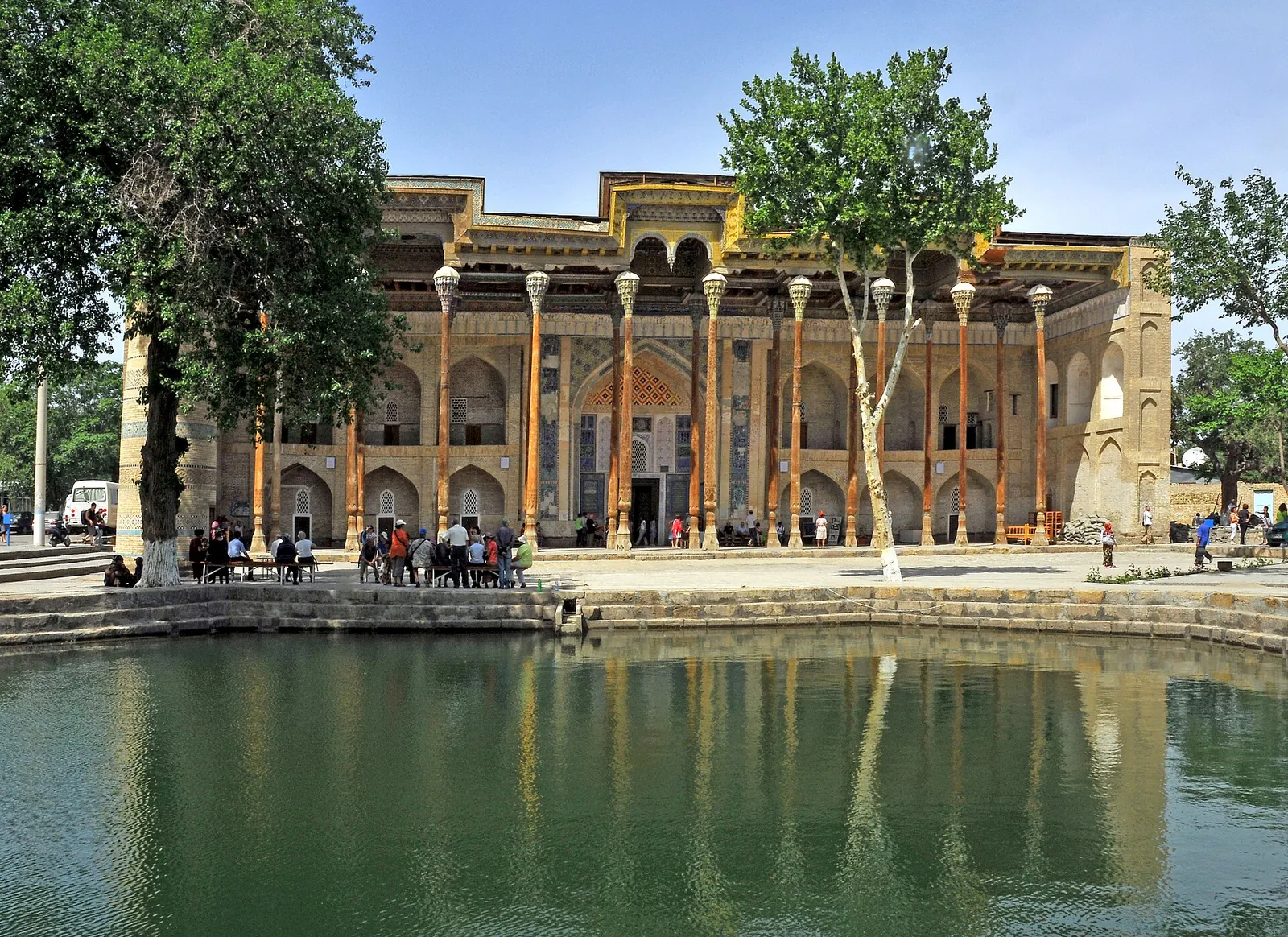
The Zindan, the emir’s prison of the 18th century, is now a museum of the emirate’s justice system (UZS 20,000). Cross the road to Bolo-Hauz, an early-18th-century mosque opposite the Ark, whose porch of slender carved wooden columns is reflected in the pool in front of it; the short minaret beside it is an early-20th-century addition. The Ark is about 10 minutes’ walk from the Ulugbek madrasa.
The Samani Mausoleum, Chashma Ayub and Chor Minor
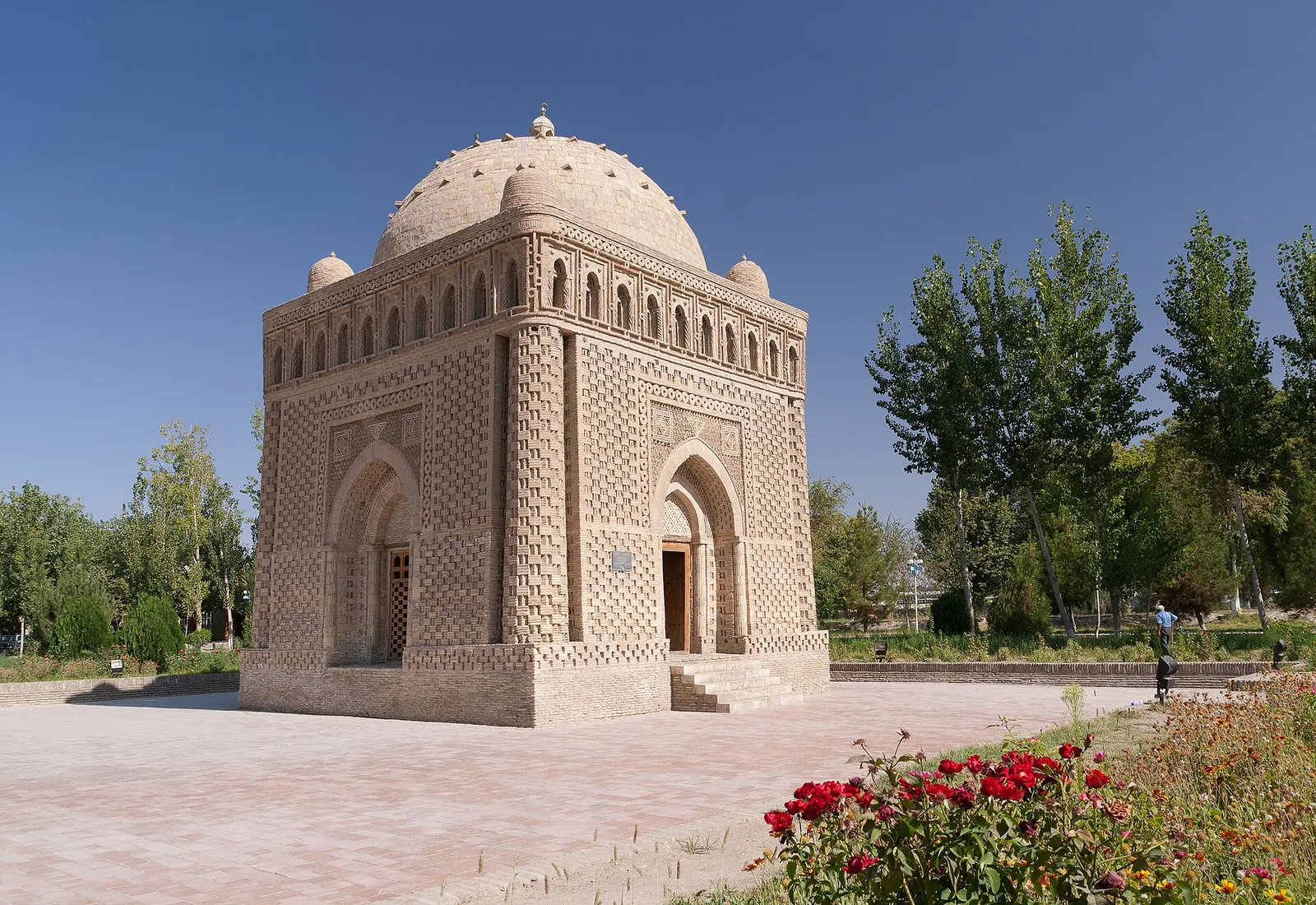
Keep the departure morning for the Samani Mausoleum, about 15 minutes’ walk west of the Ark, built between 892 and 907 by Ismail Samani over his father’s grave, where he was later buried himself. It is a brick cube under a hemispherical dome with four small domes at the corners, with walls up to 1.8 m thick, and the bricks are laid in so many patterns that the ornament seems to change with the light. A legend says Genghis Khan did not notice it among the surrounding graves.
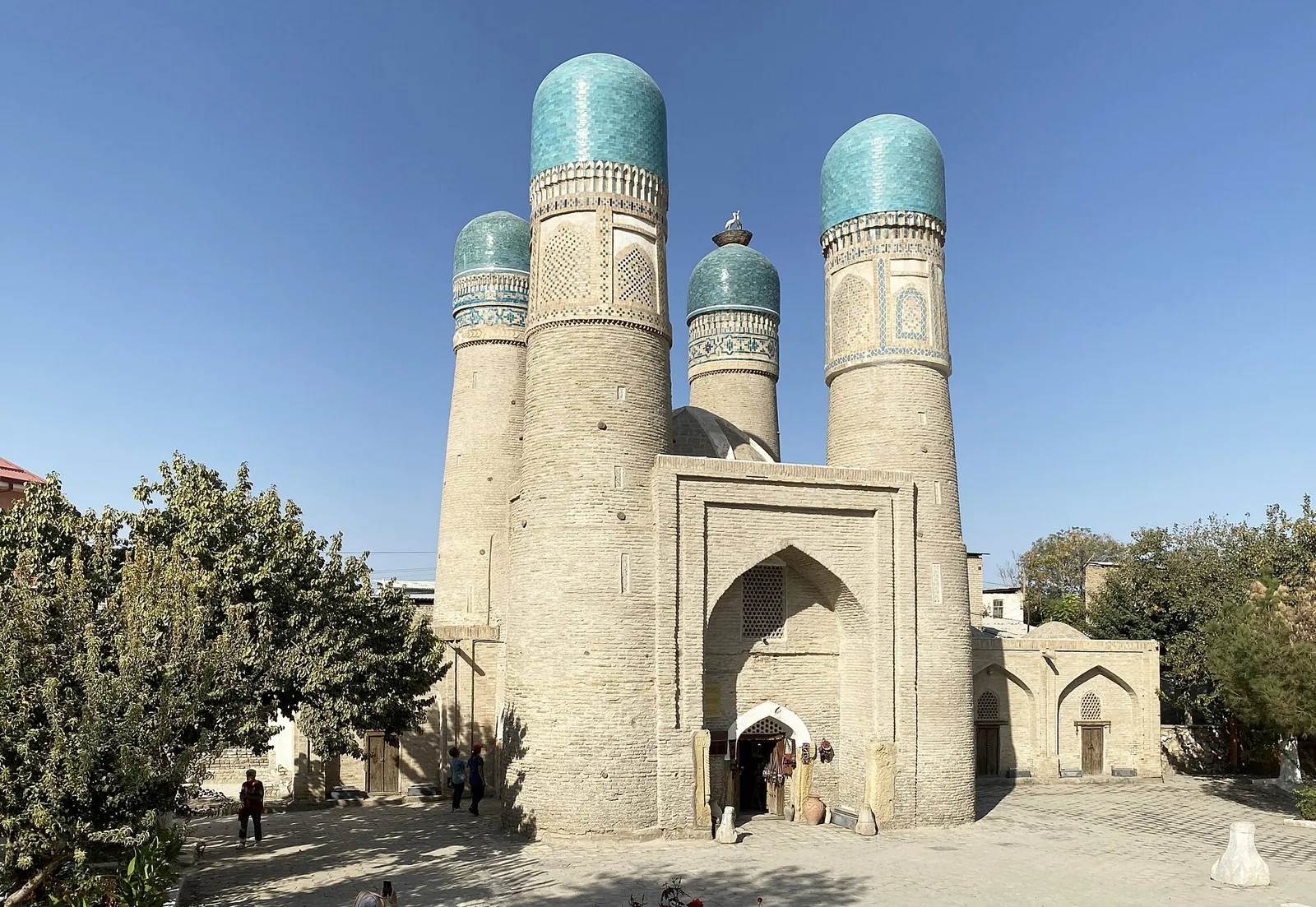
Chashma Ayub, a short walk from the mausoleum, is a mausoleum of the 12th to 16th centuries that now houses a museum of the history of Bukhara’s water supply (UZS 20,000). Chor Minor, in a lane northeast of Lyabi-Hauz (about 10 minutes on foot), was built in 1807 by Khalif Niyaz-kul as the gatehouse of his madrasa. Its name means ‘four towers’: one stands at each corner, topped by a dome and decorated with glazed tiles, and a staircase in one of them leads to the upper floor, which held a library. No separate ticket price is listed for the Samani Mausoleum or the Kalon Mosque, so entry may be charged on site; the budget below plans on about UZS 40,000 a person for each, an estimate.
Two nights, three days
This order keeps the long walks for the full day and leaves a free morning before the train. On Tuesday, Wednesday and Sunday the museums close at 17:00, so on those days take the Ark before lunch.
- Day 1, arrival: taxi from Bukhara-1 to the hotel. Lyabi-Hauz, tea by the pool, the Tim Abdullah Khan dome and Magoki Attori. Sleep in Bukhara.
- Day 2, full day: from Lyabi-Hauz it is 5 to 10 minutes on foot to the Ulugbek and Abdulaziz Khan madrasas, then Poi-Kalon and the Kalon minaret, a long lunch, the Ark and the Zindan about 10 minutes beyond, and Bolo-Hauz across the road. Sleep in Bukhara.
- Day 3, departure: the Samani Mausoleum and Chashma Ayub, about 15 minutes’ walk west of the Ark, Chor Minor on the way back, then a taxi to Bukhara-1. The 15:45 train 706 to Khiva (not Mondays) leaves the whole morning free.
What to eat and where to look
Osh-sofi (Bukhara plov)
Plov is the dish of every Uzbek city, and Bukhara’s osh-sofi is cooked in a copper cauldron almost without oil, with saffron and raisins, usually from beef rather than lamb. The tourism portal calls it almost dietary.
- Where to look
- The cafés and tea houses of the old town, which the portal says stand at every step, among them the café by the Lyabi-Hauz pool.
- Fit it into your day
- The long lunch on day 2, between the madrasas and the Ark.
Plov is made with meat; tell the kitchen if you avoid it.
Gijduvan shish kebab
Classic Uzbek shish kebab is marinated lamb threaded with small slices of lamb fat and grilled over an open fire. The town of Gijduvan, about 50 km from Bukhara, is famous for it, and the tourism portal says locals name its kebab the best in Uzbekistan.
- Where to look
- Grill restaurants and tea houses in the old town, in the evening.
- Fit it into your day
- The dinner on day 2, after Bolo-Hauz.
Samsa
A baked pastry, usually filled with meat; chicken, vegetable and pumpkin versions also exist. One is a snack rather than a meal, so order two or three.
- Where to look
- Tea houses and bakeries in the old town, around Lyabi-Hauz.
- Fit it into your day
- A snack on the arrival afternoon, between Magoki Attori and the pool.
Laghman
A spicy noodle dish, one of the local dishes that the tourism portal says any tea house in the old town will offer.
- Where to look
- Tea houses in the old town.
- Fit it into your day
- A lunch on day 3, before the train.
Stewed fish
A change from the meat dishes: the tourism portal lists stewed fish with samsa, laghman and the Gijduvan kebabs among the local dishes that every old-town café offers.
- Where to look
- The cafés around Lyabi-Hauz.
- Fit it into your day
- Dinner on the arrival evening.
Tickets, hours and guides
Bukhara State Museum-Reserve’s list, effective from 1 January 2025, charges foreign visitors UZS 60,000 for the Ark and the Sitorai Mohi-Khosa applied-arts museum, UZS 30,000 for the merchant’s house museum and UZS 20,000 for each of the smaller museums, among them the Zindan, Chashma Ayub, Magoki Attori, the Abdulaziz Khan and Ulugbek madrasas, Kukeldash and the Nadir Divan-Begi khanaka. Local visitors pay less, in separate columns of the same list. Hours are 09:00–18:00, longer in season (08:00–21:00) and shorter on Tuesday, Wednesday and Sunday (09:00–17:00), with no weekly day off. Sitorai Mohi-Khosa lies outside the walking circuit and needs a car, so add it only on a third night.
A foreign-language guide inside a museum is listed at UZS 60,000 (UZS 120,000 at the Ark and Mohi-Khosa), an audio guide at UZS 20,000 and a foreign-language city tour from UZS 700,000. Photographing exhibits costs UZS 30,000, and FCDO advises checking before you photograph government buildings, airports, bridges, police stations or military barracks.
Carry cash for taxis, small tickets and tea: international cards are not widely accepted outside Tashkent and the main cities.
Getting to Bukhara and the station transfer
Trains arrive at Bukhara-1 in Kagan. The Afrosiyob takes 4 h 11 to 4 h 22 from Tashkent to Bukhara and 4 h 11 to 4 h 20 back on the operator’s timetable, and conventional trains take 2 h 15 to 2 h 32 from Samarkand on the operator’s September 2025 timetable. Our transport guide covers booking and the fares, and the Samarkand guide the city before this one.
A Tourism Committee notice lists train 706 from Bukhara-1 to Khiva at 15:45, arriving 20:25, every day except Monday, and 707 from Khiva at 09:55, arriving 14:32, every day except Tuesday, both running from 9 September 2026. The same notice adds a weekly pair from mid-September 2026: 701 from Bukhara to Tashkent on Mondays (15:17–21:22) and 702 from Tashkent to Bukhara on Tuesdays (10:05–15:17). Our Khiva guide takes the route on.
By air, Uzbekistan Airways lists Tashkent–Bukhara from UZS 241,274 one way from 16 October 2026. The airport is Bukhara International Airport (BHK); no fixed taxi fare to the old town or the station is published, so settle it before you set off. Between Bukhara-1 and the old town, an app taxi costs roughly UZS 20,000–30,000 each way at Yandex’s published Bukhara tariff, an estimate for the 12 km.
What two nights in Bukhara cost, all in
About UZS 4.6 million for two at mid-range, UZS 2.3 million each, for two nights and three days in Bukhara. The totals cover the room, every meal and drink, taxis and local rides, tickets, two phone plans and a 10% buffer.
| Level | Per person | For two |
|---|---|---|
| Budget | UZS 1,800,000 | UZS 3,500,000 |
| Mid-range | UZS 2,300,000 | UZS 4,600,000 |
| Comfort | UZS 3,600,000 | UZS 7,200,000 |
This budget is for two adults sharing one room for two nights in ordinary spring or autumn weeks, with prices checked on 25 October 2026. Budget is Hotel Kamelot’s double at $60, mid-range Komil’s standard double at $80 and comfort Minorai Kalon’s Luxe twin at $100. The budget adds 12% VAT to each rate and the tourist tax, which depends on the size of the hotel, from UZS 22,000 to 66,000 per guest per night (UZS 44,000 at Kamelot and Minorai Kalon, and the top rate at Komil, which publishes no room count), and converts dollars at USD 1 = UZS 11,903.15, the central-bank reference rate of 23 October 2026.
Food is 2½ days: dinner and lunch on arrival, a full day and a breakfast and lunch on departure, at UZS 150,000, 225,000 or 350,000 per person per day; the breakfasts included at Kamelot and Komil are deducted. Getting around is about UZS 30,000 each way for the two taxi rides between Bukhara-1 and the old town, the top of the Yandex tariff estimate, plus about UZS 120,000, 300,000 or 600,000 for local rides. Sights are the Ark, five UZS 20,000 museums and an estimated UZS 40,000 each for the Kalon Mosque and the Samani Mausoleum, which the list does not price; comfort adds a city guide at about UZS 700,000. Two Beeline plans at UZS 60,000 a month each cover the SIM line. The trains in and out are priced in our 7-day and 10-day itineraries.
Flights: with a London–Tashkent economy return at about GBP 550–1,200 per person (UZS 8.8–19.1 million), the total per person comes to about UZS 10.5–20.9 million at budget, 11.1–21.4 million at mid-range and 12.4–22.7 million at comfort.
- Budget, for two: about UZS 3,500,000. Rooms 1,800,000, food 600,000, getting around 200,000, sights and tours 500,000, SIM and extras 100,000, buffer 300,000.
- Mid-range, for two: about UZS 4,600,000. Rooms 2,400,000, food 800,000, getting around 400,000, sights and tours 500,000, SIM and extras 100,000, buffer 400,000.
- Comfort, for two: about UZS 7,200,000. Rooms 2,800,000, food 1,800,000, getting around 700,000, sights and tours 1,200,000, SIM and extras 100,000, buffer 700,000.
Practical questions
How many nights do I need in Bukhara?
Two nights give you an arrival afternoon, a full day and a departure morning, enough for Lyabi-Hauz, the trading domes, Poi-Kalon, the Ark and the Samani Mausoleum. Add a third night for Sitorai Mohi-Khosa, which needs a car.
What do the Bukhara sights cost for a foreign visitor?
On the museum reserve’s list effective from 1 January 2025, the Ark and Sitorai Mohi-Khosa are UZS 60,000 each, the merchant’s house museum is UZS 30,000, and the Zindan, Chashma Ayub, Magoki Attori and the madrasa museums are UZS 20,000 each. The list has no ticket for the Kalon Mosque or the Samani Mausoleum, and entry may be charged on site.
Where should I stay in Bukhara?
Within a short walk of Lyabi-Hauz. The budget uses Hotel Kamelot at $60, Komil Boutique Bukhara Hotel at $80 and Minorai Kalon Boutique Hotel from $100 for a double or twin.
Is Bukhara-1 station in the old town?
No. It is in Kagan, about 12 km in a straight line from Lyabi-Hauz, so you need a taxi to and from the old town.
When are the museums open?
The reserve lists 09:00–18:00, 08:00–21:00 in season and 09:00–17:00 on Tuesday, Wednesday and Sunday, with no weekly day off.
Do I need to register in Bukhara?
FCDO says you must register within three days of arrival, with Saturdays and Sundays counting, and that hotel staff register their guests. Keep the record, because the authorities ask where you have been on departure. The entry guide covers private stays.
How much do two nights for two cost?
About UZS 4.6 million at mid-range, UZS 3.5 million at budget and UZS 7.2 million at comfort, all in, without the trains and flights. The cost section gives the subtotals.
Keep planning your trip
First trip to Uzbekistan
Choose seven days or ten for Tashkent, Samarkand, Bukhara and Khiva: nights, trains, season, registration, money, a SIM and an all-in budget.
Read the guide
Transport in Uzbekistan
Book Uzbekistan’s trains and flights: the Afrosiyob to Samarkand and Bukhara, the 2026 Khiva trains, domestic fares, airport links and the Tashkent metro.
Read the guide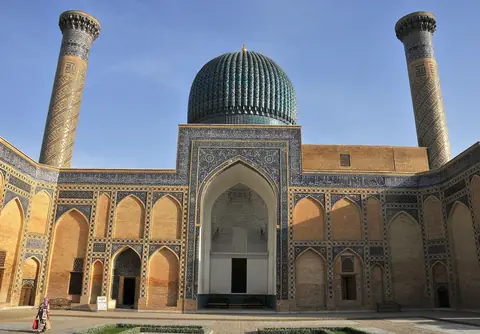
Samarkand
Plan two nights in Samarkand: the Registan, Gur-e-Amir, Bibi-Khanym, Shah-i-Zinda and Afrasiab, with tickets, hours, trains in and on to Bukhara, and costs.
Read the guide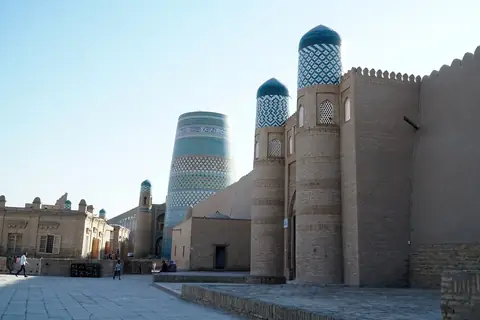
Khiva
Plan two nights inside Khiva’s walled Itchan Kala: where to sleep, the combined ticket, the main monuments, trains from Bukhara and Urgench, and what it costs.
Read the guide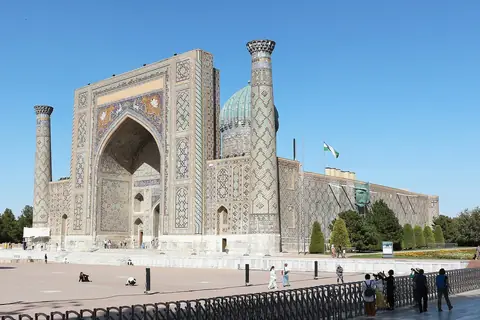
Uzbekistan in seven days
A seven-day Uzbekistan route with two nights each in Tashkent, Samarkand and Bukhara by train, real sights and an all-in cost for two.
Read the guide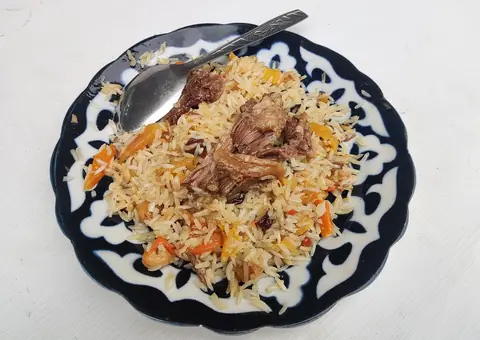
Uzbekistan food
Where to try plov, samsa, lagman, shashlik and non in Uzbekistan, with named places in Tashkent, Samarkand, Bukhara and Khiva and what a day of meals costs.
Read the guideSources and checks before you travel
(33)
- Bukhara State Museum-Reserve: ticket prices and hours ↗ — opens in a new tab
- Uzbekistan tourism portal: Bukhara ↗ — opens in a new tab
- Uzbekistan tourism portal: Poi-Kalon ↗ — opens in a new tab
- Uzbekistan tourism portal: Lyabi-Hauz ↗ — opens in a new tab
- Uzbekistan tourism portal: Tim Abdullah Khan trading dome ↗ — opens in a new tab
- Uzbekistan tourism portal: Magoki Attori mosque ↗ — opens in a new tab
- Uzbekistan tourism portal: Miri Arab madrasah ↗ — opens in a new tab
- Uzbekistan tourism portal: Abdulaziz Khan madrasah ↗ — opens in a new tab
- Uzbekistan tourism portal: Samanid Mausoleum ↗ — opens in a new tab
- Tourism Committee of Uzbekistan: Khiva–Bukhara and Bukhara–Tashkent trains ↗ — opens in a new tab
- UTY passenger rail: train timetable ↗ — opens in a new tab
- Uzbekistan Airways: domestic fare notice ↗ — opens in a new tab
- UK FCDO: Uzbekistan entry requirements ↗ — opens in a new tab
- UK FCDO: Uzbekistan safety and security ↗ — opens in a new tab
- Ipoteka Bank: currency rates ↗ — opens in a new tab
- Komil Boutique Bukhara Hotel: room rates ↗ — opens in a new tab
- Beeline: Hello 1 price notice ↗ — opens in a new tab
- Uzbekistan tourism portal: Kalon minaret ↗ — opens in a new tab
- Uzbekistan tourism portal: Ark citadel ↗ — opens in a new tab
- Bukhara State Museum-Reserve: the Ark ↗ — opens in a new tab
- Uzbekistan tourism portal: Bukhara plov and cafés ↗ — opens in a new tab
- Uzbekistan tourism portal: Uzbek kebab ↗ — opens in a new tab
- Uzbekistan tourism portal: gastro tourism ↗ — opens in a new tab
- Hotel Kamelot: prices ↗ — opens in a new tab
- Minorai Kalon Boutique Hotel: rooms ↗ — opens in a new tab
- Wikipedia: Bolo Haouz Mosque ↗ — opens in a new tab
- Uzbekistan tourism portal: Chor Minor ↗ — opens in a new tab
- OpenStreetMap: Bukhara-1 station ↗ — opens in a new tab
- OpenStreetMap: Samanid Mausoleum ↗ — opens in a new tab
- Turkish Airlines: London to Tashkent flights ↗ — opens in a new tab
- Cabinet of Ministers Resolution 475, Annex 1 (lex.uz): tourist tax rates ↗ — opens in a new tab
- Yandex Taxi: Start tariff, Bukhara ↗ — opens in a new tab
- Decree PF-115 of 23 June 2026 (lex.uz): base calculation amount ↗ — opens in a new tab
Reference sources for the version dated 10 November 2026. Confirm opening times, access, transport and conditions for your travel dates.
Photo credits
(6)
The Poi-Kalon ensemble: the Kalon minaret rising above the mosque courtyard.
Photograph: Maksimsokolov — opens in a new tab · CC BY-SA 4.0 — opens in a new tab
Changes: Resized and converted to WebP; displayed with responsive crops. · Original photograph and licence details ↗ — opens in a new tab
A bastion of the Ark, Bukhara’s citadel.
Photograph: Petar Milošević — opens in a new tab · CC BY-SA 4.0 — opens in a new tab
Changes: Resized and converted to WebP; displayed with responsive crops. · Original photograph and licence details ↗ — opens in a new tab
The pond at Lyabi-Hauz, with the Nadir Divan-Begi complex beyond.
Photograph: Ymblanter — opens in a new tab · CC BY-SA 4.0 — opens in a new tab
Changes: Resized and converted to WebP; displayed with responsive crops. · Original photograph and licence details ↗ — opens in a new tab
Chor Minor, the madrasa with four turquoise-capped towers.
Photograph: Bernard Gagnon — opens in a new tab · CC0 — opens in a new tab
Changes: Resized and converted to WebP; displayed with responsive crops. · Original photograph and licence details ↗ — opens in a new tab
The Bolo-Hauz mosque across its pool.
Photograph: LBM1948 — opens in a new tab · CC BY-SA 4.0 — opens in a new tab
Changes: Resized and converted to WebP; displayed with responsive crops. · Original photograph and licence details ↗ — opens in a new tab
The Samani Mausoleum, built between 892 and 907.
Photograph: Hylgeriak / Wikipedia — opens in a new tab · CC BY-SA 3.0 — opens in a new tab
Changes: Resized and converted to WebP; displayed with responsive crops. · Original photograph and licence details ↗ — opens in a new tab