Khorezm
Khiva: two nights in Itchan Kala, with tickets, trains and costs
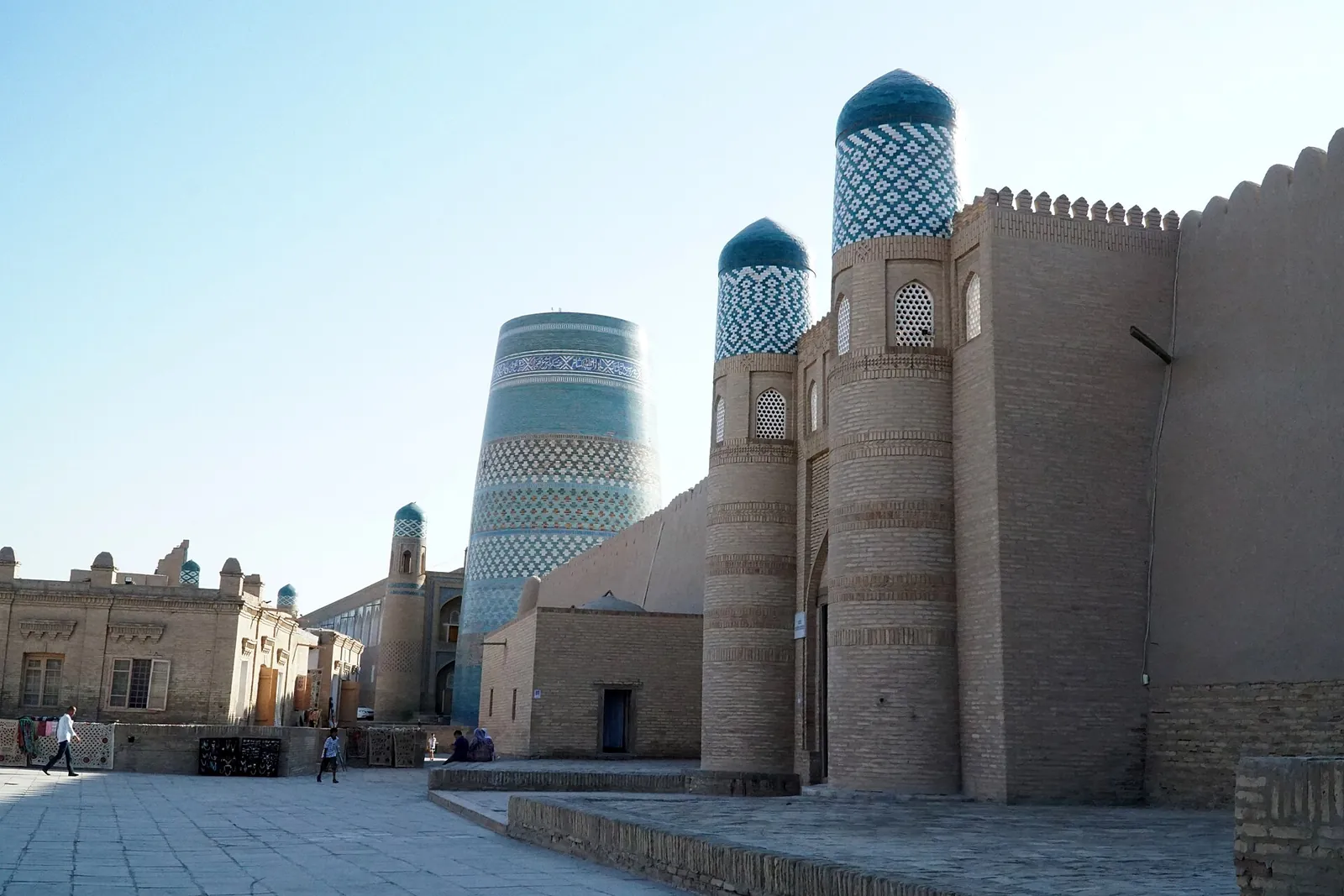
Khiva is the Silk Road city that still looks like one. Behind the mud-brick walls of Itchan Kala, madrasas, mosques and minarets stand along stone-paved lanes, and the stump of Kalta Minor, wrapped in turquoise tiles, shows what a khan planned and his death prevented. The old town is small enough to cover on foot, so the question is less which sights to choose than how long to stay. Two nights give you an evening on arrival, one full day among the monuments and an unhurried morning before the train or the flight.
In this guide
Find the location ↗ — opens in a new tabThe short answer
Book two nights inside the walls of Itchan Kala and arrive on train 706 from Bukhara, which runs every day except Monday; no fare is published, so plan on about UZS 510,000 each in economy, an estimate close to the Afrosiyob’s Tashkent–Bukhara fare. Meros B&B’s twin with balcony is $60 a night with breakfast. Plan on about UZS 250,000 each for the combined monument ticket, an estimate, since the museum-reserve publishes no price. With one full day for the monuments and a departure after breakfast, two sharing come to about UZS 4,500,000 for the two nights at mid-range, before the flight from London.
- Suggested time
- 2 nights in Khiva
- Where to stay
- Inside the walls of Itchan Kala, near the western and northern gates
- Season and timing
- April–May and September–October are the best months. Khiva’s climate is dry and desert-like, with hot, windy summers, when midday is best spent in the interiors and the walls are for early morning or evening, and winters that often fall below 0 °C.
Sleeping inside the walls
Sleep inside Itchan Kala if you can. The lanes empty once the day visitors leave, and every monument in this guide is a short walk from the door. Meros B&B, at A. Boltaev Street 57 inside the walls near the western and northern gates, charges $50 a night for a double and $60 for a twin with balcony ($35 and $45 for one person), breakfast included.
Ulli Oy Boutique Hotel, at Buyoqchi Street 8, also lies inside Itchan Kala, with the main street of restaurants and minarets 200 metres away: a Superior Double for one or two guests is $65, breakfast included. Farovon Khiva and Khiva Residence publish no nightly rate.
Hotels register foreign guests, so keep every registration slip until you leave; the entry guide explains the three-day rule. France’s advice lists Khiva among the secured tourist sites; other governments may draw the line differently, so check yours.
Itchan Kala and its combined ticket
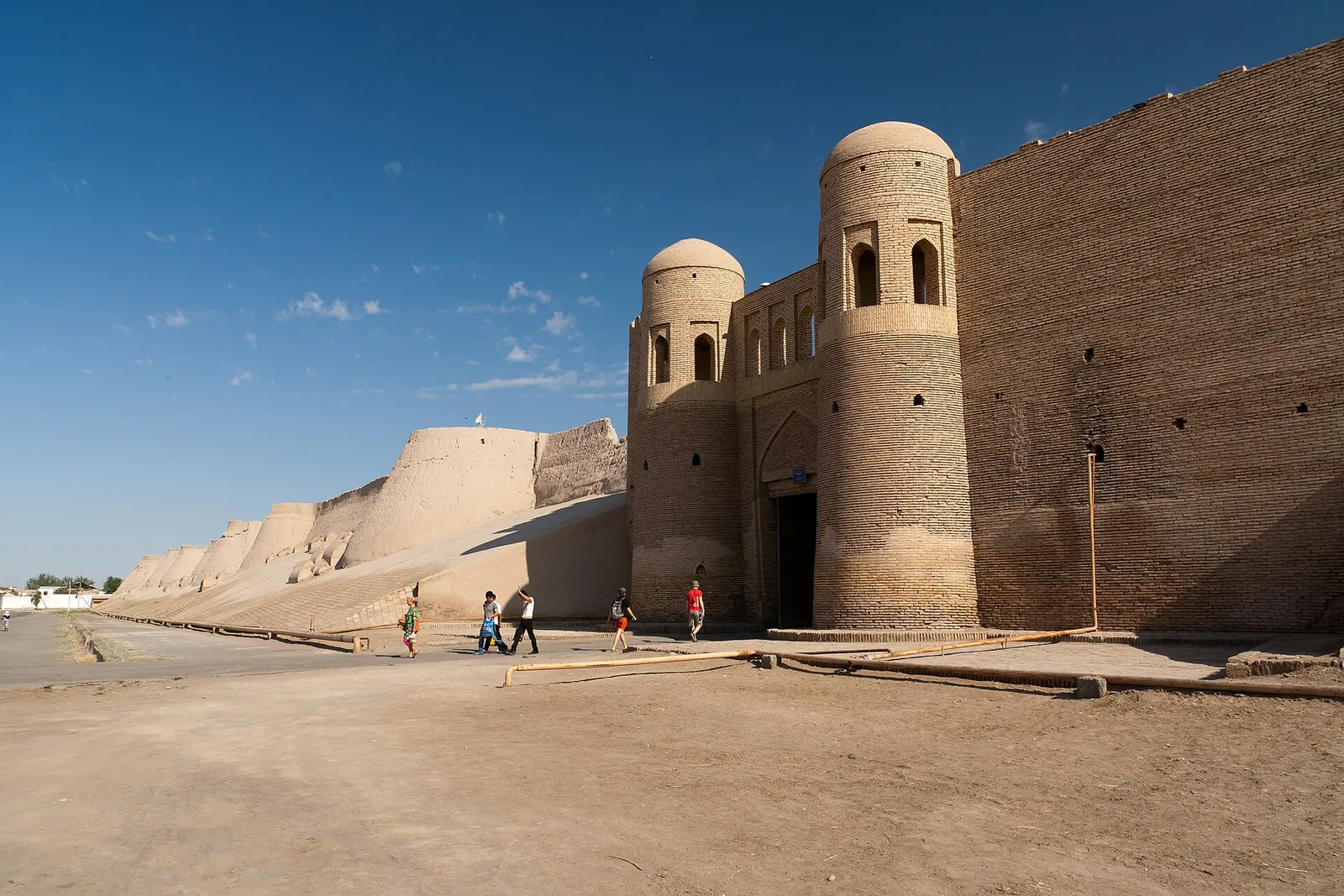
Itchan Kala is Khiva’s walled inner town: stone-paved lanes, madrasas, mosques, minarets, craft workshops and inns behind high mud-brick walls. The Uzbek tourism board dates its World Heritage listing to 1990 and calls it an open-air fortress city. Even the newer buildings are decorated to match the old ones, so almost every corner photographs well. Enter by Ota Darvoza, the main gate on the western side, in front of the Sher Muhammad Ata mosque and a pond.
The Khiva state museum-reserve publishes no ticket price, coverage or validity on its own site, so confirm them at the ticket office before you plan around them. Plan on about UZS 250,000 per foreign adult for a combined monument ticket, an estimate rather than an official tariff; ask how long it is valid before keeping a sight for a second morning. See the big sights in the morning and keep the late afternoon for the lanes.
Kalta Minor, the Kunya-Ark and the west gate
Start at Kalta Minor, near the western gate (Ota Darvoza). Muhammad Amin Khan began it in 1852 to be the largest minaret in the world: 14.5 metres across at the base and, in the plan, 80 metres high. Work stopped in 1855, when the khan died, and the squat tower was never finished. It is the only minaret in Khiva covered entirely in glazed tiles and majolica, and the city’s best-known landmark.
Close by, the Kunya-Ark was the khans’ citadel, a fortress within a fortress, separated from the rest of Itchan Kala by a high clay wall when it was completed in 1688. Inside were winter and summer mosques, a reception hall, the harem, a mint, stables and workshops, and a square used for parades and military drills; there was also a prison. The citadel was restored at the beginning of the 19th century.
Tosh Hovli and the Juma Mosque
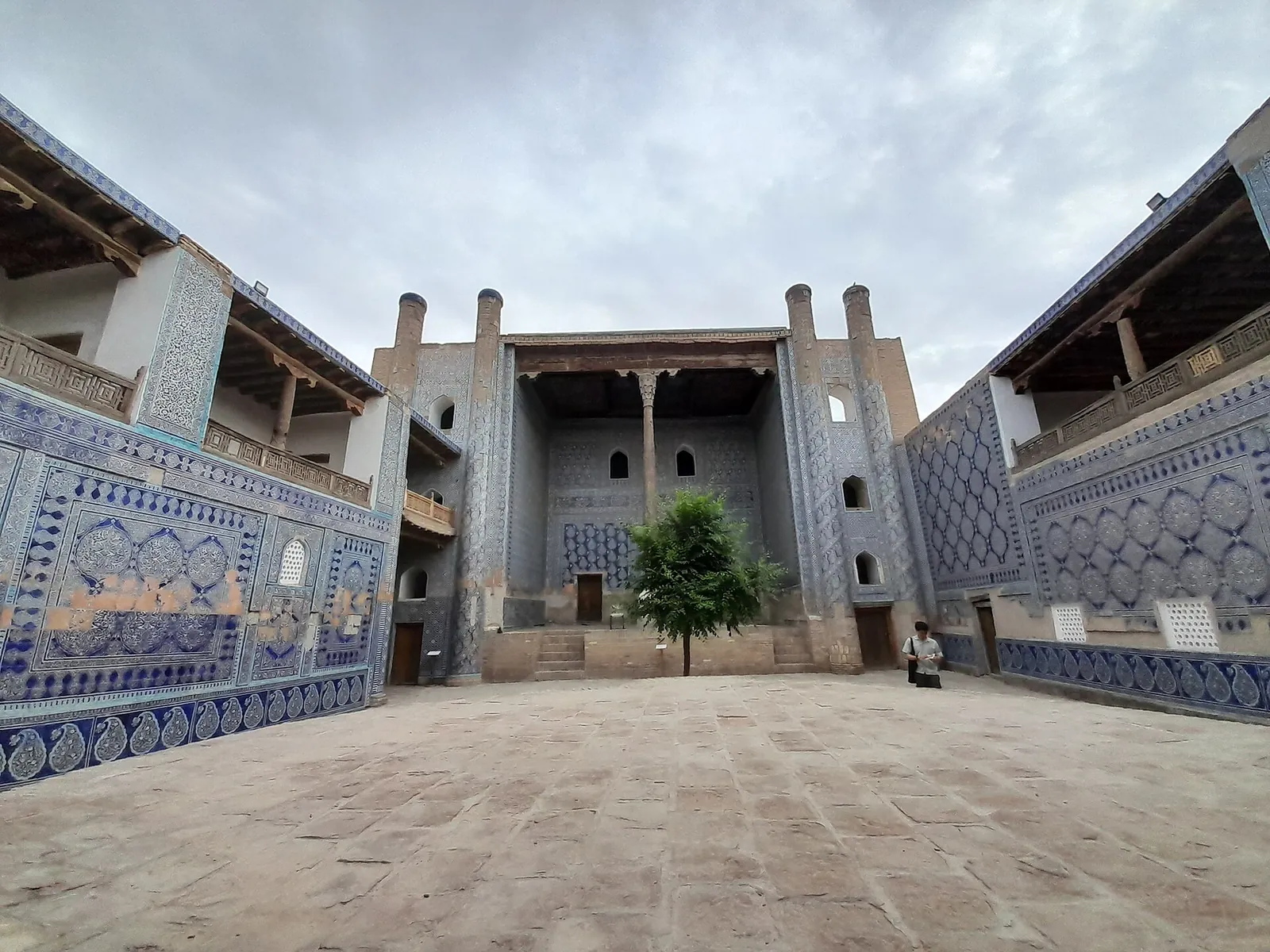
Tosh Hovli, the “stone courtyard”, is the palace Allakuli Khan had built between 1830 and 1838. Its baked-brick walls, high towers and gates make it look like a fort from outside; inside are three large courtyards, one of them the harem, five small courtyards and 163 rooms. The courtyards are lined with blue glazed tiles, and the tourism board rates the carved doors and wooden columns among the finest wood carving in Khiva. The harem courtyard has housed an exhibition of Khorezm craftsmanship since 1989.
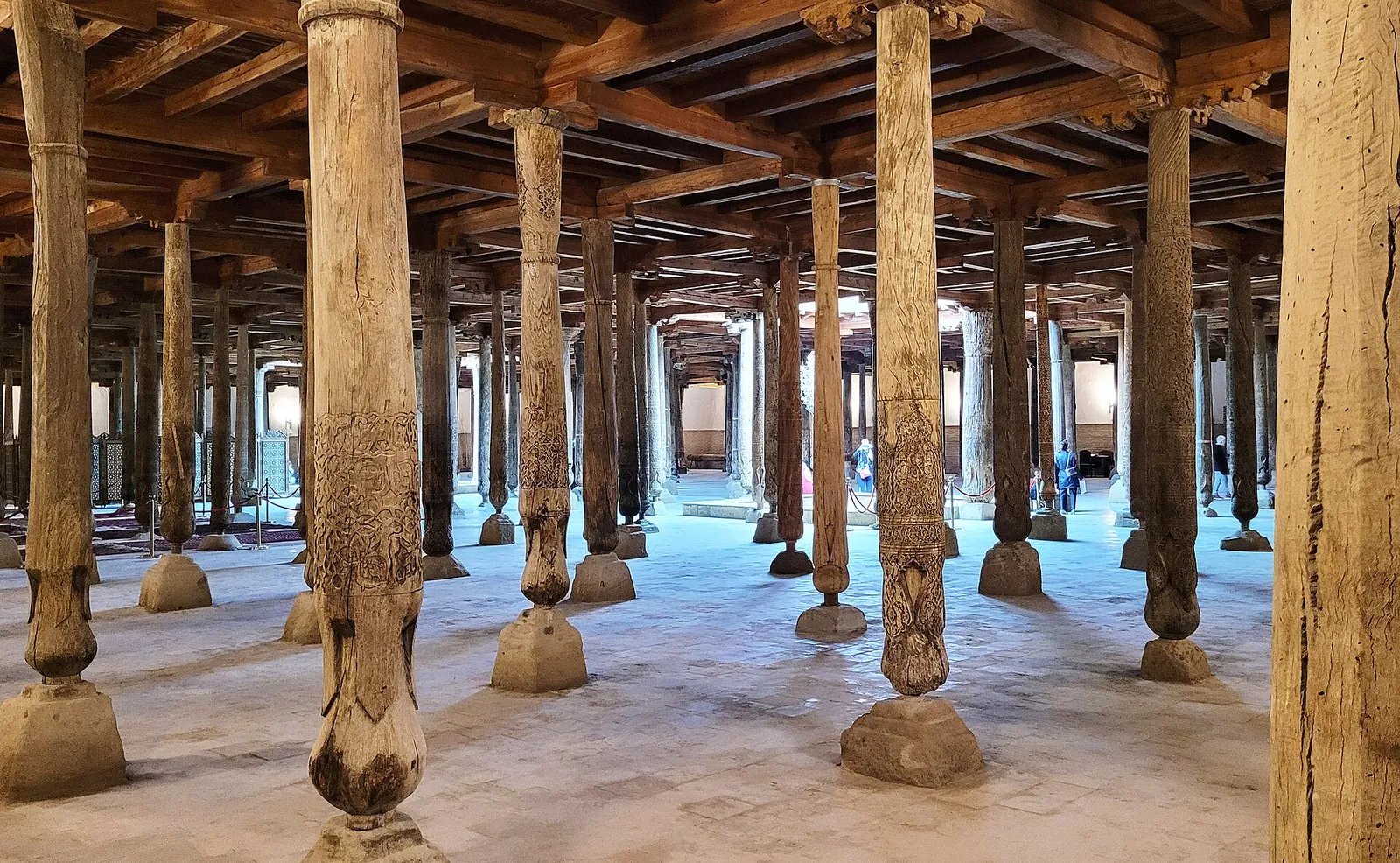
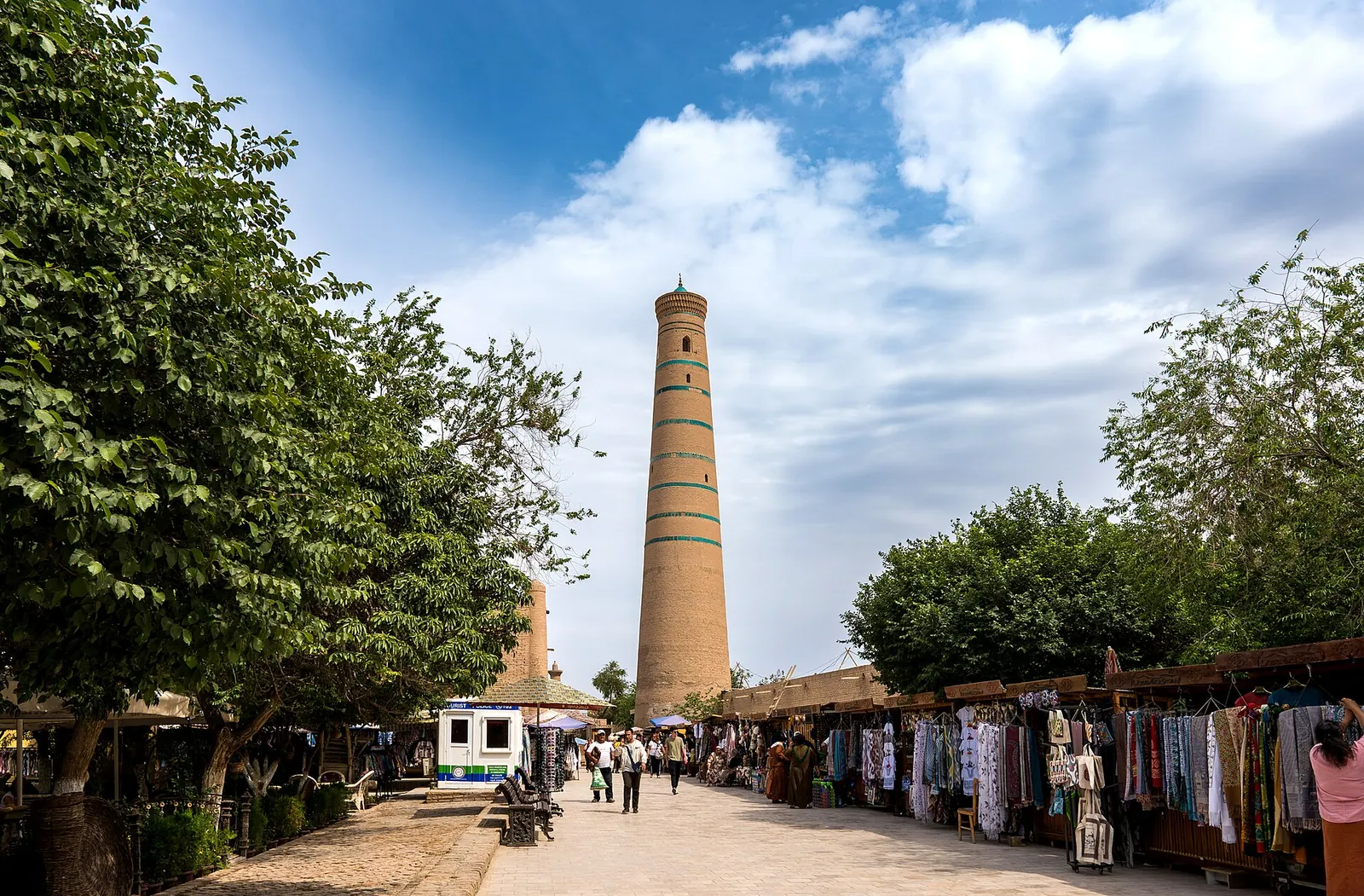
The Juma Mosque has no domes. Its roof rests on a forest of carved columns of different sizes, shapes and even centuries; the tourism board’s Khiva page counts 213. It puts the mosque’s origins in the 10th century and links the rebuilding to Muhammad Amin, who came to power in 1763. Walk in when the lane outside is quiet, then look up at the slim minaret beside the market stalls.
The Islam Khoja minaret and Pahlavon Mahmud
The Islam Khoja minaret rises in the middle of Itchan Kala beside a small madrasa. Islam Khoja, the chief minister of Khan Asfandiyar, began the ensemble in 1908. The minaret is 56.6 metres tall and 9.5 metres across at the base, and a brick spiral stair of 175 steps leads to a windowed rotunda with a view over the roofs.
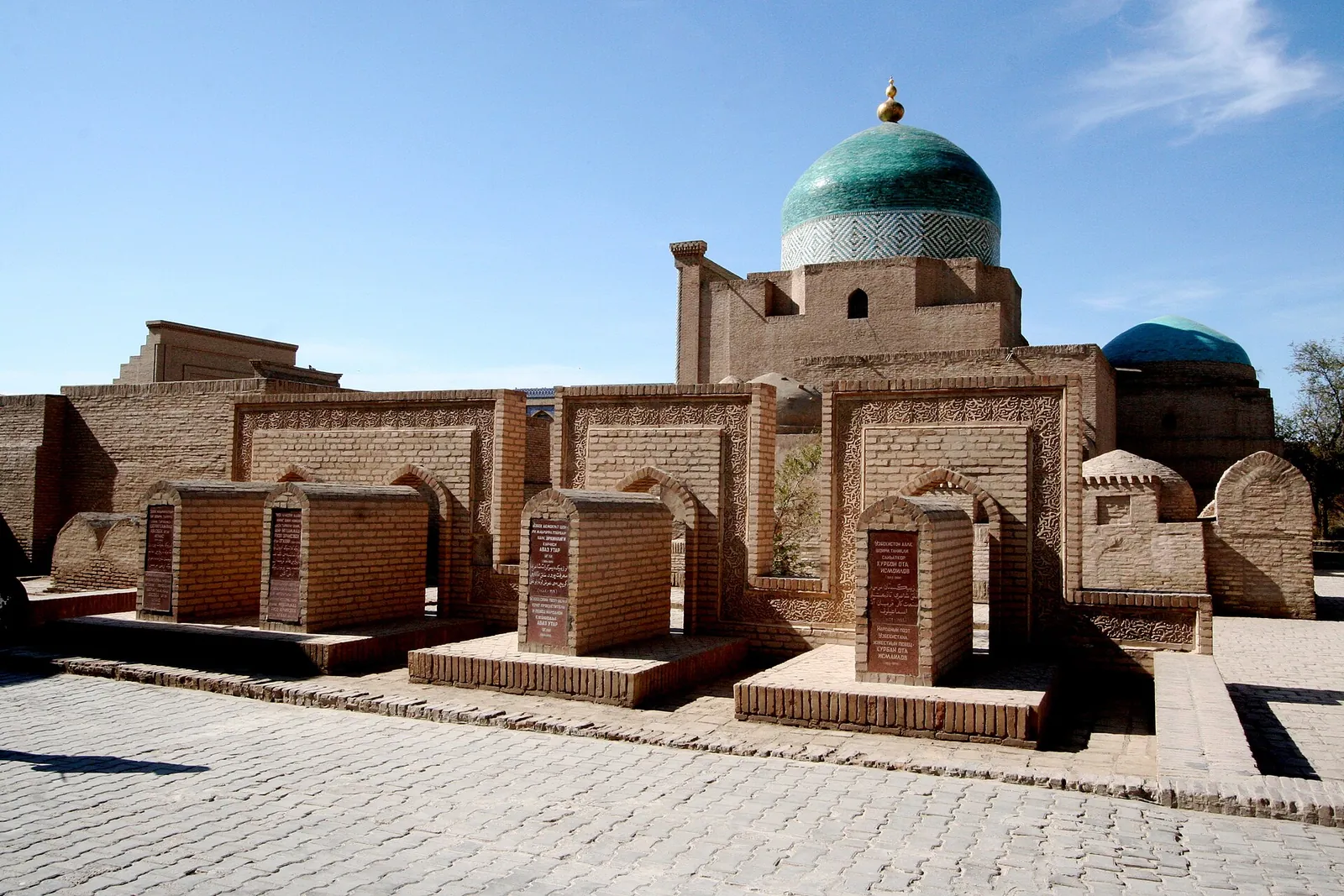
The Pahlavon Mahmud mausoleum is a revered pilgrimage site. It is a 19th-century complex in the Khorezm style, built around the grave of Pahlavon Mahmud, a 13th-century poet and craftsman revered as an invincible hero and healer. A blue glazed dome with a gilded top crowns it. Pilgrims come to pray here, so dress modestly and keep your voice down.
Two nights, day by day
This order puts the arrival evening in the lanes, the full day on the monuments and the last morning on the way out, which depends on the train or flight you take.
- Day 1: arrive on train 706 from Bukhara at 20:25 (it does not run on Mondays), take a short taxi to the old town and eat nearby. Take an evening walk past Kalta Minor if you are not too tired.
- Day 2: Kalta Minor, the Kunya-Ark and Tosh Hovli in the morning, lunch, then the Juma Mosque, the Islam Khoja minaret and Pahlavon Mahmud in the afternoon. Leave the last hour of light for the lanes and a look at the walls from outside.
- Day 3, by train to Bukhara: train 707 leaves at 09:55 (not on Tuesdays), so take a leisurely breakfast and a taxi to the station, with time only for a last look at Kalta Minor.
- Day 3, by train to Tashkent: the Jaloliddin Manguberdi leaves Khiva at 07:20 on Wednesday, Friday and Sunday, so leave straight after an early breakfast and put every monument on day 2.
- Day 3, by air: a flight from Urgench leaves the morning free for one more interior, if your ticket is still valid, then a car to the airport; the airport train 7058 leaves Khiva only at 21:00.
What to eat and where to look
Shivit oshi
The tourism board’s national dish of Khorezm, also called Khorezm lagman: bright green noodles made with dill, served with a white sour-milk sauce and a vegetable-and-meat sauce called vaju. It is prepared mainly in summer.
- Where to look
- The restaurants on Itchan Kala’s main street, 200 metres from Ulli Oy; order it by name.
- Fit it into your day
- Day 2 lunch; it is prepared mainly in summer.
Khorezm plov (chalov)
Each region cooks plov its own way, and the government’s food page names chalov as the Khorezm version made in Khiva.
- Where to look
- The restaurants along Itchan Kala’s main street.
- Fit it into your day
- Day 1 dinner after the train.
Tukhum barak
Dough parcels with an egg-and-herb filling, a Khorezm dumpling. The Tourism Committee lists it first among the traditional Khorezm dishes cooked at its September 2026 gastronomic festival.
- Where to look
- Arda Khiva, the tourist complex outside the old town that hosted that festival, with brasseries serving national cuisine; take a taxi.
- Fit it into your day
- Day 2 dinner, if you want to leave the old town.
It contains egg; most other Khorezm dishes contain meat.
Gumma
A fried, filled pastry that the Tourism Committee names among the Khorezm dishes; fillings of meat, pumpkin or potato are common, and it is eaten by hand as a starter or side.
- Where to look
- The restaurants on Itchan Kala’s main street; order a portion to share.
- Fit it into your day
- Day 2 dinner, as a starter.
Kazan-kebab
Pieces of meat fried in a cauldron, usually with potatoes; the Tourism Committee also lists it among the Khorezm dishes, and it is heartier than the shashlik served everywhere else.
- Where to look
- The brasseries of Arda Khiva, the tourist complex outside the old town that hosted the festival; take a taxi.
- Fit it into your day
- Day 1 dinner, if you prefer meat to plov.
Trains, the airport and the road in
From Bukhara, train 706 leaves Bukhara-1 at 15:45 and reaches Khiva at 20:25 (4 h 40), every day except Monday. Train 707 leaves Khiva at 09:55 and reaches Bukhara-1 at 14:32 (4 h 37), every day except Tuesday. Both have 415 economy seats and started on 9 September 2026; no fare is published, so plan on about UZS 510,000 per person in economy, an estimate close to the UZS 509,000 Tashkent–Bukhara Afrosiyob economy fare in force since 1 February 2026. Our Bukhara guide covers the other end.
From Tashkent, the Jaloliddin Manguberdi, which began running on 5 May 2026, leaves Tashkent Central at 07:00 and reaches Khiva at 14:31 on Tuesday, Thursday and Saturday; the return leaves Khiva at 07:20 and reaches Tashkent at 14:51 on Wednesday, Friday and Sunday. It stops at Samarkand, Bukhara and Urgench. The transport guide has the booking details for both trains.
Urgench International Airport (UGC) is the gateway for Khiva. Uzbekistan Airways lists Tashkent–Urgench from UZS 442,336 one way from 16 October 2026. Train 7055 leaves the airport at 08:40 and reaches Khiva at 09:22; train 7058 leaves Khiva at 21:00 and reaches the airport at 21:42. Adults pay UZS 25,000 and children UZS 14,000, booked at eticket.railway.uz. The 21:00 train does not suit a morning flight, so arrange a car through your hotel for that.
Khiva’s station is outside the walls, so plan a short taxi or walk with luggage. Travellers arriving from Karakalpakstan can end a desert-fortress drive in Khiva, as described in our Nukus and Moynaq guide.
What two nights in Khiva cost, all in
About UZS 4,500,000 for two at mid-range, UZS 2,300,000 each, for two nights and three days in Khiva, with the train in from Bukhara, the room, every meal, station taxis, tickets, a SIM and a 10% buffer.
| Level | Per person | For two |
|---|---|---|
| Budget | UZS 2,000,000 | UZS 4,100,000 |
| Mid-range | UZS 2,300,000 | UZS 4,500,000 |
| Comfort | UZS 3,800,000 | UZS 7,600,000 |
The budget covers two adults sharing one room for two nights in an ordinary spring or autumn week, with prices read on 25 October 2026. Budget is the Meros double at $50, mid-range the Meros twin with balcony at $60, and comfort a room at about UZS 1,400,000 a night with taxes, an estimate level with the comfort rooms elsewhere in this edition, because Mercure Khiva, Farovon Khiva and Khiva Residence publish no rate. Dollar prices are converted at the central-bank reference rate of 23 October 2026, USD 1 = UZS 11,903.15. The budget adds 12% VAT on rates that do not state one and the tourist tax, which depends on the size of the hotel, from UZS 22,000 to 66,000 per guest per night; Meros, with nine rooms, pays UZS 22,000, so its nights come to UZS 710,576 and UZS 843,892 for two.
Food is six meals each: dinner on arrival, a full day and a breakfast on departure. Meros includes breakfast, so budget and mid-range pay for three meals, at about UZS 61,000 and UZS 78,000 each; comfort pays for all six at about UZS 117,000. Meals are built around a plov at about UZS 52,000, with tea and a salad added. Getting around is the economy train in from Bukhara at about UZS 510,000 each, an estimate from the Tashkent–Bukhara Afrosiyob fare, plus two short station taxis, estimated at about UZS 50,000 a ride for the two of you, or about UZS 100,000 each way at comfort for a private car; the way out is priced in our trip cost guide. Sights are the combined ticket, estimated at about UZS 250,000 each because no official price is published, plus about UZS 100,000 each for tower climbs and other extras, and comfort adds a private guide, estimated at about UZS 700,000. The SIM is two Beeline eSIMs at UZS 60,000 a month each, with no activation fee. Carry cash for guesthouses and cafés, as international cards are not widely accepted outside Tashkent and the main cities.
Flights: a London–Tashkent return in economy is about GBP 550–1,200 per person, roughly UZS 8.8–19.1 million at UZS 15,916.89 to the pound on the same date. With it, the stay costs about UZS 10.8–21.2 million per person at budget, 11.0–21.4 million at mid-range and 12.6–22.9 million at comfort; fares vary by date, and the trains or flights from Tashkent to Bukhara and Khiva are priced in our trip cost guide.
- Budget, for two: about UZS 4,100,000. Rooms 1,400,000, food 400,000, getting around 1,100,000, sights and tours 700,000, SIM and extras 100,000, buffer 400,000.
- Mid-range, for two: about UZS 4,500,000. Rooms 1,700,000, food 500,000, getting around 1,100,000, sights and tours 700,000, SIM and extras 100,000, buffer 400,000.
- Comfort, for two: about UZS 7,600,000. Rooms 2,800,000, food 1,400,000, getting around 1,200,000, sights and tours 1,400,000, SIM and extras 100,000, buffer 700,000.
Practical questions
How many nights should I stay in Khiva?
Two nights. The evening train from Bukhara arrives at 20:25, so you get an evening, one full day for the monuments and a morning before you leave. A third night only pays if you want to add a day by car.
How much is the Itchan Kala ticket?
The museum-reserve publishes no price or validity on its own site, so confirm both at the ticket office. Plan on about UZS 250,000 for a foreign adult, plus about UZS 100,000 each for tower climbs and other extras; both are estimates.
How do I get from Urgench airport to Khiva?
By train 7055, which leaves the airport at 08:40 and reaches Khiva at 09:22 for UZS 25,000 per adult, or by car. The return train leaves Khiva at 21:00, so book a car for a morning flight.
How long is the train from Bukhara to Khiva?
Train 706 takes 4 h 40, from 15:45 to 20:25, every day except Monday; train 707 takes 4 h 37, from 09:55 to 14:32, every day except Tuesday.
Can I climb the Islam Khoja minaret?
The tourism board describes a spiral brick staircase of 175 steps to a windowed rotunda with views over the city. Take it slowly.
How much do two nights in Khiva cost for two people?
About UZS 4,500,000 for two at mid-range (UZS 2,300,000 each), UZS 4,100,000 at budget level and UZS 7,600,000 at comfort level, with the train from Bukhara, rooms, every meal, station taxis, tickets, a SIM and a 10% buffer. The London return adds about GBP 550–1,200 per person.
Keep planning your trip
First trip to Uzbekistan
Choose seven days or ten for Tashkent, Samarkand, Bukhara and Khiva: nights, trains, season, registration, money, a SIM and an all-in budget.
Read the guide
Transport in Uzbekistan
Book Uzbekistan’s trains and flights: the Afrosiyob to Samarkand and Bukhara, the 2026 Khiva trains, domestic fares, airport links and the Tashkent metro.
Read the guide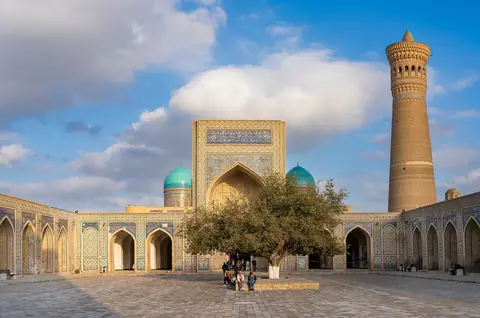
Bukhara
Plan two nights in Bukhara: Lyabi-Hauz, the trading domes, Poi-Kalon, the Ark and small museums, with 2025 ticket prices, rooms, trains and costs.
Read the guide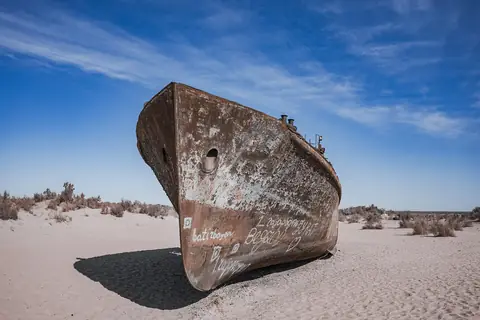
Nukus and Moynaq
Plan two nights in Nukus for the Savitsky Museum, Moynaq’s stranded ships and the desert fortresses of Khorezm, ending in Khiva on day 3.
Read the guide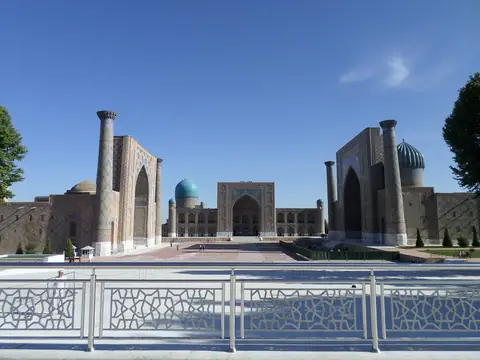
Uzbekistan in ten days
Ten days and nine nights through Tashkent, Samarkand, Bukhara and Khiva, with a Shahrisabz day trip, named hotels, trains, the flight home and an all-in budget.
Read the guide
Best time to visit Uzbekistan
Choose your Uzbekistan dates by season: spring and autumn for walking, the summer chillya, winter air, Ramadan, Navruz and the school holidays, month by month.
Read the guideSources and checks before you travel
(37)
- Uzbekistan Travel: Khiva ↗ — opens in a new tab
- Uzbekistan Travel: Ichan-Kala ↗ — opens in a new tab
- Uzbekistan Travel: Kalta Minor ↗ — opens in a new tab
- Uzbekistan Travel: Kunya-Ark Fortress ↗ — opens in a new tab
- Uzbekistan Travel: Tash Houli ↗ — opens in a new tab
- Uzbekistan Travel: Islam Khoja Minaret ↗ — opens in a new tab
- Uzbekistan Travel: Pakhlavan Makhmud mausoleum ↗ — opens in a new tab
- Uzbekistan Travel: History of Khiva ↗ — opens in a new tab
- Khiva State Museum-Reserve: official website ↗ — opens in a new tab
- Meros B&B: Khiva ↗ — opens in a new tab
- Meros B&B: double room ↗ — opens in a new tab
- Meros B&B: twin room with balcony ↗ — opens in a new tab
- Ulli Oy Boutique Hotel ↗ — opens in a new tab
- Farovon Khiva: rooms ↗ — opens in a new tab
- Khiva Residence ↗ — opens in a new tab
- Khiva city administration: Urgench Airport train ↗ — opens in a new tab
- Tourism Committee: Khiva–Bukhara trains ↗ — opens in a new tab
- Uzbekistan Railways: Jaloliddin Manguberdi launch ↗ — opens in a new tab
- Uzbekistan Airways: domestic fares ↗ — opens in a new tab
- Uzbekistan Travel: Shivit Oshi ↗ — opens in a new tab
- Uzbekistan Government: Uzbek cuisine ↗ — opens in a new tab
- Uzbekistan Travel: Arda Khiva Tourist Complex ↗ — opens in a new tab
- Uzbekistan Travel: Ata Darvaza ↗ — opens in a new tab
- Tourism Committee: Khorezm gastronomic festival ↗ — opens in a new tab
- UK FCDO: entry requirements ↗ — opens in a new tab
- UK FCDO: safety and security ↗ — opens in a new tab
- France Diplomatie: security advice for Uzbekistan ↗ — opens in a new tab
- Ipoteka Bank: currency rates ↗ — opens in a new tab
- Beeline: Hello 1 price notice ↗ — opens in a new tab
- Beeline: eSIM ↗ — opens in a new tab
- Orzu Hotel: rooms ↗ — opens in a new tab
- Cabinet of Ministers Resolution 475, Annex 1 (lex.uz): tourist tax rates ↗ — opens in a new tab
- Beshqozon: online menu ↗ — opens in a new tab
- Turkish Airlines: London to Tashkent flights ↗ — opens in a new tab
- Anhor.uz: train fares raised by 15% (Russian) ↗ — opens in a new tab
- Kursiv: Afrosiyob ticket prices to rise 15% from February 2026 ↗ — opens in a new tab
- Decree PF-115 of 23 June 2026 (lex.uz): base calculation amount ↗ — opens in a new tab
Reference sources for the version dated 1 November 2026. Confirm opening times, access, transport and conditions for your travel dates.
Photo credits
(6)
Kalta Minor and the Kunya-Ark gate towers, Itchan Kala
Photograph: Adam Harangozó — opens in a new tab · CC BY-SA 4.0 — opens in a new tab
Changes: Resized and converted to WebP; displayed with responsive crops. · Original photograph and licence details ↗ — opens in a new tab
Inside the Juma Mosque, where the roof rests on carved wooden columns
Photograph: Bgag — opens in a new tab · CC0 — opens in a new tab
Changes: Resized and converted to WebP; displayed with responsive crops. · Original photograph and licence details ↗ — opens in a new tab
A courtyard of the Tosh Hovli palace
Photograph: Miss Kamola — opens in a new tab · CC0 — opens in a new tab
Changes: Resized and converted to WebP; displayed with responsive crops. · Original photograph and licence details ↗ — opens in a new tab
The Pahlavon Mahmud mausoleum complex, with gravestones of the cemetery in the foreground
Photograph: Ramón — opens in a new tab · CC BY-SA 2.0 — opens in a new tab
Changes: Resized and converted to WebP; displayed with responsive crops. · Original photograph and licence details ↗ — opens in a new tab
The Juma Mosque minaret from a lane in Itchan Kala
Photograph: Iaa2023 — opens in a new tab · CC BY-SA 4.0 — opens in a new tab
Changes: Resized and converted to WebP; displayed with responsive crops. · Original photograph and licence details ↗ — opens in a new tab
A gate in the walls of Itchan Kala
Photograph: Hylgeriak / Wikipedia — opens in a new tab · CC BY-SA 3.0 — opens in a new tab
Changes: Resized and converted to WebP; displayed with responsive crops. · Original photograph and licence details ↗ — opens in a new tab