Itineraries
Uzbekistan in 7 days: Tashkent, Samarkand and Bukhara
Seven days is enough for the three Silk Road cities most first-time visitors want, if you give each two nights and take the train between them rather than squeezing in a fourth. The route starts in Tashkent with the old city and the metro, moves to Samarkand for the Registan and Shah-i-Zinda, and ends in Bukhara among domes and madrasas, before a train back to the capital for the flight home.
In this guide
Find the location ↗ — opens in a new tabThe short answer
Book six nights: two each in Tashkent, Samarkand and Bukhara. Book the Tashkent–Samarkand and Bukhara–Tashkent trains first, since tickets go on sale 60 days ahead; the others are Sharq 710 to Bukhara, and day 7 ends with the 14:58 train and a flight after 23:30. Foreign-visitor tickets were UZS 100,000 for the Registan and UZS 60,000 for Bukhara’s Ark in 2025. The all-in budget for two adults sharing a room is about UZS 8,800,000 each, UZS 17,600,000 for two, before flights, covering rooms, food, trains, sights, SIMs and a 10% buffer.
- Suggested time
- 7 days / 6 nights: Tashkent 2, Samarkand 2, Bukhara 2
- Route
- Tashkent 2 nights
- Samarkand 2 nights
- Bukhara 2 nights
- All-in budget on the ground
- About UZS 8,800,000 per person, UZS 17,600,000 for two Full breakdown ↓
- Season and timing
- The budget assumes ordinary spring or autumn dates outside public holidays. Summers are hot, and very hot in Samarkand, so keep the middle of the day for the hotel. In winter the Registan closes earlier and Bukhara’s room rates drop after 15 November.
- Day by day
- The seven days at a glance ↓
The seven days at a glance
One line per day, with where you sleep each night. Times, prices and bookings are in the day sections below.
- Day 1
Arrive in Tashkent
Night: Tashkent.
- Day 2
Tashkent
Khast Imam, Chorsu Bazaar and the metro, with lagman for dinner. Night: Tashkent.
- Day 3
Afrosiyob to Samarkand
the Registan and Gur-e-Amir. Night: Samarkand.
- Day 4
Samarkand
the Bibi-Khanym Mosque, Siab Bazaar and Shah-i-Zinda. Night: Samarkand.
- Day 5
Train to Bukhara
Lyabi-Hauz and the Magoki Attori Mosque. Night: Bukhara.
- Day 6
Bukhara
the Ark, Poi-Kalon and the Samani Mausoleum. Night: Bukhara.
- Day 7
Back to Tashkent
a Bukhara morning, the afternoon Afrosiyob and a flight after 23:30.
Book the six nights as one westbound journey
Use one hotel in each city: Tashkent for nights 1–2, Samarkand for nights 3–4 and Bukhara for nights 5–6. Days 3 and 5 are train days, and day 7 is departure, not another hotel night. The plan assumes you land in Tashkent on day 1 and leave on day 7 after the 14:58 train from Bukhara.
The hotels in the budget are mid-range, each priced from its own website on 25 October 2026. MIRZO Boutique Hotel, at 4 Zarqaynar Street in Tashkent’s Shaykhantakhur district, lists a twin room with two separate beds and a quiet courtyard view at USD 95 a night. Bibikhanum Hotel, at 10 Tashkent Street in Samarkand, stands beside the Bibi-Khanym Mosque and Siab Bazaar, five minutes’ walk from Shah-i-Zinda and ten from the Registan, and lists a double at USD 95. Komil Boutique Hotel, a 19th-century house at 40 Barakiyon Street in Bukhara, lists a standard double at USD 80 from 15 March to 15 November and USD 70 in winter, with breakfast and official registration included. The budget counts breakfast as included only at Komil.
Hotels register foreign guests, so hand your passport to reception at check-in and keep the registration slip: you must register within three days of arrival, counting weekends, and the authorities can ask for a record of where you stayed when you leave. Carry your passport at all times. The entry guide covers visa-free stays by nationality and customs declarations.
The currency is the Uzbek som (UZS). Cards are not widely accepted outside Tashkent and the main cities and few ATMs take international cards, so carry cash for bazaars and taxis, and change money only at official exchange booths. For data, the budget includes two Beeline Hello eSIMs from the company’s central Tashkent sales office at 1 Bukhara Street (Monday to Saturday 08:00–20:00, Sunday 09:00–18:00); a new eSIM has no activation charge.
France advises avoiding the Afghan border area (Termez city only for an imperative reason) and the Tajik and Kyrgyz borders outside the official crossings, and in border zones keeping to towns, main roads and marked paths. This route stays in Tashkent, Samarkand and Bukhara and on the rail line between them. Other governments may draw the line differently, so read your own government’s advice. UK advice says photography restrictions have been relaxed, but to check before taking photos near airports, border checkpoints, military barracks, bridges, police stations and metro stations, Tashkent’s decorated metro included.
Days 1–2: Tashkent, Khast Imam and the metro
Day 1 — arrive at TAS. Islam Karimov Tashkent International Airport is the country’s main gateway. The old city is about 6 km from the airport; ask MIRZO for a hotel car (it lists airport transfers) or order a ride through the Yandex Taxi or MyTaxi apps, which work in Tashkent and Samarkand. After checking in, have plov at Beshqozon and an early night. Sleep in Tashkent, night 1.
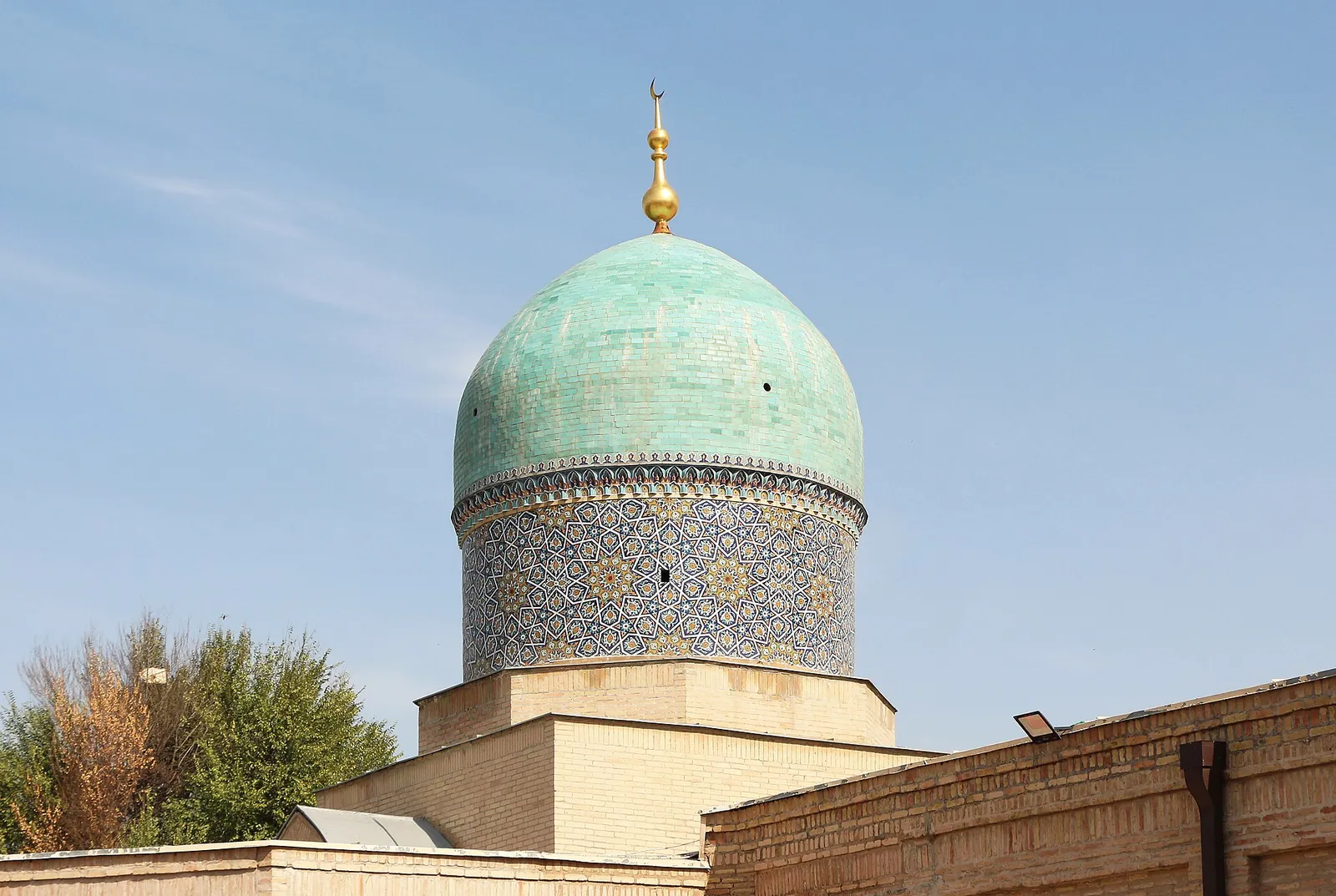
Day 2 — Khast Imam, Chorsu and the metro. Start at Khast Imam (Hazrati Imam), in the part of the old city that survived the 1966 earthquake. The ensemble groups the Tillya Sheikh mosque, the mausoleum of Kaffal Shashi, the Barak Khan madrasa and the Imam al-Bukhari Islamic Institute, and its visitors’ library stores separately a seventh-century Quran of 353 parchment leaves, attributed to the third caliph, Osman. Dress for a religious site: shorts, T-shirts and skirts are not welcome in mosques, and women should cover their heads. Areas around mosques are busy at prayer times.
From there ride the metro to Chorsu Bazaar, wander the stalls and have lunch at its food stalls, where samsa and pilaf are on offer. The metro runs daily from 06:00 to 00:00, and its decorated stations are a gallery in themselves; check before taking photos there (see the UK advice above). The Tashkent guide covers the old city in more detail.
In the afternoon choose one museum: the State Museum of History of Uzbekistan, which charges foreign visitors UZS 100,000 (UZS 200,000 to photograph exhibits) and is open Monday to Saturday, 10:00–17:00, or the State Museum of Applied Arts. End the day with lagman at Caravan, then sleep in Tashkent, night 2.
Day 3: Afrosiyob to Samarkand, the Registan and Gur-e-Amir
Take an Afrosiyob high-speed train from Tashkent’s main station; some other trains use Tashkent South, so check the station named on your ticket. Train 766 leaves at 07:21 and reaches Samarkand at 09:51 (2 h 30). The operator has also published a change notice moving 766 to 06:51–09:21, so take the time printed on your e-ticket. Book on the railway’s own site, eticket.railway.uz, where each search lists the train, its times, coach type, free seats and the price in som. Domestic tickets go on sale 60 days ahead. Enter your passport details exactly as in the passport you will travel with, pay within 15 minutes or the order lapses; the site accepts international bank cards. The transport guide covers classes, stations and the other trains.
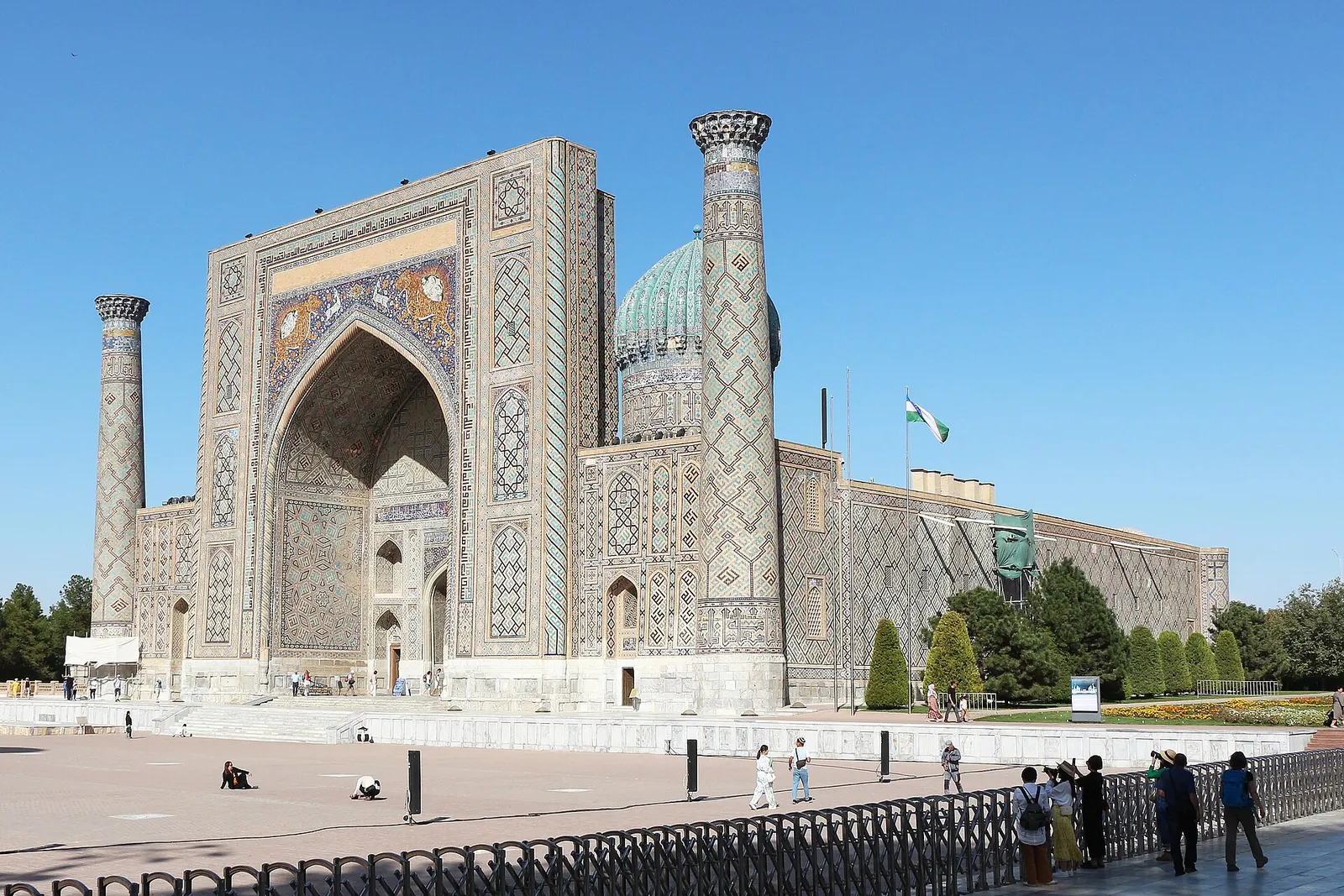
From the station take a taxi to Bibikhanum and leave your bags there. Then go straight to the Registan, which opens at 07:00 and is the reason for the stop: three madrasas, Ulugh Beg, Sherdor and Tilla-Kari, face each other across one square, with tiled portals, turquoise domes and minarets, and historical exhibitions now fill all three. The standard ticket for foreign visitors was UZS 100,000 in 2025. The ensemble is open daily, 07:00–24:00 from 20 February to 20 November and 08:00–20:00 from 20 November to 20 February; winter hours have changed before, so check them on registon.uz before an evening visit.
Have lunch of Samarkand plov (see below), then visit Gur-e-Amir, the mausoleum of Amir Temur, his mentor Mir Sayyid Barak and members of his family; the dark green jade gravestone of Amir Temur lies in the middle of its main room. It is open until 23:00, so it also suits the evening, when a music show runs on the Registan square every day at 21:00. Sleep in Samarkand, night 3.
Day 4: Bibi-Khanym, Siab Bazaar and Shah-i-Zinda
Walk from the hotel to the Bibi-Khanym Mosque, built between 1399 and 1404 on Amir Temur’s order and for a time the largest mosque in Central Asia. Its courtyard covers 5,000 square metres and could hold 10,000 worshippers; Temur was angry with the entrance portal on his return in 1404 and had it rebuilt. The complex is open until 23:00. Siab Bazaar stands next to it, selling dried fruit, nuts, sweets, halva and Samarkand’s famous bread, and stays open until 24:00.
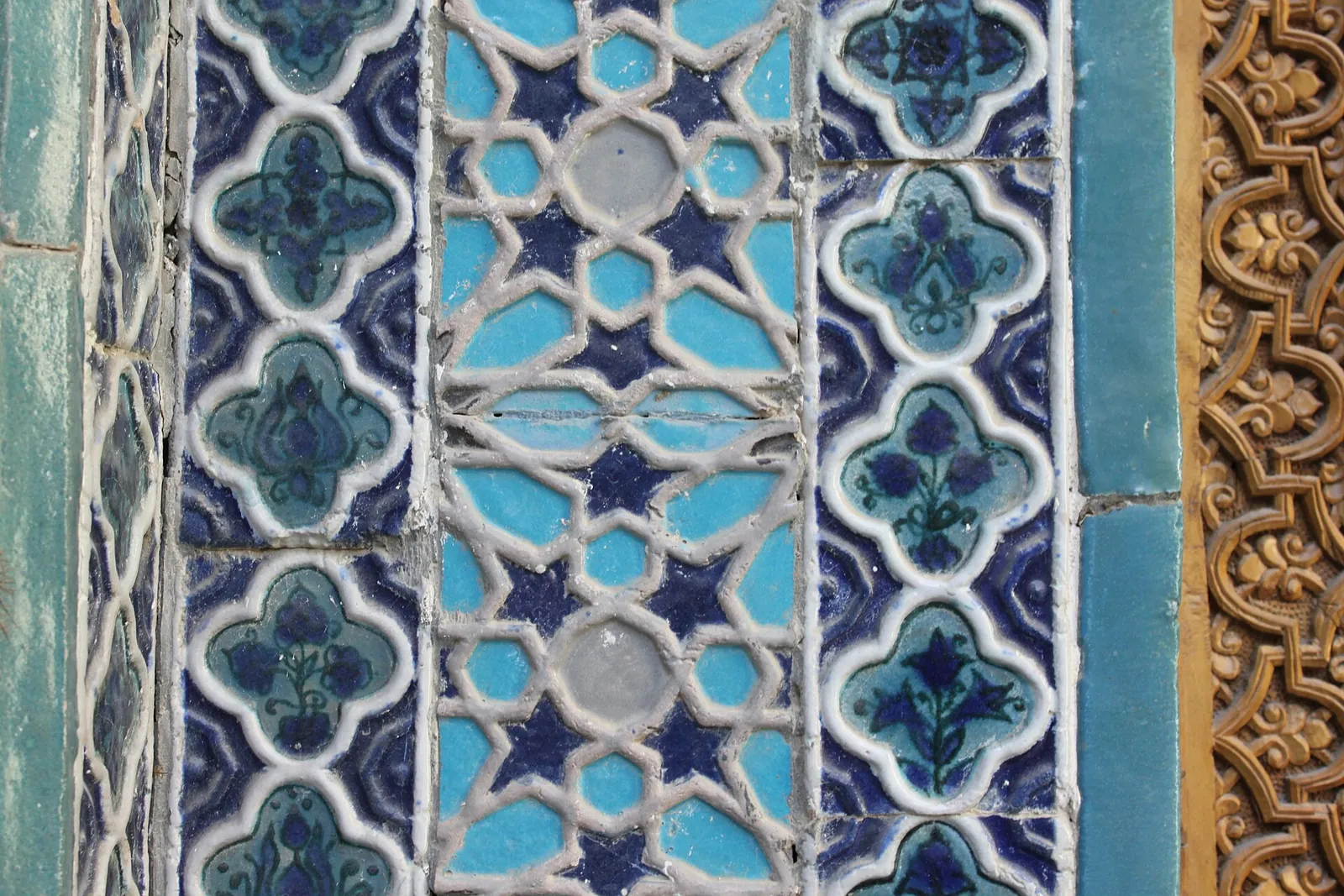
Spend the rest of the day at Shah-i-Zinda, the necropolis of tiled mausoleums built between the 11th century and the early 20th, a pilgrimage place linked to Qusam ibn Abbas, a cousin of the Prophet. It is a sacred place as well as a scenic one, so dress as you would for a mosque. Allow about two hours and see it in daylight.
If you have energy left, take a taxi for the two outlying sights, the Afrasiab museum on the site of the ancient city and the museum complex at Ulugh Beg’s observatory. Both are open until 23:00. Sleep in Samarkand, night 4.
Day 5: Sharq 710 to Bukhara and the old centre
Search Samarkand → Bukhara-1 on the railway’s site and book Sharq 710, a conventional train that leaves Samarkand at 11:55 and reaches Bukhara-1 at 14:10 (2 h 15) on the timetable effective 9 September 2025, for about UZS 200,000 a person, an estimate, since no fare is published for this leg. Bukhara-1 station is in Kagan, about 12 km in a straight line from Lyabi-Hauz, so book a hotel transfer or take an app taxi, roughly UZS 20,000–30,000 each way at Yandex’s published Bukhara tariff (an estimate).
After checking in, walk to the Lyabi-Hauz ensemble around its pool and through the trading domes beside Poi-Kalon. Most of Bukhara’s souvenir and weaving shops stand along Lyabi-Hauz and in the domes, and Bukhara is Uzbekistan’s weaving capital, with ikat fabric and carpets as its specialities. For dinner, try osh-sofi, Bukhara’s plov.
If time allows before closing, visit the carpet museum in the Magoki Attori Mosque, which costs UZS 20,000 for foreign visitors. The Bukhara museum reserve’s hours are 09:00–18:00, with 08:00–21:00 in season, and 09:00–17:00 on Tuesdays, Wednesdays and Sundays; it has no weekly closing day. Photographing exhibits is charged separately at UZS 30,000. Sleep in Bukhara, night 5.
Day 6: The Ark, Poi-Kalon and the Samani Mausoleum
Start at the Ark, the rulers’ palace until 1920: a citadel of 3.9 hectares inside walls 16 to 20 metres high, destroyed and rebuilt many times in a thousand years, which now houses the regional history museum; foreign visitors pay UZS 60,000. The former emir’s prison, the Zindan museum, costs UZS 20,000. Both prices are from the museum reserve’s tariff list of 1 January 2025.
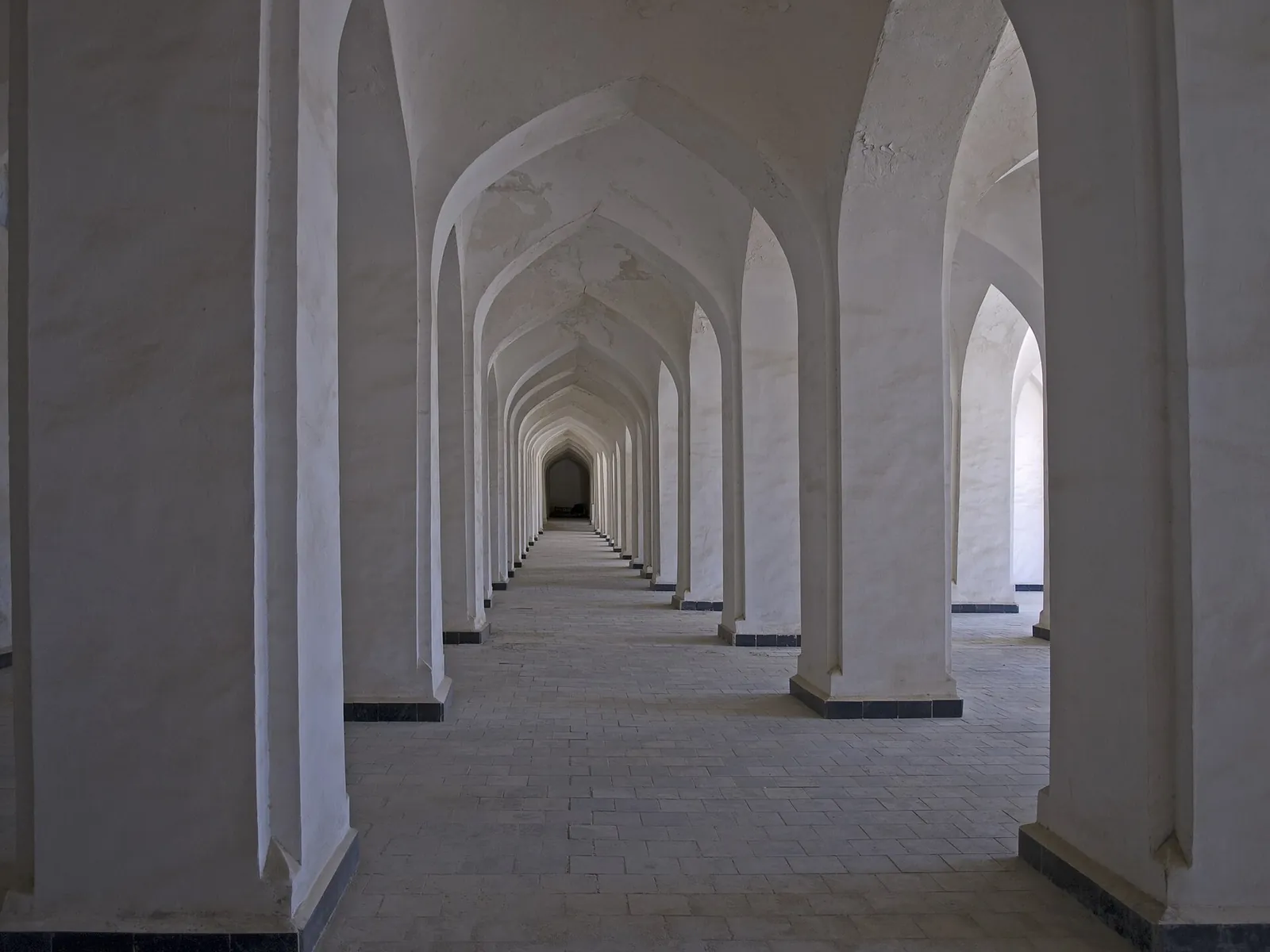
Walk on to Poi-Kalon, built between the 12th and 16th centuries around the Kalon minaret, the Kalon Mosque and the Miri-Arab and Amir-Alimkhan madrasas. An earlier minaret fell and brought down much of the mosque, and the Kalon minaret that stands today was built afterwards. Access to the mosque and to the teaching areas of the Miri-Arab madrasa depends on prayer times and on the staff, so treat the interiors as a bonus and the ensemble as the sight.
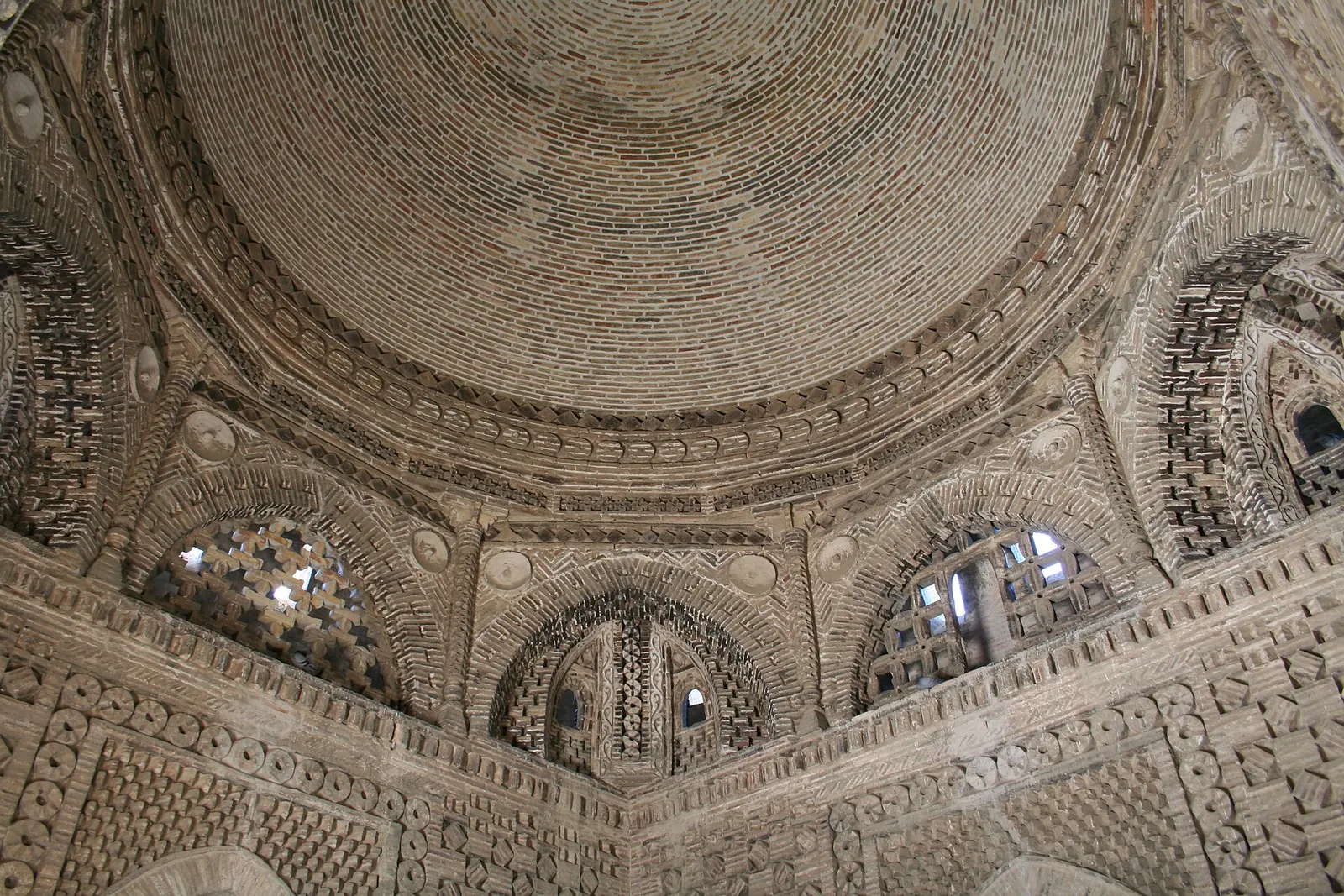
In the afternoon take in the Samani Mausoleum, the brick tomb of Ismail Samani, the second emir of the Samanid state: a cube under a hemispherical dome with four small domes at the corners, its walls up to 1.8 metres thick and its bricks laid in different patterns. Then see the Chashma Ayub mausoleum, now a museum of Bukhara’s water supply (UZS 20,000). If you still have time, the museums in the Ulugbek and Abdulaziz Khan madrasas cover calligraphy and woodcarving at UZS 20,000 each. The budget prices all of these; leave out whatever you do not reach. Sleep in Bukhara, night 6.
Day 7: Back to Tashkent for a flight after 23:30
Spend the morning in Bukhara, then take the transfer to Kagan for Afrosiyob 769, the earliest daytime Afrosiyob, which leaves Bukhara-1 at 14:58 and reaches Tashkent at 19:17 (4 h 19). Book a flight leaving after 23:30, which leaves about four hours for the taxi from Tashkent’s main station to the airport and for check-in; Uzbekistan Airways closes check-in one hour before departure, and other airlines may want longer. The only trains for an earlier flight run at night: Afrosiyob 771 leaves Bukhara-1 at 03:15 and reaches Tashkent at 07:35, and the conventional 711 leaves at 05:15 and reaches Tashkent Central at 11:54, and either costs you the last Bukhara morning. If you would rather fly after a night’s rest, add a seventh night in Tashkent for about UZS 1,400,000 more.
Plov, lagman and bread in each city
Plov is the dish to compare: mixed in Tashkent, left unmixed in Samarkand and cooked unmixed in a copper cauldron in Bukhara. Eat it at Beshqozon on day 1, on Orzu Mahmudov Street in Samarkand on day 3 and as osh-sofi at the café by the Lyabi-Hauz pool in Bukhara; take samsa and non from the Chorsu food stalls on day 2, with lagman or shashlik at Caravan that evening.
What to eat and where to look
Plov, Tashkent style
The national rice dish, made with meat and carrot and mixed as it cooks in Tashkent; Beshqozon cooks it over an open fire in large cauldrons, and its online menu lists a 450 g portion at UZS 52,000.
- Where to look
- Any Beshqozon branch in Tashkent.
- Fit it into your day
- Dinner on day 1.
Lagman
A noodle dish. Caravan says it pulls its lagman noodles thin by hand and flavours them with local spices.
- Where to look
- Caravan, 22 Mahmud Tarabi Street, Yakkasaray district, Tashkent; its site lists daily hours of 11:00–02:00.
- Fit it into your day
- Dinner on day 2.
Samarkand plov
Cooked without mixing the rice and carrots, so you choose how much of each to take; Samarkand’s own style is zig’ir osh.
- Where to look
- Orzu Mahmudov Street, a service street for tourists with 20 places to eat, open round the clock.
- Fit it into your day
- Lunch on day 3, after the Registan.
Samarkand bread
Non from the tandoor, singled out as Samarkand’s bread, with a legend that it never goes hard or mouldy. The bazaar also sells dried fruit, nuts and halva.
- Where to look
- Siab Bazaar, next to the Bibi-Khanym Mosque, Samarkand; open until 24:00.
- Fit it into your day
- Day 4, between Bibi-Khanym and Shah-i-Zinda.
Osh-sofi, Bukhara plov
Not mixed as it cooks, unlike Tashkent’s, and made only in a copper cauldron; order it by name.
- Where to look
- The café by the Lyabi-Hauz pool and the tea houses around it, Bukhara; order it by name.
- Fit it into your day
- Dinner on day 5 or lunch on day 6.
What seven days in Uzbekistan cost, all in
About UZS 8,800,000 per person, UZS 17,600,000 for two, for seven days and six nights before the international flight, at mid-range. All six hotel nights, every meal and ordinary drink, three train tickets, airport, station and city rides, admissions, two eSIMs and a 10% buffer are in.
| Level | Per person | For two |
|---|---|---|
| Budget | UZS 6,600,000 | UZS 13,200,000 |
| Mid-range (the hotels above) | UZS 8,800,000 | UZS 17,600,000 |
| Comfort | UZS 12,900,000 | UZS 25,800,000 |
The budget covers two adults sharing a double or twin room for six nights on ordinary spring or autumn dates outside public holidays, with prices checked on 25 October 2026. Room rates are each hotel’s own published rate plus an estimated 12% VAT where the rate is not stated gross, and the tourist tax, which depends on the size of the hotel, from UZS 22,000 to 66,000 per guest per night (the top rate where a hotel publishes no room count); dollar and euro prices use the central-bank reference rate of 23 October 2026 (USD 1 = UZS 11,903, EUR 1 = UZS 13,329 and GBP 1 = UZS 15,917).
For two, mid-range: rooms UZS 7,900,000; food and drinks UZS 2,900,000; getting around UZS 3,000,000; sights UZS 2,100,000; SIMs UZS 120,000; 10% buffer UZS 1,600,000.
Rooms are about UZS 1,400,000 a night at MIRZO and at Bibikhanum and about UZS 1,200,000 at Komil, with tax and VAT included. Food is UZS 225,000 per person per day for three meals and drinks, built from Beshqozon’s complete plov portion at UZS 69,000 and UZS 18,000 for tea and water, less the two Komil breakfasts. Beshqozon’s online menu lists a 450 g plov portion at UZS 52,000.
Getting around is about UZS 1,020,000 a person for the three train tickets and about UZS 1,000,000 for the two of you for the airport and station rides at both ends and short city taxis. Since 1 February 2026 the Afrosiyob has cost UZS 311,000 in economy from Tashkent to Samarkand and UZS 509,000 between Tashkent and Bukhara, the figure used for the train back; Sharq 710 from Samarkand to Bukhara has no published fare, so we plan on about UZS 200,000, the difference between the two Afrosiyob fares.
Sights are UZS 2,050,000 for two: Tashkent UZS 600,000 (the History Museum at UZS 100,000 each, plus the Applied Arts Museum and the Khast Imam Quran at an estimated UZS 100,000 each), Samarkand UZS 970,000 (the Registan at UZS 100,000 each, and Gur-e-Amir, Bibi-Khanym and the observatory museum at UZS 75,000 and Shah-i-Zinda and the Afrasiab museum at UZS 80,000 each, the foreign-adult prices that Silk Road Tour, a tour operator in Uzbekistan, listed in July 2026, since the sites publish none) and Bukhara UZS 480,000 (the Ark at UZS 60,000 each, five small museums at UZS 20,000 and the Kalon Mosque and Samani Mausoleum at an estimated UZS 40,000 each). The two eSIMs are two Hello 1 plans at UZS 60,000 each.
Budget and comfort keep the route and change the hotels and the food. Budget uses Orzu Hotel in Tashkent (UZS 770,000 a night for non-residents, VAT included), Registon Saroy in Samarkand (UZS 640,000) and Hotel Kamelot in Bukhara (USD 60) with food at UZS 150,000 a person a day, about UZS 850,000 to 890,000 a night with tax and VAT. Comfort uses T-City Presidential Hotel in Tashkent (Executive Twin from UZS 2,300,000), L’Argamak in Samarkand (from EUR 99, breakfast included) and Minorai Kalon Boutique Hotel in Bukhara (Luxe twin from USD 100), food at UZS 350,000 a day, business-class train seats and a city guide at about UZS 700,000 for two, the price from which the Bukhara museum reserve lists a foreign-language city tour.
Flights: about GBP 550–1,200 per person for a London return in economy, rounded from sample economy fares of GBP 549–1,166 on October and November 2026 departure dates; fares vary by date. With flights, mid-range comes to about GBP 1,100–1,750 per person, GBP 2,200–3,500 for two; budget is GBP 960–1,610 and comfort GBP 1,360–2,010 per person. The trip cost guide prices the ten-day version.
Practical questions
Does seven days mean six nights?
Six: two in Tashkent, two in Samarkand and two in Bukhara. Arrive on day 1, change cities on days 3 and 5; day 7 ends with the 14:58 train from Bukhara, and the late-flight rule is under day 7.
Can I add Khiva to this route?
Not at this pace. Khiva adds a long rail move west and a departure from there, so something would have to go: the ten-day route gives Khiva its own two nights and adds a night in Samarkand.
Which flight times work on day 7?
A flight leaving after 23:30 if you take Afrosiyob 769 (Bukhara-1 14:58, Tashkent 19:17), which leaves about four hours for the taxi and check-in. Uzbekistan Airways closes check-in one hour before departure, and other airlines may want longer. For an earlier flight take the night train 771 (03:15 to 07:35) or the conventional 711 (05:15 to 11:54), or add a seventh night in Tashkent.
When should I book the trains?
As soon as your dates open: domestic tickets go on sale 60 days ahead. Book the Tashkent–Samarkand and Bukhara–Tashkent trains first, since the day 7 train sets your flight.
Do I need much cash?
Some. Cards are not widely accepted outside Tashkent and the main cities and few ATMs take international cards, so carry som for bazaars, taxis and small museums, and change money only at official booths.
Does the budget cover everything for two?
Yes. About UZS 17,600,000 for two at mid-range, UZS 8,800,000 each, covers six hotel nights, every meal and drink, three trains, airport, station and city rides, admissions, two eSIMs and a 10% buffer. With a London return in economy it comes to about GBP 2,200–3,500 for two.
Keep planning your trip
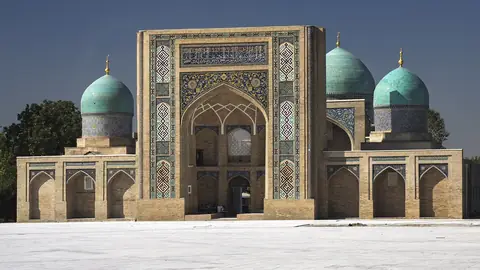
Entering Uzbekistan
Which passports enter Uzbekistan without a visa for 30 days, how hotel registration works, what to declare at customs, and the border and photography advice to follow.
Read the guide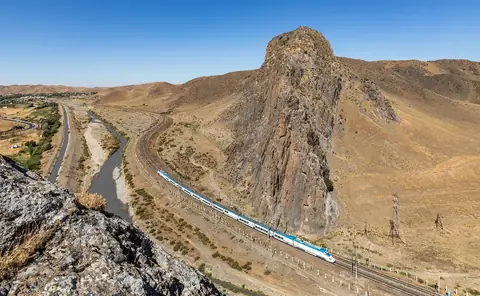
Transport in Uzbekistan
Book Uzbekistan’s trains and flights: the Afrosiyob to Samarkand and Bukhara, the 2026 Khiva trains, domestic fares, airport links and the Tashkent metro.
Read the guide
Tashkent
Plan two nights in Tashkent: Khast Imam, Chorsu Bazaar, the metro, the squares and museums, an opera evening, rooms, the airport, the train to Samarkand and costs.
Read the guide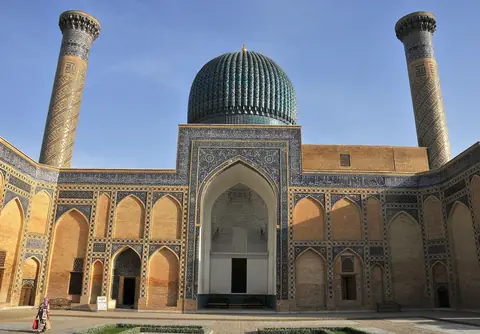
Samarkand
Plan two nights in Samarkand: the Registan, Gur-e-Amir, Bibi-Khanym, Shah-i-Zinda and Afrasiab, with tickets, hours, trains in and on to Bukhara, and costs.
Read the guide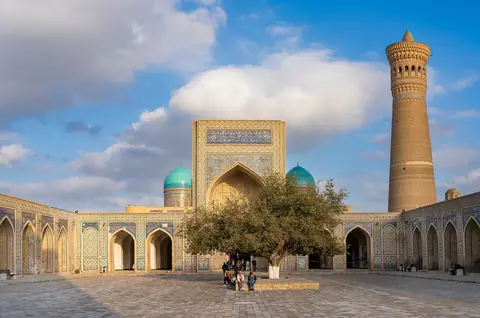
Bukhara
Plan two nights in Bukhara: Lyabi-Hauz, the trading domes, Poi-Kalon, the Ark and small museums, with 2025 ticket prices, rooms, trains and costs.
Read the guide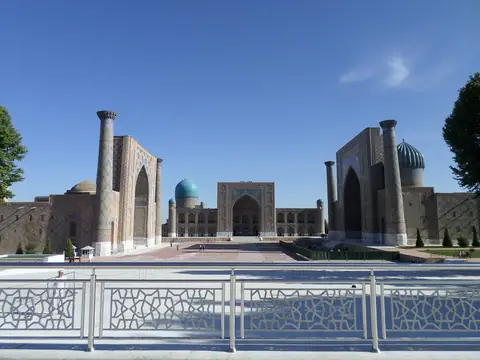
Uzbekistan in ten days
Ten days and nine nights through Tashkent, Samarkand, Bukhara and Khiva, with a Shahrisabz day trip, named hotels, trains, the flight home and an all-in budget.
Read the guideSources and checks before you travel
(50)
- MIRZO Boutique Hotel: twin room ↗ — opens in a new tab
- MIRZO Boutique Hotel: home page ↗ — opens in a new tab
- Bibikhanum Hotel: home page ↗ — opens in a new tab
- Komil Boutique Hotel: room rates ↗ — opens in a new tab
- Orzu Hotel: rooms ↗ — opens in a new tab
- Registon Saroy: home page ↗ — opens in a new tab
- T-City Presidential Hotel: home page ↗ — opens in a new tab
- L’Argamak: home page ↗ — opens in a new tab
- Registan Ensemble Directorate: home page ↗ — opens in a new tab
- Registan Ensemble Directorate: evening opening notice ↗ — opens in a new tab
- Registan Ensemble Directorate: interview with the director ↗ — opens in a new tab
- Bukhara State Museum-Reserve: ticket prices and hours ↗ — opens in a new tab
- State Museum of the History of Uzbekistan: tickets ↗ — opens in a new tab
- State Museum of the History of Uzbekistan: home page ↗ — opens in a new tab
- Uzbekistan national tourism site: Khazrati Imam ↗ — opens in a new tab
- Uzbekistan national tourism site: Bibi-Khanym Mosque ↗ — opens in a new tab
- Uzbekistan national tourism site: Shah-i-Zinda ↗ — opens in a new tab
- Uzbekistan national tourism site: Poi-Kalon ↗ — opens in a new tab
- Uzbekistan national tourism site: Samarkand ↗ — opens in a new tab
- Uzbekistan national tourism site: Bukhara ↗ — opens in a new tab
- Uzbekistan national tourism site: travel tips ↗ — opens in a new tab
- O‘zbekiston Temir Yo‘llari: train timetable ↗ — opens in a new tab
- O‘zbekiston Temir Yo‘llari: notice effective 9 September 2025 ↗ — opens in a new tab
- O‘zbekiston Temir Yo‘llari: ticket FAQ ↗ — opens in a new tab
- O‘zbekiston Temir Yo‘llari: 60-day sales announcement ↗ — opens in a new tab
- Uzbekistan Airways: check-in and boarding ↗ — opens in a new tab
- Turkish Airlines: London to Tashkent flights ↗ — opens in a new tab
- UK FCDO: Uzbekistan entry requirements ↗ — opens in a new tab
- UK FCDO: Uzbekistan safety and security ↗ — opens in a new tab
- France Diplomatie: Uzbekistan security ↗ — opens in a new tab
- Ipoteka Bank: exchange rates ↗ — opens in a new tab
- Beeline Uzbekistan: Hello 1 price notice ↗ — opens in a new tab
- Beeline Uzbekistan: eSIM ↗ — opens in a new tab
- Beeline Uzbekistan: offices ↗ — opens in a new tab
- Beshqozon: menu ↗ — opens in a new tab
- Caravan restaurant, Tashkent ↗ — opens in a new tab
- Visit Tashkent: Chorsu Bazaar ↗ — opens in a new tab
- Uzbekistan national tourism site: Lyabi-Hauz ↗ — opens in a new tab
- Uzbekistan national tourism site: Gur-Emir ↗ — opens in a new tab
- Uzbekistan national tourism site: Samanid Mausoleum ↗ — opens in a new tab
- Bukhara State Museum-Reserve: the Ark ↗ — opens in a new tab
- Hotel Kamelot, Bukhara: prices ↗ — opens in a new tab
- Minorai Kalon Boutique Hotel, Bukhara ↗ — opens in a new tab
- Cabinet of Ministers Resolution 475, Annex 1 (lex.uz): tourist tax rates ↗ — opens in a new tab
- Anhor.uz: train fares raised by 15% (Russian) ↗ — opens in a new tab
- Kursiv: Afrosiyob ticket prices to rise 15% from February 2026 ↗ — opens in a new tab
- Silk Road Tour: entrance tickets and prices in Uzbekistan ↗ — opens in a new tab
- O‘zbekiston Temir Yo‘llari: Afrosiyob fares from 1 February 2026 ↗ — opens in a new tab
- Yandex Taxi: Start tariff, Bukhara ↗ — opens in a new tab
- Decree PF-115 of 23 June 2026 (lex.uz): base calculation amount ↗ — opens in a new tab
Reference sources for the version dated 10 November 2026. Confirm opening times, access, transport and conditions for your travel dates.
Photo credits
(5)
Sherdor Madrasa on Samarkand's Registan, seen across the square on a clear day, with its tiled portal and two minarets.
Photograph: Bgag — opens in a new tab · CC0 — opens in a new tab
Changes: Resized and converted to WebP; displayed with responsive crops. · Original photograph and licence details ↗ — opens in a new tab
The turquoise dome of Barak Khan Madrasa, part of the Khast Imam complex in Tashkent's old city.
Photograph: Bgag — opens in a new tab · CC0 — opens in a new tab
Changes: Resized and converted to WebP; displayed with responsive crops. · Original photograph and licence details ↗ — opens in a new tab
Tilework on the Khodja-Akhmad Mausoleum at Shah-i-Zinda in Samarkand.
Photograph: Faqscl — opens in a new tab · CC BY-SA 3.0 — opens in a new tab
Changes: Resized and converted to WebP; displayed with responsive crops. · Original photograph and licence details ↗ — opens in a new tab
The arcade of the Kalyan Mosque in Bukhara, part of the Poi-Kalon ensemble.
Photograph: Ymblanter — opens in a new tab · CC BY-SA 4.0 — opens in a new tab
Changes: Resized and converted to WebP; displayed with responsive crops. · Original photograph and licence details ↗ — opens in a new tab
Inside the Samani Mausoleum in Bukhara, looking up into the brick dome.
Photograph: Patrickringgenberg — opens in a new tab · CC BY-SA 3.0 — opens in a new tab
Changes: Resized and converted to WebP; displayed with responsive crops. · Original photograph and licence details ↗ — opens in a new tab