Samarkand: Registan, Shah-i-Zinda and the monuments in two days
Samarkand is the Silk Road city most readers picture first, and its monuments sit close enough to fit into two days on foot and by short taxi. The Registan faces three madrasas across an open square. Gur-e-Amir holds Timur's tomb under a ribbed blue dome. Bibi-Khanym, built on his orders, was the largest mosque in Central Asia of its day. Shah-i-Zinda is a necropolis of tiled mausoleums that pilgrims still visit. Two nights give each of them time, with an evening back at the Registan, and leave Bukhara and Shahrisabz for their own days.
In this guide
Find the location ↗ — opens in a new tabThe short answer
Book two old-town nights near the Registan, and book the trains first, since domestic tickets go on sale 60 days ahead: Afrosiyob 766 from Tashkent (07:21–09:51) and Sharq 710 on to Bukhara (11:55–14:10). Spend one day on Gur-e-Amir, the Registan and Bibi-Khanym, the other on Shah-i-Zinda, Afrasiab and the observatory. Afrosiyob economy from Tashkent is UZS 311,000 on the fares in force since 1 February 2026, and the Registan charged foreign visitors UZS 100,000 when its directorate last published the price, in October 2025. The all-in budget for two sharing, arriving from Tashkent and leaving for Bukhara, comes to about UZS 3,600,000 per person, UZS 7,200,000 for two, without flights.
- Suggested time
- 2 nights in Samarkand
- Where to stay
- Old town between the Registan and Bibi-Khanym, near Siab Bazaar
- Season and timing
- April–May and September–October are the best months to visit; July and August are very hot, so keep midday indoors.
Two nights near the Registan and Bibi-Khanym
Stay in the old town, within walking distance of the Registan, Bibi-Khanym and Siab Bazaar, and keep one room for both nights. Registon Saroy (Sozangaron Street 66) is 400 metres from the Registan and lists a standard double at UZS 640,000 a night and advertises free breakfast. Bibikhanum Hotel (Tashkent Street 10) stands beside Bibi-Khanym Mosque and Siab Bazaar, five minutes on foot from Shah-i-Zinda, and lists a double at USD 95 a night. L’Argamak (4 Sulton Muhammad) lists a double or twin from EUR 99, about UZS 1,320,000, with breakfast included.
Hotel staff register you with the authorities, so keep the registration record with your passport. The UK Foreign Office advises registering within three days of arrival, counting Saturdays and Sundays; our entry guide gives the rule for your passport.
Day one: Gur-e-Amir, the Registan and Bibi-Khanym
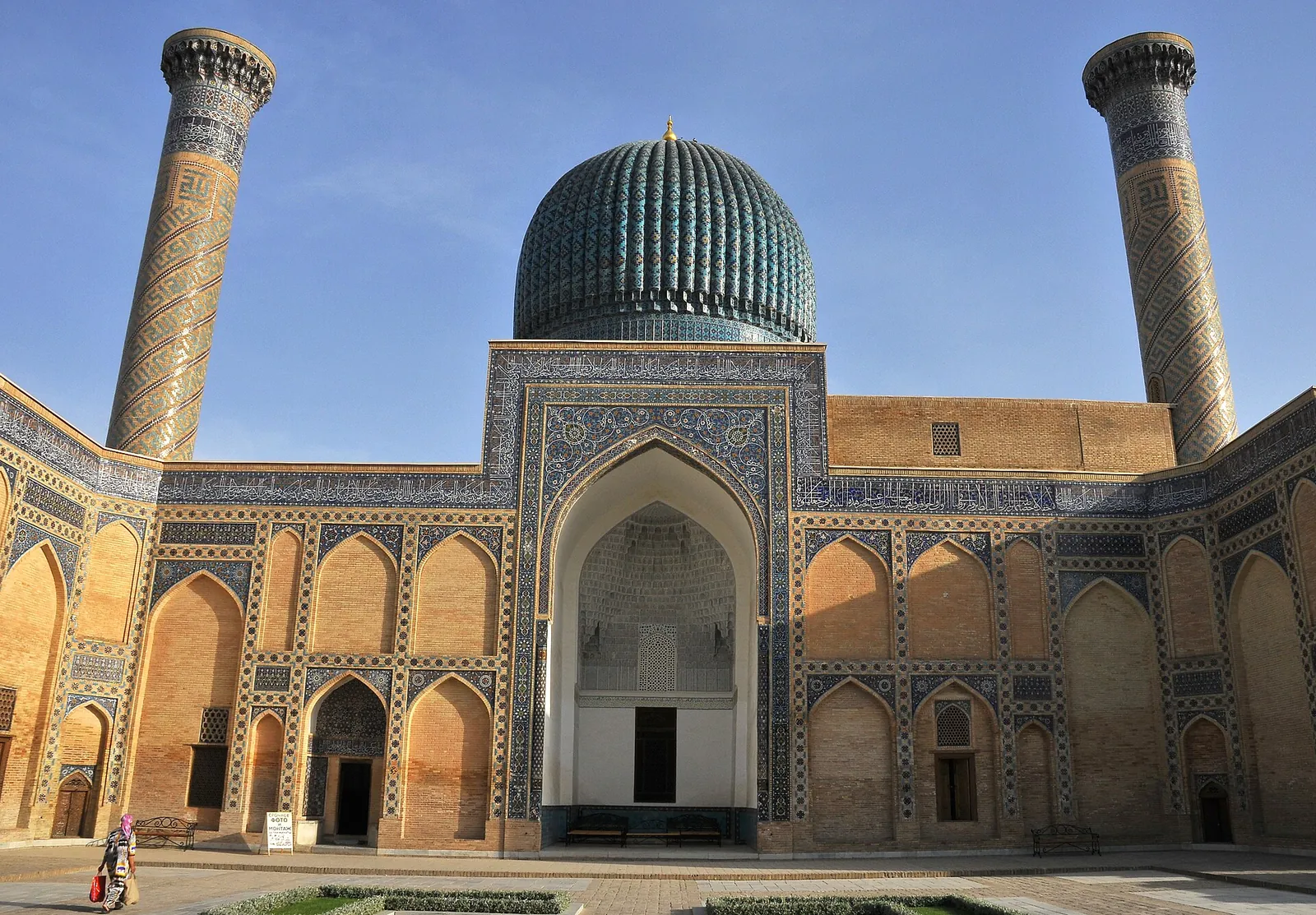
Begin at Gur-e-Amir, the mausoleum of Timur, whose ribbed blue dome rises between two minarets. Timur's grandson Muhammad Sultan began it in 1401 as a madrasa; when he died it was rebuilt as his tomb, and Timur was buried beside him. Inside, a dark jade gravestone marks Timur's grave.
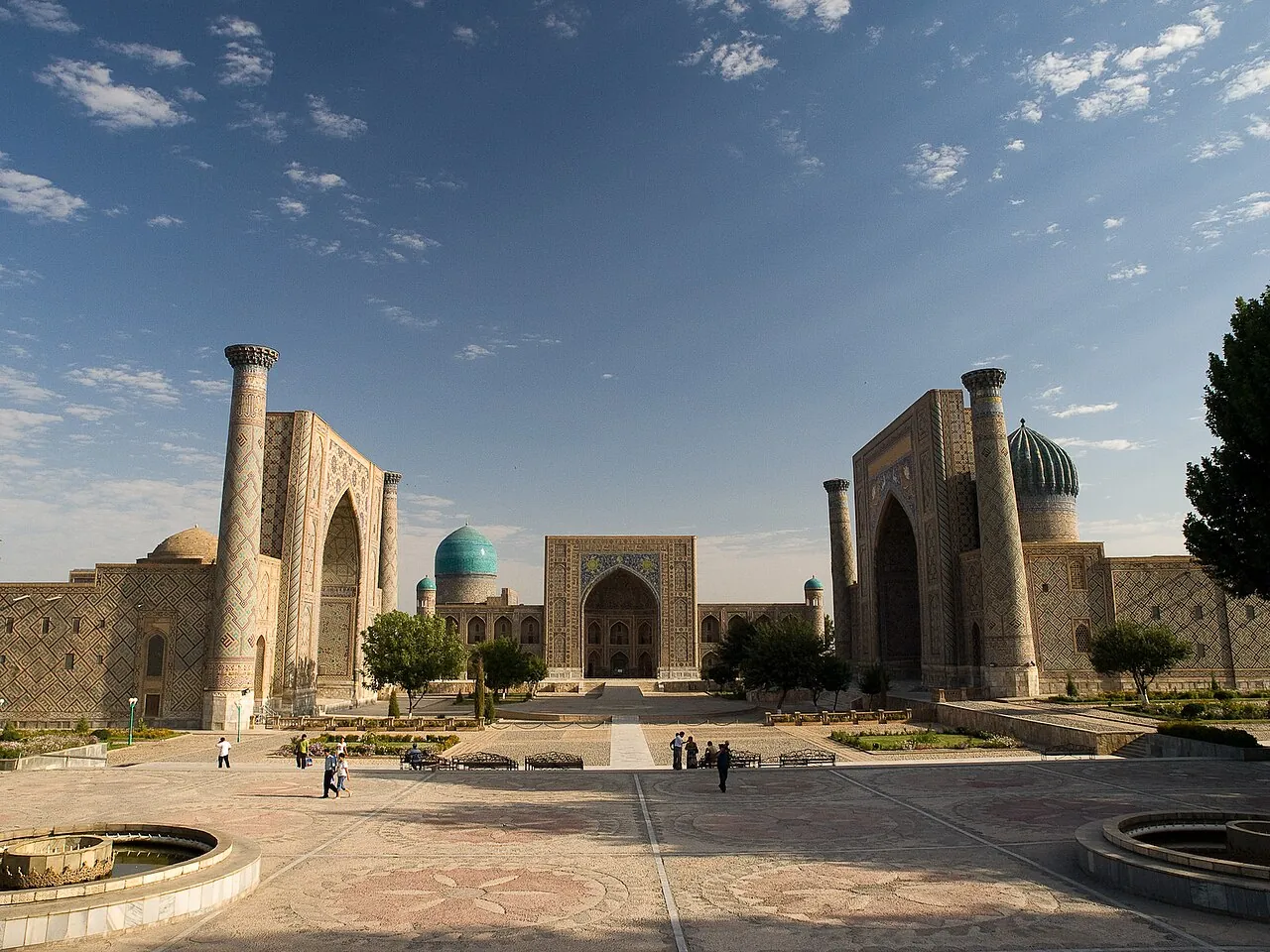
The Registan is a square closed on three sides by madrasas, and its name means “sandy place”. Ulugh Beg's madrasa came first (1417–20). Sherdor (1619–36) replaced his ruined khanaka opposite it, and Tilla-Kari (1646/47–1659/60) went up on the north side on the site of a caravanserai. Sherdor's name, “abode of lions”, comes from the tympanum over its portal, where a big cat chases a gazelle beneath a rising sun, an unusual picture for a religious building. Historical exhibitions now fill all three madrasas, showing how teaching and science went on in them in the 15th–17th centuries, and the directorate added an audio guide in 12 languages, it said in October 2025. Come back after dark.
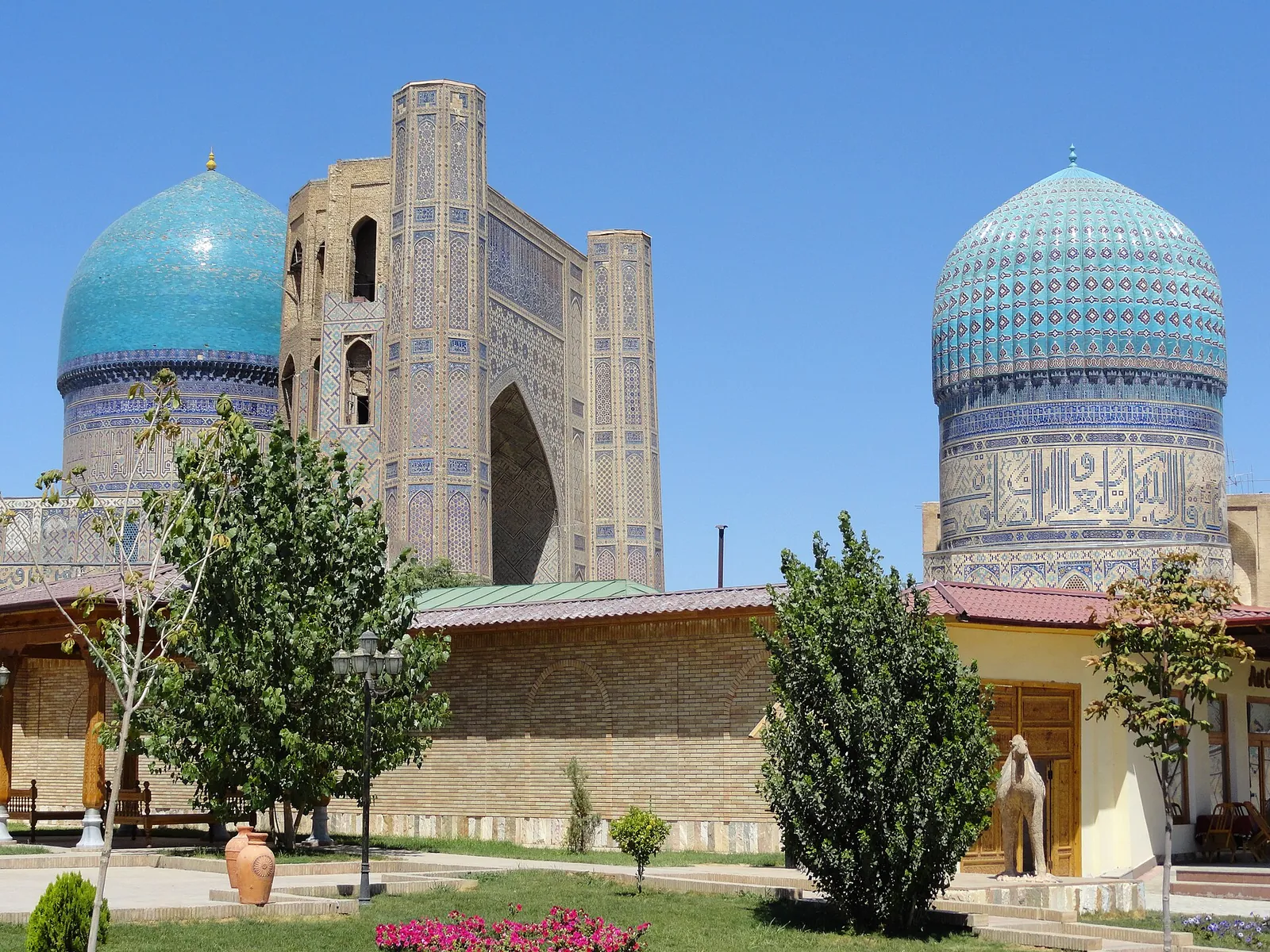
Bibi-Khanym is a short walk away. Timur ordered it after his campaign in India; work began in 1399 and the mosque was finished five years later as the largest in Central Asia. When Timur came home in 1404 he thought the entrance portal too modest and had it rebuilt. The courtyard covers about 5,000 square metres and has minarets on four sides; the walls carry paintings, carved marble and tile, the work of masters from many countries.
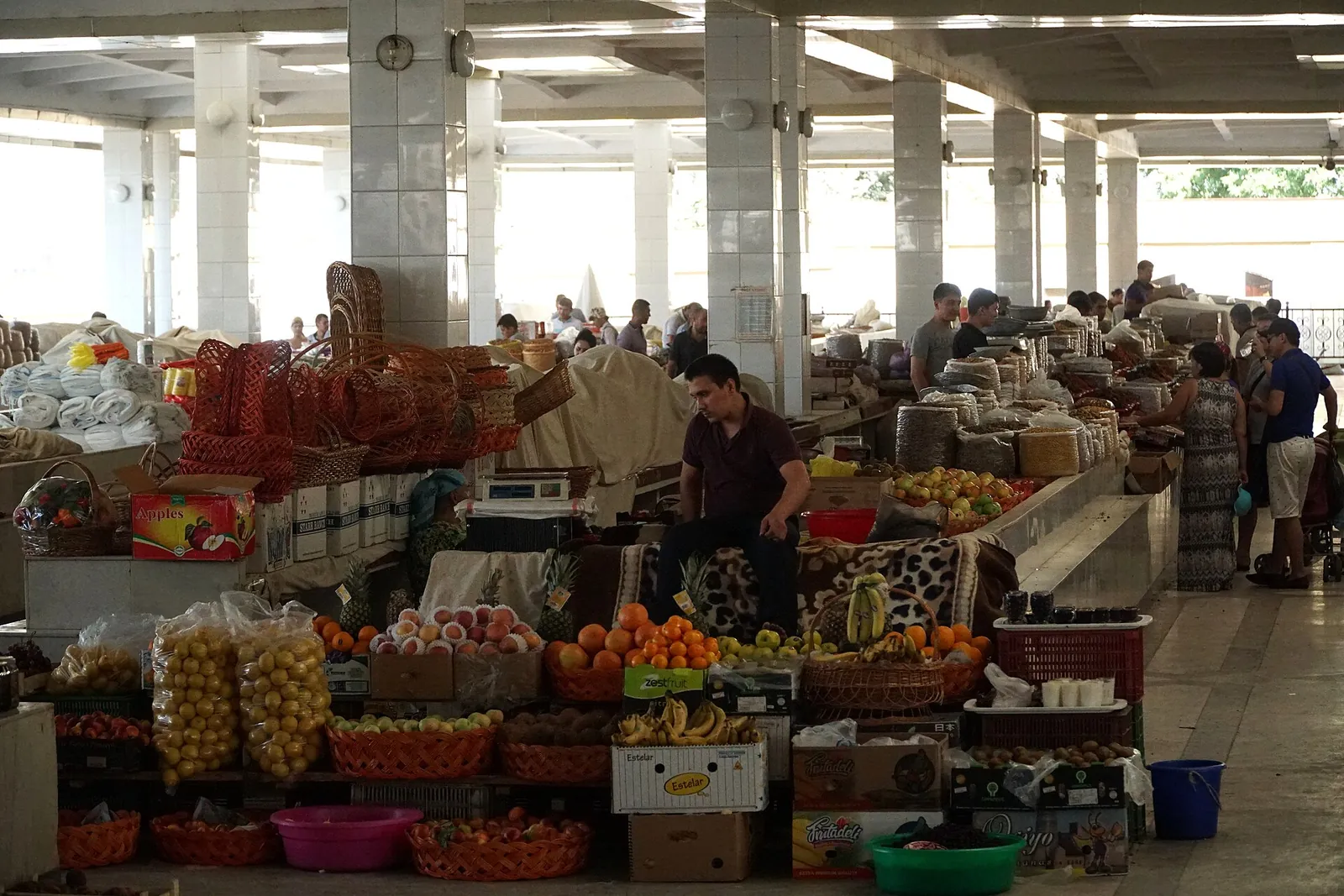
Siab Bazaar sits next to the mosque. It is considered the oldest and largest market in Central Asia and is mentioned from the 8th–9th centuries. Dried fruit, nuts, sweets, bread and halva are the things to buy; take bread and fruit from the stalls and have lunch nearby.
What to eat and where to look
Samarkand non
Flatbread baked in a tandoor, the city’s best-known loaf. Legend says a Bukhara emir tried and failed to copy it with Samarkand flour, water, clay and even a Samarkand baker, and that the bread stays fresh for as long as you like.
- Where to look
- Siab Bazaar, next to Bibi-Khanym Mosque, where bread is sold with dried fruit and halva.
- Fit it into your day
- Buy it on the day-one walk and eat it with fruit from the same stalls.
Samarkand plov (zig’ir osh)
Samarkand’s plov is not stirred while it cooks, so the rice, carrots and meat stay apart and each diner takes as much of each as they like. Zig’ir osh, the version named for the city, is cooked with beef, linseed oil, carrots, raisins and chickpeas.
- Where to look
- Orzu Mahmudov Street, a service street for tourists about 3 km south-west of the Registan, open round the clock with 20 places to eat.
- Fit it into your day
- One lunch in the two-day plan, since a portion is large.
Plov, shashlik and manti are all cooked with lamb or beef.
Shashlik
Lamb grilled on skewers over charcoal, one of the kebabs that make up the everyday meat dishes of Samarkand.
- Where to look
- Grills on Orzu Mahmudov Street, which serves national and international dishes through the night.
- Fit it into your day
- A dinner after the Registan.
Halva
Uzbekistan Travel singles out Samarkand bread and halva among the sweets, nuts and dried fruit of Siab Bazaar; buy a little with apricots or raisins for the train.
- Where to look
- The sweet stalls of Siab Bazaar, beside Bibi-Khanym.
- Fit it into your day
- Day three, before the train to Bukhara.
Manti
Steamed dumplings with a meat filling, which Uzbekistan Travel lists with plov, kebabs and bread among the dishes popular in Samarkand.
- Where to look
- The cafés of Pub Street, a 400-metre tourist street with 12 places to eat, around the brewery founded there in 1885.
- Fit it into your day
- A second dinner, or a lighter lunch on day one.
Day two: Shah-i-Zinda, Afrasiab and the observatory
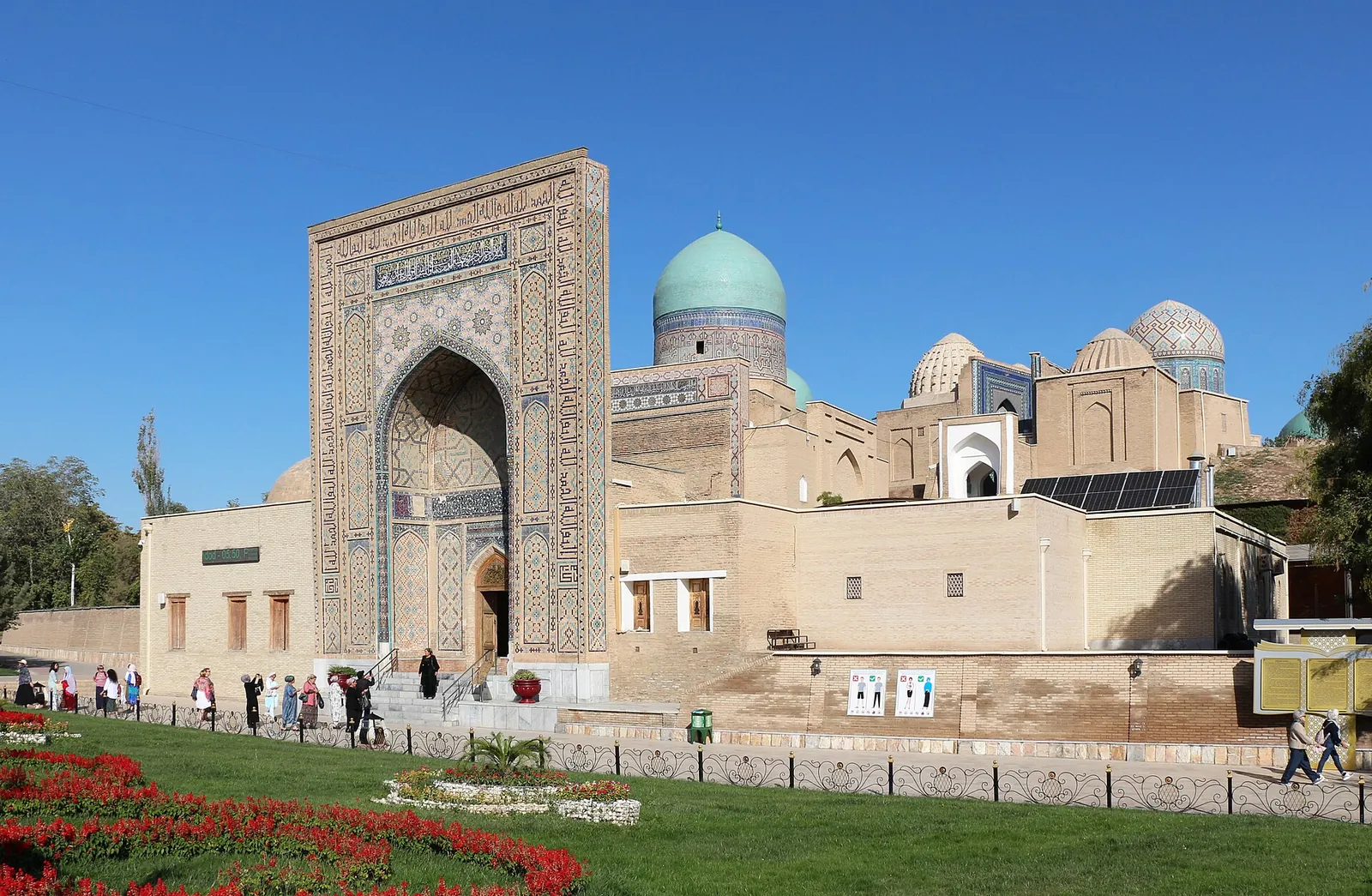
Shah-i-Zinda, “Living King”, is a necropolis of mausoleums faced in blue and turquoise tile, with buildings from the 11th century to the early 20th, and the most revered pilgrimage place in Central Asia. It is linked with Qusam ibn Abbas, a cousin of the Prophet, who is said to have gone alive into paradise from a well here. The monuments line an old street and fall into a lower group, a middle group, a northern courtyard and the complex of Qusam ibn Abbas; enter by the lower group and walk through them in that order. Women should cover shoulders, back and legs.
Afrasiab is the ancient city on the northern edge of Samarkand, where the town stood until the Mongols destroyed it in 1220. It was founded in the 8th century BC and covered 219 hectares inside four rings of walls; excavations found palaces with carved ganch plasterwork, houses, mosques, baths and cobbled streets of the Samanid era. In 1965 archaeologists uncovered seventh-century wall paintings there, and the Afrasiab museum on the site now shows them with the other finds.
Two shrines stand on the same plateau. The Hazrat Khizr Mosque, at the southern tip of Afrasiab where Shahizinda and Tashkent streets meet, is named after Khizr, the prophet who protects travellers; the mausoleum of Islam Karimov, Uzbekistan’s first president, opened in its grounds in 2018. At the north-eastern edge, on a low rise above the small Siab river, the Mausoleum of Khoja Doniyor holds, by an 18th-century legend, the remains of the prophet Daniel, brought to Samarkand by Timur; the present building dates from the start of the 20th century.
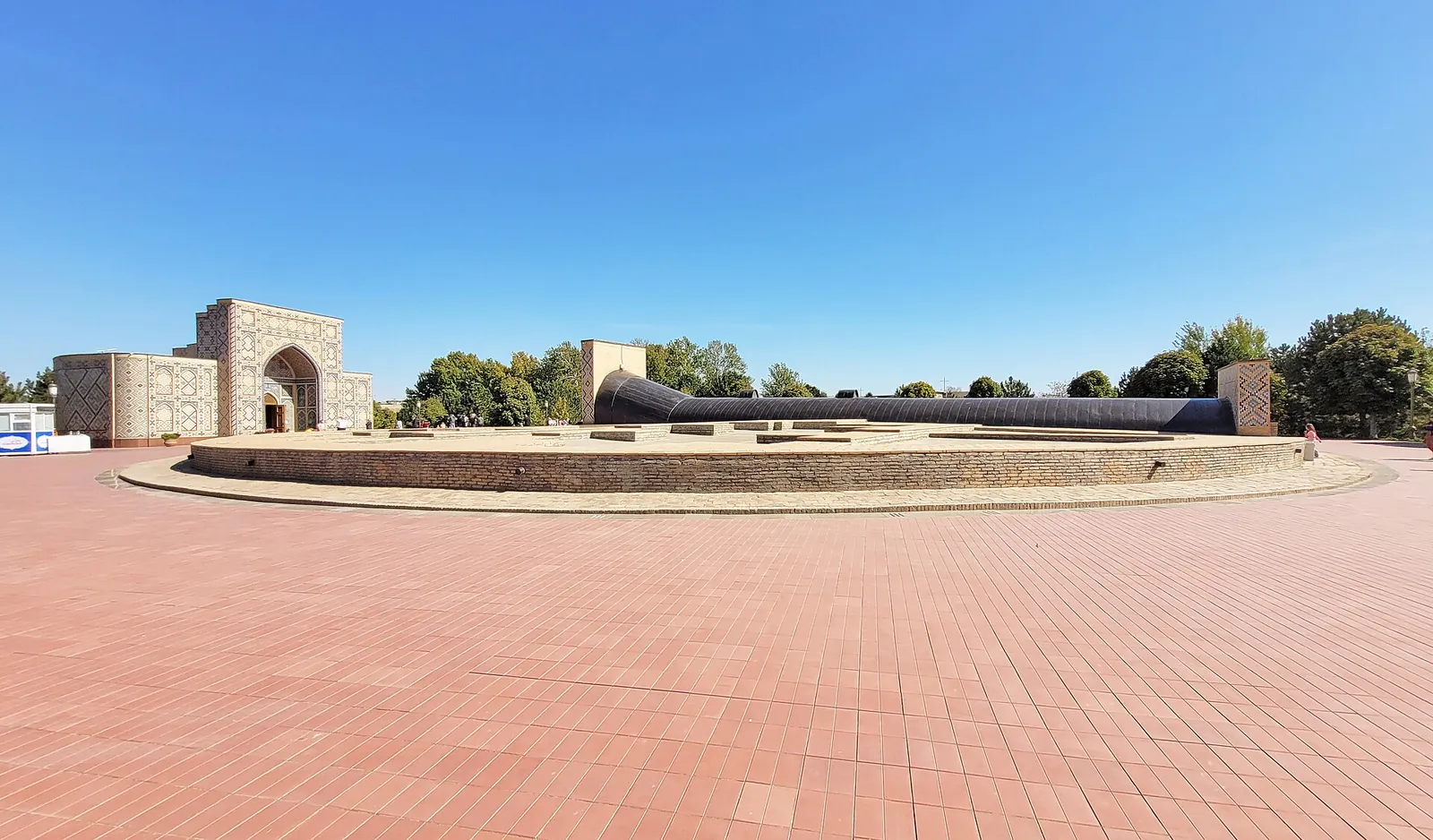
The Ulugh Beg Observatory closes the day. Ulugh Beg, Timur's grandson, had it built in 1428–29 as a round three-storey building 46.4 metres across, and his school compiled a catalogue of 1,018 stars there. Its great instrument was a marble quadrant with an arc radius of 40.2 metres, set in the meridian and sunk more than 10 metres into the hill. The building was dismantled in the late 17th century and its site was found in 1908; today you see the surviving underground part of the quadrant and the museum beside it.
Afrasiab and the observatory lie north-east of the old town, about 2 km and 3.5 km from the Registan in a straight line and 1 km from each other, so book one taxi for the circuit, with Hazrat Khizr on the way from Shah-i-Zinda; at the Yandex tariff below a ride of that length costs roughly UZS 15,000–25,000.
Tickets, opening hours and the evening Registan
The Registan sells tickets online at tickets.registon.uz. When its directorate last published the prices, in October 2025, foreign visitors paid UZS 100,000 and citizens of Uzbekistan UZS 15,000. The ensemble is open every day: its home page gives 07:00–24:00 in the season from 20 February to 20 November and 08:00–20:00 out of season from 20 November to 20 February. Winter hours have changed before, so check them before a winter evening visit.
A notice of 9 September 2026 extended evening visits: the Afrasiab museum, Gur-e-Amir, the Bibi-Khanym complex and the observatory museum complex open to 23:00, the Registan to 24:00 and Siab Bazaar to 24:00 (not every stall), with a music show on the Registan square every day at 21:00. Shah-i-Zinda is not on the list and publishes no hours, so see it in daylight.
Only the Registan publishes a foreign-visitor price. Shah-i-Zinda, Gur-e-Amir, Bibi-Khanym, the observatory and the Afrasiab museum each sell their own ticket at the gate. Silk Road Tour, a tour operator in Uzbekistan, listed foreign adults’ prices in July 2026 of UZS 75,000 for Gur-e-Amir, Bibi-Khanym and the observatory and UZS 80,000 for Shah-i-Zinda and the Afrasiab museum; SAIGA Tours’ list of July 2025 was lower, at UZS 40,000–75,000 for the four of them it priced. Plan on the newer figures, about UZS 385,000 for all five, and carry cash.
Trains from Tashkent, on to Bukhara, and getting around
Afrosiyob 766 leaves Tashkent daily at 07:21 and reaches Samarkand at 09:51 (2 h 30); 765 leaves Samarkand at 17:35 and reaches Tashkent at 20:08 (2 h 33). The operator has also published a change notice moving 766 to 06:51–09:21, so take the time printed on your e-ticket. Conventional trains take 3 h 05 to 3 h 49 on the timetable effective 9 September 2025, and the Tashkent–Khiva train launched on 5 May 2026 also stops here. Search Tashkent → Samarkand for your date on eticket.railway.uz or in the Uzrailway tickets app: the results list each train with its times, free seats and fare. Domestic tickets go on sale 60 days ahead, so book the seats first. Afrosiyob economy is UZS 311,000, business UZS 455,000 and VIP UZS 709,000 on the fares in force since 1 February 2026, when Uzbekistan Railways raised its fares by 15%. Uzbekistan Airways lists Tashkent–Samarkand flights from UZS 201,062 one way from 16 October 2026, but the train is the easier choice. Our transport guide covers the classes and the other trains.
On to Bukhara, Sharq 710 is the practical train: it leaves Samarkand at 11:55 and reaches Bukhara-1 at 14:10 (2 h 15), and the other conventional trains take up to 2 h 32, on the timetable effective 9 September 2025. Faster Afrosiyob trains also run to Bukhara, and the railway’s date search shows their times, classes and fares. No fare for this leg is published; plan on about UZS 200,000 a seat, the difference between the Tashkent–Bukhara and Tashkent–Samarkand Afrosiyob economy fares (UZS 509,000 and 311,000). Bukhara-1 is in Kagan, about 12 km in a straight line from Lyabi-Hauz; our Bukhara guide picks up there.
Trains use Samarkand station, about 5 km north-west of the Registan in a straight line, so take a taxi. Yandex’s published Start tariff for Samarkand, read on 2 November 2026, is a minimum of up to UZS 4,100, then up to UZS 1,020 a kilometre and UZS 450 a minute, so a ride between the station and the old town costs roughly UZS 15,000–25,000; the budget uses UZS 25,000 a ride. Samarkand International Airport (SKD) is about 5 km north of the Registan. Buses M1 and 256 run between the airport and the railway station daily from 06:00 to 21:00, for UZS 3,000 in cash or UZS 2,000 with a card from an Uzbek bank, and stop in front of the terminal at the arrivals exit.
Walk between the Registan, Bibi-Khanym and Siab, and take taxis for Afrasiab and the observatory; Yandex Taxi and MyTaxi both work in Samarkand. Ask before photographing government buildings, police or military sites. For the best months and summer heat, see our best-time guide.
A third night allows a day trip to Shahrisabz, Timur’s birthplace, as in our 10-day itinerary. With an evening to spare, the Eternal City at the Silk Road Samarkand resort in the Konigil area recreates an old town on 11 hectares, with craft workshops, national food and, booked ahead, master classes in Samarkand plov and mulberry paper.
What two nights cost, all in
About UZS 3,600,000 per person, UZS 7,200,000 for two, at mid-range level, for three days and two nights, arriving from Tashkent and leaving for Bukhara, with the room, every meal and drink, the train in and the train out, taxis, admissions, two SIMs and a 10% buffer.
| Level | Per person | For two |
|---|---|---|
| Budget | UZS 2,700,000 | UZS 5,400,000 |
| Mid-range | UZS 3,600,000 | UZS 7,200,000 |
| Comfort | UZS 4,400,000 | UZS 8,900,000 |
These figures are for two adults sharing one room for two nights in spring or autumn outside holiday peaks, with each hotel’s listed rate plus 12% VAT where the rate is not stated gross and the tourist tax, which depends on the size of the hotel, from UZS 22,000 to 66,000 per guest per night: UZS 44,000 at Bibikhanum, L’Argamak’s own EUR 3, and the top rate at Registon Saroy, which publishes no room count. Prices are converted at the central-bank reference rate of 23 October 2026 (USD 1 = UZS 11,903.15, EUR 1 = UZS 13,329.15, GBP 1 = UZS 15,916.89); budget stays at Registon Saroy, mid-range at Bibikhanum Hotel and comfort at L’Argamak.
Food is about UZS 150,000, 225,000 or 350,000 per person a day at the three levels, over three days, less the breakfasts included in the L’Argamak rate. Getting around is the Afrosiyob seat from Tashkent at UZS 311,000 each, Sharq 710 to Bukhara at about UZS 200,000 each, two station taxis and short rides in town; our Tashkent guide also counts the seat from Tashkent, so add it only once if you use both. Admissions are the Registan at UZS 100,000 plus UZS 385,000 for the five other sights at the operator-listed prices above, and comfort adds a private guide for one day at EUR 60, about UZS 800,000, the day rate STANTOURS lists for a guide on its tour from Samarkand (price updated 14 February 2026). The SIMs are two Beeline Hello 1 plans at UZS 60,000 a month each with free eSIM activation, for eSIM-compatible phones. A third night and the Shahrisabz day trip are priced in our 10-day itinerary.
Flights: about GBP 550–1,200 per person for a London–Tashkent return in economy. With the flight, the mid-range stay comes to about UZS 12,300,000–22,700,000 per person; fares and availability vary.
- Rooms: UZS 2,700,000 for two at the mid-range level, two nights.
- Food and drinks: UZS 1,400,000 for two.
- Getting around: UZS 1,400,000 for two, of which the trains from Tashkent and on to Bukhara are UZS 1,000,000.
- Sights and tours: UZS 1,000,000 for two.
- SIMs and extras: UZS 100,000 for two.
- 10% buffer: UZS 700,000 for two.
Practical questions
How many nights should I spend in Samarkand?
Two nights give two full days: Gur-e-Amir, the Registan, Bibi-Khanym and Siab Bazaar on the first, Shah-i-Zinda, Afrasiab and the observatory on the second. Add a third night for Shahrisabz.
Where should I stay in Samarkand?
Choose the old town between the Registan and Bibi-Khanym, near Siab Bazaar. The stay section gives three hotels with their street addresses and listed rates.
How much does the Registan cost for foreign visitors?
UZS 100,000, against UZS 15,000 for citizens of Uzbekistan, when the directorate last published its prices in October 2025. Buy online at tickets.registon.uz.
Can I see the Registan at night?
Yes. In season it stays open until 24:00 and closes earlier in winter; the tickets section has the hours.
How long is the train from Tashkent to Samarkand?
Afrosiyob 766 leaves Tashkent at 07:21 and arrives at 09:51 (2 h 30); 765 leaves Samarkand at 17:35 and reaches Tashkent at 20:08 (2 h 33). Tickets go on sale 60 days ahead, and the fare is in the trains section.
How do I get from Samarkand to Bukhara?
Sharq 710 leaves Samarkand at 11:55 and reaches Bukhara-1 at 14:10 (2 h 15). Faster Afrosiyob trains also run, and the railway’s date search shows their times and fares.
How much does two nights in Samarkand cost?
About UZS 3,600,000 per person, UZS 7,200,000 for two, at mid-range, arriving from Tashkent and leaving for Bukhara, including rooms, meals, both trains, admissions, SIMs and a 10% buffer. Budget is about UZS 2,700,000 per person and comfort UZS 4,400,000, without flights.
Keep planning your trip
First trip to Uzbekistan
Choose seven days or ten for Tashkent, Samarkand, Bukhara and Khiva: nights, trains, season, registration, money, a SIM and an all-in budget.
Read the guide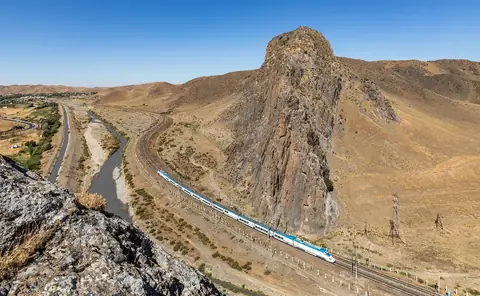
Transport in Uzbekistan
Book Uzbekistan’s trains and flights: the Afrosiyob to Samarkand and Bukhara, the 2026 Khiva trains, domestic fares, airport links and the Tashkent metro.
Read the guide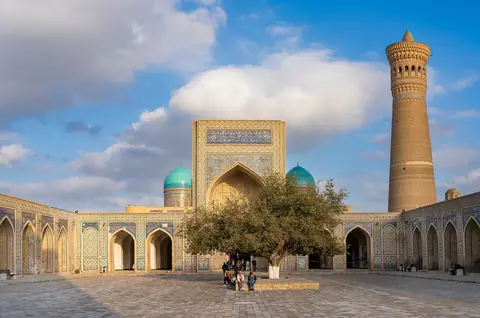
Bukhara
Plan two nights in Bukhara: Lyabi-Hauz, the trading domes, Poi-Kalon, the Ark and small museums, with 2025 ticket prices, rooms, trains and costs.
Read the guide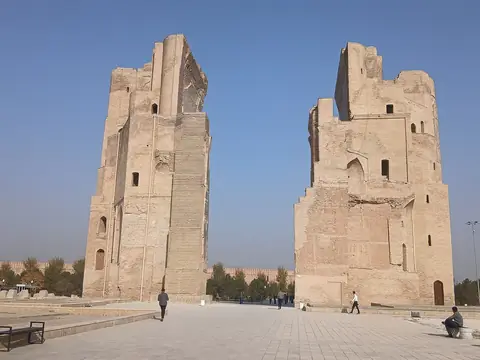
Shahrisabz
See Shahrisabz in a day from Samarkand: the Takhta-Karacha road, Ak-Saray, Kok Gumbaz and Dorus Saodat, private car and guide prices, and what the day costs for two.
Read the guide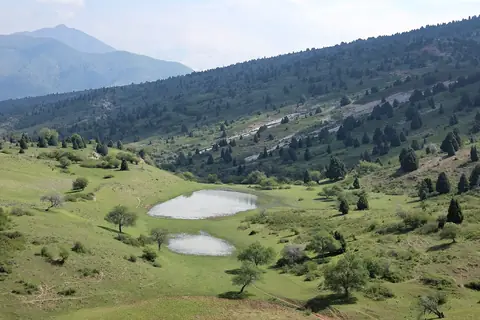
Best time to visit Uzbekistan
Choose your Uzbekistan dates by season: spring and autumn for walking, the summer chillya, winter air, Ramadan, Navruz and the school holidays, month by month.
Read the guide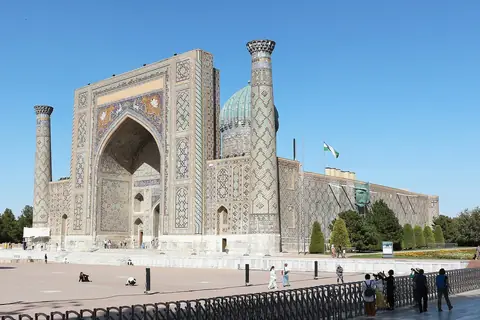
Uzbekistan in seven days
A seven-day Uzbekistan route with two nights each in Tashkent, Samarkand and Bukhara by train, real sights and an all-in cost for two.
Read the guideSources and checks before you travel
(51)
- Registan Ensemble Directorate: home page ↗ — opens in a new tab
- Registan Ensemble Directorate: interview on free days ↗ — opens in a new tab
- Registan Ensemble Directorate: notice of changed hours ↗ — opens in a new tab
- Registan Ensemble Directorate: night tourism news ↗ — opens in a new tab
- Registan Ensemble Directorate: monuments ↗ — opens in a new tab
- Registan Ensemble Directorate: history ↗ — opens in a new tab
- Uzbekistan Tourism: Samarkand ↗ — opens in a new tab
- Registan Ensemble Directorate: Registan Square ↗ — opens in a new tab
- Registan Ensemble Directorate: Shah-i-Zinda ↗ — opens in a new tab
- Uzbekistan Tourism: Sherdor Madrasah ↗ — opens in a new tab
- Uzbekistan Tourism: Ulughbek Madrasah ↗ — opens in a new tab
- Uzbekistan Tourism: Bibi-Khanym Mosque ↗ — opens in a new tab
- Uzbekistan Tourism: Shah-i-Zinda ↗ — opens in a new tab
- Uzbekistan Tourism: Gur-Emir ↗ — opens in a new tab
- Uzbekistan Tourism: Ulugbek Observatory ↗ — opens in a new tab
- Uzbekistan Tourism: Afrasiab ↗ — opens in a new tab
- Uzbekistan Tourism: food tourism ↗ — opens in a new tab
- Uzbekistan Tourism: travel tips ↗ — opens in a new tab
- Uzbekistan Railways: timetable ↗ — opens in a new tab
- Uzbekistan Railways: 60-day ticket sales ↗ — opens in a new tab
- Yandex Taxi: Start tariff, Samarkand ↗ — opens in a new tab
- Uzbekistan Railways: Tashkent–Khiva train launch ↗ — opens in a new tab
- Uzbekistan Airways: tariff notice ↗ — opens in a new tab
- UK Foreign Office: Uzbekistan entry requirements ↗ — opens in a new tab
- Registon Saroy ↗ — opens in a new tab
- Hotel Bibikhanum: home page ↗ — opens in a new tab
- L’Argamak Hotel ↗ — opens in a new tab
- L’Argamak Hotel: reservations ↗ — opens in a new tab
- L’Argamak Hotel: booking conditions ↗ — opens in a new tab
- Orzu Hotel: rooms ↗ — opens in a new tab
- Cabinet of Ministers Resolution 475, Annex 1 (lex.uz): tourist tax rates ↗ — opens in a new tab
- Beeline: Hello 1 price notice ↗ — opens in a new tab
- Beeline: eSIM ↗ — opens in a new tab
- Ipoteka Bank: exchange rates ↗ — opens in a new tab
- Turkish Airlines: London to Tashkent ↗ — opens in a new tab
- UTY: September 2025 timetable notice ↗ — opens in a new tab
- UTY: ticket questions ↗ — opens in a new tab
- Samarkand International Airport: how to get there ↗ — opens in a new tab
- Registan Ensemble Directorate: Afrasiab ↗ — opens in a new tab
- Registan Ensemble Directorate: Hazrat Khizr Mosque ↗ — opens in a new tab
- Registan Ensemble Directorate: Khoja Doniyor ↗ — opens in a new tab
- Silk Road Samarkand: Eternal City ↗ — opens in a new tab
- Beshqozon: Samarkand zig’ir plov ↗ — opens in a new tab
- OpenStreetMap: Samarkand station, airport and Orzu Mahmudov Street ↗ — opens in a new tab
- Anhor.uz: train fares raised by 15% (Russian) ↗ — opens in a new tab
- Kursiv: Afrosiyob ticket prices to rise 15% from February 2026 ↗ — opens in a new tab
- Silk Road Tour: entrance tickets and prices in Uzbekistan ↗ — opens in a new tab
- SAIGA Tours: Samarkand increases entry fees ↗ — opens in a new tab
- STANTOURS: day tour to Shahrisabz from Samarkand ↗ — opens in a new tab
- Uzbekistan Railways: Afrosiyob fares from February 2026 ↗ — opens in a new tab
- Decree PF-115 of 23 June 2026 (lex.uz): base calculation amount ↗ — opens in a new tab
Reference sources for the version dated 3 November 2026. Confirm opening times, access, transport and conditions for your travel dates.
Photo credits
(6)
The Registan, with a madrasa on each of three sides of the square.
Photograph: Gustavo Jeronimo from Aranjuez, Spain — opens in a new tab · CC BY 2.0 — opens in a new tab
Changes: Resized and converted to WebP; displayed with responsive crops. · Original photograph and licence details ↗ — opens in a new tab
The ribbed blue dome and minarets of Gur-e-Amir, the Timurid family mausoleum.
Photograph: LBM1948 — opens in a new tab · CC BY-SA 4.0 — opens in a new tab
Changes: Resized and converted to WebP; displayed with responsive crops. · Original photograph and licence details ↗ — opens in a new tab
Bibi-Khanym Mosque, begun in 1399 on Timur's orders.
Photograph: Fabio Achilli from Milano, Italy — opens in a new tab · CC BY 2.0 — opens in a new tab
Changes: Resized and converted to WebP; displayed with responsive crops. · Original photograph and licence details ↗ — opens in a new tab
The entrance portal and domes of Shah-i-Zinda.
Photograph: Bgag — opens in a new tab · CC0 — opens in a new tab
Changes: Resized and converted to WebP; displayed with responsive crops. · Original photograph and licence details ↗ — opens in a new tab
The Ulugh Beg Observatory site, with the covered trench of the great marble quadrant.
Photograph: Bgag — opens in a new tab · CC0 — opens in a new tab
Changes: Resized and converted to WebP; displayed with responsive crops. · Original photograph and licence details ↗ — opens in a new tab
Produce stalls in the covered Siab Bazaar.
Photograph: Adam Harangozó — opens in a new tab · CC BY-SA 4.0 — opens in a new tab
Changes: Resized and converted to WebP; displayed with responsive crops. · Original photograph and licence details ↗ — opens in a new tab