South Gyeongsang
Tongyeong travel guide: 2 nights for murals, cable car and islands
Tongyeong is a harbour town on Korea's south coast, and in the Joseon dynasty it was the home of the Tongjeyeong naval station, the central command for the navy bases of the Gyeongsang, Jeolla and Chungcheong regions. Admiral Yi Sun-sin's name is everywhere: on the shrine above the town, on the turtle-ship replicas moored at Gangguan Port and on Hansando, where he commanded his fleets. Today it is a compact old port with mural-painted hills, a cable car up Mireuksan, boats into Hallyeohaesang National Park and a food culture built on Chungmu gimbap, oysters and honey bread. Two nights cover the harbour, the mountain and one island.
In this guide
Find the location ↗ — opens in a new tabThe short answer
Book two nights near Gangguan Port, where the market and the mural hill are within walking distance, and add a third night for an outer island such as Somaemuldo only once you have booked both the outward and the return ferry, and never on your departure day. Book the bus first (check the fare and timetable for your date on the booking sites): it takes 4 hours 10 minutes from Seoul Nambu Terminal and about 80 minutes to 2 hours 10 minutes from Busan Seobu Intercity Bus Terminal. When we checked on 17 October 2026, VisitKorea listed the cable car round trip at KRW 17,000 for adults. The operator lists the Skyride and three Luge rides at KRW 34,000 per adult (checked on 18 October 2026).
- Suggested time
- 2 nights (3 with an outer-island day)
- Where to stay
- Gangguan Port and Jungang-dong in the old harbour; Donam-dong on Mireukdo if the cable car comes first
- Season and timing
- VisitKorea recommends spring and autumn for travelling on foot, which suits the hills and the Mireuksan trails. Oysters are in season from November to March. The Tongyeong Hansan Battle Festival is held every August, and the south's rainy season normally runs from about 23 June to 24 July according to the Korea Meteorological Administration, whose dates change each year. The city's tourism site also lists the Tongyeong International Music Festival and the Tongyeong Art Festival; check the city's events page for their dates.
Where to sleep: the old harbour or Mireukdo
Gangguan Port and Jungang-dong are the base for a visit without a car. VisitKorea describes the port as occupied by moored fishing boats and rows of restaurants that sell Chungmu-style gimbap, and Jungang Market and the mural village of Dongpirang lie next to it.
Donam-dong on Mireukdo is the resort side. VisitKorea describes the Mireukdo Special Tourist Zone, with the Donam Tourist Complex at its core, as equipped with leisure facilities, tourist accommodation and restaurants, and the cable car's lower station is at 205 Balgae-ro in Donam-dong. Mireukdo is connected to the town by an undersea tunnel, Chungmu Bridge and Tongyeong Bridge. Choose it if the cable car is your first stop; otherwise the old harbour keeps the market, the murals and the evening walk on foot.
The Tongyeong Bus Terminal is not in the old harbour, so take a taxi or a local bus to Gangguan Port and ask the driver for the travel time. Our where-to-stay guide for South Korea compares hotels, hanok and other stay types across the country.
Gangguan, Jungang Market and the mural hills
Start at Gangguan Port in Jungang-dong, the small harbour where replicas of the geobukseon, Admiral Yi Sun-sin's turtle ships, are docked in front of the market. At the quay the sea lies close at hand, with fishing boats moored beside the replicas and restaurants along the front. Behind it, Tongyeong Jungang Market, at 14-16 Jungangsijang 1-gil, has almost 400 years of history. Fresh and dried fish fill much of the market, alongside mother-of-pearl inlaid ware, quilted products and rice cakes, and opening hours vary by store.
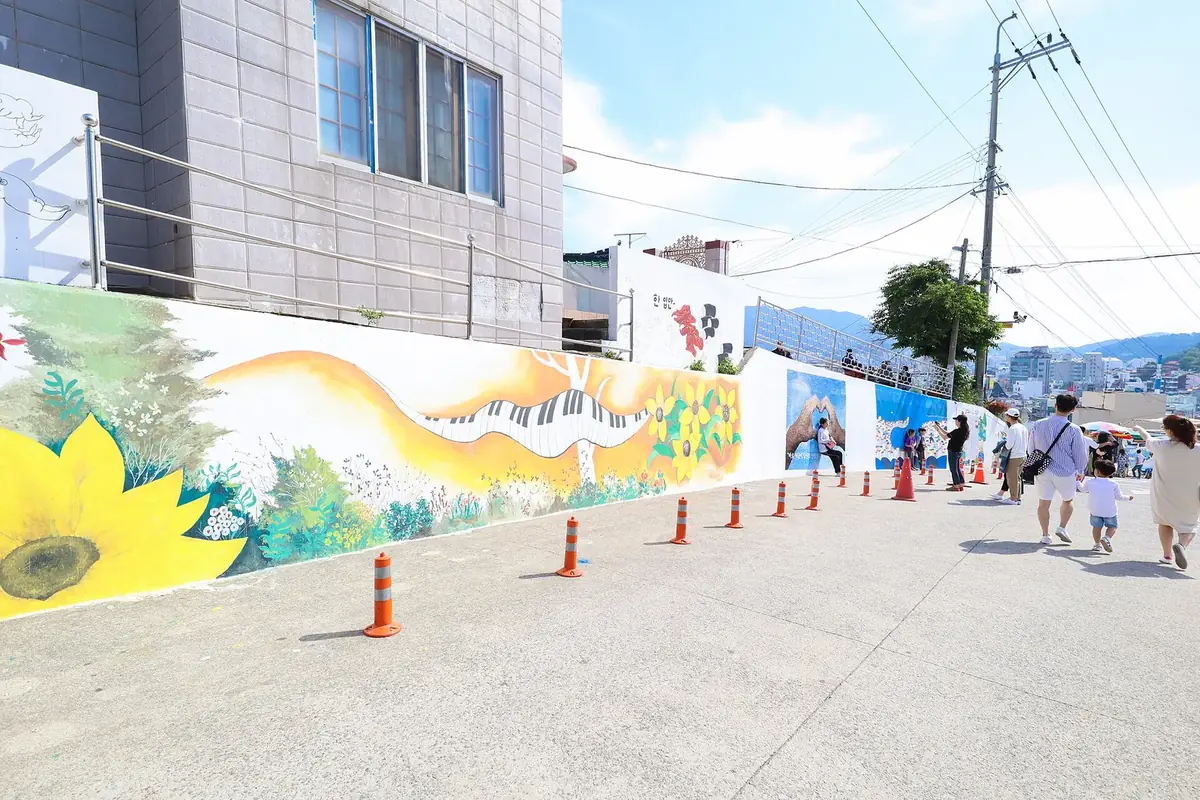
Dongpirang is the mural village on the hill beside the market. The name joins dong, meaning east, and birang, which means hill in the Tongyeong dialect. In October 2007 the Tongyeong Agenda 21 association invited people from across the country to paint murals on the walls of Dongpirang-gil Street, and the hillside lanes are still painted today. The view over the sea and Gangguan Port is the reward for the climb. The village, at 6-18 Dongpirang 1-gil, is open around the clock.
Seopirang Park, on the hill across the harbour, has walking trails, 99 stairs, a music garden and piano stairs, with murals along the uphill path. It is lit from sunset to midnight, and at the top the pavilion Seoporu looks over Tongyeong Bay and the city. Entry is free and the park is open around the clock.
DPIRANG is the ticketed evening walk: a digital theme park in Nammangsan Park, at 29 Nammanggongwon-gil, whose media show tells the story of the murals that vanished from Dongpirang and Seopirang. Fifteen themed trails of lights run for 1.3 kilometres in total. When we checked on 17 October 2026, VisitKorea listed opening hours of 19:30 to 24:00 in March, April and September, 20:00 to 24:00 from May to August and 19:00 to 24:00 from October to February. Last admission is at 22:30 in spring, summer and autumn and at 22:00 in winter. It is closed on Wednesdays, on 1 January and on the day of Chuseok, whose date changes each year. Adults aged 19 and over pay KRW 15,000, teenagers aged 13 to 18 pay KRW 12,000 and children aged 6 to 12 pay KRW 10,000, and the Interaction Light Ball is sold separately.
What to eat and where to look
Chungmu gimbap
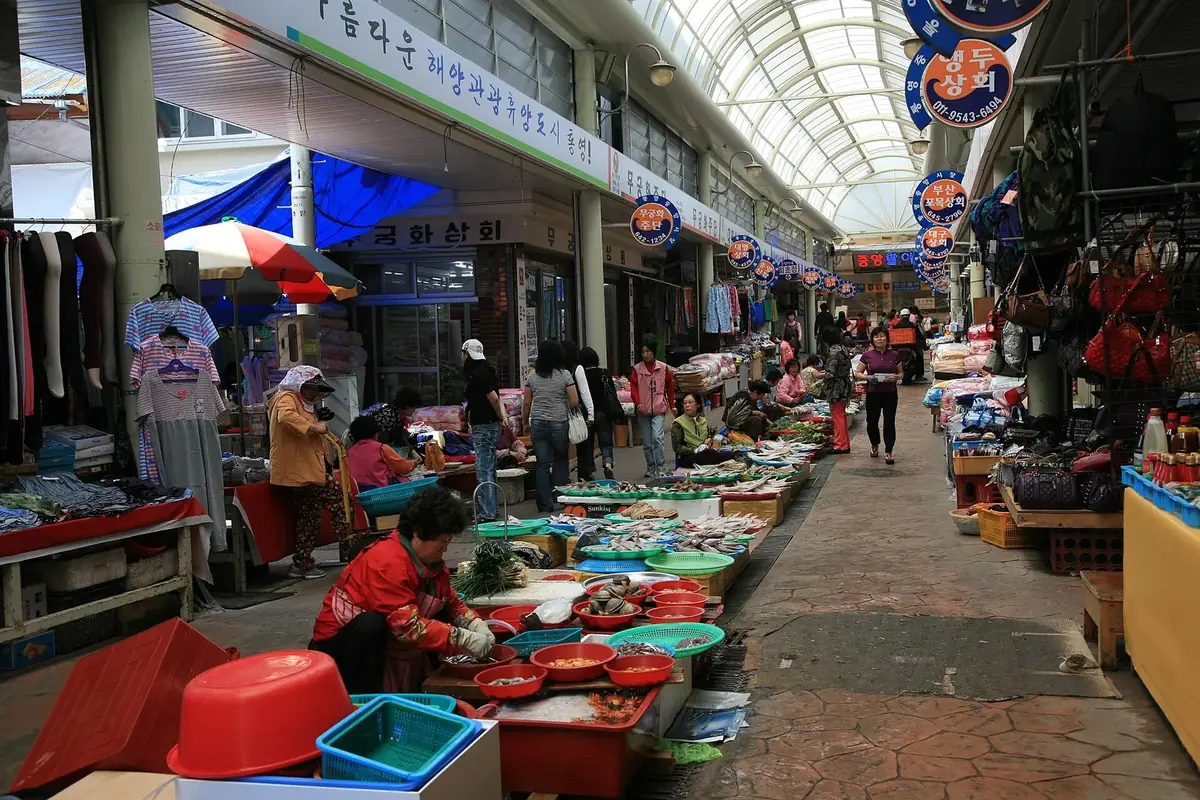
Finger-sized rolls of plain rice in laver, with no filling and no sesame-oil coating, served with spicy diced radish kimchi and squid salad. VisitKorea says the dish began with sailors who packed rice and fillings separately to keep them fresh on sea voyages, and that it was named after Chungmu, the town's former name.
- Where to look
- Ttungbo Halmae Gimbap, 325 Tongyeonghaean-ro, in Jungang Market, open 06:00 to 22:00 all year; the harbour is lined with gimbap restaurants.
- Fit it into your day
- A quick lunch on arrival day, before Jungang Market and Dongpirang.
Oysters: gul bossam, guljeon and oyster rice
Pacific oysters are at their best from November to March, and VisitKorea says most Tongyeong restaurants serve oyster dishes only in that winter season. Tongyeong GulMadang serves them all year, with a set of gul bossam (pork and oyster wrapped in napa cabbage), guljeon (oyster pancakes) and oyster hot-stone-pot rice.
- Where to look
- Tongyeong GulMadang, 257-81 Donam-ro, open 06:00 to 22:00 and accepting cards (+82-55-642-2600).
- Fit it into your day
- Lunch after the cable car, on the Donam side of town.
Oysters, sea pineapple and the squid salad served with Chungmu gimbap are seafood, and kkulppang is coated in sesame seeds, so tell the kitchen before ordering if you have an allergy.
Sea pineapple bibimbap (meongge bibimbap)
Thinly sliced sea pineapple (meongge) mixed with seaweeds such as hijiki and with sprouts, seasoned with hapjajang, a Tongyeong sauce made by boiling down broth from natural mussels. VisitKorea says more than 70% of Korea's sea pineapple supply comes from Tongyeong.
- Where to look
- Dadama Haemul Ttukbaegi, 12-5 Hangnam 5-gil, open Mondays and Wednesdays to Sundays from 11:00 to 21:00 and closed on Tuesdays (+82-55-648-3558); its Set A includes meongge bibimbap.
- Fit it into your day
- Dinner on the second evening, after the undersea tunnel.
Kkulppang (honey bread)
Deep-fried dough filled with sweet red bean paste and coated in grain syrup and sesame seeds. Despite the name it contains no honey: VisitKorea explains that the name comes from the sweetness of the syrup. It began as a long-lasting snack for sailors, and VisitKorea credits Omisa Kkulppang with introducing it in the 1960s.
- Where to look
- Kkulppang Street beside Jungang Market; VisitKorea notes that the stores often hand out samples and that the flavours differ from maker to maker.
- Fit it into your day
- A snack between Dongpirang and the market, or a box to take away.
Admiral Yi Sun-sin's Tongyeong: Sebyeonggwan, Chungnyeolsa and the waterfront park
Sebyeonggwan Hall, at 27 Sebyeong-ro at the foot of Yeohwangsan, was established in 1605 by Lee Kyung-jun, the sixth commander-in-chief of the Tongjeyeong naval headquarters. VisitKorea counts it among the widest buildings of the Joseon period, with Gyeonghoeru Pavilion in Gyeongbokgung Palace and Jinnamgwan Hall in Yeosu, and says it symbolises the end of the war and the washing away of the weapons of war. Beside it are the remains of the Tongjeyeong naval base, including Unjudang, also called Jeseungdang, a military education centre for the Joseon navy. This town site is not the Jeseungdang on Hansando, which is described with the boats below.
Sebyeonggwan is open from 09:00 to 18:00 from March to October and from 09:00 to 17:00 from November to February. Admission to the naval headquarters and the hall is KRW 3,000 for adults, KRW 2,000 for teenagers and KRW 1,000 for children; groups of 20 or more pay KRW 2,500, KRW 1,500 and KRW 800. Preschoolers under 6 and senior citizens aged 65 and over enter free.
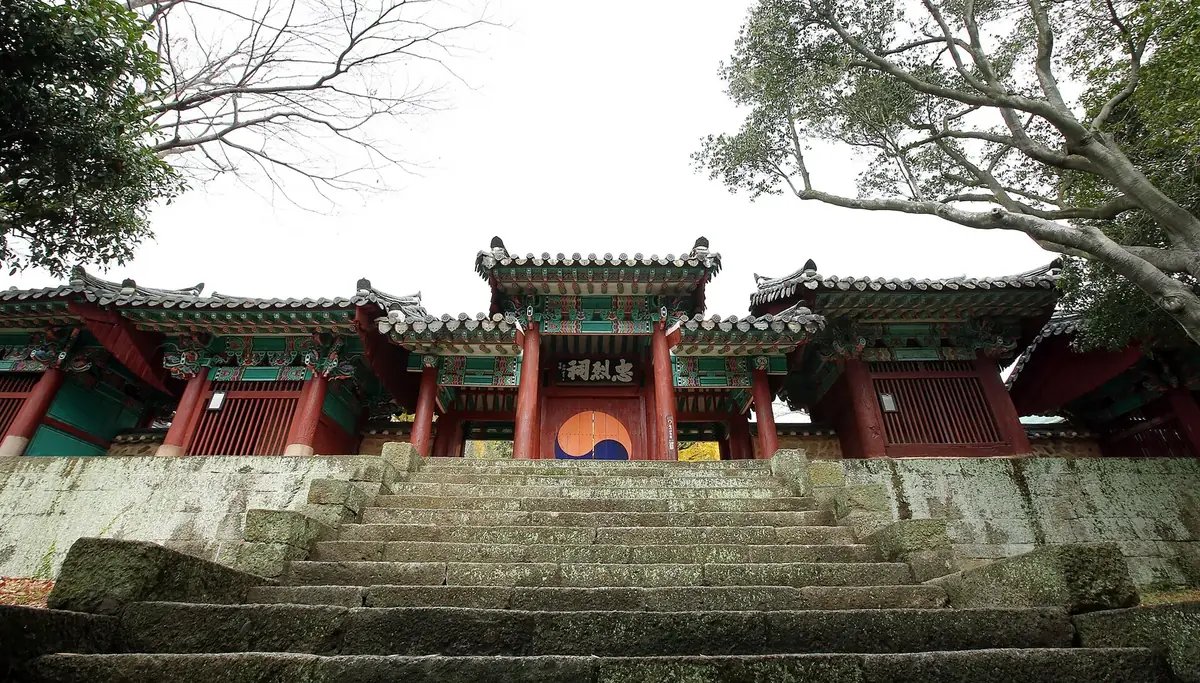
Chungnyeolsa Shrine, at 251 Yeohwang-ro, is dedicated to Admiral Yi, whose naval victories were crucial in repelling the Japanese invasions of the 1590s. The complex has a main shrine housing his spirit tablet and portrait and an exhibit hall of artefacts from the invasion of 1592, and rituals in his honour are still held every spring and autumn. VisitKorea suggests about 30 minutes. The hours are the same as at Sebyeonggwan, and admission is KRW 1,000 for adults, KRW 700 for teenagers and KRW 500 for children; groups of 30 or more pay KRW 800, KRW 600 and KRW 400.
Yi Sun-sin Park, at the foot of Mangilbong Peak and formerly the Hansan Battle Memorial Park, has a statue of the admiral, an observation deck, a walking path, a traditional cultural hall and Hagikjeong Pavilion. It is free and open around the clock.
The Tongyeong Hansan Battle Festival commemorates the admiral's victory in the Battle of Hansan, a naval battle of 1592 fought off Hansando, and is held every August. VisitKorea listed the 2026 festival for 12 to 16 August, with a battle reenactment, nighttime fireworks and street parades. The island itself is covered below with the boats.
Mireuksan: the cable car, the luge and the walk down
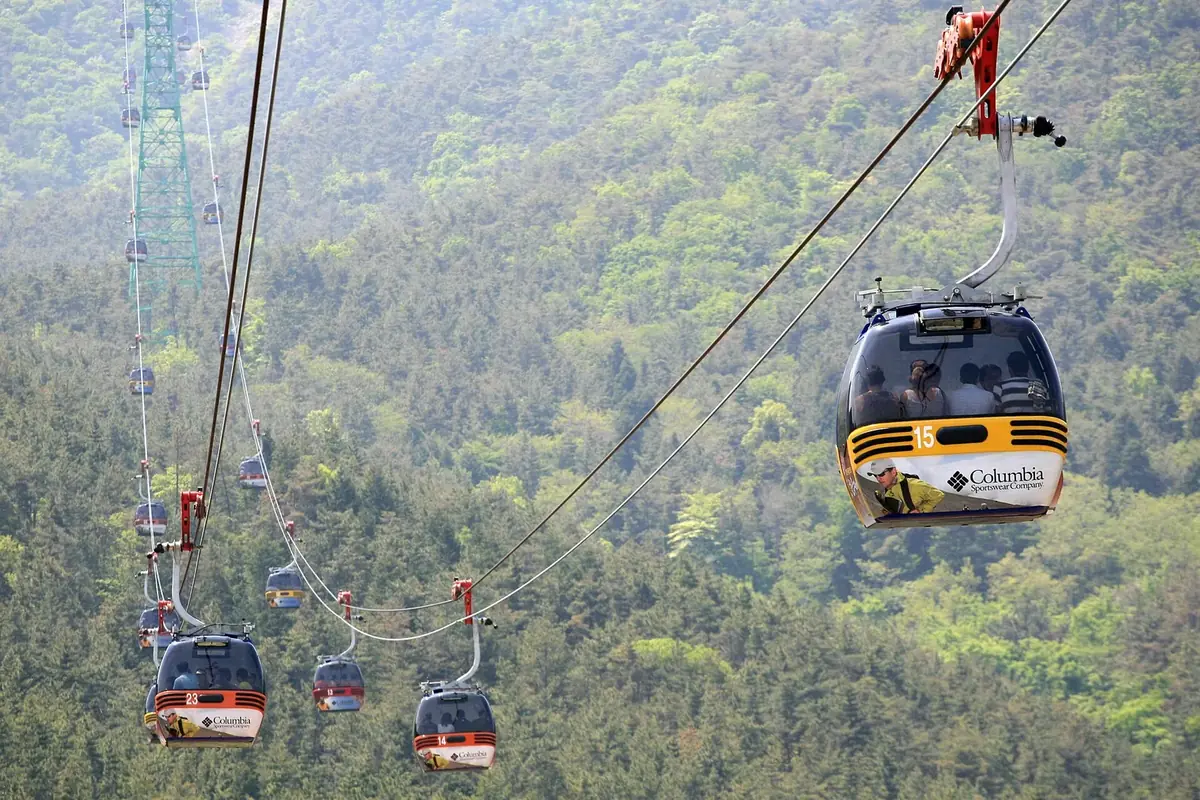
The Tongyeong Cable Car climbs Mireuksan (458.4 metres), the mountain in the middle of Mireukdo. It is 1,975 metres long and uses a Swiss-technology bi-cable system with 8-person gondolas that run non-stop, and it takes about 9 minutes to reach the upper station. From the top you look over the forests and valleys below and the island-dotted water of Hallyeohaesang National Park, and on a clear day, VisitKorea says, even as far as the Japanese island of Tsushima.
The lower station is at 205 Balgae-ro in Donam-dong, with free parking. Allow a taxi or a local bus across from Gangguan Port to Mireukdo, and ask the driver for the travel time to the lower station. When we checked on 17 October 2026, VisitKorea listed opening hours of 10:00 to 18:00 on weekdays and 09:00 to 18:00 at weekends, with the last ticket sold 50 minutes before closing and hours subject to change in bad weather. The cable car is closed on the 2nd and 4th Wednesdays of every month. A round trip costs KRW 17,000 for adults, KRW 13,000 for children and KRW 14,000 for senior citizens; one way costs KRW 13,500, KRW 11,000 and KRW 11,500. The operator's inquiry line is +82-1544-3303 and its website is cablecar.ttdc.kr.
Skyline Luge, at 178 Balgae-ro, is a luge-kart ride with four tracks and a total distance of 3.8 kilometres; you reach the start by the Sky Ride lift, and the tracks have curves and tunnels. Children between 85 and 120 centimetres tall can ride with a guardian over 19 who is 150 centimetres or taller. VisitKorea listed hours of 10:00 to 17:00 on weekdays and 10:00 to 18:00 at weekends. The operator lists the Skyride and three Luge rides at KRW 34,000 per adult (checked on 18 October 2026); its inquiry line is +82-1522-2468.
The Undersea Tunnel in Dang-dong was built over 16 months in 1931 and 1932 and is described as Asia's first submarine tunnel. It is 483 metres long and 5 metres wide, open 24 hours, and the public car park beside it is free. It is one of the three links between Mireukdo and the old town, with Chungmu Bridge and Tongyeong Bridge.
For a walk, VisitKorea describes the most travelled trail as starting at Yonghwasa Temple and climbing through Mireukjae Pass to the top, then returning by Miraesa Temple and a grass field to Yonghwasa; the trails are well maintained and suit short hikes. On the way to Yonghwasa, the Jeon Hyuck Lim Museum of Art, at 10 Bongsu 1-gil, stands on the site of the painter's home. Its outer walls reproduce paintings by him and his son Yeonggeun on about 7,500 ceramic tiles of 20 by 20 centimetres. It is open from 10:00 to 17:30 from March to October and from 10:00 to 17:00 from November to February, and it is closed on Mondays and Tuesdays, New Year's Day, Seollal and Chuseok. The museum asks for donations rather than a fixed fee. For an optional evening visit, Dara Park on southern Mireukdo has a pavilion overlooking the island-dotted waters of Hallyeohaesang National Park, a place to watch the sunset; decide your way back before you go.
Boats to Hansando, Bijindo, Somaemuldo and the outer islands
Tongyeong is the gateway to the Tongyeong district of Hallyeohaesang National Park, which VisitKorea says was designated in 1968 as Korea's first national marine park and which includes the Dadohae islets, Bijindo and the Haegeumgang islets. Passenger boats leave from the passenger ferry terminal, whose number on the city's ferry page is +82-55-642-0116. As at the ferry terminals VisitKorea lists, show a passport or personal ID to board. Check the day's fare, how to book and the walking route from Gangguan Port with the terminal before you travel.
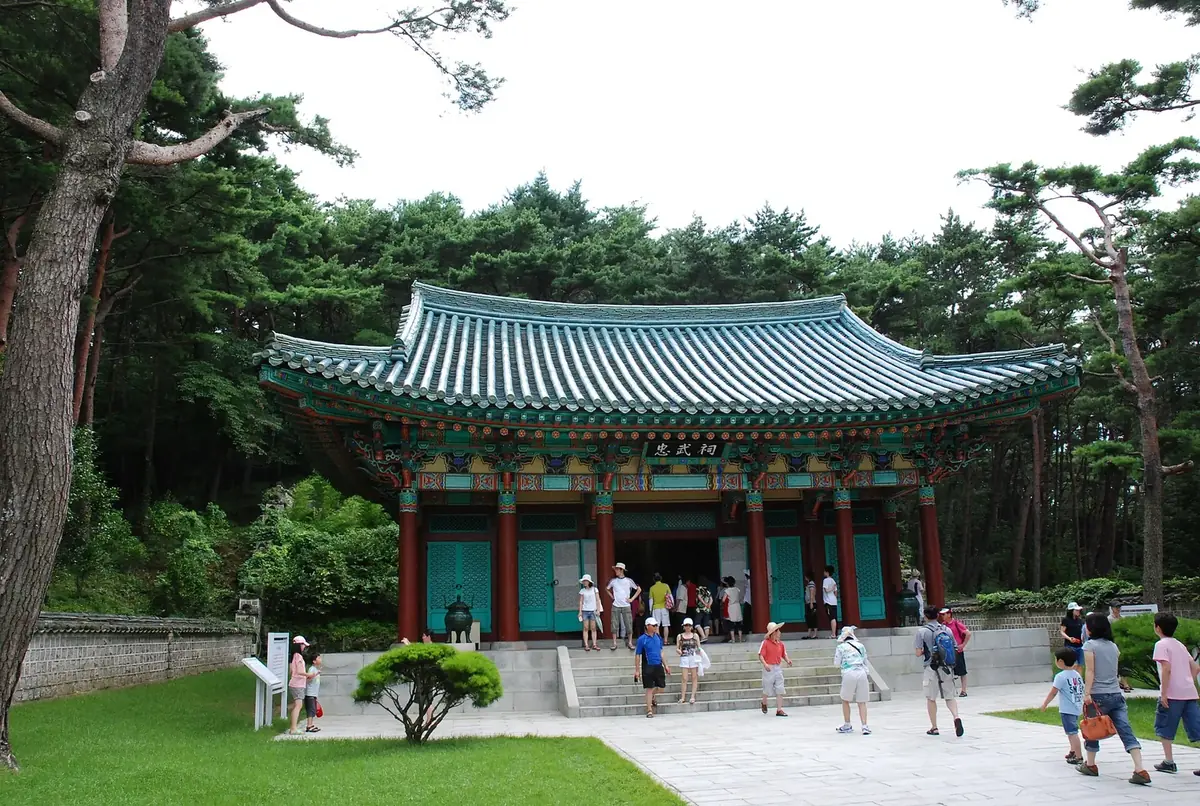
Hansando is the closest and most historic island. Admiral Yi commanded his fleets here for most of the Imjin War (1592 to 1598), and it was the site of the Great Battle of Hansan. The Paradise car ferry takes about 30 minutes from the passenger terminal to Jeseungdang, with sailings about every hour. The city's ferry page lists departures from the terminal between 07:00 and 17:00 from October to February and until 18:00 from March to September, and departures from Jeseungdang between 07:30 and 17:30, or 18:30 in the summer months. At Jeseungdang the admiral installed his headquarters in the Unjudang he built there; the Jeseungdang shrine that replaced it a century after the war stands on the same site. On the way you pass a well from which his navy drank, and behind the shrine is an archery range beside the sea, which the city calls the only one of its kind in Korea, built so the navy could practise shooting from ship to ship. A water clock stands near the shrine to the admiral. Mangsan (293 metres) rises behind, with three trails from Jeseungdang of 3.9 to 7.0 kilometres that take 1 hour 40 minutes to 3 hours. Check the entry fee, if any, at Jeseungdang.
Bijindo, 13 kilometres from Tongyeong Port, is the beach island: a beach 550 metres long appears to connect two islands, sandy on the west side and pebbly on the east, so you can see both the sunrise and the sunset from it. Somaemuldo is known for the rock formations and layered cliffs of Deungdaeseom and Somaemuldo, with Dragon Rock, Buddha Rock and Turtle Rock among them, and at low tide you can walk from one island to the other. The walk depends on the day's low tide, which you can check on the Korea Hydrographic and Oceanographic Agency's Smart Tide Forecast. The city's ferry page lists the Hansol Haewoon sailing to the Maemuldo islands at 07:00, 11:00 and 14:10 from October to February and at 07:00, 11:00 and 14:00 from March to September, with the operator's number as +82-55-645-3717. Confirm and book the outward and return ferries before choosing Bijindo or Somaemuldo; if a return cannot be secured, replace the island day with mainland Tongyeong.
Further out, Yokjido is known for its sweet potatoes and for the coastal road from the pier to Yapo, and Yeonhwado, 24 kilometres from Tongyeong Port, has Yongmeori (Dragon Head) Rock, best just before sunset. The Yokji Express car ferry takes 1 hour 15 minutes from the terminal to Yokji and calls at Yeonhwado on the way. Jangsado Sea Park, a camellia garden island, lies about 21 kilometres, or about 50 minutes, from Donam Port; VisitKorea lists it as open from 08:00 to 19:00 from April to September and from 08:30 to 17:00 from October to March.
The national park says its areas are subject to abrupt closure in adverse weather, so keep the island day flexible. The UK Foreign Office gives the typhoon season as normally running from June to November and advises following the Korea Meteorological Administration; our best-time guide has the rainy season.
Getting to Tongyeong: the bus from Seoul, Busan and Gimhae Airport
Tongyeong is reached by bus. From Seoul, intercity buses leave from Seoul Nambu Terminal (Nambu Terminal Station, Line 3); the city's bus page lists nonstop and express services between Seoul Nambu and Tongyeong, late-night buses among them. From Busan, nonstop buses leave from Busan Seobu Intercity Bus Terminal every 10 to 20 minutes from 05:15 to 20:16. Tongyeong's city bus page gives about 4 hours 10 minutes from Seoul Nambu Terminal and about 2 hours 10 minutes from Busan Seobu Intercity Bus Terminal, and VisitKorea's Gimhae Airport guide gives about 80 minutes from Busan Seobu, so plan for the longer time and check the timetable for your date on the booking sites. See our Busan guide for the city itself.
From Gimhae International Airport (PUS), VisitKorea says to go to Busan Seobu Intercity Bus Terminal, about 15 minutes away by subway or taxi; the tickets sold at the airport itself are for destinations such as Ulsan, Changwon and Geoje, so check the airport's own bus page for any direct bus to Tongyeong before you travel. Coming from Gyeongju, join the Busan route above; the Gyeongju guide covers the Gyeongju to Busan leg.
The city's page also lists nonstop buses from Jinju (1 hour 20 minutes, 06:10 to 21:00, every 10 to 30 minutes) and from Masan (Nambu) (1 hour 10 minutes, 06:15 to 21:20, every 5 to 40 minutes). Express buses are booked on kobus.co.kr and intercity buses on txbus.t-money.co.kr or bustago.or.kr, and you can also buy at terminal counters and kiosks and board 5 to 10 minutes before departure. Search a date on the booking sites to see the adult bus fare before you travel. Our transport guide covers terminals, tickets and Tmoney.
Two nights in Tongyeong, and a third for the outer islands
The plan fits the opening hours above: Sebyeonggwan and Chungnyeolsa close at 18:00 from March to October and at 17:00 from November to February, so reach the old harbour by mid-afternoon on the first day. A third night suits an outer island, because the Maemuldo boat leaves at 07:00; spend it in the same base and keep that island day away from the day you leave. With one night here inside a longer trip, the 5-day south-coast itinerary puts Tongyeong between two nights in Busan and one in Yeosu.
- Day 1: arrive by bus and check in near Gangguan Port. Chungmu gimbap for lunch at Ttungbo Halmae Gimbap, then Jungang Market, Dongpirang, Sebyeonggwan and Chungnyeolsa, and kkulppang from the shops beside the market. In the evening walk Gangguan Port and Seopirang while it is lit, or go to DPIRANG (not on a Wednesday).
- Day 2: cable car up Mireuksan when it opens (not on the 2nd or 4th Wednesday), the luge if you want it, and lunch at Tongyeong GulMadang on the Donam side. In the afternoon walk between Mireukdo and the old town through the undersea tunnel, then eat meongge bibimbap at Dadama Haemul Ttukbaegi (closed Tuesdays).
- Day 3: the Paradise ferry to Jeseungdang on Hansando in the morning, back to the terminal around midday, then the bus out.
- With a third night: on day 3 take the 07:00 boat to Bijindo or Somaemuldo and check that day's low tide for the Deungdaeseom walk, but only once you have booked both the outward and the return ferry; if a return cannot be secured, spend day 3 on mainland Tongyeong instead. On day 4 take the Hansando morning above, then the bus out.
What 3 days in Tongyeong cost, all in
About KRW 590,000 per person, KRW 1,190,000 for two, for 3 days and 2 nights, without international flights. The room, every meal and drink, airport and local transport, sights, data and a 10% buffer are all in.
| Stay | Per person, KRW | For two, KRW |
|---|---|---|
| 3 days / 2 nights, one shared private room | 590,000 | 1,190,000 |
The prices assume two adults on eligible visa-free passports sharing one private double or twin room near Gangguan Port for two nights, arriving on a Thursday in spring outside major holidays. The gross room estimate uses the Seoul hotel comparison, not a dated Tongyeong offer. Ground-price comparisons were checked on 17–23 October 2026.
Food covers two breakfasts, three lunches and two dinners each, from arrival lunch through departure lunch, plus daily drinks and snacks. Meals are priced from Tongyeong menus that VisitKorea published in February 2025: KRW 10,000 for a breakfast soup such as the oyster fish-cake soup at Hanmaeum Sikdang, KRW 13,000 for a lunch of seafood rice such as the oyster rice at Daepunggwan, and KRW 25,000 each for the oyster set at Tongyeong GulMadang, which serves oysters all year, at both dinners. Coffee, water and snacks come to about KRW 12,000 a day each. Getting around includes the return bus from Seoul Nambu, return AREX Express, Seoul terminal connections, cards, local rides and the Hansando ferry. Bus and taxi costs are estimates; the ferry estimate uses the city’s quoted passenger price. Sights include the cable car, Sebyeonggwan, Chungnyeolsa, DPIRANG and Jeseungdang entry estimated from the shrine price. Data uses LG U+’s three-day price. Two new K-ETA applications are counted only if needed; valid approvals or an exemption lower the cost. Choose an early Incheon arrival and a late departure after the Day 3 island visit and bus return.
- Rooms: KRW 360,000 for 2 nights.
- Food: KRW 290,000 for two.
- Getting around: KRW 300,000 for two.
- Sights and tours: KRW 70,000 for two.
- Data and entry: KRW 60,000 for two.
- 10% buffer: KRW 110,000.
- Flights: about GBP 850–1,150 per person for a Korean Air economy return from London to Incheon, based on advertised from-fares for selected dates checked on 21 October 2026, including taxes and fuel surcharges. With flights, the trip is about KRW 2,100,000–2,630,000 per person; fares and availability vary.
Practical questions
Is Tongyeong worth two nights?
Yes, if you want the harbour, the mural hills, the cable car and one island. Two nights give the old harbour and Admiral Yi's sites on the first day, Mireuksan on the second and a morning boat to Hansando on the third. A day trip from Busan leaves little time, because the bus takes about 80 minutes to 2 hours 10 minutes each way.
How do I get to Tongyeong without a car?
By bus. Intercity buses run from Seoul Nambu Terminal in about 4 hours 10 minutes and from Busan Seobu Intercity Bus Terminal in about 80 minutes to 2 hours 10 minutes. From Gimhae Airport, go to Busan Seobu terminal, about 15 minutes by subway or taxi. Book on the Kobus and TxBus sites.
How much is the Tongyeong Cable Car, and when is it closed?
When we checked on 17 October 2026, VisitKorea listed a round trip at KRW 17,000 for adults, KRW 13,000 for children and KRW 14,000 for senior citizens, and one way at KRW 13,500, KRW 11,000 and KRW 11,500. It is open from 10:00 to 18:00 on weekdays and from 09:00 to 18:00 at weekends, closed on the 2nd and 4th Wednesdays, and the last ticket is sold 50 minutes before closing.
What do Sebyeonggwan Hall and Chungnyeolsa cost?
Sebyeonggwan Hall charges KRW 3,000 for adults, KRW 2,000 for teenagers and KRW 1,000 for children, and is free for preschoolers under 6 and people aged 65 and over. Chungnyeolsa charges KRW 1,000 for adults, KRW 700 for teenagers and KRW 500 for children. Both are open from 09:00 to 18:00 from March to October and from 09:00 to 17:00 from November to February.
Which islands can I reach by boat from Tongyeong?
Hansando is about 30 minutes by the Paradise ferry, with sailings about every hour. Bijindo and Somaemuldo are on the Hansol Haewoon route, which sails at 07:00, 11:00 and 14:00 or 14:10. Yokji is 1 hour 15 minutes by the Yokji Express, with a stop at Yeonhwado, and Jangsado is about 50 minutes from Donam Port. Confirm and book the outward and return ferries before choosing Bijindo or Somaemuldo. For fares and bookings, ask at the terminal (+82-55-642-0116) before you travel.
When is the oyster season in Tongyeong?
Oysters are in season from November to March, and VisitKorea says most Tongyeong restaurants serve oyster dishes only then. Tongyeong GulMadang, on Donam-ro, serves them all year. In other months, restaurants serve dishes such as meongge bibimbap.
Keep planning your trip
Busan
Three nights in Busan: where to sleep, Gamcheon, Jagalchi, Haeundae, Blueline Park and Haedong Yonggungsa with hours, prices, the KTX and an all-in budget for two.
Read the guide
Gyeongju
Two nights in Gyeongju: KTX and bus into town, Daereungwon, Donggung and Wolji tickets, Bulguksa and Seokguram access, where to eat and a budget for two adults.
Read the guide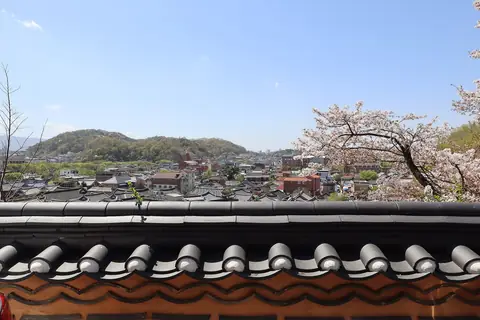
Jeonju
One night in Jeonju: KTX from Yongsan, Gyeonggijeon tickets and hours, hanok stays, the Friday and Saturday night market, bibimbap and what the night costs.
Read the guide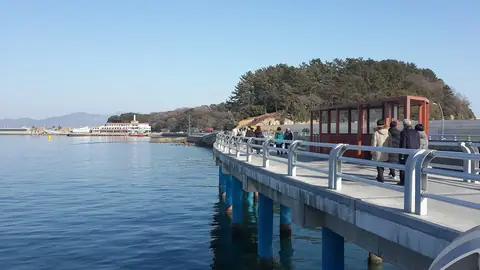
Yeosu
Two nights in Yeosu: KTX to Yeosu EXPO, the marine cable car, Odongdo, Hyangiram at sunrise, the fish market, night cruises and island boats.
Read the guide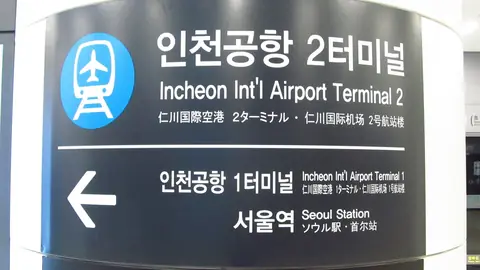
Transport in South Korea
How to ride AREX from Incheon, book the KTX on KORAIL+, choose between express buses and flights, and tap a Tmoney card.
Read the guide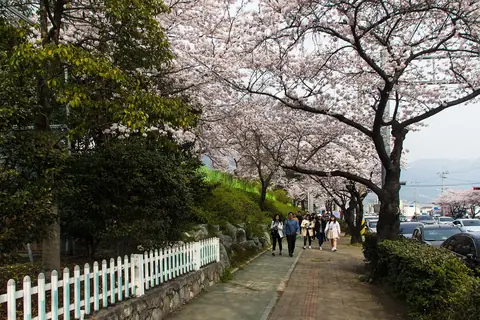
Best time to visit South Korea
Cherry blossom from late March to mid-April, autumn colour from early October on Seoraksan: which month to book, rains, typhoons and holidays that fill trains.
Read the guideSources and checks before you travel
(46)
- VisitKorea: Dongpirang Village ↗ — opens in a new tab
- VisitKorea: Tongyeong Jungang Market ↗ — opens in a new tab
- VisitKorea: Gangguan Port ↗ — opens in a new tab
- VisitKorea: Seopirang Park ↗ — opens in a new tab
- VisitKorea: DPIRANG ↗ — opens in a new tab
- VisitKorea: Tongyeong Sebyeonggwan Hall ↗ — opens in a new tab
- VisitKorea: Chungnyeolsa Shrine ↗ — opens in a new tab
- VisitKorea: Yi Sun-sin Park ↗ — opens in a new tab
- VisitKorea: Korea's Top 10 Summer Festivals for 2026 ↗ — opens in a new tab
- VisitKorea: Tongyeong Cable Car ↗ — opens in a new tab
- VisitKorea: Tongyeong Mireuksan Mountain ↗ — opens in a new tab
- VisitKorea: Mireukdo Island Special Tourist Zone ↗ — opens in a new tab
- VisitKorea: Skyline Luge ↗ — opens in a new tab
- VisitKorea: The Jeon Hyuck Lim Museum of Art ↗ — opens in a new tab
- VisitKorea: Hallyeohaesang National Park (Tongyeong district) ↗ — opens in a new tab
- VisitKorea: Hansando Island ↗ — opens in a new tab
- VisitKorea: Bijindo Island ↗ — opens in a new tab
- VisitKorea: Somaemuldo Island ↗ — opens in a new tab
- VisitKorea: Yokjido Island ↗ — opens in a new tab
- VisitKorea: Yeonhwado Island (Tongyeong) ↗ — opens in a new tab
- VisitKorea: Jangsado Sea Park ↗ — opens in a new tab
- VisitKorea: Undersea Tunnel, Tongyeong ↗ — opens in a new tab
- VisitKorea: Chungmu Gimbap ↗ — opens in a new tab
- VisitKorea: Ttungbo Halmae Gimbap ↗ — opens in a new tab
- VisitKorea: Tongyeong GulMadang ↗ — opens in a new tab
- VisitKorea: Oyster, the ocean's flavorful treasure of the winter ↗ — opens in a new tab
- VisitKorea: Dadama Haemul Ttukbaegi ↗ — opens in a new tab
- VisitKorea: Sea Pineapple Bibimbap ↗ — opens in a new tab
- VisitKorea: Honey Bread (Kkulppang) ↗ — opens in a new tab
- VisitKorea: Tongyeong kkulppang ↗ — opens in a new tab
- VisitKorea: Fly to Gimhae International Airport and experience Busan and Gyeongsangnam-do ↗ — opens in a new tab
- VisitKorea: Getting around Korea by bus ↗ — opens in a new tab
- Tongyeong City: Express bus ↗ — opens in a new tab
- Tongyeong City: Passenger ferries ↗ — opens in a new tab
- Tongyeong City: Car ferry ↗ — opens in a new tab
- Tongyeong City: Island Explore, Hansando ↗ — opens in a new tab
- UK Foreign Office: South Korea safety and security ↗ — opens in a new tab
- VisitKorea: Climate and seasons ↗ — opens in a new tab
- Korea Meteorological Administration: climate normals for the rainy season ↗ — opens in a new tab
- VisitKorea: Getting to Jeju Island (ferry terminals) ↗ — opens in a new tab
- Skyline Luge Tongyeong: pricing and packages ↗ — opens in a new tab
- Korea Hydrographic and Oceanographic Agency: Smart Tide Forecast ↗ — opens in a new tab
- VisitKorea: Dara Park ↗ — opens in a new tab
- LG U+: tourist data price comparisons ↗ — opens in a new tab
- Tongyeong City: Hansando ferry passenger-price comparison ↗ — opens in a new tab
- Korean Air: flights from London to Seoul ↗ — opens in a new tab
Reference sources for the version dated 8 November 2026. Confirm opening times, access, transport and conditions for your travel dates.
Photo credits
(6)
Gondolas of the Tongyeong cable car travelling above a wooded hillside on Mireuksan.
Photograph: by Junho Jung at Flickr from South Korea — opens in a new tab · CC BY-SA 3.0 — opens in a new tab
Changes: Resized and converted to WebP; displayed with responsive crops. · Original photograph and licence details ↗ — opens in a new tab
A path lined with painted murals of sunflowers and piano keys in Dongpirang Village.
Photograph: Mobius6 — opens in a new tab · CC BY-SA 4.0 — opens in a new tab
Changes: Resized and converted to WebP; displayed with responsive crops. · Original photograph and licence details ↗ — opens in a new tab
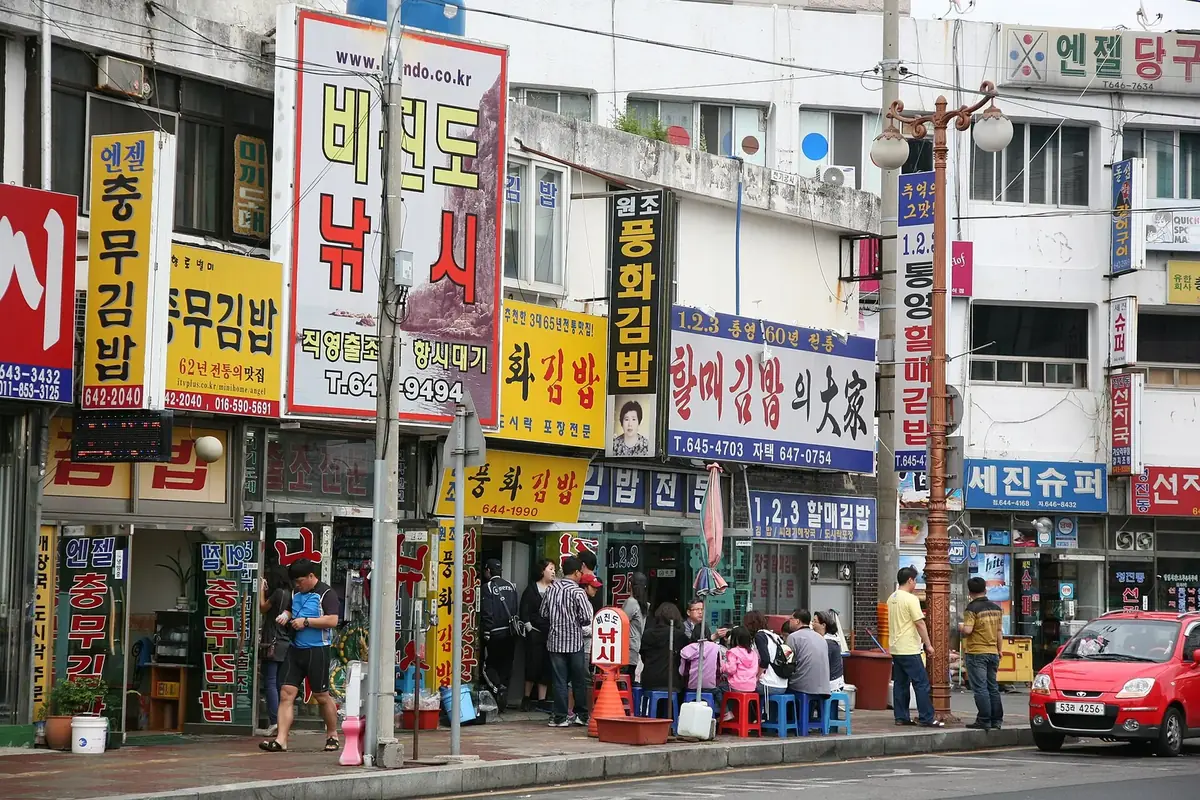
Fish stalls and shops under the arcade of the Jungang live fish market in Tongyeong.
Photograph: by Junho Jung at Flickr from South Korea — opens in a new tab · CC BY-SA 3.0 — opens in a new tab
Changes: Resized and converted to WebP; displayed with responsive crops. · Original photograph and licence details ↗ — opens in a new tab
The stone steps and main gate of Chungnyeolsa Shrine in Tongyeong, photographed in November.
Photograph: Republic of Korea from Seoul, Republic of Korea — opens in a new tab · CC BY-SA 2.0 — opens in a new tab
Changes: Resized and converted to WebP; displayed with responsive crops. · Original photograph and licence details ↗ — opens in a new tab
The Chungmu Shrine, built in memory of Admiral Yi Sun-sin, among pine trees on Hansando.
Photograph: Original uploader was Asfreeas at ko.wikipedia — opens in a new tab · CC BY-SA 3.0 — opens in a new tab
Changes: Resized and converted to WebP; displayed with responsive crops. · Original photograph and licence details ↗ — opens in a new tab
Shop fronts with signs for Chungmu gimbap restaurants on a street in Tongyeong.
Photograph: by Junho Jung at Flickr from South Korea — opens in a new tab · CC BY-SA 3.0 — opens in a new tab
Changes: Resized and converted to WebP; displayed with responsive crops. · Original photograph and licence details ↗ — opens in a new tab