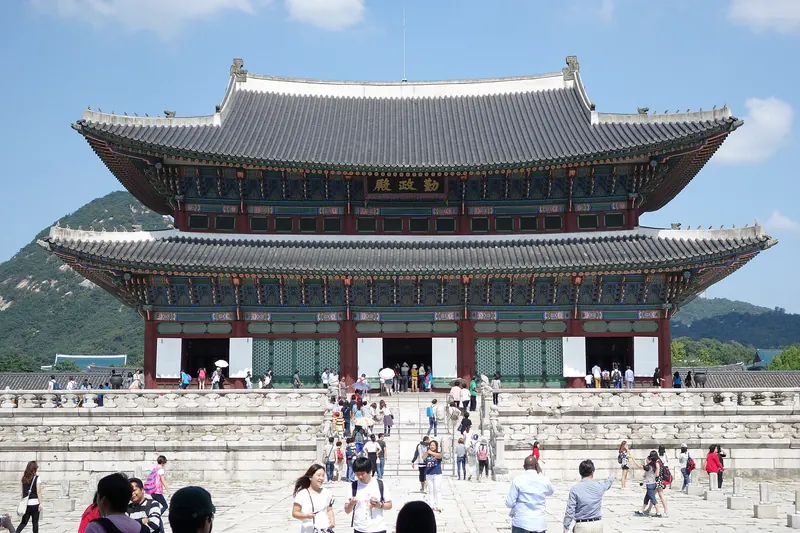
Plan your trip · South Korea
Money in South Korea: cards, T-money, cash and tax refunds for visitors
South Korea is one of the easiest countries in Asia to pay your way through with a card: department stores, hotels, convenience stores, taxis and most restaurants take Visa and Mastercard without fuss. The catch is in the small things. Public transport runs on prepaid transport cards that you load in advance, some city buses take only cards issued in Korea, airport buses want a ticket bought beforehand, and stalls in traditional markets often prefer cash. Add a tax refund system with its own rules and a foreigners-only prepaid card or two, and the money plan is less about how much to bring than about which of four tools to reach for. This guide sets out what the Korea Tourism Organization and Korea Customs said when we checked on 2026-10-03.
- Suggested time
- Set up your cards and a little cash on the first day; allow extra time at the airport on departure for tax refunds
- Where to stay
- Myeongdong or the Seoul Station area for exchange counters, card sales and Tmoney refunds
- Season and timing
- All year. From 1 October 2026 the Climate Card is valid only within Seoul; store sales usually fall from June to August and from December to February.
The short answer
Bring two international cards, ideally on different networks, and use them for hotels, shops, restaurants and taxis. On arrival, change a modest amount into won at a bank or exchange counter and buy a transport card: a Tmoney or EZL card from any convenience store if you will travel around the country, a WOWPASS if you want one card you can load with foreign cash and also pay with, or a Seoul-only Climate Card if you will ride Seoul's subway and buses a lot over a few days. Keep small won notes for market stalls, street food and topping up cards. Do not tip. Ask for a tax refund receipt with your passport whenever you spend 15,000 won or more in a shop showing a Tax Refund or Tax Free sign, and leave time at the airport to claim it. Myeongdong and the Seoul Station area are the most practical first bases, with exchange counters, card counters and the Tmoney service centre close by.
Won, cards and changing money
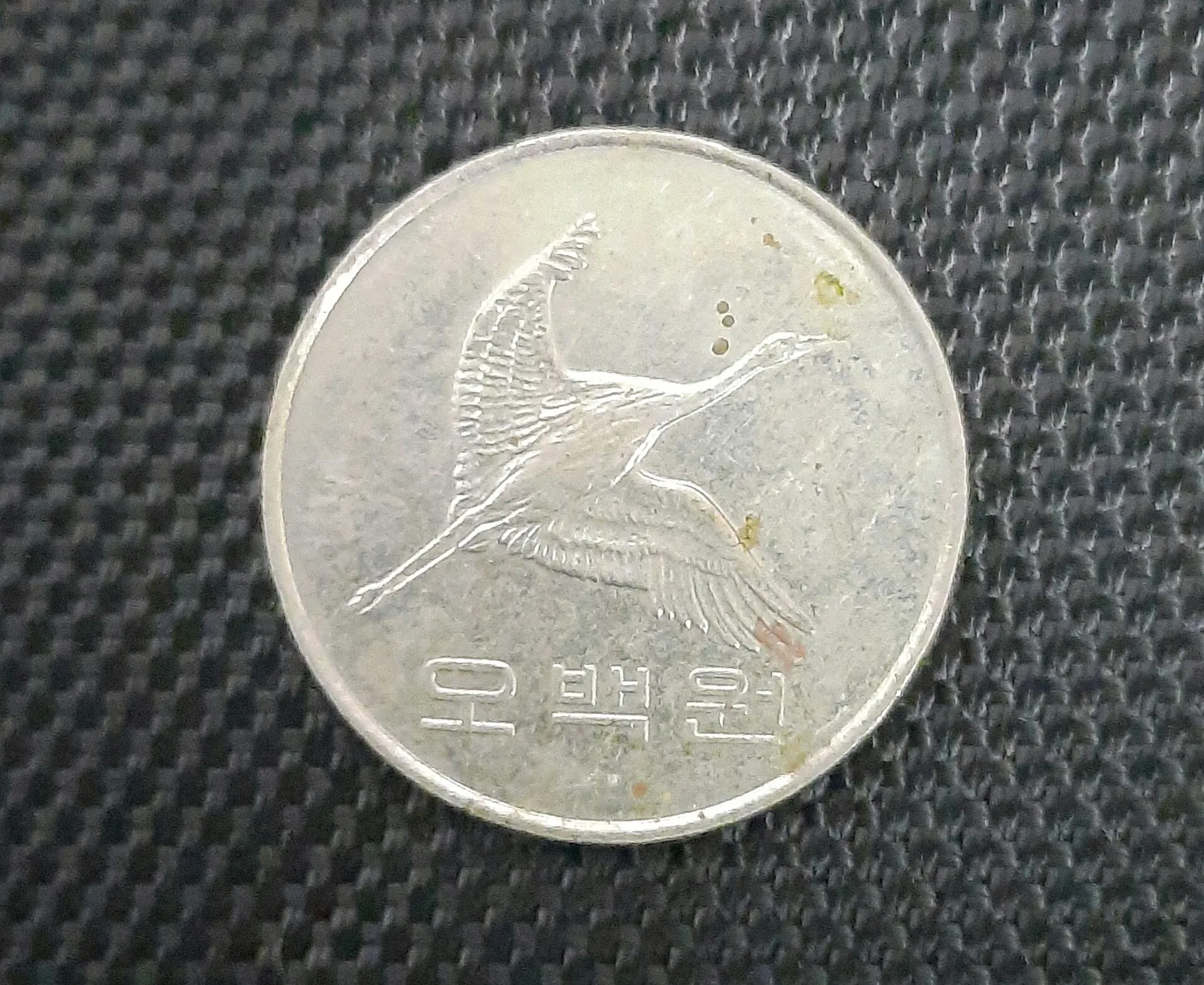
Korea's currency is the won (KRW, ₩). The Korea Tourism Organization's VisitKorea site lists four notes, 50,000, 10,000, 5,000 and 1,000 won, and coins of 500, 100, 50 and 10 won. Prices are written in full, so a café drink or a subway top-up runs to four or five digits; it helps to think in thousands from the start.
Cards are the default for most spending. VisitKorea says most businesses accept credit cards, including major hotels, department stores and general shops, and names Visa, Mastercard and American Express; its shopping guide adds JCB and UnionPay and says there is no purchase limit at most stores. It also advises checking before you buy, because some shops do not take cards. Carry two cards from different networks so that one refusal never leaves you stuck.
To change money, VisitKorea points you to a bank or an authorised exchange service. When we checked on 2026-10-03, it listed bank hours as generally 09:00 to 16:00 on weekdays (Korea Post Bank 09:00 to 16:30), varying by branch and region, and warned that old foreign notes may be refused, so bring clean, current notes if you plan to exchange cash. Its currency page also has a section on foreign exchange banks at the airports. In central Seoul, a VisitKorea update from December 2023 described self-service currency exchange kiosks in a few convenience stores, including CU Myeongdong Main Branch and emart24 branches in Myeongdong and Samcheong-dong, where you choose a currency, scan your passport and insert notes. Treat those locations as a lead to check rather than a promise, since the page itself is dated.
We did not find an official tourism page that lists which cash machines accept foreign cards, so this guide does not name any. Plan as if your card might be refused at the first machine you try: arrive with some won from your home bank or an exchange counter, and keep the second card for a second attempt.
Transport cards: Tmoney, EZL, WOWPASS or the Climate Card
Korean public transport is built around reloadable prepaid cards. VisitKorea's transportation-card guide, updated in August 2026, describes four that visitors use. They save you buying a ticket for every ride and give transfer discounts between buses and the subway, and the nationwide cards also work for small purchases.
When we checked on 2026-10-03, VisitKorea listed these details. Use them to pick one, then confirm the price at the counter.
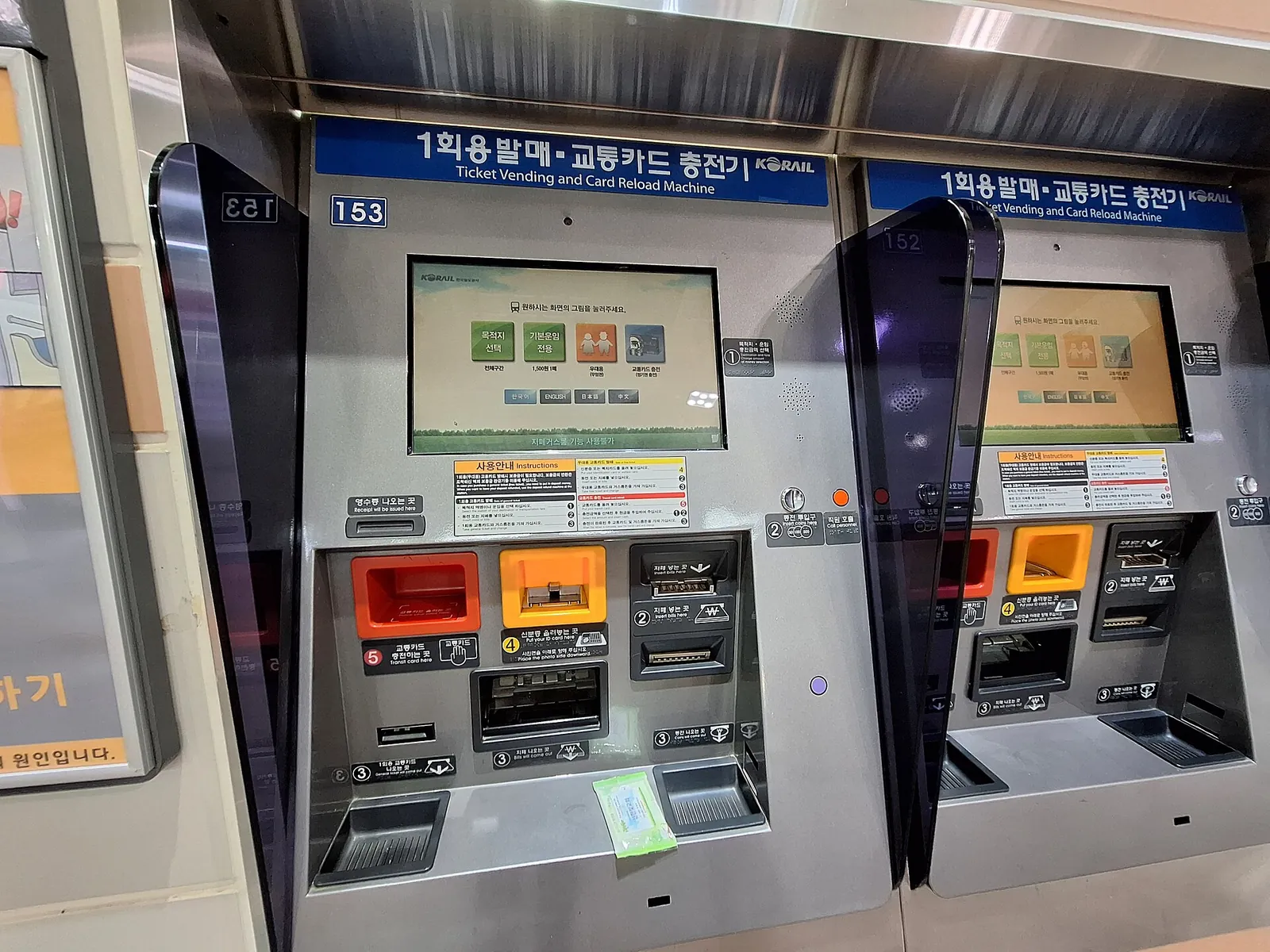
- Tmoney: sold at convenience stores nationwide (GS25, CU, 7-Eleven and others) and at information centres in Seoul subway stations on Lines 1 to 8, for 3,000 to 5,000 won for a standard card. Reload at subway ticket machines (up to 500,000 won). It works on public transport across the country, including express and intercity buses, taxis and trains, and in shops showing the Tmoney logo. Refunds of more than 50,000 won are possible only at Tmoney Town near Seoul Station (Exit 10).
- EZL: also sold at convenience stores, from 4,000 won, and usable at card-accepting shops once loaded. Convenience stores refund only balances under 20,000 won.
- WOWPASS: a foreigners-only prepaid card for 5,000 won, bought with your passport from a WOWPASS kiosk (at airports, major subway stations and hotels) or reserved through its app. You can load it at a kiosk with won or foreign notes such as US dollars, yen and yuan, then use it on public transport nationwide and as a payment card. The remaining balance can be taken out as won cash at a WOWPASS kiosk, and the app can freeze a lost card.
- Climate Card (Seoul only): a Seoul Metropolitan Government pass with unlimited rides on Seoul subway lines (except the Sinbundang Line and GTX) and Seoul-licensed buses. The card costs 3,000 won, and short-term passes cost 5,000 won for one day, 8,000 won for two, 10,000 won for three, 15,000 won for five and 20,000 won for seven. From 1 October 2026 it is valid only within Seoul, and VisitKorea notes that it can be bought and charged only with cash or a card issued in Korea. The pass starts the moment it is loaded, and leaving the system at a station outside its range costs extra.
- Mpass: a foreigners-only Tmoney card with up to 20 rides a day on Seoul subways, city buses and AREX all-stop trains, from 15,000 won for one day to 64,500 won for seven days, bought with won cash only and issued and returned at Tmoney Town near Seoul Station.
Make time for the local food
What to eat and where to look
Bindaetteok (mung bean pancake)
Thick, crisp pancakes of ground mung beans with pork, kimchi or bean sprouts, fried on big griddles and eaten with soy-onion dip. They are the classic thing to share at a market counter.
- Where to look
- Griddle stalls in Seoul's traditional markets, such as Gwangjang Market in Jongno.
- Fit it into your day
- A shared plate as an early dinner or a late-afternoon snack while you walk the market.
Market stalls are where cash is most often expected; carry small won notes. Usually contains pork.
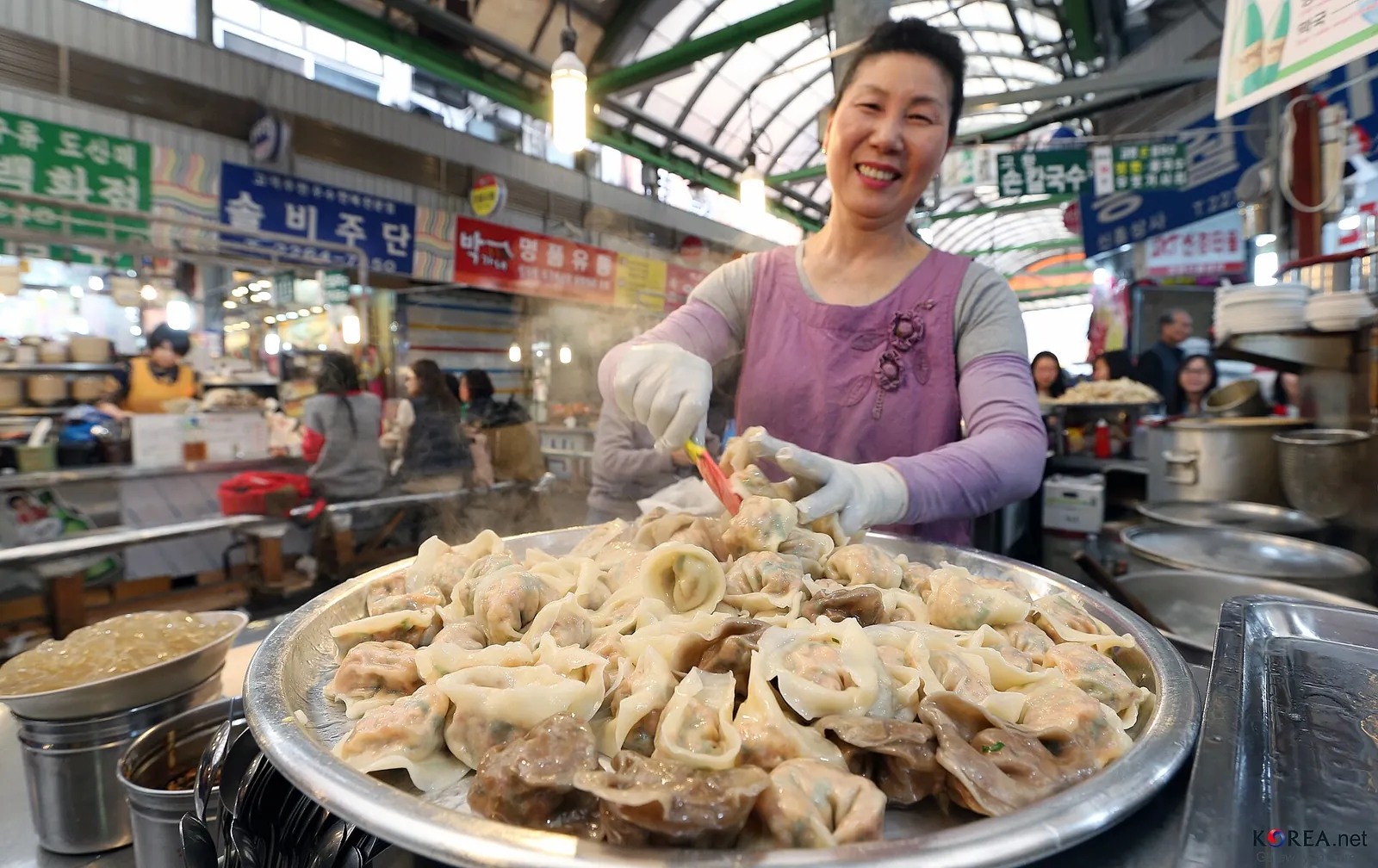
Mandu (dumplings)
Steamed or pan-fried dumplings filled with pork, tofu, glass noodles, kimchi or vegetables, sold by the plate or by the box from market counters and small shops.
- Where to look
- Market food lanes and small dumpling shops; many cook in the window, so you can point at what you want.
- Fit it into your day
- A quick lunch, or something to take back to a guesthouse in the evening.
Fillings often contain pork and wheat; kimchi versions can be spicy. Ask before you order if you avoid either.
Tteokbokki and street-cart snacks
Chewy rice cakes in a sweet, spicy red sauce, usually sold with fish cakes on skewers in broth, fried snacks and gimbap from carts and small snack shops.
- Where to look
- Street carts in busy shopping areas such as Myeongdong, and snack counters in markets.
- Fit it into your day
- A cheap snack between sights; a small portion works as a light lunch.
Carts may prefer cash. The sauce is spicy and fish-cake broth contains fish.
Convenience-store meals (gimbap and dosirak)
Triangle rice balls, gimbap rolls, instant noodles and boxed lunches (dosirak) from GS25, CU, 7-Eleven and emart24, the same chains that sell and reload transport cards.
- Where to look
- Any convenience store; they are on almost every street and in subway stations.
- Fit it into your day
- Breakfast before an early train, or a cheap meal on a travel day while you top up your transport card.
Labels are mostly in Korean; check for pork, seafood or spice with a translation app before buying.
Where cash, a transport card or a Korean card is still needed
Cards cover most of a trip, but VisitKorea flags a few gaps. Traditional markets and street shops may take cash only, so its shopping guide advises carrying petty cash before you visit. In practice this means small won notes for a plate of pancakes in a market, a skewer from a street cart or a cup of fish-cake broth.
Buses are the other trap. VisitKorea's airport guide notes that city buses from several regional airports, including Cheongju, Daegu and Yangyang, take cash on some routes, transport cards, and credit cards but not international cards. At Incheon, airport limousine buses accept neither cash nor transport cards: buy the ticket in advance at the ticket office or machine. In Jeju, the airport limousine buses to Seogwipo take transport cards only, not cash. The practical rule is to have a loaded transport card before you step onto any bus.
Taxis are easy. VisitKorea says most taxis run on the meter, do not expect tips and accept cash, credit cards or transport cards. Foreigner-friendly apps help with payment: VisitKorea describes k.ride (Kakao Mobility's app for international visitors) and TABA (backed by the Seoul Metropolitan Government) as accepting overseas cards, and notes that Uber Taxi also operates in Korea.
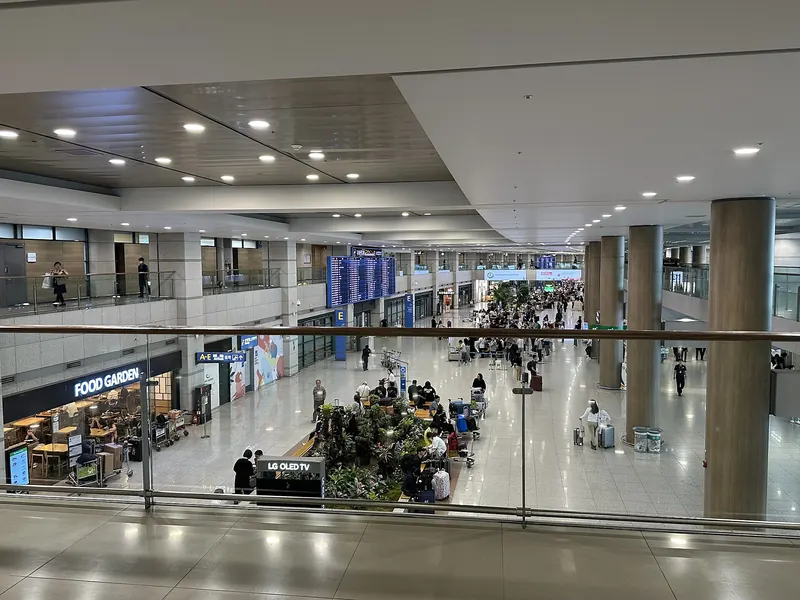
Going from Incheon into Seoul on AREX no longer needs cash either. Since early 2025, VisitKorea says, single-use AREX cards can be bought with a foreign credit card at all AREX stations from Incheon Airport Terminal 2 to Seoul Station. They still carry a 500 won deposit, which you get back from the deposit refund machine after leaving the gate at your arrival station.
If you prefer paying by phone, VisitKorea's apps guide says the Mobile Tmoney app lets you top up and tap your phone at the gate, and supports international cards including Mastercard, American Express and UnionPay. If you use Alipay, WeChat Pay or UnionPay, its shopping guide notes that these are accepted at participating ZeroPay and BC Card Paybooc QR shops.
Tax refunds: how to get the VAT back
Korea has two separate systems. Duty-free shops (run by large groups such as Lotte, Shilla and Shinsegae, at airports and downtown) sell without the tax included. Tax refund shops, marked with a "Tax Refund" or "Tax Free" sign and the logo of a refund company, charge full price and give the tax back, either later or on the spot.
When we checked on 2026-10-03, VisitKorea's tax refund guide gave these conditions: you must be a non-Korean citizen staying in Korea for less than six months; the purchase must be at least 15,000 won; goods must be new and unused; and you must leave Korea within three months of buying them. Show your passport at the till and ask for a tax refund receipt.
With an immediate tax refund, the shop takes the tax off at the till. VisitKorea lists the limits as a single payment of at least 15,000 won and under 1,000,000 won, and no more than 5,000,000 won for the whole trip. Department stores and large supermarkets started it, and some smaller shops and convenience stores now offer it.
Otherwise, claim at the airport or port when you leave, where there is no purchase limit. VisitKorea's steps are: check in but do not check the bag yet; show the goods and receipts to customs for an export approval stamp; check the bag at the oversized-baggage counter; then take your passport and receipts to a tax refund counter or kiosk. At Incheon, it listed counters in the Terminal 1 duty-free zone near Gate 28 and, in Terminal 2, at check-in counters G and F and near Gate 253, while warning that locations can change. If the counter is closed, you can drop the receipt in the box provided and the refund goes to your international credit card, Alipay or WeChat Pay within one to two months.
Downtown refund booths pay out before you reach the airport, in cash or to a card, for receipts of up to 6,000,000 won each. Each booth handles only its own company's receipts, and you still have to report the refund to customs at departure.
Tipping, bargains and carrying large sums
Tipping is not expected. VisitKorea's food guide says tipping is not required or expected in Korean restaurants, and that extra water or side dishes cost nothing. Its taxi page makes the same point for taxis. A round sum on top of a bill is more likely to confuse than to please.
Saving money is more about timing. VisitKorea's budget tips say flights get expensive in the peak periods of July to August and December to January, that most accommodation is much cheaper on weekdays than at weekends, and that national museums such as the National Museum of Korea and Gyeongju National Museum are free. Its shopping guide says most stores hold sales from June to August and from December to February.
Large sums of cash have rules. When we checked on 2026-10-03, Korea Customs said that if you arrive with foreign currency, won notes or cheques worth more than US$10,000 in total, you must declare them on the traveller declaration form and get a certificate of foreign currency declaration; it cannot be issued once you have left immigration, and failing to declare can bring fines or other penalties. Leaving with less than US$10,000 needs no report. For most visitors the easy answer is not to carry that much: cards and a modest cash float cover a trip.
Practical questions
Are foreign credit cards widely accepted in South Korea?
Yes. VisitKorea says most businesses accept credit cards, including Visa, Mastercard, American Express, JCB and UnionPay at most stores, but it advises checking before you buy. The main exceptions are traditional markets, street stalls and some city buses that take only cards issued in Korea.
Do I need cash in South Korea?
A little. Keep small won notes for market stalls and street food, and for loading transport cards: the Climate Card, for example, can be bought and charged only with cash or a Korean-issued card, and the Mpass is cash only. Hotels, shops, restaurants and taxis normally take cards.
Should I get a Tmoney card, a WOWPASS or a Climate Card?
Tmoney (or EZL) is the all-purpose choice for travel across the country. WOWPASS suits visitors who want to load foreign cash and also pay in shops with the same card. The Climate Card makes sense only for heavy use of Seoul's subway and buses over one to seven days, and from 1 October 2026 it works only within Seoul.
Do you tip in South Korea?
No. VisitKorea says tipping is not required or expected in restaurants, and taxis run on the meter without tips.
What is the minimum purchase for a tax refund in Korea?
15,000 won per receipt, according to VisitKorea, at shops displaying a Tax Refund or Tax Free sign. For an immediate refund at the till, a single payment must also be under 1,000,000 won, with no more than 5,000,000 won in total for the trip.
How much cash can I bring into South Korea?
Korea Customs says you must declare foreign currency, won or cheques worth more than US$10,000 in total when you arrive. Below that, no declaration is needed.
Sources and checks before you travel
Reference sources for the version dated 3 October 2026. Confirm opening times, access, transport and conditions for your travel dates.
- VisitKorea (Korea Tourism Organization): Korean currency ↗ — opens in a new tab
- VisitKorea: Transportation cards ↗ — opens in a new tab
- VisitKorea: Shopping in Korea ↗ — opens in a new tab
- VisitKorea: Duty free and tax refunds ↗ — opens in a new tab
- VisitKorea: Airport transportation guide ↗ — opens in a new tab
- VisitKorea: Buy single-use AREX ticket with your credit card ↗ — opens in a new tab
- VisitKorea: Taxi ↗ — opens in a new tab
- VisitKorea: Korea travel cheat sheet (December 2023) ↗ — opens in a new tab
- VisitKorea: Helpful apps and resources ↗ — opens in a new tab
- VisitKorea: About Korean food ↗ — opens in a new tab
- VisitKorea: Money-saving tips ↗ — opens in a new tab
- Korea Customs Service: Declaration of foreign currency ↗ — opens in a new tab
- WOWPASS (official site) ↗ — opens in a new tab
Does this experience fit your route?
Markets are where Korea still runs on cash and quick decisions. A guided food tour in Seoul or Busan takes the guesswork out of ordering and paying.
Check dates and details on Viator ↗ — opens in a new tabAffiliate link · Book with ViatorPhoto credits
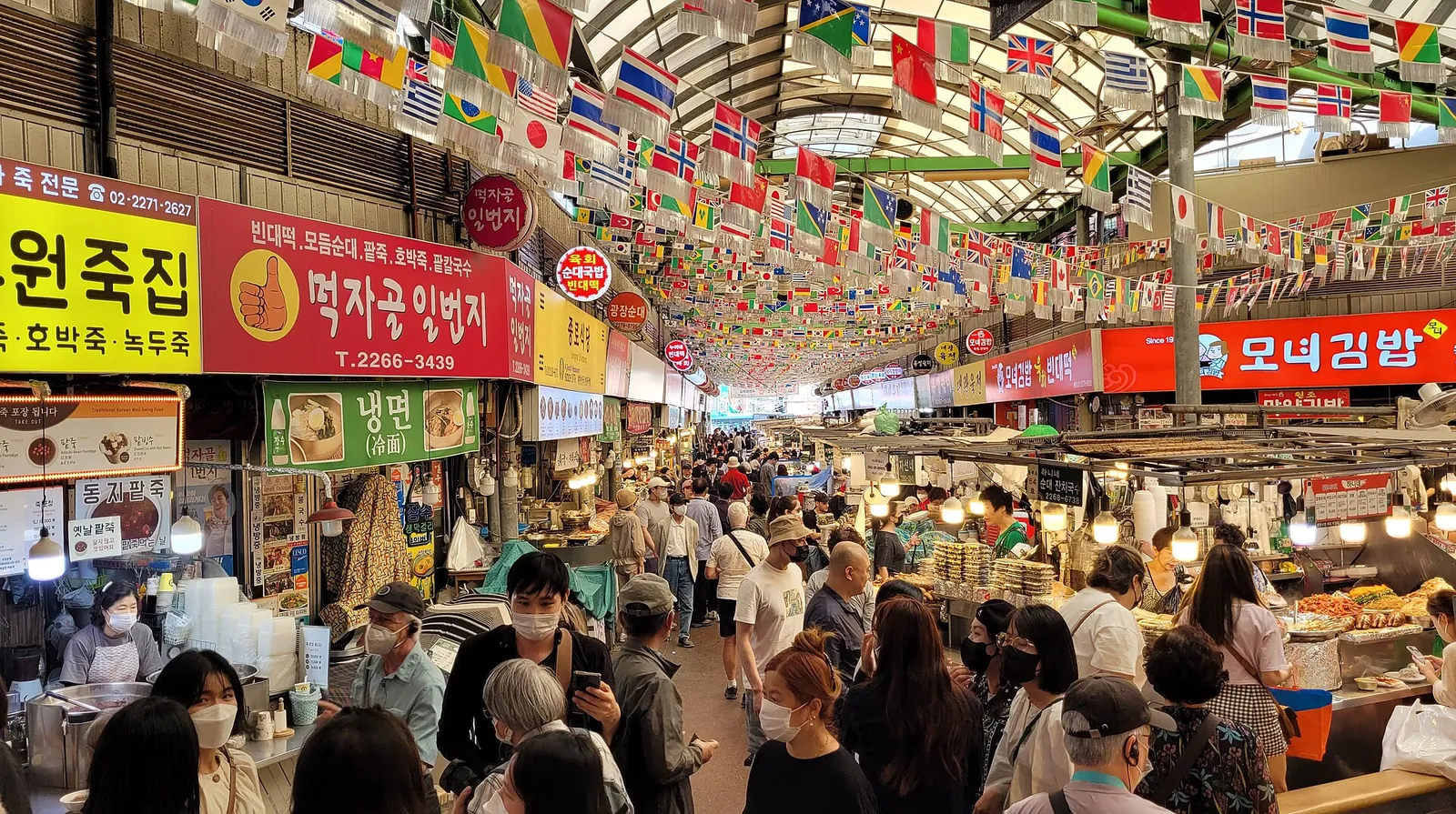
Gwangjang Market in Jongno, Seoul: market stalls are where small won notes are most useful.
Photograph: Bgag — opens in a new tab · CC0 — opens in a new tab
Changes: Resized and converted to WebP; displayed with responsive crops. · Original photograph and licence details ↗ — opens in a new tab
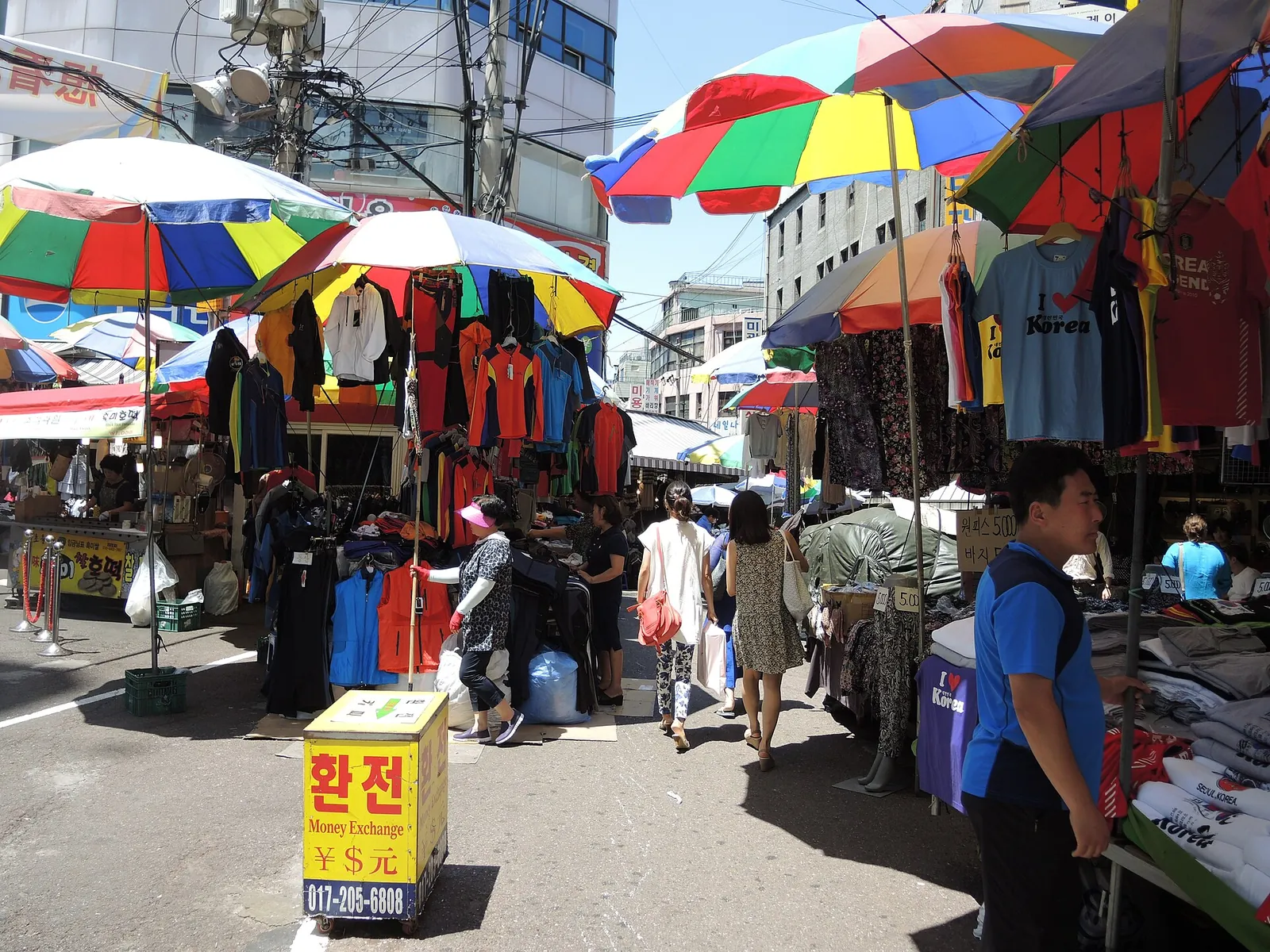
A street currency exchange sign among the stalls of Namdaemun Market, Seoul.
Photograph: Schölla Schwarz — opens in a new tab · CC BY 3.0 — opens in a new tab
Changes: Resized and converted to WebP; displayed with responsive crops. · Original photograph and licence details ↗ — opens in a new tab
Mandu dumplings at a Gwangjang Market counter, a typical cash-friendly market snack.
Photograph: Republic of Korea from Seoul, Republic of Korea — opens in a new tab · CC BY-SA 2.0 — opens in a new tab
Changes: Resized and converted to WebP; displayed with responsive crops. · Original photograph and licence details ↗ — opens in a new tab
Ticket vending and transport-card reload machines in the Seoul subway (Soraepogu Station).
Photograph: LandAndTree — opens in a new tab · CC BY 4.0 — opens in a new tab
Changes: Resized and converted to WebP; displayed with responsive crops. · Original photograph and licence details ↗ — opens in a new tab
The 500 won coin, the largest coin in circulation in South Korea.
Photograph: Lê Huỳnh Bộ — opens in a new tab · CC BY-SA 4.0 — opens in a new tab
Changes: Resized and converted to WebP; displayed with responsive crops. · Original photograph and licence details ↗ — opens in a new tab