Sumatra · North Sumatra
Bukit Lawang orangutan trek: choosing a guide, trek length and stay
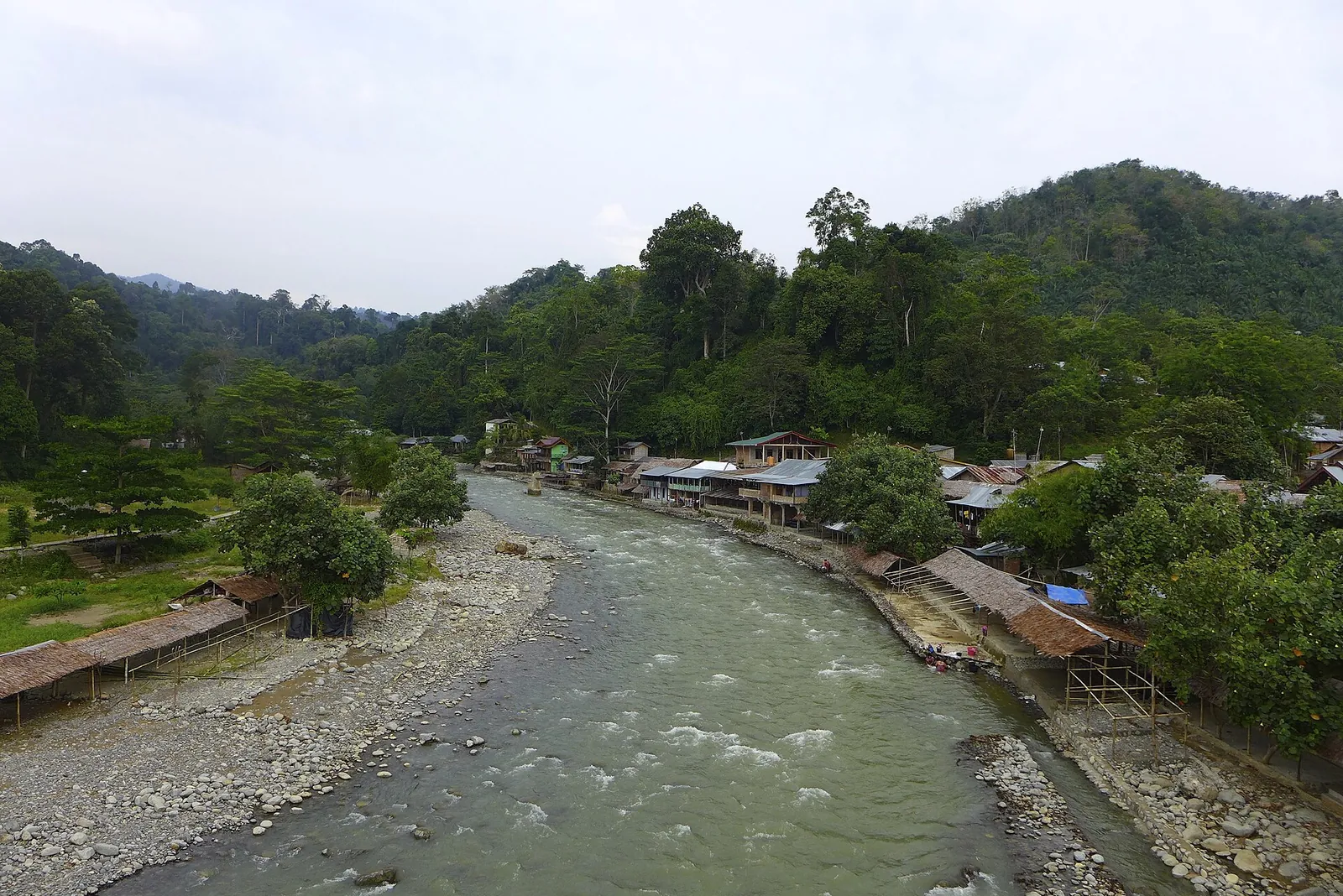
Bukit Lawang is a small riverside village on the Bahorok River in North Sumatra, about 90 kilometres north-west of Medan, on the eastern edge of Gunung Leuser National Park. Guesthouses line the river bank, and the forest begins on the far side. People come for one reason: a guided trek into the rainforest to look for Sumatran orangutans, a critically endangered great ape found only in northern Sumatra. An orangutan rehabilitation centre opened here in 1973, and the orangutans released from it and their offspring still live in the forest around the village. The trek is hot, steep and muddy, and the real choice is not whether to go but how long to stay in the forest and who to go with.
- Suggested time
- 2–3 nights (half-day to two-day trek)
- Where to stay
- Riverside guesthouses in Bukit Lawang village; a night in Medan if you land late
- Season and timing
- Treks run all year. Wikivoyage describes October to March as the wet season, with rain almost every day, usually in the late afternoon and evening; the Ministry of Tourism names June to September as the dry season for hiking in the Leuser mountains. Avoid weekends and the holiday period from June to early July if you can: Wikivoyage warns that guesthouses fill up and trekking groups get large and numerous.
The short answer
Plan two or three nights in Bukit Lawang. Arrive from Medan the afternoon before your trek, spend a full day (or a day and a night camping) in the forest with a guide, and keep a lazy day at the end for the river. A half-day trek is the minimum for a fair chance of seeing orangutans; a full day or an overnight trek goes deeper into the forest, and none of them can guarantee a sighting. You may not enter the park without a guide. Choose one through your guesthouse, and before you pay ask how many people will be in the group, whether that guide will lead you in person, whether the park permit is included and whether they keep their distance from the animals and never feed them. Sleep on the riverside path in the village. Fly into Kualanamu (KNO), then go by road via Medan; the Ministry of Tourism puts the bus from Medan's Pinang Baris terminal at about three hours.
Choosing your trek: half day, full day or a night in the forest
Every visit to the forest at Bukit Lawang is a guided trek on foot. The Ministry of Tourism describes the terrain as steep, slippery and muddy, and there are no roads or vehicles once you cross the river. What you are deciding is how long you stay inside the park. Wikivoyage advises at least a half-day or full-day trek for a reasonable chance of seeing orangutans and other wildlife. Multi-day treks, sleeping in the forest, are also offered. Wikivoyage notes that the classic way back from an overnight trek is down the river to the village.
A half-day trek suits most travellers who have never walked in a tropical rainforest: you climb into the forest behind the village, look for orangutans with your guide and are back in the village the same day. A full day goes further and quieter. An overnight trek adds a night at a forest camp, but it needs good fitness: the humidity and the gradients make even short distances hard work. Wikivoyage asks multi-day trekkers to be fit and in good condition.
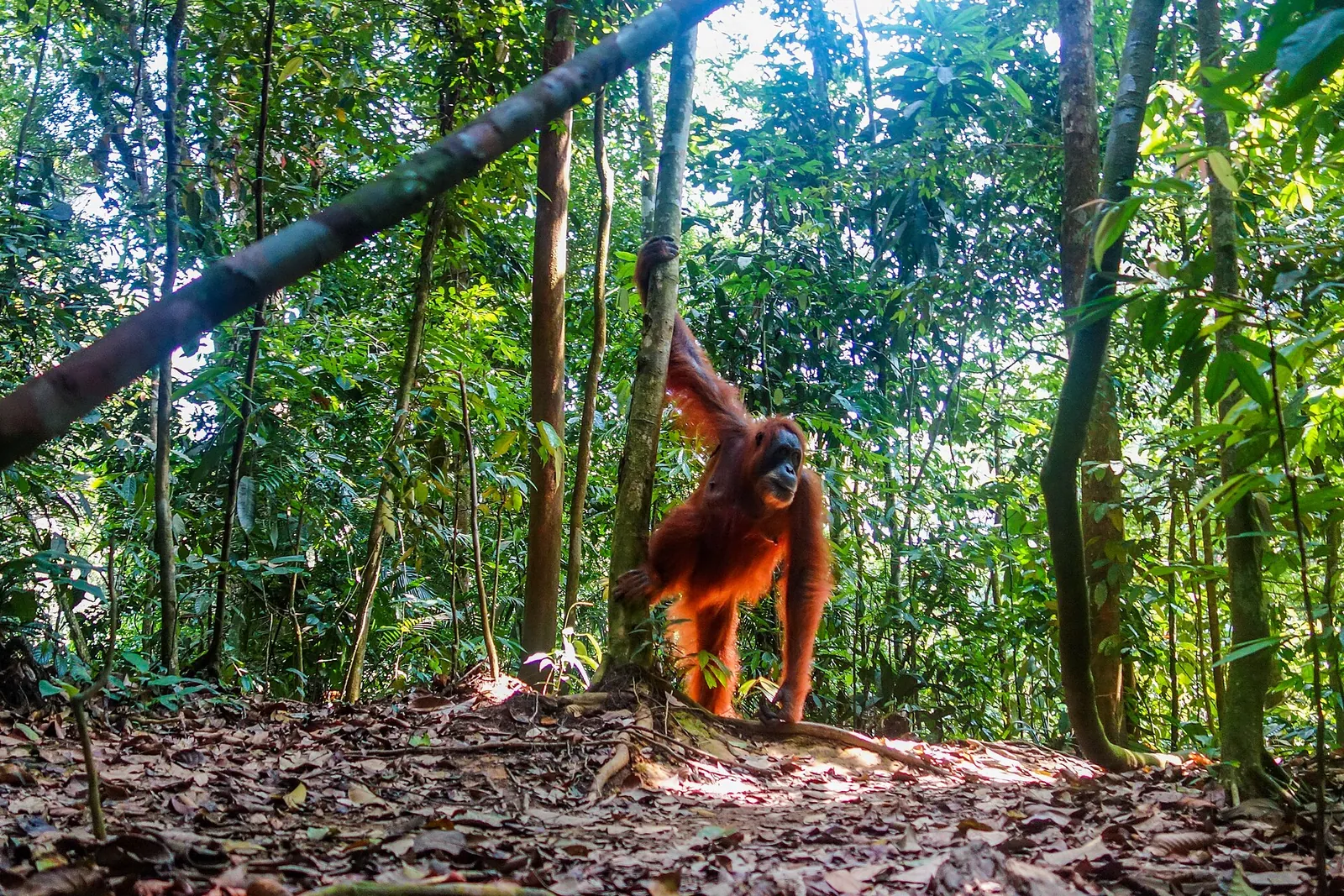
Set your expectations honestly. The orangutans around Bukit Lawang are mostly rehabilitated animals and their descendants, living semi-wild in the forest. Sightings are common, but never guaranteed. You may also meet Thomas's leaf monkeys, long-tailed and pig-tailed macaques and siamang gibbons, which English Wikipedia lists for the area. The park is also home to elephants, tigers, sun bears and clouded leopards, but tigers and rhinos are so rare that you should not expect to see them.
- Half day: the best first trek; back in the village the same day.
- Full day: deeper into the forest, with a better chance of quieter encounters.
- One or two nights: camping in the forest; only if you are fit and comfortable with heat, mud and basic conditions.
How to choose a guide, and the rules around orangutans
Wikivoyage says you are not permitted to go into the jungle unaccompanied, and the park permit should be part of every trek. Guides are easy to find in the village; the hard part is picking a good one. Book through your guesthouse rather than the first person who meets your bus. Guesthouses have a reputation to keep, and you have someone to complain to if things go wrong.
Ask the same questions every time, before you hand over money. Will this guide lead you in person, or pass you on to another group? Wikivoyage reports that some travellers paid for a small trek and ended up in a group of ten. How many people will be in the group? Is the national park permit included? Does the guide follow the park rules on wildlife?
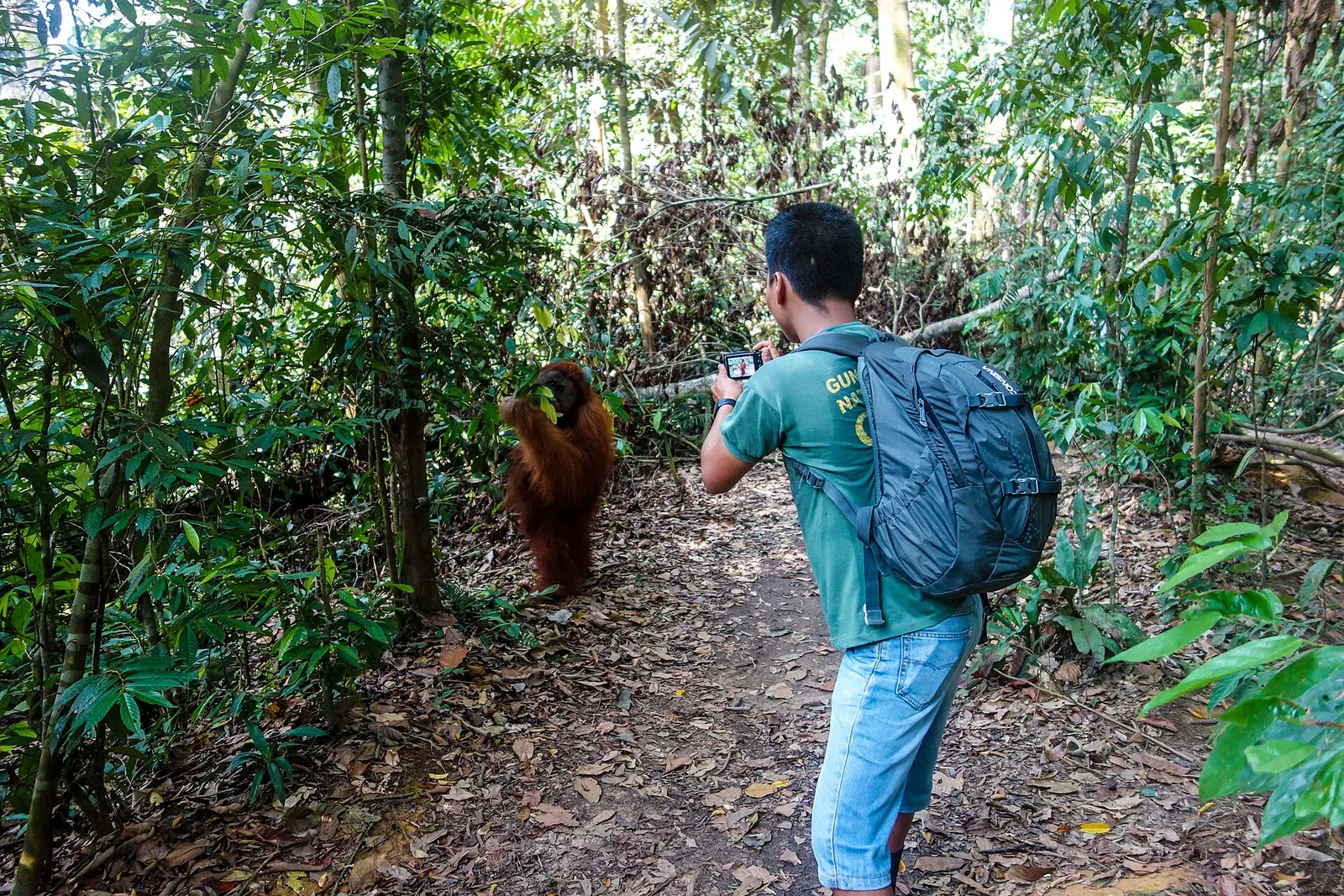
The rules on wildlife matter more here than almost anywhere. Wikivoyage reports that some guides have fed orangutans human food on treks to bring them close for photographs, and that several orangutans have fallen ill or died as a result. Keep at least 10 metres away, move back if an orangutan approaches, and never touch, call or feed any animal, even if a guide says it is fine. Orangutans catch human diseases, and one infection can spread through the population. A guide who lures animals with fruit is not giving you a better trek; walk away from that offer.
Sumatran orangutans are assessed as Critically Endangered on the IUCN Red List, and the Ministry of Tourism says their numbers keep falling because of deforestation and poaching.
- Book through a guesthouse; ask who will actually guide you and how big the group will be.
- Ask whether the park permit is included in the trek price.
- Stay at least 10 metres from orangutans; no feeding, touching or calling.
- Solo women travellers: Wikivoyage suggests joining a larger group or arranging the trek through a guesthouse with a good reputation.
Make time for the local food
What to eat and where to look
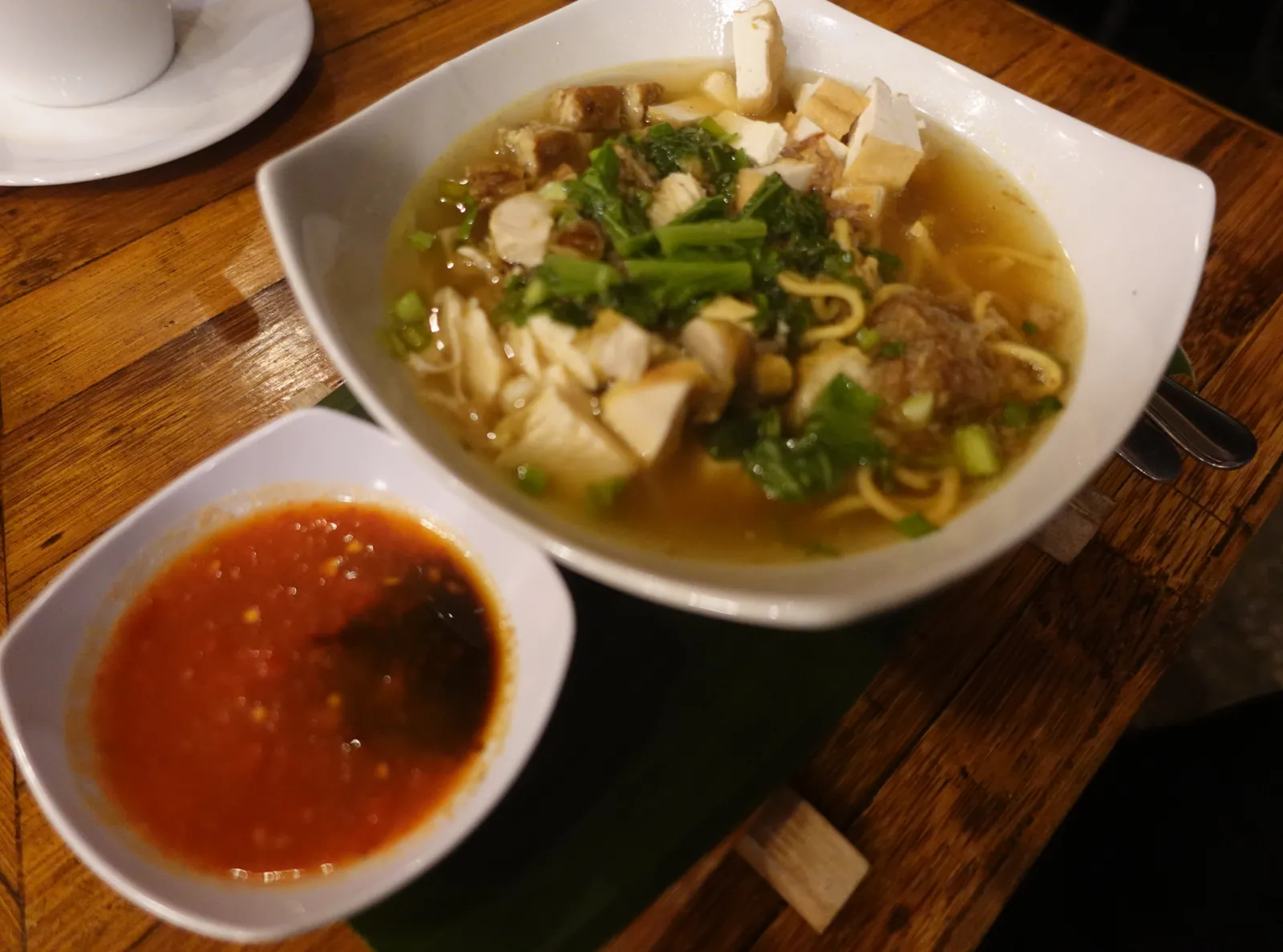
Mie sop ayam (chicken noodle soup)
A clear chicken soup with noodles, greens and shredded chicken, served with chilli sambal on the side. A light, warming meal after a hot day in the forest.
- Where to look
- Guesthouse restaurants along the river; one riverside lodge's version is shown in our photos.
- Fit it into your day
- Lunch or dinner on the evening you come back from your trek.
The sambal on the side is often very hot; add it gradually.
Guesthouse Indonesian staples: nasi goreng, gado-gado and tempe dishes
Wikivoyage notes that every guesthouse has a restaurant serving Indonesian and Western food. Fried rice, gado-gado (vegetables with peanut sauce) and tempe curries are the everyday choices, and many kitchens cater well for vegetarians.
- Where to look
- Your own guesthouse and the cafés on the riverside path.
- Fit it into your day
- Breakfast before an early trek start, and dinner the night before.
Gado-gado contains peanuts; ask if you have an allergy.
Trek meals in the forest
On a trek your guide should bring all your food and water, according to Wikivoyage. Expect simple rice-based meals and fruit, eaten on the trail or at camp.
- Where to look
- Included in the trek; ask your guide or guesthouse exactly what is provided.
- Fit it into your day
- Lunch on a full-day trek; dinner and breakfast on an overnight trek.
Confirm how much drinking water is carried, and pack extra: the humidity is intense. Never share food with wildlife.
Cap cay (stir-fried vegetables)
Chinese-Indonesian stir-fried mixed vegetables in a light sauce, a simple and widely available dish on guesthouse menus.
- Where to look
- Guesthouse restaurants in the village.
- Fit it into your day
- A side dish with rice at dinner.
May be cooked with chicken, prawns or oyster sauce; ask for a vegetarian version.
The village, the river and the 2003 flood
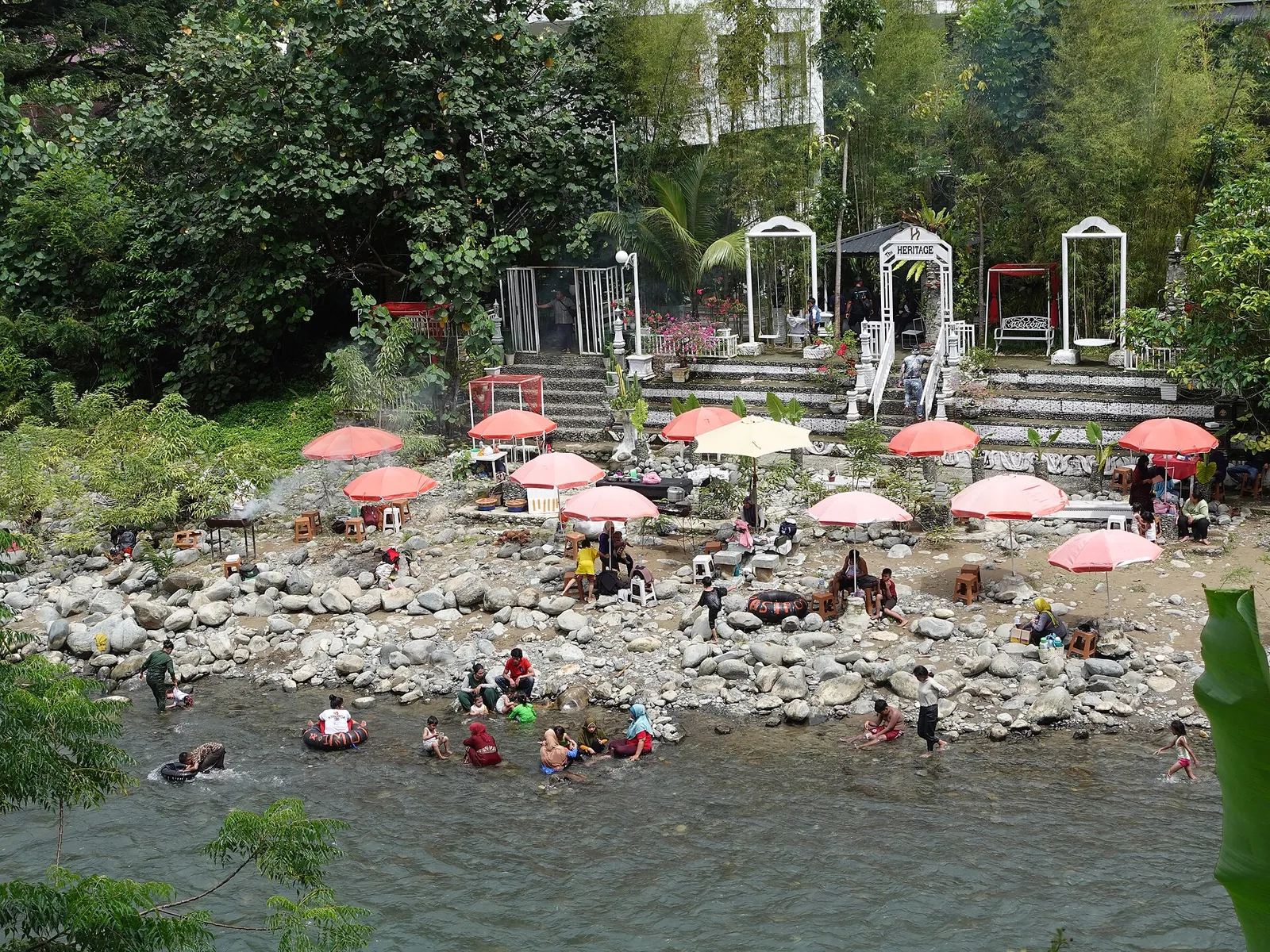
Bukit Lawang means "door to the hills". The village is little more than a riverside path of guesthouses, cafés and small shops along the Bahorok, with the forest on the opposite bank. The Ministry of Tourism describes the river as the place to swim, raft or simply sit and listen to the forest. Tubing, floating down the river on an inner tube, is the classic way to spend a rest day. Wikivoyage warns that the current is strong and that you should not float past the bridge, because the channels narrow and the rocks get sharper closer to the village.
The village you see is a rebuilt one. On 2 November 2003 a flash flood swept down the Bahorok and destroyed around 400 houses, 35 hotels and guesthouses, bridges and stalls. 239 people were killed, five of them tourists, and about 1,400 residents lost their homes. Local authorities and an environmental organisation blamed illegal logging upstream. Indonesian Wikipedia, citing The Jakarta Post, records that the resort reopened in July 2004.
The orangutan rehabilitation centre that made Bukit Lawang famous was set up in 1973, as the Ministry of Tourism describes. It was set up to return orphaned and captive orangutans to the forest. English Wikipedia says the centre closed in 2002, as the village had become too busy for rehabilitation work, and Wikivoyage says the feeding platform where visitors once watched supplementary feeding has also closed. Today you see orangutans only on guided treks in the forest. Some older guides and websites still describe the feeding sessions, so do not plan around them.
Getting there from Medan and Kualanamu
The gateway is Kualanamu International Airport (KNO) in Deli Serdang regency, which English Wikipedia places 23 kilometres east of central Medan. Bukit Lawang is on the far, north-western side of the city, so every route crosses or skirts Medan.
By public transport, the Ministry of Tourism says buses leave frequently from Medan's Pinang Baris bus terminal on Jalan Gatot Subroto and take about three hours. To reach Medan from the airport, the Railink airport train runs to Medan railway station beside Merdeka Square in about 30 minutes, according to English Wikipedia, and DAMRI buses and ride-hailing apps also serve the airport. With luggage, a late landing or a group, a private car is simpler: the ministry notes that cars with drivers can be arranged, and Wikivoyage says many Bukit Lawang guesthouses will organise an airport or Medan hotel pick-up when you book a room.
If you land in the evening, sleep in Medan and travel in daylight. Aim to arrive with time to find your guesthouse and meet your guide before the trek.
Gunung Leuser National Park and side trips
Bukit Lawang is only one entrance to a very large park. English Wikipedia gives Gunung Leuser National Park an area of 7,927 square kilometres, straddling Aceh and North Sumatra and named after Mount Leuser in the Barisan range. Together with Kerinci Seblat and Bukit Barisan Selatan national parks, it forms the UNESCO World Heritage Site Tropical Rainforest Heritage of Sumatra, inscribed in 2004. Since 2011 the site has been on UNESCO's List of World Heritage in Danger.
Around Bukit Lawang, Wikivoyage mentions a bat cave a short walk from the village (bring a torch) and walks through the rubber plantations and rice fields. A bigger side trip is Tangkahan, also in Langkat regency and also part of the park, which the Ministry of Tourism describes as an ecotourism area with forest treks, clear rivers and Sumatran elephants. Wikivoyage says the direct route from Bukit Lawang is about two hours by motorbike on dirt roads that the rain can make impassable. Many visitors go back through Medan instead.
Bukit Lawang fits naturally at the start of a North Sumatra loop: back to Medan, then up to the highland town of Berastagi and on to Lake Toba.
Practical questions
Can I see orangutans in Bukit Lawang without a guide?
No. According to Wikivoyage you are not permitted to enter the jungle unaccompanied, and the forest across the river is part of Gunung Leuser National Park. Treks are always guided.
Is the orangutan feeding platform still open?
No. English Wikipedia says supplementary feeding has stopped, and Wikivoyage says the feeding platform has closed. Today you see orangutans only on guided treks in the forest.
How long should I trek?
At least a half day, which Wikivoyage gives as the minimum for a fair chance of seeing orangutans. A full day or an overnight trek goes deeper into the forest and suits fit walkers. No trek can guarantee a sighting.
How do I get to Bukit Lawang from Medan?
The Ministry of Tourism says buses leave frequently from Medan's Pinang Baris terminal and take about three hours; a car with driver is the easier option with luggage or from the airport.
How close can I get to the orangutans?
Keep at least 10 metres away and move back if one approaches, as Wikivoyage advises. Never touch, call or feed them: human food and diseases have made orangutans here ill.
When is the rainy season?
Wikivoyage describes October to March as the wet season, with rain on most days, usually in the late afternoon. Treks still run, but trails are muddier.
Sources and checks before you travel
Reference sources for the version dated 3 October 2026. Confirm opening times, access, transport and conditions for your travel dates.
- Indonesia Travel (Ministry of Tourism): Bukit Lawang, door to the hills ↗ — opens in a new tab
- Indonesia Travel (Ministry of Tourism): Bukit Lawang (Indonesian) ↗ — opens in a new tab
- Indonesia Travel (Ministry of Tourism): Orangutan Sumatera ↗ — opens in a new tab
- Indonesia Travel (Ministry of Tourism): Ekowisata Tangkahan ↗ — opens in a new tab
- Indonesia Travel (Ministry of Tourism): Gunung Leuser ↗ — opens in a new tab
- Wikivoyage: Gunung Leuser National Park (Bukit Lawang) ↗ — opens in a new tab
- Wikipedia: Bukit Lawang ↗ — opens in a new tab
- Wikipedia (Indonesian): Bukit Lawang ↗ — opens in a new tab
- Wikipedia: Gunung Leuser National Park ↗ — opens in a new tab
- Wikipedia: Sumatran orangutan ↗ — opens in a new tab
- Wikipedia: Kualanamu International Airport ↗ — opens in a new tab
Photo credits
Bukit Lawang sits on the Bahorok River at the edge of Gunung Leuser National Park.
Photograph: Madeleine Holland — opens in a new tab · CC BY 2.0 — opens in a new tab
Changes: Resized and converted to WebP; displayed with responsive crops. · Original photograph and licence details ↗ — opens in a new tab
A Sumatran orangutan in the forest at Bukit Lawang; sightings come only on guided treks.
Photograph: Visions of Domino — opens in a new tab · CC BY 2.0 — opens in a new tab
Changes: Resized and converted to WebP; displayed with responsive crops. · Original photograph and licence details ↗ — opens in a new tab
Meeting an orangutan on the trail: keep your distance and let the animal move on.
Photograph: Visions of Domino — opens in a new tab · CC BY 2.0 — opens in a new tab
Changes: Resized and converted to WebP; displayed with responsive crops. · Original photograph and licence details ↗ — opens in a new tab
Mie sop ayam with sambal at a riverside lodge in Bukit Lawang.
Photograph: Astari28 — opens in a new tab · CC BY-SA 4.0 — opens in a new tab
Changes: Resized and converted to WebP; displayed with responsive crops. · Original photograph and licence details ↗ — opens in a new tab
The Bahorok River at Bukit Lawang, where tubing and swimming fill a rest day.
Photograph: Astari28 — opens in a new tab · CC BY-SA 4.0 — opens in a new tab
Changes: Resized and converted to WebP; displayed with responsive crops. · Original photograph and licence details ↗ — opens in a new tab