Plan your trip · Indonesia
Indonesia visa and entry: e-VOA, All Indonesia arrival card, Bali levy
Getting into Indonesia involves more paperwork than most of its neighbours, but none of it is hard if you do it in the right order. Most visitors need a visa, and for a holiday that usually means the 30-day visa on arrival, which can be bought online in advance as an e-VOA. A short list of mostly Southeast Asian passports can enter without a visa. Every traveller also has to submit a free online arrival card in the last days before landing, and anyone going to Bali pays a provincial tourist levy on top. This guide sets out which route applies to you, what the official sources said when we checked on 2026-10-03, and where look-alike websites and visa agents catch people out.
- Suggested time
- Apply for the e-VOA at least a week before you fly; it allows a 30-day stay, extendable once by 30 days
- Where to stay
- Bali (Ngurah Rai) or Jakarta (Soekarno-Hatta), the two main international gateways
- Season and timing
- All year; the arrival card can only be submitted in the three days before arrival, so plan it into the last days before you fly
The short answer
First check your passport against the Directorate General of Immigration's lists. When we checked on 2026-10-03, the visa-free list covered ASEAN countries plus a few others such as Brazil, Colombia, Peru, Turkey, Kazakhstan, Belarus, Suriname, Hong Kong and Macau, while 97 countries and territories, including the US, the UK, Australia, Canada, Japan, India, China and most of Europe, were eligible for the visa on arrival. If you are on the visa-on-arrival list, buy the e-VOA yourself on evisa.imigrasi.go.id at least a week before you fly. The UK government listed it at Rp 500,000 for a single-entry 30-day stay that can be extended once by 30 days. In the three days before arrival, fill in the free All Indonesia arrival card. If you are going to Bali, pay the Rp 150,000 levy on the provincial Love Bali site before you leave home. Carry a passport valid for six months with two blank pages and proof of your onward flight, and check the official pages again a few days before departure.
Visa-free, visa on arrival or a visa: which applies to you
The UK government's travel advice puts it plainly for British travellers: you must have a visa to visit Indonesia. The same is true of most Western passports. What differs is how you get it, and the Directorate General of Immigration (now part of the Ministry of Immigration and Corrections) publishes three lists that decide this: countries whose citizens are visa-exempt, countries eligible for a visa on arrival, and countries that need a specially screened 'calling visa'.
Visa-exempt (Bebas Visa Kunjungan). When we checked on 2026-10-03, the immigration list named Brunei, Malaysia, Thailand, Vietnam, the Philippines, Cambodia, Singapore, Myanmar, Laos and Timor-Leste, plus Suriname, Colombia, Hong Kong, Turkey, Brazil, Peru, Kazakhstan, Macau and Belarus, and foreign holders of Singapore permanent residence entering through certain checkpoints. The immigration FAQ says you still need a passport valid for at least six months and a return or onward ticket. The list does not give the length of stay on the same page, so confirm how long you may stay and whether it can be extended before you plan a longer trip.
Visa on arrival (VOA and e-VOA). The immigration FAQ, last updated on 30 September 2026 when we checked, listed 97 countries and territories eligible for the electronic visa on arrival, among them the United States, the United Kingdom, Ireland, Australia, New Zealand, Canada, Japan, South Korea, China, Taiwan, India, Germany, France, Italy, Spain and the Netherlands. Some countries, Brazil among them, appear on both lists. According to the UK advice, the 30-day VOA covers tourism, visiting family or friends, some business meetings, buying goods and official visits. It is not meant for volunteering, influencer work or creating commercial online content, which may need a different visa.
Everyone else, and longer trips. If your passport is on neither list, or you need more than 60 days, look at the other visit visas on the official eVisa site. The UK advice notes that you can apply online before travelling for options including multiple-entry visas and 60-day visas, and that the visa must be approved before you arrive: a visa approved after you have entered is not valid.
Buying the e-VOA on the official site
The only official place to apply is the Directorate General of Immigration's site, evisa.imigrasi.go.id. Indonesian government sites end in .go.id, as the immigration site itself points out, and the UK advice warns that visa scams by fake agents are increasing, with some travellers losing money and others ending up with the wrong visa, overstaying and being deported. Type the address yourself rather than clicking a search advert.
The eVisa site's FAQ lists what you need: a scan of your passport's biodata page with at least six months' validity from the date you arrive, a passport-size photo (both JPG or PNG, no larger than 200 kb), an email address and a Mastercard, Visa or JCB card; the home page also mentions payment through SIMPONI, the government payment system. Each traveller needs their own visa, although the site lets you submit an e-VOA application for up to five people at once. When it is approved, a download link is emailed to you.
When we checked on 2026-10-03, the UK government listed the VOA at Rp 500,000, payable by cash or card, valid for a single entry. The eVisa FAQ adds that the validity period starts on the date you put in your application, and you can enter on any day within that period. The UK advice recommends applying at least one week before you leave. You can still buy a VOA at the counter on arrival at most main airports and seaports, but buying it online first takes one queue out of the arrival.
- Copy your name and passport number exactly from the passport you will travel on: the FAQ says a visa that does not match your passport is invalid, and payments for mistakes are not refunded.
- Keep the visa as a PDF on your phone and a printout; officers verify it in their system, but the FAQ advises carrying a copy in case the system fails.
- Have your return or onward ticket ready to show. The FAQ says an officer can ask for it and that a visa does not guarantee entry.
Make time for the local food
What to eat and where to look
Nasi campur
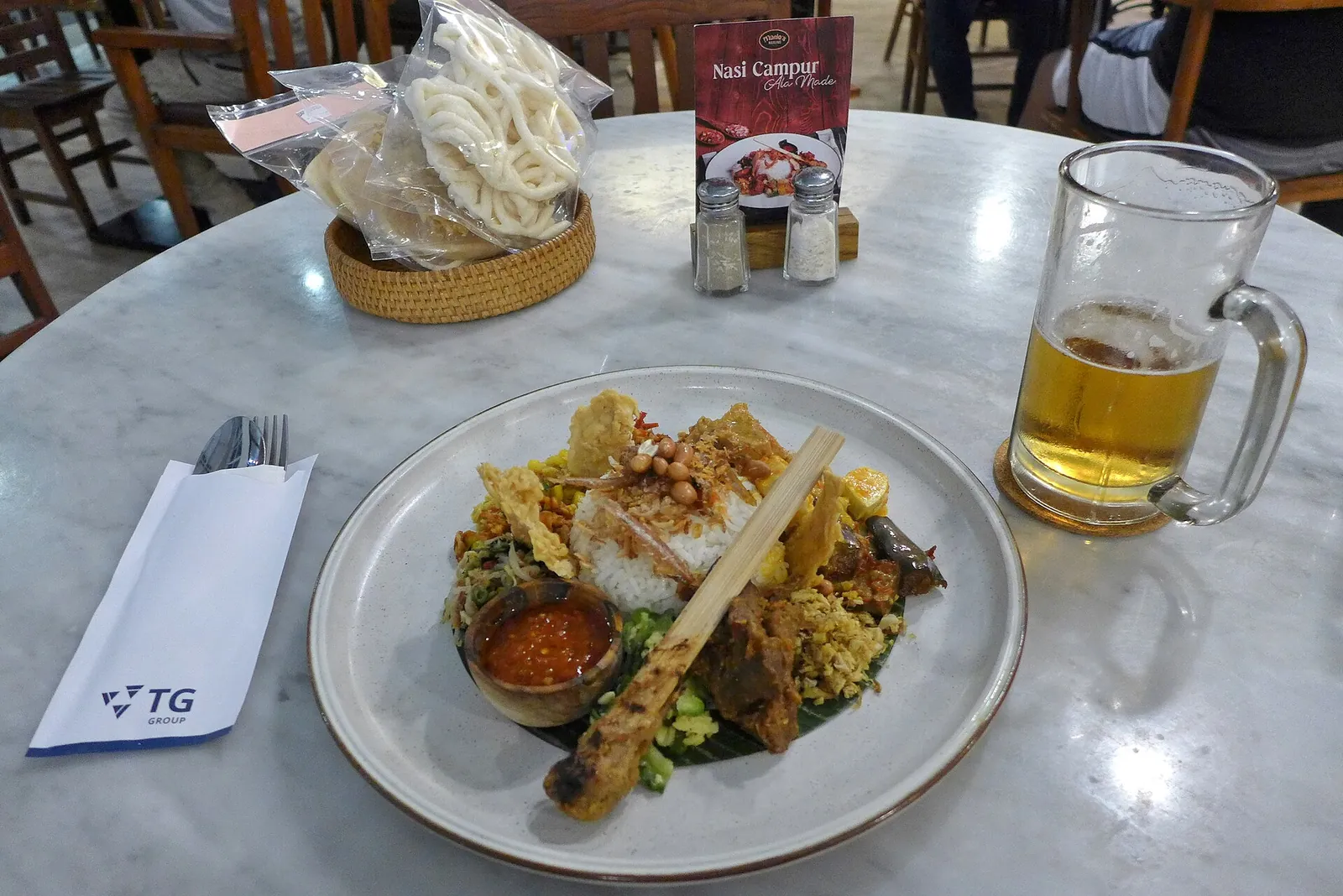
A plate of rice with small portions of several dishes around it: vegetables, a piece of meat or fish, sambal, perhaps an egg or tempeh. In Bali it often includes spiced chicken or pork and lawar. It is an easy first meal after a long flight because you can see everything before you choose.
- Where to look
- Warungs near the Kuta and Tuban hotels by Bali's airport, and food outlets in the international terminal if you arrive late.
- Fit it into your day
- A late lunch or dinner on arrival day, once you are through immigration and have rupiah from an airport ATM.
Balinese versions often contain pork and can be very spicy; ask what is on the plate and order sambal on the side.
Nasi goreng
Fried rice with sweet soy sauce, shallots, garlic and chilli, usually topped with a fried egg and served with prawn crackers and cucumber. It is on almost every menu in the country, from street carts to hotel room service, which makes it the safe order when you are tired.
- Where to look
- Evening carts and warungs in any town; hotel restaurants in Jakarta and Bali if you land after dark.
- Fit it into your day
- Breakfast or a late supper on your first night, when jet lag makes your eating times unpredictable.
Often cooked with shrimp paste and fish sauce; ask for no chilli (tidak pedas) if you want it mild.
Bakso
Beef meatball soup with noodles, tofu and fried dumplings in a clear broth, finished at the table with chilli sauce, sweet soy and lime. Light, cheap and quick, it is a good first taste of Javanese street food.
- Where to look
- Push-carts and small shops in Jakarta and other Javanese cities, and food courts at Soekarno-Hatta Airport.
- Fit it into your day
- A quick lunch between landing in Jakarta and a domestic connection or train onward.
Meatballs are usually beef but can contain other meat; ask if you have dietary restrictions.
Mie goreng
Stir-fried egg noodles with sweet soy, vegetables, egg and chicken or prawn, the noodle partner to nasi goreng and just as widely available.
- Where to look
- Warungs and hawker stalls on Batam and Bintan if you arrive by ferry from Singapore, and street stalls in any town.
- Fit it into your day
- Dinner on arrival day by ferry, before you head on to a resort or onward flight.
Contains wheat and egg; may be cooked with shrimp paste or fish sauce.
Before you land: the All Indonesia arrival card and customs
The second piece of paperwork is the All Indonesia arrival card, run by the immigration authority at allindonesia.imigrasi.go.id and in an app. When we checked on 2026-10-03, the eVisa site's home page said that all travellers must submit an arrival card within three days before arriving in Indonesia, and the UK advice described it as the online customs and health declaration, to be filled in within 72 hours of arrival. It is free. The UK advice specifically warns travellers to avoid alternative websites or email links that ask for payment for it.
In practice, that means the arrival card belongs in the last three days before your flight, not in the weeks of planning. If you are on a multi-country trip, set a reminder for the day before you fly in from Singapore, Kuala Lumpur or Bangkok. The UK advice adds that after completing the form you can also apply for a visa through the All Indonesia app.
What you declare is set by Indonesian Customs. Its passenger-goods page, under Finance Minister Regulation 34 of 2025, gave a duty-free allowance on personal goods of USD 500 per person per arrival when we checked, with duty charged on the excess. It also lists cash or other payment instruments worth Rp 100,000,000 or more, or the equivalent in foreign currency, among the items that must be declared. The same page still describes the older Electronic Customs Declaration at ecd.beacukai.go.id; follow whichever form the airline and the immigration site direct you to at the time you travel, and do not pay anyone to fill it in.
Bali's tourist levy: how and where to pay
Bali charges foreign visitors a one-time levy for the protection of Balinese culture and the natural environment, set by Bali Provincial Regulation 2 of 2025, which amended a 2023 regulation. When we checked on 2026-10-03, the provincial government's Love Bali site (lovebali.baliprov.go.id) listed it at IDR 150,000 per person. The Ministry of Tourism describes it as a single payment during your stay in Bali, before you leave Indonesia, and it is completely cashless.
The ministry describes two ways to pay. The recommended one is online through the Love Bali website or app before you travel, by bank transfer, virtual account or QRIS; you receive a paid notification and a digital receipt, and the Love Bali site emails the levy voucher and has options to verify or resend it. If you have not paid in advance, you can pay by credit or debit card at counters run by the state bank BRI at I Gusti Ngurah Rai International Airport and at the Tanjung Benoa port, and receive a printed or digital receipt.
The Love Bali site also offers group payment and an exemption application; read the exemption conditions there rather than assuming they apply to you. Only use the provincial site, which ends in baliprov.go.id, or its official app. The levy is separate from the visa: paying one does not cover the other.
Ports of entry, extensions and overstaying
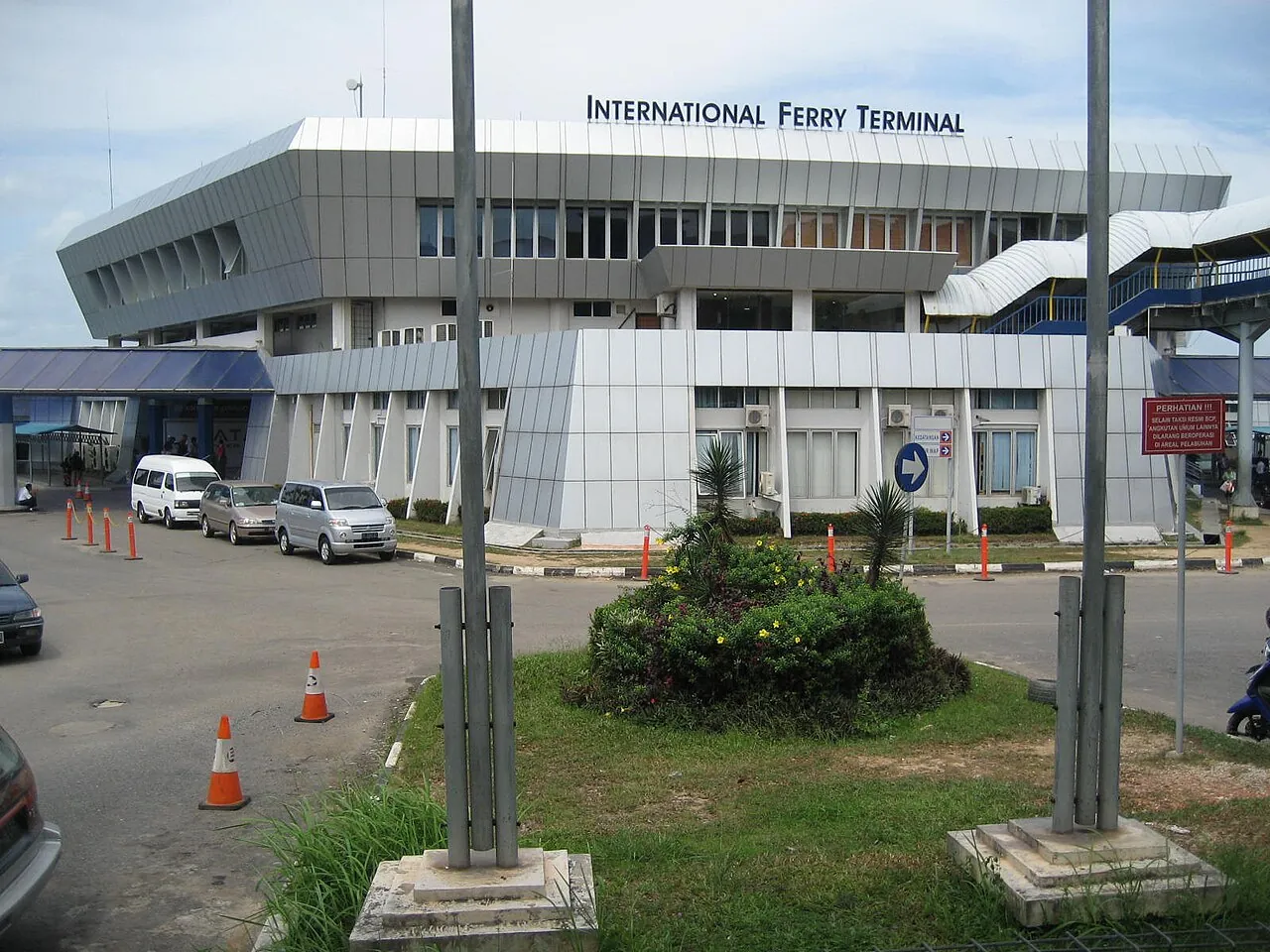
Not every border post handles visas on arrival. The immigration authority publishes the entry points for e-VOA holders. When we checked on 2026-10-03, the list covered 16 airports, including Soekarno-Hatta and Halim Perdana Kusuma in Jakarta, Ngurah Rai in Bali, Juanda in Surabaya, Yogyakarta, Kualanamu in Medan, Zainuddin Abdul Madjid in Lombok, Sultan Hasanuddin in Makassar and Sam Ratulangi in Manado. It also covered land crossings such as Entikong (from Sarawak), Mota'ain (from Timor-Leste) and Skouw (from Papua New Guinea), and seaports including Batam Centre, Sekupang and Nongsa on Batam and Bandar Bentan Telani Lagoi and Sri Bintan Pura on Bintan, the usual ferry routes from Singapore, as well as Benoa and Padang Bai in Bali. If you plan an unusual route in, check that the crossing is on that list.
The 30-day VOA can be extended once, for another 30 days, according to the UK advice: at any immigration office in Indonesia, or on the eVisa site if you applied online. Do it inside the first 30 days. Overstaying costs Rp 1,000,000 a day, and the eVisa FAQ warns that overstayers may also be detained, deported or banned from future travel. The UK advice adds that using the wrong type of visa is taken just as seriously.
One rule surprises people who rent villas or stay with friends. The UK advice says that if you stay in private accommodation, you must register with the nearest police station and could be fined Rp 5 million if you do not; hotel guests are registered automatically. If you book a private villa, ask your host whether they handle this.
Last checks before you fly
Check your passport first. The UK advice says it must have an expiry date at least six months after the day you arrive and at least two blank pages, and that you will be denied entry with a passport reported lost or stolen. Airlines check this at check-in, so a passport with five months left can stop the trip before it starts.
Health and tax are smaller items. You need a yellow fever vaccination certificate if you are arriving from a country listed as a transmission risk. Airport tax is included in domestic air fares, but the UK advice says that on some international departures it may not be included in the ticket, so ask your airline or agent.
Finally, treat any visa guide, including this one, as a starting point. The visa-free list, the e-VOA list and the arrival-card rules have all changed in recent years, and the authorities enforce them. A last look at evisa.imigrasi.go.id, the immigration lists and your own government's travel advice a few days before you fly costs nothing, and the arrival card cannot be done earlier anyway.
Practical questions
Do I need a visa for Indonesia?
Most visitors do. When we checked on 2026-10-03, the immigration authority's visa-free list covered ASEAN countries and a few others, including Brazil, Colombia, Peru, Turkey, Kazakhstan, Belarus, Suriname, Hong Kong and Macau. Citizens of 97 countries and territories, including the US, the UK, Australia, Canada, Japan, India and most of Europe, could get a visa on arrival or buy it online as an e-VOA.
Where do I apply for the official Indonesia e-VOA?
On the Directorate General of Immigration's site, evisa.imigrasi.go.id. Indonesian government sites end in .go.id; the UK government warns that visa scams by fake agents are increasing.
How much does Indonesia's visa on arrival cost?
When we checked on 2026-10-03, the UK government listed Rp 500,000 for the 30-day single-entry visa on arrival, payable by cash or card. Online, the eVisa site takes Mastercard, Visa or JCB cards.
Can I extend the visa on arrival?
Yes, once, for another 30 days, according to the UK government: at an immigration office in Indonesia, or on the eVisa site if you applied online. Do it within the first 30 days, because overstaying costs Rp 1,000,000 a day.
What is the All Indonesia arrival card?
A free online arrival declaration, run by the immigration authority on its All Indonesia website and app. When we checked on 2026-10-03, the eVisa site said all travellers must submit it within three days before arrival. Avoid look-alike sites that charge for it.
How do I pay the Bali tourist levy?
When we checked on 2026-10-03, the levy was IDR 150,000 per person, paid once on the provincial Love Bali website or app before you travel. If you have not paid, the Ministry of Tourism says you can pay by card at BRI counters at Ngurah Rai airport and Tanjung Benoa port.
Sources and checks before you travel
Reference sources for the version dated 3 October 2026. Confirm opening times, access, transport and conditions for your travel dates.
- UK FCDO travel advice: Indonesia entry requirements ↗ — opens in a new tab
- Directorate General of Immigration: List of visa-on-arrival countries ↗ — opens in a new tab
- Directorate General of Immigration: List of visa-exempt countries ↗ — opens in a new tab
- Directorate General of Immigration: Entry points for e-VOA holders ↗ — opens in a new tab
- Directorate General of Immigration: Visa FAQ ↗ — opens in a new tab
- Official eVisa website for Indonesia ↗ — opens in a new tab
- Official eVisa website: General information and FAQ ↗ — opens in a new tab
- Indonesian Customs (Bea Cukai): Passenger goods ↗ — opens in a new tab
- Ministry of Tourism: Bali vacation in mind? Get informed of the latest regulations ↗ — opens in a new tab
- Bali Provincial Government: Love Bali tourist levy ↗ — opens in a new tab
- Ministry of Tourism: Denpasar – Bali Ngurah Rai Airport ↗ — opens in a new tab
Does this experience fit your route?
Entry sorted? Compare tours from Bali and Jakarta for your first days, and book only once your e-VOA or visa exemption is confirmed.
Browse relevant experiences on Viator ↗ — opens in a new tabAffiliate link · Book with ViatorPhoto credits
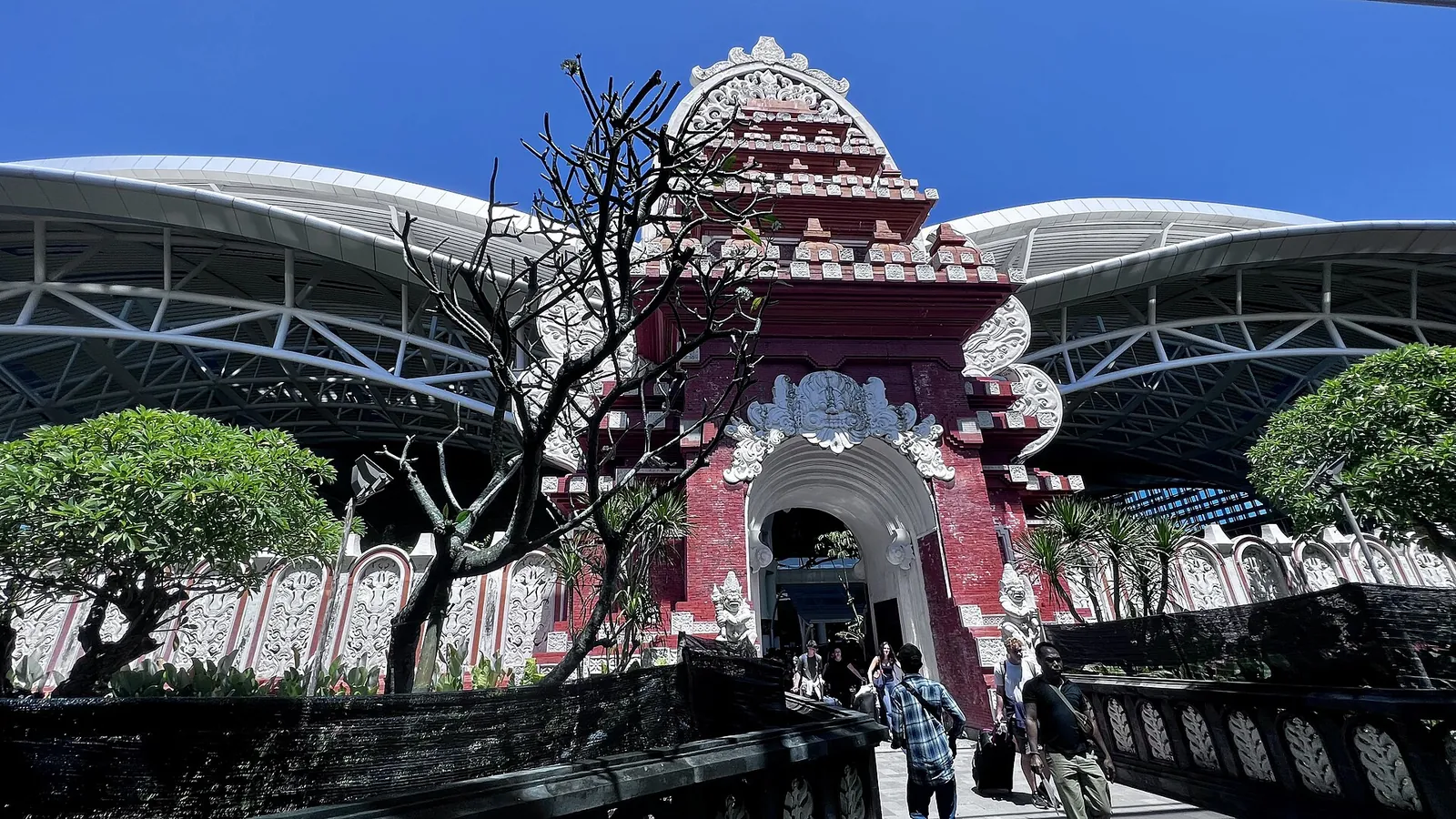
A carved Balinese temple-style gateway at I Gusti Ngurah Rai International Airport, the main gateway to Bali
Photograph: Pinterpandai.com — opens in a new tab · CC BY-SA 3.0 — opens in a new tab
Changes: Resized and converted to WebP; displayed with responsive crops. · Original photograph and licence details ↗ — opens in a new tab
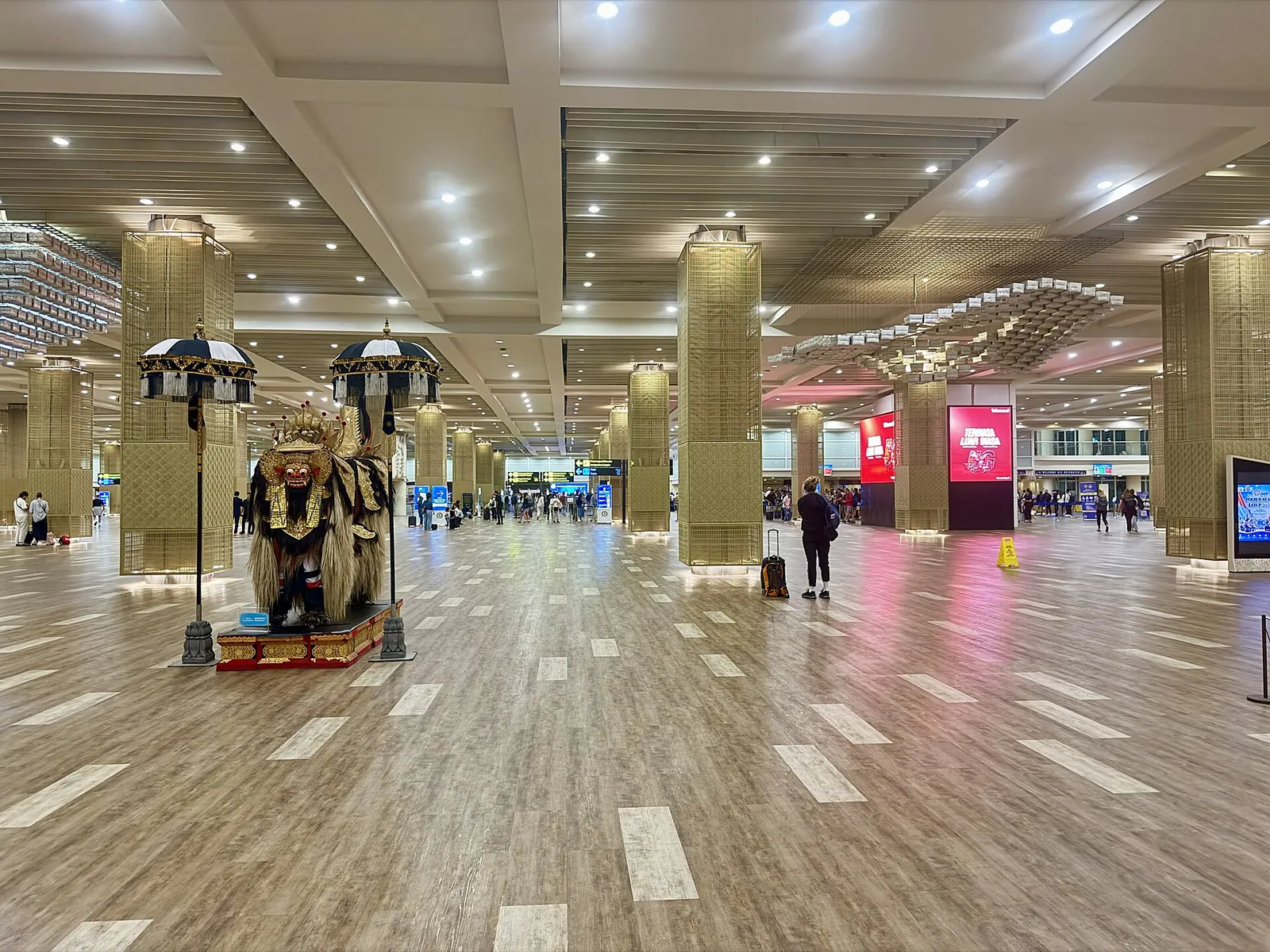
Inside the international terminal at Ngurah Rai, where most visitors to Bali arrive
Photograph: Chris Olszewski — opens in a new tab · CC BY-SA 4.0 — opens in a new tab
Changes: Resized and converted to WebP; displayed with responsive crops. · Original photograph and licence details ↗ — opens in a new tab
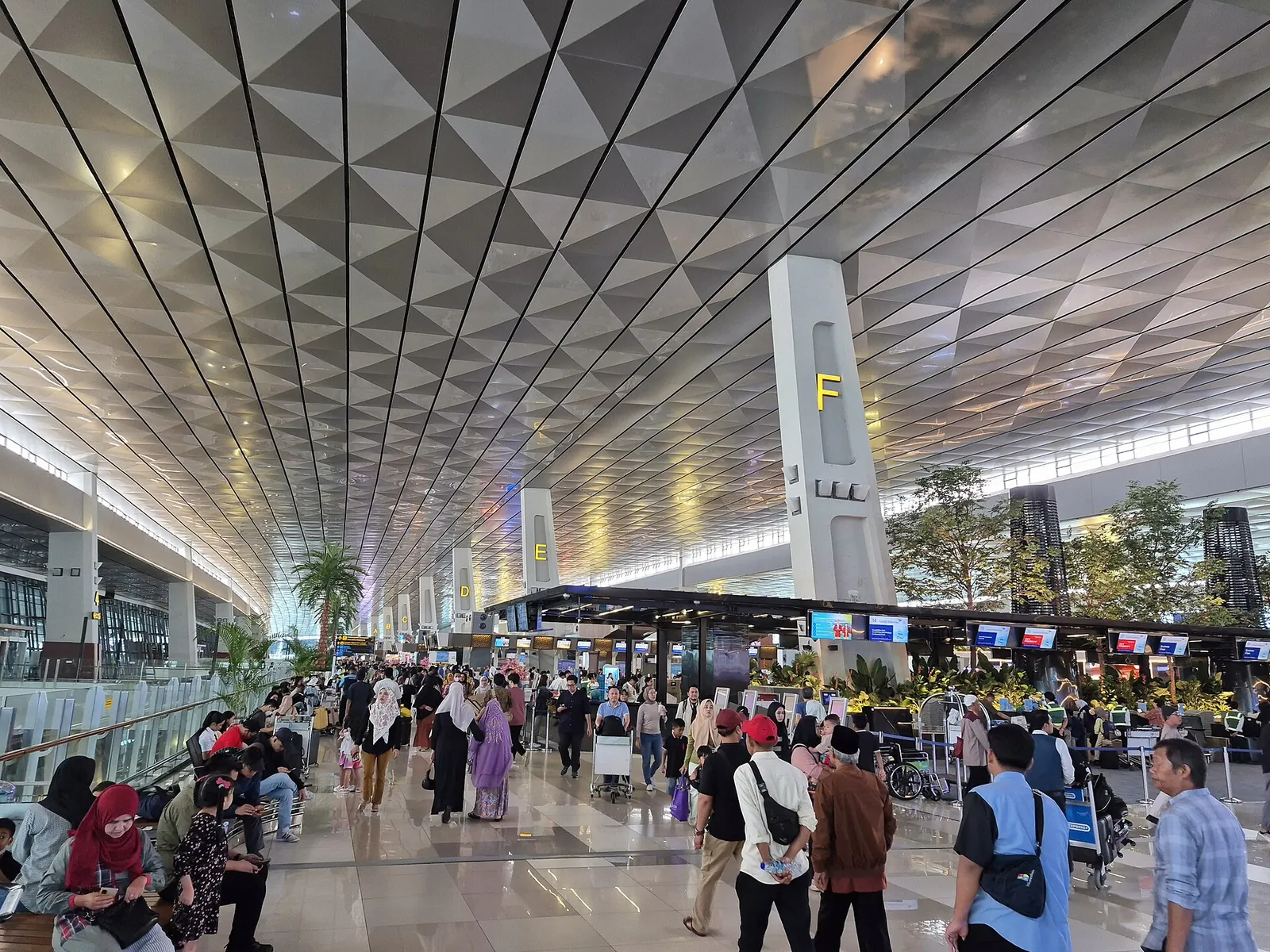
Terminal 3 at Jakarta's Soekarno-Hatta Airport, the main gateway to Java and an e-VOA entry point
Photograph: Medelam — opens in a new tab · CC BY-SA 4.0 — opens in a new tab
Changes: Resized and converted to WebP; displayed with responsive crops. · Original photograph and licence details ↗ — opens in a new tab
Batam Centre International Ferry Terminal, one of the seaports where e-VOA holders arriving from Singapore can enter
Photograph: Original uploader was Masgatotkaca at id.wikipedia — opens in a new tab · CC BY-SA 3.0 — opens in a new tab
Changes: Resized and converted to WebP; displayed with responsive crops. · Original photograph and licence details ↗ — opens in a new tab
Nasi campur at a warung in the international area of Ngurah Rai airport, an easy first meal in Bali
Photograph: Bahnfrend — opens in a new tab · CC BY-SA 4.0 — opens in a new tab
Changes: Resized and converted to WebP; displayed with responsive crops. · Original photograph and licence details ↗ — opens in a new tab