Jeju · Jeju
Jeju Island travel guide: how many days, car or bus, north or south
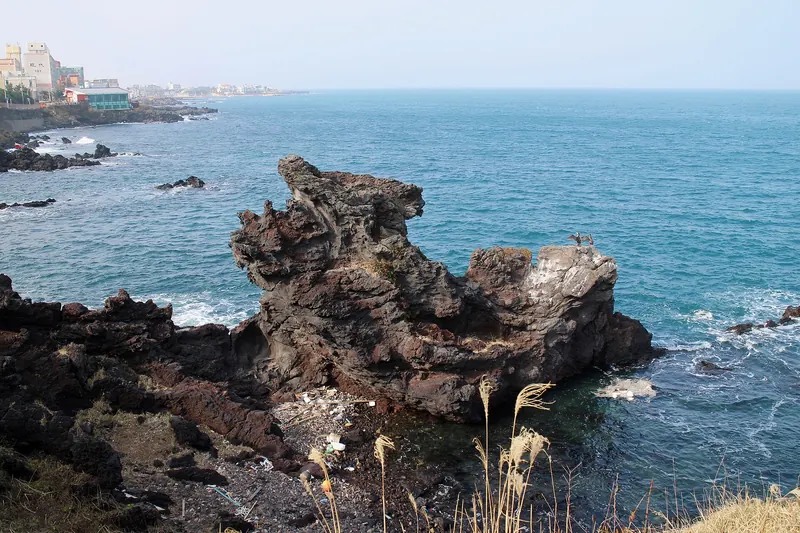
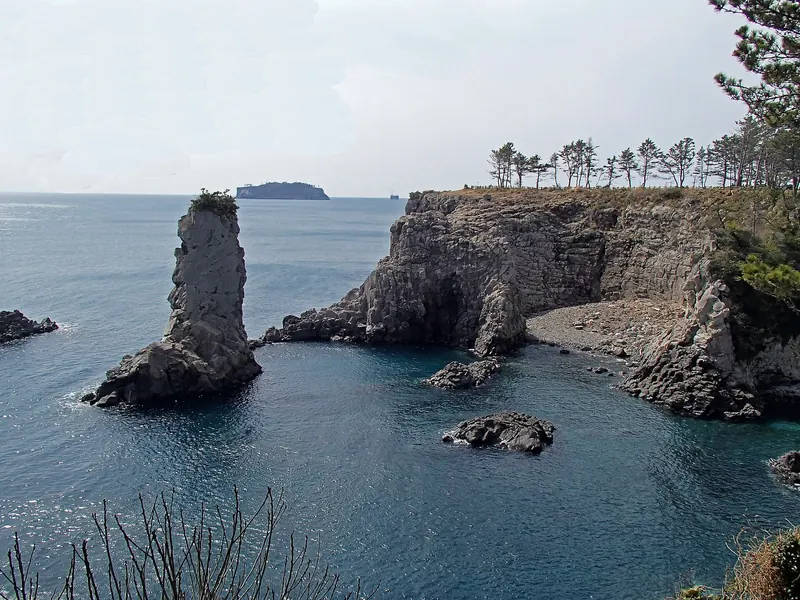
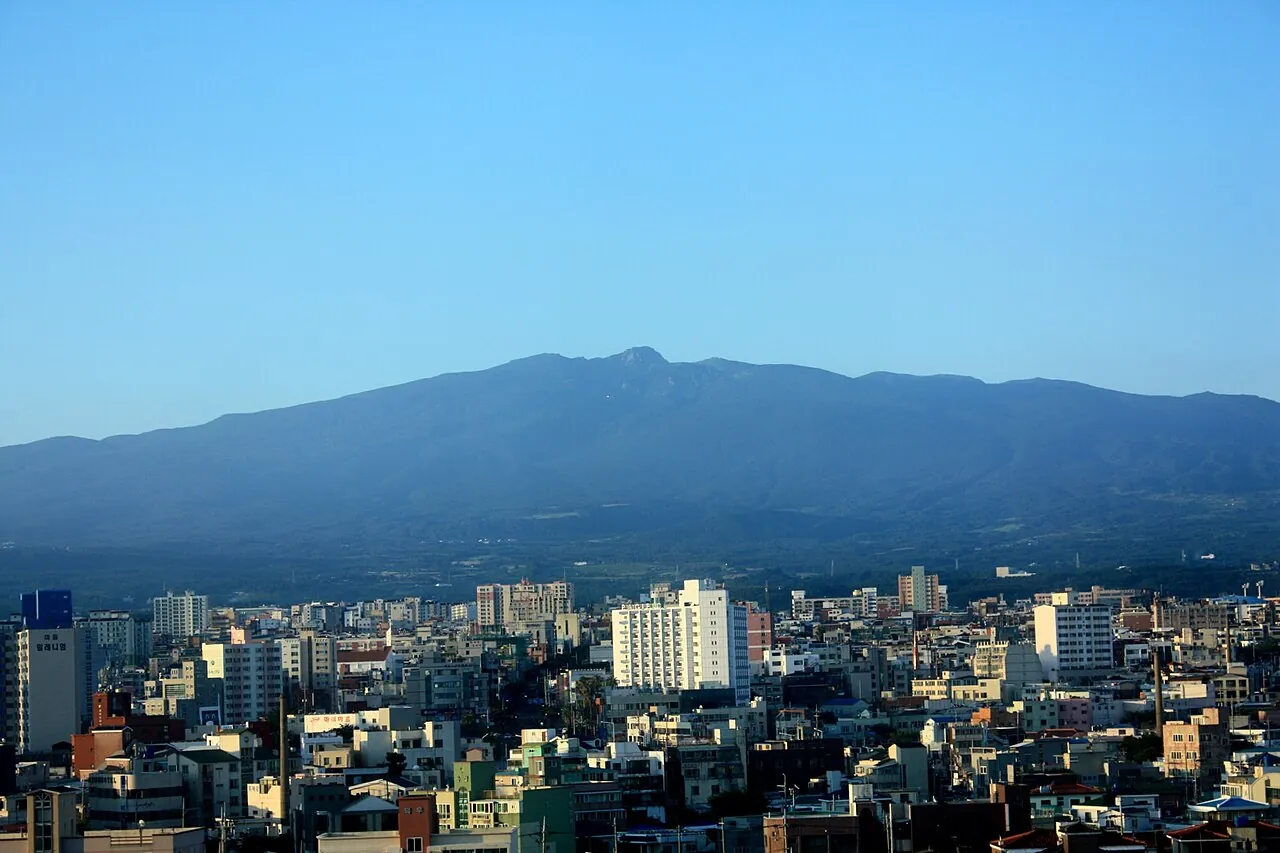
Jeju is a volcanic island off Korea's south coast, built around Hallasan, the country's highest mountain, and ringed by black basalt shores, white-sand beaches and more than 360 small volcanic cones. VisitKorea notes that Hallasan, the Seongsan Ilchulbong tuff cone and the Geomunoreum lava tube system together form Korea's first UNESCO World Natural Heritage site, and that the whole island is also a UNESCO Global Geopark and Biosphere Reserve. The island is big enough that where you sleep shapes the trip: Jeju City and the airport sit on the north coast, Seogwipo and its waterfalls on the warmer south coast, with the mountain in between. The decisions that matter most are how many nights to give it, whether to drive, and how to split the stay between north and south.
- Suggested time
- 4–6 nights
- Where to stay
- Jeju City (or Hamdeok or Aewol on the north coast) for the first half; central Seogwipo or Jungmun on the south coast for the second
- Season and timing
- Spring arrives first on Jeju: VisitKorea's 2026 cherry blossom forecast put the island, with Busan, first in the country, with blossoms around 25 March and full bloom after 1 April, and the canola fields on Seoubong by Hamdeok Beach flower from January to May. Summer is beach season at Hamdeok and Hyeopjae, but it is also typhoon season, and VisitKorea warns that ferry schedules to Udo, Marado and Biyangdo change with the weather. Autumn is mild walking weather; VisitKorea's 2026 foliage forecast had Hallasan's first colours on 31 October and the peak around 13 November. In winter, Hallasan's park office tells hikers to carry crampons, and the Jeju Camellia Arboretum near Namwon on the south coast is, in VisitKorea's words, one of the island's major winter attractions.
The short answer
Give Jeju four to six nights. Split them: two or three nights on the north side, in Jeju City or on the coast at Hamdeok or Aewol, for the airport, Dongmun Market and the east (Seongsan Ilchulbong, Udo, Manjanggul); then two or three nights in Seogwipo or Jungmun on the south coast for the waterfalls, the Olle Trail and Jusangjeolli. A rental car is the faster way to see the west coast, the inland forests and the small villages, and VisitKorea calls it the time-efficient choice; you need an international driving permit and should avoid driving at night. Without a car, the trip still works if you stay close to bus routes: limousine buses run from the airport to the south coast, and city buses follow both coasts, but they no longer take cash. If you want to climb Hallasan to the summit, book the trail reservation before you fix the rest of the plan.
How many days, and how to split north and south
Jeju is not a place to see from one hotel. Everything arrives at Jeju International Airport on the north coast, next to Jeju City, while Seogwipo, Jungmun and most of the waterfalls are on the far side of Hallasan. VisitKorea's airport guide estimates about 90 minutes by bus and 70 by taxi from the airport to central Seogwipo, about 70 minutes by bus to Hyeopjae Beach and Manjanggul, and about two hours by bus to Seongsan Ilchulbong in the east. A single base means repeating those journeys every day; two bases, one on each side, roughly halves them.
The north side (two or three nights). Jeju City is the practical base: close to the airport, with the island's largest traditional market, Dongmun Market, and the main bus terminal. If you would rather wake up by the sea, Hamdeok on the north-east coast and Aewol on the north-west are both about 40 minutes by taxi from the airport, according to VisitKorea. From the north side, the east coast (Seongsan Ilchulbong, Udo, Manjanggul and Hamdeok's beach) and the west coast (Hyeopjae and Biyangdo) are each a day out.
The south side (two or three nights). Central Seogwipo is the walking base, with Jeongbang and Cheonjiyeon falls, the Maeil Olle Market and three Olle Trail routes within reach; Jungmun is the resort area with large hotels, a surf beach and the Jusangjeolli lava columns. Our Seogwipo guide covers the choice in detail.
Four nights is the minimum for both sides of the island; five or six let you add Hallasan, one of the small islands or a full Olle walk without rushing. With only two or three nights, stay on one side and accept that you will see half the island.
Rental car or bus: what each one costs you in time
VisitKorea's Jeju overview calls a rental car the time-efficient way to explore the island, notes that many coastal and main roads are flat and easy to drive, and recommends avoiding driving at night because wildlife can appear suddenly on the roads after dark. Its airport guide adds that a car is more convenient for the west coast and inland areas, which is where buses are thinnest: the forests, the volcanic cones and the villages between the coasts.
To rent a car, VisitKorea's driving guide says short-term visitors need an international driving licence and a passport, must be over 21, and must pay by credit card in the driver's name; some companies also ask for your home licence, so bring it. Book online in advance; rental desks are found at airports. Traffic drives on the right, and Google Maps navigation does not work in Korea, so install Naver Map or Kakao Map before you arrive. Check what the insurance covers, especially damage to the rental car itself, which is not always included.
Without a car, Jeju is still workable, but plan around routes rather than sights. Jeju's city buses stopped accepting cash on 1 October 2024, according to VisitKorea; pay with a transportation card or by scanning the QR code beside the driver. On the east coast, VisitKorea compares two routes: bus 201, a slow city bus from Jeju Bus Terminal to Seogwipo Bus Terminal that stops at almost every attraction but does not serve the airport, and bus 101, an express from the airport towards Namwon-eup with fewer stops and a luggage hold. In its February 2025 column, VisitKorea gave intervals of 30 to 80 minutes for bus 201, so check the times before you rely on a connection.
A sensible compromise: go car-free in Jeju City and Seogwipo, where the sights are walkable and taxis are easy, and rent a car for two or three days in the middle of the trip for the west coast, the inland forests and Hallasan's trailheads.
Make time for the local food
What to eat and where to look
Jeju black pork (heukdwaeji) and dombegogi
The island's best-known meat. VisitKorea describes Jeju black pork as pasture-raised and grilled at barbecue restaurants across the island, and dombegogi as black pork steamed and sliced on a wooden board at the table.
- Where to look
- Barbecue restaurants in Jeju City, Seogwipo and Jungmun; at the Dongmun night market, VisitKorea mentions black pork kimchi rolls.
- Fit it into your day
- An evening barbecue for two or more; dombegogi works as a lighter shared plate.
Contains pork; table grills mean smoke on your clothes.
Galchiguk and okdom gui
Two everyday Jeju fish dishes: galchiguk, a clear cutlassfish soup that VisitKorea describes as boiled with vegetables such as pumpkin and cabbage, and okdom gui, grilled red tilefish, which VisitKorea calls the best of its kind for its mild flavour.
- Where to look
- Fish restaurants in Jeju City and Seogwipo; our Seogwipo guide lists specific places.
- Fit it into your day
- Lunch with rice and side dishes, or a simple breakfast before a long day out.
Both fish have fine bones.
Haenyeo seafood
Jeju's haenyeo are women who free-dive without breathing equipment for shellfish and seaweed; VisitKorea notes that their culture is on UNESCO's Intangible Cultural Heritage list. Haenyeo's Kitchen serves the divers' catch with storytelling: a buffet with a live performance at its Jongdal branch near Seongsan, and a multi-course meal with media art at its Bukchon branch.
- Where to look
- Haenyeo's Kitchen in Jongdal (east coast) or Bukchon (north-east), with the Jeju Haenyeo Museum nearby; seafood stalls in Dongmun Market.
- Fit it into your day
- A lunch or dinner on the east-coast day; check Haenyeo's Kitchen's schedule before you go, since the meals are built around a performance or programme.
Shellfish-heavy; avoid raw seafood if you are pregnant or immunocompromised.
Dongmun night market street food
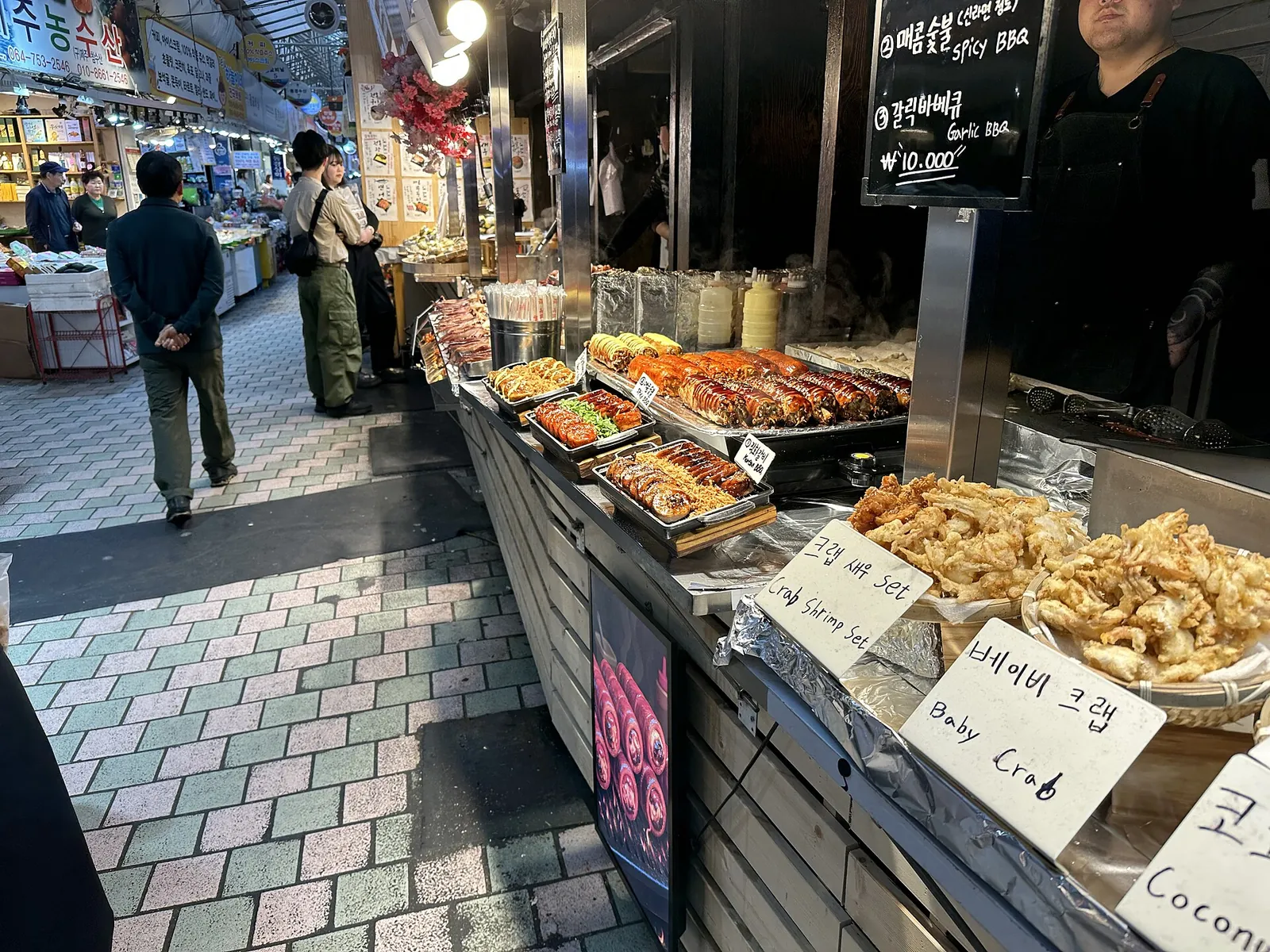
Jeju Dongmun Traditional Market is the island's largest traditional market, with a history of more than 80 years, according to VisitKorea; every evening the area around Gate 8 becomes a night market with snacks such as black pork kimchi rolls and abalone gimbap, along with dakgangjeong (crisp glazed fried chicken) and skewers.
- Where to look
- Dongmun Market in Jeju City, about 20 minutes by bus or 15 by taxi from the airport, according to VisitKorea.
- Fit it into your day
- Dinner on the first or last night in Jeju City.
Busy in the evening; carry a card and some cash, and check prices before ordering.
Hallabong, tangerines and omegitteok
Jeju's warm climate grows mandarins and hallabong citrus, sold whole, as juice and in sweets. Omegitteok are millet rice cakes rolled in bean powder or mashed red bean, a Jeju speciality VisitKorea recommends at the markets.
- Where to look
- Dongmun Market in Jeju City and the Maeil Olle Market in Seogwipo.
- Fit it into your day
- Snacks for a walk or a drive, and an easy souvenir.
Rice cakes are best eaten the same day.
The east: Seongsan Ilchulbong, Udo and the lava tubes
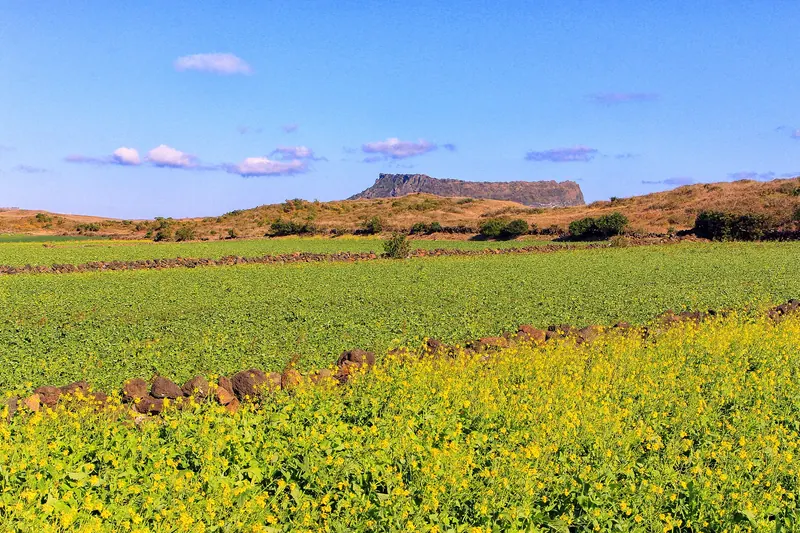
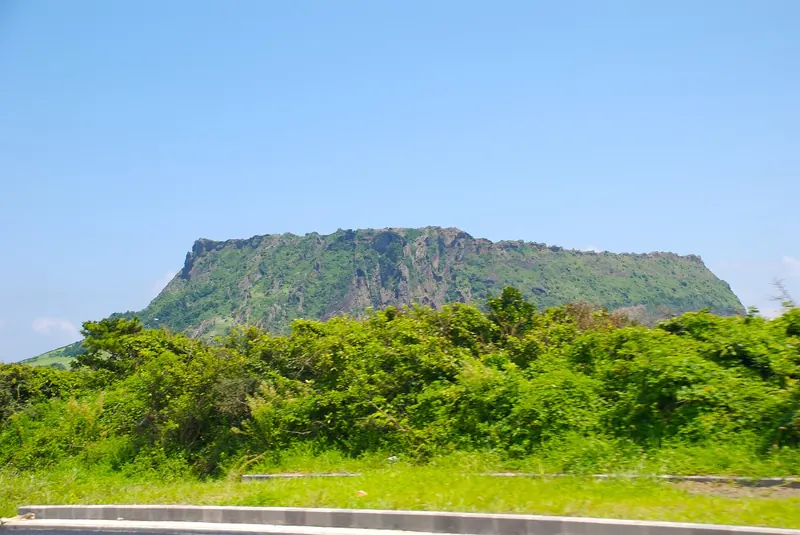
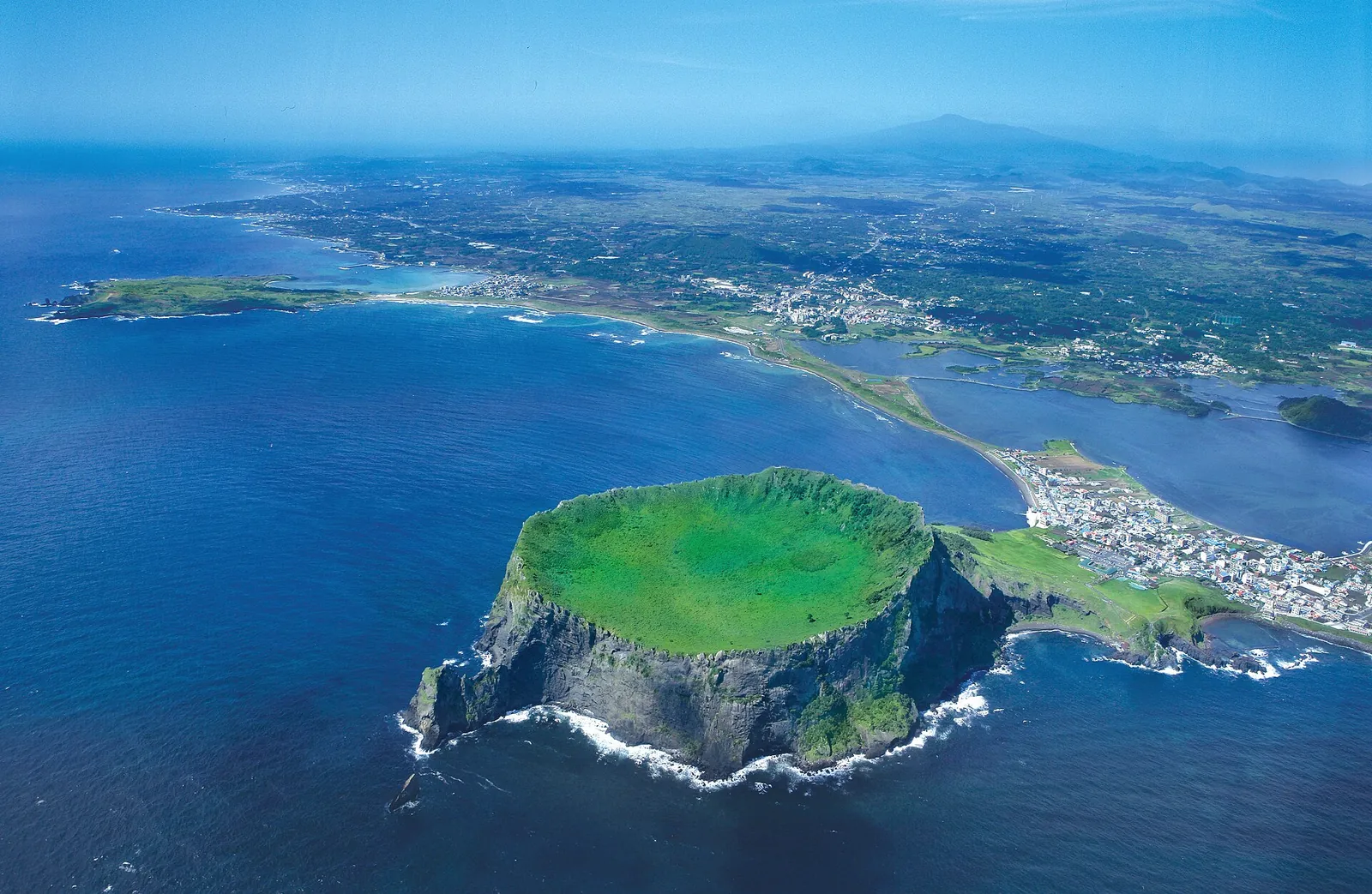
Seongsan Ilchulbong is the island's signature view: a tuff cone formed by an underwater eruption in shallow sea around 5,000 years ago, according to VisitKorea, with a crater about 600 metres across. The summit takes about 30 minutes on foot, and it is one of Jeju's best-known sunrise spots. A free coastal path runs around the base; the climb to the top is ticketed, and VisitKorea's February 2025 bus column listed 5,000 won. Gwangchigi Beach, about 25 minutes' walk away, has black basalt sand and, at low tide, moss-covered rocks below the cone.
From Seongsan Port, the ferry to Udo takes about 15 minutes. Udo is the largest of Jeju's offshore islands; VisitKorea describes a 17-kilometre loop that takes two to three hours by electric bike, and Sanho Beach, whose pale sand is made of rhodolith fragments, calcified red algae. Ferry times change with the weather, so check before you go.
Inland, Manjanggul is a lava tube that stays at about 12°C all year, according to VisitKorea; around one kilometre of its 7.4 kilometres is open to visitors, ending at a 7.6-metre lava column. Closer to Jeju City, Hamdeok Beach has emerald water and a short climb up the Seoubong cone for views of the sea and Hallasan. These four can fill a full day from the north side, or two at a slower pace.
The west: Hyeopjae, Biyangdo and the road to Marado
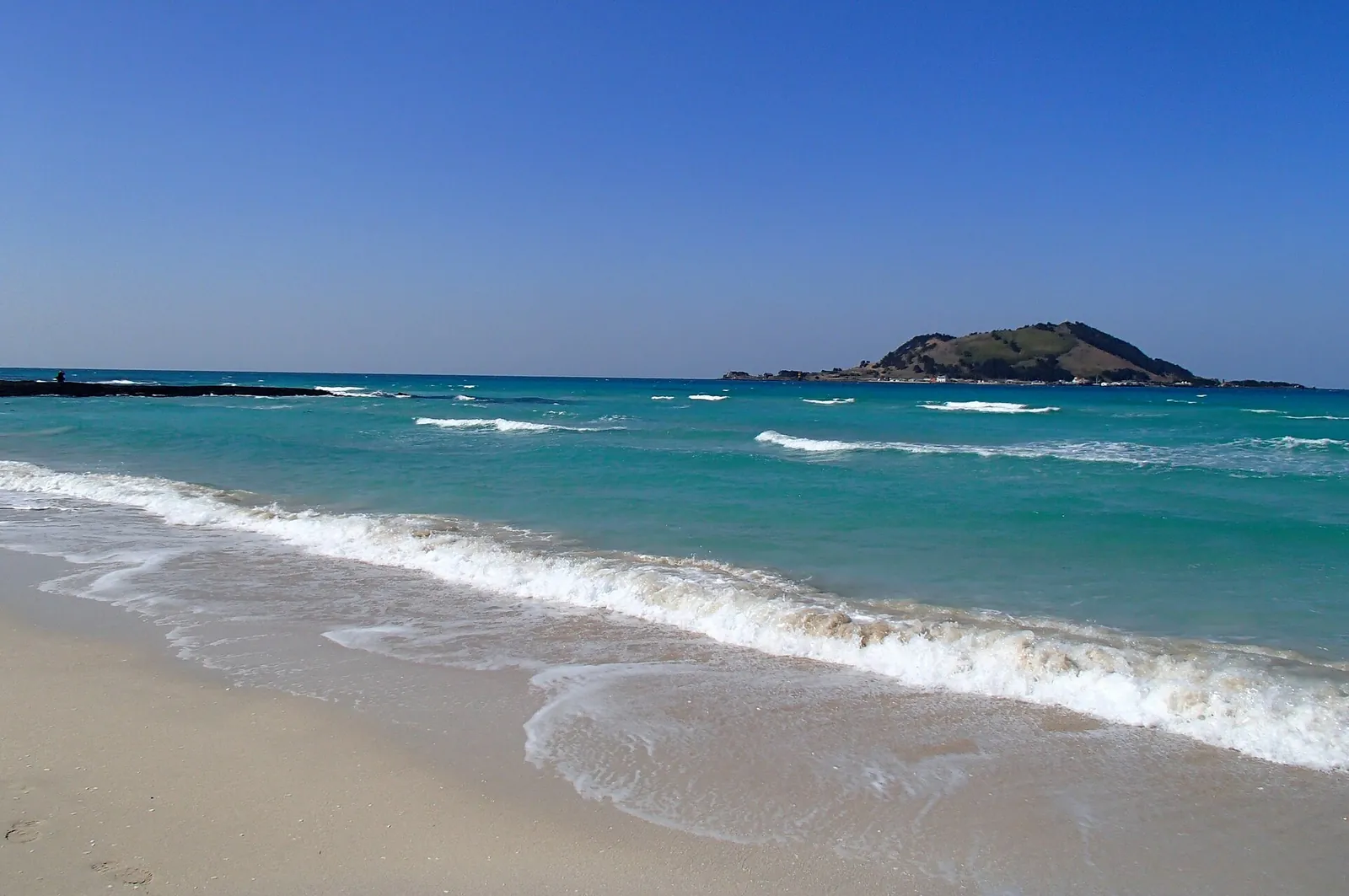
Hyeopjae Beach, on the west coast, has white sand, pine woods and shallow, gently sloping water; VisitKorea's listing describes it as ideal for swimming and notes that the sunsets behind Biyangdo Island are especially fine. When we checked on 2026-10-03, the listing gave it as open 24 hours, all year. The beach runs straight into Geumneung Beach next door.
Biyangdo is about 15 minutes by ferry from Hallim Port. VisitKorea describes a small island of volcanic features: around 20 hornitos (lava chimneys) along the north coast, a volcanic bomb of about 10 tonnes, the Peollangmot salt marsh with a boardwalk, and Biyangbong, a 114-metre cone that takes about 20 minutes to climb for a view back to Hyeopjae.
Further south-west, ferries from Unjin Port and Songaksan Port reach Marado, Korea's southernmost island, in about 30 minutes. VisitKorea gives its size as only 500 metres wide and 1.3 kilometres long; you can walk round it in about an hour to the southernmost-point monument and the 1915 lighthouse. Each of the small islands is a half-day trip, according to VisitKorea; pick one rather than all three.
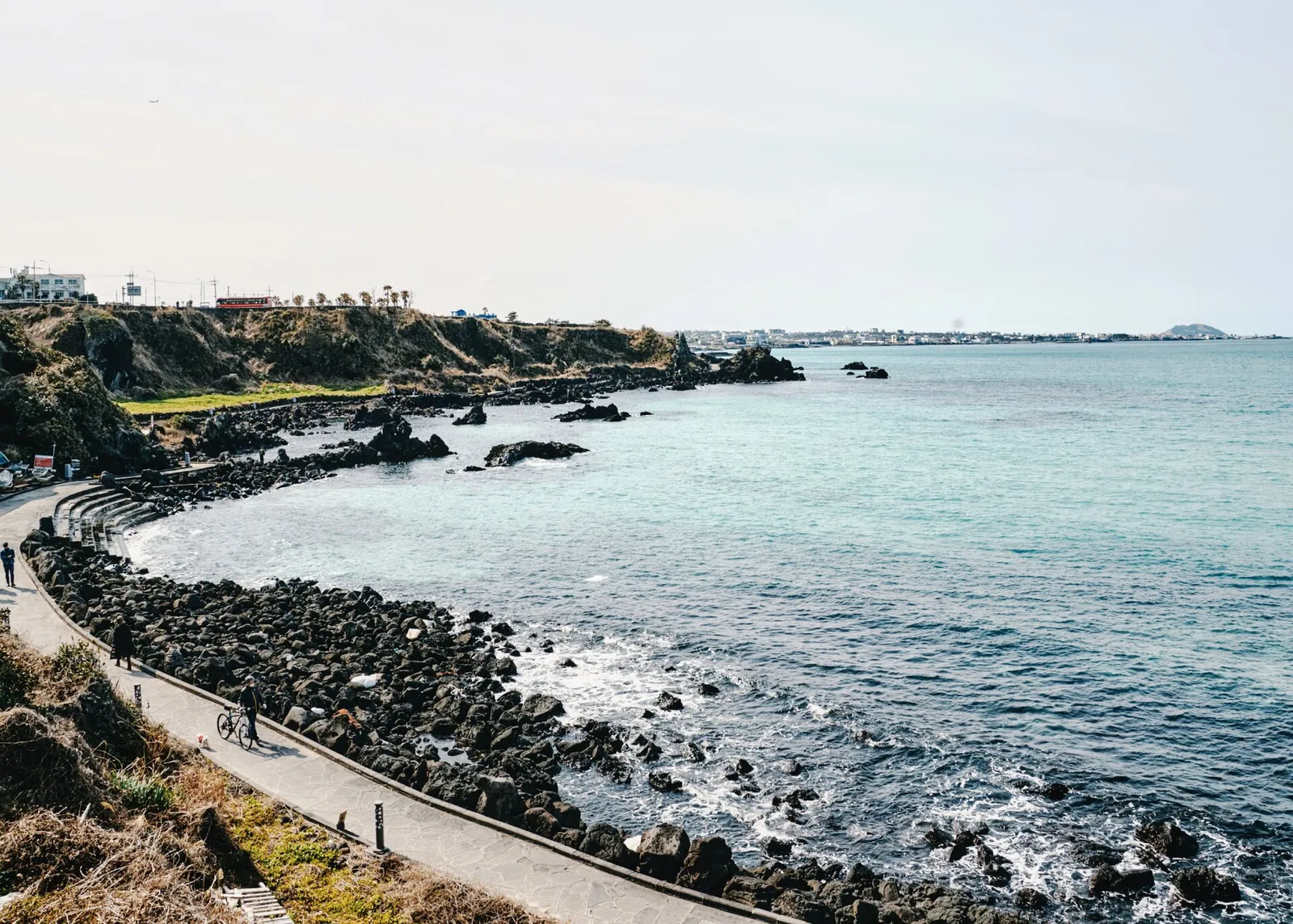
The west is where a car helps most. The Olle Trail also runs along this coast: VisitKorea describes the whole network as 437 kilometres in 27 routes, and Route 15-B in Aewol follows the shore on paved paths, an easy sample if you are staying on the north-west coast.
Hallasan and the forests in the middle
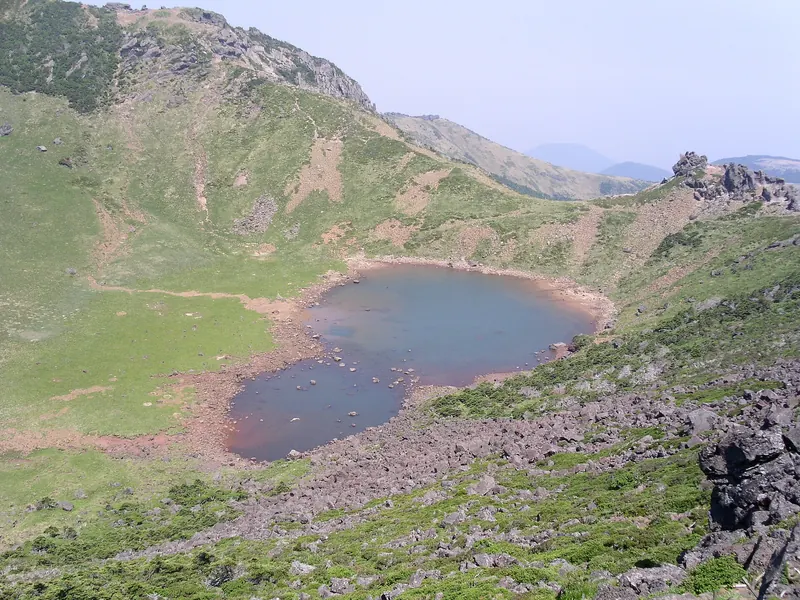
Hallasan rises to 1,947 metres in the centre of the island. Of its seven trails, VisitKorea says, only Seongpanak and Gwaneumsa reach Baengnokdam, the crater lake at the summit, and the summit trail requires an advance reservation with limited places. VisitKorea lists bus 181 from Gate 2 of the airport, or bus 281 from Jeju Bus Terminal, to the Seongpanak stop. If you do not want a full summit day, the Yeongsil trail climbs past the Byeongpungbawi cliffs to Witseoreum and descends to Eorimok without reaching the crater; VisitKorea notes that private cars cannot park at its entrance and recommends a taxi. The lower Hallasan Eco-trail runs through forest at 600 to 800 metres.
The Hallasan National Park office warns that there are no shops on the trails: bring enough water, food, rain gear and, in winter, crampons, and avoid hiking alone on the long summit routes. Keep a whole day for the summit and make it the day after a quiet one; see our Hallasan guide for the routes.
Between the coasts, VisitKorea singles out forest walks: Saryeoni Forest Path, through dense Japanese cedar, and Bijarim, a natural monument with about 2,800 nutmeg-yew (bija) trees aged 500 to 800 years. Both are easiest to reach by car.
A five-night plan
This is an editorial outline, not a timetable. Check ferry and trail conditions each morning, and swap days around the weather: keep a clear, calm day for Hallasan or the ferry islands, and a grey one for markets and lava tubes.
- Night 1 — Jeju City: arrive at the airport, check in, and eat at the Dongmun Market night market around Gate 8.
- Day 2 — The east: Seongsan Ilchulbong in the morning (or at sunrise if you stay in Seongsan), Gwangchigi Beach, Udo by ferry from Seongsan Port, and Hamdeok Beach on the way back.
- Day 3 — The west: Hyeopjae Beach and Biyangdo from Hallim Port, or the Aewol coast on Olle Route 15-B; stay for the sunset behind Biyangdo. A car makes this day much easier.
- Day 4 — Hallasan, then south: hike Seongpanak to the summit (reservation required) or the shorter Yeongsil trail, then move to Seogwipo or Jungmun for the night.
- Days 5–6 — The south coast: Jeongbang and Cheonjiyeon falls, the Maeil Olle Market and Olle Route 7 past Oedolgae; Jusangjeolli and Jungmun's beach on the last day before the transfer back to the airport.
Practical questions
How many days do I need on Jeju?
Four to six nights. Four is enough for the east coast, the west coast, a day on the south coast and a short Hallasan walk; five or six add the summit hike, a ferry island or a full Olle Trail route. With two or three nights, stay on one side of the island.
Should I stay in Jeju City or Seogwipo?
Both, if you have four nights or more: two or three in Jeju City (or Hamdeok or Aewol) for the airport, the market and the east and west coasts, then two or three in Seogwipo or Jungmun for the waterfalls and the Olle Trail. VisitKorea estimates about 90 minutes by bus from the airport to central Seogwipo, so a single base means a lot of repeat travel.
Do I need a car on Jeju?
Not strictly, but it saves a lot of time. VisitKorea calls a rental car the time-efficient choice and says it is more convenient for the west coast and inland areas. You need an international driving licence, a passport, a credit card in the driver's name, and you must be over 21. Without a car, use the airport limousine buses and the city buses, which take transportation cards or QR payment, not cash.
Can I pay cash on Jeju buses?
No. VisitKorea reports that Jeju's city buses stopped accepting cash on 1 October 2024, and the airport limousine buses 600 and 601 are card-only. Use a transportation card or scan the QR code on the bus and pay on your phone.
Do I need to book Hallasan?
For the summit, yes. VisitKorea says the trail to the top requires a reservation and has limited capacity; only the Seongpanak and Gwaneumsa trails reach Baengnokdam crater lake. Other trails, such as Yeongsil, stop below the summit.
How do I get to Jeju from Seoul or Incheon?
By domestic flight. From Seoul, flights leave from Gimpo; from Incheon International Airport, VisitKorea suggests the limousine bus to Gimpo (about 33 minutes) and a flight of about 1 hour 10 minutes. Jeju also has direct international flights, and passenger ferries run from Mokpo, Jindo, Yeosu, Wando and Samcheonpo to Jeju Port.
Sources and checks before you travel
Reference sources for the version dated 3 October 2026. Confirm opening times, access, transport and conditions for your travel dates.
- VisitKorea: [Korea Beyond Seoul ③] Fly to Jeju International Airport and Enjoy Jeju ↗ — opens in a new tab
- VisitKorea: Jeju Island, a Picturesque Paradise for a Peaceful Retreat ↗ — opens in a new tab
- VisitKorea: Jeju's East Coast Itinerary by City Bus! ↗ — opens in a new tab
- VisitKorea: Airport Transportation Guide (Jeju International Airport) ↗ — opens in a new tab
- VisitKorea: Driving in Korea ↗ — opens in a new tab
- VisitKorea: Hyeopjae Beach ↗ — opens in a new tab
- VisitKorea: Best hiking trails in Korea's national parks ↗ — opens in a new tab
- Hallasan National Park (Jeju Special Self-Governing Province) ↗ — opens in a new tab
- VisitKorea: Explore Beyond Seoul at SONO Hotels & Resorts ↗ — opens in a new tab
- VisitKorea: 2026 Cherry Blossom Forecast ↗ — opens in a new tab
- VisitKorea: 2026 Fall Foliage Forecast ↗ — opens in a new tab
Photo credits
Seongsan Ilchulbong on Jeju's east coast, a tuff cone joined to the main island by a narrow strip of land
Photograph: Korea.net / Korean Culture and Information Service — opens in a new tab · CC BY-SA 2.0 — opens in a new tab
Changes: Resized and converted to WebP; displayed with responsive crops. · Original photograph and licence details ↗ — opens in a new tab
Hyeopjae Beach on Jeju's west coast, looking out to Biyangdo Island
Photograph: Lcarrion88 — opens in a new tab · CC BY-SA 4.0 — opens in a new tab
Changes: Resized and converted to WebP; displayed with responsive crops. · Original photograph and licence details ↗ — opens in a new tab
Fried snacks and seafood at a stall in Jeju Dongmun Traditional Market, Jeju City
Photograph: Grapesurgeon — opens in a new tab · CC BY-SA 4.0 — opens in a new tab
Changes: Resized and converted to WebP; displayed with responsive crops. · Original photograph and licence details ↗ — opens in a new tab
Jeju City on the north coast, with Hallasan rising behind it in the centre of the island
Photograph: J. Patrick Fischer — opens in a new tab · CC BY-SA 3.0 — opens in a new tab
Changes: Resized and converted to WebP; displayed with responsive crops. · Original photograph and licence details ↗ — opens in a new tab
The Handam coastal path on Jeju Olle Route 15-B in Aewol, north-west Jeju
Photograph: Jeju Olle Foundation — opens in a new tab · CC BY-SA 4.0 — opens in a new tab
Changes: Resized and converted to WebP; displayed with responsive crops. · Original photograph and licence details ↗ — opens in a new tab