Kanagawa
Kamakura day trip from Tokyo: the route, trains, Enoshima and stays
Kamakura was the seat of Japan's first samurai government, and its Zen temples, great shrine and open-air bronze Buddha are about an hour from Tokyo by train. That closeness is also its problem: Kamakura City counted about 16.06 million visits in 2025, and most of them squeeze into the same few streets. The sights run in a rough line, from the Zen temples of Kita-Kamakura in the north, through Tsurugaoka Hachimangu and Kamakura Station, to the Great Buddha at Hase near the sea, with Enoshima further west along the coast. Plan the day as one direction of travel along that line and it becomes calm, walkable and easy to extend.
In this guide
Find the location ↗ — opens in a new tabThe short answer
Give Kamakura one full day from Tokyo: take the JR Yokosuka Line to Kita-Kamakura, walk south through the Zen temples to Tsurugaoka Hachimangu, then ride the Enoden to Hase for the Great Buddha. If the Buddha matters most, reverse the route and be at Kotoku-in when it opens at 08:00. To add Enoshima, stay on the Enoden to the coast and return to Shinjuku on the Odakyu line, which suits the Enoshima-Kamakura Freepass. Stay a night, near Kamakura Station, at Yuigahama or on Enoshima, if you want both at an easy pace or Hokokuji's bamboo grove as well.
- Suggested time
- 1 full day from Tokyo; 1 night to add Enoshima, Hokokuji or a hiking trail without rushing
- Where to stay
- A day trip from Tokyo; for a night, the Kamakura Station area, Yuigahama near Hase, or Enoshima and Katase-Kaigan
- Season and timing
- The tourism association lists cherry blossom in April, hydrangeas in June (the rainy season), beaches open from 1 July to 31 August in the hottest months, and autumn leaves at their best from late November to early December.
One day or one night, and where to sleep if you stay
Kamakura works as a day trip because its main sights sit on one line. Engaku-ji is a minute's walk from Kita-Kamakura Station on the JR line from Tokyo, Tsurugaoka Hachimangu is ten minutes on foot from Kamakura Station, and the Enoden reaches Hase, for the Great Buddha and Hase-dera, in five minutes. That covers the classic day. What one day cannot comfortably hold is all of that plus Enoshima, Hokokuji's bamboo grove on the east side of town, or a hiking trail; JNTO says the area can easily fill a whole day and strongly recommends an overnight stay.
If you do stay, choose by the morning you want. The Kamakura Station area (Komachi, Onarimachi and Yukinoshita) has hotels the tourism association lists a few minutes' walk from either exit, with JR, the Enoden and buses on the doorstep. Yuigahama, between Kamakura and Hase, has small hotels and guesthouses a few minutes from Yuigahama and Wadazuka stations on the Enoden, closer to the beach and the Great Buddha. Enoshima and Katase-Kaigan have traditional inns on the island and hotels by Katase-Enoshima Station, listed by Fujisawa's tourism association: the best choice for a sunset on the coast, the worst for an early start at Kita-Kamakura. Ofuna, about 10 minutes from Kamakura on the JR Yokosuka Line, has chain hotels by the station and the Shonan Monorail to Enoshima.
On a day trip with suitcases, use the Kamakura City Tourist Association's luggage service in the Enoden Building just outside the West Exit of Kamakura Station. When we checked on 10 October 2026, it stored bags from 09:00 to 17:00 for ¥300 a piece, or ¥700 if any side is longer than 40 cm, with no reservation needed; the association notes that coin lockers around the station are limited.
Getting there: JR from Tokyo, or Odakyu and the Freepass from Shinjuku
The JR Yokosuka Line runs from Tokyo and Shinagawa stations to Kita-Kamakura and Kamakura without a change. The tourism association gives about 60 minutes from Tokyo and about 50 from Shinagawa; JNTO puts it at 55 minutes from Tokyo Station. From Shinjuku, the JR Shonan-Shinjuku Line also serves both stations, and Hokokuji's access page gives about 53 minutes on a direct train. Get off at Kita-Kamakura for the route this page recommends.
Odakyu's Enoshima-Kamakura Freepass suits the other approach, from Shinjuku by way of Fujisawa. When we checked on 10 October 2026, Odakyu listed it at ¥1,640 for adults from Shinjuku: a discounted return to Fujisawa, plus one day of unlimited rides on the whole Enoden line and on the Odakyu line between Fujisawa and Katase-Enoshima. Odakyu notes that its express trains bound for Fujisawa need no change, and that a Romancecar seat costs ¥750 extra each way to Fujisawa or Katase-Enoshima. The pass is sold at Odakyu stations or as a phone ticket through Odakyu's EMot service, no more than a month before use. It does not cover JR, so it pays only on a day that starts and ends on the Odakyu side, which usually means one that includes Enoshima.
The Enoden links Kamakura with Hase, Enoshima and Fujisawa. Enoshima Electric Railway lists Kamakura to Hase at 5 minutes and ¥200, Kamakura to Enoshima at 23 minutes and ¥260, and Kamakura to Fujisawa at 34 minutes and ¥310. Suica, PASMO and contactless bank cards work at the gates, so the ¥800 one-day Noriorikun ticket is worth buying only if you plan to hop on and off several times.
What to eat and where to look
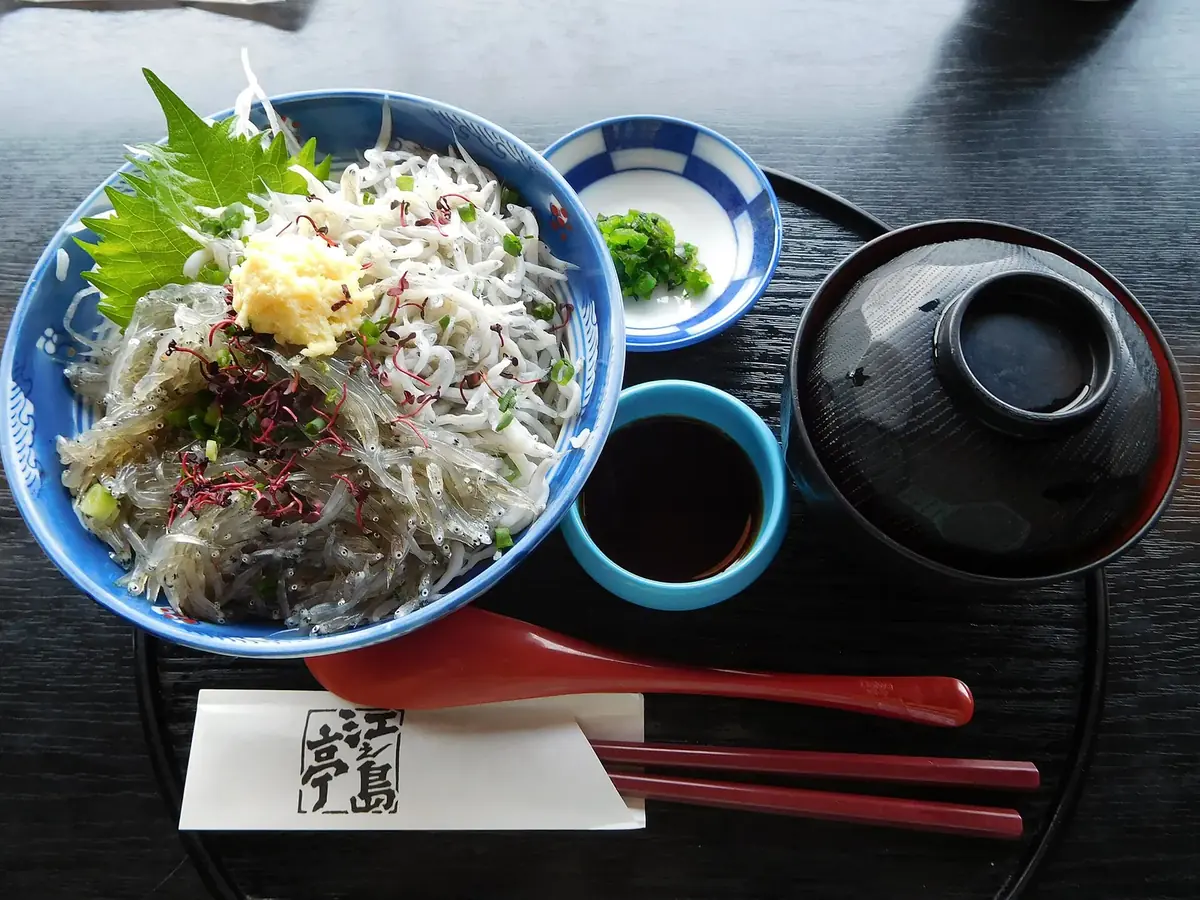
Shirasu-don (whitebait rice bowl)
Whitebait, the young of Japanese anchovies and sardines caught in Sagami Bay, piled on rice. Boiled shirasu is the usual topping, and on some days restaurants serve it raw as nama-shirasu. Both the Kamakura and the Fujisawa tourism associations name it as the local speciality.
- Where to look
- Restaurants in Kamakura and on Enoshima; on the island, Fujisawa's tourism association notes that raw whitebait caught that morning is available on some days.
- Fit it into your day
- Lunch between Hachimangu and Hase, or an early dinner on Enoshima before the train back.
Fish. Raw shirasu depends on the day's catch, so it is not always on the menu; Fujisawa's tourism association also lists whitebait bread, croquettes and rice crackers for anyone who prefers it cooked.
Shojin ryori (Buddhist temple cuisine)
Temple cooking without meat or fish, built on grains and vegetables and shaped by the Buddhist precepts against taking life and indulging desire. The tourism association counts it among the legacies of the Zen culture that came from China in the Kamakura period (1185–1333).
- Where to look
- Odakyu's Kamakura itinerary suggests Cafe Guri in the Kamakura-bori Assembly Hall on Komachi, about five minutes' walk from Kamakura Station, which serves shojin sets made with Kamakura vegetables and closes on Mondays. Hase-dera's Kaikoan restaurant serves vegetarian curry and vegan pasta.
- Fit it into your day
- A sit-down lunch after the Zen temples of Kita-Kamakura.
Usually suitable for vegetarians and vegans, but ask about the stock. Odakyu notes that the seasonal set at Cafe Guri must be reserved in advance.
Kenchinjiru (vegetable and tofu soup)
A soup of vegetables and tofu that, according to the tourism association, is believed to have originated at Kencho-ji, the Zen temple in Kita-Kamakura.
- Where to look
- Japanese restaurants and set-meal menus around town; it usually comes as the soup with a set meal rather than on its own.
- Fit it into your day
- A warming bowl with lunch on a cold day after the temples.
Restaurant versions may use fish stock or add meat; ask if it matters to you.
Kamakura vegetables
Vegetables grown in and around Kamakura are sold under the Kamakura vegetables name, and the tourism association notes that restaurants in and beyond the city put them on their menus.
- Where to look
- Renbai, the Kamakura Farmers' Market, and local supermarkets; look for the name on restaurant menus.
- Fit it into your day
- A vegetable-led lunch, or a morning browse at the market if you are staying overnight.
What is on sale changes with the season. The tourism association warns that kites swoop on food eaten outdoors in parks and on the beach.
Tako-senbei (Enoshima octopus crackers)
Rice crackers made with whole octopus and cooked at the shop front. Fujisawa's tourism association says two or three octopuses go into each one, and that shops also make shrimp and jellyfish versions.
- Where to look
- Shops on Enoshima, along the street that leads to Enoshima Shrine.
- Fit it into your day
- A snack on the walk up the island, or a souvenir; the association notes that they keep well.
Contains octopus, and the variants contain shrimp or jellyfish. Eat under cover or indoors because of the kites.
Kita-Kamakura to Tsurugaoka Hachimangu: the Zen temples first
Engaku-ji begins a minute from Kita-Kamakura Station. The regent Hojo Tokimune invited the Chinese monk Mugaku Sogen to found it, to placate the spirits of warriors who died fighting the Mongol invasions, and more than twenty halls climb the valley from the Sanmon gate to the Buddha hall and beyond; the Shariden reliquary hall is a National Treasure. When we checked on 10 October 2026, the temple listed admission at ¥500 and opening hours of 08:30–16:30 from March to November and 08:30–16:00 from December to February.
Meigetsu-in, ten minutes' walk from the station, is known as the Hydrangea Temple; the tourism association lists it at ¥500, open 09:00–16:00, with times that may change in June. Kencho-ji, about 15 minutes' walk along the road towards Kamakura, ranks first among Kamakura's five great Zen temples and was founded in 1253 by the regent Hojo Tokiyori as Japan's first monastery for training Zen monks; its great gate, Buddha hall and lecture hall stand in a straight line. Its site listed admission at ¥500, cash only, and hours of 08:30–16:30, and it holds a free zazen session open to all on Fridays and Saturdays from 15:30 to 16:30 (temple admission still applies).
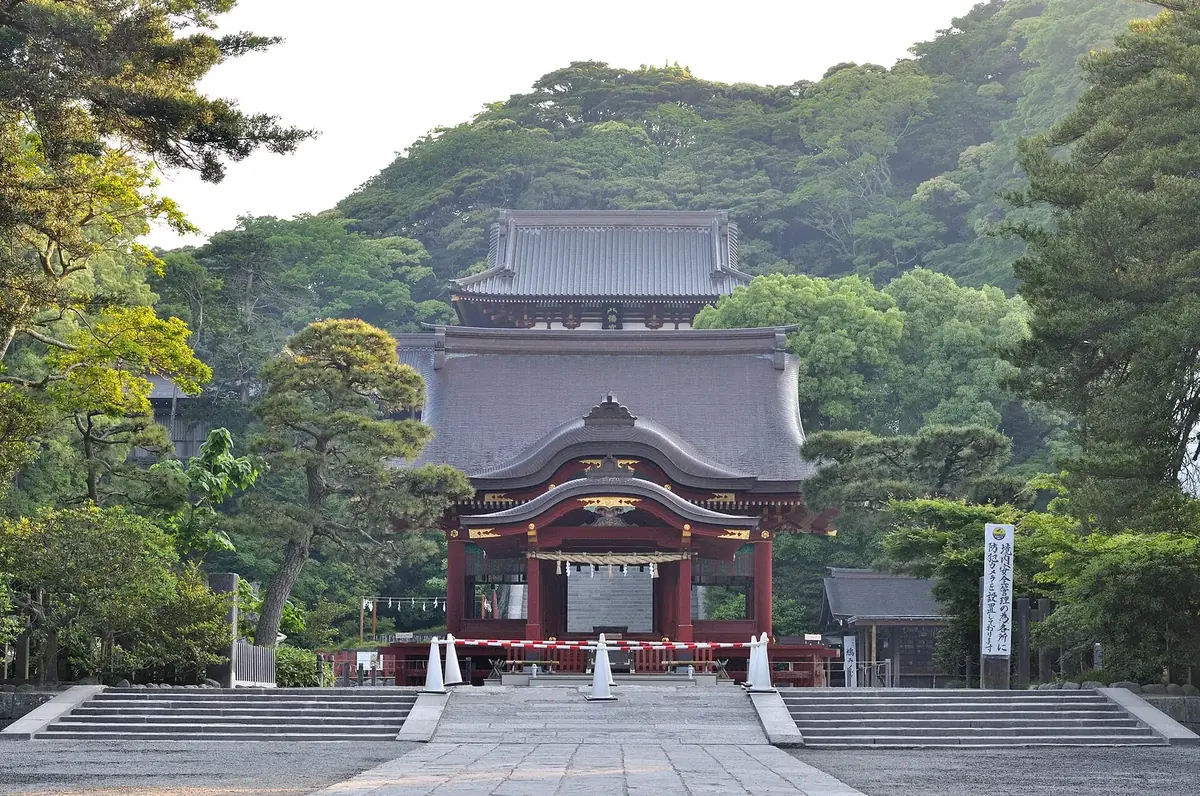
From Kencho-ji the road continues to Tsurugaoka Hachimangu, the shrine Minamoto no Yoritomo moved to its present site in 1180 and around which the city grew. The tourism association lists its gate as open from 06:00 to 20:00, and it is a ten-minute walk from Kamakura Station. Komachi-dori, the shopping street that runs parallel to the shrine approach towards the station, is the obvious place for lunch, but the city's manners ordinance asks you to think of others when eating on the street, and smoking is banned in the zone between Kamakura Station and the shrine.
Hase: the Great Buddha and Hase-dera
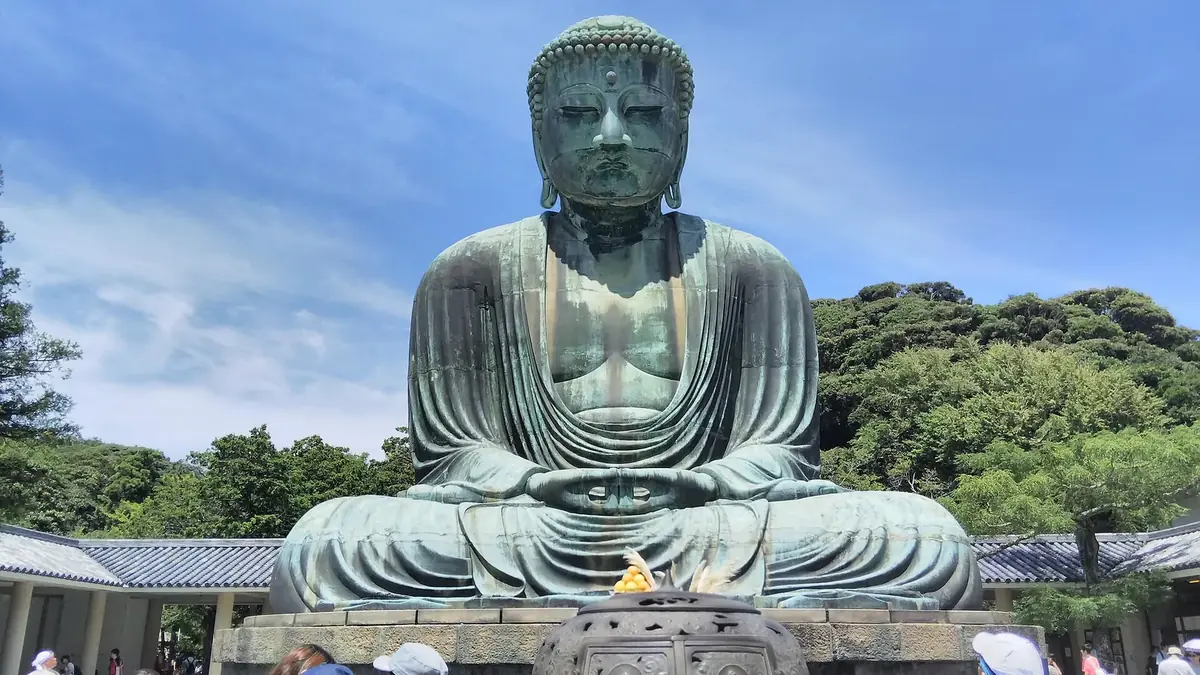
From Kamakura Station the Enoden takes five minutes to Hase, and Kotoku-in is a seven-minute walk from there; Enoden and Keikyu buses from the East Exit of Kamakura Station also stop at Daibutsu-mae in about ten minutes. The bronze Amida Buddha, a National Treasure some 11.3 m tall and weighing around 121 tonnes, was begun in 1252 according to the Azumakagami, a chronicle of the Kamakura shogunate. Typhoons in 1334 and 1369 and an earthquake in 1498 destroyed the hall that once housed it, and it has sat in the open ever since. When we checked on 10 October 2026, Kotoku-in listed admission at ¥300, ¥50 more to step inside the statue (08:00–16:30), and opening hours of 08:00–17:30 from April to September and 08:00–17:00 from October to March, with last entry 15 minutes before closing.
Finish any snacks before you arrive. Since December 2025, Kotoku-in has banned eating and drinking in its grounds and turns away visitors carrying food or drinks bought to eat while walking; only drinks in sealed bottles or flasks are allowed.
Hase-dera is about five minutes' walk from the Great Buddha. Its main image, an eleven-headed Kannon 9.18 m tall, is one of the largest wooden Buddhist statues in Japan, and the temple dates its founding to 736. Climb to the observation platform for the view over Kamakura and the sea, and duck into the Benten-kutsu cave with its figures carved into the rock. When we checked on 10 October 2026, the temple listed admission at ¥400 and hours of 08:00–17:30 from April to June and 08:00–17:00 from July to March, with last entry half an hour before closing; its Kaikoan restaurant, with views over Yuigahama, serves vegetarian curry between 10:00 and 16:00.
Adding Enoshima on the Enoden
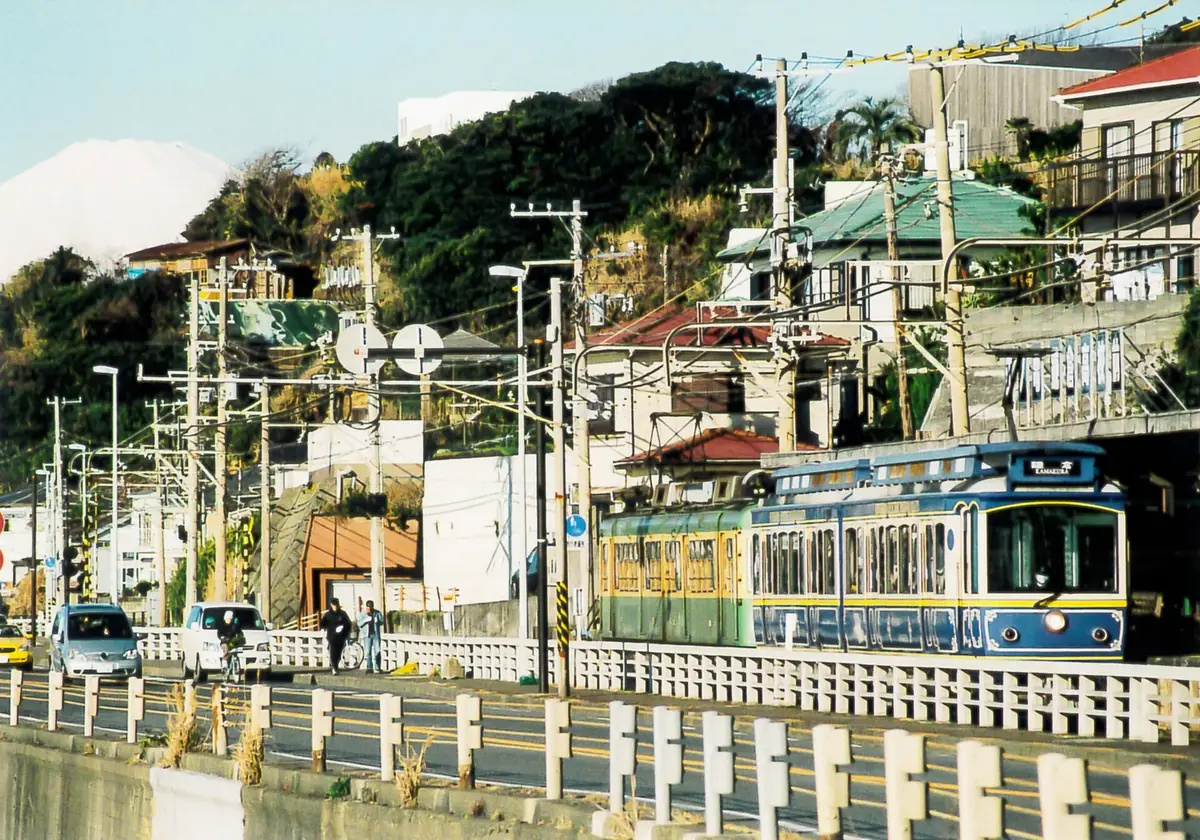
From Hase the Enoden carries on west along the coast to Enoshima, 23 minutes from Kamakura. The tourism association notes that on clear days you can see Mount Fuji beyond Cape Koyurugi from the train. Enoshima is a small island about 4 km round, reached by a bridge, with Enoshima Shrine at its heart: Fujisawa's tourism association counts it, with Miyajima and Chikubushima, among Japan's three most famous shrines to Benzaiten. The Benzaiten Nakamise shopping street runs from the bronze torii to the shrine gate.
On the island, the Enoshima Escar outdoor escalators climb in 4 minutes what takes about 20 on the stone steps, uphill only; the Fujisawa association listed them at ¥500 for all sections. The Samuel Cocking Garden at the top is free until 17:00, and inside it the Enoshima Sea Candle lighthouse observation tower (¥800) looks across Sagami Bay to Mount Fuji on clear days. Odakyu's own sample itinerary ends here at sunset.
Between Hase and Enoshima the line runs beside the sea at Kamakura-Kokomae Station, where a level crossing became so crowded with photographers, and so littered, that Kamakura City posted guards from October 2025 to March 2026 to move people off the pavements and into a photo area at Koshigoe Rakko Park next door. If you stop, use the park, keep off the road and private land, and follow Enoden's warning never to step onto the tracks. To get back, Odakyu trains leave from Katase-Enoshima Station, which suits the Freepass; with JR tickets, take the Enoden on to Fujisawa or the Shonan Monorail to Ofuna, about 14 minutes according to the tourism association.
Hokokuji's bamboo grove and the hiking trails
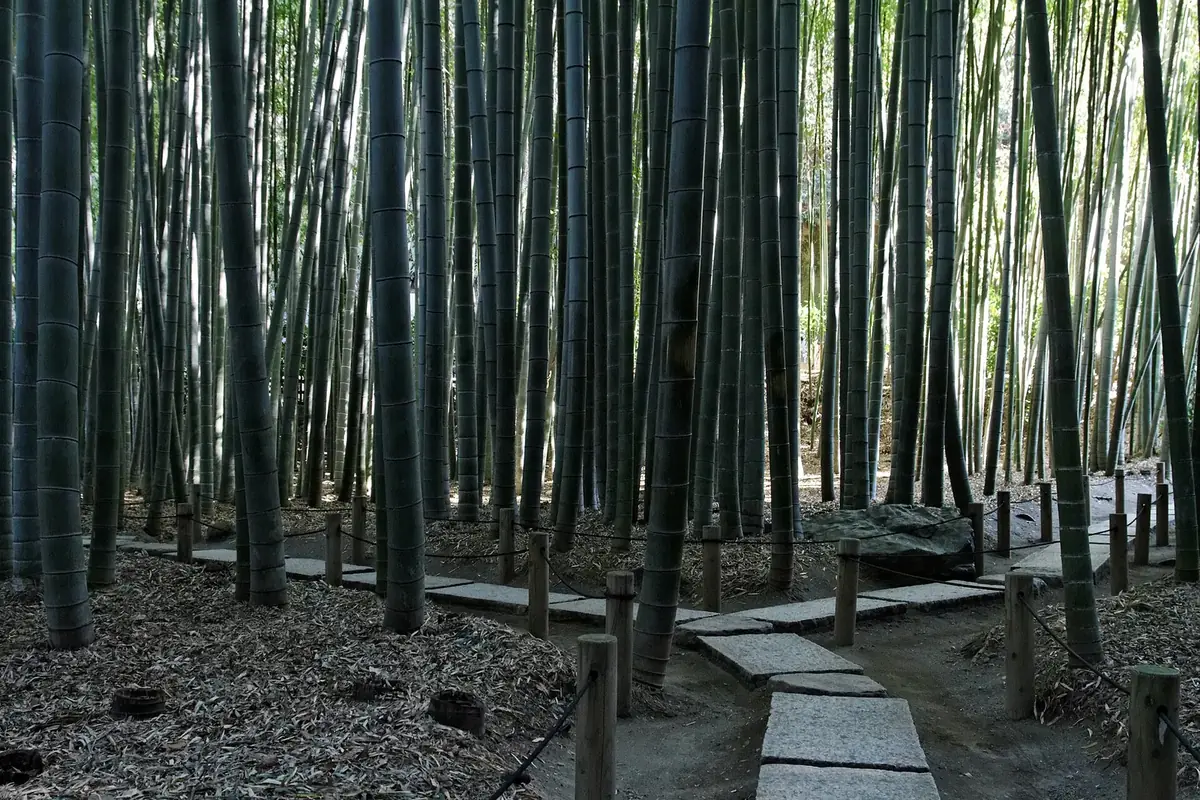
Hokokuji lies east of the centre, off the north–south line of the classic day: take a bus from the East Exit of Kamakura Station to Jomyoji and walk three minutes, or walk about 35 minutes. Its grove of moso bamboo gives it the name Bamboo Temple, and JNTO calls a bowl of green tea among the stems a meditative experience. When we checked on 10 October 2026, the temple listed admission at ¥400 from 09:00 to 16:00, matcha with a dry sweet at its Kyukoan teahouse for ¥600 until 15:30 (suspended when it is busy), and a strict Sunday zazen from 07:30 to 09:15, held in Japanese. Tripods, monopods and selfie sticks are not allowed. It fits best into a second morning or in place of Kita-Kamakura.
Two marked trails join the temples through the wooded hills. The Kuzuharaoka–Daibutsu trail runs from Jochi-ji, near Kita-Kamakura, to the Great Buddha without passing through the town centre, by way of the Zeniarai Benten and Sasuke Inari shrines; the tourism association calls it beginner-friendly, about 3 km long and 2.5 to 3 hours on foot. The Ten-en trail follows the ridges from behind Kencho-ji for about 5 km and 2.5 hours, topping out at 159.2 m on Mount Ohira with views of Mount Fuji and Sagami Bay on clear days; there is only one toilet on the route, and Kencho-ji asks hikers to pay its admission fee.
Both are natural mountain paths that turn muddy and slippery after rain, and hornets are active from summer into autumn. Sections close after storms or fallen trees, so look at the tourism association's news page the day before you hike; when we checked on 10 October 2026, no closure was listed.
Crowds and seasons: when Kamakura is hard work
The tourism association warns that roads near the main sights are heavily congested on weekdays as well as weekends, so leave the car and use the trains. The Enoden is the pinch point: Kamakura City reports that during the long holidays of late April and early May, queues for the Enoden at Kamakura Station spill outside the station. On those days, ride the Enoden before lunch or take the bus to Daibutsu-mae.
June is hydrangea season and the busiest month at the flower temples. Hase-dera, which grows about 2,500 hydrangeas of more than 40 varieties, says they peak from late May to late June. At the peak in 2025 the hydrangea path needed a ¥500 ticket on top of admission, sold online in timed entry windows, so check the temple's site in May for the coming season's rules; the path has well over 200 steps and no ramps. Meigetsu-in, the other hydrangea temple, may change its hours in June, and June and July are the rainy season, so carry an umbrella.
Each other season has its own draw. Cherry blossom arrives in April, with the Kamakura Festival. July and August are often above 35°C; the tourism association suggests sightseeing in the morning, museums in the heat of the day and dinner at a beach hut in the evening, with the beaches and their huts open from 1 July to 31 August. Autumn leaves are at their best from late November to early December, the best time for the hiking trails, and Tsurugaoka Hachimangu holds horseback archery at its annual festival in September. In January, many people come for the first shrine or temple visit of the year.
Zen temples to the Great Buddha in a day from Tokyo, and a second day
This is an editorial suggestion, not a timetable. It assumes a day outside Golden Week and the June hydrangea peak.
- Morning, Kita-Kamakura: JR Yokosuka Line from Tokyo or Shinagawa to Kita-Kamakura Station, Engaku-ji when it opens at 08:30, then Kencho-ji (with Meigetsu-in in June).
- Midday, Hachimangu and Komachi-dori: walk on to Tsurugaoka Hachimangu, then have shirasu-don or a shojin lunch around Komachi-dori.
- Afternoon, Hase: Enoden to Hase for the Great Buddha and Hase-dera's view over the bay.
- Late afternoon, Enoshima or home: stay on the Enoden to Enoshima for the shrine and the Sea Candle at sunset and return from Katase-Enoshima on the Odakyu line, or ride back to Kamakura for the JR.
- Hase first instead: Kotoku-in at 08:00, then Hase-dera, the Enoden to Kamakura and Hachimangu, and Kencho-ji and Engaku-ji before they close at 16:30 (16:00 at Engaku-ji in winter), going home by JR from Kita-Kamakura.
- With a night: Hokokuji's bamboo grove and a bowl of matcha the next morning, or the Kuzuharaoka–Daibutsu trail, and Enoshima at sunset without watching the clock.
Practical questions
How many days do you need in Kamakura?
One full day covers the classic route from the Zen temples of Kita-Kamakura to the Great Buddha at Hase. Stay a night if you also want Enoshima, Hokokuji's bamboo grove or a hiking trail without rushing.
Should I start a Kamakura day trip at Kita-Kamakura or Hase?
Start at Kita-Kamakura if you arrive by JR and want the Zen temples first, then walk south to Hachimangu and take the Enoden to Hase. Start at Hase if the Great Buddha is your priority, arriving when Kotoku-in opens at 08:00, and reach Kencho-ji and Engaku-ji before they close.
How do I get from Tokyo to Kamakura?
Take the JR Yokosuka Line from Tokyo or Shinagawa, about 60 and 50 minutes according to the tourism association, or the JR Shonan-Shinjuku Line from Shinjuku. Get off at Kita-Kamakura for the Zen temples or at Kamakura for the town centre.
Is the Enoshima-Kamakura Freepass worth it?
It suits a day that starts and ends on the Odakyu line from Shinjuku and includes Enoshima. When we checked on 10 October 2026, it cost ¥1,640 from Shinjuku with unlimited Enoden rides, but it does not cover JR, so it is no help if you travel to Kita-Kamakura.
Can you do Kamakura and Enoshima in one day?
Yes, if you travel in one direction: Kita-Kamakura in the morning, Hase after lunch, then the Enoden to Enoshima for sunset and the Odakyu line back to Shinjuku. It is a long day on foot, so a night lets you see each at an easier pace.
When do the hydrangeas bloom at Hase-dera?
Hase-dera says they peak from late May to late June. At the height of the season, the hydrangea path needs a ¥500 ticket on top of admission, with timed entry windows that can be booked online; in 2025 the paid period ran from 6 to 26 June.
Keep planning your trip
Tokyo
How many nights Tokyo needs on a first or second trip, which area to sleep in, and how to split the city into east, centre and west days without zigzagging.
Read the guide
Day trips from Tokyo
Which day trips from Tokyo to take first, the train and pass for each, the season to go, which Tokyo area to sleep in and when Fuji or Hakone needs a night.
Read the guide
Hakone
How many nights Hakone needs, which area to stay in, which way to ride the Hakone loop, whether the Freepass pays, ropeway closures and onsen manners.
Read the guide
Nikko
Decide whether Nikko is a day trip or worth a night: Tobu trains and the NIKKO PASS from Asakusa, the shrine route, Kegon Falls and autumn road traffic.
Read the guide
Japan in 14 days
A 14-day Japan itinerary by train: Tokyo and Kamakura, a Hakone ryokan, Kanazawa, Kyoto and Nara, Hiroshima and Miyajima, with bases, tickets and bookings.
Read the guideSources and checks before you travel
(19)
- Kamakura City Tourist Association (Visit Kamakura): Access ↗ — opens in a new tab
- Visit Kamakura: transport (JR, Enoden and unlimited-ride passes) ↗ — opens in a new tab
- Visit Kamakura: temple and shrine pages (Engakuji, Kenchoji, Meigetsuin, Tsurugaoka Hachimangu, Hokokuji) ↗ — opens in a new tab
- Visit Kamakura: hiking itineraries and trail notice ↗ — opens in a new tab
- Visit Kamakura: About Kamakura, Seasons, guidelines and luggage storage ↗ — opens in a new tab
- JNTO: Kamakura ↗ — opens in a new tab
- Kotoku-in (Great Buddha), official site ↗ — opens in a new tab
- Hase-dera, official site ↗ — opens in a new tab
- Hase-dera: hydrangea ticket press release (PR TIMES, 6 May 2026) ↗ — opens in a new tab
- Engaku-ji, official site ↗ — opens in a new tab
- Kencho-ji, official site (Japanese) ↗ — opens in a new tab
- Houkokuji (Hokokuji), official site (Japanese) ↗ — opens in a new tab
- Odakyu: Enoshima-Kamakura Freepass and Romancecar ↗ — opens in a new tab
- Odakyu: one-day itinerary for Enoshima and Kamakura ↗ — opens in a new tab
- Enoshima Electric Railway (Enoden): access, fares and notices ↗ — opens in a new tab
- Discover Fujisawa (Fujisawa City Tourist Association): Enoshima ↗ — opens in a new tab
- Kamakura City: Enoden resident priority-entry trial report 2026 (PDF, Japanese) ↗ — opens in a new tab
- Kamakura City: measures at Kamakura-Kokomae Station (Japanese) ↗ — opens in a new tab
- Kamakura City: 2025 visitor numbers (Japanese) ↗ — opens in a new tab
Reference sources for the version dated 24 October 2026. Confirm opening times, access, transport and conditions for your travel dates.
Photo credits
(5)
The Great Buddha at Kotoku-in, which has sat in the open since its hall was destroyed in the 14th and 15th centuries
Photograph: あかれぎ — opens in a new tab · CC BY-SA 4.0 — opens in a new tab
Changes: Resized and converted to WebP; displayed with responsive crops. · Original photograph and licence details ↗ — opens in a new tab
Tsurugaoka Hachimangu, the shrine the city grew around; its gate opens at 06:00
Photograph: Ocdp — opens in a new tab · CC0 — opens in a new tab
Changes: Resized and converted to WebP; displayed with responsive crops. · Original photograph and licence details ↗ — opens in a new tab
Hokokuji's bamboo grove, worth a second morning if you stay the night
Photograph: KimonBerlin — opens in a new tab · CC BY-SA 2.0 — opens in a new tab
Changes: Resized and converted to WebP; displayed with responsive crops. · Original photograph and licence details ↗ — opens in a new tab
The Enoden on the coast near Kamakura-Kokomae, with Mount Fuji showing on a clear day
Photograph: Kirin7739 — opens in a new tab · CC BY 4.0 — opens in a new tab
Changes: Resized and converted to WebP; displayed with responsive crops. · Original photograph and licence details ↗ — opens in a new tab
Shirasu-don on Enoshima: on some days the whitebait is served raw, caught that morning
Photograph: Miyuki Meinaka — opens in a new tab · CC BY-SA 4.0 — opens in a new tab
Changes: Resized and converted to WebP; displayed with responsive crops. · Original photograph and licence details ↗ — opens in a new tab