Chongqing
Chongqing and a Three Gorges cruise to Yichang in a week
Chongqing is a city built on cliffs above two rivers: at Chaotianmen, the tip of its old peninsula, the Jialing flows into the Yangtze, and the Yangtze below is the way into the Three Gorges. The decision is how much river to take. A four-day sailing downstream to Yichang fits three nights on board, passes Qutang and Wu gorges by day and ends with a morning at the Three Gorges Dam. Two nights in Chongqing before the boat leave time for the cableway, Ciqikou, a night boat on the two rivers and a hot-pot dinner, and an overnight sleeper from Yichang reaches Shanghai in time for the flight home.
In this guide
Find the location ↗ — opens in a new tabThe short answer
Spend two nights in Chongqing’s Yuzhong district, near Jiefangbei, three on a Century sailing downstream to Yichang, and the last on the sleeper train to Shanghai. Book the cruise first: a non-refundable deposit of at least USD 500 each, the balance 120 days ahead. The sailing costs USD 1,049 a person sharing a deluxe cabin (about CNY 7,050) in June to August and November 2027, and USD 1,349 from April to May and September to October. For the London–Shanghai return below, a 2027 sailing needs an extension of the waiver, currently published to 31 December 2026, or a visa. Two adults at mid-range spend about CNY 23,030, CNY 11,520 each, before flights from Europe.
- Suggested time
- 7 days / 6 nights: two in Chongqing, three on the ship, one on the night train to Shanghai
- Where to stay
- Yuzhong, near Jiefangbei, for two nights in Chongqing, then three nights on the ship to Yichang and one on the sleeper to Shanghai
- Season and timing
- Century’s 2027 sailings run on Fridays from 2 April to 26 November. The British government warns that floods and storms are common from May to November, and itineraries and times change with river conditions.
Two nights in Chongqing before the boat
Chongqing climbs the cliffs of the Yuzhong peninsula, where the Jialing River meets the Yangtze, and a short walk here can mean a long flight of steps. Base yourself in Yuzhong, around Jiefangbei, so that Hongyadong, the old streets and the riverside are a walk or a metro ride away; a hotel in Nan’an District, across the Yangtze, adds a river crossing to every outing. Two nights before the sailing mean a late flight or a delayed train does not cost you the boat, and the sailing day itself is free until you board.
With a third night, add the Dazu Rock Carvings, a UNESCO World Heritage site of Buddhist, Taoist and Confucian figures carved into the cliffs between the 9th and 13th centuries, in Dazu District about 80 km from the centre; buses from the long-distance bus station near Chongqing North take about two and a half to three hours and cost about CNY 60 a person.
Chongqing in two days: Hongyadong, Chaotianmen, the cableway and Ciqikou
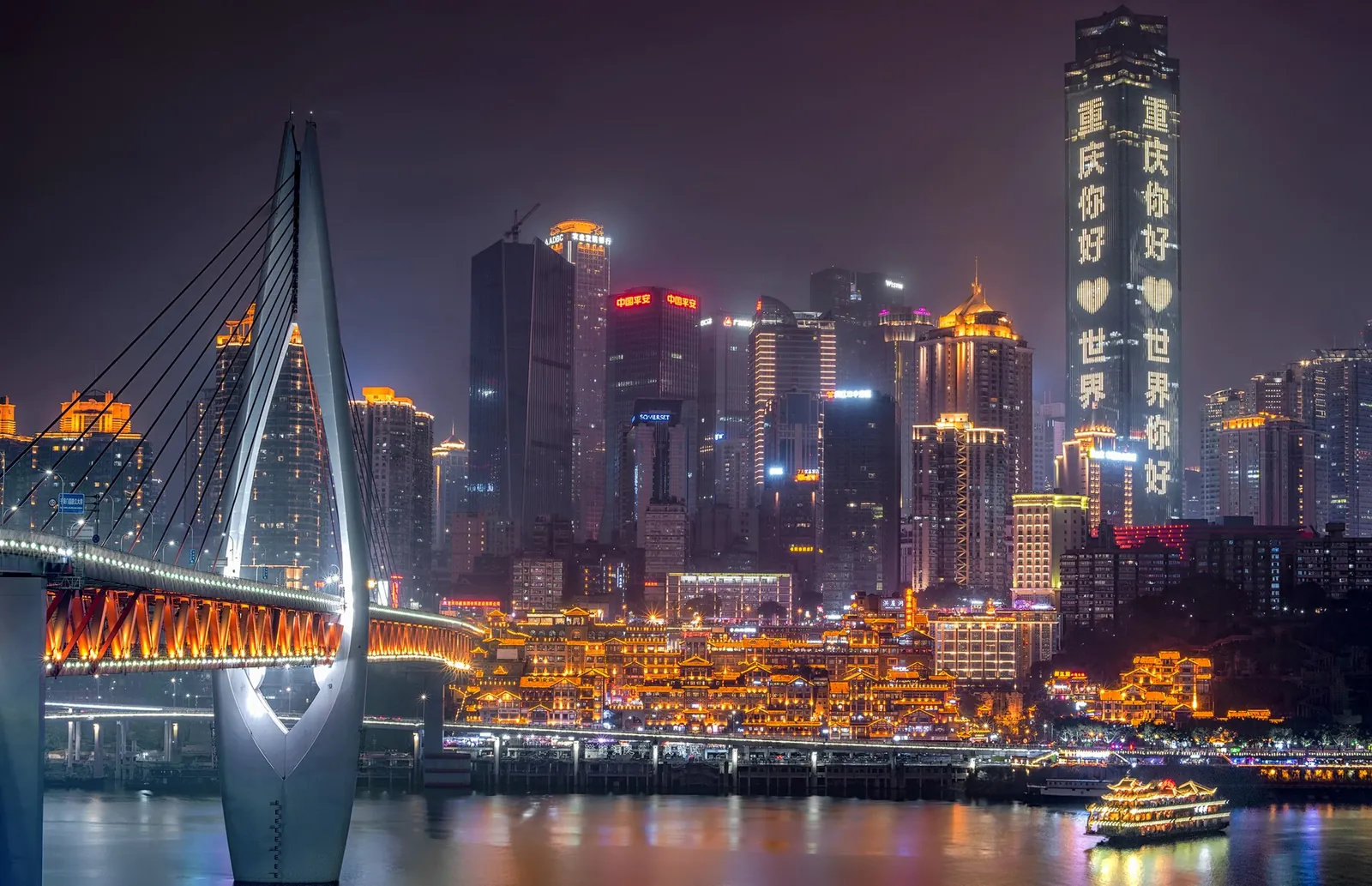
Start with Hongyadong, a tiered stilt-house complex of 11 floors hanging on the cliff above the Jialing, with shops and restaurants on every level and a square at the top that looks over Jiefangbei and the river. Entry is free and it is open 24 hours, and it is best after dark, when the façades are lit. Metro line 2 to Linjiangmen (exit A) and lines 1 or 6 to Xiaoshizi (exit 6) are each about 700 metres’ walk away.
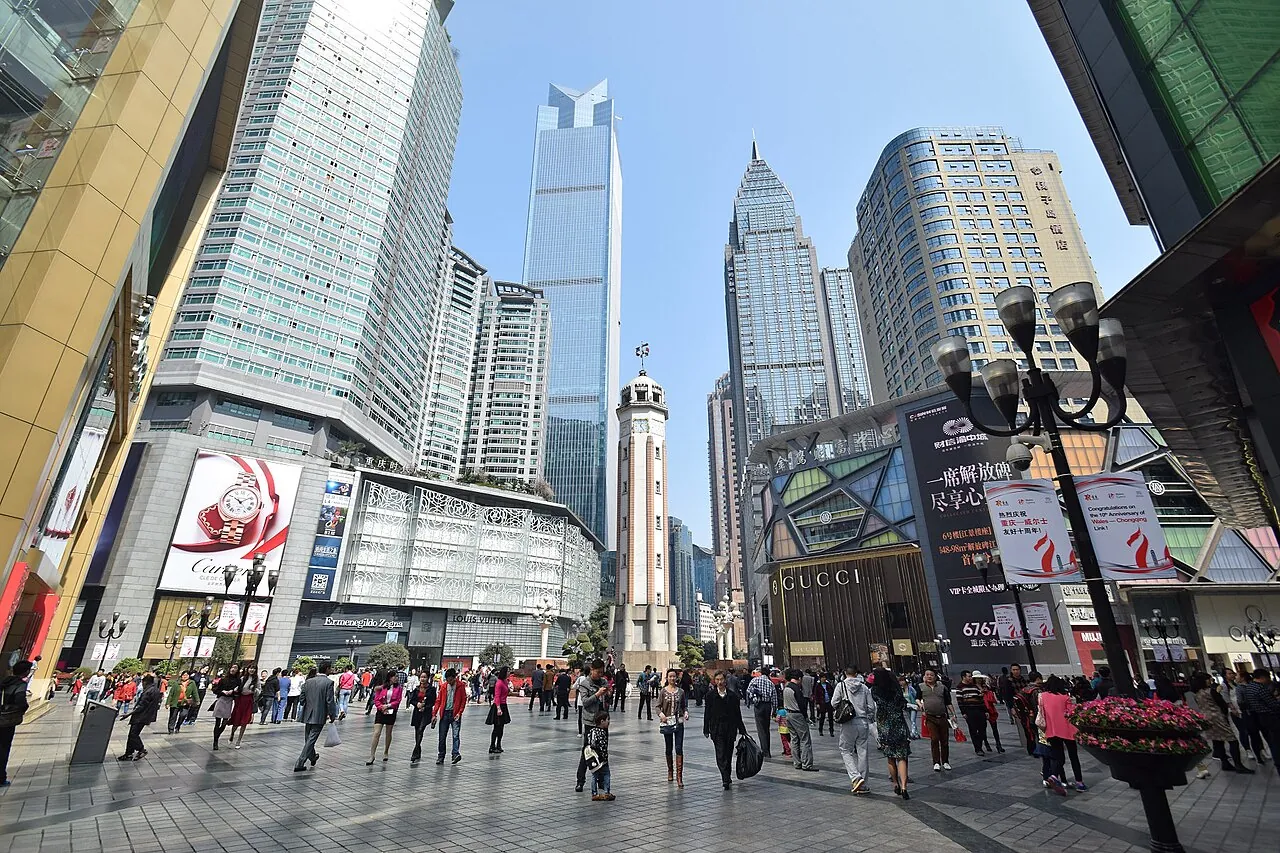
Jiefangbei is the commercial heart: a pedestrian district around the Liberation Monument, a clock tower about 28 metres tall, built to mark China’s victory in the war against Japan and once among the tallest buildings in the city. It is free and open all day. The nearby 81st Street (Bayi Road) is the place for street food, from noodles to hot pot and desserts, with food courts at modest prices.
Walk on to Chaotianmen, ‘the gate facing heaven’, at the tip of the Yuzhong peninsula, the oldest part of the city, where the Jialing flows into the Yangtze and the view runs across both rivers to the bridges and the mountains beyond. The confluence is at its best from the water after dark: the two-rivers night boats leave the Chaotianmen waterfront on Changjiang Binjiang Road (metro line 6 to Xiaoshizi) for one-hour trips on the Yangtze and the Jialing, with departures from about 19:30 to 22:20. Fares run from about CNY 140 to 200 a person depending on the boat, on the city’s English tourism portal, and rise around National Day and the Spring Festival; some boats carry short shows such as Sichuan opera face-changing.
Two old quarters sit on the river below. Longmenhao Old Street lies under Dongshuimen Bridge on Nanbin Road; it has been rebuilt, but the place has more than 1,000 years of history as a river port, and it became the first inland port in China’s history when Chongqing opened to the world in 1890. Eighteen Steps (Shibati), at Zhongxing Road in Yuzhong, is a stone staircase running down towards the Yangtze, now a rebuilt commercial quarter whose old residents have left.
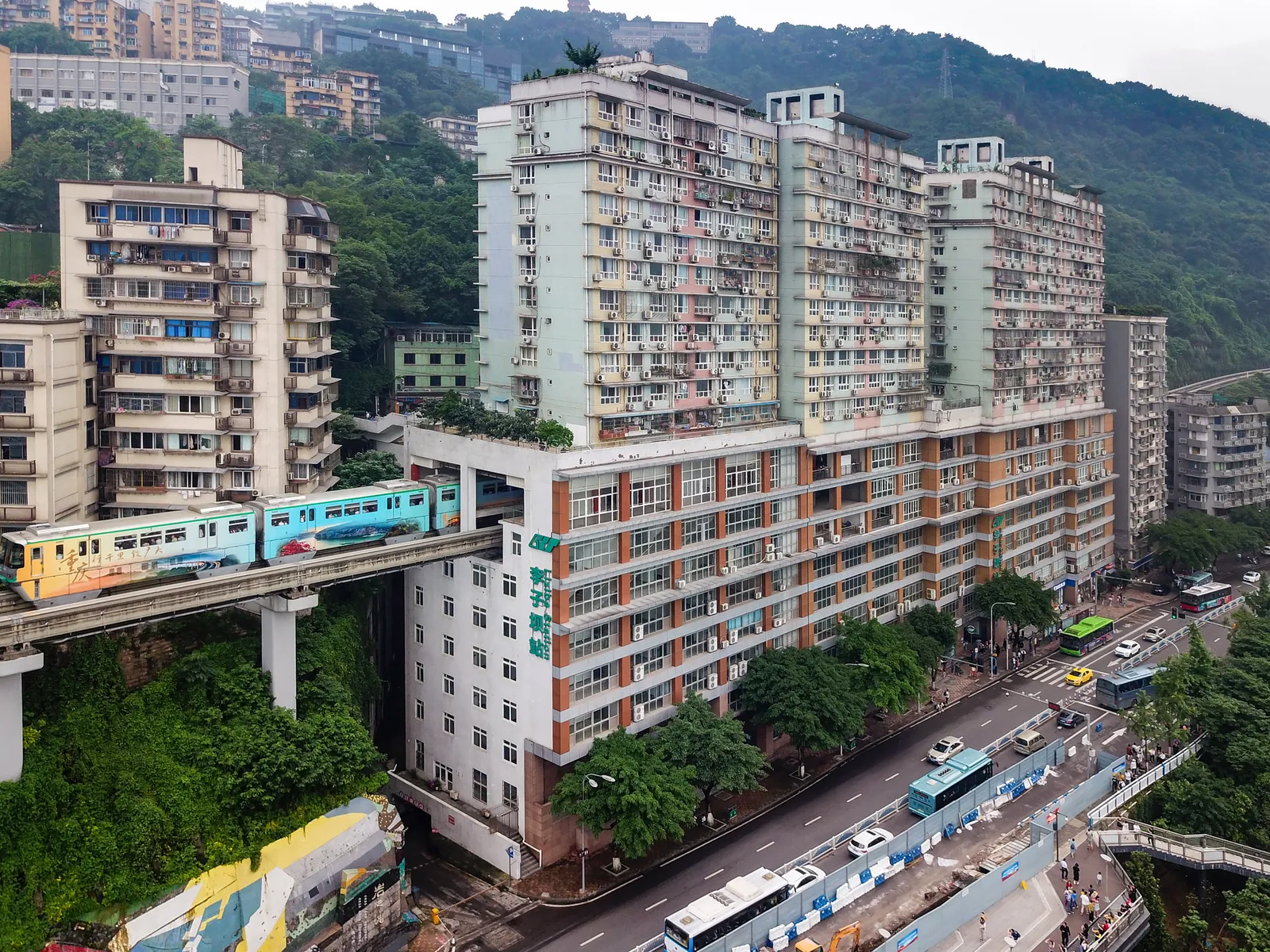
Two rides show how the city is built. The Yangtze River Cableway leaves from Xinhua Road, a short walk from Xiaoshizi metro station, and crosses 1,166 metres of river to Shangxin Street in Nan’an in a few minutes; for decades the way locals crossed the Yangtze, it is now ridden mostly for the view. The operator’s hours, read on 26 October 2026, are 08:00 to 22:00 from March to November and 08:00 to 21:00 from December to February; public-holiday hours are 07:30 to 23:00 and 07:30 to 22:30 respectively. Its notice closes the cableway all day on 28 October 2026 for maintenance, reopening at 08:00 on 29 October. Same-day tickets go on sale on the 长江索道 WeChat account at 07:45, or 07:15 on public holidays. Budget about CNY 50 a person for a return ride, using the city’s published maximum fare as the estimate; check the ticket offered on your date. At Liziba, on monorail line 2, the train runs into a 19-storey block of flats and stops inside it: the station fills the sixth to eighth floors, with homes above, and a public viewing platform below lets you watch the trains run into the building.
Ciqikou, in Shapingba District on the west bank of the Jialing, is the old river town that still shows what Chongqing once looked like. Its name means Porcelain Port, after the porcelain it made and shipped under the Ming and Qing; the pedestrian street has snack stalls and teahouses with Sichuan opera, Baolun Temple stands close by, and the town is free and open all day. It lies outside Yuzhong, so give it a half day. If it rains, the China Three Gorges Museum, at 236 Renmin Road in Yuzhong (metro line 3 to Niujiaotuo), covers the region you are about to sail through, from Ba and Shu bronzes to relics of the Three Gorges area; it opens from 09:00 to 17:00 and closes on Mondays except national holidays.
What to eat and where to look
Chongqing hot pot
A pot of beef-tallow and chilli broth that began among boatmen on the Jialing and at Chaotianmen wharf. The nine-grid pot gives each diner two grids, so ingredients cook in separate heat while sharing one base; choose a two-flavour pot if the full chilli base is too much.
- Where to look
- Xiao Tian’e (Little Swan) on the sixth floor of Yingli IMIX Park at Jiefangbei, a good introduction that also serves a plain broth; or the old street of Ciqikou, where chefs fry the chilli base in view of passers-by.
- Fit it into your day
- Dinner on day 1, your first evening in the city.
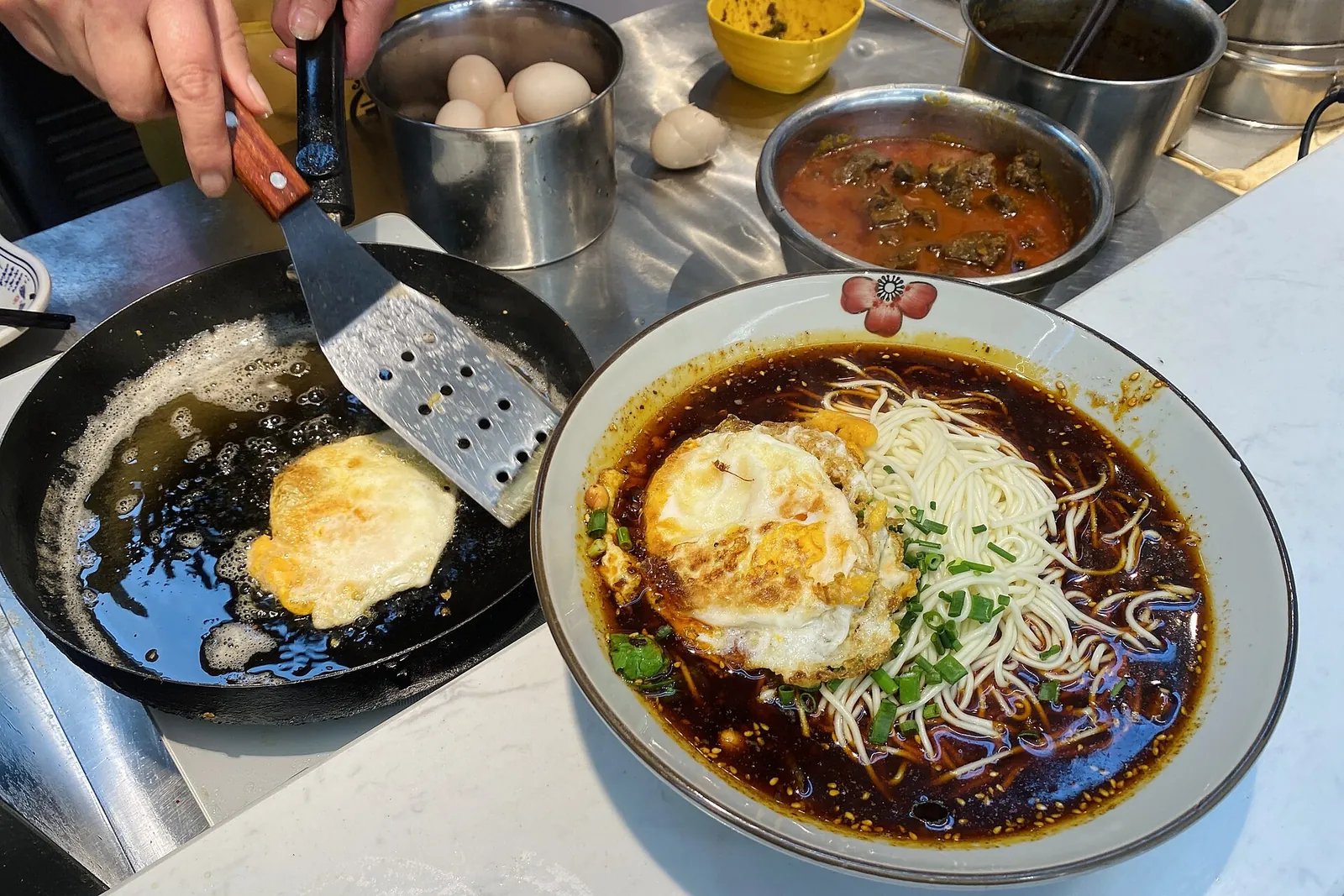
Chongqing xiaomian
Wheat noodles, pressed hundreds of times so they keep their bite, in a seasoning of chilli oil, soy sauce, Sichuan pepper and pickled mustard tuber over a pale bone broth.
- Where to look
- The street-food stalls of 81st Street (Bayi Road) beside Jiefangbei, where noodles are among the snacks.
- Fit it into your day
- Breakfast on day 2.
Ciqikou mahua
Ciqikou’s own snack since the late Qing dynasty: twisted dough of flour, sesame, glutinous rice, white sugar and rock sugar, fried in walnut oil so that it is crisp outside, soft within and not greasy. The shops now sell it in several varieties.
- Where to look
- The snack shops along the pedestrian street of Ciqikou, where it is the town’s best-known speciality.
- Fit it into your day
- A snack on the afternoon of day 2 in Ciqikou.
Laziji (chilli chicken)
A Chongqing classic of deep-fried diced chicken buried in a heap of dried red chillies, with Sichuan pepper and spring onion: you dig through the chillies with your chopsticks for the chicken, which is crisp outside and soft within, hot, salty and numbing. It was first served at a roadside restaurant on Gele Mountain in 1990 and spread across the city from there.
- Where to look
- Ask for la zi ji by name at a Chongqing home-style (jianghu) restaurant; it is a shared dish that goes with plain rice.
- Fit it into your day
- Dinner on day 2, the last night before the ship.
Which cruise, and life on board
Chongqing to Yichang runs with the current, and that is the short way: Century Cruises sells it as four days and three nights. Going upstream, from Yichang to Chongqing, takes five days and four nights, and Century lists no upstream sailings for 2027. For a 2027 trip, book the downstream sailing.
Century’s 2027 downstream sailings are all on Fridays. The fare is USD 1,349 a person from 2 April to 28 May and from 3 September to 29 October, and USD 1,049 from 4 June to 27 August and from 5 to 26 November; there is no 1 October sailing. Fares are per person, two sharing a deluxe twin cabin; at the central rate of 23 October 2026 (USD 1 = CNY 6.7180), that is about CNY 9,060 or CNY 7,050 a person. The ships on the route are Century Oasis, Victory, Voyage and Glory.
The deluxe cabin measures 280 square feet with a shower, and on all four ships it has a private balcony over the river. Each ship has a main restaurant serving Chinese and Western dishes and food from the towns along the Yangtze, a sun deck and a top observation deck for the gorges, and a theatre, a spa and a fitness room below. Restaurants, bars and suites differ from ship to ship, so ask which ship sails your Friday when you request the quote. The first evening is the sail-out: after the embarkation buffet and the captain’s welcome reception, the ship slips past Chongqing’s lit skyline.
Seven days in order
Pick a Century Friday for the sailing, then count back: you arrive in Chongqing on the Wednesday, board on Friday, take the sleeper out of Yichang on Monday evening and fly home from Shanghai on Tuesday.
- Day 1: arrive in Chongqing. Fly from London to Shanghai Pudong (PVG) and connect there to Chongqing; if your Chongqing flight leaves from Hongqiao (SHA), the Airport Link Line runs from Pudong to Hongqiao Terminal 2 in about 40 minutes for CNY 26 a person, every 15 minutes, plus check-in and walking time. Check in in Yuzhong and walk to Jiefangbei and Hongyadong for the evening.
- Day 2: Chongqing. Cross the Yangtze by cableway in the morning, ride monorail line 2 to Liziba, and spend the afternoon in Ciqikou, or in the Three Gorges Museum if it rains. In the evening, walk to Chaotianmen for the confluence and take a night boat on the two rivers.
- Day 3: board in Chongqing. Free until boarding, then the embarkation buffet dinner and the captain’s welcome reception as the ship sails past Chongqing’s night views.
- Day 4: Fengdu. A shore visit to Fengdu Ghost City, and the crew’s cabaret on board in the evening.
- Day 5: the gorges. Qutang and Wu gorges from the deck, and Goddess Stream by small boat in the afternoon.
- Day 6: Yichang and the night train. The ship docks at Maoping in the morning; visit the Three Gorges Dam and the Three Gorges Engineering Museum, and take the included coach to central Yichang. Keep a day bag with you, have lunch in the centre and spend the afternoon on the bank of the Yangtze, then take a taxi to Yichang East for the evening sleeper to Shanghai South.
- Day 7: Shanghai and home. Arrive at Shanghai South early in the morning, take metro line 1 to People’s Square and change to line 2, which reaches Shanghai Pudong (PVG) in about an hour, for a late flight to Europe. Leave several hours for the metro, check-in and a delayed train; if you cannot accept that risk, add a Shanghai night.
The gorges and the dam
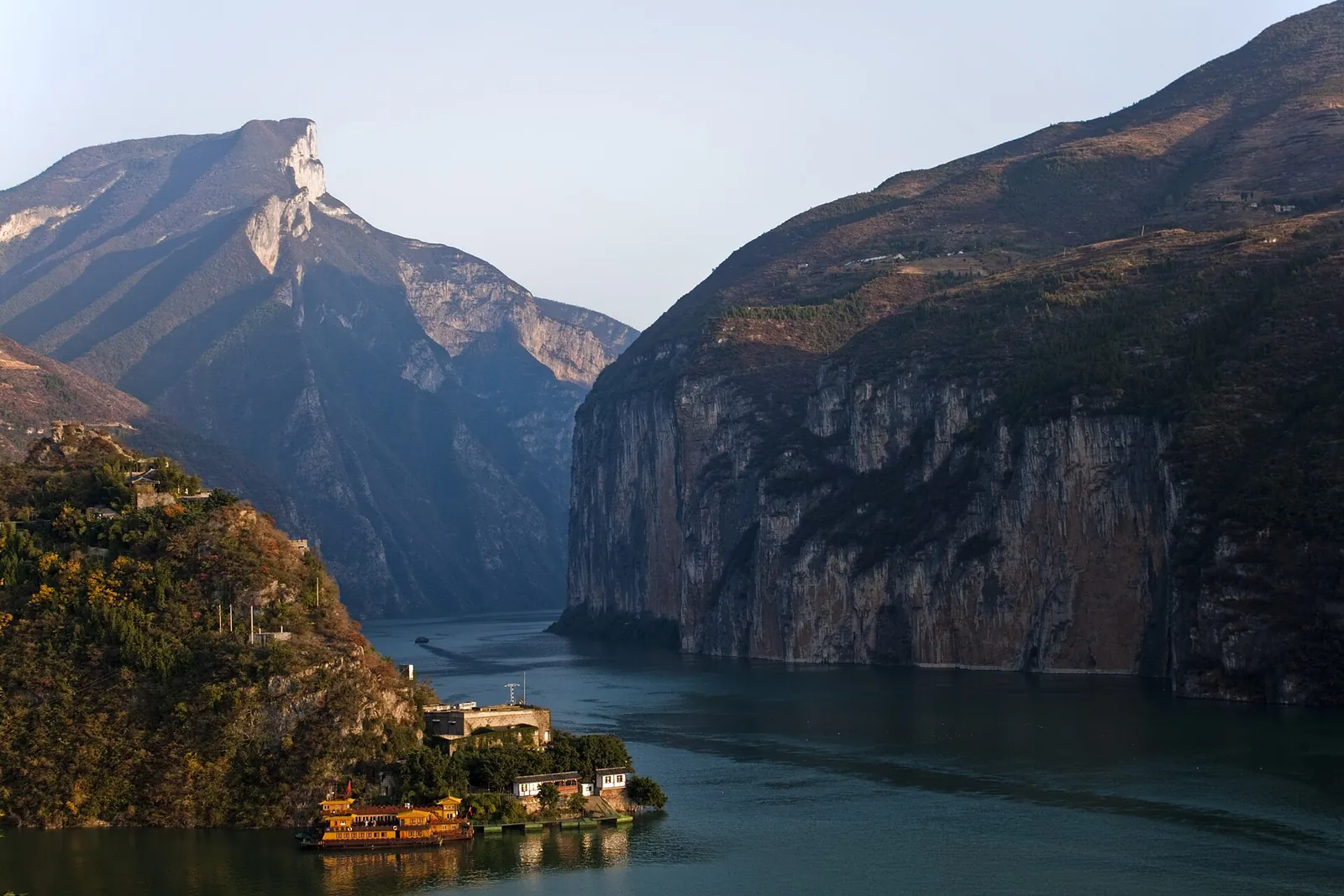
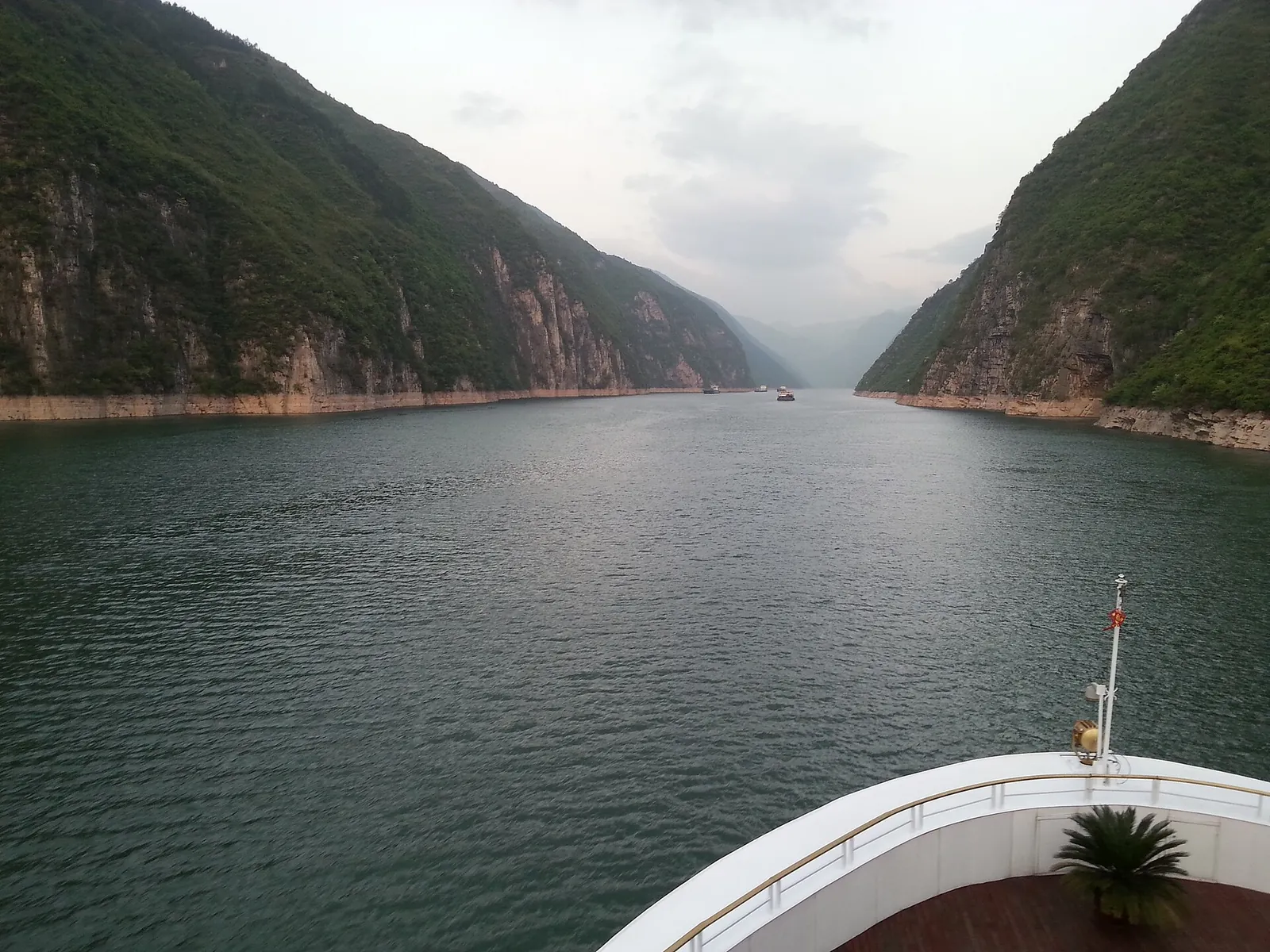
The Three Gorges are Qutang, Wu and Xiling, in that order downstream. Qutang is the shortest and the most dramatic, about 8 km long and as narrow as about 150 metres. Wu Gorge runs for about 40 km between forested mountains, with cliffs so sheer that the sun barely reaches the water; on its north bank stands Goddess Peak, the highest of its twelve peaks, a rock shaped like a slender young woman watching over the river. Xiling is the longest, about 66 km, and holds the dam at Sandouping. Its upper part may pass in the dark, depending on river traffic and the time of year, so count on Qutang and Wu in daylight; the ship stops above the dam, and the stretch of Xiling below it is seen only on the optional ship-lift excursion.
The shore stops come first. Fengdu Ghost City, on Mingshan Mountain in Fengdu County, is a cluster of temples and shrines on the theme of the afterlife, with a Palace of Hell, a Gate of Hell and statues of ghosts and punishments; Tianzi Palace, said to be the office of Yama, King of Hell, is the largest, oldest and best preserved of its temples. White Emperor City (Baidicheng), an optional morning excursion on day 5, stands on Baidi Hill at the western opening of Qutang Gorge: Tuogu Hall recreates Liu Bei entrusting his son and his kingdom to Zhuge Liang, the stele forest holds more than 70 works of calligraphy, and the viewing platform faces Kuimen, the scene on the back of the CNY 10 note. Century sells it, the evening show at Fengdu and the ship lift at the dam as extras; budget about USD 60 a person each, an estimate based on Victoria Cruise Lines’ published prices, and ask Century for its own prices with the quote. At Wushan you change to a smaller boat for Goddess Stream (Shennu Stream), a narrow tributary that locals call Beauty Stream for its clear water and the shapely hills along its banks. The boat runs quietly up a slim channel between steep mountains, through small gorges of its own.
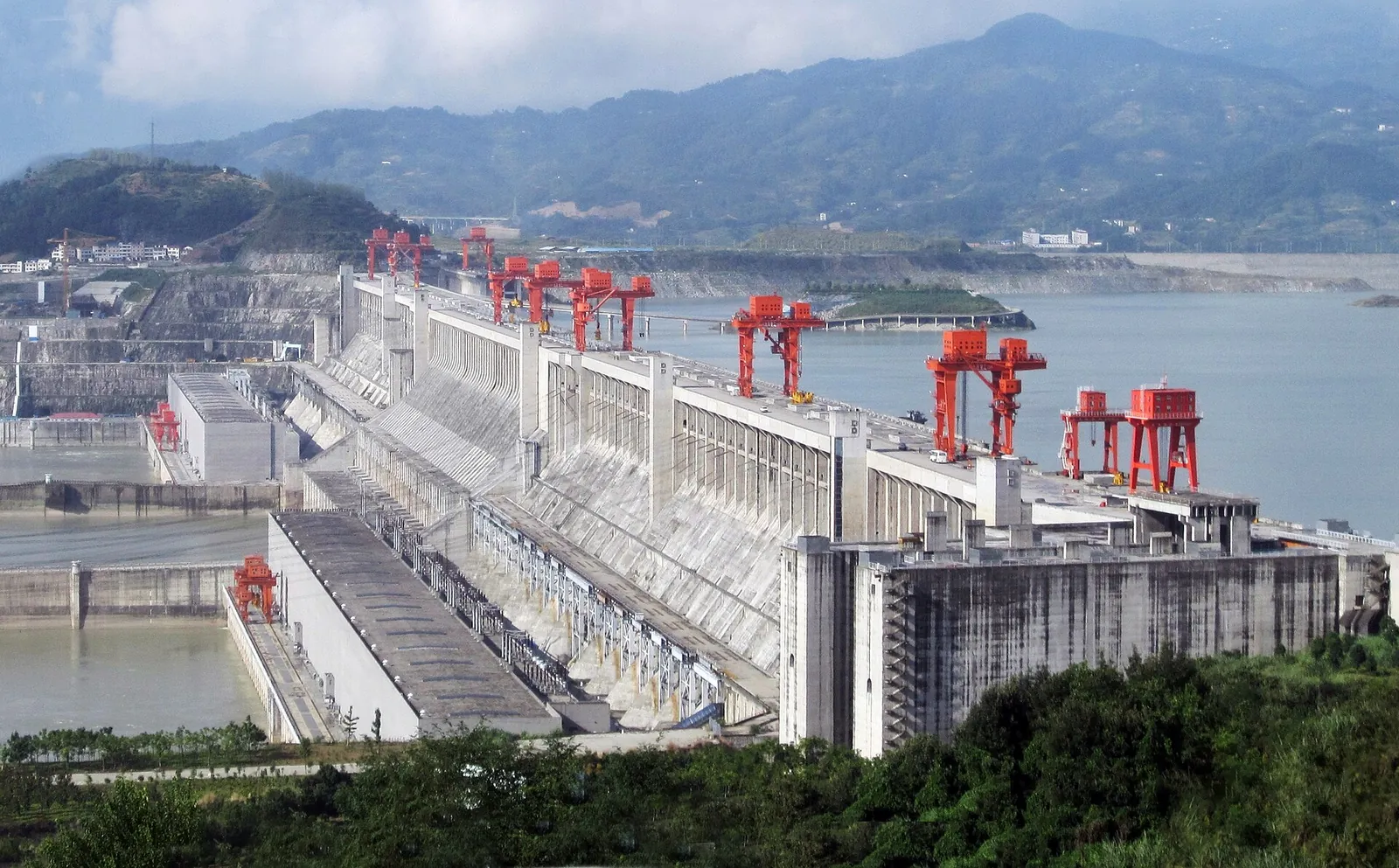
The dam fills the morning of day 6. The ship docks at Maoping Pier in Zigui, above the dam, and the included tour views the dam from the shore, then the Three Gorges Engineering Museum beside it. The dam runs 2,309.5 metres across the Yangtze at Sandouping, with its crest 185 metres above sea level, and holds the reservoir behind it at up to 175 metres; beside it, the five-stage ship lock steps ships down more than 120 metres in a staircase of chambers. The ship lift, an optional excursion before the dam tour, is an elevator for boats: it carries a smaller boat down past the dam in about 40 minutes to an hour.
Booking the cruise
Century does not sell online. Use the Request a quote form on the sailing’s page or the enquiry form at centurycruises.com/inquire, giving the date, cabin grade and number of travellers; a cruise specialist replies with availability and the current fare, and confirms the cancellation terms when you book. Century also answers on its US toll-free number, 1-833-940-6254. Its terms ask for a non-refundable deposit of at least USD 500 a person, final payment at least 120 days before departure, and a copy of a passport valid for six months after your return date when you reserve.
Dinner is included on the boarding evening (the embarkation buffet), all three meals on the two full days on the river, and breakfast on the morning you reach Yichang, so lunch on day 6 is yours. The fare also includes coach transport at both ends; ask the specialist for the pick-up point in Chongqing and the pier when you book. Allow about USD 60 a person for each optional excursion and about USD 25 (about CNY 170) a person for the service charge, estimates based on Victoria Cruise Lines’ published excursion and service charges; Century’s own charges belong in your quote.
Leaving Yichang for Shanghai
After the dam and the museum, the coach takes you to the centre of Yichang; it follows a morning of sightseeing, so expect to arrive around midday. Plan to have your luggage with you until the train, with a day bag for the afternoon, and ask the specialist when you book whether the coach can hold bags during the dam visit. For the taxi from the coach drop-off to Yichang East, budget about CNY 70 a vehicle, the same estimate as a day of mid-range local rides in the trip-cost guide; the actual fare depends on the drop-off point.
The November 2026 examples recorded for this guide had a sleeper from Yichang East at 19:34 to Shanghai South at 07:07, with second-class berths at CNY 333 or 364 depending on the date. Treat that as an example for planning, not a confirmed 2027 connection. It goes on sale only 15 days ahead, counting the day you buy, months after you have paid for the cruise and the flight to Chongqing, so check the times when sales open; our transport guide explains the 12306 app and passport ticketing. If the sleeper is full, stay a night in Yichang and take a morning train from Yichang North to Shanghai Hongqiao, about six and a half hours for about CNY 490 in second class, then the Airport Link Line to Pudong for a late flight or a Shanghai night. The fallback adds a hotel night, meals and a different rail fare to the budget below. Shanghai South is on metro lines 1, 3 and 15.
Getting to Chongqing and staying safe
Chongqing Jiangbei International Airport (CKG) is the main airport. Metro lines 3 and 10 link it with the centre, and about 40 minutes and CNY 5 take you to Jiefangbei; the K01 airport bus to Jiefangbei covers about 35 km for CNY 15, and taxis are metered at CNY 10 for the first 3 km and CNY 2 a km by day, so budget about CNY 80 a vehicle to Yuzhong, estimated from the 35 km airport-bus distance and the meter tariff, rather than a fixed airport fare. From Chengdu, the fastest high-speed trains take about an hour. Chongqing has four railway stations in the city, among them Chongqing North and Chongqing West, so check the name on your ticket; our payments and apps guide covers paying for rides.
Carry your original passport at all times; a printed copy is not accepted. Hotels register you with it, and the night train needs the passport you booked with. Drones are tightly regulated: declare one at customs and get registration and any local permission before you fly, or leave it at home rather than plan shots from the deck. Check your own government’s current travel advice before you book.
What the week costs
| Level | Per person, about CNY | For two, about CNY |
|---|---|---|
| Mid-range | 11,520 | 23,030 |
These figures assume two adults sharing one double for two nights in Chongqing and one twin cabin for three nights on Century’s downstream sailing on a Friday between June and August or in November 2027, with prices checked on 26 October 2026. They fly from London to Shanghai Pudong and on to Chongqing, take the sleeper from Yichang East to Shanghai South in two second-class berths on the evening of day 6, and fly home from Pudong on day 7. The total covers rooms, meals when you are not on the ship, local rides, the flight to Chongqing, the sleeper, the cruise with its listed excursions, the cableway, a night boat, two SIMs and a 10% buffer. Room figures are estimates based on late-November rate cards of international hotel chains, so a hotel’s own rate for your dates will differ.
A London return to Shanghai costs about GBP 650 to 850 a person (GBP 1,300 to 1,700 for two), an estimate from published London–Shanghai return fares from GBP 563, not a quote. With it the trip comes to about GBP 1,930 to 2,130 a person (GBP 3,870 to 4,270 for two), converted at the State Administration of Foreign Exchange central parity rate of 23 October 2026 (GBP 1 = CNY 8.9749); your bank or card will give a different rate.
- Rooms, about CNY 1,300 for two. Two nights at about CNY 650 for a mid-range double in Yuzhong, with no breakfast counted.
- Food, about CNY 1,380 for two. About CNY 180 a person a day on days 1 and 2, CNY 90 on day 3 before you board, CNY 150 for lunch and dinner on day 6 and CNY 90 for breakfast and an airport lunch on day 7; the ship’s meals are in the fare.
- Getting around, about CNY 380 for two. In Chongqing about CNY 290: the airport taxi at about CNY 80 a vehicle, then about CNY 70 a day for two for metro and taxi rides on days 1 to 3. In Yichang about CNY 70 a vehicle for the taxi from the coach drop-off to Yichang East. In Shanghai about CNY 20 for two for the metro from Shanghai South to Pudong.
- Flight and train within China, about CNY 2,730 for two. Shanghai Pudong to Chongqing on day 1 at about CNY 1,000 a person, based on typical economy fares between Shanghai and Chengdu, a slightly longer flight; book on the airline’s own site or app. The sleeper from Yichang East to Shanghai South at CNY 364 a person for a second-class berth on 2026 fares.
- Cruise, about CNY 14,090 for two. Three nights in a deluxe twin at USD 1,049 a person, with the ship’s meals and the listed excursions. On a spring or autumn Friday at USD 1,349 the cruise costs about CNY 4,430 more for two, buffer included. White Emperor City adds about CNY 890 for two (about USD 60 a person, buffer included); all three optional excursions about CNY 2,660.
- Sights, about CNY 420 for two. A return cableway crossing (about CNY 100 for two) and a night boat on the two rivers at about CNY 160 a person; Hongyadong, Jiefangbei and Ciqikou are free.
- SIM and extras, about CNY 640 for two. About CNY 300 for two SIMs at about CNY 150 each for a roughly 15-day data card, estimated from China Telecom’s regional CNY 125 visitor plan, and about CNY 340 for two for the service charge.
- Buffer, about CNY 2,090. Ten per cent of the subtotal of about CNY 20,940; rounded lines can differ from the total by one unit of 10.
Practical questions
How many days do I need for Chongqing and the Three Gorges?
A week, with six nights: two in Chongqing, three on the ship and one on the night train from Yichang to Shanghai, flying home on day 7. Century’s downstream sailing is four days and three nights. With a third night in Chongqing you can add the Dazu Rock Carvings.
What does the Century fare include?
Your cabin, the meals on board (dinner on the boarding evening, three meals on the two full days and breakfast on the last morning), coach transport at both ends, an English-speaking guide, Fengdu Ghost City, Goddess Stream, the Three Gorges Dam and the Engineering Museum. The evening show, White Emperor City, the ship lift and the service charge are extra.
Is the cruise cheaper in summer?
On Century’s 2027 list the fare is USD 1,049 a person from 4 June to 27 August and from 5 to 26 November, and USD 1,349 from 2 April to 28 May and from 3 September to 29 October. Every date on the list is a Friday.
Should I sail upstream or downstream?
Downstream, from Chongqing to Yichang: it runs with the current in four days and three nights, against five days and four nights upstream, and it is the sailing Century offers on Fridays through 2027.
Will I see all three gorges in daylight?
Not all of Xiling. Qutang and Wu gorges are the day-5 sights on Century’s itinerary; the upper part of Xiling may pass in the dark, and the ship stops above the dam, so the stretch below it is seen only on the optional ship-lift excursion.
How do I get from Yichang to Shanghai after the cruise?
By the overnight sleeper from Yichang East to Shanghai South, which in the November 2026 examples left at 19:34 and arrived at 07:07; check the timetable for your year before fixing the flight home, and choose a late departure; tickets go on sale 15 days ahead, counting the day you buy. If it is full, stay a night in Yichang and take a morning train to Shanghai Hongqiao. From Shanghai South, metro line 1 to People’s Square and line 2 take you to Shanghai Pudong (PVG) for flights home.
Do I need a visa for Chongqing and the cruise?
Ordinary-passport holders from Australia, Austria, Belgium, Brazil, Canada, Denmark, Finland, France, Germany, Hungary, Ireland, Italy, the Netherlands, New Zealand, Norway, Poland, Portugal, Romania, Spain, Sweden, Switzerland and the United Kingdom can enter without a visa for tourism, business, visiting family or friends, exchange or transit. You can stay up to 30 days, counted from the day after you enter. The waiver is published until 31 December 2026, so a 2027 sailing needs a published extension or a visa. US and Czech passports are not on this visa-free list, and US and Czech citizens need a visa unless they qualify for the 240-hour transit rule, which needs a confirmed onward ticket to a third country or region through designated ports and within permitted areas, and cannot be used for a return to the country you arrived from; our entry guide explains it in full.
Keep planning your trip

Chengdu
Two nights in Chengdu: booking the Panda Base with a passport, Wenshu Monastery, Kuanzhai Alley, the Leshan Giant Buddha by train, where to stay and what it costs.
Read the guide
Zhangjiajie
Three nights in Wulingyuan: park tickets and gates, the lifts, the Grand Canyon glass bridge, Tianmen Mountain, where to stay and what four days cost.
Read the guide
Getting around China
Book China's high-speed trains on 12306 with a foreign passport, decide when to fly, and get from the airports and stations into town.
Read the guide
Best time to visit China
When to go to China by region and month: spring and autumn for Beijing, Xi’an and Shanghai, rain and typhoon seasons, and the expected 2027 holiday peaks.
Read the guide
First trip to China
How long a first China trip should be, then a week in Beijing, Xi’an and Shanghai: what to book first, the trains, entry, paying and the cost per day.
Read the guide
Entering China
Who can enter China visa-free for 30 days, when the waiver ends, how 240-hour transit works, and the arrival card, hotel registration, customs and safety rules.
Read the guideSources and checks before you travel
(48)
- Century Cruises: Chongqing to Yichang 3-night Yangtze Signature cruise ↗ — opens in a new tab
- Century Cruises: ship pages (Century Oasis, Victory, Voyage and Glory) ↗ — opens in a new tab
- Century Cruises: plan your journey (enquiry form) ↗ — opens in a new tab
- Century Cruises: Yichang to Chongqing 4-night Yangtze Signature cruise ↗ — opens in a new tab
- Century Cruises: terms and conditions ↗ — opens in a new tab
- Victoria Cruise Lines: Three Gorges Highlights cruise, Chongqing to Yichang ↗ — opens in a new tab
- Ministry of Water Resources: The Three Gorges Project ↗ — opens in a new tab
- ichongqing: Goddess Peak and Shennu Stream ↗ — opens in a new tab
- ichongqing: Tour the Three Gorges by Yangtze River cruise (2018) ↗ — opens in a new tab
- ichongqing: Hongyadong ↗ — opens in a new tab
- ichongqing: Jiefangbei Pedestrian Street ↗ — opens in a new tab
- ichongqing: Gorgeous night viewing in Chongqing ↗ — opens in a new tab
- ichongqing: Chongqing Two-River Cruise ↗ — opens in a new tab
- ichongqing: Longmenhao Old Street ↗ — opens in a new tab
- ichongqing: Eighteen Steps ↗ — opens in a new tab
- ichongqing: Chongqing hot pot ↗ — opens in a new tab
- ichongqing: Chongqing spicy noodles ↗ — opens in a new tab
- ichongqing: Jianghu cuisine in Chongqing, chilli chicken ↗ — opens in a new tab
- ichongqing: Xiao Tian'e Hotpot Restaurant ↗ — opens in a new tab
- CGTN: Ciqikou Ancient Town in Chongqing (May 2023) ↗ — opens in a new tab
- ichongqing: Yangtze River Cableway ↗ — opens in a new tab
- ichongqing: Which came first, Liziba Station or its residential building? ↗ — opens in a new tab
- ichongqing: Liziba Station lookout platform opened to public ↗ — opens in a new tab
- ichongqing: Ciqikou Ancient Town ↗ — opens in a new tab
- ichongqing: China Three Gorges Museum ↗ — opens in a new tab
- ichongqing: Discover Chongqing, a guide to its premier museums (2024) ↗ — opens in a new tab
- ichongqing: Fengdu Ghost City ↗ — opens in a new tab
- ichongqing: White Emperor City ↗ — opens in a new tab
- ichongqing: Dazu Rock Carvings ↗ — opens in a new tab
- ichongqing: Plane (Chongqing Jiangbei International Airport) ↗ — opens in a new tab
- ichongqing: Car and taxi ↗ — opens in a new tab
- ichongqing: Train ↗ — opens in a new tab
- ichongqing: A better life for commuters between Chengdu and Chongqing ↗ — opens in a new tab
- China Railway 12306: timetables and fares, Yichang to Shanghai ↗ — opens in a new tab
- Shanghai government: Shanghai South Railway Station renovation (December 2024) ↗ — opens in a new tab
- Shanghai government: Airplane (Pudong and Hongqiao airports) ↗ — opens in a new tab
- Shanghai government: Airport Link Line ↗ — opens in a new tab
- UK government: China travel advice, safety and security ↗ — opens in a new tab
- French Foreign Ministry: China security advice ↗ — opens in a new tab
- French Foreign Ministry: China practical information ↗ — opens in a new tab
- China Ministry of Foreign Affairs: visa-free policy answers ↗ — opens in a new tab
- Chinese Consulate General in Toronto: 240-hour visa-free transit, ports and permitted stay areas ↗ — opens in a new tab
- State Administration of Foreign Exchange: central parity table ↗ — opens in a new tab
- China Telecom Shaanxi: 15-day foreign-visitor plan ↗ — opens in a new tab
- Chongqing cableway operator: Yangtze River Cableway and seasonal hours ↗ — opens in a new tab
- Chongqing cableway operator: online ticketing ↗ — opens in a new tab
- Chongqing cableway operator: October 2026 maintenance notice ↗ — opens in a new tab
- Chongqing Development and Reform Commission: cableway fare ceiling, March 2025 ↗ — opens in a new tab
Reference sources for the version dated 26 October 2026. Confirm opening times, access, transport and conditions for your travel dates.
Photo credits
(7)
Qutang Gorge, the first of the three gorges downstream, seen from Baidicheng at Fengjie.
Photograph: Tan Wei Liang Byorn — opens in a new tab · CC BY 3.0 — opens in a new tab
Changes: Resized and converted to WebP; displayed with responsive crops. · Original photograph and licence details ↗ — opens in a new tab
Hongyadong and Qiansimen Bridge at night, with the Chongqing World Financial Centre among the towers.
Photograph: Jay Huang — opens in a new tab · CC BY 2.0 — opens in a new tab
Changes: Resized and converted to WebP; displayed with responsive crops. · Original photograph and licence details ↗ — opens in a new tab
The Jiefangbei monument in its pedestrian square, in the middle of Chongqing's Yuzhong district.
Photograph: Baycrest — opens in a new tab · CC BY-SA 2.5 — opens in a new tab
Changes: Resized and converted to WebP; displayed with responsive crops. · Original photograph and licence details ↗ — opens in a new tab
A bowl of Chongqing xiaomian with a fried egg.
Photograph: 王桁霽 — opens in a new tab · CC BY-SA 4.0 — opens in a new tab
Changes: Resized and converted to WebP; displayed with responsive crops. · Original photograph and licence details ↗ — opens in a new tab
The Three Gorges Dam, with the reservoir behind it.
Photograph: Source file : Le Grand Portage Derivative work: Rehman — opens in a new tab · CC BY 2.0 — opens in a new tab
Changes: Resized and converted to WebP; displayed with responsive crops. · Original photograph and licence details ↗ — opens in a new tab
Wu Gorge from the bow of a Yangtze passenger ship, the view from the forward deck on day 5.
Photograph: Photnart — opens in a new tab · CC BY-SA 4.0 — opens in a new tab
Changes: Resized and converted to WebP; displayed with responsive crops. · Original photograph and licence details ↗ — opens in a new tab
A line 2 train leaving Liziba station, which fills the sixth to eighth floors of a block of flats.
Photograph: David290 — opens in a new tab · CC BY-SA 4.0 — opens in a new tab
Changes: Resized and converted to WebP; displayed with responsive crops. · Original photograph and licence details ↗ — opens in a new tab