Hunan
Zhangjiajie in four days: forest park, glass bridge and Tianmen
Zhangjiajie is the sandstone-pillar country of Hunan: forested towers rising out of mist, reached by stairs, eco-buses and cable cars. Four days is enough for the forest park, the Grand Canyon with its glass bridge and Tianmen Mountain. The difficulty is booking, not choosing: the park, the canyon and Tianmen are three separate operators with three tickets, and the lifts inside the park are sold apart again. Sleep in Wulingyuan, beside the park gate, and reserve the park before anything else.
In this guide
Find the location ↗ — opens in a new tabThe short answer
Take the morning through train from Shanghai Hongqiao to Zhangjiajie West and sleep three nights in Wulingyuan, beside the forest park’s gate. Give day 2 to the forest park, day 3 to the Grand Canyon glass bridge and Yellow Dragon Cave, and the last morning to Tianmen Mountain. Have your hotel book the park’s first timed slot on day 2, at the Wulingyuan gate. Park entry is CNY 165, plus about CNY 60 for eco-buses. Tianmen’s main cable car is closed and only line C runs: allow about CNY 290 a person. Two adults at mid-range prices spend about CNY 10,880 from Shanghai and back, CNY 5,440 each.
- Suggested time
- 4 days / 3 nights
- Where to stay
- Wulingyuan, at the gates of the forest park
- Season and timing
- Go in late October or the first half of November. That is after the June to October rains, which German advice says fall heavily in the mountains and can bring landslides, and before the rime: Tianmen rises to 1,518.6 metres, and in 2025 its first rime formed on 17 November, so bring a warm layer. Avoid the breaks around 1 May and 1 October and the summer school holidays, the park’s peak seasons, when the queues for eco-buses, lifts and cable cars are longest.
Three nights in Wulingyuan
Zhangjiajie is two places for a booking. Wulingyuan is the small town at the gates of the national forest park, and the place to sleep. The city of Zhangjiajie, in Yongding district, has the old railway station, the airport at Hehua and the cable-car station for Tianmen Mountain. Sleeping in Wulingyuan puts the park gate within walking distance, which matters because the first slots of the day are the quietest. A hotel in the city works for the last night if you leave from there, but it adds a transfer before every park morning.
Wulingyuan town runs along Wuling Avenue and the Suoxi River. Xibu Street is an old-style street of Tujia crafts, restaurants, snack stalls and inns between the avenue and the river. The tourism department places the core scenic area about 800 metres west of it. A mid-range double costs about CNY 650 a night in this guide’s room estimate; choose a hotel near the Wulingyuan gate if walking to the first slot matters. Hotels register foreign guests with the police for you. Chinese policy says hotels should not turn foreign guests away for lacking a licence, but confirm passport registration with the hotel before you book.
Park tickets, gates and lifts
The core of the park has five ticket stations, and they are not interchangeable stops, so enter by the gate your reservation names. Book the Wulingyuan gate on the east side (also listed as the Wujiayu gate) for your first entry, at the first slot of the day: it stands at the edge of the town, so you walk there from the hotel, and the eco-buses leave from it for the lifts and the valley floor. The core-area ticket is CNY 165 and is valid for four consecutive days, in and out; it does not include the eco-buses or the lifts. Eco-buses are about CNY 60 a person for four days. The province’s published visitor guide gives 07:00 to 17:00; use your reserved entry slot and the day’s operating notices for the last bus.
The lifts belong to separate companies and are sold ride by ride. The day in the park uses two of them: the Bailong elevator up to Yuanjiajie, about CNY 65, and the Tianzishan cable car down, CNY 72 one way, so about CNY 137 a person. With the entry and the eco-buses that comes to about CNY 362 a person. Since December 2023 three packages have been sold alongside the single tickets: CNY 238 for four single rides within four days, chosen freely among the Bailong elevator and the Tianzishan, Huangshizhai and Yangjiajie cable cars, CNY 40 less than four separate tickets; CNY 298 for unlimited lift rides; and CNY 518 for the entry, eco-buses and unlimited lift rides. The four-ride pass can include repeat rides on the same system; it does not require all four different lifts. For the two rides in this guide, separate tickets cost less. All three passes last four days, so a fifth calendar day lies outside a pass first used on day 1.
Visitors entering for the first time must reserve a timed slot and a ticket station in advance, through the official “张家界一机游” (Zhangjiajie Yijiyou) mini-programme in WeChat. The mini-programme is in Chinese, so have your hotel make the booking with your passport details, and take that passport to the gate. Ask for the ticket’s entry date, gate and slot before paying; the published visitor guide gives no fixed number of days ahead for sales to open.
A day among the sandstone pillars
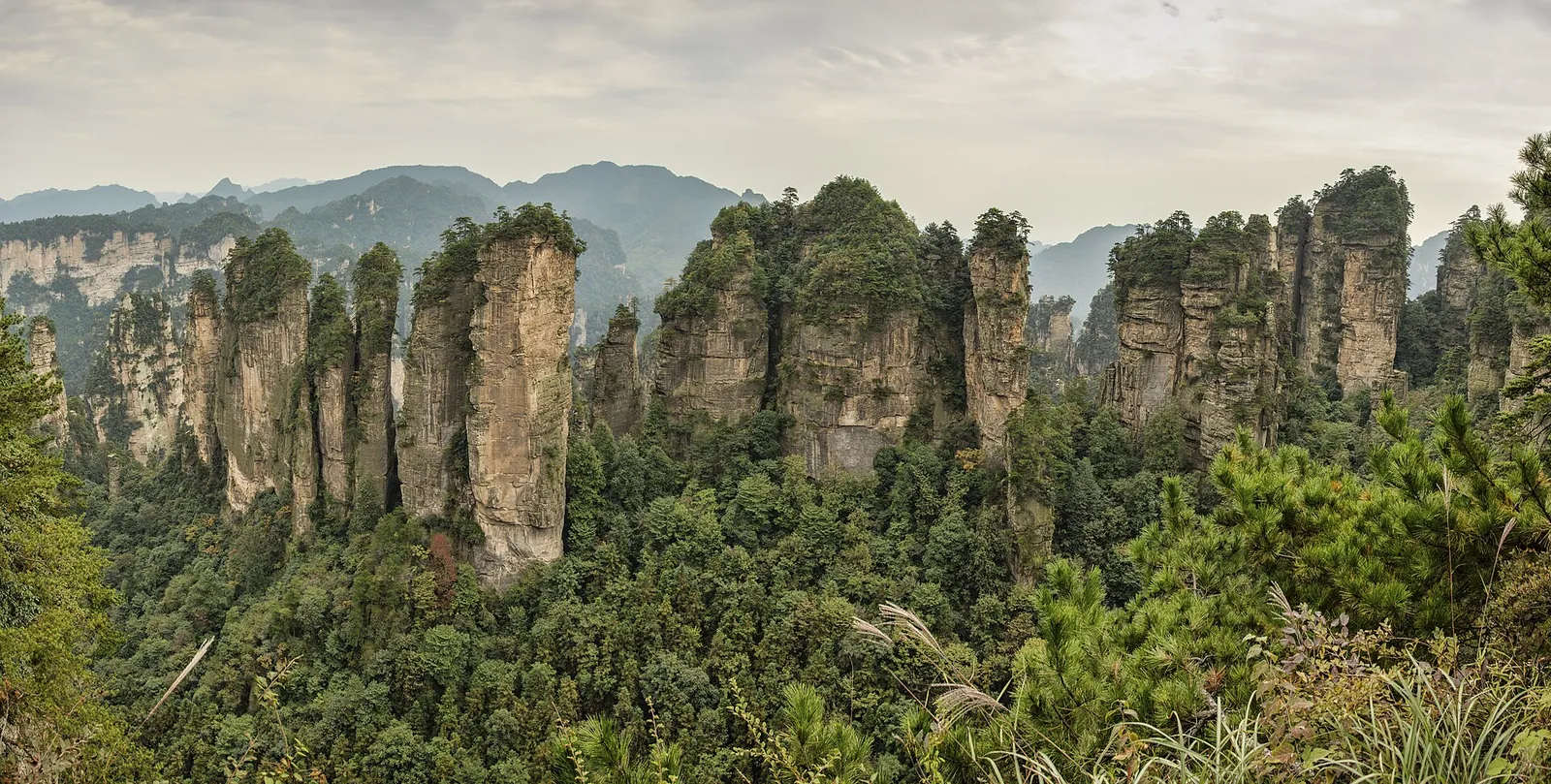
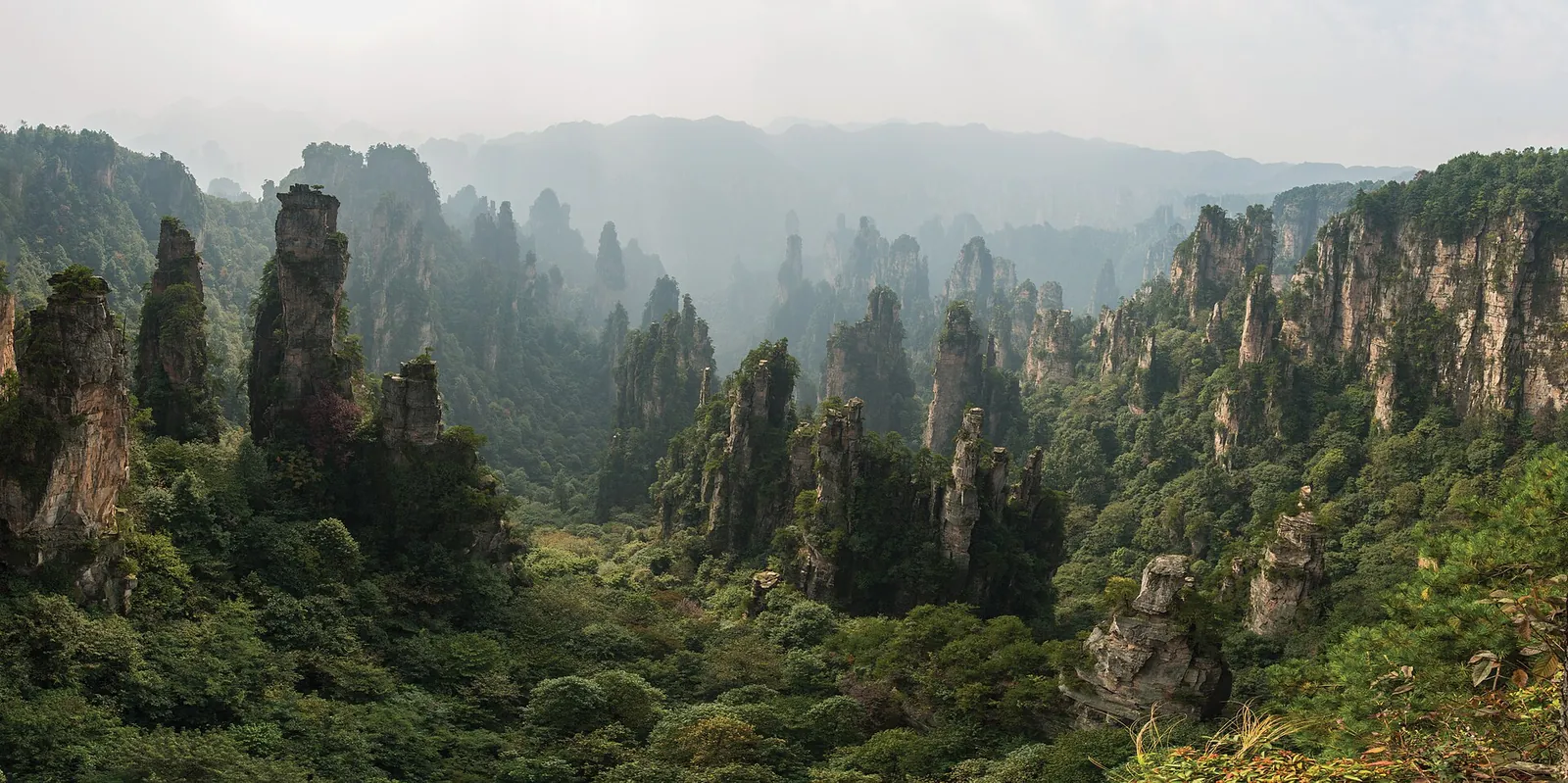
Wulingyuan is a forest of quartz-sandstone pillars wrapped in forest and mist: more than 3,000 peaks, 243 of them above 1,000 metres. The peak forest put the area on UNESCO’s World Heritage list in 1992, and Zhangjiajie National Forest Park, at its heart, became China’s first national forest park in 1982. Day 2 sees the pillars from three sides: the valley floor along Golden Whip Stream, the Yuanjiajie plateau and Tianzi Mountain; Huangshizhai is the fourth, for a fifth day.
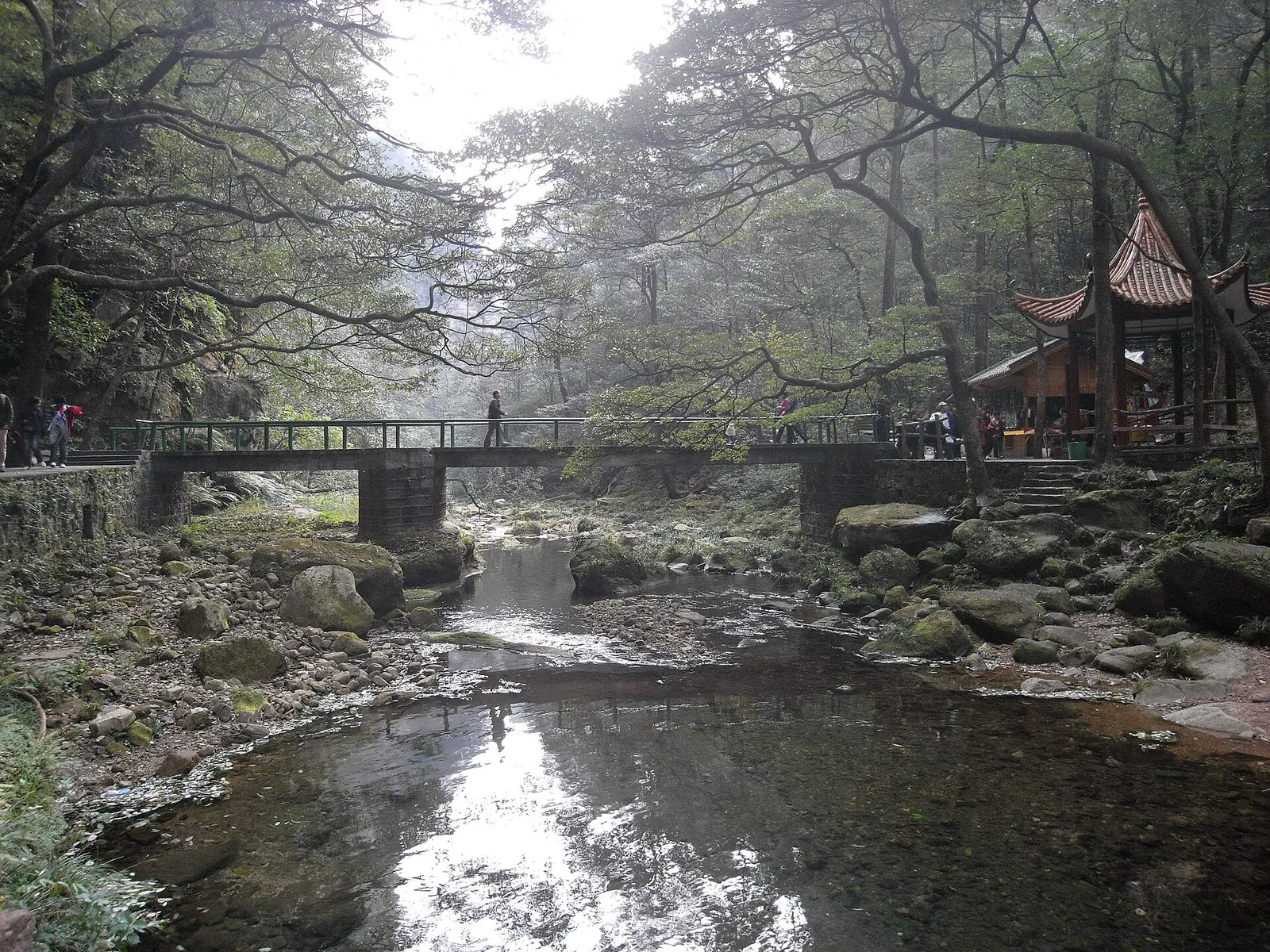
Golden Whip Stream is the gentle start: a clear stream that runs 7.5 km along the valley floor under the cliffs, with fish in the shallows and wild monkeys on the banks, so keep food out of sight. From the Wulingyuan gate an eco-bus runs to Shuiraosimen, where the path meets the stream; start the day here, walking upstream as far as Camel Peak and back the same way. The Ten-Mile Gallery is a flat valley you can walk; a small train also runs along it at extra cost, for tired legs at the end of the day.
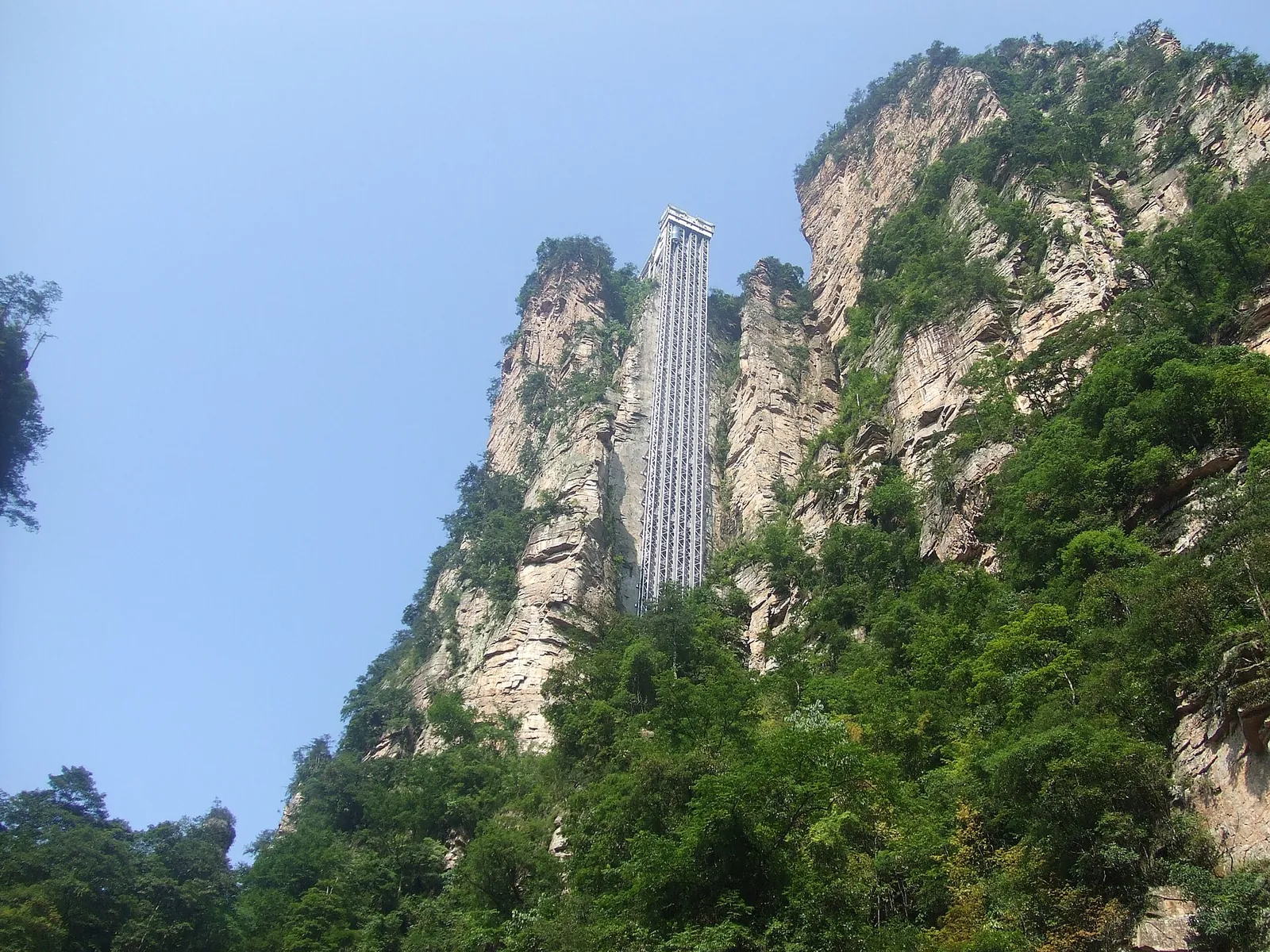
Yuanjiajie is the plateau most people come for. The Bailong elevator climbs the cliff face to it from Shuiraosimen: Guinness World Records certified it in 2015 as the tallest outdoor lift in the world, at 326 metres, with an ascent of 1 minute 32 seconds. At the top stands the pillar that inspired the floating Hallelujah Mountain in the film Avatar. Nearby, the natural stone arch called the First Bridge Under Heaven, more than 20 metres long and about 2 metres wide, links two peaks and stands 350 metres high.
On day 2, enter by the Wulingyuan gate at the first slot and take the eco-bus to Shuiraosimen. Walk Golden Whip Stream to Camel Peak and back, then ride the elevator up to Yuanjiajie. From Tianqiao stop on the plateau, an eco-bus takes about half an hour on a winding road to Tianzishan. Ride the Tianzishan cable car down, walk the Ten-Mile Gallery and take an eco-bus back to the Wulingyuan gate before the park closes at 17:00. It is a full day, so start at opening time.
Tianzi Mountain, in the north of the area, was a nature reserve of its own before it was joined with the forest park and Suoxiyu to form Wulingyuan, 369 square kilometres in all. On misty days the clouds roll over it like a sea. From the eco-bus stop a row of snack shops leads to He Long Park, with its bronze statue of Marshal He Long; beyond it are the viewpoints of West Sea (Xihai), Fairy Scattering Flowers and Tianzi Pavilion. A path beside the pavilion walks down in about two hours, but after a day on the stairs the cable car is the kinder way.
Huangshizhai rises on the far side of the park, above the Forest Park gate in the south, and its cliff-edge viewpoints look out over a crowd of pillars. It is reached from that gate, on the opposite side of the park from Wulingyuan, so keep it for a fifth day: a five-minute walk from the gate brings you to Oxygen Bar Square, where stone steps climb the mountain on the left, and an eco-bus runs to the lower station of the Huangshizhai cable car.
The Grand Canyon, Yellow Dragon Cave and Baofeng Lake
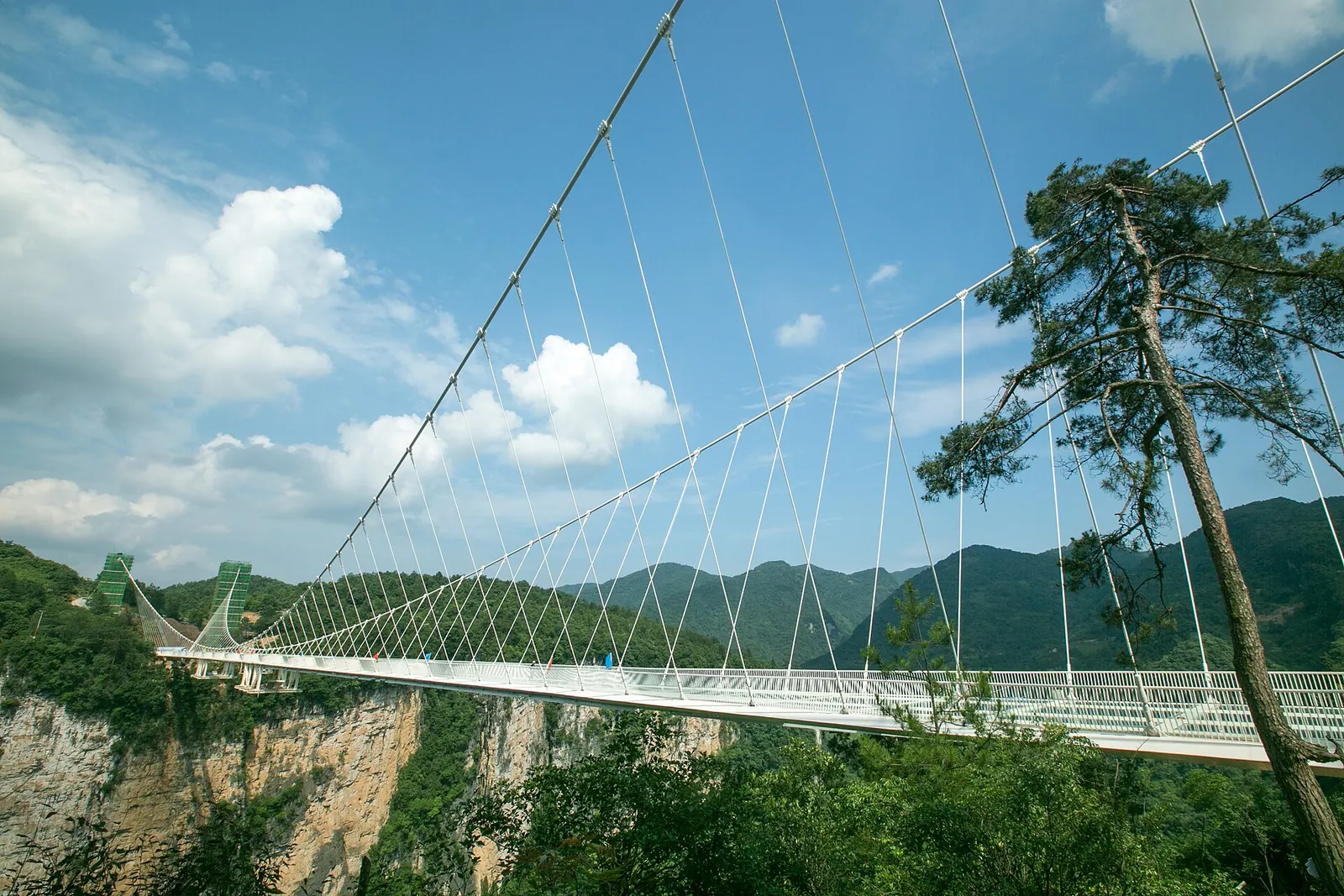
The Zhangjiajie Grand Canyon is not part of the forest park. It lies at Sanguansi in Cili county, about 30 minutes by road from Wulingyuan, and has its own ticket: CNY 91 for basic entry. Direct buses also run there from Wulingyuan. Plan on at least three hours at the canyon; leave after breakfast, have lunch at Sanguansi and you are back in Wulingyuan by mid-afternoon. The glass bridge is the reason most people come: 430 metres long and 6 metres wide, with its deck about 300 metres above the floor of the gorge, it takes up to 800 people at a time. The bridge also carries a bungee jump and a zip line, and below it a path follows the stream through the canyon.
The bridge is sold apart from the CNY 91 basic entry. Budget about CNY 220 a person for entry and bridge together, an estimate; the basic entry alone is CNY 91. Arrange the dated ticket with your passport details before committing to the car, and make sure the glass bridge is included.
Back in Wulingyuan, spend the afternoon at Yellow Dragon Cave (Huanglong Dong), at Hekou village in Suoxiyu, about 3 km east of Xibu Street. It is a karst cave on four levels, dry passages above and an underground river below, packed with stalactites and stalagmites; its emblem, the Needle that Calms the Sea, is a column about 20 metres high and only 10 cm across at its narrowest. The walking galleries show the formations at close range. The tourism department also describes a boat through the underground river, but choose that only where your selected ticket includes it. The 2025 government price directory lists CNY 60 basic admission without transport, which is the cave visit priced below. Baofeng Lake, 600 metres south of Xibu Street, is the gentler choice: a lake held between sandstone peaks, with a waterfall and boats on the water, and a steep path through a narrow gorge and along a walkway fixed to the cliff to Yingwozhai, once a bandit stronghold. Entry is CNY 30, without the boat or other transport inside.
Cable cars, lifts and the bridge can stop in high wind, heavy rain or ice. Move the forest-park day to the better forecast if your reservations allow it. A closed glass bridge is no substitute for a closed lift: use Yellow Dragon Cave only if its operator confirms access, or keep the day indoors in town. Buy lift rides for the day you use them and read the cancellation terms when reserving dated tickets.
Tianmen Mountain on the way out
Tianmen Mountain rises 8 km south of the city and, at 1,518.6 metres, is the highest mountain in Zhangjiajie. It is not part of the forest park, so it has its own ticket. From 1 August 2025 the government-guided entrance price is CNY 72, set for five years. Children under 14 and visitors aged 65 and over enter free with valid ID, and ages 14 to 17, 60 to 64 and full-time students up to undergraduate level pay half. Insurance may not be added to the ticket automatically; it is sold at a separate window for those who want it.
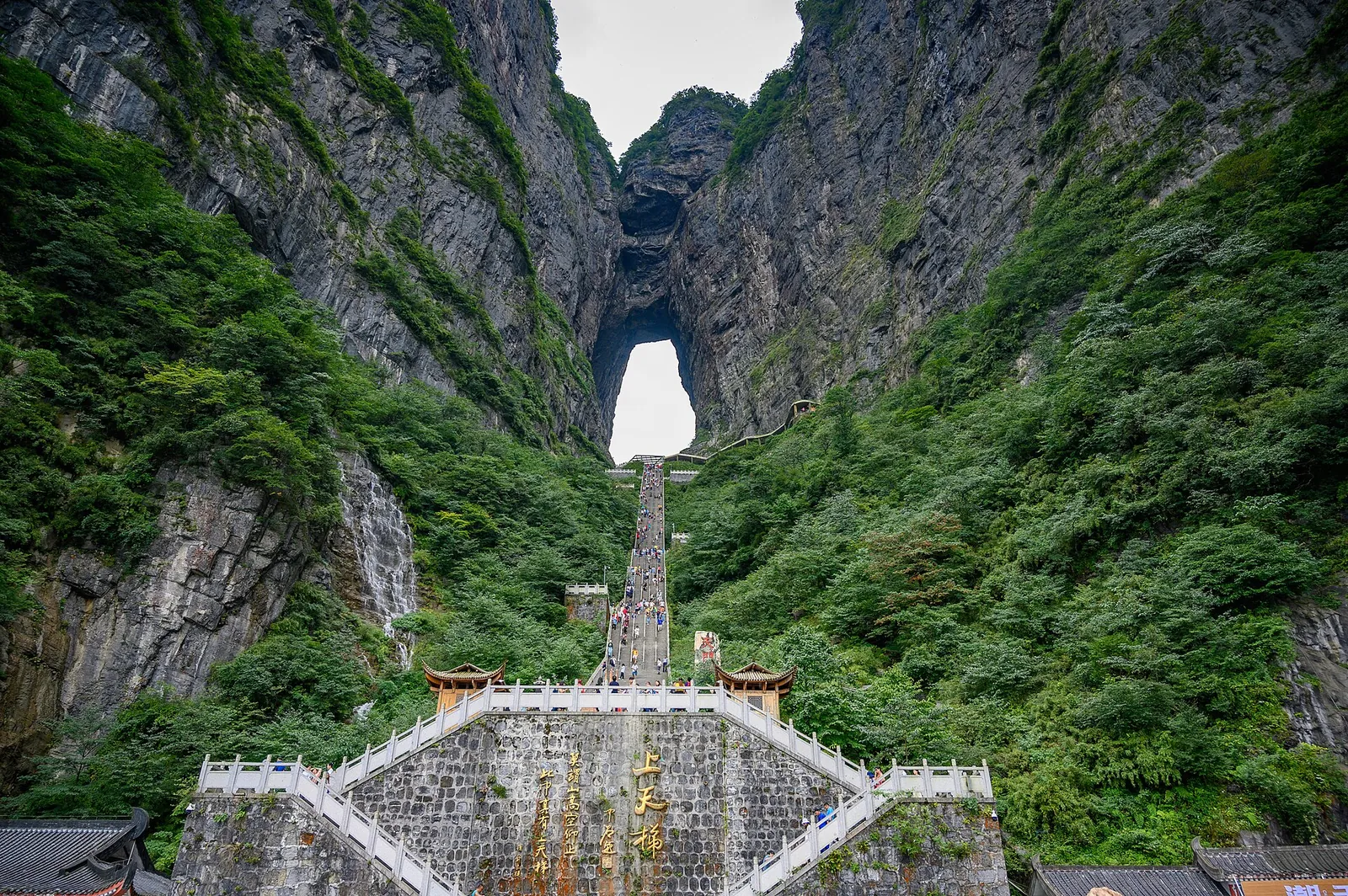
The mountain’s best-known sight is Tianmen Cave, the natural arch known as Heaven’s Gate; local history says the cliff split open in the third century, and the mountain took its name from it. A road of 99 hairpin bends climbs towards the arch and ends at the long stairway known as the celestial ladder. The main cable car from the city, 7,455 metres long with a rise of 1,279 metres, is closed for an upgrade: its upper half stopped on 6 November 2025 and the whole line on 13 October 2026, and no reopening date has been announced. Until it reopens, only line C runs. A shuttle bus runs from the cable-car station in the city to the mountain gate; from there the Tianmen Cave express cable car rides up to Tianmen Cave, seven stages of escalators climb through the mountain from behind the cave to the summit and back, and the express cable car brings you down. On the summit, the Ghost Valley plank walk clings to the cliff for 800 metres, including a 60-metre stretch with a glass floor.
The line C package covers the express cable car and the upper escalators both ways, but not the lower escalator, a one-way ride up towards the arch that is paid separately. Allow about CNY 290 a person, entrance included; the glass walkways and the celestial ladder can close at short notice. Tickets are sold from 07:30 to 16:00 and rides start at 08:00; the scenic area’s hotline is 0744-8366666. For a last-morning visit, be at the city cable-car station for 08:00 and plan roughly four hours for the shuttle, line C, escalators and Ghost Valley, plus lunch, a car to Zhangjiajie West and an hour at the station. This is a planning estimate for that sequence, with queues extra. Choose an evening train if possible; the 14:39 departure used in the budget leaves little room for a delayed lift. If that is your only train, put Tianmen on a separate day and add a night.
Four days in order
Three nights in Wulingyuan: an arrival day, the forest park on day 2, the canyon and Yellow Dragon Cave on day 3 and Tianmen on the way out.
- Day 1: Take the morning through train from Shanghai Hongqiao to Zhangjiajie West, about 7 hours 15 minutes, and a car to Wulingyuan; settle in and eat on Xibu Street. If you fly in instead and can be at the Wulingyuan gate by about 13:00, book an afternoon slot and walk Golden Whip Stream from Shuiraosimen that day.
- Day 2: The first slot at the Wulingyuan gate: Golden Whip Stream to Camel Peak and back, the Bailong elevator to Yuanjiajie, the eco-bus to Tianzishan, the cable car down and a walk through the Ten-Mile Gallery.
- Day 3: The Grand Canyon and the glass bridge in the morning and lunch at Sanguansi, then Yellow Dragon Cave or Baofeng Lake in Wulingyuan in the afternoon. Move the park days only where the booked slots and operating notices allow; keep an indoor alternative for closures.
- Day 4: Check out early and keep the car for the morning: it takes you to the Tianmen cable-car station in the city, about 40 minutes, for the first rides at 08:00, holds your bags while you ride line C and drives you on to Zhangjiajie West afterwards. Prefer an evening train; for the 14:39 example, move Tianmen to another day if queues or a closure would risk the connection.
What to eat and where to look
Sanxiaguo
The Tujia “three-pots” dish, made mostly from offal such as pork belly and intestines with cured bacon and vegetables. The name means three processes, not three dishes: the meat is blanched, then stir-fried and stewed, then simmered at the table. It comes as a dry pot, hot with chilli, or as a milder soup pot. Expect offal.
- Where to look
- Its signboards are everywhere in Zhangjiajie, so try it in Wulingyuan town that evening.
- Fit it into your day
- Dinner on day 3, back from the canyon and Yellow Dragon Cave.
Cold noodles (liangmian)
A bowl of cold noodles piled with pig’s ear, spiced beef or dried tofu, peanuts, seaweed and pickles, with a tomato broth on the side. Locals often eat it for breakfast, and a filling bowl costs a little over CNY 10.
- Where to look
- The cold-noodle street beside the Yadian International Homeland compound on Shuangyong Road, in the city, where several shops sell nothing else.
- Fit it into your day
- A quick lunch in the city on day 4, after Tianmen.
Rock-ear chicken
Free-range chicken stewed in a clear pot with rock ear, a black, finely spined fungus that grows on cliff faces, larger than wood ear, and takes six or seven years to mature. It was once a tribute dish sent to the emperor, and it is Wulingyuan’s own speciality.
- Where to look
- Restaurants in Wulingyuan town, where it is the local speciality; ask for it by its Chinese name, 岩耳炖鸡.
- Fit it into your day
- Dinner on day 2, back from Tianzishan.
Cili mandarin fish
Mandarin fish is the fish of Cili county, where the Grand Canyon lies. Braised in soy, it is one of the signature dishes on Zhangjiajie’s “one table” menu of local food.
- Where to look
- Restaurants around the canyon at Sanguansi, in Cili county; ask for 红烧鳜鱼, braised mandarin fish.
- Fit it into your day
- Lunch on canyon day.
Tujia pork belly (kourou)
Thick slices of fatty pork belly, steamed until soft and turned out on to the plate. The Tujia version is on Zhangjiajie’s “one table” menu as well.
- Where to look
- Restaurants serving Tujia and Xiangxi home cooking in Wulingyuan town; ask for 土家扣肉.
- Fit it into your day
- Dinner on day 1, your first evening in Wulingyuan.
Getting to Zhangjiajie and around
Trains arrive at Zhangjiajie West and flights at Hehua International Airport (DYG). The four days start and end in Shanghai, on the through trains: the 12306 examples recorded for this guide on 25 October 2026, for a weekday in early November, were a morning train from Shanghai Hongqiao that took 7 hours 15 minutes and an afternoon train back that left Zhangjiajie West at 14:39 and took 7 hours 18 minutes, each CNY 786 in second class. These are dated examples, so check your actual trains before fixing the park days. A through train from Hong Kong West Kowloon took 6 hours 42 minutes. The same dated examples from Beijing West change at Changsha South: 5 hours 10 minutes to 8 hours 18 minutes (CNY 506 to 778), then 2 hours 52 minutes to 3 hours 39 minutes on to Zhangjiajie West (CNY 242 to 319), so the journey takes most of a day. From Changsha itself, the recorded trains from Changsha station, in the city, took 1 hour 43 minutes to 2 hours 12 minutes for CNY 135 to 166. Book rail on the 12306 website or app, or at a station counter: tickets go on sale up to 15 days ahead, counting the day you buy, and the English site accepts a valid foreign passport only. Flying into Hehua is the alternative if you are coming from further away.
The city’s old railway station is a different place from Zhangjiajie West. From the bus station next to the old railway station, a bus runs to the east or south gate of the park every 15 minutes or so for CNY 13 a person; Wulingyuan is about 40 minutes’ drive from the city. From Zhangjiajie West, a taxi into the city centre takes about 18 minutes and bus 6 about 50. For Wulingyuan, take a car from the station and allow up to an hour: the city centre is an 18-minute ride away and Wulingyuan about 40 minutes’ drive beyond it. Tianmen’s shuttle bus leaves from the cable-car station in the city, so on day 4 the car takes you from Wulingyuan back into town.
Carry your original passport at all times; a printed copy is not accepted. German advice is to refrain from using VPN services, so plan on limited access to some overseas apps and keep offline maps and notes. Drones are tightly regulated: declare one at customs and get registration and any local permission before you fly, or leave it at home. Check your own government’s current travel advice before you book.
What four days in Zhangjiajie cost
| Level | Per person, about CNY | For two, about CNY |
|---|---|---|
| Mid-range | 5,440 | 10,880 |
These figures are for two adults sharing one private double for three nights, outside the national holidays, with prices checked on 25 October 2026. They cover the through train from Shanghai Hongqiao and back, rooms, three meals and drinks a day, the park, the canyon, Yellow Dragon Cave and Tianmen, every car on the ground, two SIMs and a 10% buffer.
The figures assume a passport on the visa-free list in our entry rules guide, so no visa fee is included. The waiver is published until 31 December 2026. For 2027, check for an extension or use a visa; conditional 240-hour transit is a separate option for a qualifying onward journey to a third country or region.
Zhangjiajie is usually added to a trip that flies into Beijing and home from Shanghai. A London return to Beijing, flying home from Shanghai, costs about GBP 650 to 850 a person (GBP 1,300 to 1,700 for two). The flight and these four days from Shanghai and back come to about GBP 1,260 to 1,460 a person (GBP 2,510 to 2,910 for two), at the State Administration of Foreign Exchange central parity rate of 23 October 2026 (GBP 1 = CNY 8.9749).
- Rooms, about CNY 1,950 for two. Three nights at about CNY 650, a typical mid-range double, without breakfast.
- Food, about CNY 1,440 for two. About CNY 180 a person a day for four days, a mid-range day: CNY 30 for breakfast, 60 for lunch, 70 for dinner and 20 for water and snacks.
- Getting around, about CNY 4,340 for two. The through train from Shanghai Hongqiao and back, CNY 786 a person each way in second class: CNY 3,144 for two. A car and driver from Zhangjiajie West to Wulingyuan and another for the Grand Canyon and back by way of Yellow Dragon Cave, about CNY 300 a car each, an estimate for a private car and driver. On day 4, a car kept for the morning, from Wulingyuan to Tianmen and on to Zhangjiajie West with your bags aboard, about CNY 600, the price of two such rides. The direct bus from Wulingyuan to the canyon and the CNY 13 bus between the city and the park gates are the cheap alternatives to the cars.
- Sights, about CNY 1,860 for two. About CNY 932 a person: the park entry CNY 165, the eco-buses about CNY 60, the Bailong elevator about CNY 65 and the Tianzishan cable car CNY 72; Tianmen’s line C package about CNY 290, entrance included; the canyon with the bridge about CNY 220; and Yellow Dragon Cave CNY 60. The eco-bus estimate uses the operator’s older CNY 60 tariff; the canyon estimate compares the CNY 91 basic entry with a separate bridge ticket. The elevator and Tianmen package remain estimates from this guide’s earlier ticket comparisons, not confirmed current checkout prices.
- SIM and extras, about CNY 300 for two. About CNY 150 a person for a roughly 15-day data SIM, estimated from China Telecom’s regional CNY 125 visitor plan; the airport product and your dates may cost more.
- Buffer, about CNY 990. Ten per cent of the subtotal.
Practical questions
How many nights do I need in Zhangjiajie?
Three nights give four days: an arrival day, one in the forest park, one at the Grand Canyon and Yellow Dragon Cave, and Tianmen on the way out. For a dependable departure, give Tianmen a separate day and add a night if you cannot take an evening train, and a fifth day for Huangshizhai from the Forest Park gate. With only two days, take the forest park and drop the others.
Is the CNY 165 park ticket all I need?
No. CNY 165 is the entry alone, valid for four consecutive days. Add about CNY 60 for the eco-buses and, for day 2, about CNY 137 for two lift rides: the Bailong elevator up and the Tianzishan cable car down.
Do I have to book the forest park in advance?
Yes, on a first visit. The timed-slot rule applies to independent travellers as well as tour groups, so have your hotel reserve your slot before you arrive and choose the Wulingyuan gate.
Can I see the Grand Canyon bridge and Tianmen in one day?
They are in different parts of the area, and each needs a full half-day with its own ticket and queue. We put them on separate days. A private two-day tour covers Tianmen and a forest-park day together if you prefer not to arrange cars.
Where can I leave my bags on the last day?
Ticket offices at most sights in Zhangjiajie store bags. On day 4 the simplest answer is the car: keep the one that takes you to Tianmen for the morning, leave your bags in it while you ride line C, and let the driver take you on to Zhangjiajie West. The budget includes it.
Is Tianmen Mountain part of the forest park ticket?
No. Tianmen has its own entrance, CNY 72, sold within route packages that include its lifts. Its main cable car is closed for an upgrade, so only line C runs, from the mountain gate, which a shuttle bus links to the city. The mountain rises above the city, not the park.
Keep planning your trip
First trip to China
How long a first China trip should be, then a week in Beijing, Xi’an and Shanghai: what to book first, the trains, entry, paying and the cost per day.
Read the guide
Getting around China
Book China's high-speed trains on 12306 with a foreign passport, decide when to fly, and get from the airports and stations into town.
Read the guide
Best time to visit China
When to go to China by region and month: spring and autumn for Beijing, Xi’an and Shanghai, rain and typhoon seasons, and the expected 2027 holiday peaks.
Read the guide
Chongqing and the Yangtze
Two nights in Chongqing, three on a Yangtze cruise to Yichang, a night train to Shanghai: the 2027 fares, life on board, booking and the week's cost.
Read the guide
Chengdu
Two nights in Chengdu: booking the Panda Base with a passport, Wenshu Monastery, Kuanzhai Alley, the Leshan Giant Buddha by train, where to stay and what it costs.
Read the guide
Guilin and Yangshuo
One night in Guilin and two in Yangshuo: how to buy the Li River cruise, where the countryside rides and the Longji terraces fit, and what four days cost.
Read the guideSources and checks before you travel
(35)
- Hunan Development and Reform Commission: government-priced scenic areas directory, 2025 ↗ — opens in a new tab
- Hunan Development and Reform Commission: Tianmen Mountain ticket price notice ↗ — opens in a new tab
- Hunan government portal: Wulingyuan one-ticket system, December 2023 ↗ — opens in a new tab
- Zhangjiajie Tourism Group: notice on Wulingyuan eco-bus and ticket prices, October 2020 (Shenzhen Stock Exchange filing) ↗ — opens in a new tab
- Hunan government international site: Zhangjiajie National Forest Park ↗ — opens in a new tab
- Hunan Department of Culture and Tourism: Wulingyuan transport guide, 2022 ↗ — opens in a new tab
- Hunan Department of Culture and Tourism: a three-day Zhangjiajie guide, 2022 ↗ — opens in a new tab
- Hunan Department of Culture and Tourism: Tianmen Mountain transport guide, 2022 ↗ — opens in a new tab
- Hunan Department of Culture and Tourism: Grand Canyon transport guide, 2022 ↗ — opens in a new tab
- Hunan Department of Culture and Tourism: from Zhangjiajie West station, 2022 ↗ — opens in a new tab
- Hunan Department of Culture and Tourism: Wulingyuan scenic area ↗ — opens in a new tab
- Hunan Department of Culture and Tourism: Wulingyuan scenic and historic area ↗ — opens in a new tab
- Hunan Department of Culture and Tourism: Zhangjiajie Grand Canyon ↗ — opens in a new tab
- Hunan government international site: Zhangjiajie Grand Canyon’s glass-bottom bridge ↗ — opens in a new tab
- Hunan Department of Culture and Tourism: Yellow Dragon Cave ↗ — opens in a new tab
- Hunan Department of Culture and Tourism: Baofeng Lake ↗ — opens in a new tab
- Hunan Department of Culture and Tourism: Xibu Street ↗ — opens in a new tab
- Hunan Department of Culture and Tourism: Tianmen Mountain ↗ — opens in a new tab
- Hunan Daily (New Hunan): Tianmen Mountain notice on line C only from 13 October 2026 ↗ — opens in a new tab
- Hunan Daily (New Hunan): Tianmen route changes, 6 November 2025 ↗ — opens in a new tab
- China Daily, government channel: 72 hours in Hunan (Tianmen pages), 2019 ↗ — opens in a new tab
- Hunan government international site: Tianmen Mountain rime, November 2025 ↗ — opens in a new tab
- Hunan government international site: a 10-day Greater Zhangjiajie route, March 2026 ↗ — opens in a new tab
- Guinness World Records: Bailong elevator, 2015 ↗ — opens in a new tab
- Hunan government portal: Zhangjiajie food report, 2022 ↗ — opens in a new tab
- Hunan Department of Culture and Tourism: rock-ear chicken, 2022 ↗ — opens in a new tab
- Embassy of China in the United States: visa-free entry FAQ ↗ — opens in a new tab
- National Immigration Administration: accommodation registration ↗ — opens in a new tab
- China Daily via Shanghai government: accommodation for foreign visitors ↗ — opens in a new tab
- China Railway 12306: frequently asked questions ↗ — opens in a new tab
- China Railway 12306: train and fare search (trains of 5 November 2026) ↗ — opens in a new tab
- UK government: China safety and security ↗ — opens in a new tab
- German Federal Foreign Office: China safety ↗ — opens in a new tab
- State Administration of Foreign Exchange: renminbi central parity ↗ — opens in a new tab
- China Telecom Shaanxi: 15-day foreign-visitor plan ↗ — opens in a new tab
Reference sources for the version dated 26 October 2026. Confirm opening times, access, transport and conditions for your travel dates.
Photo credits
(6)
The Grand Canyon glass bridge and its suspension cables above the gorge.
Photograph: אביהוד — opens in a new tab · CC BY-SA 4.0 — opens in a new tab
Changes: Resized and converted to WebP; displayed with responsive crops. · Original photograph and licence details ↗ — opens in a new tab
Sandstone pillars around Five Fingers Peak at Huangshizhai, Wulingyuan.
Photograph: chensiyuan — opens in a new tab · CC BY-SA 4.0 — opens in a new tab
Changes: Resized and converted to WebP; displayed with responsive crops. · Original photograph and licence details ↗ — opens in a new tab
Golden Whip Stream on the valley floor of the forest park, with a footbridge and a pavilion on the bank.
Photograph: gdczjkk — opens in a new tab · CC BY 3.0 — opens in a new tab
Changes: Resized and converted to WebP; displayed with responsive crops. · Original photograph and licence details ↗ — opens in a new tab
The Bailong elevator climbing the cliff face to the Yuanjiajie plateau.
Photograph: Nyx Ning — opens in a new tab · CC BY-SA 3.0 — opens in a new tab
Changes: Resized and converted to WebP; displayed with responsive crops. · Original photograph and licence details ↗ — opens in a new tab
The pillar forest seen from Tianzi Mountain in Wulingyuan, with mist in the valleys.
Photograph: chensiyuan — opens in a new tab · CC BY-SA 4.0 — opens in a new tab
Changes: Resized and converted to WebP; displayed with responsive crops. · Original photograph and licence details ↗ — opens in a new tab
The celestial ladder, the stone stairway that climbs to Tianmen Cave.
Photograph: xiquinhosilva — opens in a new tab · CC BY 2.0 — opens in a new tab
Changes: Resized and converted to WebP; displayed with responsive crops. · Original photograph and licence details ↗ — opens in a new tab