Northern Mountains · Lao Cai
Mu Cang Chai guide: golden terraces, the right weeks and where to stay
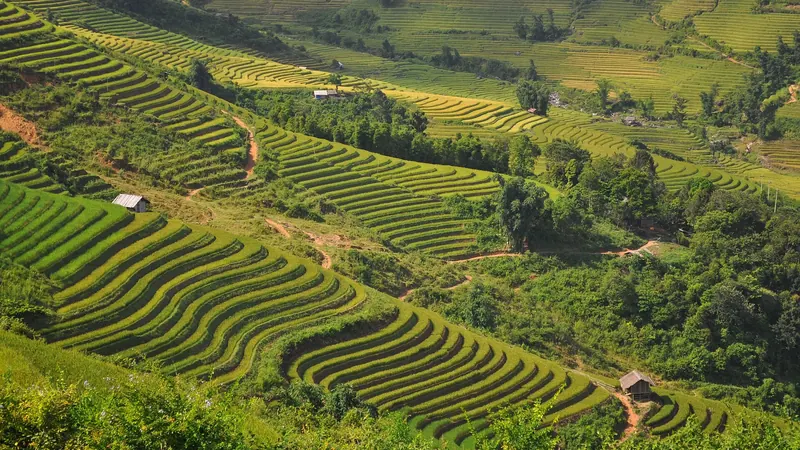
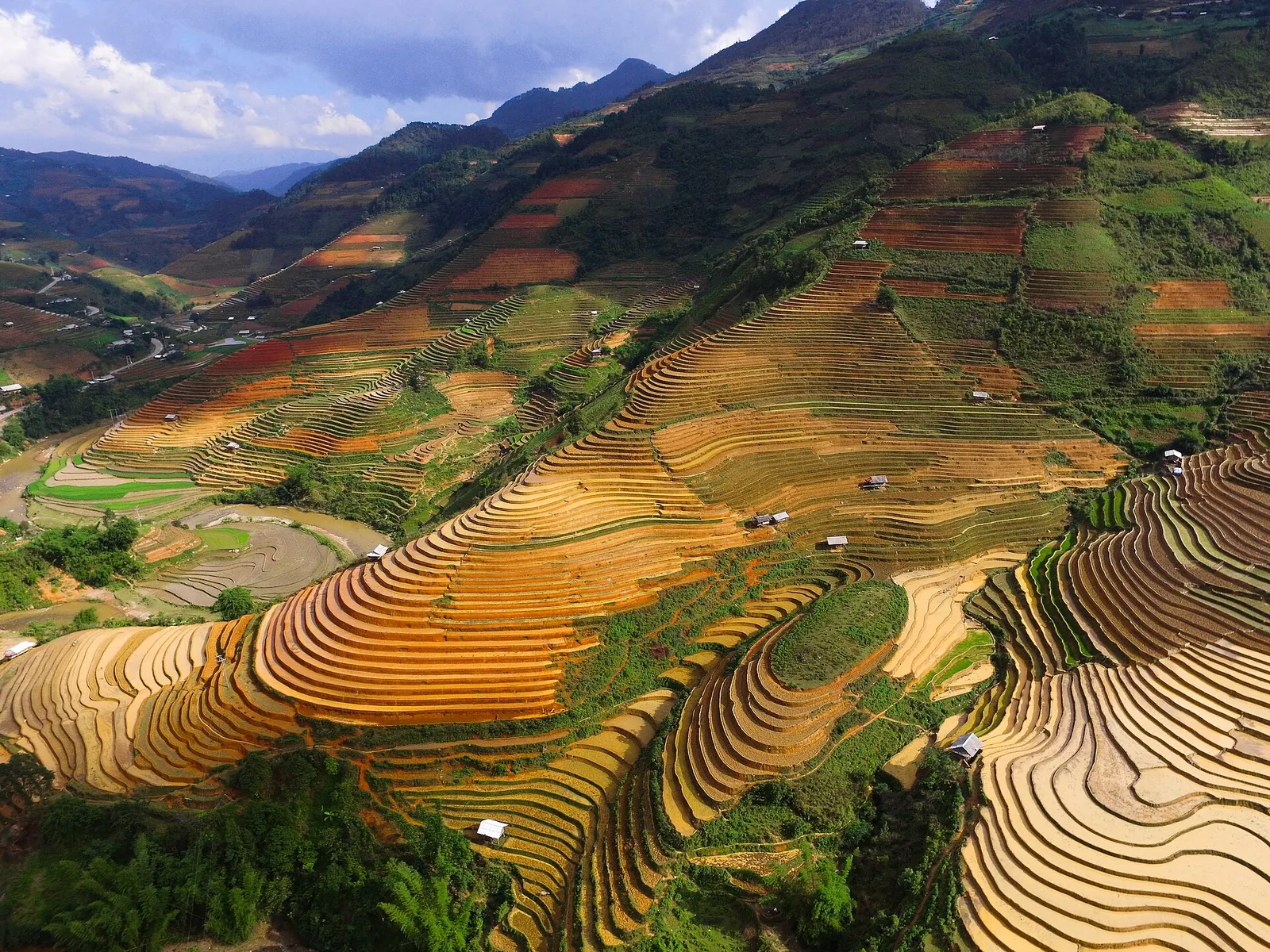
Mu Cang Chai is a long way to drive for a view, and the view depends on the calendar. Its terraced rice fields, sculpted into the slopes over centuries by Hmong farmers, are flooded and mirror-like in the planting season and gold just before the harvest; outside those weeks they are green, or bare and quiet. Plan the trip around the rice, not the other way round, and give the road the respect it needs: everything here is reached over mountain passes, and the famous hills fill up fast on fine weekends.
- Suggested time
- 2–3 nights
- Where to stay
- Tu Le for the first night and Khau Pha; Mu Cang Chai's centre or a homestay near La Pan Tan or Che Cu Nha for the main terraces
- Season and timing
- Golden season from mid-August (Tu Le and Khau Pha) to about mid-October (La Pan Tan and the centre); the flooded planting season falls in spring, roughly April to early June depending on the rains. The national tourism site describes a cold, dry season from November to March and a hot, rainy one from April to October; wild peach trees flower around December and January.
The short answer
Give Mu Cang Chai two nights, three if you can: it is a six- to eight-hour road journey from Hanoi, so a day trip does not work. Go in the golden season (the Tu Le valley by Khau Pha Pass ripens first, from about mid-August; La Pan Tan, Che Cu Nha and De Xu Phinh follow from about mid-September to mid-October) or in the flooded planting season in spring. Sleep one night in Tu Le on the way in, then one or two in Mu Cang Chai's centre or a homestay near La Pan Tan. Travel midweek if you can, book beds early, and see the viewpoints at sunrise, on foot or with a local driver or guide.
Pick your weeks, then your bed
The rice does not ripen everywhere at once. In August 2026 Dan Tri reported that the fields in the Tu Le valley and below Khau Pha Pass (around Lim Mong, Lim Thai and Cao Pha) ripen first and look best from mid-August to early September, while the big terrace areas beyond the pass — La Pan Tan, Che Cu Nha and De Xu Phinh — are at their best from mid-September to mid-October. That gives nearly two months of golden fields, but in two different places. The exact weeks shift with the weather each year: in 2024, the Ministry of Culture's portal showed the central terraces being harvested in mid-October.
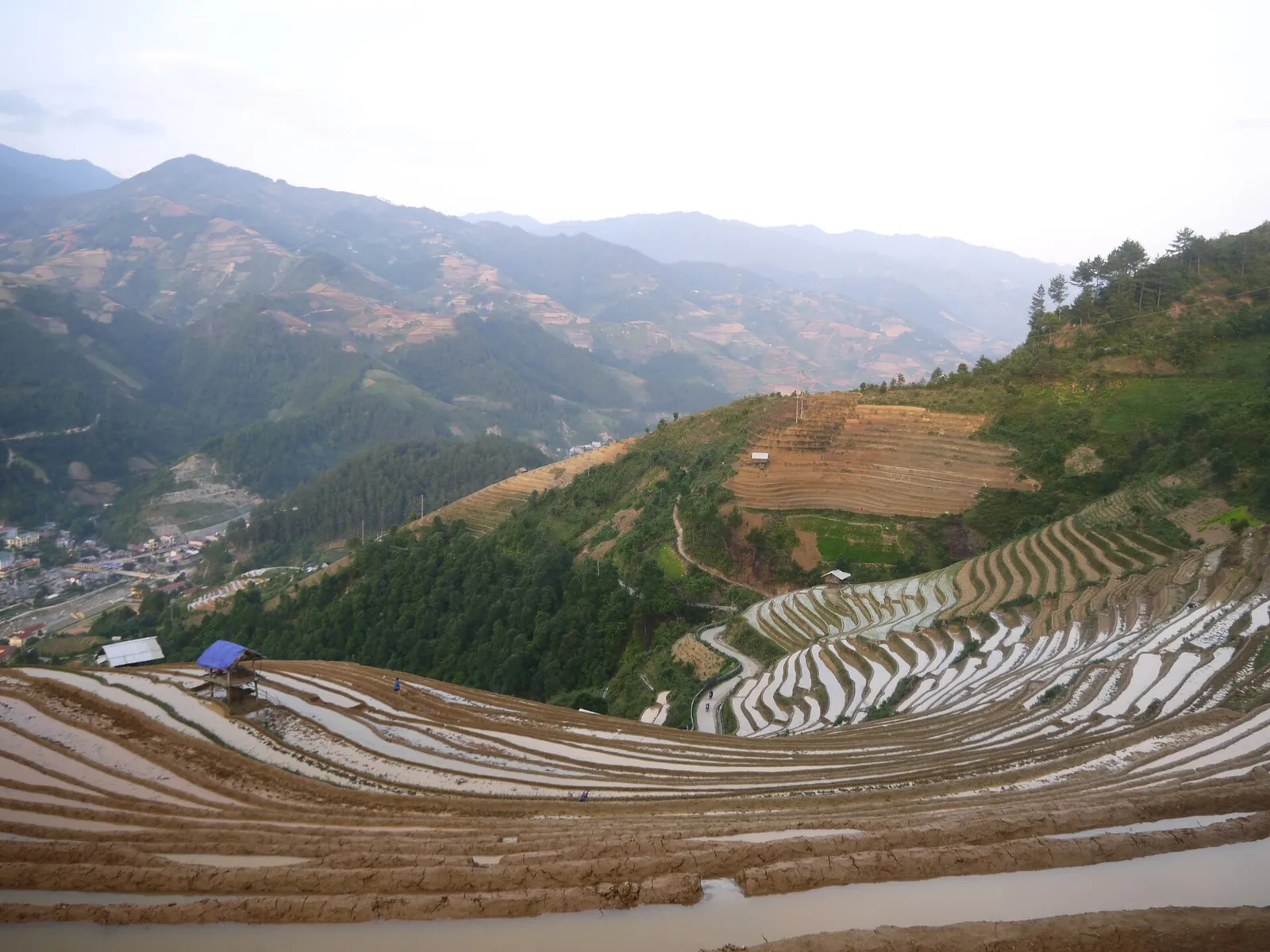
The other big season is the water season, when farmers channel water down the slopes, the terraces fill and the seedlings go in. Even official descriptions disagree on its timing — Vietnam Tourism's own article mentions both late April to early May and late May to early June — because it follows the rains and the planting calendar of each village. VnExpress puts it in April and May. If you are coming for flooded terraces, ask your homestay a week or two ahead what the fields look like.
Crowds are the real cost of the golden season. VnExpress reported about 5,100 visitors in Mu Cang Chai commune on Saturday 26 September 2026 alone, around 11,000 a week since the 2 September holiday, and a jam of more than two hours on the narrow road to Mong Ngua hill at sunset. The culture ministry's newspaper warned that over the 30 August – 2 September holiday and on September and October weekends, demand outstrips the local supply of rooms. Book ahead, come midweek if you can, and choose the base that puts you next to the terraces you most want to see.
Rooms are simple. Hotels are concentrated in Mu Cang Chai's centre, the former district town; homestays and stilt houses, some with shared dormitories, sit in the villages near the terraces. Tu Le, about three kilometres from Khau Pha Pass, is the natural first night on the drive from Hanoi and has hot springs; for the gold of the central terraces you want to sleep on the far side of the pass.
The terrace hills: La Pan Tan, Mong Ngua and the villages
The Mu Cang Chai terraces were ranked a special national relic in 2019, a protected scenic area spread over La Pan Tan, Che Cu Nha, De Xu Phinh, Kim Noi, Mo De and Lao Chai. Two hills have become the image of the place. Mam Xoi hill, at La Pan Tan, is more than eight kilometres from the centre and its access road is steep and poor; Vietnam Tourism advises using a local driver, especially when it is wet. Mong Ngua — the horseshoe-shaped bowl of terraces at Vong Lua in Mo De — is close to the centre and is the one that jams at sunset.
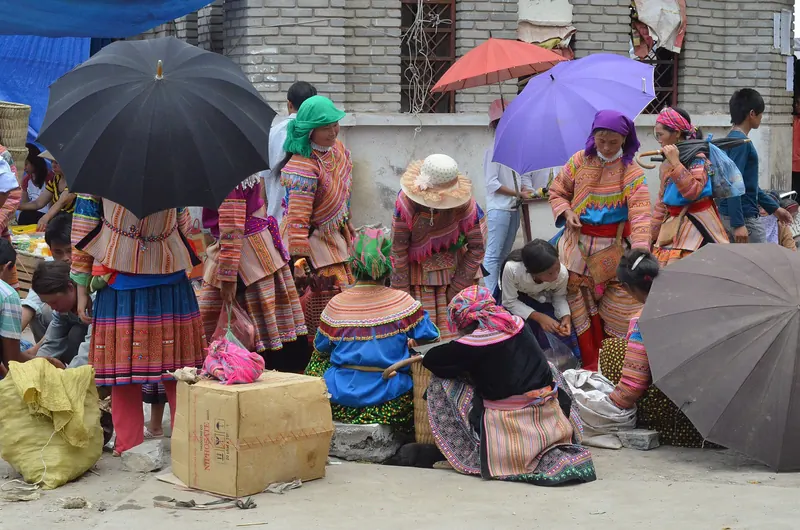
Do not build the whole trip around those two photographs. Vietnam Tourism points out that nearly every bend of the road shows terraces, and recommends Black Hmong villages such as Mo De, La Pan Tan, Sang Nhu and Mang Mu for a glimpse of village life; the Hmong here build their houses on the ground rather than on stilts, and many people still wear traditional dress. The valley of Lao Chai and the Na Hang Tua Chu bamboo forest, about 20 kilometres from the centre, are other places worth the detour, though VnExpress lists the bamboo forest among the busy spots too.
Go early. Sunrise at the viewpoints is calmer than sunset, the light is softer, and you leave the roads to the farmers before the day traffic starts. These are working fields at harvest time: stay on the bunds and paths, do not walk through standing rice for a photo, and ask before photographing people. VnExpress also asks visitors not to hand children money or sweets along the road.
Make time for the local food
What to eat and where to look
Com Tu Le (young green rice flakes)
Unripe grains of the local nep Tan sticky rice, picked, roasted and pounded into soft green flakes, a Thai tradition in the Tu Le valley. It has its own festival in late summer.
- Where to look
- Tu Le, along Highway 32 below Khau Pha Pass, where families sell it in season and visitors can watch it being made.
- Fit it into your day
- A snack on the drive between Nghia Lo and Khau Pha, or something to take home.
It is a seasonal product made in the weeks before harvest; outside August and September you may not find it fresh.
Xoi nep Tan (Tu Le sticky rice)
Sticky rice from Tu Le, which Vietnam Tourism singles out for its fragrance and chewy texture; it turns up at almost every meal in the area, sometimes in coloured versions.
- Where to look
- Homestays and local eateries in Tu Le and Mu Cang Chai.
- Fit it into your day
- Order it as the rice for a dinner of grilled meat and vegetables, or eat a portion for breakfast before a walk.
Filling and dense; a small portion goes a long way.
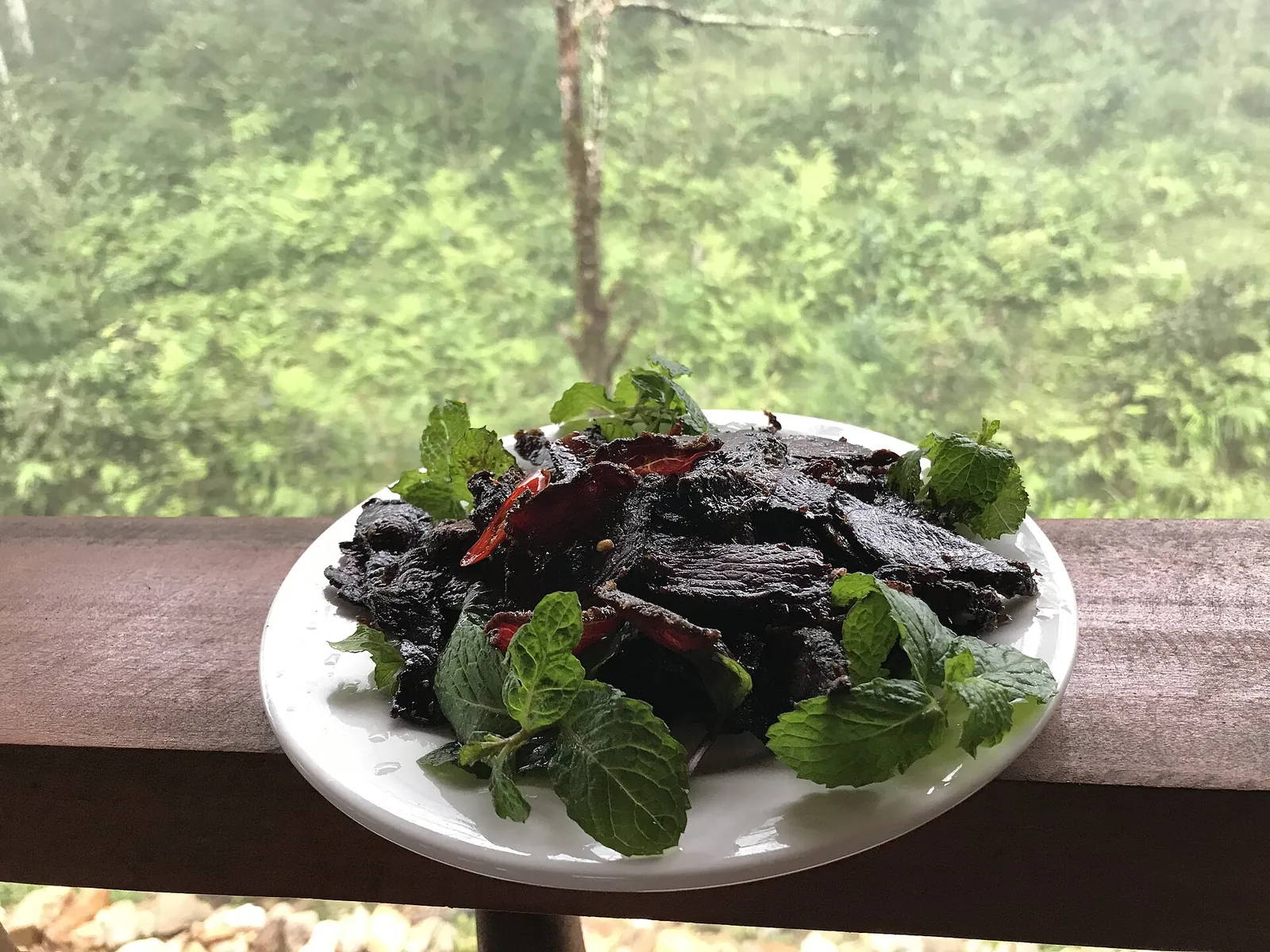
Thit trau gac bep (smoked buffalo meat)
Strips of lean buffalo cured with chilli, ginger and mac khen, the wild pepper of the northwest, then hung above the kitchen fire to smoke. Vietnam Tourism names it the top speciality of the former Yen Bai province, with roots among the Black Thai of Nghia Lo.
- Where to look
- Restaurants and specialty shops in Mu Cang Chai's centre, Tu Le and Nghia Lo.
- Fit it into your day
- A small plate to share with rice wine or as a side dish at dinner.
Chewy and dry, and usually spiced with chilli and mac khen; ask for it less spicy if needed.
Bamboo shoots (mang)
Fresh bamboo shoots gathered in the mountain forests and cooked in many ways, from stir-fries to shoots rolled around minced pork. Vietnam Tourism notes that the Na Hang Tua Chu bamboo forest near Mu Cang Chai is where locals collect them.
- Where to look
- Homestay dinners and local eateries in Mu Cang Chai; markets when the shoots are in season.
- Fit it into your day
- Part of a shared dinner with sticky rice and grilled meat after a day on the terraces.
Mang dang (bitter bamboo shoots) are bitter on purpose; ask which kind you are ordering.
Tao meo wine
Rice wine macerated with the small, sour wild apples (Docynia indica) of the northern mountains, one of the regional specialities listed by Vietnam Tourism.
- Where to look
- Shops and homestays in Mu Cang Chai and Tu Le.
- Fit it into your day
- A small glass at a homestay meal, not before driving or riding.
Strong alcohol; never drink before taking the mountain roads, and decline politely if you prefer.
Walk the terraces rather than drive past them
Hiking is the best way to see Mu Cang Chai at the pace it deserves. Vietnam Tourism describes trails that villagers have used for generations, linking every hamlet and climbing past terraces, tea and corn plots to forest higher up. They are not waymarked for visitors and paths change with the fields, so a local guide is worth having — ask your hotel or homestay, or book one of the half-day and full-day treks led by Hmong guides.
A half day is enough for one valley and a viewpoint; a full day lets you link two or three villages and come back down at the end of the afternoon. Wear shoes with grip: the bunds are narrow and the clay is slippery after rain. Take water and a light layer, since VnExpress notes that days can be hot and nights cool.
Getting there: Highway 32 and Khau Pha Pass
Mu Cang Chai is about 300 kilometres from Hanoi, and Vietnam Tourism describes it as a six- to eight-hour road journey. There is no airport and no railway to the valley. Buses leave from Hanoi's My Dinh bus station, mostly via Nghia Lo; your hotel can also arrange a direct bus or private car. Vietnam Tourism also suggests the train or a bus to Yen Bai, then onward road transport via Nghia Lo — slower to organise, and only worth it if you enjoy the journey itself.
By car, the usual way in is the Noi Bai – Lao Cai expressway, then down to Highway 32 through Nghia Lo and Tu Le and over Khau Pha Pass. Dan Tri describes two expressway exits, IC12 via Ba Khe or IC14 via An Luong, both rejoining Highway 32. Khau Pha is counted among the 'four great passes' of the northwest, and the road over it is mountain driving: allow daylight, slow down in rain and fog, and avoid arriving after dark on your first trip.
The mountain roads around Mu Cang Chai are also why many travellers come by motorbike. Vietnam Tourism highlights the stretch from Mu Cang Chai to Tu Le over Khau Pha and the mostly paved road up to Mo De, and notes that basic motorbikes can be arranged through hotels. If you are not an experienced rider on steep, wet roads, hire a driver: the side roads to the viewpoints are narrow, and one visitor told VnExpress she had to get off and push her bike in the crowds at Mong Ngua.
Khau Pha paragliding and the Tu Le valley
Paragliders launch from the top of Khau Pha Pass and fly down over the Lim Mong valley. The 2026 'Flying over the Golden Season' festival opened on 30 August at the Khau Pha landing site, with the launch point at 1,268 metres, and the ministry's newspaper reported that visitors without experience can book tandem flights with professional pilots. It pointed visitors to mebayluon.com for flight schedules and advised booking early; Dan Tri notes that morning is usually the best time for the wind. Flights depend on the weather, so keep a spare morning.
Tu Le itself is worth more than a lunch stop. It is known for nep Tan, a sticky rice grown in this valley, and for com, the green flakes made from young rice; in 2026 the Tu Le com festival opened on 22 August. The area also has hot springs and, at Aeris Hill, a zipline that Vietnam Tourism describes as 1.2 kilometres long. Since the July 2025 reorganisation, Tu Le and the former Cao Pha commune form one commune of Lao Cai province.
A workable three-day plan
This is an editorial suggestion for the golden season, not a timetable; adjust it to where the rice is ripest when you go.
- Day 1 — Hanoi to Tu Le: leave early, have lunch on the way, spend the afternoon in the Tu Le valley or the hot springs, and sleep in Tu Le.
- Day 2 — Khau Pha and over the pass: a morning tandem flight or simply the viewpoints on Khau Pha, then over the pass to Mu Cang Chai; an afternoon walk near your homestay.
- Day 3 — The central terraces: sunrise at Mong Ngua or La Pan Tan, a guided half-day walk through the villages, then either a third night or the long drive back to Hanoi.
- In the water season: reverse the emphasis and spend more time around La Pan Tan, De Xu Phinh and Che Cu Nha, where the flooded terraces are.
A new address, the same valley
Most maps, signs and older guides still put Mu Cang Chai in Yen Bai province. Since 1 July 2025 the area has been part of Lao Cai province, and the old district has been reorganised into larger communes. The new Mu Cang Chai commune combines the former town with Kim Noi, Mo De and Che Cu Nha; La Pan Tan and De Xu Phinh are now part of Pung Luong commune. When you book a homestay or a car, give the village name as well as the commune, so the driver knows exactly which hillside you mean.
Practical questions
When is the best time to see the rice terraces in Mu Cang Chai?
For gold, from mid-August to early September in the Tu Le valley and below Khau Pha, and from mid-September to mid-October at La Pan Tan, Che Cu Nha and De Xu Phinh. For flooded terraces, the planting season in spring, roughly April to early June depending on the rains. Timing varies a little every year, so check with your homestay before you go.
Can I visit Mu Cang Chai as a day trip from Hanoi?
No. Vietnam Tourism puts it at six to eight hours by road each way, about 300 kilometres. Plan at least two nights, ideally one in Tu Le and one or two in Mu Cang Chai.
Where should I stay in Mu Cang Chai?
In the centre of Mu Cang Chai for hotels and quick access to Mong Ngua, in a homestay near La Pan Tan or Che Cu Nha to wake up beside the terraces, or in Tu Le if you want the hot springs and Khau Pha. In the golden season, book early and avoid weekends if you can.
Can I go paragliding at Khau Pha without experience?
Yes, as a tandem passenger with a professional pilot, according to the culture ministry's newspaper. Flights depend on the wind and weather, mornings are usually best, and places sell out in peak weeks, so book ahead and keep a spare morning.
Is Mu Cang Chai in Yen Bai or Lao Cai province?
It is now in Lao Cai. Yen Bai was merged into Lao Cai province on 1 July 2025, and the former district was reorganised into larger communes; many maps and signs still use the old names.
Is it worth going outside the rice seasons?
If you like hiking and quiet villages, yes: the summer terraces are green, and wild peach trees flower around December and January. But if you are making the long drive specifically for the famous golden or flooded views, go in those weeks.
Sources and checks before you travel
Reference sources for the version dated 3 October 2026. Confirm opening times, access, transport and conditions for your travel dates.
- Vietnam Tourism: 4 things you'll love about Mu Cang Chai ↗ — opens in a new tab
- Vietnam Tourism: Mu Cang Chai, spectacle of the water pouring season ↗ — opens in a new tab
- Vietnam Tourism: paragliding festival over the golden season ↗ — opens in a new tab
- Vietnam Tourism: food haunt in Yen Bai ↗ — opens in a new tab
- Bao Van Hoa (Ministry of Culture newspaper): paragliding and ultra trail in the 2026 golden season ↗ — opens in a new tab
- Dan Tri: Mu Cang Chai's rice starts to ripen (August 2026) ↗ — opens in a new tab
- VnExpress: crowds and a two-hour jam at Mu Cang Chai (September 2026) ↗ — opens in a new tab
- VnExpress: Mu Cang Chai travel guide ↗ — opens in a new tab
- Ministry of Culture, Sports and Tourism: golden season in Mu Cang Chai (October 2024) ↗ — opens in a new tab
- Bao Lao Cai: Lao Cai's 99 commune-level units after reorganisation ↗ — opens in a new tab
- Vietnam Tourism: a traveller's guide to Vietnam's airports ↗ — opens in a new tab
Does this experience fit your route?
A local guide makes the terraces easier to read and the trails easier to find. Check the walking time, the start point and whether lunch is included before you book.
Check dates and details on Viator ↗ — opens in a new tabAffiliate link · Book with ViatorPhoto credits
Terraces turning gold in Che Cu Nha, one of the core terrace areas around Mu Cang Chai
Photograph: Doan Tuan danny_pham93 — opens in a new tab · CC0 — opens in a new tab
Changes: Resized and converted to WebP; displayed with responsive crops. · Original photograph and licence details ↗ — opens in a new tab
The water season in De Xu Phinh: terraces flooded and ready for planting
Photograph: Gió Đông ( thảo luận ) — opens in a new tab · Public domain — opens in a new tab
Changes: Resized and converted to WebP; displayed with responsive crops. · Original photograph and licence details ↗ — opens in a new tab
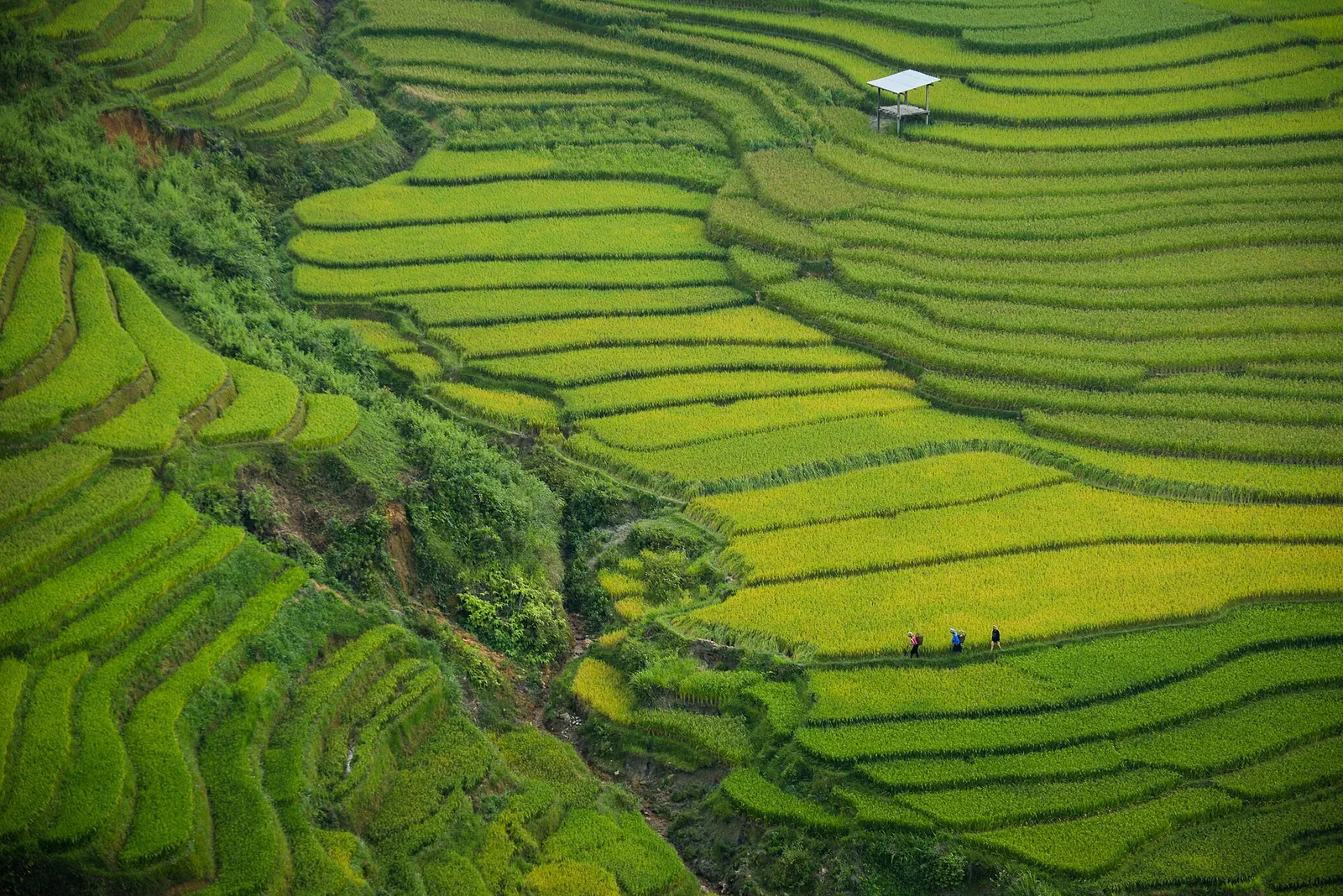
Green terraces near Khau Pha Pass, on the road between Tu Le and Mu Cang Chai
Photograph: Doan Tuan danny_pham93 — opens in a new tab · CC0 — opens in a new tab
Changes: Resized and converted to WebP; displayed with responsive crops. · Original photograph and licence details ↗ — opens in a new tab
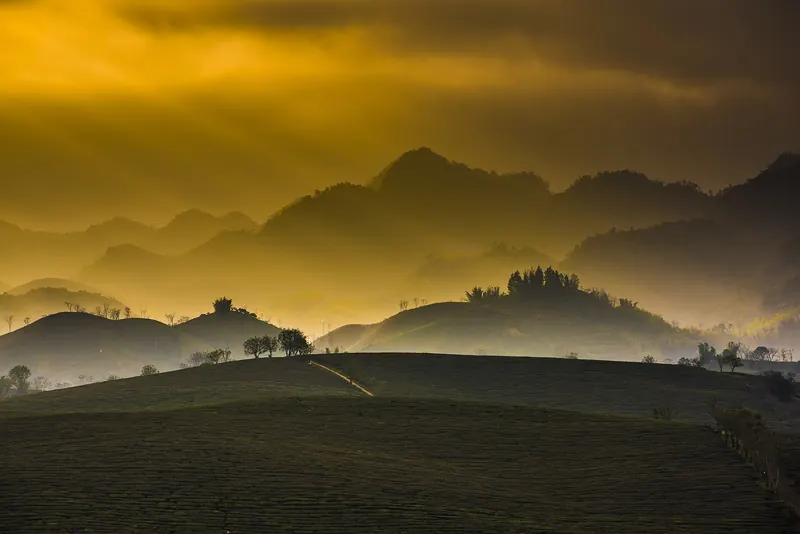
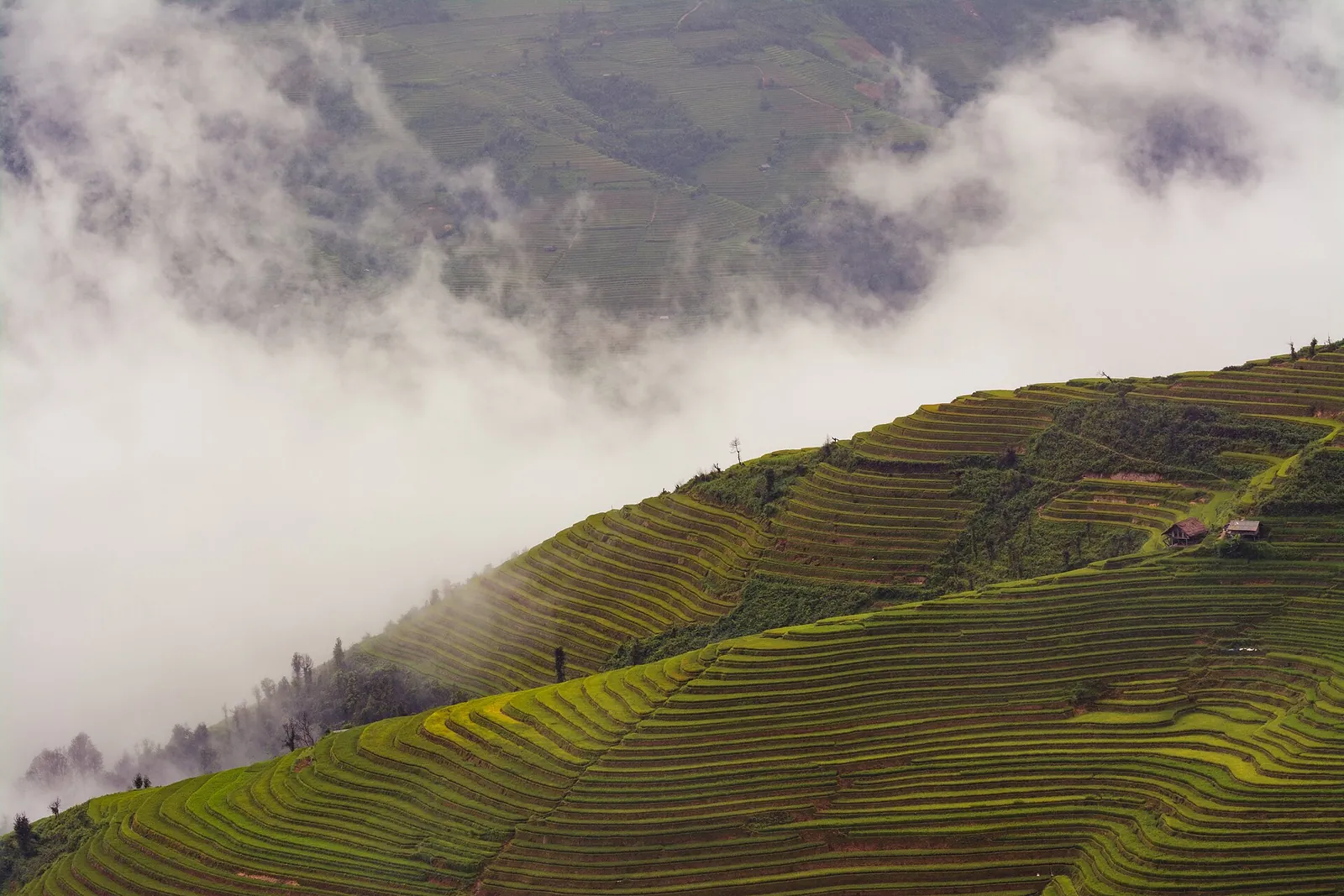
Cloud rolling over the terraces of La Pan Tan
Photograph: Văn Ngọc Tăng langthangdaydo — opens in a new tab · CC0 — opens in a new tab
Changes: Resized and converted to WebP; displayed with responsive crops. · Original photograph and licence details ↗ — opens in a new tab
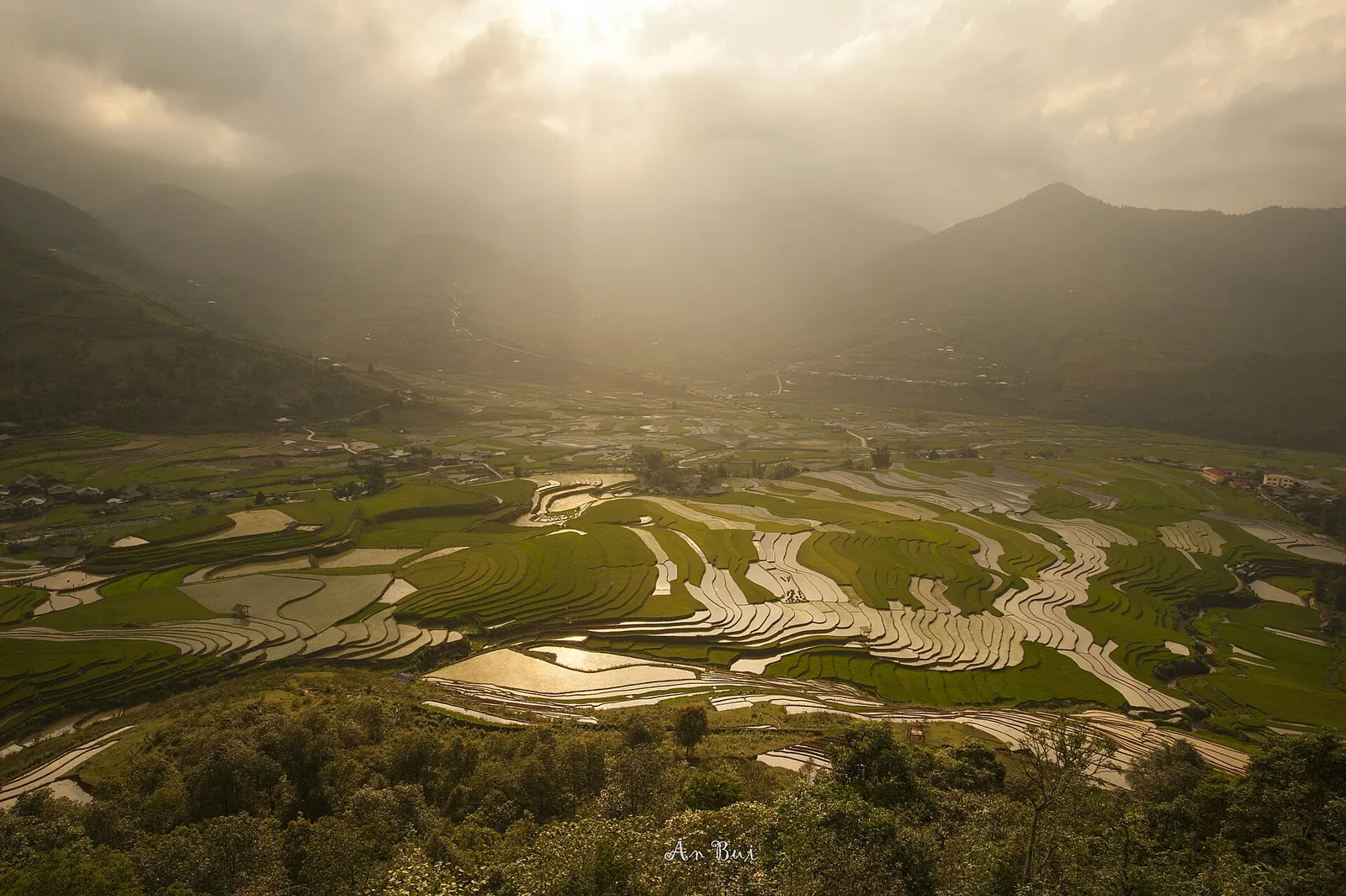
The Tu Le valley below Khau Pha, the usual first stop on the drive from Hanoi
Photograph: Vietnam Photo Tours | An Bui — opens in a new tab · CC BY 2.0 — opens in a new tab
Changes: Resized and converted to WebP; displayed with responsive crops. · Original photograph and licence details ↗ — opens in a new tab
Smoked buffalo meat (thit trau gac bep), a northern mountain speciality; this plate was photographed at Ta Phin Ho, not in Mu Cang Chai
Photograph: GiangLy — opens in a new tab · CC BY-SA 4.0 — opens in a new tab
Changes: Resized and converted to WebP; displayed with responsive crops. · Original photograph and licence details ↗ — opens in a new tab