Seoul and the Capital Area · Gyeonggi
Suwon travel guide: Hwaseong Fortress walls, galbi and where to stay
In Suwon, King Jeongjo built Hwaseong Fortress between 1794 and 1796 around a new town beside his father's relocated tomb, and the wall still wraps the old centre, climbing over Paldalsan on the west side and running flat across the east. Inside it are a rebuilt royal travel palace, workshop streets, cafés and a market district; outside it, Suwon is a large modern city you can mostly leave aside. The decisions that matter are how much of the wall to walk, which meal to build the day around, and whether to go back to Seoul at night.
- Suggested time
- 1 long day; 1 night for evenings on the wall
- Where to stay
- Inside the fortress around Haenggung-dong for atmosphere; Suwon Station for rail connections
- Season and timing
- Early October is festival season: the Suwon Hwaseong Cultural Festival and the fortress media art evenings both fall around then. The wall is open year-round, but the tourist trolley and the archery range do not run in rain or snow.
The short answer
One long day from Seoul covers the fortress wall, the Haenggung palace and a galbi dinner. Stay one night inside or beside the fortress if you want the wall after dark, an unhurried dinner, or an evening programme such as the autumn festival or a palace night opening. Come by Seoul Subway Line 1 to Suwon Station and take a city bus to the Hwaseong Haenggung stop, or take a red express bus from Gangnam to Paldalmun. Walk the wall clockwise from the palace up Paldalsan first, while your legs are fresh.
Day trip or a night in the fortress town
Suwon works as a day trip because the sights are concentrated inside one wall: the full circuit, the palace and a meal fit between a morning train out and an evening train back. The problem with the day trip is that the best part of the day comes at the end. VisitKorea describes the fortress trail as even more enchanting at night, when the walls and city lights glow, and Suwon's two signature meals — wanggalbi and cauldron-fried chicken — are dinners rather than snacks.
Stay a night if you want to walk part of the wall after dark, eat galbi without watching the clock, or see one of the evening programmes. The Suwon Cultural Foundation runs Suwon Hostel in Haenggung-dong near the palace, with dormitory-style youth rooms as well as Western- and Korean-style rooms; the foundation's page lists 31 rooms. The streets around it have the cafés and restaurants. If you would rather have a larger hotel and quick trains, sleep near Suwon Station and take the bus in.
Walking the Hwaseong Fortress wall
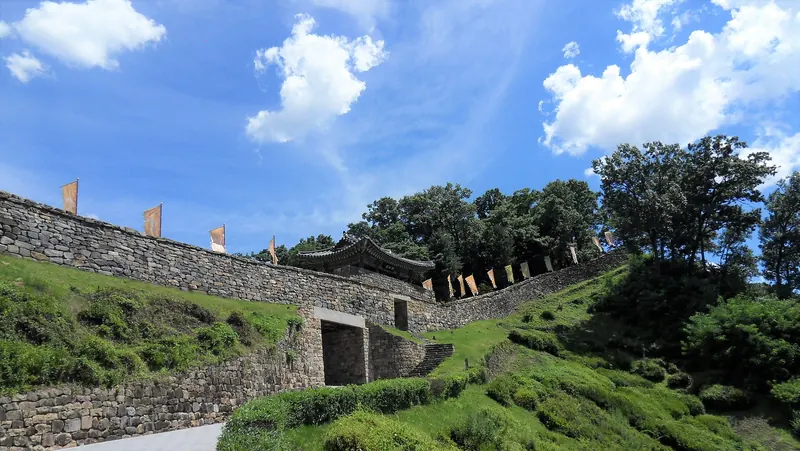
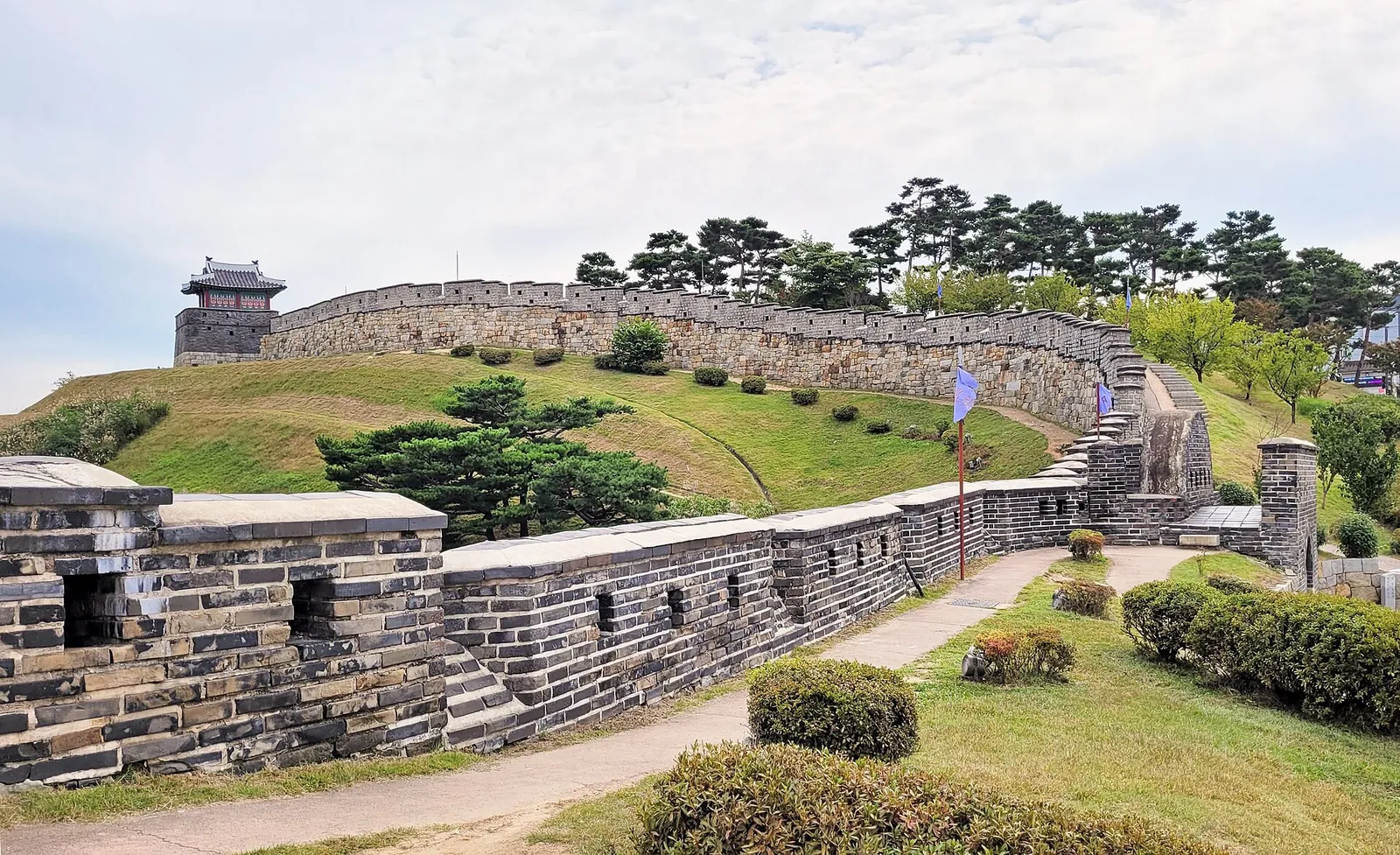
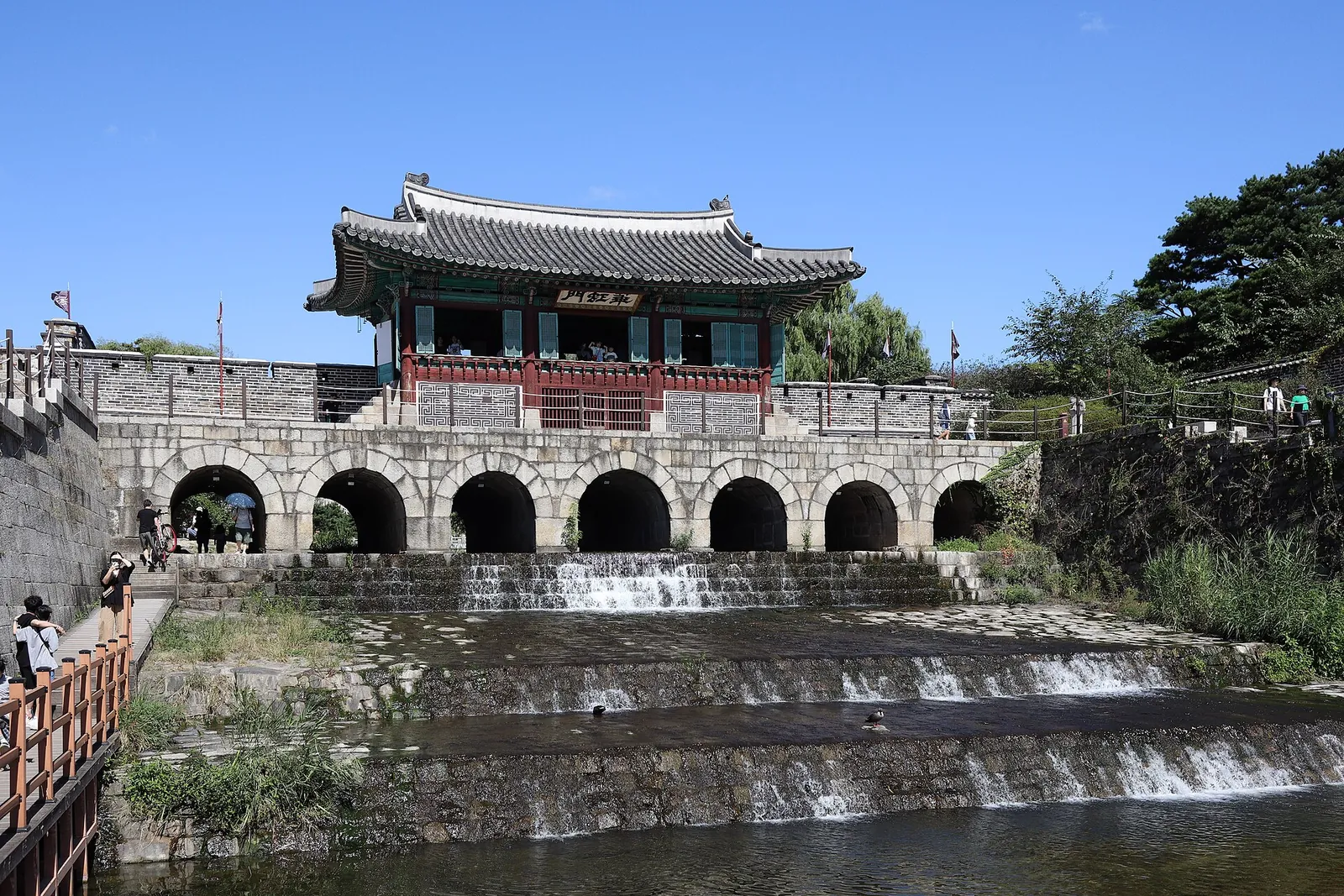
The Suwon Cultural Foundation, which manages the site, gives the circumference as 5,744 metres. It is a mixed flat-and-mountain fortress: the western section climbs Paldalsan, the eastern section crosses level ground, and Suwoncheon stream still flows through the Hwahongmun water gate on the north side. Of the original 49 structures — gates, command posts, observation towers, crossbow platforms, secret gates and a beacon tower — the foundation counts 45 still standing. Most of the destroyed or missing sections were repaired between 1975 and 1979 using Hwaseong Seongyeok Uigwe, the detailed construction record published in 1801. The fortress was inscribed on UNESCO's World Heritage List in December 1997.
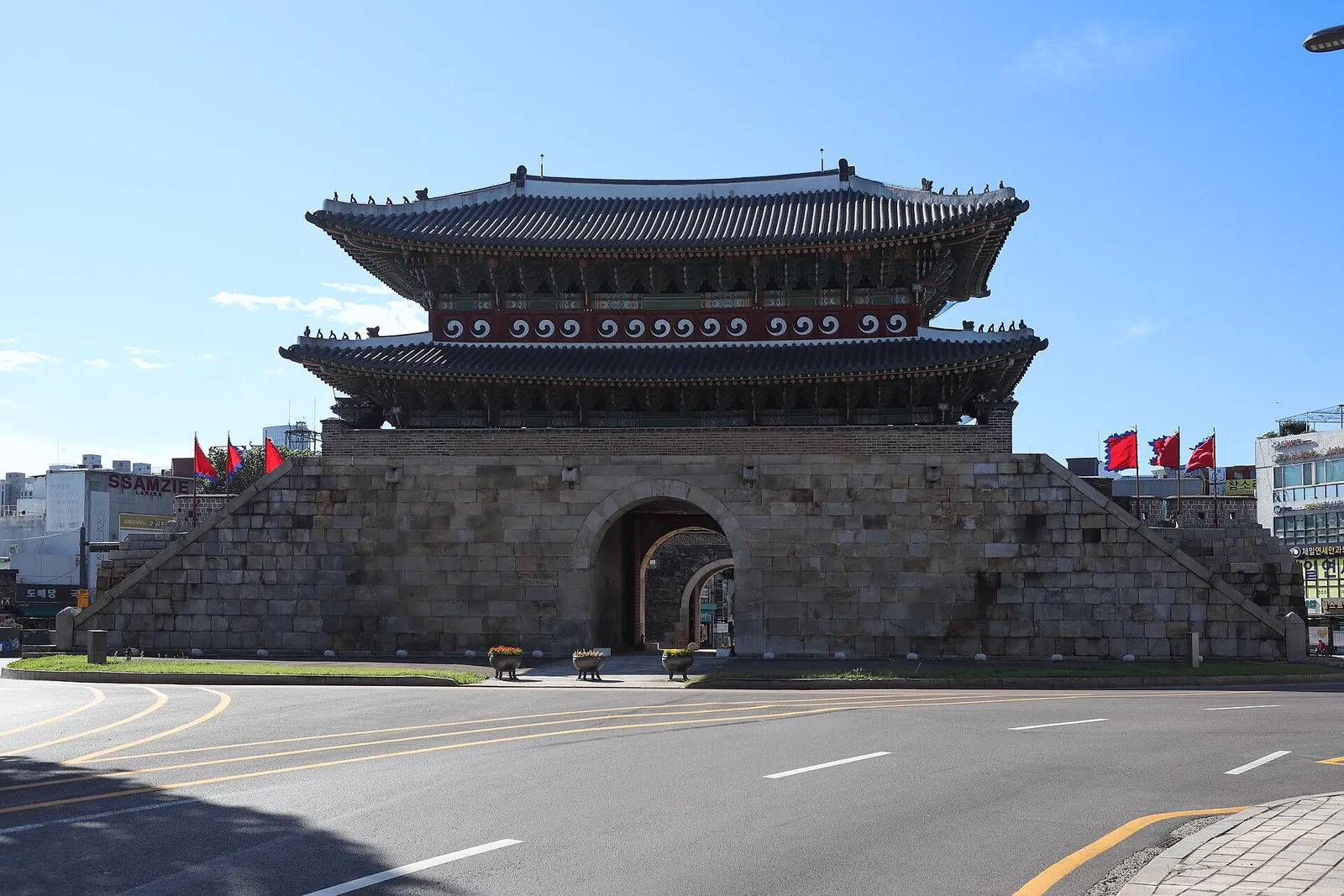
When we checked on 3 October 2026, VisitKorea listed the fortress wall as open 24 hours and free to enter. Start from the palace and climb Paldalsan, the hill on the western side, for the overview over the town; then follow the wall north to Hwaseomun, Janganmun (the north gate), Hwahongmun and Banghwasuryujeong, the pavilion above Yongyeon pond, and round to Changnyongmun and Yeonmudae in the east. Paldalmun, the south gate beside the market, is detached from the rest of the wall, as VisitKorea notes. The circuit has steps and steep stretches on the Paldalsan side; wear proper shoes and carry water.
If you do not want to walk all of it, the Hwaseong Fortress Tourist Trolley runs a roughly 20-minute loop from Yeonmudae past Hwahongmun, Janganmun and Hwaseomun. When we checked, VisitKorea listed it running Tuesday to Sunday from 9:40 to 17:00, with an audio guide in English, and the Suwon Cultural Foundation's price list showed 6,000 won for an adult ticket; the foundation notes that it does not run on rainy or snowy days. At Yeonmudae you can also try traditional Korean archery: the foundation listed 3,000 won for a round of 10 arrows, again weather permitting.
Make time for the local food
What to eat and where to look
Suwon wanggalbi (jumbo beef short ribs)
Suwon's signature dish: extra-large beef short ribs grilled at the table. VisitKorea traces the city's galbi tradition to a local slaughterhouse that made ribs easy to buy, and notes that the classic Suwon style is seasoned simply with salt. Most restaurants offer both saeng-galbi (unmarinated) and yangnyeom-galbi (marinated).
- Where to look
- Long-established galbi restaurants around the fortress and in the surrounding districts; VisitKorea lists Bonsuwon Galbi in Uman-dong, Yeonpo Galbi in a converted bathhouse in Buksu-dong and Hwacheong Galbi in Maehyang-dong.
- Fit it into your day
- Make it dinner, in a group if possible. For a cheaper version, look for a lunchtime galbi jeongsik set — VisitKorea describes one at Hwacheong Galbi — or weekday-lunch galbitang, the rib soup Yeonpo Galbi serves.
Check the menu for the beef's origin (imported or Korean hanu) and the price per portion, and note that some places take a mid-afternoon break or close over Seollal and Chuseok.
Cauldron-fried whole chicken (tongdak)
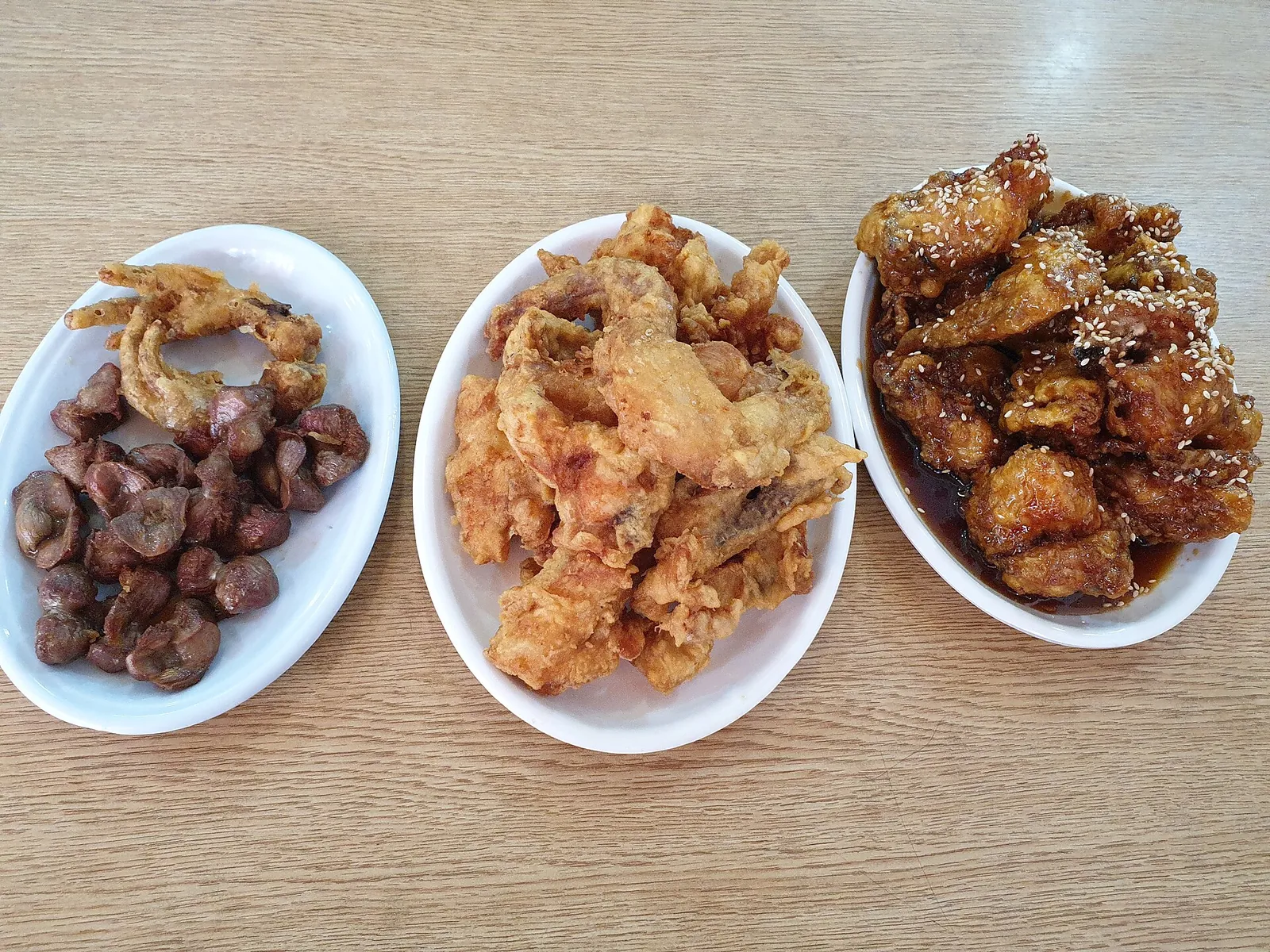
On Suwon Chicken Street, a 100-metre alley along Suwoncheon, around ten shops have been frying whole chickens in large cast-iron cauldrons since the 1970s. VisitKorea describes plain fried, sweet-and-spicy sauced and wanggalbi chicken — chicken in short-rib marinade — with fried gizzards usually served alongside.
- Where to look
- Suwon Chicken Street, 16 Jeongjo-ro 800beon-gil, Paldal-gu, along Suwoncheon.
- Fit it into your day
- An easy dinner after the wall walk, or a late meal for anyone staying the night; share plain and sauced chicken to compare the two.
VisitKorea notes that servings are generous, so order less than you think. The gizzards that come with it are offal.
Sundae at Jidong Market
Korean sausage served with gopchang (intestine) and vegetables and a red pepper paste dip. VisitKorea counts Jidong Market's Sundae Town among the three best-known sundae alleys in Korea.
- Where to look
- Jidong Market, one of the nine markets that make up Suwon Nammun Market near Paldalmun.
- Fit it into your day
- A cheap, filling lunch while you look round the market; the other markets in the cluster add snacks such as hotteok and noodle soup.
The gopchang served with it is offal; ask for sundae on its own if you prefer. Stall hours vary by shop.
The Haenggung palace and the streets around it
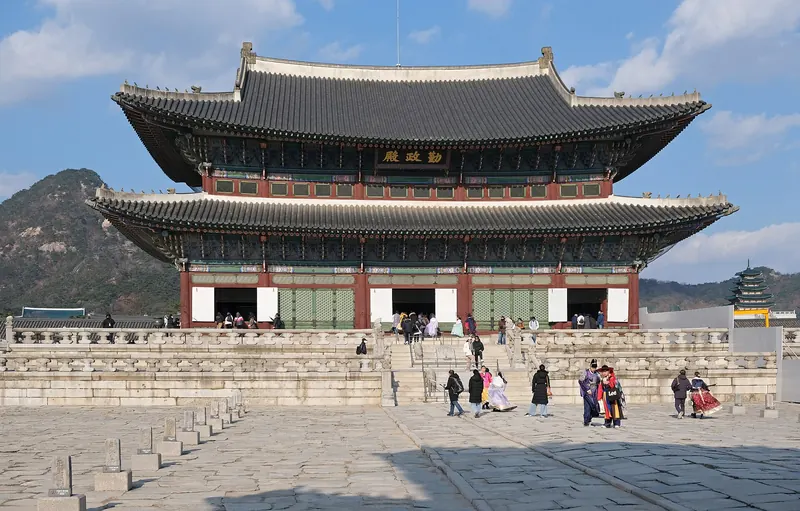
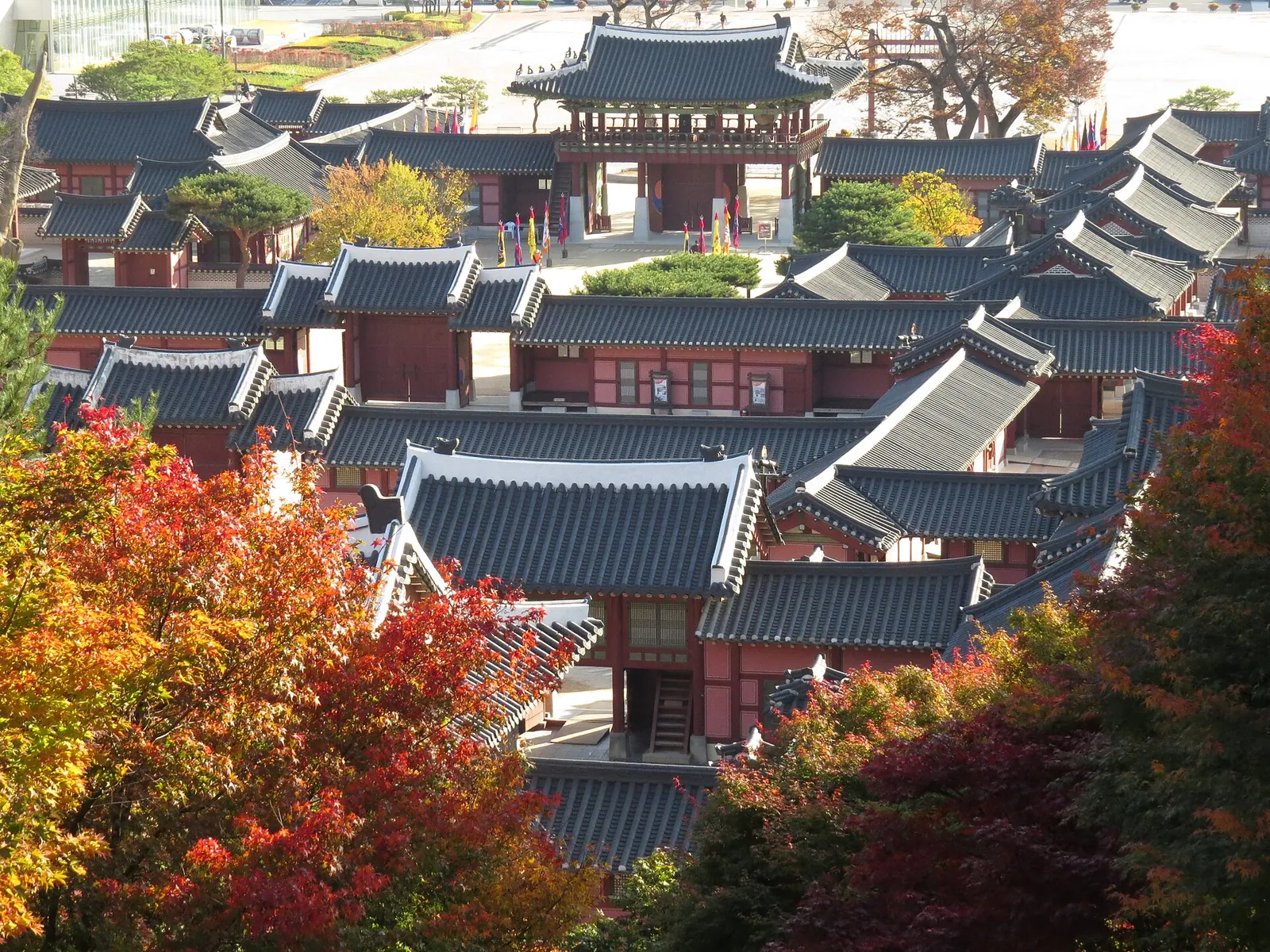
Hwaseong Haenggung was the royal travel palace where King Jeongjo stayed on his 13 visits to his father's tomb, and the foundation describes it as the largest and best equipped of the Joseon dynasty's haenggung. The foundation notes that of the original buildings only Naknamheon survived later wars and unrest; most of what you see is reconstructed. The square in front of it is the natural starting point for the wall walk. When we checked on 3 October 2026, the Suwon Cultural Foundation listed opening hours of 9:00 to 18:00 with last admission at 17:30, an individual adult ticket of 2,000 won, and free entry for visitors aged 65 and over, for anyone wearing hanbok and on Culture Day, the last Wednesday of each month. An integrated ticket also covers the palace, the Suwon Hwaseong Museum and the Suwon Museum; the two official sources we read gave different prices, so check at the ticket office.
In 2025 the palace opened on Friday to Sunday evenings from May to early November, from 18:00 to 21:30, according to VisitKorea; check the foundation's site for the current season before planning an evening around it. The Suwon Hwaseong Museum explains how the wall and the town were built; VisitKorea listed it as open 9:00 to 18:00, closed on Mondays.
Haenggung-ro runs about 420 metres from the palace to Paldalmun and is lined with craft workshops and small restaurants, many of which run make-your-own programmes. North of the palace, the lanes between Hwaseo Park and Hwahongmun — known as Haengnidan-gil — are where the cafés, studios and small shops are; VisitKorea notes they have appeared in several recent K-dramas.
Getting there and getting around
From Seoul, Suwon Station is on Seoul Subway Line 1. The Suwon Cultural Foundation's directions page sends visitors from the North Square side of the station (exit 4) on city bus 11, 13 or 13-4 to the Hwaseong Haenggung stop. From the south of Seoul, red express buses can be simpler than the train: the same page lists bus 3000 from Gangnam Station exit 5 to the Paldalmun stop and bus 1007 from Jamsil Station exit 6 to the Hwaseong Haenggung stop. Routes and stops change, so check a map app on the day.
Once inside the fortress, walk. The old centre is compact, the wall is the main route between the sights, and the trolley covers the northern gates if you tire. During festival evenings, expect the area around the palace square and the northern gates to be busy.
Suwon Chicken Street runs along Suwoncheon and the Nammun market district spreads out from Paldalmun, so a natural day ends there or at a galbi restaurant before the bus back to the station.
Festivals and evenings in early autumn
Early October is Suwon's main festival period. VisitKorea's festival listing gave the Suwon Hwaseong Cultural Festival dates as 4 to 11 October 2026, with programmes from 12:00 to 21:00 around the fortress. The festival recreates King Jeongjo's royal procession to Hwaseong in 1795 — VisitKorea calls it the largest royal procession reenactment in Korea — alongside evening performances; in 2025, VisitKorea reported, these included night military drills and water performances at Banghwasuryujeong. Entry to most of it is free, though some programmes charge.
The 2026 Suwon Hwaseong Media Art programme, according to the Suwon Cultural Foundation, runs from 19 September to 6 October 2026 at Hwaseomun, Janganmun and Jangan Park, from 18:00 to 22:00, with the main projection show at Hwaseomun at 19:30, 20:30 and 21:30. If your dates overlap, this is the clearest case for staying the night: the cafés of Haengnidan-gil are close to Hwaseomun, so dinner and the show fit into one evening without a late bus.
A workable Suwon day
This is an editorial suggestion, not a timetable. Check opening days before you go, and remember that the palace and the museum have different closing days.
- Morning: arrive at the Haenggung square, see the palace when it opens, then climb to Seojangdae on Paldalsan for the view over the town.
- Midday: follow the wall north via Hwaseomun and Janganmun to Hwahongmun and Banghwasuryujeong; stop for lunch in the Haengnidan-gil lanes or try a galbi lunch set nearby.
- Afternoon: continue east to Changnyongmun and Yeonmudae — trolley or archery if the weather is dry — then come back down through the Hwaseong Museum or along Suwoncheon.
- Evening: galbi or fried chicken near Paldalmun, then either the bus to Suwon Station or a night walk on the wall if you are staying.
Practical questions
Is Suwon worth a day trip from Seoul?
Yes, if you want a walled Joseon-era town and a long walk. One day covers the fortress wall, the Haenggung palace and a galbi meal. Stay a night only if you want the wall after dark or an evening event.
How long does it take to walk Hwaseong Fortress?
The wall is about 5.7 km around. VisitKorea's Hwaseong Fortress Trail, which also takes in the markets, is 5.1 km and it suggests 2 to 3 hours. Allow extra time for the steep Paldalsan section, the gates and stops.
Do I need a ticket for Hwaseong Fortress?
When we checked on 3 October 2026, VisitKorea listed the fortress as free and open 24 hours. The Haenggung palace, the museums, the trolley and the archery range charge separately.
How do I get from Suwon Station to the fortress?
The Suwon Cultural Foundation's directions page lists city buses 11, 13 and 13-4 from the stop near exit 4 (North Square) to the Hwaseong Haenggung stop. From Gangnam, red bus 3000 goes to Paldalmun.
When is the Suwon Hwaseong Cultural Festival?
VisitKorea's listing gave 4 to 11 October 2026. The festival centres on a reenactment of King Jeongjo's 1795 royal procession, with performances around the fortress.
Where should I stay in Suwon?
Inside the fortress around Haenggung-dong for the atmosphere and evening walks, including the foundation-run Suwon Hostel beside the palace. Near Suwon Station for trains, or in Ingye-dong, where VisitKorea lists several hotels.
Sources and checks before you travel
Reference sources for the version dated 3 October 2026. Confirm opening times, access, transport and conditions for your travel dates.
- Suwon Cultural Foundation: Hwaseong Fortress ↗ — opens in a new tab
- Suwon Cultural Foundation: spectator information and prices ↗ — opens in a new tab
- Suwon Cultural Foundation: Hwaseong Haenggung ↗ — opens in a new tab
- Suwon Cultural Foundation: experience information ↗ — opens in a new tab
- Suwon Cultural Foundation: directions ↗ — opens in a new tab
- Suwon Cultural Foundation: Suwon Hostel ↗ — opens in a new tab
- Suwon Cultural Foundation: Haenggung Street ↗ — opens in a new tab
- Suwon Cultural Foundation: 2026 Suwon Hwaseong Media Art ↗ — opens in a new tab
- VisitKorea: Suwon Hwaseong Fortress ↗ — opens in a new tab
- VisitKorea: Ride, Stroll, Pedal & Soar — ways to enjoy Suwon ↗ — opens in a new tab
- VisitKorea: Suwon Hwaseong Festival ↗ — opens in a new tab
- VisitKorea: Grilled Suwon jumbo galbi ↗ — opens in a new tab
- VisitKorea: Bonsuwon Galbi, Yeonpo Galbi and Hwacheong Galbi ↗ — opens in a new tab
- VisitKorea: Suwon Chicken Street ↗ — opens in a new tab
- VisitKorea: Suwon Nammun Rodeo Market ↗ — opens in a new tab
- VisitKorea: Suwon Hwaseong Museum ↗ — opens in a new tab
- VisitKorea: Airport transportation guide ↗ — opens in a new tab
Does this experience fit your route?
Suwon is easy on your own by subway and bus. A guided trip from Seoul makes sense if you also want to combine it with another stop in one day — check how much time it leaves on the fortress wall.
Browse relevant experiences on Viator ↗ — opens in a new tabAffiliate link · Book with ViatorPhoto credits
The Hwaseong Fortress wall climbing a grassy slope in Suwon
Photograph: Bernard Gagnon — opens in a new tab · CC0 — opens in a new tab
Changes: Resized and converted to WebP; displayed with responsive crops. · Original photograph and licence details ↗ — opens in a new tab
Paldalmun, the south gate of Hwaseong Fortress, beside Suwon's market district
Photograph: Mobius6 — opens in a new tab · CC BY-SA 4.0 — opens in a new tab
Changes: Resized and converted to WebP; displayed with responsive crops. · Original photograph and licence details ↗ — opens in a new tab
Hwaseong Haenggung, the royal travel palace inside the fortress, in autumn
Photograph: Rtflakfizer — opens in a new tab · CC BY-SA 4.0 — opens in a new tab
Changes: Resized and converted to WebP; displayed with responsive crops. · Original photograph and licence details ↗ — opens in a new tab
Hwahongmun, the northern water gate where Suwoncheon flows through the fortress wall
Photograph: Mobius6 — opens in a new tab · CC BY-SA 4.0 — opens in a new tab
Changes: Resized and converted to WebP; displayed with responsive crops. · Original photograph and licence details ↗ — opens in a new tab
Fried chicken and gizzards from Suwon Chicken Street
Photograph: LR0725 — opens in a new tab · CC BY-SA 4.0 — opens in a new tab
Changes: Resized and converted to WebP; displayed with responsive crops. · Original photograph and licence details ↗ — opens in a new tab