Seoul and the Capital Area · Seoul
Hongdae, Yeonnam and Mangwon, Seoul: where to stay, eat and go out
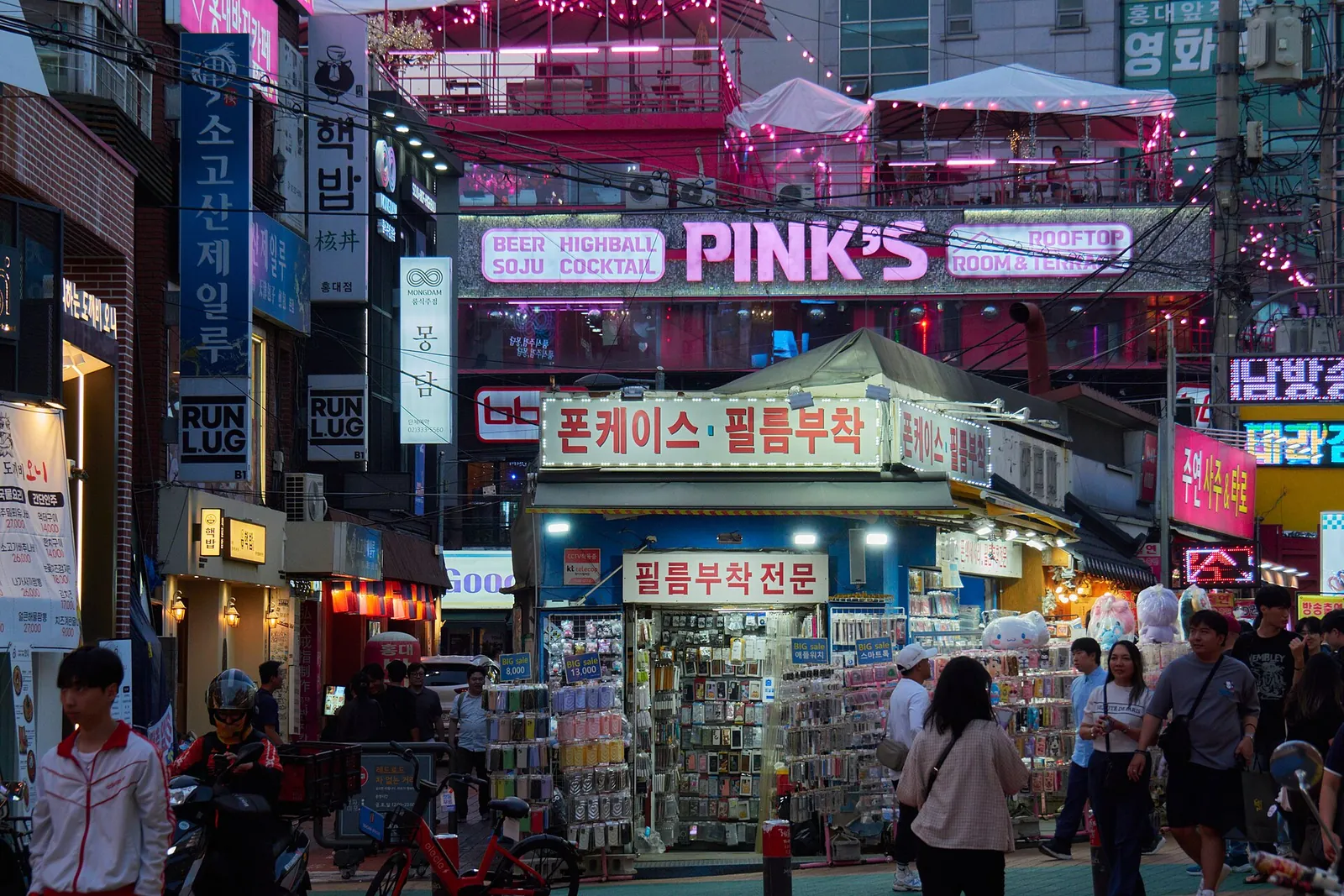
Hongdae is the student and nightlife district around Hongik University in Seoul's Mapo-gu, and its station is on the airport railway, so you can ride from the plane to your hotel street without changing trains. It is loud, young and at its busiest after dark. A short walk away, Yeonnam-dong turns an old railway line into a long park, and one subway line further on, Mangwon-dong has a traditional market and the Han River at the end of the street. Treat them as one west-side neighbourhood rather than three separate sights.
- Suggested time
- 1–2 days (as a base for a longer Seoul stay)
- Where to stay
- Near Hongik University Station for the airport train and nightlife; Yeonnam-dong, Hapjeong or Mangwon for quieter nights
- Season and timing
- Open all year. Autumn (September to November) is Seoul's most pleasant season and suits evenings in the park and by the river; the Hongdae Free Market runs on Saturdays from March to November. Summer is hot and humid, with monsoon rain in June and July, and winter is very cold.
The short answer
Give Hongdae and its neighbours one full day plus your evenings: an afternoon walk through Yeonnam-dong's Gyeongui Line Forest Park, an evening on Hongdae's busking streets, and a second half-day for Mangwon Market and the river. Sleep near Hongik University Station if you arrive or leave by the airport train, want nights out and are happy to ride the subway to the palaces; choose Yeonnam-dong or Mangwon for quieter streets. Pair it with a stay in Jongno or Myeongdong if the palaces are your priority.
Who should sleep in Hongdae, and where exactly
Hongik University Station is the reason to stay here. It is served by Subway Line 2, the Gyeongui–Jungang Line and the AREX airport railroad, so the all-stop airport trains from Incheon and Gimpo pull in under the neighbourhood without a change. Line 2 is Seoul's circle line, and it runs on to Sinchon, the city centre at City Hall and Euljiro, and across the river to Gangnam and Seongsu. What Hongdae does not give you is the palaces on foot: Jongno and Myeongdong are subway rides away, not walks.
The core of Hongdae, in Seogyo-dong between the station and the university, is where the bars, clubs, street stalls and busking are. Rooms here suit travellers who want to walk home late; light sleepers should look one or two streets back from the main lanes or move a little further out. Yeonnam-dong, north of exit 3, is calmer, with small restaurants and cafes along the Gyeongui Line Forest Park. Hapjeong (Lines 2 and 6) and Sangsu (Line 6) sit just south of the busiest streets, and Mangwon (Line 6) is a residential neighbourhood by the market and the river. Compare the walk to the station before the room rate.
Eating from Hongdae to Mangwon Market
Hongdae eats late. Much of its food is designed to go with drinks: grilled pork and beef, gopchang (grilled intestines), dakgalbi cooked at the table, and pocha-style pubs serving tteokbokki and other anju (drinking food) into the early hours. One such place listed by VisitSeoul, Samgeori Pocha near Sangsu Station, asks visitors to show photo ID at the door, so carry your passport if you plan a night of pubs.
Yeonnam-dong's alleys are better for an unhurried lunch or dinner, with small Korean, Asian and Western restaurants and many cafes along the park. Jincheongyujeom, a contemporary Korean restaurant there listed by VisitSeoul, presses its own sesame and perilla oils and serves dishes such as perilla-oil makguksu (buckwheat noodles) and seasonal bibimbap, an easy introduction to Korean cooking for first-timers.
For cheap, varied food, go to Mangwon Market. VisitSeoul describes it as a traditional market of more than 40 years, now popular with people in their 20s and 30s, and singles out Q's Dakgangjeong for glazed fried chicken and Hwanginho Croquette for spicy croquettes and doughnuts. When we checked on 2026-10-03, VisitSeoul listed it as open daily from 10:00 to 21:00, with hours varying by store. Buy food there and carry it to Mangwon Hangang Park for a picnic, as VisitSeoul suggests.
Make time for the local food
What to eat and where to look
Dakgalbi (spicy stir-fried chicken)
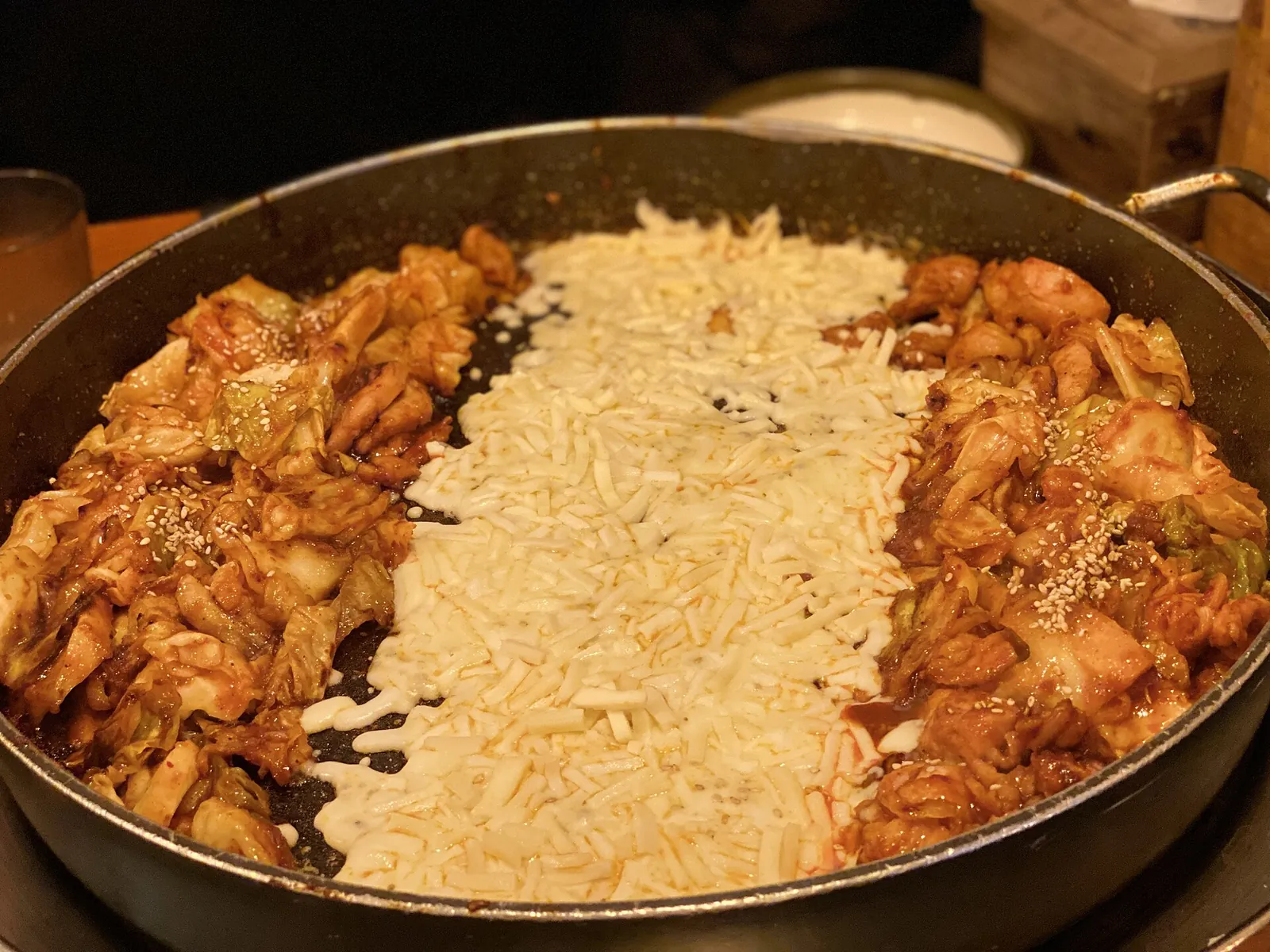
Marinated chicken stir-fried with cabbage, rice cakes and chilli paste on a large griddle at your table, often finished with melted cheese and fried rice in the same pan. Shin Migyeong Hongdae Dakgalbi, listed by VisitSeoul, is known for its cheese-fondue version and offers English service.
- Where to look
- Dakgalbi restaurants around Hongik University Station; the griddle sits in the middle of the table.
- Fit it into your day
- A shared dinner for two or more before an evening on the busking streets; leave room for the fried rice at the end.
Spicy by default; ask about the heat level, and check what the cheese or fried-rice add-ons cost before ordering.
Gopchang (grilled beef or pork intestines)
Chewy, rich grilled intestines cooked with vegetables, a classic Korean drinking dish. VisitSeoul lists Booyas Gopchang, a restaurant that has served it in Hongdae for over 15 years.
- Where to look
- Grill restaurants on the streets around exit 8 of Hongik University Station.
- Fit it into your day
- A late dinner with soju or beer, shared between the table.
This is offal; if you are unsure, order a mixed grill or Korean pork belly instead.
Dakgangjeong (glazed fried chicken)
Crisp fried chicken pieces tossed in a sticky sauce, sweet or spicy. VisitSeoul names Q's Dakgangjeong in Mangwon Market for spicy and fruit versions.
- Where to look
- Mangwon Market, a short walk from exit 2 of Mangwon Station on Line 6.
- Fit it into your day
- Buy a box with croquettes or other snacks and take it to Mangwon Hangang Park for a riverside picnic.
Sauces are often sweet and spicy; check the heat before you buy a large box.
Tteokbokki and pocha food
Rice cakes in a spicy red sauce, along with other anju served in pocha-style pubs. VisitSeoul highlights the spicy whole-squid tteokbokki at Samgeori Pocha near Sangsu Station, which opens in the evening and stays open until the early hours.
- Where to look
- Pocha pubs and late-opening bars between Hongdae and Sangsu Station.
- Fit it into your day
- A second dinner or a late snack after the busking streets.
Bring photo ID: some pubs check it at the door.
Perilla-oil makguksu (buckwheat noodles)
Cold buckwheat noodles dressed with fragrant perilla oil, a lighter Korean dish. VisitSeoul lists it at Jincheongyujeom in Yeonnam-dong, which presses its own sesame and perilla oils.
- Where to look
- Small Korean restaurants in Yeonnam-dong's alleys, north of exit 3 of Hongik University Station.
- Fit it into your day
- A late lunch before a walk along the Gyeongui Line Forest Park.
Buckwheat noodles may also contain wheat; and some Yeonnam restaurants, Jincheongyujeom included, close for a weekday afternoon break.
Pork backbone soup (gamjatang style)
A hearty soup of slow-cooked pork bones and greens. Il Deung Sikdang, opened in 1986 and listed by VisitSeoul, makes its broth without soybean paste, using green onions and shiitake mushrooms.
- Where to look
- Il Deung Sikdang is near Mapo-gu Office Station, one stop west of Mangwon on Line 6; soup restaurants of this kind are common across Mapo-gu.
- Fit it into your day
- A warming lunch or dinner in the cold months, ordered as a single bowl or a sharing pot.
Expect to pick meat off the bone; contains pork.
The Red Road and the busking streets
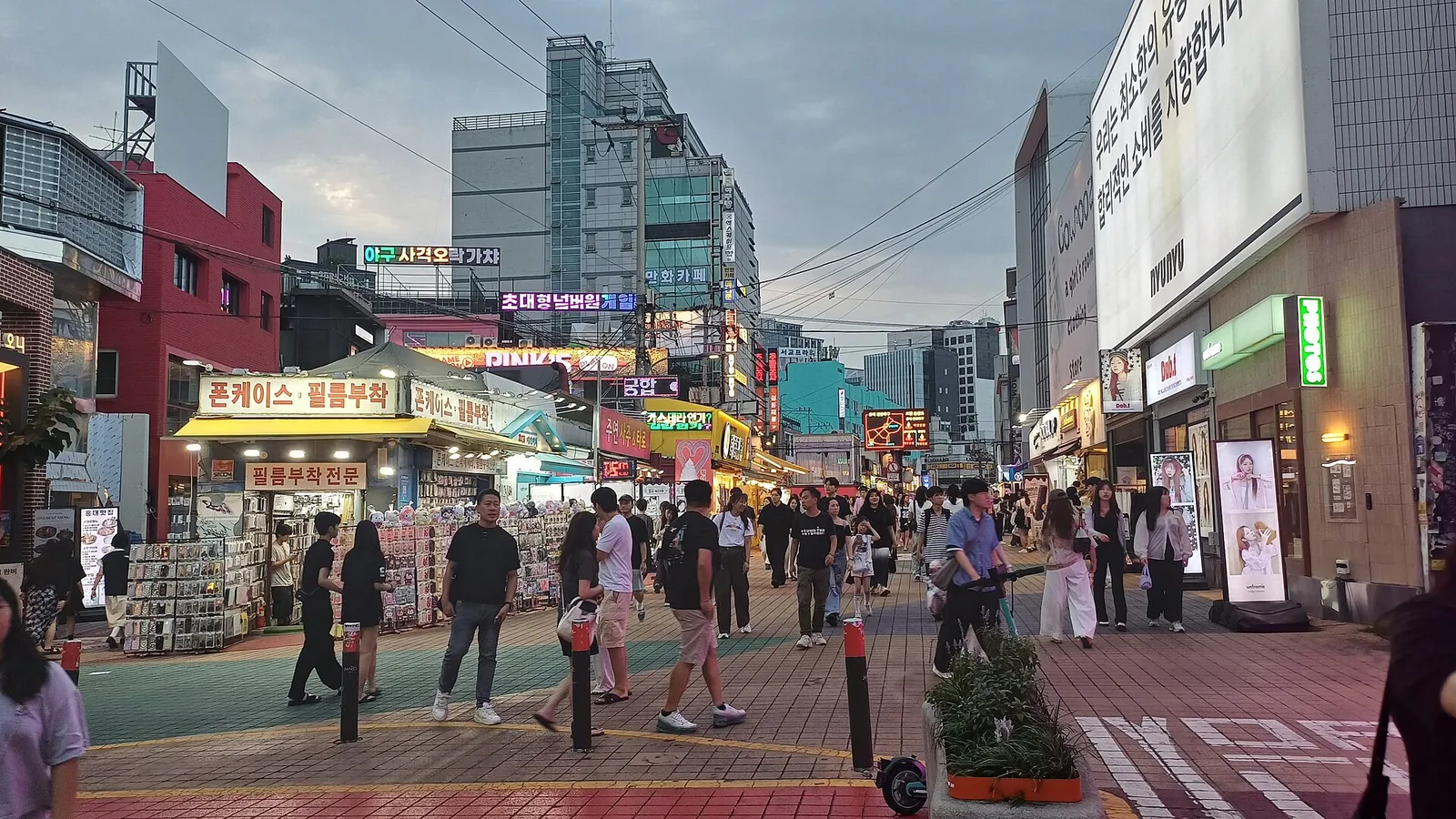
Mapo-gu has turned the busiest streets near Hongik University Station into the "Red Road", a tourism street of about 2 km divided into numbered sections. In VisitSeoul's descriptions, R1 is a "Red Culture Market" with flea markets, caricature drawing, traditional games and busking; R2, the "Street You Want to Walk", is a pedestrian street where performers in pop music, dance, magic and mime appear through a prior registration system; and R3 is packed with clothing and cosmetics shops. Spring and autumn bring welcome events for visitors with traditional cultural activities.
Busking is the evening event, not a fixed show: walk the pedestrian streets after dark and stop where a crowd forms. Keep a passage clear for people walking past, and ask before filming performers up close. If you are in town on a Saturday between March and November, the Hongdae Free Market, held since 2002 by Hongdae Playground, sells original work by young artists rather than second-hand goods and has its own afternoon stage for local musicians.
Away from the main lanes, the alleys to the left of Hongik University's main gate hold Hongdae Mural Street, murals and graffiti scattered over walls and uphill residential paths with no set route. Indiespace, Korea's first cinema dedicated to independent film, is near exit 8 of the station. The Mapo Tourist Information Center close to the station hands out free brochures and gives information in English, Japanese and Chinese.
Yeonnam-dong and the Gyeongui Line Forest Park
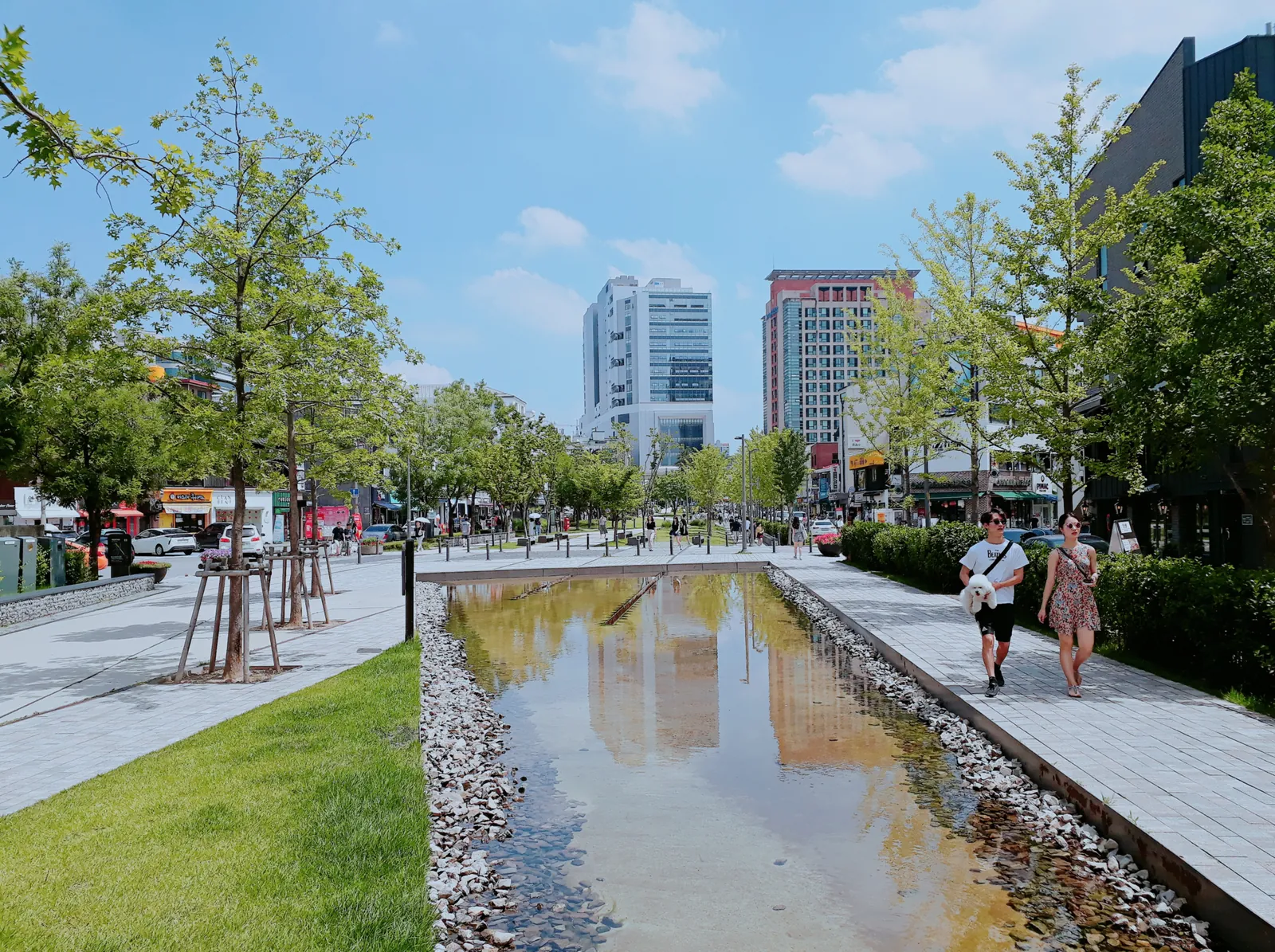
The Gyeongui Line Forest Park is a 6.3 km linear park laid over a former railway, running from near Gajwa Station in Yeonnam-dong to Wonhyo-dong in Yongsan-gu. Its longest section, nicknamed Yeontral Park, starts just outside exit 3 of Hongik University Station and runs towards Gajwa Station, with ginkgo-lined paths, lawns, a small triangular pond crossed by a piece of the old track, and seats built from railway materials. On warm evenings, young Seoulites lay out mats and drink beer on the grass.
Walk it in the late afternoon, then turn off into Yeonnam-dong's side streets for dinner. In the other direction, the Gyeongui Line Book Street near exit 6 is a short, book-themed stretch of the same park with monthly talks and author events. Some sections of the park recreate old rails and crossings and display old train cars, which makes it a good slow walk rather than just a shortcut.
Mangwon: market, river and an easy afternoon
Mangwon Station on Line 6 is the stop for both the market (VisitSeoul gives about 350 m from exit 2) and the river. Mangwon-dong itself is low-rise and residential, with small shops, cafes and, according to VisitSeoul, one of the highest densities of bookshops in Seoul. It is the quietest part of this guide and a good choice for travellers who want Hongdae's transport without its nights.
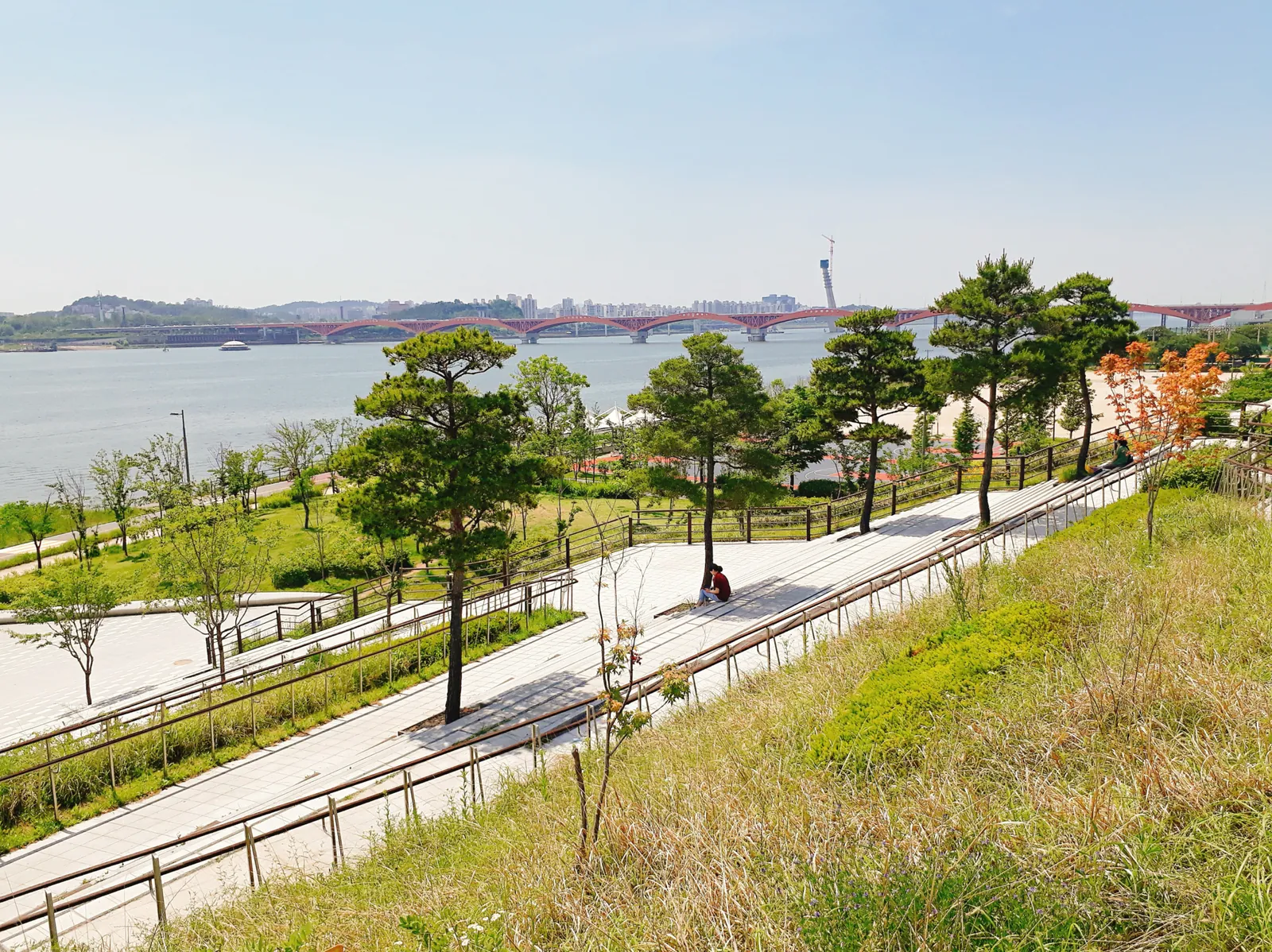
Mangwon Hangang Park lies on the Han River between Seongsandaegyo and Yanghwadaegyo bridges, with open views, sports facilities and a 3.1 km bike path. Mangwonjeong Pavilion, a riverside spot King Sejong visited for its views, and the Jeoldusan Martyrs' Shrine are nearby. Come in the late afternoon, eat from the market on the riverbank and stay for the bridge lights.
In autumn, add Haneul Park further west, one of the parks built for the 2002 FIFA World Cup on the former Nanjido landfill. VisitSeoul says its silver grass festival is held every October and that opening hours vary with the month and sunset; it is about 1.6 km from exit 1 of World Cup Stadium Station on Line 6, so check the hours before you set out.
Getting in and around
From Incheon Airport, take an AREX all-stop train, not the express. The express runs non-stop between the airport and Seoul Station, so it passes under Hongdae; the all-stop service calls at stations including Gimpo Airport, Digital Media City and Hongik University on its way to Seoul Station. Check whether your airline uses Terminal 1 or 2 before you go: AREX's own site lists the airlines by terminal.
Inside the neighbourhood, everything is walkable. For the rest of Seoul, use Line 2 for Sinchon, City Hall, Euljiro (for Myeongdong) and Gangnam, and Line 6 from Sangsu, Hapjeong or Mangwon for Itaewon or World Cup Stadium. On check-out day, VisitSeoul lists unmanned luggage storage with large lockers near Hongik University Station, which is useful if your flight leaves late in the day.
A workable two-day plan
This is an editorial suggestion, not a timetable. Check the opening days of anything you plan around.
- Day 1 — Yeonnam and Hongdae: a late lunch in Yeonnam-dong, a walk along Yeontral Park from exit 3 towards Gajwa, then back to Hongdae for dinner and the busking streets after dark.
- Day 2 — Mangwon and the river: Mangwon Market for lunch or snacks, a picnic or bike ride in Mangwon Hangang Park, and in October, Haneul Park for the silver grass.
- Saturday (March to November): fit in the Hongdae Free Market by Hongdae Playground.
- The rest of Seoul: take Line 2 for the city centre and Gangnam, and give the palaces their own days from a Jongno or Myeongdong base if they matter most to you.
Practical questions
Is Hongdae a good base for a first trip to Seoul?
Yes, if you value the airport train, nights out and easy subway connections on Line 2. It is less suited to travellers whose priority is the palaces and Bukchon, which are a subway ride away; for them, Jongno or Myeongdong is the better base.
How do I get from Incheon Airport to Hongdae?
Take the AREX all-stop train to Hongik University Station. The AREX express runs non-stop to Seoul Station and does not stop at Hongik University. The same all-stop line also serves Gimpo Airport.
Is Hongdae too noisy to sleep in?
The streets around the station and the pedestrian lanes are busy late into the night, especially at weekends. Light sleepers should pick a room a few streets back, or stay in Yeonnam-dong, Hapjeong or Mangwon.
When is the Hongdae Free Market?
VisitSeoul lists it on Saturdays from March to November, next to Hongdae Playground. It sells original work by young artists, and local musicians perform on its afternoon stage.
Are Yeonnam-dong and Mangwon worth visiting from elsewhere in Seoul?
Yes, as a half-day each. Yeonnam-dong is the Gyeongui Line Forest Park and its restaurants, starting at exit 3 of Hongik University Station; Mangwon is the market and the Han River, from Mangwon Station on Line 6.
Do I need ID to go out in Hongdae?
Carry your passport for bars and clubs. Some venues check photo ID at the door; VisitSeoul notes this for Samgeori Pocha, a popular pub near Sangsu Station.
Sources and checks before you travel
Reference sources for the version dated 3 October 2026. Confirm opening times, access, transport and conditions for your travel dates.
- VisitSeoul: Hongdae R1 Red Culture Market ↗ — opens in a new tab
- VisitSeoul: Hongdae R2 busking street ↗ — opens in a new tab
- VisitSeoul: Hongdae R3 ↗ — opens in a new tab
- VisitSeoul: How to enjoy Hongdae to the fullest ↗ — opens in a new tab
- VisitSeoul: Hongdae Free Market ↗ — opens in a new tab
- VisitSeoul: Hongdae Playground ↗ — opens in a new tab
- VisitSeoul: Hongdae Mural Street ↗ — opens in a new tab
- VisitSeoul: Mapo Tourist Information Center ↗ — opens in a new tab
- VisitSeoul: Gyeongui Line Forest Park ↗ — opens in a new tab
- VisitSeoul: Streetside architecture — Yeonnam-ro ↗ — opens in a new tab
- VisitSeoul: Gyeongui Line Book Street ↗ — opens in a new tab
- VisitSeoul: Mangwon Market ↗ — opens in a new tab
- VisitSeoul: Mangwon Hangang Park ↗ — opens in a new tab
- VisitSeoul: Cafe Gongmyung Mangwon Book Bakery ↗ — opens in a new tab
- VisitSeoul: Haneul Park ↗ — opens in a new tab
- VisitSeoul: Shin Migyeong Hongdae Dakgalbi ↗ — opens in a new tab
- VisitSeoul: Booyas Gopchang Hongdae ↗ — opens in a new tab
- VisitSeoul: Samgeori Pocha ↗ — opens in a new tab
- VisitSeoul: Jincheongyujeom ↗ — opens in a new tab
- VisitSeoul: Il Deung Sikdang ↗ — opens in a new tab
- VisitSeoul: luggage storage near Hongik University ↗ — opens in a new tab
- AREX Airport Railroad (official) ↗ — opens in a new tab
- Wikipedia: AREX ↗ — opens in a new tab
- Wikipedia: Seoul Subway Line 2 ↗ — opens in a new tab
- Wikipedia: Seoul Subway Line 6 ↗ — opens in a new tab
- Seoul Metropolitan Government: climate ↗ — opens in a new tab
Does this experience fit your route?
Hongdae is easiest on your own feet, but a guided food tour or a day trip can fill a gap in a longer Seoul stay. Check the meeting point and whether it is in Hongdae before you book.
Browse relevant experiences on Viator ↗ — opens in a new tabAffiliate link · Book with ViatorPhoto credits
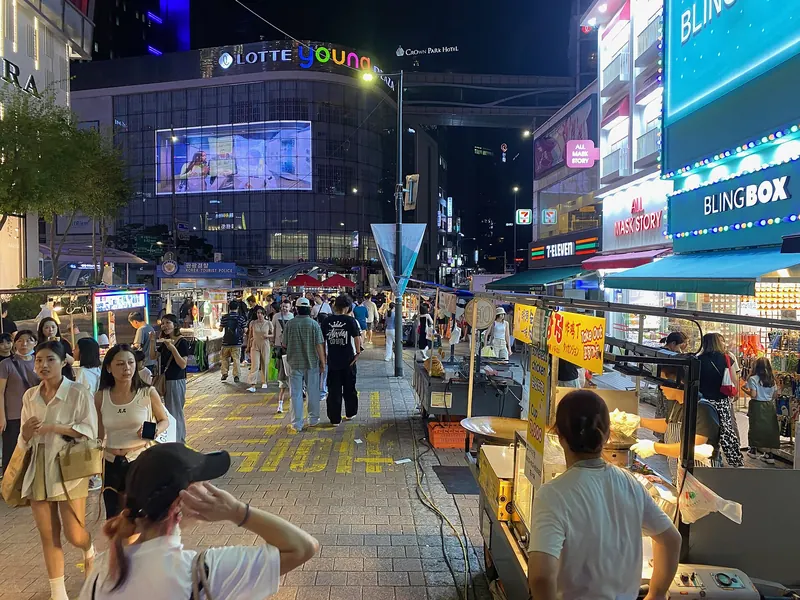
Hongdae's lanes fill with neon signs, street stalls and shoppers as the evening starts.
Photograph: lumoplank — opens in a new tab · CC0 — opens in a new tab
Changes: Resized and converted to WebP; displayed with responsive crops. · Original photograph and licence details ↗ — opens in a new tab
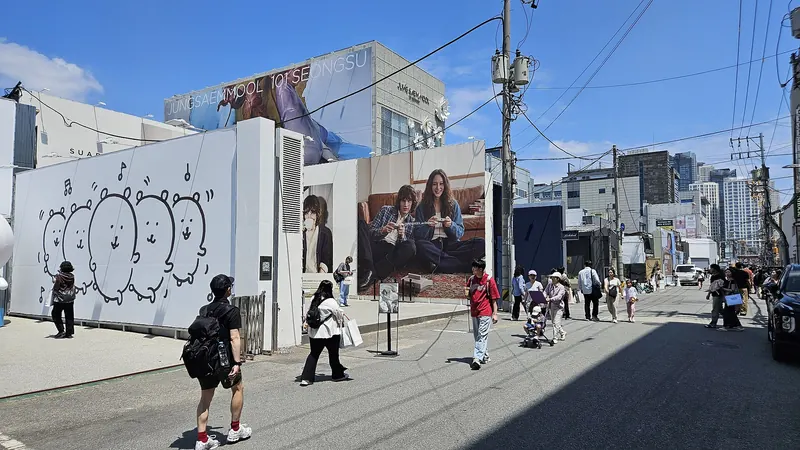
The pedestrianised streets near Hongik University Station carry most of Hongdae's shopping and street performances.
Photograph: Striker9498 — opens in a new tab · CC0 — opens in a new tab
Changes: Resized and converted to WebP; displayed with responsive crops. · Original photograph and licence details ↗ — opens in a new tab
Yeontral Park follows the old Gyeongui railway line from Hongik University Station towards Gajwa.
Photograph: Brit in Seoul — opens in a new tab · CC BY-SA 4.0 — opens in a new tab
Changes: Resized and converted to WebP; displayed with responsive crops. · Original photograph and licence details ↗ — opens in a new tab
Mangwon Hangang Park, on the Han River a short walk from Mangwon Market.
Photograph: Brit in Seoul — opens in a new tab · CC BY-SA 4.0 — opens in a new tab
Changes: Resized and converted to WebP; displayed with responsive crops. · Original photograph and licence details ↗ — opens in a new tab
Cheese dakgalbi before the cheese melts, cooked at the table on a large griddle pan.
Photograph: revi — opens in a new tab · CC BY-SA 2.0 kr — opens in a new tab
Changes: Resized and converted to WebP; displayed with responsive crops. · Original photograph and licence details ↗ — opens in a new tab