Plan your trip
Nyepi 2027 in Bali: dates, what closes and how to plan
Nyepi is the Balinese New Year, and Bali greets it in silence. For a day the island stops: the roads empty, shops and beaches close, and lights stay low after dark, while Balinese Hindus spend the day in prayer and reflection. The night before is the loudest of the year, when villages carry giant papier-mâché demons, the ogoh-ogoh, through the streets and burn them. Being on the island for both is one of the most memorable things you can do in Bali; arriving or leaving on the wrong day can cost you a flight. This guide gives the 2027 dates, what happens on each day, where to watch, what closes, and how to plan flights and ferries around them.
In this guide
Find the location ↗ — opens in a new tabThe short answer
Nyepi 2027 is Monday 8 March, a national holiday in the government's 2027 decree, and for 24 hours Bali stops: no flights, no traffic, no open shops, and lights kept low after dark. Spend it in one hotel with its own restaurant in Denpasar, Sanur, Kuta or Ubud, the places best known for the ogoh-ogoh parades on the eve, Sunday 7 March, and book at least the nights of the 7th and 8th. Land by Sunday 7 March and fly or sail on from Tuesday 9 March, booking that onward leg early: the decree lists Idul Fitri for 10 and 11 March, with collective leave from the 9th. Bali's tourist levy is IDR 150,000 per foreign visitor, the Padang Bai to Lembar ferry for Lombok starts at IDR 65,300 a passenger for a 4 to 5 hour crossing, and the parades and Sesetan's omed-omedan need no ticket. Holders of certain visas and stay permits, including KITAS and KITAP, are exempt from Bali's tourist levy.
- Key point
- The Day of Silence lasts 24 hours, Monday 8 March 2027; with Melasti before it and Ngembak Geni after it, the ritual days run from about 4 to 9 March.
- Where it applies
- One Bali hotel for the night before and Nyepi itself: Denpasar, Sanur, Kuta or Ubud for the ogoh-ogoh parades, and a hotel you would be content to spend a whole day inside.
- Timing
- Early March 2027, near the end of the rainy season, which the UK Foreign Office says usually runs from October to March.
Nyepi 2027: the date, and the days around it
The joint decree of three ministers on the 2027 national holidays, signed on 15 September 2026 and published by the State Secretariat, sets Hari Suci Nyepi, the Saka New Year 1949, on Monday 8 March 2027. Nyepi moves each year because it follows the Balinese calendar: it is the first day of the tenth month, the day after the ninth new moon, which puts it in March or April.
The ceremonies around it keep a fixed order, so their dates follow from Nyepi's. Melasti, the purification at the sea, begins three to four days before, around Thursday 4 and Friday 5 March; the ogoh-ogoh night falls on the eve, Sunday 7 March; and Ngembak Geni, the day after, on Tuesday 9 March. Each village holds its own Melasti and its own parade, so times and routes vary from place to place, and the 2027 programmes and transport hours are announced shortly before Nyepi. For the rest of Indonesia's 2027 calendar, see our Indonesia festivals guide.
What happens, day by day
Nyepi is the still point of a week of ceremonies. It is a day of prayer and self-reflection, and the days before it are about cleansing: the island's temples, then its villages, then each household. In 2027 the sequence should run like this.
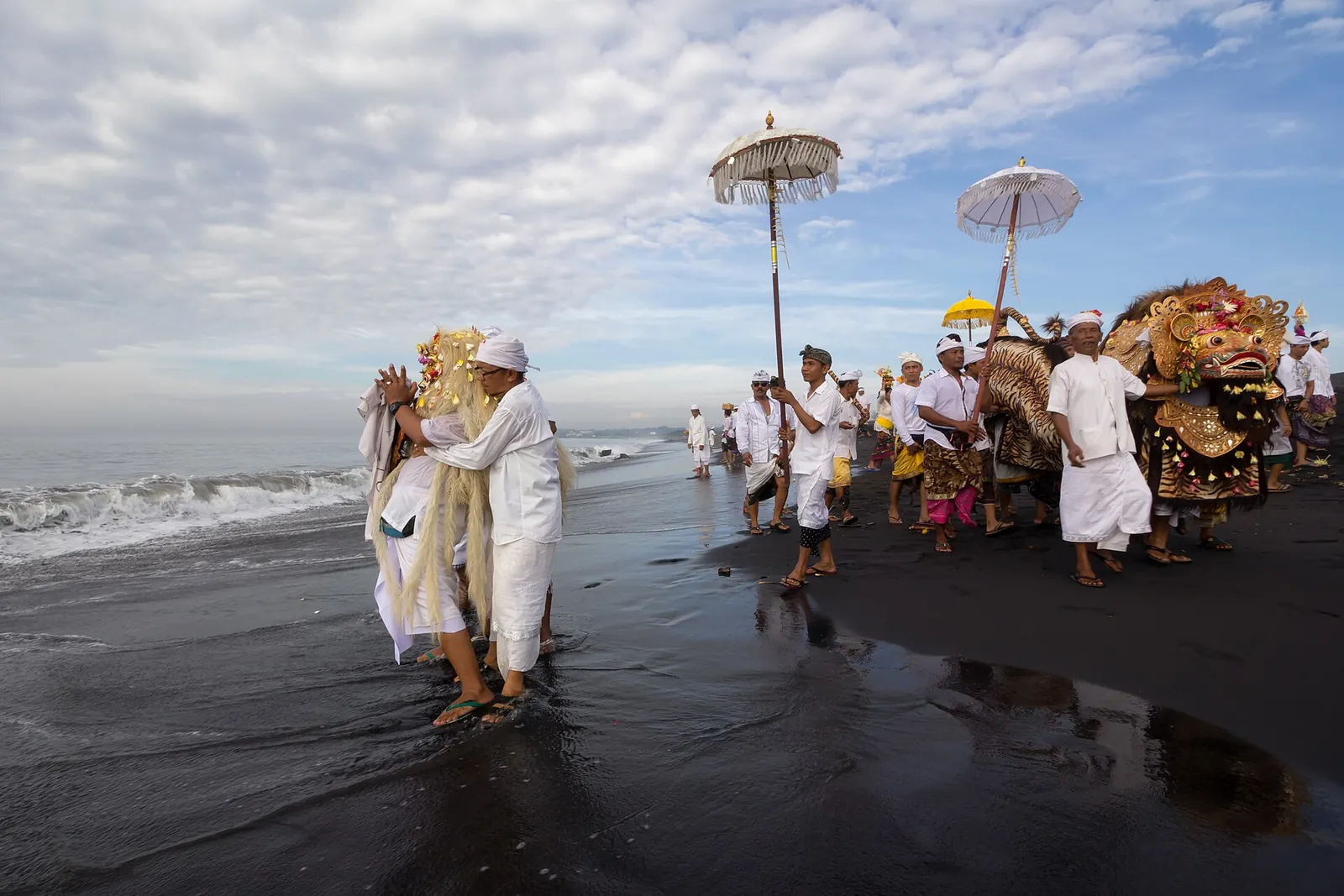
- Around Thursday 4 and Friday 5 March: Melasti. Processions in white carry the temples' sacred objects to the sea, a lake, a river or a spring to purify them and to collect holy water, and pray together facing the sea before taking the objects back to the village temple. Villages near the coast hold it on the beach, and the long lines of parasols and offerings on the sand are one of the most beautiful sights of the Balinese year.
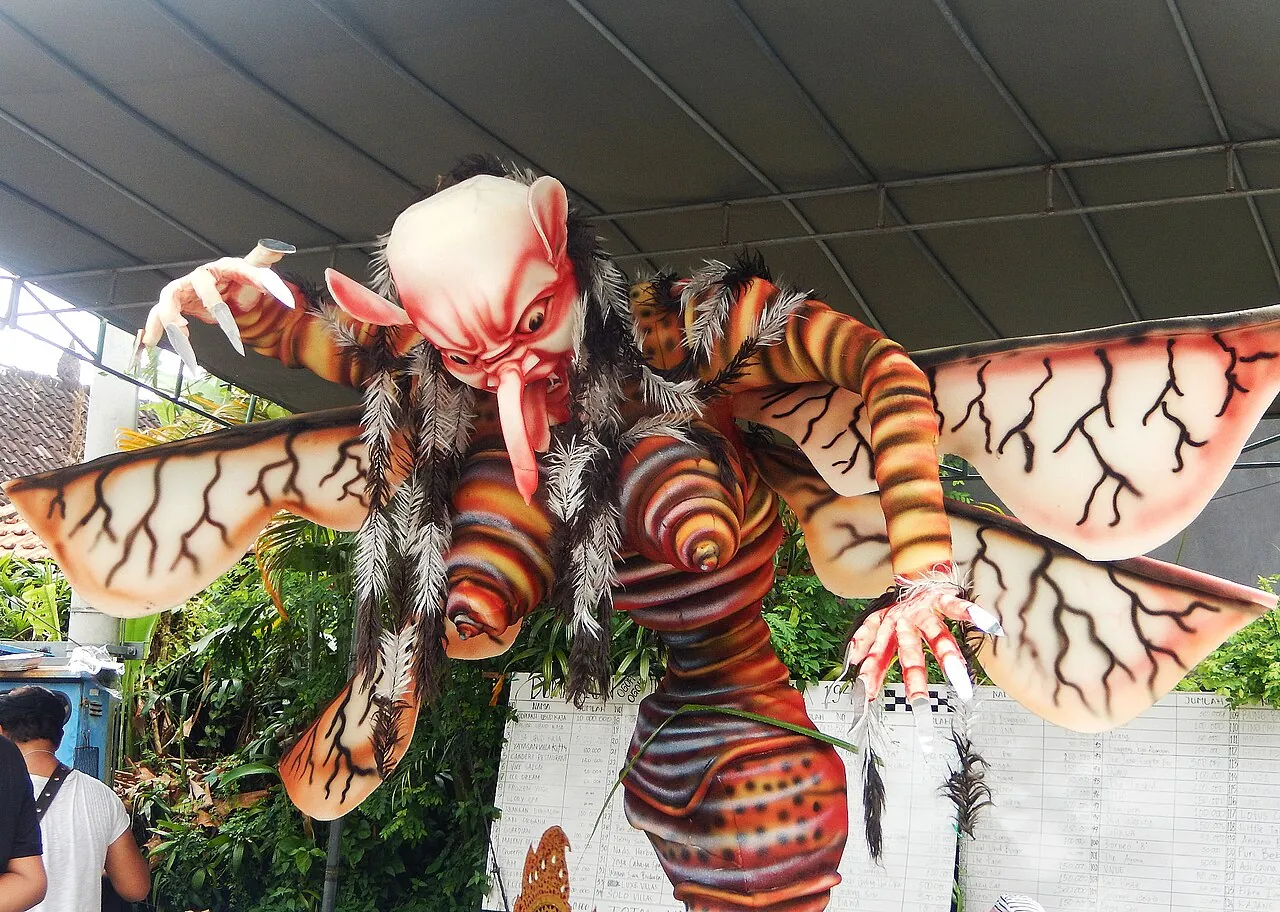
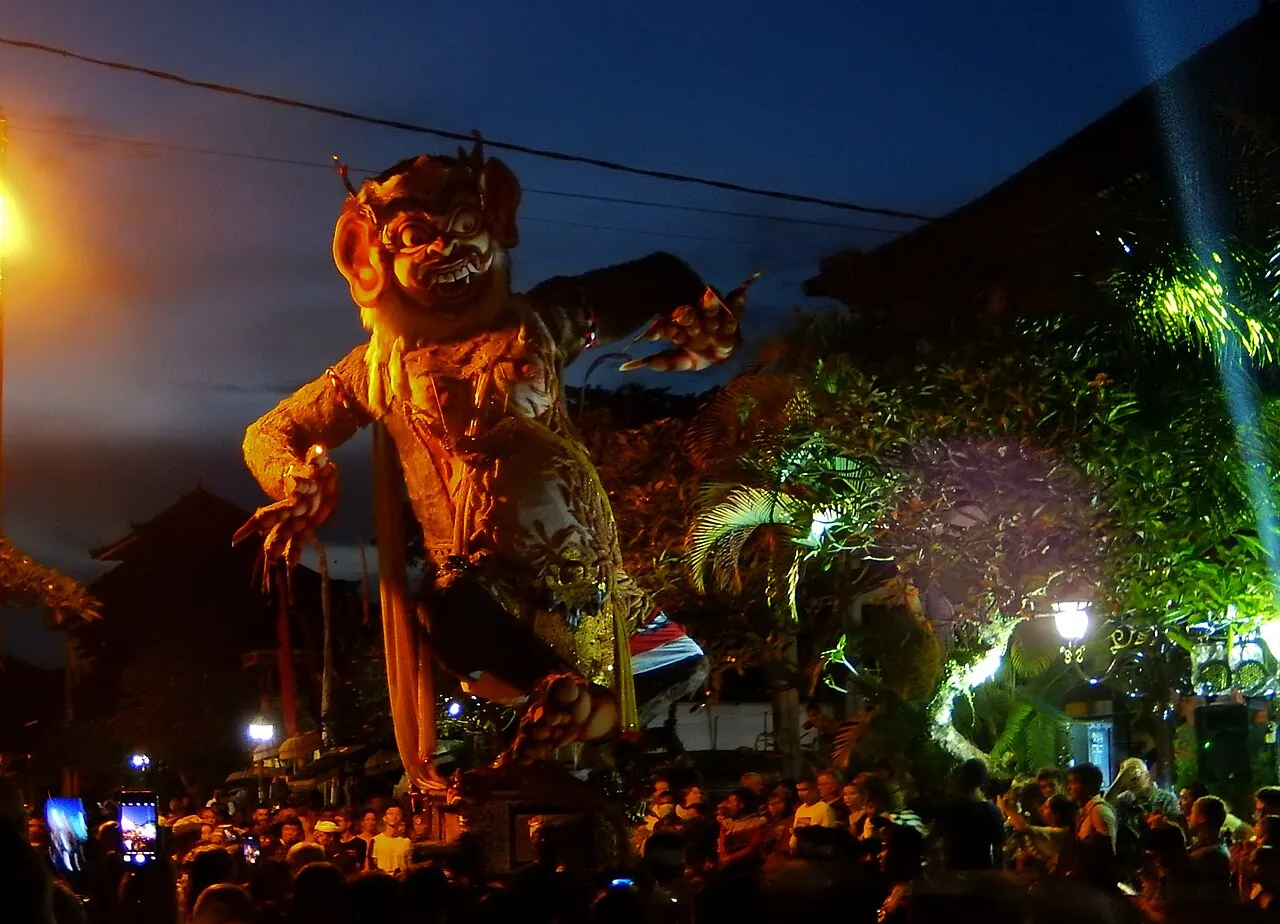
- Sunday 7 March, the eve: Tawur Kesanga and the ogoh-ogoh. In the daytime, offerings are made at village crossroads to appease the spirits. At sunset, around 17:00 or 18:00, Pengrupukan begins: people parade through their village with torches and the clatter of bamboo kulkul, and youth groups carry the ogoh-ogoh, huge demon figures made by each banjar (neighbourhood association), through the streets to gamelan and baleganjur music before burning them. It is loud, crowded and exhilarating.
- Monday 8 March: Nyepi, the Day of Silence. For 24 hours Bali observes the four prohibitions of the Catur Brata: no fire or light (amati geni), no work (amati karya), no travel (amati lelungan) and no entertainment (amati lelangunan). Roads, shops and beaches close, the airport too, and at night the lights go out across the island, so the whole of Bali lies dark under the sky.
- Tuesday 9 March: Ngembak Geni. Life starts again. Balinese Hindu families visit relatives and neighbours to ask each other's forgiveness, and in Sesetan, in south Denpasar, the young people of Banjar Kaja hold the omed-omedan.
Where to watch the ogoh-ogoh and the omed-omedan
Almost every village in Bali builds at least one ogoh-ogoh, so wherever you stay you will probably see a parade on your own street, starting at about 18:00. The largest are in Denpasar, where the youth groups of the city's banjar parade around the Catur Muka statue in the centre. Along the coast, Kuta Beach, Seminyak, Nusa Dua and Sanur are traditional places to watch, and contests for the best ogoh-ogoh are held in Sanur, Kuta, Denpasar and Ubud.
Ubud is a good place to spend the eve if you want a town atmosphere rather than a beach, with its own ogoh-ogoh contest; our Ubud guide covers where to sleep there. Wherever you watch, choose a spot within walking distance of your hotel. The parades fill the streets for the evening, and on Nyepi morning you will not be able to move to another hotel.
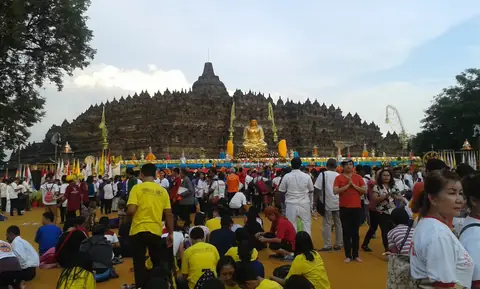
The omed-omedan in Banjar Kaja, Sesetan, takes place every year on Ngembak Geni, so it is expected on Tuesday 9 March 2027. Two groups of local young people aged 17 to 30 take turns to embrace and pull each other while residents throw water over them; in 2025 the peak came in the afternoon in front of the Banjar Kaja hall, as part of the Sesetan Heritage Omed-Omedan Festival with food stalls, music and a mini ogoh-ogoh contest. It is a local ceremony that visitors watch from the side, not one they join, and like the parades it has no ticket or seating.
The Day of Silence: the rules for visitors
The rules apply to everyone in Bali, not only to Hindus: foreigners are not exempt. You stay inside your hotel or villa for 24 hours and do not go out even to buy food, because all shops and markets are closed. Pecalang, the village watchmen, patrol the streets and stop anyone outside, and the beaches are closed to walkers too.
Inside, life goes on quietly. A low light in your room at night is allowed, but not on the balcony, and hotels draw the curtains so that no light shows outside. Television and radio are allowed at low volume, but the stations themselves go off air for the day (see below), so bring downloaded films, music and books; many resorts organise indoor activities; many hotels also sell Nyepi packages, and some keep their spa open to guests. Indonesia's tourism ministry suggests spending the day over Balinese food prepared by your hotel or bought in advance; in a villa without a kitchen team, that means shopping the day before for food, water and medicines, and taking out cash before the eve.
In an emergency, call the hotel, which can ask for an ambulance: the UK Foreign Office notes that emergency services and hospitals are allowed to operate on Nyepi.
Mobile data. Each year the Bali provincial government has the mobile networks switch off mobile data and IPTV for Nyepi, and television and radio stations stop broadcasting. In 2024 that ran from 06:00 on Nyepi to 06:00 the next day; phone calls, SMS and fibre-optic connections stayed on, as did services at hospitals, the police and other essential facilities. Whether your hotel's Wi-Fi keeps working depends on its connection, so download maps, books and films before the eve, and keep your phone credit topped up for calls.
Flights, ferries and fast boats
Flights. No planes land at or take off from Ngurah Rai for 24 hours on Nyepi. For Nyepi 2026 the Ministry of Transport stopped all domestic and international flights from 06:00 WITA on Thursday 19 March to 06:00 WITA on Friday 20 March; the same pattern in 2027 would close the airport from 06:00 on Monday 8 March to 06:00 on Tuesday 9 March. Land by Sunday 7 March, early enough to reach your hotel before the parades fill the roads, and fly out on 9 March or later.
Ferries from Java and Lombok. The ferries stop for longer than the airport, and each port keeps its own hours. For Nyepi 2026 ASDP Indonesia Ferry paused sailings from Ketapang (Java) from 17:00 WIB on the day before Nyepi to 06:00 WIB on the day after, and from Gilimanuk (Bali) from 05:00 WITA on Nyepi to 06:00 WITA the next day. On the Lombok route, Lembar stopped from 21:00 WITA on the day before Nyepi to 01:30 WITA on the day after, and Padang Bai from 04:00 WITA on Nyepi to 11:30 WITA the next day. Java runs on WIB, one hour behind Bali's WITA. Our transport guide covers Ferizy, ASDP's booking system.
In 2027 the Java crossing also meets the Lebaran rush. In the 2026 Lebaran travel period the Minister of Transport reported two days of congestion at Gilimanuk at the height of the journeys home, and in 2027 that rush starts in the same week as Nyepi, so expect queues at Ketapang and Gilimanuk in early and mid March. If the 2026 hours repeat, the last ferry from Java leaves Ketapang on the afternoon of Sunday 7 March; cross on Saturday 6 March or earlier.
Fast boats and buses. No fast boats run to or from Nusa Penida, Lombok or the Gili Islands on Nyepi. In 2026 the Mengwi bus terminal ran intercity buses only until midday on the day before Nyepi and closed on Nyepi itself. Nusa Penida, Lembongan and Ceningan belong to Bali's Klungkung regency and keep Nyepi on land as well; their own Nyepi Segara, a separate day when the sea around them is closed to boats, falls on another date, set by the ceremonies at Pura Penataran Ped.
Nyepi and Idul Fitri in the same week
In 2027 Nyepi falls two days before Idul Fitri, the feast at the end of Ramadan. The decree lists Idul Fitri on Wednesday 10 and Thursday 11 March 2027, a date the Minister of Religious Affairs fixes by separate decision, with collective leave on Tuesday 9, Friday 12 and Monday 15 March. The Idul Fitri break usually stretches to 7 to 10 days as families gather in their home towns, so the flights and ferries you need after Nyepi will be busy with holiday traffic as well. If East Java is on your route, note that Bromo Tengger Semeru National Park closed entirely from 28 March to 1 April 2025 for Nyepi and Idul Fitri. Our best time to visit Indonesia guide covers the Lebaran travel period. Our Ramadan and Lebaran guide covers the rest of the month.

What to book, and in what order
For a Nyepi stay, book in this order:
- The hotel for Sunday 7 and Monday 8 March. Choose it as the place you will spend a whole day inside: a garden, a pool and a restaurant that cooks for guests make the day a pleasure rather than a wait. Our Bali where-to-stay guide compares the areas.
- The flight or boat out, booked as early as the hotel because of the Idul Fitri week, and the flight in, earlier still if you want to see Melasti on the beaches.
- The tourist levy. Most foreign visitors pay Bali's IDR 150,000 tourist levy through Love Bali, whose FAQ lists exemptions such as diplomatic and student visas and KITAS or KITAP stay permits; those who have not paid online use cashless counters at Ngurah Rai airport or Tanjung Benoa port.
- Supplies on Sunday 7 March. Snacks, water, medicines and cash, bought before the shops close for the evening parades.
Etiquette on the eve and the day
On the eve, watch the parades from the roadside and leave the route to the bearers and the gamelan players; the figures are big and the crowds move with them. During Melasti, keep out of the procession's path to the water. On Nyepi itself, keep the curtains closed after dark and voices low by the pool. In 2023 the joint appeal of Bali's religious councils, acknowledged by the governor, asked that no fireworks, loudspeakers, noise or lights disturb the sanctity of the day, and that is what the pecalang will expect of hotel guests too.
Practical questions
When is Nyepi 2027 in Bali?
Monday 8 March 2027, according to the government's 2027 holiday decree. The ogoh-ogoh parades are expected on the evening before, Sunday 7 March, and Ngembak Geni with the omed-omedan in Sesetan on Tuesday 9 March.
Can I fly into or out of Bali on Nyepi?
No. No planes land or take off at Ngurah Rai for 24 hours; in 2026 the stop ran from 06:00 on Nyepi to 06:00 the next day, Bali time. Land by Sunday 7 March 2027 and fly out on Tuesday 9 March or later.
What can tourists do on Nyepi?
Stay inside the hotel or villa grounds for the whole day. You can eat, read and watch downloaded films at low volume (television and radio stations go off air), and many resorts run indoor activities and Nyepi packages; you cannot go to the beach, the street or the shops.
Does the internet work during Nyepi?
Mobile data is switched off for the 24 hours; in 2024 phone calls, SMS and fibre-optic lines stayed on. Hotel Wi-Fi depends on the hotel's connection, so download what you need before the eve.
Where is the best place to see the ogoh-ogoh parade?
Nearly every village holds one at sunset on the eve. The largest is in central Denpasar around the Catur Muka statue; Kuta Beach, Seminyak, Nusa Dua, Sanur and Ubud are also good. Watch within walking distance of your hotel.
Does Nyepi affect Lombok and the Gili Islands?
Yes, through the crossings: no boats run to or from Bali on Nyepi. In 2026 the Lembar ferry stopped at 21:00 on the eve and Padang Bai at 04:00 on Nyepi, then they restarted at 01:30 and 11:30 the day after. If 2027 keeps those hours, sail on Sunday 7 March in daylight, or from Padang Bai from 11:30 on Tuesday 9 March.
Keep planning your trip
Indonesia festivals and events 2027
Indonesia's 2027 holidays and festivals month by month: Nyepi in Bali on 8 March, Idul Fitri and the Lebaran week, Waisak, the Bali Arts Festival and 17 August.
Read the guide
Best time to visit Indonesia
Which months suit Bali, Java, Komodo, Sumatra and Raja Ampat, how sea and fire change plans, and the 2027 Nyepi and Lebaran dates, and what Ramadan changes.
Read the guide
Getting around Indonesia
How to combine domestic flights, KAI trains and Whoosh on Java, car ferries and fast boats from Bali, ride-hailing, drivers and scooter licences.
Read the guide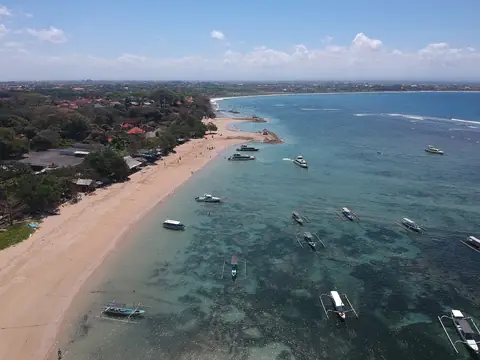
Where to stay in Bali
Compare Seminyak, Canggu, Uluwatu, Sanur, Nusa Dua and Ubud, with official airport transfer times and a clear rule for when to split your Bali stay.
Read the guide
Ubud
How many nights Ubud needs, where to sleep, the Monkey Forest, Tegallalang, the temple road and how to plan the Mount Batur sunrise trek.
Read the guide
Bali in 7 days
Seven days and six nights in Bali: three in Ubud, three on the south coast, with Mount Batur, Nusa Penida or Amed as options, and what to book first.
Read the guideSources and checks before you travel
(21)
- State Secretariat (Setneg): joint ministerial decree on 2027 national holidays and collective leave ↗ — opens in a new tab
- Ministry of Tourism (Indonesia Travel): Planning to spend Nyepi in Bali? Frequently asked questions ↗ — opens in a new tab
- Ministry of Tourism (Indonesia Travel): Nyepi, Bali's New Year's Day of Complete Silence ↗ — opens in a new tab
- UK Foreign Office (FCDO): Indonesia safety and security ↗ — opens in a new tab
- Ministry of Transport (Kemenhub): Kemenhub Sesuaikan Operasional Transportasi Jelang Hari Raya Nyepi di Bali (15 March 2026) ↗ — opens in a new tab
- ASDP Indonesia Ferry: Nyepi suspension of Java-Bali-Lombok crossings (4 March 2026) ↗ — opens in a new tab
- Bali Provincial Government: Layanan Data Seluler dan IPTV Dimatikan Saat Nyepi 2024 ↗ — opens in a new tab
- Bali Provincial Government: joint appeal of Bali's religious councils on Nyepi Saka 1945 (2023) ↗ — opens in a new tab
- Love Bali (Bali Provincial Government): Denpasar Ogoh-Ogoh Parade (2026) ↗ — opens in a new tab
- Love Bali (Bali Provincial Government): Ogoh-Ogoh Parade (2025) ↗ — opens in a new tab
- Love Bali (Bali Provincial Government): Omed-Omedan, the kissing tradition of Bali (2026) ↗ — opens in a new tab
- Denpasar City Government: Sesetan Heritage Omed-Omedan Festival 2025 ↗ — opens in a new tab
- Denpasar City Government: report on the 2025 omed-omedan ↗ — opens in a new tab
- Ministry of Tourism (Indonesia Travel): Business hours and holiday ↗ — opens in a new tab
- Love Bali (Bali Provincial Government): tourist levy FAQ ↗ — opens in a new tab
- Ministry of Tourism (Indonesia Travel): The serenity of Nyepi Day in Bali, activities to enjoy ↗ — opens in a new tab
- Ministry of Tourism (Indonesia Travel): road trip from Bali to the Mandalika circuit (Indonesian) ↗ — opens in a new tab
- Ministry of Tourism (Indonesia Travel): Bali tourist levy and regulations ↗ — opens in a new tab
- Ministry of Transport (Kemenhub): Angkutan Lebaran 2026 Berlangsung Baik, Menhub Dudy Sampaikan Sejumlah Catatan dan Evaluasi ↗ — opens in a new tab
- Bromo Tengger Semeru National Park: total closure for Nyepi and Idul Fitri 2025 ↗ — opens in a new tab
- Klungkung Regency information office: Nyepi Segara, no activity at sea (2019) ↗ — opens in a new tab
Reference sources for the version dated 30 October 2026. Confirm opening times, access, transport and conditions for your travel dates.
Photo credits
(4)
Melasti, the purification before Nyepi, on Siyut Beach in Gianyar.
Photograph: Wiaskara — opens in a new tab · CC BY-SA 4.0 — opens in a new tab
Changes: Resized and converted to WebP; displayed with responsive crops. · Original photograph and licence details ↗ — opens in a new tab
An ogoh-ogoh in Ubud, ready for the parade on the eve of Nyepi.
Photograph: MagdaLena7 — opens in a new tab · CC BY-SA 4.0 — opens in a new tab
Changes: Resized and converted to WebP; displayed with responsive crops. · Original photograph and licence details ↗ — opens in a new tab
An ogoh-ogoh carried through Ubud on the eve of Nyepi.
Photograph: MagdaLena7 — opens in a new tab · CC BY-SA 4.0 — opens in a new tab
Changes: Resized and converted to WebP; displayed with responsive crops. · Original photograph and licence details ↗ — opens in a new tab
The omed-omedan in Banjar Kaja, Sesetan, on the day after Nyepi.
Photograph: Yohana Afrita — opens in a new tab · CC BY-SA 4.0 — opens in a new tab
Changes: Resized and converted to WebP; displayed with responsive crops. · Original photograph and licence details ↗ — opens in a new tab