Itineraries · Uttar Pradesh and Madhya Pradesh
Varanasi and Khajuraho in 5 days: the ghats, Sarnath and the temples
Most first trips to India stop at the Taj Mahal. Five more days take you east to two of the country's great sights, which a direct train now joins: Varanasi, where pilgrims bathe and pray on the river steps of the Ganges and the Buddha's deer park at Sarnath lies just outside town, and Khajuraho, where the Chandela kings left sandstone temples carved from plinth to spire. This plan gives each place two nights, uses the Khajuraho-Banaras Vande Bharat Express for the middle leg, and brings you back to Delhi by train or plane, with the Agra connections set out for travellers who begin there.
- Suggested time
- 5 days / 4 nights
- Where to stay
- Varanasi's old city near Dashashwamedh Ghat for 2 nights; Khajuraho's town by the Western Group of Temples for 2 nights
- Season and timing
- Incredible India gives October to March as the best time for both places, and winter mornings can bring fog over the Ganges. April to June is very hot, the monsoon from June to September can stop the boats on the Ganges, and Varanasi's Dev Deepawali and the Khajuraho Dance Festival in February change dates each year.
The short answer
Book four nights: two in the old city of Varanasi near Dashashwamedh Ghat, then two in Khajuraho by the Western Group of Temples. Book the Khajuraho-Banaras Vande Bharat for day 3 first, under IRCTC's Foreign Tourist quota, then the two rooms and your flight or train in and out. Two key prices, checked on 17 October 2026: the Archaeological Survey of India charges foreign visitors INR 600 for Khajuraho's Western Group, and the Shri Kashi Vishwanath Temple Trust sells foreign visitors a darshan ticket for INR 600. The model budget below, with the rooms priced in our two place guides, comes to about INR 26,091 for two: the rooms, the darshan and the Khajuraho tickets, before the trains or flights, meals, local transport and the other items it lists as not included.
Two nights by the river, two by the temples
The route has two bases and one long train ride between them. In Varanasi, sleep in the old city behind Dashashwamedh Ghat, where the evening aarti, the dawn boats and Kashi Vishwanath are all a walk away; Assi Ghat, at the southern end of the river steps, is the quieter alternative. In Khajuraho, stay in the small town around the Western Group of Temples, which puts the main temples, the evening light and sound show and the bazaar on foot.
Two nights in each place is the least that does them justice. Varanasi needs one evening for the aarti, a dawn on the river and a half day at Sarnath; Khajuraho needs a first evening at the show, a sunrise at the Western Group and a morning for the Jain and Southern temples. Going through in one night each turns both into a blur of stations.
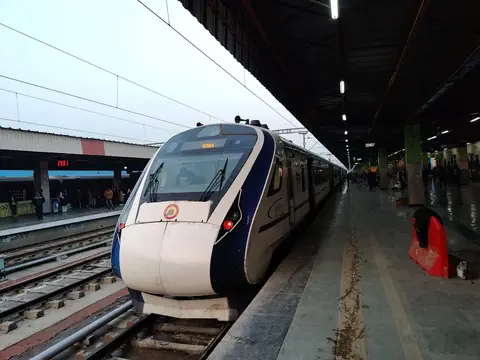
Book the middle train first. The Khajuraho-Banaras Vande Bharat is the leg that holds the plan together, and Vande Bharat trains ran above 100 percent occupancy in 2024-25 and in the first quarter of 2025-26, so seats go early. The ministry lists it, like the Khajuraho-Hazrat Nizamuddin Vande Bharat, as running six days a week, so pick a day it runs, then fix the rooms around that date and the way in and out. Check the weekdays as you book: day 2, the Sarnath day, should not fall on a Friday, when the museum there is closed, and day 4 should not be a Monday if you want the tribal art museum in Khajuraho.
Getting to Varanasi from Delhi or Agra
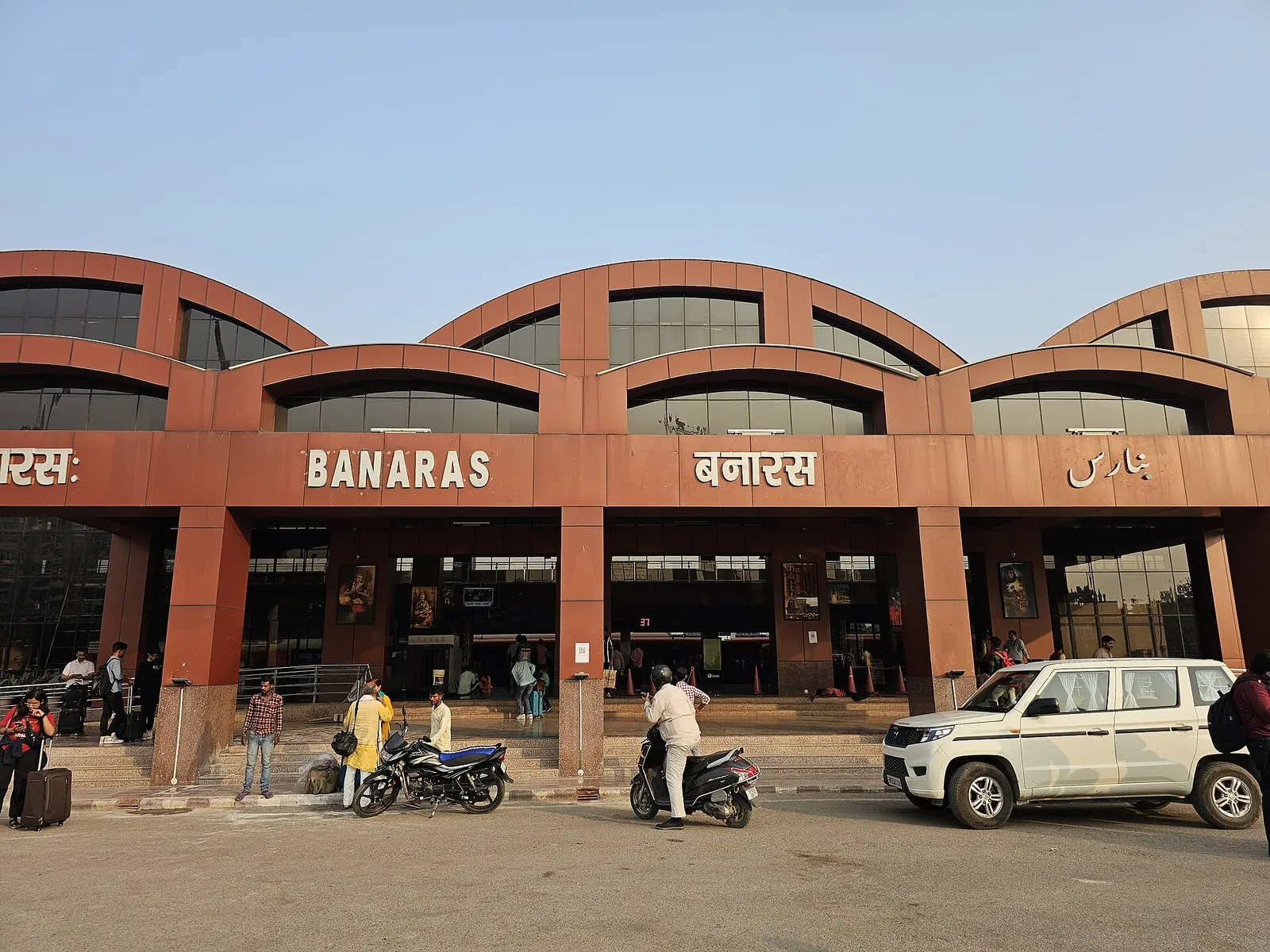
From Delhi by train. India's first Vande Bharat Express began on the New Delhi-Kanpur-Prayagraj-Varanasi line in 2019, and the Ministry of Railways gives its scheduled journey between New Delhi and Varanasi as approximately eight hours, so the train takes most of day 1. Varanasi has four main stations: Varanasi Junction (BSB), Banaras (BSBS) and Kashi (KEI) in the city, and Pt. Deen Dayal Upadhyaya Junction (DDU), which lies outside it in neighbouring Chandauli district; check which one is on your ticket.
From Delhi by air. A morning flight leaves the whole first afternoon for the ghats. Lal Bahadur Shastri International Airport (VNS) at Babatpur is about 25 km from the city centre, and it is also one of the airports where e-Visa holders can enter India, so a trip can begin here. Our Delhi guide covers the city at the start of the trip.
From Agra. If you come straight from the Taj Mahal, the simplest link is back through Delhi, for the Vande Bharat or a flight. Our Agra guide has the trains from Delhi and the Friday closure of the Taj Mahal, which matters when you plan the days before this route.
Booking the trains. Foreign visitors register on www.irctc.co.in with an international mobile number, pay a fee of INR 100 plus GST, and book under the Foreign Tourist quota up to 365 days ahead; IRCTC's terms charge 1.5 times the normal fare plus INR 200 plus GST per ticket, and you carry your original passport and visa on board. Indian Railways publishes current departure times and fares only in its journey search, so check IRCTC for your date. Flight times and fares are in the airlines' own booking pages; plan the evening of each travel day around the arrival time on your ticket. Our guide to transport in India explains the quota, the classes and the waiting lists. France Diplomatie names the Delhi-Varanasi line among those with frequent thefts and advises keeping documents and money on you and padlocking bags to the racks; our health and safety guide has the rest of the advice for the road and the rails.
Days 1-2: the ghats, Kashi Vishwanath and Sarnath
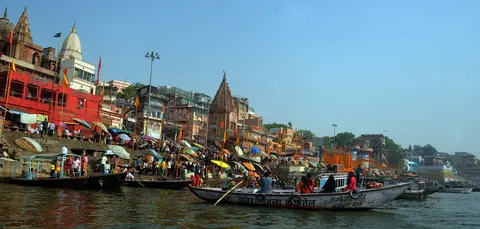
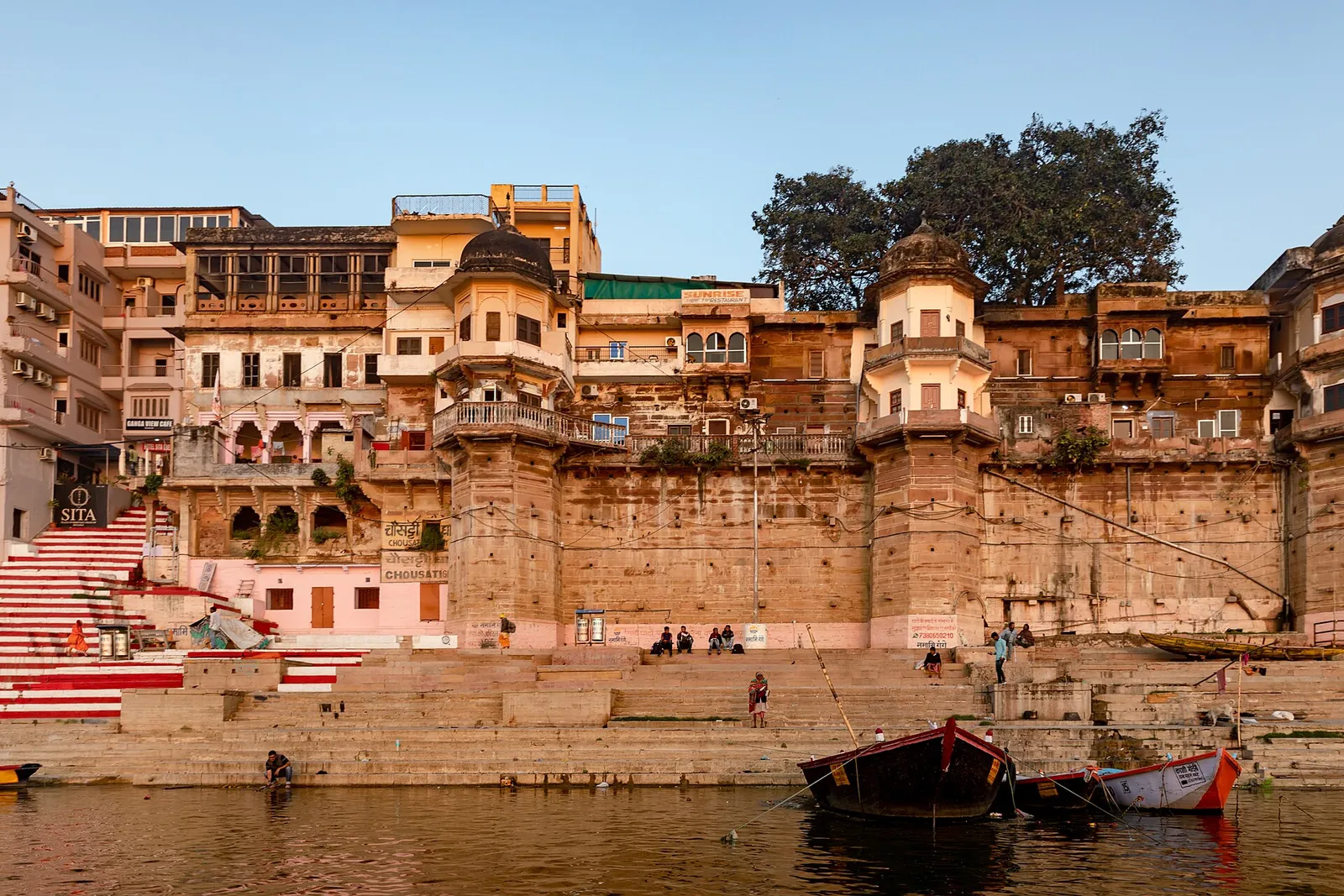
Varanasi is seen from its river steps. The evening Ganga aarti at Dashashwamedh Ghat begins just after sunset and lasts about forty-five minutes, with young priests raising tall brass lamps in unison to the sound of conches and bells; the start time moves with the season, so arrive well before sunset or watch from a boat. At dawn the river belongs to bathers and priests, and a boat along the ghats is the way to see it; rowing and motor boats wait at Dashashwamedh and Assi. From the water you see priests making their offerings and pilgrims taking their ritual dip as the ghats turn gold in the first light, and the smoke of the pyres at Manikarnika and at Harishchandra Ghat, which also has an electric crematorium. No official boat fare is published; agree the price, the route and whether it is per boat or per person before you set off. Manikarnika is a working cremation ground, with pyres burning day and night: pass at a distance, quietly, and take no photographs. At Assi Ghat, at the southern end of the river steps, the Subah-e-Banaras programme greets each sunrise with Vedic hymns, classical music and yoga. Our Varanasi guide describes each ghat, the lanes and the temple in full.
Kashi Vishwanath, the city's great Shiva temple, sits in the lanes behind the ghats. Foreign visitors book their darshan only at the temple trust's head-office help desk near Shapuri Mall, Bansphatak: show your original passport, hand over photocopies of your passport and visa, and pay INR 600 for a ticket that includes a Shastri escort and prasad. The trust lists the temple as open from 03:00 to 23:00, with darshan from 04:00 to 11:00, 12:20 to 19:00 and 20:30 to 21:00. Phones, pens and other gadgets go into the free lockers before you enter.
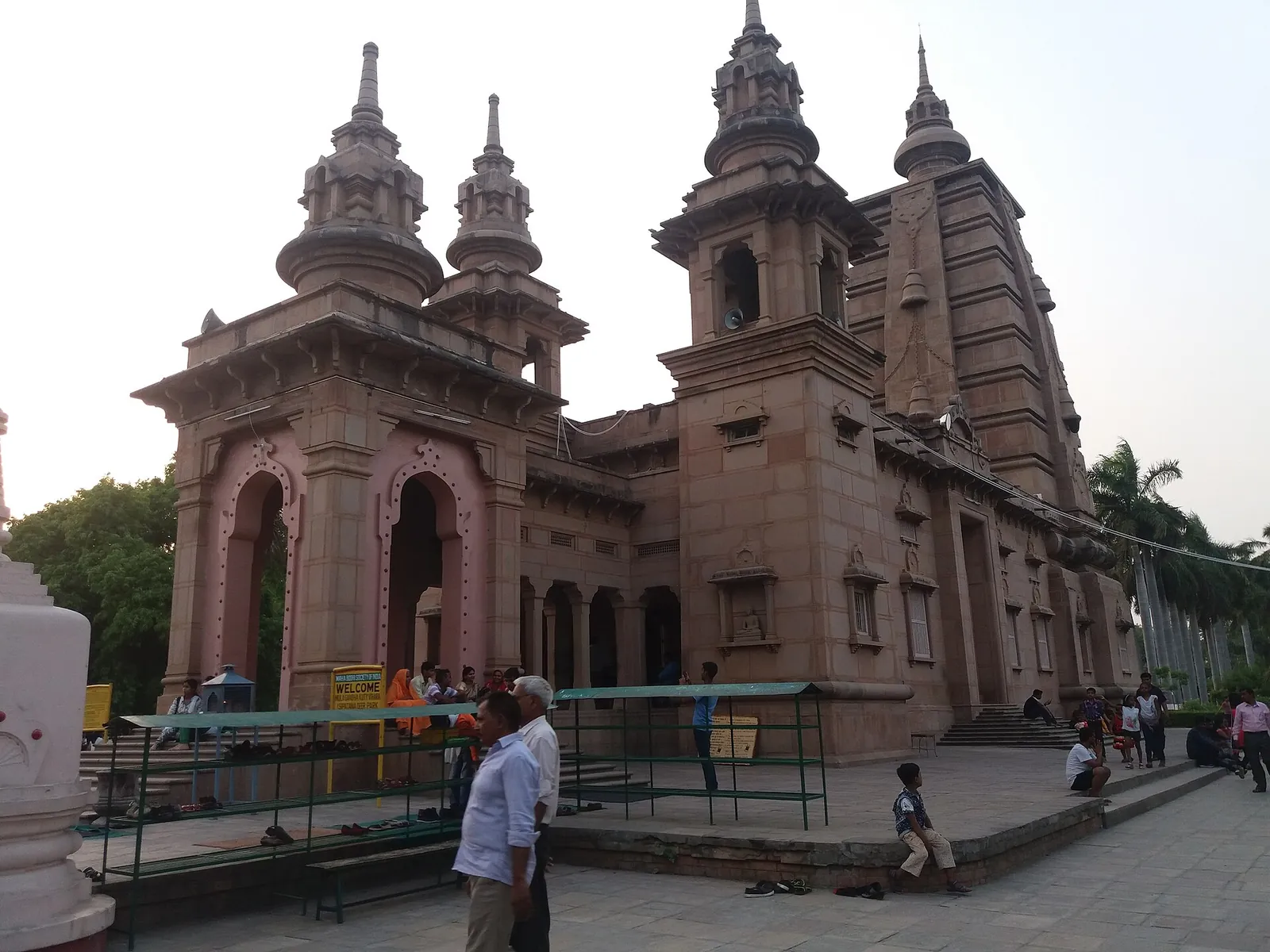
Sarnath, about 10 km from the city, is where the Buddha gave his first sermon, and it has been a UNESCO World Heritage Site since July 2026. A half day covers the Dhamekh Stupa over the place of the sermon, the ruined monasteries round the Ashokan pillar, the Chaukhandi Stupa and the museum, whose Lion Capital of Ashoka is India's national emblem. The museum is closed on Fridays. The Archaeological Survey of India sells monument tickets on its booking site, asi.paygov.org.in; check there whether the Chaukhandi Stupa can be booked, and ask at the gate for the entry fee to the Sarnath ruins and the Sarnath Museum. Go by auto-rickshaw or taxi.
- Day 1: arrive by the morning flight or the Vande Bharat from New Delhi. If you fly, check in by mid-afternoon, walk the ghats from Dashashwamedh south towards Assi in the late-afternoon light, then come back to Dashashwamedh and take your place for the aarti; if you come by train, the aarti may be the only thing the evening allows.
- Day 2, morning: a boat at sunrise, breakfast in the lanes, then Kashi Vishwanath with your passport at the help desk first; visit by 10:00 or after 12:20, when darshan resumes.
- Day 2, afternoon: Sarnath for the stupas and the museum, and back for a quieter evening by the river at Assi Ghat; if you sleep near Assi, Subah-e-Banaras is on your doorstep the next morning, before the train.
Day 3: the Vande Bharat from Banaras to Khajuraho
Since 11 November 2025, the Khajuraho-Banaras Vande Bharat Express (26505/26506) has run directly between Banaras and Khajuraho via Prayagraj and Chitrakoot. It is about 2 hours 40 minutes faster than the special trains that ran on the route before it, and it is the reason this pairing now works without a flight. The train uses Banaras station (BSBS), not Varanasi Junction, so give the taxi the right name. Treat day 3 as a travel day and plan the evening around the arrival time on your ticket.
Madhya Pradesh Tourism places Khajuraho railway station 5 km from the town, a short taxi ride to the hotels. If you prefer to fly, MP Tourism lists flights from Khajuraho's domestic airport, 2 km from the temples, to Delhi, Mumbai, Bhopal and Varanasi, without naming the airlines; their own booking pages show the current flights. By road, MP Tourism gives no distance or bus service from Varanasi; the buses it mentions from Khajuraho go to nearby cities such as Jhansi, so go by train or plane.
If the train gets you in before dusk, walk over to the Western Group for the light and sound show, which MP Tourism stages there. MP Tourism lists the English show from 18:30 to 19:05 between October and February and from 19:30 to 20:05 between March and September, and a foreign adult pays INR 800. If you arrive later, see it on day 4.
Days 4-5: Khajuraho's temple groups and the way back
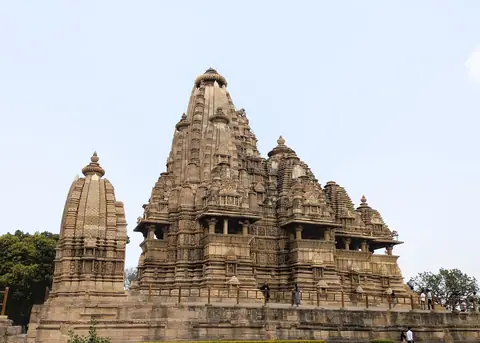
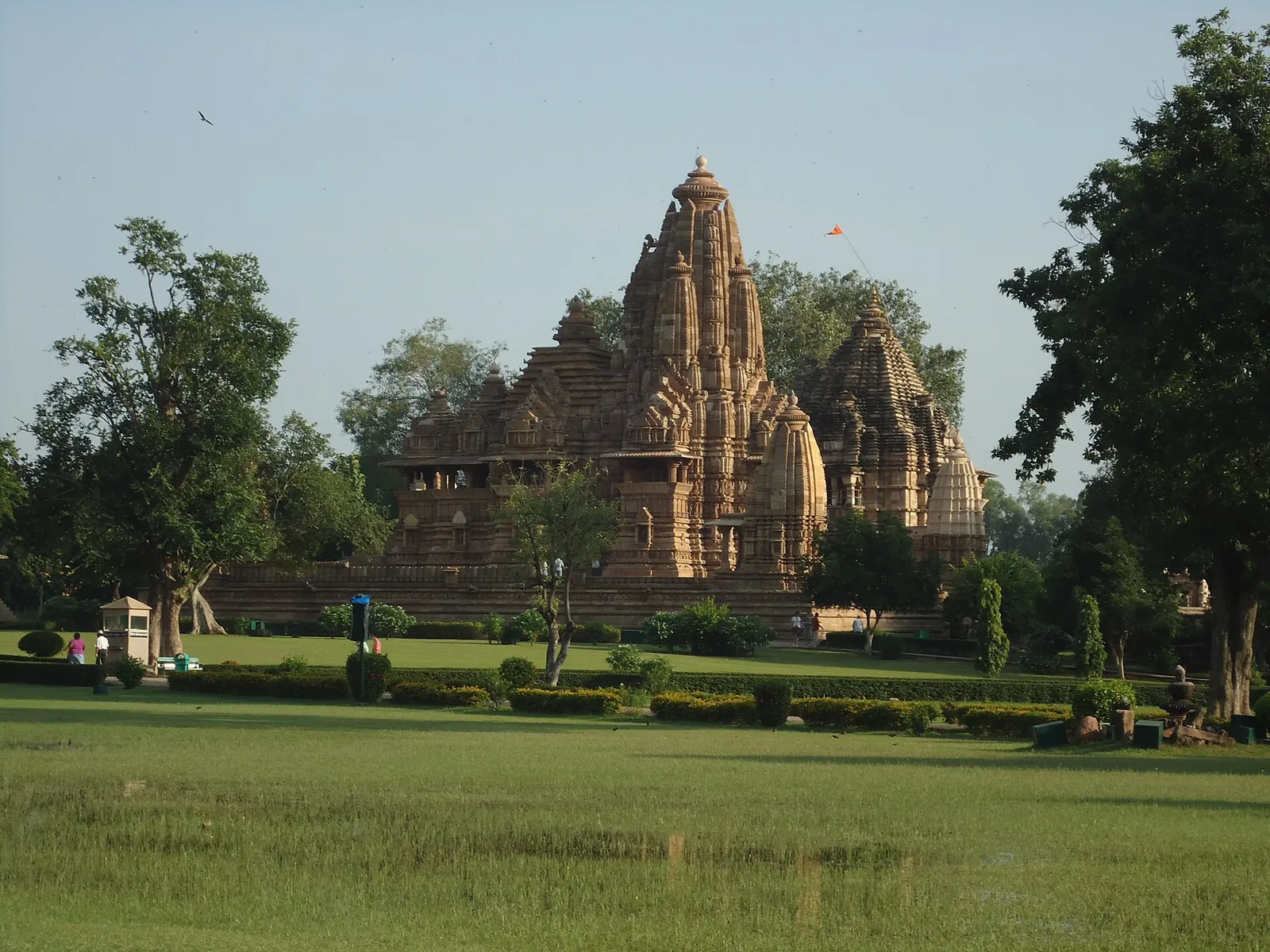
The Western Group is the reason to come. The Chandela kings built these sandstone temples: the Archaeological Survey of India dates the Lakshmana Temple, with its frieze of elephants, hunts and battles, to Yasovarman (AD 954), and attributes Kandariya Mahadeva, the largest and grandest, to King Ganda (AD 1017-29). Gods, dancers, musicians and celestial women cover every wall; the famous erotic sculptures, which MP Tourism says make up only about a tenth of them, are a small part of the whole. The Archaeological Survey of India lists the Western Group as open daily from sunrise to sunset, charges foreign visitors INR 600 in cash, and lets children below 15 in free. Go at opening, before the heat, and keep the Archaeological Museum beside it for later in the morning. Just south of the Lakshmana Temple, on the bank of the Shiva Sagar tank, Matangeshwar is still used for worship. Our Khajuraho guide walks through the temples one by one.
In the afternoon, the Adivart Tribal and Folk Art Museum on the bypass road shows the homes of the seven major tribes of Madhya Pradesh in a tribal village; it lists foreign visitors at INR 500, opens from 12:00 to 21:00 and is closed on Mondays and national holidays. Raneh Falls, a granite canyon on the Ken River, is the alternative by taxi (open from 06:00 to 18:00, to 12:00 on Wednesdays). A tiger safari in Panna needs a third night and a permit from the Madhya Pradesh Forest Department's portal.
On the last morning, cycle or take an auto-rickshaw to the Eastern Group, near the old village, where Incredible India counts three Hindu and four Jain temples. The Jain temples, more than a thousand years old and still in worship, stand in a modern enclosure: the Parsvanatha Temple is the largest and most finely detailed, with its best figures on the northern wall, and the Adinatha Temple stands beside it. Then ride out to the Southern Group, about five kilometres south of the village: Duladeo, a Shiva temple of about 1100-1150, has flying celestials on its upper tower and finely carved jewellery on its female figures, and Chaturbhuj is the only temple in Khajuraho without a single erotic sculpture.
Back to Delhi or Agra. The Khajuraho-Hazrat Nizamuddin Vande Bharat Express (22469/22470) runs between Khajuraho and Delhi's Hazrat Nizamuddin station, or you can fly from Khajuraho to Delhi. For Agra, take the Vande Bharat to Delhi and continue from there. Khajuraho Airport (HJR) is domestic only, so an international flight home leaves from Delhi or another gateway.
- Day 4, morning: the Western Group at sunrise, then the Archaeological Museum.
- Day 4, afternoon: the Adivart museum (not on a Monday) or Raneh Falls (not on a Wednesday afternoon), and the light and sound show if you missed it on day 3.
- Day 5: the Eastern and Southern groups in the cool of the morning, then the train to Hazrat Nizamuddin or a flight to Delhi; if your ticket shows a morning departure, see the Eastern Group on the afternoon of day 4 instead.
Make time for the local food
What to eat and where to look
Tamatar chaat
Varanasi's own chaat: tomatoes cooked down with boiled potato and spices, topped with sweet-and-sour chutney and yoghurt and finished with coriander. Incredible India and the city's Kashi portal both list it among the dishes of Banaras.
- Where to look
- The chaat stalls of the old-city lanes behind Dashashwamedh Ghat.
- Fit it into your day
- After the aarti on day 1.
Served hot and spicy; ask for less chilli.
Kachori sabzi
Fried kachoris with a spiced vegetable curry, served in a bowl made of leaves; the Kashi portal says this is how breakfast begins in Varanasi.
- Where to look
- Kachauri Gali, the old-city lane named after it, which Incredible India lists among the city's famous lanes.
- Fit it into your day
- Breakfast on day 2, after the dawn boat.
Fried and often hot with chilli.
Baati chokha
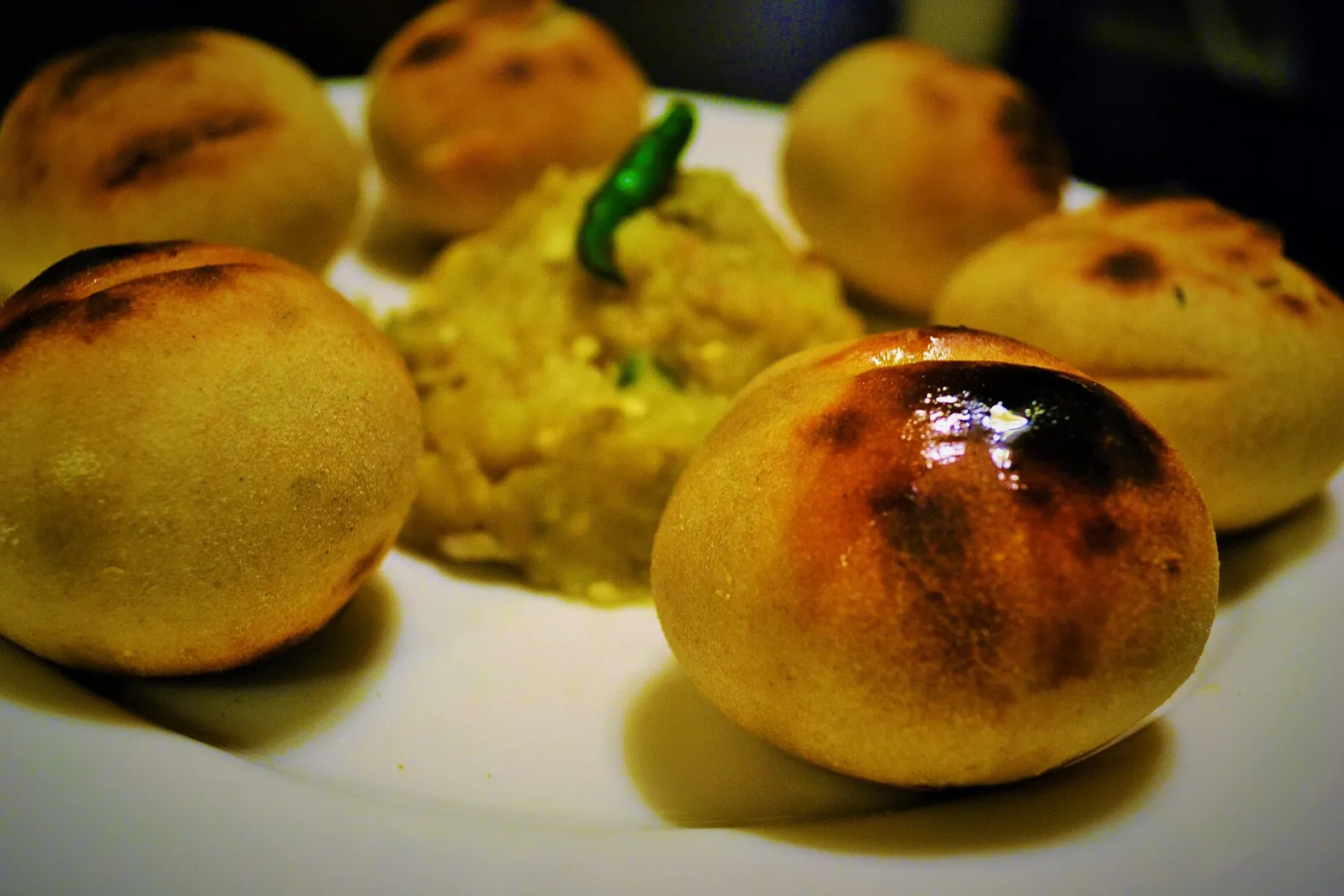
Balls of wheat dough roasted over coals, eaten with chokha, a mash of roasted vegetables; the Kashi portal says you will find it almost everywhere in Varanasi's streets and restaurants.
- Where to look
- The eateries around Assi Ghat, at the southern end of the river steps.
- Fit it into your day
- Dinner on day 2, after the evening at Assi Ghat.
Usually brushed with ghee; ask if you avoid dairy.
Banarasi lassi
Sweet yoghurt and milk churned into a thick drink, often topped with cream; the Kashi portal lists it among the city's classic tastes. In winter, the sweet shops also sell malaiyyo, a frothy milk sweet made only in the cold months.
- Where to look
- The lassi and sweet shops of Vishwanath Gali, the lane that leads to the temple.
- Fit it into your day
- Mid-afternoon on day 2, before the drive to Sarnath.
Often served with ice; skip it while your stomach is settling in.
Bundeli gosht
A slow-cooked mutton curry of Bundelkhand, the region around Khajuraho; MP Tourism names it among the dishes that come from the region's mix of Mughal, Rajput and tribal cooking.
- Where to look
- The restaurants of the market lanes by the Western Group of Temples.
- Fit it into your day
- Dinner on day 4, after the light and sound show.
Not every kitchen makes it every day; ask in the morning.
Four days instead of five
With one day less, cut a night in Khajuraho, not in Varanasi. Keep days 1 and 2 as above, take the Vande Bharat to Khajuraho on day 3 and see the light and sound show that evening if the train arrives in time.
On day 4, be at the Western Group at sunrise, see the Archaeological Museum, then take the train to Hazrat Nizamuddin or a flight to Delhi. You lose the Eastern and Southern groups and the Adivart museum, and the budget below drops by one Khajuraho night and the museum tickets.
When to go: cool winters, hot summers, festival nights
Both places are at their best from October to March, the season Incredible India recommends for walking the ghats and moving between the temple groups without hurrying. The UK Foreign Office calls severe air pollution a major health hazard in the winter months from October to February, with North Indian cities most affected, so look at the air quality before a December or January trip. MP Tourism calls April to June extremely hot in Khajuraho; if you travel then, see the temples at sunrise and after four.
The south-west monsoon, which the India Meteorological Department says covers the whole country around 8 July, is the hardest time for the river. When the Ganges rises towards its danger mark, boats can be stopped: DD News carried a PTI report dated 20 August 2026 in which a Varanasi police officer said boat operations had been suspended as a precaution until the water level and the current return to normal, and that cremations had moved to the upper steps and rooftops of the Harishchandra and Manikarnika ghats. That is one reported event; when the river is high, ask your hotel whether boat rides are running. In Khajuraho the rains fill the canyon at Raneh Falls, which MP Tourism calls the best time to see it.
Two festival nights are worth planning around. In Varanasi, Dev Deepawali, when lamps line every ghat, falls fifteen days after Diwali, so its date changes each year. In Khajuraho, the dance festival brings classical dancers to a stage in front of the illuminated Western Group each February; MP Tourism has announced the 53rd festival for 20-26 February 2027, and announces the dates each year. Book the rooms early for either.
A priced five-day trip for two
This model follows the plan above for two adults sharing a room, with the prices checked on 17 October 2026. In Varanasi it uses the two-night package for two that our Varanasi guide prices, at INR 14,742 plus 12% GST, which includes airport pickup and drop by car, a temple tour by car (BHU, Sankat Mochan and others) and one Sugam Darshan, so it suits a flight in from Delhi; this plan leaves by train and has no time for the car tour, so the drop and the tour go unused. The guest house itself states the 12% GST for that package. In Khajuraho it uses MP Tourism's own hotel that our Khajuraho guide prices, at INR 2,290 a night.
- Varanasi, two nights for two with airport transfers: INR 14,742 plus 12% GST, about INR 16,511.
- Khajuraho, two nights: 2 x INR 2,290 = INR 4,580.
- Kashi Vishwanath, foreign-visitor darshan: the guest house does not say whether a foreign guest can use the package's Sugam Darshan, and the trust books foreign visitors only at its help desk, so two foreign visitors add INR 600 each: INR 1,200.
- Western Group, ASI foreign-visitor ticket: 2 x INR 600 = INR 1,200.
- Light and sound show, foreign adults: 2 x INR 800 = INR 1,600.
- Adivart Tribal and Folk Art Museum, foreign visitors: 2 x INR 500 = INR 1,000.
- Total for two: 16,511 + 4,580 + 1,200 + 1,200 + 1,600 + 1,000 = about INR 26,091.
- Not included: the trains and flights (Foreign Tourist quota tickets cost 1.5 times the normal fare plus INR 200 plus GST each), the Sarnath tickets, the boats, auto-rickshaws and taxis, any tax on the Khajuraho room, Raneh Falls if you go there instead of the Adivart museum (INR 50 a person plus INR 300 for a car at the gate, and the taxi), a Panna safari, and meals.
Practical questions
How many days do Varanasi and Khajuraho need?
Five days and four nights: two nights in Varanasi for the aarti, a dawn boat, Kashi Vishwanath and Sarnath, the Vande Bharat to Khajuraho on day 3, and two nights there for the temple groups and the light and sound show.
Can I go in the monsoon?
You can, but June to September is the weakest time for Varanasi: when the Ganges runs high, boats can be suspended, as DD News reported once, on 20 August 2026 (ask your hotel whether boats are running), and the water reaches the lower ghats, among them Manikarnika. Khajuraho's temples stay open, and Raneh Falls is at its fullest.
How do I get from Varanasi to Khajuraho?
Take the Khajuraho-Banaras Vande Bharat Express (26505/26506), which has run directly between Banaras station and Khajuraho via Prayagraj and Chitrakoot since 11 November 2025 and runs six days a week. If the train does not run on your day, MP Tourism also lists flights between Khajuraho and Varanasi.
Should I start from Delhi or from Agra?
Delhi is simpler: the New Delhi-Varanasi Vande Bharat takes approximately eight hours, flights go to Varanasi, and the Khajuraho-Hazrat Nizamuddin Vande Bharat and Khajuraho's flights bring you back to Delhi. From Agra, the simplest link is back through Delhi.
Can I run the route the other way round?
Yes. Take the Vande Bharat or a flight from Delhi to Khajuraho first, then the Vande Bharat to Banaras, and fly home or onward from Varanasi, whose airport has international connections.
Do foreign visitors pay more at the sights?
Yes. The Archaeological Survey of India charges foreign visitors INR 600 for the Western Group at Khajuraho, MP Tourism's light and sound show costs INR 800 for a foreign adult, and the Kashi Vishwanath darshan ticket for foreign visitors costs INR 600. Children below 15 enter ASI monuments free.
Sources and checks before you travel
Reference sources for the version dated 17 October 2026. Confirm opening times, access, transport and conditions for your travel dates.
- Ministry of Tourism, Incredible India: Varanasi ↗ — opens in a new tab
- Ministry of Tourism, Incredible India: Dashashwamedh Ghat ↗ — opens in a new tab
- Kashi portal (Varanasi Smart City): Ganga Aarti ↗ — opens in a new tab
- Kashi portal (Varanasi Smart City): Manikarnika Ghat ↗ — opens in a new tab
- Kashi portal (Varanasi Smart City): Harishchand Ghat ↗ — opens in a new tab
- Kashi portal (Varanasi Smart City): Assi Ghat ↗ — opens in a new tab
- Kashi portal (Varanasi Smart City): Sarnath ↗ — opens in a new tab
- Archaeological Survey of India: ticketed monuments ↗ — opens in a new tab
- Kashi portal (Varanasi Smart City): Varanasi cuisine ↗ — opens in a new tab
- Ministry of Culture via PIB: Ancient Buddhist Site of Sarnath inscribed on the World Heritage List (25 July 2026) ↗ — opens in a new tab
- Shri Kashi Vishwanath Temple Trust: Foreign tourist ticket booking process ↗ — opens in a new tab
- Shri Kashi Vishwanath Temple Trust: FAQ (PDF) ↗ — opens in a new tab
- PIB (Ministry of Railways): Vande Bharat Express backgrounder, 16 January 2026 ↗ — opens in a new tab
- PIB (Ministry of Railways): Vande Bharat trains in Maharashtra and Madhya Pradesh, 11 February 2026 ↗ — opens in a new tab
- PIB: four new Vande Bharat trains, 6 November 2025 ↗ — opens in a new tab
- IRCTC: Foreign Tourist quota booking (PDF) ↗ — opens in a new tab
- IRCTC: Foreign Tourist quota general terms and conditions (PDF) ↗ — opens in a new tab
- IRCTC: foreign user registration guide (PDF) ↗ — opens in a new tab
- Official e-Visa site: e-Tourist visa and entry points ↗ — opens in a new tab
- France Diplomatie: India security advice ↗ — opens in a new tab
- UK Foreign Office (FCDO): India travel advice, health ↗ — opens in a new tab
- India Meteorological Department: Monsoon FAQ ↗ — opens in a new tab
- DD News: Ganga water level in Varanasi approaches danger mark; boat operations suspended (20 August 2026) ↗ — opens in a new tab
- Madhya Pradesh Tourism (MP Tourism): Khajuraho ↗ — opens in a new tab
- Madhya Pradesh Tourism (MP Tourism): accommodation list ↗ — opens in a new tab
- Archaeological Survey of India: Group of Temples, Khajuraho ↗ — opens in a new tab
- Ministry of Tourism, Incredible India: Khajuraho ↗ — opens in a new tab
- Madhya Pradesh Tourism (MP Tourism): Lakshmana Temple ↗ — opens in a new tab
- Madhya Pradesh Tourism (MP Tourism): Matangeshwar Temple ↗ — opens in a new tab
- Madhya Pradesh Tourism (MP Tourism): Jain temples of Khajuraho ↗ — opens in a new tab
- Madhya Pradesh Tourism (MP Tourism): sound and light shows in Madhya Pradesh (updated 13 July 2026) ↗ — opens in a new tab
- Aadivart Tribal and Folk Art State Museum ↗ — opens in a new tab
- Madhya Pradesh Tourism (MP Tourism): Adivart Tribal and Folk Art Museum ↗ — opens in a new tab
- Madhya Pradesh Tourism (MP Tourism): Raneh Falls ↗ — opens in a new tab
- Madhya Pradesh Forest Department, MPOnline: Panna National Park permits ↗ — opens in a new tab
- Madhya Pradesh Tourism (MP Tourism): Khajuraho Dance Festival ↗ — opens in a new tab
- Madhya Pradesh Tourism (MP Tourism): Madhya Pradesh's cuisines ↗ — opens in a new tab
- Archaeological Survey of India: online ticket booking ↗ — opens in a new tab
- Chandauli district administration: how to reach ↗ — opens in a new tab
- Southern Grand Kashi: 2 nights/3 days package ↗ — opens in a new tab
Does this experience fit your route?
Book the Vande Bharat from Banaras to Khajuraho first, then a room by the ghats and one by the Western Group; add a guide in either place if you want the river or the carvings explained.
Check dates and details on Viator ↗ — opens in a new tabAffiliate link · Book with ViatorPhoto credits
Chausatti Ghat on the Varanasi riverfront in the first light of the morning
Photograph: Ninara from Helsinki, Finland — opens in a new tab · CC BY 2.0 — opens in a new tab
Changes: Resized and converted to WebP; displayed with responsive crops. · Original photograph and licence details ↗ — opens in a new tab
Banaras station (BSBS), where the Vande Bharat to Khajuraho starts
Photograph: Gannu03 — opens in a new tab · CC BY-SA 4.0 — opens in a new tab
Changes: Resized and converted to WebP; displayed with responsive crops. · Original photograph and licence details ↗ — opens in a new tab
A temple of the Western Group at Khajuraho, across the lawns of the enclosure
Photograph: Felix Dance — opens in a new tab · CC BY 2.0 — opens in a new tab
Changes: Resized and converted to WebP; displayed with responsive crops. · Original photograph and licence details ↗ — opens in a new tab
The Mulagandha Kuti Vihar, a modern Buddhist temple at Sarnath
Photograph: Abhishekraj272 — opens in a new tab · CC BY-SA 4.0 — opens in a new tab
Changes: Resized and converted to WebP; displayed with responsive crops. · Original photograph and licence details ↗ — opens in a new tab
Baati (also called litti) with chokha, the roasted dough balls and vegetable mash of eastern Uttar Pradesh and Bihar
Photograph: Vinay Sah — opens in a new tab · CC BY-SA 4.0 — opens in a new tab
Changes: Resized and converted to WebP; displayed with responsive crops. · Original photograph and licence details ↗ — opens in a new tab