Plan your trip
Where to stay in Busan: Seomyeon, Haeundae and more compared
Busan stretches along the sea, and its sights lie far apart: the fish market and old streets of the port in the south-west, the beaches in the east, the hot springs in the north. No single area puts all of them on foot, so the choice is which one you want outside the door and which you are happy to ride to. Two metro lines decide most of it: Line 1 runs from the old port through Busan Station and Seomyeon to Dongnae, and Line 2 runs from Seomyeon east to the beaches. This guide compares Seomyeon, Haeundae, Nampo, Busan Station and Dongnae by who they suit, how you get around, what the evenings are like and the hotels each has, then covers the airport links. For the sights themselves, use our Busan guide.
In this guide
Find the location ↗ — opens in a new tabThe short answer
For a first visit of three nights, stay in Seomyeon, where Line 1 to the old port and Line 2 to the beaches meet. Choose Haeundae if the beach is the point, Nampo for Jagalchi and the markets, Busan Station for a late or early KTX, and Dongnae (Oncheonjang Station) for a hot-spring hotel. From Gimhae Airport, the limousine bus to Seomyeon costs KRW 6,000 (credit card only), and the light rail with Line 2 takes about 30 minutes. Seomyeon's hotels publish no room rates, so the price here is from Dongnae: a double at Nokcheon Hot Spring Hotel is listed at about KRW 160,000 for two on weekdays, taxes and service included (its regular rate, checked on 28 October 2026). If you arrive by KTX, book the seat and the hotel together, as our Busan guide explains; a Haeundae room for a summer stay is the one to book earliest.
- Key point
- One base for the whole stay: 3 nights for Busan on its own, 2 when it is one stop on a week in Korea
- Where it applies
- Seomyeon for a first visit; Haeundae for the beach; Nampo for the markets of the old port; Busan Station for the KTX; Dongnae and Oncheonjang for hot springs
- Timing
- Any time of year. The beaches are open for swimming only in each year's official period: VisitKorea listed 26 June to 15 September at Haeundae and 1 July to 31 August at Gwangalli for 2026, and the dates change each year. Swimming is not allowed outside the period or at night. Summer is when Haeundae is at its busiest.
Seomyeon or Haeundae: decide this first
For most first visits, stay in Seomyeon. It is where Busan Metro Line 1 and Line 2 cross, so the old port is one line away in one direction and the beaches one line away in the other, and the light rail from Gimhae Airport joins Line 2 at Sasang, on the way in. Busan's sights fall on both lines and lie far apart, so sleeping at the crossing keeps every day out to a single line.
Choose Haeundae instead if the beach is what you came for. You give up the old port on the doorstep, a long ride with a change at Seomyeon, in return for the sand at the end of the street. The other three areas each answer one need: Nampo for the fish market and the old streets, Busan Station for the KTX and the Japan ferries, and Dongnae for a room filled with hot-spring water. Keep one hotel for three nights: moving within the city rarely saves time.
The five areas compare like this (stops counted on the metro to or from Seomyeon):
| Area | What it is like | Station and lines | Stops from Seomyeon | Best for |
|---|---|---|---|---|
| Seomyeon | The downtown crossing: a department store on the station, pork-soup alleys by Seomyeon Market, Jeonpo Café Street; no sea | Seomyeon, Lines 1 and 2 | 0; Sasang, for the airport light rail, is 8 on Line 2 | A first visit that splits its days between the port and the beaches |
| Haeundae | A 1.5 km beach lined with hotels from luxury to guesthouses; Haeridan Street's restaurants and cafés behind the station; crowded in summer | Haeundae, Line 2 | 16 on Line 2 (Gwangan 10) | The beach, Dongbaekseom and Blueline Park |
| Nampo | Jagalchi Market, BIFF Square, Gukje Market and Yongdusan Park within walking distance; the Bupyeong night market until 23:30 | Nampo and Jagalchi, Line 1 | 8 on Line 1 | Markets, seafood and Gamcheon |
| Busan Station | The KTX terminus, two Line 1 stops from Nampo, with the Japan ferry terminal 10 to 15 minutes' walk away | Busan Station, Line 1, KTX | 6 on Line 1 | A late train in, an early train out or a ferry |
| Dongnae and Oncheonjang | Hot-spring hotels with spring water in the rooms, and the Heosimcheong bathhouse | Oncheonjang, Line 1 | 8 on Line 1, north | Baths and an evening soak after sightseeing |
Seomyeon: both metro lines and late dinners
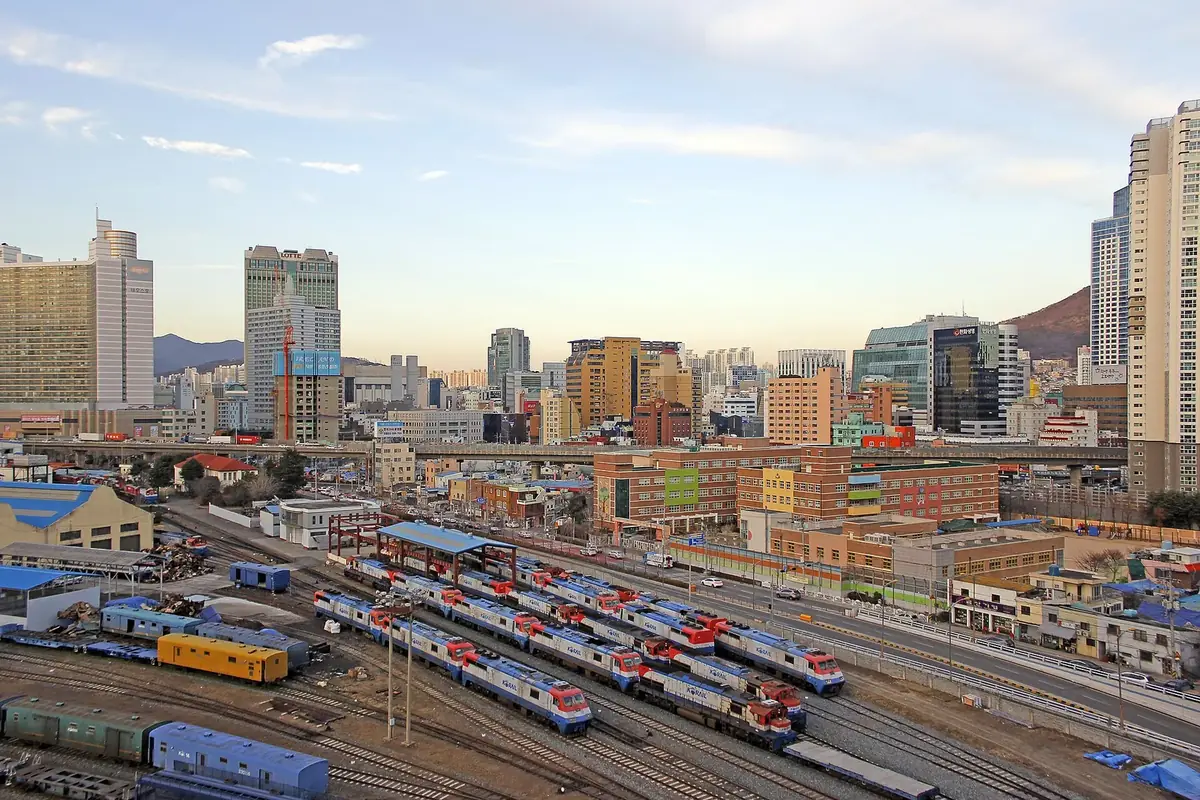
Seomyeon, in central Busan, grows around its metro interchange. LOTTE Department Store's Busan Main Store, a shopping landmark with a food hall, is directly connected to it. For the evening, Jeonpo Café Street has a lively downtown scene, and the alley beside Seomyeon Market, called Seomyeon Local Food Street (Seomyeon-ro 68beon-gil), is lined with eateries that specialise in dwaeji gukbap, the pork and rice soup Busan is known for. Songjeong Samdae Gukbap, one of them, is open 24 hours, about 200 metres from Exit 1 of the station.
What Seomyeon does not have is the sea: Haeundae and Gwangalli are further along Line 2, and Nampo down Line 1, so every beach or market day starts with a ride. From the airport, the light rail to Sasang and Line 2 take about 30 minutes, and the limousine bus stops at Seomyeon Station by the Lotte Hotel on its way to Bujeon.
Toyoko Inn Busan Seomyeon, at 39 Seojeon-ro, is a business hotel of the Toyoko Inn chain 8 minutes' walk from Exits 8 and 10 of Seomyeon Station, and, like the chain's other two Busan branches in this guide, it includes breakfast.
Haeundae: the beach on your doorstep
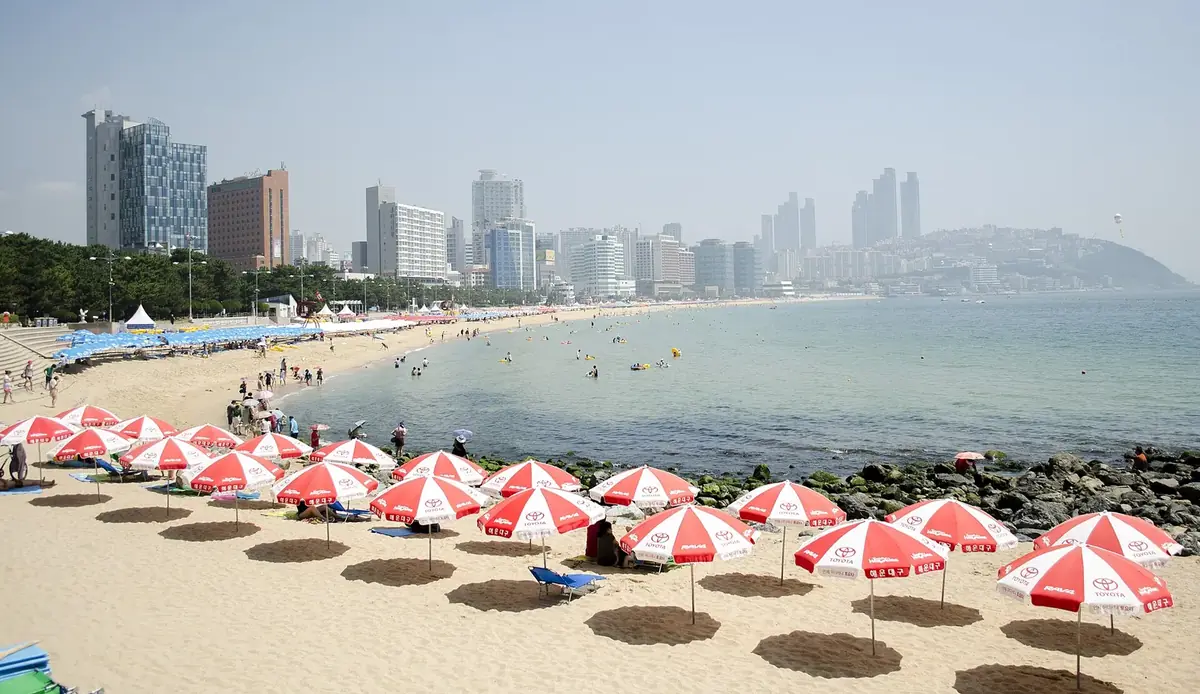
Haeundae Beach is the most famous in Busan: white sand about 1.5 kilometres long and 30 to 50 metres wide, in front of a shallow bay, with Dongbaekseom's island walk at one end. Hotels of every kind, from luxury hotels to private guesthouses, have grown up around it, and people flock here every summer, so book early for a summer stay. Haeundae Station on Line 2 is about 5 minutes' walk from the beach (Exit 3 or 5). Just behind the station, Haeridan Street, once a residential neighbourhood, is now a district of restaurants, dessert cafés and small shops popular with younger visitors, which makes for easy evenings.
Haeundae is also the base for the east coast. Blueline Park's Beach Train starts at Mipo, about 15 minutes' walk from Exit 7 of Jungdong Station, the next stop east on Line 2, and our Busan guide covers the train, Haedong Yonggungsa and Gwangalli's Saturday drone show. The trade-off is the west of the city: Nampo and Jagalchi mean Line 2 to Seomyeon and a change to Line 1, one of the two longest rides between these areas.
Gwangalli is the alternative on the same line, closer to Seomyeon: a beach 1.4 kilometres long, lined with cafés and restaurants, about 10 minutes' walk from Gwangan Station (Exit 3 or 5), where evenings end at the lights of Gwangandaegyo Bridge. Gwangalli is also the stage of the Busan Fireworks Festival: the organiser listed its 21st edition for November 2026 around the beach, so check the festival date before booking an autumn stay here.
Toyoko Inn Busan Haeundae No.2, at 5 Haeundaehaebyeon-ro 237beon-gil, is a business hotel of the same chain about 10 minutes' walk from Exit 5 of Haeundae Station. The airport limousine bus to Haeundae (KRW 9,500) stops at Dongbaekseom, Haeundae Beach and the Haeundae Hot Spring Intersection on its way to Jangsan Station.
Nampo and Busan Station: the old port and the KTX
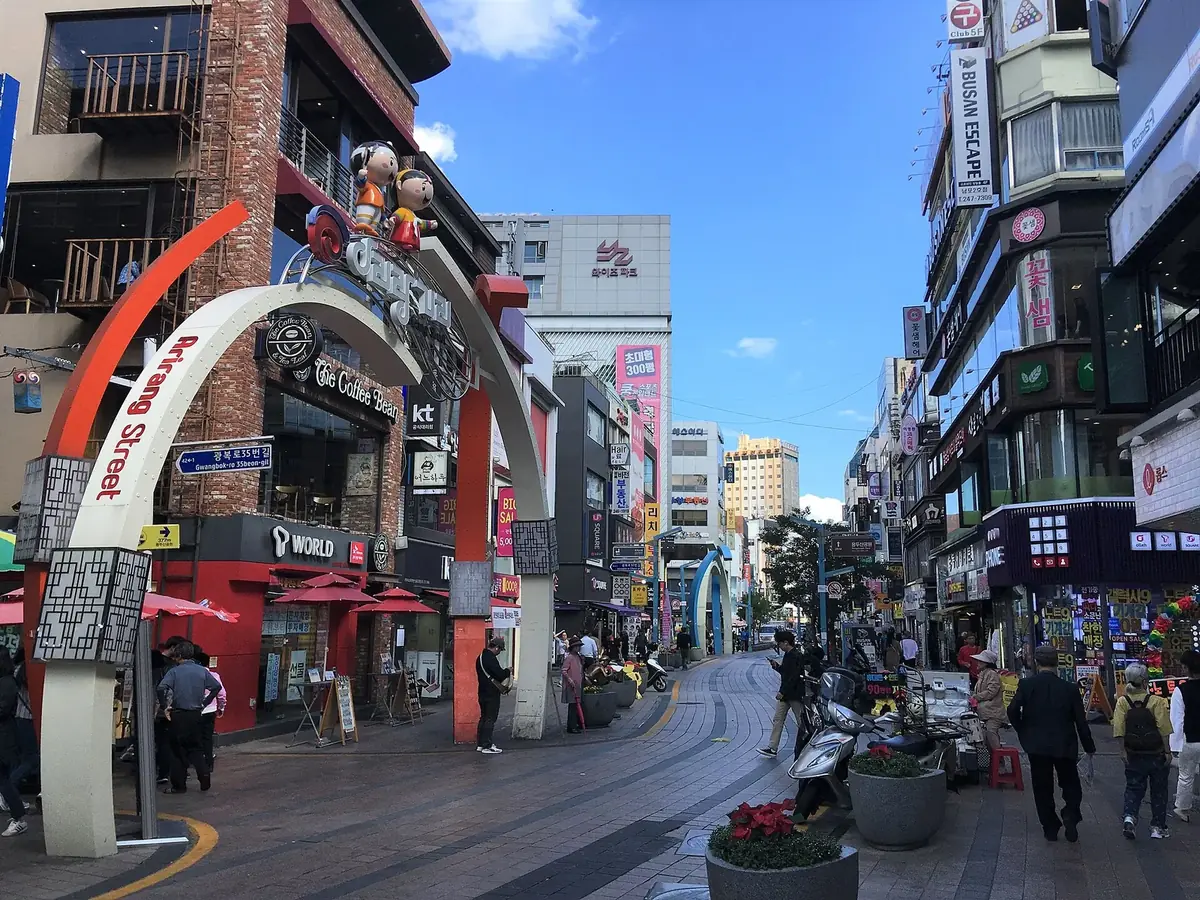
Nampo is the old port, and the reason to sleep here is that its sights are all on foot. Jagalchi Market, on the seaside road, is one of the largest seafood markets in Korea, selling live and dried fish; it is open from 05:00 to 22:00 and closed on the first and third Tuesdays of each month. Within walking distance lie BIFF Square, the film street named for the Busan International Film Festival in 1996, and Gukje Market, a maze of two wings of alleys and halls that grew from the stalls of refugees after the Korean War. Escalators climb from Nampo-dong to Yongdusan Park and Busan Tower, whose view at night is worth the evening. After dark, the Bupyeong Kkangtong Market night market opens from 19:30 to 23:30.
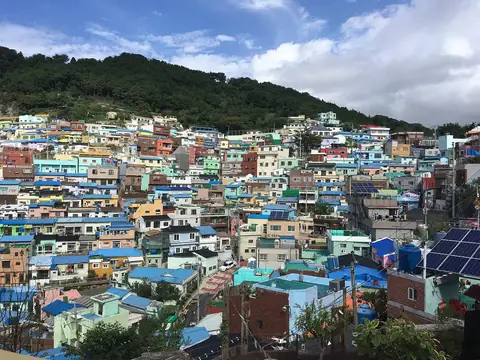
Nampo is also the closer start for Gamcheon Culture Village: the village's own directions page sends you to Exit 1 of Jagalchi Station on Line 1 (the Chungmu Market stop) or Exit 6 of Toseong Station for village buses Seo-gu 2, Seo-gu 2-2 and Saha-gu 1-1. The trade-off is the east: Haeundae is a ride on Line 1 to Seomyeon and on along Line 2.
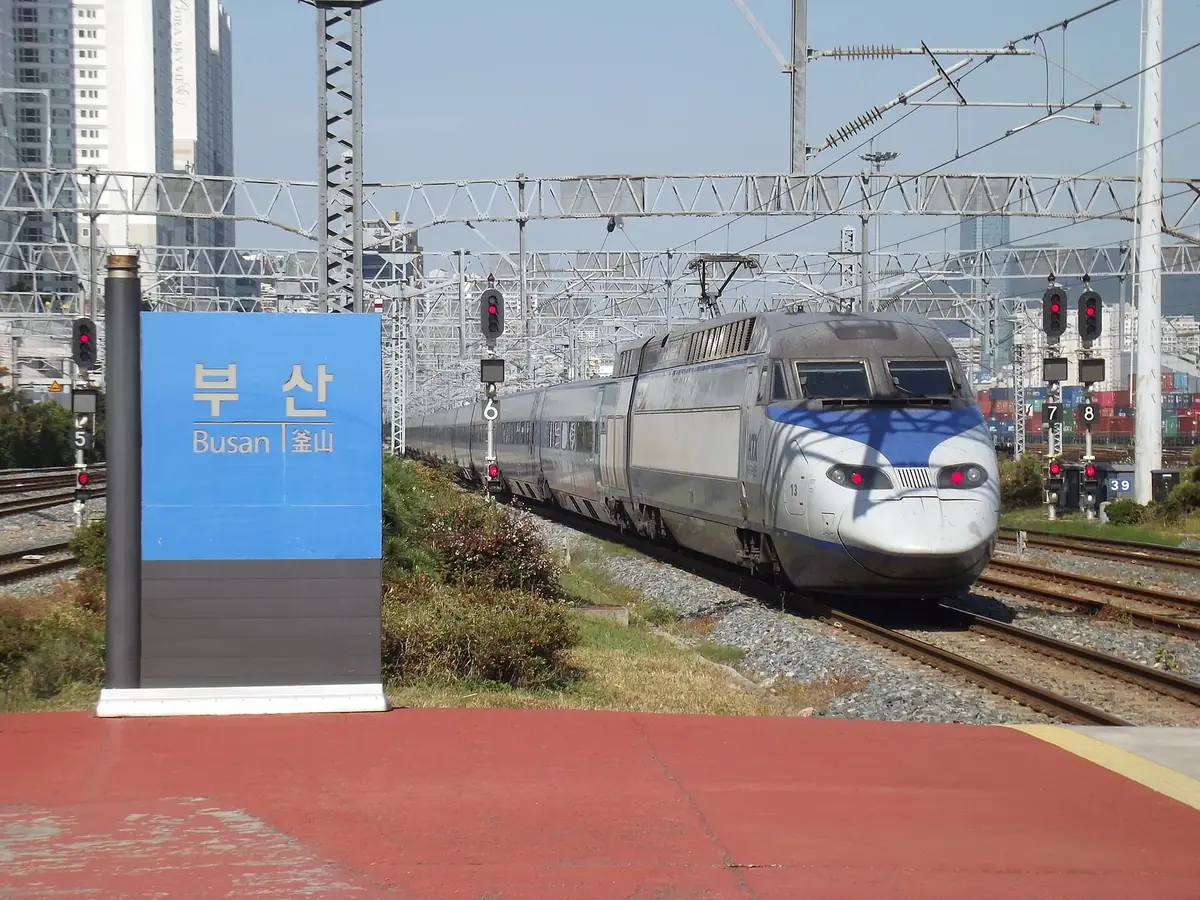
Busan Station is a different base, just north of Nampo on Line 1. It is where the KTX from Seoul arrives, on the Gyeongbu Line, and the Busan Port International Passenger Terminal, for the ferries to Fukuoka, Shimonoseki and Osaka, is a walk of 10 to 15 minutes from it. Sleep here for a late arrival, an early departure or a ferry; Nampo's markets and Seomyeon are both on Line 1 without a change.
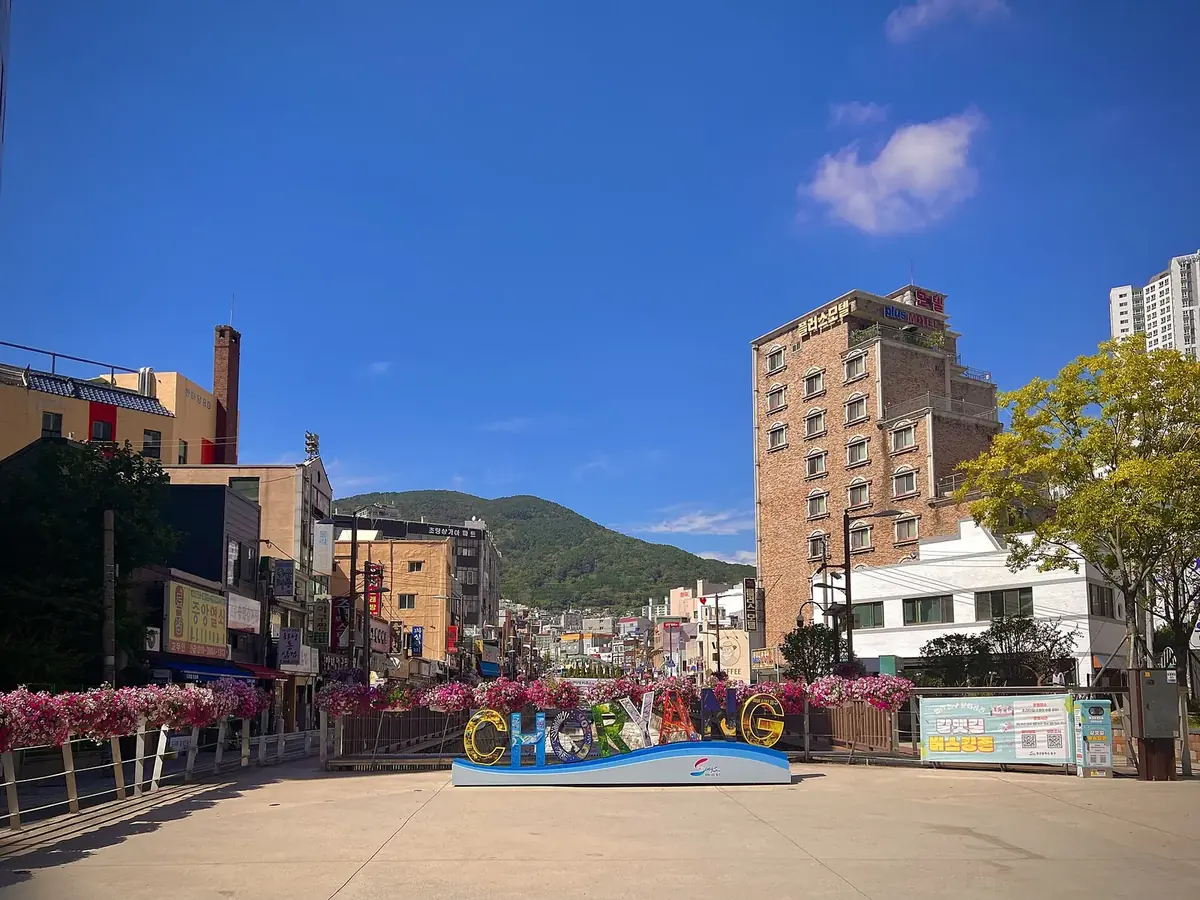
In Nampo, Hotel Foret Premier Nampo, at 54-1 Gudeok-ro, has Standard Doubles of 24 m² for one or two adults, with simple dark brown furniture and free parking during the stay. By the station, Toyoko Inn Busan Station No.1, at 12 Jungang-daero 196beon-gil, is 1 minute's walk from the KTX station and 2 minutes from the metro. Ramada Encore by Wyndham Busan Station stands right next to the station in Choryang-dong, with a fitness centre, a seasonal rooftop pool and a buffet breakfast from 07:00 to 10:00.
Dongnae and Oncheonjang: a hot-spring stay
Dongnae, in the north of the city, has the hot springs, and its hotels cluster around Oncheonjang Station on Line 1. Here the spring water reaches the rooms: Nokcheon Hot Spring Hotel, which began as a public bath in 1962 and was built as a hotel in 1980, says every room uses Dongnae's hot-spring water and has its own bath. Heosimcheong, the bathhouse of Hotel Nongshim, takes day visitors 5 to 7 minutes' walk from Exit 1 or 3 of the station: its hot-spring baths are open from 05:30 to 22:00 (last entry 21:30) every day of the year, and an adult pays KRW 15,000 on weekdays and KRW 18,000 on Saturdays, Sundays and holidays for up to 3 hours.
The cost is distance. Seomyeon and Nampo are down Line 1, and the beaches mean a change at Seomyeon to Line 2. Choose Dongnae for a night or two of baths, or for the whole stay if an evening soak after sightseeing matters more than being close to the sea. Dongnae Station, just south, is a separate station from Oncheonjang; for these hotels, get off at Oncheonjang.
Hotels and what rooms cost
Two Dongnae hotels list their room prices on their own sites, and these compare like this (read on 28 October 2026):
| Hotel | Room | Price on the hotel's own site | What it includes |
|---|---|---|---|
| Nokcheon Hot Spring Hotel | Double Standard, for two | About KRW 160,000 on weekdays, KRW 200,000 at weekends (regular rate) | Taxes and service; a hot-spring bath in the room |
| Hotel Nongshim | Deluxe Twin, for two adults | KRW 363,000 | VAT and service; 50% off the Heosimcheong bathhouse for two guests; breakfast KRW 30,600 an adult |
| Hotel Nongshim | High Deluxe Double, for two adults | KRW 423,500 | VAT and service; the Heosimcheong bathhouse free for up to 2 guests; breakfast KRW 30,600 an adult |
The 50% bathhouse discount belongs to the Deluxe Twin; the High Deluxe Double includes the baths free. Nokcheon's Double Standard checks in from 15:00 on weekdays and from 17:00 at weekends and on holidays, and from 17:00 every day from 20 December to 30 January. Hotel Nongshim checks in from 15:00 and out at 11:00, and extra bedding costs KRW 50,000 a night.
Toyoko Inn, Foret and Ramada publish no room rates on their own sites. The three Toyoko Inns check in from 15:00 and out at 10:00, and Foret checks in from 15:00 and out at 11:00.
From Gimhae Airport to each area
Gimhae International Airport is west of the city, and the area you choose decides whether you take the train or the bus. By rail, the Busan-Gimhae Light Rail runs from Airport Station to Sasang, where you change to Line 2. The limousine buses leave from Platform 3 on the ground floor; buy the ticket first at the counter near Gate 4, by credit card, since cash and transport cards are not accepted. The links to each area compare like this (adult fares, one way):
| Area | By light rail and metro | By limousine bus |
|---|---|---|
| Seomyeon | Light rail to Sasang, then Line 2: about 30 minutes | Seomyeon and Bujeon route: KRW 6,000; first bus 07:20, last 21:30 |
| Haeundae | Light rail to Sasang, then Line 2: about 70 minutes | Haeundae and Jangsan route via Haeundae Beach: KRW 9,500; first bus 07:10, last 21:40 |
| Nampo | Public transport to Jagalchi: about 60 minutes | No limousine route; a taxi takes about 40 minutes |
| Busan Station | Light rail and Line 2 to Seomyeon, then 6 stops south on Line 1 | No limousine route |
| Dongnae and Oncheonjang | Light rail and Line 2 to Seomyeon, then 8 stops north on Line 1 | No limousine route |
A taxi from the stand on the second floor of the international terminal takes about 40 minutes to Seomyeon and about 70 to Gwangalli or Haeundae, paid by meter per car.
With a Tmoney or another Korean transport card, the change between the light rail and the metro is free if you board within 30 minutes, and the trip costs the higher of the two fares rather than both; the light rail's adult card fare is KRW 1,600 or 1,800 by distance (checked on 28 October 2026). Arriving by KTX, you are already at Busan Station; our transport guide for South Korea covers the trains from Seoul.
The 30-second choice
Match the trip to the area, then compare rooms there. If more than one line fits, take the first.
- First visit, three nights, a bit of everything: Seomyeon.
- The beach, Blueline Park and the east coast: Haeundae, or Gwangalli for the bridge lights.
- Jagalchi, the markets and Gamcheon: Nampo.
- A late KTX in, an early one out, or a ferry to Japan: Busan Station.
- Hot-spring water in your room: Dongnae, at Oncheonjang Station.
Practical questions
What is the best area to stay in Busan for first-time visitors?
Seomyeon: the old port is down Line 1, Haeundae along Line 2, and the airport about 30 minutes by light rail and Line 2. Choose Haeundae instead if the beach is the main reason for the trip.
Is it better to stay in Seomyeon or Haeundae?
Stay in Haeundae for the beach, Haeridan Street's cafés and Blueline Park, and in Seomyeon for equal reach to the old port and the coast. From Haeundae, Jagalchi and Gamcheon mean a ride to Seomyeon and a change to Line 1.
Where should I stay in Busan for the KTX?
Busan Station, where the KTX from Seoul arrives. Toyoko Inn Busan Station No.1 is 1 minute's walk from the KTX station, and Ramada Encore by Wyndham Busan Station stands next to it. Nampo's markets are a short ride away on Line 1.
Which Busan hotels have hot-spring baths?
Those around Oncheonjang Station in Dongnae. Nokcheon Hot Spring Hotel puts hot-spring water in every room's bath, and a double there is listed at about KRW 160,000 for two on weekdays, taxes and service included (regular rate). Hotel Nongshim's guests use its Heosimcheong bathhouse, which day visitors can also enter for KRW 15,000 on weekdays.
How do I get from Gimhae Airport to Haeundae?
Take the light rail to Sasang and Line 2 to Haeundae, about 70 minutes, or the limousine bus via Haeundae Beach for KRW 9,500, bought by credit card at the counter near Gate 4 before boarding. A taxi takes about 70 minutes.
Keep planning your trip
Busan
Three nights in Busan: where to sleep, Gamcheon, Jagalchi, Haeundae, Blueline Park and Haedong Yonggungsa with hours, prices, the KTX and an all-in budget for two.
Read the guide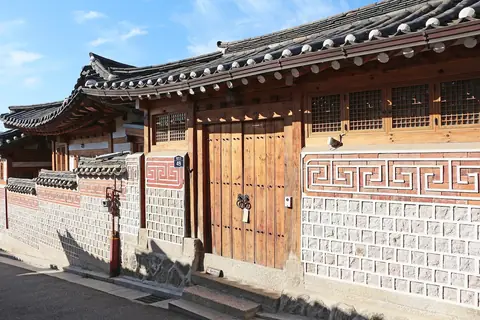
Where to stay in South Korea
Which area to sleep in for Seoul, Busan, Gyeongju, Jeonju, Jeju and more, what hanok and templestays are like, room choices and rates from hotels' own pages.
Read the guide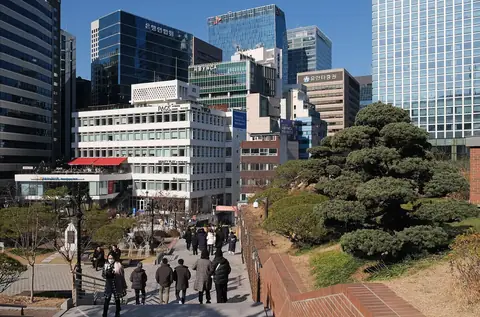
Where to stay in Seoul
Myeongdong, Insa-dong or Hongdae? Six Seoul areas compared by who they suit, their stations, their nights and their hotels, with the airport train to each.
Read the guide
Transport in South Korea
How to ride AREX from Incheon, book the KTX on KORAIL+, choose between express buses and flights, and tap a Tmoney card.
Read the guide
Busan and the south coast in 5 days
Five days and four nights on Korea's south coast: two nights in Busan, one in Tongyeong and one in Yeosu, the rail and bus legs and an all-in budget for two.
Read the guide
South Korea in 7 days
Seven days and six nights through Seoul, Gyeongju and Busan: the KTX and bus legs, one named hotel for each stop, the closing days and an all-in budget for two.
Read the guideSources and checks before you travel
(32)
- Korea Airports Corporation: Gimhae International Airport public transportation ↗ — opens in a new tab
- VisitKorea: Airport transportation ↗ — opens in a new tab
- VisitKorea: Fly to Gimhae Airport and experience Busan ↗ — opens in a new tab
- Busan-Gimhae Light Rail Transit: fares (Korean) ↗ — opens in a new tab
- Busan-Gimhae Light Rail Transit: route search station lists (Korean) ↗ — opens in a new tab
- VisitKorea: Stay safe and have fun in Busan ↗ — opens in a new tab
- VisitKorea: Dwaejigukbap, Busan's representative local dish ↗ — opens in a new tab
- VisitKorea: Haeundae Beach ↗ — opens in a new tab
- VisitKorea: Best summer beach destinations ↗ — opens in a new tab
- VisitKorea: Gwangalli Beach ↗ — opens in a new tab
- Haeundae Blueline Park: stations and access ↗ — opens in a new tab
- VisitKorea: Jagalchi Market ↗ — opens in a new tab
- VisitKorea: BIFF Square ↗ — opens in a new tab
- VisitKorea: Gukje Market ↗ — opens in a new tab
- VisitKorea: Yongdusan Park ↗ — opens in a new tab
- VisitKorea: Bupyeong (Kkangtong) Market ↗ — opens in a new tab
- Gamcheon Culture Village: directions (Korean) ↗ — opens in a new tab
- VisitKorea: Ferry ↗ — opens in a new tab
- Toyoko Inn: Busan Seomyeon ↗ — opens in a new tab
- Toyoko Inn: Busan Haeundae No.2 ↗ — opens in a new tab
- Toyoko Inn: Busan Station No.1 ↗ — opens in a new tab
- Hotel Foret Premier Nampo: Standard Double ↗ — opens in a new tab
- Ramada Encore by Wyndham Busan Station ↗ — opens in a new tab
- Nokcheon Hot Spring Hotel: rooms (Korean) ↗ — opens in a new tab
- Nokcheon Hot Spring Hotel: about and location (Korean) ↗ — opens in a new tab
- Hotel Nongshim: Deluxe Twin ↗ — opens in a new tab
- Hotel Nongshim: High Deluxe Double ↗ — opens in a new tab
- Hotel Nongshim: reservation ↗ — opens in a new tab
- Hotel Nongshim: location ↗ — opens in a new tab
- Heosimcheong spa: guide, hours and rates ↗ — opens in a new tab
- VisitKorea: East coast train trip and summer beaches ↗ — opens in a new tab
- Busan Fireworks Festival: official site ↗ — opens in a new tab
Reference sources for the version dated 28 October 2026. Confirm opening times, access, transport and conditions for your travel dates.
Photo credits
(5)
Haeundae Beach, with the hotels that line the bay behind it.
Photograph: StephNurnberg — opens in a new tab · CC BY 2.0 — opens in a new tab
Changes: Resized and converted to WebP; displayed with responsive crops. · Original photograph and licence details ↗ — opens in a new tab
Seomyeon, Busan's downtown, seen across the Korail Busan Depot.
Photograph: Minseong Kim — opens in a new tab · CC BY-SA 4.0 — opens in a new tab
Changes: Resized and converted to WebP; displayed with responsive crops. · Original photograph and licence details ↗ — opens in a new tab
A shopping street in Nampo-dong and the arch of Arirang Street, in Busan's old port.
Photograph: Christophe95 — opens in a new tab · CC BY-SA 4.0 — opens in a new tab
Changes: Resized and converted to WebP; displayed with responsive crops. · Original photograph and licence details ↗ — opens in a new tab
A KTX train pulling into Busan Station, where the trains from Seoul end.
Photograph: Smiley.toerist — opens in a new tab · CC BY-SA 4.0 — opens in a new tab
Changes: Resized and converted to WebP; displayed with responsive crops. · Original photograph and licence details ↗ — opens in a new tab
Choryang, the neighbourhood around Busan Station.
Photograph: Sharon Hahn Darlin — opens in a new tab · CC BY 2.0 — opens in a new tab
Changes: Resized and converted to WebP; displayed with responsive crops. · Original photograph and licence details ↗ — opens in a new tab