Delhi and the north · Madhya Pradesh
Khajuraho travel guide: 2 nights, the temple groups and the light show
Khajuraho is a small town in the Chhatarpur district of Madhya Pradesh with one of the great sights of India: sandstone temples built by the Chandela kings a thousand years ago and covered, inside and out, with gods, dancers, musicians, armies and lovers. The finest stand together in the Western Group, a short walk from the town's hotels; the Jain temples of the Eastern Group and the two shrines of the Southern Group lie a little further out. Two nights cover all three groups, the evening light and sound show and the tribal art museum, with a third night if you want a tiger safari in Panna.
- Suggested time
- 2 nights (3 days)
- Where to stay
- The town around the Western Group of Temples, for walking to the main temples and the evening show; the Eastern Group side for quieter homestays near the Jain temples
- Season and timing
- Incredible India gives October to March as the best time, when the weather is cool enough to walk between the temple groups without hurrying; MP Tourism calls April to June extremely hot. June to September is the monsoon, IMD's principal rainy season: Raneh Falls has the most water then, while MP Tourism recommends Panna between October and June. The Khajuraho Dance Festival is held at the Western Group each February.
The short answer
Book two nights (three days) in Khajuraho, ideally in the town by the Western Group of Temples; MP Tourism's own hotel in Khajuraho, MPT Jhankar, was listed at INR 2,290 a night. Book your Vande Bharat or flight first, because Vande Bharat trains ran above 100 percent occupancy in 2024-25 and in the first quarter of 2025-26, then the room; Panna safari permits, if you want one, open online 120 days ahead. Two key prices, checked on 17 October 2026: the Archaeological Survey of India's page for the Khajuraho temples lists INR 600 in cash for foreign visitors, and MP Tourism's light and sound show costs INR 800 for a foreign adult. The model stay below comes to about INR 8,380 for two, before trains, taxis and meals.
Where to sleep: by the Western Group or near the Jain temples
Khajuraho is small enough that where you sleep matters less than in a city, but the town around the Western Group is the easiest base: the main temples, the evening light and sound show, the bazaar and most restaurants are a walk away. MP Tourism also runs two hotels in Khajuraho. Its accommodation list gives MPT Jhankar, with a restaurant, at INR 2,290 a night, and MPT Payal, a business hotel with a bar and restaurant, at INR 2,490 (checked on 17 October 2026). Book either through MP Tourism's accommodation pages.
The Eastern Group side, around the old village and the Jain temples, is quieter. MP Tourism's homestay guide describes family-run homestays there, including one within walking distance of the Eastern Group and the Duladeo temple, for travellers who want to see village life as well as the monuments. From either base, the airport and the railway station are a short taxi ride away.
The Western Group: Kandariya Mahadeva, Lakshmana and the royal temples
The Chandelas ruled much of central India from Khajuraho, and the Archaeological Survey of India (ASI) says local tradition counts 85 temples, of which 25 still stand. All but three are built of fine-grained sandstone in buff, pink or pale yellow; Chausath Yogini and the Brahma temple are among the three of granite. The site has been a UNESCO World Heritage Site since 1986. The Western Group, the grandest of the three, has twelve temples, and the carvings cover every terrace and wall: gods and goddesses, celestial nymphs at their mirrors, musicians, elephants, hunts and battles. The famous erotic sculptures make up only about a tenth of them.
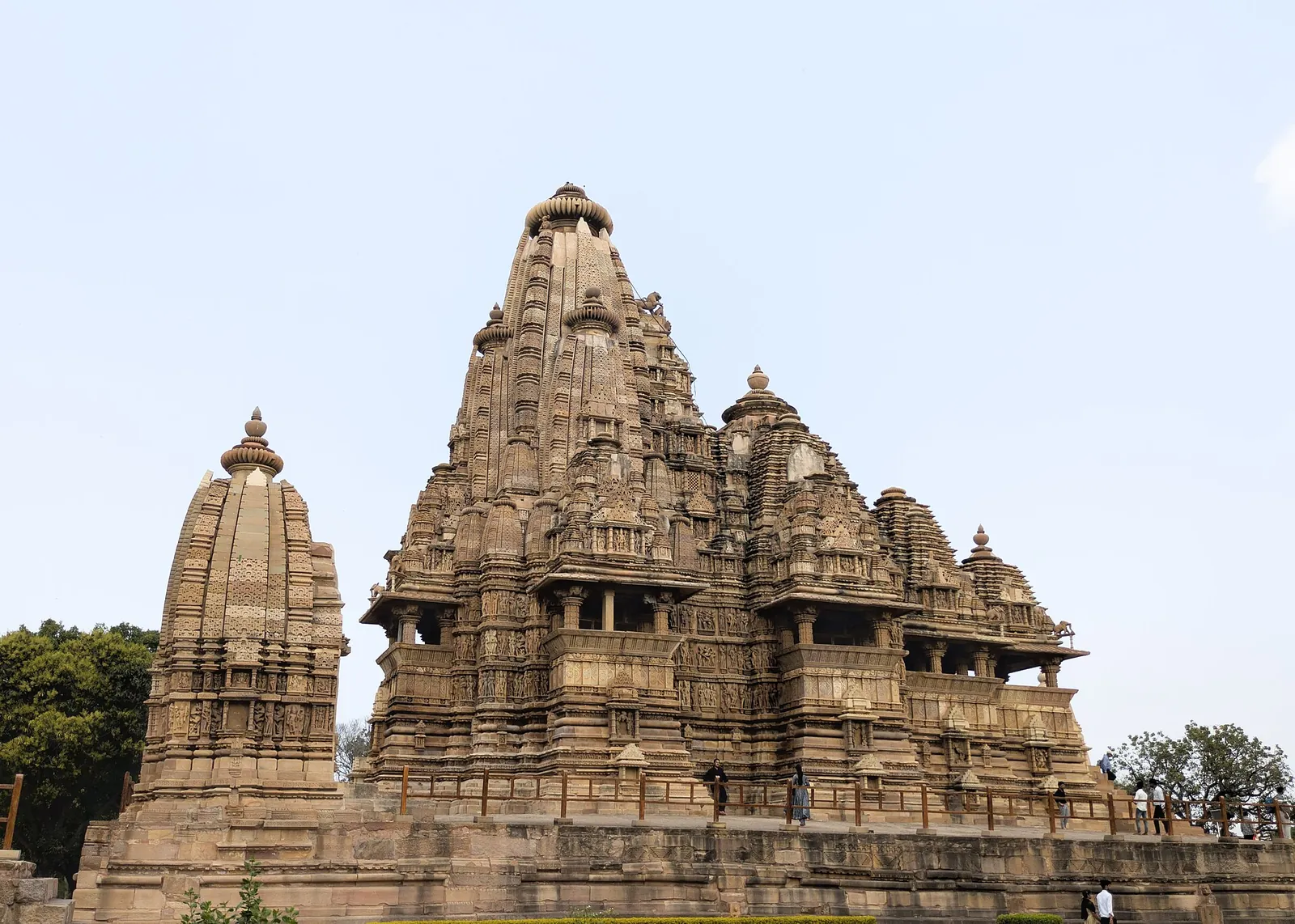
Kandariya Mahadeva, dedicated to Shiva, is the largest and grandest temple at Khajuraho; ASI attributes it to King Ganda (1017-29). Its towers rise one behind another like a range of hills to the main spire, and more than 870 sculptures cover its walls. The Lakshmana Temple, which ASI dates to Yasovarman (AD 954), is dedicated to Vishnu and is the best preserved, the only temple here that keeps all four corner shrines and its carved platform, with a frieze of elephants, horses, hunts and battles running round the base. Inside is a three-headed image of Vaikuntha Vishnu.
Leave time for the Vishwanatha temple and its Nandi shrine; the Chitragupta temple to the Sun god, with its hunting scenes and elephant fights; the Devi Jagadambi; and the boar-shaped Varaha, carved with about 674 figures. The granite ruins of Chausath Yogini, built for the 64 yoginis, are the earliest surviving shrine at the site.
Immediately south of the Lakshmana Temple, on the bank of the Shiva Sagar tank, Matangeshwar is still actively used for worship: a plain square shrine around a huge polished lingam, open from sunrise to sunset; local legend says the lingam grows a little every year. At Shivaratri, in February or March, it holds a three-day celebration of Shiva's marriage.
Tickets and hours. ASI's page for the Khajuraho group of temples lists them as open daily from sunrise to sunset. Foreign visitors pay INR 600 in cash, and children below 15 enter free. ASI's page also prints a line reading "Rs.40 per head" in cash without saying who pays it, so it is not quoted here as a fee. Ask at the ticket counter before you go which of the three temple groups the ticket covers, whether Matangeshwar and Chausath Yogini lie inside the ticketed enclosure, and whether you can buy it online. The Archaeological Museum, by the Western Group, has five galleries of Chandela sculpture, including the 11th-12th-century Sambhava Nath in its Jain gallery and a six-headed Varaha. Ask at the museum for its hours and fee. Come early, before the midday heat.
The Jain temples and the Southern Group
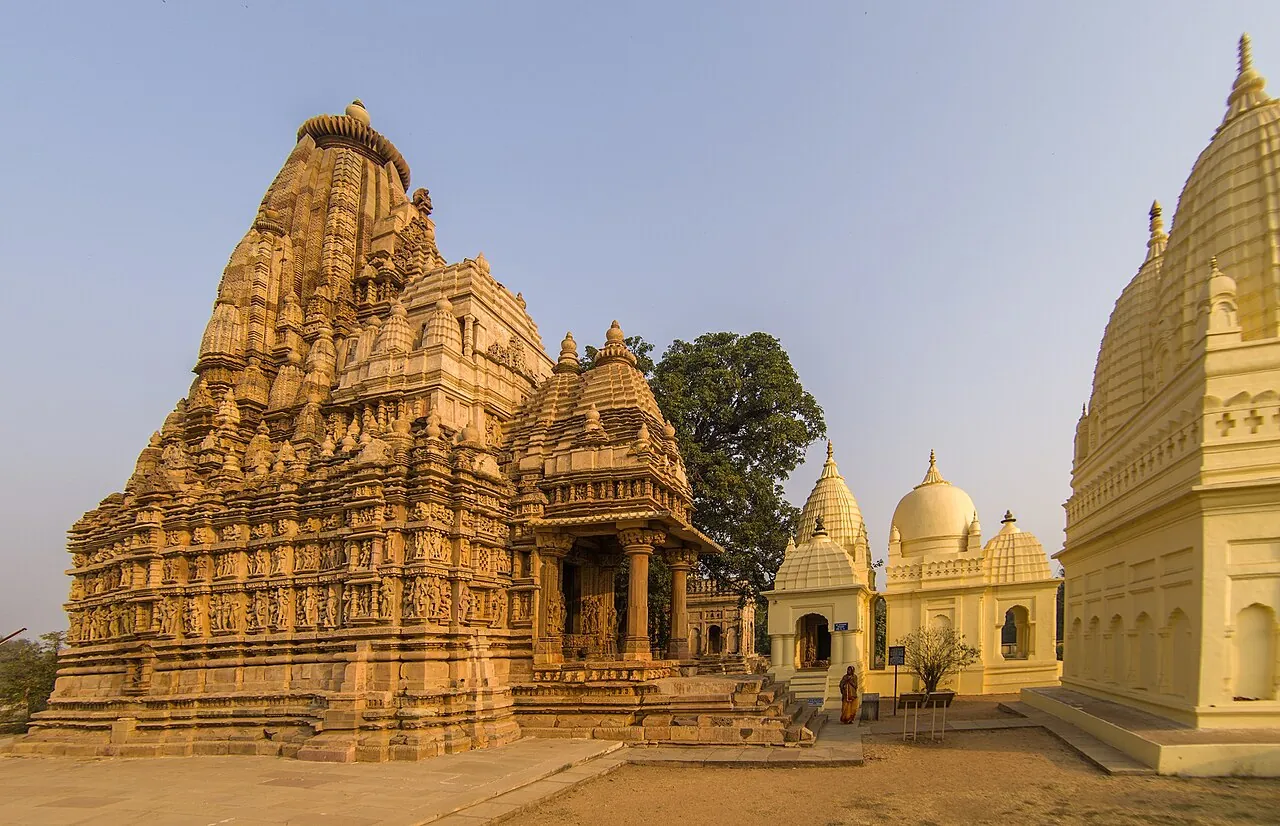
The Eastern Group, near the old village, mixes Hindu and Jain shrines, with three Hindu and four Jain temples: the small Brahma Temple of about AD 900 with its four-faced lingam, the Vamana Temple to Vishnu's dwarf incarnation, and the Javari Temple on its high plinth with a finely carved makara arch. The Jain temples stand inside a modern enclosure that holds about sixteen shrines. The Parsvanatha Temple is the largest and most detailed of them, and its northern wall carries some of Khajuraho's finest figures, among them a woman taking a thorn from her foot. Beside it stands the Adinatha Temple, another of the Jain group. These Jain temples, more than a thousand years old, are still in worship, so dress and behave as in any temple.
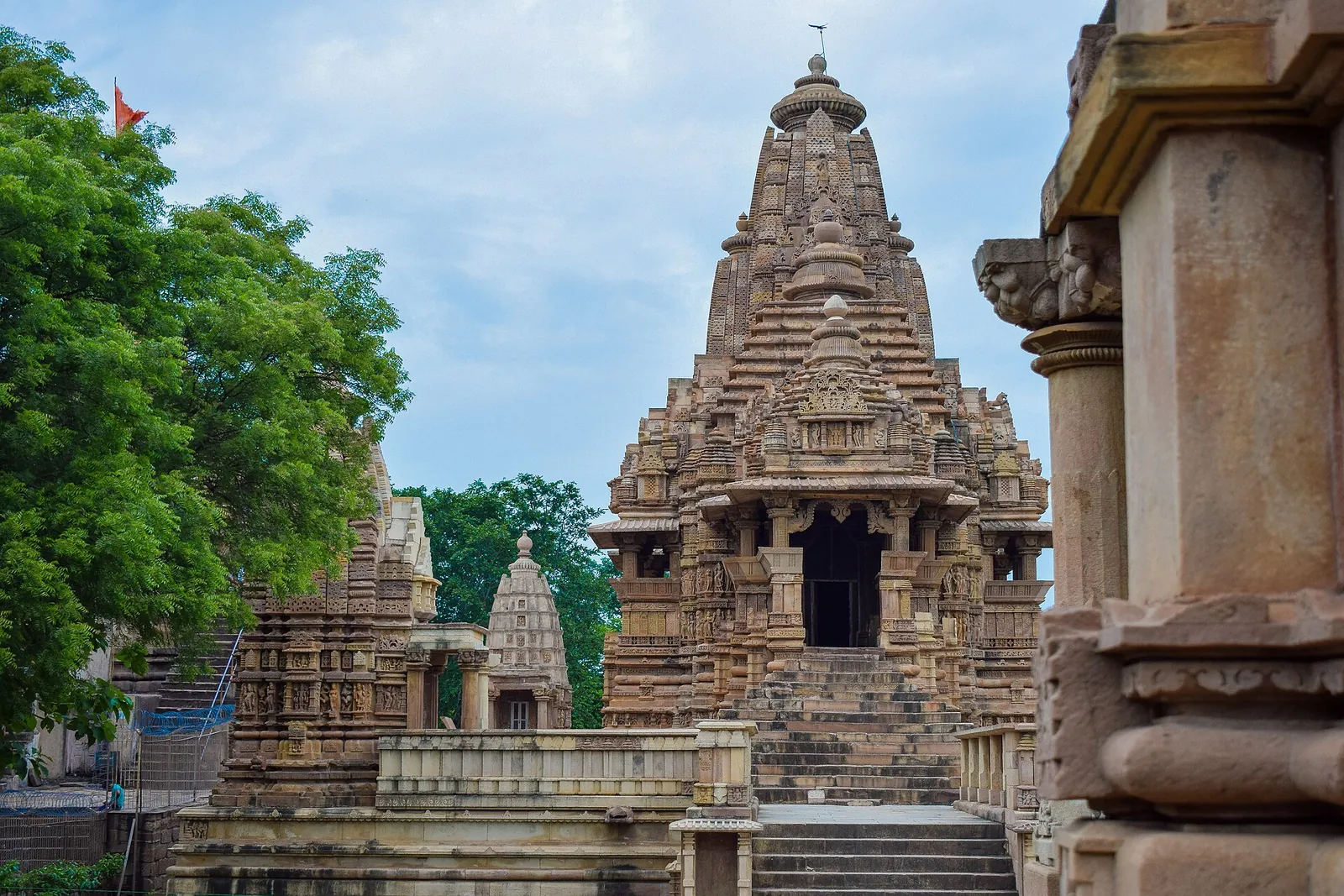
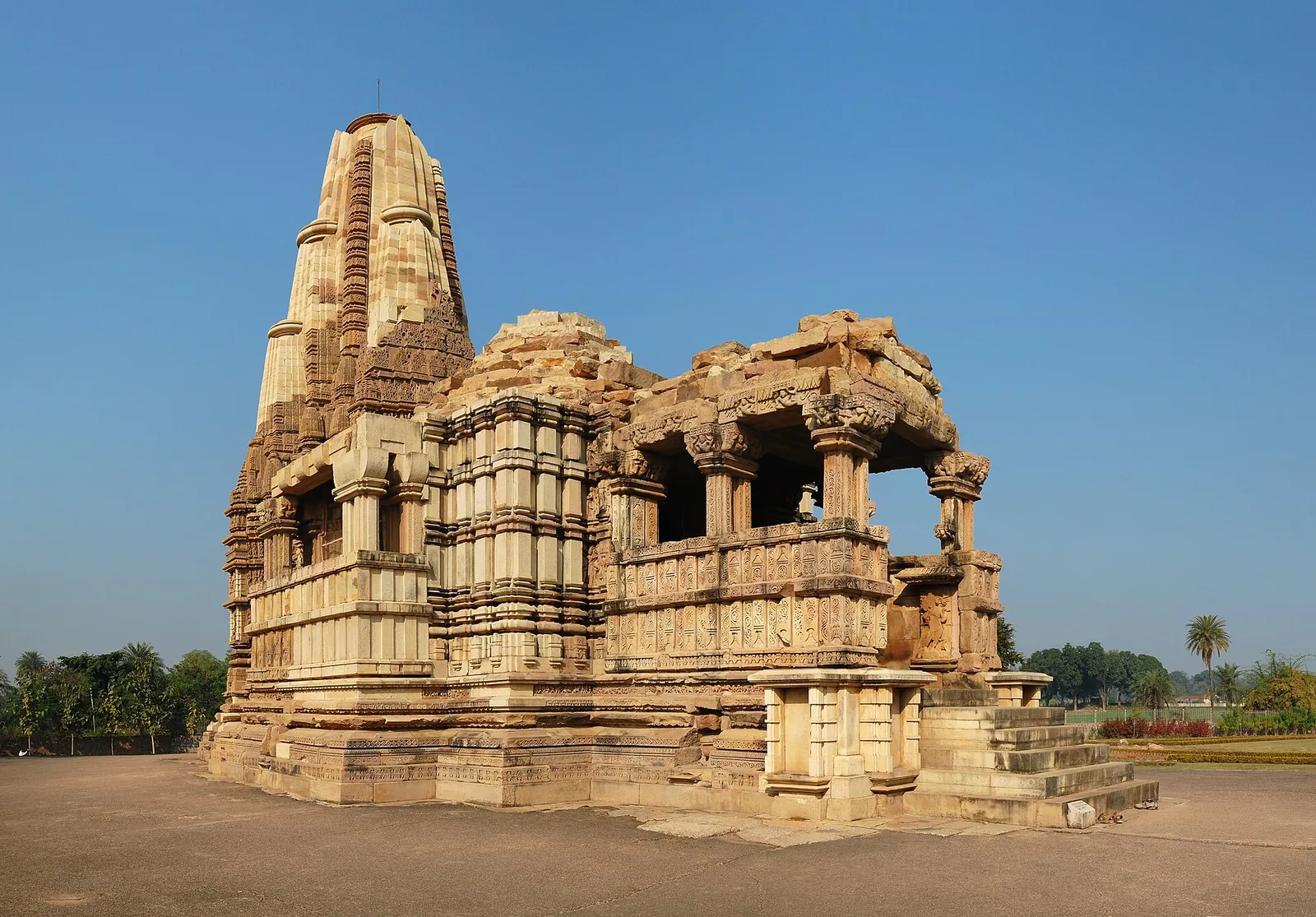
About five kilometres south of the village, the Southern Group has two temples. Duladeo, a Shiva temple of about 1100-1150, has flying celestials on its uppermost tower and finely carved jewellery on its female figures. Chaturbhuj is the only temple in Khajuraho without a single erotic sculpture. Take an auto-rickshaw or cycle out here in the late afternoon, when the groups are quiet.
Evenings: the light and sound show and the dance festival
MP Tourism runs a light and sound show at the Western Group every evening. It tells the story of the Chandela kings and their temples while lights play across the temples, and the narration is by Amitabh Bachchan. Between October and February, the English show runs from 18:30 to 19:05 and the Hindi show from 19:25 to 20:00, and from 19:30 to 20:05 (English) and 20:25 to 21:00 (Hindi) between March and September. Tickets cost INR 800 for a foreign adult and INR 400 for a foreign child, against INR 300 and INR 150 for Indian visitors. No online booking is published for the show.
In February, the Khajuraho Dance Festival brings India's leading classical dancers, in Bharatanatyam, Kathak, Odissi and other styles, to a stage in front of the illuminated Western Group. MP Tourism has announced the 53rd festival for 20-26 February 2027, and entry is free. Dates change each year, and MP Tourism announces them on its festival page.
Beyond the temples: Adivart, Raneh Falls and Panna
The Adivart Tribal and Folk Art Museum, run by Madhya Pradesh's Department of Culture on the bypass road, is a good stop after the temples. Its open-air village has full-size houses of seven tribes, including the Bhil, Gond, Baiga and Korku, each furnished and painted as it would be lived in, and its galleries show tribal painting, jewellery, tattoos and musical instruments. The museum lists foreign visitors at INR 500 (INR 20 for Indian visitors) plus INR 100 per camera, opening from 12:00 to 21:00 and closed on Mondays and national holidays.
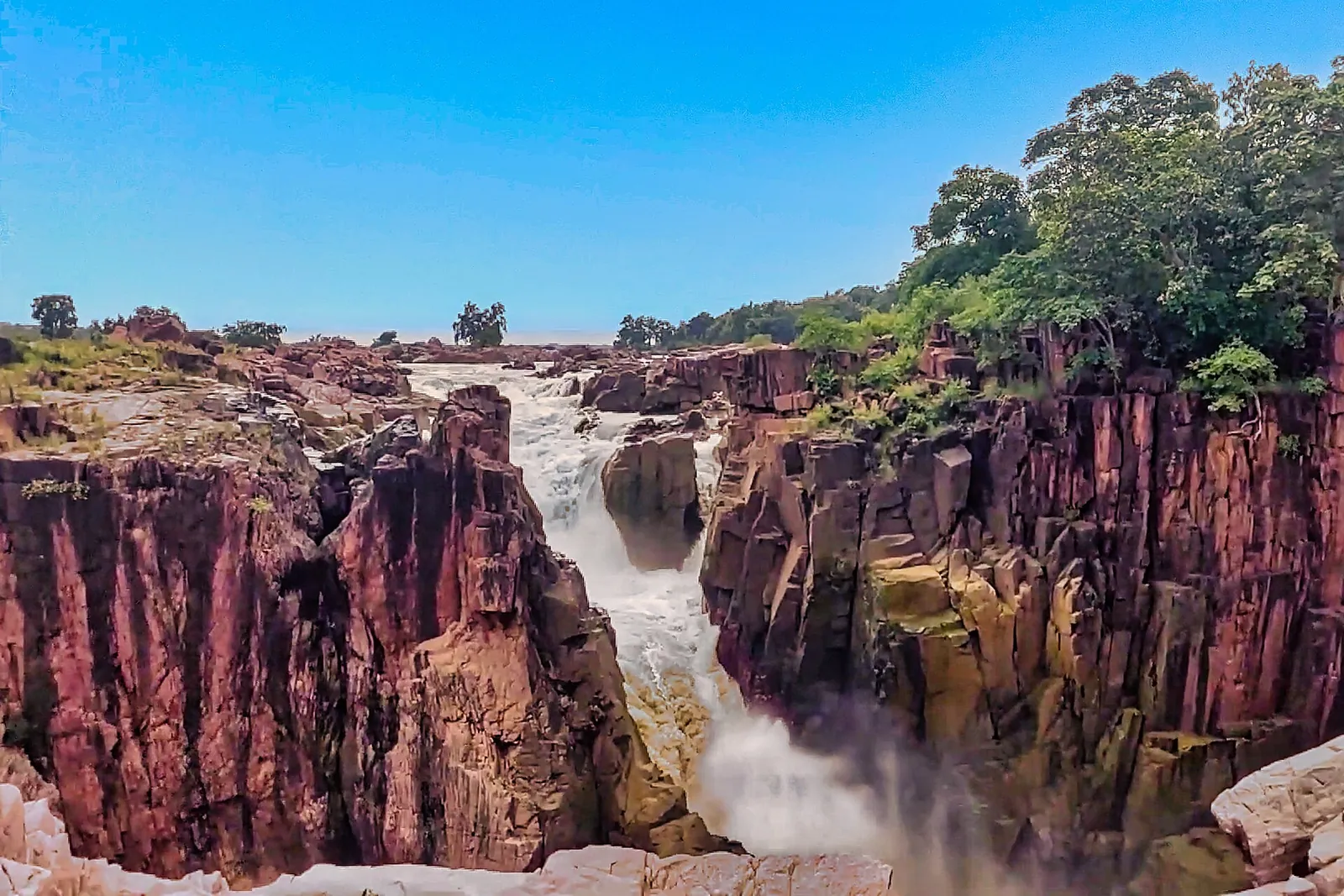
Raneh Falls, on the Ken River, is the half-day trip most visitors make. MP Tourism places the falls 21 km from the Khajuraho bus stop, and describes a canyon about 5 km long and up to 30 m deep, cut into granite in shades of pink, red and grey, with waterfalls all year and many more after the monsoon. It is open from 06:00 to 18:00 (to 12:00 on Wednesdays), and entry costs INR 50 a person plus INR 300 for a car. Hire a taxi in Khajuraho for the half day.
Panna Tiger Reserve has tigers, leopards, sloth bears and nilgai in teak forest along the Ken River. MP Tourism's pages give its distance from Khajuraho as 25 km, 27 km and 96 km, so ask your hotel or taxi driver for the distance to the gate you will use. MP Tourism recommends a visit between October and June and says the core zone is closed during the monsoon, from July to September, while the buffer zones stay open. Safari permits are sold on the Madhya Pradesh Forest Department's MPOnline portal, which opens each date 120 days ahead at 11:00; the permit fee shows in that booking for your date, and the jeep and the guide are paid separately at the gate. The portal publishes entry and exit times in a separate notice rather than in its permit pages, so check the slot for your date before you book. Madhya Pradesh's tiger reserves take a half day off on Wednesdays; which half is not published, so plan the safari for another day. Plan a third night if you want a safari as well as the temples.
Getting there and around: the Vande Bharat, the airport and the road
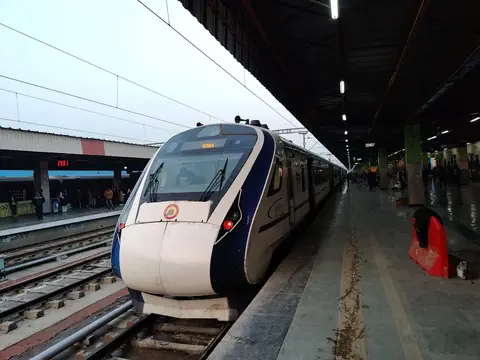
By train. Since 11 November 2025, the Khajuraho-Banaras Vande Bharat Express (26505/26506) has run directly between Banaras and Khajuraho via Prayagraj and Chitrakoot, about 2 hours 40 minutes faster than the special trains that ran on the route before it, which makes Khajuraho an easy pair with Varanasi. Khajuraho also has a Vande Bharat to Delhi, the Khajuraho-Hazrat Nizamuddin Vande Bharat Express (22469/22470). The Ministry of Railways lists both Vande Bharats as running six days a week. Indian Railways publishes current departure times and fares only in its journey search, so check IRCTC for your date. The railway enquiry number is 139. Foreign visitors can book through the Foreign Tourist quota on IRCTC, as our guide to transport in India explains.
By air. Madhya Pradesh Tourism places Khajuraho railway station 5 km from the town and the domestic airport 2 km from the temples, with flights to Delhi, Mumbai, Bhopal and Varanasi. Khajuraho Airport (HJR) is domestic only, so international visitors enter India elsewhere first; our India entry guide lists the e-Visa airports. Flight times and fares are in each airline's own booking search for your date, and local cabs take you from the airport to the hotels and temples.
By road. MP Tourism says public and private buses run from Khajuraho to nearby cities such as Jhansi, and that private cabs can be hired. It places Orchha, the old Bundela capital on the Betwa River, 196 km away, and UP Tourism's road-distance table puts Agra 400 km from Khajuraho.
Getting around. Khajuraho is small, and MP Tourism notes that local cabs, auto-rickshaws and bikes can be hired to move around: a bike or an auto-rickshaw suits the Eastern and Southern groups, and a taxi is the way to Raneh Falls and Panna. No official taxi or auto-rickshaw fare is published, so agree the return fare, with any waiting time, before you set off.
Two nights in Khajuraho, day by day
This plan assumes you arrive by early afternoon on day 1 and leave on the afternoon of day 3. Keep the Adivart museum off a Monday and Raneh Falls off a Wednesday afternoon.
- Day 1, afternoon: check in near the Western Group, visit Matangeshwar and walk round the Western Group in the late-afternoon light, then stay for the English light and sound show.
- Day 2, morning: go back to the Western Group at opening for Kandariya Mahadeva and Lakshmana in the low sun, then see the Archaeological Museum before the midday heat.
- Day 2, afternoon: take a taxi to Raneh Falls, or spend the afternoon at the Adivart Tribal and Folk Art Museum and stay for a Bundeli lunch at its canteen.
- Day 3, morning: cycle or take an auto-rickshaw to the Jain temples of the Eastern Group, the Brahma and Javari temples, and out to Duladeo and Chaturbhuj in the Southern Group, before your train or flight.
Make time for the local food
What to eat and where to look
Bundeli thali
A set meal of Bundelkhand, the region around Khajuraho, cooked from local recipes; MP Tourism describes it as simple and full of flavour.
- Where to look
- The canteen of the Adivart Tribal and Folk Art Museum on the bypass road.
- Fit it into your day
- Lunch on day 2, after the tribal houses and galleries.
Tell the canteen about any food allergy before you order: a thali brings several dishes at once.
Mahua dishes: dubri, murka and kucha
Bundeli dishes made with mahua, the flowers of the mahua tree, which the Adivart museum names as part of its canteen's Bundeli menu.
- Where to look
- The same Adivart museum canteen.
- Fit it into your day
- Order one alongside the thali to taste the forest side of the region's cooking.
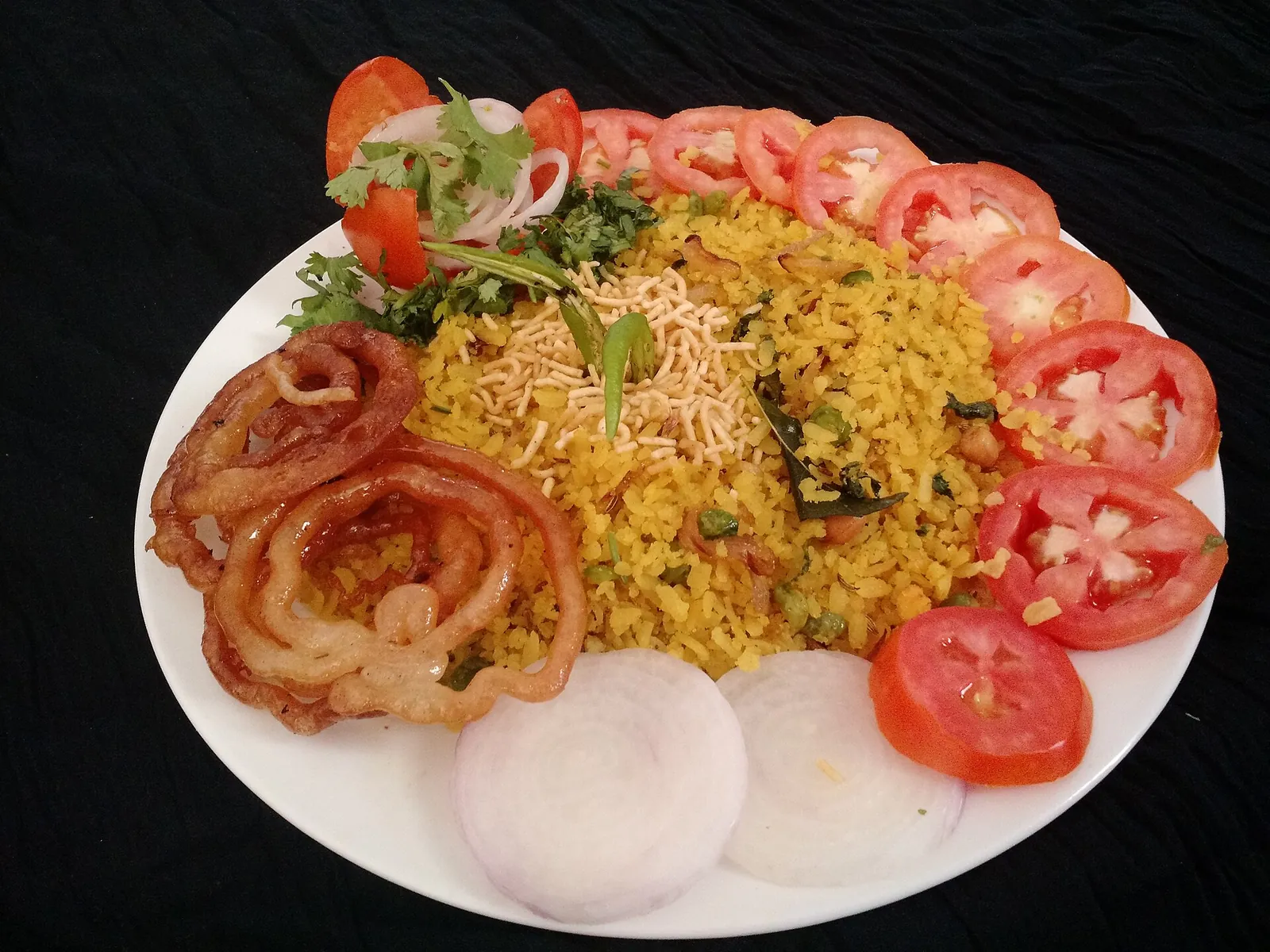
Poha jalebi
Flattened rice cooked with spices, topped with sev, chopped onion and coriander and served with lemon, eaten with hot jalebis; MP Tourism calls it the breakfast found all over Madhya Pradesh.
- Where to look
- The breakfast stalls and sweet shops of the market lanes near the Western Group of Temples.
- Fit it into your day
- Breakfast on day 2, after sunrise at the temples.
Street food is fried and served fast; choose a busy stall where the jalebis come straight from the oil.
Chai and mangode
Sweet spiced tea with mangode, crisp lentil fritters fried to order, the snack MP Tourism names for a rainy afternoon in the state.
- Where to look
- The tea stalls of the market by the Western Group.
- Fit it into your day
- A late-afternoon snack on a rainy day in the monsoon months, before the light and sound show.
A priced two-night stay for two
This model uses MP Tourism's own hotel in Khajuraho and the published ticket prices for two foreign adults, checked on 17 October 2026. MP Tourism lists MPT Jhankar at INR 2,290 a night; check the final price with taxes when you book.
- MPT Jhankar, two nights: 2 x INR 2,290 = INR 4,580.
- Temples, ASI foreign-visitor ticket (ASI's page does not say which groups it covers): 2 x INR 600 = INR 1,200.
- Light and sound show, foreign adults: 2 x INR 800 = INR 1,600.
- Adivart Tribal and Folk Art Museum, foreign visitors: 2 x INR 500 = INR 1,000.
- Optional, instead of Adivart: Raneh Falls gate, 2 x INR 50 a person plus INR 300 for the car = INR 400.
- Optional: Adivart camera fee, INR 100 per camera.
- Total for two: about INR 8,380.
- Not included: trains or flights, taxis, a Panna safari, and meals.
Practical questions
How many nights do I need in Khajuraho?
Two nights: the Western Group and the light and sound show on the first evening, the main temples again at sunrise and the Adivart museum or Raneh Falls on day 2, and the Eastern and Southern groups on the last morning. Add a third night for a safari in Panna Tiger Reserve.
How much is the Khajuraho temple ticket for foreigners?
The Archaeological Survey of India's page for the Khajuraho group of temples lists INR 600 in cash for foreign visitors, with opening from sunrise to sunset every day, and free entry for children below 15. Ask at the ticket counter which of the three temple groups the ticket covers.
What time is the Khajuraho light and sound show?
From October to February, MP Tourism lists the English show at 18:30-19:05 and the Hindi show at 19:25-20:00; from March to September, 19:30-20:05 and 20:25-21:00. A foreign adult pays INR 800 and a foreign child INR 400.
How do I get from Varanasi to Khajuraho?
Take the Khajuraho-Banaras Vande Bharat Express (26505/26506), which has run directly between Banaras and Khajuraho via Prayagraj and Chitrakoot since 11 November 2025, about 2 hours 40 minutes faster than the special trains before it. It runs six days a week. MP Tourism also lists flights between Khajuraho and Varanasi.
Can I combine Khajuraho with Agra?
Yes. Khajuraho has its own Vande Bharat to Delhi (Hazrat Nizamuddin), and by road UP Tourism's table puts Agra 400 km from Khajuraho, and MP Tourism places Orchha 196 km away.
When is the best time to visit Khajuraho?
October to March, when Incredible India says it is cool enough to see the temples without rushing. February adds the Khajuraho Dance Festival, which MP Tourism has announced for 20-26 February 2027. April to June is very hot, so see the temples early and late in the day; our best time to visit India guide covers the seasons.
Sources and checks before you travel
Reference sources for the version dated 17 October 2026. Confirm opening times, access, transport and conditions for your travel dates.
- Madhya Pradesh Tourism (MP Tourism): Khajuraho ↗ — opens in a new tab
- Madhya Pradesh Tourism (MP Tourism): accommodation list ↗ — opens in a new tab
- Madhya Pradesh Tourism (MP Tourism): homestays in Khajuraho ↗ — opens in a new tab
- Archaeological Survey of India: Group of Temples, Khajuraho ↗ — opens in a new tab
- Archaeological Survey of India: ticketed monuments (Western Group of temples, Khajuraho) ↗ — opens in a new tab
- Ministry of Tourism, Incredible India: Khajuraho ↗ — opens in a new tab
- Madhya Pradesh Tourism (MP Tourism): Kandariya Mahadeva Temple ↗ — opens in a new tab
- Madhya Pradesh Tourism (MP Tourism): Lakshmana Temple ↗ — opens in a new tab
- Madhya Pradesh Tourism (MP Tourism): temples of Khajuraho ↗ — opens in a new tab
- Madhya Pradesh Tourism (MP Tourism): Matangeshwar Temple ↗ — opens in a new tab
- Madhya Pradesh Tourism (MP Tourism): Jain temples of Khajuraho ↗ — opens in a new tab
- Madhya Pradesh Tourism (MP Tourism): sound and light shows in Madhya Pradesh (updated 13 July 2026) ↗ — opens in a new tab
- Madhya Pradesh Tourism (MP Tourism): things to do in Khajuraho ↗ — opens in a new tab
- Madhya Pradesh Tourism (MP Tourism): Khajuraho Dance Festival ↗ — opens in a new tab
- Madhya Pradesh Tourism (MP Tourism): slow travel in Khajuraho ↗ — opens in a new tab
- Aadivart Tribal and Folk Art State Museum ↗ — opens in a new tab
- Madhya Pradesh Tourism (MP Tourism): Adivart Tribal and Folk Art Museum ↗ — opens in a new tab
- Madhya Pradesh Tourism (MP Tourism): Raneh Falls ↗ — opens in a new tab
- Madhya Pradesh Tourism (MP Tourism): Panna ↗ — opens in a new tab
- Madhya Pradesh Forest Department, MPOnline: Panna National Park permits ↗ — opens in a new tab
- Madhya Pradesh Tourism (MP Tourism): Madhya Pradesh's cuisines ↗ — opens in a new tab
- Madhya Pradesh Tourism (MP Tourism): winter snacks of Madhya Pradesh ↗ — opens in a new tab
- Madhya Pradesh Tourism (MP Tourism): monsoon street foods ↗ — opens in a new tab
- PIB (Ministry of Railways): Vande Bharat trains in Maharashtra and Madhya Pradesh, 11 February 2026 ↗ — opens in a new tab
- PIB: four new Vande Bharat trains, 6 November 2025 ↗ — opens in a new tab
- Uttar Pradesh Tourism (Taj Mahal site): getting around ↗ — opens in a new tab
- IRCTC: Foreign Tourist quota booking (PDF) ↗ — opens in a new tab
- India Meteorological Department: monsoon FAQ (PDF) ↗ — opens in a new tab
- PIB (Ministry of Railways): Vande Bharat Express backgrounder, 16 January 2026 ↗ — opens in a new tab
- Madhya Pradesh Tourism (MP Tourism): Panna beyond tigers ↗ — opens in a new tab
Does this experience fit your route?
Book the train or flight first, then a room by the Western Group; add a guide for the temples if you want the carvings explained.
Check dates and details on Viator ↗ — opens in a new tabAffiliate link · Book with ViatorPhoto credits
Kandariya Mahadeva, the largest temple of the Western Group
Photograph: WarmaFiesta — opens in a new tab · CC BY-SA 4.0 — opens in a new tab
Changes: Resized and converted to WebP; displayed with responsive crops. · Original photograph and licence details ↗ — opens in a new tab
The Lakshmana Temple in the Western Group
Photograph: Omkarshinde19 — opens in a new tab · CC BY-SA 4.0 — opens in a new tab
Changes: Resized and converted to WebP; displayed with responsive crops. · Original photograph and licence details ↗ — opens in a new tab
The Parsvanatha Temple among the Jain temples of the Eastern Group
Photograph: Itsmalay~commonswiki — opens in a new tab · CC BY-SA 4.0 — opens in a new tab
Changes: Resized and converted to WebP; displayed with responsive crops. · Original photograph and licence details ↗ — opens in a new tab
Duladeo, one of the two temples of the Southern Group
Photograph: Marcin Białek — opens in a new tab · CC BY-SA 4.0 — opens in a new tab
Changes: Resized and converted to WebP; displayed with responsive crops. · Original photograph and licence details ↗ — opens in a new tab
Raneh Falls on the Ken River
Photograph: Ms Sarah Welch — opens in a new tab · CC0 — opens in a new tab
Changes: Resized and converted to WebP; displayed with responsive crops. · Original photograph and licence details ↗ — opens in a new tab
Poha with jalebi, the breakfast of Madhya Pradesh
Photograph: Rhundet — opens in a new tab · CC BY-SA 4.0 — opens in a new tab
Changes: Resized and converted to WebP; displayed with responsive crops. · Original photograph and licence details ↗ — opens in a new tab