Plan your trip
Kandy Esala Perahera 2027: expected dates, seats and how to plan
For ten nights each year, the Temple of the Tooth in Kandy sends its sacred casket out into the streets on the back of an elephant, among drummers, dancers, torch-bearers and a long file of tuskers in embroidered cloths. The Esala Perahera is a religious procession first and a spectacle second, and planning for it means three decisions: which nights to be in Kandy, where to sit or stand, and how to get there while the railway into town is interrupted. This guide sets out what is known about the 2027 dates, what the 2026 festival looked like, and how to book once the temple publishes the programme.
In this guide
Find the location ↗ — opens in a new tabThe short answer
The Kandy Esala Perahera 2027 is expected in July or August, the season the Temple of the Tooth gives every year; the temple has not yet announced the 2027 procession nights. Esala Poya (Sunday 18 July) and Nikini Poya (Monday 16 August) are public holidays on the official calendar, not procession dates. Once the temple announces the programme (it did so on 8 July in 2026), book two or three nights in the Kandy town centre, within walking distance of the Temple of the Tooth, around the last Randoli nights, the grandest of the festival. Official seats are the Kandy Municipal Council's: in 2025 they cost Rs. 12,000, 15,000 or 18,000 a seat, and resold seats went for several times that. A temple visit is separate: LKR 3,000 for most foreign visitors.
- Key point
- Usually ten nights of processions, five Kumbal and five Randoli, followed by the water-cutting ceremony at dawn and the Day Perahera that afternoon; the 2026 festival lasted 11 days.
- Where it applies
- Kandy town centre, within walking distance of the Temple of the Tooth and the procession streets.
- Timing
- July or August, in the month of Esala or Nikini; the temple announces each year's nights, in 2026 about six weeks ahead.
The 2027 dates: what is fixed and what is not
The Sri Dalada Maligawa, the Temple of the Sacred Tooth Relic, holds its Esala Perahera in July or August, in the lunar month of Esala or Nikini. It fixes the nights anew each year and announces them at a media briefing; in 2026 that briefing took place on 8 July, about six weeks before the first procession. The 2027 programme has not been announced yet. What the official calendars do give is the holidays around it:
| Date in 2027 | What it is | Status |
|---|---|---|
| July or August | Kandy Esala Perahera season | Expected, from the temple's festival page |
| Sunday 18 July and Monday 16 August | Esala and Nikini Full Moon Poya Days, bank and public holidays | Official holidays; not procession dates |
| Kumbal nights, Randoli nights, water-cutting, Day Perahera | The processions themselves | Set by the temple each year |
Our Sri Lanka festivals calendar has the rest of the year's holidays from the Central Bank of Sri Lanka's 2027 list.
The 2026 festival shows the usual shape. The temple's schedule ran the five Kumbal processions from 18 to 22 August and the five Randoli processions from 23 to 27 August, each starting in the evening between 6.28 PM and 7.00 PM. The water-cutting ceremony followed at 1.28 AM on 28 August and the Day Perahera at 2.18 PM the same day. The 2027 nights and start times will be different.
Ten nights and a day: how the festival unfolds
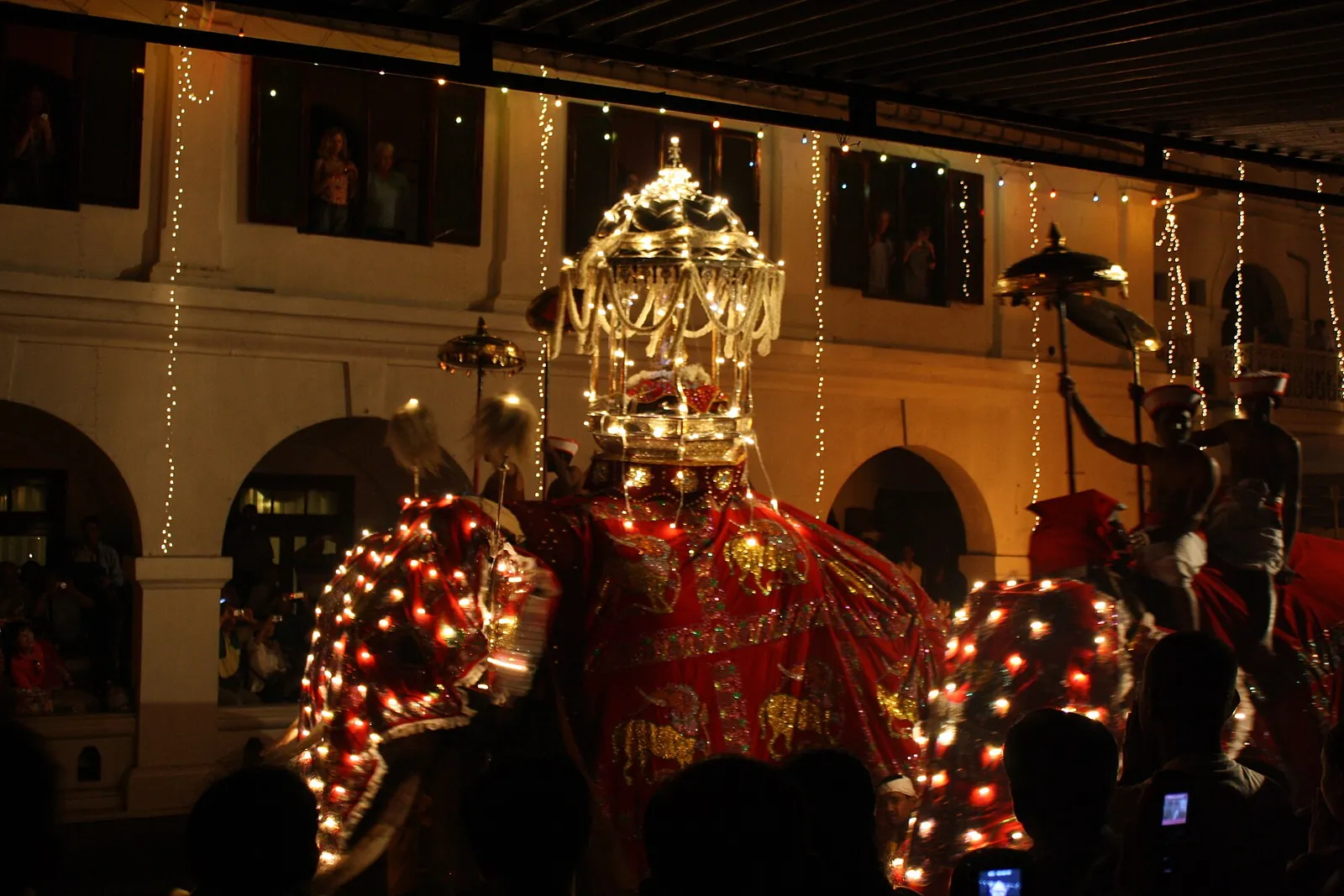
The temple calls the Perahera the oldest cultural event in the world. It grew from a procession held in Anuradhapura after the Tooth Relic reached Sri Lanka in 310 A.D., in the hope of timely rain and a good harvest, and the procession that parades the streets today is built around the Perahera casket, which, in the temple's words, is considered as the living Lord Buddha. The relic itself stays out of sight; what passes you on the street is the casket under its canopy, carried by the temple's ceremonial tusker. The 2026 festival was, by the temple's count, the 1716th.
It starts quietly. According to the official festival website, run by the temple's Media Bureau, the festival opens with the Kap Situveema, when a young jackfruit tree is cut and planted at each of the four Devales, the shrines of the guardian gods Natha, Vishnu and Kataragama and the goddess Pattini. The first five nights are the Kumbal Perahera. The same site describes them as a semi-procession: the Nilames, the lay officials of the temple and the Devales, do not walk, and the drummers and tuskers appear without their ceremonial costumes.
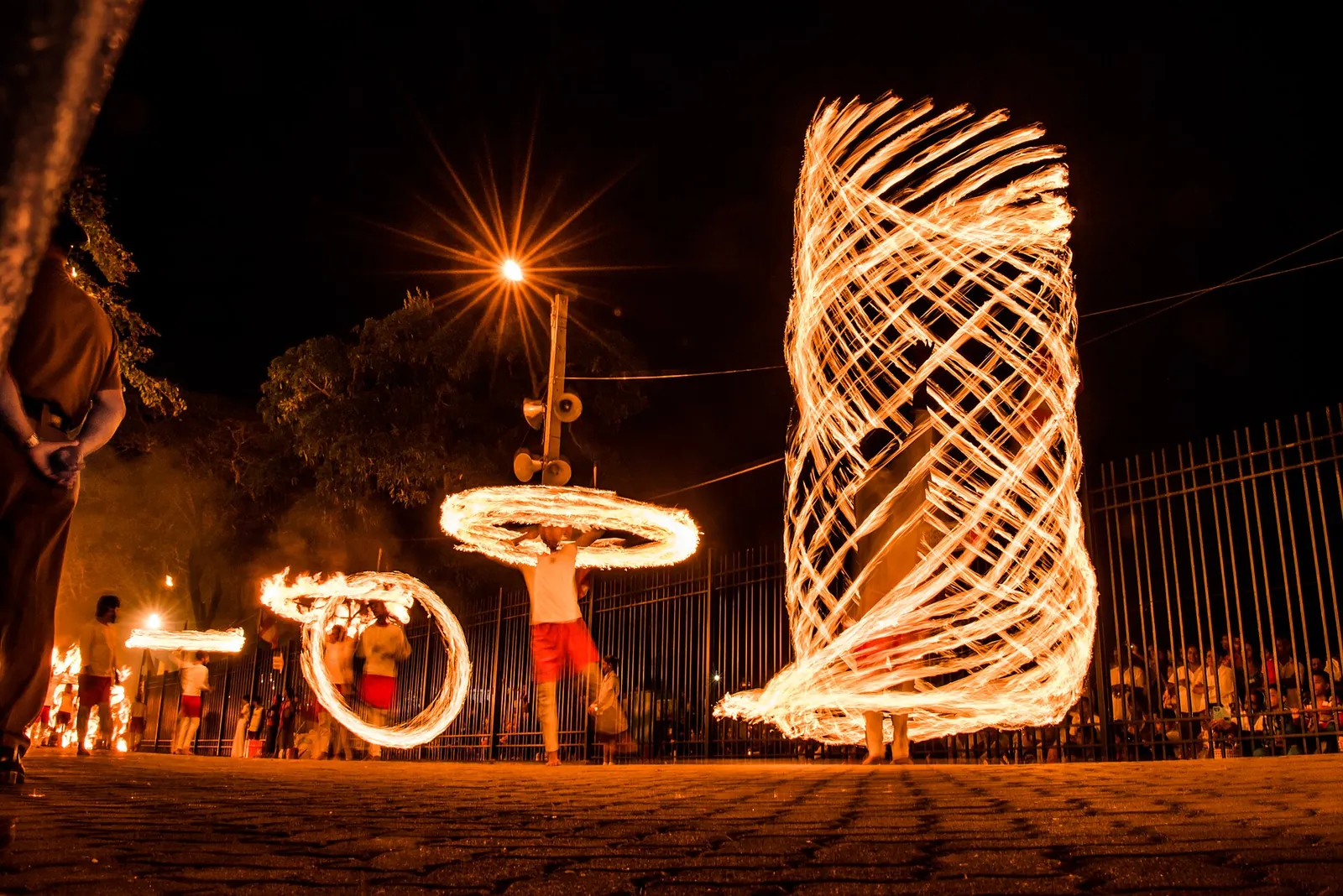
The next five nights are the Randoli Perahera, when the four Devales join with their own decorated palanquins, and the last of them, the Maha Randoli or Grand Randoli, is the grandest night of all: tuskers garlanded and in gold-stitched cloths, drummers in full ceremonial dress, and the Diyawadana Nilame, the temple's chief lay custodian, in a newly stitched costume. In 2026 the temple described a night lit by copra torches, with the tusker Kataragama Wasana bearing the golden casket.
After the last Randoli, in the early hours, the casket is carried in procession to the Asgiriya Gedige Raja Maha Viharaya, and the processions of the four Devales go down to the Mahaweli River at Gatambe for the Diya Kapeema, the water-cutting ceremony; in 2026 thousands of devotees waited on the riverbanks. The festival closes that afternoon with the Dahawal Perahera, the Day Procession, the one chance to see it in daylight. At its end, the festival's closing message, the Perahera Sandeshaya, is handed to the President.
Which nights to choose, and where to watch
If you have only one evening, make it one of the last Randoli nights; the Maha Randoli is the fullest procession, and the busiest. Two or three nights in Kandy let you see a Randoli night and stay for the Day Perahera the next afternoon. The Kumbal nights are simpler, and they suit travellers whose dates do not stretch to the end of the festival. Our Kandy guide covers the town, and the where-to-stay guide the rooms; book them as soon as the dates are out.
The processions move through the streets of the old town around the Temple of the Tooth. The official seats are in the Queen's Hotel corridor, on the route in the town centre (see the seats section below). The route map appears on the Perahera Route page of the temple's festival website once the year's programme is out. Pick a place close to your hotel, because you will walk to it and back in the crowd.
You can also watch from home or from your hotel room: the temple streams the processions on the LIVE Stream page of sridaladamaligawa.lk, and the festival website carries the same stream. It is the way to see a night you cannot be in Kandy for.
Seats: the official ones and the resale market
The temple's own tickets, issued by machines inside the Sri Dalada Maligawa, are for visiting the temple, not for the procession. In August 2024 the Diyawadana Nilame said that seats along the route were being sold at exorbitant rates, and the Sunday Times reported that some visitors were led to think the temple was selling them (11 August 2024).
The official seats belong to the Kandy Municipal Council. In July 2025, the Mayor of Kandy said that only a limited number of viewing seats were sold officially, through the council, in the Queen's Hotel corridor, at Rs. 12,000, Rs. 15,000 and Rs. 18,000, and that they were sold online (Daily Mirror, 16 July 2025). He also said that some buyers took more than 100 tickets each online and resold them, and that resold seats were offered for Rs. 50,000 to 65,000; for the final Randoli he feared prices of Rs. 100,000 a seat.
In 2025 the Kandy Municipal Council sold its seats online, and its sale for 2027 has not opened yet; buy only through the council's own sale when it does, and skip resale websites and street touts, however official they look. If no official seat is left, a hotel stay within walking distance of the route and an early place along it, or the live stream, is a better use of the money than a resold seat.
Visiting the Temple of the Tooth during the festival
Seeing the procession and visiting the temple are two different things. The temple charges foreign visitors LKR 3,000, or LKR 2,500 for visitors from SAARC countries, Thailand and Myanmar. The ticket covers the Temple of the Tooth Relic, the Dalada Museum, the World Buddhist Museum, the Tusker Museum and the Royal Elephant Stable, and only the machines at the temple issue valid tickets; tickets or fees issued by other individuals or institutions are not valid.
Everyone entering is screened, and offerings are scanned. Shorts, sleeveless and body-revealing clothes are not admitted, though suitable clothing can be obtained at the entrances, and footwear, bulky luggage and non-essential items go to the reception booths for a token. The UK Foreign Office adds the rule for any Buddhist temple: cover your legs and shoulders, take off shoes and hats, and do not pose for photographs standing in front of a statue of the Buddha.
What closes, and how the town changes
On Poya days, Sri Lanka Tourism says, the sale of alcohol, meat and fish is prohibited and some shops and businesses close. In 2027 that applies on Esala Poya, Sunday 18 July, and Nikini Poya, Monday 16 August. If a procession night falls on a Poya day, plan dinner without a drink.
Kandy itself rearranges its evenings around the processions. The Kandy Lake Club's cultural show, normally from 5.00 PM to 6.00 PM every day, moves to 4.30 PM during the Esala Perahera period, according to its website, so it fits before a procession.
Getting to Kandy: trains to Peradeniya, buses and the road
Trains from Colombo Fort stop short of Kandy for now. Since 2 October 2026 they run only as far as Peradeniya and Gampola (Daily Mirror, 28 September 2026): the Intercity 1029 leaves Colombo Fort at 3.35 PM and reaches Peradeniya at 5.56 PM, train 1005 leaves at 5.55 AM and reaches Peradeniya at 8.34 AM, and the 1030 returns from Peradeniya at 6.25 AM to Colombo Fort at 8.44 AM. Peradeniya, where the botanic gardens lie less than 5.5 km from Kandy, is a short tuk-tuk or car ride from town. The line into Kandy waits for the repair of the bridge over the Mahaweli beyond Sarasavi Uyana station, with trains to Kandy hoped for by February 2027 (Sunday Times, 4 October 2026). When they run again, the reserved-seat trains that end at Kandy take 2 hours 31 minutes to 3 hours 20 minutes from Colombo Fort. Our transport guide has the current state of the line and the booking steps.
Reserved seats are sold only on the railway's own seat-reservation site, from 30 days before the date of travel. You need every passenger's passport number, the seats are allocated for you, and online bookings carry a 5% convenience fee. For a festival trip, book on the day sales open for your date. The booking site shows the fare for your train.
Buses go all the way into Kandy. Long-distance buses leave Colombo from the Pettah Central Bus Depot, run by the Sri Lanka Transport Board and by private companies, whose bus station is close by. When we checked on 28 October 2026, the National Transport Commission's fare list in force from 6 July 2026 gave route 1, Colombo to Kandy, at LKR 521 on a normal bus and LKR 1,018 on an air-conditioned luxury bus, and its expressway list gave Colombo to Kandy at LKR 1,230. By road, the Colombo to Kandy road (A1) is 115.85 km, and Sri Lanka Tourism gives about 3 hours by road from Colombo. Before you fly, read our entry guide for the ETA.
Crowds and safety advice
The Perahera draws a very large crowd, and three European governments give advice that covers it. The UK Foreign Office names large public gatherings, including religious occasions, among possible terrorist targets and advises avoiding crowded public places. The German Foreign Office advises avoiding larger gatherings and taking particular care at religious sites. France Diplomatie advises avoiding religious gatherings. Other governments may advise differently; read your own government's advice.
None of them names the Perahera, but they are a reason to choose how you watch: an official seat or the live stream keeps you out of the densest standing crowd, and if you stand, arrive early, keep to the edge and agree a meeting point.
Practical questions
When is the Kandy Esala Perahera 2027?
In July or August 2027, the season the Temple of the Tooth gives every year. The temple announces the nights at a media briefing; in 2026 it did so on 8 July, about six weeks before the first procession.
Is the Perahera on Esala Poya or Nikini Poya?
Not necessarily. Esala Poya (Sunday 18 July 2027) and Nikini Poya (Monday 16 August 2027) are public holidays on the official calendar; the temple sets the procession nights separately each year.
Which night of the Kandy Perahera is best?
The last Randoli night, the Maha Randoli, is the grandest, with the tuskers in their gold-stitched cloths and the drummers in full costume. The Day Perahera the next afternoon is the only procession in daylight.
How do I buy an official seat for the Kandy Perahera?
Through the Kandy Municipal Council, which sells a limited number of seats in the Queen's Hotel corridor online; in 2025 they cost Rs. 12,000, 15,000 or 18,000. The temple does not sell procession seats, and resold seats cost several times the official price.
Can I watch the Perahera online?
Yes. The temple streams the processions on the LIVE Stream page of sridaladamaligawa.lk, and the official festival website carries the same stream.
Can I take the train to Kandy for the Perahera?
Not into Kandy itself for now: since October 2026 trains from Colombo Fort have run only to Peradeniya and Gampola while a bridge before Kandy is repaired. Reserved seats open 30 days before travel on the railway's own site; buses from Colombo's Pettah depot run to Kandy.
Keep planning your trip
Sri Lanka festivals and events 2027
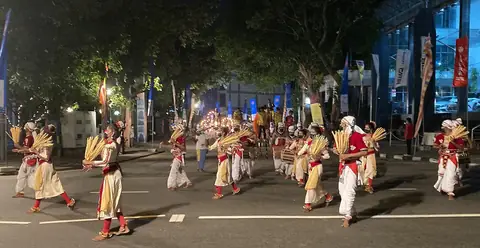
Sri Lanka's 2027 holidays and festivals month by month: Poya days, the Navam Perahera in Colombo, Sinhala and Tamil New Year, Vesak, Poson and the Kandy Esala Perahera.
Read the guide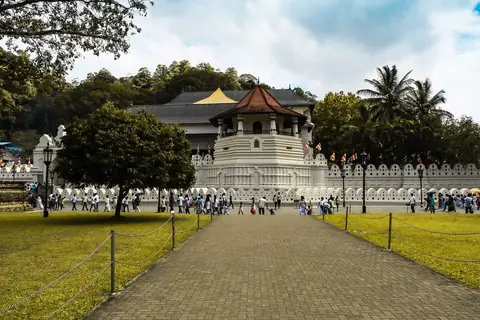
Kandy
How many nights Kandy needs, what the Temple of the Tooth ticket covers, the Peradeniya gardens, a Kandyan dance show and the train to Ella.
Read the guide
Best time to visit Sri Lanka
Choose Sri Lanka dates from the two monsoons, the beach and hill seasons, the Cultural Triangle, the Esala Perahera and Poya days, with the loop set for January.
Read the guide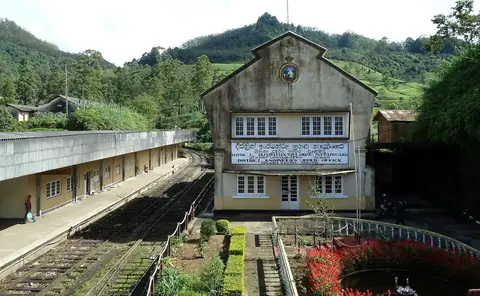
Transport in Sri Lanka
Kandy to Ella while the hill line is partly closed, the Nanu Oya to Ella train, expressway buses, a car with a driver and the airport transfer.
Read the guide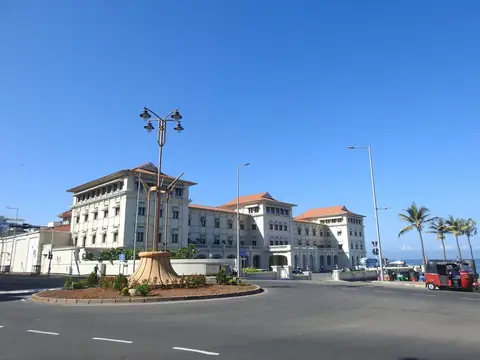
Where to stay in Sri Lanka
Choose a base for each stop of the Sri Lanka loop, with a named hotel and its dated nightly rate, plus Mirissa, Nuwara Eliya and the safari lodges.
Read the guide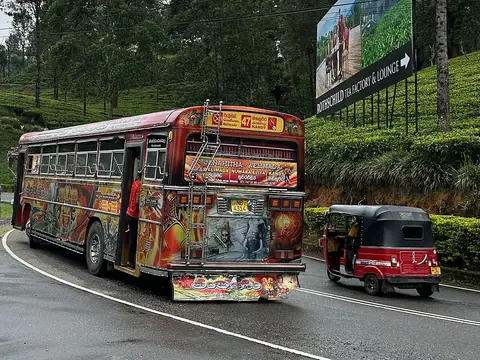
First trip to Sri Lanka
Nine nights through the ancient cities, Kandy, Ella and Galle: all-in costs for two, the ETA, trains, monsoons, dengue, the sea and the roads.
Read the guideSources and checks before you travel
(27)
- Sri Dalada Maligawa: Four Main Festivals ↗ — opens in a new tab
- Sri Dalada Maligawa: The Kandy Esala Perahera Festival 2026 ↗ — opens in a new tab
- Kandy Esala Perahera official website (Media Bureau of Sri Dalada Maligawa): Event Dates 2026 ↗ — opens in a new tab
- Sri Dalada Maligawa: dates announced for the Kandy Esala Perahera 2026 ↗ — opens in a new tab
- Kandy Esala Perahera official website: About Perahera ↗ — opens in a new tab
- Kandy Esala Perahera official website: the Grand Randoli Perahera 2026 ↗ — opens in a new tab
- Kandy Esala Perahera official website: Early Morning Procession and Water Cutting Ceremony 2026 ↗ — opens in a new tab
- Kandy Esala Perahera official website: Perahera Sandeshaya 2026 ↗ — opens in a new tab
- Kandy Esala Perahera official website: home page ↗ — opens in a new tab
- Central Bank of Sri Lanka: bank, public and mercantile holidays 2027 ↗ — opens in a new tab
- Sri Lanka Tourism: public holidays ↗ — opens in a new tab
- Sunday Times (Sri Lanka): Questions over perahera seating on Queen's Hotel corridor in Kandy, 11 August 2024 ↗ — opens in a new tab
- Daily Mirror: Kandy perahera tickets sold at exorbitant prices, 16 July 2025 ↗ — opens in a new tab
- Sri Dalada Maligawa: FAQ ↗ — opens in a new tab
- UK Foreign Office (FCDO): Sri Lanka safety and security ↗ — opens in a new tab
- German Foreign Office (Auswaertiges Amt): Sri Lanka, Reise- und Sicherheitshinweise ↗ — opens in a new tab
- France Diplomatie: Sri Lanka, security ↗ — opens in a new tab
- Kandy Lake Club Cultural Show ↗ — opens in a new tab
- Daily Mirror: Upcountry train services to Gampola resume from Oct 2 (28 September 2026) ↗ — opens in a new tab
- Sunday Times (Sri Lanka): railway's return to Peradeniya and Gampola (4 October 2026) ↗ — opens in a new tab
- Department of National Botanic Gardens: Royal Botanic Gardens, Peradeniya ↗ — opens in a new tab
- Sri Lanka Railways: trains with reserved seats ↗ — opens in a new tab
- Sri Lanka Railways: seat reservation FAQ ↗ — opens in a new tab
- Sri Lanka Tourism: Getting Around ↗ — opens in a new tab
- National Transport Commission: inter-provincial full bus fares from 6 July 2026 (Sinhala PDF) ↗ — opens in a new tab
- National Transport Commission: expressway full fare list ↗ — opens in a new tab
- Road Development Authority: gazetted list of national highways ↗ — opens in a new tab
Reference sources for the version dated 28 October 2026. Confirm opening times, access, transport and conditions for your travel dates.
Photo credits
(5)
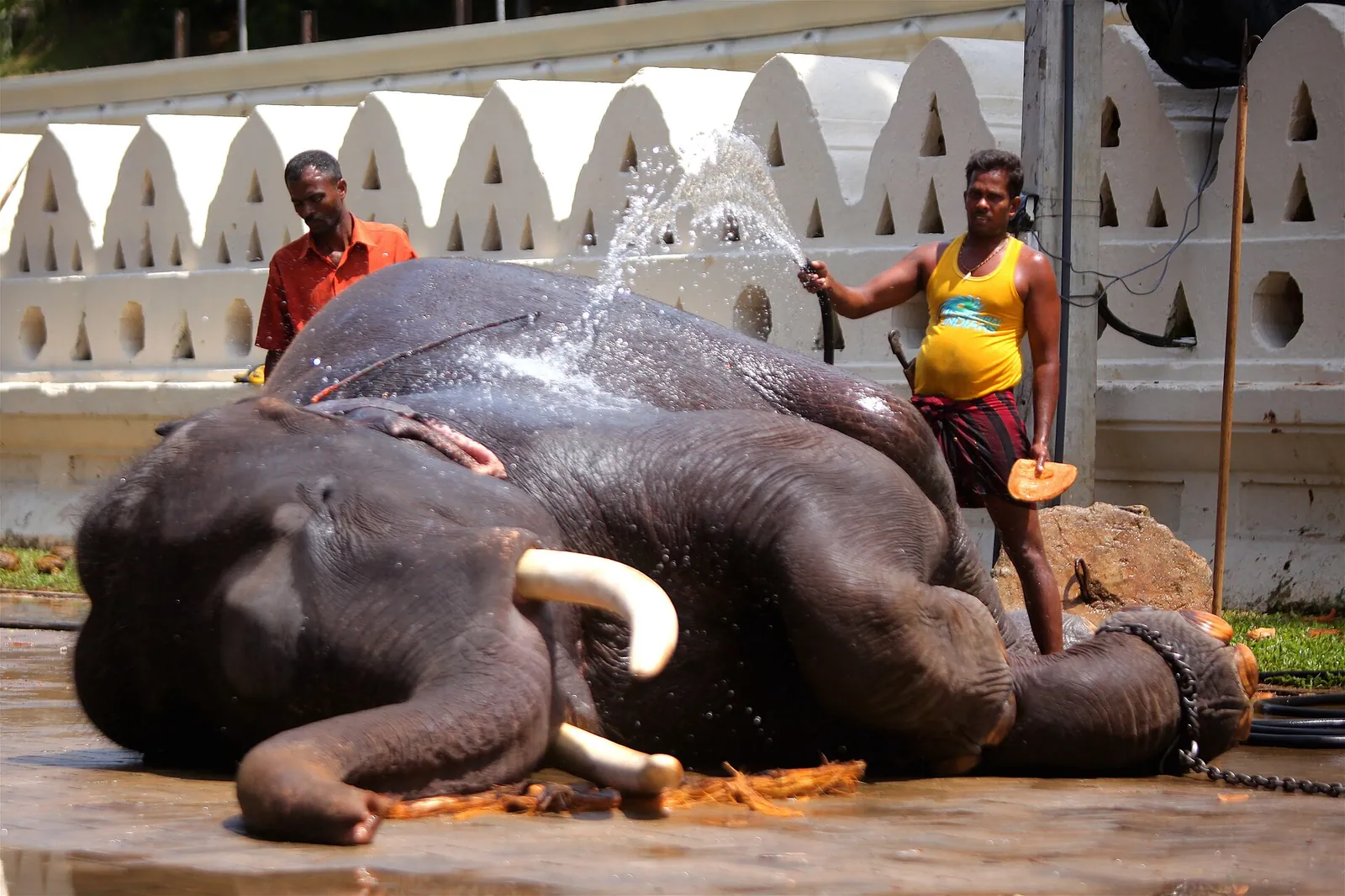
An elephant is washed in Kandy before an evening of the Esala Perahera
Photograph: Al Jazeera English — opens in a new tab · CC BY-SA 2.0 — opens in a new tab
Changes: Resized and converted to WebP; displayed with responsive crops. · Original photograph and licence details ↗ — opens in a new tab
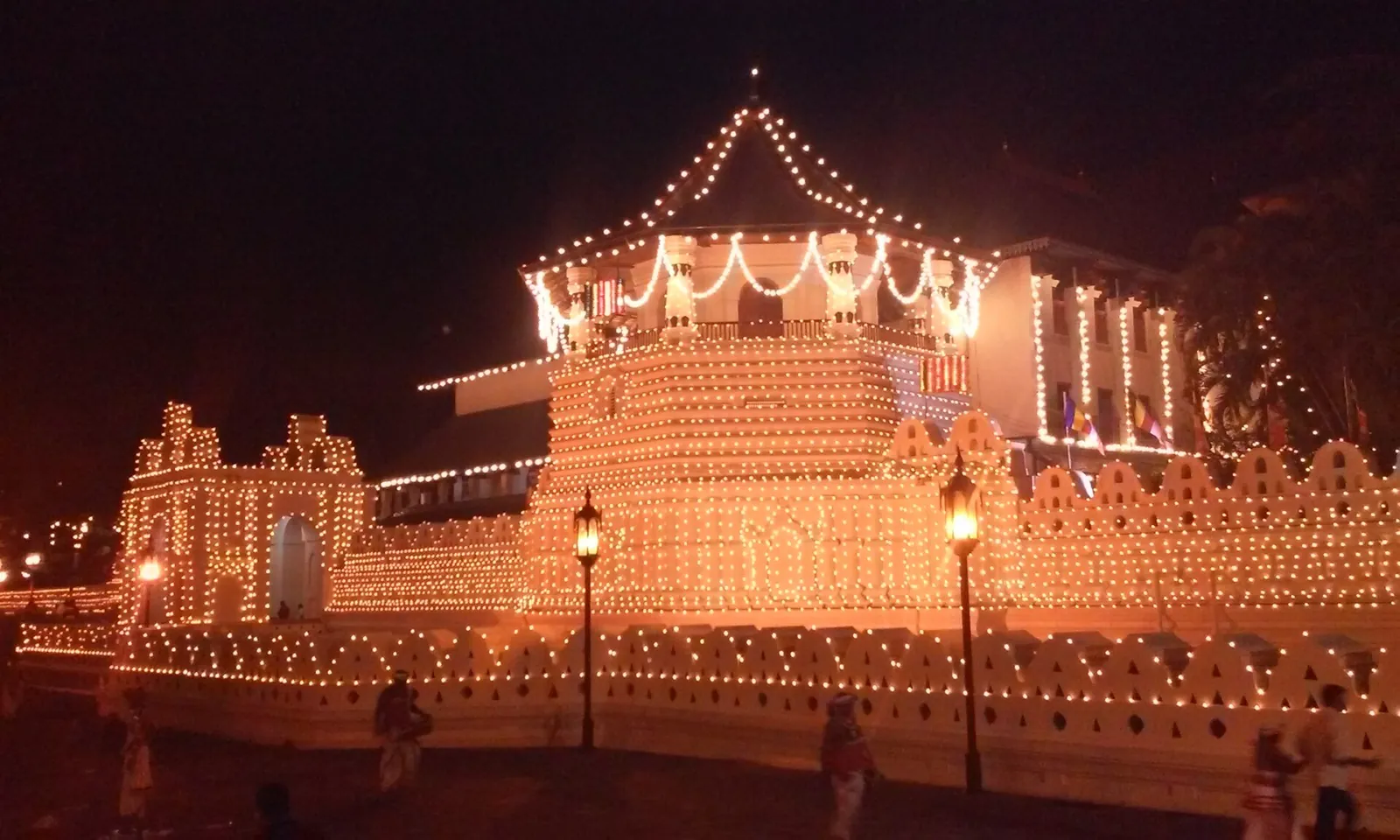
The Temple of the Tooth lit up on the night of the final Randoli Perahera in 2015
Photograph: Ravi Prabhath Pattiyakumburage — opens in a new tab · CC BY-SA 3.0 — opens in a new tab
Changes: Resized and converted to WebP; displayed with responsive crops. · Original photograph and licence details ↗ — opens in a new tab
The elephant bearing the casket under its lit canopy passes the arcades of central Kandy
Photograph: Omar AV — opens in a new tab · CC BY 3.0 — opens in a new tab
Changes: Resized and converted to WebP; displayed with responsive crops. · Original photograph and licence details ↗ — opens in a new tab
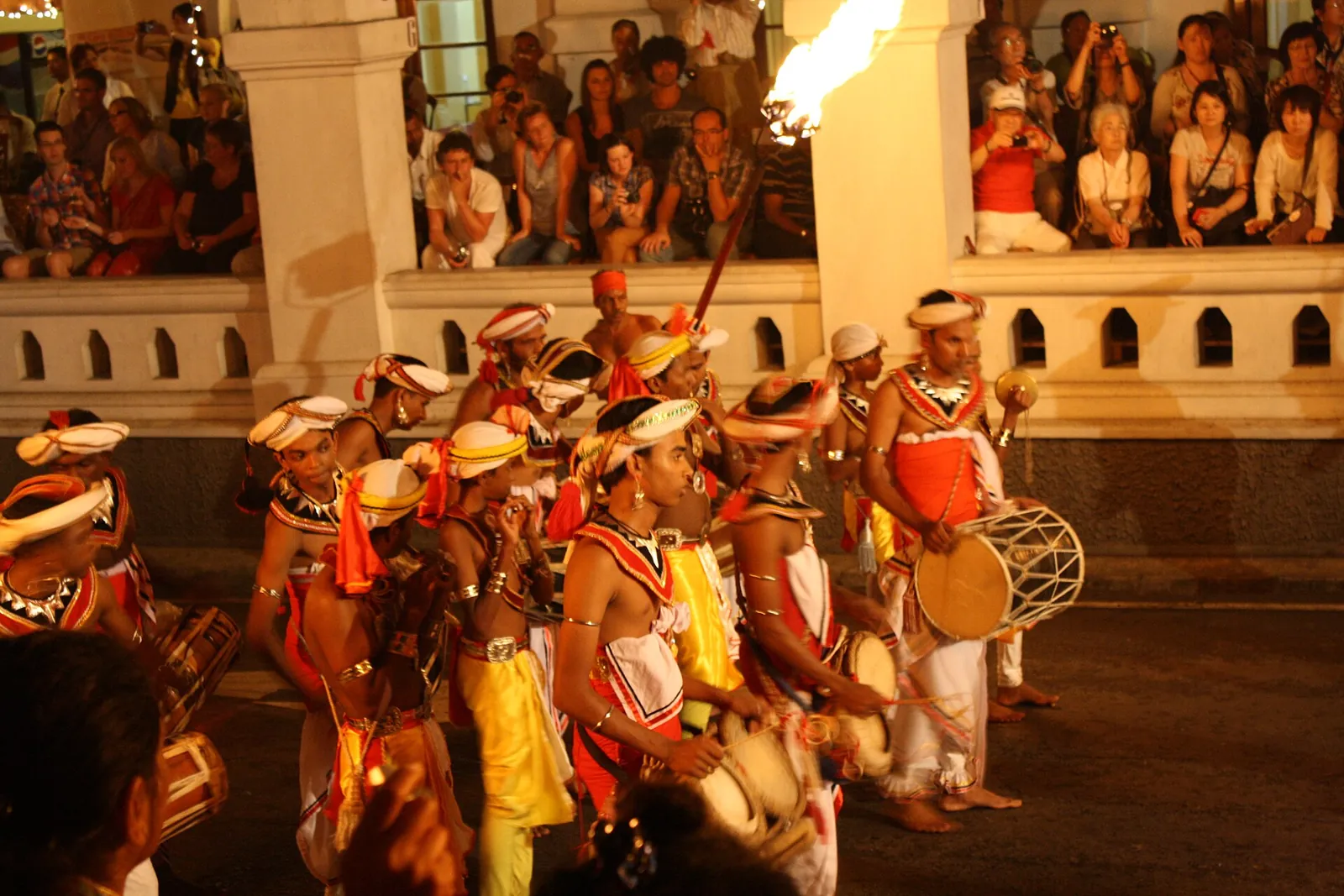
Drummers and dancers pass seated spectators on a Perahera night in Kandy
Photograph: Omar AV — opens in a new tab · CC BY 3.0 — opens in a new tab
Changes: Resized and converted to WebP; displayed with responsive crops. · Original photograph and licence details ↗ — opens in a new tab
Fire spinners at the Kandy Esala Perahera
Photograph: Sachin Kaveesha Fernando — opens in a new tab · CC BY-SA 4.0 — opens in a new tab
Changes: Resized and converted to WebP; displayed with responsive crops. · Original photograph and licence details ↗ — opens in a new tab