Plan your trip
What to eat in Cambodia: amok, prahok, market noodles and prices
Khmer cooking is herbal and quietly seasoned, built on a paste of lemongrass, galangal, turmeric and kaffir lime called kroeung, a fermented fish called prahok that seasons many dishes, river fish and rice. The ASEAN tourism site describes it as a kitchen that took ideas from Thailand, Vietnam and the French years and kept its own ingredients. This guide covers the dishes worth looking for and where each is at home: amok and lok lak in the restaurants, prahok in the dips and soups, num banh chok at the morning markets, pepper and crab on the coast. It also covers what a meal costs, and how to handle water, ice and dietary needs.
In this guide
Find the location ↗ — opens in a new tabThe short answer
Eat num banh chok and bai sach chrouk at a market in the morning, amok and lok lak at a Khmer restaurant at night, and save pepper crab for Kampot or Kep. Plan dinners around closing days: HAVEN and The Sugar Palm in Siem Reap both close on Mondays. Two prices: the Cambodia Tourism Board puts Siem Reap's num banh chok with prahok sauce at around KHR 15,000–20,000 (about USD 3.50–5), and Khmer Surin in Phnom Penh listed lok lak at USD 6 when we checked on 27 October 2026. A day of eating costs about USD 18 a person at cafes and Khmer restaurants, USD 32 with sit-down meals and USD 75 at hotel restaurants. Drink bottled or treated water, not tap water.
- Key point
- Eat as you go: the four Siem Reap nights and two Phnom Penh nights of a first week give you enough mornings and evenings for the Siem Reap and Phnom Penh dishes below
- Where it applies
- Wherever the route already sleeps: Siem Reap for num banh chok, palm cake and amok, Phnom Penh for lok lak and the big markets, Kampot or Kep for pepper and crab
- Timing
- Prahok is made mainly in the dry season, from November or December to March, when the Tonle Sap recedes and fish are easy to catch.
Kroeung, prahok and rice: what makes Khmer food
Kroeung is the herb paste pounded from lemongrass, turmeric, galangal and kaffir lime leaves; the Cambodia Tourism Board credits it with the smell and greenish-yellow colour of the national noodle curry. Prahok is fermented freshwater fish, used as a seasoning, stirred into soups or eaten with rice. And rice is the meal itself, whether steamed, broken under grilled pork at breakfast or turned into the fresh noodles of num banh chok.
You can taste those outside influences. The tourism board counts bread and kuy teav, the rice-noodle soup, as foreign arrivals, and num banh chok as indigenous Khmer. The Sugar Palm, a Siem Reap restaurant serving home-style Khmer cooking, describes its own food as distinguished by a subtle use of spice.
The country's dishes also have home towns, which makes planning simple. A week on our first-trip route through Siem Reap and Phnom Penh covers most of them; the coast adds the rest.
- Siem Reap: num banh chok with prahok sauce and grilled fish, palm cakes from Preah Dak village, and amok at town restaurants such as HAVEN.
- Phnom Penh: lok lak, the Russian Market's noodle stalls, and num banh chok on the riverside at weekends.
- Kampot and Kep: Kampot pepper, crab fried with it, and num banh chok Kampot, the dry version with dried shrimp, coconut cream and fish sauce.
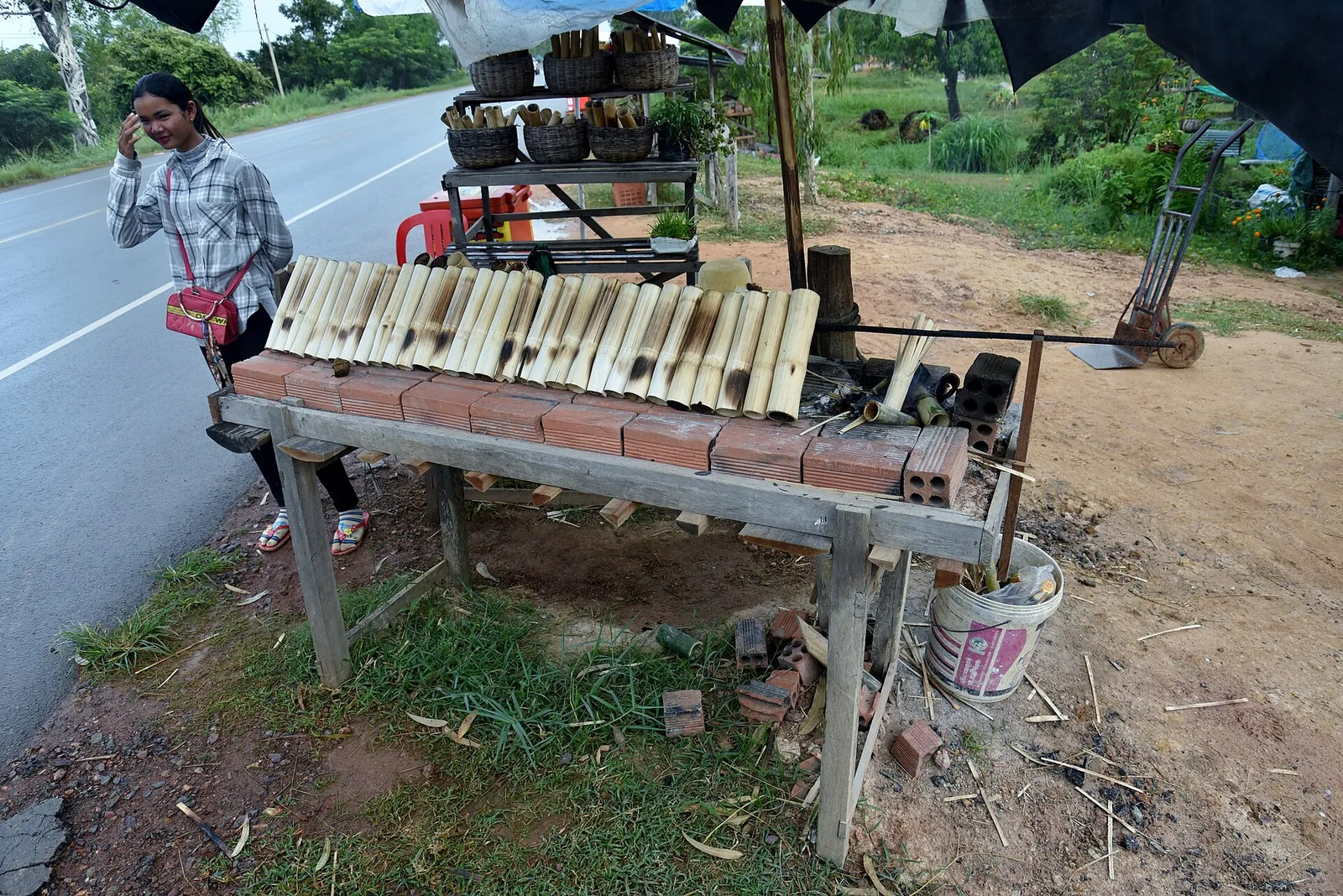
- Battambang and Kratie: a sweeter, caramelised bai sach chrouk around Psar Nath, and kralan, sticky rice roasted in bamboo, in Kratie's Thmor Kre commune.
Amok and lok lak: the restaurant classics
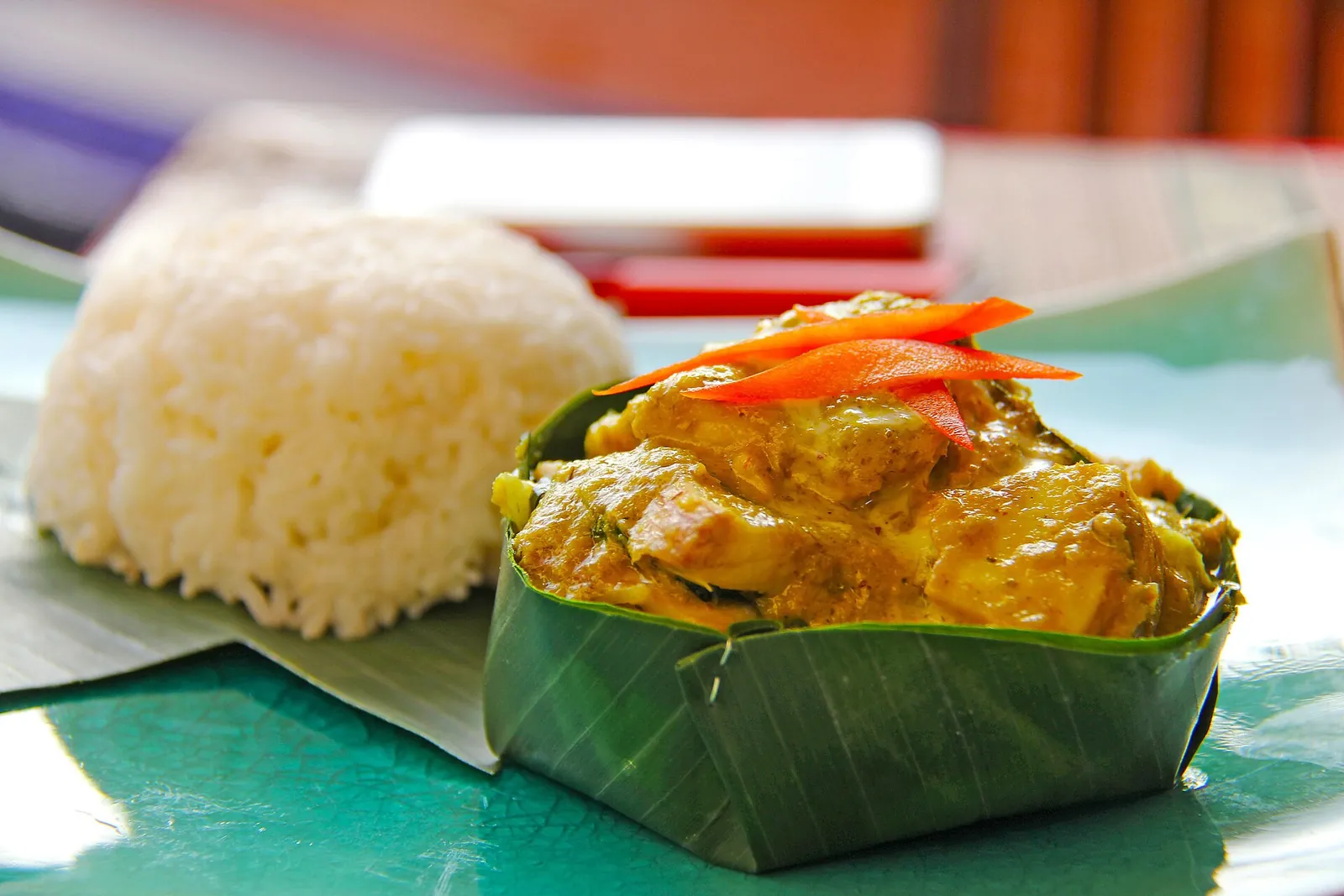
Fish amok is known as Cambodia's national dish. Freshwater fish is mixed with kroeung and coconut cream and steamed rather than simmered, so it comes out silky and soft, traditionally in a cup of banana leaf or a young coconut shell, topped with shredded kaffir lime leaf. The Royal Embassy of Cambodia in London calls it a royal dish, and its recipe adds a little shrimp paste or prahok. The restaurants below also offer chicken, prawn or tofu versions.
In Siem Reap, HAVEN on Chocolate Road lists Khmer amok with red rice at USD 7.50, VAT included, on its October 2026 menu; it opens Tuesday to Sunday, 10:00–22:00. For a version steamed to order, The Sugar Palm on Street 27, opposite Pannasastra University, makes it with snakehead fish, kroeung, coconut cream and noni leaf and asks you to allow 40 minutes; it opens for dinner only, Tuesday to Sunday from 17:30, with last orders at 21:30.
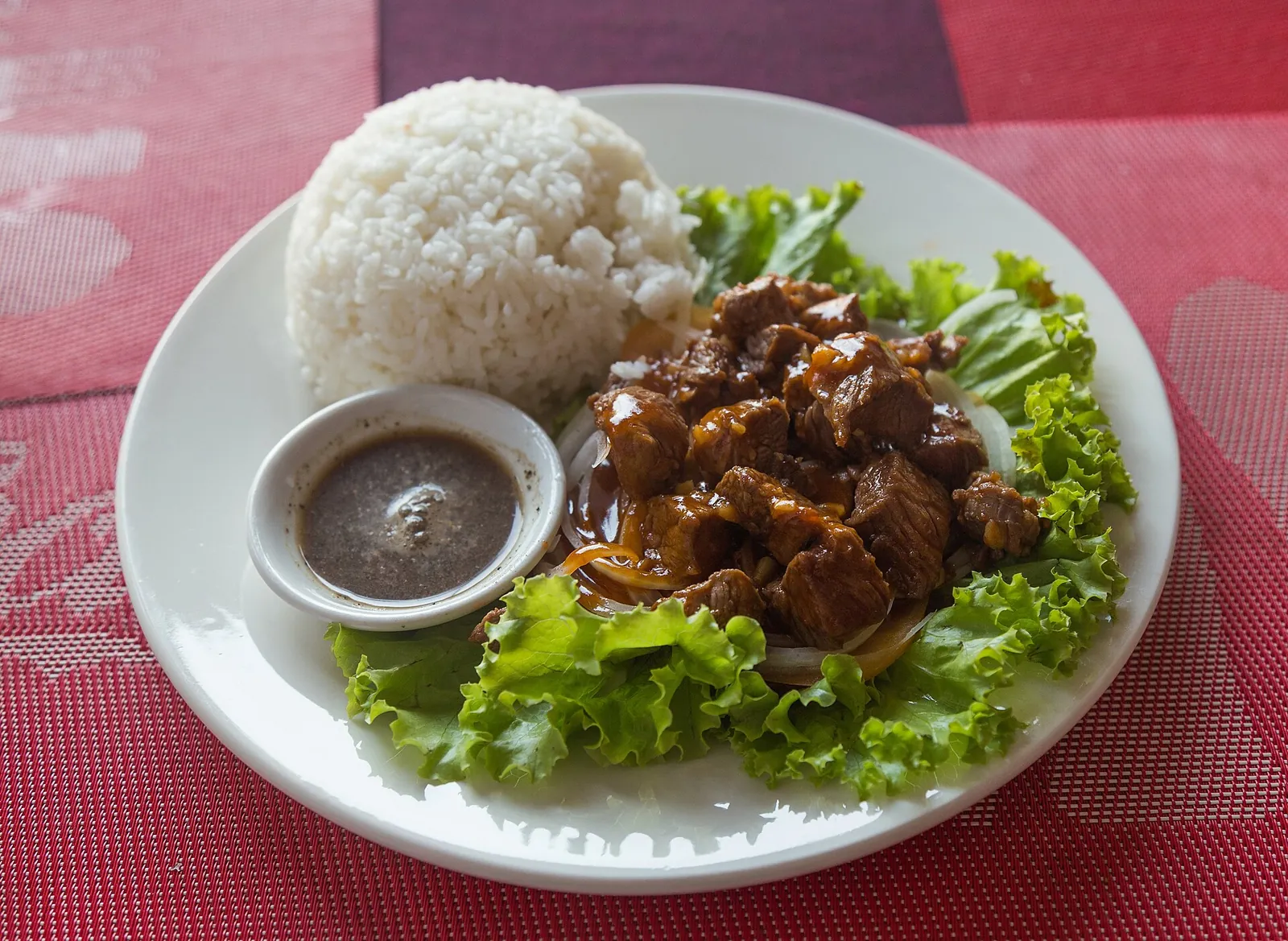
Lok lak is beef cubed, marinated and stir-fried with onions, served with rice (or chips) over lettuce and tomato, with a dipping sauce of lime juice, salt and pepper and often a fried egg on top. ASEAN calls it Cambodia's nod to its colonial past. Khmer Surin, a garden restaurant at No. 8E0 Street 57 in Phnom Penh's BKK1, open daily 10:00–22:00, is one place for it; its menu listed Lok Lac at USD 6 and fish or chicken amok at USD 5.50 when we checked on 27 October 2026. ASEAN notes that Khmer Surin makes it with Kampot pepper, a first taste of the coast's famous crop.
Prahok: the flavour underneath
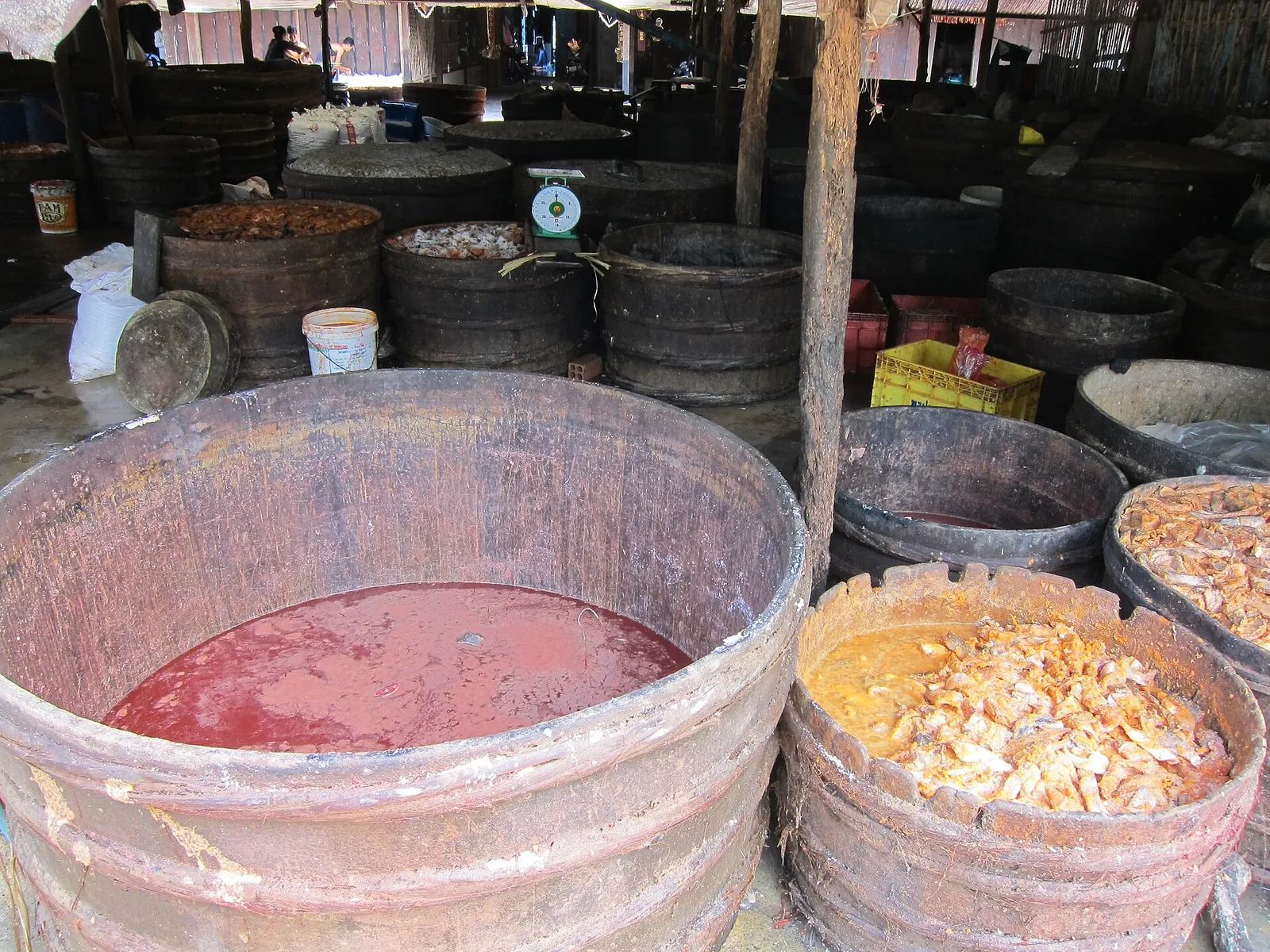
Prahok is, in the tourism board's words, the traditional Khmer flavour. Small river fish such as the trey riel are fermented into a paste with a strong fishy smell, and jars of it sit in shops and homes. It is made mainly in the dry season, from November or December to March, when the Tonle Sap lake shrinks and the fish are concentrated and easy to catch; in 2025 the agriculture ministry named 2–10 January as the best days for making it.
It is eaten with rice, used as a seasoning and mixed into dishes, the national noodle curry among them; at The Sugar Palm, three of the five soups on the menu carry a touch of it. The dish where it is the star is prahok k'tis, a dip of minced pork cooked with prahok and coconut cream, eaten with raw vegetables: The Sugar Palm makes it with pea eggplant and dried red chillies. In Phnom Penh, Khmer Surin serves it fried as Bpro-Hok Gatee, with coconut milk and roasted peanuts; our Phnom Penh guide has the restaurant's details.
If the smell puts you off, start with the dip, where coconut cream softens the fermented edge.
Kampot pepper and Kep crab
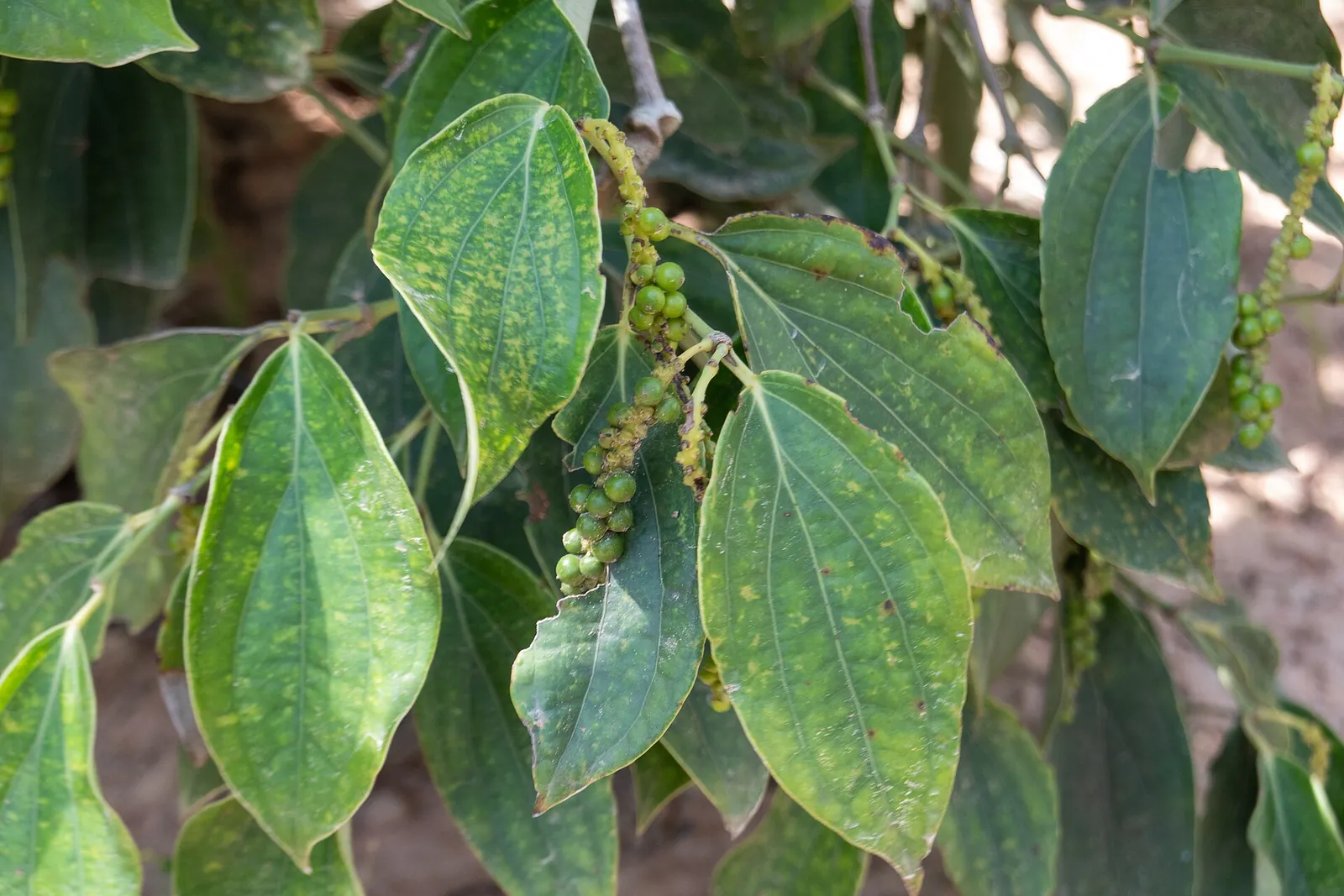
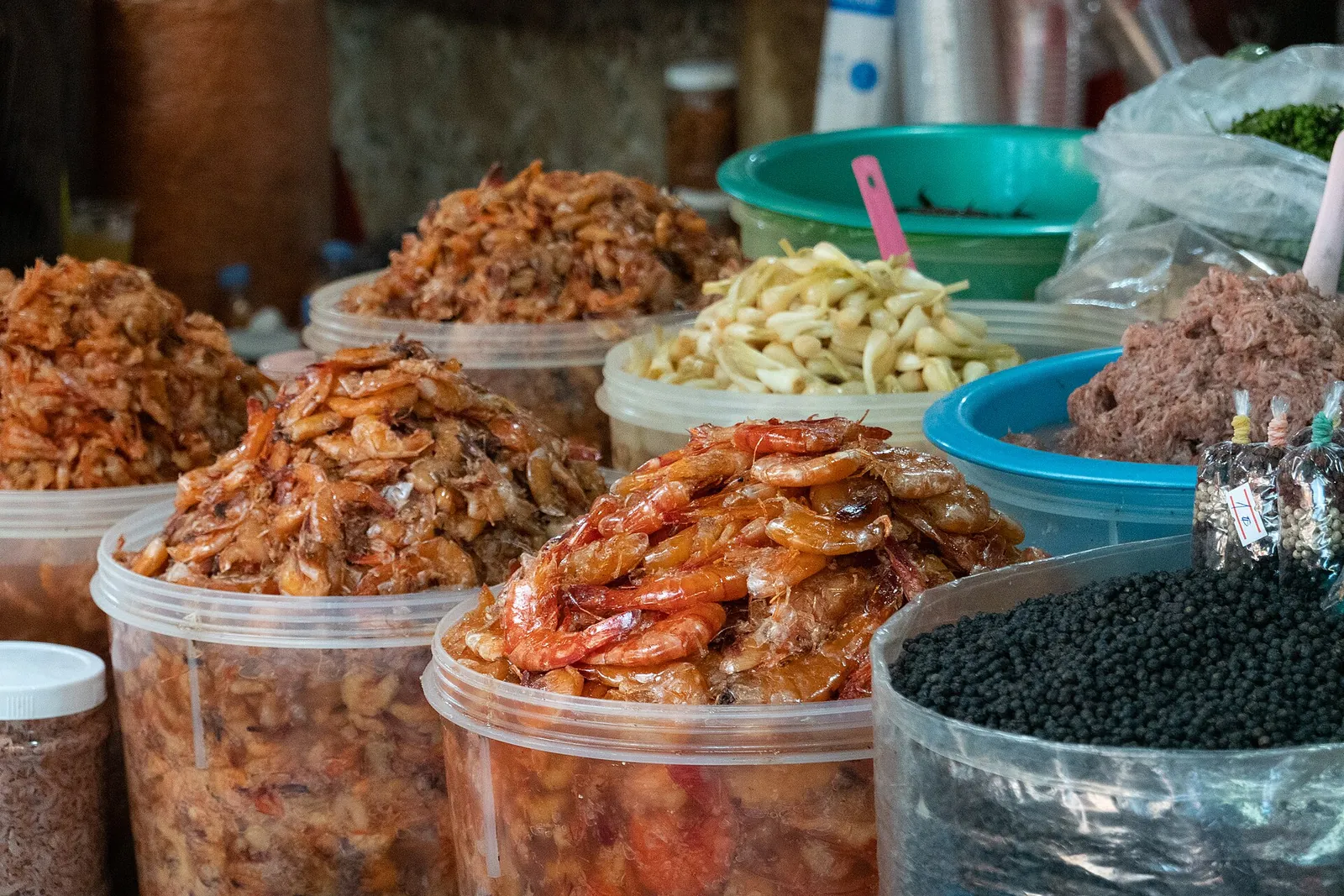
Kampot pepper was Cambodia's first geographical indication in 2010 and received the EU's protected status in 2016; it grows in Kampot province and parts of Kep. It comes in four forms from the same vine: green and fresh, black, red when left to ripen, and white with the skin removed. The tourism board pairs the fresh green pepper with seafood and stir-fries, and that is how the coast cooks it.
Its best-known use is Kep crab fried with Kampot pepper, eaten at the oceanfront shacks of Kep's Crab Market. Our Kep guide covers the Crab Market and a Kep restaurant that cooks the dish, and our Kampot guide covers the pepper farm visits and the farm's own restaurant.
How to order at a stall and at a restaurant
At a market stall the menu is whatever is in the pots, so pointing works. With num banh chok, mix the noodles, sauce and vegetables together before you eat, as the tourism board says most people do.
At a Khmer restaurant dishes are usually shared. For two or three people, order a soup, a curry or amok, a stir-fry and a salad with steamed rice; The Sugar Palm says its soups are taken with the other dishes rather than as a first course and are sized for the table.
Paying. The restaurants in this guide print their prices in US dollars, while the tourism board quotes market food in riel; Germany's foreign office notes that payments are mostly made in cash, in US dollars or riel, and change comes in both. The Sugar Palm's prices include 10% VAT, but some restaurants add tax or a service charge on top, so read the line at the foot of the menu.
Market breakfasts, sweets and coffee
Num banh chok is an early-morning dish: fresh rice noodles, made daily, under a light fish curry coloured by kroeung and flavoured with prahok, with banana blossom, cucumber and water lily stems on top. In Siem Reap the local version is num banh chok tek prahok, with grilled catfish, boiled greens and a prahok sauce; the tourism board lists it at Phsar Chas (the Old Market), around Angkor Wat and Srah Srang, and in Preah Dak village, at around KHR 15,000–20,000. Phsar Leu market's vendors set up before sunrise. In Phnom Penh, the Russian Market (Tuol Tom Poung) has stalls serving regional versions, and the Chaktomuk riverside opposite the Royal Palace has num banh chok on weekend evenings.
Bai sach chrouk is the other breakfast: thin slices of pork marinated in garlic or coconut milk, grilled over charcoal and served over broken rice with pickled vegetables. Kandal Market in Phnom Penh has vendors grilling it early in the morning, and Battambang's version around Psar Nath is sweeter and caramelised. ASEAN suggests a strong iced coffee with it, and the Russian Market's stalls brew Khmer iced coffee alongside their noodles.
Sweets to look for are made from rice and palm sugar. Num akor, the Khmer palm cake, is sticky-rice flour, coconut and palm sugar steamed in small banana-leaf cups; Preah Dak village, about 15 km north-east of Siem Reap on the road to Banteay Srei, is its heartland, where the tourism board puts a box of nine at about KHR 10,000. Go in the morning, when the cakes are freshest, as a stop on the way to the outer temples. Kralan is sweet sticky rice packed into a bamboo tube and roasted slowly over an open fire, in plain, jackfruit and coconut versions; the tourism board names Kratie's Thmor Kre commune, Battambang's Samraong Knong commune and Siem Reap's Khchas commune as its home ground.
What a meal costs
Prices below were checked on 27 October 2026 on the restaurants' own menus and the Cambodia Tourism Board's pages; the board gives its riel prices with a dollar equivalent of roughly KHR 4,000 to the dollar.
| Where you eat | A dish | Published examples |
|---|---|---|
| Market stall | KHR 10,000–20,000 | Siem Reap num banh chok tek prahok KHR 15,000–20,000; nine palm cakes at Preah Dak KHR 10,000 |
| Cafe breakfast | USD 3.50 | SPOONS, Siem Reap: num banh chok USD 3.50 (KHR 14,000), 07:00–11:00 |
| Khmer restaurant | USD 5.50–7.50 | Khmer Surin, Phnom Penh: amok USD 5.50, lok lak USD 6. HAVEN, Siem Reap: Khmer amok with rice USD 7.50, VAT included |
For a day rather than a dish: about USD 18 a person at cafes and Khmer restaurants, about USD 32 with sit-down meals, and about USD 75 with hotel breakfasts, hotel-restaurant dinners and drinks. Our trip-cost guide adds rooms, transport and the Angkor pass for the whole week.
Meal by meal on the first-trip route
This day plan follows the week in our seven-day itinerary: arrive in Siem Reap on a Monday, take the sunrise tour on Tuesday, keep Wednesday for the town and Thursday for the Big Circuit, take the bus to Phnom Penh on Friday and fly home on Sunday.
- Tuesday, sunrise at Angkor: the tour's breakfast box and lunch; in the evening, prahok k'tis and fish amok at The Sugar Palm, from 17:30.
- Wednesday, town day: num banh chok at SPOONS, served 07:00–11:00, or at the Phsar Chas stalls; a walk through the Old Market; amok at HAVEN for dinner, which our Siem Reap guide covers with its other town addresses.
- Thursday, the Big Circuit: breakfast before the 08:30 pick-up and lunch on the circuit; the tourism board lists num banh chok tek prahok stalls in the Angkor Wat and Srah Srang areas.
- Friday, Phnom Penh: lunch on the bus journey; lok lak and fish amok at Malis, which our Phnom Penh guide covers.
- Saturday, palace and museums: bai sach chrouk at Kandal Market, where the grills start early, before the palace; lok lak and amok at Khmer Surin for dinner, or num banh chok on the Chaktomuk riverside, where stalls set up on weekend evenings.
- Sunday, departure: noodles and iced coffee at the Russian Market, open from 06:00 or 07:00, before the airport.
What to eat and where to look
Fish amok
Freshwater fish or chicken with kroeung and coconut cream, steamed until soft and silky: the dish known as Cambodia's national one.
- Where to look
- Khmer Surin, No. 8E0 Street 57, BKK1, Phnom Penh; open daily 10:00–22:00; fish or chicken amok USD 5.50 on its menu. In Siem Reap, HAVEN on Chocolate Road (closed Mondays).
- Fit it into your day
- Saturday dinner in Phnom Penh, shared with lok lak; in Siem Reap, have it at HAVEN on the Wednesday.
Made with fish and coconut; ask for the chicken version if you avoid fish.
Lok lak
Marinated beef stir-fried and served over lettuce, onion and tomato with a dipping sauce of lime juice, salt and black pepper, and rice.
- Where to look
- Khmer Surin, Phnom Penh (address and hours in the amok entry); USD 6 on its menu.
- Fit it into your day
- The other dish at the same Khmer Surin dinner.
The beef is stir-fried with oyster sauce.
Num banh chok
Fresh rice noodles under a light fish curry coloured with kroeung, with raw vegetables on top; Siem Reap's own version, tek prahok, adds grilled catfish and a prahok sauce.
- Where to look
- SPOONS, Bamboo Street, Siem Reap; breakfast daily 07:00–11:00, num banh chok USD 3.50 (KHR 14,000) on its breakfast menu. The tek prahok version at the stalls the tourism board lists around Phsar Chas, Angkor Wat and Srah Srang, around KHR 15,000–20,000.
- Fit it into your day
- Breakfast on the Wednesday town day; the tek prahok version for lunch on the Thursday Big Circuit.
Built on river fish and prahok.
Num akor (Khmer palm cake)
Small cakes of sticky-rice flour, coconut and palm sugar, steamed in banana-leaf cups over a wood fire and best eaten warm.
- Where to look
- Preah Dak village near Siem Reap, the cake's heartland, where the tourism board lists a box of nine at about KHR 10,000; the stalls are busiest in the morning.
- Fit it into your day
- Only if you swap a temple day for Banteay Srei, which passes Preah Dak; go in the morning.
Water, ice, alcohol and dietary needs
Water. Drink bottled water from a sealed bottle, or water you have boiled or filtered, not tap water. Germany's foreign office notes that travellers to Cambodia often get stomach illness from poor drinking-water and food hygiene, and the US CDC advises against tap water, and ice made from it, wherever the supply may be contaminated. Hot tea and coffee served steaming hot are generally safe; Khmer iced coffee is poured over ice, and the CDC's advice where the water is in doubt is to avoid drinks with ice, so order it hot if you are unsure. At stalls, the CDC's advice is to choose food served steaming hot; if your stomach is sensitive, go easy on the raw herbs and vegetables that come with noodle dishes.
Alcohol. The UK government reports deaths and serious illness in Cambodia from alcoholic drinks containing methanol, which cannot be detected by taste or smell. If anyone feels unwell after drinking, get medical help at once, as the UK advice urges.
Vegetarian food. Prahok, fish sauce and shrimp paste season many dishes that look vegetable-based, including soups and dips. Some restaurants mark vegetarian and vegan dishes: HAVEN labels them on its menu, and The Sugar Palm offers a tofu amok and a tofu curry.
Halal food. No official list of halal restaurants is published; Cambodia's Ministry of Tourism said in April 2025 that it is expanding halal-certified restaurants and prayer rooms for Muslim visitors.
Allergies. Fish, shellfish, peanuts and coconut appear in many of the dishes above: amok is fish or seafood in coconut cream, several of The Sugar Palm's salads are topped with peanuts, and Khmer Surin's lok lak is cooked with oyster sauce. When you order, name any allergy and say whether you eat fish sauce, prahok and shrimp paste; HAVEN's menu asks guests to do exactly that.
Practical questions
What is the one dish to eat in Cambodia?
Fish amok, the steamed coconut and kroeung curry known as Cambodia's national dish. For the most Khmer breakfast, have num banh chok, the rice-noodle fish curry, at a morning market.
Is Cambodian food spicy?
It can be, but much of it is not: The Sugar Palm describes its home-style cooking as subtly spiced, and the tourism board says num banh chok tastes better with a little or a lot of chilli, depending on your spice tolerance.
Can I drink the tap water in Cambodia?
No. Drink sealed bottled water or water you have boiled or filtered, and skip ice if you are unsure where it came from.
How much does food cost per day in Cambodia?
About USD 18 a person at cafes and Khmer restaurants, USD 32 with sit-down meals and USD 75 at hotel restaurants with drinks. A market plate of noodles costs around KHR 15,000–20,000 in Siem Reap.
Can vegetarians eat well in Cambodia?
Yes, with care: prahok, fish sauce and shrimp paste go into many soups, dips and curries, so ask for none of them as well as no meat. Tofu amok and tofu curry are on The Sugar Palm's menu in Siem Reap.
Keep planning your trip
Your first trip to Cambodia
Plan a first week in Cambodia: four nights in Siem Reap, two in Phnom Penh, Angkor, visa steps and the intercity bus.
Read the guide
Cambodia trip cost 2027
What a week in Siem Reap, Angkor and Phnom Penh costs in January 2027, all in: about USD 545 per person on a budget, 820 mid-range or 1,520 in comfort.
Read the guide
Siem Reap
Plan four nights in Siem Reap: Angkor Wat, Bayon and Ta Prohm, the museum, Old Market, Khmer meals, SAI airport buses and a budget for two.
Read the guide
Phnom Penh
Plan three nights in Phnom Penh: the Royal Palace, National Museum, Tuol Sleng and Choeung Ek, Khmer meals, central bases and Techo airport transfers.
Read the guide
Kampot
Plan three nights by the river in Kampot: La Plantation pepper tours, guided paddleboarding, local dishes, Phnom Penh buses and what the costs include.
Read the guide
Kep
Plan two nights in Kep: choose a coast or hillside base, visit the Crab Market and beach, and organise the park walk and Phnom Penh bus.
Read the guideSources and checks before you travel
(23)
- ASEAN tourism (Visit Southeast Asia): food spots in Cambodia ↗ — opens in a new tab
- Royal Embassy of Cambodia, London: fish amok recipe ↗ — opens in a new tab
- Cambodia Tourism Board: num banh chok ↗ — opens in a new tab
- Cambodia Tourism Board: num banh chok tek prahok in Siem Reap ↗ — opens in a new tab
- Cambodia Tourism Board: Preah Dak village food street ↗ — opens in a new tab
- Cambodia Tourism Board: Khmer palm cake ↗ — opens in a new tab
- Cambodia Tourism Board: kralan ↗ — opens in a new tab
- Cambodia Tourism Board: Tuol Tom Poung (Russian) Market ↗ — opens in a new tab
- Cambodia Tourism Board: Kampot pepper ↗ — opens in a new tab
- Honorary Consulate of Cambodia: Kep ↗ — opens in a new tab
- Bernama via The Star: prahok season, 5 January 2025 ↗ — opens in a new tab
- The Sugar Palm, Siem Reap: hours and address ↗ — opens in a new tab
- The Sugar Palm: menu (August 2022 PDF) ↗ — opens in a new tab
- HAVEN, Siem Reap: October 2026 menu ↗ — opens in a new tab
- HAVEN, Siem Reap: address and opening hours ↗ — opens in a new tab
- SPOONS, Siem Reap: breakfast menu ↗ — opens in a new tab
- SPOONS, Siem Reap: opening hours ↗ — opens in a new tab
- OpenStreetMap: SPOONS, Siem Reap ↗ — opens in a new tab
- Khmer Surin, Phnom Penh: food menu ↗ — opens in a new tab
- AKP: Cambodia's Ministry of Tourism and Muslim-friendly tourism, 24 April 2025 ↗ — opens in a new tab
- German Federal Foreign Office: Cambodia travel and safety advice (health) ↗ — opens in a new tab
- US CDC: food and water safety for travellers ↗ — opens in a new tab
- UK FCDO: Cambodia safety and security ↗ — opens in a new tab
Reference sources for the version dated 27 October 2026. Confirm opening times, access, transport and conditions for your travel dates.
Photo credits
(6)
Fish amok served in banana leaves with steamed rice in Siem Reap
Photograph: sharonang — opens in a new tab · CC0 — opens in a new tab
Changes: Resized and converted to WebP; displayed with responsive crops. · Original photograph and licence details ↗ — opens in a new tab
Beef lok lak with rice and a pepper dipping sauce in Phnom Penh
Photograph: Marcin Konsek — opens in a new tab · CC BY-SA 4.0 — opens in a new tab
Changes: Resized and converted to WebP; displayed with responsive crops. · Original photograph and licence details ↗ — opens in a new tab
Barrels of prahok, Cambodia's fermented fish paste, at a market in Battambang
Photograph: Cristina Bejarano from based in new york city — opens in a new tab · CC BY 2.0 — opens in a new tab
Changes: Resized and converted to WebP; displayed with responsive crops. · Original photograph and licence details ↗ — opens in a new tab
Green peppercorns on the vine at La Plantation, Kampot Province
Photograph: PsamatheM — opens in a new tab · CC BY-SA 4.0 — opens in a new tab
Changes: Resized and converted to WebP; displayed with responsive crops. · Original photograph and licence details ↗ — opens in a new tab
Dried shrimp and Kampot pepper for sale at the Crab Market in Kep
Photograph: PsamatheM — opens in a new tab · CC BY-SA 4.0 — opens in a new tab
Changes: Resized and converted to WebP; displayed with responsive crops. · Original photograph and licence details ↗ — opens in a new tab
Kralan, sticky rice roasted in bamboo, at a roadside stall in Siem Reap Province
Photograph: Bahnfrend — opens in a new tab · CC BY-SA 4.0 — opens in a new tab
Changes: Resized and converted to WebP; displayed with responsive crops. · Original photograph and licence details ↗ — opens in a new tab