Paro
Paro and Tiger's Nest: the cliff-monastery hike and two nights
Paro is where Bhutan begins for most visitors: the plane lands on the floor of a wide valley of rice fields and farmhouses, with a fortress-monastery standing above the river. Its great sight is the walk to Paro Taktsang (Tiger's Nest), a monastery built against a cliff 900 metres above the valley. Below it lie Rinpung Dzong and its covered bridge, the National Museum in a 17th-century watchtower, Kyichu Lhakhang, one of the two oldest temples in the country, and the road to Chele La, one of the highest passes you can drive in Bhutan.
In this guide
Find the location ↗ — opens in a new tabThe short answer
Spend nights 5 and 6 of a western Bhutan week in Paro: the museum and Rinpung Dzong on arrival from Punakha, the Tiger's Nest hike the next day, and a flight out the morning after. The Department of Tourism gives the hike as 5–6 hours, and its monument list gives entry as Nu 1,000. Start early and check visiting hours with your guide. Stay in Paro town or on the Olathang hillside above it. Book the operator and Paro flights first; the operator supplies the mandatory guide. For a separate three-day, two-night trip, one operator's calculator estimates USD 1,160 for two adults, including visas and the SDF; flights and personal spending are extra.
- Suggested time
- 2 nights in Paro at the end of a western Bhutan week; add a third for Chele La or a spare day before your flight
- Where to stay
- Paro town, or the Olathang hillside and Satsam Chorten just outside it
- Season and timing
- The Department of Tourism describes spring, from early March to mid-April, as generally dry, and autumn, from late September or early October to late November, as a season of bright, sunny days. From June to September the monsoon can affect transport and services; from late November to March, snowfall is common above 3,000 metres, which takes in Chele La and the top of the Tiger's Nest trail.
Two days in Paro at the end of the week
Two nights cover Paro's sights, and they work best as nights 5 and 6 of a week in the western valleys, after Thimphu and Punakha: you walk to the monastery with several days at altitude behind you, and the airport is a short drive from your hotel on the morning you leave. The town itself is one handsome main street of wooden shopfronts, worth a stroll on the first evening.
Day 5: the road from Punakha is 115 km over Dochula, which Little Bhutan, a licensed Thimphu operator, gives as 3.5–4 hours, so leave after breakfast and you reach Paro for lunch. Spend the afternoon at the National Museum (last admission 16:00), then walk down to Rinpung Dzong. Day 6: the Tiger's Nest, with an early start; if you are back in the valley by about 16:00, stop at Kyichu Lhakhang on the way (it closes at 16:30). Day 7: fly out in the morning.
You can book every part of the trip yourself, but a guide certified by the Department of Tourism must be with you at all times, and you may stay only in DoT-certified hotels, homestays or campsites. A guide is also needed to enter dzongs and monuments. Self-drive cars cannot be hired locally; visitors bringing their own vehicle may drive with a guide and the required documents. With a certified guide, no route permit is needed for the western valleys; national parks still need permits.
Paro's hotels sit either in the valley, close to the town's main street and its restaurants, or on the Olathang hillside above it, where pine woods keep the nights quiet and the rooms look across the valley; both are a drive from the airport and the Tiger's Nest trailhead. Hotel Olathang was Bhutan's first hotel, built in 1974 for the guests at the Fourth King's coronation: a heritage property of 59 rooms in pine woods overlooking the valley, 5 km from the airport, with a restaurant, bar and spa. A Standard double costs Nu 5,280 a night and a Deluxe Cottage double Nu 6,600, taxes included. Olathang Cottages, a separate property of 29 rooms in 12 cottages among apple trees just above it, charges Nu 5,400 for a Deluxe double with taxes. Udumwara Resort, at Satsam Chorten in the valley outside the town, charges Nu 9,000 a night for a Deluxe double in its villas from March to May and September to November and Nu 8,500 in the other months, plus 10% BST and 10% service charge. All three are three-star hotels certified by the Department of Tourism; prices checked 2 November 2026.
Paro Taktsang, the Tiger's Nest
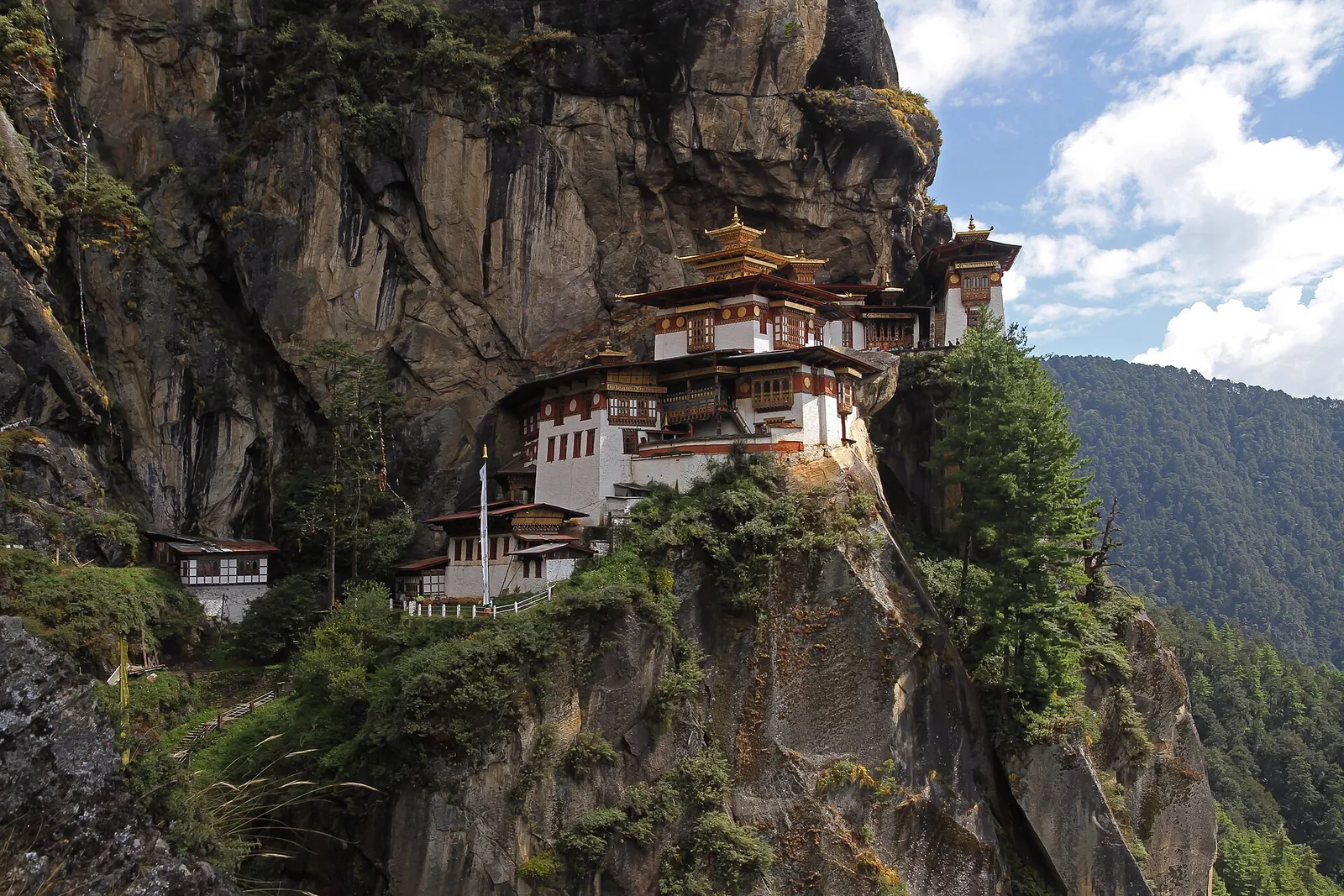
Paro Taktsang (Tiger's Nest) clings to a sheer cliff high above the valley floor, at about 3,120 m. Its story goes back to the 8th century: Guru Rinpoche, who brought Vajrayana Buddhism to Bhutan, is said to have flown here from the east on the back of a tigress and meditated in a cave for three months, and the place took its name, "Tiger's Lair", from that legend. Tenzin Rabgye, the Fourth Druk Desi, first built the monastery in 1692 to enshrine the sacred meditation caves, and it is still one of the country's most important pilgrimages, so you share the path with Bhutanese families as well as other visitors.
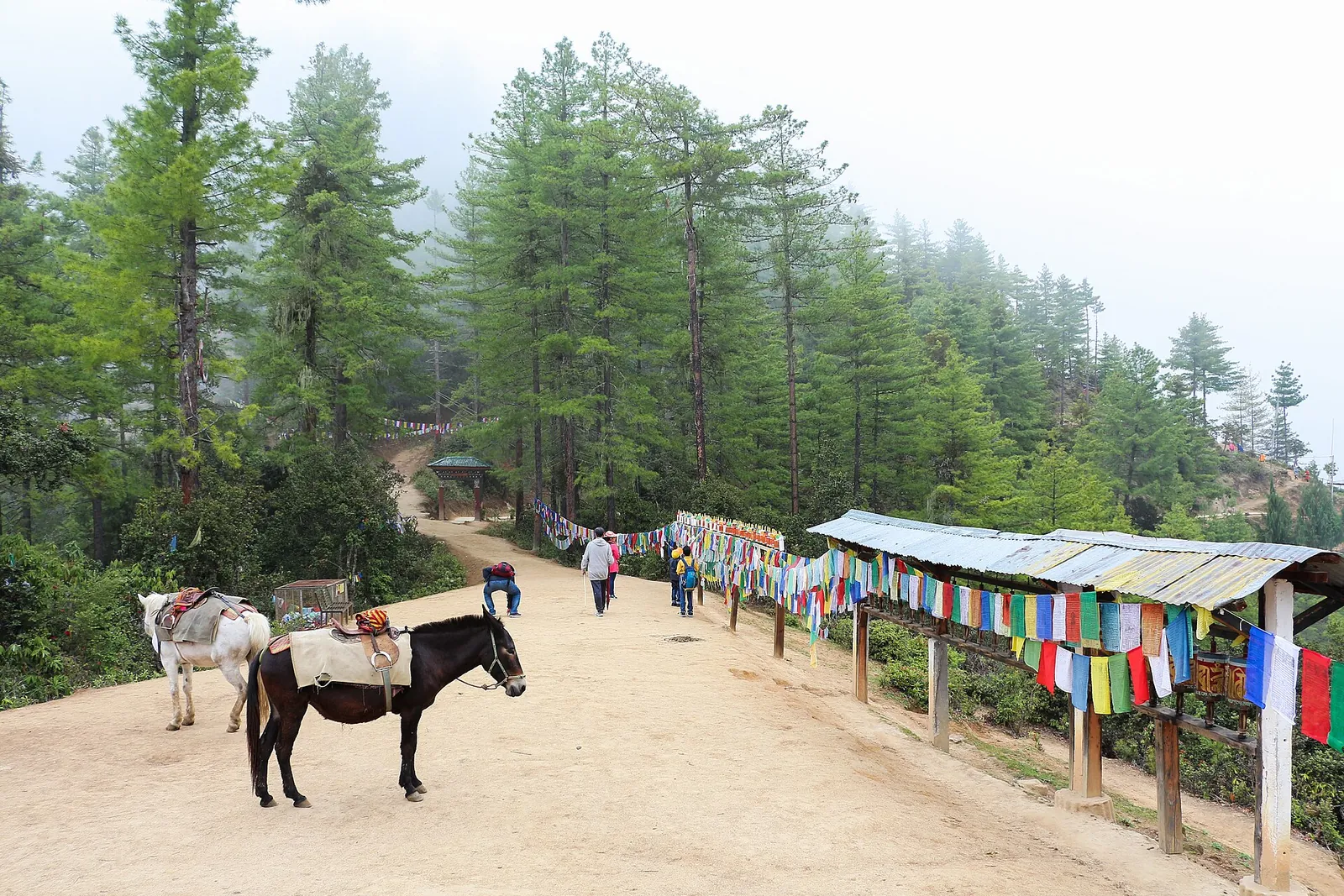
The walk starts at a road-accessible trailhead above the valley floor, so you climb less than the full 900 m. The Department of Tourism gives the hike as 5–6 hours. The trail is wide and roughly 6 km there and back: a steady climb through blue pine hung with prayer flags to the Taktsang Cafeteria, about halfway up, then a stretch to a viewpoint level with the monastery, close enough to see prayer flags strung across the void, and finally a flight of stone steps that drops into the gorge and climbs again to the gate. Most people climb it in 1.5–3 hours and spend about an hour inside; the descent is quicker but hard on the knees, so walking poles and shoes with a good grip are worth packing.
The cafeteria is the classic place to photograph the monastery across the gorge and a natural place to turn back if the climb is too much. It is run by Bhutan Hotels and Restaurants, serves a vegetarian menu with tea and light refreshments, and opens for breakfast from 07:00 to 10:00 and for lunch from 11:00 to 15:00.
Ponies carry riders up the first half of the trail, as far as the cafeteria, but not beyond it and not downhill, so everyone walks the upper section and the whole descent. The Department of Tourism announced in April 2023 that ponies must be booked in advance through the Taktsang services management; without a booking guests wait their turn. No fare is published, so your guide books the pony and it costs extra.
Entry costs Nu 1,000, paid on arrival in cash or through the Bank of Bhutan's goBoB app; under-18s pay half and children of five and under go free, and some guided packages include the fee. Behind the gate, the temples are pressed against the rock face around Guru Rinpoche's meditation cave, and your guide leads you past the murals to the cave shrine. Fire destroyed much of the complex in 1998; it has since been restored, and it remains a working place of pilgrimage rather than a museum. Bags, cameras and phones go into lockers, and photography is not allowed in the temples.
Planning the hike day
Start early. The Department of Tourism's 2023 monument list gives visiting sessions of 09:00–12:00 and 14:00–17:00, but also says there is no lunch break. Little Bhutan says it is open daily, including Tuesdays. Ask your guide for the current hours when planning the walk. An early start leaves time for the climb and a stop at the cafeteria.
The climb takes you well above the valley. Germany advises seeing a doctor experienced in altitude medicine before final planning for travel above 2,300 m, and the UK advises insurance that covers medical treatment, helicopter evacuation and repatriation.
Do not put the hike on the day you fly out. If rain, ice, illness or cloud rules the trail out on day 6, Drukgyel Dzong and the valley temples fill the day instead.
Rinpung Dzong and the National Museum
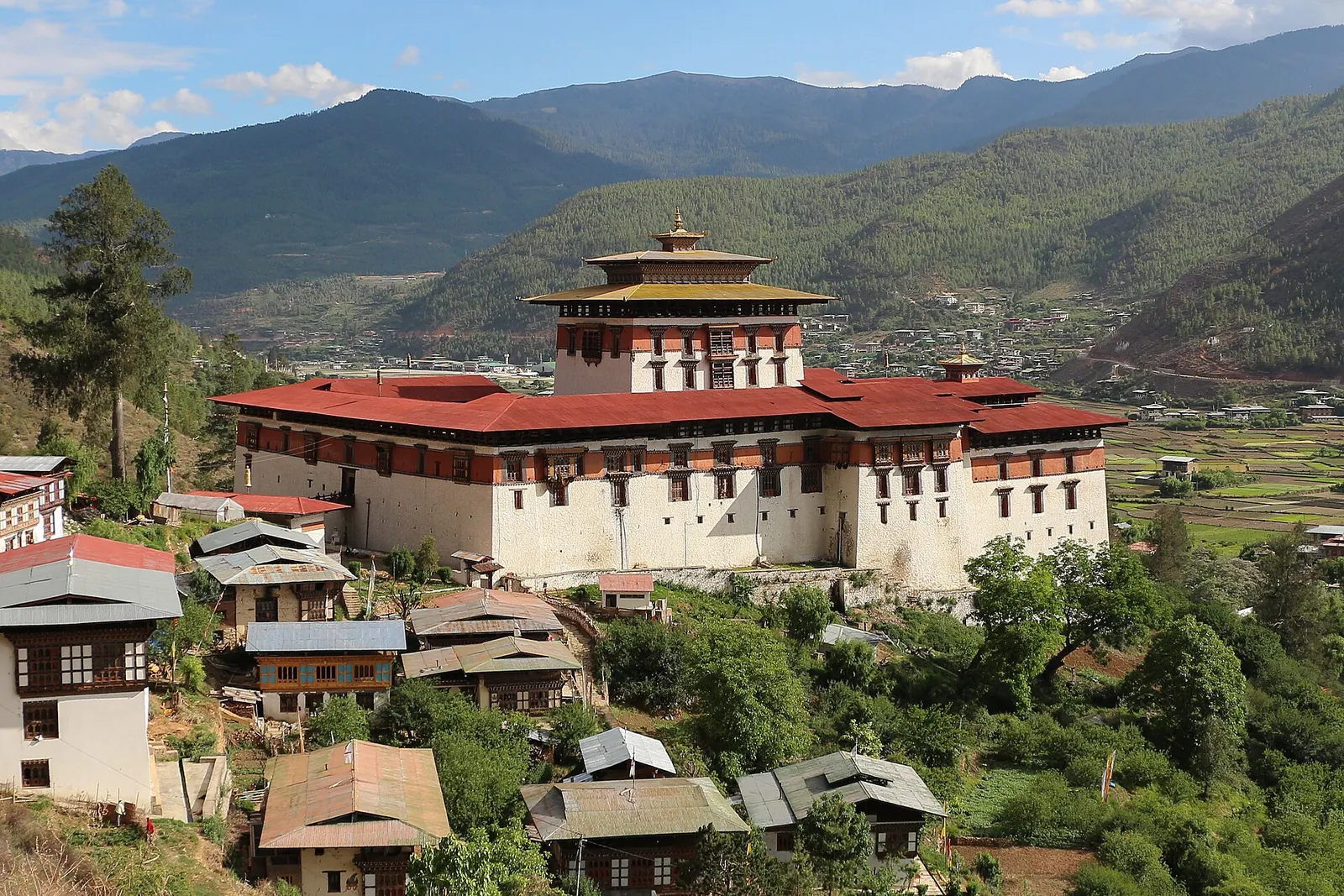
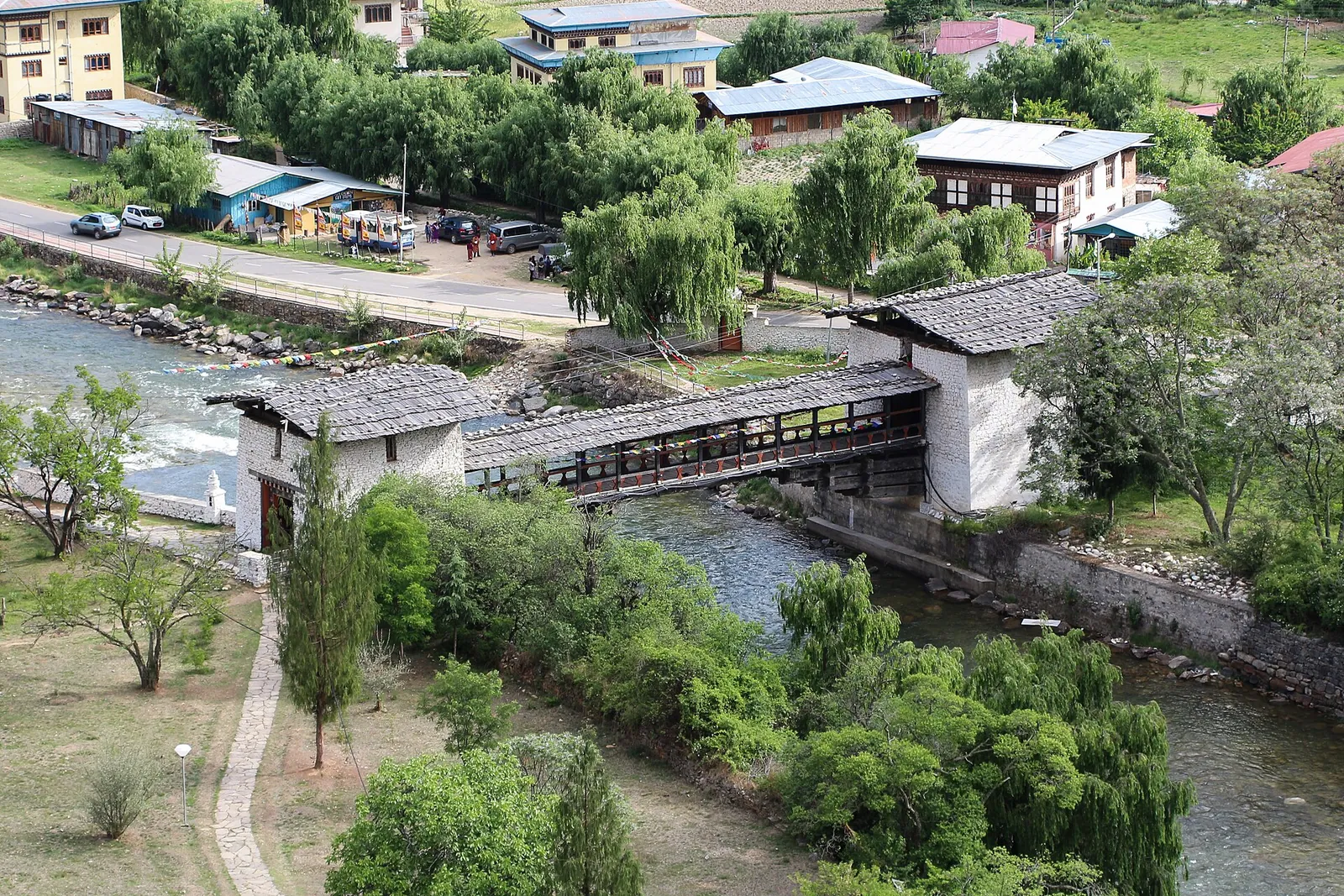
Rinpung Dzong rises on a spur above the Pa Chhu, reached on foot across Nyamai Zam (also written Nemi Zam), a roofed cantilever bridge. It has governed the valley since 1646 and still houses the district administration and the monk body around steep, worn stairways and courtyards on several levels; the inward-leaning walls make it look even more massive from below. Every spring the Paro Tshechu takes place on the Deyangkha ground beside the dzong: the Department of Tourism's tentative dates for 2027 are 18 to 22 March, with the great thongdrel (a giant appliqué thangka) unveiled on the last day. Our festivals guide has the other tshechus. The Department of Tourism’s 2023 monument list gives free entry; its hours contain conflicting information, so check the current schedule with your guide. Photograph the courtyards, not the chapels.
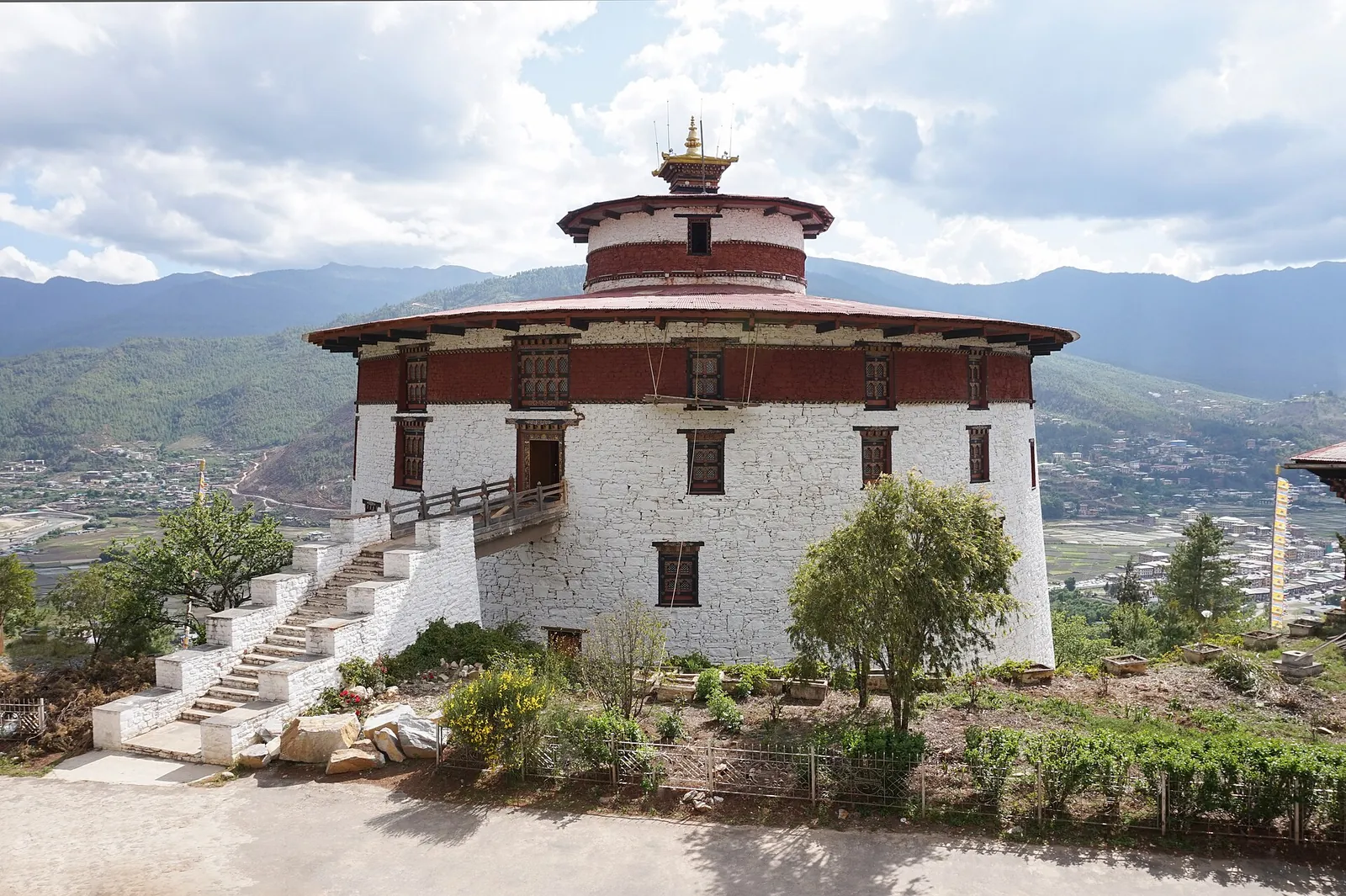
Above it, the round watchtower of Ta Dzong was built in 1649 to guard the dzong and became the National Museum of Bhutan in 1968. An earthquake damaged it badly in 2011; after its restoration with the support of the Government of India, it reopened on 24 June 2020. Its collection of more than 3,000 objects climbs through seven floors: farming tools and metalwork at the bottom, weapons in the former prison cells, stamps, jewellery and coins, Stone Age tools and early Buddhist objects, a royal gallery, thangka paintings and a 10th-century Kadam stupa, and at the top a three-dimensional mandala of the Tree of Merit. A separate natural-history gallery shows the takin, the snow leopard and the Bhutan Glory butterfly.
The museum opens daily from 09:00 to 17:00, with last admission at 16:00, and closes on government and local holidays. The museum lists admission for international visitors as Nu 500. Photography and video are not allowed inside, and lockers are provided for cameras.
Kyichu Lhakhang, Drukgyel Dzong and a hot-stone bath
Kyichu Lhakhang, north-west of the town centre on the road up the valley, is one of the two oldest temples in Bhutan. Tradition holds that the Tibetan emperor Songtsen Gampo founded it in the 7th century, one of 108 temples built to pin down a demoness who lay across the Himalaya. Two temples share a small walled courtyard: the ancient one, and the Guru Lhakhang added in the 20th century, with two orange trees between them. Allow 30–45 minutes. Entry is Nu 500, and the temple is open 09:00–12:00 and 13:00–16:30.
Drukgyel Dzong, at the head of the Paro valley, is the sight for anyone not hiking. It was built in 1649 by Tenzin Drukdra, under the command of Zhabdrung Ngawang Namgyel, as a symbol of victory over invaders, and was badly damaged by fire in 1951. It stood in ruins for some seventy years, until a rebuild by traditional methods from 2016 to 2023 restored its white and red walls and five watchtowers. The operator Little Bhutan says the site is open but does not specify which parts visitors can enter; check access with your guide.
If you have an evening to spare, a farmhouse dinner with a hot-stone bath (menchu or dotsho), Bhutan's traditional cure for tired legs, is an optional extra outside the plan and the budget above. River stones are heated in a fire until they glow and dropped into a wooden tub of water infused with artemisia leaves; more stones go in while you soak, so the water gets hotter rather than cooler. Hotels, homestays and hot-stone bath centres all offer them. Farmhouse meals in Paro bring seasonal vegetables, red rice, chilli dishes and ara, the local spirit.
What to eat and where to look
Jasha maru
A spicy chicken stew of diced chicken with chillies, onion, tomato and coriander, eaten with red rice, the heirloom grain Bhutanese prize above all others.
- Where to look
- Paro Grand Restaurant at Hotel Paro Grand in Bondey, which lists jasha maru among its Bhutanese dishes.
- Fit it into your day
- Lunch on day 5, when you arrive from Punakha. Ask your operator early to book this and the places below as package meals.
Bhutanese cooking uses chilli generously and cheese in most vegetable dishes; say so before you order if you avoid either.
Khuley with aezey
Buckwheat pancakes, eaten with aezey, a Bhutanese chilli paste.
- Where to look
- Phangguu Paro, a cosy, traditional dining room across the road from Rinpung Dzong, whose cooking is home-style Bhutanese.
- Fit it into your day
- Dinner on day 5, after the museum and Rinpung Dzong.
Sikam paa
Dried pork cooked with chilli and vegetables, cooked the home-style way.
- Where to look
- Phangguu Paro, opposite Rinpung Dzong.
- Fit it into your day
- With the khuley at the same dinner, as a second dish to share.
Suja and khapse
Suja is Bhutan's salted butter tea, made with butter, milk and tea leaves and drunk all day to keep warm; khapse are fried biscuits to go with it.
- Where to look
- Taktsang Cafeteria, halfway up the Tiger's Nest trail, which serves suja or milk tea with khapse in view of the monastery.
- Fit it into your day
- A break on the way up or down on day 6.
Hoentey
Buckwheat dumplings filled with spinach and cheese, a speciality of the Haa valley over Chele La.
- Where to look
- Mountain Café on Paro's main street, a vegetarian café and bakery that serves hoentey.
- Fit it into your day
- A late lunch in town when you come down from the Tiger's Nest on day 6.
Chele La: the high road towards Haa
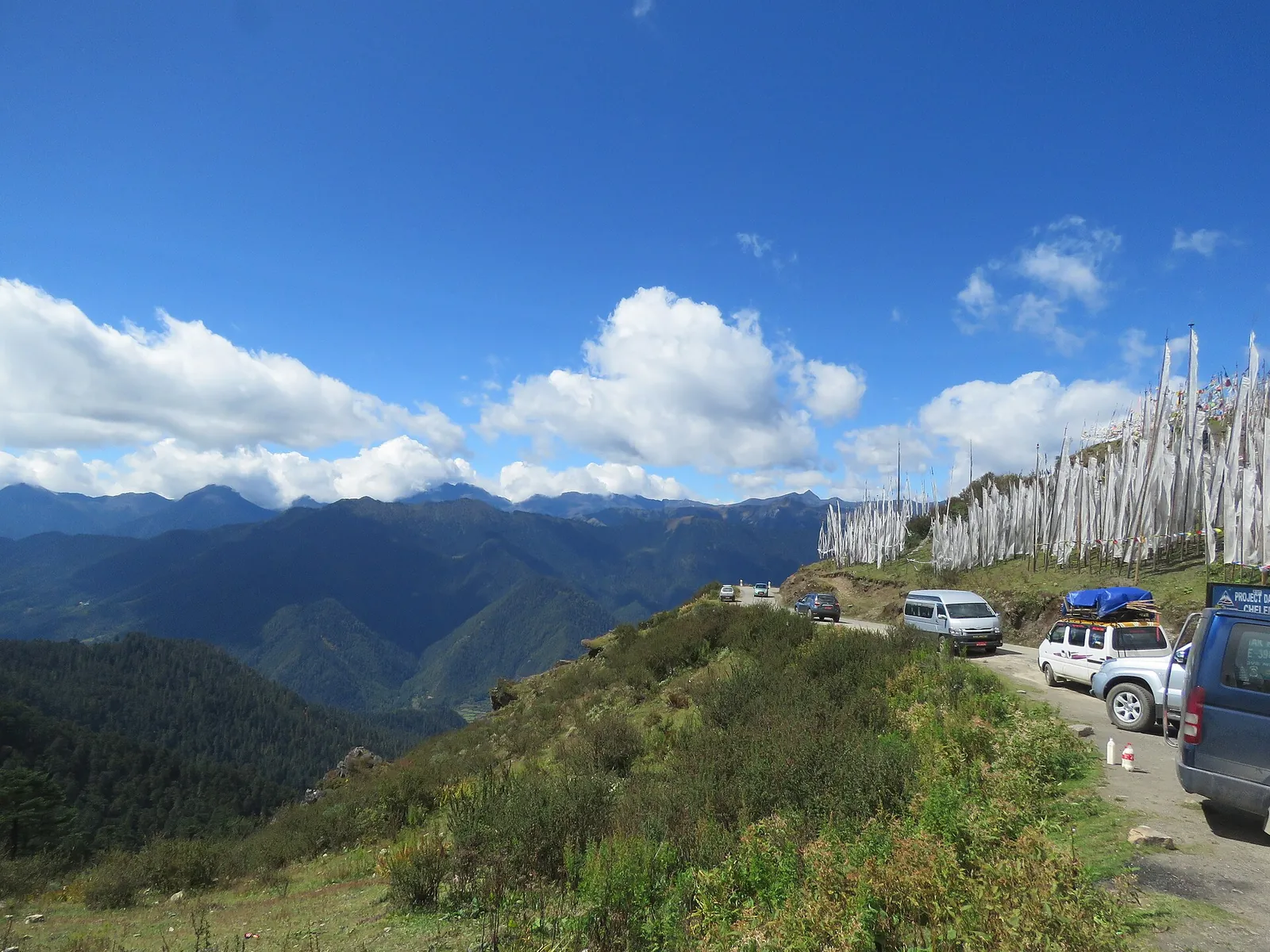
For a half-day high up, Chele La is the pass on the road from Paro to the Haa valley. At 3,988 m it is one of the highest motorable passes in Bhutan, with a walk of about two hours from the pass to Kila Nunnery and, on a clear day, a view of Jomolhari. The pass is 35 km and about 1.5 hours by car from Paro, and Haa 65 km and 1.5–2 hours, on a narrow, winding road through blue pine, fir and rhododendron; the pass itself is a bare saddle covered in prayer flags, and much colder and windier than the valley. Snow can close the road without notice, so decide on the morning, and go by daylight.
Flying into Paro and driving on to Thimphu
Paro International Airport (PBH) is Bhutan's gateway. Drukair and Bhutan Airlines fly to Paro from Bangkok, Delhi, Kolkata, Bagdogra, Bodhgaya, Dhaka, Kathmandu, Guwahati, Dubai and Singapore. The landing is part of the trip: the approach winds down a narrow valley between forested ridges, passing close to forested mountainsides, and pilots fly it by hand, in daylight and clear visibility only, onto a runway of about 2.3 km. Your guide can meet you at the terminal. Flights in and out of Paro depend on the weather and can be delayed or cancelled, so leave a spare day before an onward long-haul flight. Travel by road in daylight only, even with a driver, and in the monsoon, June to September, allow for landslides that can close roads for days.
A western Bhutan loop can take you from the airport to Thimphu, 47 km and 1–1.5 hours, then over Dochula to Punakha, and back to Paro for the last two nights. Our Thimphu and Punakha guide covers the first two stops, and the 7-day itinerary puts the three valleys together with the Tiger's Nest on day 6.
Most international visitors need a tourist visa (USD 40) and pay the Sustainable Development Fee (SDF): USD 100 per adult per night through 31 August 2027, USD 50 for children aged 6 to under 12 and nothing under 6. Indian nationals need a permit rather than a visa and pay a different SDF; the first 15,000 Bangladeshi guests qualify for a lower rate. Bangladeshis and Maldivians may apply for a visa on arrival. The SDF and visa fee are paid with the application; our entry guide explains the steps.
Dress, photographs and stray dogs
In dzongs and temples, wear clothing that covers you from shoulders to knees, with long sleeves and covered legs in temples, as the Department of Tourism asks; wear the same on the Tiger's Nest walk so that you can go straight into the temples at the top. Keep your camera away in temples and dzong shrine rooms; courtyards and the outside of buildings are usually fine to photograph, and your guide will tell you where not to.
Stray dogs roam in places: keep your distance, and after a bite go straight to the nearest hospital for rabies treatment, as France advises.
What two nights in Paro cost
Guided Bhutan's calculator, checked on 2 November 2026, estimates USD 1,160 for two adults for a separate three-day, two-night trip in standard three-star hotels. This is an estimate for a trip of that length, not a price for the Paro portion of the week; the operator's quote sets the actual route and cost.
The estimate includes USD 400 in SDF, USD 80 in visas and USD 680 in estimated tour services: hotels, a licensed guide, a vehicle and driver, meals and permits. Ask for the entry fees and the planned hotels and route in your quote. International flights, insurance, tips, drinks and personal purchases are extra.
Bhutan Telecom lists a seven-day tourist SIM for Nu 200. Hotel Paro Grand lists evening tea and snacks at Nu 100 and mineral water at Nu 25, plus its stated 10% BST and 10% service charge. Guided Bhutan suggests USD 10–15 per traveller per day for a guide and USD 5–10 for a driver; tipping is optional. Our trip cost guide prices a complete week.
Practical questions
How many nights do I need in Paro?
Two. Paro works best at the end of a week in the western valleys, after Thimphu and Punakha, when you are used to the altitude.
How long does the Tiger's Nest hike take?
5–6 hours in all, on the Department of Tourism's figure. The trail is roughly 6 km there and back, with 1.5–3 hours up for most people and about an hour inside the monastery.
What time should I start the Tiger's Nest hike?
Start early. The Department of Tourism's monument list gives 09:00–12:00 and 14:00–17:00 but also says there is no lunch break; ask your guide for the current hours.
How much does it cost to enter the Tiger's Nest?
Nu 1,000 for adults; under-18s pay half and children of five and under go free. Most packages include it.
Can I ride a horse up to the Tiger's Nest?
Only up to the cafeteria, about halfway, and only on the way up. The Department of Tourism says to book in advance through the Taktsang services management; your guide can arrange it at extra cost.
What can I see in Paro if I do not hike?
The National Museum, Rinpung Dzong and Kyichu Lhakhang, and Drukgyel Dzong at the head of the valley, rebuilt from 2016 to 2023 after decades in ruins. Chele La is a drive, with an optional walk.
Can I hike to the Tiger's Nest without a guide?
No. A certified guide must be with you at all times in Bhutan, and a guide is needed to enter monuments.
Keep planning your trip
Thimphu and Punakha
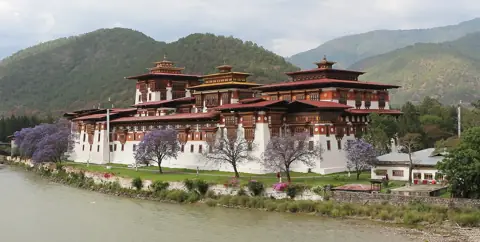
Two nights in Thimphu and two in Punakha: Buddha Dordenma, Tashichho Dzong at dusk, the drive over Dochula, Punakha Dzong and Chimi Lhakhang, with fees, hotels and costs.
Read the guide
Bhutan in seven days
Two nights each in Thimphu, Punakha and Paro, with Dochula on day 3 and the Tiger's Nest hike on day 6: drive times, hotels, the fees and an all-in budget.
Read the guide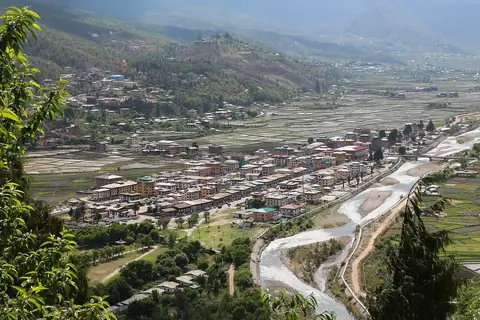
Bhutan trip cost
A Bhutan week for two: about USD 1,880 per person on a budget, USD 2,080 mid-range or USD 2,520 in four-star rooms, plus international flights.
Read the guide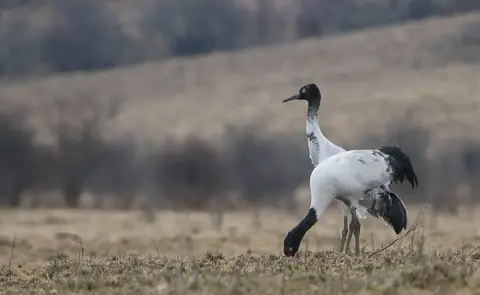
Bhutan festivals and events 2027
Tentative 2027 Bhutan festival dates: Punakha in February, Paro in March, Thimphu in October and the crane festival in November.
Read the guide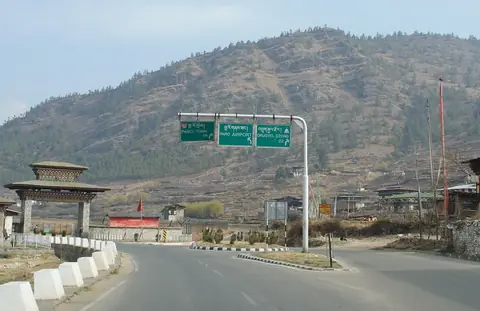
Entering Bhutan
Bhutan visa, the standard USD 100 nightly SDF to August 2027, certified guides and customs for UK and EU visitors.
Read the guide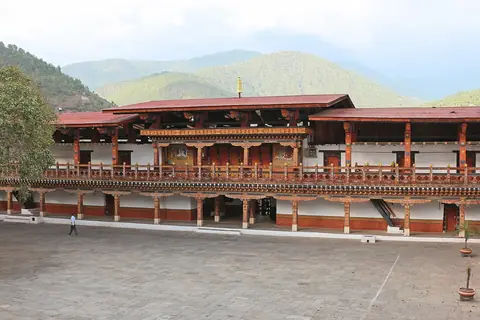
First trip to Bhutan
A first week in Bhutan: the visa and nightly fee, why a certified guide comes along, the Paro, Thimphu and Punakha loop, money, SIMs, etiquette and daily costs.
Read the guideSources and checks before you travel
(43)
- Paro Taktshang (Department of Culture and Dzongkha Development, Ministry of Home Affairs) ↗ — opens in a new tab
- Department of Tourism: adventure experiences ↗ — opens in a new tab
- Department of Tourism: Museums and Monuments Fees of Bhutan (monument list linked from the FAQ) ↗ — opens in a new tab
- Department of Tourism: FAQs ↗ — opens in a new tab
- Department of Tourism: visa ↗ — opens in a new tab
- Department of Tourism: announcements ↗ — opens in a new tab
- Department of Tourism: tentative festival dates for 2027 ↗ — opens in a new tab
- Department of Tourism: Chele La in 'Soulful journeys' ↗ — opens in a new tab
- Department of Tourism: wellness and wellbeing ↗ — opens in a new tab
- Department of Tourism: the diverse and delicious food of Bhutan ↗ — opens in a new tab
- Department of Tourism: food and drink ↗ — opens in a new tab
- National Museum of Bhutan (Department of Culture museums site) ↗ — opens in a new tab
- BBS: Drugyel Dzong will be reconstructed to its former glory ahead of schedule ↗ — opens in a new tab
- Little Bhutan (DoT-listed operator): Drugyel Dzong ↗ — opens in a new tab
- HIDMC (tour operator): Bhutanese food tourism, where to go ↗ — opens in a new tab
- Little Bhutan (DoT-listed operator): Tiger's Nest ↗ — opens in a new tab
- Little Bhutan: Rinpung Dzong ↗ — opens in a new tab
- Little Bhutan: Kyichu Lhakhang ↗ — opens in a new tab
- Little Bhutan: Chele La Pass ↗ — opens in a new tab
- Little Bhutan: Bhutan 7-day itinerary ↗ — opens in a new tab
- Guided Bhutan: trip cost calculator (3 days) ↗ — opens in a new tab
- Hotel Olathang (Bhutan Hotels and Restaurants) ↗ — opens in a new tab
- Olathang Cottages (Bhutan Hotels and Restaurants) ↗ — opens in a new tab
- Udumwara Resort: Deluxe rooms at Villas ↗ — opens in a new tab
- Department of Tourism services portal: Hotel Olathang ↗ — opens in a new tab
- Department of Tourism services portal: Olathang Cottages ↗ — opens in a new tab
- Department of Tourism services portal: Udumwara Resort ↗ — opens in a new tab
- Bhutan Hotels and Restaurants: Taktsang Cafeteria ↗ — opens in a new tab
- Hotel Paro Grand: standard deluxe room and meal rates ↗ — opens in a new tab
- Hotel Paro Grand: Bhutanese cuisine in Paro ↗ — opens in a new tab
- Hotel Paro Grand: Paro Grand Restaurant ↗ — opens in a new tab
- Guided Bhutan: hiring a guide in Bhutan ↗ — opens in a new tab
- Bhutan Telecom: tourist SIM ↗ — opens in a new tab
- Bhutan Travel Bureau (tour operator): driving distances ↗ — opens in a new tab
- Bank of Bhutan: current rate of exchange ↗ — opens in a new tab
- UK Foreign Office: Bhutan safety and health ↗ — opens in a new tab
- German Foreign Office: Bhutan travel and safety advice ↗ — opens in a new tab
- French Foreign Ministry: Bhutan advice (useful information, health, security) ↗ — opens in a new tab
- Daily Bhutan: most popular restaurants in Paro ↗ — opens in a new tab
- Druk Asia (Drukair agent): 7 facts about flying into Bhutan, with a Drukair pilot ↗ — opens in a new tab
- Department of Tourism: visit and travel etiquette ↗ — opens in a new tab
- UK government: Bhutan health advice ↗ — opens in a new tab
- France: Bhutan safety advice ↗ — opens in a new tab
Reference sources for the version dated 2 November 2026. Confirm opening times, access, transport and conditions for your travel dates.
Photo credits
(6)
Paro Taktsang, the Tiger's Nest, on its cliff above the Paro valley
Photograph: Gerd Eichmann — opens in a new tab · CC BY-SA 4.0 — opens in a new tab
Changes: Resized and converted to WebP; displayed with responsive crops. · Original photograph and licence details ↗ — opens in a new tab
Horses and prayer flags at the start of the Taktsang trail
Photograph: Bernard Gagnon — opens in a new tab · CC BY-SA 4.0 — opens in a new tab
Changes: Resized and converted to WebP; displayed with responsive crops. · Original photograph and licence details ↗ — opens in a new tab
Rinpung Dzong above the Paro valley
Photograph: Bernard Gagnon — opens in a new tab · CC BY-SA 4.0 — opens in a new tab
Changes: Resized and converted to WebP; displayed with responsive crops. · Original photograph and licence details ↗ — opens in a new tab
Nyamai Zam, the covered bridge below Rinpung Dzong
Photograph: Bernard Gagnon — opens in a new tab · CC BY-SA 4.0 — opens in a new tab
Changes: Resized and converted to WebP; displayed with responsive crops. · Original photograph and licence details ↗ — opens in a new tab
The National Museum of Bhutan in the Ta Dzong watchtower
Photograph: Bernard Gagnon — opens in a new tab · CC BY-SA 4.0 — opens in a new tab
Changes: Resized and converted to WebP; displayed with responsive crops. · Original photograph and licence details ↗ — opens in a new tab
Prayer flags at Chele La, on the road from Paro to Haa
Photograph: Vinayaraj — opens in a new tab · CC BY-SA 4.0 — opens in a new tab
Changes: Resized and converted to WebP; displayed with responsive crops. · Original photograph and licence details ↗ — opens in a new tab