Surat Thani
Khao Sok National Park: village, lake and raft-house stays
Khao Sok rewards travellers who recognise that its two headline experiences begin in different places. Khlong Sok village stands beside the national-park headquarters and is the base for forest walks, river trips and night wildlife outings. Cheow Lan Lake begins at Rajjaprabha Municipal Pier, on the far side of the park, where longtail boats run between limestone towers to simple floating raft houses. Three nights let you experience both without spending every morning in a vehicle. This guide explains the order, the park fee and raft-house rates, the seasonal closures that remove particular caves and flower trails, and the transfers to reserve before arrival.
In this guide
Find the location ↗ — opens in a new tabThe short answer
Book three nights: two in Khlong Sok village and one in a raft house on Cheow Lan Lake, and reserve the lake night before the flights or village activities, then fit the village nights around it. Two useful prices: national-park entry is THB200 per foreign adult and THB100 per child, and a park-run raft sleeping two with a shared bathroom is THB600 a night (Department of National Parks fee regulation, Government Gazette, 9 December 2021). Coming from Phuket, Khao Lak or Krabi, start in the village and finish on the lake; from Surat Thani Airport, put the lake first if your operator can collect you on that side. Give the village day to one guided forest activity and the lake day to the boat, raft house and the open seasonal outing rather than trying to commute between the two bases.
- Suggested time
- Three nights: two in Khlong Sok village and one on Cheow Lan Lake.
- Where to stay
- Khlong Sok village for the headquarters and forest; one separate night in a Cheow Lan Lake raft house reached from Rajjaprabha Municipal Pier.
- Season and timing
- Particular routes close for rain and conservation: the DNP sheet (data as of 7 January 2026) closes Nam Thalu Cave from 1 June to 30 November and the km 111 Rafflesia site from 1 April to 30 November; other activities remain subject to the day's park notice.
Split three nights between the village and the lake
Treat Khlong Sok village and Cheow Lan Lake as two bases, not two attractions reached from one hotel. The village gathers guesthouses, restaurants and activity desks close to the national-park headquarters. It is the practical starting point for guided forest walks, a river canoe or tubing trip and a night walk. The lake begins at Rajjaprabha Municipal Pier near the dam, followed by a boat journey to accommodation that cannot be reached by road.
For a first stay, book two village nights and one lake night. The extra village night protects the trip from a late arrival and gives you a full forest day without carrying luggage. The lake night earns its place because the water is calmest and the limestone silhouettes most atmospheric after the day boats leave and before they return. It also turns the boat ride, meals and a guided outing into part of the stay rather than a rushed excursion squeezed between two long road transfers.
From Phuket, Khao Lak or Krabi, the village is the natural first stop. Arrive, sleep beside the forest, take the guided land day, then travel to the pier for the raft-house night and leave towards Surat Thani. From Surat Thani Airport or the Gulf side, the order can be reversed when the operator offers a collection that reaches the pier first: lake night, village transfer, then two nights by the headquarters.
Keep the village programme deliberately short: choose either a substantial guided hike or a half-day walk plus a canoe trip, then leave space for the humidity, a long lunch and an early night.
On the lake, let the shared package define the order. A typical sequence is the road journey to the municipal pier, a longtail boat through the karst, lunch at or near the raft house, a guided walk or cave outing if the route is open, swimming or paddling in the designated area, dinner and an early-morning wildlife boat before returning. The exact raft house and outing can change with water and trail conditions; the durable booking is a lake night with a guide, boat and meals clearly included.
A two-night stay can work with one night at each base, but it leaves little room for a delayed arrival or changed trail. Three nights are the balanced first visit; add a fourth only for a slower village day or a second lake morning.
- Day 1: arrive in Khlong Sok village, settle into one room and use the afternoon for a canoe trip or a short guided activity.
- Day 2: take one guided forest day from the headquarters side, following the route currently open to visitors.
- Day 3: join the shared transfer and longtail boat to Cheow Lan Lake, then sleep in the raft house.
- Day 4: take the morning activity and the boat back, then continue towards Surat Thani or the next southern base.
Park fees, raft houses and how to book the lake night
Foreign visitors pay THB200 per adult and THB100 per child to enter Khao Sok National Park; a child is aged 3 to 14 or up to 140 cm. Khao Sok is in the second fee group of the Department of National Parks regulation published in the Government Gazette on 9 December 2021. When we checked on 26 October 2026, this 2021 regulation was still the one in force: the Department of National Parks' payment system still lists it among its rules. The same regulation charges boats a vehicle fee for entering a national park, THB20 for a long-tail boat carrying up to 20 passengers. Carry enough cash for the fee and for the day.
Park-run raft houses are priced in the same regulation. At the Khlong Ka unit beside Rajjaprabha Dam, a raft sleeping two with a shared bathroom is THB600 a night and a raft sleeping six with two bathrooms is THB1,800. The park's rafts at the Ao Somdet, Khlong Pae and Krai Son guard stations are THB400 a night for two with a shared bathroom. The Department of National Parks' portal carries a park-accommodation booking link (จองที่พักอุทยาน).
The other way onto the lake is a package or boat from a village operator, which bundles the longtail boat, a guide, meals and a bed. The boat and guide price is the operator's own. A package title can describe a land-only stay, so compare the number of lake nights, the group size, the meals and the bathroom type.
For two adults, the official prices add up to THB400 for park entry and THB600 for one night on a park-run two-person raft with a shared bathroom.
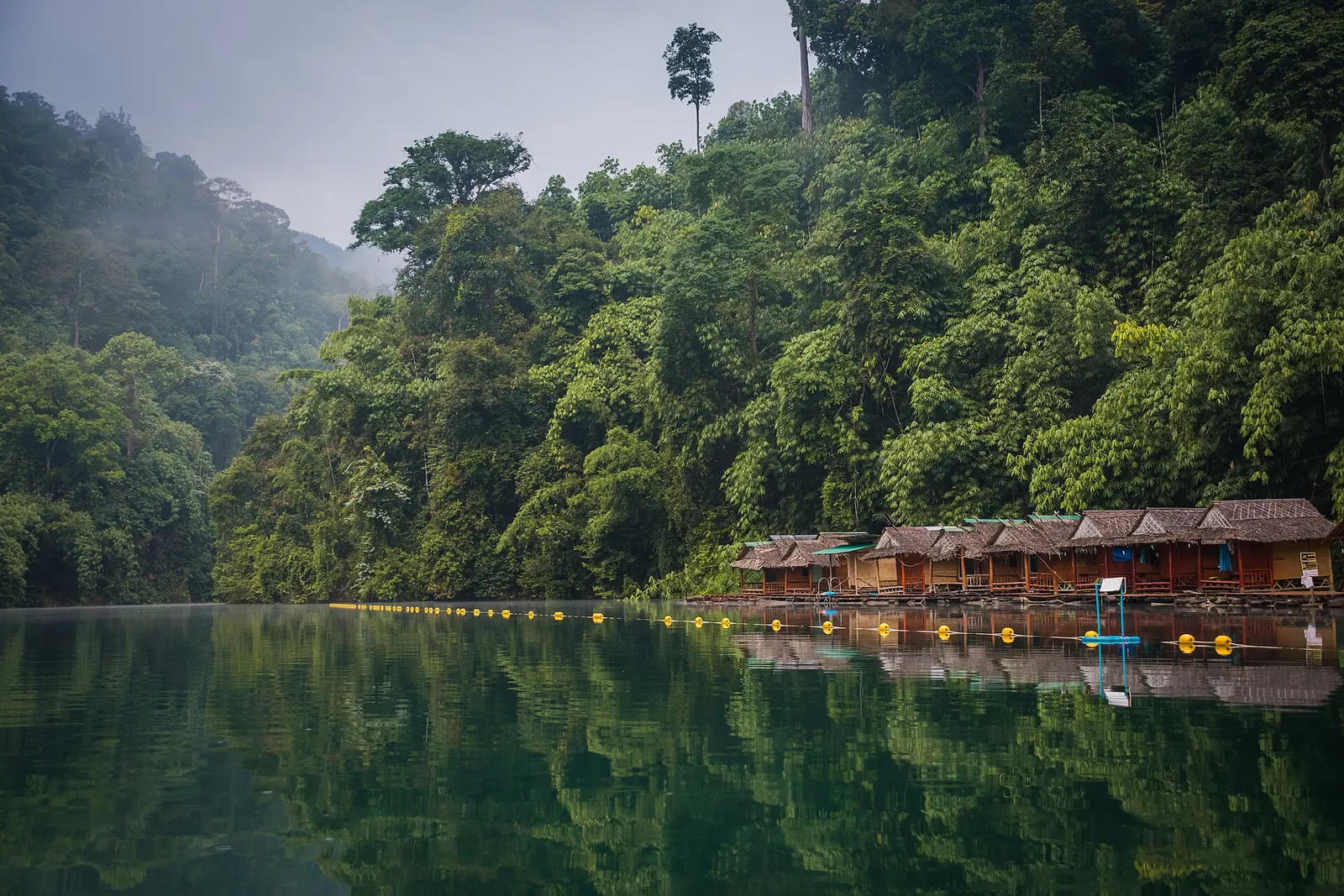
The raft house is a nature stay, not a floating resort category. Expect a compact room, wet boat landings and fewer meal choices than in the village. Pack one small overnight bag, sandals that grip, a dry pouch, a torch and essential medication.
Cheow Lan Lake begins with Rajjaprabha Dam and a boat
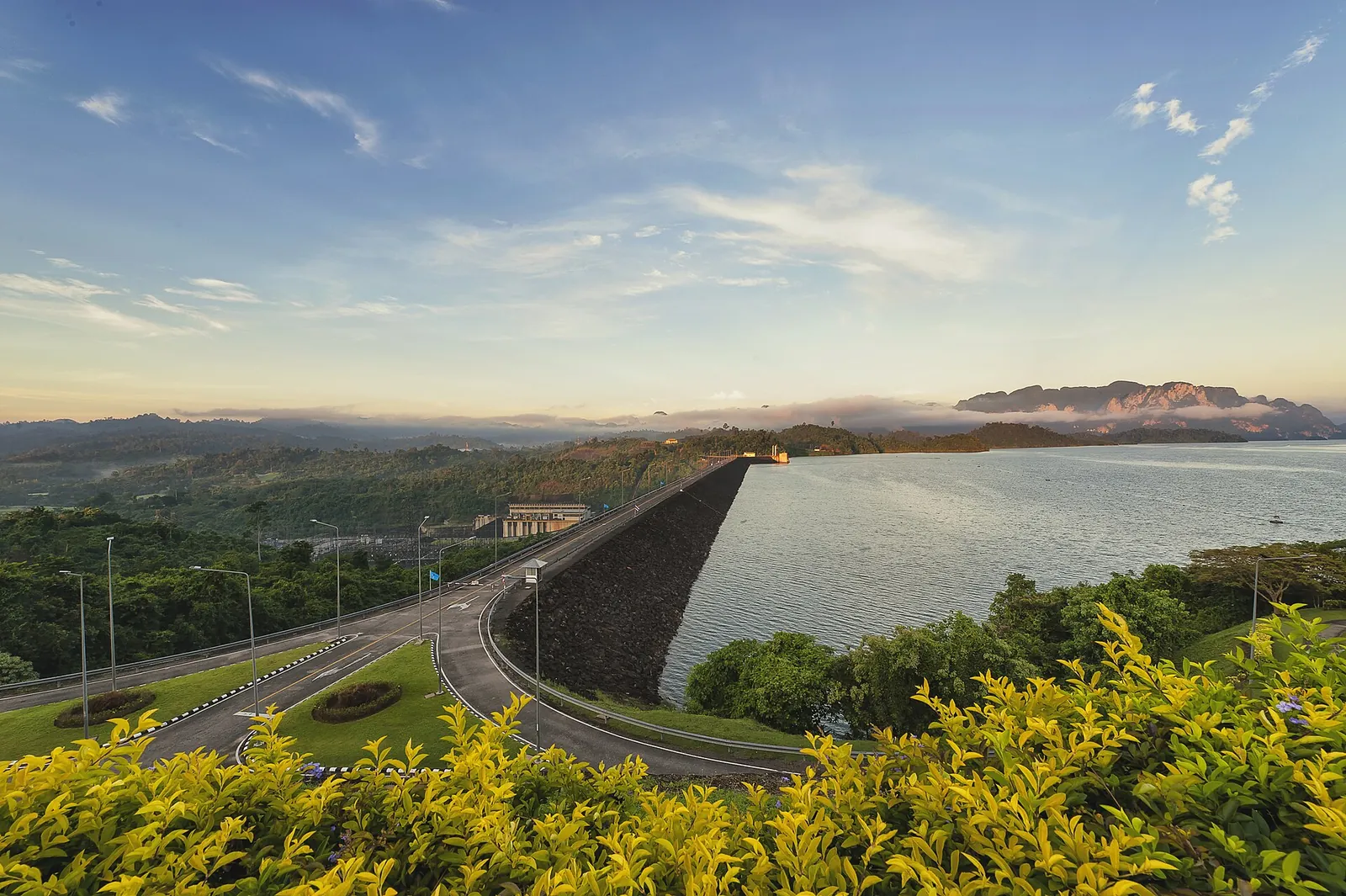
Cheow Lan is the reservoir behind Rajjaprabha Dam, and that origin explains both its scale and its geography. The Electricity Generating Authority of Thailand says construction began on 9 February 1982 and finished in September 1987; the dam was inaugurated on 30 September 1987. EGAT lists a height of 94 metres, a reservoir area of 185 square kilometres and a generating capacity of 240 MW. Forested ridges became peninsulas and islands, leaving the pale limestone towers that now frame the boat route.
The lake trip starts at Rajjaprabha Municipal Pier near the dam, not at the Khao Sok headquarters. A longtail boat is then transport, sightseeing and the only practical approach to most raft houses. The park's rafts sit in several zones of the lake (Khlong Ka by the dam, Ao Somdet, Khlong Pae and Krai Son), so the boat time depends on which raft you sleep on. Sit where the operator assigns the weight, keep the life jacket on while moving and protect electronics from spray.
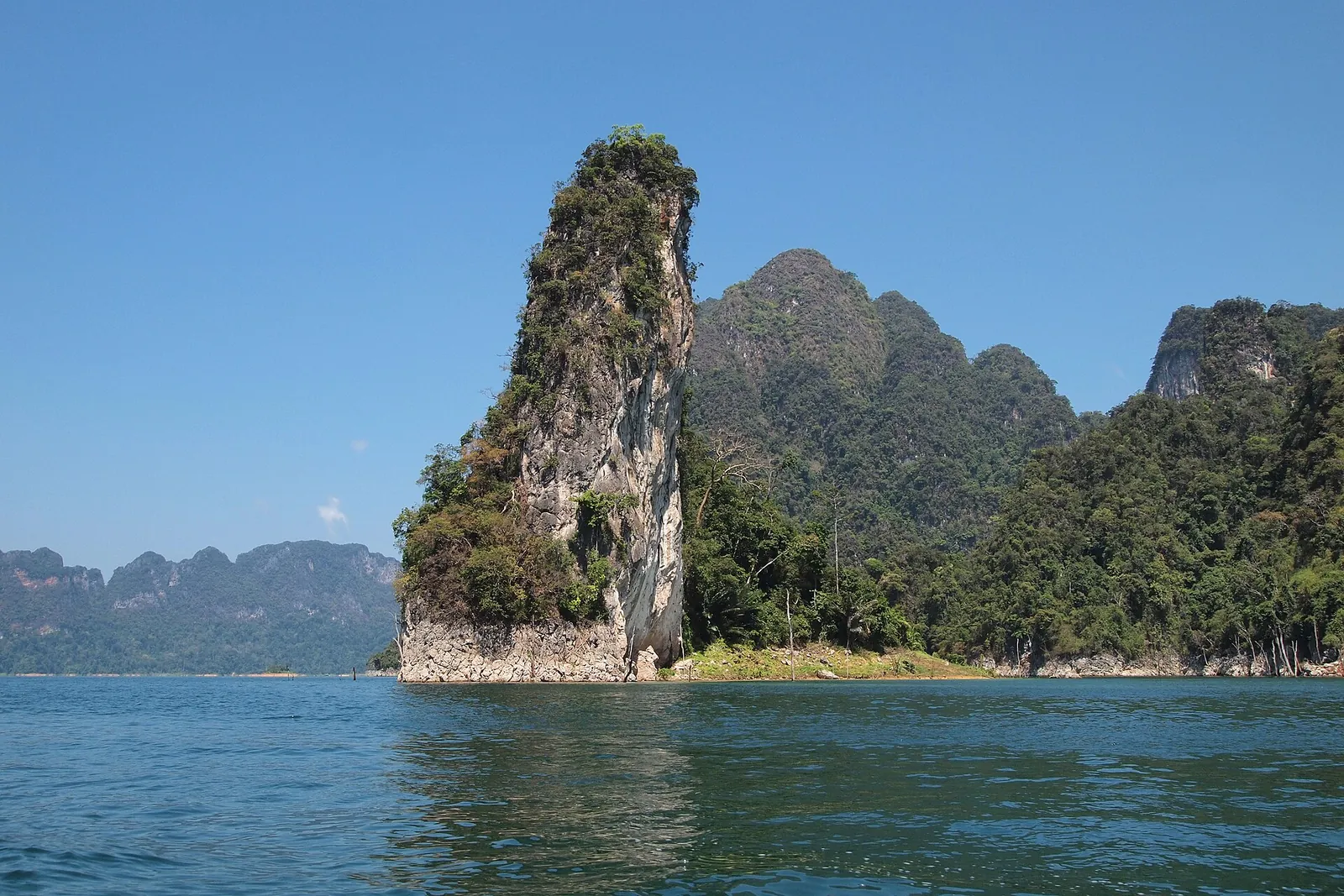
On the outward journey, look for the structure of the landscape: cliffs rise from the reservoir, wooded saddles link taller peaks and narrow water arms disappear into valleys. The ASEAN Centre for Biodiversity places the park in the Klong Saeng–Khao Sok Forest Complex; the lake is a route into that protected forest, not an isolated reservoir cruise.
A raft-house day normally balances movement and stillness: the boat in, lunch, an afternoon hike or time to swim, dinner, a night on the water and a morning-mist boat before breakfast. That shape is better than adding an extra cave or viewpoint simply to lengthen a list. Swimming belongs only in the designated area named by the guide, away from boat approaches; kayaking belongs close enough to the raft house to follow local instructions.
The morning is the reason to sleep on the water. Mist can sit between the ridges, gibbons or hornbills may be heard before engines begin, and the first boat reveals reflections that disappear when wind rises. Wildlife remains a possibility, not a package inclusion. A responsible guide slows down for sounds and tracks but does not chase an animal through the forest or promise elephants at a fixed bend.
The return boat is followed by another road journey, and the group may be dropped at the village before dispersing. Put an important flight or ferry on the following day.
Use the DNP closure calendar to choose the day's forest route
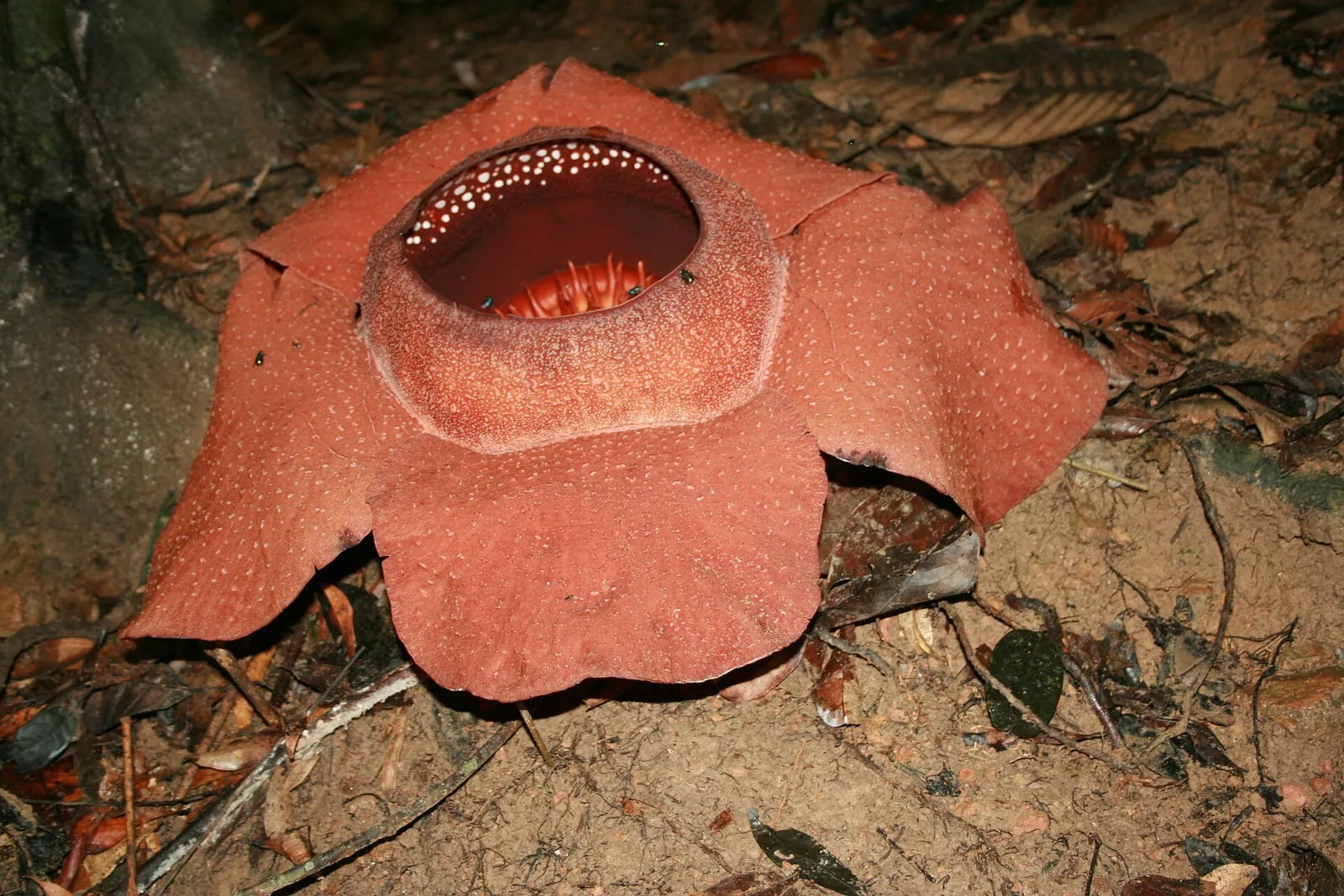
Khao Sok does not close as one unit for the wet season, but individual routes do. The Department of National Parks' public closure sheet, headed 'data as of 7 January 2026', lists Nam Thalu Cave closed every year from 1 June to 30 November. It lists the Rafflesia kerrii site at kilometre 111 closed from 1 April to 30 November. The same sheet marks the Bang Man Rafflesia site and the attraction named in Thai as Nam Tok Sip Et Chan, or Eleven-tier Waterfall, closed indefinitely. Those entries matter more than a tour description written for a different month.
This is the trip's single weather caution: heavy rain can raise streams and change cave, trail, river and boat access, so use the DNP sheet and the ranger's route for the day. A package sold during Nam Thalu's closure must use another outing. TAT explains that Thailand's parks close particular attractions seasonally for visitor safety and ecological recovery, and that the dates differ by location and conditions.
In the open season Nam Thalu Cave is one of the named outings on the sheet, and it is closed for half the calendar. Choose the package for the lake and forest, with the cave as a possible open-season component, not as a guaranteed centrepiece.
The Rafflesia has a similarly narrow logic. Rafflesia kerrii is one of the park's signature plants, named by both TAT and the ASEAN Centre for Biodiversity. A photograph of its huge mottled flower is not a promise that one will be open on your walking day. The km 111 site is closed from April through November in the current DNP table, while Bang Man has no reopening date. In the permitted period, a guide can use the park's current information to choose a legal route; outside it, enjoy the forest without sending anyone towards a shut site.
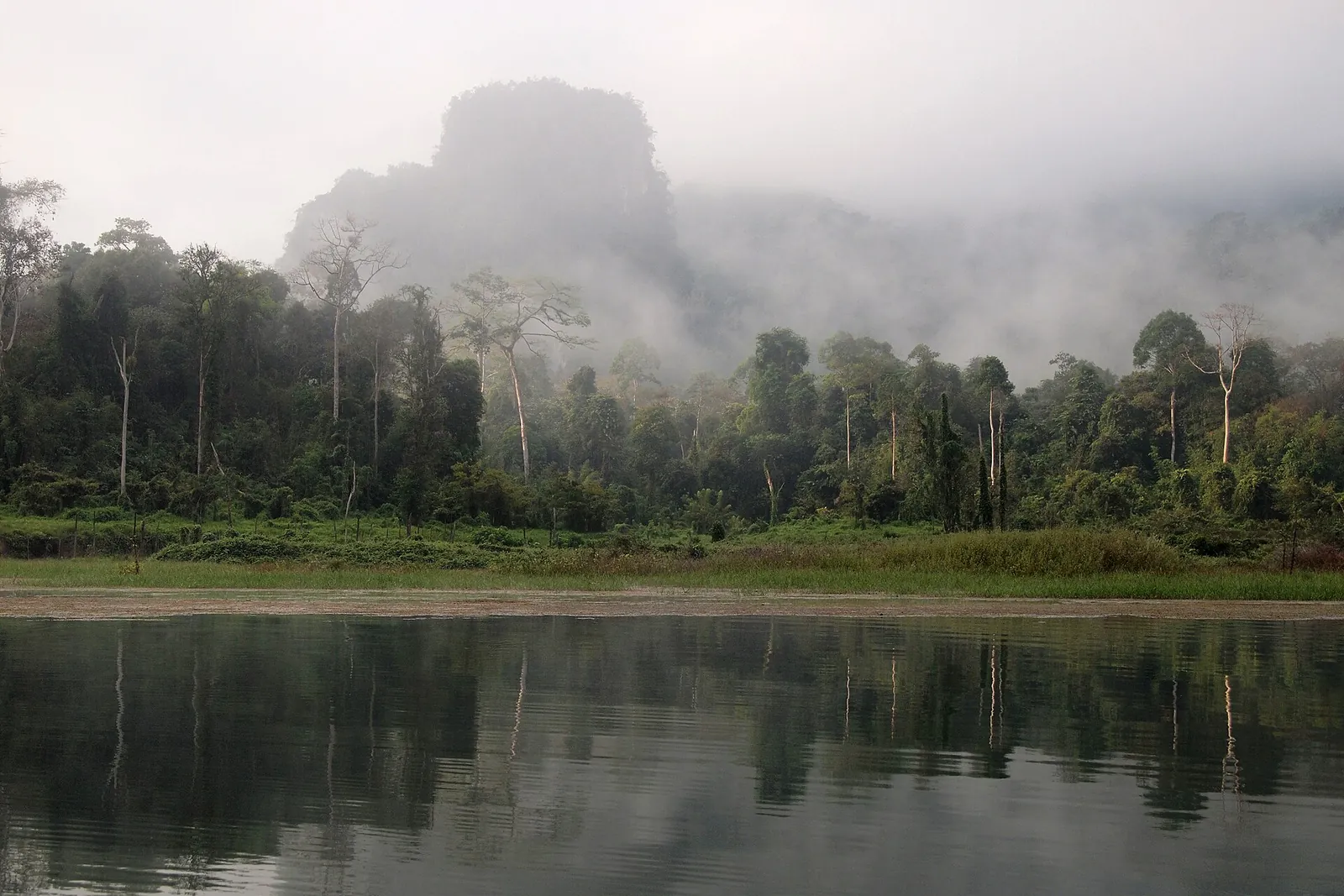
The headquarters side is rainforest over limestone. The Thailand Tourism Directory describes limestone spires and tower-like cliffs above tropical rain forest, where the Sok and Pha Saeng streams start and join to form the Pum Duang canal, a branch of the Tapee River; it lists hiking, bird-watching and nature trails among the park's activities. The DNP sheet names the closed sites but no open trail, and it does not say whether a guide is required. The forest is humid, roots become slick quickly, and a distance that sounds modest can take hours when the path climbs or crosses water. Long trousers, closed shoes, water, insect repellent and a dry layer are more useful than a rigid checklist of waterfalls. Leech socks are a sensible wet-ground addition, but they do not replace staying on the open trail.
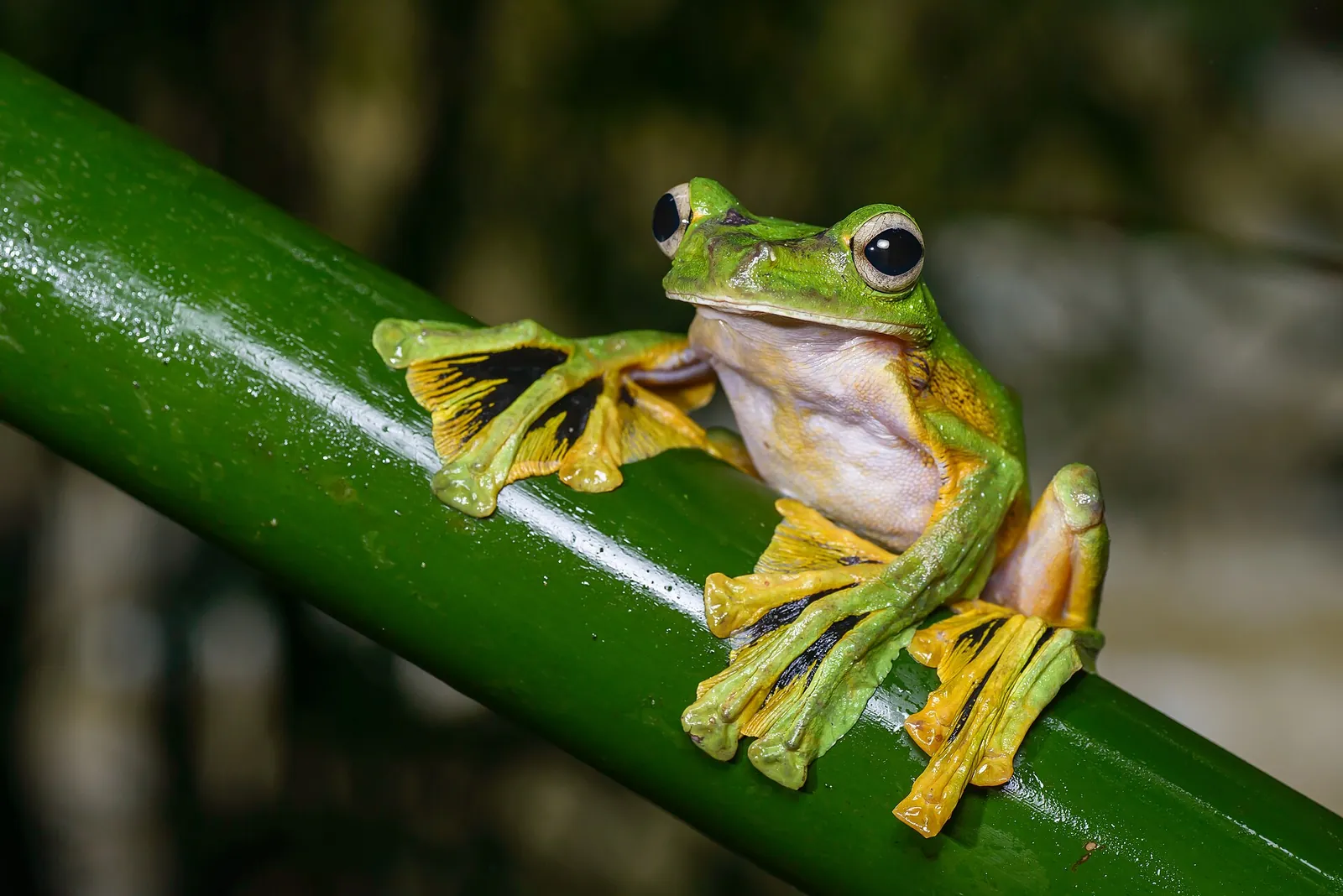
A guided night walk belongs to the village stay. Its appeal is the smaller life of the rainforest—frogs, insects, spiders, lizards and sleeping birds—rather than a promised large-mammal sighting. Move quietly and let the guide control light around animals.
For a lighter village afternoon, the Tourism Directory lists canoeing and tubing among the park's popular activities.
Look for a living rainforest, not a guaranteed animal list
Khao Sok became Thailand's 22nd national park in 1980 and covers 738.74 square kilometres in Phanom and Ban Ta Khun districts, according to TAT. It was designated the 50th ASEAN Heritage Park in 2020. The recognition reflects a connected landscape of rugged limestone, evergreen forest and water, and it places conservation at the centre of the visit rather than treating the lake as scenery around a resort. The ASEAN Centre for Biodiversity puts moist evergreen forest at about 65% of the park, the reservoir at about 25% and limestone karst at about 9%.
The ASEAN Centre for Biodiversity records 95 mammals, 296 birds, 96 reptiles, 46 amphibians and 118 fish species in the park, alongside 86 tree species in moist evergreen forest and 44 plant species associated with limestone karst. Its list includes Asian elephant, Malayan tapir, lar gibbon, Sunda pangolin and the helmeted hornbill. These are records from the protected area, not a visitor's probable sightings over three nights.
The sounds arrive before the animals. Gibbons may call across the ridges at dawn; hornbills can cross a gap above the lake; macaques may move through roadside trees. On the water, a distant silhouette or movement at the forest edge deserves a slow approach and space. On land, tracks, fruit remains and calls are part of the guide's interpretation even when the animal stays hidden.
Large mammals should never be pursued. A shared morning boat can pause offshore while guests watch the canopy, and a forest guide may change direction when fresh elephant signs appear. That is good guiding, not a missed attraction. Feed nothing, remove nothing and keep sound low around a raft house after dark, when the water carries voices farther than expected.
The park's limestone flora includes the endemic Khaosokia caricoides, while Rafflesia kerrii is the best-known flower. The DNP closure calendar governs access to its named sites; never follow a social-media pin across a closed trail. The overnight pattern improves the odds without selling certainty: village forest at dusk, lake edge at dawn, and two guides reading two habitats.
Reach the correct base from Surat Thani or the Andaman coast
Surat Thani Airport (URT) suits a Gulf-side route; Phuket Airport (HKT) suits an Andaman-coast route. Neither is at a park gate. Name Khlong Sok village, Rajjaprabha Municipal Pier or the exact meeting point to the driver, because ‘Khao Sok’ alone does not identify the road destination.
TAT's 2026 southern fruit calendar describes Surat Thani as reachable by air or rail, with onward road transfers to Khao Sok and Rajjaprabha Dam.
From the Gulf islands, buy a through boat-and-road product whose final destination is Khao Sok or Surat Thani, with the onward van named. Lomprayah's official timetable page publishes its 2026 Gulf network, and its terms require passengers at the office 60 minutes before departure, make tickets non-refundable and allow weather-related schedule changes. Its office page distinguishes Donsak and Tapee locations in Surat Thani. Those names matter when a road transfer is meeting the ferry.
From Khao Lak, Phuket or Krabi, a road transfer to Khlong Sok is simpler than crossing Surat Thani first. Place the village first, then move once to the lake pier. Returning to the Andaman coast after the lake can create backtracking, which is why a route finishing in Surat Thani normally flows better.
Let the package finish before another independent ticket begins, and sleep in Surat Thani or the next coastal base before a flight that cannot be missed.
Plan southern meals around the two-base stay
The village is where you choose meals; the raft house follows a set programme. Count how many meals a package includes rather than relying on the phrase ‘meals included’.
For food that belongs to southern Thailand, begin with kaeng som pla. TAT describes southern cooking as sharp and chilli-led, with sour tamarind, seafood, lemongrass and makrut-lime leaf, and names this hot-and-sour fish curry among its staples. It has no coconut milk to soften the heat. Order it with rice and another mild plate, and share it rather than treating it as a solitary bowl after a hot hike.
Khao yam pak tai is the cooler counterpoint: a rice salad of vegetables, sour fruit, roasted coconut, herbs and a salty fermented dressing. TAT's regional dish guide names carrots, long beans, sour mango, pomelo, dried shrimp or fish, lemongrass, makrut-lime leaf and chilli among the possible ingredients. It suits lunch in the village before a canoe trip, when a heavy curry would feel out of place.
Two more southern plates add texture. Pla thot kamin is fish fried with garlic and turmeric until slightly crisp, while phat sato combines strongly scented stink beans with curry paste and commonly pork or prawns. Both are identified by TAT as southern dishes. Vegetarian travellers should note that a vegetable-led plate may still contain shrimp paste, fish sauce or meat; a made-to-order kitchen is easier than a fixed raft-house menu for dietary needs.
Surat Thani province contributes its own ingredients. TAT identifies the province with large oysters, river prawns and salted duck eggs, and its 2026 fruit calendar names Nasan rambutan and salak, Khlong Noi santol and Khlong Saeng durian. The same calendar proposes Khao Sok and Cheow Lan as part of a fruit-led Surat Thani route. Fruit availability follows harvest conditions, so buy what is ripe at a village or roadside stall instead of travelling for a named variety on a fixed date.
Keep transfer snacks sealed around wildlife and take all packaging out. Send dietary needs to the package operator before departure because the raft kitchen serves a limited group menu. Use village dinners for sour curries, turmeric fish and rice salads; on the raft, the shared table is part of the stay.
What to eat and where to look
Kaeng som pla
A sharp southern fish curry or soup soured with tamarind, rich in chilli and made without coconut milk.
- Where to look
- Thai kitchens in Khlong Sok village, where it can be paired with a milder plate.
- Fit it into your day
- Share at dinner with rice after the forest day.
Southern versions can be extremely hot; choose the chilli level before the pot is cooked.
Khao yam pak tai
A southern rice salad layered with herbs, vegetables, sour fruit, roasted coconut and a salty fermented dressing.
- Where to look
- Village restaurants serving a southern lunch rather than a generic tour buffet.
- Fit it into your day
- Lunch before a river activity or on the free village afternoon.
The dressing commonly contains fermented fish or prawns; request a suitable version for a vegetarian diet.
Pla thot kamin
Southern-style fish fried with garlic and turmeric until the outside is lightly crisp.
- Where to look
- Made-to-order restaurants in Khlong Sok village.
- Fit it into your day
- A shared dinner plate with rice, vegetables and a sour curry.
A whole fish can contain fine bones; eat it slowly in good light.
Phat sato
Strongly scented stink beans stir-fried with curry paste, commonly with prawns or pork in southern kitchens.
- Where to look
- Local Thai restaurants around the village when sato is available.
- Fit it into your day
- One savoury plate in a shared dinner, balanced by rice and a milder vegetable dish.
It is not usually vegetarian even when beans dominate the plate; the paste may contain shrimp.
Surat Thani fruit
Nasan rambutan and salak, Khlong Noi santol and Khlong Saeng durian are among the province's fruits highlighted by TAT's 2026 calendar.
- Where to look
- Village and roadside fruit stalls; buy the variety that is ripe during your stay.
- Fit it into your day
- Breakfast extra or a sealed snack for the road transfer, not food for a wildlife trail.
Harvest dates move with local conditions, so a named variety may not be available every week.
Reserve in the order that protects the lake night
Start with the lake night, because the raft house, group boat and guide must line up. Next secure the arrival that reaches the pier or village in daylight, then the onward night after the boat. The forest activity comes last, chosen from what the park has open during the stay.
The closures in the plan above apply to the stay: a guide can replace a closed site with an open walk or a quieter lake activity, and the two-base plan still works because it is built around the forest and water, not one cave.
Travel advice differs by government. On 13 October 2026, the UK FCDO and German Foreign Office warnings named Thailand's far-southern provinces and areas within 20 km of the Cambodian border; France Diplomatie, read on 14 October 2026, formally advises against Narathiwat, Pattani, Yala and Songkhla and against the entire Myanmar border except Mae Sot, very formally advises against the area within 50 km of the Cambodian border, and advises against Satun and Phatthalung except for compelling reasons. Khao Sok and the transfers in this guide remain in Surat Thani, Phang Nga, Phuket and Krabi, outside those named routes. Other governments draw their own lines, so use your own government's advice and insurance terms for the full Thailand itinerary.
Keep the stay simple enough to absorb rain. A lake outing can change while the raft-house night continues; a forest route can shorten while the village room remains useful. Pack closed walking shoes, long trousers, rain protection, water, insect repellent and regular medication for the forest, then sandals with grip, a dry bag and torch for the raft.
Before paying, check the bathroom type, group size, meals, whether park entry is included, the pickup and the final drop-off. A package that names these clearly is easier to fit into a larger holiday than a cheap ‘Cheow Lan tour’ with no base or endpoint.
- First: the shared lake package and exact raft-house room type.
- Second: the daylight arrival and the transfer between bases.
- Third: the onward night after the lake, before any important flight or ferry.
- Last: the village forest activity, selected from the DNP routes open during the stay.
Practical questions
How many nights do I need in Khao Sok?
Book three nights: two in Khlong Sok village for the headquarters side and one in a raft house on Cheow Lan Lake. Two nights works with one at each base, but it leaves no buffer for a late arrival or a weather-led change.
Should I stay in Khao Sok village or on Cheow Lan Lake?
Stay in both. The village gives you forest guides, river activities, restaurants and a stable arrival base; the lake night includes the longtail-boat journey, simple raft accommodation and the quiet dawn that a day trip misses.
How much do the park fee and a raft house cost?
Foreign adults pay THB200 and children THB100 to enter Khao Sok National Park. A park-run raft sleeping two with a shared bathroom is THB600 a night and one sleeping six with two bathrooms is THB1,800, under the Department of National Parks regulation of 9 December 2021.
When is Nam Thalu Cave closed?
The Department of National Parks sheet (data as of 7 January 2026) closes Nam Thalu Cave annually from 1 June to 30 November. During those months, choose a package for the lake stay itself and use the alternative outing selected by the park and guide.
Can I see Rafflesia in Khao Sok?
Possibly, but access and flowering are separate questions. The DNP sheet closes the km 111 Rafflesia site from 1 April to 30 November and lists Bang Man closed indefinitely, so use only an open park route with a guide and never plan the trip around a guaranteed flower.
Which airport is best for Khao Sok?
Surat Thani Airport (URT) fits a route towards the Gulf and can put the lake first; Phuket Airport (HKT) fits an Andaman-coast route and normally puts Khlong Sok village first.
Keep planning your trip

Getting around Thailand
Choose trains or flights between regions, the right Bangkok airport and station, and named ferry piers, with published fares and room for connections.
Read the guide
Khao Lak and the Similan Islands
Plan five nights in Khao Lak, choose the right beach, book a shared Similan day from Thap Lamu, and add Takua Pa and the tsunami memorials.
Read the guide
Phuket
Choose the right Phuket base, plan five nights, use the airport bus and budget a Phi Phi or Phang Nga Bay boat day with its park fees.
Read the guide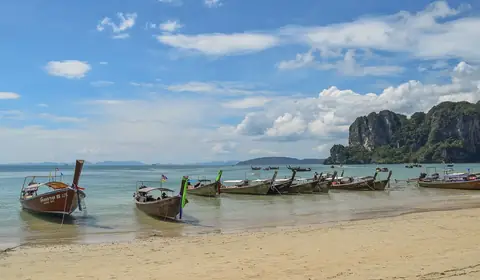
Krabi
Plan five nights in Krabi: three in Ao Nang, two on Railay, an island cruise, forest pools and a complete two-adult budget with transfers.
Read the guide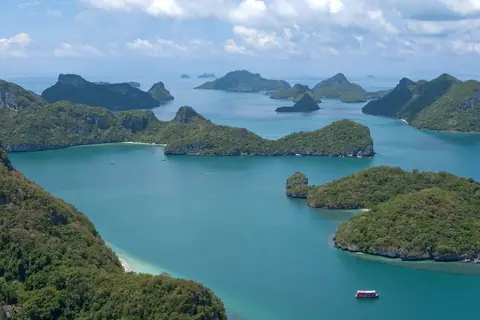
Koh Samui
Book five nights on Koh Samui: choose the right beach, arrive through USM or Donsak, tour the island and reserve an Ang Thong day in season.
Read the guide
Thailand islands
Choose the right Thai island by season, beach style and ferry route, with a seven-night plan, current fares and closure dates.
Read the guideSources and checks before you travel
(21)
- Tourism Authority of Thailand: Khao Sok as the 50th ASEAN Heritage Park ↗ — opens in a new tab
- ASEAN Centre for Biodiversity: Khao Sok National Park ↗ — opens in a new tab
- Electricity Generating Authority of Thailand: Rajjaprabha Dam ↗ — opens in a new tab
- Department of National Parks: public attraction status sheet ↗ — opens in a new tab
- Tourism Authority of Thailand: annual national-park closure guidance ↗ — opens in a new tab
- Department of National Parks fee regulation (Government Gazette vol. 138, special part 301 Ng, 9 December 2021), DNP-hosted copy ↗ — opens in a new tab
- Thailand Tourism Directory: Khao Sok National Park ↗ — opens in a new tab
- Department of National Parks: national-park portal ↗ — opens in a new tab
- Tourism Authority of Thailand: cuisine of Thailand's four regions ↗ — opens in a new tab
- Tourism Authority of Thailand: regional dishes ↗ — opens in a new tab
- Tourism Authority of Thailand: Surat Thani food ↗ — opens in a new tab
- Tourism Authority of Thailand: southern fruit calendar 2026 ↗ — opens in a new tab
- International Air Transport Association: URT code ↗ — opens in a new tab
- Lomprayah: 2026 timetable page ↗ — opens in a new tab
- Lomprayah: passenger terms ↗ — opens in a new tab
- Lomprayah: offices and piers ↗ — opens in a new tab
- Thai Meteorological Department: seven-day forecast dated 13 October 2026 ↗ — opens in a new tab
- UK FCDO: Thailand travel advice ↗ — opens in a new tab
- German Foreign Office: Thailand travel advice ↗ — opens in a new tab
- France Diplomatie: Thailand security advice ↗ — opens in a new tab
- Department of National Parks: central e-payment system, rules and regulations ↗ — opens in a new tab
Reference sources for the version dated 26 October 2026. Confirm opening times, access, transport and conditions for your travel dates.
Photo credits
(6)
Karst pinnacles on Cheow Lan Lake.
Photograph: Vyacheslav Argenberg — opens in a new tab · CC BY 4.0 — opens in a new tab
Changes: Resized and converted to WebP; displayed with responsive crops. · Original photograph and licence details ↗ — opens in a new tab
Raft houses on Cheow Lan Lake.
Photograph: Marcin Kaliński marcinkalinski — opens in a new tab · CC0 — opens in a new tab
Changes: Resized and converted to WebP; displayed with responsive crops. · Original photograph and licence details ↗ — opens in a new tab
Rainforest around Cheow Lan Lake.
Photograph: Vyacheslav Argenberg — opens in a new tab · CC BY 4.0 — opens in a new tab
Changes: Resized and converted to WebP; displayed with responsive crops. · Original photograph and licence details ↗ — opens in a new tab
Ratchaprapha (Cheow Lan) Dam.
Photograph: Preecha.MJ — opens in a new tab · CC BY-SA 4.0 — opens in a new tab
Changes: Resized and converted to WebP; displayed with responsive crops. · Original photograph and licence details ↗ — opens in a new tab
Rafflesia kerrii near Khao Sok.
Photograph: Ahoerstemeier — opens in a new tab · CC BY-SA 3.0 — opens in a new tab
Changes: Resized and converted to WebP; displayed with responsive crops. · Original photograph and licence details ↗ — opens in a new tab
A Wallace's flying frog.
Photograph: Rushenb — opens in a new tab · CC BY-SA 4.0 — opens in a new tab
Changes: Resized and converted to WebP; displayed with responsive crops. · Original photograph and licence details ↗ — opens in a new tab