Plan your trip
Holi 2027 in India: dates, where to go and what to expect
Holi is the day India stops worrying about its clothes. On the colour day, streets, temple courtyards and rooftops fill with people throwing gulaal, the coloured powder, and squirting coloured water, to the beat of the dhol drum; the night before, bonfires burn for Holika Dahan. In 2027 the festival falls in the second half of March, but not on one day for the whole country: the national calendar and Rajasthan's tourism calendar place the colour day a day apart, and the Krishna towns of Braj start their own celebrations days earlier. This guide sets out the dates place by place, what happens where, what closes, and how to get a train seat.
In this guide
Find the location ↗ — opens in a new tabThe short answer
Jaipur gives the simplest fixed-date plan: Dhulandi, the colour day, falls on Monday 22 March, with a tourism-department event for foreign visitors; stay three nights from Sunday 21 March, leaving on Wednesday 24 March. Rangotsav (Mathura–Vrindavan, 16 to 30 March) has the most fervent celebrations, but its event days are still to be set: hold a refundable room in Mathura, 145 km from Delhi, for the days you can travel within 16–30 March, and cut it to two nights plus one per event once the programme is out; watch temple events from outside the courtyards. Rajasthan's Braj Holi (Deeg, Kaman, Bharatpur) falls on 17–18 March: arrive in Bharatpur on 16 March. Request trains now under IRCTC's Foreign Tourist quota: 1.5 times the normal fare plus INR 200 plus GST per ticket, after a one-off INR 100 plus GST registration.
- Key point
- Jaipur alone: three nights from Sunday 21 March, leaving Wednesday 24 March. Rajasthan's Braj Holi plus Jaipur: three nights in Bharatpur from Tuesday 16 March, then Jaipur from Friday 19 March to Wednesday 24 March. Rangotsav in Uttar Pradesh: two or more nights in Mathura during Rangotsav, 16-30 March 2027.
- Where it applies
- Mathura for the Braj temple celebrations and day trips to Barsana, with Vrindavan as the alternative; Bharatpur for Rajasthan's Braj Holi, 17-18 March; Jaipur for Dhulandi and the tourism department's event; Delhi for the airport and onward trains.
- Timing
- The second half of March 2027, when the plains of the north heat up quickly; check IMD's heat-wave bulletins, which run from 1 March, before a long day outdoors.
The 2027 dates, place by place
Holi falls on the full moon of the month of Phalguna, usually in March. The bonfire of Holika Dahan is lit on the eve, and the colour day, called Dhulandi in Rajasthan (Dulhendi in some spellings), follows the next day. For 2027 the official calendars do not agree on that day, so plan by the place you will be in:
| Where | Event | 2027 date | Notes |
|---|---|---|---|
| Deeg, Kaman and Bharatpur, Rajasthan | Rajasthan's Braj Holi | Wednesday 17 and Thursday 18 March | Raslila dance |
| Jaipur | Dhulandi, the colour day | Monday 22 March | Tourism-department event for foreign visitors |
| Mathura and Vrindavan | Rangotsav, Uttar Pradesh's Holi festival | Tuesday 16 to Tuesday 30 March | Colour-day dates within it not yet announced |
| Barsana, then Nandgaon | Lathmar Holi | Two days within Rangotsav | Day trip from Mathura |
| Most other places | Holika Dahan, then Holi | Monday 22 and Tuesday 23 March | National calendar (IMD) |
One route in Rajasthan has every date fixed: arrive in Bharatpur on Tuesday 16 March for Rajasthan's Braj Holi on Wednesday 17 and Thursday 18 March, move to Jaipur on Friday 19 March for its sights and Dhulandi on Monday the 22nd, and leave on Wednesday 24 March, after the national colour day. In Uttar Pradesh, the days of Lathmar Holi and the temple events within Rangotsav are set locally each year. Our India festivals calendar has the rest of the year.
Bonfire night and colour day
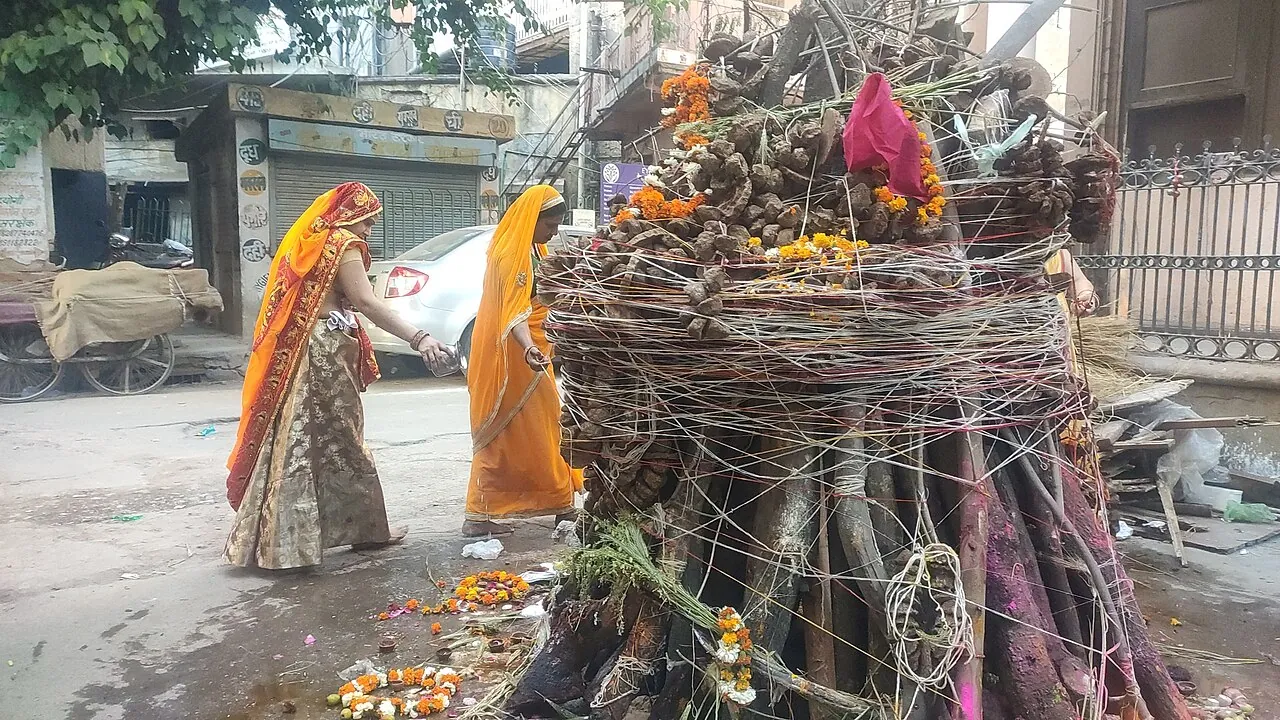
Holi has two parts. On the eve, families gather around the Holika Dahan bonfire and toss wood, dry leaves, twigs and roasting grains into the flames. The story behind it: the demon king Hiranyakashipu tried to kill his son Prahlada with the help of his sister Holika, but it was Holika who burned. The fire stands for good defeating evil.
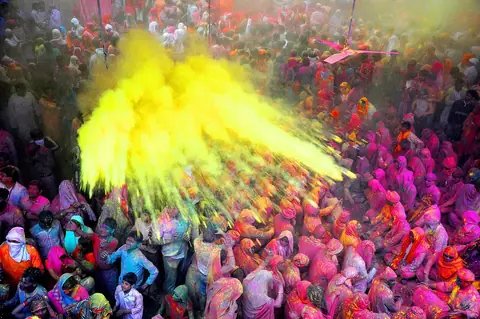
The next day is the colour day. People of all ages smear each other with gulaal and spray coloured water from pichkaris, the water pistols, while dhol drums play in the street. Each colour carries a meaning (green for rebirth, red for marriage and fertility, yellow for purity and victory, blue for Krishna), and the day is tied to the love of Radha and Krishna. Later, people visit friends and neighbours, and the sweets come out: gujiya (fried dumplings), malpua (pancakes in syrup) and thandai (a cool drink of milk, nuts and spices).
Braj: Mathura, Vrindavan, Barsana and Nandgaon
Braj, the Krishna country on the Yamuna around Mathura, is where Holi is celebrated with the most fervour, and its temples draw large crowds. The UK Foreign Office (FCDO) tells travellers to avoid large gatherings, including at religious sites, and notes that stampedes have occurred at some religious gatherings. Watch from outside the temple courtyards rather than going in. Other governments may draw a wider line, so check your own country's advice too.
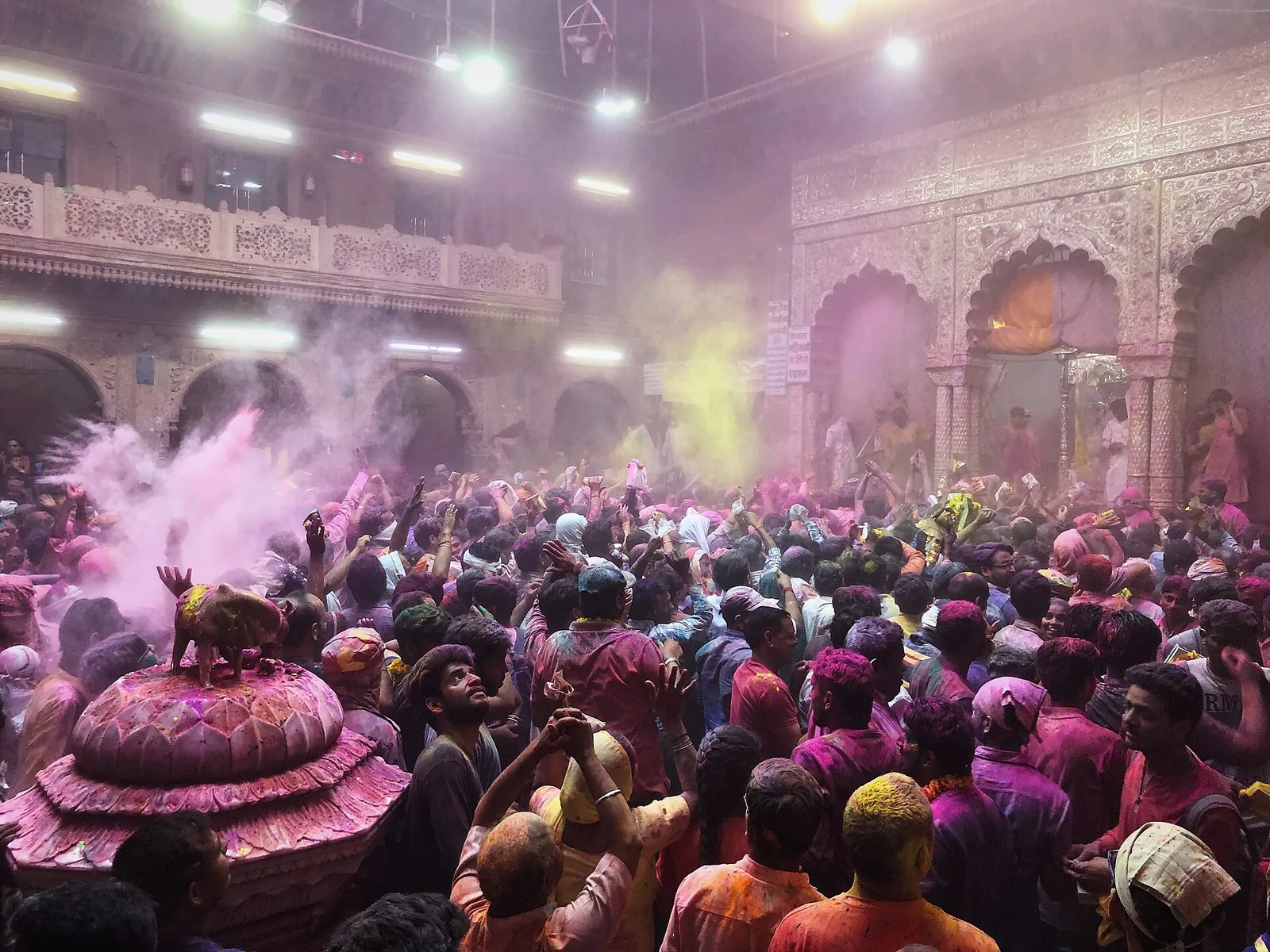
In Mathura, the Shri Krishna Janmasthan complex is built around a small prison cell held to be the spot where Krishna was born, in the jail of the tyrant king Kansa. Nearby, the Dwarkadhish Temple, built in 1814, shows Krishna as the king of Dwarka in a black marble image, with a white marble Radha beside him. Pilgrims come to Vishram Ghat, the most important of the city's 25 ghats on the Yamuna, for rituals and holy dips; Krishna is said to have rested here after defeating Kansa, and at Holi the ghats turn into one long celebration.
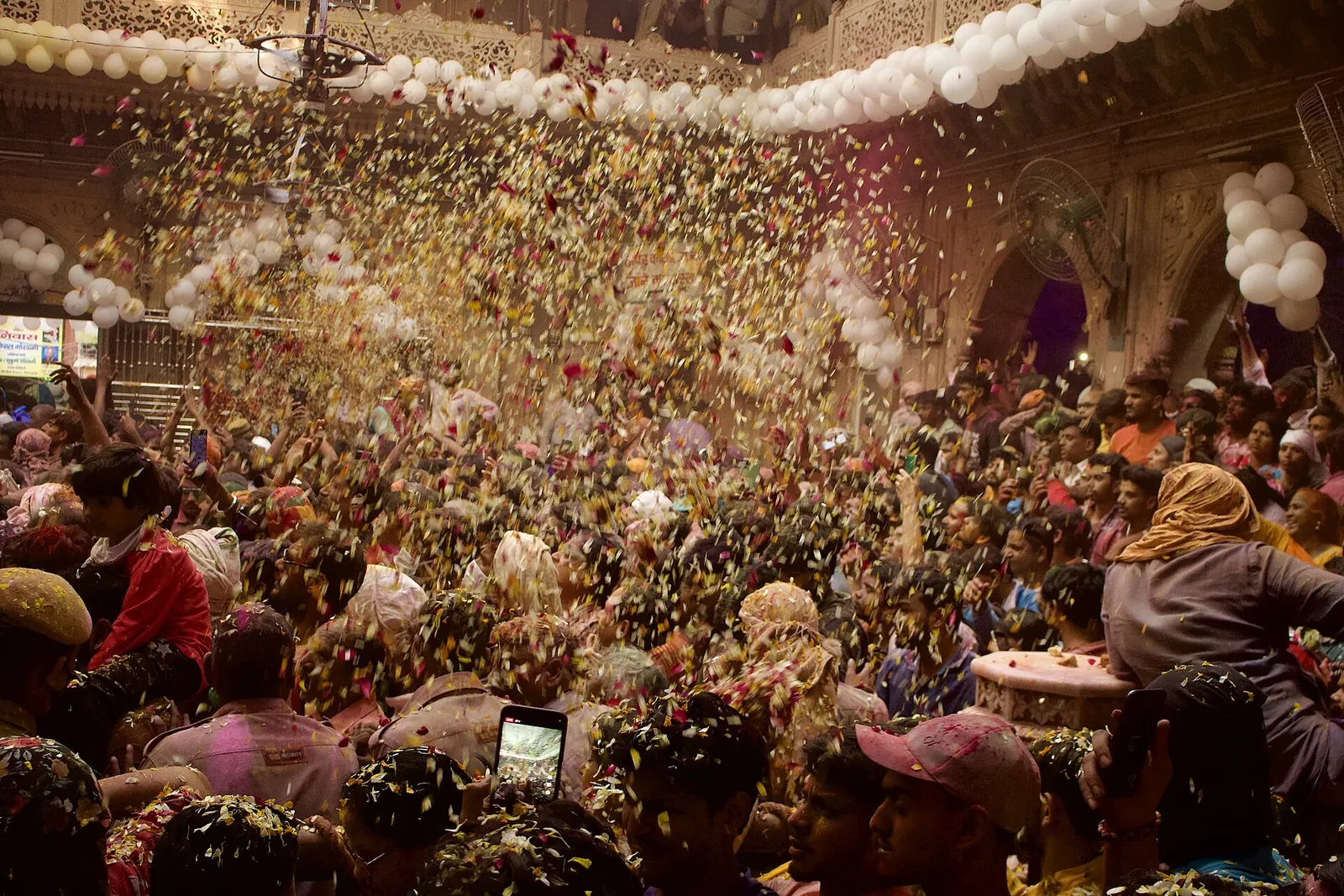
In Vrindavan, a short drive away, the Banke Bihari Temple keeps an image of Krishna standing in the tribhanga pose, bent in three places, and its priests draw a curtain across it at intervals; it and the ISKCON Temple are the most visited. Vrindavan is the home of Phoolon Ki Holi, played with showers of fragrant flower petals instead of powder, while during Rangwali Holi the streets of all Braj fill with colour and music. It is also where widowed women, long sheltered by the town's temples and ashrams, now hold a Widows' Holi of their own, a break with the restrictions that once kept them from the festival.
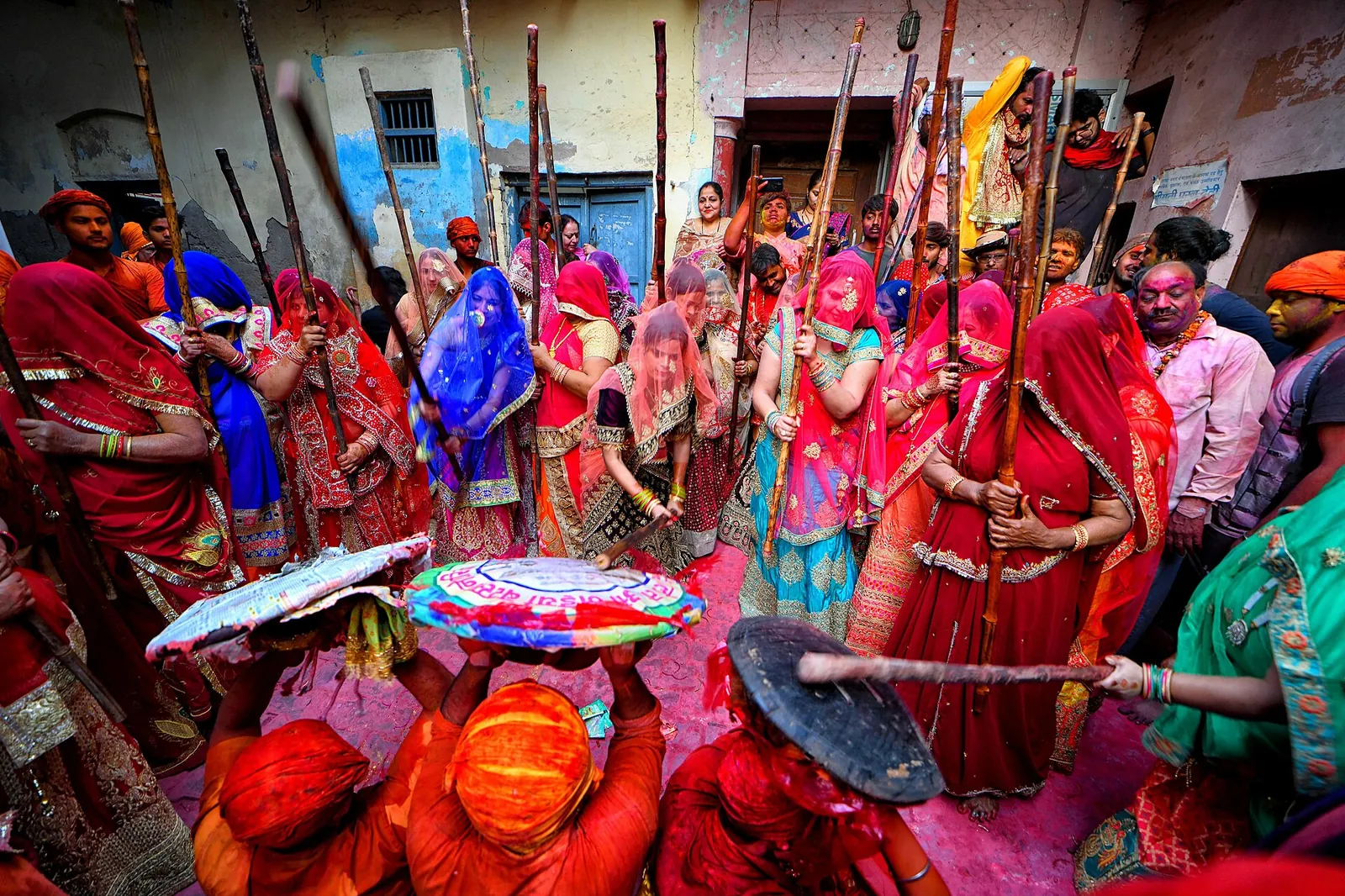
Barsana, 40 km from Mathura and the birthplace of Radha, sits around two hills, Brahma Hill and Vishnu Hill, with the Radha Rani Temple at its heart and, close by, the Ladliji Mandir (Shri Ladliji Maharaj Temple). It holds the best-known Braj ritual, Lathmar Holi. Over two days, the men of Nandgaon, Krishna's village, come to the Radha Rani Temple, where the women of Barsana meet them with bamboo sticks and mock blows; the next day the people of Barsana go to Nandgaon. It is one of Braj's biggest draws for visitors and a day trip from Mathura. It is also the most crowded day of the season, so the FCDO's advice on crowds at religious sites applies here most of all: watch from outside the Radha Rani Temple courtyard, not inside it. Past programmes have included Laddu Mar Holi at the Ladliji Mandir, where devotees throw sweets at each other.
Rajasthan's Braj Holi and Jaipur
Rajasthan's Braj Holi, in Deeg, Kaman and Bharatpur, on 17 and 18 March 2027, is a separate festival a few days before Holi, known for its Raslila dance about the love of Radha and Krishna. It is a different event from Uttar Pradesh's Rangotsav in Mathura and Vrindavan, and from Barsana's Lathmar Holi. Base yourself in Bharatpur, whose station is Bharatpur Junction; Deeg, with its 18th-century palace and fountain gardens, is a short journey north, and Bharatpur's Keoladeo Ghana National Park, a UNESCO World Heritage Site, is home to over 370 species of birds.
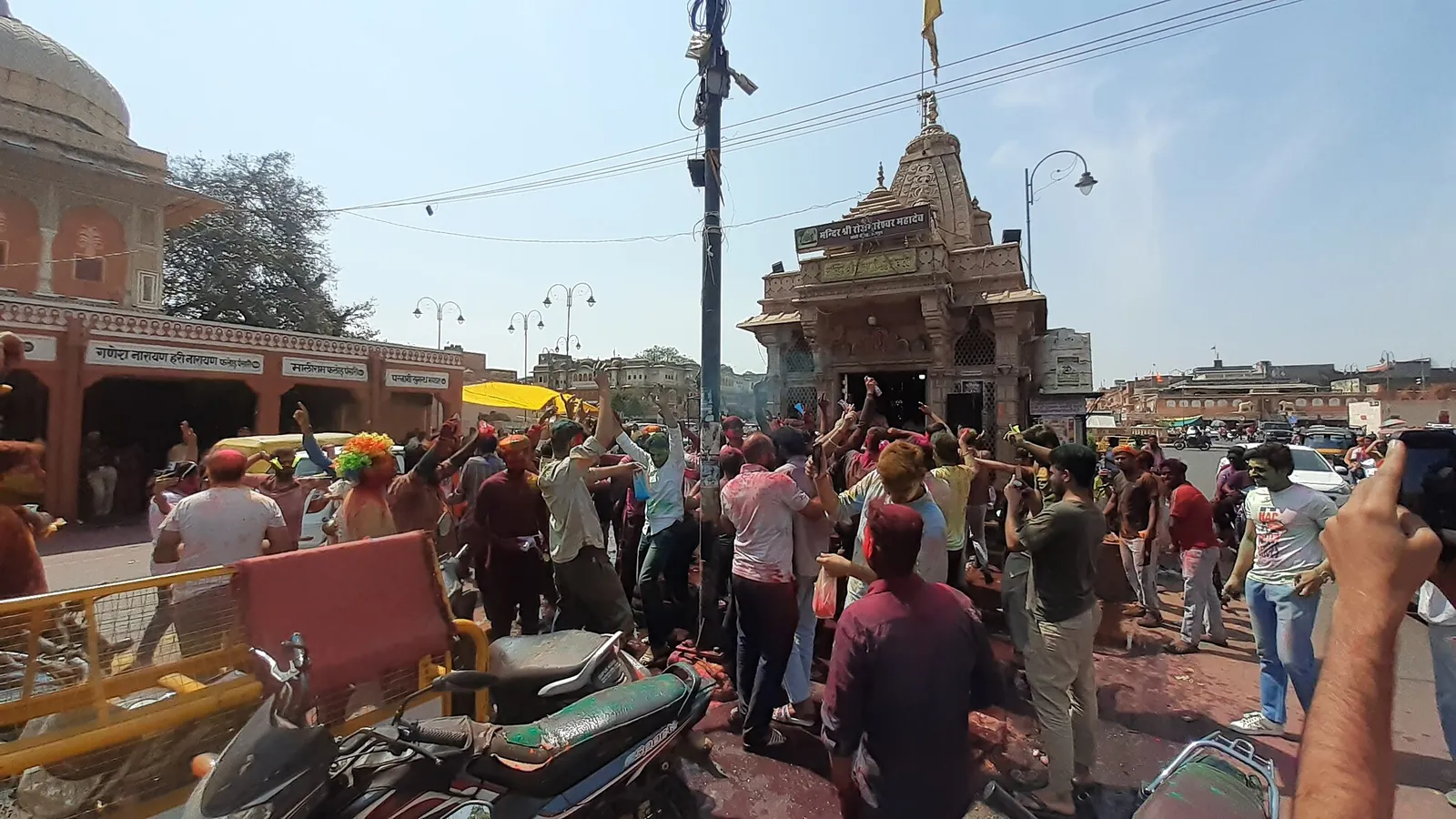
In Jaipur, Dhulandi falls on Monday 22 March 2027, when people of all ages play with colours and water through much of the day. Rajasthan's Department of Tourism holds an event meant especially for foreign tourists on the lawns of the Khasa Kothi hotel, with dry colours and Rajasthani folk music played by local artists. To get there, fly into Jaipur (JAI), drive about five hours from Delhi, or take one of the direct trains between Delhi and Jaipur, which include the Shatabdi, Rajdhani, Duronto and Mandor Express.
Before or after the colour day, two sights repay the trip. Hawa Mahal, the Palace of Winds built in 1799, faces the street through 953 small windows, and Amber Fort, commissioned by Man Singh I in 1592, hides the Sheesh Mahal, a hall whose walls and ceilings are covered in thousands of tiny mirrors. Hawa Mahal stands inside the walled Pink City, where our where-to-stay guide for India suggests staying; Amber Fort lies outside the city, a drive away.
Closures and the Delhi Metro
Jaipur's City Palace Museum, open daily from 09:30 to 18:30, closes on Dhulandi, 22 March 2027: if you are in Jaipur that Monday, keep the museum for another day.
In Delhi, where most visitors land, the IMD calendar puts the colour day on Tuesday 23 March 2027. On Holi 2026 the Delhi Metro stopped for the colour morning: it ran no trains until 14:30 on all lines, the Airport Express Line included, then started from the terminal stations and ran normally.
Trains and the booking rush
Indian Railways opens reservations 60 days ahead, not counting the day of travel, except for certain daytime expresses such as the Taj Express and Gomti Express, which keep shorter limits. On the Bharatpur route, a train on Tuesday 16 March 2027 opens for booking on Friday 15 January 2027, and the onward leg to Jaipur on Friday 19 March on Monday 18 January. For the Jaipur plan, a train on Sunday 21 March opens on 20 January, and the return on Wednesday 24 March, which both plans use, on Saturday 23 January. Foreign visitors can book earlier under IRCTC's Foreign Tourist quota, which accepts bookings up to 365 days ahead, so Holi 2027 is already open to requests; beyond the 60-day window, the berth is allotted only when that window opens, and IRCTC confirms it by international SMS. Holi brings a surge of passengers (for Holi 2026, the Ministry of Railways planned 1,244 special train trips), so request early and check your allotment on the day the window opens. Registration costs INR 100 plus GST, and each ticket costs 1.5 times the normal fare plus INR 200 plus GST. Our guide to transport in India explains the account, the classes and the rules.
Mathura lies 145 km south-east of Delhi on the Delhi–Agra line, with many trains between the two cities. By road, the Yamuna Expressway links them, and a car pays INR 120 at the Jewar toll plaza and INR 155 at Mathura's. On Tuesday 23 March, the national colour day on the IMD calendar, stay where you are, and if you land at Delhi that day, take a car from the airport.
Colours, crowds and how to join in
Wear clothes you are happy to throw away, add a hat and sunscreen for a day in the March sun, and keep your phone and passport in a sealed bag. If you would rather watch than play, stay indoors or on a rooftop while the colour play lasts, which can be much of the day; out in the street, you will be coloured.
Do not accept drinks or food from strangers, as spiked drinks have been reported; stay away from illegal drugs; and, if you are a woman, avoid isolated areas when alone and join the colour play with friends you trust, since female travellers often experience harassment. Our health and safety guide for India covers the rest.
Practical questions
When is Holi 2027 in India?
Jaipur's Dhulandi is on Monday 22 March; Mathura and Vrindavan hold Rangotsav from 16 to 30 March; elsewhere, the national calendar gives Holika Dahan on Monday 22 March and Holi on Tuesday 23 March 2027.
When is Lathmar Holi 2027 in Barsana?
Lathmar Holi lasts two days, first in Barsana, then in Nandgaon, and falls within Uttar Pradesh's Rangotsav, which runs from 16 to 30 March 2027. Its exact 2027 days are not yet announced.
Where is the best place to see Holi in India?
Mathura, Vrindavan and Barsana for the temple celebrations, Phoolon Ki Holi and Lathmar Holi during Rangotsav, and Jaipur for Dhulandi and the tourism department's event for foreign visitors.
Does the Delhi Metro run on Holi?
In 2026 the Delhi Metro ran no trains until 14:30 on Holi, then ran normally.
Is everything closed in India on Holi?
No. Each state sets its own holidays; plan around Jaipur's City Palace Museum, which closes on Dhulandi, 22 March 2027.
Can I book trains for Holi 2027 already?
Yes. Foreign visitors can request seats now under IRCTC's Foreign Tourist quota; the berth is allotted when the 60-day window opens. The train section above gives the opening date for every leg.
Keep planning your trip
India festivals and events 2027
India's 2027 festivals and holidays month by month: Magh Mela, Republic Day, Holi, Eid, Durga Puja in Kolkata, Dussehra, Diwali on 29 October and Christmas in Goa.
Read the guide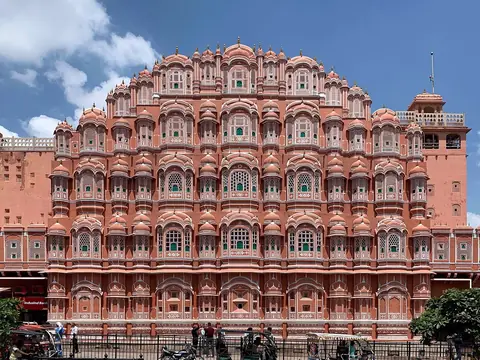
Jaipur
Three nights in Jaipur: the City Palace and its own tickets, Amber Fort's hours, Jantar Mantar, Hawa Mahal, Nahargarh, the bazaars and trains from Delhi.
Read the guide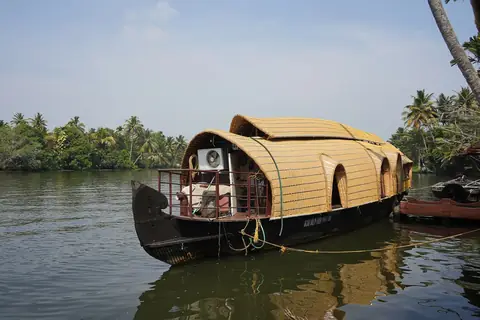
Where to stay in India
The area to sleep in for each of India's classic stops, from Delhi to Hampi, what havelis, houseboats, homestays and ashrams are like, and what check-in asks.
Read the guide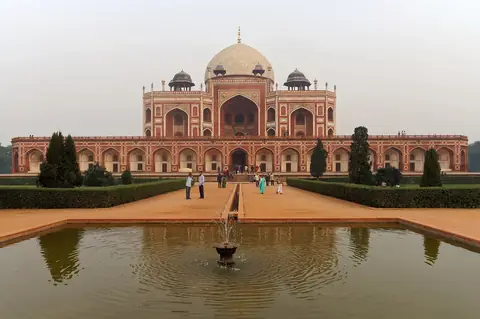
Delhi
Three nights in Delhi: where to stay, Red Fort, Humayun's Tomb and Qutb Minar fees and hours, Jama Masjid, the airport metro, Old Delhi food, a budget for two.
Read the guide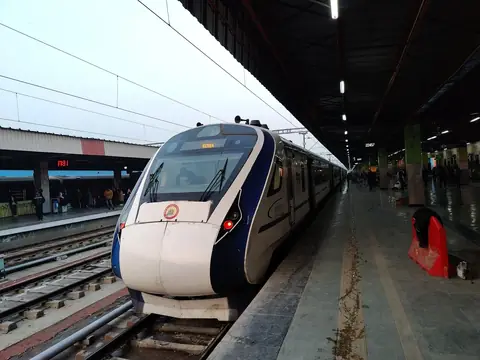
Transport in India
How foreign visitors book Indian trains on IRCTC, the trains and times for each main leg, airport buses, ferries, flights, taxis and a car with driver.
Read the guide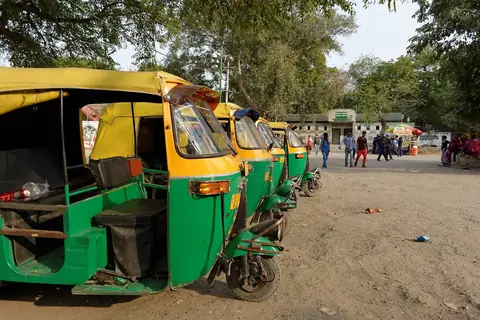
Health and safety in India
Which vaccines and malaria advice apply, Delhi's winter smog, the pre-monsoon heat, rabies, road and train safety, the scams to expect, women travellers and 112.
Read the guideSources and checks before you travel
(24)
- India Meteorological Department (Positional Astronomy Centre): calendar for Chaitra, 2026-2027 ↗ — opens in a new tab
- Rajasthan Tourism: fairs and festivals calendar ↗ — opens in a new tab
- Incredible India (Ministry of Tourism): Bharatpur ↗ — opens in a new tab
- Incredible India (Ministry of Tourism): Holi ↗ — opens in a new tab
- Incredible India (Ministry of Tourism): Mathura ↗ — opens in a new tab
- Incredible India (Ministry of Tourism): Barsana ↗ — opens in a new tab
- Incredible India (Ministry of Tourism): Rangotsav 2027 (source: Uttar Pradesh Tourism) ↗ — opens in a new tab
- District Mathura (Government of Uttar Pradesh): Shri Krishna Janambhumi ↗ — opens in a new tab
- District Mathura (Government of Uttar Pradesh): Shri Dwarkadhish Temple ↗ — opens in a new tab
- DD News: Widows' Holi celebrated in Vrindavan (2025) ↗ — opens in a new tab
- District Mathura (Government of Uttar Pradesh): how to reach ↗ — opens in a new tab
- YEIDA: Yamuna Expressway toll rates ↗ — opens in a new tab
- District Mathura (Government of Uttar Pradesh): Shri Banke Bihari ↗ — opens in a new tab
- Incredible India (Ministry of Tourism): Jaipur ↗ — opens in a new tab
- Incredible India: Hawa Mahal ↗ — opens in a new tab
- Incredible India: Amber Fort ↗ — opens in a new tab
- All India Radio (Akashvani News): Delhi Metro services suspended till 2:30 PM on Holi, 3 March 2026 ↗ — opens in a new tab
- City Palace, Jaipur: official site ↗ — opens in a new tab
- PIB (Ministry of Railways): Holi special train trips, 2026 ↗ — opens in a new tab
- PIB (Ministry of Railways): Advance Reservation Period cut to 60 days, 17 October 2024 ↗ — opens in a new tab
- IRCTC: Foreign Tourist Quota booking (PDF) ↗ — opens in a new tab
- IRCTC: Foreign Tourist quota general terms and conditions (PDF) ↗ — opens in a new tab
- UK FCDO: India travel advice, safety and security ↗ — opens in a new tab
- India Meteorological Department: FAQ on Heat Wave ↗ — opens in a new tab
Reference sources for the version dated 28 October 2026. Confirm opening times, access, transport and conditions for your travel dates.
Photo credits
(5)
Lathmar Holi in Barsana: the women swing bamboo sticks, and the men take the blows on shields.
Photograph: Avis19871 — opens in a new tab · CC BY-SA 4.0 — opens in a new tab
Changes: Resized and converted to WebP; displayed with responsive crops. · Original photograph and licence details ↗ — opens in a new tab
Petals thrown over the crowd at the Banke Bihari temple in Vrindavan during Holi.
Photograph: Saxenation — opens in a new tab · CC BY-SA 4.0 — opens in a new tab
Changes: Resized and converted to WebP; displayed with responsive crops. · Original photograph and licence details ↗ — opens in a new tab
Holi inside a temple in Mathura, with colour thrown over the pilgrims.
Photograph: Jayteesydney — opens in a new tab · CC BY-SA 4.0 — opens in a new tab
Changes: Resized and converted to WebP; displayed with responsive crops. · Original photograph and licence details ↗ — opens in a new tab
Street Holi in Jaipur in 2025.
Photograph: Adert — opens in a new tab · CC BY-SA 4.0 — opens in a new tab
Changes: Resized and converted to WebP; displayed with responsive crops. · Original photograph and licence details ↗ — opens in a new tab
A Holika Dahan pyre being worshipped in a Delhi street before it is lit in the evening.
Photograph: Goutam1962 — opens in a new tab · CC BY-SA 4.0 — opens in a new tab
Changes: Resized and converted to WebP; displayed with responsive crops. · Original photograph and licence details ↗ — opens in a new tab