Itineraries · Bagmati, Gandaki and Lumbini
Nepal in 14 days: Patan, Poon Hill, Chitwan and Lumbini
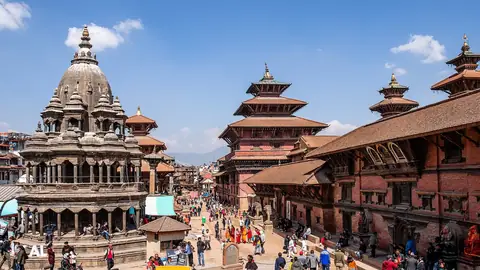
Two weeks is enough to add a mountain walk and the Buddha's birthplace to the usual valley, lake and jungle route. The order is what makes it work: fly from Kathmandu to Pokhara, walk to Poon Hill, go on from Pokhara to Chitwan and from Chitwan to Lumbini without going back to the capital, then fly to Kathmandu for the last three nights. That keeps the trip to three domestic flights and one long road day, and leaves time at the end for Bhaktapur, Patan's own square and a spare day before the flight home.
- Suggested time
- 14 days / 13 nights
- Where to stay
- Patan for 2 nights; Lakeside, Pokhara, for 1; Poon Hill trail lodges for 3; Lakeside for 1; Sauraha, beside Chitwan National Park, for 2; Lumbini for 1; Patan for the last 3
- Season and timing
- The Nepal Tourism Board says the clearest skies come after the monsoon in October and November. The monsoon runs from June to September. Spring, when the rhododendrons bloom on the Poon Hill trail, is the other trekking season. Air pollution in the Kathmandu Valley is generally highest in winter and in the weeks before the monsoon.
The short answer
Book 13 nights: two in Patan, one in Lakeside, Pokhara, three on the Poon Hill trail, one more in Lakeside, two in Sauraha beside Chitwan National Park, one in Lumbini and the last three in Patan. Book a registered trekking agency first, then the three domestic flights: Kathmandu to Pokhara, Pokhara to Bharatpur and Bhairahawa to Kathmandu. For visitors other than SAARC nationals, TIMS costs NPR 2,000 per person and ACAP NPR 3,000, checked on 18 October 2026. Use a licensed guide and carry both permits for the trek. Day 14 is departure.
Why this order: up to the hills, down to the jungle, west to Lumbini
Two weeks lets you add what a ten-day trip has to drop: a mountain walk and the Buddha's birthplace. This route puts a four-day walk to Poon Hill near the start, drops to the lowland jungle at Chitwan and ends at Lumbini, with Patan as the valley base at both ends. Yeti Airlines gives Kathmandu to Pokhara as about 25 minutes. From Pokhara, Buddha Air flies to Bharatpur, the airport for Chitwan; from Sauraha the road runs through Butwal to Lumbini. Yeti Airlines gives the flight between Bhairahawa, the airport for Lumbini, and Kathmandu as approximately 35 minutes. That makes three domestic flights and one long road day.
The three nights in Patan at the end are not wasted time. The trek ends on day 7 and the flight home leaves on day 14, which is the long gap France Diplomatie urges trekkers to leave between the end of a trek and an international flight. Day 12 also absorbs a late flight from Bhairahawa: the UK government says internal flights in high mountain areas are often delayed by weather and that cancellations are common. The base is Patan, about 5 km southeast of central Kathmandu, so its old streets are on foot from the hotel.
Two things are left out on purpose. Nagarkot is the easiest addition if you trade away the Lumbini night, and a longer walk such as Annapurna Base Camp or the Everest route needs a different shape of trip altogether.
Days 1–2: Patan, Kathmandu Durbar Square and Swayambhunath
Day 1: arrive in Patan. The visa and arrival steps at the airport are in our entry guide. Outside the terminal, a prepaid taxi service is available, and taxi drivers, travel agents and hoteliers wait to offer rides. Patan is about 5 km southeast of Kathmandu by taxi or Pathao, whose car service runs in the Kathmandu Valley; ask the fare at the counter before you pay, or have the hotel send a car. Hotel Goodwill stands in Kanibahal, Lalitpur, which is Patan, and it is the address for all five Patan nights. Its Standard Room, 180 square feet for up to three guests, is listed from USD 60++ a night. Ask the hotel to keep your main bag for the eight nights you are away; you come back to it on day 11. Leave the first evening free.
Day 2: Kathmandu Durbar Square and Swayambhunath. The square is also called Basantapur Durbar or Hanuman Dhoka, and the Nepal Tourism Board nicknames it the Museum of Temples. Taleju Temple, built by King Mahendra Malla, is its tallest structure and opens to the public one day a year, during Dashain. The Kumari Ghar, also called the Kumari Temple, is the residence of the Living Goddess. The Jagannath Temple is known for the carved figures on its wooden struts. King Tribhuvan's bedroom and study are on show in the Tribhuvan Museum. The ticket is NPR 1,000 for foreign nationals, children under 10 are free, and it is paid at the entry point.
Spend the afternoon at Swayambhunath, on a hillock about 3 km west of the centre. Look for the gold-plated vajra on the east side of the stupa, the sleeping Buddha, the Dewa Dharma Monastery with its bronze Buddha and Tibetan paintings, and the temple of Harati, the goddess of children. The stone steps are very steep and a motor road reaches almost to the top. The ticket is NPR 200 for foreign nationals.
Day 3: the flight to Pokhara and an evening on the lake
Fly from Kathmandu to Pokhara International Airport (PKR) in the morning. Foreign nationals other than Indian and Nepali citizens pay Yeti Airlines' USD fare, which the booking page shows for your date. Extra baggage costs NPR 150 per kilo, so leave what the trek does not need at the hotel in Patan.
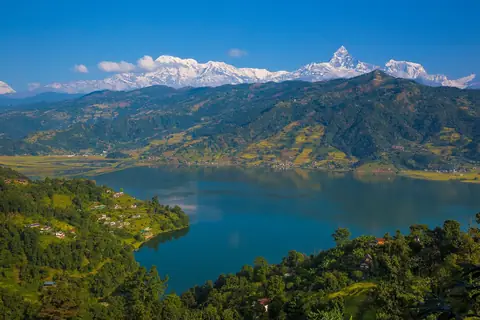
The International Mountain Museum explains the mountains you are about to walk beneath. Its Mountain Activities Gallery tells the story of Maurice Herzog and Louis Lachenal's first ascent of Annapurna on 3 June 1950 and of Junko Tabei, the first woman to climb Everest. The museum opens daily from 09:30 to 17:00 and lists foreign admission at NPR 750, checked on 18 October 2026. In the afternoon go up to the World Peace Pagoda on its hill on the southern fringe of Phewa Lake: the tourism board describes a dome-shaped pagoda with four images of the Buddha facing the four directions, and a hilltop view of the Annapurna range.
Sleep at New Pokhara Lodge on Lakeside Street 3 for nights 3 and 7. Its Standard Room with an attached bathroom and double or twin bed for two costs USD 30 per night including all taxes, checked on 18 October 2026; breakfast is USD 5 per person extra. Our where-to-stay guide compares the other bases. Meet your trekking agency before setting off; it registers you, your guide and your route for TIMS.
Days 4–7: four days to Poon Hill and back
This plan allows four days for Poon Hill: three nights on the trail, then Pokhara again on day 7, following the Nepal Alternative Treks package described below. Foreign trekkers on the routes the Nepal Tourism Board lists, which include Poon Hill-ABC, must walk with a licensed guide and carry a TIMS card issued through a registered agency, under the revised rule in force since 31 March 2023. The UK government tells trekkers not to go alone. Government guide and TIMS advice also applies to this short loop. Our Poon Hill guide covers the route, season and permits.
Day 4: Pokhara to the trail. Nepal Alternative Treks gives its own drive from Pokhara to Hile as about 70 km and 2.5 hours, stopping at the Birethanti check post to register the ACAP permit. The walk begins at Hile and climbs the stone steps through Ulleri to Banthanti, 2,210 m, in about four hours. Its package names Machhapuchhre Guest House or a similar property for the night. The stages and walking times for the next three days come from that agency's own itinerary, not a public route timetable.
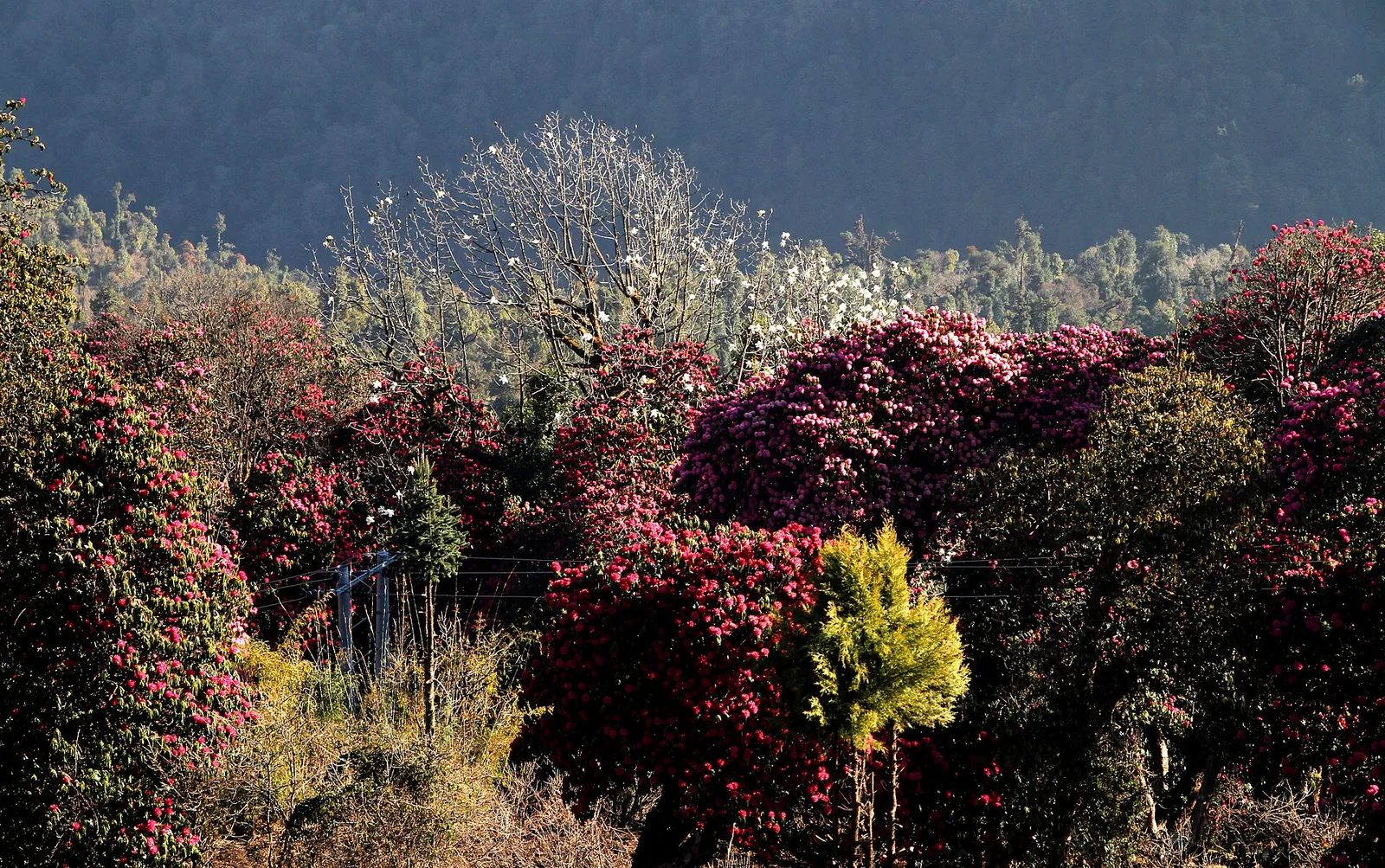
Day 5: on up to Ghorepani. The trail climbs through rhododendron forest to Ghorepani, the village below the viewpoint, in about four hours. The package names Hotel Super View or a similar property for the night. The National Trust for Nature Conservation says the region holds among the world's largest rhododendron forests at Ghorepani, and the Nepal Tourism Board names spring as the time they bloom.
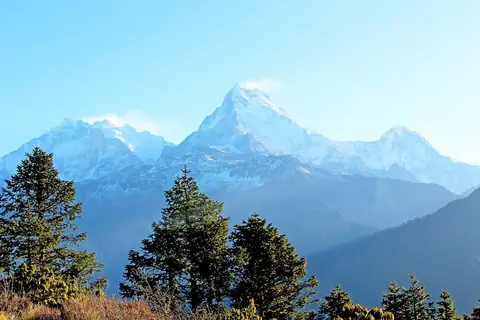
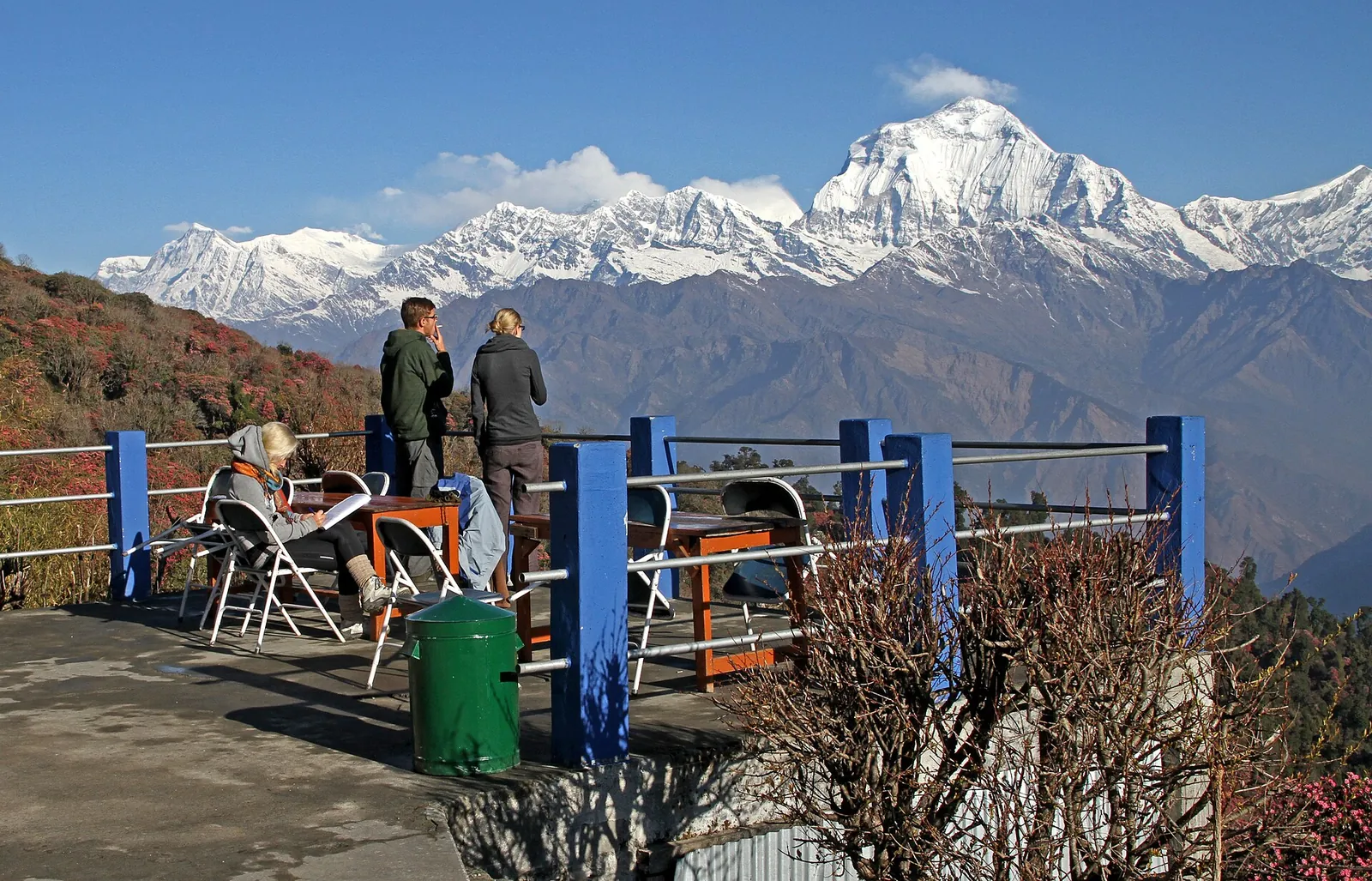
Day 6: sunrise at Poon Hill. Climb on foot to the viewpoint at 3,210 m, where the Nepal Tourism Board says the peaks of Annapurna and Dhaulagiri glow golden at sunrise. Return to Ghorepani for breakfast, then walk on to Tadapani, 5 to 7 hours on foot in all. The package names Hotel Grand View or a similar property for the night.
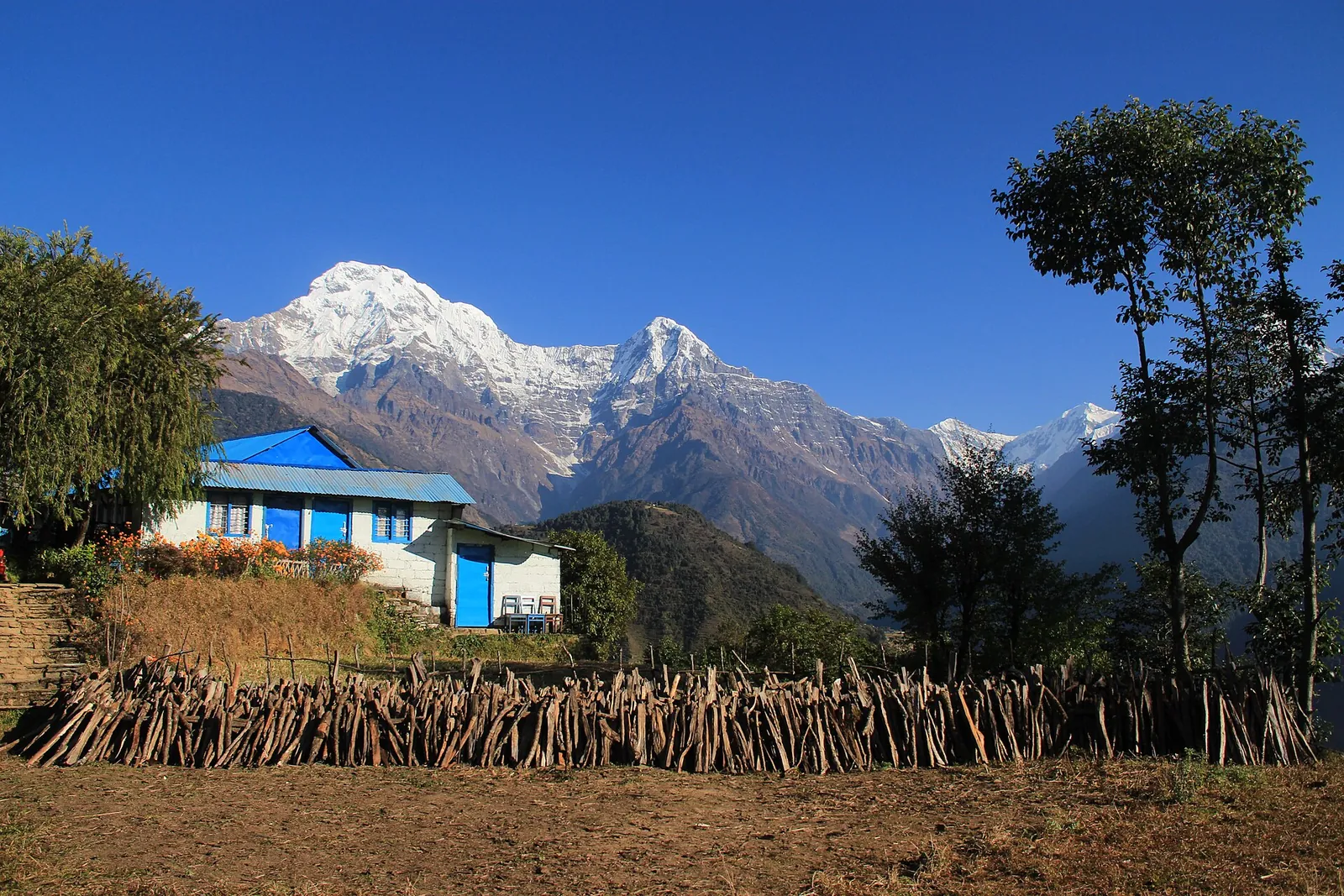
Day 7: down to Ghandruk and back to Pokhara. Walk down to Ghandruk, about four hours from Tadapani; the road from Pokhara reaches the village. The Nepal Tourism Board describes it as a traditional Gurung village in Kaski with a Gurung museum and one of the best views of Annapurna South, Gangapurna, Annapurna III, Hiunchuli and Machhapuchhre, and a marketplace, Seuli Bazar, for local goods. Take the drive back to Lakeside in the afternoon, about 2.5 hours. In the evening, boats are hired along the shore, and the usual trip crosses to Taal Barahi Temple on its small island.
The agency package covers the three lodge nights; no individual lodge rates are given here. Altitude illness is a risk from 2,500 m. If you develop symptoms of altitude sickness, stop climbing, descend promptly with a companion to a lower altitude (below 4,000 m if you are higher) and consult a doctor. Carry insurance that covers mountain rescue and helicopter costs.
Day 8: Pokhara to Bharatpur and on to Sauraha
Day 8: Pokhara to Chitwan. Fly to Bharatpur after the trek. Buddha Air lists one flight a day from Pokhara to Bharatpur, taking 20 minutes, checked on 18 October 2026. A cancellation may change the day's plan; keep the daylight road alternative available and follow the road advice below.
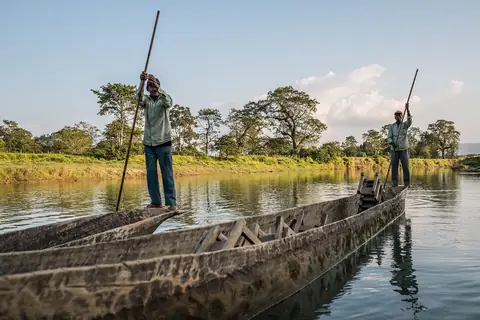
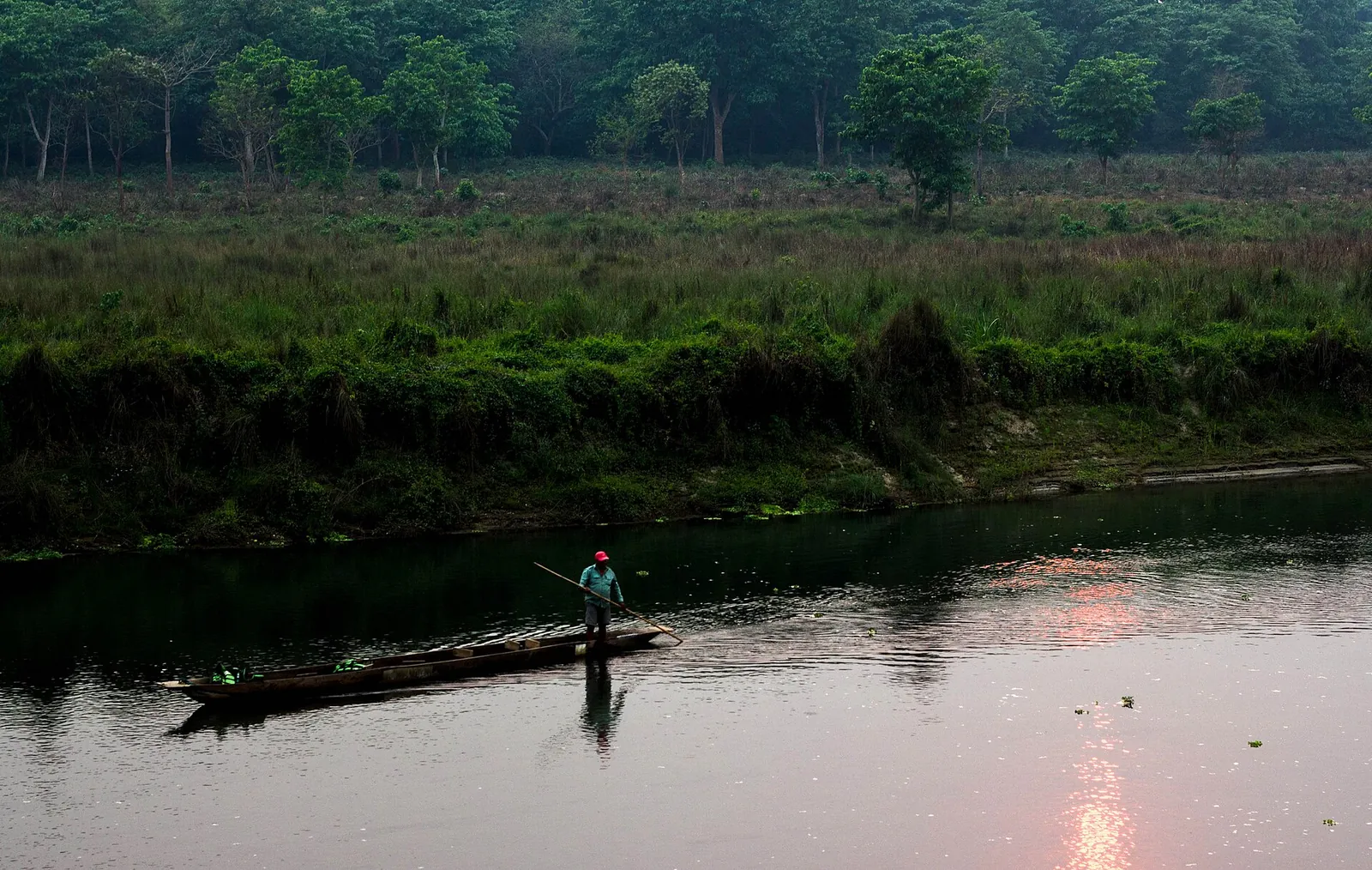
Arrange the airport transfer to Chitwan Safari Club in Sauraha, the lodge town on the Rapti River. The Nepal Tourism Board describes tourist-standard hotels, community homestays and restaurants overlooking the river at sunset. Chitwan Safari Club lists its Double Deluxe Room, with a queen bed, air conditioning, a television and free Wi-Fi, at USD 30 per night, checked on 18 October 2026. In the afternoon visit the Tharu Cultural Museum, NPR 25 for foreign nationals, and a Tharu village. In the evening the board describes a campfire with the Tharu stick dance and folk songs. Our Chitwan guide covers the lodge towns and park.
Day 9: a day in Chitwan National Park
Day 9: the park. The park office lists an entry permit of NPR 2,000 per person per day for foreign nationals other than SAARC citizens, issued at the entrance gate on a copy of your passport, or NPR 2,260 if the 13% VAT on the tourism board's heritage-site table is charged. A jeep drive needs a second permit on top of every passenger's entry permit, NPR 5,000 per jeep; the budget counts one jeep permit in full. A boat or rafting permit is listed at NPR 4,000 for foreign nationals other than SAARC citizens, but its charging unit is not stated, so it is outside the total. Book walks, canoe trips and jeep drives with a carded nature guide through your lodge. The lodge's own activity charges come on top: checked on 17 October 2026, Jungle Safari Resort's own tariff, also quoted in our where-to-stay guide, started at USD 55 for a canoe ride, USD 55 for a half-day jeep safari and USD 70 for a jungle walk, varying with group size, nationality and guide.
The Nepal Tourism Board describes Chitwan's jungle safari as a chance to see one-horned rhinoceroses, Bengal tigers and elephants, with crocodiles on the river banks; treat any single sighting as a bonus. End the day at the Elephant Breeding Centre at Khorsar, where the board describes domesticated elephants and the calves born there; foreign nationals pay NPR 100.
Days 10–11: the road to Lumbini, the Maya Devi Temple and the flight back
Day 10: Sauraha to Lumbini by road. Buddha Air lists its Bharatpur to Bhairahawa flight as temporarily suspended, so plan the leg by road through Butwal. The Lumbini Development Trust's current visitor page lists buses from Chitwan to Lumbini and gives Chitwan to Lumbini as 170 km; that is a city-to-city figure, not a distance from your Sauraha hotel. Allow a full travel day. The trust lists no operator, departure time or fare for this Chitwan service; arrange it through your hotel or a travel agent. A car or jeep with a driver is the other option, hired through a travel agent or your hotel. Lumbini Buddha Garden lists its Cottage Room, with air conditioning, a balcony with a garden view and free Wi-Fi, from USD 80 per double night, or from USD 72 under its 10% direct-booking discount, checked on 18 October 2026. Our Lumbini guide sets out the sights and fee.
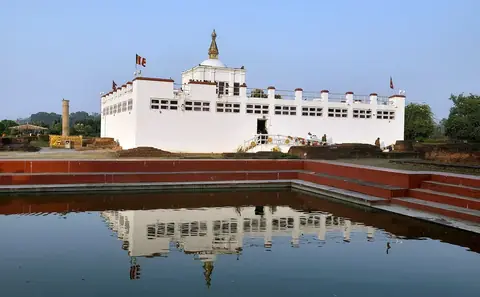
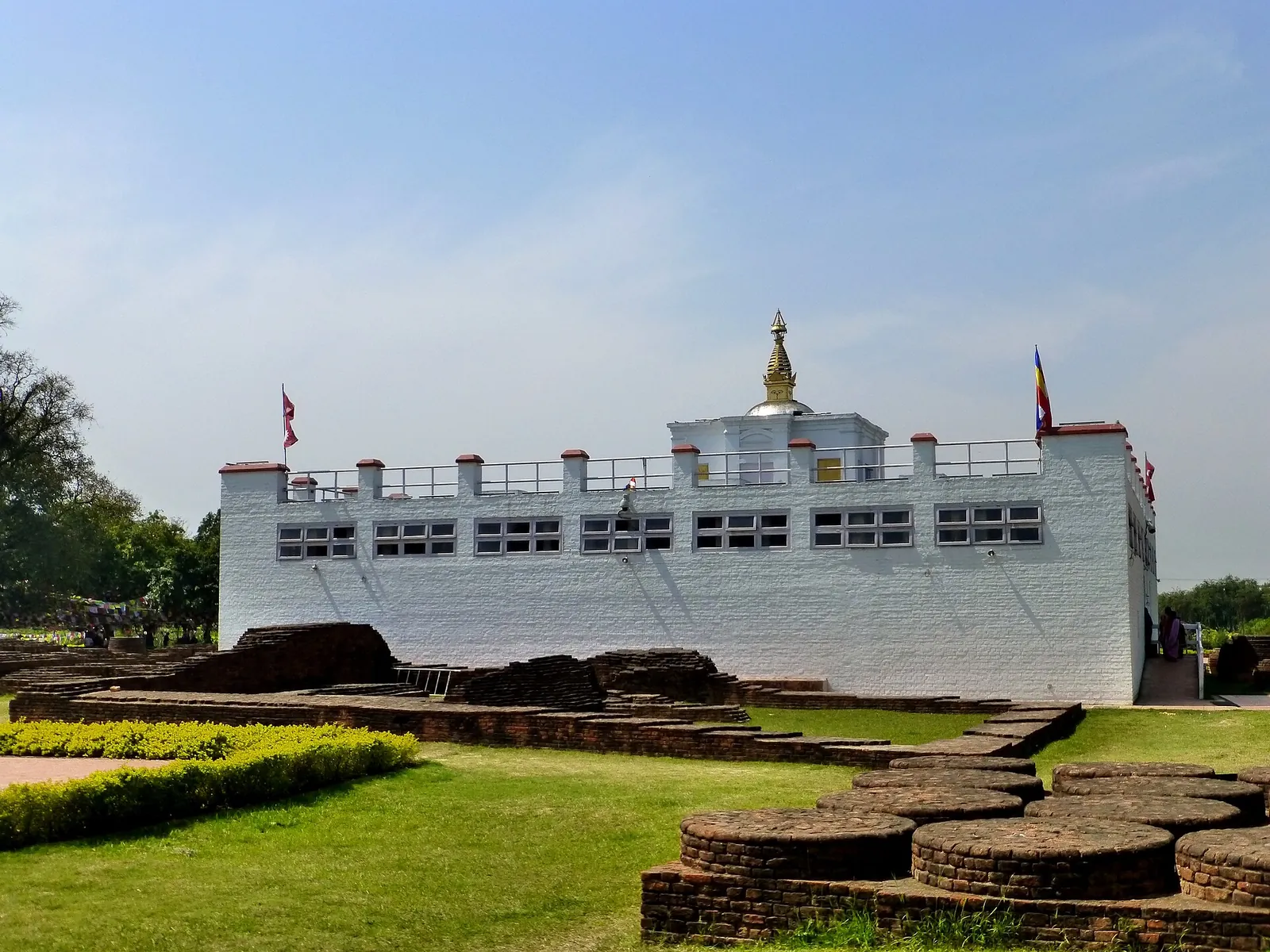
Day 11: the Sacred Garden and the flight back. Go to the Sacred Garden early in the morning. Inside the Maya Devi Temple, which the Lumbini Development Trust says was reconstructed in 2003, a Marker Stone of 70 cm by 40 cm by 10 cm marks the spot where Prince Siddhartha was born. Outside stand the Ashoka Pillar, erected in 249 BC and 9.41 m high with almost half of it below ground, and the Sacred Pond. Remove your shoes, dress modestly and leave food and drink at the entrance. Checked on 17 October 2026, the Lumbini Development Trust listed the daily conservation fee at NPR 1,000 for other nationals and NPR 700 for SAARC and Myanmar nationals, with a still camera at USD 3 a day. Pay in cash or by QR code at the site, or buy the ticket on tickets.lumbinidevtrust.gov.np.
A 1.6 km pedestrian walkway divides the monastic zone. The east side holds the Theravada countries, among them the Royal Thai Monastery and the Myanmar Golden Temple, and the west side holds 18 Mahayana monasteries, among them the Great Lotus Stupa built by the Tara Foundation of Germany and the Sokyo Japanese Monastery. Walk it in the late morning, then take a car or taxi to the airport, which the trust puts 18 km from Lumbini, and agree the fare before you get in. Yeti Airlines flies between Gautam Buddha International Airport (BWA) at Bhairahawa and Kathmandu every day in approximately 35 minutes, so book a departure that leaves time to reach Hotel Goodwill in Patan before dark. If no such flight can run, use the buffer days and change the booking.
Days 12–14: Bhaktapur, the east of the valley, Patan and the way home
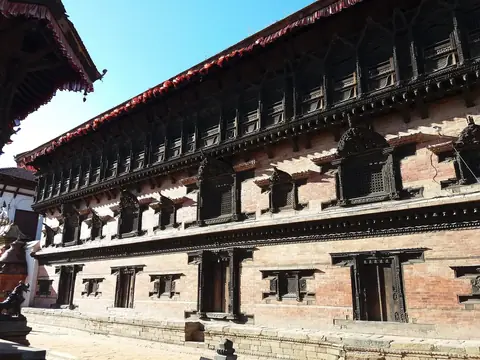
Day 12: Bhaktapur. This is the day to give up if the flight from Bhairahawa ran late or was cancelled. Bhaktapur lies 12 km to the east of Kathmandu on the Arniko Highway; a taxi with the roof sign and black licence plate or a Pathao car takes you there and on around the east of the valley. Its Durbar Square is an open space facing south, surrounded by buildings from the 13th to the 18th century, with the 15th-century Palace of 55 Carved Windows and the Golden Gate, a masterpiece of repoussé art. Nyatapola, whose name means five-storied, rises above the town and withstood a devastating earthquake. Foreign nationals pay US$ 18 or NPR 1,800 at the entry point.
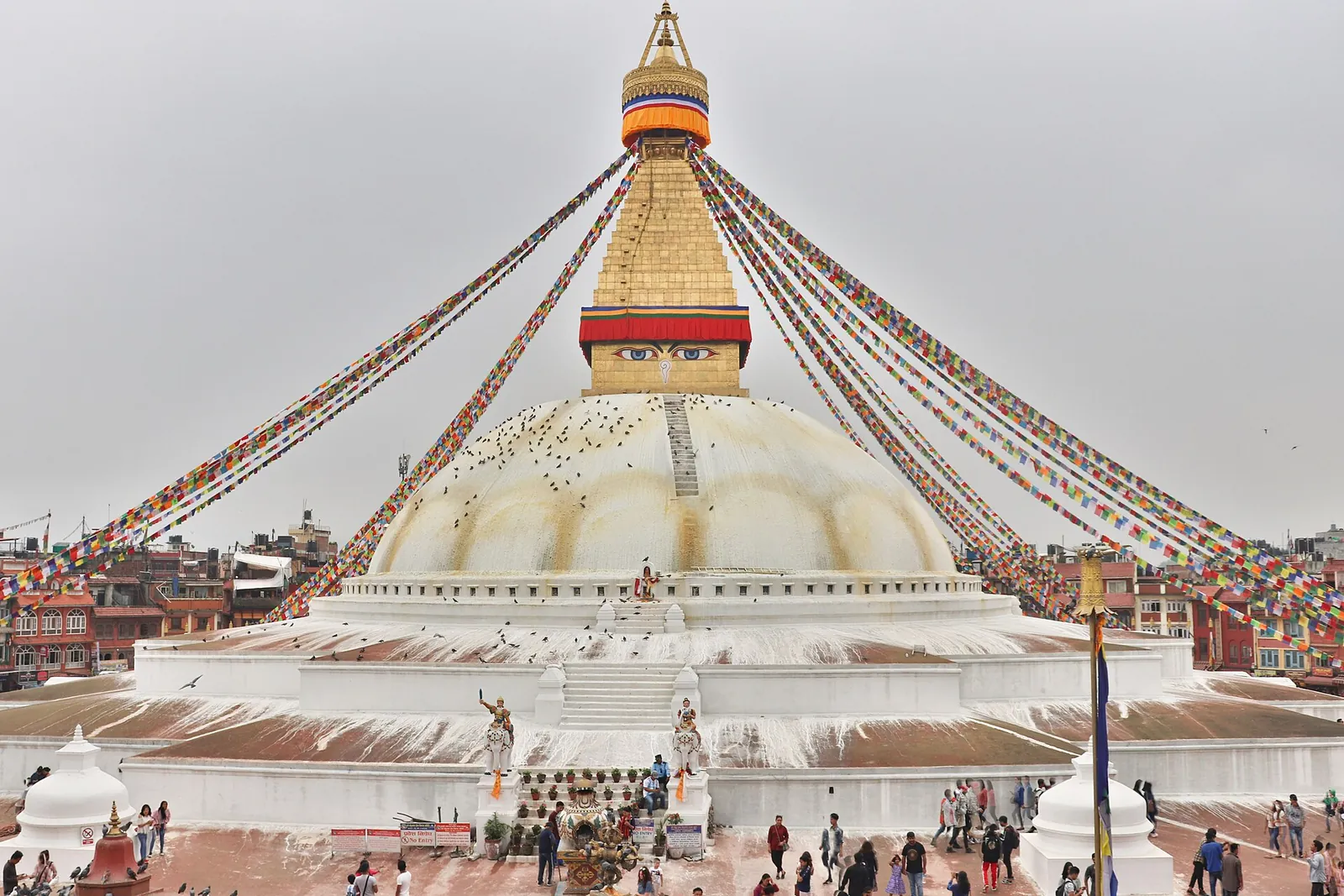
On the way back, stop at Pashupatinath, on the banks of the Bagmati, the most revered Hindu temple in Nepal. The Pashupati Area Development Trust lists it open daily from 4:00 to 21:00, with the main sanctum for Hindus only and the ghats open to everyone. According to the Nepal Tourism Board, non-Hindus watch from the terraces across the river and leather items must be left outside. The ticket is NPR 1,000 per day for foreign nationals. Finish at Boudhanath, about 8 km east of the capital, in the late afternoon. It is the largest stupa in the valley, with a dome 36 m across, and Kathmandu Metropolitan City describes the district as a settlement of Tibetan refugees, often crowded with visitors. The city lists the stupa as open 24 hours, and the ticket is NPR 400 for foreign nationals. Leave time for the road journey back to Patan before dark.
Day 13: Patan on foot. Patan Durbar Square and Patan Museum share one ticket, NPR 1,000 for foreign nationals. Start with the stone Krishna Temple of 1637 and its 21 spires. Then spend the longest in the museum's Gallery G, which shows repoussé in stages from a pencil drawing to a finished gilded face and explains the lost-wax casting still practised in Patan's workshops. The Golden Temple is a five-minute walk from the northern end of the square. Keep the evening for packing: it is the slack before the flight home.
Day 14: fly home from Tribhuvan International Airport. On 15 September 2026 France's foreign ministry said works at the airport have partly closed it and may affect bookings on arrival or departure, so check your flight with the airline before you travel. The airport-works notice gives no closure hours.
Roads, flights and floods on this route
The UK government, checked on 17 October 2026, listed areas of Gorkha, Nuwakot and Dhading among those affected by the floods of 26 August 2026 and warned that heavy rain could trigger more landslides. Before a road transfer, check that the route is open. The Nepal Tourism Board says intercity tourist buses to Pokhara, Chitwan and Lumbini leave from Kantipath in Kathmandu. Tourist-bus operators and fares are not listed on that page; check both when booking. Have the final boarding point written on the ticket. France Diplomatie places the whole country in a zone of enhanced vigilance. Check your own government's advice too, since it may draw a wider line.
On every road leg, use a marked tourist bus or a car with a driver in daylight: the UK government advises against overloaded buses and night travel, and Germany says to use only marked tourist buses. If the Bhairahawa flight fails, allow a full travel day for the bus. The Lumbini Development Trust lists the Kathmandu–Lumbini bus at approximately 280 km and around 10 to 11 hours, departing at 07:00 and 19:00 for around NPR 1,500 to 2,000, checked on 18 October 2026; use a road service only if it can finish before dark; otherwise fly or change the plan, and confirm the return service when booking. Every Nepali airline is on the UK Air Safety List, and Germany says all are on the EU list of unsafe airlines.
What to book first
Book in the order of what has the fewest alternatives:
- The trekking agency first. It supplies the licensed guide and registers the TIMS cards at NPR 2,000 per person for visitors other than SAARC nationals. The model below adds TIMS separately to the package price; the quoted package includes ACAP.
- The three domestic flights. Kathmandu to Pokhara on day 3, Pokhara to Bharatpur on day 8 and Bhairahawa to Kathmandu on day 11. Prioritise the Pokhara to Bharatpur flight, which runs once a day.
- The Lumbini and Sauraha rooms, which have the fewest alternatives on the route, then Hotel Goodwill for the five Patan nights and a Lakeside room for nights 3 and 7.
- Insurance that includes mountain rescue and helicopter cover, before the first flight.
Where you sleep and the budget for two adults
These prices for two adults other than SAARC, BIMSTEC or Chinese nationals sharing a room were checked on 18 October 2026. Ten hotel nights are priced at the hotels' own rates and the three trail nights within the agency package. New Pokhara Lodge includes taxes; Hotel Goodwill prints USD 60++ without explaining the additions, and the other hotels do not state breakfast or tax inclusions.
- Patan, 5 nights at Hotel Goodwill, Standard Room from USD 60 (nights 1, 2, 11, 12 and 13): USD 300.
- Sauraha, 2 nights at Chitwan Safari Club, Double Deluxe Room at USD 30 (nights 8 and 9): USD 60.
- Lumbini, 1 night at Lumbini Buddha Garden, Cottage Room from USD 80 per double night, or from USD 72 booking direct (night 10): USD 80.
- Lakeside, Pokhara, 2 nights at New Pokhara Lodge, Standard Room for two at USD 30 per night including all taxes, breakfast extra (nights 3 and 7): USD 60, bringing the ten hotel nights to USD 500.
- The trek (nights 4, 5 and 6). Nepal Alternative Treks publishes its four-day Ghorepani Poon Hill package at a discounted USD 280 per person for groups of one to four, or USD 560 for two. It includes Pokhara hotel pick-up, the road transport in its itinerary, a government-authorised English-speaking guide, one porter per two trekkers, twin-share lodge rooms, meals on the trek and ACAP. Add NPR 4,000 for two non-SAARC TIMS cards; do not assume they are included in the package.
- Fees for two, in NPR: TIMS cards 4,000; Kathmandu Durbar Square 2,000; Swayambhunath 400; International Mountain Museum 1,500; Tharu Cultural Museum 50; Chitwan entry for one day 4,000 (4,520 with VAT); one jeep permit 5,000; Elephant Breeding Centre 200; Lumbini conservation fee 2,000; Bhaktapur Durbar Square 3,600; Pashupatinath 2,000; Boudhanath 800; Patan Durbar Square and Museum 2,000. Total NPR 27,550 (NPR 28,070 with park-entry VAT), excluding the boat permit. ACAP is already included in the agency package.
- Everything priced here: USD 1,060 for the hotel rooms and trek package plus NPR 27,550 for fees, or about NPR 188,290 at Nepal Rastra Bank's buying rate of NPR 151.64 per US dollar on 17 October 2026.
- Flights on top: Kathmandu to Pokhara (day 3), Pokhara to Bharatpur (day 8) and Bhairahawa to Kathmandu (day 11) for two, at each airline's USD fare for foreign visitors, which the booking page shows for your date, plus the international flights.
- Not in the totals: the boat permit; lodge charges for the jeep drive, canoe and walk; Bharatpur airport pick-up, the bus or car from Sauraha to Lumbini and the taxi to Bhairahawa airport; meals off the trail; drinks and tips on the trek; the Lumbini camera fee; Phewa boats; hotel supplements not stated above; the visa and insurance.
Meals along the route
The trek package covers meals on the trail, so the meals to budget are those in the valley, Pokhara, Sauraha and Lumbini. The staples change with the route: momo in Lakeside, dal bhat in the trail lodges, a Tharu set in Sauraha and Newari snacks around Patan and Bhaktapur.
Make time for the local food
What to eat and where to look
Momo
Steamed dumplings that the Nepal Tourism Board calls a must-eat Nepali dish; minced chicken, mutton, cheese or vegetables go inside, and they are also fried or served in a soup called jhol momo.
- Where to look
- Restaurants along the lake shore in Lakeside, Pokhara.
- Fit it into your day
- Dinner on day 3 in Lakeside, after you meet the trekking agency.
Most fillings contain meat; ask for vegetable momo if you avoid it.
Dal bhat
The staple Nepali meal of dal, rice, vegetables and achar, a sauce or dip, served with yogurt or buttermilk. The Nepal Tourism Board says the lentils change with the season and that a chicken or mutton curry may follow.
- Where to look
- The dining room of the lodge where you sleep on the trail.
- Fit it into your day
- Dinner on day 4, at the first lodge.
Bara (wo)
A Newari pancake or patty of spiced lentils, called wo by the Newars and bara in the hills, made at festivals and rituals and sold as a snack.
- Where to look
- Newari eateries in the old towns of Patan and Bhaktapur.
- Fit it into your day
- A snack in Bhaktapur on day 12.
Taas
Spicy fried goat meat served with beaten rice, which the board calls a must-try in Chitwan.
- Where to look
- Roadside restaurants and eateries around Sauraha, according to the board.
- Fit it into your day
- Lunch on day 9, between the park trips.
Tharu-style set meal
The board lists the Tharu-style set, next to the Terai-style set, among the popular options in Chitwan; the Tharu delicacies it names include ghongi, a water snail cooked in gravy, and dhikri, steamed rice dough eaten with chutney.
- Where to look
- Tharu eateries and homestays near Sauraha.
- Fit it into your day
- Dinner on day 8, after the stick dance.
Practical questions
Can I fit Poon Hill, Chitwan and Lumbini into 14 days?
Yes, with 13 nights: two in Patan, one in Pokhara, three in trail lodges, one more in Pokhara, two in Sauraha, one in Lumbini and the last three in Patan. The route needs three domestic flights and one road day, from Sauraha to Lumbini, and leaves no room for Annapurna Base Camp or the Everest region.
Do I need a guide for Poon Hill?
Yes. Follow the licensed-guide and agency-issued TIMS requirements described in the trekking section. For non-SAARC visitors, ACAP costs NPR 3,000 and TIMS NPR 2,000 per person; the model's agency package includes ACAP and budgets TIMS separately.
Which legs do I fly and which do I ride?
Fly Kathmandu to Pokhara, then Pokhara to Bharatpur, and return from Bhairahawa to Kathmandu. Travel from Sauraha to Lumbini by road, since the direct Bharatpur–Bhairahawa flight is temporarily suspended.
What happens if a flight is cancelled?
Keep days 12 and 13 flexible before the international flight. If the Bhairahawa return is delayed, drop Bhaktapur first; a longer disruption can change more of the plan. If the Pokhara–Bharatpur flight is cancelled, use the daylight road fallback only after checking that the road is open.
How much does this route cost for two people?
The ten hotel nights and the agency trek package come to USD 1,060, plus NPR 27,550 in the listed fees for two adults other than SAARC, BIMSTEC or Chinese nationals, checked on 18 October 2026. That is about NPR 188,290 at the historical 17 October 2026 buying rate. The boat permit, flights, lodge activities, hotel supplements and meals off the trail are extra.
Which month suits this route?
October and November offer the Nepal Tourism Board's clearest skies. Spring is the other trekking season; winter brings the valley's worst air.
Sources and checks before you travel
Reference sources for the version dated 18 October 2026. Confirm opening times, access, transport and conditions for your travel dates.
- Nepal Tourism Board: heritage site entry fees ↗ — opens in a new tab
- Nepal Tourism Board: Kathmandu Durbar Square ↗ — opens in a new tab
- Nepal Tourism Board: Swayambhunath ↗ — opens in a new tab
- Kathmandu Metropolitan City: heritage sites ↗ — opens in a new tab
- Nepal Tourism Board: Pashupatinath Temple ↗ — opens in a new tab
- Pashupati Area Development Trust: home page ↗ — opens in a new tab
- Nepal Tourism Board: Patan ↗ — opens in a new tab
- Patan Museum: Gallery G ↗ — opens in a new tab
- International Mountain Museum: visitor information ↗ — opens in a new tab
- International Mountain Museum: Mountain Activities Gallery ↗ — opens in a new tab
- Yeti Airlines: Pokhara ↗ — opens in a new tab
- Yeti Airlines: fare categories and cancellation ↗ — opens in a new tab
- Yeti Airlines: extra baggage charges ↗ — opens in a new tab
- Nepal Tourism Board: find tigers in Chitwan National Park ↗ — opens in a new tab
- Chitwan National Park office: citizen charter (Nepali) ↗ — opens in a new tab
- Nepal Tourism Board: local cuisine of Chitwan ↗ — opens in a new tab
- Nepal Tourism Board: food and culinary ↗ — opens in a new tab
- Nepal Tourism Board: climate ↗ — opens in a new tab
- UK government: Nepal travel advice ↗ — opens in a new tab
- UK government: Nepal safety and security ↗ — opens in a new tab
- German Federal Foreign Office: Nepal travel and security advice ↗ — opens in a new tab
- France Diplomatie: Nepal security advice ↗ — opens in a new tab
- France Diplomatie: Nepal entry and stay ↗ — opens in a new tab
- Nepal Tourism Board: Phewa and the Cluster of 9 Lakes ↗ — opens in a new tab
- Nepal Tourism Board: local transportation ↗ — opens in a new tab
- Pathao: car ↗ — opens in a new tab
- Nepal Tourism Board: top trekking destinations ↗ — opens in a new tab
- Nepal Tourism Board: TIMS card ↗ — opens in a new tab
- National Trust for Nature Conservation (NTNC): Annapurna Conservation Area Project ↗ — opens in a new tab
- National Trust for Nature Conservation (NTNC): online permit system ↗ — opens in a new tab
- UK Travel Health Pro: Nepal ↗ — opens in a new tab
- Nepal Tourism Board: Sauraha ↗ — opens in a new tab
- Lumbini Development Trust: Entry Formalities ↗ — opens in a new tab
- Lumbini Development Trust: Lumbini ↗ — opens in a new tab
- Yeti Airlines: Bhairahawa ↗ — opens in a new tab
- Hotel Goodwill: rooms and rates ↗ — opens in a new tab
- Chitwan Safari Club: rooms and rates ↗ — opens in a new tab
- Lumbini Buddha Garden: rooms and rates ↗ — opens in a new tab
- Buddha Air: flights from Pokhara to Bharatpur ↗ — opens in a new tab
- Buddha Air: flights from Bharatpur to Bhairahawa ↗ — opens in a new tab
- Nepal Alternative Treks: Ghorepani Poon Hill Trek, 4 days ↗ — opens in a new tab
- Nepal Tourism Board: FAQ ↗ — opens in a new tab
- Nepal Tourism Board: Bhaktapur ↗ — opens in a new tab
- Nepal Tourism Board: World Peace Pagoda ↗ — opens in a new tab
- Nepal Tourism Board: Ghandruk ↗ — opens in a new tab
- Nepal Rastra Bank: foreign exchange rates, 17 October 2026 ↗ — opens in a new tab
- New Pokhara Lodge: tariff ↗ — opens in a new tab
- New Pokhara Lodge: location ↗ — opens in a new tab
- Chitwan Safari Club: contact ↗ — opens in a new tab
- France Diplomatie: Nepal health advice ↗ — opens in a new tab
- Jungle Safari Resort: own activity tariff ↗ — opens in a new tab
- Department of Environment: Status of Air Quality in Nepal, Annual Report 2025 ↗ — opens in a new tab
Photo credits
Ghandruk village with the Annapurna peaks behind it, a stop on the trek route
Photograph: Bijaya2043 — opens in a new tab · CC BY-SA 3.0 — opens in a new tab
Changes: Resized and converted to WebP; displayed with responsive crops. · Original photograph and licence details ↗ — opens in a new tab
A viewpoint at Ghorepani with the Dhaulagiri range beyond
Photograph: Gerd Eichmann — opens in a new tab · CC BY-SA 4.0 — opens in a new tab
Changes: Resized and converted to WebP; displayed with responsive crops. · Original photograph and licence details ↗ — opens in a new tab
Rhododendrons in bloom at Ghorepani
Photograph: Gerd Eichmann — opens in a new tab · CC BY-SA 4.0 — opens in a new tab
Changes: Resized and converted to WebP; displayed with responsive crops. · Original photograph and licence details ↗ — opens in a new tab
The Mayadevi Temple at Lumbini, seen from the west
Photograph: Photo Dharma from Penang, Malaysia — opens in a new tab · CC BY 2.0 — opens in a new tab
Changes: Resized and converted to WebP; displayed with responsive crops. · Original photograph and licence details ↗ — opens in a new tab
A canoe on the Rapti River at Sauraha, with the forest of Chitwan National Park beyond
Photograph: Ajay Gautam — opens in a new tab · CC BY-SA 4.0 — opens in a new tab
Changes: Resized and converted to WebP; displayed with responsive crops. · Original photograph and licence details ↗ — opens in a new tab
Boudhanath stupa in the Kathmandu Valley
Photograph: Nabin K. Sapkota — opens in a new tab · CC BY-SA 4.0 — opens in a new tab
Changes: Resized and converted to WebP; displayed with responsive crops. · Original photograph and licence details ↗ — opens in a new tab