The Terai: Chitwan and Lumbini · Lumbini
Lumbini travel guide: the Buddha's birthplace and its monasteries
The Lumbini Development Trust dates Prince Siddhartha's birth here to 623 BCE, and the question for most visitors is how much of a flat, hot and very spread-out site to take on in the time they have. The Sacred Garden around the Maya Devi Temple is compact and can be seen in a morning. The monasteries that other Buddhist nations have built along a 1.6 km walkway need a second half day, and the ruins of ancient Kapilavastu to the west and the Ramagrama stupa to the east each take a day of their own. The site lies on the Terai plain, 22 km from Bhairahawa, which is a 35-minute flight from Kathmandu.
- Suggested time
- 1 night; a second night if you add Kapilavastu or Ramagrama
- Where to stay
- Lumbini, close to the Sacred Garden and monastery zones, or Bhairahawa for the airport and onward buses
- Season and timing
- The Nepal Tourism Board says the southern Tarai exceeds 40 degrees C in summer and ranges from 7 to 23 degrees C in winter. The monsoon runs from June to September. It calls October and November the clearest months. October to February is the comfortable window for a site you cover on foot. NaTHNaC rates malaria risk as low in the Terai and advises bite avoidance, and Japanese encephalitis occurs there all year with a May to October peak.
The short answer
Book one night in or near Lumbini and fly Kathmandu to Bhairahawa (BWA), about 35 minutes with Yeti Airlines. From the airport the Lumbini Development Trust puts Lumbini 18 km away by car or taxi, and its Lumbini page, checked on 18 October 2026, listed local buses from the Bhairahawa bus stand at NPR 80 to 100, taking 1 to 1.5 hours. Spend the first day on the Sacred Garden and the second morning on the monasteries. The trust's Entry Formalities page lists the daily conservation fee at NPR 1,000 for other nationals and NPR 700 for SAARC and Myanmar nationals; Indian nationals have a separate NPR 80 rate. Book the flight first, and see Kapilavastu or Ramagrama only if you can add a third day.
The Sacred Garden: the Maya Devi Temple, the Marker Stone and the Ashoka Pillar
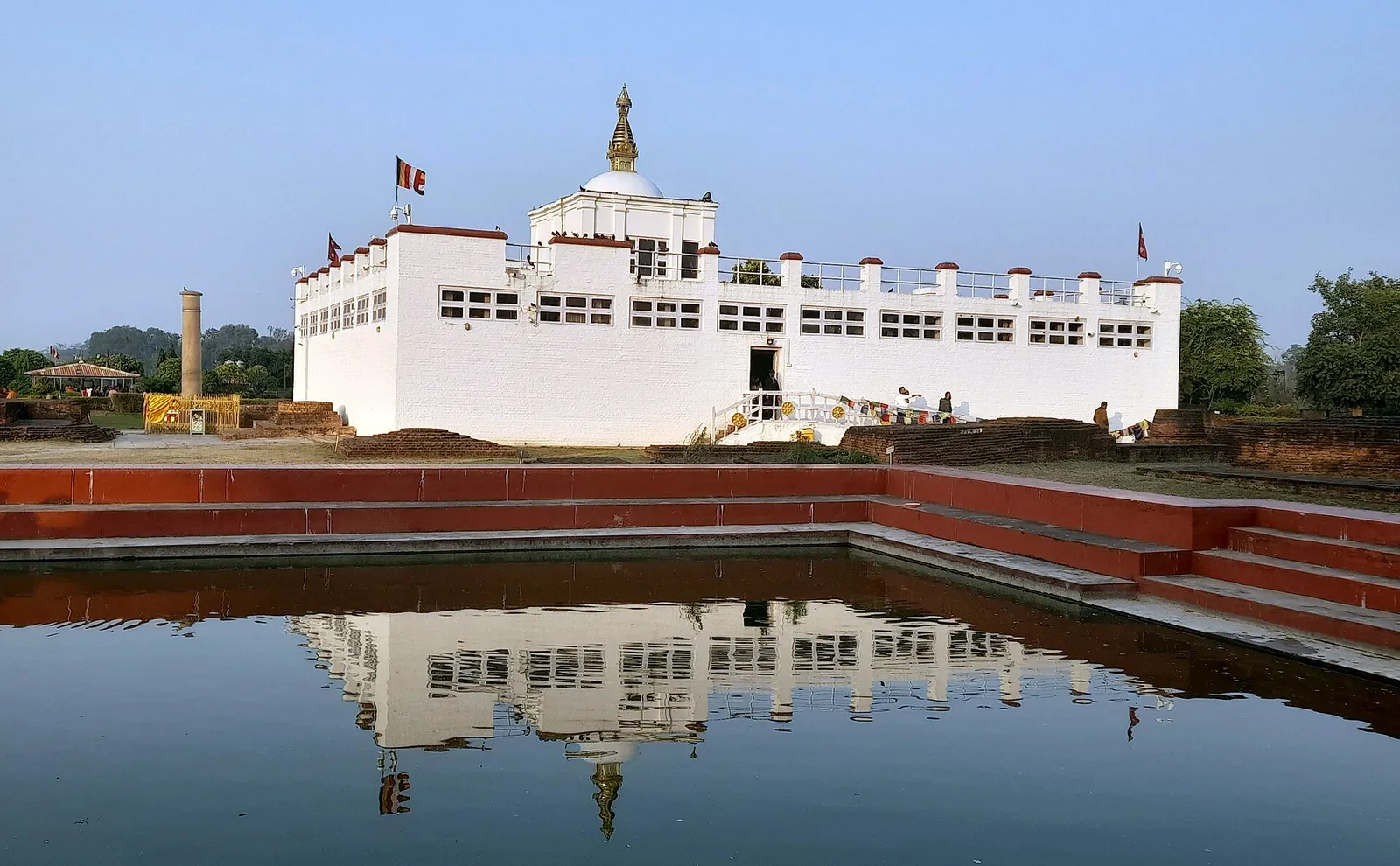
The Sacred Garden is the core of Lumbini and the reason for the journey. A circular pond and a circular levee ring it, and inside lie the Maya Devi Temple, the Ashoka Pillar, the Sacred Pond (Puskarini), the ruins of early monasteries and 31 excavated stupas. The Lumbini Development Trust says excavations show the temple site was built and restored many times from the 6th century BC, and that the present temple was reconstructed in 2003.
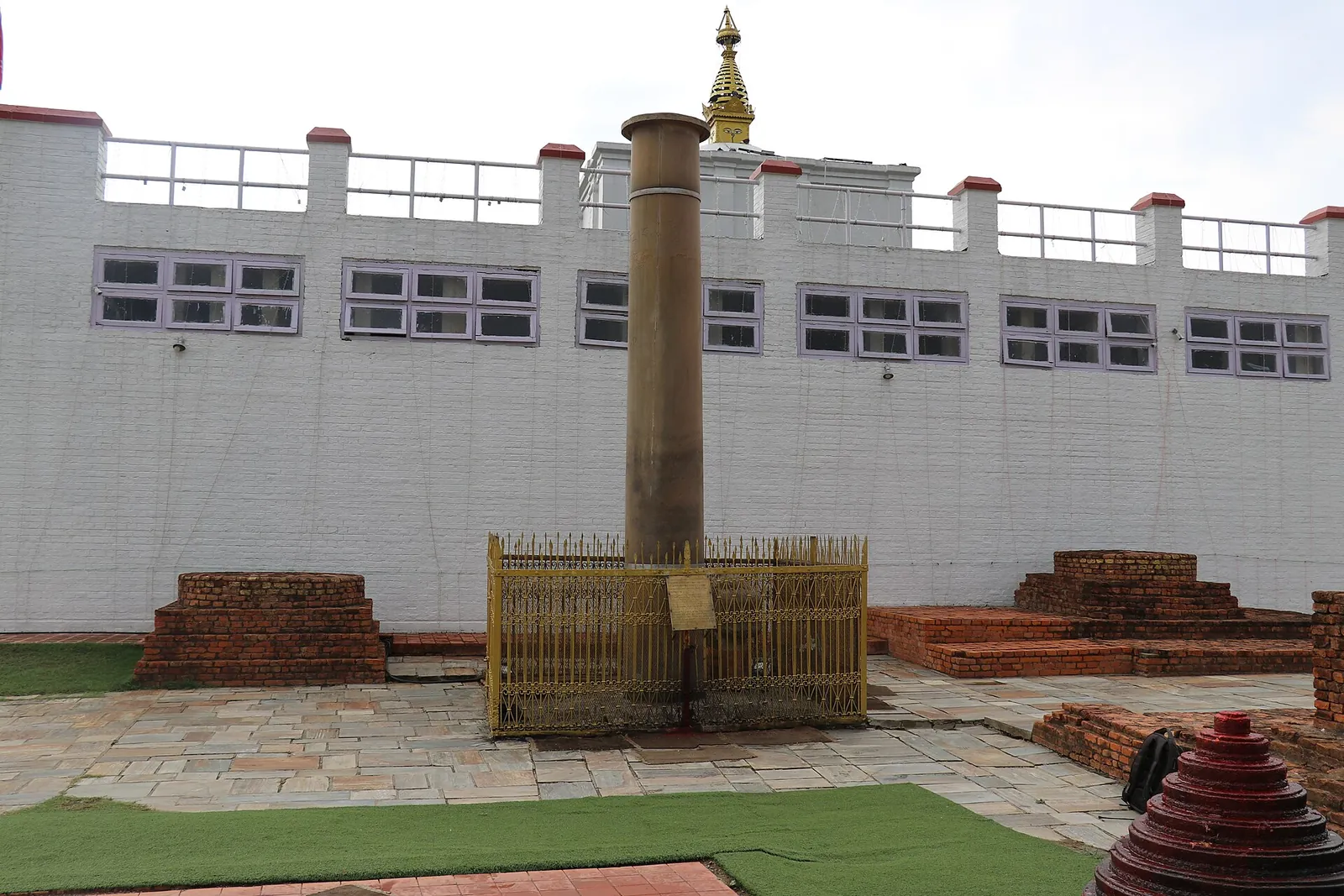
Inside the Maya Devi Temple the Marker Stone is the object everything points to. The trust describes a sandstone-based conglomerate measuring 70 cm by 40 cm by 10 cm, resting on a platform of seven layers of brick from the 3rd century BC, and says it marks the spot where Prince Siddhartha was born. Beside it is the Nativity Sculpture, a 4th-century red sandstone relief in the Mathura style that shows Queen Maya Devi holding a tree branch while the newborn prince stands on a lotus. Outside, the Ashoka Pillar was erected by the emperor in 249 BC; its Brahmi inscription records that the Buddha was born here and that the village's tax was reduced. It stands 9.41 m high with almost half of it below ground, and the Sacred Pond, where tradition says Maya Devi bathed before the birth, measures 24.90 m by 24.85 m.
At the temple you remove your shoes, dress modestly and leave food and drink at the entrance. Checked on 18 October 2026, the trust's Entry Formalities page listed the daily conservation fee at NPR 1,000 for other nationals and NPR 700 for SAARC and Myanmar nationals, with a separate NPR 80 rate for Indian nationals. A still camera costs USD 3 and a video camera USD 25 a day for foreign visitors other than Indian nationals. A 12-day meditation pass is NPR 1,500 for other nationals, NPR 1,000 for SAARC and Myanmar nationals other than Indians, and NPR 500 for Indians. The fee is waived for monks, nuns, people with disabilities and residents of the three surrounding districts. Tickets can be bought in cash, by QR code or at tickets.lumbinidevtrust.gov.np. At the trust's Visitor Information Centre visitors register and pay their fees before going on to the Maya Devi Temple.
Two working monasteries stand close to the temple. The Rajkiya Buddha Vihara, a Theravada monastery in classic Nepali style, has a Dhamma hall with Buddha statues, a marble replica of the Nativity Sculpture and wall paintings, and its monks arrange pujas and blessings for visitors on request. The Dharmaswami Maharaja Buddha Vihara, founded in 1968, follows the Sakya school of Tibetan Buddhism and hosts the Sakya Monlam Puja, a 10-day world peace ceremony attended by thousands. The trust's GLA tour page describes evening lighting and chanting ceremonies, especially around the full moon, and meditation sessions at the birthplace.
The monastery zones: east for Theravada, west for Mahayana and Vajrayana
Kenzo Tange's master plan, approved by the Nepali government in 1978, covers an area of 1 by 3 miles on a north-south axis and divides it into three zones of about a square mile each: the Sacred Garden, the Monastic Zone and the Cultural Center with New Lumbini Village. A 1.6 km pedestrian walkway and a canal divide the Monastic Zone in two, and the Central Canal has boating facilities, the Peace Bell and the Eternal Peace Flame, where the trust invites visitors to light a flame for peace.
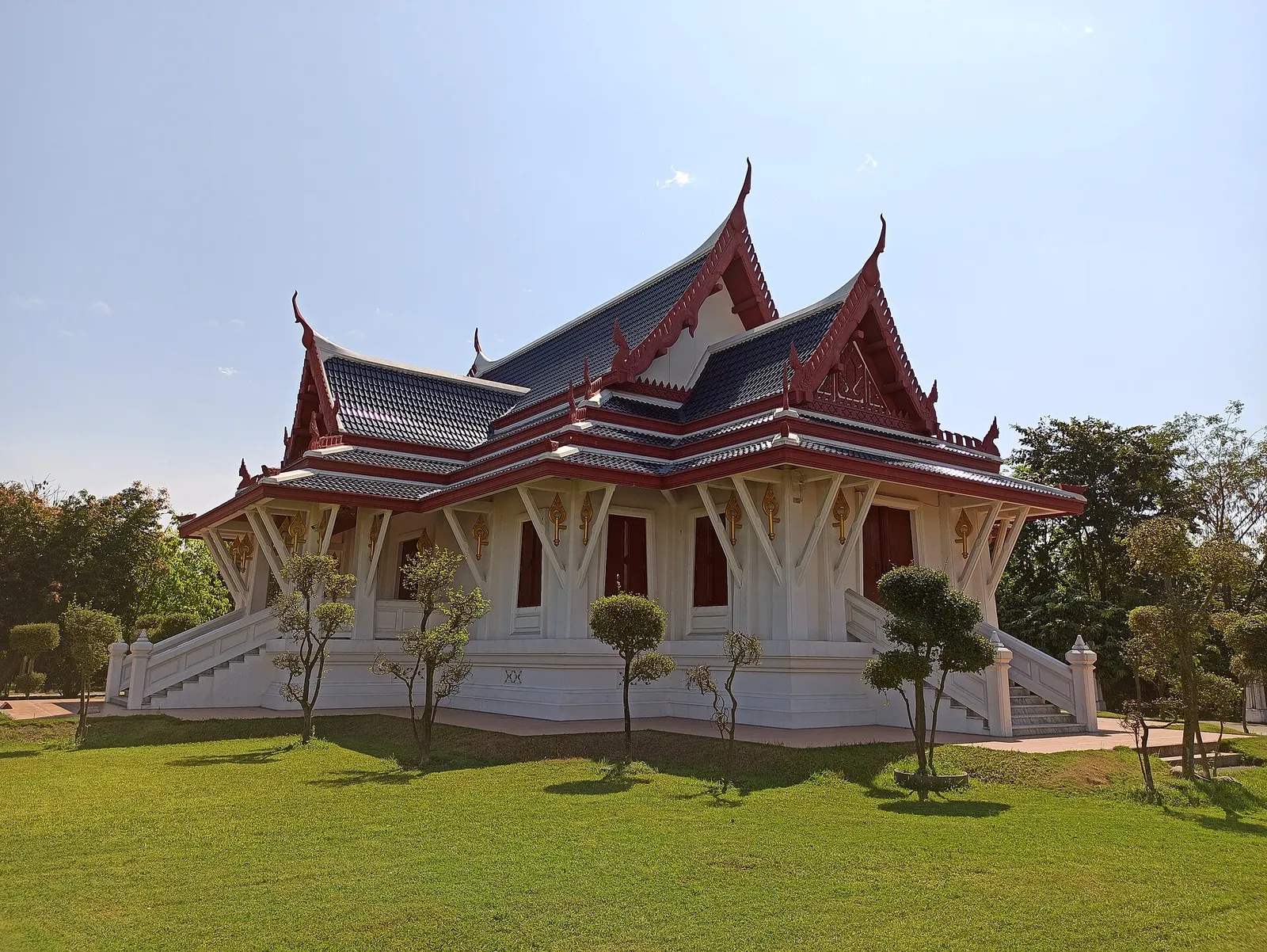
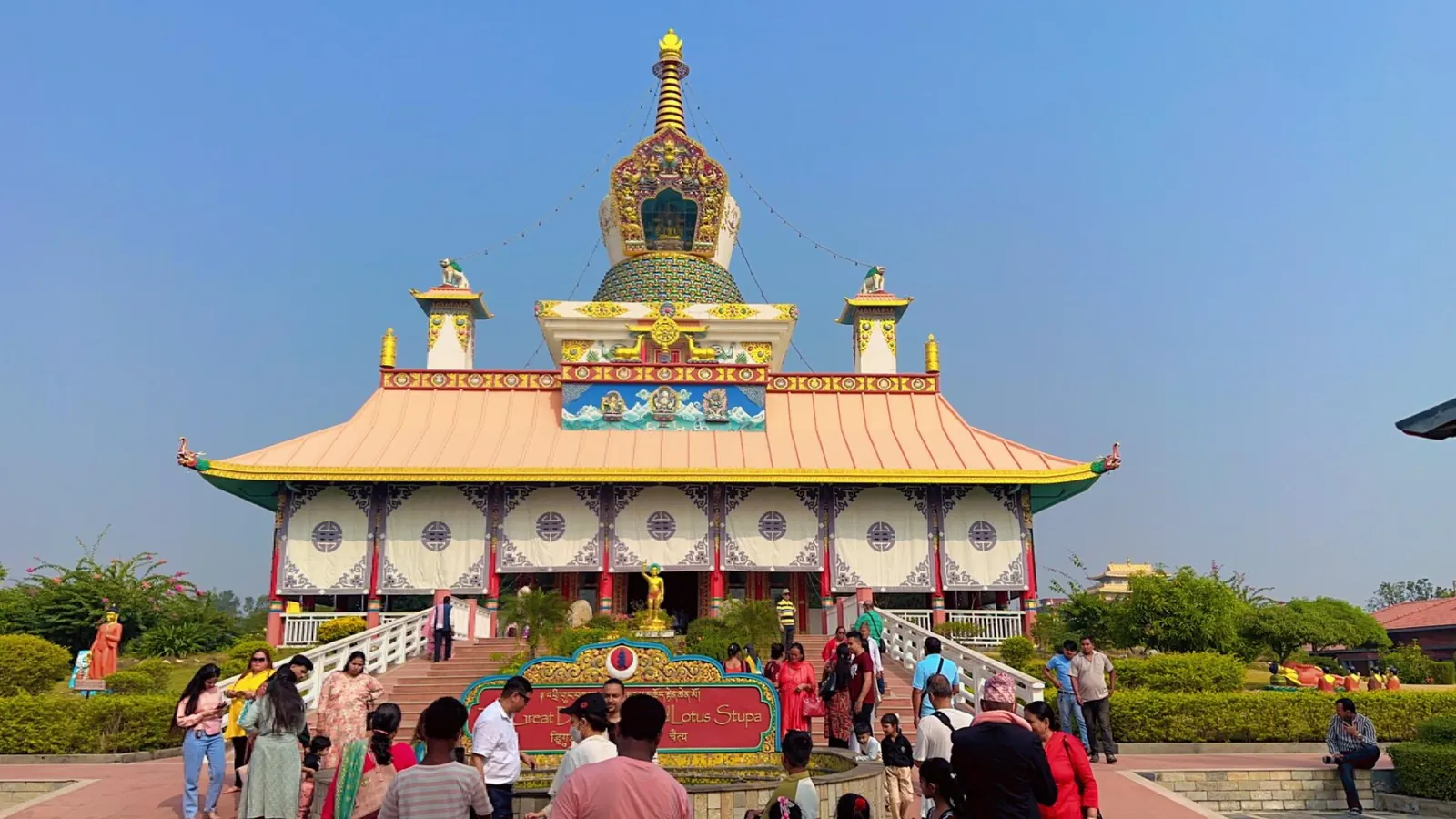
The East Monastic Zone holds the Theravada countries. The trust lists the Royal Thai Monastery, the Myanmar Golden Temple, the Mahabodhi Society Temple of India, the Cambodian Temple, the Sri Lankan Monastery and the International Gautami Nuns Temple among seven monasteries and one Vipassana centre in operation. The West Monastic Zone is the Mahayana and Vajrayana side, with 18 monasteries and two meditation centres in operation. Among them the trust names the Great Lotus Stupa built by the Tara Foundation of Germany, the Sokyo Japanese Monastery, the Chinese Monastery, the Dae Sung Shakya Temple from South Korea, the Geden International Monastery from Austria and the Vietnam Phat Quoc Tu. The trust sets aside 13 plots in the east for Theravada viharas and 29 in the west for Mahayana monasteries. The trust describes each monastery as showing its country's own architectural style and religious artistry, and invites visitors to pray and meditate inside, so walking both sides is a tour of Buddhist building from Thailand and Myanmar to China, Japan and Korea.
Ask for the Sacred Garden's opening hours when you register at the Visitor Information Centre, and plan the visit for daylight. About 1.17 million people visited Lumbini in 2024 according to the trust, most of them Nepali and Indian visitors, with 111,425 holders of other passports. The trust gives the birth as on Baisakh Purnima, the full moon of the first Nepali month. Festival dates such as Buddha Jayanti change each year, and the Ministry of Home Affairs announces the public-holiday list for each Nepali year.
Getting around the master plan
Lumbini is bigger than it looks on arrival. The trust's master plan covers a north-south axis 3 miles long, with the Sacred Garden, the Monastic Zone and the Cultural Center and New Lumbini Village. The Monastic Zone's pedestrian walkway alone is 1.6 km long.
Begin at the trust's Visitor Information Centre in the Cultural Center, where you register and pay, and where the staff give free information and guide visitors. Transport options and fares around the master plan are not confirmed; ask the Visitor Information Centre before setting out. Take the Sacred Garden early in the morning or late in the afternoon, carry water, and keep the World Peace Pagoda and the Crane Sanctuary for a separate outing. The trust also recommends a cycling tour through the surrounding villages, paddy fields and wetlands. The trust asks for permission from the District Administration Office, the Civil Aviation Authority of Nepal and the trust itself before a drone is flown over the Buddhist heritage sites of the Greater Lumbini Area.
Kapilavastu, Ramagrama and the rest of the Greater Lumbini Area
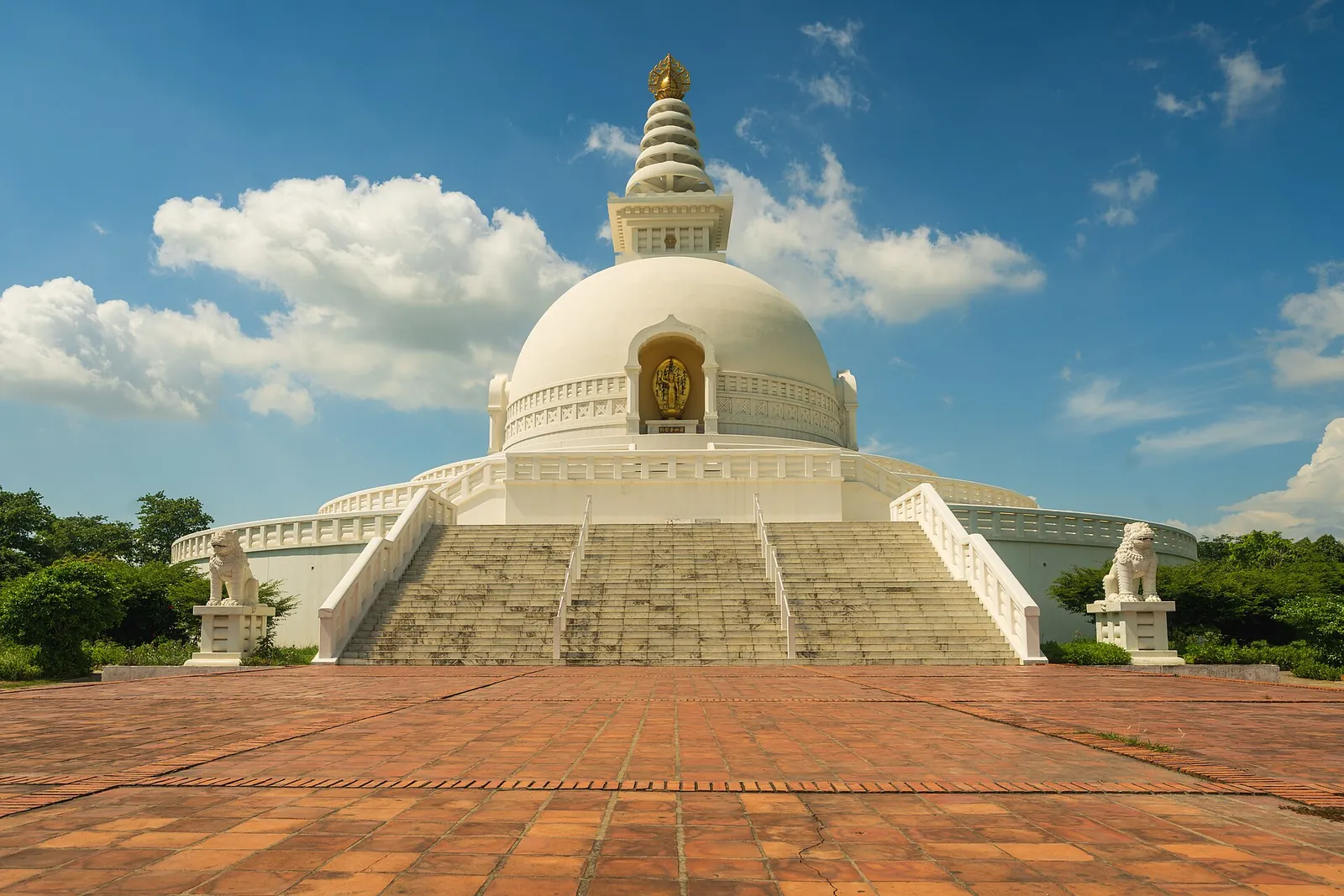
The trust's Greater Lumbini Area pages send visitors beyond the master plan. Its recommended circuit begins at the Visitors' Information Center. It goes on to the World Peace Pagoda of Japan in New Lumbini Village and ends at the Lumbini Crane Sanctuary, a 256-hectare protected area with five artificial wetlands, more than 210 bird species and 300 breeding pairs of Sarus cranes, where the trust lists guided bird watching and nature trails. The circuit also names the Lumbini Museum, a Kenzo Tange building whose terracotta figures, stone sculptures and ancient coins were excavated at Lumbini and Kapilavastu. The tourism board lists the Lumbini Museum as closed.
Ancient Kapilavastu, where the trust says Siddhartha lived for his first 29 years, is an open museum of more than 130 archaeological sites. Tilaurakot, 29 km west of Lumbini, is the fortified site many scholars take for the Sakya capital, with palace remains, a wall and a moat. Kudan, about 3 km south of Taulihawa, is where the trust says the Buddha met King Suddhodhana for the first time after his enlightenment. Gotihawa has a 3.25 m Ashoka Pillar in place at the birthplace of Krakuchhanda Buddha, and Niglihawa, about 7 km northeast of Taulihawa, has a pillar broken in two that marks the birthplace of Kanakamuni Buddha. The Nepal Tourism Board's fee table, checked on 18 October 2026, lists the Kapilvastu Museum at NPR 10 for foreign nationals, closed on Tuesdays. The trust says public buses connect Taulihawa to Bhairahawa and Lumbini, and that e-rickshaws can be hired at Taulihawa to reach the sites.
Ramagrama, about 50 km east of Lumbini and 29 km east of Bhairahawa, holds a 7 m brick stupa that the trust calls the only one of the eight original relic stupas to keep its original form, because Ashoka left it unopened. The trust names Parasi Bazaar, Bhumahi and Sunwal as places to hire e-rickshaws, and says taxis and private cars can be hired from Bhairahawa or Butwal. Devadaha, 57 km east of Lumbini, is the trust's site of the ancient Koliya capital and the maternal home of Queen Maya Devi, with temples at Bhawanipur, Kanyamai and Bairimai; buses run between Butwal and Sitalnagar, and e-rickshaws can be hired in Sitalnagar and Khairahani. Each of these is a full day from a Lumbini base.
One night or a day trip from Kathmandu
Give Kathmandu to Lumbini one night rather than squeezing it into a day trip. Arrive, see the garden, stay near it, and spend the next morning on the monastery walkway before the heat builds. Add a second night for Kapilavastu or Ramagrama.
Choose between Lumbini itself, close to the Sacred Garden and monasteries, and Bhairahawa, 22 km away, which has the airport and the onward buses. Lumbini suits an early garden visit, while Bhairahawa suits a flight out. Our Nepal where-to-stay guide names a hotel by the Sacred Garden.
Flying or driving to Lumbini
Lumbini has no airport of its own. Gautam Buddha International Airport (BWA) is at Bhairahawa. Yeti Airlines says it flies between Kathmandu and Bhairahawa every day in approximately 35 minutes, and Buddha Air lists Bhairahawa among its airports. Foreign nationals other than Indian and Nepali citizens pay Yeti's USD fares, which the booking page shows for your date. Yeti's extra-baggage charge on Kathmandu to Bhairahawa, checked on 18 October 2026, was NPR 150 per kilo. From the airport the trust puts Lumbini 18 km away by car or taxi; the Nepal Tourism Board says Lumbini lies 22 km from Bhairahawa town, with regular buses between the two and taxis at Bhairahawa, and the trust lists the local bus from the Bhairahawa bus stand at NPR 80 to 100 for a ride of 1 to 1.5 hours. Germany's Federal Foreign Office says all Nepali airlines are on the EU list of unsafe airlines, and the UK government lists them on its Air Safety List.
The Lumbini Development Trust puts Kathmandu to Lumbini at approximately 280 km and around 10 to 11 hours by bus. Its Lumbini page, checked on 18 October 2026, lists departures at 7 am and 7 pm and tickets at about NPR 1,500 to 2,000. Take the morning departure and a marked tourist bus: the UK government advises against night travel and overloaded buses, and Germany's Federal Foreign Office says to use only marked tourist buses. The trust's Lumbini page says buses also run to Lumbini from Pokhara, 227 km away, and from Chitwan, 170 km away. From June to October, floods and landslides can cut roads for days, so check that the road is open the day before, and keep an available flight as your fallback. The UK government, checked on 17 October 2026, listed areas of Gorkha, Nuwakot and Dhading among those affected by the floods of 26 August 2026 and warned that heavy rain could trigger more landslides. If neither flights nor daylight road travel is possible, stay put and change the plan. Our Nepal transport guide covers the other domestic routes.
By land, the tourism board lists Bhairahawa and Birgunj among the border posts that issue a visa on arrival; they are the Nepal side of Sonauli/Belahiya and Raxaul/Birgunj, the only two crossings at which Germany's Federal Foreign Office says foreigners can travel on to India by land, and either can close at short notice. Our Nepal entry guide covers the visa rules.
Make time for the local food
What to eat and where to look
Dal bhat tarkari
Rice with lentil soup and seasonal vegetable curry, the everyday meal of Nepal and of the Terai plain, and the plain, filling choice after a morning of walking in the heat.
- Where to look
- Look for a dal bhat meal near your Lumbini base.
- Fit it into your day
- Lunch between the Sacred Garden and the monastery walk.
NaTHNaC advises against untreated tap water and ice; choose sealed bottled drinks or boiled water.
Dhikri
Steamed rice dough shaped in different ways and eaten with chutney, a Tharu delicacy listed by the Nepal Tourism Board.
- Where to look
- Ask about Tharu food if you add a village visit around Kapilavastu; the trust recommends homestay experiences in Jagadispur.
- Fit it into your day
- A village meal if you add a day of Kapilavastu.
Mithai (Terai sweets)
A sweet-shop stop before leaving Bhairahawa.
- Where to look
- Look for a sweet shop in Bhairahawa before your flight.
- Fit it into your day
- A box to take home before the flight from Bhairahawa.
Practical questions
How many days do I need in Lumbini?
One night and two half days cover the Sacred Garden and the monastery zones. Add one day each for Kapilavastu and Ramagrama if you want the ruins.
How much is the Lumbini entry fee?
Checked on 18 October 2026, the trust's Entry Formalities page listed the daily conservation fee at NPR 1,000 for other nationals and NPR 700 for SAARC and Myanmar nationals, with a separate NPR 80 rate for Indian nationals. A still camera costs USD 3 and a video camera USD 25 a day for foreign visitors other than Indian nationals.
How do I get from Kathmandu to Lumbini?
Fly Kathmandu to Bhairahawa (BWA), about 35 minutes with Yeti Airlines, then go 18 km by car or taxi from the airport, or take the local bus from the Bhairahawa bus stand. The Lumbini Development Trust puts Kathmandu to Lumbini at approximately 280 km and around 10 to 11 hours by bus. Take the morning departure and travel by daylight.
Do I need to remove my shoes and dress modestly?
Yes at the Maya Devi Temple: remove your shoes, wear modest clothing and leave food and drink at the entrance.
Where do I buy the Lumbini ticket?
At the trust's Visitor Information Centre, where visitors register and pay before the Maya Devi Temple, in cash or by QR code, or online at tickets.lumbinidevtrust.gov.np.
Sources and checks before you travel
Reference sources for the version dated 18 October 2026. Confirm opening times, access, transport and conditions for your travel dates.
- Lumbini Development Trust: Entry Formalities ↗ — opens in a new tab
- Lumbini Development Trust: Lumbini ↗ — opens in a new tab
- Lumbini Development Trust: Kapilavastu ↗ — opens in a new tab
- Lumbini Development Trust: Ramagrama Area ↗ — opens in a new tab
- Lumbini Development Trust: Devadaha Area ↗ — opens in a new tab
- Lumbini Development Trust: GLA Tour ↗ — opens in a new tab
- Lumbini Development Trust: Lumbini records tourist arrival of 1.17 million in 2024 ↗ — opens in a new tab
- Nepal Tourism Board: Lumbini ↗ — opens in a new tab
- Nepal Tourism Board: visa information ↗ — opens in a new tab
- Nepal Tourism Board: heritage site entry fees ↗ — opens in a new tab
- Nepal Tourism Board: Climate ↗ — opens in a new tab
- Yeti Airlines: Bhairahawa ↗ — opens in a new tab
- Yeti Airlines: fare categories, reschedule and cancellation policies ↗ — opens in a new tab
- Yeti Airlines: extra baggage charges ↗ — opens in a new tab
- GOV.UK: Nepal safety and security ↗ — opens in a new tab
- Germany's Federal Foreign Office (Auswaertiges Amt): Nepal travel and security advice ↗ — opens in a new tab
- NaTHNaC: Nepal ↗ — opens in a new tab
- NaTHNaC: food and water hygiene ↗ — opens in a new tab
- Ministry of Home Affairs: holidays ↗ — opens in a new tab
- Nepal Tourism Board: local cuisine ↗ — opens in a new tab
- GOV.UK: Nepal travel advice ↗ — opens in a new tab
- Buddha Air: flights from Kathmandu to Bhairahawa ↗ — opens in a new tab
Photo credits
The Mayadevi Temple in the Sacred Garden at Lumbini, reflected in the pond.
Photograph: Rangan Datta Wiki — opens in a new tab · CC BY-SA 4.0 — opens in a new tab
Changes: Resized and converted to WebP; displayed with responsive crops. · Original photograph and licence details ↗ — opens in a new tab
The Ashoka Pillar behind its railing, with the Mayadevi Temple behind.
Photograph: Imsurit — opens in a new tab · CC BY-SA 4.0 — opens in a new tab
Changes: Resized and converted to WebP; displayed with responsive crops. · Original photograph and licence details ↗ — opens in a new tab
The Royal Thai Monastery with its tiered red roofs, in the monastery zone at Lumbini.
Photograph: Lureypema — opens in a new tab · CC BY-SA 4.0 — opens in a new tab
Changes: Resized and converted to WebP; displayed with responsive crops. · Original photograph and licence details ↗ — opens in a new tab
The Great Lotus Stupa, a Mahayana monastery in the West Monastic Zone, with visitors at its steps.
Photograph: SristiAwasthi21 — opens in a new tab · CC BY-SA 4.0 — opens in a new tab
Changes: Resized and converted to WebP; displayed with responsive crops. · Original photograph and licence details ↗ — opens in a new tab
The white World Peace Pagoda at Lumbini.
Photograph: Sunuwargr — opens in a new tab · CC BY-SA 4.0 — opens in a new tab
Changes: Resized and converted to WebP; displayed with responsive crops. · Original photograph and licence details ↗ — opens in a new tab