Pokhara and the Annapurnas · Gandaki
Poon Hill trek: Ghorepani sunrise, permits, season and lodges
Poon Hill is the trek that most first-time visitors to the Annapurnas choose, because it ends at a famous sunrise viewpoint without asking for the days that Annapurna Base Camp does. The Nepal Tourism Board calls it one of the most popular short treks in Nepal, perfect for beginners and families. It is still a trek in a protected area: foreign trekkers need a licensed guide arranged through a registered agency, a TIMS card and the Annapurna Conservation Area permit, and the viewpoint sits above the height where altitude illness begins. This guide sets out the loop from Birethanti over Ghorepani to Ghandruk, what to arrange before you leave Pokhara, what the trek costs two people and when to go.
- Suggested time
- 3 to 4 days on the trail, plus a night in Pokhara before and after
- Where to stay
- Lakeside, Pokhara, before and after the trek; Ghorepani on the trail for the sunrise at Poon Hill
- Season and timing
- The Nepal Tourism Board names spring, when the rhododendrons bloom, and the weeks after the monsoon as the best times, with the clearest skies in October and November. The monsoon runs from June to September.
The short answer
Base yourself in Lakeside, Pokhara, for a night before and after, and allow three to four days on the trail, the length the Nepal Tourism Board gives for Poon Hill: in at Birethanti, a night at Ghorepani for the sunrise at 3,210 m, and out through Ghandruk. Book a government-registered trekking agency first, because foreign trekkers must walk with a licensed guide and carry a TIMS card that only an agency can buy (NPR 2,000). The Annapurna Conservation Area permit costs NPR 3,000; both fees were checked on 17 October 2026.
Is Poon Hill the right trek for you
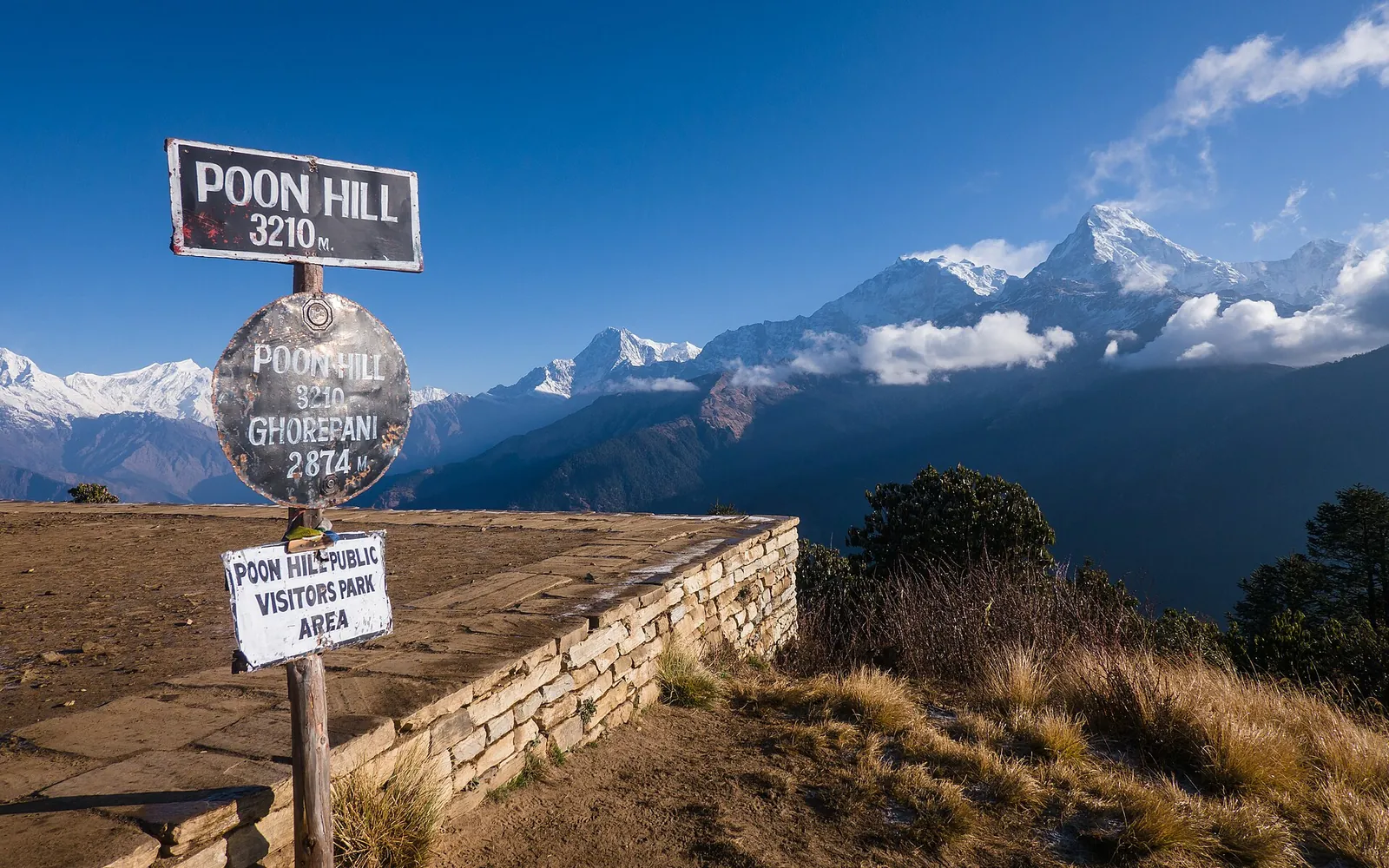
Poon Hill is the short Annapurna trek. The Nepal Tourism Board describes the Ghorepani Poon Hill trek as one of the most popular short treks in Nepal, perfect for beginners and families, and suggests it to families as a short trek of three to four days. Its highlight is the sunrise from Poon Hill, at 3,210 m.
Choose it if you have a week or less around Pokhara, want mountain views from a trail with lodges rather than a camp, and have not trekked at height before. Choose Annapurna Base Camp instead if you have a week or more and want to walk into the Sanctuary; the Nepal Tourism Board notes that the base camp route offers sunrise views if combined with Poon Hill, and its TIMS list names a combined route, Poon Hill-ABC. Poon Hill is the easier of the two on the body, but it is not a stroll: the early climb to the viewpoint is made in the dark and the cold.
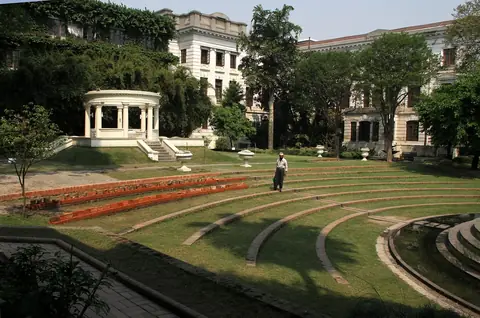
The trek starts from Pokhara, whose own guide covers the lake, the museums and the nights either side of the trek.
The dawn view from Poon Hill, the Ghorepani forest and Ghandruk
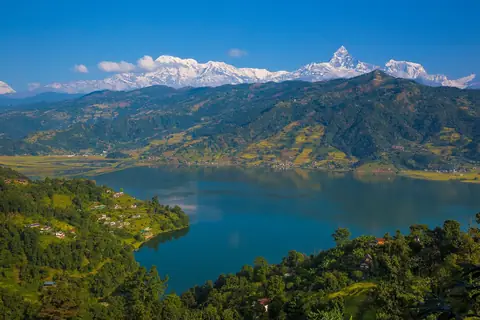
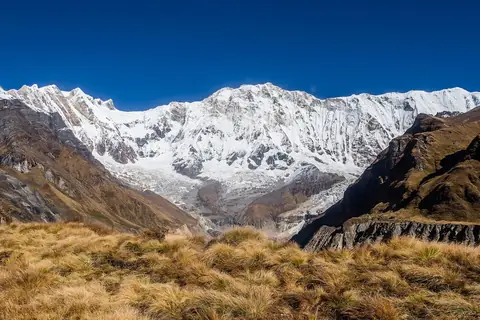
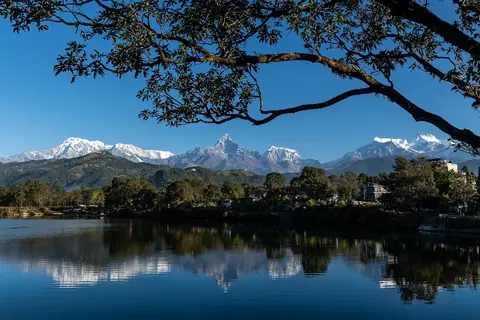
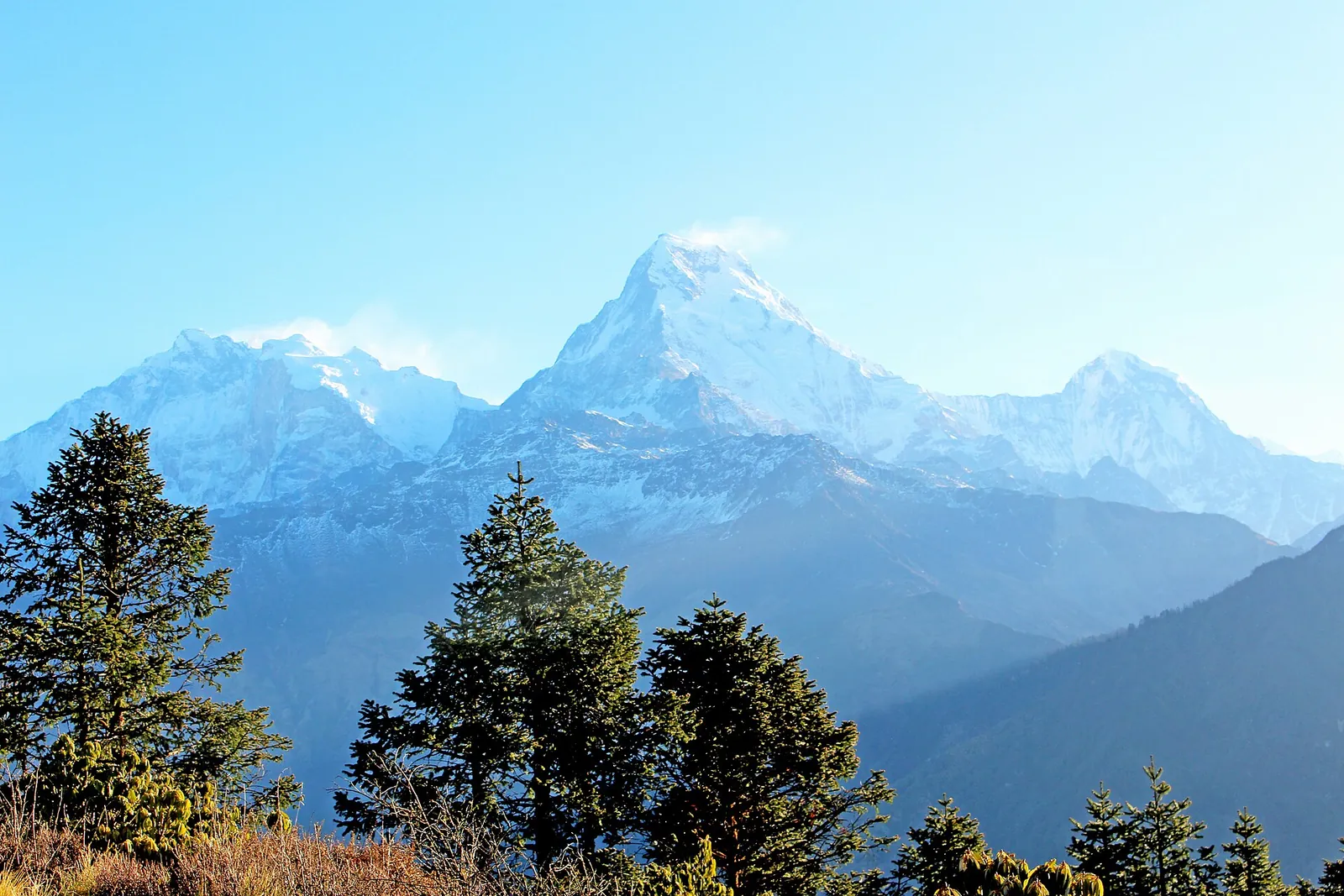
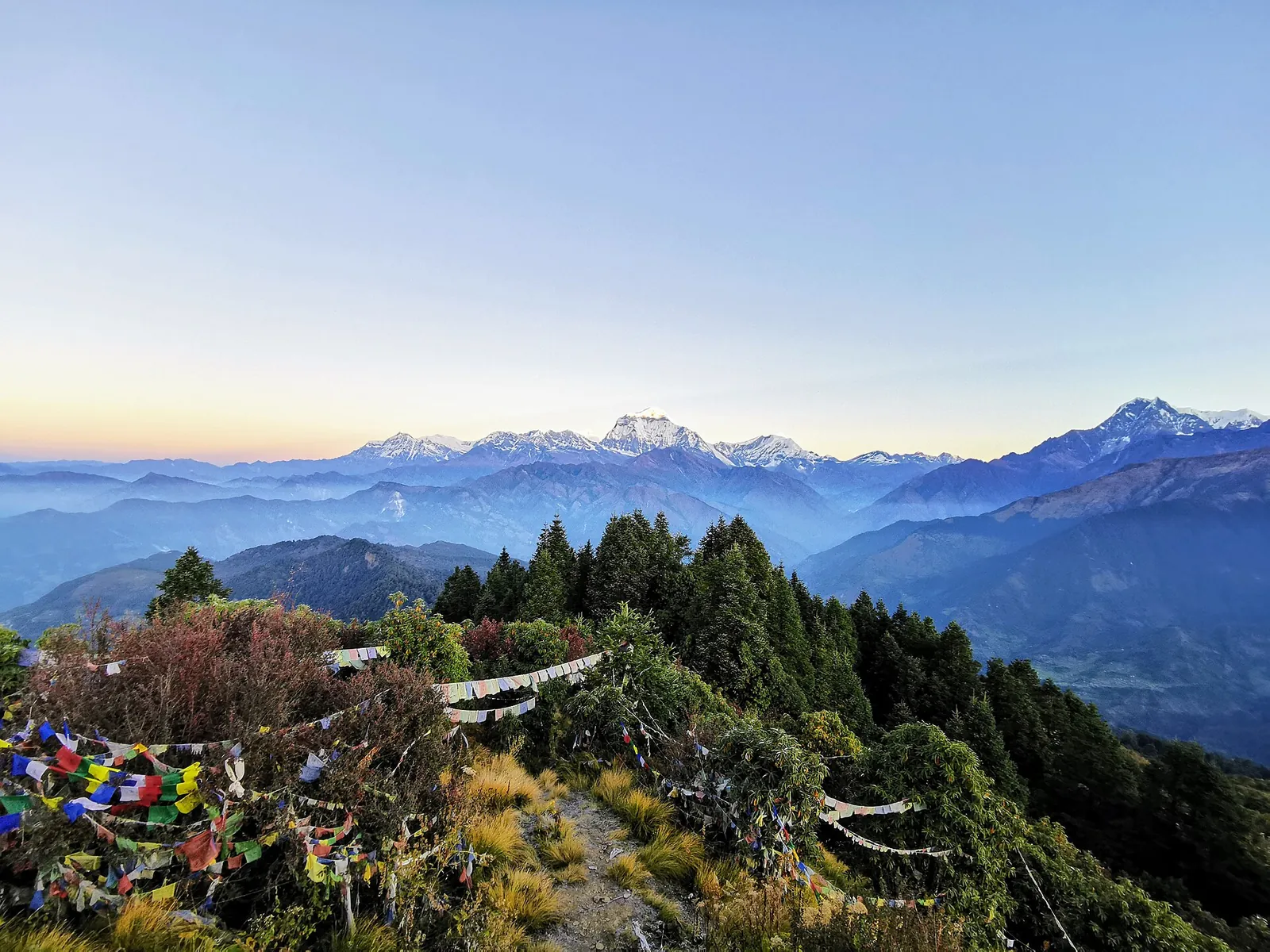
The view is the reason for the trek, and it comes early. From Poon Hill, the Nepal Tourism Board says, the peaks of Annapurna and Dhaulagiri glow golden at sunrise. Dhaulagiri I, at 8,167 m the seventh highest mountain in the world, stands 34 km west of Annapurna I, the tenth highest at 8,091 m, and between the two massifs runs the Kali Gandaki, which the board calls the deepest gorge in the world. The Annapurna chain also includes Annapurna II (7,937 m), Annapurna III (7,555 m) and Annapurna South (7,219 m).
You climb from Ghorepani in the dark to be on top before the sun reaches the peaks, so settle the departure time with your guide the evening before and carry small rupee notes. Take a torch and a warm layer: the Nepal Tourism Board notes that temperatures fall about 6 degrees C for every 1,000 m of altitude, so the viewpoint is far colder than Pokhara at about 800 m.
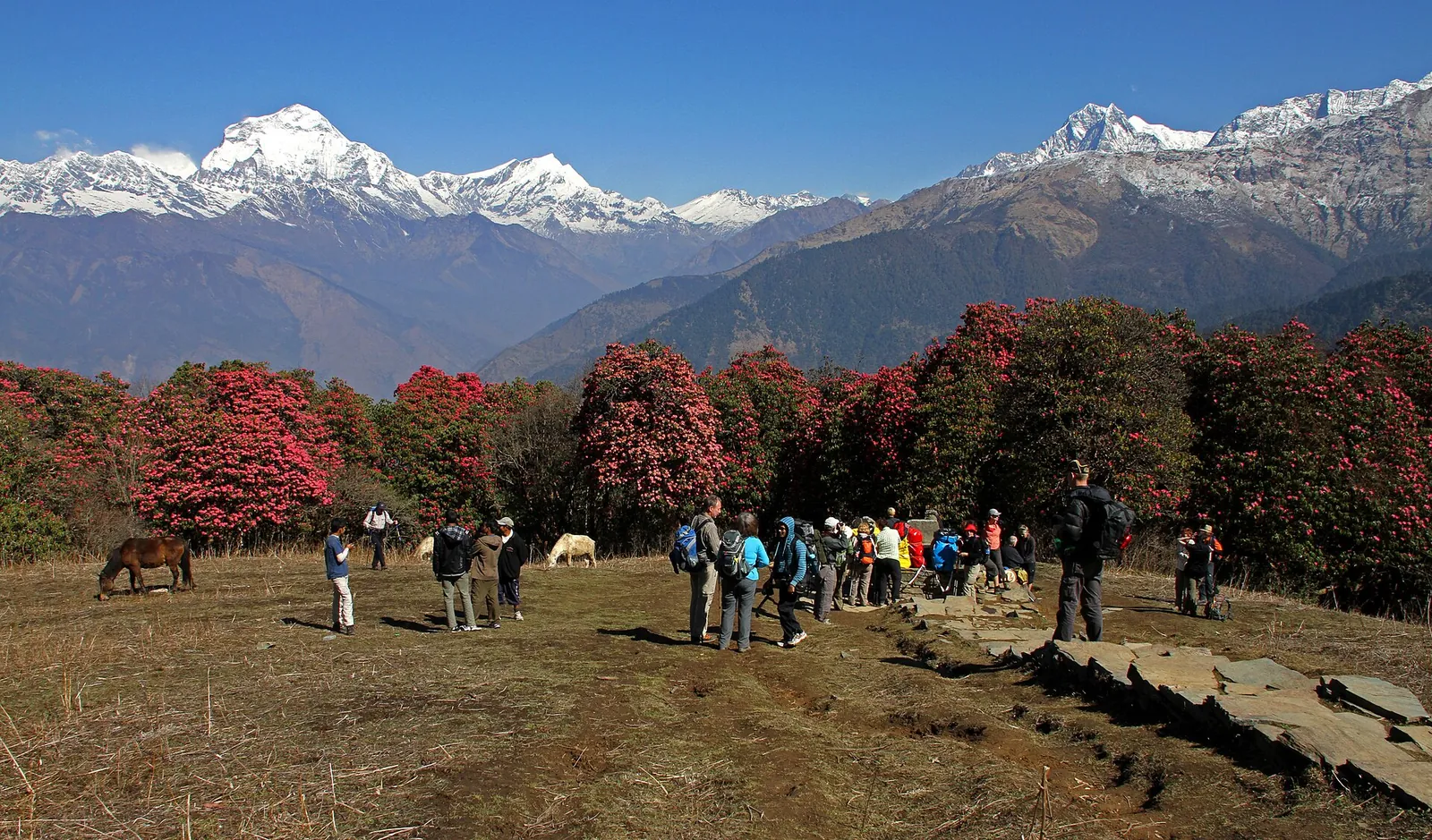
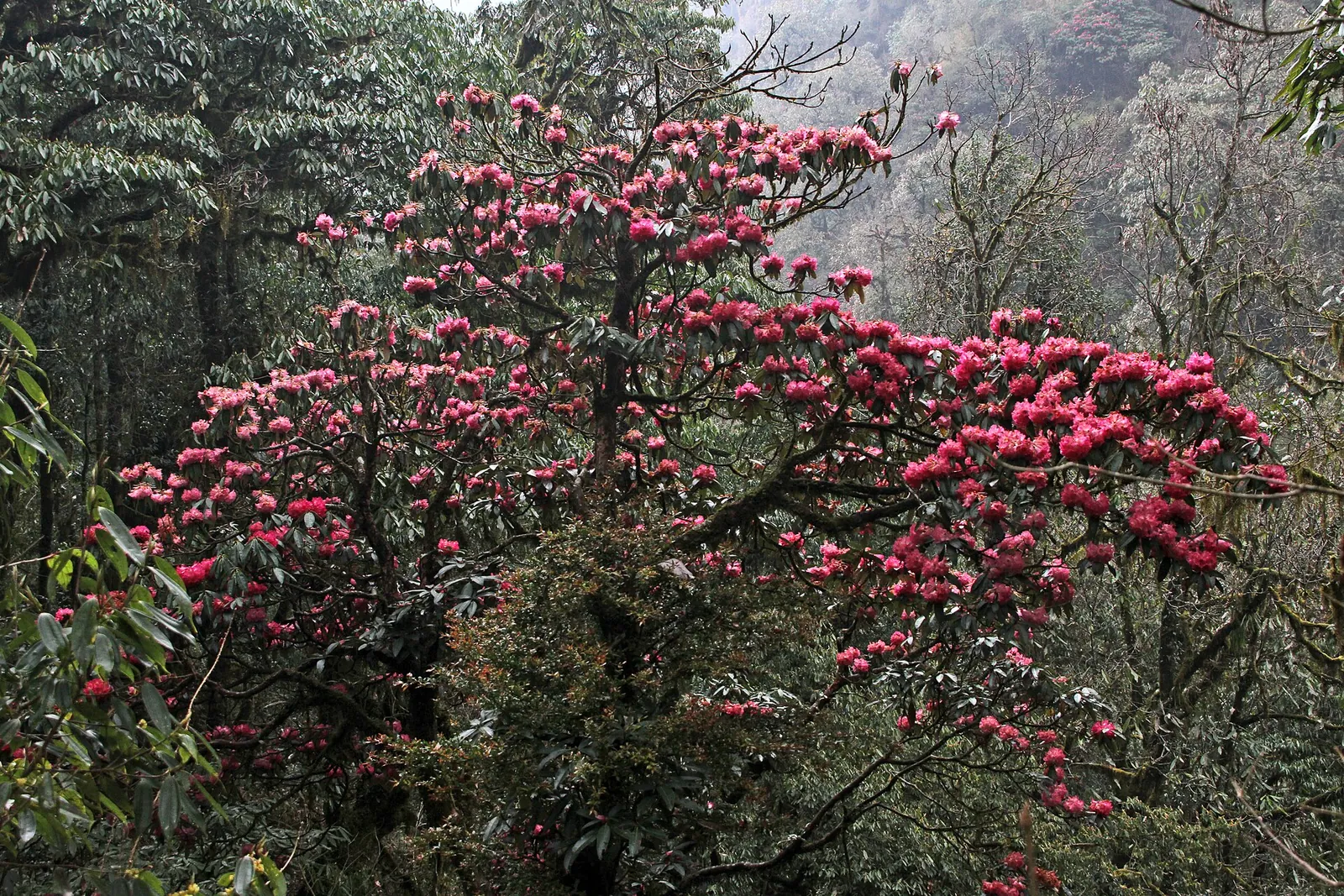
The walk to Ghorepani is the second reason. The National Trust for Nature Conservation, which runs the conservation area, says the region contains among the world's largest rhododendron forests at Ghorepani, and the Nepal Tourism Board says spring is when the rhododendrons bloom. Gurung and Magar communities are the dominant groups in the south of the area, the trust adds.
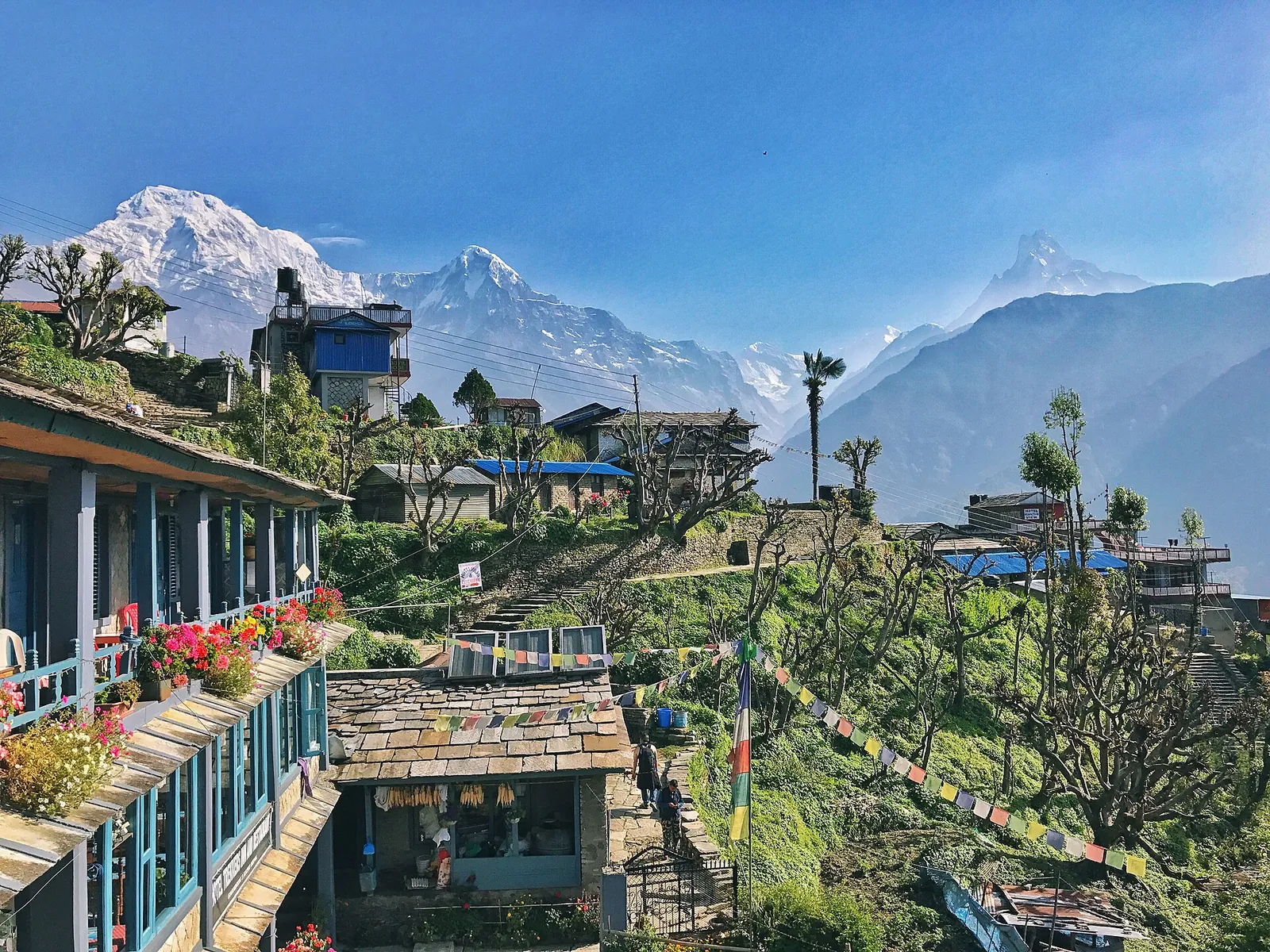
Ghandruk, at the end of the loop, deserves an unhurried afternoon. The Nepal Tourism Board describes it as a traditional Gurung village in Kaski with a Gurung museum and one of the best views of Annapurna South, Gangapurna, Annapurna III, Hiunchuli and Machhapuchhre, and a marketplace, Seuli Bazar, for local goods. It is also where the conservation area began: the trust says its project was first tested as a pilot in Ghandruk in 1986.
The loop from Birethanti over Ghorepani to Ghandruk
The Trekking Agencies' Association of Nepal publishes the normal routes on its TIMS overview page. For the Poon Hill-ABC trek it gives Pothana or Birethanti, Poon Hill, Chhomrong, Dobhan and Annapurna Base Camp, with the TIMS check post at Birethanti; for the Khopra trek it gives Birethanti, Poon Hill, Tadhapani, Khopra, Tatopani and Gharkhola. Birethanti is therefore the entry point to look for. Nepal Police lists tourist-police posts at Birethanti, Ghorepani, Ghandruk and Dhampus.
The short loop uses the first part of those routes: by road from Pokhara to Nayapul, on foot from Birethanti up to Ghorepani, the village below the 3,210 m viewpoint, over Poon Hill to Tadapani, one of the trails the Nepal Tourism Board names around Ghandruk, and down to Ghandruk, which the road from Pokhara reaches. Before you pay, have the agency write into the itinerary where each night is and how many hours each day walks, and check that the first night leaves a short climb to Ghorepani on day 2. A four-day plan looks like this:
- Day 1: transfer by road from Pokhara to Nayapul, register at the TIMS check post at Birethanti, and start the climb towards Ghorepani, with the first night at the lodge village your itinerary names.
- Day 2: on up through the rhododendron forest to Ghorepani, the village below the viewpoint, and an early night.
- Day 3: the pre-dawn climb to Poon Hill for the sunrise, back to Ghorepani for breakfast, then on to Tadapani.
- Day 4: down to Ghandruk, time for the village and the Gurung museum, and the drive back to Pokhara.
- Three or five days: a three-day version drops the first night and climbs to Ghorepani in a single day, which is comfortable only if the transfer drives you on up the road past Birethanti before you start walking, so check where the walking begins; a fifth day is best spent as a night in Ghandruk or a slower climb to Ghorepani.
Licensed guide, TIMS card and conservation area permit
Foreign trekkers may not walk the Poon Hill route alone. The Nepal Tourism Board says that since the revised rule took effect on 31 March 2023, foreign trekkers on a listed set of routes in protected areas must be accompanied by a licensed trekking guide and carry a TIMS card issued through a trekking agency, and its list names Poon Hill-ABC among the Annapurna routes. France's foreign ministry applies the licensed-guide and TIMS requirement to all trekkers in Nepal, so arrange both through a registered agency for the short loop too.
Only agencies buy the TIMS card: the agency registers the trekkers, guides and route on the board's system, pays online, and each trekker gets an e-card with a QR code. The Nepal Tourism Board tells trekkers to contact a government-registered trekking agency first; the trekking permits guide explains how the card and the permit fit together.
Fees. On the official pages checked on 17 October 2026, the TIMS card cost NPR 2,000 for foreign trekkers other than South Asian (SAARC) nationals, who pay NPR 1,000. The Annapurna Conservation Area permit cost NPR 3,000 for foreigners and NPR 1,000 for SAARC nationals, tax included, for one entry; children under 10 do not need one. For a foreign adult other than a SAARC national, the two come to NPR 5,000 before the guide, transport and lodges, when the conservation-area permit is paid at a counter. Carry the TIMS e-card, the permit and your passport for the whole trek, for the check posts on the way.
The permit can be bought on the National Trust for Nature Conservation's e-permit website, with a 2.9% online payment-gateway charge, or in cash at one of its counters with your passport or other valid identification, with no additional charge. Permits issued at check-posts cost double, so buy it before the trek. It is non-transferable and non-refundable, and you should register at the check-posts along the route.
Insurance. The UK government advises that your insurance include mountain rescue and helicopter costs, and warns that rapid helicopter evacuation may be hard to arrange in remote areas. France's foreign ministry says mountain rescue is paid for and helicopters fly only when payment is guaranteed; give your insurance details to the agency before the trek. It reserves helicopter transport from an accident site to Kathmandu for extreme emergencies. France's foreign ministry recommends that trekkers or their guides carry satellite phones.
What the trek costs two people
For two foreign adults other than SAARC nationals, the permits come to NPR 10,000: two TIMS cards at NPR 2,000 and two conservation area permits at NPR 3,000, at the fees given above, paying the conservation-area fee at a counter.
The guide, a porter and the road transfers make up the rest, and agencies sell them as one package. As one example, Nepal Alternative Treks' own four-day Ghorepani Poon Hill package, checked on 18 October 2026, was advertised at a discounted USD 280 per person for your own group of one to four, USD 560 for two, reduced from USD 380 per person. For two trekkers, its listed inclusions are pick-up and drop-off at your Pokhara hotel, the overland transport in its itinerary, a government-authorised English-speaking guide, one porter for every two trekkers, twin-share lodge rooms and all meals on the trek. The listed package also includes the ACAP permit and all necessary trekking permits. Drinks, tips, personal travel insurance and your hotel nights and meals in Pokhara are extra.
The same package page says TIMS is generally not issued for this trek, so its advertised price does not establish that the card is included. Confirm the required TIMS card and the agency's government registration before booking. Compare other agencies on the full list of inclusions; the UK government warns that trekking deals that look very cheap may be scams.
Budget for whatever your package leaves out, from drinks and tips to, in a guide-only package, lodge nights and meals. Lodge rates are not listed here; draw enough rupees in Pokhara before you start.
Altitude at 3,210 m
Poon Hill is not high by Himalayan standards, but it is high enough to matter. UK Travel Health Pro says altitude illness is a risk from 2,500 m, depending on the height gained, the rate of ascent and the sleeping altitude, and the viewpoint is at 3,210 m according to the Nepal Tourism Board. Germany's Federal Foreign Office advises medical advice before going above 2,300 m.
UK Travel Health Pro advises spending a few days below 3,000 m. TravelHealthPro advises gaining no more than about 500 m of sleeping height a day above 3,000 m. Take a rest day at the same altitude every three or four days. If you develop symptoms of altitude sickness, stop climbing, descend promptly with a companion to a lower altitude (below 4,000 m if you are higher) and consult a doctor. Signs of cerebral or pulmonary oedema need immediate descent and emergency medical treatment.
For a weather or flood warning call 1155, the Nepal Meteorological Department's toll-free line, and for help call the tourist police on 1144.
When to go: spring bloom, clear autumn and the monsoon
The Nepal Tourism Board says that for most trekking areas the best times are spring and autumn. Spring is when the rhododendrons bloom around Ghorepani, and the clearest skies come after the monsoon, in October and November. The best time to visit guide compares the seasons across Nepal.
The monsoon runs from June to September. The board gives Pokhara 3,345 mm of rain a year, so leave room for cloud to obscure the view. Winter is colder, with shorter days, but the board points out that even in December and January, when winter is at its severest, there is bright sun and brilliant views.
Dates of festivals change each year; check the Ministry of Home Affairs holiday list for the year you travel.
Getting from Pokhara to Birethanti and back from Ghandruk
Fly from Kathmandu to Pokhara before the trek. Yeti Airlines gives Kathmandu to Pokhara as about 25 minutes. Every Nepali airline is on the UK Air Safety List and the EU list of unsafe airlines, and mountain flights are often delayed by weather. The Nepal Tourism Board says intercity tourist buses to Pokhara, Chitwan and Lumbini leave from Kantipath in Kathmandu. Tourist-bus operators and fares are not listed on that page; check both when booking. Have the final boarding point written on the ticket. The transport guide compares the two ways in.
Birethanti is the TIMS entry point. No official page gives the road distance, time or fare from Pokhara to Birethanti; ask your agency to include the transfer. Nepal Alternative Treks gives its own drive from Pokhara through Nayapul and Birethanti to the start of its four-day walk as about 70 km and 2.5 hours.
At the end of the loop, the Nepal Tourism Board puts Ghandruk 54.8 km by road from Pokhara and gives the drive as anything from about 1 hour 35 minutes to 4 to 5 hours, so keep the rest of that day free.
Check that the road is open, travel in daylight and use a marked tourist bus or an agency-arranged vehicle. The UK government calls road conditions poor, especially in the monsoon, advises against travel at night and gives June to October as the season when floods and landslides can cut roads. If the trailhead road closes, delay the trek in Pokhara. Keep a buffer day in Pokhara or Kathmandu before an international flight home.
Where to sleep on the trail: Ghorepani, Tadapani and Ghandruk
The trail is lined with lodges: the National Trust for Nature Conservation counts over 1,000 lodges and teashops in the conservation area, and the Nepal Tourism Board says Thakali families, known for their business sense, run tea houses along the Annapurna trek routes. The nights on the loop are the village your itinerary names on the climb, Ghorepani for the sunrise, Tadapani, and Ghandruk if you stay a fifth night, where the board says there are hotels and lodges in several places.
Ghorepani is the one night that cannot move, because the sunrise depends on it, so ask your agency to reserve it, above all for the clear weeks of October and November and around the main festivals. For the nights in Pokhara before and after, the where to stay guide compares the areas.
The Nepal Tourism Board says lodges have facilities for charging batteries; check at check-in what charging, a hot shower or wifi costs, and pay in rupees.
Meals are simple and filling, eaten in the lodge dining room. Drink only sealed or boiled water: UK Travel Health Pro advises against untreated tap water and ice in countries with poor sanitation.
Make time for the local food
What to eat and where to look
Dal bhat and the Thakali set
The staple Nepali meal of dal, rice, vegetables and achar, with yogurt or buttermilk; the Nepal Tourism Board says the lentils change with the season and that a chicken or mutton curry may follow. The Thakali set is the version from Thakali cuisine, one of the two cooking styles the board names for authentic Nepali taste, in which dhido sometimes replaces the rice.
- Where to look
- The lodge dining rooms at Ghorepani, Tadapani and Ghandruk; on the Annapurna routes, the board says, many tea houses are run by Thakali families.
- Fit it into your day
- The evening meal at Ghorepani, before the early start.
Meat curries are often served alongside, so say if you eat vegetarian.
Dhido
A porridge of hot water and ground grain such as millet, barley, buckwheat or wheat flour, eaten with curry, achar or soup. The Nepal Tourism Board calls it one of the most popular indigenous meals in the Himalayan community.
- Where to look
- Lodge kitchens at Ghorepani and Tadapani, in a Thakali set in place of rice.
- Fit it into your day
- A filling dinner after a climbing day.
Dhido can be made from wheat flour, so check the grain if you avoid gluten.
Gundruk ko jhol
A sour soup of fermented and dried green leafy vegetables. The Nepal Tourism Board calls gundruk one of Nepal's national dishes.
- Where to look
- Lodge dining rooms at Tadapani and Ghandruk, served as a soup with dal bhat.
- Fit it into your day
- A warm soup at the end of a cold day.
The soup is sour, and some versions are spicy.
Timmure alu
Potatoes cooked with timmur, the wild pepper also known as Sichuan pepper. The Nepal Tourism Board says the dish comes from the higher Himalayan region, is served in most Thakali restaurants and is eaten as a side dish with dal bhat or on its own as a snack.
- Where to look
- Teashops and lodges between Ghorepani and Ghandruk, where Thakali dishes are cooked.
- Fit it into your day
- A snack at a tea stop, or a side dish with dal bhat.
It can be spicy; order it mild if you avoid heat.
Practical questions
How many days does the Poon Hill trek take?
The Nepal Tourism Board gives three to four days on the trail. A four-day loop runs from Birethanti over Ghorepani and Poon Hill to Tadapani and Ghandruk; add a night in Pokhara before and after.
Do I need a guide and a TIMS card for Poon Hill?
Yes. Foreign trekkers on the route the Nepal Tourism Board lists as Poon Hill-ABC must walk with a licensed guide and carry an agency-issued TIMS card at NPR 2,000; arrange both through a registered agency for the short loop too.
How high is Poon Hill, and is altitude sickness a risk?
The Nepal Tourism Board gives the sunrise viewpoint as 3,210 m. UK Travel Health Pro says altitude illness is a risk from 2,500 m; read the altitude section before booking.
What does the Annapurna Conservation Area permit cost?
The National Trust for Nature Conservation, checked on 17 October 2026, listed NPR 3,000 for foreigners and NPR 1,000 for SAARC nationals, for one entry. Permits issued at check-posts cost double, and children under 10 do not need one.
What does the trek cost?
For two foreign adults other than SAARC nationals, the permits come to NPR 10,000 when the conservation-area fee is paid at a counter. Nepal Alternative Treks' own four-day package, checked on 18 October 2026, was advertised at a discounted USD 280 per person for your own group of one to four, USD 560 for two, reduced from USD 380 per person. Lodges and meals on the trek are included, but confirm TIMS separately before booking.
When is the best time for the Poon Hill trek?
The Nepal Tourism Board names spring, for the rhododendron bloom, and the weeks after the monsoon, with the clearest skies in October and November. Read the season section for rain and road conditions.
Sources and checks before you travel
Reference sources for the version dated 18 October 2026. Confirm opening times, access, transport and conditions for your travel dates.
- Nepal Tourism Board: top trekking destinations ↗ — opens in a new tab
- Nepal Tourism Board: Annapurna ↗ — opens in a new tab
- Nepal Tourism Board: TIMS card ↗ — opens in a new tab
- Trekking Agencies' Association of Nepal: TIMS overview ↗ — opens in a new tab
- NTNC: Annapurna Conservation Area Project ↗ — opens in a new tab
- NTNC: online permit system ↗ — opens in a new tab
- Nepal Tourism Board: trekking in Nepal ↗ — opens in a new tab
- Nepal Tourism Board: climate ↗ — opens in a new tab
- Nepal Tourism Board: safety in the mountains ↗ — opens in a new tab
- UK Travel Health Pro: Nepal ↗ — opens in a new tab
- UK Travel Health Pro: food and water hygiene ↗ — opens in a new tab
- GOV.UK: Nepal safety and security ↗ — opens in a new tab
- Germany's Federal Foreign Office (Auswaertiges Amt): Nepal travel and security advice (German) ↗ — opens in a new tab
- Nepal Police: Tourist Police ↗ — opens in a new tab
- Nepal Meteorological Department ↗ — opens in a new tab
- Yeti Airlines: Pokhara ↗ — opens in a new tab
- Nepal Tourism Board: local transportation ↗ — opens in a new tab
- Nepal Tourism Board: FAQ ↗ — opens in a new tab
- Nepal Tourism Board: food and culinary ↗ — opens in a new tab
- Ministry of Home Affairs: holidays ↗ — opens in a new tab
- Nepal Tourism Board: travel with children ↗ — opens in a new tab
- Nepal Tourism Board: Ghandruk ↗ — opens in a new tab
- Nepal Tourism Board: Dhaulagiri ↗ — opens in a new tab
- Nepal Tourism Board: Annapurna region ↗ — opens in a new tab
- Nepal Tourism Board: Pokhara ↗ — opens in a new tab
- Nepal Alternative Treks: Ghorepani Poon Hill Trek, 4 days ↗ — opens in a new tab
- France Diplomatie: Nepal health advice ↗ — opens in a new tab
- France Diplomatie: Nepal security advice ↗ — opens in a new tab
Photo credits
Snow peaks of the Annapurna range seen from Poon Hill, Ghorepani, in clear morning light
Photograph: Aditya Pal — opens in a new tab · CC BY-SA 4.0 — opens in a new tab
Changes: Resized and converted to WebP; displayed with responsive crops. · Original photograph and licence details ↗ — opens in a new tab
The Poon Hill summit sign at 3,210 m, with the Annapurna range behind
Photograph: Faj2323 — opens in a new tab · CC BY-SA 4.0 — opens in a new tab
Changes: Resized and converted to WebP; displayed with responsive crops. · Original photograph and licence details ↗ — opens in a new tab
Rhododendrons in flower in a clearing on the trail between Ghorepani and Tadapani, with trekkers and snow peaks behind
Photograph: Gerd Eichmann — opens in a new tab · CC BY-SA 4.0 — opens in a new tab
Changes: Resized and converted to WebP; displayed with responsive crops. · Original photograph and licence details ↗ — opens in a new tab
A rhododendron in bloom in the forest on the climb from Ulleri to Ghorepani
Photograph: Gerd Eichmann — opens in a new tab · CC BY-SA 4.0 — opens in a new tab
Changes: Resized and converted to WebP; displayed with responsive crops. · Original photograph and licence details ↗ — opens in a new tab
Ghandruk village in Kaski, with the Annapurna mountain range behind its houses
Photograph: Kushaltmg — opens in a new tab · CC BY-SA 4.0 — opens in a new tab
Changes: Resized and converted to WebP; displayed with responsive crops. · Original photograph and licence details ↗ — opens in a new tab
Prayer flags on the Poon Hill ridge at dawn, with the Dhaulagiri range on the horizon
Photograph: Sajjan811 — opens in a new tab · CC BY-SA 4.0 — opens in a new tab
Changes: Resized and converted to WebP; displayed with responsive crops. · Original photograph and licence details ↗ — opens in a new tab