Plan your trip
What to eat in Malaysia: four kitchens, how to order and prices
Malaysia cooks in several languages at once. A Malay breakfast of coconut rice, a Hainanese chicken-rice lunch and a Tamil dinner served on a banana leaf can all happen on one street in Kuala Lumpur, and in George Town a Nyonya kitchen mixes Chinese ingredients with Malay spices in the same pot. On Borneo, Sabah and Sarawak add dishes of their own. This guide sets out what each kitchen does and where to eat it on a first trip, how ordering works at a hawker centre, a kopitiam and a mamak, what a meal costs, and how to read the halal logo and plan around Ramadan.
In this guide
Find the location ↗ — opens in a new tabThe short answer
Eat along the usual first-trip route, three nights in Kuala Lumpur and three in George Town: Malay rice dishes, chicken rice and banana-leaf rice in the capital, then Hokkien noodles, assam laksa, Nyonya cooking and nasi kandar in Penang. At a hawker centre, sit down first, order at each stall and give your table number; at most mamaks you pay at the counter on the way out. Two prices, checked on 27 October 2026: a hawker plate in Kuala Lumpur runs about RM5–15 and a kopitiam breakfast RM5–12. On a budget, reckon on about MYR 60 a person a day for food in Kuala Lumpur and MYR 43 in George Town, as our first-trip guide prices them.
- Key point
- No fixed length: three days in Kuala Lumpur and three in George Town reach all four kitchens; Sabah and Sarawak need their own trip
- Where it applies
- Wherever the route sleeps: Kuala Lumpur for Malay, Chinese and Tamil food side by side, George Town for Hokkien hawker food and Nyonya cooking, Kota Kinabalu or Kuching for Borneo
- Timing
- Good all year. During Ramadan, bazaars sell food for breaking the fast at dusk.
Four kitchens and two Borneo states
Malaysia's food is usually sorted into four kitchens: Malay, Chinese, Indian and Nyonya. They are not separate menus in separate places. A Malay stall grills satay a few doors from a Chinese noodle shop, a Tamil restaurant serves rice on a banana leaf across the road, and the Nyonya cooking of the Straits Chinese borrows from all of them. Laksa shows how far it goes: Penang's assam laksa is thick rice noodles in a sour, spicy fish broth sharpened with shrimp paste, Melaka's Nyonya laksa is coconut-rich, and Sarawak's is a richly spiced broth of its own.
The Chinese kitchen is itself several kitchens, divided by the dialect groups that brought it: Hokkien noodles in Penang, Cantonese roast meats in Kuala Lumpur, Hakka thunder-tea rice, and Hainanese chicken rice. The Indian kitchen splits too, between Tamil banana-leaf restaurants and the Indian-Muslim mamak, often open late and the usual place for roti canai.
For planning, that means the usual first trip already covers most of it. Our first-trip guide sets out the three nights in Kuala Lumpur and three in George Town; this guide is about what to eat once you are there, and what to look for on Borneo if you go further.
- Malay: rice cooked in coconut milk, sambal, satay, grilled fish and rice platters, with regional dishes such as Melaka's asam pedas.
- Chinese: chicken rice, char koay teow, Hokkien mee, bak kut teh, roast meats and claypot rice, much of it with pork.
- Indian: banana-leaf rice from the Tamil kitchens, and roti canai, nasi kandar and teh tarik at the Indian-Muslim mamak.
- Nyonya: Chinese ingredients cooked with Malay spices, at its best in George Town and Melaka.
- Sabah and Sarawak: live-tank seafood, hinava and tuaran mee in Kota Kinabalu; Sarawak laksa and kolo mee in Kuching.
Malay cooking: coconut rice, sambal and satay
Malay food is built on rice and on sambal, a chilli paste served with many meals. Nasi lemak is rice cooked in coconut milk and served with sambal, a boiled egg, cucumber, peanuts and small fried fish, with fried chicken or curry added if you want more; it is a classic breakfast. Satay is meat marinated with lemongrass and turmeric, grilled on skewers over charcoal and eaten with a sweet-spicy peanut sauce, usually chicken, also beef and mutton. Nasi goreng and mee goreng are fried rice and fried noodles, usually made hot with chilli, and kangkung belacan is water spinach stir-fried with belacan, a fermented shrimp paste with a strong smell.
In George Town, Ali Nasi Lemak Daun Pisang is a halal stall in the Sri Weld Food Court at 19 Lebuh Pantai that sells nothing but nasi lemak, wrapped in a banana leaf with sambal and one of six toppings. It is a breakfast and lunch stall, not a supper.
For a fuller meal in Kuala Lumpur, Congkak at 24 Jalan Beremi, just off Bukit Bintang, is known for its nasi ambeng platter, rice with a spread of spicy, sweet and savoury dishes with sambal, served in sizes to suit the table. The city's Malay night market in Kampung Baru and Melaka's sour-hot asam pedas are covered in our Kuala Lumpur guide and our Melaka guide.
- Breakfast: nasi lemak in its banana leaf.
- Dinner: a nasi ambeng platter shared between two or more.
- Ask about the sambal: it usually contains belacan or dried anchovies.
Chinese Malaysia, one dialect at a time
Hainanese. Chicken rice, poached chicken over rice cooked in its stock with chilli and ginger sauces, traces its roots to Hainan. Nam Heong, founded in 1938 by a Hainanese owner, serves it at 56 Jalan Sultan in Kuala Lumpur's Chinatown, with two kinds of chicken and a side of Ipoh bean sprouts.
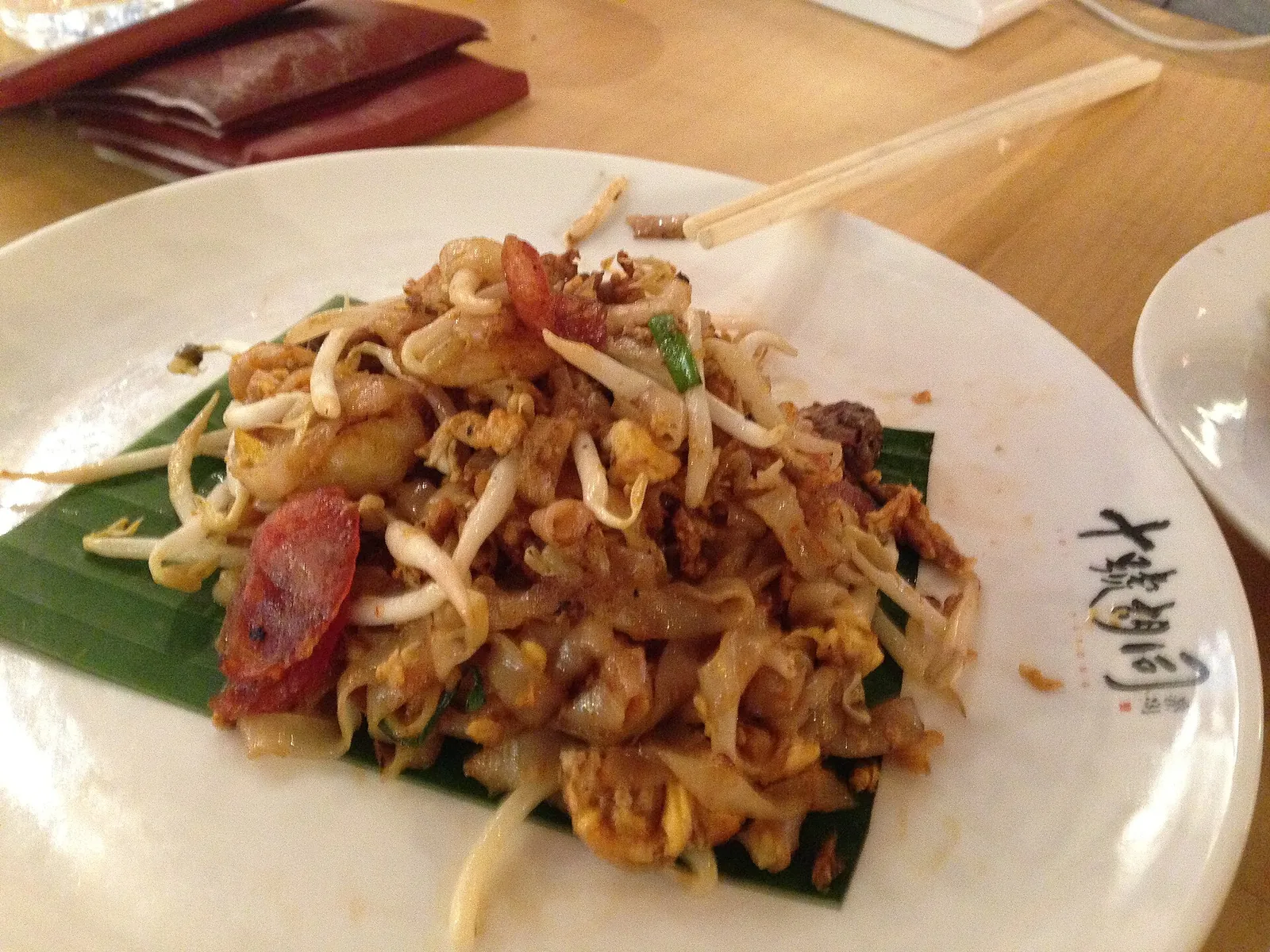
Hokkien. Penang Hokkien mee is not the dark fried noodle that Kuala Lumpur calls by the same name, but noodles in a deep red prawn broth; 888 Hokkien Mee at 67-A Lebuh Presgrave in George Town has served it for more than 30 years. Char koay teow, flat rice noodles fried with prawns, vegetables and crisp pork fat, is made all over the country, and Penang's is the best known.
Cantonese. In Pudu, east of Chinatown, Sek Yuen has cooked Cantonese food at 313 Jalan Pudu since 1948 and is known for its pipa duck. Bak kut teh, pork simmered in a broth of Chinese herbs and eaten with rice, is said to come from Klang, west of Kuala Lumpur.
Hakka. The Hakka dish to look for is lui cha, thunder-tea rice: a green soup of ground sesame, peanuts and mint poured over rice and vegetables. Hor Poh Cuisine serves it in Segambut, a suburb north-west of the centre, so it suits a second visit rather than a first.
Ipoh, on the ETS line north of Kuala Lumpur, has its own Cantonese plates and white coffee; our Ipoh guide covers them. Much Chinese hawker food contains pork or lard, so it is not halal; the last section lists halal Chinese options.
- Lunch in Chinatown: chicken rice at Nam Heong.
- An evening in George Town: Hokkien mee at 888, and char koay teow from a neighbouring stall.
- For the table: pipa duck in Pudu, or bak kut teh with rice.
Indian Malaysia: banana leaves and the mamak
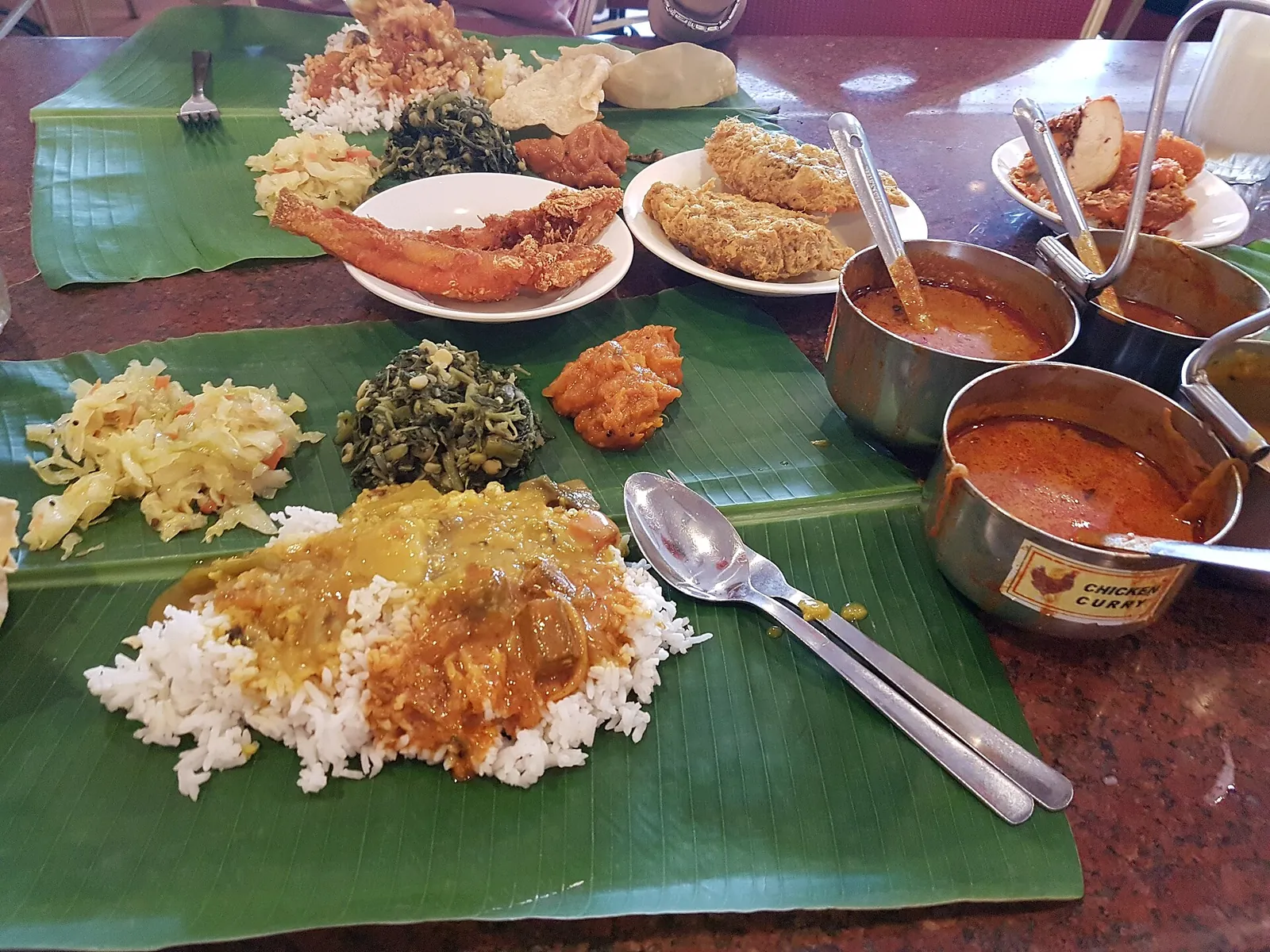
Banana-leaf rice is the South Indian kitchen's everyday meal: rice and vegetable sides served on a leaf instead of a plate, with curry poured over. The curry is gravy only, so chicken curry or fried chicken is ordered as an extra. In Kuala Lumpur, Nirwana at 43 Jalan Telawi 3 in Bangsar serves banana-leaf sets with rice and vegetable curry, topped up with fish, chicken or lamb. The South Indian restaurants of Brickfields, beside KL Sentral, are in our Kuala Lumpur guide.
The mamak is the Indian-Muslim, largely Tamil-Muslim, coffee shop, often open very late or round the clock. Its staple is roti canai, a layered flatbread stretched and griddled to order and eaten with curry, a classic breakfast. The other is nasi kandar, an Indian-Muslim dish of rice with curries and sides: the name comes from the rice (nasi) and the yoke (kandar) on which hawkers once carried it from house to house. Nasi Kandar Pelita, which began as a stall in Perai in 1995 and now has more than 25 restaurants, has branches at 113 Jalan Ampang near the KLCC towers and at 146A Jalan Macalister in George Town. Penang's own nasi kandar addresses are in our Penang guide.
- Banana leaf: rice and vegetables come with the set; order meat or fish on the side.
- Mamak: roti canai and teh tarik at breakfast or after midnight.
- Nasi kandar: choose your dishes and ask for the curries to be poured over the rice.
Nyonya and Jawi Peranakan: George Town and Melaka
The Peranakan, or Baba Nyonya, are the Straits Chinese of the old ports. Their cooking is Chinese ingredients cooked with Malay spices and cooking techniques, and it comes in two styles: Melaka's, which took in Portuguese, Dutch and Indonesian influences over the centuries, and Penang's, enriched by Thai cooking. Penang also has Jawi Peranakan food, shaped by Malay, Indian-Muslim and Peranakan cooks.
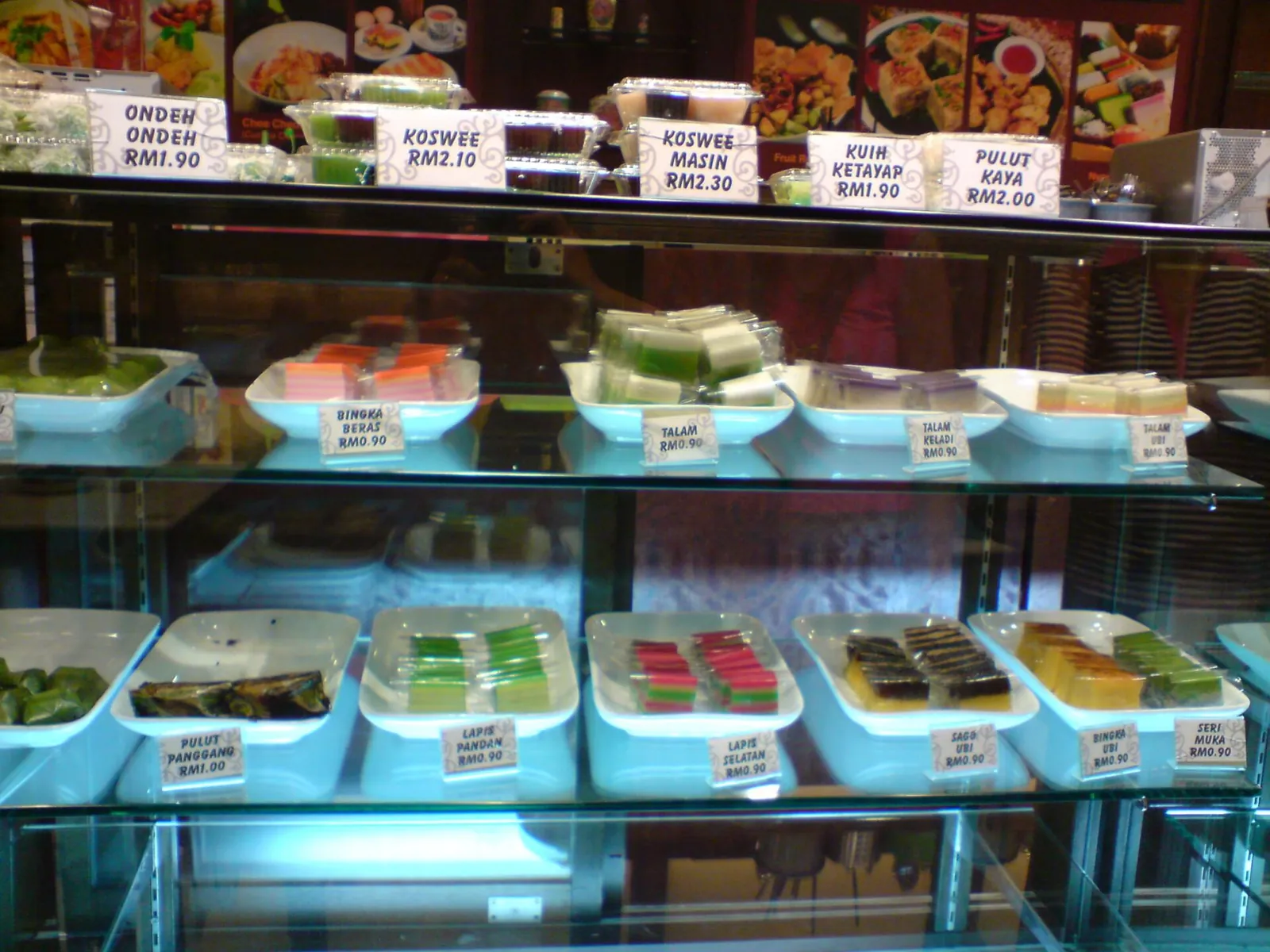
The dishes to look for are pie tee, crisp little pastry cups filled with vegetables and prawn and eaten with chilli sauce; otak-otak, fish paste with coconut milk and spices steamed in a banana leaf; curry kapitan; nasi ulam, rice tossed with shredded herbs; and the sweet, layered rice-flour cakes called kuih. In George Town, Auntie Gaik Lean's Old School Eatery at 1 Lebuh Bishop, which holds a Michelin star, makes its pie tee from scratch, along with a gulai tumis curry whose paste uses more than eight ingredients. In Kuala Lumpur, Limapulo at 50 Jalan Doraisamy serves Nyonya laksa and sago with gula Melaka.
Melaka is the other Nyonya city, and its version, with chicken rice balls, satay celup and cendol, is worth a night; our Melaka guide has the walk. George Town's other Peranakan kitchens are in our Penang guide.
- Lunch or dinner: both restaurants serve two sittings and close in between.
- Order to share: pie tee to start, a curry, nasi ulam and a plate of kuih.
- Sweet: sago or cendol with gula Melaka, the dark palm sugar.
Sabah and Sarawak: seafood, hinava and Borneo noodles
Across the South China Sea, Borneo eats differently. Kota Kinabalu is a seafood town, where restaurants let you choose live fish from the tanks, and Sabah's indigenous peoples add dishes of their own: hinava, a marinated raw-fish dish, and lihing, Sabah's rice wine. The local noodles are tuaran mee, thin noodles fried until crisp, and a tom yam noodle soup; Kedai Kopi Seng Hing in Ruang Sinsuran 2, a kopitiam that closes in the afternoon, is known for both, and Yee Fung Laksa at 127 Gaya Street serves a mild, coconut-rich laksa from early morning. Our Kota Kinabalu guide adds the markets and the Sabah dishes to look for.
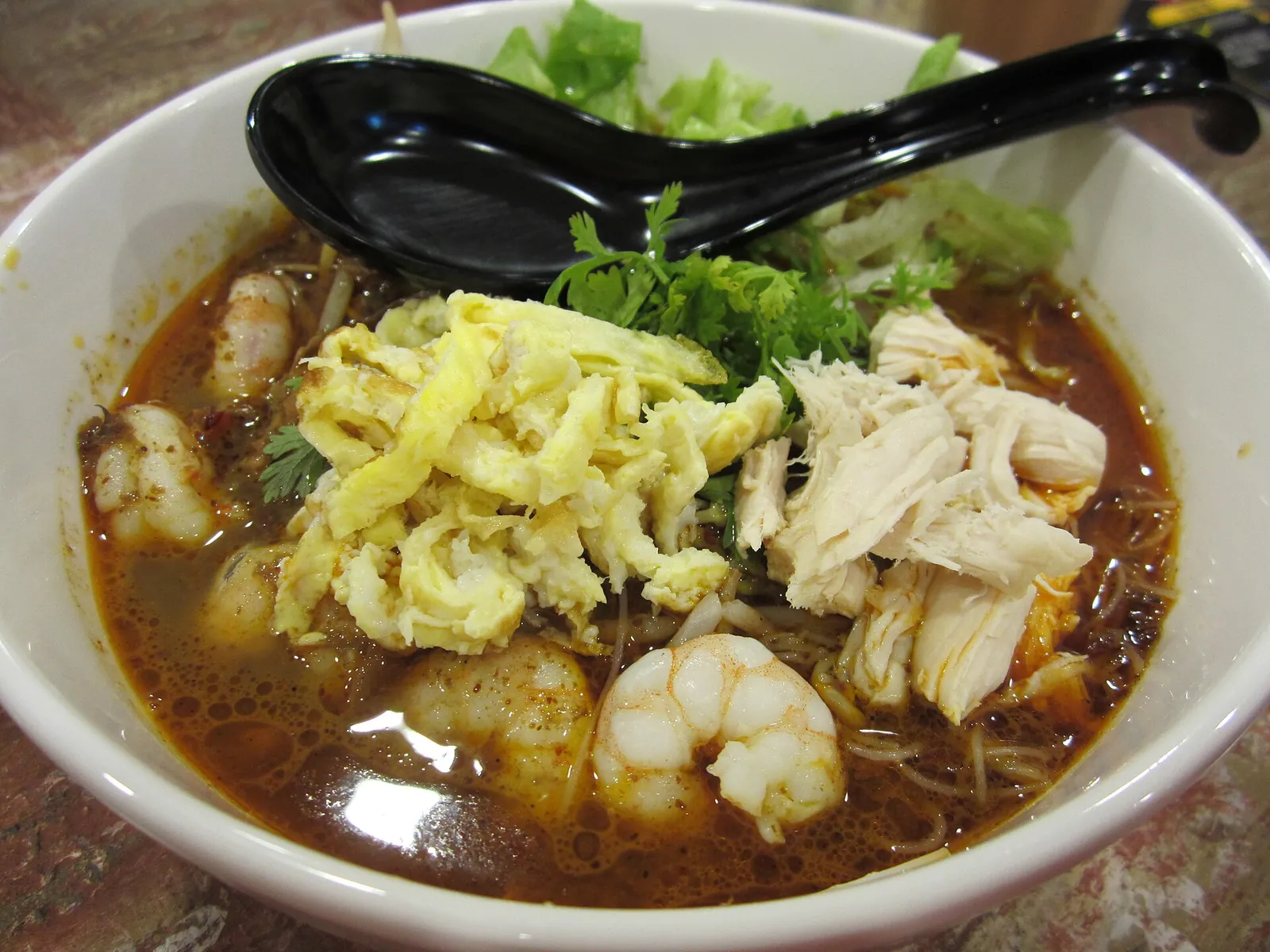
Sarawak's dish is Sarawak laksa, rice vermicelli in a richly spiced, aromatic broth, commonly finished with chicken, prawns, omelette, bean sprouts, herbs and lime. Kuching also has kolo mee, springy noodles tossed dry, the bamboo-cooked chicken called manok pansoh and the fern shoots midin; our Kuching guide names the cafés that serve them.
- Kota Kinabalu: a seafood dinner chosen from the tanks, and tuaran mee for lunch.
- Kuching: Sarawak laksa, then kolo mee at a neighbourhood café.
- Borneo is a second trip: both states are a flight from the peninsula.
How to order: hawker centres, kopitiams and mamaks
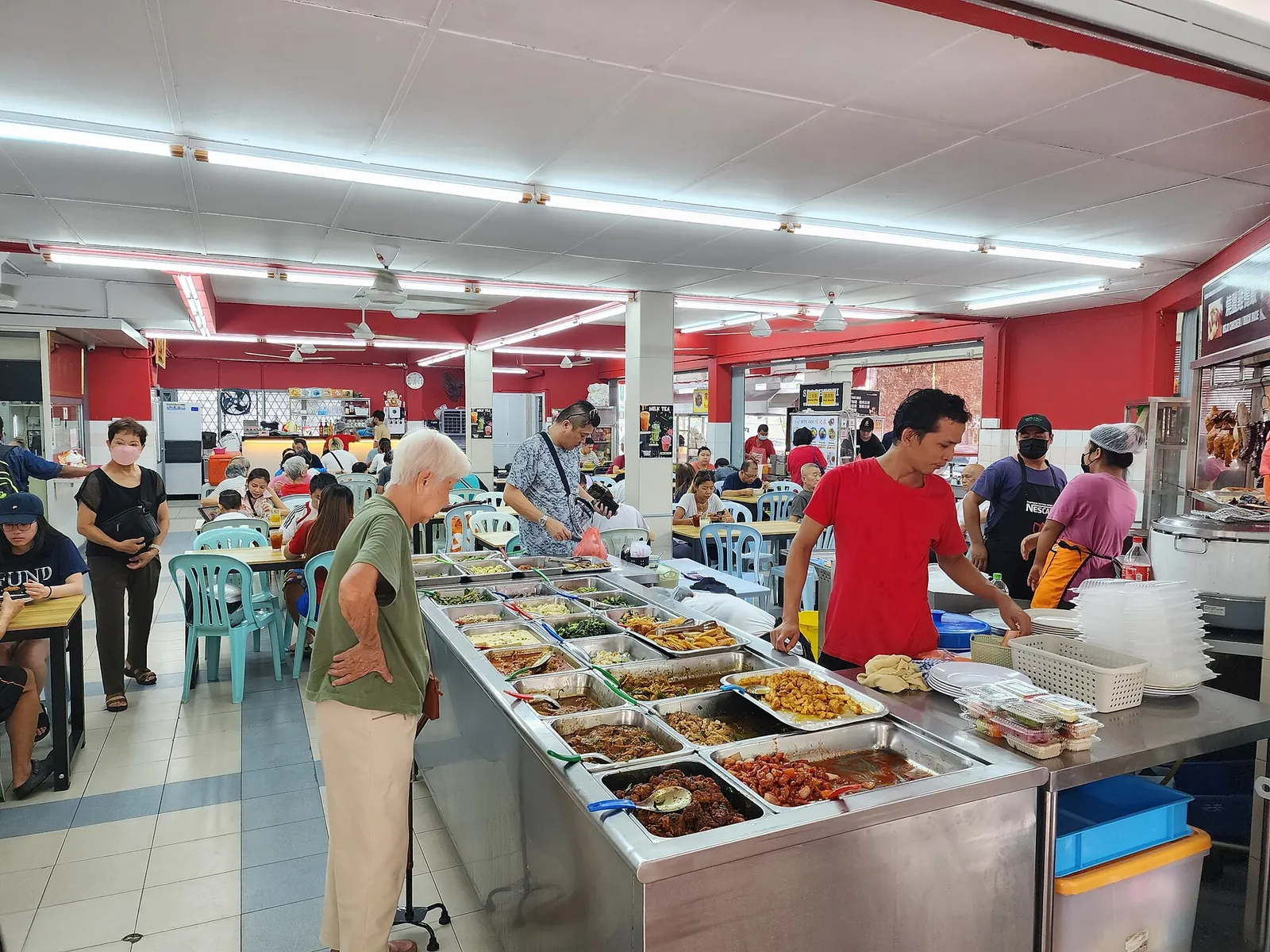
At a hawker centre. Sit down first: claim a table, then walk round the stalls, each of which cooks one or two dishes. Order at as many as you like, point if the names are new, and tell each stall your table number; the food is brought to you, and you usually pay each stall as it arrives. Drinks usually come from a separate drinks stall whose staff take the order at your table. Carry small notes: most stalls take cash, though more of them now accept e-wallets.
At a kopitiam. The traditional coffee shop has a drinks counter and a few rented food stalls. Breakfast is kaya toast, toast spread with butter and coconut jam, dipped into soft-boiled eggs. Coffee comes with a grammar: kopi has condensed milk, kopi O is black with sugar, kopi C uses evaporated milk; add kosong for no sugar, peng for iced, and kurang manis or siew dai for less sweet. Tea follows the same pattern.
At a mamak. Roti comes in versions: roti canai plain, roti telur with egg, roti tisu as a tall crisp cone. Teh tarik, the pulled milk tea, is the drink; teh O ais limau, iced black tea with lime, is the one for a hot afternoon. At most mamaks you pay at the counter on the way out.
At a rice counter (nasi campur). You point: rice first, then the dishes, and the price depends on what and how much you took, with meat costing more than vegetables. Decide before you reach the front.
- Takeaway: say bungkus; to eat in, makan sini. Drinks to go come in a tied plastic bag with a straw.
- Heat: kurang pedas means less spicy.
- Tipping is not expected at stalls.
Breakfast, sweets and drinks
Breakfast can be nasi lemak at a Malay stall, roti canai at a mamak or kaya toast and kopi at a kopitiam, and many people move between all three. In Penang, Bee Hwa Cafe at 10 Lebuh Dickens serves Chinese hawker dishes cooked with chicken and seafood instead of pork, from char koay teow fried with garlic instead of lard to a seafood noodle soup.
The sweets are cold and coconut-rich. Cendol is shaved ice with fresh coconut milk, palm-sugar syrup, red beans and green pandan jelly; ais kacang, also called ABC, piles beans, jelly, fruit and corn on shaved ice. Kuih are the small cakes of the Nyonya and Malay kitchens, among them the striped kuih lapis.
Many drinks are made sweet as standard. Teh tarik is tea with condensed milk, poured between cups until it froths; bandung is rose syrup with condensed milk, pink and very sweet, a favourite at Malay restaurants; sirap limau is rose syrup with lime. Ipoh is known for its white coffee.
- Three breakfasts: nasi lemak, roti canai with curry, kaya toast with soft eggs.
- Afternoon: cendol or ais kacang.
- Drinks: ask for kurang manis if you want less sugar.
What a meal costs
Typical meal prices, checked on 27 October 2026. The restaurants in the box below are "on a budget" or "a moderate spend" places.
| Where you eat | A meal | Published ranges |
|---|---|---|
| Hawker stall, kopitiam, mamak | RM5–15 | Hawker plate RM5–15, kopitiam breakfast RM5–12, roti canai RM1.50–2.50 at a mamak (Kuala Lumpur) |
| Casual sit-down restaurant | RM20–40 a person | Kuala Lumpur casual sit-down meal |
| Mid-range restaurant | RM50–150 a person | Malaysia-wide |
| Fine dining | RM200–500 or more a person | Malaysia-wide |
For a whole day, our trip-cost guide puts food at about MYR 43 a day each if you eat at hawker stalls and Indian canteens, about MYR 105 with one sit-down restaurant meal a day, and about MYR 380 with hotel breakfasts and fine dining. The trip-cost guide also prices the rooms, trains and sights. George Town's own meal prices are in our Penang guide.
- Cheapest good meal: nasi lemak or roti canai with teh tarik.
- Restaurants: sit-down places may add a service charge to the bill; hawker prices are what you pay.
- Cash: small ringgit notes for stalls.
Meal by meal on the first-trip route
This plan follows the days of the first-trip route: three nights in Kuala Lumpur, the ETS train north on day 4 and three nights in George Town. Closing days that can hit the route: 888 Hokkien Mee on Thursdays, Limapulo, Ali and Bee Hwa on Sundays, and Auntie Gaik Lean's on Mondays and Tuesdays.
- Kuala Lumpur, day 1: satay or laksa at the upstairs food court of Central Market for the first dinner; if you would rather sit down to banana-leaf rice, Nirwana in Bangsar serves late.
- Kuala Lumpur, day 2: roti canai and teh tarik at a mamak before the early train to Batu Caves; Nyonya laksa at Limapulo in Chow Kit for lunch; a nasi ambeng platter at Congkak near Bukit Bintang after the evening at the Petronas Towers.
- Kuala Lumpur, day 3: chicken rice at Nam Heong in Chinatown for lunch, between Merdeka Square and Petaling Street; satay and bak kut teh at the stalls of Jalan Alor for dinner.
- Day 4, train north: a banana-leaf lunch in Brickfields beside KL Sentral before the afternoon ETS; in George Town, after the ferry, Hokkien mee at 888 on Lebuh Presgrave for dinner.
- George Town, day 5: nasi lemak at Ali in the Sri Weld Food Court for breakfast; pie tee and gulai tumis at Auntie Gaik Lean's for lunch; cendol at the Penang Road shop on Lebuh Keng Kwee in the afternoon.
- George Town, day 6: char koay teow without lard at Bee Hwa Cafe for breakfast; assam laksa in Ayer Itam after Kek Lok Si, as in our Penang guide; nasi kandar at Pelita on Jalan Macalister for dinner after Penang Hill.
What to eat and where to look
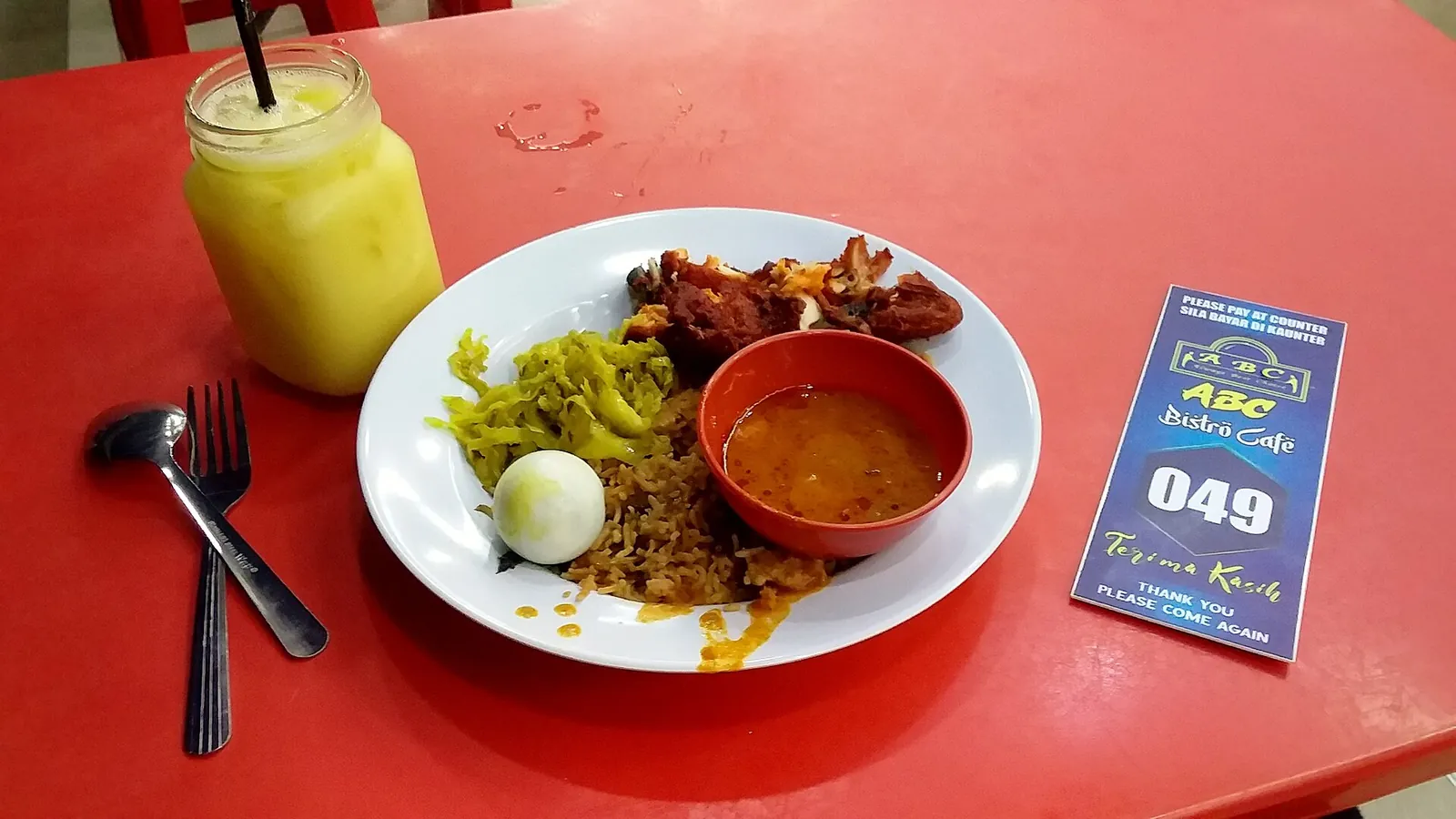
Nasi lemak in a banana leaf
Rice cooked in coconut milk, with sambal, a boiled egg, cucumber, peanuts and small fried fish, wrapped in a banana leaf: a Malay breakfast classic.
- Where to look
- Ali Nasi Lemak Daun Pisang, a halal stall in the Sri Weld Food Court, 19 Lebuh Pantai, George Town; Monday to Friday 07:00–14:00, Saturday 07:00–13:00, closed Sunday; in the Michelin Guide's "on a budget" band.
- Fit it into your day
- Breakfast on a George Town heritage day, before the heat.
The sambal usually contains dried anchovies or shrimp paste, and the plate comes with peanuts.
Nasi ambeng
A rice platter for sharing, with spicy, sweet and savoury dishes around the rice and sambal on the side: Congkak's most popular dish.
- Where to look
- Congkak, 24 Jalan Beremi, off Bukit Bintang, Kuala Lumpur; 12:00–22:00, until 23:00 on Fridays and Saturdays; in the Michelin Guide's "a moderate spend" band.
- Fit it into your day
- Dinner on a Kuala Lumpur evening, ordered in a size for the whole table.
Sambal and several side dishes are hot; ask which ones are mild.
Hainanese chicken rice
Poached chicken over rice cooked in chicken stock, with chilli and ginger sauces: a Hainanese plate now sold far beyond Hainanese shops.
- Where to look
- Nam Heong Chicken Rice, 56 Jalan Sultan, Chinatown, Kuala Lumpur, a shop founded in 1938; daily 10:00–22:00; in the Michelin Guide's "on a budget" band.
- Fit it into your day
- Lunch on the old-city day, with a plate of bean sprouts.
The menu includes roast pork belly and other barbecue meats.
Penang Hokkien mee
Noodles in a deep red prawn broth, sometimes with braised pork ribs or roast pork: Penang's Hokkien version, quite different from Kuala Lumpur's dark fried noodles of the same name.
- Where to look
- 888 Hokkien Mee, 67-A Lebuh Presgrave, George Town; 15:00–21:30, closed Thursday; in the Michelin Guide's "on a budget" band.
- Fit it into your day
- An early dinner on the evening you arrive in George Town.
The broth is made with prawns and the toppings include pork, so it is neither halal nor vegetarian.
Banana-leaf rice
Rice, vegetable curry and sides served on a banana leaf, with fish, chicken or lamb ordered as extras: the everyday meal of the Tamil kitchen.
- Where to look
- Nirwana, 43 Jalan Telawi 3, Bangsar Baru, Kuala Lumpur; daily 11:30–23:00; in the Michelin Guide's "a moderate spend" band.
- Fit it into your day
- The arrival dinner in Kuala Lumpur, or lunch on the day of the train north.
The set covers rice and vegetables; fish, chicken or lamb come as extras on the bill.
Nyonya pie tee and gulai tumis
Crisp pastry cups of vegetables and prawn, and a curry whose paste uses more than eight ingredients: two Penang Nyonya classics, with nasi ulam, rice tossed with shredded herbs.
- Where to look
- Auntie Gaik Lean's Old School Eatery, 1 Lebuh Bishop, George Town; Wednesday to Sunday 12:00–14:30 and 18:00–21:30, closed Monday and Tuesday; in the Michelin Guide's "a moderate spend" band.
- Fit it into your day
- A sit-down lunch on a George Town heritage day, Wednesday to Sunday.
Pie tee is filled with prawn as well as vegetables; ask about shellfish before ordering.
Halal, Ramadan, vegetarian and allergies
Halal. Malaysian halal certification is issued by JAKIM, the federal Department of Islamic Development, or by the Islamic religious department or council of each state (JAIN or MAIN); certificates for the local market are applied for at the state body. Restaurants, food courts, canteens and kiosks can all be certified. The logo is round, with an eight-pointed star at its centre holding the Arabic word for halal, the word HALAL in Roman letters below it, and "Malaysia" in Roman and Arabic script around the circle, separated by two small five-pointed stars. JAKIM's Halal Malaysia Portal has a "Verify Halal Status" search with a category for food premises. Under Malaysian trade law, words such as "halal" or "Muslim food" on a menu must mean food that meets the halal definition; a "no pork, no lard" sign is not certification, only a statement of what the kitchen leaves out. The Michelin Guide describes Bee Hwa Cafe in George Town as serving halal Chinese hawker dishes. Look for the logo at the counter.
Ramadan. During the fasting month, Muslims who are fasting abstain from food and drink from dawn to dusk, and Ramadan bazaars sell food for breaking the fast, which non-Muslims are welcome to buy too. In 2027 the month ends with Hari Raya Aidilfitri, expected on 10–11 March; our festivals guide has the holiday dates. The UK government's travel advice asks visitors to check the opening hours of shops and restaurants during Ramadan and to follow local dress codes.
Vegetarian and allergies. Belacan is in many sambals and Malay dishes, and ikan bilis, dried anchovies, goes into stocks and sambals, so a dish of vegetables may not be vegetarian; ask "ada belacan atau ikan bilis?". Chinese Buddhist vegetarian restaurants and South Indian vegetarian kitchens are the easy choices. Peanuts are in satay sauce, rojak and many garnishes, and shrimp paste or dried shrimp turn up in dishes that do not look like seafood; with a severe allergy, carry a card in Malay.
- Halal: look for the round JAKIM or state logo with the eight-pointed star, not a hand-written sign.
- Ramadan: the bazaars fill from the late afternoon with food for breaking the fast.
- Vegan: name belacan and ikan bilis, not only meat.
Practical questions
What is the national dish of Malaysia?
Nasi lemak is the usual answer: rice cooked in coconut milk with sambal, egg, cucumber, peanuts and small fried fish, a breakfast staple. The Michelin Guide's listing for a George Town nasi lemak stall calls it the national dish.
How do I order at a hawker centre?
Find a table first, then order at each stall and give your table number. The food is brought to you and you usually pay each stall as it arrives; drinks usually come from a separate drinks stall.
How can I tell if a restaurant is halal in Malaysia?
Look for the round halal logo issued by JAKIM or a state religious authority, with an eight-pointed star and the word HALAL. A "no pork, no lard" sign is not certification. JAKIM's Halal Malaysia Portal lets you check a food premises' status.
Can I eat during the day in Ramadan?
The fast applies to Muslims who are fasting, from dawn to dusk; Ramadan bazaars then sell food for breaking the fast, and anyone can buy there.
What does a meal cost in Malaysia?
A hawker plate is about RM5–15 and a kopitiam breakfast RM5–12 in Kuala Lumpur; a casual sit-down meal is RM20–40 a person. A whole day at stalls comes to about MYR 43 a person.
What is the difference between a kopitiam and a mamak?
A kopitiam is a traditional Chinese-run coffee shop with a drinks counter and a few food stalls, known for kaya toast and kopi. A mamak is an Indian-Muslim coffee shop, often open very late, serving roti canai, nasi kandar and teh tarik.
Keep planning your trip

First trip to Malaysia
Seven days in Kuala Lumpur and George Town: where to base yourself, visa by nationality and the MDAC, the ETS train to Penang and what to see.
Read the guide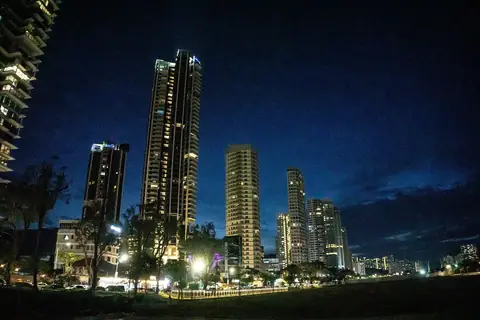
Where to stay in Penang
Compare George Town, Gurney Drive, Tanjung Bungah and Batu Ferringhi by walkability, food, beach access and airport or ferry transfers before booking.
Read the guide
Kuala Lumpur
Three nights in Kuala Lumpur: where to sleep, the old city, Batu Caves by Komuter, the Petronas Towers, the ETS from KL Sentral and a dated budget for two.
Read the guide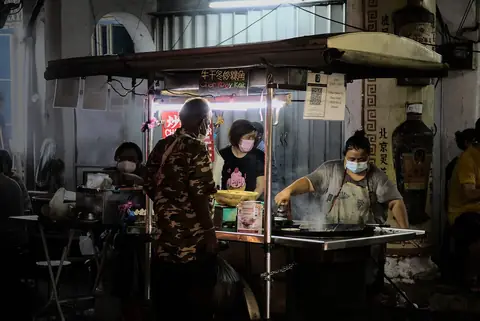
George Town and Penang
Three nights in Penang: where to sleep in George Town, mansion tours and fees, Penang Hill fares, the national park, the ferry, the airport bus and a priced stay for two.
Read the guide
Melaka
Plan one night in UNESCO-listed Melaka for an early heritage walk, Jonker's weekend market, the river after dark, Peranakan food and an easy arrival.
Read the guide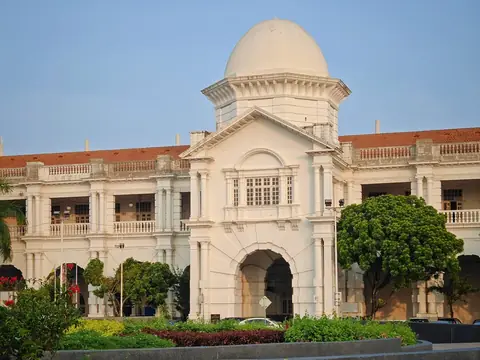
Ipoh
Two nights in Ipoh by ETS: the Old Town heritage trail, Han Chin Pet Soo, cave temples, Tasik Cermin, Kellie's Castle, local food and a budget for two.
Read the guideSources and checks before you travel
(25)
- Tourism Malaysia (Japan office): Malaysian food ↗ — opens in a new tab
- Tourism Malaysia (Japan office): restaurants by city ↗ — opens in a new tab
- Tourism Malaysia (Japan office): events ↗ — opens in a new tab
- Penang Global Tourism: food ↗ — opens in a new tab
- Old China Café, Kuala Lumpur: menu and location ↗ — opens in a new tab
- Nasi Kandar Pelita: home and branches ↗ — opens in a new tab
- Halal Malaysia Portal (JAKIM): procedure and definitions ↗ — opens in a new tab
- Halal Malaysia Portal (JAKIM): corporate ↗ — opens in a new tab
- Halal Malaysia Portal (JAKIM): home ↗ — opens in a new tab
- UK FCDO: Malaysia safety and security ↗ — opens in a new tab
- Michelin Guide: price bands, Kuala Lumpur ↗ — opens in a new tab
- Michelin Guide: Nam Heong Chicken Rice (City Centre) ↗ — opens in a new tab
- Michelin Guide: Congkak (Bukit Bintang) ↗ — opens in a new tab
- Michelin Guide: Nirwana ↗ — opens in a new tab
- Michelin Guide: Limapulo ↗ — opens in a new tab
- Michelin Guide: Sek Yuen ↗ — opens in a new tab
- Michelin Guide: Hor Poh Cuisine ↗ — opens in a new tab
- Michelin Guide: Ali Nasi Lemak Daun Pisang ↗ — opens in a new tab
- Michelin Guide: 888 Hokkien Mee ↗ — opens in a new tab
- Michelin Guide: Auntie Gaik Lean's Old School Eatery ↗ — opens in a new tab
- Michelin Guide: Bee Hwa Cafe ↗ — opens in a new tab
- Malaysia4U: Kuala Lumpur food guide (updated 11 July 2026) ↗ — opens in a new tab
- Malaysia4U: Malaysia food guide ↗ — opens in a new tab
- Malaysia4U: Malaysia street food guide ↗ — opens in a new tab
- Tourism Malaysia: Bazaar Ramadan (press release, 2005) ↗ — opens in a new tab
Reference sources for the version dated 27 October 2026. Confirm opening times, access, transport and conditions for your travel dates.
Photo credits
(6)
Banana-leaf rice at a South Indian restaurant in Malaysia.
Photograph: Misaochan — opens in a new tab · CC BY-SA 4.0 — opens in a new tab
Changes: Resized and converted to WebP; displayed with responsive crops. · Original photograph and licence details ↗ — opens in a new tab
Nasi lemak ayam, coconut rice with chicken and sambal, at a cafe in Brickfields, Kuala Lumpur.
Photograph: Bahnfrend — opens in a new tab · CC BY-SA 4.0 — opens in a new tab
Changes: Resized and converted to WebP; displayed with responsive crops. · Original photograph and licence details ↗ — opens in a new tab
Inside a Malaysian kopitiam, where individual stalls serve breakfast, lunch and dinner.
Photograph: ReySussy — opens in a new tab · CC BY-SA 4.0 — opens in a new tab
Changes: Resized and converted to WebP; displayed with responsive crops. · Original photograph and licence details ↗ — opens in a new tab
Nyonya kuih at a shop counter in Mid Valley City, Kuala Lumpur.
Photograph: Alpha — opens in a new tab · CC BY-SA 2.0 — opens in a new tab
Changes: Resized and converted to WebP; displayed with responsive crops. · Original photograph and licence details ↗ — opens in a new tab
Sarawak laksa in Kuching: rice vermicelli, prawns, chicken and omelette in a spiced broth.
Photograph: Marufish from Alor Setar, Malaysia — opens in a new tab · CC BY-SA 2.0 — opens in a new tab
Changes: Resized and converted to WebP; displayed with responsive crops. · Original photograph and licence details ↗ — opens in a new tab
Penang-style char kway teow served in Kuala Lumpur.
Photograph: brown_colour — opens in a new tab · CC BY 2.0 — opens in a new tab
Changes: Resized and converted to WebP; displayed with responsive crops. · Original photograph and licence details ↗ — opens in a new tab