Northeast Thailand (Isaan) · Khon Kaen, Udon Thani and Nong Khai; optional Nakhon Phanom and Loei
Isaan: Khon Kaen, Udon Thani, Nong Khai and the Mekong
A first Isaan journey works well as a northbound trip through Khon Kaen, Udon Thani and Nong Khai. Start with the nine-storey temple at Kaen Nakhon Lake, spend a day with Ban Chiang's pottery and burial archaeology, then finish among Nong Khai's Buddhist sculpture and Mekong riverfront. Phu Phrabat adds a different kind of heritage: rock shelters alongside sacred boundary stones. The route below leaves room for shared Isaan meals and an evening by the river, with Nakhon Phanom and Chiang Khan kept as choices for a longer journey.
- Suggested time
- Seven days and six nights for the core route; eight days and seven nights with both Udon heritage outings.
- Where to stay
- Kaen Nakhon Lake or central Khon Kaen; central Udon Thani; Nong Khai's Mekong riverfront.
- Season and timing
- November to February is the usual Red Lotus Sea flowering window in TAT's seasonal guide; the core temple, museum and river-town itinerary does not depend on the bloom.
The short answer
Book six nights: two in Khon Kaen, two in Udon Thani and two in Nong Khai. Reserve the long-distance trains, rooms and a return car for Ban Chiang first. Stay near Kaen Nakhon Lake, central Udon and Nong Khai's Mekong riverfront respectively. Two useful admission figures, checked on 14 October 2026: Ban Chiang National Museum costs THB 200 per non-Thai visitor. TAT Japan lists THB 40 at Sala Kaew Ku, without a nationality distinction. Train 75 provides the northbound connections, and train 76 returns from Nong Khai to Bangkok. The rail times in this guide are the timed route. Flying to Khon Kaen (KKC) or Udon Thani (UTH) is possible, but the airport-to-town ride is not published by an official source, so settle it with your hotel before you book a flight.
A seven-day route with a full day in each base
The six-night plan has a simple shape: arrival, a full Khon Kaen day, transfer to Udon, a Ban Chiang day, transfer to Nong Khai, a full river-town day, then departure. It is a starting itinerary rather than a claim that all of Isaan fits into a week. If your interest is mainly archaeology, move a night from Khon Kaen to Udon; if this is your first visit, keep the balance below.
Use Kaen Nakhon Lake as the Khon Kaen base when the temple and lakeside walks matter most. Choose central Khon Kaen instead when you prefer to organise the stay around dinners and the railway departure. In Udon, choose a central hotel and have the excursion car collect you there. In Nong Khai, choose the Mekong riverfront for the final stay. Station and airport rides are covered in the transport section.
There is one full sightseeing day between each pair of hotel nights. That makes the Udon choice important: Ban Chiang or Phu Phrabat fits the core week; both need an extra night. The Red Lotus Sea is another optional outing, not a compulsory addition to the same heritage day. Make the museum day fall outside Monday, which TAT Japan lists as Ban Chiang's weekly closure.
For a shorter trip, use Udon and Nong Khai alone. Remove Khon Kaen's arrival and city days rather than trying to compress the same number of places into fewer nights. For a longer trip, add the second Udon heritage day before considering another Mekong town.
- Day 1: travel from Bangkok to Khon Kaen, settle in and have dinner; sleep in Khon Kaen.
- Day 2: visit Wat Nong Wang and Kaen Nakhon Lake, with a long lunch and time in the city; sleep in Khon Kaen.
- Day 3: keep the morning in Khon Kaen, then take train 75 north (it leaves Khon Kaen at 15:32) to Udon Thani; sleep in Udon.
- Day 4: take a return car to Ban Chiang National Museum and the archaeological display at Wat Pho Si Nai; sleep in Udon.
- Day 5: spend the morning in Udon, then take train 75 (it leaves Udon at 16:58 and reaches Nong Khai at 17:30); sleep in Nong Khai.
- Day 6: visit Wat Pho Chai and Sala Kaew Ku, then return to the Mekong riverfront; sleep in Nong Khai.
- Day 7: return to Bangkok on train 76 (07:45 from Nong Khai), or leave by your separately booked onward connection.
Khon Kaen: a nine-storey stupa above the lake
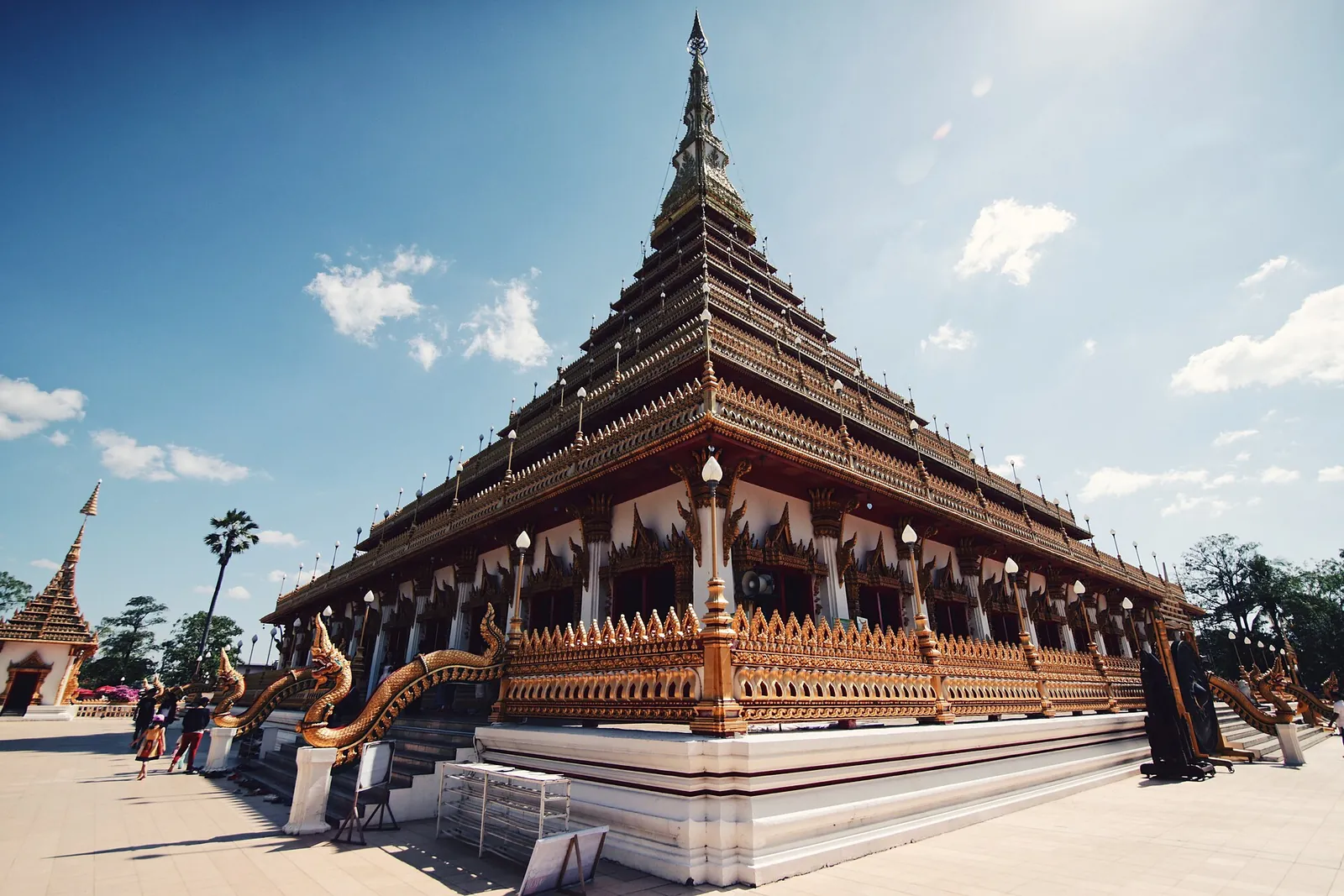
Wat Nong Wang, also written Wat Nong Waeng, gives the city day its focus. TAT Japan describes its nine-storey stupa, Phra Mahathat Kaen Nakhon, as holding Buddha relics and important scriptures. The stupa's doors and windows carry carved scenes, including 16 Brahma deities and Buddhist ceremonies, and its walls depict the city's history. The top floor holds the relics and has a panoramic view over the city.
Bueng Kaen Nakhon, usually called Kaen Nakhon Lake in English, is a natural lake in the middle of Khon Kaen. The Thailand Tourism Directory describes a recreation area and a road around the lake for exercise or cycling, with a shrine to the city's founder, Thao Pia Mueang Pan. Pair the park with the temple, taking the lakeside portion early or late in the day according to the weather. Leave the middle of the day for lunch instead of turning the visit into an endurance walk.
The temple and lake make a satisfying city day without an out-of-town excursion. Start with the stupa, pause over a shared meal, then return to the water when you want an easier pace. Wear clothing suitable for a place of worship and follow the instructions at the entrance.
For a museum-focused alternative, the Khon Kaen National Museum collects and displays antiques and artefacts from the northern part of Isaan, most of them concerning history, art and archaeology; the Tourism Directory lists it as closed on Mondays. The national fee regulation lists THB 200 for a non-Thai individual ticket and THB 20 for a Thai individual ticket, checked on 14 October 2026. Treat it as a substitute for part of the lake day, rather than a reason to shorten Ban Chiang later.
Keep the fossil sites for a deliberate extra excursion. TAT Japan places Phu Wiang National Park about 80 km north-west of Khon Kaen, with a dinosaur museum about 3 km from the park showing skeletons and life-size dioramas. TAT Japan lists the museum open Tuesday to Sunday, 09:00–17:00, closed Mondays unless Monday is a public holiday, checked on 14 October 2026. This is a separate visit, not part of the city-day plan. If dinosaurs are the main reason for coming, add time in Khon Kaen and arrange the outing before reducing another base's full day.
Udon Thani: choose Ban Chiang, then add Phu Phrabat
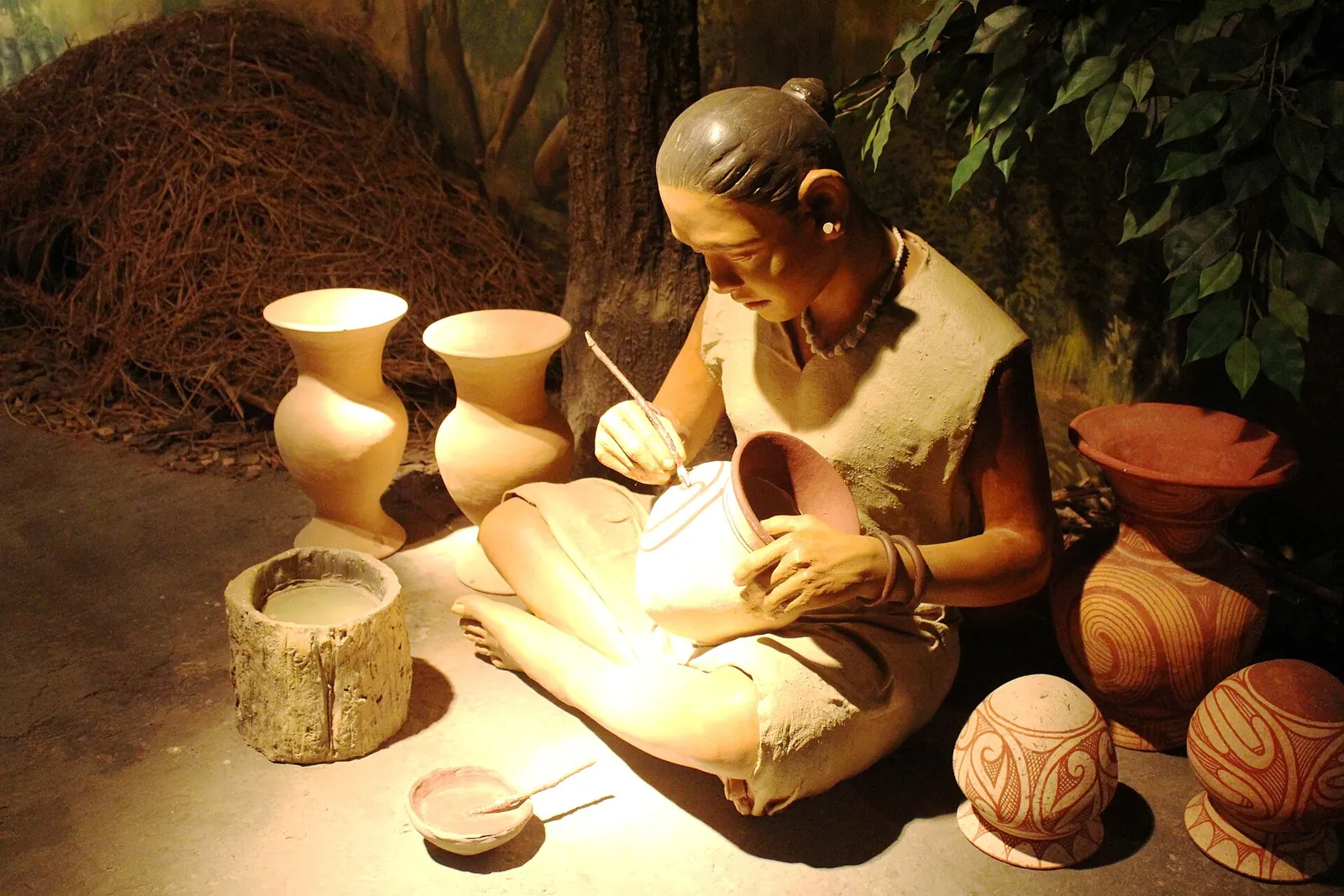
Ban Chiang is more than a collection of decorated pots. UNESCO describes a settlement and burial site that documents early farming, ceramic production and bronze technology in Southeast Asia. The museum supplies the context, while the excavation display at Wat Pho Si Nai shows objects in their archaeological layers, including pottery placed with burials. Visit the museum first so that the exposed site is more than an arrangement of soil, vessels and bones.
TAT Japan lists Ban Chiang National Museum 09:00–16:00, closed Mondays, and places it about 50 km east of Udon Thani, roughly one hour by car. Use a return car from your Udon hotel and keep this as the day's main excursion. The national fee regulation gives THB 200 for a non-Thai individual ticket and THB 30 for a Thai individual ticket, checked on 14 October 2026. The car and any guide cost extra.
The museum and the excavation display answer different questions. In the galleries, look at how pottery, metal objects and burial practices are used to reconstruct everyday life. At Wat Pho Si Nai, the important detail is the relationship between objects and the layers in which they were found. That is why this guide gives Ban Chiang its own day instead of treating the museum as a quick stop on a drive elsewhere.
Phu Phrabat is the stronger alternative for travellers who want a landscape visit. UNESCO describes natural rock shelters adapted for religious use alongside Sīma boundary stones during the Dvaravati period, from the seventh to eleventh centuries. Rock paintings belong to an earlier layer of use. The World Heritage listing counts 47 painted shelters across the wider property.
The Thailand Tourism Directory describes Phu Phra Bat Historical Park at the foot of Phu Phan Mountain, covering 3,430 rai, with sandstone shaped by natural erosion into unusual rock sheds. Here, the interest is in the relationship between rock, boundary stones and sacred space: walk between the formations, rather than looking for one conventional temple building. Choose footwear for the ground underfoot. The site complements Ban Chiang because the two visits tell their stories in different ways.
TAT Japan's visitor listing gives 08:00–16:30 daily, about one and a half hours by car from Udon, and says a guide must accompany visitors. The national fee regulation sets individual admission at THB 120 for non-Thai visitors and THB 20 for Thai visitors, checked on 14 October 2026. TAT also lists an electric buggy at THB 100 per vehicle.
Back in Udon, Nong Prachak Park offers a gentler city outing. The Tourism Directory describes a large pond west of the centre, with a garden on its island, bridges between the islands and a fountain. Residents use it for exercise and sport, and an eight-metre yellow duck floats in the water. It is a useful choice for the morning before the Nong Khai train, when a distant excursion would add a deadline. Have lunch in Udon, retrieve your bags and leave the afternoon for the rail transfer.
Nong Khai: a revered image, sculpture garden and river evening
Begin with Wat Pho Chai, whose revered image is Luang Pho Phra Sai. TAT describes murals recounting the image's history and the legend of its journey across the Mekong. Take time with those painted scenes as well as the image itself: they connect the temple to the river outside. TAT Japan lists visiting hours of 08:30–16:30, closed on public holidays, with no admission charge, and estimates about 20 minutes by car from central Nong Khai, checked on 14 October 2026.
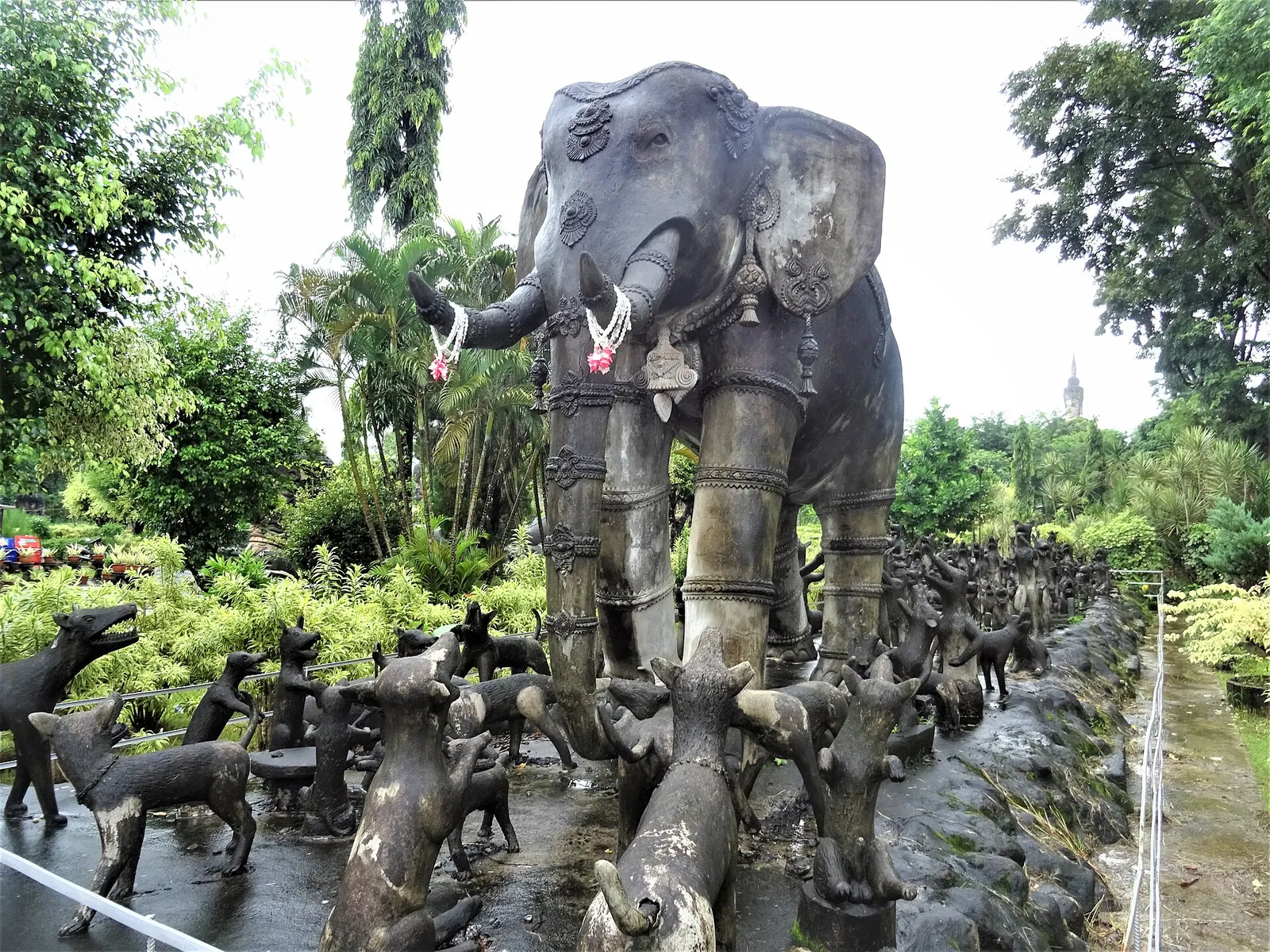
At Sala Kaew Ku, Buddhist and Hindu imagery becomes a garden of large sculptures. The Tourism Directory gives its area as 67,200 square metres, about 3 km from the city, and credits the park to Boonluea Sureerat (1933–1996), who believed all religions could be blended together. Its brick-and-mortar figures are on a gigantic scale. Many tell the story of the Buddha from birth through enlightenment to parinirvana. Others draw on Brahmin, Hindu and Christian legend, or on proverbs and folk tales, and the bases carry explanatory text in Isan Thai and central Thai. TAT Japan lists 08:00–18:00 and THB 40 admission with no nationality distinction, checked on 14 October 2026. No official page gives a recommended visit length.
Do both in one morning by local car or tuk-tuk from your riverfront base, then leave the afternoon and evening for the Mekong.
Tha Sadet Market and the Mekong riverfront supply the less structured part of the stay. Thailand's Tourism Directory places the market on the Mekong and describes goods from Thailand, China, Vietnam and Laos. Browse if that appeals, then spend the evening by the water. Shopping is optional; the reason for sleeping in Nong Khai is to have time for both its sights and an ordinary river-town evening.
The first evening follows the train arrival, so keep it simple: reach the hotel, eat, then walk as far as you feel like. The second evening comes after the sightseeing day and can be slower. Choose a hotel for its actual position along the riverfront rather than treating every Nong Khai address as equivalent.
This route stays in Thailand and needs no Laos crossing; the itinerary ends at Nong Khai or returns to Bangkok.
Seasonal water lilies and a longer Mekong journey
The Red Lotus Sea, or Talay Bua Daeng, is a seasonal alternative from Udon. TAT's 2020 guide describes pink water lilies on Nong Han Lake, about 40 km from Udon Thani, with a usual November–February flowering period. It recommends viewing around 06:00–11:00, before stronger sun closes the flowers.
TAT's 2020 guide describes boat outings of roughly 45–90 minutes, with smaller boats suitable for a couple and larger boats for about eight passengers. A boat takes visitors out among the flowers; the shore is not the equivalent experience. Use it instead of another outing rather than attaching it to a tightly timed transfer.
For more time on the Mekong, Nakhon Phanom offers a promenade, the Naga monument and Vietnamese-influenced food, while Wat Phra That Phanom supplies a major religious visit in the province. TAT's 2026 feature describes the temple's white-and-gold stupa and the riverfront atmosphere. This is the extension to choose when a larger river town and a temple excursion appeal more than another archaeology day.
Chiang Khan, in Loei province, has a different scale. TAT describes traditional wooden shophouses, a walking street and a walkway beside the Mekong. Choose it for a stay organised around the town and riverbank rather than for another series of major monuments. Give either river-town extension at least two nights as an itinerary choice; do not add both to the six-night core.
The road or rail link from Nong Khai to either town is outside the timed core route, and the three-base week is complete without them.
Festival trips need a different calendar from an ordinary river stay. TAT describes Lai Reua Fai, Nakhon Phanom's illuminated-boat celebration, around the end of Buddhist Lent. Community-built boats carry the light displays on the Mekong. Its dates move each year, so use the organiser's dates for your year.
Order a shared Isaan meal
Isaan cooking gives this journey another thread. TAT identifies sticky rice, grilled meats, som tam and larb as regional staples, with fermented fish sauce, chilli, lime and herbs among the characteristic flavours. Build a meal around contrasting dishes instead of ordering several similar meat plates: something grilled, a salad or larb, rice, and a soup if you want a larger lunch.
The food box uses two Khon Kaen restaurants with their own published menus: Come, on Sri Chan Road in Ban Pet, and Jha Brown Larb Ped Khonkaen, on Mittraphap Road. Put the meals into the Khon Kaen city stay, not into the Ban Chiang excursion day. Their own menus list the dishes below.
For a priced shared lunch, Come's menu lists Lao-style papaya salad at THB 69, pork larb at THB 100, spicy beef soup at THB 119 and a plate of steamed rice at THB 20, checked on 14 October 2026. One of each dish and two rice plates gives THB 328 for the food ordered for two adults. Drinks and any separately applied charges are outside that menu-price calculation.
In Udon, Samuay & Sons is the planned-meal choice: TAT describes tasting menus that pair Isan-style marinated beef with organic vegetables and foraged mushrooms. For Nong Khai, no official source names a restaurant or dish; TAT's 2024 Isan feature mentions restaurants along the banks of the Mekong in the northeast generally, so ask your hotel to suggest a riverside place for dinner.
Fermented fish sauce, seafood ingredients, peanuts and meat can vary by dish and kitchen. State allergies or dietary restrictions when ordering rather than relying on an English dish name.
Make time for the local food
What to eat and where to look
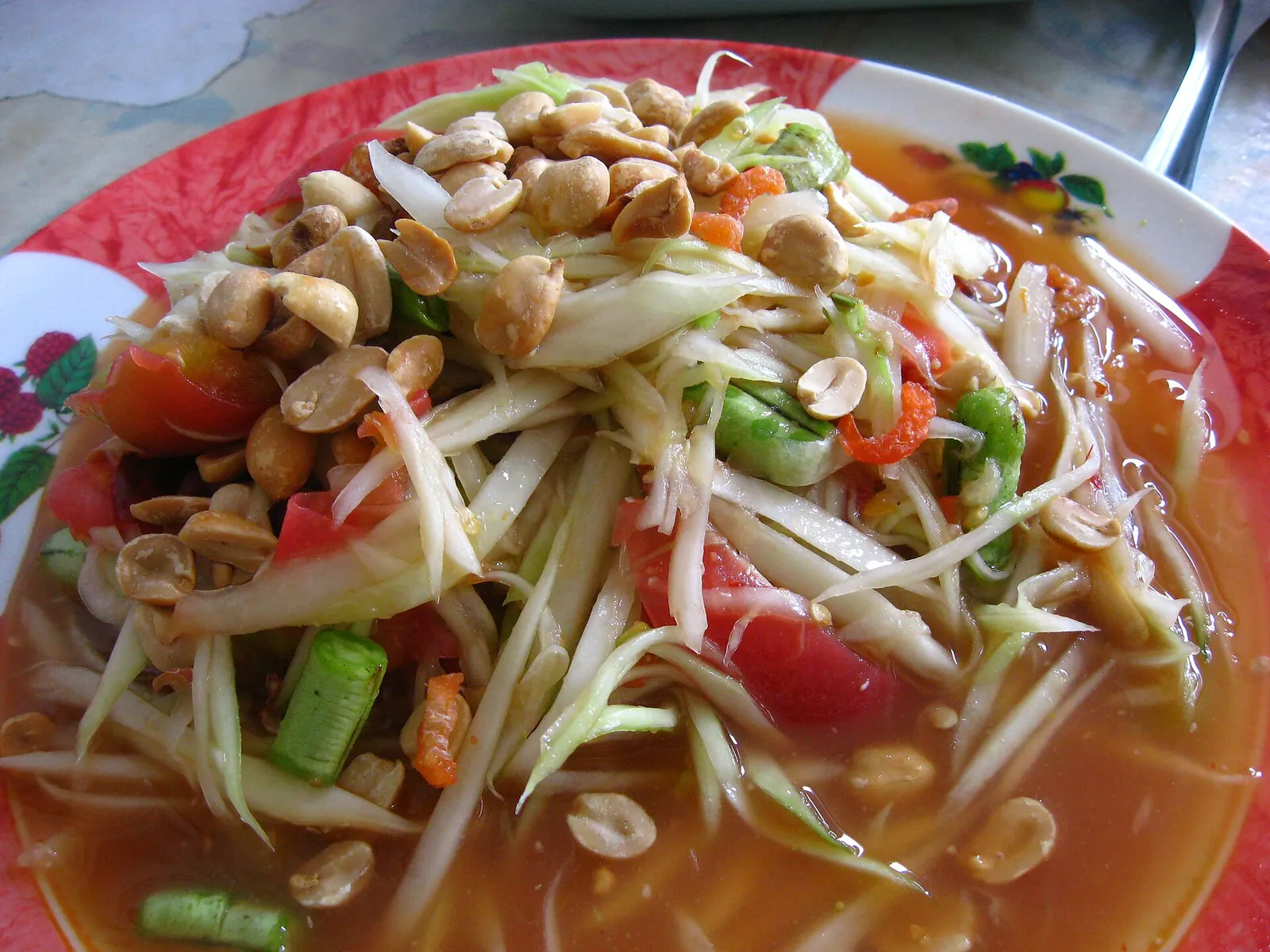
Som tam Lao
Lao-style green-papaya salad: the sharp, spicy part of a shared Isaan meal.
- Where to look
- Come, Sri Chan Road, Ban Pet, Khon Kaen; its menu lists Lao-style papaya salad.
- Fit it into your day
- Share alongside grilled meat or larb and rice.
Tom saep nuea
Spicy beef soup, a warming contrast to the salads and grilled dishes.
- Where to look
- Come in Khon Kaen lists tom saep with beef.
- Fit it into your day
- Order a bowl to share with the rest of lunch.
Larb ped
Minced duck with herbs and Isaan seasoning.
- Where to look
- Jha Brown Larb Ped Khonkaen, Mittraphap Road, Khon Kaen.
- Fit it into your day
- Make it the main meat dish in a shared meal with rice and a salad.
Kho mu yang
Grilled pork neck; the restaurant describes its version as tender and marinated.
- Where to look
- Jha Brown Larb Ped Khonkaen lists grilled pork neck on its own menu.
- Fit it into your day
- Choose it as the grilled dish rather than ordering several similar meat plates.
Isan-style marinated beef
Marinated beef served with organic vegetables and foraged mushrooms in a tasting-menu format.
- Where to look
- Samuay & Sons, Udon Thani; TAT's 2024 Isan cuisine feature describes its tasting menus.
- Fit it into your day
- A planned dinner in Udon after the Ban Chiang day.
Use named trains for the northbound route
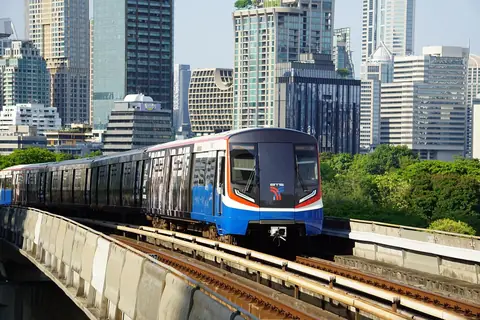
The rail plan uses SRT train 75 northbound and train 76 southbound. SRT's Nong Khai service page lists train 75 leaving Krung Thep Aphiwat Central Terminal in Bangkok at 08:45 and arriving at its terminus, Nong Khai, at 17:30. The full Bangkok–Nong Khai run is therefore 8 hours 45 minutes on that named service. Use the intermediate departure fields below to plan the shorter legs.
SRT's northbound timetable gives train 75 departures of 15:32 from Khon Kaen and 16:58 from Udon Thani. The scheduled departure-to-departure intervals are 6 hours 47 minutes for Bangkok–Khon Kaen and 1 hour 26 minutes for Khon Kaen–Udon, including the stop at the intermediate endpoint; Udon's 16:58 departure to Nong Khai's 17:30 arrival takes 32 minutes. These intermediate times are departures, not arrivals. The timetable and service page were checked on 14 October 2026.
For the return, SRT lists train 76 from Nong Khai at 07:45 to Krung Thep Aphiwat at 16:45, a scheduled 9 hours. This makes the final day a travel day. Book the required date and class through SRT D-Ticket, using the station names and train number rather than a generic Bangkok search. Tickets for each intercity leg are separate budget items, and this guide does not price them.
Flying is an alternative to the long Bangkok rail day. AirAsia's own route pages list direct Bangkok Don Mueang (DMK)–Khon Kaen (KKC) and Bangkok Don Mueang–Udon Thani (UTH) services. The ride time, mode and fare from the airports and railway stations into Khon Kaen, Udon Thani and Nong Khai are not published by an official source. Ask each hotel how to reach it and what that costs, before booking a flight or the 07:45 train. Compare the complete fare for your date with baggage included before choosing between rail and air; no flight price is built into this guide's budget.
Ban Chiang is a return day from Udon; Phu Phrabat is a separate return day if added. Ask your Udon hotel to arrange a car with the museum or park name, collection at the hotel, waiting time and the return all agreed in advance. No official page publishes a price for either trip, so get the figure from the hotel before you commit.
Keep the core route within the destinations described here. On 13 October 2026, UK FCDO advised against all but essential travel within 20 km of the Cambodia land border, while France Diplomatie (read on 14 October 2026) very formally advises against the area within 50 km. This itinerary excludes that wider border zone. Check your own government's advice and insurance conditions before booking; different governments draw different boundaries.
A priced starting point, with the remaining costs visible
The figures below are published components for two non-Thai adults, checked on 14 October 2026. They are not a whole-trip budget: hotel nights, train tickets, local rides, the Ban Chiang car and most meals are not priced here.
At Mut Mee in Nong Khai, the hotel's own price page, checked on 14 October 2026, lists 770–1,100 baht for an air-conditioned double with bathroom and hot water. Confirm with the hotel what that rate covers, per room or per night, when you book. Mut Mee prefers bookings by email and cannot always guarantee a specific room. This guide adds no room total.
For the core sightseeing, two non-Thai Ban Chiang museum tickets at THB 200 each total THB 400. Two Sala Kaew Ku admissions at the TAT Japan-listed THB 40 each total THB 80. Wat Pho Chai's listed admission is free. If you add Phu Phrabat, its non-Thai admission is THB 240 for two, before its road transport, guide and any buggy.
Add the THB 328 shared Come lunch to those admissions: THB 400 + THB 80 + THB 328 = THB 808 for two adults. That covers one shared meal and the named admissions only. Accommodation, transport and the other meals come on top.
A second Udon heritage outing adds a room and an excursion cost on top of this.
Practical questions
How many nights does the first Isaan route need?
Six nights: two each in Khon Kaen, Udon Thani and Nong Khai, for seven days including arrival and departure. Add an Udon night to visit both Ban Chiang and Phu Phrabat on separate days.
Should I fly to Khon Kaen or Udon Thani?
Rail is the timed route in this guide. AirAsia lists direct services from Bangkok Don Mueang to both Khon Kaen (KKC) and Udon Thani (UTH), but the airport-to-town ride is not published by an official source, so ask your hotel about it first. KKC leads into the full route; UTH into a shorter Udon–Nong Khai trip.
Can Ban Chiang and Phu Phrabat fit into the two-night Udon stay?
The core plan has one full Udon excursion day, so choose one. Ban Chiang suits a museum-and-excavation day; Phu Phrabat suits a landscape of rock shelters and sacred boundary stones.
When does the Red Lotus Sea usually flower?
TAT’s seasonal guide describes November to February, with viewing around 06:00–11:00. Add it when a local update supports the bloom for your dates; current boat prices are outside the core budget.
What are the main Nong Khai visits?
Wat Pho Chai for the revered image and its painted stories, Sala Kaew Ku for Buddhist and Hindu sculpture, and Tha Sadet Market and the Mekong riverfront for a less structured afternoon or evening.
Does the published subtotal cover the whole week?
No. The THB 808 for two adults covers only one shared Come lunch and the Ban Chiang and Sala Kaew Ku admissions. Hotel nights (Mut Mee lists 770–1,100 baht for a double without saying what period it covers), trains, local rides, the Ban Chiang car and other meals are additional.
Sources and checks before you travel
Reference sources for the version dated 15 October 2026. Confirm opening times, access, transport and conditions for your travel dates.
- Thailand Tourism Directory: Kaen Nakhon Lake ↗ — opens in a new tab
- Thailand Tourism Directory: Khon Kaen National Museum ↗ — opens in a new tab
- Thailand Tourism Directory: Phu Phra Bat Historical Park ↗ — opens in a new tab
- Thailand Tourism Directory: Nong Prachak Park ↗ — opens in a new tab
- TAT Japan: Wat Nong Waeng (Phra Mahathat Kaen Nakhon) ↗ — opens in a new tab
- TAT Japan: Phu Wiang National Park and Dinosaur Museum ↗ — opens in a new tab
- Royal Gazette: national museum and historical-park fees ↗ — opens in a new tab
- UNESCO World Heritage Centre: Ban Chiang Archaeological Site ↗ — opens in a new tab
- UNESCO World Heritage Centre: Phu Phrabat ↗ — opens in a new tab
- TAT Japan: Ban Chiang National Museum ↗ — opens in a new tab
- TAT Japan: Phu Phrabat Historical Park ↗ — opens in a new tab
- TAT Japan: Wat Pho Chai ↗ — opens in a new tab
- TAT Japan: Sala Kaew Ku ↗ — opens in a new tab
- TAT Newsroom: Udon Thani's Red Lotus Sea ↗ — opens in a new tab
- TAT Newsroom: River of Fire in Nakhon Phanom ↗ — opens in a new tab
- TAT Newsroom: Loei and Chiang Khan ↗ — opens in a new tab
- TAT Newsroom: traditional and contemporary Isaan cuisine ↗ — opens in a new tab
- Come Khon Kaen: restaurant menu ↗ — opens in a new tab
- Jha Brown Larb Ped Khonkaen: menu and location ↗ — opens in a new tab
- SRT: Bangkok–Nong Khai trains 75 and 76 ↗ — opens in a new tab
- SRT: northbound northeastern timetable ↗ — opens in a new tab
- State Railway of Thailand: D-Ticket ↗ — opens in a new tab
- AirAsia: Bangkok Don Mueang to Khon Kaen ↗ — opens in a new tab
- AirAsia: Bangkok Don Mueang to Udon Thani ↗ — opens in a new tab
- UK FCDO: Thailand travel advice ↗ — opens in a new tab
- France Diplomatie: Thailand travel advice ↗ — opens in a new tab
- Mut Mee: direct room rates and booking ↗ — opens in a new tab
- Thailand Tourism Directory: Wat Pho Chai ↗ — opens in a new tab
- Thailand Tourism Directory: Tha Sadet Market ↗ — opens in a new tab
- Thailand Tourism Directory: Sala Kaew Ku ↗ — opens in a new tab
Photo credits
Phra Mahathat Kaen Nakhon in Khon Kaen, the route’s first city base.
Photograph: Newsabra — opens in a new tab · CC BY-SA 4.0 — opens in a new tab
Changes: Resized and converted to WebP; displayed with responsive crops. · Original photograph and licence details ↗ — opens in a new tab
A pottery-painting diorama at Ban Chiang National Museum.
Photograph: Kiwiodysee — opens in a new tab · CC BY-SA 3.0 — opens in a new tab
Changes: Resized and converted to WebP; displayed with responsive crops. · Original photograph and licence details ↗ — opens in a new tab
Sculptures at Sala Kaew Ku in Nong Khai, the main outing before the final riverfront evening.
Photograph: Christophe95 — opens in a new tab · CC BY-SA 4.0 — opens in a new tab
Changes: Resized and converted to WebP; displayed with responsive crops. · Original photograph and licence details ↗ — opens in a new tab
Som tam photographed in Yasothon.
Photograph: Dragfyre — opens in a new tab · CC BY-SA 3.0 — opens in a new tab
Changes: Resized and converted to WebP; displayed with responsive crops. · Original photograph and licence details ↗ — opens in a new tab