The south coast · Southern Province
South coast beaches travel guide: Mirissa, Weligama and Unawatuna
Sri Lanka's south coast is a string of bays along one road and one railway line, and the question is how much of it to take. Mirissa has the harbour where the whale and dolphin boats leave at dawn, Weligama has the surf school, and Unawatuna sits beside Galle at the fort end of the coast. This guide helps you decide which town to sleep in, how many nights to give the coast, what the boat trip costs and when it runs, what a surf lesson and the train cost, and how to reach all three without a car of your own.
- Suggested time
- 3 nights: 2 in Mirissa, 1 in Unawatuna
- Where to stay
- Mirissa for the harbour and the whale boats; Weligama as a surf-lesson stop 5 km along the line; Unawatuna for the Galle end of the coast
- Season and timing
- Sri Lanka Tourism describes November to April as Mirissa's winter season, with fine weather and calm seas, and May to October as the off season, when the town is quiet and the sea gets rougher. The German Foreign Office (page of 17 October 2026) puts the south-west rainy season from June to October. The whale-boat calendar is in the whale section.
The short answer
Book three nights: two in Mirissa and one in Unawatuna, with a morning surf lesson at Weligama on the way between them. Book the whale boat first, for your first full morning in Mirissa: it leaves the harbour at 06:30 with check-in at 06:00, and Raja & the Whales charged LKR 20,000 per adult aged 12 or over when we checked on 16 October 2026. The coast train from Colombo Fort to Mirissa costs LKR 550 in ordinary second class, on the railway's fare table of 2022. Rooms are in the where-to-stay guide.
Choosing a base: Mirissa, Weligama or Unawatuna
The three towns sit on the coast line in a fixed order from Galle: Unawatuna first, then Weligama, then Mirissa. By the railway's table, Weligama lies about 23 km along the line from Unawatuna and Mirissa about 5 km beyond Weligama.
Mirissa is the base to choose if the boat is the point. Sri Lanka Tourism calls it the largest fishing port on the south coast, and the whale and dolphin trips leave from its harbour in the early morning, so a room near the harbour spares you a ride in the dark. Weligama is the surf town, a stop for a lesson rather than a base. Unawatuna is a bay with a wooded headland, Rumassala, behind it, close enough to Galle that it suits the last night before the fort.
The where-to-stay guide has rooms and dated rates for Mirissa and for Galle, which is a short ride from Unawatuna.
Mirissa: the harbour and the quiet months
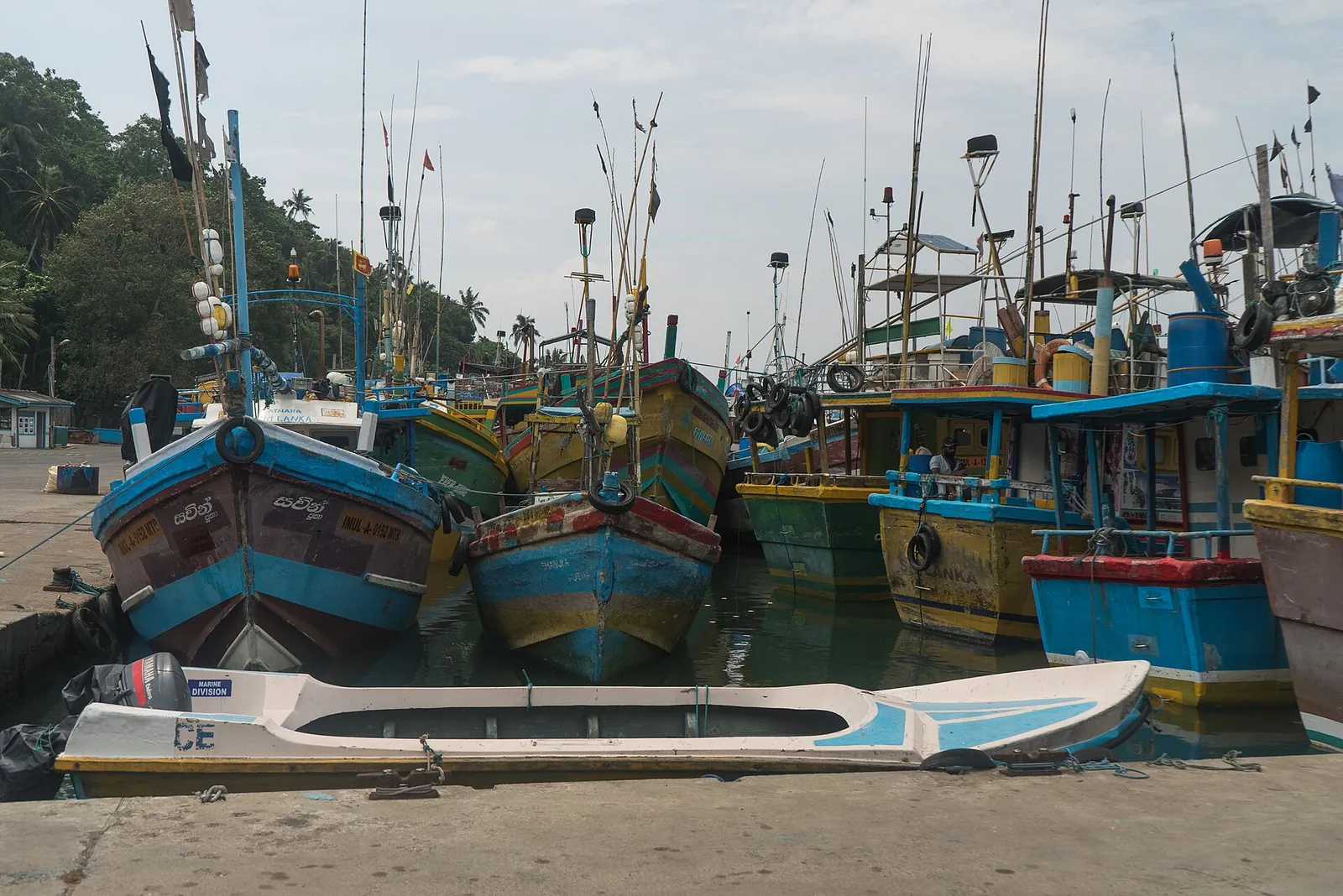
Sri Lanka Tourism says Mirissa's first tourist accommodation was built in 1980 and that tourism grew sharply only from the mid-1990s; before that it was, and still is, a fishing town known for the tuna, mullet, snapper and butterfish its harbour lands. That working harbour, with its painted boats, is where the day begins for anyone taking a whale trip, and Raja & the Whales keeps its office on the road just outside it.
The same page divides the year in two. November to April is the winter season, when the beaches are at their best with fine weather and calm seas. From May to October the town becomes quiet and the sea gets rougher, though it stays popular at weekends with crowds from Colombo who come for the day. If the beach is the reason for the trip, choose the fine-weather months; the whale trips follow their own calendar, set out below.
Whale and dolphin trips: operators, season, price and rules
Many companies run whale and dolphin trips from Mirissa harbour. Sri Lanka Tourism says dolphins are easy to see, jumping out of the water in a big group for a long time, while the whales are elusive and you will most likely see only a back for a second when one surfaces for air. It advises looking at the boat in the harbour first, asking how many people will be on board and avoiding an overcrowded one, and says every boat includes a hot drink, water, some breakfast and fruit.
Raja & the Whales, the first local company to run whale and dolphin trips from Mirissa, has done so since 2009. It runs trips from November to the end of April or early May when it has at least 10 passengers, which is usually daily. From August to October it goes if weather and sea are good enough and it has 10 passengers, and it runs no trips in May, June or July, the worst of the monsoon. The boat leaves at 06:30 with check-in at 06:00 in the office outside the harbour. The trip takes between 2 and 8 hours depending on where the whales are, 4 to 5 hours on average, and the boat does not turn back early for seasickness, a flight or a hotel check-out. Its own odds are 50% for whales and about 20% for blue whales on any trip; take seasickness tablets one to two hours before boarding.
When we checked on 16 October 2026, Raja & the Whales charged LKR 20,000 per adult aged 12 or over, LKR 10,000 per child from 5 to 11.99 years and nothing under 5. The price includes government fees and taxes, pick-up within 6 km of Mirissa, a full breakfast on the boat with vegan or vegetarian options, water, juice and snacks, and photographs by e-mail. It takes cash or cards, in rupees, euros or US dollars. Other operators set their own prices.
Sri Lanka Tourism says the Sri Lanka Coast Guard monitors whale and dolphin watching at Mirissa under the Sea Mammals Observation, Regulation and Control Regulations. Raja & the Whales publishes its own approaching guidelines: slow to under 7 knots within 400 metres of the nearest whale, keep at least 100 metres away, approach from the side, and never swim with, touch or feed the animals. It offers no snorkelling or diving with whales or dolphins.
The sea: currents, rip tides and the monsoon months
France Diplomatie's page of 27 September 2026 strongly discourages sea swimming on the west coast from April to November. It also says that several tourists drown every year on the tourist beaches of the west and the south, in particular at Hikkaduwa, Mirissa and Tangalle, especially in the monsoon months, and that even strong swimmers are at risk. It asks swimmers to stay in a group and to prefer beaches with lifeguards, and notes that some beaches close for a while when jellyfish arrive.
When we checked on 16 October 2026, the UK Foreign Office said many beaches in Sri Lanka have dangerous surf or rip tides at certain times of the year and told visitors to get advice from their hotel or tour operator before going in the sea.
Weligama and Koggala: a first surf lesson and the stilt fishermen
The stilt fishermen work the coast road east of Galle towards Weligama, and Sri Lanka Tourism lists Koggala Beach, one of the longest beaches in Sri Lanka, among the places to see them. Each man's long pole with a crossbar is planted in the seabed close to shore, and the fishermen wade or swim out to the poles when the sea and the fish are running in the right direction, so there is no fixed hour: you pass the poles and look. Marine turtles nest on Koggala beach in the breeding season, though seeing the laying is very rare.
Ama Surf School in Weligama has coaches certified by the International Surfing Association. When we checked on 16 October 2026, a private beginner lesson for one person cost USD 20 for 75 minutes, a private beginner lesson for a couple USD 30 for two people, and a group beginner lesson of 3 to 10 people USD 15 per person, for 75 minutes to two hours by the school's pages. Total beginners start on soft boards and learn to paddle, pop up and catch whitewater waves, and group lessons take place in waist-deep water with at most five students to one instructor. Other schools set their own prices. France Diplomatie's page of 27 September 2026 advises great caution when swimming anywhere on the Sri Lankan coast because of the power of the waves and the currents, and that applies to the lesson too.
Unawatuna: the bay, Rumassala and Jungle Beach
Unawatuna is a suburb of Galle (see our Galle guide), about 5 km south-east of the city centre. Its name comes from the legend of Rumassala: in the Ramayana, the monkey-warrior Hanuman carried a whole Himalayan mountain to the battlefield and a piece of it fell here, and Una-watuna means roughly fell down. The hill behind the bay is that Rumassala.
The bay and the hill offer more than a beach. More than sixty bird species have been sighted around the remaining marsh and the Rumassala hillock, coral reefs, shipwrecks, fish and turtles lie off the coast, and turtles still come ashore to nest, at times going right into the beachfront restaurants. The Rumassala reefs at the east end of Galle harbour attract divers, and eco treks run through the scrub jungle on the hill.
For something quieter, Jungle Beach is a small, secluded beach about 7.5 km from Galle, reached by a climb up Rumassala and then a walk down through greenery on a small route. It is rich in coral, so bring your own snorkelling equipment; the same sea caution applies to snorkelling there.
Getting to the coast and between the towns
The coast line is the best way in. By the railway's table, Mirissa is 147.56 km from Colombo Fort and Matara, 9 km further, 156.82 km. The railway's reserved-seat leaflet lists four coast trains between Maradana station and Matara or Beliatta, 3 hours 12 minutes to 4 hours 22 minutes end to end. No Mirissa time is published; the booking site's train list for your date gives your train. Sri Lanka Tourism's chart gives Colombo to Galle as 3 hours by rail and by road, and Colombo to Matara as 4 hours 30 minutes by rail and 4 hours by road; Mirissa lies between the two.
When we checked on 17 October 2026, the railway's ordinary fares from Colombo Fort, last updated in September 2022, were LKR 950 in first class, LKR 500 in second and LKR 240 in third to Unawatuna, and LKR 1,100, LKR 550 and LKR 280 to Weligama and to Mirissa. The railway's January 2024 leaflet shows reserved seats only in air-conditioned first class on the coast trains; the booking site lists first, second and third class. The reserved coast trains toward Colombo leave in the morning, Beliatta at 05.25 AM and Matara at 06.05 AM; the two afternoon trains start at Maradana at 02.30 PM and 03.40 PM. The 2022 seat-reservation table prices a first-class seat at LKR 1,100 from Colombo Fort to Galle and LKR 1,400 to Matara; no Mirissa price is published, so check the booking site for your date.
Online reservations open 30 days before the date of travel and close 2 hours before the train leaves, with a 5% fee on the total, and every passenger's passport or NIC number is entered at booking. The transport guide has the booking steps, the refund rules and the car-with-driver option.
By road, Sri Lanka Tourism puts Galle Fort 113 km from Colombo on the A2. The National Transport Commission's fare list effective 6 July 2026 prices the Southern Expressway bus from Makumbura at LKR 930 to Galle and LKR 1,170 to Matara, and Sri Lanka Tourism says buses to the coastal towns leave Colombo's Pettah depot every half hour. No official page gives the expressway bus's journey time. From Matara, about 9 km by rail from Mirissa, take a train or a tuk-tuk for the last leg.
You fly into Bandaranaike International Airport at Katunayake, which Sri Lanka Tourism's travel-tips page puts 35 km north of Colombo and 6 km from Negombo; its airports page says 30 km. Add that leg to the Colombo times above. Holiday visitors need to apply for the ETA before arrival; the entry guide has the fees and the steps.
Between the towns, the railway's table puts Mirissa about 5 km from Weligama, and Weligama about 23 km from Unawatuna. No official page publishes a fare or timetable for these short rides or for tuk-tuks; Sri Lanka Tourism says most tuk-tuks are not metered, so agree the fare beforehand.
Three nights on the coast: a plan
Arrive in Mirissa on day 1 by car with a driver, or by one of the two afternoon trains from Maradana (02.30 PM and 03.40 PM) towards Beliatta and Matara, but check the booking site's train list for your date to see whether your train stops at Mirissa, and keep the evening free. Book the whale trip for the next morning: check-in at Raja & the Whales is at 06:00 for a 06:30 departure, and with 4 to 5 hours on average the boat is back before the middle of the day. Spend the rest of the second day on the harbour road and the beach.
On the third morning, take the train about 5 km to Weligama for a surf lesson, then continue about 23 km along the line to Unawatuna for the night. The train back to Colombo boards at Unawatuna, and Galle Fort is about 5 km away if you want a few hours there first.
On the ten-day loop, which ends in Galle, swap Galle for Mirissa to make the last two nights a beach stay, and drop either the Weligama lesson or the Unawatuna night. If you would rather keep Galle Fort as the base, Unawatuna works as a day out from it, but the whale boats need a night in Mirissa because check-in at the harbour is at 06:00. For wildlife after the beach, Yala and Udawalawe are the two safari parks of the south.
Look for the dishes in the box below on the menus along the harbour road in Mirissa and in the bay at Unawatuna.
Make time for the local food
What to eat and where to look
Fish from Mirissa harbour
Sri Lanka Tourism names tuna, mullet, snapper and butterfish as the harbour's catch, landed at what it calls the largest fishing port on the south coast.
- Where to look
- Mirissa, around the harbour where the boats land the catch.
- Fit it into your day
- Lunch or dinner on the Mirissa days.
The German Foreign Office (page of 17 October 2026) advises against eating sea fish and seafood (ciguatera).
Rice and curry
Sri Lanka Tourism calls rice and curry the main meal of Sri Lanka, served with curries of vegetables, meat and fish, pickles, sambol and papadum.
- Where to look
- Lunch menus in Mirissa and Unawatuna; choose the fish curry on the coast.
- Fit it into your day
- Lunch on the Unawatuna day.
Hoppers
Bowl-shaped pancakes of fermented rice flour and coconut milk, crisp at the edges and thicker at the bottom; Sri Lanka Tourism lists plain, egg and honey versions.
- Where to look
- A guesthouse or hotel breakfast on the coast.
- Fit it into your day
- Breakfast on the Unawatuna morning.
Plain hoppers come with a chilli relish, lunumiris; try it in small amounts.
Kottu
Chopped godamba roti stir-fried with vegetables, egg or meat and spices; Sri Lanka Tourism lists fish and seafood versions among its variations and calls it very popular street food.
- Where to look
- Dinner menus and street stalls in Mirissa and Unawatuna.
- Fit it into your day
- Dinner on either night.
Buffalo curd with treacle
Curd made from buffalo milk, which Sri Lanka Tourism says is usually taken with treacle or sugar.
- Where to look
- Dessert menus along the coast.
- Fit it into your day
- Dessert after dinner.
What the boat, the lesson and the train cost for two
Prices for two adults, from the operators' and the railway's own pages as checked on 16 and 17 October 2026, with the currencies kept apart. The train line is the ordinary second-class ticket.
- Whale trip: Raja & the Whales, LKR 20,000 per adult, LKR 40,000 for two.
- Surf lesson: Ama Surf School, private beginner lesson for a couple, USD 30.
- Trains, second class: Colombo Fort to Mirissa LKR 550 and Unawatuna to Colombo Fort LKR 500, LKR 1,050 a person, LKR 2,100 for two.
- Total: LKR 42,100 and USD 30.
- Not included: rooms, meals, the rides between the three towns, the airport car, tickets and any tax or service charge the pages do not include.
Cash, Poya days and what to wear
The German Foreign Office (page of 17 October 2026) says foreign debit cards cannot be used in Sri Lanka, so bring a credit card and cash. The UK Foreign Office (checked 17 October 2026) adds that not all ATMs accept international cards. Sri Lanka Tourism advises carrying plenty of small notes, because change is hard to come by apart from hotels and big shops. On full-moon Poya days the sale of alcohol, meat and fish is prohibited and some shops and businesses close. Sri Lanka Tourism advises women to dress modestly, especially off the beach and at religious sites.
Practical questions
How many nights do Mirissa, Weligama and Unawatuna need?
Three nights are enough for the three towns: two in Mirissa so the boat morning is not your arrival day, and one in Unawatuna, with a surf lesson at Weligama on the way. On the ten-day loop, swap Galle for Mirissa to make the last two nights a beach stay.
Can I swim in the sea at Mirissa?
Take the warnings seriously: the sea section above gives France Diplomatie's page of 27 September 2026, which names Mirissa, and the UK Foreign Office's advice.
When do the whale boats run, and what do they cost?
Raja & the Whales usually runs daily from November to the end of April or early May, goes in suitable weather from August to October and runs no trips in May, June or July; the whale section has the conditions. When we checked on 16 October 2026, it charged LKR 20,000 per adult aged 12 or over and LKR 10,000 per child from 5 to 11.99 years; other operators set their own prices.
Do I need to book the whale trip ahead?
Raja & the Whales highly recommends advance booking and uses an online form. Other operators set their own terms.
Is Weligama suitable for a first surf lesson?
Yes: beginners start on soft boards, and Ama Surf School's group lessons take place in waist-deep water with at most five students to one instructor.
How do I get to Mirissa from Colombo?
By coast train from Colombo Fort, at an ordinary 2022 second-class fare of LKR 550, or by Southern Expressway bus from Makumbura to Matara at LKR 1,170. No official page gives the expressway bus's journey time; Sri Lanka Tourism's chart gives Colombo to Matara as 4 hours 30 minutes by rail. The transport guide explains both.
What do the boat, a lesson and the train cost?
About LKR 42,100 plus USD 30 for two adults on the dated figures of 16 and 17 October 2026: the whale trip, a couple's surf lesson and second-class train fares, before rooms, meals and local rides.
Sources and checks before you travel
Reference sources for the version dated 18 October 2026. Confirm opening times, access, transport and conditions for your travel dates.
- Sri Lanka Tourism: Mirissa ↗ — opens in a new tab
- Sri Lanka Tourism: whale watching ↗ — opens in a new tab
- Sri Lanka Tourism: Unawatuna ↗ — opens in a new tab
- Sri Lanka Tourism: Jungle Beach ↗ — opens in a new tab
- Sri Lanka Tourism: Weligama Bay ↗ — opens in a new tab
- Sri Lanka Tourism: Sri Lankan food ↗ — opens in a new tab
- Raja & the Whales: our trips ↗ — opens in a new tab
- Raja & the Whales: approaching guidelines ↗ — opens in a new tab
- Raja & the Whales: home page ↗ — opens in a new tab
- Ama Surf School: booking ↗ — opens in a new tab
- Ama Surf School: beginner lesson ↗ — opens in a new tab
- Ama Surf School: group surf lessons ↗ — opens in a new tab
- Ama Surf School: home page ↗ — opens in a new tab
- Sri Lanka Railways: passenger ticket rates, Colombo Fort ↗ — opens in a new tab
- Sri Lanka Railways: List of Ticket Fare and Charges 2022 ↗ — opens in a new tab
- Sri Lanka Railways: revision of charges for seat reservation, 1 August 2022 ↗ — opens in a new tab
- Sri Lanka Railways: seat reservation FAQ ↗ — opens in a new tab
- National Transport Commission: expressway fares, Southern Expressway ↗ — opens in a new tab
- France Diplomatie: Sri Lanka, Sécurité ↗ — opens in a new tab
- UK Foreign Office (GOV.UK): Sri Lanka travel advice, Safety and security ↗ — opens in a new tab
- Sri Lanka Tourism: Koggala Beach ↗ — opens in a new tab
- German Foreign Office (Auswärtiges Amt): Sri Lanka, Reise- und Sicherheitshinweise ↗ — opens in a new tab
- Sri Lanka Railways: reserved-seat leaflet ↗ — opens in a new tab
- National Transport Commission: expressway full fares, July 2026 ↗ — opens in a new tab
- Sri Lanka Tourism: Getting Around ↗ — opens in a new tab
- Sri Lanka Tourism: Galle Fort ↗ — opens in a new tab
- Sri Lanka Tourism: Airports ↗ — opens in a new tab
- Sri Lanka Tourism: Travel Tips ↗ — opens in a new tab
- Sri Lanka Tourism: public holidays ↗ — opens in a new tab
- Department of Immigration and Emigration: ETA, how to apply ↗ — opens in a new tab
- UK Foreign Office (GOV.UK): Sri Lanka travel advice, Entry requirements ↗ — opens in a new tab
- Sri Lanka Railways: seat reservation service ↗ — opens in a new tab
Photo credits
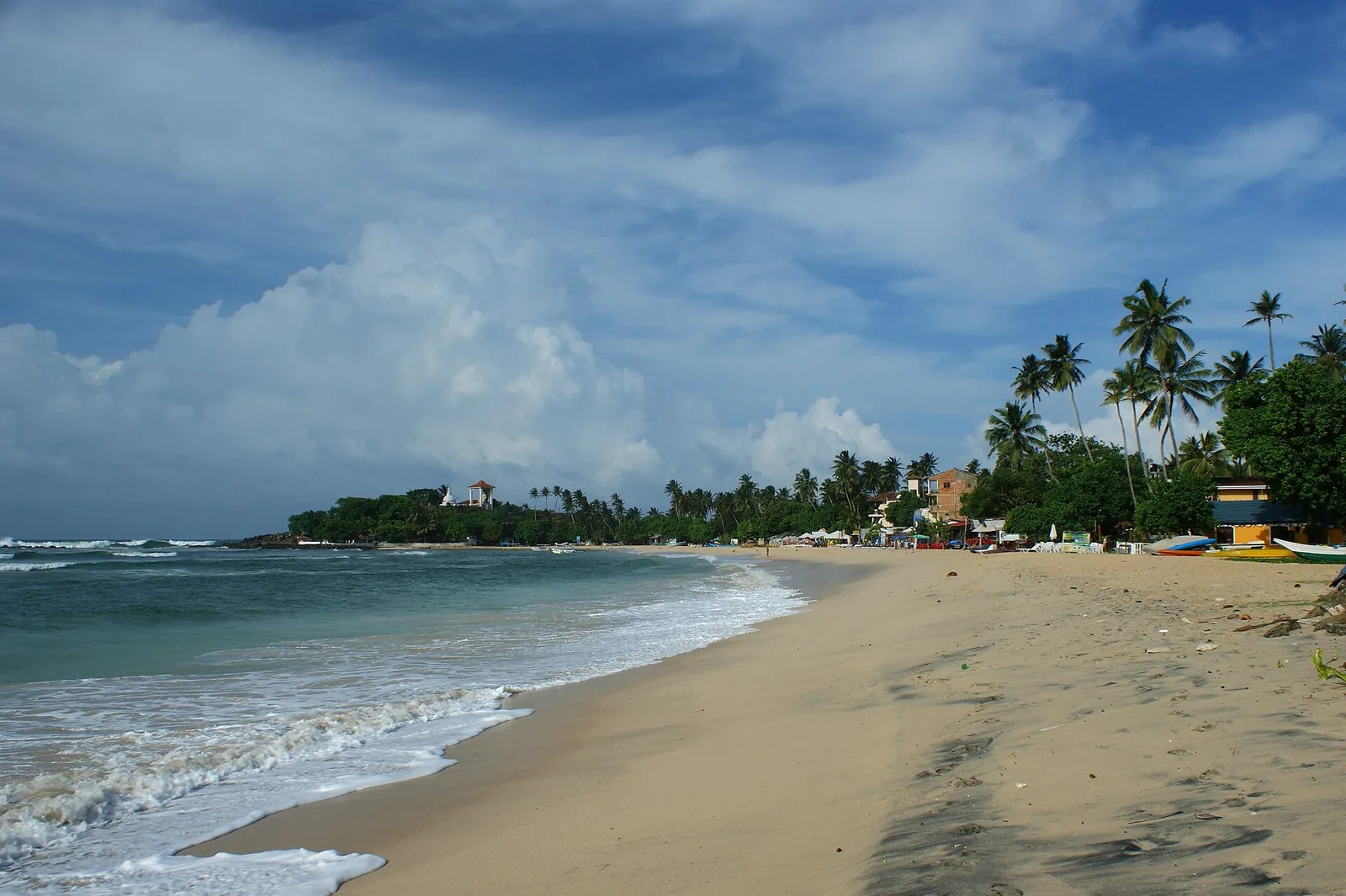
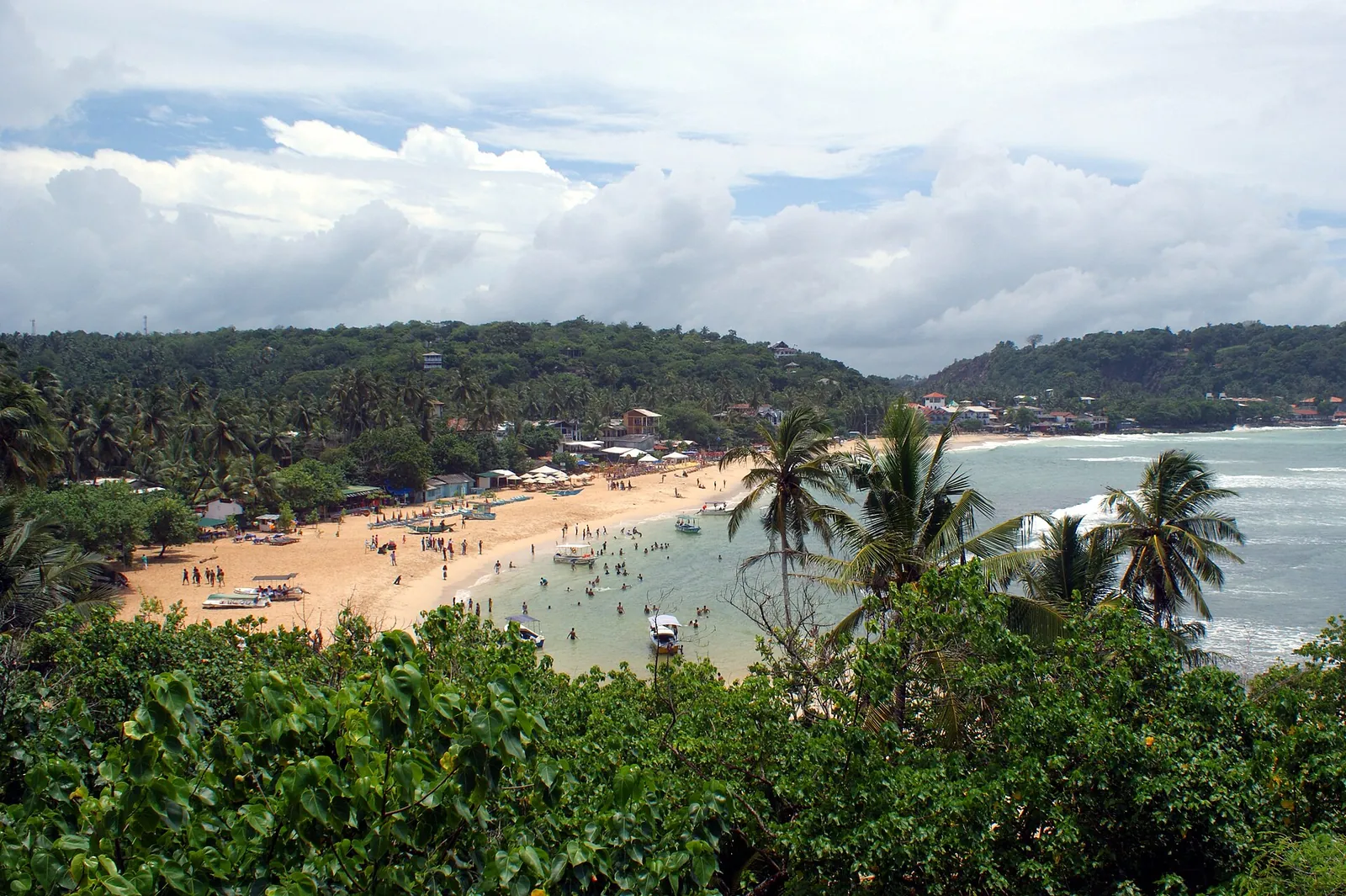
Unawatuna Beach, looking from north to south.
Photograph: Kondephy — opens in a new tab · CC BY-SA 4.0 — opens in a new tab
Changes: Resized and converted to WebP; displayed with responsive crops. · Original photograph and licence details ↗ — opens in a new tab
Boats at Mirissa Fisheries Harbor, where the whale-watching trips set out.
Photograph: Alexey Komarov — opens in a new tab · CC BY-SA 4.0 — opens in a new tab
Changes: Resized and converted to WebP; displayed with responsive crops. · Original photograph and licence details ↗ — opens in a new tab
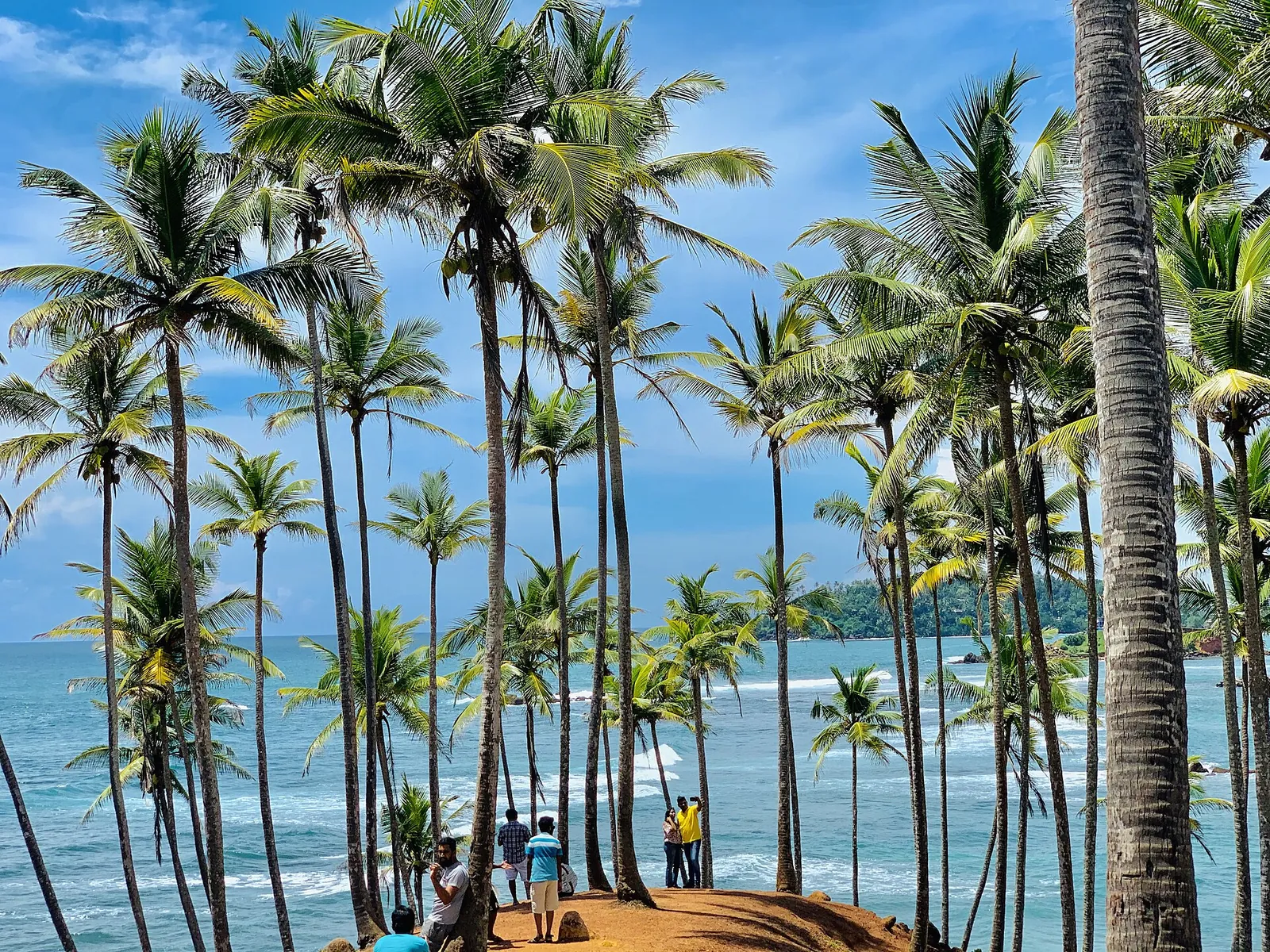
Coconut Tree Hill at Mirissa.
Photograph: Swanthika — opens in a new tab · CC BY-SA 4.0 — opens in a new tab
Changes: Resized and converted to WebP; displayed with responsive crops. · Original photograph and licence details ↗ — opens in a new tab
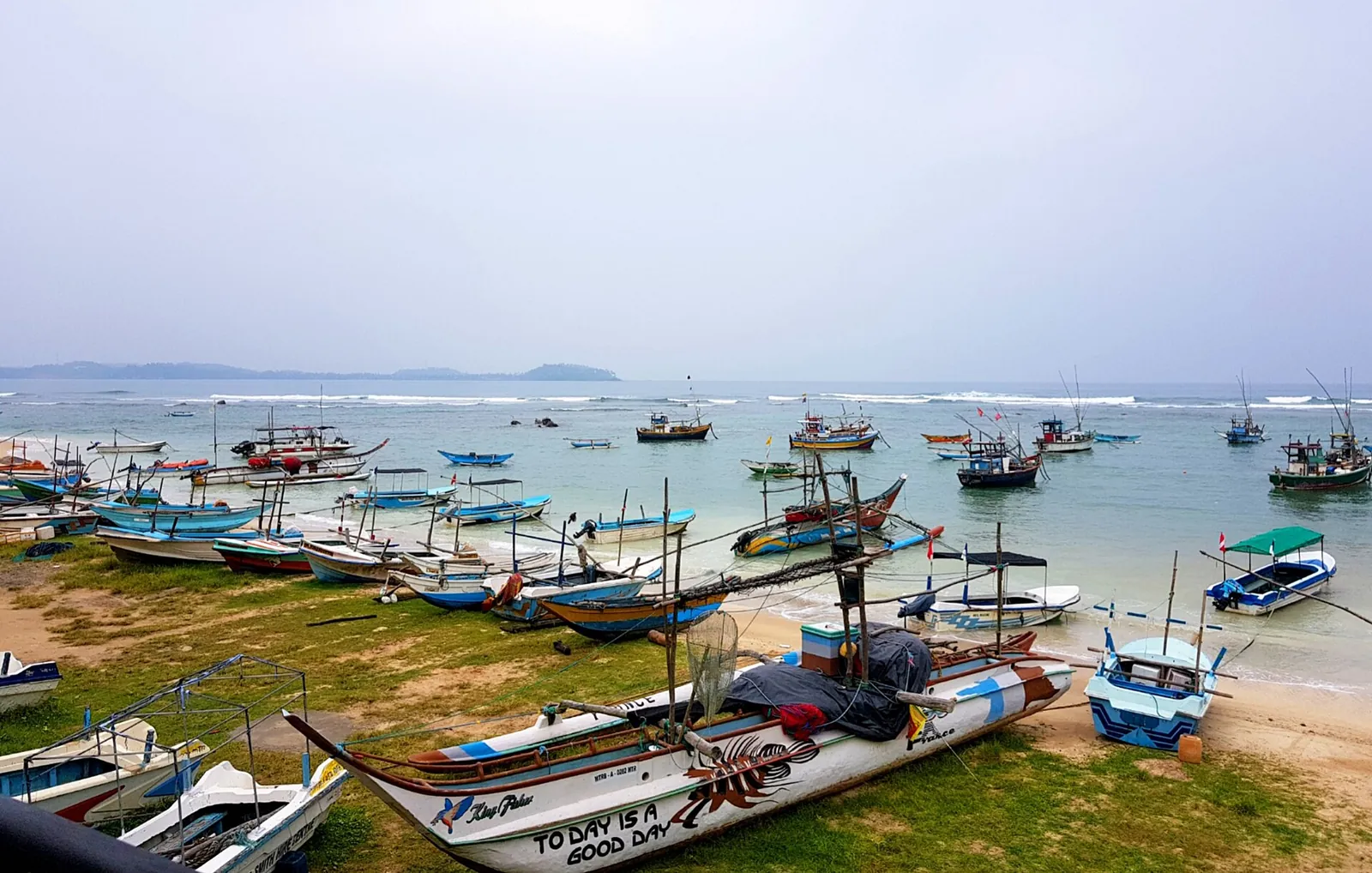
Boats on the shore at Weligama.
Photograph: Annelicious i — opens in a new tab · CC BY-SA 4.0 — opens in a new tab
Changes: Resized and converted to WebP; displayed with responsive crops. · Original photograph and licence details ↗ — opens in a new tab
Unawatuna Beach seen from the stupa at the southern end.
Photograph: Kondephy — opens in a new tab · CC BY-SA 4.0 — opens in a new tab
Changes: Resized and converted to WebP; displayed with responsive crops. · Original photograph and licence details ↗ — opens in a new tab