Jeju · Jeju
Seongsan Ilchulbong guide: sunrise climb, haenyeo divers, Manjanggul
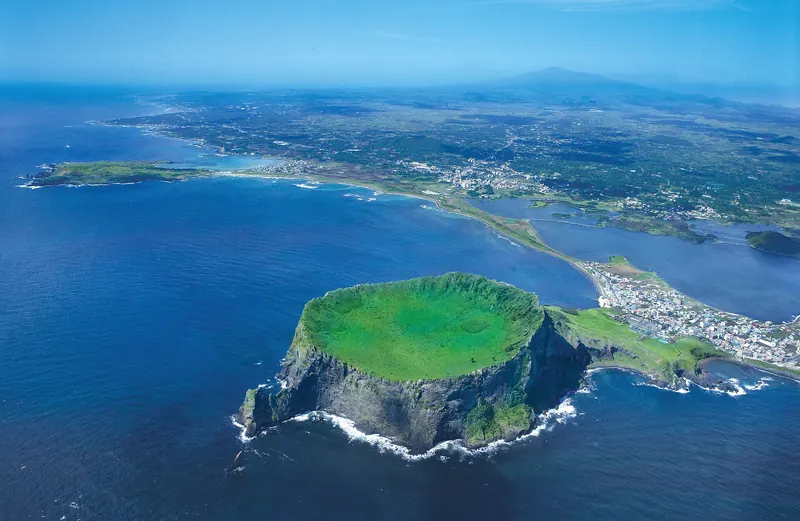
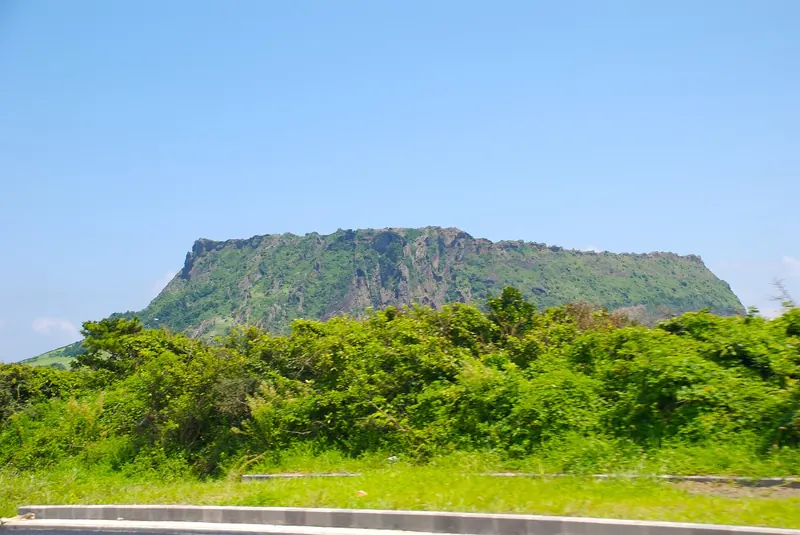
Seongsan Ilchulbong is the cliff-walled crater that closes off Jeju's eastern tip, a tuff cone that rose out of a shallow sea around 5,000 years ago and was later tied to the main island by a bar of sand and gravel. 'Ilchul' means sunrise, and seeing the sun come up from its 180-metre rim has long been counted among the Ten Scenic Views of Jeju. Around it sits a compact day's worth of the east side: the women divers who still work the water below the cliffs, the black lava shore of Gwangchigi, the cape of Seopjikoji, Udo a fifteen-minute ferry ride away, and, inland of the north-east coast on the way back to Jeju City, Manjanggul, the lava tube that reopened in May 2026 after more than two years closed. The decision that shapes the trip is simple: whether you sleep out here or come from Jeju City.
- Suggested time
- 1–2 nights (one for the sunrise, two to add Udo or Manjanggul)
- Where to stay
- Seongsan-ri, below the cone and next to Seongsan Port; Goseong-ri by Gwangchigi beach; Sinyang-ri near Seopjikoji for a quieter beach base
- Season and timing
- The summit is open all year, and the gates move with the daylight: when we checked on 2026-10-03, Visit Jeju listed 04:30–20:00 from May to August, 05:00–19:00 in March–April and September–October, and 06:00–18:00 from November to February, with tickets sold until an hour before closing. The cone closes on the first Monday of every month (the following day if that Monday is a public holiday), so check the date before you build a sunrise around it. VisitKorea notes a sunrise festival here every 31 December, the busiest morning of the year. Anything on the water — the haenyeo demonstration, the Udo ferries — depends on the sea, so keep a spare morning in windy weather.
The short answer
Give the east side one or two nights in Seongsan-ri, the village at the foot of the cone, rather than visiting from Jeju City: VisitKorea puts Seongsan Ilchulbong one to one and a half hours from Jeju International Airport by public transport, and the summit gates open before dawn (04:30 in summer when we checked). Climb for sunrise (30–40 minutes up), come down for the haenyeo diving demonstration at Umutgae beach, which is free with your summit ticket, and walk 25 minutes to Gwangchigi beach. Spend the second day on Udo or at Seopjikoji and the Haenyeo Museum, and do Manjanggul on the way back towards the airport. Without a car, use bus 201 along the coast and taxis for the inland lava tube.
Sleep in Seongsan-ri if you want the sunrise
The point of Seongsan Ilchulbong is the sunrise from the rim, and that is hard to do from anywhere but the village at its foot. VisitKorea's airport guide puts the cone one to one and a half hours from Jeju International Airport by public transport, and its east-coast bus guide says bus 201 runs at intervals of 30 to 80 minutes, so a pre-dawn arrival from Jeju City or Seogwipo really means a taxi or a rental car. Sleep in Seongsan-ri and the ticket gate is a walk from your door.
Seongsan-ri also puts you next to Seongsan Port, where the Udo ferries leave (VisitKorea gives about 15 minutes for the crossing), and within walking distance of Gwangchigi beach. If you would rather wake to a beach, Goseong-ri sits behind Gwangchigi on the road towards Seopjikoji, and Sinyang-ri has the small, shallow Sinyang Seopji Beach; both are short taxi rides from the cone. Jeju City makes sense only if you are happy to see the cone in daylight on a day trip.
One night is enough for the sunrise, the haenyeo demonstration and Gwangchigi. Add a second if you want Udo or Manjanggul without rushing: the east side rewards slow mornings more than long drives.
Climbing the cone: summit trail, free shore path and what you see
Visit Jeju divides the site into two parts. The paid section is the climb to the summit, a run of stairs and uphill sections that it says typically takes 30 to 40 minutes; the free section is a gentler path around the base and down to Umutgae beach on the north side. When we checked on 2026-10-03, VisitKorea listed admission at 5,000 won for adults and 2,500 won for teenagers and children, with free parking. Visit Jeju notes that outside food is not allowed.
At the top you look into a crater about 600 metres across and, according to VisitKorea, 90 metres deep, now a bowl of silver grass ringed by jagged rock — the 'fortress' that gives Seongsan (castle mountain) its name. VisitKorea describes how it formed: hot magma meeting cold seawater under the sea, building a cone of volcanic ash whose seaward sides have since been cut into cliffs by the waves. From the rim you see Udo, the rooftops of Seongsan-ri and the sea on three sides.
The cone was designated Natural Monument No. 420 in 2000 and, in 2007, inscribed as part of the UNESCO World Natural Heritage site Jeju Volcanic Island and Lava Tubes, together with Hallasan and the Geomunoreum lava tube system. Visit Jeju also points out what the view does not tell you: the Japanese military left facilities around the cone during the colonial period, and Teojinmok, the neck of land between the cone and the main island, is a site of the Jeju 4·3 Incident. It is worth a pause on the way down.
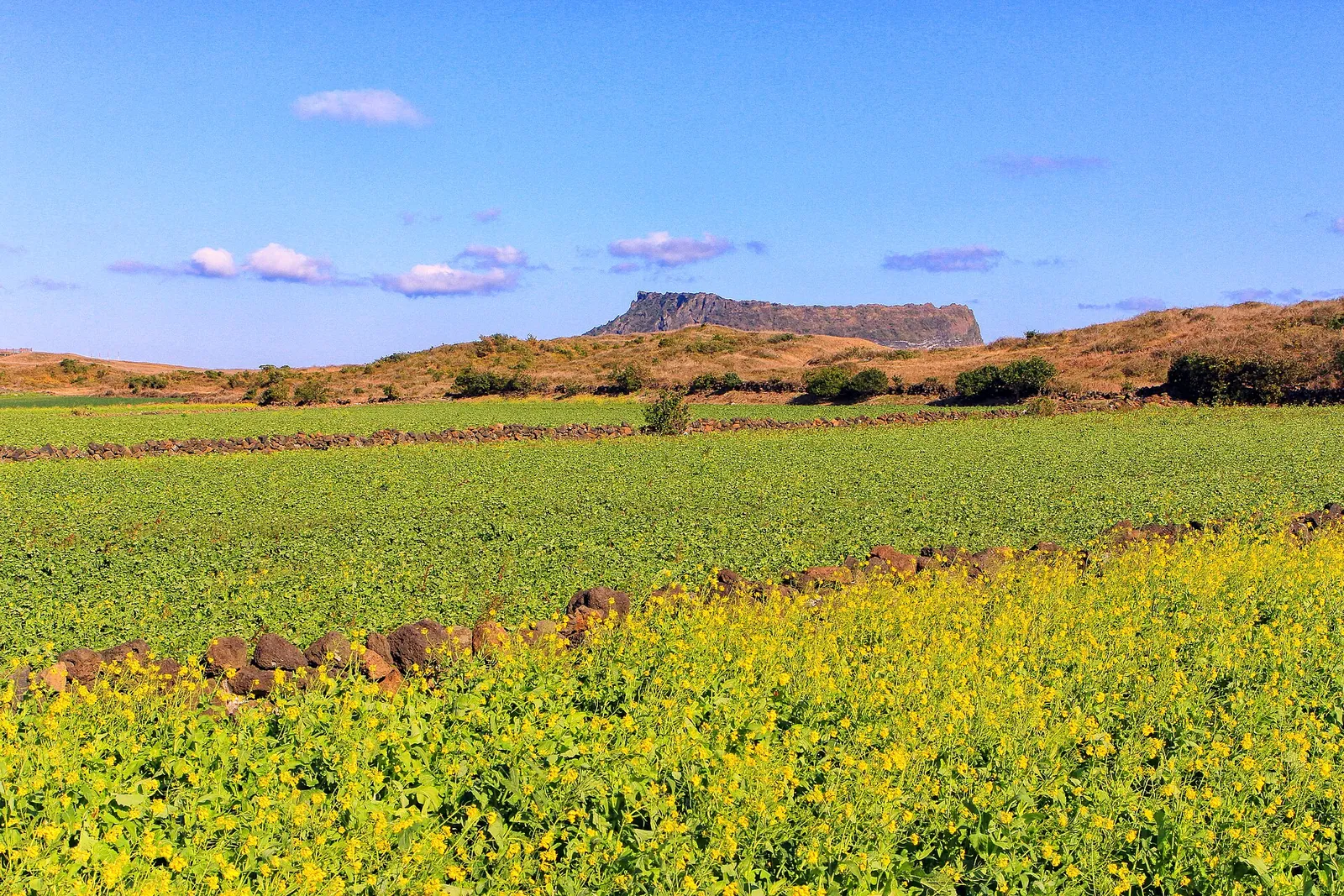
For sunrise, buy your ticket as the gate opens and allow the full 40 minutes in the dark; a headlamp helps on the stairs. If you only want the shape of the cone, the classic views are from below: from Gwangchigi beach to the south, or across the canola fields beside the beach.
Make time for the local food
What to eat and where to look
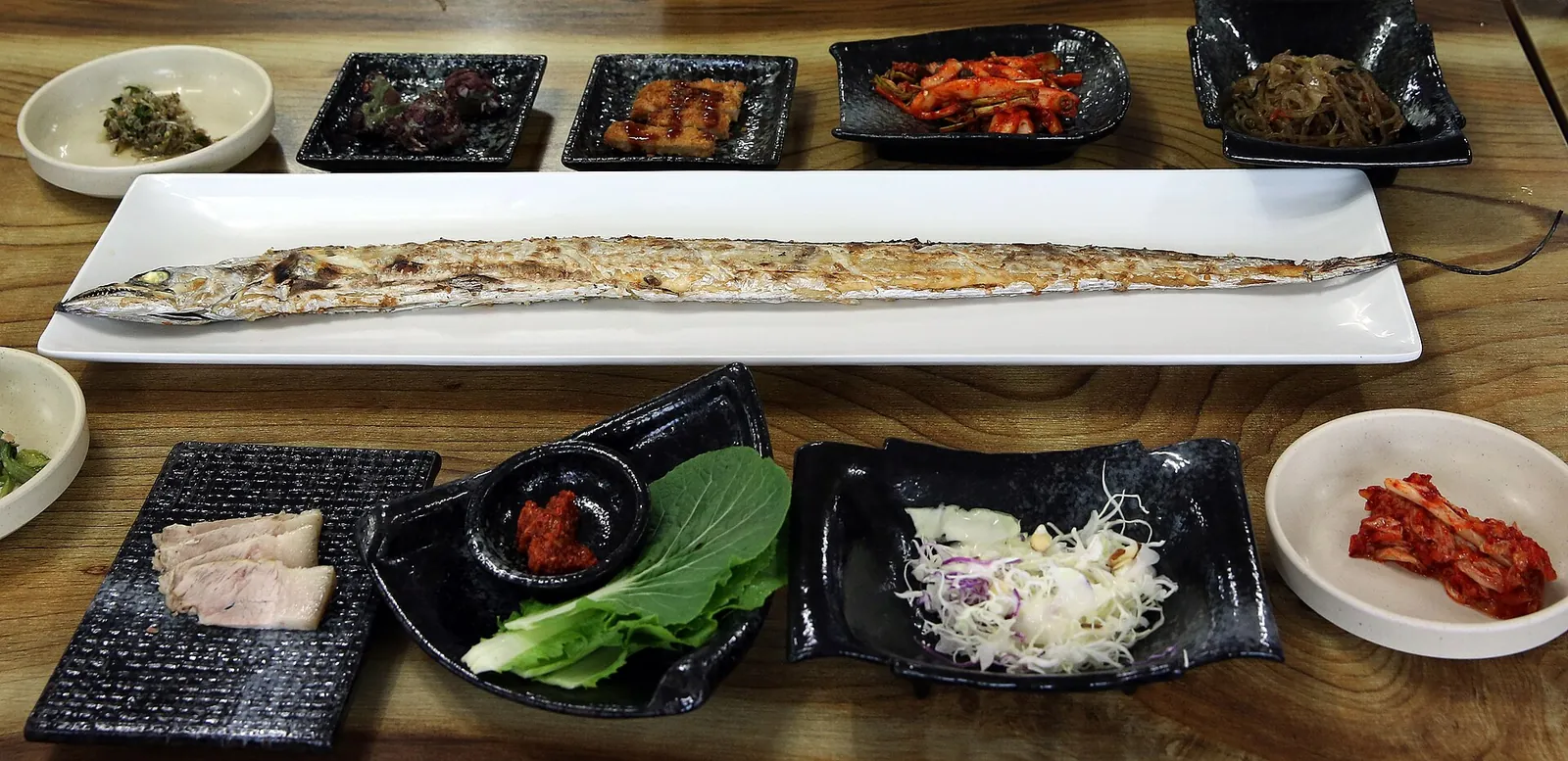
Galchi gui (grilled whole cutlassfish)
Long, silver cutlassfish grilled whole and brought to the table in one piece. VisitKorea lists tong galchi gui as the main dish at Seongsan Haeoreum Sikdang, by the entrance to the cone, alongside braised cutlassfish in spicy sauce.
- Where to look
- Seongsan Haeoreum Sikdang, 260 Ilchul-ro, Seongsan-eup; when we checked on 2026-10-03, VisitKorea listed 08:00–20:00, closed on Seollal and Chuseok days.
- Fit it into your day
- Lunch or dinner for two or more; whole-fish dishes are usually ordered to share.
Cutlassfish has fine bones; eat slowly and check prices on the menu before ordering, as whole-fish dishes vary with the catch.
Grilled mackerel with sea urchin seaweed soup
The post-sunrise breakfast. VisitKorea says Seongsan Haeoreum Sikdang serves grilled mackerel with seongge miyeokguk (sea urchin and seaweed soup) and soy-marinated crab for breakfast; its other dishes include haemul ttukbaegi (seafood hot pot) and sea urchin bibimbap.
- Where to look
- Seongsan Haeoreum Sikdang at the cone's entrance (opening at 08:00 when we checked).
- Fit it into your day
- After the sunrise climb, before the haenyeo demonstration.
Contains fish and shellfish; soy-marinated crab is raw.
Bomal kalguksu and bomaljuk
Noodle soup or rice porridge with bomal, the Jeju word for the brown turban shell. VisitKorea says Seongsan Bom Juk Kalguksu makes its noodles with tangerine, which gives them a yellowish colour and a chewy bite, and also serves galchijuk (cutlassfish porridge).
- Where to look
- Seongsan Bom Juk Kalguksu, in front of Sinsan Elementary School in Seongsan-eup; when we checked on 2026-10-03, VisitKorea listed 07:30–19:30. It is a drive or taxi ride south of Seongsan-ri.
- Fit it into your day
- An early breakfast on the way to Seopjikoji or a light lunch.
Shellfish; ask before ordering if you have an allergy.
Haenyeo-caught seafood at Umutgae
Fresh catch straight from the divers. VisitKorea says the Haenyeo's House restaurant run by the Seongsanpo haenyeo at Umutgae beach offers sea cucumber, sea pineapple (sea squirt) and conch, and the demonstration itself ends with selling and tasting.
- Where to look
- Umutgae beach on the free path below Seongsan Ilchulbong, 284-34 Ilchul-ro; hours change with the season and the weather.
- Fit it into your day
- A snack after the demonstration rather than a full meal.
Raw shellfish and sea squirt; avoid if you are pregnant or immunocompromised, and confirm the price before you are served.
Mandarin drinks with a view of the cone
Jeju's mandarins turn up in drinks everywhere. VisitKorea lists Cafe The Light, between the cone and the Seongsanpo port terminal, for its handmade mandarin ade and mandarin latte and its large windows facing Seongsan Ilchulbong and Udo.
- Where to look
- Cafe The Light, 269 Hando-ro, Seongsan-eup; when we checked on 2026-10-03, VisitKorea listed 10:00–20:00 (last order 19:30), closed Sundays.
- Fit it into your day
- A break while you wait for a ferry or after the afternoon walk.
Closed on Sundays according to that listing.
The haenyeo: dive show at Umutgae and the museum at Hado
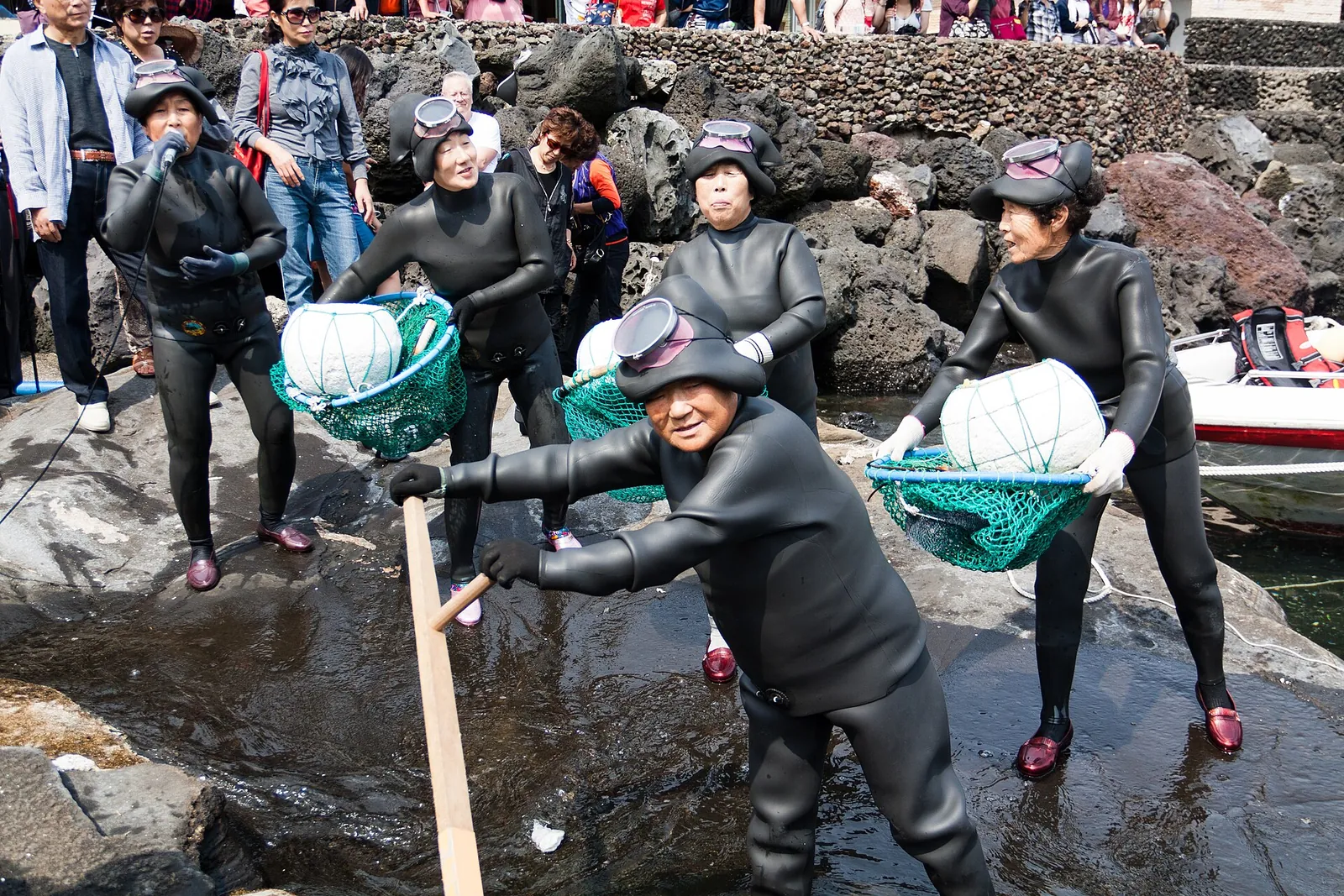
Jeju's haenyeo are women who free-dive for shellfish such as abalone and sea urchins without breathing equipment. UNESCO, which inscribed the culture of Jeju haenyeo on its Representative List of the Intangible Cultural Heritage of Humanity in 2016, describes divers, some in their 80s, going down around 10 metres on a single breath of about a minute, for up to seven hours a day and some 90 days a year, and making a distinctive sound as they surface. They are ranked by experience as hagun, junggun and sanggun, and pray to the sea goddess Jamsugut before diving.
At Umutgae beach, on the free path below Seongsan Ilchulbong, the Seongsanpo haenyeo give a demonstration of their work. VisitKorea lists the sequence as an introduction, the dive, collecting seafood, photos, then selling and tasting, and says entry is free with a Seongsan Ilchulbong admission ticket. The divers also run a small restaurant, the Haenyeo's House, where VisitKorea says you can taste sea cucumber, sea pineapple and conch. The schedule changes with the season and the weather, and we could not find an official timetable, so ask at the ticket office when you climb in the morning.
For context, go to the Jeju Haenyeo Museum in Hado-ri, Gujwa-eup, on the coast north of Seongsan. VisitKorea describes exhibits donated by the haenyeo themselves, a replica of a diver's house and displays on their food, farming-and-fishing life and rituals; it is also the end point of Olle Route 20. When we checked on 2026-10-03, VisitKorea listed 09:00–18:00 (last entry 17:00), closed Mondays, New Year's Day, Seollal and Chuseok, with admission of 1,100 won for adults. VisitKorea's airport guide also mentions Haenyeo's Kitchen, whose Jongdal branch pairs a live performance with a seafood buffet; check its own booking page before you go.
Gwangchigi, Seopjikoji and Sinyang: the coast south of the cone
Gwangchigi beach is the low, black-sand shore that curves south from the cone, about 25 minutes on foot from Seongsan Ilchulbong according to VisitKorea. Its interest is under the water line: VisitKorea and Visit Jeju describe lava that froze where it met the sea, and at low tide flat rocks carpeted in green moss appear in front of the cone. It is also a celebrated sunrise spot with Seongsan Ilchulbong as the backdrop, and VisitKorea notes a canola field planted beside it in 2023. It marks the end of Olle Route 1 and the start of Route 2, it is free, and VisitKorea lists it as open at all hours. Check the tide table if you want the moss rocks.
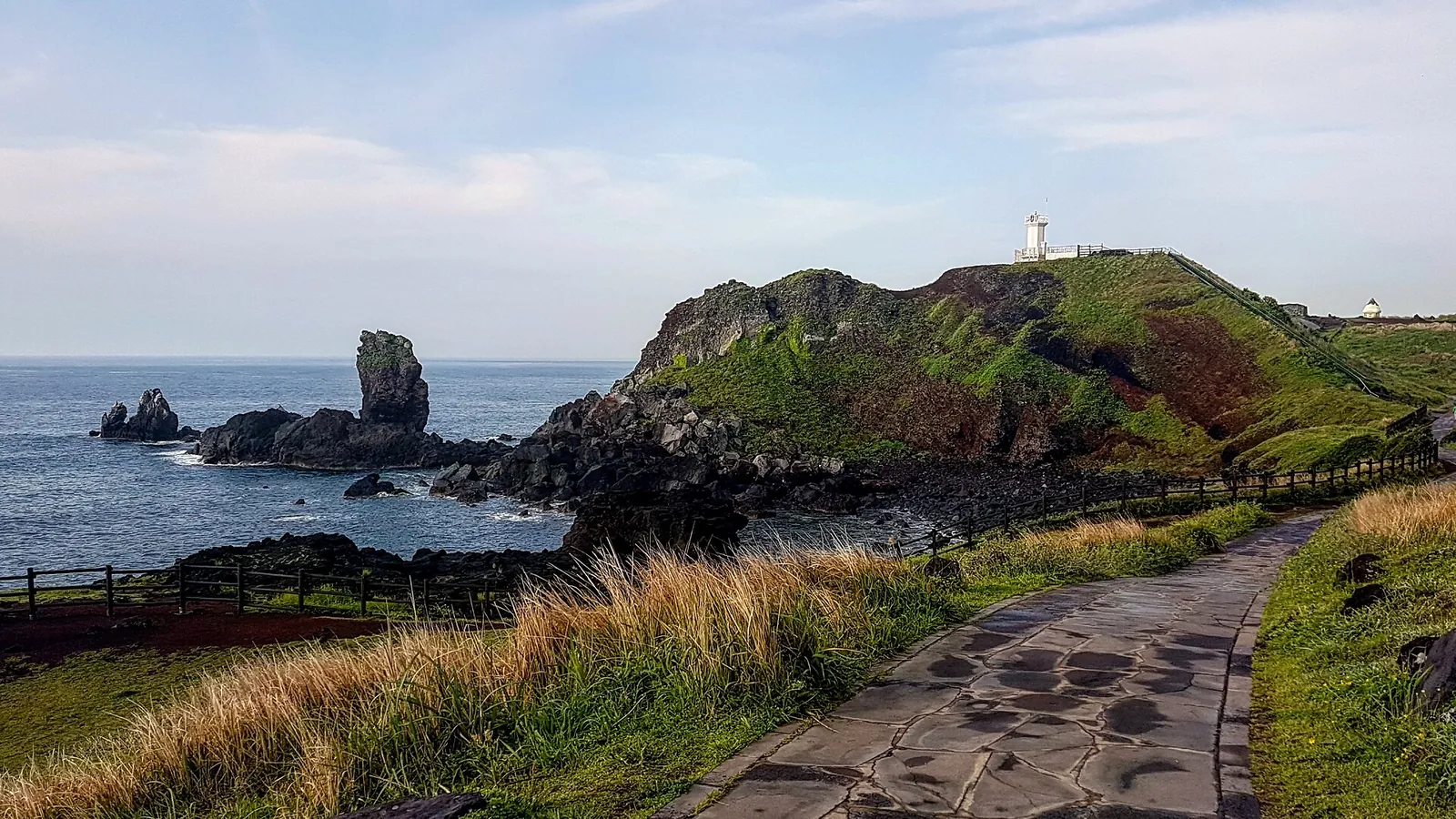
Seopjikoji, just south, is a cape ('koji' in the Jeju dialect) with a clifftop path. VisitKorea describes a stone beacon-fire station 4 metres high and 9 metres across on the hill, the red-soiled Bulgeunoreum cone behind it topped by a white lighthouse, and views back to the tuff cone over canola fields. It is free and open around the clock, and has appeared in many Korean films and dramas.
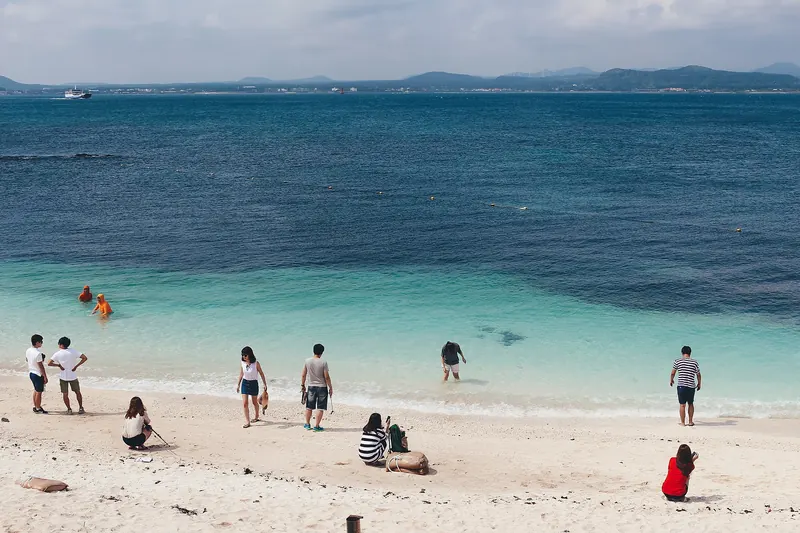
Between the two, Sinyang Seopji Beach is the quiet option for swimming: VisitKorea gives it a 300-metre crescent of fine sand, an average depth of about one metre and small waves, which makes it the best choice on this stretch for children. Windsurfing is available nearby, VisitKorea says.
Manjanggul lava tube: reopened in 2026
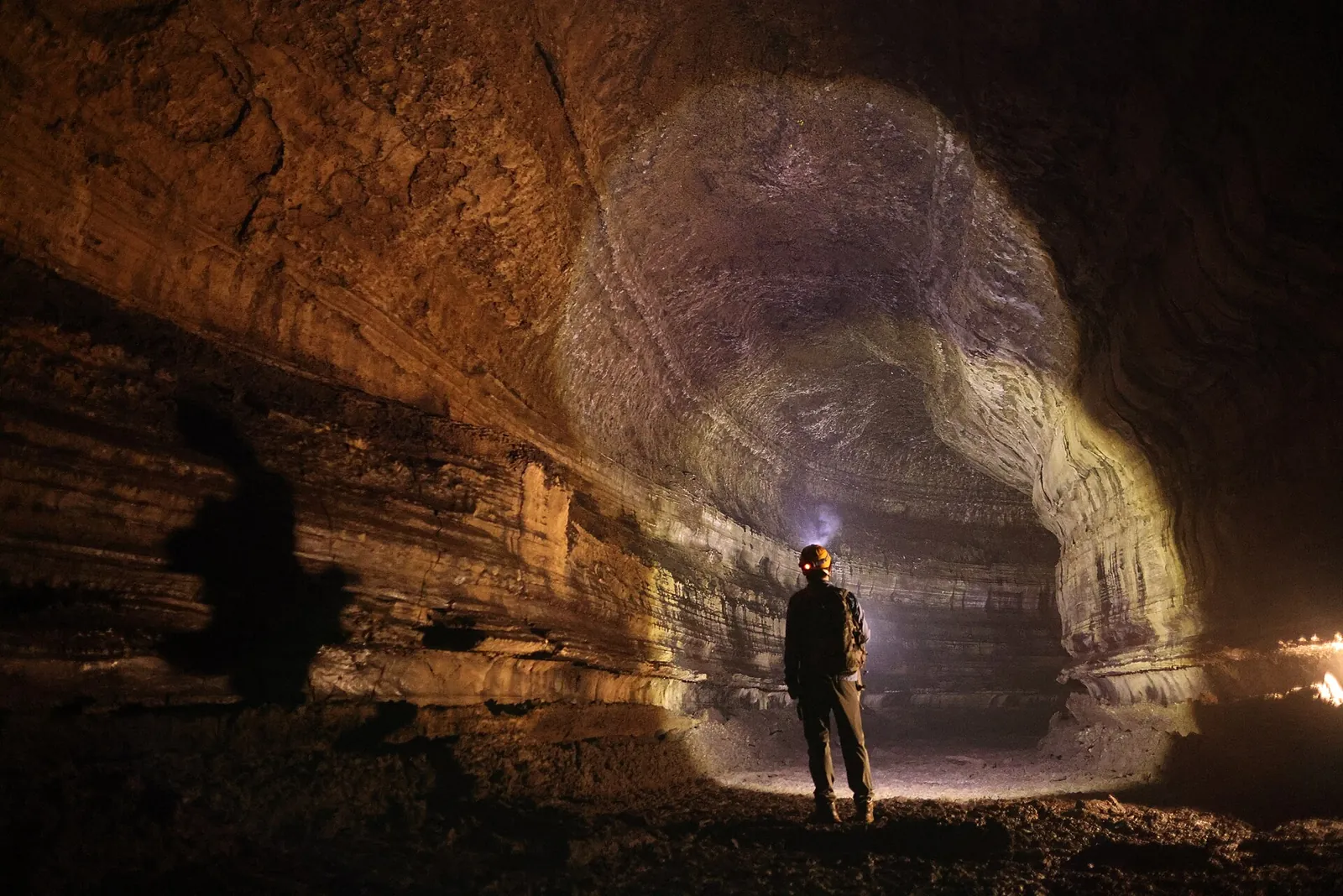
Manjanggul lies inland of Gimnyeong on the north-east coast, in Gujwa-eup, on the way between Seongsan and Jeju City rather than in Seongsan itself. It belongs to the Geomunoreum lava tube system, part of the same UNESCO site as the cone. VisitKorea describes a tube about 7,400 metres long and up to 25 metres high and 18 metres wide, of which about one kilometre is open to visitors, ending at a 7.6-metre lava column recorded as the largest in the world. VisitKorea's airport guide says the tube stays at a cool 12°C all year, so bring a layer even in August, and expect wet, uneven floors.
The tube was closed from 29 December 2023 for maintenance. Jeju's World Natural Heritage office announced that it reopened on 30 May 2026, with tickets sold from 09:00 to 17:00 and visits from 09:00 to 18:00. When we checked on 2026-10-03, VisitKorea listed admission at 4,000 won for adults and 2,000 won for teenagers and children, free parking, and a closure on the first Wednesday of every month; confirm the closing day on the official site, as that listing predates the reopening.
Manjanggul fits best on the day you leave the east side: visit in the morning from Seongsan, then continue west to the airport. The bus network does not run to the entrance on the routes we could verify, so plan on a taxi or a rental car for this leg.
Getting there and around without a car
VisitKorea's east-coast bus guide sets out the two routes. Bus 101 is the express from Jeju International Airport (Platform 2, in front of Gate 2 on the first floor) along the east coast to Namwon; bus 201 is the slower city bus from Jeju City Bus Terminal to Seogwipo that stops almost everywhere, including the Seongsan Ilchulbong stop. The guide's suggested route is 101 from the airport to Hamdeok (about 40 minutes), then 201 to Seongsan Ilchulbong (about an hour). When we checked on 2026-10-03, the same guide gave fares of 1,150 won for bus 201 and 2,000 won for bus 101 by card.
Jeju's city buses stopped taking cash on 1 October 2024, VisitKorea says, so carry a transport card or use the QR payment on board. Gwangchigi is walkable from the cone; Seopjikoji, the Haenyeo Museum and Manjanggul are easier by taxi. VisitKorea's airport guide adds that a rental car is more convenient for the west coast and the interior, which is why many visitors combine a car-free night in Seongsan with a car for the rest of the island.
A two-day east-side plan
This is our suggested order, not a timetable: check the summit hours for your month, the haenyeo demonstration at the ticket office, and the Udo ferries at the port.
- Day 1, afternoon: arrive by bus 101 and 201 or by car, check in at Seongsan-ri, walk the free shore path to Umutgae beach and on to Gwangchigi for the late light on the cone.
- Day 2, dawn: be at the gate when it opens, climb 30–40 minutes for sunrise over the crater rim, then breakfast near the entrance.
- Day 2, late morning: the haenyeo demonstration at Umutgae if it is running, then Seopjikoji and Sinyang Seopji Beach.
- Day 2, afternoon: either the ferry to Udo from Seongsan Port, or north to the Jeju Haenyeo Museum at Hado (closed Mondays).
- Day 3, morning: Manjanggul on the way back towards Jeju City and the airport (not on the first Wednesday of the month if the VisitKorea listing holds).
Practical questions
How long does it take to climb Seongsan Ilchulbong?
Visit Jeju says the paid summit trail, mostly stairs, typically takes 30 to 40 minutes up. Allow about an hour and a half for the climb, the crater rim and the walk down, and more if you add the free shore path to Umutgae beach.
What time does Seongsan Ilchulbong open for sunrise?
When we checked on 2026-10-03, Visit Jeju listed 04:30 from May to August, 05:00 in March–April and September–October, and 06:00 from November to February. It closes on the first Monday of every month (the next day if that Monday is a public holiday).
How much is the entrance fee?
When we checked on 2026-10-03, VisitKorea listed 5,000 won for adults and 2,500 won for teenagers and children. The haenyeo demonstration at Umutgae beach is free with that ticket, and the shore path below the cone is free.
When is the haenyeo diving show at Seongsan?
VisitKorea says the schedule changes with the season and the weather, and we could not find an official timetable. Ask at the ticket office in the morning; in rough seas it may not run.
Is Manjanggul open?
Yes. Jeju's World Natural Heritage office announced that Manjanggul reopened on 30 May 2026 after a closure that began in December 2023, with tickets sold 09:00–17:00 and visits until 18:00. Check the official site for the monthly closing day.
Can I visit Seongsan Ilchulbong and Udo on the same day?
Yes, if you sleep in Seongsan-ri: climb for sunrise, then take a ferry from Seongsan Port, about 15 minutes to Udo according to VisitKorea. Ferries depend on the weather, so keep the afternoon flexible.
Do I need a car on Jeju's east side?
Not for Seongsan itself: bus 101 and bus 201 reach the Seongsan Ilchulbong stop, and Gwangchigi is a 25-minute walk. A car or taxi makes Manjanggul, the Haenyeo Museum and a pre-dawn arrival much easier.
Sources and checks before you travel
Reference sources for the version dated 3 October 2026. Confirm opening times, access, transport and conditions for your travel dates.
- VisitKorea: Seongsan Ilchulbong Tuff Cone [UNESCO World Heritage] ↗ — opens in a new tab
- Visit Jeju: Seongsan Ilchulbong ↗ — opens in a new tab
- VisitKorea: UNESCO World Heritages (Jeju Volcanic Island and Lava Tubes) ↗ — opens in a new tab
- VisitKorea: Seongsanpo Haenyeo Gongyeonjang ↗ — opens in a new tab
- UNESCO Intangible Cultural Heritage: Culture of Jeju Haenyeo (women divers) ↗ — opens in a new tab
- VisitKorea: Jeju Haenyeo Museum ↗ — opens in a new tab
- VisitKorea: Jeju Olle Trail Route 20 ↗ — opens in a new tab
- VisitKorea: Gwangchigi Beach ↗ — opens in a new tab
- VisitKorea: Seopjikoji ↗ — opens in a new tab
- VisitKorea: Sinyang Seopji Beach ↗ — opens in a new tab
- VisitKorea: Manjanggul Lava Tube [National Geopark] ↗ — opens in a new tab
- Jeju World Natural Heritage (Jeju Special Self-Governing Province): Manjanggul reopening notice ↗ — opens in a new tab
- VisitKorea: [Korea Beyond Seoul ③] Fly to Jeju International Airport and Enjoy Jeju ↗ — opens in a new tab
- VisitKorea: Jeju's East Coast Itinerary by City Bus ↗ — opens in a new tab
- VisitKorea: Seongsan Haeoreum Sikdang ↗ — opens in a new tab
- VisitKorea: Seongsan Bom Juk Kalguksu ↗ — opens in a new tab
- VisitKorea: Cafe The Light ↗ — opens in a new tab
- VisitKorea: Jeju Island, a Picturesque Paradise for a Peaceful Retreat ↗ — opens in a new tab
Does this experience fit your route?
Seongsan is easiest on your own from a night in Seongsan-ri. If you would rather have a guide for the east coast, check that the tour climbs the cone and gives you enough time at the places you care about.
Browse relevant experiences on Viator ↗ — opens in a new tabAffiliate link · Book with ViatorPhoto credits
Seongsan Ilchulbong seen across the fields of Seongsan-eup, Jeju
Photograph: SEUNGMIN WOO — opens in a new tab · CC BY-SA 3.0 — opens in a new tab
Changes: Resized and converted to WebP; displayed with responsive crops. · Original photograph and licence details ↗ — opens in a new tab
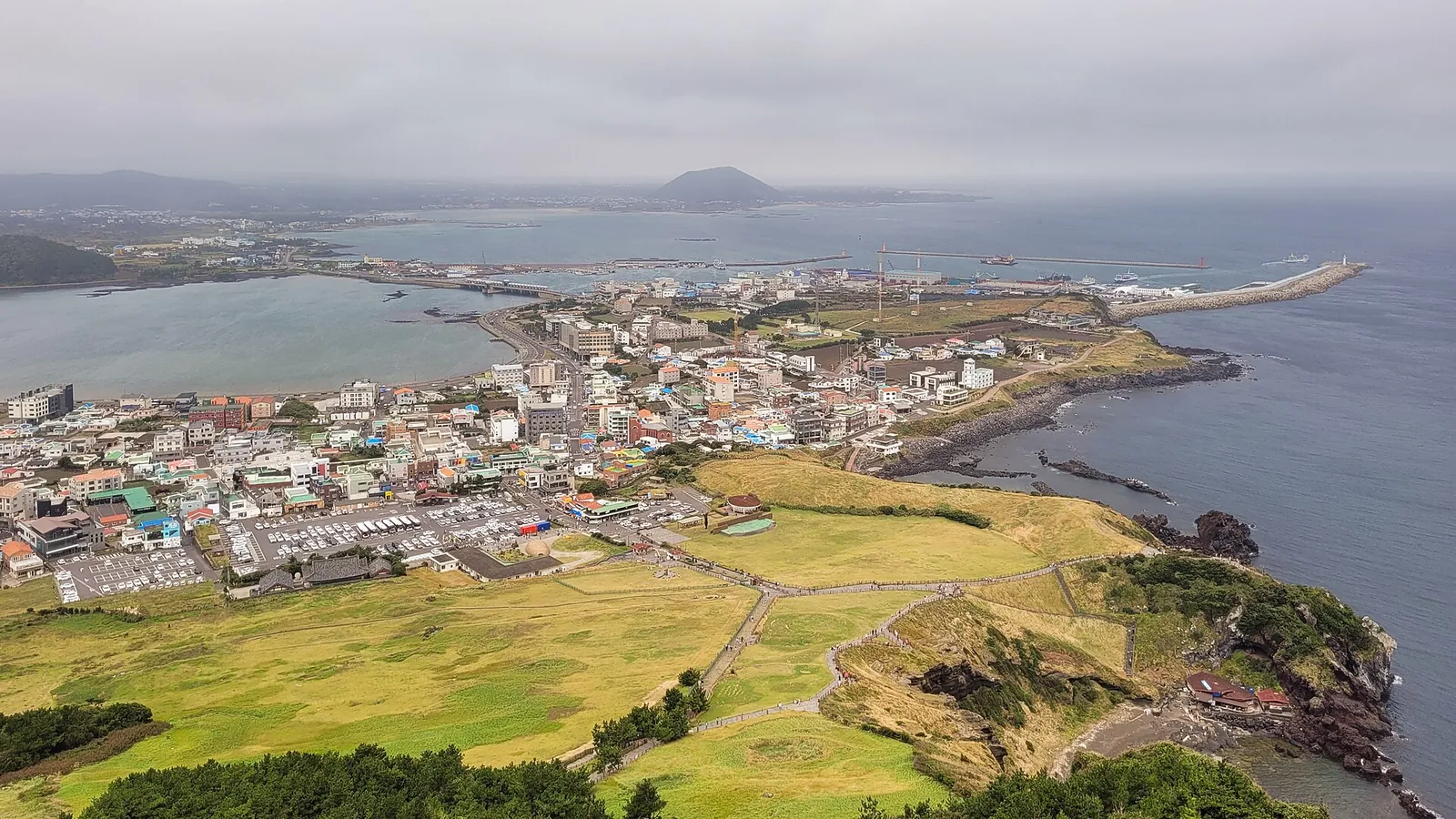
Seongsan-ri and its harbour from Seongsan Ilchulbong
Photograph: Bernard Gagnon — opens in a new tab · CC0 — opens in a new tab
Changes: Resized and converted to WebP; displayed with responsive crops. · Original photograph and licence details ↗ — opens in a new tab
The clifftop path and lighthouse at Seopjikoji, south of Seongsan
Photograph: Engin Cukuroglu — opens in a new tab · CC BY-SA 4.0 — opens in a new tab
Changes: Resized and converted to WebP; displayed with responsive crops. · Original photograph and licence details ↗ — opens in a new tab
Inside Manjanggul lava tube, Gujwa-eup
Photograph: 강형원 — opens in a new tab · CC BY 4.0 — opens in a new tab
Changes: Resized and converted to WebP; displayed with responsive crops. · Original photograph and licence details ↗ — opens in a new tab
Galchi gui, grilled whole cutlassfish with side dishes, Jeju
Photograph: Republic of Korea from Seoul, Republic of Korea — opens in a new tab · CC BY-SA 2.0 — opens in a new tab
Changes: Resized and converted to WebP; displayed with responsive crops. · Original photograph and licence details ↗ — opens in a new tab
Haenyeo women divers coming ashore on Jeju
Photograph: Own work — opens in a new tab · CC BY-SA 3.0 — opens in a new tab
Changes: Resized and converted to WebP; displayed with responsive crops. · Original photograph and licence details ↗ — opens in a new tab