Jeju · Jeju
Seogwipo travel guide: waterfalls, Jusangjeolli, Olle walks, Jungmun
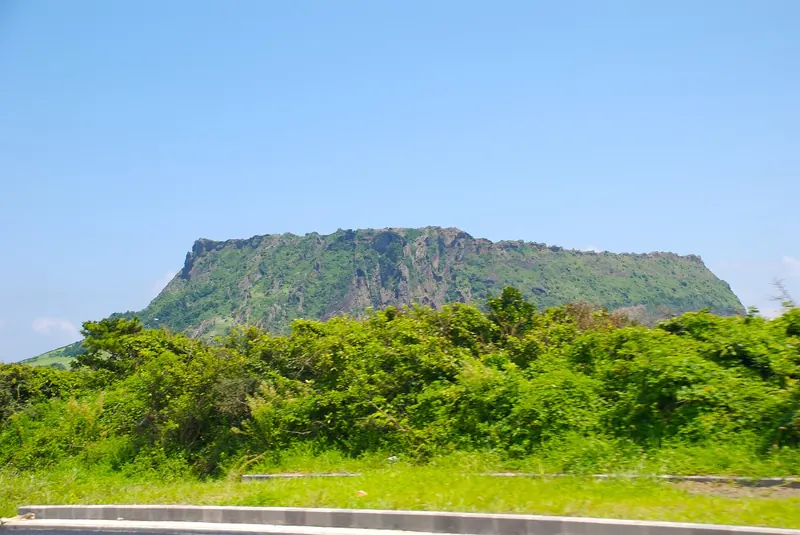
Seogwipo is the town on Jeju's warm south coast, on the far side of Hallasan from the airport, and it is a base for walking and waterfalls rather than for nightlife or shopping. Within a few kilometres of the centre are two of Jeju's three famous falls, the sea stack of Oedolgae, a covered market that runs into the evening and the harbour bridge to Saeseom Island. Westwards, the Jungmun resort area adds a surf beach, a third waterfall and the hexagonal lava columns of Daepo Jusangjeolli. Three sections of the Jeju Olle Trail cover most of it on foot, which is the best reason to stay here instead of making a day trip from Jeju City.
- Suggested time
- 2–3 nights
- Where to stay
- Central Seogwipo around the Maeil Olle Market for walking, food and buses; the Jungmun Tourist Complex for resort hotels and the beach
- Season and timing
- Spring comes early here: VisitKorea's 2026 cherry blossom forecast put Jeju, with Busan, first in the country, with blossoms around 25 March and full bloom after 1 April. Summer is beach season at Jungmun, but the same waves that draw surfers make it a less gentle swimming beach, and the Seogwipo harbour cruise does not sail during typhoon warnings. In autumn, VisitKorea's 2026 forecast had Hallasan's first foliage on 31 October and the peak around 13 November, so a mid-November trip can pair the foliage with coastal walking.
The short answer
Stay two nights, or three if you want to walk a full Olle route. Sleep in central Seogwipo near the Maeil Olle Market if you plan to get around on foot and by bus: Jeongbang and Cheonjiyeon falls, Lee Jung-seob Street, Saeyeongyo Bridge and the start of Olle Route 7 to Oedolgae are all close by. Choose a Jungmun resort instead if you want a beach hotel; airport limousine buses 600 and 601 run there directly. Spend one day on the town's falls and harbour, one on Oedolgae and the Olle coast, and use half a day for Jungmun's Jusangjeolli cliff and Cheonjeyeon Falls.
Central Seogwipo or Jungmun: choose the base first
Central Seogwipo is the town itself: streets that drop towards the harbour, the Maeil Olle Market in the middle, and most of the sights within walking distance. VisitKorea places Jeongbang Falls about 1.5 kilometres southeast of the centre, and its Saeyeongyo Bridge page describes the harbour bridge as a pleasant walk from Cheonjiyeon Falls. The Jeju Olle Foundation's route pages show Route 6 arriving from the east through downtown and Lee Jung-seob Street to the Jeju Olle Travel Center, where Route 7 sets off west towards Oedolgae. Staying here means you can walk to dinner, to the falls and to the trail.
The Jungmun Tourist Complex, further west along the coast, is a resort area that VisitKorea describes as spanning Jungmun-dong, Saekdal-dong and Daepo-dong, with large hotels such as The Suites Hotel and Lotte Hotel Jeju, a botanic garden and other attractions. It sits next to Jungmun Saekdal Beach, Cheonjeyeon Falls and the Daepo Jusangjeolli lava columns, and airport limousine buses 600 and 601 run straight to it. It suits a beach-and-pool stay; evenings are spent at the hotel rather than in a town.
If you have three nights and no car, one option is to split them: one or two in central Seogwipo for the walks and the market, the last in Jungmun. Otherwise pick the centre — the falls, the market and the Olle routes are all there — and visit Jungmun for half a day.
Three waterfalls, three separate visits
Seogwipo's waterfalls are each a separately ticketed park, and they do not look alike. Jeongbang Falls, 23 metres high, drops onto the shoreline; VisitKorea calls it the only coastal waterfall in Asia that falls directly into the sea, and on sunny days the spray can throw a rainbow across the rocks. When we checked on 2026-10-03, VisitKorea listed opening hours of 09:00–17:20 and adult admission of 2,000 won.
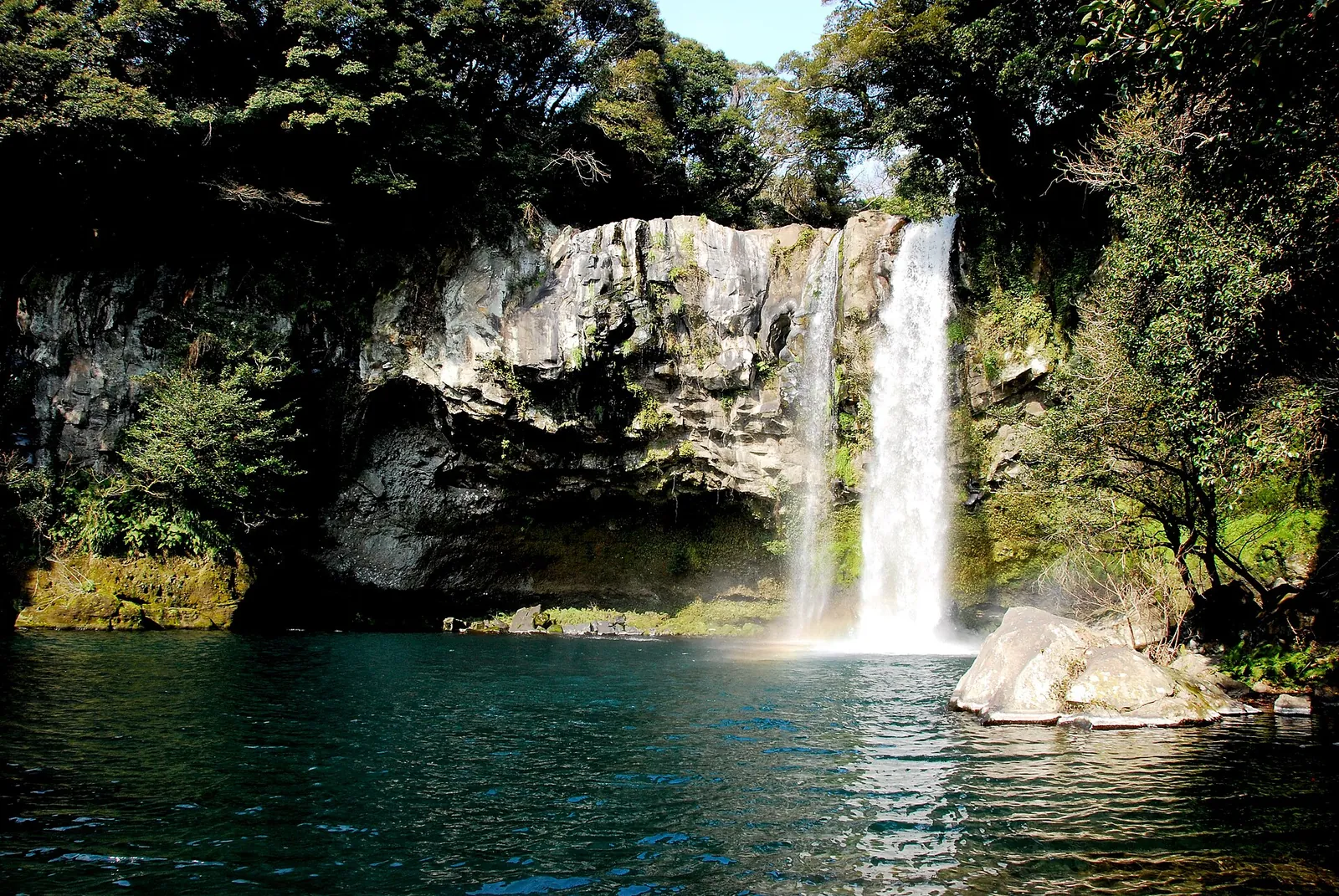
Cheonjiyeon Falls, a short walk from the harbour, is 22 metres high and falls into a pool about 20 metres deep in a wooded valley. According to VisitKorea, the clear water is a designated natural monument and a habitat for the protected mutae eel (giant mottled eel), and the forest around it is protected too. Unusually, it stays open into the evening: when we checked, VisitKorea listed 09:00–22:00 with last tickets at 21:20, and adult admission of 2,000 won. That makes it the one to keep for after dinner, followed by the short walk to the harbour.
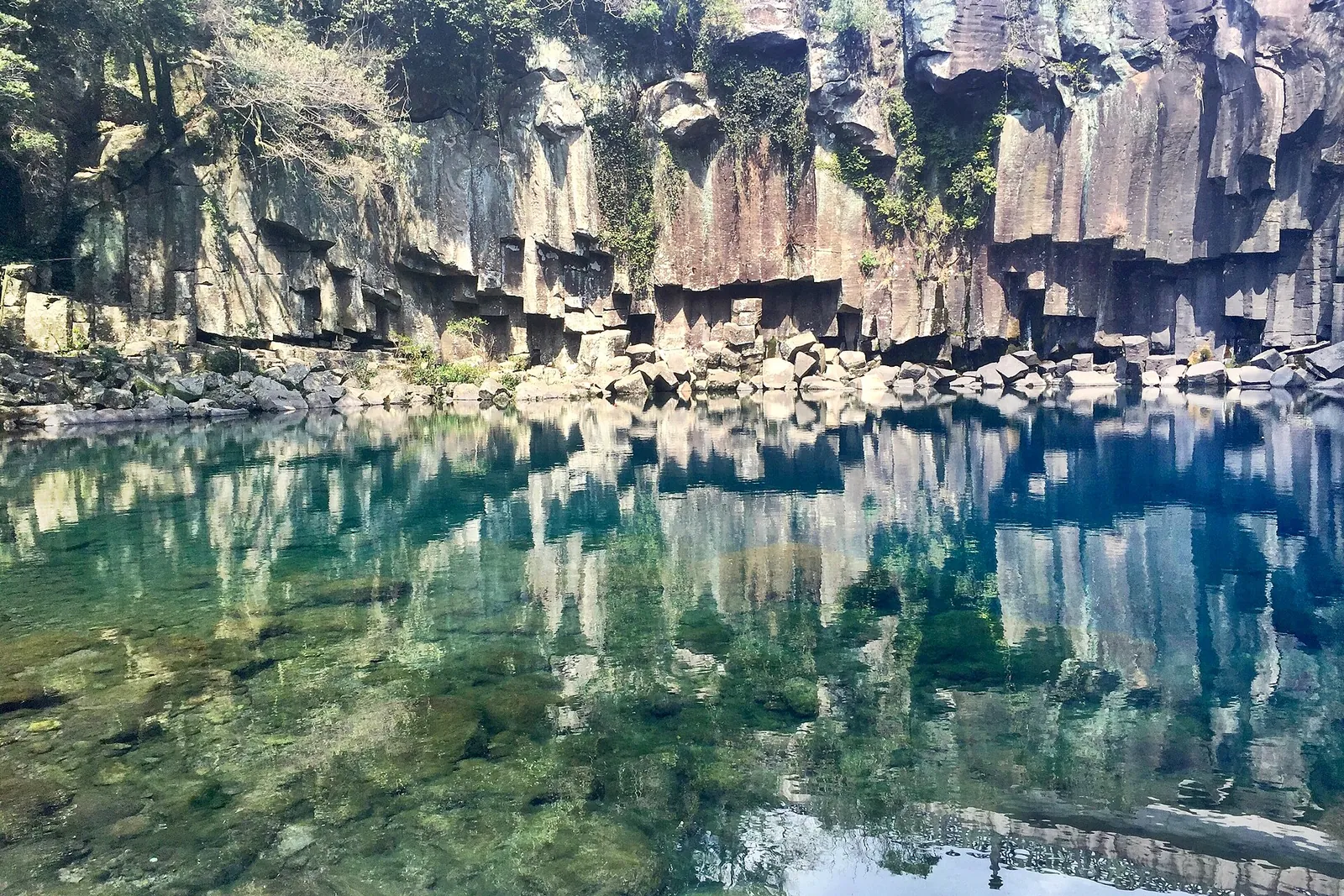
Cheonjeyeon Falls, in Jungmun, is a three-tiered fall in dense forest; VisitKorea explains its name, 'the pond of God', with a legend of seven nymphs who descend from a cloud bridge at night to play there, and the Seonimgyo Bridge nearby is carved with the seven nymphs. When we checked, VisitKorea listed 09:00–17:50 (last admission 17:10) and adult admission of 2,500 won. Visit it on your Jungmun half-day rather than from the centre.
Make time for the local food
What to eat and where to look
Galchi (cutlassfish): grilled, braised or in soup
Long, silver cutlassfish is a Jeju staple, eaten as galchi gui (grilled), galchi jorim (braised) or galchiguk, a clear soup that VisitKorea describes as cutlassfish boiled with vegetables such as pumpkin and cabbage.
- Where to look
- Arangjoeul Food Street in central Seogwipo, where VisitKorea features Negeori Sikdang (grilled cutlassfish as its signature; listed hours 07:00–21:40 when we checked). In Jungmun, VisitKorea lists Cheonjeyeon Tosok Eumsikjeom for braised cutlassfish.
- Fit it into your day
- Dinner after the waterfalls; the braised version is usually a dish to share with rice.
Cutlassfish has many fine bones; ask how spicy the jorim is if you are sensitive to chilli.
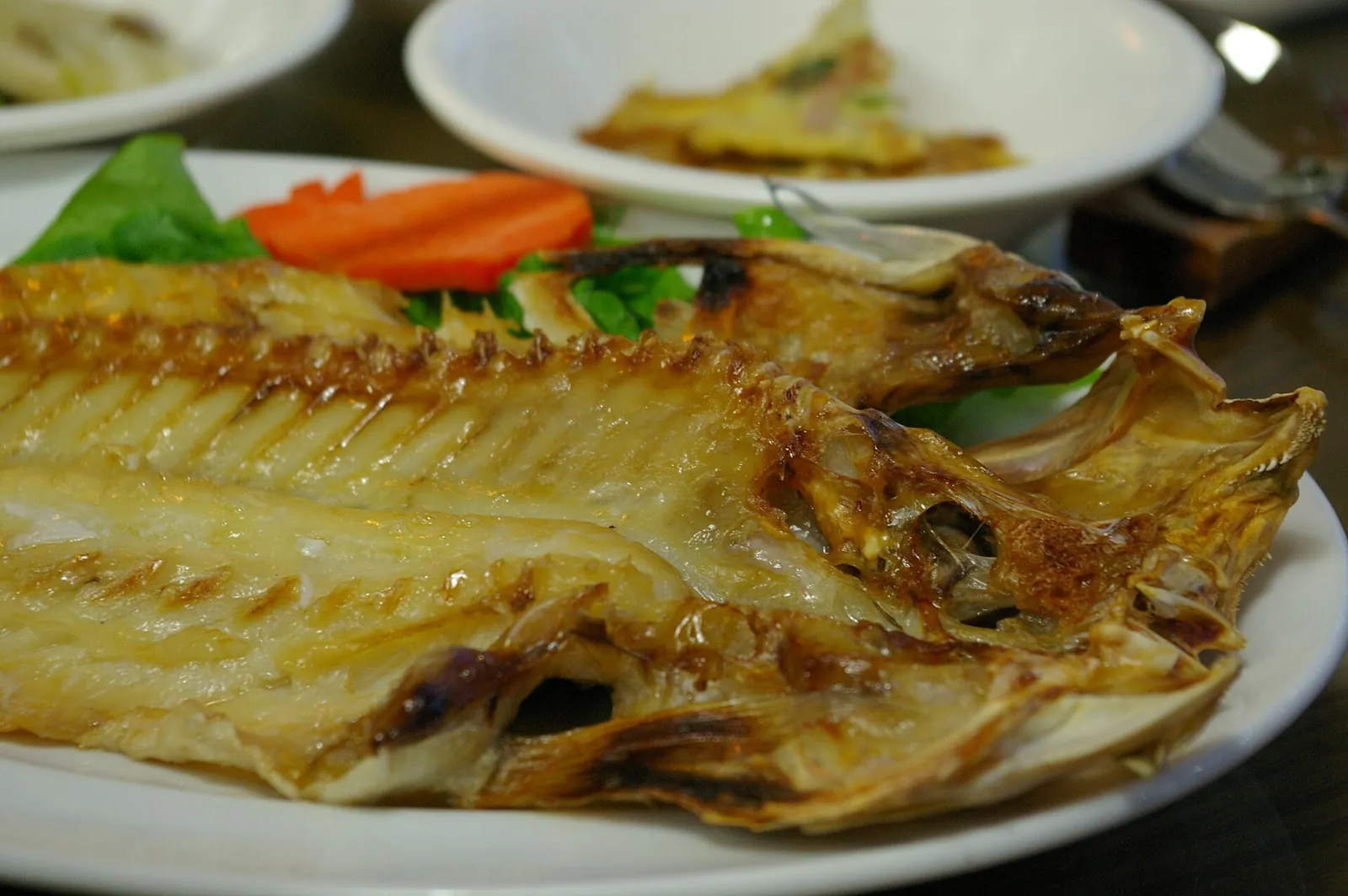
Okdom gui (grilled red tilefish)
Grilled red tilefish is one of the island's signature dishes; VisitKorea calls the fish the best of its kind for its mild flavour. It also turns up in okdom miyeokguk, a seaweed soup.
- Where to look
- Seafood restaurants in central Seogwipo; VisitKorea lists it at Negeori Sikdang and at Suhui Sikdang on Taepyeong-ro near Cheonjiyeon Falls.
- Fit it into your day
- A simple lunch with rice and soup, or as part of a fish dinner.
Usually served whole; watch for bones.
Jeonbok ttukbaegi (abalone hot pot)
A hot pot of fresh abalone and other seafood from Jeju's waters. VisitKorea names it the signature dish of Suhui Sikdang, which also serves sea urchin soup and galchi soup.
- Where to look
- Suhui Sikdang, 377 Taepyeong-ro; when we checked, VisitKorea listed 08:00–21:00 with a break from 15:00 to 17:00.
- Fit it into your day
- A warming breakfast or lunch before a walk, or dinner on a cool evening.
Contains shellfish; mind the break time if you arrive mid-afternoon.
Jeju black pork and dombegogi
Jeju's black pork is grilled at barbecue restaurants across the island; VisitKorea also highlights dombegogi, black pork steamed and sliced on a wooden board at the table. At the market, look for grilled black pork galbi patties.
- Where to look
- Barbecue restaurants in central Seogwipo and Jungmun, and the snack stalls of the Maeil Olle Market.
- Fit it into your day
- Grilled black pork is an evening meal for two or more; the market patties are a snack.
Contains pork; table grills mean smoke, so do not wear your best jacket.
Market snacks: omegitteok, tangerines and takeaway hoe
The Maeil Olle Market sells Jeju specialities ready to eat: omegitteok (millet rice cakes rolled in bean powder or red bean), tangerine bread and juice, hallabong juice, mandu, and sliced raw fish packed to take away, according to VisitKorea.
- Where to look
- Seogwipo Maeil Olle Market, a covered arcade more than 600 metres long in the town centre, which VisitKorea says also becomes a night market in the evening. When we checked on 2026-10-03, VisitKorea listed 07:00–21:00 in summer and 07:00–20:00 in winter, open all year.
- Fit it into your day
- Lunch or an early-evening picnic of stall food; VisitKorea suggests coming at mealtimes.
Keep raw fish cool and eat it the same day; avoid raw seafood if you are pregnant or immunocompromised.
Jusangjeolli and the Jungmun coast
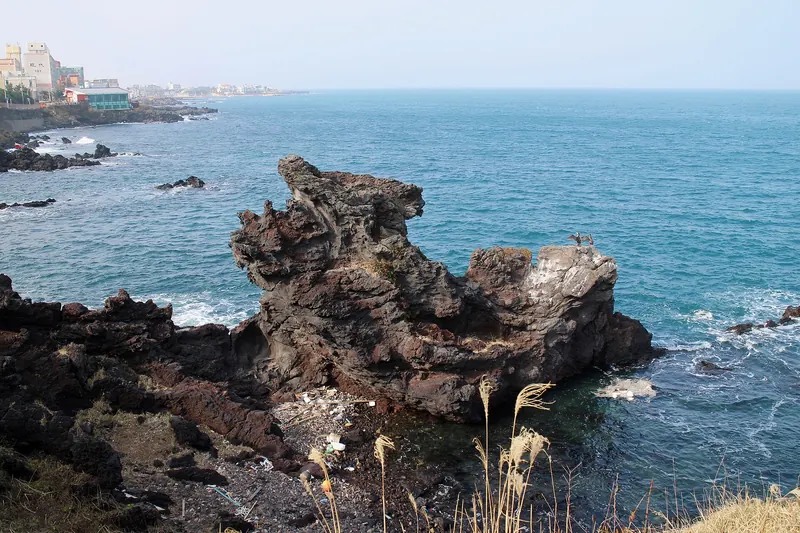
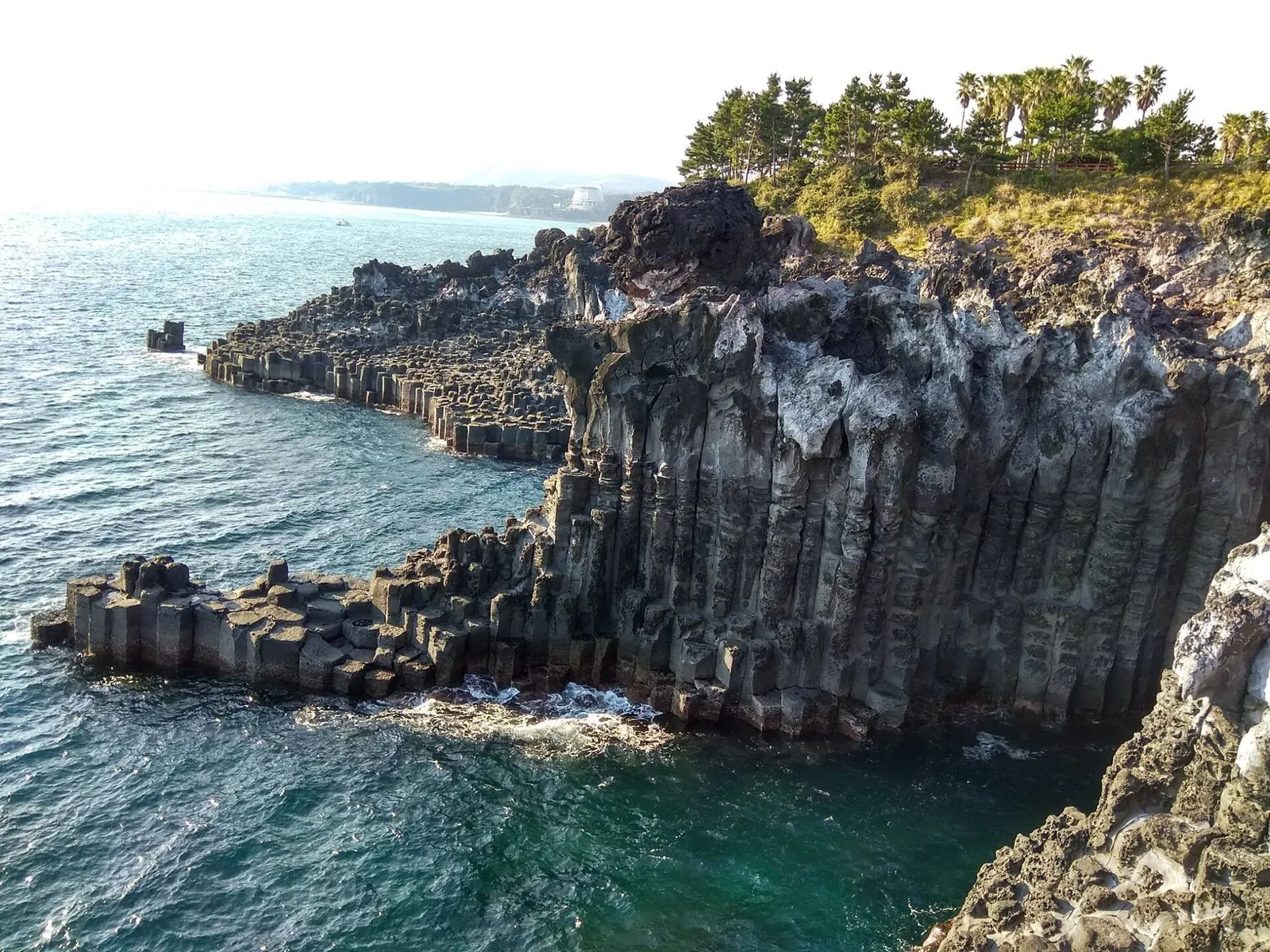
Daepo Jusangjeolli Cliff is the reason to go west. The lava that formed this stretch of coast cooled and contracted fast, cracking into polygonal, mostly hexagonal columns that step down into the sea along about a kilometre of shore. VisitKorea gives their height as 30 to 40 metres, and the Jeju Olle Foundation notes that in rough seas the waves breaking over them can shoot up more than 20 metres. Rough days are the most dramatic; stay behind the railings. When we checked on 2026-10-03, VisitKorea listed 09:00–18:00 (last entry 17:40), adult admission of 2,000 won and a paid car park.
Jungmun Saekdal Beach, below the resort hotels, is a curved white-sand beach set among black volcanic rock. VisitKorea describes it as a surfers' beach, with frequent wind and high waves, and it hosts international surfing competitions; swim only within the patrolled season and area, and take the waves seriously. VisitKorea's summer beach guide lists buses 600 and 601 from Jeju International Airport, taking about 60 to 90 minutes.
A Jungmun half-day fits the beach, Jusangjeolli and Cheonjeyeon Falls together. Walkers can link them on foot along Olle Route 8, which passes Jusangjeolli, Daepo Port and the beach on its way west.
Walking the Jeju Olle: Routes 6, 7 and 8
The Jeju Olle Trail is a network of 27 walking routes, 437 kilometres in all according to VisitKorea, that circles the island along the coast and through villages. Three of its best-known sections run through Seogwipo. Routes 6 and 7 meet at the Jeju Olle Travel Center in town, so you can walk one a day from the same hotel and return by bus or taxi; Route 8 starts further west at Wolpyeong and runs through Jungmun. The figures below are from the Jeju Olle Foundation's own route pages, which we read on 2026-10-03.
Before you go, check the foundation's site or call the Jeju Olle information centre (+82-64-762-2190, listed by VisitKorea) for detours and closures, carry water, and wear proper shoes: much of the trail is rough volcanic rock and steps.
- Route 6 — Soesokkak to the Jeju Olle Travel Center: 10.1 km, 3–4 hours, the foundation's easiest rating. A coast-and-town walk from the Soesokkak gorge past Bomok Port, the Seogwipo KAL Hotel seaside path and the Honeymoon House viewpoint, then through downtown, Lee Jung-seob Street and the Olle market. Good for a first day.
- Route 7 — Jeju Olle Travel Center to Seogwipo Bus Terminal: 12.9 km, 3–4 hours. The classic one: Oedolgae and Subong-ro, a path that the trail volunteer Kim Su-bong cut along a goat track with only a shovel and a pickaxe, then Beophwan Port, where the foundation notes seaside restaurants and cafés for lunch.
- Route 8 — Wolpyeong to Daepyeong: 19.3 km, 5–6 hours. The longest of the three, past Jusangjeolli, Yerae Ecological Park, Daepo Port, Jungmun Saekdal Beach and the spring-fed pool at Nonjitmul, ending in the small village of Daepyeong.
- Route 7-1 — Seogwipo Bus Terminal back to the Travel Center: 15.7 km, 4–5 hours, an inland route through the hills above the town with views up to Hallasan and down over the south coast.
Oedolgae, Lee Jung-seob and the harbour at night
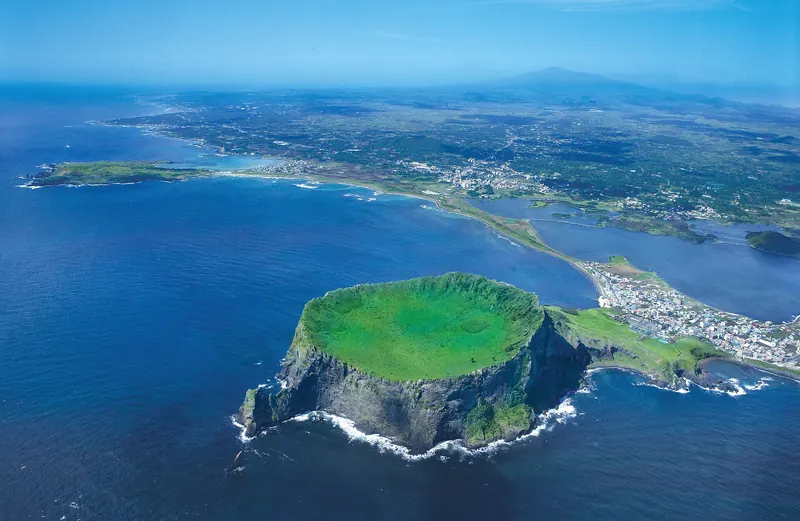
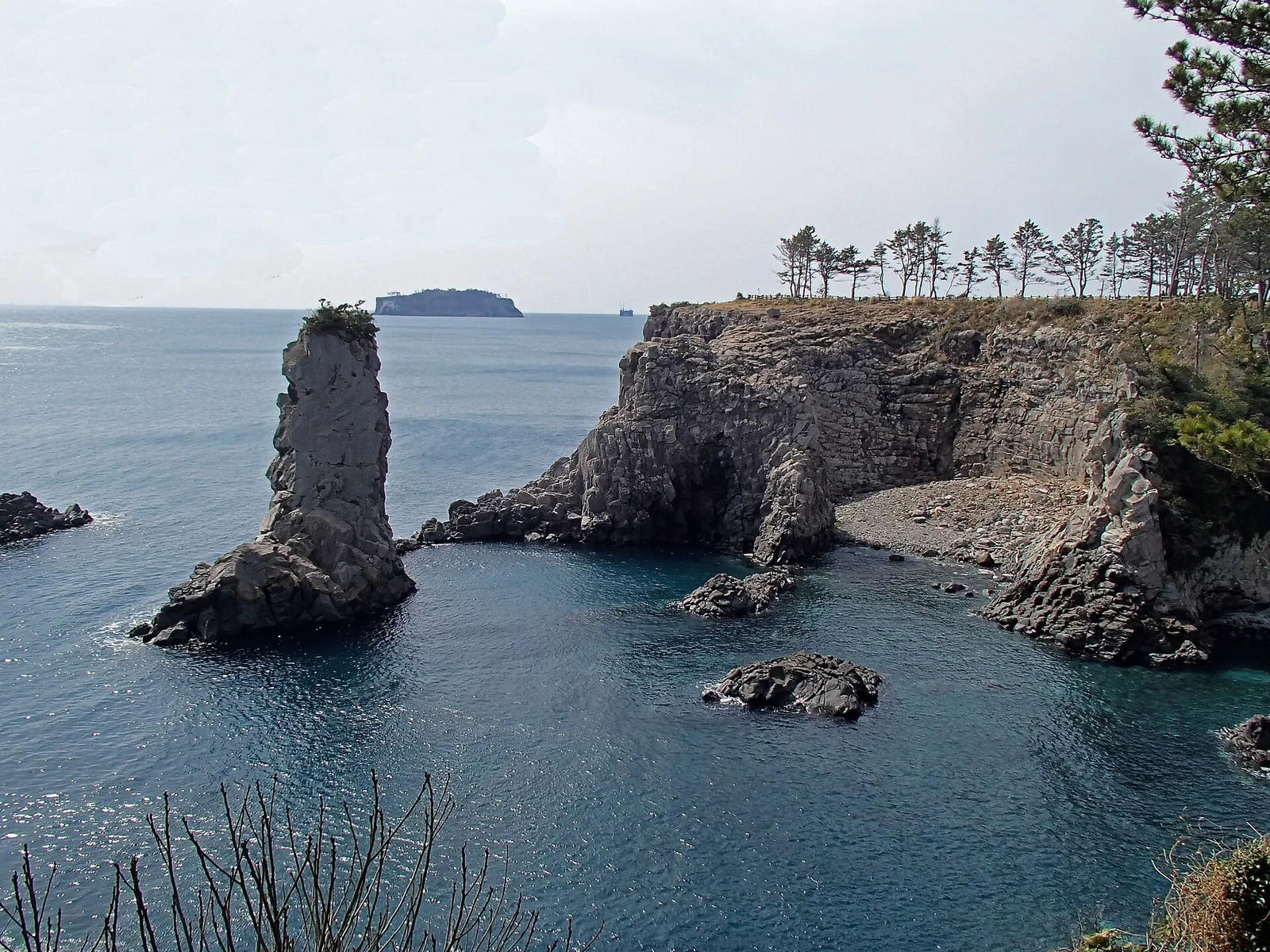
Oedolgae is a 20-metre rock pillar standing alone in the sea below Sammaebong Peak, formed, VisitKorea says, around 1.5 million years ago; the sunset over Beomseom Island seen from here is a long-admired view. It is free and open at all hours. Above it, the Namseongjeong pavilion on Sammaebong looks out over Beomseom, Munseom, Saeseom and Seopseom islands and, to the west, Marado and Gapado. Oedolgae is on Olle Route 7, a short way west of the Travel Center, and Sammaebong rises just above it.
In town, Lee Jung-seob Street remembers the painter best known for 'White Ox', who spent a year in Seogwipo as a refugee during the Korean War with his Japanese wife and two sons in a small leased house, and produced many of his masterpieces there. The city bought the house and restored it, renamed the street Ijungseop-ro, and built the Lee Jung Seop Art Gallery behind it. When we checked on 2026-10-03, VisitKorea listed the gallery as open 09:00–18:00 from October to June and 09:00–20:00 from July to September, closed on Mondays, with adult admission of 1,500 won.
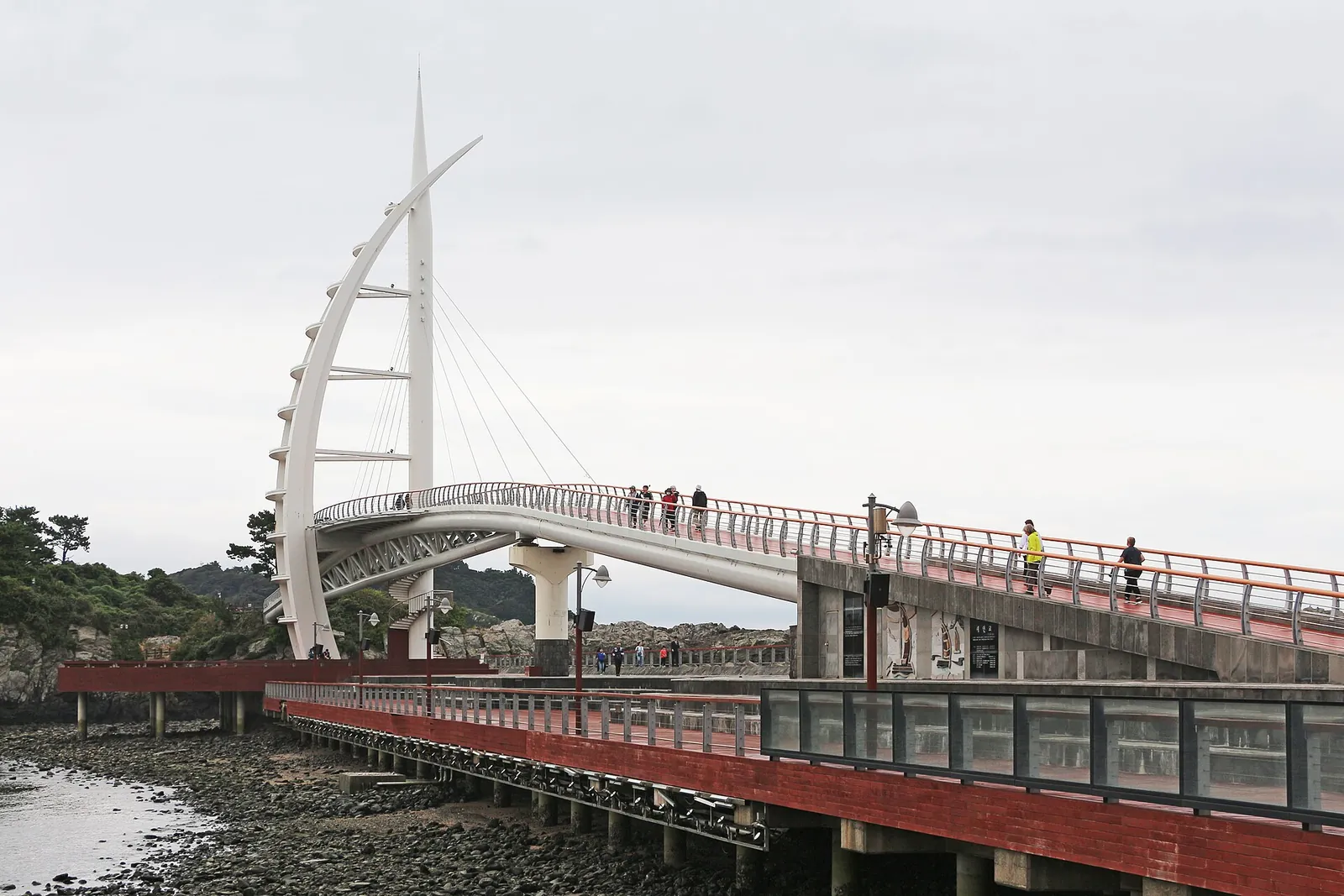
At the harbour, Saeyeongyo Bridge crosses to the uninhabited Saeseom Island, a forest reserve with a walking path. VisitKorea lists the bridge lighting from sunset until 23:30 and a musical fountain show twice a day, closed on Mondays and in bad weather. From the same port, the Seogwipo New Paradise cruise takes about an hour around the islands of the Seogwipo Provincial Marine Park; Munseom, Seopseom and Beomseom are natural monuments and part of a UNESCO Biosphere Reserve. When we checked, VisitKorea listed sailings at 11:30, 14:00 and 15:20, subject to weather, an adult fare of 16,500 won plus a 1,000-won marine park fee, and no sailings during typhoon warnings.
Soesokkak and a two- or three-day plan
East of the centre, Soesokkak is a narrow gorge of hardened lava where a stream meets the sea between pine-covered rocks, and the start of Olle Route 6. VisitKorea lists it as free and open at all hours. Go early or late in the day if you want the water to yourself.
The plan below is an editorial suggestion, not a timetable; check opening days and the weather before each day.
- Day 1 — Town and falls: Jeongbang Falls in the morning, lunch at the Maeil Olle Market, Lee Jung-seob Street and the gallery (not Mondays), then dinner and Cheonjiyeon Falls in the evening, finishing on Saeyeongyo Bridge.
- Day 2 — The Olle coast: Olle Route 7 west from the Travel Center past Oedolgae to Beophwan Port for lunch; walk on or return by bus or taxi.
- Day 3 — Jungmun or Route 6: Jusangjeolli, Cheonjeyeon Falls and the beach in Jungmun, or Route 6 from Soesokkak back into town if you would rather keep walking.
- Hallasan from the south: the Yeongsil trailhead has a Seogwipo address, but VisitKorea notes that private cars cannot park at the trail entrance and recommends a taxi. The summit routes need an advance reservation; see our Hallasan guide.
Practical questions
Should I stay in Seogwipo or Jungmun?
Central Seogwipo, if you want to walk: the market, Jeongbang and Cheonjiyeon falls, Lee Jung-seob Street, Saeyeongyo Bridge and Olle Routes 6 and 7 are all close. Jungmun is better for a resort hotel by the beach, with Jusangjeolli and Cheonjeyeon Falls nearby, but has little town life in the evening.
How do I get from Jeju airport to Seogwipo?
By airport limousine bus or taxi. VisitKorea lists limousine buses to the Seogwipo area from outside Gate 5 on the first floor of Jeju International Airport, with buses 600 and 601 serving the Jungmun and Jusangjeolli area; they take a transportation card, not cash. VisitKorea estimates about 90 minutes by bus or 70 by taxi to central Seogwipo, and about 50 minutes by taxi to Jungmun.
How many days do I need in Seogwipo?
Two nights cover the town's waterfalls, the market, Oedolgae and one Olle route. Add a third for Jungmun's Jusangjeolli cliff and Cheonjeyeon Falls, or for a second Olle walk.
Which Olle route should I walk if I only have one day?
Route 7, from the Jeju Olle Travel Center in town west past Oedolgae to Beophwan Port and on to Seogwipo Bus Terminal: 12.9 kilometres and 3–4 hours, according to the Jeju Olle Foundation. Route 6 (10.1 km, the foundation's easiest rating) is the gentler alternative.
Can I visit Cheonjiyeon Falls in the evening?
Yes. When we checked on 2026-10-03, VisitKorea listed Cheonjiyeon Falls as open until 22:00, with last tickets at 21:20, and the lit Saeyeongyo Bridge is a short walk away. Jeongbang and Cheonjeyeon falls close in the late afternoon.
Can I see all three waterfalls in one day?
Yes, but it is a rush. Jeongbang and Cheonjiyeon are both in central Seogwipo; Cheonjeyeon is in Jungmun and fits better with Jusangjeolli on a separate half-day.
Sources and checks before you travel
Reference sources for the version dated 3 October 2026. Confirm opening times, access, transport and conditions for your travel dates.
- VisitKorea: Jeongbangpokpo Falls ↗ — opens in a new tab
- VisitKorea: Cheonjiyeonpokpo Falls [UNESCO Global Geopark] ↗ — opens in a new tab
- VisitKorea: Cheonjeyeonpokpo Falls ↗ — opens in a new tab
- VisitKorea: Daepo Jusangjeolli Cliff ↗ — opens in a new tab
- VisitKorea: Jungmun Saekdalhaebyeon Beach ↗ — opens in a new tab
- VisitKorea: Jungmun Tourist Complex ↗ — opens in a new tab
- VisitKorea: Best Summer Beach Destinations ↗ — opens in a new tab
- VisitKorea: Seogwipo Maeil Olle Market ↗ — opens in a new tab
- VisitKorea Cruise: Seogwipo Maeil Olle Market ↗ — opens in a new tab
- VisitKorea: Oedolgae Sea Stack ↗ — opens in a new tab
- VisitKorea: Sammaebong Peak ↗ — opens in a new tab
- VisitKorea: Lee Jung Seop Art Gallery ↗ — opens in a new tab
- VisitKorea: Saeyeongyo Bridge (Saeseom Island) ↗ — opens in a new tab
- VisitKorea: Munseom, Seopseom, Beomseom and Saeseom Islands ↗ — opens in a new tab
- VisitKorea: Seogwipo New Paradise Cruise ↗ — opens in a new tab
- VisitKorea: Soesokkak Estuary ↗ — opens in a new tab
- Jeju Olle Foundation: trail route pages (Routes 5, 6, 7, 7-1 and 8) ↗ — opens in a new tab
- VisitKorea: Explore Beyond Seoul at SONO Hotels & Resorts ↗ — opens in a new tab
- VisitKorea: Jeju Olle Trail Route 20 ↗ — opens in a new tab
- VisitKorea: Best hiking trails in Korea's national parks ↗ — opens in a new tab
- VisitKorea: Negeori Sikdang ↗ — opens in a new tab
- VisitKorea: Suhui Sikdang ↗ — opens in a new tab
- VisitKorea: Cheonjeyeon Tosok Eumsikjeom ↗ — opens in a new tab
- VisitKorea: Jeju Island, a Picturesque Paradise for a Peaceful Retreat ↗ — opens in a new tab
- VisitKorea: Airport Transportation Guide ↗ — opens in a new tab
- VisitKorea: [Korea Beyond Seoul ③] Fly to Jeju International Airport ↗ — opens in a new tab
- VisitKorea: 2026 Cherry Blossom Forecast ↗ — opens in a new tab
- VisitKorea: 2026 Fall Foliage Forecast ↗ — opens in a new tab
Photo credits
Oedolgae, the lone 20-metre sea stack on Olle Route 7 west of central Seogwipo
Photograph: Lcarrion88 — opens in a new tab · CC BY-SA 4.0 — opens in a new tab
Changes: Resized and converted to WebP; displayed with responsive crops. · Original photograph and licence details ↗ — opens in a new tab
Cheonjiyeon Falls, a short walk from Seogwipo harbour and open into the evening
Photograph: Martin Chen — opens in a new tab · CC BY 2.0 — opens in a new tab
Changes: Resized and converted to WebP; displayed with responsive crops. · Original photograph and licence details ↗ — opens in a new tab
Daepo Jusangjeolli Cliff in Jungmun, where cooled lava split into columns
Photograph: Marcella Astrid — opens in a new tab · CC BY-SA 3.0 — opens in a new tab
Changes: Resized and converted to WebP; displayed with responsive crops. · Original photograph and licence details ↗ — opens in a new tab
Okdom gui, grilled red tilefish, one of Jeju's signature fish dishes
Photograph: by 아침꿀물 at Flickr — opens in a new tab · CC BY-SA 3.0 — opens in a new tab
Changes: Resized and converted to WebP; displayed with responsive crops. · Original photograph and licence details ↗ — opens in a new tab
The first pond of Cheonjeyeon Falls in Jungmun, ringed by columnar basalt
Photograph: anokarina — opens in a new tab · CC BY-SA 2.0 — opens in a new tab
Changes: Resized and converted to WebP; displayed with responsive crops. · Original photograph and licence details ↗ — opens in a new tab
Saeyeongyo Bridge, linking Seogwipo harbour with Saeseom Island
Photograph: Bernard Gagnon — opens in a new tab · CC0 — opens in a new tab
Changes: Resized and converted to WebP; displayed with responsive crops. · Original photograph and licence details ↗ — opens in a new tab