Busan and South Gyeongsang · Busan
Nampo and Jagalchi, Busan: fish market, old markets and where to stay
Nampo-dong is where Busan still feels like a port. Fishing boats tie up beside Jagalchi Market, women sell mackerel and sea squirts from boxes along the seawall, and the alleys behind them hold the markets that grew out of the Korean War, when refugees from across the country crowded into this corner of the city. Everything worth seeing here sits within walking distance of the waterfront: Jagalchi, Gukje Market, the Bupyeong Kkangtong night market, BIFF Square, Yongdusan Park and the Yeongdo drawbridge. Gamcheon Culture Village and Songdo Beach are a short ride west. Come for the food and the harbour, not for a beach holiday.
- Suggested time
- 1–2 days
- Where to stay
- Nampo-dong for the markets and evenings; Busan Station for KTX and ferry arrivals; Songdo for a sea view
- Season and timing
- VisitKorea describes Busan's weather as mild all year. October is the busiest month in the old port: the Busan Jagalchi Festival is held at the market every October, and the eve-of-festival event for the Busan International Film Festival takes place in BIFF Square. From December into January, the Gwangbok-ro Christmas tree festival lights up the shopping street.
The short answer
One full day covers the old port on foot: Jagalchi for a seafood lunch, Gukje Market and BIFF Square in the afternoon, Yongdusan Park and Busan Tower at dusk, and the Kkangtong night market for dinner. Give it two days if you also want Gamcheon Culture Village (visiting hours 9:00 to 18:00), the 40 Steps and Bosu-dong book alley, or Songdo's cable car. Sleep in Nampo-dong itself so the night market and the harbour are on your doorstep, or near Busan Station if you are arriving by KTX or by ferry from Japan. Watch the closing days: Jagalchi on the first and third Tuesdays, Gukje Market on Sundays.
Why stay in the old port rather than at the beach
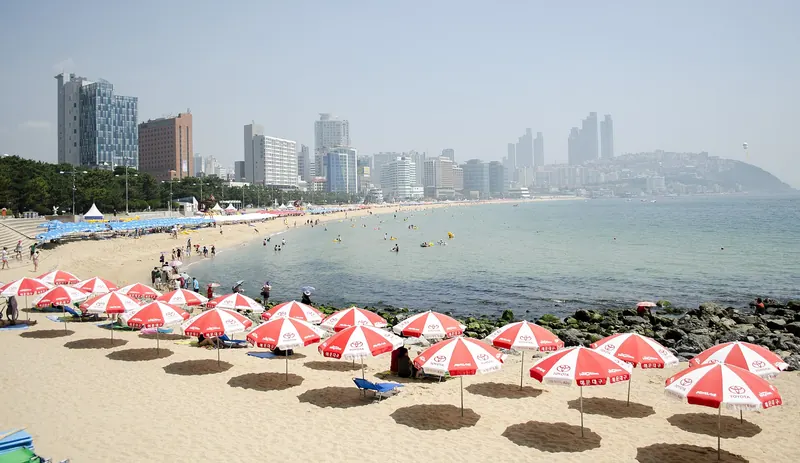
Busan splits into two very different halves. The east coast around Haeundae is beaches and high-rise hotels; Jung-gu, around Nampo-dong and Gwangbok-dong, is markets, steep lanes and the working harbour. VisitKorea puts Jagalchi and Gukje Market about an hour from Gimhae Airport by public transport and about 15 minutes from Busan Station, while the beaches are at the other end of the city. If your idea of Busan is eating your way through markets rather than lying on sand, base yourself here.
Nampo-dong is compact enough that a hotel there turns the whole area into a walk: the waterfront market, the covered shopping lanes, the escalators up to Yongdusan Park and the night market are all close together. Below street level, the 517-metre Nampo-dong Underground Shopping Center links Jagalchi and Nampo-dong subway stations, which is useful on a wet day. The area around Busan Station suits travellers arriving on the KTX or on a ferry from Japan: VisitKorea notes that Busan Port International Passenger Terminal, with routes from Fukuoka, Osaka, Shimonoseki and Tsushima, is a 10- to 15-minute walk from the station.
Songdo, just west in Seo-gu, is the option for a sea view without leaving the old town behind. Its beach, 800 metres long, was one of the first in Korea to open, in 1913. Check the walk from any hotel to the nearest station or bus stop: much of the old town sits on hillsides above the water.
Jagalchi Market: how to eat there
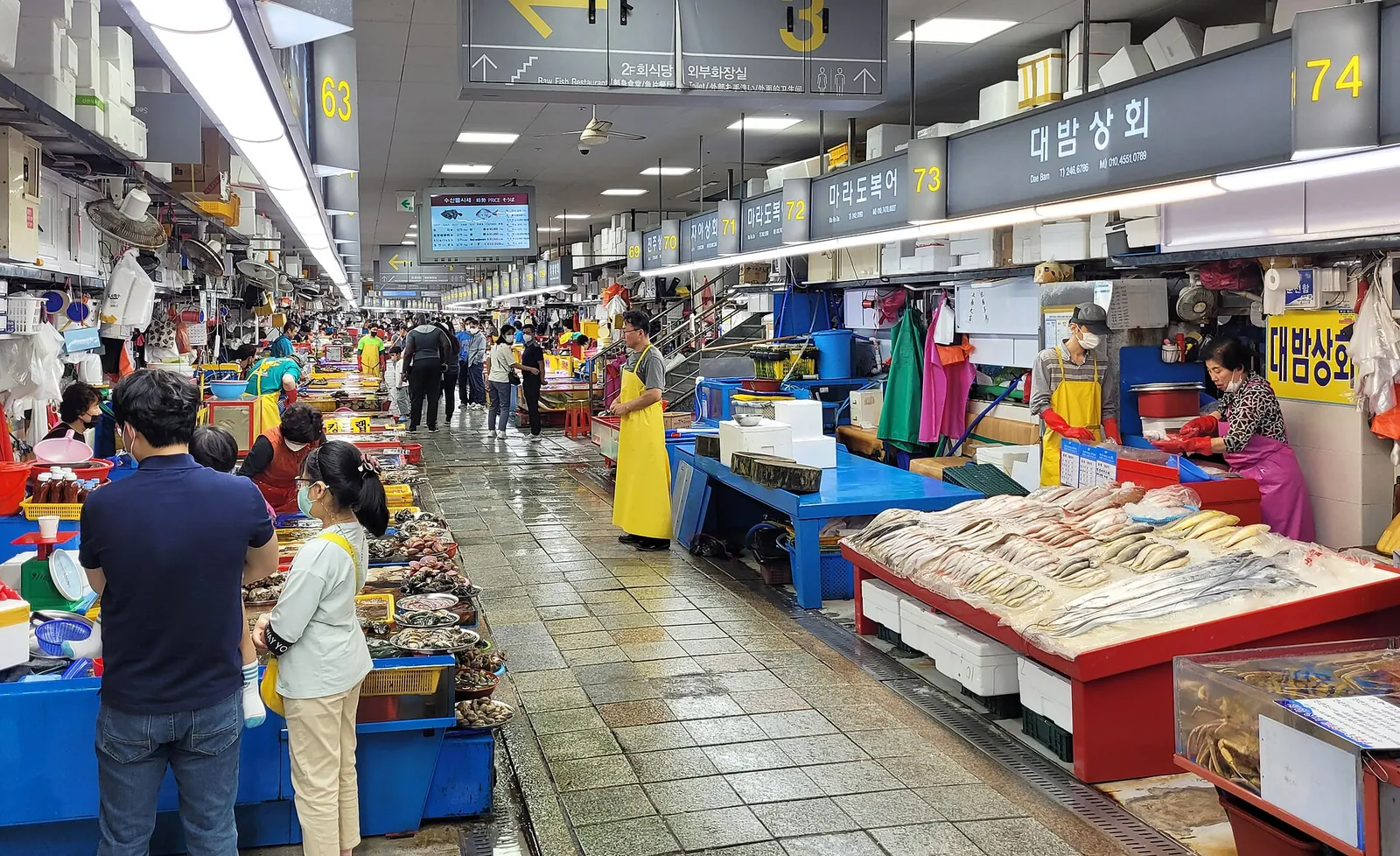
Jagalchi Market, on the seaside road at 52 Jagalchihaean-ro, is one of the largest seafood markets in Korea, selling live and dried fish. It took its present form as a fish market after the Korean War, and most of the sellers are women, known as the Jagalchi ajumeoni. Jung-gu's tourism office describes the market as stretching from the dried-fish stalls below Yeongdo Bridge to the dawn market at Nambumin-dong, with tanks of live fish set out on the roadside stalls east of the main building.
The way to use Jagalchi is as a meal. VisitKorea's advice is to choose live fish and seafood on the ground floor, then take it upstairs to be served as sliced raw fish (hoe) or grilled. Agree what you are buying, how much it weighs and what the upstairs restaurant will charge for preparing it before anything is killed or cut; we found no official price list, so we give no prices here.
When we checked on 2026-10-03, VisitKorea listed the market as open from 5:00 to 22:00 and closed on the first and third Tuesdays of each month; Jung-gu's own page listed 2:00 to 22:00 daily. Plan your visit for the daytime and avoid those Tuesdays. Every October, the Busan Jagalchi Festival, held since 1992 under the slogan 'Oiso! Boiso! Saiso!' ('Come, look, buy'), fills the market and nearby Yurari Square with stage events, hands-on activities and a fireworks show over the harbour; check the festival dates for the year before you plan around it.
Make time for the local food
What to eat and where to look
Hoe (sliced raw fish) at Jagalchi
Fish and seafood chosen live from the tanks and prepared in the market itself, either sliced raw or grilled.
- Where to look
- Pick your fish on Jagalchi Market's ground floor, then take it upstairs to be prepared, as VisitKorea describes; the roadside stalls along Jagalchihaean-ro sell from tanks too.
- Fit it into your day
- Make it the main lunch of your Nampo day, when the market is at its busiest.
Agree the weight, the price and the upstairs preparation charge before the fish is killed. Avoid the first and third Tuesdays, when the market is listed as closed.
Eomuk (Busan fish cake)
Busan is known for fish cakes with a high fish content, in shapes and flavours from squid, crab sticks and mandu to cheese and sweet potato; the long-established makers also sell fish-cake croquettes.
- Where to look
- The fish-cake street in Bupyeong (Kkangtong) Market, which grew around Busan's first fish-cake factory, and the Samjin Amook main store in Yeongdo's Bongnae Market area.
- Fit it into your day
- A snack between markets, or a box to take home: several shops package them as gifts.
Fillings vary widely, from cheese to mandu; ask what is inside if you have allergies or avoid meat.
Bibim dangmyeon and Chungmu gimbap
Bibim dangmyeon, spicy glass noodles, is the dish VisitKorea calls iconic to Busan's markets. Chungmu gimbap is rice rolls served with a sweet-and-sour squid salad on the side.
- Where to look
- The stools of Gukje Market Food Street, which VisitKorea lists for both dishes, and the Kkangtong night market.
- Fit it into your day
- A light lunch eaten at the stall, followed by something sweet.
Both come spicy; the food street was listed as closed on the first and third Sundays.
Danpatjuk (red-bean porridge) and ssiat hotteok
Kkangtong Market's red-bean porridge is served Japanese-style with grilled injeolmi rice cake on top. Ssiat hotteok, a griddle cake filled with brown sugar and seeds, is the classic Nampo street snack.
- Where to look
- The red-bean porridge street between the import shops in Bupyeong Market; hotteok stalls around Gukje Market and BIFF Square.
- Fit it into your day
- Dessert after a market lunch, or a warm snack on a winter evening.
The filling of a fresh hotteok is very hot; let it cool for a minute.
Jokbal and naengchae jokbal
Sliced braised pig's trotters, served in the jokbal alley at the end of Bupyeong Market. Busan also has its own cold version, naengchae jokbal, which Jung-gu lists among the alley's specialities.
- Where to look
- The jokbal alley at the end of Bupyeong Market facing Gwangbok-dong, where Jung-gu lists about ten shops, including one with more than 50 years of history.
- Fit it into your day
- A shared dinner with drinks before or after the night market.
Some shops specialise in the cold version; check which style you are ordering.
Gukje, Kkangtong and the war-time markets
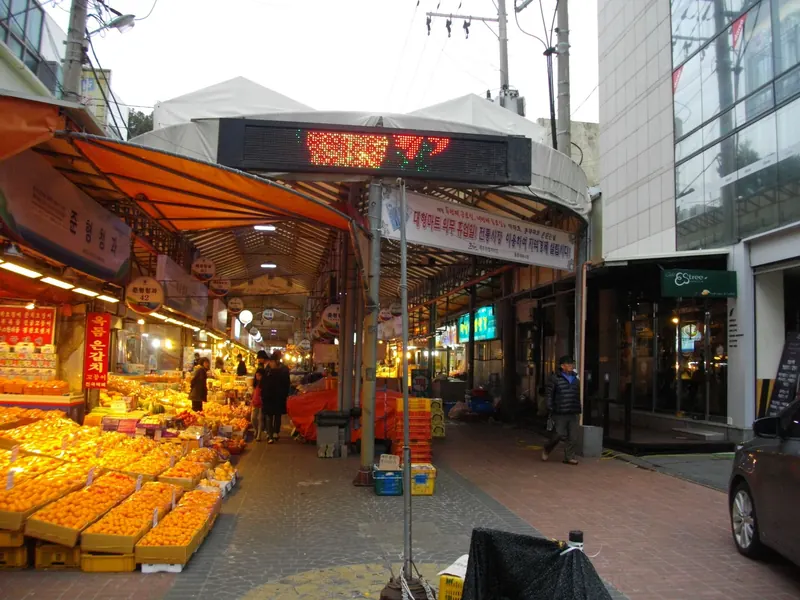
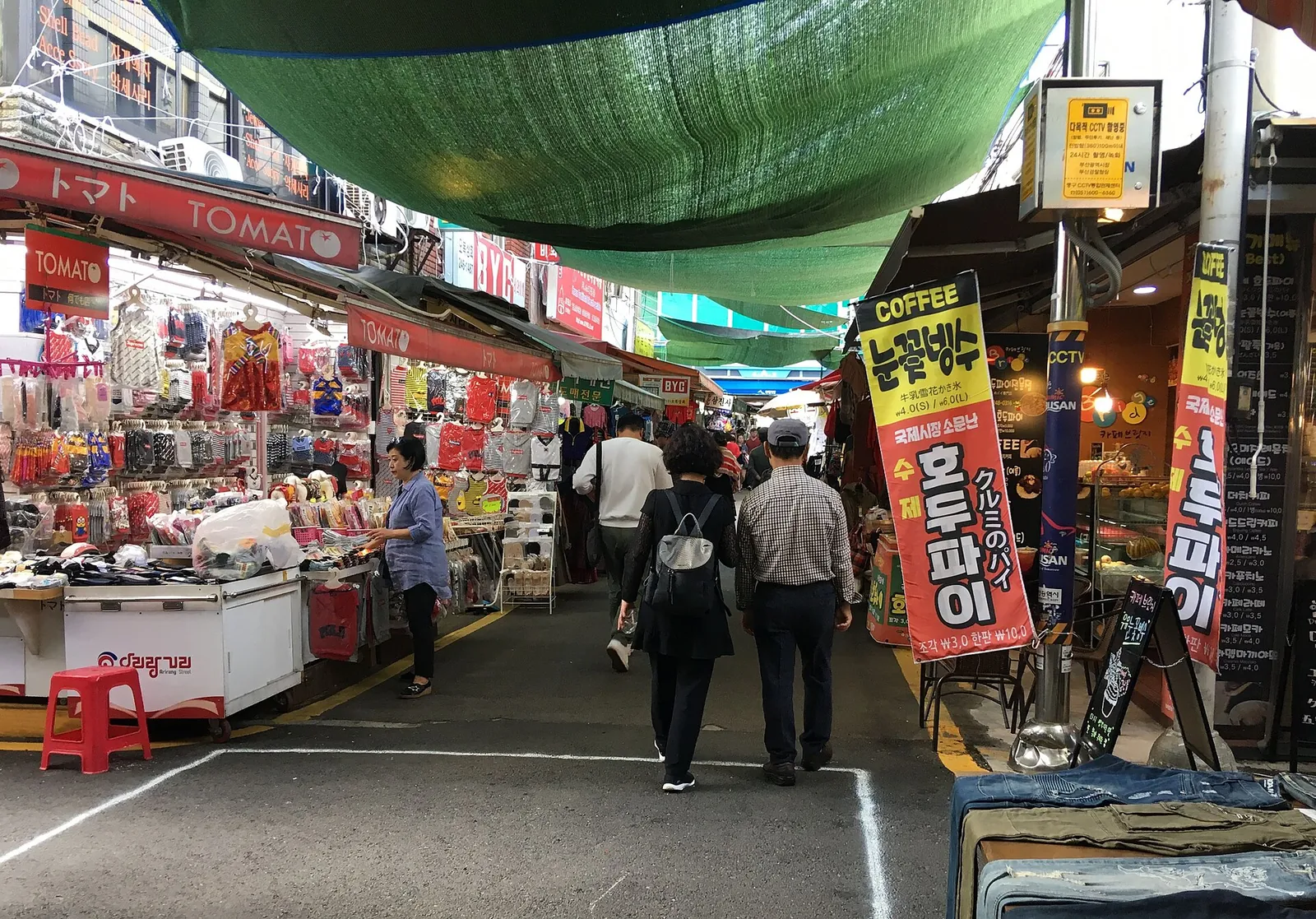
Gukje Market began after Korea's liberation in 1945, when people traded goods left behind by the Japanese and brought home by returning Koreans; after the Korean War, refugees set up stalls selling imported and smuggled goods, and the name, gukje, means 'international'. VisitKorea calls it one of the country's largest markets and warns first-timers about its maze of alleys and halls. When we checked, it listed 9:00 to 20:00 (varying by shop) and closed on Sundays. The market's food street, with more than 60 years of history, is where you sit on small stools at the stalls for Chungmu gimbap, tteokbokki, milmyeon, dwaeji gukbap and Busan's bibim dangmyeon; it was listed as closed on the first and third Sundays. The 2014 film 'Ode to My Father' was shot here.
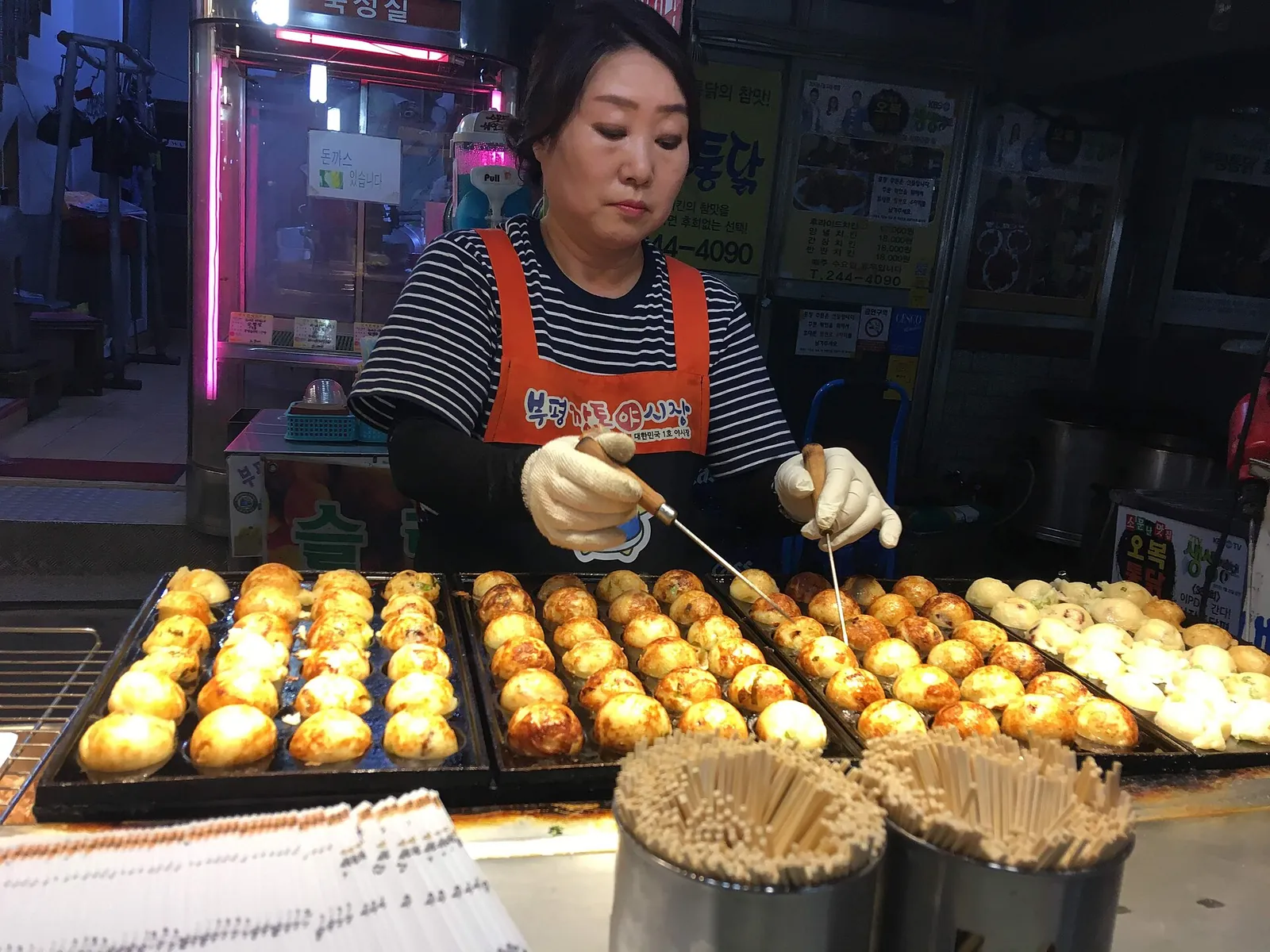
Bupyeong Market, also inside the old-port tourist zone, is better known as Kkangtong (tin can) Market, after the American canned goods that passed through it during the war. In October 2013 it opened what Jung-gu calls Korea's first permanent night market. When we checked, Jung-gu listed the market from 9:00 to 20:00 and the night market from 19:30 to midnight, open all year; VisitKorea gave the night market as 19:30 to 23:30, so arrive by about 20:00 to be safe. The day market has its own food alleys: a fish-cake street that grew around Busan's first fish-cake factory, a red-bean porridge street, and a jokbal (pig's trotter) alley at the far end.
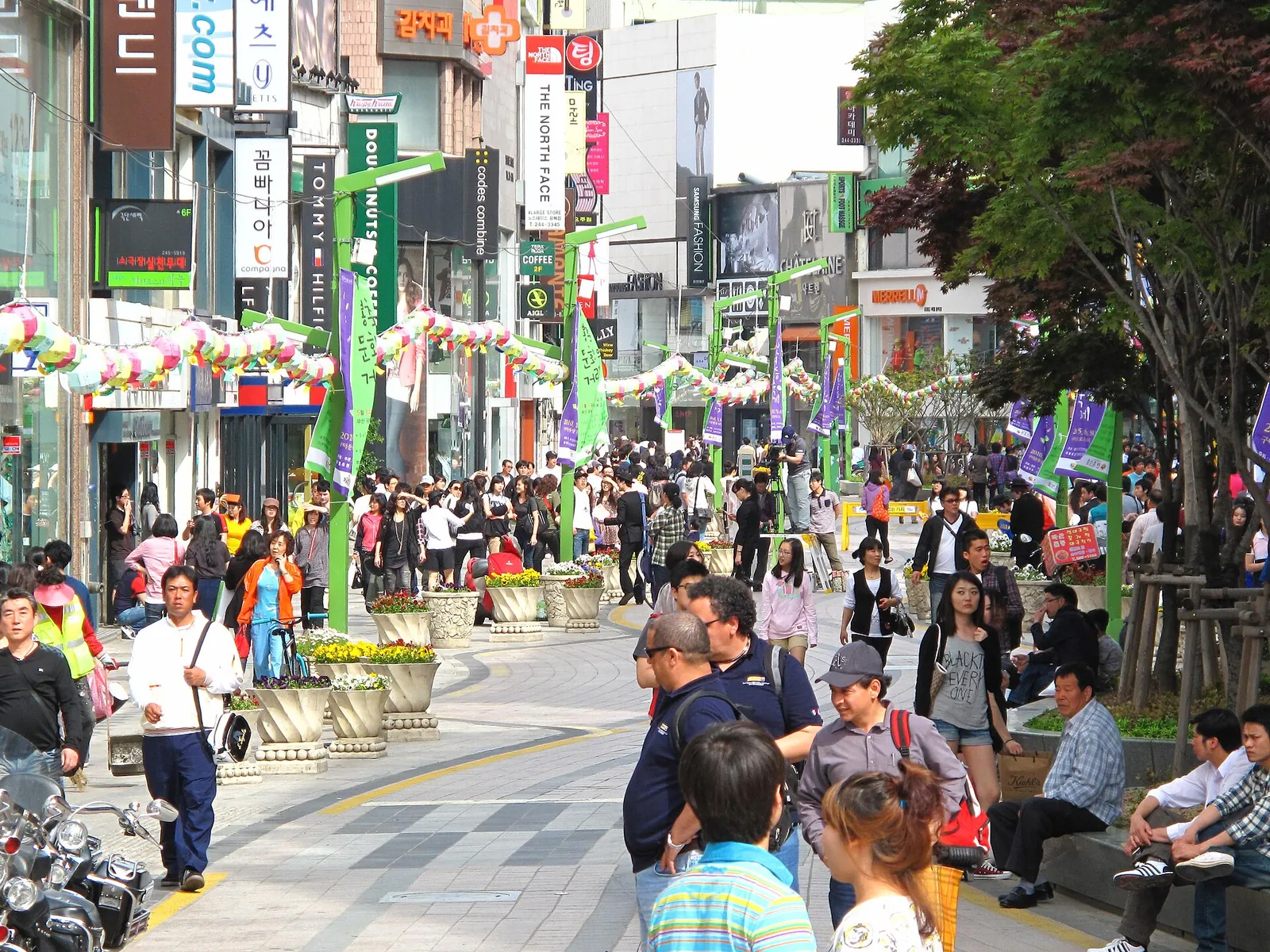
Between the markets and the waterfront, BIFF Square is a 428-metre street of cinemas renamed on 13 September 1996 for the first Busan International Film Festival; the eve-of-festival event, with stars' handprints, is still held here each year. Gwangbok-ro, the 600-metre fashion street that runs from the Gukje Market entrance, becomes pedestrian-only for the Christmas tree festival in December.
Yongdusan Park, Busan Tower and the Yeongdo drawbridge
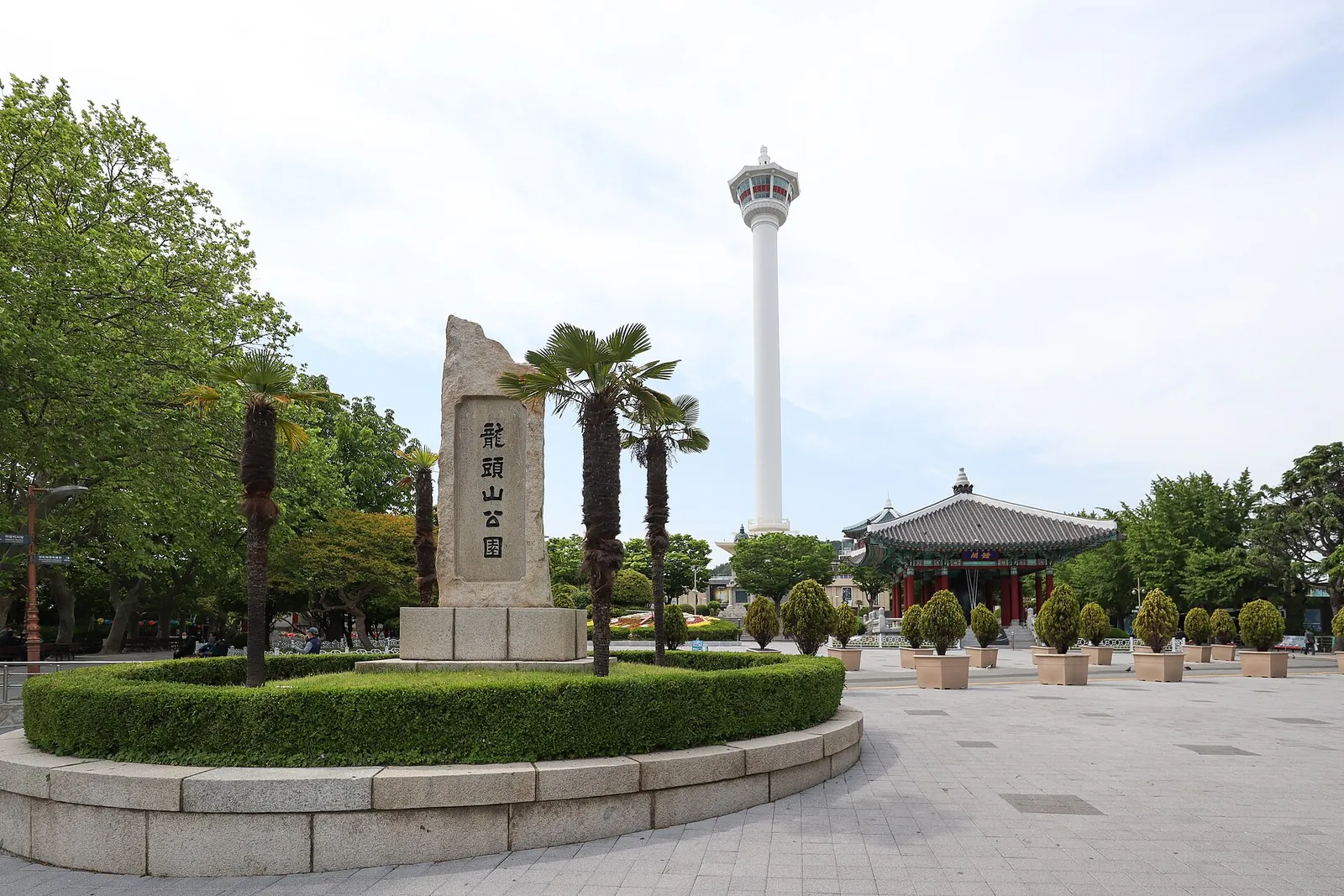
Yongdusan Park sits on the hill above Nampo-dong and is reached by escalators from the shopping streets. VisitKorea lists it as open 24 hours and free, with the statue of Admiral Yi Sun-sin, a flower clock and a bell pavilion; Jung-gu notes that a Japanese trading post (waegwan) was established around the hill in 1678. The 120-metre Busan Tower stands in the park, with views over Busan Port and Yeongdo. When we checked on 2026-10-03, VisitKorea listed the tower as open from 10:00 to 22:00 (last admission 21:30) at 12,000 won for adults and 9,000 won for children and over-65s, with a projection show on the observatory windows at night. Go up at dusk.
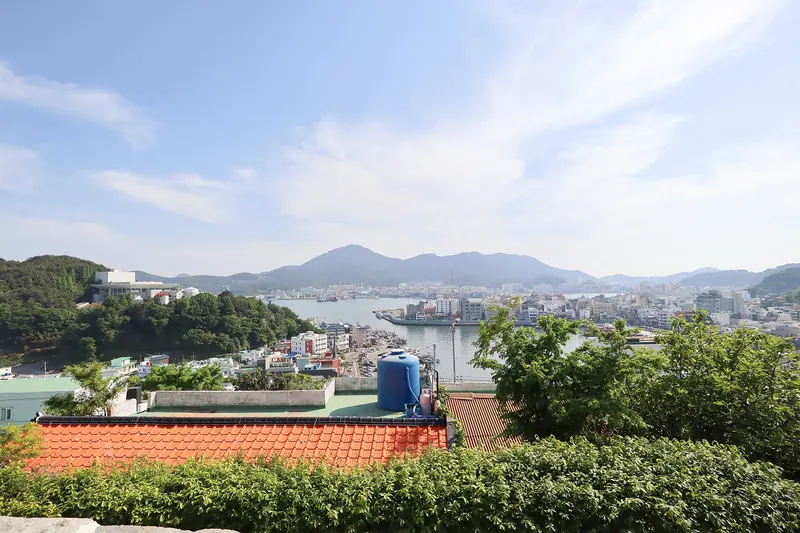
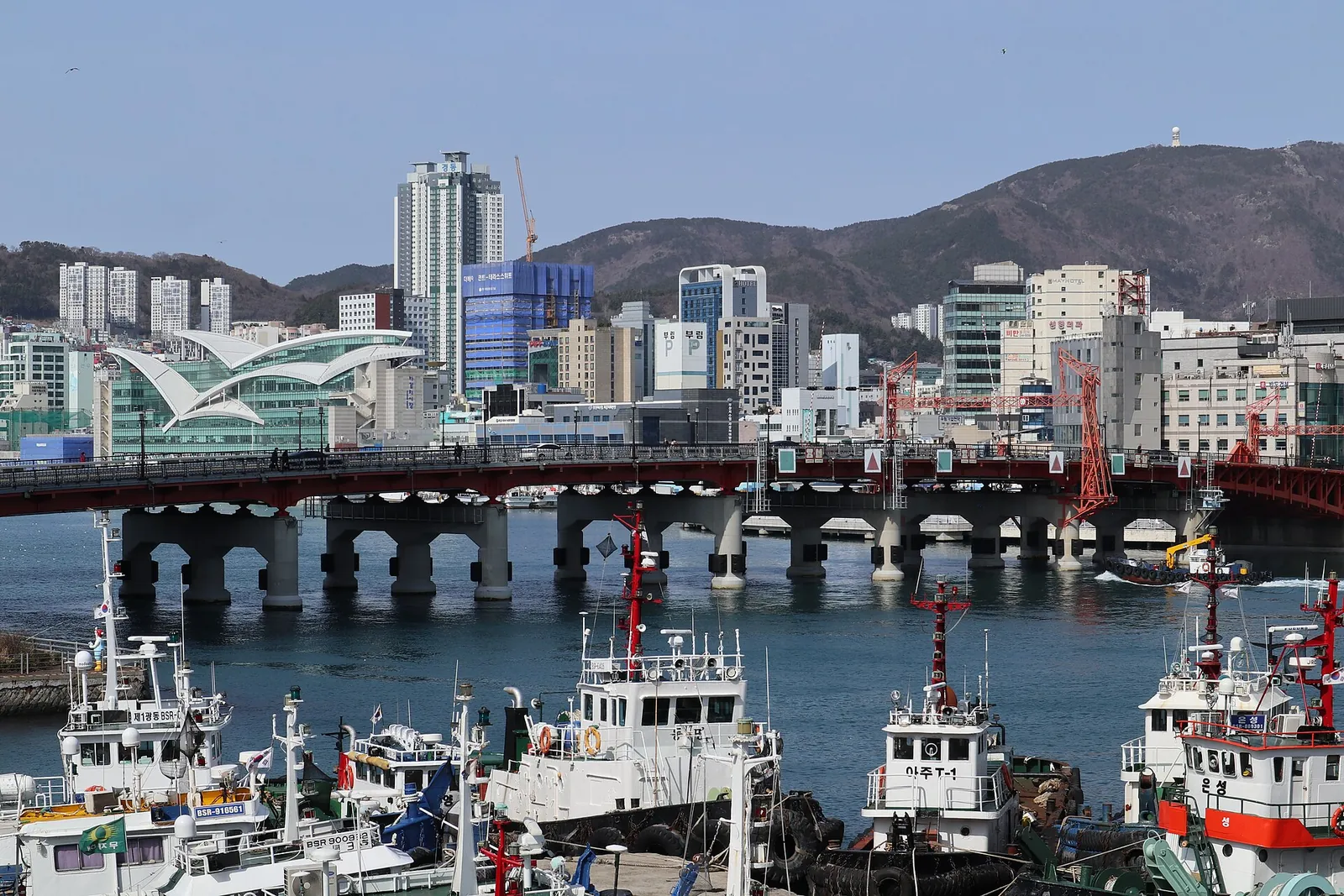
Yeongdo Bridge (Yeongdodaegyo), at the eastern end of Jagalchi, was completed in November 1934 to link Yeongdo with the port, and during the Korean War it became the place where separated families promised to meet again. Its lifting section stopped working in 1966; the bridge was rebuilt and reopened in November 2013. When we checked, Jung-gu's tourism page listed the bascule lifting on Saturdays at 14:00 for 15 minutes, although an older paragraph on the same page still says daily; confirm locally before you plan the day around it. The newer Busandaegyo Bridge, built in 1980 and 694 metres long, also links Yeongdo with the mainland.
Across the bridge, Bongnae Market in Yeongdo is where Samjin Foods, one of Busan's long-established fish-cake makers, has kept its base for more than 50 years; VisitKorea lists the Samjin Amook main store on Taejong-ro in Yeongdo-gu.
The refugee hillsides: 40 Steps, Bosu-dong and Gamcheon
The hills behind the port filled with refugee shacks during the Korean War, and three places tell that story within reach of Nampo. The 40 Steps in Jungang-dong were a market for relief goods landed at the pier and a meeting place for families separated in the war; the 450-metre 40-step Culture & Tourism Theme Street leading to them has sculptures of 1950s street life, including an accordion player and a man making puffed-rice snacks. Nearby, Bosu-dong Book Street is an alley of second-hand bookshops that took shape after liberation; its small cultural centre was listed by VisitKorea at 10:00 to 18:00, free and closed on Mondays.
The Busan Modern & Contemporary History Museum, at 112 Daecheong-ro, uses the former Bank of Korea building and the 1929 office of the Oriental Development Company to trace the city from the opening of the port through Japanese rule, the war and industrialisation. When we checked, VisitKorea listed it as free, open 9:00 to 18:00 and closed on Mondays and 1 January. For families, Jung-gu lists the Busan Museum of Movies on Daecheong-ro at 10:00 to 18:00 (last entry 17:00), closed on Mondays, at 10,000 won for adults.
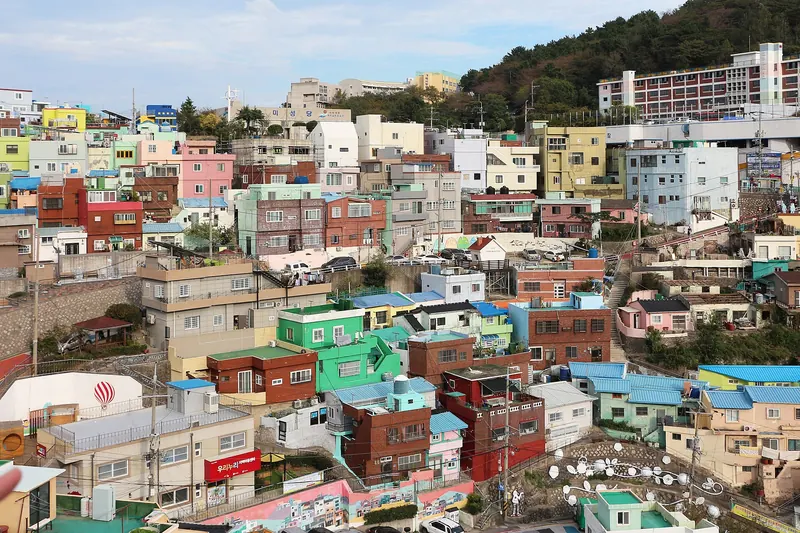
Gamcheon Culture Village, in Saha-gu west of Nampo, grew from refugee houses built in tiers up a coastal hillside and is now painted with murals and sculptures by residents. Entry is free, but it is a special management zone: VisitKorea's August 2026 notice limits visits to the residential areas to 9:00 to 18:00, asks for quiet and no photographs of residents or homes without permission, requires groups of ten or more to buy a group map, and restricts tourist vehicles, including taxis, inside the village. Go in the morning, then come back to Jagalchi for lunch.
Songdo: a beach and a cable car next door
Songdo Beach, in Seo-gu just west of Jagalchi, is 800 metres long and opened in 1913. Amnam Park beside it, a former military zone opened to the public in 1996, has an observatory, a 3.8-kilometre promenade and raw-fish restaurants with views over the Songdo coast and Namhang port; the Provisional Capital Memorial Hall nearby recalls the three years when Busan served as the temporary capital during the Korean War.
The Songdo Marine Cable Car (Busan Air Cruise) crosses 1.62 kilometres of sea from Songnim Park to Amnam Park. When we checked, VisitKorea's page for Songdo Sky Park, the upper station, listed operating hours of 9:00 to 21:00 from September to November, 9:00 to 20:00 in December, January and February, and 9:00 to 22:00 in July and August. Songdo works as a half day after a morning in Gamcheon or as an evening alternative to Busan Tower.
A workable one- or two-day plan
This is an editorial suggestion, not a timetable. Check the market closing days (Jagalchi on the first and third Tuesdays, Gukje Market on Sundays) and the Monday closures of the museums.
- Day 1 morning: Jagalchi's waterfront stalls and the ground-floor fish hall, then a raw-fish or grilled-fish lunch upstairs.
- Day 1 afternoon: Yeongdo Bridge (on a Saturday, be there by 14:00 for the lifting), Gukje Market and its food street, BIFF Square.
- Day 1 evening: the escalators to Yongdusan Park and Busan Tower at dusk, then dinner at the Kkangtong night market.
- Day 2: Gamcheon Culture Village after 9:00, back for the 40 Steps, Bosu-dong book alley and the Modern & Contemporary History Museum, and the Songdo cable car late in the day.
- Next: the east coast in a separate day (see our Haeundae guide), or Tongyeong by intercity bus from Busan Seobu Intercity Bus Terminal, about 80 minutes according to VisitKorea.
Practical questions
How long do I need in Nampo-dong and Jagalchi?
One full day covers Jagalchi, Gukje Market, BIFF Square, Yongdusan Park and the Kkangtong night market on foot. Add a second day for Gamcheon Culture Village, the 40 Steps and Bosu-dong, or Songdo's beach and cable car.
When is Jagalchi Market closed?
When we checked on 2026-10-03, VisitKorea listed the market as open from 5:00 to 22:00 and closed on the first and third Tuesdays of the month. Jung-gu's page listed 2:00 to 22:00 daily. Plan a daytime visit on another day.
Can I eat raw fish I buy at Jagalchi?
Yes. VisitKorea suggests choosing live seafood on the ground floor and taking it upstairs to be served as sliced raw fish or grilled. Agree the price and the preparation charge before buying.
What time does Yeongdo Bridge lift?
When we checked, Jung-gu's tourism page listed the lifting on Saturdays at 14:00 for 15 minutes; an older line on the same page still says daily. Confirm locally before planning around it.
Is the Kkangtong night market open every day?
Jung-gu listed the night market from 19:30 to midnight, open all year; VisitKorea gave 19:30 to 23:30. Arrive in the early evening for the widest choice of stalls.
Should I stay in Nampo-dong or Haeundae?
Stay in Nampo-dong if markets, seafood and the old harbour are the point of your trip, or near Busan Station if you are arriving by KTX or ferry. Choose Haeundae if beaches are the priority, and visit the old port as a day trip.
Sources and checks before you travel
Reference sources for the version dated 3 October 2026. Confirm opening times, access, transport and conditions for your travel dates.
- VisitKorea: Jagalchi Market ↗ — opens in a new tab
- Busan Jung-gu tourism: sights (Jagalchi Market, Bupyeong Kkangtong Night Market, Yeongdo Bridge, Yongdusan Park, 40 Steps, Busan Museum of Movies, Yeongju-dong monorail) ↗ — opens in a new tab
- Busan Jung-gu tourism: festivals (Busan Jagalchi Festival, Gwangbok-ro winter tree festival) ↗ — opens in a new tab
- VisitKorea: Gukje Market ↗ — opens in a new tab
- VisitKorea: Gukje Market Food Street ↗ — opens in a new tab
- VisitKorea: Bupyeong (Kkangtong) Market ↗ — opens in a new tab
- VisitKorea: Yongdusan Jagalchi Special Tourist Zone ↗ — opens in a new tab
- VisitKorea: Yongdusan Park ↗ — opens in a new tab
- VisitKorea: Busan Tower ↗ — opens in a new tab
- VisitKorea: BIFF Square ↗ — opens in a new tab
- VisitKorea: Gwangbok-dong Cultural & Fashion Street ↗ — opens in a new tab
- VisitKorea: Busandaegyo Bridge ↗ — opens in a new tab
- VisitKorea: Yeongdo Bongnae Market ↗ — opens in a new tab
- VisitKorea: Busan fishcake ↗ — opens in a new tab
- VisitKorea: 40-step Culture & Tourism Theme Street ↗ — opens in a new tab
- VisitKorea: Bosu-dong Book Street Cultural Center ↗ — opens in a new tab
- VisitKorea: Busan Modern & Contemporary History Museum (main building and feature) ↗ — opens in a new tab
- VisitKorea: Busan Gamcheon Culture Village ↗ — opens in a new tab
- VisitKorea: travel etiquette at Gamcheon Culture Village (August 2026) ↗ — opens in a new tab
- VisitKorea: Busan Songdo Beach ↗ — opens in a new tab
- VisitKorea: Busan Air Cruise and Songdo Sky Park ↗ — opens in a new tab
- VisitKorea: Nampo-dong Underground Shopping Center ↗ — opens in a new tab
- VisitKorea: [Korea Beyond Seoul 4] Fly to Gimhae International Airport ↗ — opens in a new tab
- VisitKorea: Feel the Sea, Enjoy the City — discover Busan ↗ — opens in a new tab
- VisitKorea: Busan ↗ — opens in a new tab
- VisitKorea: BTS World Tour in Busan travel guide ↗ — opens in a new tab
- VisitKorea: Ferry ↗ — opens in a new tab
Does this experience fit your route?
A guided market walk is the easiest way to order with confidence at Jagalchi. Check the start time, the market's closing Tuesdays and what the tastings include before you book.
Check dates and details on Viator ↗ — opens in a new tabAffiliate link · Book with ViatorPhoto credits
Yeongdo Bridge and fishing boats at the edge of Jagalchi, Busan's old harbour
Photograph: S h y numis — opens in a new tab · CC BY 4.0 — opens in a new tab
Changes: Resized and converted to WebP; displayed with responsive crops. · Original photograph and licence details ↗ — opens in a new tab
Inside Jagalchi Market, where ground-floor stalls sell live and fresh fish
Photograph: Bernard Gagnon — opens in a new tab · CC0 — opens in a new tab
Changes: Resized and converted to WebP; displayed with responsive crops. · Original photograph and licence details ↗ — opens in a new tab
Cooking at a stall in the Bupyeong Kkangtong Night Market
Photograph: Christophe95 — opens in a new tab · CC BY-SA 4.0 — opens in a new tab
Changes: Resized and converted to WebP; displayed with responsive crops. · Original photograph and licence details ↗ — opens in a new tab
One of Gukje Market's covered shopping lanes
Photograph: Christophe95 — opens in a new tab · CC BY-SA 4.0 — opens in a new tab
Changes: Resized and converted to WebP; displayed with responsive crops. · Original photograph and licence details ↗ — opens in a new tab
Busan Tower in Yongdusan Park, above Nampo-dong
Photograph: Mobius6 — opens in a new tab · CC BY-SA 4.0 — opens in a new tab
Changes: Resized and converted to WebP; displayed with responsive crops. · Original photograph and licence details ↗ — opens in a new tab
Nampo-dong's shopping streets on a busy day
Photograph: Ken Eckert — opens in a new tab · CC BY-SA 4.0 — opens in a new tab
Changes: Resized and converted to WebP; displayed with responsive crops. · Original photograph and licence details ↗ — opens in a new tab