Jeolla · Jeonbuk State
Maisan guide: Tapsa's stone towers and the horse-ear peaks from Jeonju
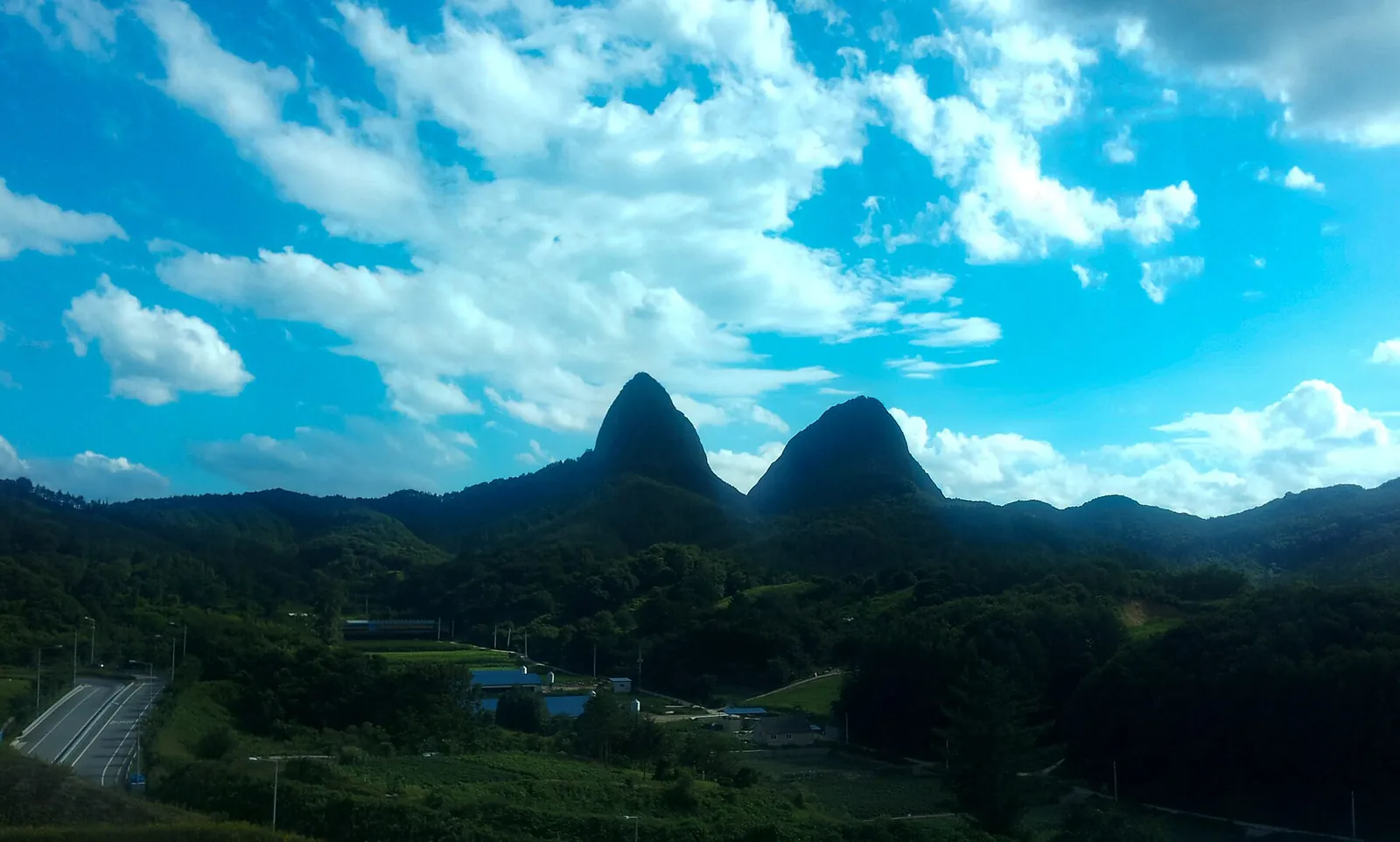
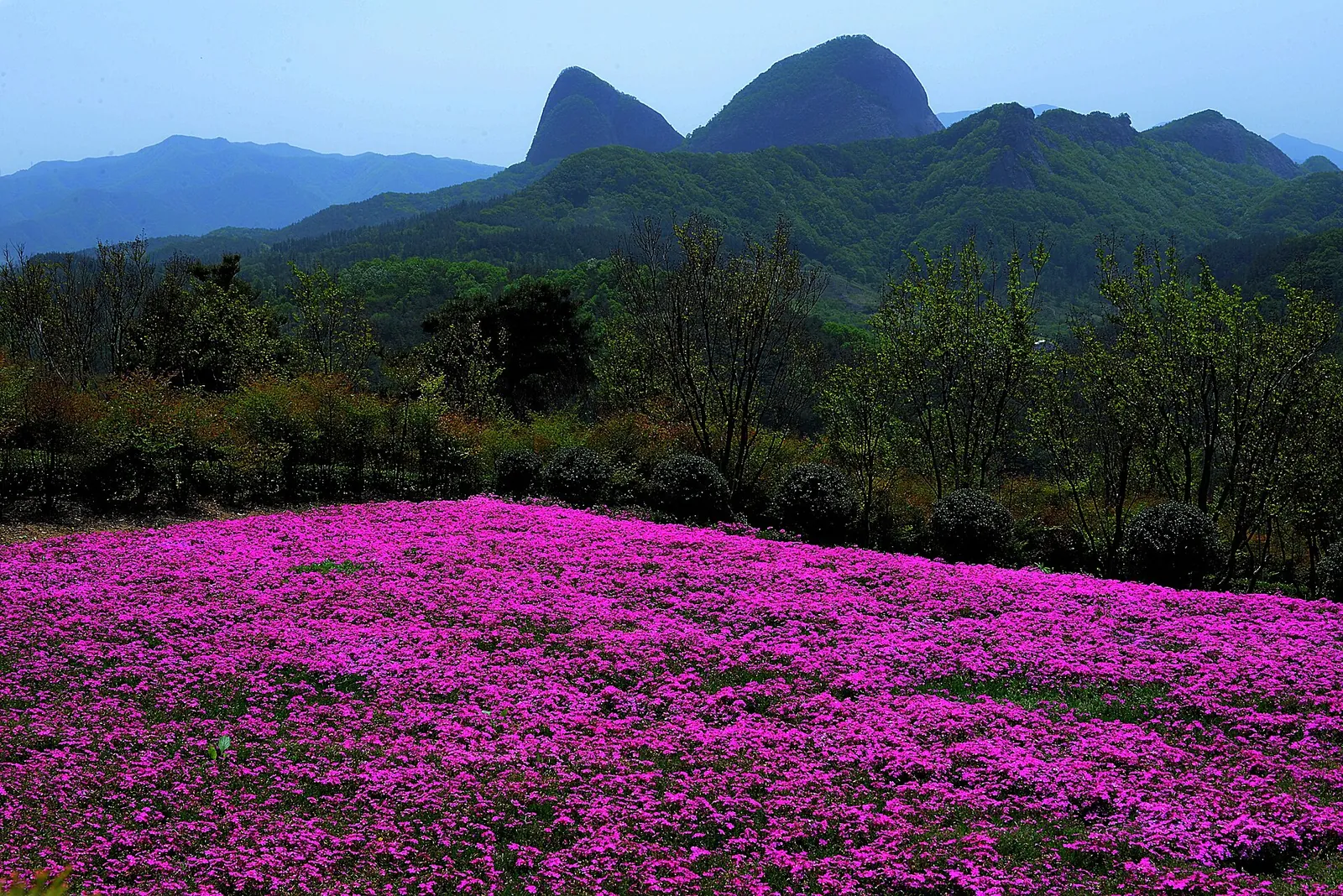
Maisan is the mountain with two ears. Its twin conglomerate peaks, Ammaibong (687.4 m) and Sumaibong (681.1 m), rise out of the Jinan highlands about 32 km east of Jeonju, and Jinan County says the name, 'horse-ear mountain', has stuck since early Joseon, when it was still called Sokgeumsan. Between and below the peaks sit three temples: Eunsusa in the pass, Geumdangsa near the south entrance and, under the cliff of Ammaibong, Tapsa, with more than 80 dry-stacked stone towers that have stood through typhoons. The mountain is a provincial park, a national Scenic Site and part of a national geopark for its honeycomb tafoni cliffs. None of this needs a hard climb: the classic visit is a 3.3 km walk over the pass from one car park to the other.
- Suggested time
- Half a day from Jeonju; a full day with Ammaibong or the ridge
- Where to stay
- Jeonju (most travellers); pensions and minbak at the Maisan north or south entrance for an early start
- Season and timing
- Jinan County describes the 2.5 km cherry-blossom road from the south entrance to Tapsa as blooming around April, after the blossoms elsewhere have fallen, and VisitKorea mentions cosmos and silver grass in autumn. In winter the county closes the Ammaibong summit path, and it describes 'reverse icicles' that grow upwards from bowls of water around Eunsusa and Tapsa. Heavy rain closes the trails: the county shut every hiking path in July and again from 30 August to 1 September 2026, leaving only the Tapsa–Eunsusa section open. The county also warns that all courses close during the spring and autumn wildfire-prevention periods, so check its notices before a hike.
The short answer
Give Maisan half a day from Jeonju, or a full day if you add the Ammaibong summit or the southern ridge. Most people sleep in Jeonju; stay at the park's north or south entrance only if you want Tapsa before the day visitors. Take an intercity bus from Jeonju to Jinan (Jinan County gives about 40 minutes), then the hourly county bus or a taxi 5 km to the north entrance. Walk through the pass of Cheonhwangmun to Eunsusa and down to Tapsa, then either walk back (2.5 km to the north car park, says the county) or continue past Tapyeongje lake and Geumdangsa to the south car park for one of the few southern buses. Tapsa charges a heritage fee; the park itself is free.
How Maisan works: two entrances, one pass
Maisan has two front doors, and choosing between them shapes the day. The north entrance is the Maisan tourist complex in Danyang-ri, Jinan-eup, a short ride from Jinan's bus stop; the south entrance is at Dongchon-ri, Maryeong-myeon, where the road continues as a cherry-lined walk past Tapyeongje lake and Geumdangsa to Tapsa. Jinan County notes that the southern road is closed to ordinary cars, so from the south car park you walk.
Between the two lies Cheonhwangmun, the saddle between the two peaks, which the county describes as the watershed between the Geum and Seomjin rivers and the pass you must cross to go from one side to the other. Eunsusa sits just below it on the south side, and Tapsa a short way further down. The county counts about 80 per cent of visitors on the north-to-south walk through Tapsa, about 15 per cent climbing Ammaibong and the rest on the ridge paths. Its trail figures make the choice simple.
- Classic crossing: north car park, Cheonhwangmun, Eunsusa, Tapsa, Tapyeongje, Geumdangsa, south car park; 3.3 km, 1 hour 30 minutes to 2 hours (Jinan County). Reverse it to go south to north.
- With the Ammaibong summit: north car park, Cheonhwangmun, Ammaibong, back to Cheonhwangmun, Eunsusa and Tapsa, then back to the north car park (5.3 km, 2 hours 50 minutes to 3 hours 30 minutes) or down to the south car park (3.9 km, 2 hours 30 minutes to 3 hours).
- Southern ridge to Tapsa: south car park, Gogeumdang, Biryongdae viewpoint (527 m) and Bongdubong (540 m) to Tapsa; 3.5 km, about 2 hours 20 minutes.
- Maintained geology trail: south car park over Biryongdae and Bongdubong to Tapsa, Eunsusa and Cheonhwangmun to the north car park; 5.7 km, 3 hours 30 minutes to 4 hours. The county says it has been upgraded so that older walkers and children can use it.
- Long ridge from Gwangdaebong (609 m): from Hammi fortress or Boheungsa, 5.4–8.4 km to Tapsa; the county warns that Gwangdaebong needs ropes and is for experienced hikers.
Tapsa: the stone towers under Ammaibong
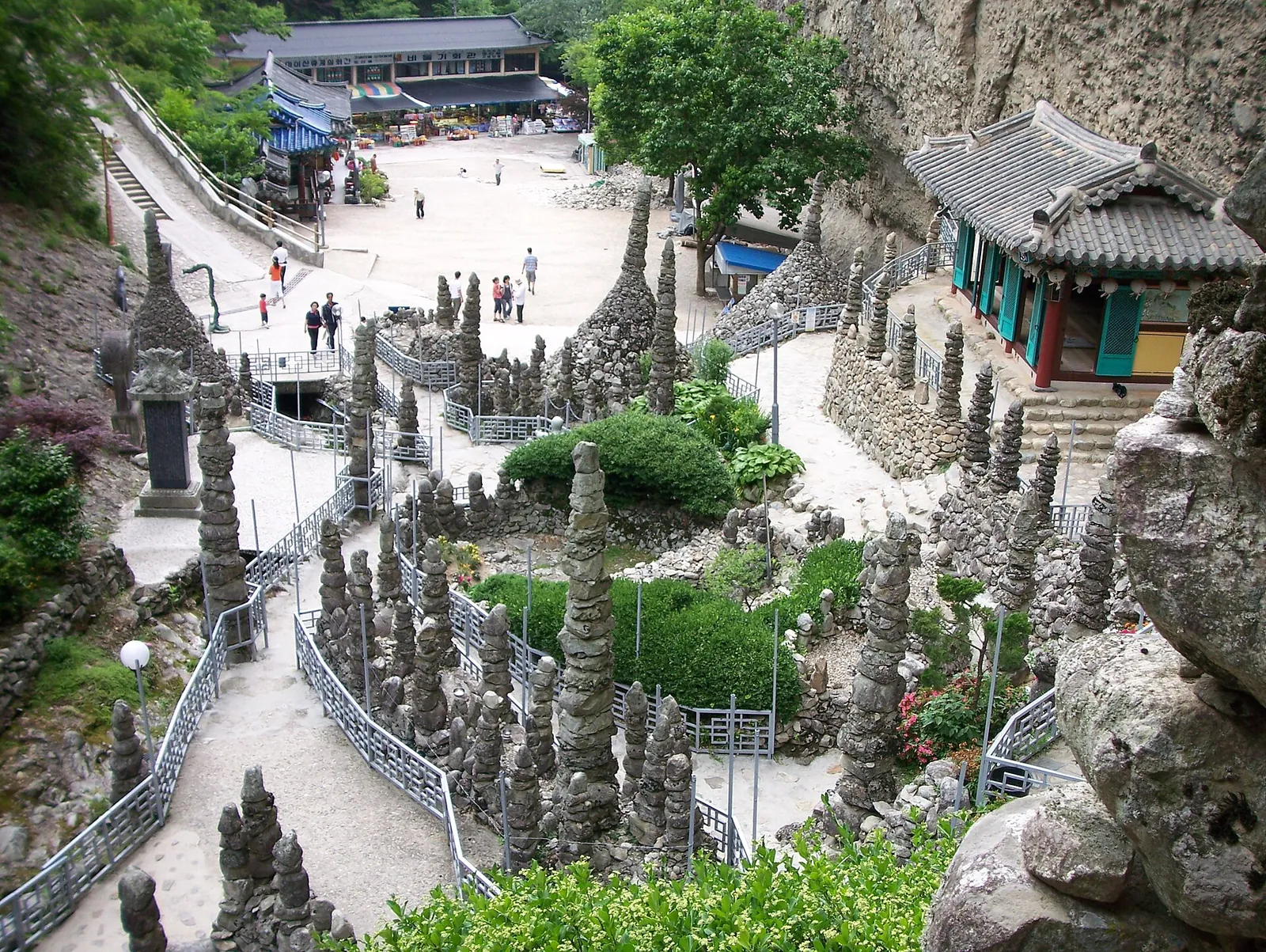
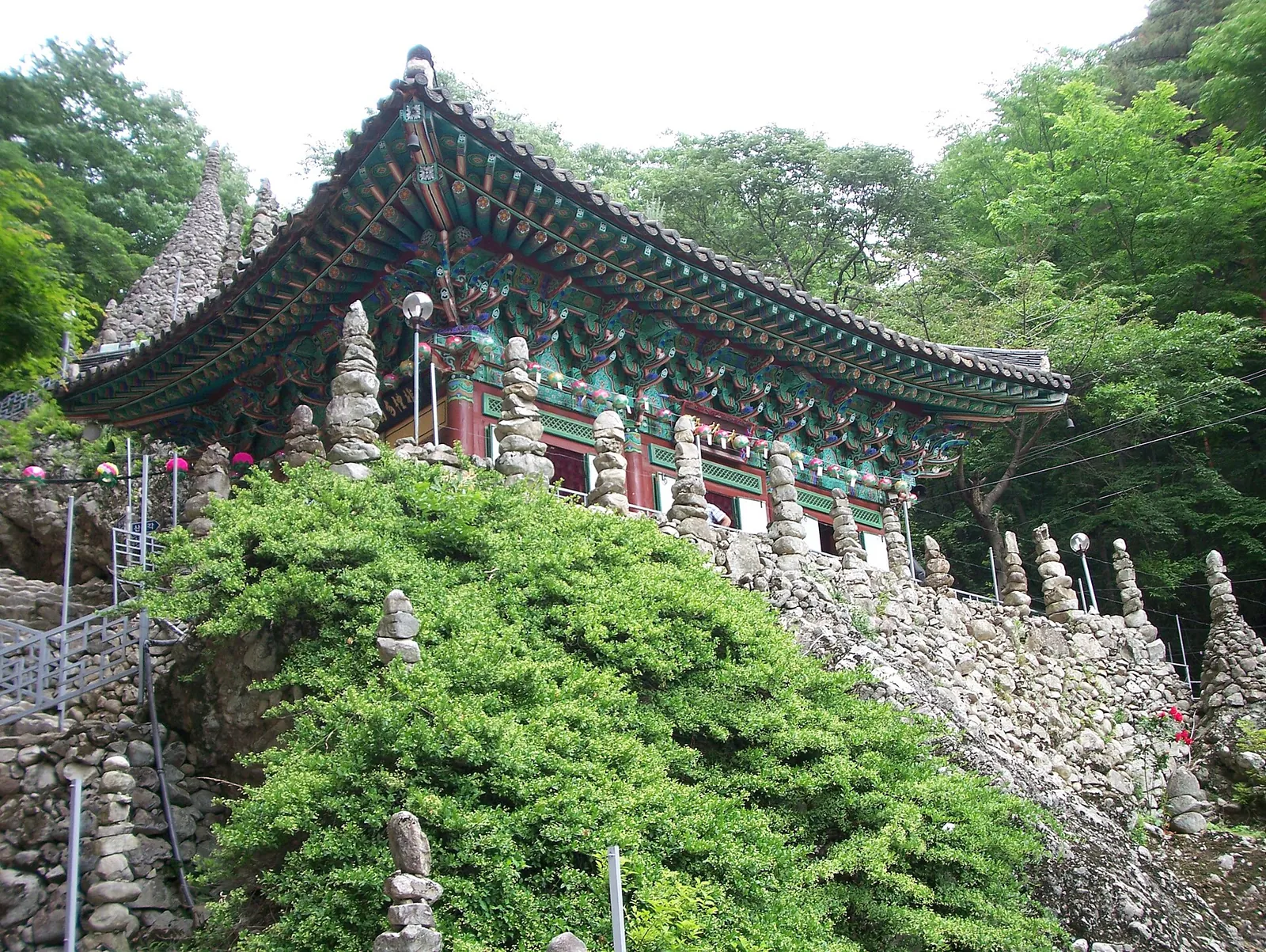
Tapsa is what most people come for. VisitKorea describes more than 80 stone pagodas, each with its own name and role, built of natural stone and ranging from 1 m to 13.5 m high, from cones to slender single columns; the two tallest, a pair behind the main hall (Daeungjeon), stand about three times the height of an adult. Jinan County calls the topmost tower, Cheonjitap, the principal one, and points out what makes the site uncanny: the stones are not glued, mortared or notched into each other, yet the towers have stood through typhoons strong enough to uproot trees. A VisitKorea column last updated in December 2025 puts their age at over 100 years.
The towers fill a narrow strip at the foot of Ammaibong's cliff, so the site is busy in a small space. Walk the paths between the towers slowly and do not touch or lean on them. Look up at the cliff above as well: VisitKorea describes the honeycomb hollows of tafoni on Ammaibong's southern face, thought to date from an Ice Age and shaped by frost, and Jinan County calls Maisan's tafoni the largest in the world, the reason the area became a national geopark in 2019.
Tapsa collects the fee. When we checked on 2026-10-03, VisitKorea listed 3,000 won for adults, 2,000 won for teenagers and 1,000 won for children, with group rates for 30 or more. Jinan County explains that the park itself is free, and that Tapsa, as owner of the heritage site, sells tickets at both the north and south approaches and charges anyone who walks through, including hikers heading for Ammaibong; if you do not want to visit, the county asks you to take a detour.
Make time for the local food
What to eat and where to look
Jinan red ginseng (hongsam)
Jinan is Korea's largest ginseng producer, VisitKorea says, thanks to cool highland temperatures and sharp seasonal swings. The county markets its red ginseng, made from steamed ginseng, as concentrate, sticks, slices and powder, and also makes a red-ginseng liquor.
- Where to look
- The county lists specialist red-ginseng shops, traditional markets, farm-produce stores and souvenir shops near the sights. The Jinan Red Ginseng Festival is held at the north side of Maisan; the 2026 edition ran from 18 to 20 September.
- Fit it into your day
- A tea or a small gift pack on the way back through Jinan, rather than a meal.
Ginseng is sold as a health food; if you take regular medication, ask a pharmacist before trying concentrates.
Jinan beef and black pork
The county promotes two local meat brands from the Jinan highlands: Jinsamu Korean beef, raised on red ginseng, and Kkamdoya black pork, which it describes as dense and clean-tasting.
- Where to look
- Jinan County's list of restaurants inside the park covers both the north and south entrances; ask whether the meat is local before you order.
- Fit it into your day
- A late, sit-down lunch at the entrance you finish at, before the bus back to Jinan.
The county's restaurant list gives names and phone numbers only; menus, hours and prices were not verified, so ask before you sit down.
Seedless dried persimmons (got-gam)
Dried persimmons from the Unjangsan area of Jinan, which the county praises as elastic and chewy because of the big day-night temperature swings. VisitKorea describes Hakdong Village in Jeongcheon-myeon making seedless dried persimmons and persimmon tarts as hands-on activities.
- Where to look
- Local-produce shops in Jinan; Hakdong Village runs its own programmes, with a restaurant and café at the village recreation centre.
- Fit it into your day
- A trail snack on the walk over the pass, or a gift to take home.
Hakdong's programme hours vary, VisitKorea says, and activities are charged separately; check in advance.
Jeonju bibimbap, back in Jeonju
If you are based in Jeonju, dinner sorts itself out. VisitKorea describes Jeonju bibimbap as warm rice topped with individually seasoned vegetables such as bean sprouts, bracken and spinach, with beef and yellow mung-bean jelly, mixed with chilli paste.
- Where to look
- Restaurants in and around Jeonju Hanok Village and downtown Jeonju; see our Jeonju guide.
- Fit it into your day
- Dinner after the bus back from Jinan, or bean sprout soup for breakfast before you leave.
The chilli paste is usually mixed in; ask for it on the side if you avoid heat.
Eunsusa and the climb up Ammaibong
Eunsusa, just below the pass, is the closest you can get to both peaks. VisitKorea and the county tell the same story of the name: King Taejo, founder of the Joseon dynasty, found the water here as clear as silver. The county adds that Taejo prayed here for a hundred days and planted the Cheongsil pear tree in the courtyard, now about 650 years old and Natural Monument No. 386, and that the temple's Taegeukjeon hall shows his dream of receiving a golden ruler. VisitKorea also mentions a huge Buddhist drum made in 1982 and a climbing euonymus, Natural Monument No. 380, which the county says is at the northern limit of its range. The county holds its Maisan mountain-spirit rite at the altar behind the temple each year on 11 October.
From Cheonhwangmun a separate path climbs Ammaibong, the higher of the two peaks. The county adds 1 hour to 1 hour 30 minutes for the summit and closes the path in winter and in fog or rain; its trail list has no route up Sumaibong. Hwaeomgul, the cave below Sumaibong whose spring is said to bring sons, is closed because of rockfall, the county says. Rock climbing anywhere in the park is banned, and so are pets, under the Natural Parks Act.
Tapyeongje, Geumdangsa and the cherry road from the south
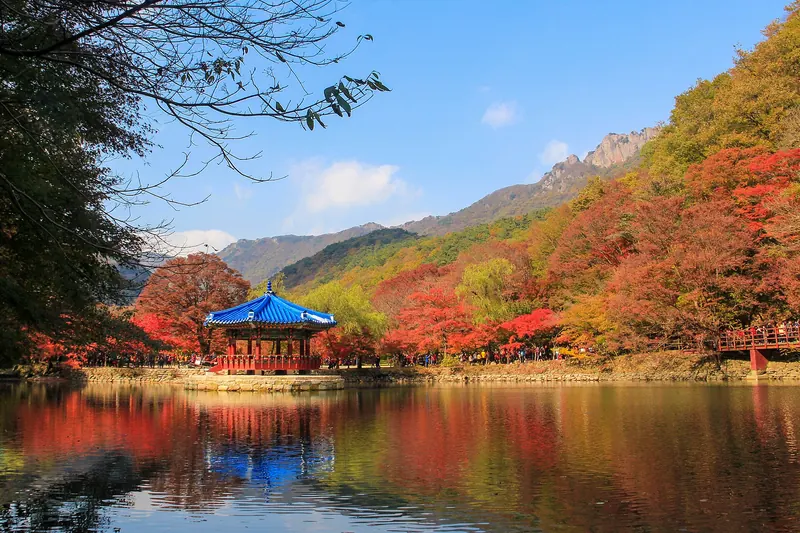
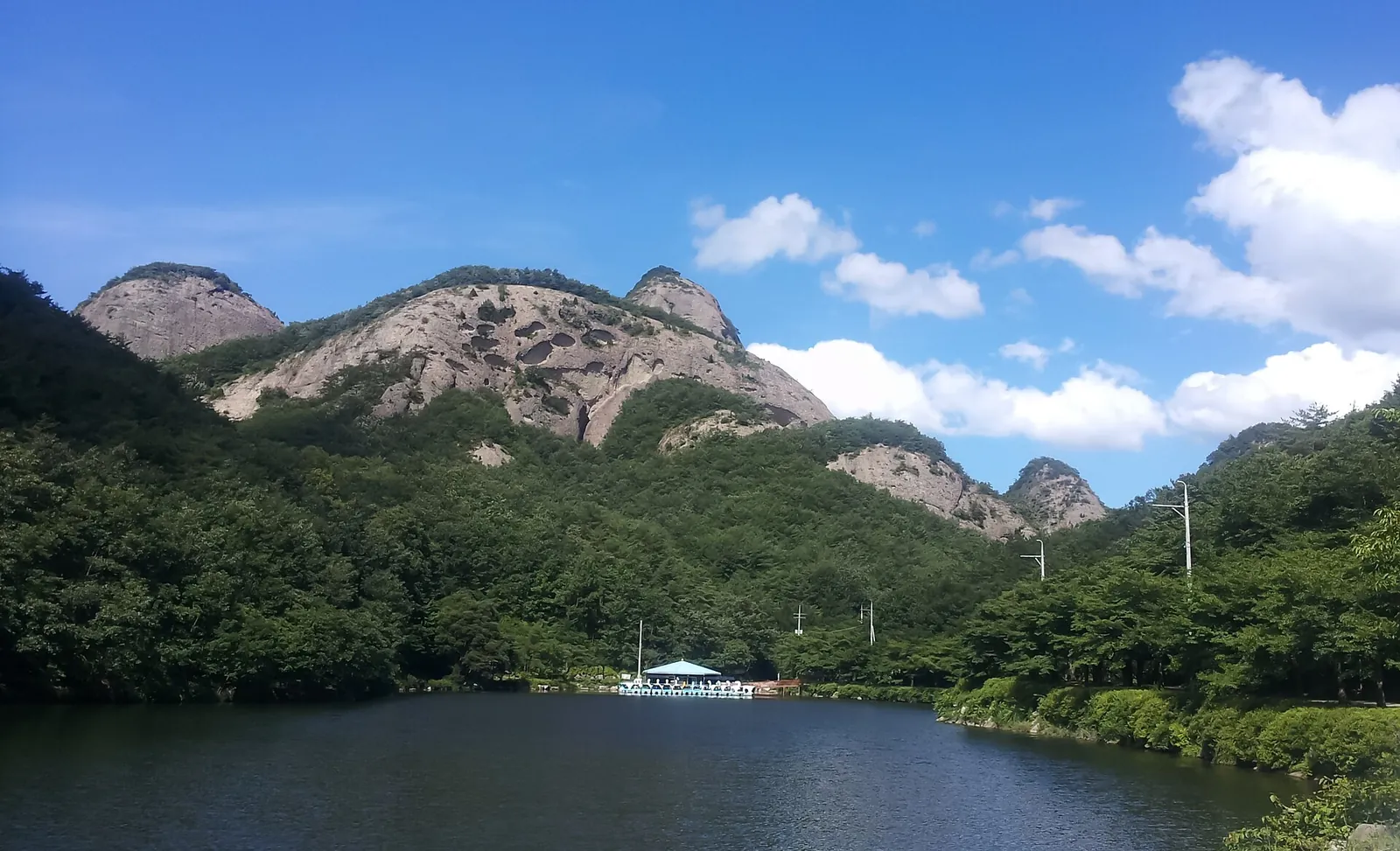
Coming from or going to the south entrance, you pass two quieter stops. Tapyeongje, an artificial lake about 1 km above the south car park, frames Bongdubong and Ammaibong behind it; beside it stands a monument to the Joseon poet couple Ha Rip and Lady Kim Samuidang, who the county says were born in the same village on the same day. Further down, Geumdangsa was rebuilt on its present site in 1675 and keeps a stone pagoda that the county attributes to the Goryeo period, with only three roof stones left.
In spring this stretch is the 2.5 km cherry-blossom tunnel from the south entrance to Tapsa, which the county says draws crowds in April. The pedal boats on the lake and the small 'Mai train' are private businesses; the county notes that the train runs only on the Lovers' Road at the north side and does not go to Tapsa, so you still walk the last part via Cheonhwangmun.
A workable day from Jeonju
This is an editorial plan built on Jinan County's published bus times, not a timetable. Check the times at Jinan before you rely on a connection.
- Morning: intercity bus from Jeonju to Jinan. When we checked on 2026-10-03, the county's Maisan site listed departures from Jeonju between 06:05 and 21:05, about 40 minutes.
- To the north entrance: the county's local-bus page listed Jinan to North Maisan (5.0 km) at 07:30 and then hourly from 08:20 to 18:20, 12 runs a day. A taxi is the alternative; the county lists Jinan taxi and call-taxi numbers.
- On foot: north car park, Cheonhwangmun, Eunsusa and Tapsa; add Ammaibong if it is open and you have the legs.
- Back: retrace your steps to the north car park (2.5 km from Tapsa, says the county) for the hourly bus, which the county listed at 07:40 and then 08:30 to 18:30. Or walk on to the south car park; buses from South Maisan to Jinan were listed at only 09:55, 12:50, 14:05, 17:15 and 19:00.
- Evening: bus from Jinan back to Jeonju; the county listed departures from 06:50 to 21:30, every 10 to 60 minutes.
Getting there: Jeonju, Seoul and the airport
Jeonju is the practical hub. Jinan County lists intercity buses between Jeonju and Jinan through the day, and the Jinan tourism site's timetable counted 45 daily departures from Jinan to Jeonju when we checked. From Seoul, the county gives two routes: an express bus from Central City (Honam line) to Jeonju, about 2 hours 30 minutes, then the bus to Jinan; or a direct bus from Central City to Jinan, which it listed at 10:10 and 15:10 (about 3 hours 30 to 3 hours 43 minutes), returning from Jinan at 10:30 and 14:35. VisitKorea's bus guide confirms that Jinan is served from Central City Express Bus Terminal.
By rail, the county's suggested route ends at Jeonju Station, from where you continue by road. Visit Jeonju gives the KTX from Seoul to Jeonju at about 1 hour 40 minutes. Drivers can use the north or south car parks; the county's FAQ describes park parking as free, while VisitKorea listed parking at the Maisan tourist resort at 2,000 won for cars, so be ready for either.
Guided option: VisitKorea's December 2025 list of featured K-culture tours included a 10-hour Jeonju Hanok Village and Maisan Tapsa day tour run by Dream Journey Korea. It suits travellers who want both places in one day without bus connections; check the departure point, the time at Tapsa and whether the fee is included.
Practical questions
How do I get from Jeonju to Maisan by bus?
Take an intercity bus from Jeonju to Jinan (Jinan County gives about 40 minutes), then the county bus to North Maisan, which the county listed at 07:30 and hourly from 08:20 to 18:20 when we checked, or a taxi for the 5 km. A few buses also run to South Maisan.
Is there an entrance fee for Maisan and Tapsa?
The provincial park is free, Jinan County says, but Tapsa charges a heritage viewing fee at the north and south approaches, even to hikers passing through. When we checked on 2026-10-03, VisitKorea listed 3,000 won for adults, 2,000 won for teenagers and 1,000 won for children.
How long does the walk to Tapsa take?
The classic crossing from the north car park over Cheonhwangmun to Eunsusa, Tapsa and down to the south car park is 3.3 km and 1 hour 30 minutes to 2 hours, according to Jinan County. From Tapsa back to the north car park is 2.5 km.
Can I climb the peaks of Maisan?
Only Ammaibong, by a path from the Cheonhwangmun pass; the county adds 1 hour to 1 hour 30 minutes and closes it in winter and in fog or rain. Rock climbing is banned throughout the park.
Are the trails ever closed?
Yes. Jinan County closes the hiking trails after heavy rain (in 2026, for example, from 30 August to 1 September), usually leaving the Tapsa–Eunsusa section open, and warns that all courses close during the spring and autumn wildfire-prevention periods. Check the notices on the county's Maisan site before you go.
Is Maisan worth it from Seoul as a day trip?
It is a long day. The county lists direct buses from Seoul's Central City terminal to Jinan at 10:10 and 15:10, about 3 hours 30 minutes, with returns at 10:30 and 14:35, which leaves little time. Combining it with a night in Jeonju works much better.
Sources and checks before you travel
Reference sources for the version dated 3 October 2026. Confirm opening times, access, transport and conditions for your travel dates.
- Jinan County: Maisan overview (Korean) ↗ — opens in a new tab
- Jinan County: directions to Maisan (Korean) ↗ — opens in a new tab
- Jinan Culture & Tourism: local buses (Korean) ↗ — opens in a new tab
- Jinan Culture & Tourism: intercity buses (Korean) ↗ — opens in a new tab
- Jinan County: common sightseeing course (Korean) ↗ — opens in a new tab
- Jinan County: hiking trails, geology trail and long courses (Korean) ↗ — opens in a new tab
- Jinan County: Maisan Tapsa (Korean) ↗ — opens in a new tab
- Jinan County: Maisan FAQ (Korean) ↗ — opens in a new tab
- Jinan County: Yi Seong-gye and Eunsusa (Korean) ↗ — opens in a new tab
- Jinan County: Cheonwangmun and Hwaeomgul (Korean) ↗ — opens in a new tab
- Jinan County: Tapyeongje and the poet couple's monument (Korean) ↗ — opens in a new tab
- Jinan County: Geumdangsa and Naongam (Korean) ↗ — opens in a new tab
- Jinan County: cherry-blossom road (Korean) ↗ — opens in a new tab
- Jinan County: Maisan features (Korean) ↗ — opens in a new tab
- Jinan County: trail closure notice, 30 August 2026 (Korean) ↗ — opens in a new tab
- Jinan County: lodging and restaurants in the park (Korean) ↗ — opens in a new tab
- Jinan Culture & Tourism: local specialities (Korean) ↗ — opens in a new tab
- VisitKorea: Maisan Provincial Park ↗ — opens in a new tab
- VisitKorea: Tapsa Temple ↗ — opens in a new tab
- VisitKorea: Eunsusa Temple ↗ — opens in a new tab
- VisitKorea: Maisan Mountain Tafoni Terrain ↗ — opens in a new tab
- VisitKorea: Officially Featured K-Culture Signature Tours, Vol. 2 ↗ — opens in a new tab
- VisitKorea: Express Bus & Intercity Bus ↗ — opens in a new tab
- VisitKorea: Shopping Like a Local, Jinan ginseng ↗ — opens in a new tab
- VisitKorea: Jinan Hakdong Village ↗ — opens in a new tab
- VisitKorea: Jinan Red Ginseng Festival ↗ — opens in a new tab
- VisitKorea: Jeonju Bibimbap ↗ — opens in a new tab
- Visit Jeonju (Jeonju City): Getting to Jeonju ↗ — opens in a new tab
Photo credits
Maisan's two 'horse-ear' peaks, Ammaibong and Sumaibong, above the Jinan highlands
Photograph: Ji Yeon Song — opens in a new tab · CC BY-SA 3.0 — opens in a new tab
Changes: Resized and converted to WebP; displayed with responsive crops. · Original photograph and licence details ↗ — opens in a new tab
The dry-stacked stone towers of Tapsa at the foot of Ammaibong
Photograph: dokaspar — opens in a new tab · CC BY-SA 3.0 — opens in a new tab
Changes: Resized and converted to WebP; displayed with responsive crops. · Original photograph and licence details ↗ — opens in a new tab
A hall of Tapsa rising above its stone towers and terraces
Photograph: dokaspar — opens in a new tab · CC BY-SA 3.0 — opens in a new tab
Changes: Resized and converted to WebP; displayed with responsive crops. · Original photograph and licence details ↗ — opens in a new tab
A lake below the rocky ridge of Maisan Provincial Park
Photograph: Ji Yeon Song — opens in a new tab · CC BY-SA 3.0 — opens in a new tab
Changes: Resized and converted to WebP; displayed with responsive crops. · Original photograph and licence details ↗ — opens in a new tab
Pink moss phlox below the twin peaks of Maisan in spring
Photograph: Lee46js — opens in a new tab · CC BY-SA 4.0 — opens in a new tab
Changes: Resized and converted to WebP; displayed with responsive crops. · Original photograph and licence details ↗ — opens in a new tab